




1 Introduction
A variety of notions of rank and independence have played an important role in model theory at least since Morley’s influential work on uncountably categorical theories [Reference Morley21] in the 1960s. Such notions have been central for developing more or less general (meta) theories which divide complete first-order theories into various classes. Shelah [Reference Shelah26] used them in his development of stability theory by which theories can be classified into
$\omega $
 -stable, superstable, stable, or unstable. Later Shelah’s classification theory, and its notion of independence, was shown, by Kim and Pillay [Reference Kim16, Reference Kim and Pillay17], to make sense in a wider context and the classes of simple and supersimple first-order theories were introduced. Yet later, more general notions of independence, including thorn-independence, have been studied by Onshuus, Ealy, and Adler and the classes of rosy and superrosy theories have been introduced [Reference Adler1, Reference Ealy and Onshuus8, Reference Onshuus23]. The class of rosy theories is quite diverse and includes, for example, all simple theories (which exclude a linearly ordered universe) and all o-minimal theories (which assume a linearly ordered universe) [Reference van den Dries7]. It is also the largest class of theories for which there is an independence relation which satisfies certain basic and natural properties [Reference Ealy and Onshuus8]. The work on NIP theories [Reference Simon27] also uses notions of rank and independence (and NIP theories and rosy theories partially overlap).
Another direction of model theoretic research, which has used notions of rank and independence as a crucial tool, has focused on understanding the fine structure of the models of more specific theories, and on finding “nice” axiomatizations of such theories. This line of research includes work on totally categorical theories, uncountably categorical theories [Reference Ahlbrandt and Ziegler2, Reference Hrushovski13, Reference Hrushovski14, Reference Zilber30], theories of stable finitely homogeneous structures [Reference Lachlan, Hart, Lachlan and Valeriote20],
$\omega $
 -categorical
$\omega $
-categorical
$\omega $
 -stable theories [Reference Cherlin, Harrington and Lachlan4], theories of smoothly approximable structures [Reference Cherlin and Hrushovski5, Reference Kantor, Liebeck and Macpherson15], theories of simple finitely homogeneous structures [Reference Baldwin, Freitag and Mutchnik3, Reference Koponen18], theories of Fraïssé limits of classes of finite structures with the free amalgamation property [Reference Conant6],
$\omega $
-stable theories [Reference Cherlin, Harrington and Lachlan4], theories of smoothly approximable structures [Reference Cherlin and Hrushovski5, Reference Kantor, Liebeck and Macpherson15], theories of simple finitely homogeneous structures [Reference Baldwin, Freitag and Mutchnik3, Reference Koponen18], theories of Fraïssé limits of classes of finite structures with the free amalgamation property [Reference Conant6],
$\omega $
 -categorical NIP theories [Reference Simon28], and NIP finitely homogeneous rosy theories [Reference Onshuus and Simon24]. In the present context it is relevant that all finitely homogeneous structures (which are also called ultrahomogeneous, or simply homogeneous, and which include all Fraïssé limits with a finite relational vocabulary) and all smoothly approximable structures are
$\omega $
-categorical NIP theories [Reference Simon28], and NIP finitely homogeneous rosy theories [Reference Onshuus and Simon24]. In the present context it is relevant that all finitely homogeneous structures (which are also called ultrahomogeneous, or simply homogeneous, and which include all Fraïssé limits with a finite relational vocabulary) and all smoothly approximable structures are
$\omega $
 -categorical.
In this study we consider (only)
$\omega $
 -categorical theories T and investigate a hierarchy of ranks, the n-ranks for
$n < \omega $
-categorical theories T and investigate a hierarchy of ranks, the n-ranks for
$n < \omega $
 , where the n-rank is defined entirely in terms of the algebraic closure operator on
$\mathcal {M}^{\mathrm {eq}}$
, where the n-rank is defined entirely in terms of the algebraic closure operator on
$\mathcal {M}^{\mathrm {eq}}$
 (where
$\mathcal {M}$
(where
$\mathcal {M}$
 is a model of the theory) restricted to the set
$M_n$
is a model of the theory) restricted to the set
$M_n$
 containing every real element and every imaginary element that corresponds to an equivalence class of an
$\emptyset $
containing every real element and every imaginary element that corresponds to an equivalence class of an
$\emptyset $
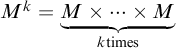
 -definable equivalence relation on
$M^k = \underbrace {M \times \cdots \times M}_{k \text {times}}$
-definable equivalence relation on
$M^k = \underbrace {M \times \cdots \times M}_{k \text {times}}$
 where
$k \leq n$
where
$k \leq n$
 . With the n-rank we define a notion of n-independence, denoted
${\smile} \hspace {-6.8pt}{|^n} $
. With the n-rank we define a notion of n-independence, denoted
${\smile} \hspace {-6.8pt}{|^n} $
 . Without further assumptions than
$\omega $
. Without further assumptions than
$\omega $
 -categoricity, n-independence restricted to
$M_n$
-categoricity, n-independence restricted to
$M_n$
 has all the properties of an independence relation according to [Reference Kim and Pillay17] (possibly) except for the symmetry property. The main technical contribution of this study is to isolate a property, parametrized by n, which implies (in fact, is equivalent to) that n-independence is symmetric. The property in question (Assumption 5.1) is the exchange property of algebraic closure restricted to elements of
$M_n$
has all the properties of an independence relation according to [Reference Kim and Pillay17] (possibly) except for the symmetry property. The main technical contribution of this study is to isolate a property, parametrized by n, which implies (in fact, is equivalent to) that n-independence is symmetric. The property in question (Assumption 5.1) is the exchange property of algebraic closure restricted to elements of
$M_n$
 with n-rank 1 (over some
$C \subseteq M^{\mathrm {eq}}$
with n-rank 1 (over some
$C \subseteq M^{\mathrm {eq}}$
 ). More precisely, if, for any
$C \subseteq M^{\mathrm {eq}}$
). More precisely, if, for any
$C \subseteq M^{\mathrm {eq}}$
 , the algebraic closure using parameters from C restricted to elements of
$M_n$
, the algebraic closure using parameters from C restricted to elements of
$M_n$
 with n-rank 1 over C has the exchange property, then n-independence is symmetric, and hence it is an independence relation in the sense of [Reference Kim and Pillay17] when restricted to
$M_n$
with n-rank 1 over C has the exchange property, then n-independence is symmetric, and hence it is an independence relation in the sense of [Reference Kim and Pillay17] when restricted to
$M_n$
 , which is stated by Theorem 5.15. Using this we can relatively easily show the statement of Theorem 6.9 that if, for all
$n < \omega $
, which is stated by Theorem 5.15. Using this we can relatively easily show the statement of Theorem 6.9 that if, for all
$n < \omega $
 , the algebraic closure restricted to elements of
$M_n$
, the algebraic closure restricted to elements of
$M_n$
 with n-rank 1 has the exchange property, then the theory is rosy, which is proved by showing that thorn-independence has local character (see [Reference Ealy and Onshuus8, Theorem 3.7]). Thus, an
$\omega $
with n-rank 1 has the exchange property, then the theory is rosy, which is proved by showing that thorn-independence has local character (see [Reference Ealy and Onshuus8, Theorem 3.7]). Thus, an
$\omega $
 -categorical theory which is not rosy must, for some
$n < \omega $
-categorical theory which is not rosy must, for some
$n < \omega $
 , have a model
$\mathcal {M}$
, have a model
$\mathcal {M}$
 and
$C \subseteq M^{\mathrm {eq}}$
and
$C \subseteq M^{\mathrm {eq}}$
 such that algebraic closure using parameters from C restricted to elements of
$M_n$
such that algebraic closure using parameters from C restricted to elements of
$M_n$
 with n-rank 1 over C does not have the exchange property. This may be useful for finding a dividing line between
$\omega $
with n-rank 1 over C does not have the exchange property. This may be useful for finding a dividing line between
$\omega $
 -categorical rosy theories (e.g., dense linear order and the Fraïssé limit of a class of finite relational structures with free amalgamation [Reference Conant6]) and
$\omega $
-categorical rosy theories (e.g., dense linear order and the Fraïssé limit of a class of finite relational structures with free amalgamation [Reference Conant6]) and
$\omega $
 -categorical non-rosy theories (e.g., the Fraïssé limit of finite Boolean algebras and
$T^*_{feq}$
-categorical non-rosy theories (e.g., the Fraïssé limit of finite Boolean algebras and
$T^*_{feq}$
 in [Reference Adler1, Example 2.6]). A consequence of Theorem 6.9 is that if algebraic closure on
$M^{\mathrm {eq}}$
in [Reference Adler1, Example 2.6]). A consequence of Theorem 6.9 is that if algebraic closure on
$M^{\mathrm {eq}}$
 is trivial in the sense of Definition 6.10, then the theory is rosy, as stated by Theorem 6.12.
We then consider the effects of assuming geometric elimination of imaginaries (Definition 2.9) in the context studied here, where geometric elimination of imaginaries is a consequence of the perhaps more familiar concept of weak elimination of imaginaries [Reference Conant6, Reference Hodges11, Reference Hodges, Hodkinson and Macpherson12, Reference Newelski and Wencel22]. It will be shown that if the
$\omega $
 -categorical theory has geometric elimination of imaginaries, then the hierarchy of n-independence notions, for
$n < \omega $
-categorical theory has geometric elimination of imaginaries, then the hierarchy of n-independence notions, for
$n < \omega $
 , collapses to the bottom level, that is, for all
$n < \omega $
, collapses to the bottom level, that is, for all
$n < \omega $
 ,
$A, B, C \subseteq M^{\mathrm {eq}}$
,
$A, B, C \subseteq M^{\mathrm {eq}}$
 ,
$A \underset {C}{{\smile} \hspace {-6.8pt}{|^n} } B$
,
$A \underset {C}{{\smile} \hspace {-6.8pt}{|^n} } B$
 if and only if
$A \underset {C}{{\smile} \hspace {-6.8pt}{|^0} } B$
if and only if
$A \underset {C}{{\smile} \hspace {-6.8pt}{|^0} } B$
 .
.
We use this to show that if the
$\omega $
 -categorical theory T has geometric elimination of imaginaries and, for any
$\mathcal {M} \models T$
-categorical theory T has geometric elimination of imaginaries and, for any
$\mathcal {M} \models T$
 and
$C \subseteq M^{\mathrm {eq}}$
and
$C \subseteq M^{\mathrm {eq}}$
 , algebraic closure using parameters from C restricted to elements of M (i.e., “real” elements) that have 0-rank 1 over C has the exchange property, then T is superrosy with finite
$U^{{{\unicode{x00FE}}
}}$
, algebraic closure using parameters from C restricted to elements of M (i.e., “real” elements) that have 0-rank 1 over C has the exchange property, then T is superrosy with finite
$U^{{{\unicode{x00FE}}
}}$
 -rank; this is Theorem 6.14 below. Hence Theorems 6.9 and 6.14 are generalizations, in the context of
$\omega $
-rank; this is Theorem 6.14 below. Hence Theorems 6.9 and 6.14 are generalizations, in the context of
$\omega $
 -categorical theories, of the result that if a theory has geometric elimination of imaginaries and algebraic closure on all real elements (not just those of
$0$
-categorical theories, of the result that if a theory has geometric elimination of imaginaries and algebraic closure on all real elements (not just those of
$0$
 -rank 1 over some set) has the exchange property, then the theory is superrosy with
$U^{ {{\unicode{x00FE}}
}}$
-rank 1 over some set) has the exchange property, then the theory is superrosy with
$U^{ {{\unicode{x00FE}}
}}$
 -rank 1 (this is [Reference Ealy and Onshuus8, Theorem 4.12] where the authors also contribute the result to Gagelman [Reference Gagelman10] and Adler).
Conant [Reference Conant6] has proved that the theory of the Fraïssé limit of any class of finite (relational) structures with free amalgamation has weak elimination of imaginaries and is superrosy with
$U^{{{\unicode{x00FE}}
}}$
 -rank 1. Such a theory has trivial algebraic closure on real elements and therefore the algebraic closure on real elements satisfies the exchange property. So unless every theory to which Theorem 6.14 applies can be constructed as the Fraïssé limit of a class of relational structures with free amalgamation, then Theorem 6.14 applies to a larger class of theories than [Reference Conant6]. It may also be the case that Theorem 6.9 or Theorem 6.14 can be applied to
$\omega $
-rank 1. Such a theory has trivial algebraic closure on real elements and therefore the algebraic closure on real elements satisfies the exchange property. So unless every theory to which Theorem 6.14 applies can be constructed as the Fraïssé limit of a class of relational structures with free amalgamation, then Theorem 6.14 applies to a larger class of theories than [Reference Conant6]. It may also be the case that Theorem 6.9 or Theorem 6.14 can be applied to
$\omega $
 -categorical theories obtained by Hrushovski’s method of construction of a “generic structure” for a class of finite structures (see, e.g., [Reference Evans9]), but I have not investigated this.
2 Preliminaries
We assume familiarity with basic model theory as can be found in, for example, [Reference Hodges11, Reference Shelah26, Reference Tent and Ziegler29]. A first-order structure will be denoted by
$\mathcal {M}$
 and its universe (also called domain) by M. Subsets of the universe (of a first-order structure) will be denoted by
$A, B, C, D$
and its universe (also called domain) by M. Subsets of the universe (of a first-order structure) will be denoted by
$A, B, C, D$
 and finite sequences (also called tuples) of elements of the universe will be denoted by
$\bar {a}, \bar {b}, \bar {c}$
and finite sequences (also called tuples) of elements of the universe will be denoted by
$\bar {a}, \bar {b}, \bar {c}$
 , etc. If S is a set then
$|S|$
, etc. If S is a set then
$|S|$
 denotes its cardinality, and if
$\bar {s}$
denotes its cardinality, and if
$\bar {s}$
 is a finite sequence then
$|\bar {s}|$
is a finite sequence then
$|\bar {s}|$
 denotes its length and
$\mathrm {rng}(\bar {s})$
denotes its length and
$\mathrm {rng}(\bar {s})$
 denotes the set of elements occurring in
$\bar {s}$
denotes the set of elements occurring in
$\bar {s}$
 . By
$Th(\mathcal {M})$
. By
$Th(\mathcal {M})$
 we denote the complete first-order theory of the structure
$\mathcal {M}$
we denote the complete first-order theory of the structure
$\mathcal {M}$
 . We sometimes write
$AB$
. We sometimes write
$AB$
 to denote the union
$A \cup B$
to denote the union
$A \cup B$
 of the sets A and B, and if
$\bar {a} = (a_1, \ldots , a_k)$
of the sets A and B, and if
$\bar {a} = (a_1, \ldots , a_k)$
 we sometimes write
$\bar {a}B$
we sometimes write
$\bar {a}B$
 to denote the set
$\{a_1, \ldots , a_k\} \cup B$
to denote the set
$\{a_1, \ldots , a_k\} \cup B$
 .
.
We assume familiarity with the structure
$\mathcal {M}^{\mathrm {eq}}$
 “with imaginaries” which is constructed from any structure
$\mathcal {M}$
“with imaginaries” which is constructed from any structure
$\mathcal {M}$
 as explained in (for example) [Reference Hodges11, Reference Shelah26]. In this study we will be concerned with “n-level approximations” of
$M^{\mathrm {eq}}$
as explained in (for example) [Reference Hodges11, Reference Shelah26]. In this study we will be concerned with “n-level approximations” of
$M^{\mathrm {eq}}$
 (the universe of
$\mathcal {M}^{\mathrm {eq}}$
(the universe of
$\mathcal {M}^{\mathrm {eq}}$
 ) as follows.
Definition 2.1. Let V be a vocabulary and let
$\mathcal {M}$
 be a V-structure with universe M. Let
$V \cup W$
be a V-structure with universe M. Let
$V \cup W$
 be the vocabulary of
$\mathcal {M}^{\mathrm {eq}}$
be the vocabulary of
$\mathcal {M}^{\mathrm {eq}}$
 . Define
$M_0 = M$
. Define
$M_0 = M$
 and, for all
$n < \omega $
and, for all
$n < \omega $
 ,
$M_{n+1} = M_n \cup X_{n+1}$
,
$M_{n+1} = M_n \cup X_{n+1}$
 where
$X_{n+1}$
where
$X_{n+1}$
 is the set of all imaginary elements
$a \in M^{\mathrm {eq}}$
is the set of all imaginary elements
$a \in M^{\mathrm {eq}}$
 such that a is an equivalence class of an (
$\emptyset $
such that a is an equivalence class of an (
$\emptyset $
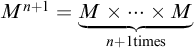
 -definable) equivalence relation on
$M^{n+1} = \underbrace {M \times \cdots \times M}_{n+1 \text {times}}$
-definable) equivalence relation on
$M^{n+1} = \underbrace {M \times \cdots \times M}_{n+1 \text {times}}$
 . For each
$n < \omega $
. For each
$n < \omega $
 , let
$\mathcal {M}^{\prime }_n$
, let
$\mathcal {M}^{\prime }_n$
 be the reduct of
$\mathcal {M}^{\mathrm {eq}}$
be the reduct of
$\mathcal {M}^{\mathrm {eq}}$
 to the subvocabulary of
$V \cup W$
to the subvocabulary of
$V \cup W$
 that contains V and every symbol from W that is associated with an
$\emptyset $
that contains V and every symbol from W that is associated with an
$\emptyset $
 -definable equivalence relation on
$M^k$
-definable equivalence relation on
$M^k$
 for some
$1 \leq k \leq n$
for some
$1 \leq k \leq n$
 . Then let
$\mathcal {M}_n$
. Then let
$\mathcal {M}_n$
 be the substructure of
$\mathcal {M}^{\prime }_n$
be the substructure of
$\mathcal {M}^{\prime }_n$
 with universe
$M_n$
with universe
$M_n$
 .
.
Definition 2.2. Let
$\mathcal {M}$
 be a structure. For every
$A \subseteq M^{\mathrm {eq}}$
be a structure. For every
$A \subseteq M^{\mathrm {eq}}$
 ,
$\mathrm {acl}^{\mathrm {eq}}(A)$
,
$\mathrm {acl}^{\mathrm {eq}}(A)$
 denotes the algebraic closure of A computed in
$\mathcal {M}^{\mathrm {eq}}$
denotes the algebraic closure of A computed in
$\mathcal {M}^{\mathrm {eq}}$
 . For all
$n < \omega $
. For all
$n < \omega $
 and
$A \subseteq M^{\mathrm {eq}}$
and
$A \subseteq M^{\mathrm {eq}}$
 , we define
$\mathrm {acl}^n(A) = \mathrm {acl}^{\mathrm {eq}}(A) \cap M_n$
, we define
$\mathrm {acl}^n(A) = \mathrm {acl}^{\mathrm {eq}}(A) \cap M_n$
 .
.
The following follows directly from the definition above.
Lemma 2.3. Suppose that
$m < n < \omega $
 and
$C \subseteq M^{\mathrm {eq}}$
and
$C \subseteq M^{\mathrm {eq}}$
 .
.
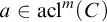
(i) If
$a \in \mathrm {acl}^m(C)$
 then
$a \in \mathrm {acl}^n(C)$
then
$a \in \mathrm {acl}^n(C)$
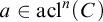 .
.
(ii) If
$a \in M_m$
 and
$a \notin \mathrm {acl}^m(C)$
and
$a \notin \mathrm {acl}^m(C)$
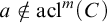 then
$a \notin \mathrm {acl}^n(C)$
then
$a \notin \mathrm {acl}^n(C)$
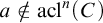 .
.
Since each
$\mathcal {M}_n$
 is interpretable in
$\mathcal {M}$
is interpretable in
$\mathcal {M}$
 the following result follows from [Reference Hodges11, Theorem 7.3.8].
Fact 2.4. If T is
$\omega $
 -categorical and
$\mathcal {M} \models T$
-categorical and
$\mathcal {M} \models T$
 then, for every
$n < \omega $
then, for every
$n < \omega $
 ,
$Th(\mathcal {M}_n)$
,
$Th(\mathcal {M}_n)$
 is
$\omega $
is
$\omega $
 -categorical.
We will use the following facts about
$\omega $
 -categorical theories (briefly explained below).
Fact 2.5.
(i) If T is
$\omega $
 -categorical then, for all
$0 < n < \omega $
-categorical then, for all
$0 < n < \omega $
 , there are only finitely many complete types over
$\emptyset $
, there are only finitely many complete types over
$\emptyset $
 in the free variables
$x_1, \ldots , x_n$
in the free variables
$x_1, \ldots , x_n$
 and each one of them is implied (modulo T) by a single formula (the formula that isolates the type). Hence, there are only finitely many nonequivalent (modulo T) formulas in the same free variables.
(ii) If T is
$\omega $
 -categorical,
$\mathcal {M} \models T$
-categorical,
$\mathcal {M} \models T$
 ,
$n < \omega $
,
$n < \omega $
 , and
$B \subseteq M^{\mathrm {eq}}$
, and
$B \subseteq M^{\mathrm {eq}}$
 is finite, then
$\mathrm {acl}^n(B)$
is finite, then
$\mathrm {acl}^n(B)$
 is finite.
The first part above follows from the well-known theorem of Engeler, Ryll-Nardzewski, and Svenonius [Reference Hodges11, Theorem 7.3.1]. The second part is a consequence of the fact that, since B is finite, there is
$n \leq m < \omega $
 such that
$B \subseteq M_m$
such that
$B \subseteq M_m$
 and
$Th(\mathcal {M}_m)$
and
$Th(\mathcal {M}_m)$
 is
$\omega $
is
$\omega $
 -categorical.
2.1 In the rest of the article we make the following assumptions
-
(1) T is a complete $\omega $
 -categorical theory in a countable language.
 -
(2) $\mathcal {M} \models T$
is
$\kappa $
-saturated where
$\kappa $
is an infinite cardinal (which can be chosen as large as we like). It follows that
$\mathcal {M}^{\mathrm {eq}}$
is
$\kappa $
-saturated and we let
$T^{\mathrm {eq}}$
be the complete theory of
$M^{\mathrm {eq}}$
. -
(3) All subsets of $M^{\mathrm {eq}}$
that are mentioned have cardinality less than
$\kappa $
.


Notation 2.6. If
$a_1, \ldots , a_n \in M^{\mathrm {eq}}$
 and
$B \subseteq M^{\mathrm {eq}}$
and
$B \subseteq M^{\mathrm {eq}}$
 , then
$\mathrm {tp}(a_1, \ldots , a_n / B)$
, then
$\mathrm {tp}(a_1, \ldots , a_n / B)$
 denotes the complete type of
$a_1, \ldots , a_n$
denotes the complete type of
$a_1, \ldots , a_n$
 over B computed in
$\mathcal {M}^{\mathrm {eq}}$
over B computed in
$\mathcal {M}^{\mathrm {eq}}$
 , and
$\mathrm {tp}(a_1, \ldots , a_n)$
, and
$\mathrm {tp}(a_1, \ldots , a_n)$
 is an abbreviation of
$\mathrm {tp}(a_1, \ldots , a_n / \emptyset )$
is an abbreviation of
$\mathrm {tp}(a_1, \ldots , a_n / \emptyset )$
 .
.
Definition 2.7. (i) Let us call a bijective function
$\sigma $
 from a subset
$A \subseteq M^{\mathrm {eq}}$
from a subset
$A \subseteq M^{\mathrm {eq}}$
 to a subset of
$M^{\mathrm {eq}}$
to a subset of
$M^{\mathrm {eq}}$
 elementary if for all
$n < \omega $
elementary if for all
$n < \omega $
 and all
$a_1, \ldots , a_n \in A$
and all
$a_1, \ldots , a_n \in A$
 ,
$\mathrm {tp}(a_1, \ldots , a_n) = \mathrm {tp}(\sigma (a_1), \ldots , \sigma (a_n))$
,
$\mathrm {tp}(a_1, \ldots , a_n) = \mathrm {tp}(\sigma (a_1), \ldots , \sigma (a_n))$
 .
.
(ii) Following [Reference Kim and Pillay17] we say that a collection
$\Gamma $
 of triples
$(A, B, C)$
of triples
$(A, B, C)$
 , where
${A, B, C \subseteq M^{\mathrm {eq}}}$
, where
${A, B, C \subseteq M^{\mathrm {eq}}}$
 and A is finite, is an independence relation if the following hold, where
$A \underset {C}{{\smile} \hspace {-6.8pt}{|} \; \: } B$
and A is finite, is an independence relation if the following hold, where
$A \underset {C}{{\smile} \hspace {-6.8pt}{|} \; \: } B$
 means that
$(A, B, C) \in \Gamma $
means that
$(A, B, C) \in \Gamma $
 :
:
-
(1) (Invariance) If $\sigma $
is an elementary function from some subset of
$M^{\mathrm {eq}}$
that includes
$ABC$
to some subset of
$M^{\mathrm {eq}}$
, then
$A \underset {C}{{\smile} \hspace {-6.8pt}{|} \; \: } B$
if and only if
$\sigma (A) \underset {\sigma (C)}{{\smile} \hspace {-6.8pt}{|} \; \: } \sigma (B)$
. -
(2) (Local character) For all A and B (where A is finite) there is a countable $C \subseteq B$
such that
$A \underset {C}{{\smile} \hspace {-6.8pt}{|} \; \: } B$
. -
(3) (Finite character) $A \underset {C}{{\smile} \hspace {-6.8pt}{|} \; \: } B$
if and only if for all finite
$B' \subseteq B$
,
$A \underset {C}{{\smile} \hspace {-6.8pt}{|} \; \: } B'$
. -
(4) (Extension) For all $n < \omega $
,
$A = \{a_1, \ldots , a_n\}$
, B, and C, such that
$C \subseteq B$
, there is
$A' = \{a^{\prime }_1, \ldots , a^{\prime }_n\}$
such that
$\mathrm {tp}(a^{\prime }_1, \ldots , a^{\prime }_n / C) = \mathrm {tp}(a_1, \ldots , a_n / C)$
and
$A' \underset {C}{{\smile} \hspace {-6.8pt}{|} \; \: } B$
. -
(5) (Monotonicity)Footnote 1 If $B \subseteq C \subseteq D$
and
$A \underset {B}{{\smile} \hspace {-6.8pt}{|} \; \: } D$
then
$A \underset {B}{{\smile} \hspace {-6.8pt}{|} \; \: } C$
and
$A \underset {C}{{\smile} \hspace {-6.8pt}{|} \; \: } D$
. -
(6) (Transitivity) If $B \subseteq C \subseteq D$
,
$A \underset {B}{{\smile} \hspace {-6.8pt}{|} \; \: } C,$
and
$A \underset {C}{{\smile} \hspace {-6.8pt}{|} \; \: } D$
, then
$A \underset {B}{{\smile} \hspace {-6.8pt}{|} \; \: } D$
. -
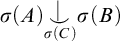
(7) (Symmetry) For all finite A and B and any C, $A \underset {C}{{\smile} \hspace {-6.8pt}{|} \; \: } B$
if and only if
$B \underset {C}{{\smile} \hspace {-6.8pt}{|} \; \: } A$
.












(iii) We call
$\Gamma $
 an independence relation restricted to
$M_n$
an independence relation restricted to
$M_n$
 if (1)–(7) hold whenever
$A, B, C, D \subseteq M_n$
if (1)–(7) hold whenever
$A, B, C, D \subseteq M_n$
 .
.
Remark 2.8. The local character of
${\smile} \hspace {-6.8pt}{|} \; \: $
 (property (2) above) is (assuming that T is countable) equivalent to the following: There do not exist finite
$A \subseteq M^{\mathrm {eq}}$
(property (2) above) is (assuming that T is countable) equivalent to the following: There do not exist finite
$A \subseteq M^{\mathrm {eq}}$
 and finite
$B_\alpha $
and finite
$B_\alpha $
 , for all
$\alpha < \aleph _1$
, for all
$\alpha < \aleph _1$
 , such that
$A \underset {\bigcup _{i < \alpha }B_i}{{\smile} \hspace {-6.8pt}{|}\hspace {-6.8pt} {\diagup} } B_\alpha $
, such that
$A \underset {\bigcup _{i < \alpha }B_i}{{\smile} \hspace {-6.8pt}{|}\hspace {-6.8pt} {\diagup} } B_\alpha $
 for all
$\alpha < \aleph _1$
for all
$\alpha < \aleph _1$
 . This formulation (roughly) is used in, e.g., [Reference Ealy and Onshuus8], but I have not found a clear statement in the literature of the equivalence of the two versions of local character. However, the argument in the proof of Proposition 2.3.7 in [Reference Kim16] (the part showing that conditions (1) and (2) of that proposition are equivalent) can easily be adapted to prove the equivalence of the two versions of local character.
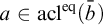
Definition 2.9. We say that T has geometric elimination of imaginaries if for all
$a \in M^{\mathrm {eq}}$
 there is a finite sequence
$\bar {b}$
there is a finite sequence
$\bar {b}$
 of elements from M such that
$a \in \mathrm {acl}^{\mathrm {eq}}(\bar {b})$
of elements from M such that
$a \in \mathrm {acl}^{\mathrm {eq}}(\bar {b})$
 and
$\mathrm {rng}(\bar {b}) \subseteq \mathrm {acl}^{\mathrm {eq}}(a)$
and
$\mathrm {rng}(\bar {b}) \subseteq \mathrm {acl}^{\mathrm {eq}}(a)$
 , or equivalently,
$\mathrm {acl}^{\mathrm {eq}}(a) = \mathrm {acl}^{\mathrm {eq}}(\bar {b})$
, or equivalently,
$\mathrm {acl}^{\mathrm {eq}}(a) = \mathrm {acl}^{\mathrm {eq}}(\bar {b})$
 .
.
The more commonly used notion of weak elimination of imaginaries (where, with the notation of the definition above, it is required that a belongs to the definable closure of
$\bar {b}$
 ) implies geometric elimination of imaginaries. Weak elimination of imaginaries has been studied, for example, by Hodges et al., in [Reference Hodges, Hodkinson and Macpherson12] where they demonstrated, among other things, that the complete theories of dense linear order, the random (or Rado) graph, and the Fraïssé limit of the set of finite
$K_n$
) implies geometric elimination of imaginaries. Weak elimination of imaginaries has been studied, for example, by Hodges et al., in [Reference Hodges, Hodkinson and Macpherson12] where they demonstrated, among other things, that the complete theories of dense linear order, the random (or Rado) graph, and the Fraïssé limit of the set of finite
$K_n$
 -free graphs have weak elimination of imaginaries. Conditions that apply to
$\omega $
-free graphs have weak elimination of imaginaries. Conditions that apply to
$\omega $
 -categorical theories and imply weak elimination of imaginaries are given by [Reference Hodges, Hodkinson and Macpherson12, Lemma 6.5 and Proposition 8.2]. Newelski and Wencel [Reference Newelski and Wencel22] have proved that the complete theory of an infinite Boolean algebra with only finitely many atoms has weak elimination of imaginaries. The above mentioned result about
$K_n$
-categorical theories and imply weak elimination of imaginaries are given by [Reference Hodges, Hodkinson and Macpherson12, Lemma 6.5 and Proposition 8.2]. Newelski and Wencel [Reference Newelski and Wencel22] have proved that the complete theory of an infinite Boolean algebra with only finitely many atoms has weak elimination of imaginaries. The above mentioned result about
$K_n$
 -free graphs has been generalized by Conant [Reference Conant6] to a result saying that the theory of every Fraïssé limit of a class of finite structures with free amalgamation has weak elimination of imaginaries.
The backbone of the theory that will be developed does not use the assumption that T has geometric elimination of imaginaries, but, as we will see, the “hierarchy” of ranks and independence relations that we will study collapses to the bottom level under the assumption of geometric elimination of imaginaries.
In Section 5 we will need the following concept [Reference Hodges11, Reference Oxley25, Reference Tent and Ziegler29].
Definition 2.10. A pregeometry, also called matroid, consists of a set X and a function
$\mathrm {cl}$
 from the powerset of X to the powerset of X which has the following properties:
-
(1) For all $A \subseteq X$
,
$A \subseteq \mathrm {cl}(A)$
. -
(2) For all $A \subseteq X$
,
$\mathrm {cl}(\mathrm {cl}(A)) = \mathrm {cl}(A)$
. -
(3) For all $A \subseteq X$
, if
$a \in \mathrm {cl}(A)$
then
$a \in \mathrm {cl}(A')$
for some finite
$A' \subseteq A$
. -
(4) (Exchange property) For all $A {\kern-1.5pt}\subseteq{\kern-1.5pt} X$
and all
$b, c {\kern-1.5pt}\in{\kern-1.5pt} X$
, if
$b {\kern-1.5pt}\in{\kern-1.5pt} \mathrm {cl}(A {\kern-1.5pt}\cup{\kern-1.5pt} \{c\}) \setminus \mathrm {cl}(A)$
, then
$c \in \mathrm {cl}(A \cup \{b\})$
.







Fact 2.11. Let
$(X, \mathrm {cl})$
 be a pregeometry and let
$A \subseteq X$
be a pregeometry and let
$A \subseteq X$
 .
.
(i) Then there is
$B \subseteq A$
 such that
$A \subseteq \mathrm {cl}(B)$
such that
$A \subseteq \mathrm {cl}(B)$
 (“B spans A”) and for every
$b \in B$
(“B spans A”) and for every
$b \in B$
 ,
$b \notin \mathrm {cl}(B \setminus \{b\})$
,
$b \notin \mathrm {cl}(B \setminus \{b\})$
 (“B is independent”). We call such B a basis of A.
(ii) All bases of A have the same cardinality which we call the dimension of A.
3 n-rank
In this section we develop, for an arbitrary
$n < \omega $
 , a theory of a notion of “n-rank” which will be used, in the next section, to define a notion of “n-independence.”
Lemma 3.1. Let
$n < \omega $
 , let
$A \subseteq M_n$
, let
$A \subseteq M_n$
 be finite, and let
$B \subseteq M^{\mathrm {eq}}$
be finite, and let
$B \subseteq M^{\mathrm {eq}}$
 . Then there is
$r < \omega $
. Then there is
$r < \omega $
 , depending only on n and
$|A|$
, depending only on n and
$|A|$
 , such that if
$a_1, \ldots , a_m \in \mathrm {acl}^n(A)$
, such that if
$a_1, \ldots , a_m \in \mathrm {acl}^n(A)$
 and, for all
$k = 1, \ldots , m$
and, for all
$k = 1, \ldots , m$
 ,
$a_k \notin \mathrm {acl}^{\mathrm {eq}}(a_1, \ldots , a_{k-1}, B)$
,
$a_k \notin \mathrm {acl}^{\mathrm {eq}}(a_1, \ldots , a_{k-1}, B)$
 , then
$m \leq r$
, then
$m \leq r$
 .
.
Proof. Let
$n < \omega $
 , let
$A \subseteq M_n$
, let
$A \subseteq M_n$
 be finite, with cardinality
$s < \omega $
be finite, with cardinality
$s < \omega $
 , say, and let
$B \subseteq M^{\mathrm {eq}}$
, say, and let
$B \subseteq M^{\mathrm {eq}}$
 . Suppose that
$a_1, \ldots , a_m \in \mathrm {acl}^n(A)$
. Suppose that
$a_1, \ldots , a_m \in \mathrm {acl}^n(A)$
 and, for all
$k = 1, \ldots , m$
and, for all
$k = 1, \ldots , m$
 ,
$a_k \notin \mathrm {acl}^{\mathrm {eq}}(a_1, \ldots , a_{k-1}, B)$
,
$a_k \notin \mathrm {acl}^{\mathrm {eq}}(a_1, \ldots , a_{k-1}, B)$
 . Then
$a_i \neq a_j$
. Then
$a_i \neq a_j$
 if
$i \neq j$
if
$i \neq j$
 so
$|\mathrm {acl}^n(A)| \geq m$
so
$|\mathrm {acl}^n(A)| \geq m$
 . Since
$Th(\mathcal {M}_n)$
. Since
$Th(\mathcal {M}_n)$
 is
$\omega $
is
$\omega $
 -categorical (by Fact 2.4) it follows that there is
$r < \omega $
-categorical (by Fact 2.4) it follows that there is
$r < \omega $
 such that whenever
$A' \subseteq M^n$
such that whenever
$A' \subseteq M^n$
 and
$|A'| \leq s$
and
$|A'| \leq s$
 , then
$|\mathrm {acl}^n(A')| \leq r$
, then
$|\mathrm {acl}^n(A')| \leq r$
 . Hence
$m \leq |\mathrm {acl}^n(A)| \leq r$
. Hence
$m \leq |\mathrm {acl}^n(A)| \leq r$
 .
.
Definition 3.2. Let
$n < \omega $
 . For all
$A, B \subseteq M^{\mathrm {eq}}$
. For all
$A, B \subseteq M^{\mathrm {eq}}$
 we define the n-rank of A over B, denoted
$\mathrm {rk}^n(A / B)$
we define the n-rank of A over B, denoted
$\mathrm {rk}^n(A / B)$
 , as follows:
-
(1) $\mathrm {rk}^n(A / B) \geq 0$
. -
(2) For any ordinal $\alpha $
,
$\mathrm {rk}^n(A / B) \geq \alpha + 1$
if there is
$a \in \mathrm {acl}^n(A) \setminus \mathrm {acl}^n(B)$
such that
$\mathrm {rk}^n(A / \{a\} \cup B) \geq \alpha $
. -
(3) For a limit ordinal $\alpha $
,
$\mathrm {rk}^n(A / B) \geq \alpha $
if
$\mathrm {rk}^n(A / B) \geq \beta $
for all
$\beta < \alpha $
.









Finally,
$\mathrm {rk}^n(A / B) = \alpha $
 if
$\mathrm {rk}^n(A / B) \geq \alpha $
if
$\mathrm {rk}^n(A / B) \geq \alpha $
 and
$\mathrm {rk}^n(A / B) \not \geq \alpha + 1$
and
$\mathrm {rk}^n(A / B) \not \geq \alpha + 1$
 . If
$\mathrm {rk}^n(A / B) \geq \alpha $
. If
$\mathrm {rk}^n(A / B) \geq \alpha $
 for all ordinals
$\alpha $
for all ordinals
$\alpha $
 we say that the n-rank of A over B is undefined. We define
$\mathrm {rk}^n(A) = \mathrm {rk}^n(A / \emptyset )$
we say that the n-rank of A over B is undefined. We define
$\mathrm {rk}^n(A) = \mathrm {rk}^n(A / \emptyset )$
 . If
$\bar {a}$
. If
$\bar {a}$
 is a sequence of elements (from
$M^{\mathrm {eq}}$
is a sequence of elements (from
$M^{\mathrm {eq}}$
 ) then
$\mathrm {rk}^n(\bar {a} / B)$
) then
$\mathrm {rk}^n(\bar {a} / B)$
 means the same as
$\mathrm {rk}^n(\mathrm {rng}(\bar {a}) / B)$
means the same as
$\mathrm {rk}^n(\mathrm {rng}(\bar {a}) / B)$
 , and if
$\bar {b}$
, and if
$\bar {b}$
 is a sequence of elements then
$\mathrm {rk}^n(\bar {a} / \bar {b})$
is a sequence of elements then
$\mathrm {rk}^n(\bar {a} / \bar {b})$
 means the same as
$\mathrm {rk}^n(\mathrm {rng}(\bar {a}) / \mathrm {rng}(\bar {b}))$
means the same as
$\mathrm {rk}^n(\mathrm {rng}(\bar {a}) / \mathrm {rng}(\bar {b}))$
 .
.
Note that it follows that
$\mathrm {rk}^n(A / B) \geq 1$
 if and only if
$\mathrm {acl}^n(A) \not \subseteq \mathrm {acl}^n(B)$
if and only if
$\mathrm {acl}^n(A) \not \subseteq \mathrm {acl}^n(B)$
 .
.
For the rest of this section we fix an arbitrary
$n < \omega $
 .
.
Example 3.3. Let T be the theory which expresses that E is an equivalence relation with infinitely many equivalence classes all of which are infinite. Let
$\mathcal {M} \models T$
 and let
$a \in M$
and let
$a \in M$
 . It is well-known (and easy to show) that T is
$\omega $
. It is well-known (and easy to show) that T is
$\omega $
 -categorical with elimination of quantifiers. From this it easily follows that, for all
$A \subseteq M$
-categorical with elimination of quantifiers. From this it easily follows that, for all
$A \subseteq M$
 ,
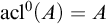
$\mathrm {acl}^0(A) = A$
,
$\mathrm {acl}^0(A) = A$
 . Therefore
$\mathrm {rk}^0(a) = 1$
. Therefore
$\mathrm {rk}^0(a) = 1$
 . Let
$[a]_E$
. Let
$[a]_E$
 denote the equivalence class of a with respect to E as an element of
$M^{\mathrm {eq}}$
denote the equivalence class of a with respect to E as an element of
$M^{\mathrm {eq}}$
 , so
$[a]_E \in M_1$
, so
$[a]_E \in M_1$
 . Then
$\mathrm {rk}^1(a / \{a, [a]_E\}) \geq 0$
. Then
$\mathrm {rk}^1(a / \{a, [a]_E\}) \geq 0$
 , and as
$a \in \mathrm {acl}^1(a) \setminus \mathrm {acl}^1(\emptyset )$
, and as
$a \in \mathrm {acl}^1(a) \setminus \mathrm {acl}^1(\emptyset )$
 we get
$\mathrm {rk}^1(a / \{[a]_E\}) \geq 1$
we get
$\mathrm {rk}^1(a / \{[a]_E\}) \geq 1$
 . Since
$[a]_E \in \mathrm {acl}^1(a) \setminus \mathrm {acl}^1(\emptyset )$
. Since
$[a]_E \in \mathrm {acl}^1(a) \setminus \mathrm {acl}^1(\emptyset )$
 we get
$\mathrm {rk}^1(a) \geq 2$
we get
$\mathrm {rk}^1(a) \geq 2$
 . As T has elimination of quantifiers it follows that E is the only
$\emptyset $
. As T has elimination of quantifiers it follows that E is the only
$\emptyset $
 -definable equivalence relation on M. Hence
$\mathrm {acl}^1(a) = \{a, [a]_E\}$
-definable equivalence relation on M. Hence
$\mathrm {acl}^1(a) = \{a, [a]_E\}$
 and consequently
$\mathrm {rk}^1(a) = 2$
and consequently
$\mathrm {rk}^1(a) = 2$
 . Let
$b \in M$
. Let
$b \in M$
 be such that
$b \neq a$
be such that
$b \neq a$
 and
$[b]_E = [a]_E$
and
$[b]_E = [a]_E$
 . By arguing similarly as above it follows that
$\mathrm {rk}^0(a / b) = \mathrm {rk}^0(a) = 1$
. By arguing similarly as above it follows that
$\mathrm {rk}^0(a / b) = \mathrm {rk}^0(a) = 1$
 and
$\mathrm {rk}^1(a / b) = 1 < 2 = \mathrm {rk}^1(a)$
and
$\mathrm {rk}^1(a / b) = 1 < 2 = \mathrm {rk}^1(a)$
 .
.
Lemma 3.4. Let
$A, B \subseteq M^{\mathrm {eq}}$
 and suppose that
$\mathrm {rk}^n(A / B)$
and suppose that
$\mathrm {rk}^n(A / B)$
 and
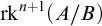
$\mathrm {rk}^{n+1}(A / B)$
and
$\mathrm {rk}^{n+1}(A / B)$
 are defined. Then
$\mathrm {rk}^n(A / B) \leq \mathrm {rk}^{n+1}(A / B)$
are defined. Then
$\mathrm {rk}^n(A / B) \leq \mathrm {rk}^{n+1}(A / B)$
 .
.
Proof. We prove by induction that if
$\mathrm {rk}^n(A / B) \geq \alpha $
 then
$\mathrm {rk}^{n+1}(A / B) \geq \alpha $
then
$\mathrm {rk}^{n+1}(A / B) \geq \alpha $
 . This is clear for
$\alpha = 0$
. This is clear for
$\alpha = 0$
 . So suppose that
$\mathrm {rk}^n(A / B) \geq \alpha + 1$
. So suppose that
$\mathrm {rk}^n(A / B) \geq \alpha + 1$
 . Then there is
$a \in \mathrm {acl}^n(A) \setminus \mathrm {acl}^n(B)$
. Then there is
$a \in \mathrm {acl}^n(A) \setminus \mathrm {acl}^n(B)$
 such that
$\mathrm {rk}^n(A / aB) \geq \alpha $
such that
$\mathrm {rk}^n(A / aB) \geq \alpha $
 . By the induction hypothesis we get
$\mathrm {rk}^{n+1}(A / aB) \geq \alpha $
. By the induction hypothesis we get
$\mathrm {rk}^{n+1}(A / aB) \geq \alpha $
 . We have
$a \in \mathrm {acl}^n(A) \subseteq \mathrm {acl}^{n+1}(A)$
. We have
$a \in \mathrm {acl}^n(A) \subseteq \mathrm {acl}^{n+1}(A)$
 and
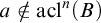
$a \notin \mathrm {acl}^n(B)$
and
$a \notin \mathrm {acl}^n(B)$
 so (by Lemma 2.3)
$a \notin \mathrm {acl}^{n+1}(B)$
so (by Lemma 2.3)
$a \notin \mathrm {acl}^{n+1}(B)$
 . Hence
$\mathrm {rk}^{n+1}(A / B) \geq \alpha + 1$
. Hence
$\mathrm {rk}^{n+1}(A / B) \geq \alpha + 1$
 . If
$\alpha $
. If
$\alpha $
 is a limit ordinal and
$\mathrm {rk}^n(A / B) \geq \alpha $
is a limit ordinal and
$\mathrm {rk}^n(A / B) \geq \alpha $
 then
$\mathrm {rk}^n(A / B) \geq \beta $
then
$\mathrm {rk}^n(A / B) \geq \beta $
 for all
$\beta < \alpha $
for all
$\beta < \alpha $
 , so by the induction hypothesis
$\mathrm {rk}^{n+1}(A / B) \geq \beta $
, so by the induction hypothesis
$\mathrm {rk}^{n+1}(A / B) \geq \beta $
 for all
$\beta < \alpha $
for all
$\beta < \alpha $
 , hence
$\mathrm {rk}^{n+1}(A / B) \geq \alpha $
, hence
$\mathrm {rk}^{n+1}(A / B) \geq \alpha $
 .
.
Lemma 3.5. Let
$\alpha < \omega $
 and
$A, B \subseteq M^{\mathrm {eq}}$
and
$A, B \subseteq M^{\mathrm {eq}}$
 .
.
(i)
$\mathrm {rk}^n(A / B) \geq \alpha $
 if and only if there are
$a_1, \ldots , a_\alpha \in \mathrm {acl}^n(A)$
if and only if there are
$a_1, \ldots , a_\alpha \in \mathrm {acl}^n(A)$
 such that, for all
$k = 1, \ldots , \alpha $
such that, for all
$k = 1, \ldots , \alpha $
 ,
$a_k \notin \mathrm {acl}^n(\{a_1, \ldots , a_{k-1}\} \cup B)$
,
$a_k \notin \mathrm {acl}^n(\{a_1, \ldots , a_{k-1}\} \cup B)$
 .
.
(ii) If
$\mathrm {rk}^n(A / B) = \alpha $
 then
$\alpha $
then
$\alpha $
 is maximal such that there are
$a_1, \ldots , a_\alpha \in \mathrm {acl}^n(A)$
is maximal such that there are
$a_1, \ldots , a_\alpha \in \mathrm {acl}^n(A)$
 such that, for all
$k = 1, \ldots , \alpha $
such that, for all
$k = 1, \ldots , \alpha $
 ,
$a_k \notin \mathrm {acl}^n(\{a_1, \ldots , a_{k-1}\} \cup B)$
,
$a_k \notin \mathrm {acl}^n(\{a_1, \ldots , a_{k-1}\} \cup B)$
 .
.
(iii) Suppose that
$\mathrm {rk}^n(A / B) = \alpha $
 ,
$a_1, \ldots , a_\alpha \in \mathrm {acl}^n(A)$
,
$a_1, \ldots , a_\alpha \in \mathrm {acl}^n(A)$
 and, for all
$k = 1, \ldots , \alpha $
and, for all
$k = 1, \ldots , \alpha $
 ,
$a_k \notin \mathrm {acl}^n(\{a_1, \ldots , a_{k-1}\} \cup B)$
,
$a_k \notin \mathrm {acl}^n(\{a_1, \ldots , a_{k-1}\} \cup B)$
 . Then, for all
$k = 1, \ldots , \alpha $
. Then, for all
$k = 1, \ldots , \alpha $
 ,
,
-
(1) $\mathrm {rk}^n(a_k / \{a_1, \ldots , a_{k-1}\} \cup B) = 1$
, -
(2) $\mathrm {rk}^n(A / \{a_1, \ldots , a_k\} \cup B) = \alpha - k$
, and -
(3) $\mathrm {rk}^n(a_1, \ldots , a_k / B) = k$
.



In particular we have
$\mathrm {rk}^n(A / \{a_1, \ldots , a_\alpha \} {\kern-1pt}\cup{\kern-1pt} B) {\kern-1pt}={\kern-1pt} 0$
 so
${\mathrm {acl}^n(A) {\kern-1pt}\subseteq{\kern-1pt} \mathrm {acl}^n(\{a_1, \ldots , a_\alpha \} {\kern-1pt}\cup{\kern-1pt} B)}$
so
${\mathrm {acl}^n(A) {\kern-1pt}\subseteq{\kern-1pt} \mathrm {acl}^n(\{a_1, \ldots , a_\alpha \} {\kern-1pt}\cup{\kern-1pt} B)}$
 , and
$\mathrm {rk}^n(a_1, \ldots , a_\alpha / B) = \alpha = \mathrm {rk}^n(A / B)$
, and
$\mathrm {rk}^n(a_1, \ldots , a_\alpha / B) = \alpha = \mathrm {rk}^n(A / B)$
 .
.
Proof. Let
$\alpha < \omega $
 and
$A, B \subseteq M^{\mathrm {eq}}$
and
$A, B \subseteq M^{\mathrm {eq}}$
 . We prove (i) by induction on
$\alpha $
. We prove (i) by induction on
$\alpha $
 . For
$\alpha = 0$
. For
$\alpha = 0$
 the statement is vacuous. Suppose that
$\mathrm {rk}^n(A / B) \geq \alpha + 1$
the statement is vacuous. Suppose that
$\mathrm {rk}^n(A / B) \geq \alpha + 1$
 . Then there is
$a \in \mathrm {acl}^n(A) \setminus \mathrm {acl}^n(B)$
. Then there is
$a \in \mathrm {acl}^n(A) \setminus \mathrm {acl}^n(B)$
 such that
$\mathrm {rk}^n(A / aB) \geq \alpha $
such that
$\mathrm {rk}^n(A / aB) \geq \alpha $
 . By the induction hypothesis there are
$a_1, \ldots , a_\alpha \in \mathrm {acl}^n(A)$
. By the induction hypothesis there are
$a_1, \ldots , a_\alpha \in \mathrm {acl}^n(A)$
 such that, for all
$k = 1, \ldots , \alpha $
such that, for all
$k = 1, \ldots , \alpha $
 ,
$a_k \notin \mathrm {acl}^n(\{a, a_1, \ldots , a_{k-1}\} \cup B)$
,
$a_k \notin \mathrm {acl}^n(\{a, a_1, \ldots , a_{k-1}\} \cup B)$
 . If we rename
$a_i$
. If we rename
$a_i$
 by
$a_{i+1}$
by
$a_{i+1}$
 for
$i = 1, \ldots , \alpha $
for
$i = 1, \ldots , \alpha $
 and then rename a by
$a_1$
and then rename a by
$a_1$
 we get
$a_i \notin \mathrm {acl}^n(\{a_1, \ldots , a_{i-1}\} \cup B)$
we get
$a_i \notin \mathrm {acl}^n(\{a_1, \ldots , a_{i-1}\} \cup B)$
 for all
$i = 1, \ldots , \alpha + 1$
for all
$i = 1, \ldots , \alpha + 1$
 .
.
Now suppose that
$a_1, \ldots , a_{\alpha +1} \in \mathrm {acl}^n(A)$
 and, for all
$k = 1, \ldots , \alpha + 1$
and, for all
$k = 1, \ldots , \alpha + 1$
 ,
,

By the induction hypothesis we have
$\mathrm {rk}^n(A / a_1 B) \geq \alpha $
 . By the choice of
$a_1, \ldots , a_{\alpha + 1}$
. By the choice of
$a_1, \ldots , a_{\alpha + 1}$
 we have
$a_1 \in \mathrm {acl}^n(A) \setminus \mathrm {acl}^n(B)$
we have
$a_1 \in \mathrm {acl}^n(A) \setminus \mathrm {acl}^n(B)$
 , so
$\mathrm {rk}^n(A / B) \geq \alpha + 1$
, so
$\mathrm {rk}^n(A / B) \geq \alpha + 1$
 . Now we have proved part (i). Part (ii) follows directly from part (i).
(iii) Suppose that
$\mathrm {rk}^n(A / B) = \alpha $
 and that
$a_1, \ldots , a_\alpha \in \mathrm {acl}^n(A)$
and that
$a_1, \ldots , a_\alpha \in \mathrm {acl}^n(A)$
 are such that, for all
$k = 1, \ldots , \alpha $
are such that, for all
$k = 1, \ldots , \alpha $
 ,
$a_k \notin \mathrm {acl}^n(\{a_1, \ldots , a_{k-1}\} \cup B)$
,
$a_k \notin \mathrm {acl}^n(\{a_1, \ldots , a_{k-1}\} \cup B)$
 . Then
$\mathrm {rk}^n(a_k / \{a_1, \ldots , a_{k-1}\} \cup B) \geq 1$
. Then
$\mathrm {rk}^n(a_k / \{a_1, \ldots , a_{k-1}\} \cup B) \geq 1$
 for all
$k = 1, \ldots , \alpha $
for all
$k = 1, \ldots , \alpha $
 . Suppose, for a contradiction, that for some k,
$\mathrm {rk}^n(a_k / \{a_1, \ldots , a_{k-1}\} \cup B) \geq 2$
. Suppose, for a contradiction, that for some k,
$\mathrm {rk}^n(a_k / \{a_1, \ldots , a_{k-1}\} \cup B) \geq 2$
 . Choose the least such k. Then there is

such that
$\mathrm {rk}^n(a_k / \{a, a_1, \ldots , a_{k-1}\} \cup B) \geq 1$
 which in particular means that

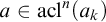
Since
$a \in \mathrm {acl}^n(a_k)$
 it follows from the choice of
$a_1, \ldots , a_\alpha $
it follows from the choice of
$a_1, \ldots , a_\alpha $
 that, for all
$i = k+1, \ldots , \alpha $
that, for all
$i = k+1, \ldots , \alpha $
 ,
$a_i \notin \mathrm {acl}^n(\{a, a_1, \ldots , a_{i-1}\} \cup B)$
,
$a_i \notin \mathrm {acl}^n(\{a, a_1, \ldots , a_{i-1}\} \cup B)$
 . Since
$a \in \mathrm {acl}^n(a_k) \subseteq \mathrm {acl}^n(A)$
. Since
$a \in \mathrm {acl}^n(a_k) \subseteq \mathrm {acl}^n(A)$
 it now follows from part (i) that
$\mathrm {rk}^n(A / B) \geq \alpha + 1$
it now follows from part (i) that
$\mathrm {rk}^n(A / B) \geq \alpha + 1$
 , contradicting the assumption.
By assumption and part (ii), for every
$k = 1, \ldots , \alpha $
 , the number
$\alpha - k$
, the number
$\alpha - k$
 is maximal such that there are
$a^{\prime }_{k+1}, \ldots , a^{\prime }_\alpha \in \mathrm {acl}^n(A)$
is maximal such that there are
$a^{\prime }_{k+1}, \ldots , a^{\prime }_\alpha \in \mathrm {acl}^n(A)$
 such that, for all
$i = k+1, \ldots , \alpha $
such that, for all
$i = k+1, \ldots , \alpha $
 ,
,

Hence
$\mathrm {rk}(A / \{a_1, \ldots , a_k\} \cup B) = \alpha - k$
 for all
$k = 1, \ldots , \alpha $
for all
$k = 1, \ldots , \alpha $
 .
.
Let
$k \in \{1, \ldots , \alpha \}$
 . By part (i), the sequence
$a_1, \ldots , a_k$
. By part (i), the sequence
$a_1, \ldots , a_k$
 witnesses that
$\mathrm {rk}(a_1, \ldots , a_k / B)\, \geq k$
witnesses that
$\mathrm {rk}(a_1, \ldots , a_k / B)\, \geq k$
 . Suppose, for a contradiction, that
$\mathrm {rk}(a_1, \ldots , a_k / B) \geq k+1$
. Suppose, for a contradiction, that
$\mathrm {rk}(a_1, \ldots , a_k / B) \geq k+1$
 . Then (by part (i)) we find

such that, for all
$i = 0, \ldots , k$
 ,
$a^{\prime }_i \notin \mathrm {acl}^n(\{a^{\prime }_1, \ldots , a^{\prime }_{i-1}\} \cup B)$
,
$a^{\prime }_i \notin \mathrm {acl}^n(\{a^{\prime }_1, \ldots , a^{\prime }_{i-1}\} \cup B)$
 . Then
$\mathrm {acl}^n(\{a^{\prime }_0, \ldots , a^{\prime }_k\} \cup B) \subseteq \mathrm {acl}^n(\{a_1, \ldots , a_k\} \cup B)$
. Then
$\mathrm {acl}^n(\{a^{\prime }_0, \ldots , a^{\prime }_k\} \cup B) \subseteq \mathrm {acl}^n(\{a_1, \ldots , a_k\} \cup B)$
 so, for all
$i = k+1, \ldots , \alpha $
so, for all
$i = k+1, \ldots , \alpha $
 ,
$a_i \notin \mathrm {acl}^n(\{a^{\prime }_0, \ldots , a^{\prime }_k, a_{k+1}, \ldots , a_{i-1}\} \cup B)$
,
$a_i \notin \mathrm {acl}^n(\{a^{\prime }_0, \ldots , a^{\prime }_k, a_{k+1}, \ldots , a_{i-1}\} \cup B)$
 By part (i), the sequence
$a^{\prime }_0, \ldots , a^{\prime }_k, a_{k+1}, \ldots , a_\alpha $
By part (i), the sequence
$a^{\prime }_0, \ldots , a^{\prime }_k, a_{k+1}, \ldots , a_\alpha $
 witnesses that
$\mathrm {rk}(A / B) \geq \alpha +1$
witnesses that
$\mathrm {rk}(A / B) \geq \alpha +1$
 which contradicts the assumption.
Definition 3.6. Let
$A, B \subseteq M^{\mathrm {eq}}$
 and suppose that
$\mathrm {rk}^n(A / B) = \alpha < \omega $
and suppose that
$\mathrm {rk}^n(A / B) = \alpha < \omega $
 . Then every sequence
$a_1, \ldots , a_\alpha \in \mathrm {acl}^n(A)$
. Then every sequence
$a_1, \ldots , a_\alpha \in \mathrm {acl}^n(A)$
 such that, for all
$k = 1, \ldots , \alpha $
such that, for all
$k = 1, \ldots , \alpha $
 ,
$a_k \notin \mathrm {acl}^n(\{a_1, \ldots , a_{k-1}\} \cup B)$
,
$a_k \notin \mathrm {acl}^n(\{a_1, \ldots , a_{k-1}\} \cup B)$
 will be called an n-coordinatization sequence (n-cs) for
$A/B$
will be called an n-coordinatization sequence (n-cs) for
$A/B$
 (“A over B”).
Lemma 3.7. If
$A, B \subseteq M^{\mathrm {eq}}$
 and A is finite then
$\mathrm {rk}^n(A / B)$
and A is finite then
$\mathrm {rk}^n(A / B)$
 is defined and finite.
Proof. Let
$A, B \subseteq M^{\mathrm {eq}}$
 where A is finite. Then
$|\mathrm {acl}^n(A)| = \alpha $
where A is finite. Then
$|\mathrm {acl}^n(A)| = \alpha $
 for some
$\alpha < \omega $
for some
$\alpha < \omega $
 . If
$\mathrm {rk}^n(A / B) \geq \alpha + 1$
. If
$\mathrm {rk}^n(A / B) \geq \alpha + 1$
 then, by Lemma 3.5(i), there are
$a_1, \ldots , a_{\alpha + 1} \in \mathrm {acl}^n(A)$
then, by Lemma 3.5(i), there are
$a_1, \ldots , a_{\alpha + 1} \in \mathrm {acl}^n(A)$
 such that, for all
$k = 1, \ldots , \alpha + 1$
such that, for all
$k = 1, \ldots , \alpha + 1$
 ,
$a_k \notin \mathrm {acl}^n(\{a_1, \ldots , a_{k-1}\} \cup B)$
,
$a_k \notin \mathrm {acl}^n(\{a_1, \ldots , a_{k-1}\} \cup B)$
 . Then
$a_i \neq a_j$
. Then
$a_i \neq a_j$
 if
$i \neq j$
if
$i \neq j$
 so
$|\mathrm {acl}^n(A)| \geq \alpha + 1$
so
$|\mathrm {acl}^n(A)| \geq \alpha + 1$
 , a contradiction.
Lemma 3.8. Suppose that T has geometric elimination of imaginaries. Let
$\alpha < \omega $
 and
$A, B \subseteq M^{\mathrm {eq}}$
and
$A, B \subseteq M^{\mathrm {eq}}$
 .
.
(i) If
$\mathrm {rk}^n(A / B) \geq \alpha $
 then
$\mathrm {rk}^0(A / B) \geq \alpha $
then
$\mathrm {rk}^0(A / B) \geq \alpha $
 .
.
(ii) If A is finite then
$\mathrm {rk}^n(A / B) = \mathrm {rk}^0(A / B)$
 .
.
Proof. (i) Suppose that
$\mathrm {rk}^n(A / B) \geq \alpha $
 . By Lemma 3.5, there are
$a_1, \ldots , a_\alpha \in \mathrm {acl}^n(A)$
. By Lemma 3.5, there are
$a_1, \ldots , a_\alpha \in \mathrm {acl}^n(A)$
 such that, for all
$k = 1, \ldots , \alpha $
such that, for all
$k = 1, \ldots , \alpha $
 ,
$a_k \notin \mathrm {acl}^n(\{a_1, \ldots , a_{k-1}\} \cup B)$
,
$a_k \notin \mathrm {acl}^n(\{a_1, \ldots , a_{k-1}\} \cup B)$
 . By induction on
$\alpha $
. By induction on
$\alpha $
 we prove that there are
$a^{\prime }_1, \ldots , a^{\prime }_\alpha \in \mathrm {acl}^0(A)$
we prove that there are
$a^{\prime }_1, \ldots , a^{\prime }_\alpha \in \mathrm {acl}^0(A)$
 such that
$a^{\prime }_k \notin \mathrm {acl}^0(\{a^{\prime }_1, \ldots , a^{\prime }_{k-1}\} \cup B)$
such that
$a^{\prime }_k \notin \mathrm {acl}^0(\{a^{\prime }_1, \ldots , a^{\prime }_{k-1}\} \cup B)$
 and
$a^{\prime }_k \in \mathrm {acl}^0(a_k)$
and
$a^{\prime }_k \in \mathrm {acl}^0(a_k)$
 for all
$k = 1, \ldots , \alpha $
for all
$k = 1, \ldots , \alpha $
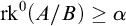
 , and it follows from Lemma 3.5 that
$\mathrm {rk}^0(A / B) \geq \alpha $
, and it follows from Lemma 3.5 that
$\mathrm {rk}^0(A / B) \geq \alpha $
 . If
$\alpha = 0$
. If
$\alpha = 0$
 there is nothing to prove, so suppose that
$\alpha> 0$
there is nothing to prove, so suppose that
$\alpha> 0$
 . By the induction hypothesis there are
$a^{\prime }_1, \ldots , a^{\prime }_{\alpha -1} \in \mathrm {acl}^0(A)$
. By the induction hypothesis there are
$a^{\prime }_1, \ldots , a^{\prime }_{\alpha -1} \in \mathrm {acl}^0(A)$
 such that
$a^{\prime }_k \notin \mathrm {acl}^0(\{a^{\prime }_1, \ldots , a^{\prime }_{k-1}\} \cup B)$
such that
$a^{\prime }_k \notin \mathrm {acl}^0(\{a^{\prime }_1, \ldots , a^{\prime }_{k-1}\} \cup B)$
 and
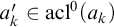
$a^{\prime }_k \in \mathrm {acl}^0(a_k)$
and
$a^{\prime }_k \in \mathrm {acl}^0(a_k)$
 for all
$k = 1, \ldots , \alpha -1$
for all
$k = 1, \ldots , \alpha -1$
 . Since T is assumed to have geometric elimination of imaginaries, there is a finite sequence
$\bar {c}$
. Since T is assumed to have geometric elimination of imaginaries, there is a finite sequence
$\bar {c}$
 of elements from
$M_0 = M$
of elements from
$M_0 = M$
 such that
$\mathrm {acl}^{\mathrm {eq}}(a_\alpha ) = \mathrm {acl}^{\mathrm {eq}}(\bar {c})$
such that
$\mathrm {acl}^{\mathrm {eq}}(a_\alpha ) = \mathrm {acl}^{\mathrm {eq}}(\bar {c})$
 . Since
$a_\alpha \notin \mathrm {acl}^n(\{a_1, \ldots , a_{\alpha -1}\} \cup B)$
. Since
$a_\alpha \notin \mathrm {acl}^n(\{a_1, \ldots , a_{\alpha -1}\} \cup B)$
 we have
$\mathrm {rng}(\bar {c}) \not \subseteq \mathrm {acl}^n(\{a_1, \ldots , a_{\alpha -1}\} \cup B)$
we have
$\mathrm {rng}(\bar {c}) \not \subseteq \mathrm {acl}^n(\{a_1, \ldots , a_{\alpha -1}\} \cup B)$
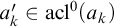
 . As
$a^{\prime }_k \in \mathrm {acl}^0(a_k)$
. As
$a^{\prime }_k \in \mathrm {acl}^0(a_k)$
 for all
$k = 1, \ldots , \alpha - 1$
for all
$k = 1, \ldots , \alpha - 1$
 it follows that
$\mathrm {rng}(\bar {c}) \not \subseteq \mathrm {acl}^0(\{a^{\prime }_1, \ldots , a^{\prime }_{\alpha - 1}\} \cup B)$
it follows that
$\mathrm {rng}(\bar {c}) \not \subseteq \mathrm {acl}^0(\{a^{\prime }_1, \ldots , a^{\prime }_{\alpha - 1}\} \cup B)$
 . Thus we can choose some element from
$\bar {c}$
. Thus we can choose some element from
$\bar {c}$
 , which we call
$a^{\prime }_\alpha $
, which we call
$a^{\prime }_\alpha $
 , such that
$a^{\prime }_\alpha \notin \mathrm {acl}^0(\{a^{\prime }_1, \ldots , a^{\prime }_{\alpha -1}\} \cup B)$
, such that
$a^{\prime }_\alpha \notin \mathrm {acl}^0(\{a^{\prime }_1, \ldots , a^{\prime }_{\alpha -1}\} \cup B)$
 . Now Lemma 3.5 implies that
$\mathrm {rk}^0(A / B) \geq \alpha $
. Now Lemma 3.5 implies that
$\mathrm {rk}^0(A / B) \geq \alpha $
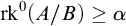 .
.
(ii) Suppose that A is finite. By Lemma 3.7,
$\mathrm {rk}^n(A / B) = \alpha $
 for some
$\alpha < \omega $
for some
$\alpha < \omega $
 . By Lemma 3.4,
$\mathrm {rk}^n(A / B) \geq \mathrm {rk}^0(A / B)$
. By Lemma 3.4,
$\mathrm {rk}^n(A / B) \geq \mathrm {rk}^0(A / B)$
 , and by part (i)
$\mathrm {rk}^n(A / B) \leq \mathrm {rk}^0(A / B)$
, and by part (i)
$\mathrm {rk}^n(A / B) \leq \mathrm {rk}^0(A / B)$
 .
.
Lemma 3.9. Let
$A, B, C, D \subseteq M^{\mathrm {eq}}$
 where
$A \supseteq B$
where
$A \supseteq B$
 ,
$C \subseteq D,$
,
$C \subseteq D,$
 and A is finite. Then
-
(a) $\mathrm {rk}^n(A / A) = 0$
, -
(b) $\mathrm {rk}^n(A / C) \geq \mathrm {rk}^n(B / C)$
, -
(c) $\mathrm {rk}^n(A / C) \geq \mathrm {rk}^n(A / D)$
, and -
(d) $\mathrm {rk}^n(A / C) \geq \mathrm {rk}^n(B / C) + \mathrm {rk}^n(A / BC)$
.




Proof. Suppose that
$A, B, C, D \subseteq M^{\mathrm {eq}}$
 where
$A \supseteq B$
where
$A \supseteq B$
 ,
$C \subseteq D,$
,
$C \subseteq D,$
 and A is finite, so all mentioned n-ranks in (a)–(d) are finite. Part (a) is obvious from the definition of n-rank.
For part (b), suppose that
$\mathrm {rk}^n(B / C) \geq \alpha $
 (where
$\alpha < \omega $
(where
$\alpha < \omega $
 ). By Lemma 3.5, there are
$a_1, \ldots , a_\alpha \in \mathrm {acl}^n(B)$
). By Lemma 3.5, there are
$a_1, \ldots , a_\alpha \in \mathrm {acl}^n(B)$
 such that, for all
$k = 1, \ldots , \alpha $
such that, for all
$k = 1, \ldots , \alpha $
 ,
$a_k \notin \mathrm {acl}^n(\{a_1, \ldots , a_{k-1}\} \cup C)$
,
$a_k \notin \mathrm {acl}^n(\{a_1, \ldots , a_{k-1}\} \cup C)$
 . Since
$A \supseteq B$
. Since
$A \supseteq B$
 it follows that
$a_1, \ldots , a_\alpha \in \mathrm {acl}^n(A)$
it follows that
$a_1, \ldots , a_\alpha \in \mathrm {acl}^n(A)$
 , so, by Lemma 3.5 again,
$\mathrm {rk}^n(A / C) \geq \alpha $
, so, by Lemma 3.5 again,
$\mathrm {rk}^n(A / C) \geq \alpha $
 .
.
Now consider part (c). Suppose that
$\mathrm {rk}^n(A / D) \geq \alpha $
 . Then there are
$a_1, \ldots , a_\alpha \in \mathrm {acl}^n(A)$
. Then there are
$a_1, \ldots , a_\alpha \in \mathrm {acl}^n(A)$
 such that, for all
$k = 1, \ldots , \alpha $
such that, for all
$k = 1, \ldots , \alpha $
 ,
$a_k \notin \mathrm {acl}^n(\{a_1, \ldots , a_{k-1}\} \cup D)$
,
$a_k \notin \mathrm {acl}^n(\{a_1, \ldots , a_{k-1}\} \cup D)$
 . Since
$C \subseteq D$
. Since
$C \subseteq D$
 we get
$a_k \notin \mathrm {acl}^n(\{a_1, \ldots , a_{k-1}\} \cup C)$
we get
$a_k \notin \mathrm {acl}^n(\{a_1, \ldots , a_{k-1}\} \cup C)$
 for all
$k = 1, \ldots , \alpha $
for all
$k = 1, \ldots , \alpha $
 , so
$\mathrm {rk}^n(A / C) \geq \alpha $
, so
$\mathrm {rk}^n(A / C) \geq \alpha $
 .
.
Finally we consider part (d). Let
$\beta = \mathrm {rk}^n(B / C)$
 and
$\alpha = \mathrm {rk}^n(A / BC)$
and
$\alpha = \mathrm {rk}^n(A / BC)$
 , so
$\alpha , \beta < \omega $
, so
$\alpha , \beta < \omega $
 . By Lemma 3.5, there are
$b_1, \ldots b_\beta \in \mathrm {acl}^n(B)$
. By Lemma 3.5, there are
$b_1, \ldots b_\beta \in \mathrm {acl}^n(B)$
 and
$a_1, \ldots , a_\alpha \in \mathrm {acl}^n(A)$
and
$a_1, \ldots , a_\alpha \in \mathrm {acl}^n(A)$
 such that, for all
$k = 1, \ldots , \beta $
such that, for all
$k = 1, \ldots , \beta $
 ,
$b_k \notin \mathrm {acl}^n(\{b_1, \ldots , b_{k-1}\} \cup C)$
,
$b_k \notin \mathrm {acl}^n(\{b_1, \ldots , b_{k-1}\} \cup C)$
 , and for all
$l = 1, \ldots , \alpha $
, and for all
$l = 1, \ldots , \alpha $
 ,
$a_l \notin \mathrm {acl}^n(\{a_1, \ldots , a_{l-1}\} \cup BC)$
,
$a_l \notin \mathrm {acl}^n(\{a_1, \ldots , a_{l-1}\} \cup BC)$
 . Moreover,
$\beta $
. Moreover,
$\beta $
 and
$\alpha $
and
$\alpha $
 are maximal such that such sequences exist. For a contradiction, suppose that, for some
$l \in \{1, \ldots , \alpha \}$
are maximal such that such sequences exist. For a contradiction, suppose that, for some
$l \in \{1, \ldots , \alpha \}$
 ,
$a_l \in \mathrm {acl}^n(\{b_1, \ldots , b_\beta , a_1, \ldots , a_{l-1}\} \cup C)$
,
$a_l \in \mathrm {acl}^n(\{b_1, \ldots , b_\beta , a_1, \ldots , a_{l-1}\} \cup C)$
 . Since
$b_1, \ldots , b_\beta \in \mathrm {acl}^n(B)$
. Since
$b_1, \ldots , b_\beta \in \mathrm {acl}^n(B)$
 we get
$a_l \in \mathrm {acl}^n(\{a_1, \ldots , a_{l-1}\} \cup BC)$
we get
$a_l \in \mathrm {acl}^n(\{a_1, \ldots , a_{l-1}\} \cup BC)$
 which contradicts the choice of
$a_1, \ldots , a_\alpha $
which contradicts the choice of
$a_1, \ldots , a_\alpha $
 . Hence we conclude that
$a_l \notin \mathrm {acl}^n(\{b_1, \ldots , b_\beta , a_1, \ldots , a_{l-1}\} \cup C)$
. Hence we conclude that
$a_l \notin \mathrm {acl}^n(\{b_1, \ldots , b_\beta , a_1, \ldots , a_{l-1}\} \cup C)$
 for all
$l = 1, \ldots , \alpha $
for all
$l = 1, \ldots , \alpha $
 . Since
$B \subseteq A$
. Since
$B \subseteq A$
 we have
$\mathrm {acl}^n(B) \subseteq \mathrm {acl}^n(A)$
we have
$\mathrm {acl}^n(B) \subseteq \mathrm {acl}^n(A)$
 and therefore
$b_1, \ldots , b_\beta , a_1, \ldots , a_\alpha \in \mathrm {acl}^n(A)$
and therefore
$b_1, \ldots , b_\beta , a_1, \ldots , a_\alpha \in \mathrm {acl}^n(A)$
 . By Lemma 3.5, we get
$\mathrm {rk}(A / C) \geq \beta + \alpha $
. By Lemma 3.5, we get
$\mathrm {rk}(A / C) \geq \beta + \alpha $
 .
.
Lemma 3.10. Let
$A, B \subseteq M^{\mathrm {eq}}$
 . If
$\mathrm {acl}^n(A) \setminus \mathrm {acl}^n(B) \neq \emptyset $
. If
$\mathrm {acl}^n(A) \setminus \mathrm {acl}^n(B) \neq \emptyset $
 then there is
$a \in \mathrm {acl}^n(A) \setminus \mathrm {acl}^n(B)$
then there is
$a \in \mathrm {acl}^n(A) \setminus \mathrm {acl}^n(B)$
 such that
$\mathrm {rk}^n(a / B) = 1$
such that
$\mathrm {rk}^n(a / B) = 1$
 .
.
Proof. Note that (by Lemma 3.7), if
$a \in \mathrm {acl}^n(A) \setminus \mathrm {acl}^n(B)$
 then
$\mathrm {rk}^n(a / B) < \omega $
then
$\mathrm {rk}^n(a / B) < \omega $
 . We first prove the following claim.
Claim. If
$a' \in \mathrm {acl}^n(A) \setminus \mathrm {acl}^n(B)$
 and
$\mathrm {rk}^n(a' / B) = \alpha + 1$
and
$\mathrm {rk}^n(a' / B) = \alpha + 1$
 where
$\alpha \geq 1$
where
$\alpha \geq 1$
 , then there is
$a \in \mathrm {acl}^n(a') \subseteq \mathrm {acl}^n(A)$
, then there is
$a \in \mathrm {acl}^n(a') \subseteq \mathrm {acl}^n(A)$
 such that
$1 \leq \mathrm {rk}^n(a / B) \leq \alpha $
such that
$1 \leq \mathrm {rk}^n(a / B) \leq \alpha $
 .
.
Proof of the claim.
Suppose that
$a' \in \mathrm {acl}^n(A) \setminus \mathrm {acl}^n(B)$
 and
${\mathrm {rk}^n(a' / B) = \alpha + 1}$
and
${\mathrm {rk}^n(a' / B) = \alpha + 1}$
 where
$\alpha \geq 1$
where
$\alpha \geq 1$
 . Suppose that
$a' \in \mathrm {acl}^n(A) \setminus \mathrm {acl}^n(B)$
. Suppose that
$a' \in \mathrm {acl}^n(A) \setminus \mathrm {acl}^n(B)$
 and
$\mathrm {rk}^n(a' / B) = \alpha + 1$
and
$\mathrm {rk}^n(a' / B) = \alpha + 1$
 where
$\alpha \geq 1$
where
$\alpha \geq 1$
 . By the definition of
$\mathrm {rk}^n$
. By the definition of
$\mathrm {rk}^n$
 there is
$a \in \mathrm {acl}^n(a') \setminus \mathrm {acl}^n(B)$
there is
$a \in \mathrm {acl}^n(a') \setminus \mathrm {acl}^n(B)$
 such that
${\mathrm {rk}^n(a' / aB) = \alpha }$
such that
${\mathrm {rk}^n(a' / aB) = \alpha }$
 . If
$a' \in \mathrm {acl}^n(aB)$
. If
$a' \in \mathrm {acl}^n(aB)$
 then
$\mathrm {rk}^n(a' / aB) = 0$
then
$\mathrm {rk}^n(a' / aB) = 0$
 , so
$\alpha = 0$
, so
$\alpha = 0$
 , which contradicts that
$\alpha \geq 1$
, which contradicts that
$\alpha \geq 1$
 . Hence
$a' \notin \mathrm {acl}^n(aB)$
. Hence
$a' \notin \mathrm {acl}^n(aB)$
 . As
$a \notin \mathrm {acl}^n(B)$
. As
$a \notin \mathrm {acl}^n(B)$
 we have
$\mathrm {rk}^n(a / B) \geq 1$
we have
$\mathrm {rk}^n(a / B) \geq 1$
 .
.
We now show that
$\mathrm {rk}^n(a / B) \leq \alpha $
 . For a contradiction, suppose that
$\mathrm {rk}^n(a / B) \geq \alpha + 1$
. For a contradiction, suppose that
$\mathrm {rk}^n(a / B) \geq \alpha + 1$
 . By Lemma 3.5 there are
$a_1, \ldots , a_{\alpha + 1} {\kern-1pt}\in{\kern-1pt} \mathrm {acl}^n(a)$
. By Lemma 3.5 there are
$a_1, \ldots , a_{\alpha + 1} {\kern-1pt}\in{\kern-1pt} \mathrm {acl}^n(a)$
 such that for all
${i {\kern-1pt}={\kern-1pt} 1, \ldots , \alpha {\kern-1pt}+{\kern-1pt} 1}$
such that for all
${i {\kern-1pt}={\kern-1pt} 1, \ldots , \alpha {\kern-1pt}+{\kern-1pt} 1}$
 ,
$a_i \notin \mathrm {acl}^n(\{a_1, \ldots , a_{i-1}\} \cup B)$
,
$a_i \notin \mathrm {acl}^n(\{a_1, \ldots , a_{i-1}\} \cup B)$
 . If
$a' \in \mathrm {acl}^n(\{a_1, \ldots , a_{\alpha + 1}\} \cup B)$
. If
$a' \in \mathrm {acl}^n(\{a_1, \ldots , a_{\alpha + 1}\} \cup B)$
 , then
$a' \in \mathrm {acl}^n(aB)$
, then
$a' \in \mathrm {acl}^n(aB)$
 contradicting what we concluded above. Hence
$a' \notin \mathrm {acl}^n(aB)$
contradicting what we concluded above. Hence
$a' \notin \mathrm {acl}^n(aB)$
 . Therefore the sequence
$a_1, \ldots , a_{\alpha + 1}, a' \in \mathrm {acl}^n(a')$
. Therefore the sequence
$a_1, \ldots , a_{\alpha + 1}, a' \in \mathrm {acl}^n(a')$
 and Lemma 3.5 witness that
$\mathrm {rk}^n(a' / B) \geq \alpha + 2$
and Lemma 3.5 witness that
$\mathrm {rk}^n(a' / B) \geq \alpha + 2$
 which contradicts the assumption about
$a'$
which contradicts the assumption about
$a'$
 . This concludes the proof of the claim.
Now suppose that
$a' \in \mathrm {acl}^n(A) \setminus \mathrm {acl}^n(B)$
 . Let
$\alpha = \mathrm {rk}^n(a' / B)$
. Let
$\alpha = \mathrm {rk}^n(a' / B)$
 . Since
$a' \notin \mathrm {acl}^n(B)$
. Since
$a' \notin \mathrm {acl}^n(B)$
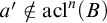 we have
$\alpha \geq 1$
we have
$\alpha \geq 1$
 . If
$\alpha = 1$
. If
$\alpha = 1$
 then we are done (by letting
$a = a'$
then we are done (by letting
$a = a'$
 ). So suppose that
$\alpha \geq 2$
). So suppose that
$\alpha \geq 2$
 . By repeatedly using the claim we eventually find
$a \in \mathrm {acl}^n(a') \subseteq \mathrm {acl}^n(A)$
. By repeatedly using the claim we eventually find
$a \in \mathrm {acl}^n(a') \subseteq \mathrm {acl}^n(A)$
 such that
$\mathrm {rk}^n(a / B) = 1$
such that
$\mathrm {rk}^n(a / B) = 1$
 . This ends the proof of the lemma.
Lemma 3.11.
(i) Suppose that
$A \subseteq M^{\mathrm {eq}}$
 is finite and
$B \subseteq C \subseteq M^{\mathrm {eq}}$
is finite and
$B \subseteq C \subseteq M^{\mathrm {eq}}$
 . If
$\mathrm {rk}^n(A / C) < \mathrm {rk}^n(A / B)$
. If
$\mathrm {rk}^n(A / C) < \mathrm {rk}^n(A / B)$
 then there is a finite
$C' \subseteq C$
then there is a finite
$C' \subseteq C$
 such that
$\mathrm {rk}^n(A / B \cup C') < \mathrm {rk}^n(A / B)$
such that
$\mathrm {rk}^n(A / B \cup C') < \mathrm {rk}^n(A / B)$
 .
.
(ii) Suppose that
$A \subseteq M^{\mathrm {eq}}$
 is finite and
$B \subseteq M^{\mathrm {eq}}$
is finite and
$B \subseteq M^{\mathrm {eq}}$
 . Then there is finite
$B' \subseteq B$
. Then there is finite
$B' \subseteq B$
 such that
$\mathrm {rk}^n(A / B') = \mathrm {rk}^n(A / B)$
such that
$\mathrm {rk}^n(A / B') = \mathrm {rk}^n(A / B)$
 .
.
Proof. (i) Let
$A \subseteq M^{\mathrm {eq}}$
 be finite and let
$B \subseteq C \subseteq M^{\mathrm {eq}}$
be finite and let
$B \subseteq C \subseteq M^{\mathrm {eq}}$
 . We prove the claim by induction on
$\mathrm {rk}^n(A / B)$
. We prove the claim by induction on
$\mathrm {rk}^n(A / B)$
 . If
$\mathrm {rk}^n(A / B) = 0$
. If
$\mathrm {rk}^n(A / B) = 0$
 then there is nothing to prove (as we cannot have
$\mathrm {rk}^n(A / C) < \mathrm {rk}^n(A / B)$
then there is nothing to prove (as we cannot have
$\mathrm {rk}^n(A / C) < \mathrm {rk}^n(A / B)$
 ). So suppose that
$\mathrm {rk}^n(A / B) = \alpha + 1$
). So suppose that
$\mathrm {rk}^n(A / B) = \alpha + 1$
 . Then there is
$a \in \mathrm {acl}^n(A) \setminus \mathrm {acl}^n(B)$
. Then there is
$a \in \mathrm {acl}^n(A) \setminus \mathrm {acl}^n(B)$
 such that
$\mathrm {rk}^n(A / \{a\} \cup B) \geq \alpha $
such that
$\mathrm {rk}^n(A / \{a\} \cup B) \geq \alpha $
 . In fact we must have
$\mathrm {rk}^n(A / \{a\} \cup B) = \alpha $
. In fact we must have
$\mathrm {rk}^n(A / \{a\} \cup B) = \alpha $
 because if
$\mathrm {rk}^n(A / \{a\} \cup B) \geq \alpha +1$
because if
$\mathrm {rk}^n(A / \{a\} \cup B) \geq \alpha +1$
 then
$ \mathrm {rk}^n(A / B) \geq \alpha +2$
then
$ \mathrm {rk}^n(A / B) \geq \alpha +2$
 which contradicts the assumption. Since A is finite it follows that
$\mathrm {acl}^n(A)$
which contradicts the assumption. Since A is finite it follows that
$\mathrm {acl}^n(A)$
 is finite and therefore there is finite
$C_1 \subseteq C$
is finite and therefore there is finite
$C_1 \subseteq C$
 such that

By the induction hypothesis, if
$a \in \mathrm {acl}^n(A) \setminus \mathrm {acl}^n(B)$
 is such that
$\mathrm {rk}^n(A / \{a\} \cup C) < \mathrm {rk}^n(A / \{a\} \cup B) = \alpha $
is such that
$\mathrm {rk}^n(A / \{a\} \cup C) < \mathrm {rk}^n(A / \{a\} \cup B) = \alpha $
 , then there is finite
$C_{a} \subseteq C$
, then there is finite
$C_{a} \subseteq C$
 such that
$\mathrm {rk}^n(A / \{a\} \cup B \cup C_{a}) < \mathrm {rk}^n(A / \{a\} \cup B)$
such that
$\mathrm {rk}^n(A / \{a\} \cup B \cup C_{a}) < \mathrm {rk}^n(A / \{a\} \cup B)$
 . Let
$C_2$
. Let
$C_2$
 be the union of all
$C_{a} \subseteq C$
be the union of all
$C_{a} \subseteq C$
 where a ranges over the members of the finite set
$\mathrm {acl}^n(A)$
where a ranges over the members of the finite set
$\mathrm {acl}^n(A)$
 such that
$\mathrm {rk}^n(A / \{a\} \cup C) < \mathrm {rk}^n(A / \{a\} \cup B)$
such that
$\mathrm {rk}^n(A / \{a\} \cup C) < \mathrm {rk}^n(A / \{a\} \cup B)$
 . Let
$C' = C_1 \cup C_2$
. Let
$C' = C_1 \cup C_2$
 so
$C'$
so
$C'$
 is finite.
Now suppose that
$\mathrm {rk}^n(A / C) < \mathrm {rk}^n(A / B)$
 . Then for every
$a \in \mathrm {acl}^n(A) \setminus \mathrm {acl}^n(B)$
. Then for every
$a \in \mathrm {acl}^n(A) \setminus \mathrm {acl}^n(B)$
 such that
$\mathrm {rk}^n(A / \{a\} \cup B) = \alpha $
such that
$\mathrm {rk}^n(A / \{a\} \cup B) = \alpha $
 we have either
$a \in \mathrm {acl}^{\mathrm {eq}}(C)$
we have either
$a \in \mathrm {acl}^{\mathrm {eq}}(C)$
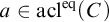 or
$\mathrm {rk}^n(A / \{a\} \cup C) < \alpha $
or
$\mathrm {rk}^n(A / \{a\} \cup C) < \alpha $
 which in turn implies that either
$a \in \mathrm {acl}^n(C')$
which in turn implies that either
$a \in \mathrm {acl}^n(C')$
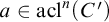 or
$\mathrm {rk}^n(A / \{a\} \cup B \cup C') < \mathrm {rk}^n(A / \{a\} \cup B)$
or
$\mathrm {rk}^n(A / \{a\} \cup B \cup C') < \mathrm {rk}^n(A / \{a\} \cup B)$
 . It follows that
$\mathrm {rk}^n(A / B \cup C') < \alpha +1 = \mathrm {rk}^n(A / B)$
. It follows that
$\mathrm {rk}^n(A / B \cup C') < \alpha +1 = \mathrm {rk}^n(A / B)$
 .
.
(ii) Suppose that
$\mathrm {rk}^n(A / B) = \alpha $
 (where A is finite) and
$\mathrm {rk}^n(A / \emptyset ) = \beta $
(where A is finite) and
$\mathrm {rk}^n(A / \emptyset ) = \beta $
 so
$\alpha \leq \beta $
so
$\alpha \leq \beta $
 (by Lemma 3.9). If
$\alpha = \beta $
(by Lemma 3.9). If
$\alpha = \beta $
 we are done. So suppose that
$\alpha < \beta $
we are done. So suppose that
$\alpha < \beta $
 . Let
$B_0 = \emptyset $
. Let
$B_0 = \emptyset $
 . By part (i) there is finite
$B_1 \subseteq B$
. By part (i) there is finite
$B_1 \subseteq B$
 such that
$\mathrm {rk}^n(A / B_1) < \mathrm {rk}^n(A / B_0)$
such that
$\mathrm {rk}^n(A / B_1) < \mathrm {rk}^n(A / B_0)$
 . If
$\mathrm {rk}^n(A / B) < \mathrm {rk}^n(A / B_1)$
. If
$\mathrm {rk}^n(A / B) < \mathrm {rk}^n(A / B_1)$
 then we use part (i) again and get a finite
$B_2 \subseteq B$
then we use part (i) again and get a finite
$B_2 \subseteq B$
 such that
$\mathrm {rk}^n(A / B_0 \cup B_1 \cup B_2) < \mathrm {rk}^n(A / B_0 \cup B_1)$
such that
$\mathrm {rk}^n(A / B_0 \cup B_1 \cup B_2) < \mathrm {rk}^n(A / B_0 \cup B_1)$
 . We can repeat this procedure as long as
$\mathrm {rk}^n(A / B) < \mathrm {rk}^n(A / B_0 \cup \cdots \cup B_m)$
. We can repeat this procedure as long as
$\mathrm {rk}^n(A / B) < \mathrm {rk}^n(A / B_0 \cup \cdots \cup B_m)$
 . But as there is no infinite decreasing sequence of natural numbers we eventually find
$m < \omega $
. But as there is no infinite decreasing sequence of natural numbers we eventually find
$m < \omega $
 and finite
$B_k \subseteq B$
and finite
$B_k \subseteq B$
 for
$k \leq m$
for
$k \leq m$
 such that
$\mathrm {rk}^n(A / B_0 \cup \cdots \cup B_m) = \mathrm {rk}^n(A / B)$
such that
$\mathrm {rk}^n(A / B_0 \cup \cdots \cup B_m) = \mathrm {rk}^n(A / B)$
 .
.
Lemma 3.12. Suppose that
$A \subseteq M^{\mathrm {eq}}$
 is finite and
$B \subseteq M^{\mathrm {eq}}$
is finite and
$B \subseteq M^{\mathrm {eq}}$
 . Then there is countable
$C \subseteq B$
. Then there is countable
$C \subseteq B$
 such that
$\mathrm {rk}^n(A / C) = \mathrm {rk}^n(A / B)$
such that
$\mathrm {rk}^n(A / C) = \mathrm {rk}^n(A / B)$
 for all
$n < \omega $
for all
$n < \omega $
 .
.
Proof. Suppose that
$A \subseteq M^{\mathrm {eq}}$
 is finite and
$B \subseteq M^{\mathrm {eq}}$
is finite and
$B \subseteq M^{\mathrm {eq}}$
 . Lemma 3.11 says that for every
$n < \omega $
. Lemma 3.11 says that for every
$n < \omega $
 there is a finite
$B_n \subseteq B$
there is a finite
$B_n \subseteq B$
 such that
$\mathrm {rk}^n(A / B_n) = \mathrm {rk}^n(A / B)$
such that
$\mathrm {rk}^n(A / B_n) = \mathrm {rk}^n(A / B)$
 . Let
$C = \bigcup _{n < \omega } B_n$
. Let
$C = \bigcup _{n < \omega } B_n$
 , so
$C \subseteq B$
, so
$C \subseteq B$
 is countable. By Lemma 3.9, for all
$n < \omega $
is countable. By Lemma 3.9, for all
$n < \omega $
 ,
$\mathrm {rk}^n(A / B_n) \geq \mathrm {rk}^n(A / C) \geq \mathrm {rk}^n(A / B) = \mathrm {rk}^n(A / B_n)$
,
$\mathrm {rk}^n(A / B_n) \geq \mathrm {rk}^n(A / C) \geq \mathrm {rk}^n(A / B) = \mathrm {rk}^n(A / B_n)$
 , and hence
$\mathrm {rk}^n(A / C) = \mathrm {rk}^n(A / B_n) = \mathrm {rk}^n(A / B)$
, and hence
$\mathrm {rk}^n(A / C) = \mathrm {rk}^n(A / B_n) = \mathrm {rk}^n(A / B)$
 .
.
Lemma 3.13.
(i) Let
$m, r, k, l < \omega $
 where
$n \leq m$
where
$n \leq m$
 . The
$(k+l)$
. The
$(k+l)$
 -ary relation on
$M_m$
-ary relation on
$M_m$
 which holds for
$(a_1, \ldots , a_k, b_1, \ldots , b_l) \in (M_m)^{k+l}$
which holds for
$(a_1, \ldots , a_k, b_1, \ldots , b_l) \in (M_m)^{k+l}$
 if and only if
$\mathrm {rk}^n(a_1, \ldots , a_k / b_1, \ldots , b_l) = r$
if and only if
$\mathrm {rk}^n(a_1, \ldots , a_k / b_1, \ldots , b_l) = r$
 is
$\emptyset $
is
$\emptyset $
 -definable in
$\mathcal {M}_m$
-definable in
$\mathcal {M}_m$
 and in
$\mathcal {M}^{\mathrm {eq}}$
and in
$\mathcal {M}^{\mathrm {eq}}$
 .
.
(ii) Let
$\bar {a}$
 ,
$\bar {a}'$
,
$\bar {a}'$
 ,
$\bar {b,}$
,
$\bar {b,}$
 and
$\bar {b}'$
and
$\bar {b}'$
 be finite sequences of elements from
$M^{\mathrm {eq}}$
be finite sequences of elements from
$M^{\mathrm {eq}}$
 . If
$\mathrm {tp}(\bar {a}, \bar {b}) = \mathrm {tp}(\bar {a}', \bar {b}')$
. If
$\mathrm {tp}(\bar {a}, \bar {b}) = \mathrm {tp}(\bar {a}', \bar {b}')$
 , then
$\mathrm {rk}^n(\bar {a} / \bar {b}) = \mathrm {rk}^n(\bar {a}' / \bar {b}')$
, then
$\mathrm {rk}^n(\bar {a} / \bar {b}) = \mathrm {rk}^n(\bar {a}' / \bar {b}')$
 .
.
Proof. (i) Suppose that
$n \leq m < \omega $
 . Since T is
$\omega $
. Since T is
$\omega $
 -categorical it follows that
$Th(\mathcal {M}_m)$
-categorical it follows that
$Th(\mathcal {M}_m)$
 is
$\omega $
is
$\omega $
 -categorical and from this it follows that, for all
$k < \omega $
-categorical and from this it follows that, for all
$k < \omega $
 , the
$(k+1)$
, the
$(k+1)$
 -ary relation on
$M_m$
-ary relation on
$M_m$
 which holds for
$(b, a_1, \ldots , a_k) \in (M_m)^{k+1}$
which holds for
$(b, a_1, \ldots , a_k) \in (M_m)^{k+1}$
 if and only if
$b \in \mathrm {acl}^n(a_1, \ldots , a_k)$
if and only if
$b \in \mathrm {acl}^n(a_1, \ldots , a_k)$
 is
$\emptyset $
is
$\emptyset $
 -definable in
$\mathcal {M}_m$
-definable in
$\mathcal {M}_m$
 . It follows that for all
$r, k, l < \omega $
. It follows that for all
$r, k, l < \omega $
 , the
$(k+l)$
, the
$(k+l)$
 -ary relation on
$M_m$
-ary relation on
$M_m$
 which holds for
$(a_1, \ldots , a_k, b_1, \ldots , b_l) \in (M_m)^{k+l}$
which holds for
$(a_1, \ldots , a_k, b_1, \ldots , b_l) \in (M_m)^{k+l}$
 if and only if r is maximal such that

is
$\emptyset $
 -definable in
$\mathcal {M}_m$
-definable in
$\mathcal {M}_m$
 , by
$\varphi _r^m(x_1, \ldots , x_k, y_1, \ldots , y_l)$
, by
$\varphi _r^m(x_1, \ldots , x_k, y_1, \ldots , y_l)$
 say. Then the formula
$\psi _r^m(x_1, \ldots , x_k,\, y_1, \ldots , y_l)$
say. Then the formula
$\psi _r^m(x_1, \ldots , x_k,\, y_1, \ldots , y_l)$
 which expresses that “all
$x_1, \ldots , x_k, y_1, \ldots , y_l$
which expresses that “all
$x_1, \ldots , x_k, y_1, \ldots , y_l$
 belong to
$M_m$
belong to
$M_m$
 and
$\varphi _r^m(x_1, \ldots , x_k,\, y_1, \ldots , y_l)$
and
$\varphi _r^m(x_1, \ldots , x_k,\, y_1, \ldots , y_l)$
 holds” defines the same relation in
$\mathcal {M}^{\mathrm {eq}}$
holds” defines the same relation in
$\mathcal {M}^{\mathrm {eq}}$
 .
.
By Lemma 3.5,
$\mathrm {rk}^n(a_1, \ldots , a_k / b_1, \ldots , b_l) = r$
 if and only if r is maximal such that (3.1) holds. It follows that, for every
$r < \omega $
if and only if r is maximal such that (3.1) holds. It follows that, for every
$r < \omega $
 , the
$(k+l)$
, the
$(k+l)$
 -ary relation on
$(M_m)^{k+l}$
-ary relation on
$(M_m)^{k+l}$
 which holds for
$(a_1, \ldots , a_k, b_1, \ldots , b_l) \in (M_m)^{k+l}$
which holds for
$(a_1, \ldots , a_k, b_1, \ldots , b_l) \in (M_m)^{k+l}$
 if and only if
$\mathrm {rk}^n(a_1, \ldots , a_k / b_1, \ldots , b_l) = r$
if and only if
$\mathrm {rk}^n(a_1, \ldots , a_k / b_1, \ldots , b_l) = r$
 is
$\emptyset $
is
$\emptyset $
 -definable in
$\mathcal {M}_m$
-definable in
$\mathcal {M}_m$
 by
$\varphi _r^m(x_1, \ldots , x_k, y_1, \ldots , y_l)$
by
$\varphi _r^m(x_1, \ldots , x_k, y_1, \ldots , y_l)$
 . The same relation is definable in
$\mathcal {M}^{\mathrm {eq}}$
. The same relation is definable in
$\mathcal {M}^{\mathrm {eq}}$
 by
$\psi _r^m(x_1, \ldots , x_k, y_1, \ldots , y_l)$
by
$\psi _r^m(x_1, \ldots , x_k, y_1, \ldots , y_l)$
 .
.
(ii) Suppose that
$\bar {a}, \bar {a}' \in (M^{\mathrm {eq}})^k$
 ,
$\bar {b}, \bar {b}' \in (M^{\mathrm {eq}})^l$
,
$\bar {b}, \bar {b}' \in (M^{\mathrm {eq}})^l$
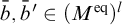 and that
$\mathrm {rk}^n(\bar {a} / \bar {b}) = r$
and that
$\mathrm {rk}^n(\bar {a} / \bar {b}) = r$
 . Then there is
$m < \omega $
. Then there is
$m < \omega $
 such that
$n \leq m$
such that
$n \leq m$
 ,
$\bar {a}, \bar {a}' \in (M_m)^k$
,
$\bar {a}, \bar {a}' \in (M_m)^k$
 , and
$\bar {b}, \bar {b}' \in (M_m)^l$
, and
$\bar {b}, \bar {b}' \in (M_m)^l$
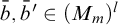 . Then
$\mathcal {M}^{\mathrm {eq}} \models \psi _r^m(\bar {a}, \bar {b})$
. Then
$\mathcal {M}^{\mathrm {eq}} \models \psi _r^m(\bar {a}, \bar {b})$
 , and if
$\mathrm {tp}(\bar {a}, \bar {b}) = \mathrm {tp}(\bar {a}', \bar {b}')$
, and if
$\mathrm {tp}(\bar {a}, \bar {b}) = \mathrm {tp}(\bar {a}', \bar {b}')$
 then also
$\mathcal {M}^{\mathrm {eq}} \models \psi _r^m(\bar {a}', \bar {b}')$
then also
$\mathcal {M}^{\mathrm {eq}} \models \psi _r^m(\bar {a}', \bar {b}')$
 , so
$\mathrm {rk}^n (\bar {a}' / \bar {b}') = r$
, so
$\mathrm {rk}^n (\bar {a}' / \bar {b}') = r$
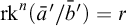 .
.
Lemma 3.14. Let
$B \subseteq C \subseteq M^{\mathrm {eq}}$
 be finite and
$a \in M^{\mathrm {eq}}$
be finite and
$a \in M^{\mathrm {eq}}$
 . If
$a \notin \mathrm {acl}^{\mathrm {eq}}(B)$
. If
$a \notin \mathrm {acl}^{\mathrm {eq}}(B)$
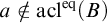 then there is
$a' \in M^{\mathrm {eq}}$
then there is
$a' \in M^{\mathrm {eq}}$
 such that
$\mathrm {tp}(a' / B) = \mathrm {tp}(a / B)$
such that
$\mathrm {tp}(a' / B) = \mathrm {tp}(a / B)$
 and
$a' \notin \mathrm {acl}^{\mathrm {eq}}(C)$
and
$a' \notin \mathrm {acl}^{\mathrm {eq}}(C)$
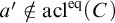 .
.
Proof. Let S be the sort of a. Since
$a \notin \mathrm {acl}^{\mathrm {eq}}(B)$
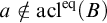 it follows that
$\mathrm {tp}(a / B)$
it follows that
$\mathrm {tp}(a / B)$
 has infinitely many realizations. As C is finite it follows (from
$\omega $
has infinitely many realizations. As C is finite it follows (from
$\omega $
 -categoricity) that
$\mathrm {acl}^{\mathrm {eq}}(C) \cap S$
-categoricity) that
$\mathrm {acl}^{\mathrm {eq}}(C) \cap S$
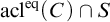 is finite and hence there is
$a' \notin \mathrm {acl}^{\mathrm {eq}}(C)$
is finite and hence there is
$a' \notin \mathrm {acl}^{\mathrm {eq}}(C)$
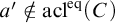 such that
$\mathrm {tp}(a' / B) = \mathrm {tp}(a / B)$
such that
$\mathrm {tp}(a' / B) = \mathrm {tp}(a / B)$
 .
.
Lemma 3.15. Suppose that
$\bar {d}$
 is a finite sequence of elements from
$M_n$
is a finite sequence of elements from
$M_n$
 ,
$B, C \subseteq M^{\mathrm {eq}}$
,
$B, C \subseteq M^{\mathrm {eq}}$
 are finite and
$B \subseteq C$
are finite and
$B \subseteq C$
 . Let
$\alpha = \mathrm {rk}^n(\bar {d} / B)$
. Let
$\alpha = \mathrm {rk}^n(\bar {d} / B)$
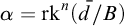 (so
$\alpha < \omega $
(so
$\alpha < \omega $
 ). Then there is a finite sequence
$\bar {d}'$
). Then there is a finite sequence
$\bar {d}'$
 of elements from
$M_n$
of elements from
$M_n$
 such that
$\mathrm {tp}(\bar {d}' / B) = \mathrm {tp}(\bar {d} / B)$
such that
$\mathrm {tp}(\bar {d}' / B) = \mathrm {tp}(\bar {d} / B)$
 and
$\mathrm {rk}^n(\bar {d}' / C) = \alpha $
and
$\mathrm {rk}^n(\bar {d}' / C) = \alpha $
 .
.
Proof. Let
$\bar {d}$
 be a finite sequence of elements from
$M_n$
be a finite sequence of elements from
$M_n$
 . Suppose that
${\alpha = \mathrm {rk}^n(\bar {d} / B)}$
. Suppose that
${\alpha = \mathrm {rk}^n(\bar {d} / B)}$
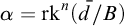 . By Lemma 3.5 there are
$a_1, \ldots , a_\alpha \in \mathrm {acl}^n(\bar {d})$
. By Lemma 3.5 there are
$a_1, \ldots , a_\alpha \in \mathrm {acl}^n(\bar {d})$
 such that,

In particular,
$\mathrm {rk}^n(a_1, \ldots , a_\alpha / B) = \alpha $
 and
$\mathrm {rk}^n(\bar {d} / \{a_1, \ldots , a_\alpha \} \cup B) = 0$
and
$\mathrm {rk}^n(\bar {d} / \{a_1, \ldots , a_\alpha \} \cup B) = 0$
 , so (as
$\mathrm {rng}(\bar {d}) \subseteq M_n$
, so (as
$\mathrm {rng}(\bar {d}) \subseteq M_n$
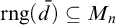 )
$\mathrm {rng}(\bar {d}) \subseteq \mathrm {acl}^n(\bar {d}) \subseteq \mathrm {acl}^n(\{a_1, \ldots , a_\alpha \} \cup B)$
)
$\mathrm {rng}(\bar {d}) \subseteq \mathrm {acl}^n(\bar {d}) \subseteq \mathrm {acl}^n(\{a_1, \ldots , a_\alpha \} \cup B)$
 and hence
$\mathrm {acl}^n(\bar {d}B) = \mathrm {acl}^n(\{a_1, \ldots , a_\alpha \} \cup B)$
and hence
$\mathrm {acl}^n(\bar {d}B) = \mathrm {acl}^n(\{a_1, \ldots , a_\alpha \} \cup B)$
 .
.
Suppose that
$k < \alpha $
 and that there are
$a^{\prime }_1, \ldots , a^{\prime }_k \in M_n$
and that there are
$a^{\prime }_1, \ldots , a^{\prime }_k \in M_n$
 such that


We will find
$a^{\prime }_{k+1}$
 so that the above also holds with k replaced by
$k+1$
so that the above also holds with k replaced by
$k+1$
 . Let
. Let

By (3.2),
$p(x, a_1, \ldots , a_k)$
 is non-algebraic. By (3.3), also
$p(x, a^{\prime }_1, \ldots , a^{\prime }_k)$
is non-algebraic. By (3.3), also
$p(x, a^{\prime }_1, \ldots , a^{\prime }_k)$
 is non-algebraic, so by Lemma 3.14 there is
$a^{\prime }_{k+1} \in M_n \setminus \mathrm {acl}^n(\{a^{\prime }_1, \ldots , a^{\prime }_k\} \cup C)$
is non-algebraic, so by Lemma 3.14 there is
$a^{\prime }_{k+1} \in M_n \setminus \mathrm {acl}^n(\{a^{\prime }_1, \ldots , a^{\prime }_k\} \cup C)$
 which realizes
$p(x, a^{\prime }_1, \ldots , a^{\prime }_k)$
which realizes
$p(x, a^{\prime }_1, \ldots , a^{\prime }_k)$
 , that is,
$\mathrm {tp}(a^{\prime }_1, \ldots , a^{\prime }_k, a^{\prime }_{k+1} / B) = \mathrm {tp}(a_1, \ldots , a_k, a_{k+1} / B)$
, that is,
$\mathrm {tp}(a^{\prime }_1, \ldots , a^{\prime }_k, a^{\prime }_{k+1} / B) = \mathrm {tp}(a_1, \ldots , a_k, a_{k+1} / B)$
 . Now (3.3) and (3.4) hold if k is replaced by
$k+1$
. Now (3.3) and (3.4) hold if k is replaced by
$k+1$
 . By induction it follows that there are
$a^{\prime }_1, \ldots , a^{\prime }_\alpha \in M_n$
. By induction it follows that there are
$a^{\prime }_1, \ldots , a^{\prime }_\alpha \in M_n$
 such that


From (3.5) it follows that there is
$\bar {d}'$
 such that

Then
$a^{\prime }_1, \ldots , a^{\prime }_\alpha \in \mathrm {acl}^n(\bar {d}')$
 . This together with (3.6) implies that
$\mathrm {rk}^n(\bar {d}' / C) \geq \alpha $
. This together with (3.6) implies that
$\mathrm {rk}^n(\bar {d}' / C) \geq \alpha $
 . From (3.7) and Lemma 3.13 we get
$\mathrm {rk}^n(\bar {d}' / B) = \mathrm {rk}^n(\bar {d} / B) = \alpha $
. From (3.7) and Lemma 3.13 we get
$\mathrm {rk}^n(\bar {d}' / B) = \mathrm {rk}^n(\bar {d} / B) = \alpha $
 . Since we must (by Lemma 3.9) have
$\mathrm {rk}^n(\bar {d}' / C) \leq \mathrm {rk}^n(\bar {d}' /B)$
. Since we must (by Lemma 3.9) have
$\mathrm {rk}^n(\bar {d}' / C) \leq \mathrm {rk}^n(\bar {d}' /B)$
 we get
$\mathrm {rk}^n(\bar {d}' / C) = \alpha $
we get
$\mathrm {rk}^n(\bar {d}' / C) = \alpha $
 . From (3.7) we get
$\mathrm {tp}(\bar {d}' / B) = \mathrm {tp}(\bar {d} / B)$
. From (3.7) we get
$\mathrm {tp}(\bar {d}' / B) = \mathrm {tp}(\bar {d} / B)$
 so the proof is completed.
Lemma 3.16. Suppose that
$\bar {d}$
 is a finite sequence of elements from
$M_n$
is a finite sequence of elements from
$M_n$
 ,
$B, C \subseteq M^{\mathrm {eq}}$
,
$B, C \subseteq M^{\mathrm {eq}}$
 and
$B \subseteq C$
and
$B \subseteq C$
 . Then there is a finite sequence
$\bar {d}'$
. Then there is a finite sequence
$\bar {d}'$
 of elements from
$M_n$
of elements from
$M_n$
 such that
$\mathrm {tp}(\bar {d}' / B) = \mathrm {tp}(\bar {d} / B)$
such that
$\mathrm {tp}(\bar {d}' / B) = \mathrm {tp}(\bar {d} / B)$
 and
$\mathrm {rk}^n(\bar {d}' / C) = \mathrm {rk}^n(\bar {d} / B)$
and
$\mathrm {rk}^n(\bar {d}' / C) = \mathrm {rk}^n(\bar {d} / B)$
 .
.
Proof. Let
$\bar {d}$
 be a finite sequence of elements from
$M_n$
be a finite sequence of elements from
$M_n$
 and let
$\alpha = \mathrm {rk}^n(\bar {d} / B)$
and let
$\alpha = \mathrm {rk}^n(\bar {d} / B)$
 . Hence
$\mathrm {rk}^n(\bar {d} / B') \geq \alpha $
. Hence
$\mathrm {rk}^n(\bar {d} / B') \geq \alpha $
 for every finite
$B' \subseteq B$
for every finite
$B' \subseteq B$
 . By Lemma 3.13, for all finite
$B' \subseteq B$
. By Lemma 3.13, for all finite
$B' \subseteq B$
 and finite
$C' \subseteq C$
and finite
$C' \subseteq C$
 there is a formula
$\varphi _{B'C'}(\bar {x})$
there is a formula
$\varphi _{B'C'}(\bar {x})$
 with parameters from
$B' \cup C'$
with parameters from
$B' \cup C'$
 that expresses that
$\mathrm {tp}(\bar {x} / B') = \mathrm {tp}(\bar {d} / B')$
that expresses that
$\mathrm {tp}(\bar {x} / B') = \mathrm {tp}(\bar {d} / B')$
 and
$\mathrm {rk}^n(\bar {x} / B'C') \geq \alpha $
and
$\mathrm {rk}^n(\bar {x} / B'C') \geq \alpha $
 . Let
$\Phi (\bar {x})$
. Let
$\Phi (\bar {x})$
 be the set of all such formulas
$\varphi _{B'C'}(\bar {x})$
be the set of all such formulas
$\varphi _{B'C'}(\bar {x})$
 as
$B'$
as
$B'$
 and
$C'$
and
$C'$
 varies over finite subsets of B and C, respectively. From Lemma 3.15 it follows that every finite subset of
$\Phi (\bar {x})$
varies over finite subsets of B and C, respectively. From Lemma 3.15 it follows that every finite subset of
$\Phi (\bar {x})$
 is consistent. From compactness it follows that
$\Phi (\bar {x})$
is consistent. From compactness it follows that
$\Phi (\bar {x})$
 is consistent. Let
$\bar {d}'$
is consistent. Let
$\bar {d}'$
 be a realization of the type
$\Phi (\bar {x})$
be a realization of the type
$\Phi (\bar {x})$
 . It follows that
$\mathrm {tp}(\bar {d}' / B) = \mathrm {tp}(\bar {d} / B)$
. It follows that
$\mathrm {tp}(\bar {d}' / B) = \mathrm {tp}(\bar {d} / B)$
 and, by Lemma 3.11, that
$\mathrm {rk}^n(\bar {d}' / C) \geq \alpha $
and, by Lemma 3.11, that
$\mathrm {rk}^n(\bar {d}' / C) \geq \alpha $
 . Since we must (by Lemmas 3.9 and 3.13) have
$\mathrm {rk}^n(\bar {d}' / C) \leq \mathrm {rk}^n(\bar {d}' / B) = \mathrm {rk}^n(\bar {d} / B) = \alpha $
. Since we must (by Lemmas 3.9 and 3.13) have
$\mathrm {rk}^n(\bar {d}' / C) \leq \mathrm {rk}^n(\bar {d}' / B) = \mathrm {rk}^n(\bar {d} / B) = \alpha $
 it follows that
$\mathrm {rk}^n(\bar {d}' / C) = \alpha $
it follows that
$\mathrm {rk}^n(\bar {d}' / C) = \alpha $
 .
.
4 n-independence
Now we are ready to define a hierarchy of independence relations, the notions of n-independence, for all
$n < \omega $
 . In this section we will prove that, for all
$n < \omega $
. In this section we will prove that, for all
$n < \omega $
 , n-independence has all properties of an independence relation restricted to
$M_n$
, n-independence has all properties of an independence relation restricted to
$M_n$
 with the possible exception of the symmetry property. Actually the restriction to
$M_n$
with the possible exception of the symmetry property. Actually the restriction to
$M_n$
 is only needed for the extension property. We also show that if the theory T has geometric elimination of imaginaries, then the hierarchy of n-independence relations collapses to the bottom level of 0-independence.
Definition 4.1. Let
$n < \omega $
 . For
$A, B, C \subseteq M^{\mathrm {eq}}$
. For
$A, B, C \subseteq M^{\mathrm {eq}}$
 define
$A \underset {C}{{\smile} \hspace {-6.8pt}{|^n} } B$
define
$A \underset {C}{{\smile} \hspace {-6.8pt}{|^n} } B$
 if and only if, for all finite
$A' \subseteq A$
if and only if, for all finite
$A' \subseteq A$
 ,
$\mathrm {rk}^n(A' / BC) = \mathrm {rk}^n(A' / C)$
,
$\mathrm {rk}^n(A' / BC) = \mathrm {rk}^n(A' / C)$
 . If
$\bar {a}$
. If
$\bar {a}$
 and
$\bar {b}$
and
$\bar {b}$
 are sequences then
$\bar {a} \underset {C}{{\smile} \hspace {-6.8pt}{|^n} } \bar {b}$
are sequences then
$\bar {a} \underset {C}{{\smile} \hspace {-6.8pt}{|^n} } \bar {b}$
 means the same as
$\mathrm {rng}(\bar {a}) \underset {C}{{\smile} \hspace {-6.8pt}{|^n} } \mathrm {rng}(\bar {b})$
means the same as
$\mathrm {rng}(\bar {a}) \underset {C}{{\smile} \hspace {-6.8pt}{|^n} } \mathrm {rng}(\bar {b})$
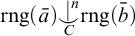 .
.
Example 4.2. Let T be as in Example 3.3,
$\mathcal {M} \models T,$
 and let
$a, b \in M$
and let
$a, b \in M$
 be distinct and such that
$[a]_E = [b]_E$
be distinct and such that
$[a]_E = [b]_E$
 . By the conclusions in that example we get
$\mathrm {rk}^0(a / b) = \mathrm {rk}^0(a)$
. By the conclusions in that example we get
$\mathrm {rk}^0(a / b) = \mathrm {rk}^0(a)$
 and
$\mathrm {rk}^1(a / b) = 1 < 2 = \mathrm {rk}^1(a)$
and
$\mathrm {rk}^1(a / b) = 1 < 2 = \mathrm {rk}^1(a)$
 . Hence
$a \underset {\emptyset }{{\smile} \hspace {-6.8pt}{|^0} } b$
. Hence
$a \underset {\emptyset }{{\smile} \hspace {-6.8pt}{|^0} } b$
 and
and
 .
.
For the rest of this section we fix an arbitrary
$n < \omega $
 .
.
Lemma 4.3. (Invariance)
Suppose that
$\sigma $
 is an elementary function from a subset of
$M^{\mathrm {eq}}$
is an elementary function from a subset of
$M^{\mathrm {eq}}$
 to a subset of
$M^{\mathrm {eq}}$
to a subset of
$M^{\mathrm {eq}}$
 and that
$A, B$
and that
$A, B$
 , and C are subsets of the domain of
$\sigma $
, and C are subsets of the domain of
$\sigma $
 . If
$A \underset {C}{{\smile} \hspace {-6.8pt}{|^n} } B$
. If
$A \underset {C}{{\smile} \hspace {-6.8pt}{|^n} } B$
 then
$\sigma (A) \underset {\sigma (C)}{{\smile} \hspace {-6.8pt}{|^n} } \sigma (B)$
then
$\sigma (A) \underset {\sigma (C)}{{\smile} \hspace {-6.8pt}{|^n} } \sigma (B)$
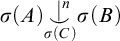 .
.
Proof. Suppose that
$\sigma $
 is an elementary function and that
$A, B$
is an elementary function and that
$A, B$
 , and C are subsets of the domain of
$\sigma $
, and C are subsets of the domain of
$\sigma $
 . Suppose that
$A \underset {C}{{\smile} \hspace {-6.8pt}{|^n} } B$
. Suppose that
$A \underset {C}{{\smile} \hspace {-6.8pt}{|^n} } B$
 , so by Definition 4.1 of
${\smile} \hspace {-6.8pt}{|^n} $
, so by Definition 4.1 of
${\smile} \hspace {-6.8pt}{|^n} $
 we have
$\mathrm {rk}^n(A' / BC) = \mathrm {rk}^n(A' / C)$
we have
$\mathrm {rk}^n(A' / BC) = \mathrm {rk}^n(A' / C)$
 for all finite
$A' \subseteq A$
for all finite
$A' \subseteq A$
 . It suffices to show that for every finite
$A' \subseteq A$
. It suffices to show that for every finite
$A' \subseteq A$
 ,
$\mathrm {rk}^n(\sigma (A') / \sigma (B)\sigma (C)) = \mathrm {rk}^n(\sigma (A') / \sigma (C))$
,
$\mathrm {rk}^n(\sigma (A') / \sigma (B)\sigma (C)) = \mathrm {rk}^n(\sigma (A') / \sigma (C))$
 . This follows if we can show that for all
$A, B \subseteq M^{\mathrm {eq}}$
. This follows if we can show that for all
$A, B \subseteq M^{\mathrm {eq}}$
 where A is finite,
$\mathrm {rk}^n(A / B) = \mathrm {rk}^n(\sigma (A) / \sigma (B))$
where A is finite,
$\mathrm {rk}^n(A / B) = \mathrm {rk}^n(\sigma (A) / \sigma (B))$
 . Since also the inverse of
$\sigma $
. Since also the inverse of
$\sigma $
 is an elementary function, it actually suffices to show that
$\mathrm {rk}^n(A / B) \geq \mathrm {rk}^n(\sigma (A) / \sigma (B))$
is an elementary function, it actually suffices to show that
$\mathrm {rk}^n(A / B) \geq \mathrm {rk}^n(\sigma (A) / \sigma (B))$
 .
.
So let
$A = \{a_1, \ldots , a_k\} \subseteq A$
 be finite. Lemma 3.11 tells that there is finite
${B' = \{b_1, \ldots , b_l\} \subseteq B}$
be finite. Lemma 3.11 tells that there is finite
${B' = \{b_1, \ldots , b_l\} \subseteq B}$
 such that
$\mathrm {rk}^n(A / B') = \mathrm {rk}^n(A / B)$
such that
$\mathrm {rk}^n(A / B') = \mathrm {rk}^n(A / B)$
 . Since
$\mathrm {tp}(a_1, \ldots , a_k, b_1, \ldots , b_l) = \mathrm {tp}(\sigma (a_1), \ldots , \sigma (a_k), \sigma (b_1), \ldots , \sigma (b_l))$
. Since
$\mathrm {tp}(a_1, \ldots , a_k, b_1, \ldots , b_l) = \mathrm {tp}(\sigma (a_1), \ldots , \sigma (a_k), \sigma (b_1), \ldots , \sigma (b_l))$
 it follows from Lemmas 3.9 and 3.13 that

Lemma 4.4. (Monotonicity)
Let
$A, B, C, D \subseteq M^{\mathrm {eq}}$
 where
$B \subseteq C \subseteq D$
where
$B \subseteq C \subseteq D$
 .
.
If
$A \underset {B}{{\smile} \hspace {-6.8pt}{|^n} } D$
 , then
$A \underset {B}{{\smile} \hspace {-6.8pt}{|^n} } C$
, then
$A \underset {B}{{\smile} \hspace {-6.8pt}{|^n} } C$
 and
$A \underset {C}{{\smile} \hspace {-6.8pt}{|^n} } D$
and
$A \underset {C}{{\smile} \hspace {-6.8pt}{|^n} } D$
 .
.
Proof. Let
$A, B, C, D \subseteq M^{\mathrm {eq}}$
 where
$B \subseteq C \subseteq D$
where
$B \subseteq C \subseteq D$
 . Suppose that
$A \underset {B}{{\smile} \hspace {-6.8pt}{|^n} } D$
. Suppose that
$A \underset {B}{{\smile} \hspace {-6.8pt}{|^n} } D$
 and let
$A' \subseteq A$
and let
$A' \subseteq A$
 be finite. Then
$\mathrm {rk}^n(A' / D) = \mathrm {rk}^n(A' / B)$
be finite. Then
$\mathrm {rk}^n(A' / D) = \mathrm {rk}^n(A' / B)$
 . By Lemma 3.9,
$\mathrm {rk}^n(A' / B) = \mathrm {rk}^n(A' / D) \leq \mathrm {rk}^n(A' / C) \leq \mathrm {rk}^n(A' / B)$
. By Lemma 3.9,
$\mathrm {rk}^n(A' / B) = \mathrm {rk}^n(A' / D) \leq \mathrm {rk}^n(A' / C) \leq \mathrm {rk}^n(A' / B)$
 . Hence
$\mathrm {rk}^n(A' / D) = \mathrm {rk}^n(A' / C) = \mathrm {rk}^n(A' / B)$
. Hence
$\mathrm {rk}^n(A' / D) = \mathrm {rk}^n(A' / C) = \mathrm {rk}^n(A' / B)$
 and thus
$A \underset {B}{{\smile} \hspace {-6.8pt}{|^n} } C$
and thus
$A \underset {B}{{\smile} \hspace {-6.8pt}{|^n} } C$
 and
$A \underset {C}{{\smile} \hspace {-6.8pt}{|^n} } D$
and
$A \underset {C}{{\smile} \hspace {-6.8pt}{|^n} } D$
 .
.
Lemma 4.5. (Transitivity)s
Suppose that
$A, B, C, D \subseteq M^{\mathrm {eq}}$
 and
$B \subseteq C \subseteq D$
and
$B \subseteq C \subseteq D$
 . If
$A \underset {B}{{\smile} \hspace {-6.8pt}{|^n} } C$
. If
$A \underset {B}{{\smile} \hspace {-6.8pt}{|^n} } C$
 and
$A \underset {C}{{\smile} \hspace {-6.8pt}{|^n} } D$
and
$A \underset {C}{{\smile} \hspace {-6.8pt}{|^n} } D$
 then
$A \underset {B}{{\smile} \hspace {-6.8pt}{|^n} } D$
then
$A \underset {B}{{\smile} \hspace {-6.8pt}{|^n} } D$
 .
.
Proof. Suppose that
$A, B, C, D \subseteq M^{\mathrm {eq}}$
 and
$B \subseteq C \subseteq D$
and
$B \subseteq C \subseteq D$
 . By the definition of n-independence it suffices to prove that for all finite
$A' \subseteq A$
. By the definition of n-independence it suffices to prove that for all finite
$A' \subseteq A$
 , if
$A' \underset {B}{{\smile} \hspace {-6.8pt}{|^n} } C$
, if
$A' \underset {B}{{\smile} \hspace {-6.8pt}{|^n} } C$
 and
$A' \underset {C}{{\smile} \hspace {-6.8pt}{|^n} } D$
and
$A' \underset {C}{{\smile} \hspace {-6.8pt}{|^n} } D$
 then
$A' \underset {B}{{\smile} \hspace {-6.8pt}{|^n} } D$
then
$A' \underset {B}{{\smile} \hspace {-6.8pt}{|^n} } D$
 . Therefore we can assume that A is finite. So suppose that
$A \underset {B}{{\smile} \hspace {-6.8pt}{|^n} } C$
. Therefore we can assume that A is finite. So suppose that
$A \underset {B}{{\smile} \hspace {-6.8pt}{|^n} } C$
 and
$A \underset {C}{{\smile} \hspace {-6.8pt}{|^n} } D$
and
$A \underset {C}{{\smile} \hspace {-6.8pt}{|^n} } D$
 . Then
$\mathrm {rk}^n(A / B) = \mathrm {rk}^n(A / C) = \mathrm {rk}^n(A / D)$
. Then
$\mathrm {rk}^n(A / B) = \mathrm {rk}^n(A / C) = \mathrm {rk}^n(A / D)$
 , so
$A \underset {B}{{\smile} \hspace {-6.8pt}{|^n} } D$
, so
$A \underset {B}{{\smile} \hspace {-6.8pt}{|^n} } D$
 .
.
Lemma 4.6. (Finite character)
Let
$A, B, C \subseteq M^{\mathrm {eq}}$
 and suppose that
$A \underset {C}{{\smile} \hspace {-6.8pt}{|^n}\hspace {-12pt} {\diagup} } B$
and suppose that
$A \underset {C}{{\smile} \hspace {-6.8pt}{|^n}\hspace {-12pt} {\diagup} } B$
 . Then there are finite
$A' \subseteq A$
. Then there are finite
$A' \subseteq A$
 and finite
$B' \subseteq B$
and finite
$B' \subseteq B$
 such that
$A' \underset {C}{{\smile} \hspace {-6.8pt}{|^n}\hspace {-12pt} {\diagup} } B'$
such that
$A' \underset {C}{{\smile} \hspace {-6.8pt}{|^n}\hspace {-12pt} {\diagup} } B'$
 .
.
Proof. If
$A \underset {C}{{\smile} \hspace {-6.8pt}{|^n}\hspace {-12pt} {\diagup} } B$
 then (by definition of
${\smile} \hspace {-6.8pt}{|^n}\hspace {-12pt} {\diagup} $
then (by definition of
${\smile} \hspace {-6.8pt}{|^n}\hspace {-12pt} {\diagup} $
 )
$A' \underset {C}{{\smile} \hspace {-6.8pt}{|^n}\hspace {-12pt} {\diagup} } B$
)
$A' \underset {C}{{\smile} \hspace {-6.8pt}{|^n}\hspace {-12pt} {\diagup} } B$
 for some finite
$A' \subseteq A$
for some finite
$A' \subseteq A$
 . Then
$\mathrm {rk}^n(A' / BC) < \mathrm {rk}^n(A' / C)$
. Then
$\mathrm {rk}^n(A' / BC) < \mathrm {rk}^n(A' / C)$
 . By Lemma 3.11(i) there is finite
$B' \subseteq B$
. By Lemma 3.11(i) there is finite
$B' \subseteq B$
 such that
$\mathrm {rk}^n(A' / B'C)\, <\, \mathrm {rk}^n(A' / C)$
such that
$\mathrm {rk}^n(A' / B'C)\, <\, \mathrm {rk}^n(A' / C)$
 . Hence
$A' \underset {C}{{\smile} \hspace {-6.8pt}{|^n}\hspace {-12pt} {\diagup} } B'$
. Hence
$A' \underset {C}{{\smile} \hspace {-6.8pt}{|^n}\hspace {-12pt} {\diagup} } B'$
 .
.
Lemma 4.7. (Locality)
If
$A, B \subseteq M^{\mathrm {eq}}$
 and A is finite then there is finite
$C \subseteq B$
and A is finite then there is finite
$C \subseteq B$
 such that
$A \underset {C}{{\smile} \hspace {-6.8pt}{|^n} } B$
such that
$A \underset {C}{{\smile} \hspace {-6.8pt}{|^n} } B$
 .
.
Proof. Let
$A, B \subseteq M^{\mathrm {eq}}$
 and suppose that A is finite. From Lemma 3.11(ii) it follows that there is a finite
$C \subseteq B$
and suppose that A is finite. From Lemma 3.11(ii) it follows that there is a finite
$C \subseteq B$
 such that
$\mathrm {rk}^n(A / C) = \mathrm {rk}^n(A / B)$
such that
$\mathrm {rk}^n(A / C) = \mathrm {rk}^n(A / B)$
 . Hence
$A \underset {C}{{\smile} \hspace {-6.8pt}{|^n} } B$
. Hence
$A \underset {C}{{\smile} \hspace {-6.8pt}{|^n} } B$
 .
.
Lemma 4.8. (Extension)
Let
$\bar {a}$
 be a finite sequence of elements from
$M_n$
be a finite sequence of elements from
$M_n$
 , and let
$B, C \subseteq M^{\mathrm {eq}}$
, and let
$B, C \subseteq M^{\mathrm {eq}}$
 where
$B \subseteq C$
where
$B \subseteq C$
 . Then there is
$\bar {a}' \subseteq M^{\mathrm {eq}}$
. Then there is
$\bar {a}' \subseteq M^{\mathrm {eq}}$
 such that
$\mathrm {tp}(\bar {a}' / B) = \mathrm {tp}(\bar {a} / B)$
such that
$\mathrm {tp}(\bar {a}' / B) = \mathrm {tp}(\bar {a} / B)$
 and
$\bar {a}' \underset {B}{{\smile} \hspace {-6.8pt}{|^n} } C$
and
$\bar {a}' \underset {B}{{\smile} \hspace {-6.8pt}{|^n} } C$
 .
.
Proof. Under the given assumptions, Lemma 3.16 implies that there is a finite sequence
$\bar {a}'$
 of elements from
$M_n$
of elements from
$M_n$
 such that
$\mathrm {tp}(\bar {a}' / B) = \mathrm {tp}(\bar {a} / B)$
such that
$\mathrm {tp}(\bar {a}' / B) = \mathrm {tp}(\bar {a} / B)$
 and
$\mathrm {rk}^n(\bar {a}' / C) = \mathrm {rk}^n(\bar {a} / B)$
and
$\mathrm {rk}^n(\bar {a}' / C) = \mathrm {rk}^n(\bar {a} / B)$
 . Hence
$\mathrm {rk}^n(\bar {a}' / B) = \mathrm {rk}^n(\bar {a} / B)$
. Hence
$\mathrm {rk}^n(\bar {a}' / B) = \mathrm {rk}^n(\bar {a} / B)$
 , so
$\bar {a}' \underset {B}{{\smile} \hspace {-6.8pt}{|^n} } C$
, so
$\bar {a}' \underset {B}{{\smile} \hspace {-6.8pt}{|^n} } C$
 .
.
Lemma 4.9. Suppose that T has geometric elimination of imaginaries. For all
$n < \omega $
 and all
$A, B, C \subseteq M^{\mathrm {eq}}$
and all
$A, B, C \subseteq M^{\mathrm {eq}}$
 we have
$A \underset {C}{{\smile} \hspace {-6.8pt}{|^n} } B$
we have
$A \underset {C}{{\smile} \hspace {-6.8pt}{|^n} } B$
 if and only if
$A \underset {C}{{\smile} \hspace {-6.8pt}{|^0} } B$
if and only if
$A \underset {C}{{\smile} \hspace {-6.8pt}{|^0} } B$
 .
.
Proof. By definition of
${\smile} \hspace {-6.8pt}{|^n} $
 ,
$A \underset {C}{{\smile} \hspace {-6.8pt}{|^n} } B$
,
$A \underset {C}{{\smile} \hspace {-6.8pt}{|^n} } B$
 if and only if
$\mathrm {rk}^n(A' / BC) = \mathrm {rk}^n(A' / C)$
if and only if
$\mathrm {rk}^n(A' / BC) = \mathrm {rk}^n(A' / C)$
 for all finite
$A' \subseteq A$
for all finite
$A' \subseteq A$
 . Under the assumption that T has geometric elimination of imaginaries, Lemma 3.8 implies that
$\mathrm {rk}^n(A' / BC) = \mathrm {rk}^0(A' / BC)$
. Under the assumption that T has geometric elimination of imaginaries, Lemma 3.8 implies that
$\mathrm {rk}^n(A' / BC) = \mathrm {rk}^0(A' / BC)$
 and
$\mathrm {rk}^n(A' / C) = \mathrm {rk}^0(A' / C)$
and
$\mathrm {rk}^n(A' / C) = \mathrm {rk}^0(A' / C)$
 for all finite
$A' \subseteq A$
for all finite
$A' \subseteq A$
 . Hence
$A \underset {C}{{\smile} \hspace {-6.8pt}{|^n} } B$
. Hence
$A \underset {C}{{\smile} \hspace {-6.8pt}{|^n} } B$
 if and only if
$A \underset {C}{{\smile} \hspace {-6.8pt}{|^0} } B$
if and only if
$A \underset {C}{{\smile} \hspace {-6.8pt}{|^0} } B$
 .
.
5 The exchange property and symmetry
According to the results in Section 4, for each
$n < \omega $
 ,
${\smile} \hspace {-6.8pt}{|^n} $
,
${\smile} \hspace {-6.8pt}{|^n} $
 has all properties of an independence relation restricted to
$M_n$
has all properties of an independence relation restricted to
$M_n$
 with the possible exception of the symmetry property. In this section we prove that, for any
$n < \omega $
with the possible exception of the symmetry property. In this section we prove that, for any
$n < \omega $
 , the symmetry of
${\smile} \hspace {-6.8pt}{|^n} $
, the symmetry of
${\smile} \hspace {-6.8pt}{|^n} $
 is a consequence of a more restricted symmetry property, namely that the following assumption holds.
Assumption 5.1. (Exchange property with respect to n)
In this section we fix an arbitrary
$n < \omega $
 . We assume that if
$C \subseteq M^{\mathrm {eq}}$
. We assume that if
$C \subseteq M^{\mathrm {eq}}$
 ,
$2 \leq k < \omega $
,
$2 \leq k < \omega $
 ,
$a_1, \ldots , a_k \in M_n$
,
$a_1, \ldots , a_k \in M_n$
 ,
$\mathrm {rk}^n(a_i / C) = 1$
,
$\mathrm {rk}^n(a_i / C) = 1$
 for all
$i = 1, \ldots , k$
for all
$i = 1, \ldots , k$
 , and
$a_k \in \mathrm {acl}^{\mathrm {eq}}(\{a_1, \ldots , a_{k-1}\} \cup C) \setminus \mathrm {acl}^{\mathrm {eq}}(\{a_2, \ldots , a_{k-1}\} \cup C)$
, and
$a_k \in \mathrm {acl}^{\mathrm {eq}}(\{a_1, \ldots , a_{k-1}\} \cup C) \setminus \mathrm {acl}^{\mathrm {eq}}(\{a_2, \ldots , a_{k-1}\} \cup C)$
 , then
$a_1 \in \mathrm {acl}^{\mathrm {eq}}(\{a_2, \ldots , a_k\} \cup C)$
, then
$a_1 \in \mathrm {acl}^{\mathrm {eq}}(\{a_2, \ldots , a_k\} \cup C)$
 .
.
Lemma 5.2. Let
$C \subseteq M^{\mathrm {eq}}$
 ,
$X = \{d \in M_n : \mathrm {rk}^n(d / C) = 1\}$
,
$X = \{d \in M_n : \mathrm {rk}^n(d / C) = 1\}$
 , and for every
$A \subseteq X$
, and for every
$A \subseteq X$
 , let
$\mathrm {cl}(A) = \mathrm {acl}^n(AC) \cap X$
, let
$\mathrm {cl}(A) = \mathrm {acl}^n(AC) \cap X$
 . Then
$(X, \mathrm {cl})$
. Then
$(X, \mathrm {cl})$
 is a pregeometry.
Proof. It is well-known that for all
$A \subseteq M^{\mathrm {eq}}$
 ,
$A \subseteq \mathrm {acl}^{\mathrm {eq}}(A)$
,
$A \subseteq \mathrm {acl}^{\mathrm {eq}}(A)$
 ,
$\mathrm {acl}^{\mathrm {eq}}(\mathrm {acl}^{\mathrm {eq}}(A)) = \mathrm {acl}^{\mathrm {eq}}(A)$
,
$\mathrm {acl}^{\mathrm {eq}}(\mathrm {acl}^{\mathrm {eq}}(A)) = \mathrm {acl}^{\mathrm {eq}}(A)$
 , and if
$a \in \mathrm {acl}^{\mathrm {eq}}(A)$
, and if
$a \in \mathrm {acl}^{\mathrm {eq}}(A)$
 then
$a \in \mathrm {acl}^{\mathrm {eq}}(A')$
then
$a \in \mathrm {acl}^{\mathrm {eq}}(A')$
 for some finite
$A' \subseteq A$
for some finite
$A' \subseteq A$
 . It follows straightforwardly that
$\mathrm {cl}$
. It follows straightforwardly that
$\mathrm {cl}$
 has properties (1)–(3) in Definition 2.10, even without Assumption 5.1. Suppose that
$A \subseteq X$
has properties (1)–(3) in Definition 2.10, even without Assumption 5.1. Suppose that
$A \subseteq X$
 ,
$b, c \in X$
,
$b, c \in X$
 , and
$b \in \mathrm {cl}(A \cup \{c\}) \setminus \mathrm {cl}(A)$
, and
$b \in \mathrm {cl}(A \cup \{c\}) \setminus \mathrm {cl}(A)$
 . Then there is finite
$A' \subseteq A$
. Then there is finite
$A' \subseteq A$
 such that
$b \in \mathrm {cl}(A' \cup \{c\}) \setminus \mathrm {cl}(A)$
such that
$b \in \mathrm {cl}(A' \cup \{c\}) \setminus \mathrm {cl}(A)$
 . By Assumption 5.1, we get
$c \in \mathrm {cl}(A \cup \{b\})$
. By Assumption 5.1, we get
$c \in \mathrm {cl}(A \cup \{b\})$
 . Hence
$(X, \mathrm {cl})$
. Hence
$(X, \mathrm {cl})$
 is a pregeometry.
Due to Lemma 5.2, whenever
$C \subseteq M^{\mathrm {eq}}$
 ,
$X = \{d \in M_n : \mathrm {rk}^n(d / C) = 1\}$
,
$X = \{d \in M_n : \mathrm {rk}^n(d / C) = 1\}$
 , and
$A \subseteq X$
, and
$A \subseteq X$
 it makes sense to talk about a basis of A and the dimension of A with respect to
$(X, \mathrm {cl})$
it makes sense to talk about a basis of A and the dimension of A with respect to
$(X, \mathrm {cl})$
 where
$\mathrm {cl}$
where
$\mathrm {cl}$
 is defined as in Lemma 5.2.
Definition 5.3. Let
$A, B \subseteq M^{\mathrm {eq}}$
 and suppose that A is finite. An n-canonical coordinatization sequence (n-ccs) for
$A/B$
and suppose that A is finite. An n-canonical coordinatization sequence (n-ccs) for
$A/B$
 (“A over B”) is a (finite) sequence
$a_1, \ldots , a_\alpha \in \mathrm {acl}^n(A)$
(“A over B”) is a (finite) sequence
$a_1, \ldots , a_\alpha \in \mathrm {acl}^n(A)$
 together with a core sequence of indices
$0 = k_0 < k_1 < \cdots < k_m = \alpha $
together with a core sequence of indices
$0 = k_0 < k_1 < \cdots < k_m = \alpha $
 such that
-
(1) $\mathrm {acl}^n(A) \subseteq \mathrm {acl}^n(\{a_1, \ldots , a_\alpha \} \cup B),$
and -
(2) for all $j = 0, \ldots , m-1$
,
$\{a_{k_j + 1}, \ldots , a_{k_{j+1}}\}$
is a basis of $$\begin{align*}\mathrm{acl}^n(A) \cap \{d \in M_n : \mathrm{rk}^n(d / \{a_1, \ldots, a_{k_j}\} \cup B) = 1 \}. \end{align*}$$




Lemma 5.4. Let
$A, B \subseteq M^{\mathrm {eq}}$
 where A is finite.
(i) There is an n-ccs for
$A/B$
 .
.
(ii) Suppose that
$a_1, \ldots , a_\alpha $
 and
$a^{\prime }_1, \ldots , a^{\prime }_{\alpha '}$
and
$a^{\prime }_1, \ldots , a^{\prime }_{\alpha '}$
 are two n-ccs for
$A/B$
are two n-ccs for
$A/B$
 with core sequences
$0 = k_0 < k_1 < \cdots < k_s = \alpha $
with core sequences
$0 = k_0 < k_1 < \cdots < k_s = \alpha $
 and
$0 = l_0 < l_1 < \cdots < l_t = \alpha '$
and
$0 = l_0 < l_1 < \cdots < l_t = \alpha '$
 , respectively. Then
$s = t$
, respectively. Then
$s = t$
 and, for all
$i = 0, \ldots , s$
and, for all
$i = 0, \ldots , s$
 ,
$k_i = l_i$
,
$k_i = l_i$
 (so
$\alpha = \alpha '$
(so
$\alpha = \alpha '$
 ). Moreover, for all
$m = 1, \ldots , s$
). Moreover, for all
$m = 1, \ldots , s$
 ,
$\mathrm {acl}^{\mathrm {eq}}(\{a_1, \ldots , a_{k_m}\} \cup B) = \mathrm {acl}^{\mathrm {eq}}(\{a^{\prime }_1, \ldots , a^{\prime }_{k_m}\} \cup B)$
,
$\mathrm {acl}^{\mathrm {eq}}(\{a_1, \ldots , a_{k_m}\} \cup B) = \mathrm {acl}^{\mathrm {eq}}(\{a^{\prime }_1, \ldots , a^{\prime }_{k_m}\} \cup B)$
 .
.
Proof. We prove part (i) and point out during the argument why the uniqueness properties of part (ii) follow. Suppose that
$\mathrm {acl}^n(A) \not \subseteq \mathrm {acl}^n(B)$
 for otherwise the empty sequence has the required properties. By convention let
$k_0 = 0$
for otherwise the empty sequence has the required properties. By convention let
$k_0 = 0$
 . By Lemma 3.10 the following set is nonempty:

By Lemma 5.2
$(\{d \in M_n : \mathrm {rk}^n(d / B) = 1 \}, \mathrm {cl})$
 with
$\mathrm {cl}(Y) = \mathrm {acl}^n(YB) \cap \{d \in M_n : \mathrm {rk}^n(d / B) = 1 \}$
with
$\mathrm {cl}(Y) = \mathrm {acl}^n(YB) \cap \{d \in M_n : \mathrm {rk}^n(d / B) = 1 \}$
 for all
$Y \subseteq \{d \in M_n : \mathrm {rk}^n(d / B) = 1 \}$
for all
$Y \subseteq \{d \in M_n : \mathrm {rk}^n(d / B) = 1 \}$
 is a pregeometry. Let
$k_1$
is a pregeometry. Let
$k_1$
 be the dimension of
$X_1$
be the dimension of
$X_1$
 and let
$\{a_1, \ldots , a_{k_1}\} \subseteq X_1$
and let
$\{a_1, \ldots , a_{k_1}\} \subseteq X_1$
 be a basis of
$X_1$
be a basis of
$X_1$
 . Note that
$k_1$
. Note that
$k_1$
 is determined only by A,
$B,$
is determined only by A,
$B,$
 and n. Also observe that for any other basis
$\{a^{\prime }_1, \ldots , a^{\prime }_{k_1}\} \subseteq X_1$
and n. Also observe that for any other basis
$\{a^{\prime }_1, \ldots , a^{\prime }_{k_1}\} \subseteq X_1$
 we have
$\mathrm {acl}^{\mathrm {eq}}(\{a^{\prime }_1, \ldots , a^{\prime }_{k_1}\} \cup B) = \mathrm {acl}^{\mathrm {eq}}(\{a_1, \ldots , a_{k_1}\} \cup B)$
we have
$\mathrm {acl}^{\mathrm {eq}}(\{a^{\prime }_1, \ldots , a^{\prime }_{k_1}\} \cup B) = \mathrm {acl}^{\mathrm {eq}}(\{a_1, \ldots , a_{k_1}\} \cup B)$
 .
.
Now suppose that, for some m,
$k_1 < \cdots < k_m$
 and
$a_1, \ldots , a_{k_m} \in \mathrm {acl}^n(A)$
and
$a_1, \ldots , a_{k_m} \in \mathrm {acl}^n(A)$
 have been defined in such a way that, for all
$j = 0, \ldots , m-1$
have been defined in such a way that, for all
$j = 0, \ldots , m-1$
 ,
$\{a_{k_j + 1}, \ldots , a_{k_{j+1}}\}$
,
$\{a_{k_j + 1}, \ldots , a_{k_{j+1}}\}$
 is a basis of

Also suppose that the uniqueness properties of part (ii) hold for
$k_1, \ldots , k_m$
 and
$\mathrm {acl}^{\mathrm {eq}}(\, \{a_1, \ldots , a_{k_i}\}\, \cup B)$
and
$\mathrm {acl}^{\mathrm {eq}}(\, \{a_1, \ldots , a_{k_i}\}\, \cup B)$
 for
$i \leq m$
for
$i \leq m$
 . If
$\mathrm {acl}^n(A) \subseteq \mathrm {acl}^n(\{a_1, \ldots , a_{k_m}\} \cup B)$
. If
$\mathrm {acl}^n(A) \subseteq \mathrm {acl}^n(\{a_1, \ldots , a_{k_m}\} \cup B)$
 then we let
$\alpha = k_m$
then we let
$\alpha = k_m$
 and then
$a_1, \ldots , a_\alpha $
and then
$a_1, \ldots , a_\alpha $
 is an n-ccs for
$A/B$
is an n-ccs for
$A/B$
 .
.
Suppose that
$\mathrm {acl}^n(A) \not \subseteq \mathrm {acl}^n(\{a_1, \ldots , a_{k_m}\} \cup B)$
 . By Lemma 3.10 the set

is nonempty. Let d be the dimension of
$X_{m+1}$
 , let
$k_{m+1} = k_m + d$
, let
$k_{m+1} = k_m + d$
 , and let

be a basis of
$X_{m+1}$
 . Note that
$k_{m+1}$
. Note that
$k_{m+1}$
 depends only on
$k_m$
depends only on
$k_m$
 and the dimension of
$X_{m+1}$
and the dimension of
$X_{m+1}$
 where the latter depends only on A, B,
$a_1, \ldots , a_{k_m}$
where the latter depends only on A, B,
$a_1, \ldots , a_{k_m}$
 , and n. The inductive assumption that for any choice of
$a^{\prime }_1, \ldots , a^{\prime }_{k_m}$
, and n. The inductive assumption that for any choice of
$a^{\prime }_1, \ldots , a^{\prime }_{k_m}$
 with the same properties as
$a_1, \ldots , a_{k_m}$
with the same properties as
$a_1, \ldots , a_{k_m}$
 we have
$\mathrm {acl}^{\mathrm {eq}}(\{a^{\prime }_1, \ldots , a^{\prime }_{k_m}\} \cup B) = \mathrm {acl}^{\mathrm {eq}}(\{a_1, \ldots , a_{k_m}\} \cup B)$
we have
$\mathrm {acl}^{\mathrm {eq}}(\{a^{\prime }_1, \ldots , a^{\prime }_{k_m}\} \cup B) = \mathrm {acl}^{\mathrm {eq}}(\{a_1, \ldots , a_{k_m}\} \cup B)$
 implies that
$\mathrm {acl}^{\mathrm {eq}}(\{a^{\prime }_1, \ldots , a^{\prime }_{k_{m+1}}\} \cup B) = \mathrm {acl}^{\mathrm {eq}}(\{a_1, \ldots , a_{k_{m+1}}\} \cup B)$
implies that
$\mathrm {acl}^{\mathrm {eq}}(\{a^{\prime }_1, \ldots , a^{\prime }_{k_{m+1}}\} \cup B) = \mathrm {acl}^{\mathrm {eq}}(\{a_1, \ldots , a_{k_{m+1}}\} \cup B)$
 for any basis
$\{a^{\prime }_{k_m + 1}, \ldots , a^{\prime }_{k_{m+1}}\} \subseteq X_{m+1}$
for any basis
$\{a^{\prime }_{k_m + 1}, \ldots , a^{\prime }_{k_{m+1}}\} \subseteq X_{m+1}$
 . It also implies that, ultimately,
$k_{m+1}$
. It also implies that, ultimately,
$k_{m+1}$
 depends only on A,
$B,$
depends only on A,
$B,$
 and n.
Observe that for all
$i = 1, \ldots , k_{m+1}$
 ,
$a_i \notin \mathrm {acl}^n(\{a_1, \ldots , a_{i-1}\} \cup B)$
,
$a_i \notin \mathrm {acl}^n(\{a_1, \ldots , a_{i-1}\} \cup B)$
 so by Lemma 3.5 we have
$\mathrm {rk}^n(A / B) \geq k_{m+1}$
so by Lemma 3.5 we have
$\mathrm {rk}^n(A / B) \geq k_{m+1}$
 . Since
$\mathrm {rk}^n(A / B)$
. Since
$\mathrm {rk}^n(A / B)$
 is finite (as A is finite) it follows that the process of extending the current sequence
$a_1, \ldots , a_{k_{m+1}}$
is finite (as A is finite) it follows that the process of extending the current sequence
$a_1, \ldots , a_{k_{m+1}}$
 in the described way will terminate after finitely many steps and then we have an n-ccs for
$A/B$
in the described way will terminate after finitely many steps and then we have an n-ccs for
$A/B$
 .
.
Lemma 5.5. Let
$A, B \subseteq M^{\mathrm {eq}}$
 and suppose that
$\mathrm {rk}^n(A / B) = \alpha < \omega $
and suppose that
$\mathrm {rk}^n(A / B) = \alpha < \omega $
 . If
$a_1, \ldots , a_\alpha $
. If
$a_1, \ldots , a_\alpha $
 is an n-ccs for
$A/B$
is an n-ccs for
$A/B$
 then it is also an n-cs of
$A/B$
then it is also an n-cs of
$A/B$
 .
.
Proof. Suppose that
$a_1, \ldots , a_\alpha $
 is an n-ccs for
$A/B$
is an n-ccs for
$A/B$
 with core sequence of indices
$0 = k_0 < k_1 < \cdots < k_m = \alpha $
with core sequence of indices
$0 = k_0 < k_1 < \cdots < k_m = \alpha $
 . From Definition 5.3 of an n-ccs it follows that, for all
$i = 1, \ldots , \alpha $
. From Definition 5.3 of an n-ccs it follows that, for all
$i = 1, \ldots , \alpha $
 ,
$a_i \notin \mathrm {acl}^n(\{a_1, \ldots , a_{i-1}\} \cup B)$
,
$a_i \notin \mathrm {acl}^n(\{a_1, \ldots , a_{i-1}\} \cup B)$
 . Since
$\alpha = \mathrm {rk}^n(A / B)$
. Since
$\alpha = \mathrm {rk}^n(A / B)$
 it follows from Definition 3.6 of an n-cs that
$a_1, \ldots , a_\alpha $
it follows from Definition 3.6 of an n-cs that
$a_1, \ldots , a_\alpha $
 is an n-cs for
$A/B$
is an n-cs for
$A/B$
 .
.
Lemma 5.6. Let
$A, B \subseteq M^{\mathrm {eq}}$
 where A is finite.
If
$\mathrm {rk}^n(A / B) = \alpha $
 then every n-ccs for
$A/B$
then every n-ccs for
$A/B$
 has length
$\alpha $
has length
$\alpha $
 .
.
Proof. Suppose that
$\mathrm {rk}^n(A/B) = \alpha $
 . By Lemma 5.4, it suffices to prove that there is at least one n-ccs for
$A/B$
. By Lemma 5.4, it suffices to prove that there is at least one n-ccs for
$A/B$
 that has length
$\alpha $
that has length
$\alpha $
 . By Lemma 3.5 and Definition 3.6 of n-cs, there is an n-cs
$a_1, \ldots , a_\alpha $
. By Lemma 3.5 and Definition 3.6 of n-cs, there is an n-cs
$a_1, \ldots , a_\alpha $
 for
$A/B$
for
$A/B$
 . By the same definition and lemma we have

The rest of the proof will show how to transform
$a_1, \ldots , a_\alpha $
 into an n-ccs for
$A/B$
into an n-ccs for
$A/B$
 with length
$\alpha $
with length
$\alpha $
 . This will be done step by step via a sequence of claims.
Claim 5.7. Suppose that
$0 \leq k_1 < k_2 < \alpha $
 and that
$\{a_{k_1 + 1}, \ldots , a_{k_2}\}$
and that
$\{a_{k_1 + 1}, \ldots , a_{k_2}\}$
 is an independent subset of

If
$\{a_{k_1 + 1}, \ldots , a_{k_2}\}$
 is not a basis of X then there are
$d \in X$
is not a basis of X then there are
$d \in X$
 and
$k_2 < l \leq \alpha $
and
$k_2 < l \leq \alpha $
 such that
$\{a_{k_1 + 1}, \ldots , a_{k_2}, d\}$
such that
$\{a_{k_1 + 1}, \ldots , a_{k_2}, d\}$
 is an independent subset of X and
$a_1, \ldots , a_{l-1}, d, a_{l+1}, \ldots , a_\alpha $
is an independent subset of X and
$a_1, \ldots , a_{l-1}, d, a_{l+1}, \ldots , a_\alpha $
 is an n-cs for
$A/B$
is an n-cs for
$A/B$
 .
.
Proof. Suppose that
$\{a_{k_1 + 1}, \ldots , a_{k_2}\}$
 is not a basis of X. There is
$d \in X$
is not a basis of X. There is
$d \in X$
 such that
$d \notin \mathrm {acl}^n(\{a_1, \ldots , a_{k_2}\} \cup B)$
such that
$d \notin \mathrm {acl}^n(\{a_1, \ldots , a_{k_2}\} \cup B)$
 . If
$d \notin \mathrm {acl}^n(\{a_1, \ldots , a_\alpha \} \cup B)$
. If
$d \notin \mathrm {acl}^n(\{a_1, \ldots , a_\alpha \} \cup B)$
 then it follows (by (5.1) and Lemma 3.5) that
$\mathrm {rk}^n(A / B) \geq \alpha + 1$
then it follows (by (5.1) and Lemma 3.5) that
$\mathrm {rk}^n(A / B) \geq \alpha + 1$
 , which contradicts the assumption. Hence there is a minimal
$1 \leq l \leq \alpha $
, which contradicts the assumption. Hence there is a minimal
$1 \leq l \leq \alpha $
 such that
$d \in \mathrm {acl}^n(\{a_1, \ldots , a_l\} \cup B)$
such that
$d \in \mathrm {acl}^n(\{a_1, \ldots , a_l\} \cup B)$
 . Since
$d \notin \mathrm {acl}^n(\{a_1, \ldots , a_{k_2}\} \cup B)$
. Since
$d \notin \mathrm {acl}^n(\{a_1, \ldots , a_{k_2}\} \cup B)$
 we must have
$l> k_2$
we must have
$l> k_2$
 . Then
$d \notin \mathrm {acl}^n(\{a_1, \ldots , a_{l-1}\} \cup B)$
. Then
$d \notin \mathrm {acl}^n(\{a_1, \ldots , a_{l-1}\} \cup B)$
 . As also
$d \in X$
. As also
$d \in X$
 it follows (using Lemma 3.9) that
$\mathrm {rk}^n(d / \{a_1, \ldots , a_{l-1}\} \cup B) = 1$
it follows (using Lemma 3.9) that
$\mathrm {rk}^n(d / \{a_1, \ldots , a_{l-1}\} \cup B) = 1$
 . By (5.1), we have
$\mathrm {rk}^n(a_l / \{a_1, \ldots , a_{l-1}\} \cup B) = 1$
. By (5.1), we have
$\mathrm {rk}^n(a_l / \{a_1, \ldots , a_{l-1}\} \cup B) = 1$
 . Now Assumption 5.1 implies that
$a_l \in \mathrm {acl}^n( \{a_1, \ldots , a_{l-1}, d\} \cup B)$
. Now Assumption 5.1 implies that
$a_l \in \mathrm {acl}^n( \{a_1, \ldots , a_{l-1}, d\} \cup B)$
 .
.
Suppose, for a contradiction, that there is
$i> l$
 such that

Since
$d \in \mathrm {acl}^n(\{a_1, \ldots , a_l\} \cup B)$
 it follows that
$a_i \in \mathrm {acl}^n(\{a_1, \ldots , a_{i-1}\} \cup B)$
it follows that
$a_i \in \mathrm {acl}^n(\{a_1, \ldots , a_{i-1}\} \cup B)$
 which contradicts (5.1). Hence, no such
$i> l$
which contradicts (5.1). Hence, no such
$i> l$
 exists and it follows that
$a_1, \ldots , a_{l-1}, d, a_{l+1}, \ldots , a_\alpha $
exists and it follows that
$a_1, \ldots , a_{l-1}, d, a_{l+1}, \ldots , a_\alpha $
 is an n-cs for
$A/B$
is an n-cs for
$A/B$
 .
.
Claim 5.8. Suppose that, for some
$0 \leq k < \alpha $
 and
$1 \leq s \leq \alpha - k$
and
$1 \leq s \leq \alpha - k$
 , we have

If
$k+s < l \leq \alpha $
 and
$\mathrm {rk}^n(a_l / \{a_1, \ldots , a_k\} \cup B) = 1$
and
$\mathrm {rk}^n(a_l / \{a_1, \ldots , a_k\} \cup B) = 1$
 then
then

Proof. Let k and s be as assumed. Suppose that
$k+s < l \leq \alpha $
 and
$\mathrm {rk}^n(a_l / \{a_1, \ldots , a_k\} \cup B) = 1$
and
$\mathrm {rk}^n(a_l / \{a_1, \ldots , a_k\} \cup B) = 1$
 . Suppose, for a contradiction, that there is
$k+s < j < l$
. Suppose, for a contradiction, that there is
$k+s < j < l$
 such that
$a_j \in \mathrm {acl}^n(\{a_1, \ldots , a_{k+s}, a_l, a_{k+s+1}, \ldots , a_{j-1}\} \cup B)$
such that
$a_j \in \mathrm {acl}^n(\{a_1, \ldots , a_{k+s}, a_l, a_{k+s+1}, \ldots , a_{j-1}\} \cup B)$
 . By (5.1) and Lemma 3.9,

Hence
$\mathrm {rk}^n(a_l / \{a_1, \ldots , a_{j-1}\} \cup B) = 1$
 . By (5.1) we also have
$\mathrm {rk}^n(a_j / \{a_1, \ldots , a_{j-1}\} \cup B) = 1$
. By (5.1) we also have
$\mathrm {rk}^n(a_j / \{a_1, \ldots , a_{j-1}\} \cup B) = 1$
 . Now Assumption 5.1 implies that
$a_l \in \mathrm {acl}^n(\{a_1, \ldots , a_j\} \cup B)$
. Now Assumption 5.1 implies that
$a_l \in \mathrm {acl}^n(\{a_1, \ldots , a_j\} \cup B)$
 and since
$j < l$
and since
$j < l$
 this contradicts (5.1).
For a contradiction, suppose that there is
$l < j \leq \alpha $
 such that

Since
$\{a_1, \ldots , a_{k+s}, a_l, a_{k+s+1}, \ldots , a_{l-1}, a_{l+1}, \ldots , a_{j-1}\} = \{a_1, \ldots a_{j-1}\}$
 we have a contradiction to (5.1). It follows that
$a_1, \ldots , a_{k+s}, a_l, a_{k+s+1}, \ldots , a_{l-1}, a_{l+1}, \ldots , a_\alpha $
we have a contradiction to (5.1). It follows that
$a_1, \ldots , a_{k+s}, a_l, a_{k+s+1}, \ldots , a_{l-1}, a_{l+1}, \ldots , a_\alpha $
 is an n-cs for
$A/B$
is an n-cs for
$A/B$
 .
.
Claim 5.9. Suppose that
$0 \leq k_1 < k_2 < \alpha $
 and that
$\{a_{k_1 + 1}, \ldots , a_{k_2}\}$
and that
$\{a_{k_1 + 1}, \ldots , a_{k_2}\}$
 is an independent subset of

If
$\{a_{k_1 + 1}, \ldots , a_{k_2}\}$
 is not a basis of X then there is
$d \in X$
is not a basis of X then there is
$d \in X$
 such that
$\{a_{k_1 + 1}, \ldots , a_{k_2}, d\}$
such that
$\{a_{k_1 + 1}, \ldots , a_{k_2}, d\}$
 is an independent subset of X and, for some
$k_2 < i \leq \alpha $
is an independent subset of X and, for some
$k_2 < i \leq \alpha $
 ,
,

Proof. Let us make the assumptions of the claim. Moreover, suppose that
$\{a_{k_1 + 1}, \ldots , a_{k_2}\}$
 is not a basis of X. Now we first apply Claim 5.7 to find
$d \in X$
is not a basis of X. Now we first apply Claim 5.7 to find
$d \in X$
 and
$k_2 < i \leq \alpha $
and
$k_2 < i \leq \alpha $
 such that
$\{a_{k_1 + 1}, \ldots , a_{k_2}, d\}$
such that
$\{a_{k_1 + 1}, \ldots , a_{k_2}, d\}$
 is an independent subset of X and
$a_1, \ldots , a_{i-1}, d, a_{i+1}, \ldots , a_\alpha $
is an independent subset of X and
$a_1, \ldots , a_{i-1}, d, a_{i+1}, \ldots , a_\alpha $
 is an n-cs for
$A/B$
is an n-cs for
$A/B$
 . Then Claim 5.8 implies that also
$a_1, \ldots , a_{k_2}, d, a_{k_2 + 1}, \ldots , a_{i-1}, a_{i+1}, \ldots , a_\alpha $
. Then Claim 5.8 implies that also
$a_1, \ldots , a_{k_2}, d, a_{k_2 + 1}, \ldots , a_{i-1}, a_{i+1}, \ldots , a_\alpha $
 is an n-cs for
$A/B$
is an n-cs for
$A/B$
 .
.
Claim 5.10. Suppose that
$0 \leq k_1 < k_2 < \alpha $
 and that
$\{a_{k_1 + 1}, \ldots , a_{k_2}\}$
and that
$\{a_{k_1 + 1}, \ldots , a_{k_2}\}$
 is an independent subset of

If
$\{a_{k_1 + 1}, \ldots , a_{k_2}\}$
 is not a basis of X then there are
$1 \leq s \leq \alpha - k_2$
is not a basis of X then there are
$1 \leq s \leq \alpha - k_2$
 ,
$d_1, \ldots , d_s \in X$
,
$d_1, \ldots , d_s \in X$
 , and
$a^{\prime }_{\alpha - k_2 - s}, \ldots , a^{\prime }_\alpha \in M_n$
, and
$a^{\prime }_{\alpha - k_2 - s}, \ldots , a^{\prime }_\alpha \in M_n$
 such that
$\{a_{k_1 + 1}, \ldots , a_{k_2}, d_1, \ldots , d_s\}$
such that
$\{a_{k_1 + 1}, \ldots , a_{k_2}, d_1, \ldots , d_s\}$
 is a basis of X and
$a_1, \ldots , a_{k_2}, d_1, \ldots , d_s, a^{\prime }_{\alpha - k_2 - s}, \ldots , a^{\prime }_\alpha $
is a basis of X and
$a_1, \ldots , a_{k_2}, d_1, \ldots , d_s, a^{\prime }_{\alpha - k_2 - s}, \ldots , a^{\prime }_\alpha $
 is an n-cs for
$A/B$
is an n-cs for
$A/B$
 .
.
Proof. The claim follows from repeated uses of Claim 5.9 and the fact that all bases of X have the same finite cardinality.
Claim 5.11. Suppose that there are
$m < \alpha $
 and
$0 = k_0 < k_1 < \cdots < k_m < \alpha $
and
$0 = k_0 < k_1 < \cdots < k_m < \alpha $
 such that, for all
$j = 0, \ldots , m-1$
such that, for all
$j = 0, \ldots , m-1$
 ,
$\{a_{k_j + 1}, \ldots , a_{k_{j+1}}\}$
,
$\{a_{k_j + 1}, \ldots , a_{k_{j+1}}\}$
 is a basis of

Then there are
$k_m < k_{m+1} \leq \alpha $
 , a basis
$\{a^{\prime }_{k_m + 1}, \ldots , a^{\prime }_{k_{m+1}}\}$
, a basis
$\{a^{\prime }_{k_m + 1}, \ldots , a^{\prime }_{k_{m+1}}\}$
 of
of

and
$a^{\prime }_{k_{m+1} + 1}, \ldots , a^{\prime }_\alpha \in M_n$
 such that
$a_1, \ldots , a_{k_m}, a^{\prime }_{k_m + 1}, \ldots , a^{\prime }_\alpha $
such that
$a_1, \ldots , a_{k_m}, a^{\prime }_{k_m + 1}, \ldots , a^{\prime }_\alpha $
 is an n-cs for
$A/B$
is an n-cs for
$A/B$
 .
.
Proof. From (5.1) we get
$\mathrm {rk}^n(a_{k_m + 1} / \{a_1, \ldots , a_{k_m}\} \cup B) = 1$
 . If
$\{a_{k_m + 1}\}$
. If
$\{a_{k_m + 1}\}$
 is a basis of
$X_{m+1}$
is a basis of
$X_{m+1}$
 then let
$a^{\prime }_i = a_i$
then let
$a^{\prime }_i = a_i$
 for all
$i = k_m + 1, \ldots , \alpha $
for all
$i = k_m + 1, \ldots , \alpha $
 and we are done. Otherwise we get the conclusion of the claim by Claim 5.10.
Observe that the assumptions of Claim 5.11 are vacuously satisfied if
$m = 0$
 . Therefore Lemma 5.6 follows by induction on m where Claim 5.11 serves as the inductive step. This completes the proof of Lemma 5.6.
$ \square $
. Therefore Lemma 5.6 follows by induction on m where Claim 5.11 serves as the inductive step. This completes the proof of Lemma 5.6.
$ \square $

Lemma 5.12. Let
$A, B, C \subseteq M^{\mathrm {eq}}$
 where B is finite. Suppose that
$\mathrm {rk}^n(B / AC) = \mathrm {rk}^n(B / C) = \beta $
where B is finite. Suppose that
$\mathrm {rk}^n(B / AC) = \mathrm {rk}^n(B / C) = \beta $
 (so
$\beta < \omega $
(so
$\beta < \omega $
 ).
).
(i) If
$b_1, \ldots , b_\beta $
 is an n-ccs for
$B/AC$
is an n-ccs for
$B/AC$
 with core sequence of indices
$0 = k_0 < k_1 < \cdots < k_t = \beta $
with core sequence of indices
$0 = k_0 < k_1 < \cdots < k_t = \beta $
 , then
$b_1, \ldots , b_\beta $
, then
$b_1, \ldots , b_\beta $
 is also an n-ccs for
$B/C$
is also an n-ccs for
$B/C$
 with the same core sequence of indices.
(ii) If
$b_1, \ldots , b_\beta $
 is an n-ccs for
$B/C$
is an n-ccs for
$B/C$
 with core sequence of indices
$0 = k_0 < k_1 < \cdots < k_t = \beta $
with core sequence of indices
$0 = k_0 < k_1 < \cdots < k_t = \beta $
 , then
$b_1, \ldots , b_\beta $
, then
$b_1, \ldots , b_\beta $
 is also an n-ccs for
$B/AC$
is also an n-ccs for
$B/AC$
 with the same core sequence of indices.
Proof. Suppose that B is finite and
$\mathrm {rk}^n(B / AC) = \mathrm {rk}^n(B / C) = \beta $
 .
.
(i) Let
$b_1, \ldots , b_\beta $
 be an n-ccs for
$B/AC$
be an n-ccs for
$B/AC$
 with core sequence of indices
$0 = k_0 < k_1 < \cdots < k_t = \beta $
with core sequence of indices
$0 = k_0 < k_1 < \cdots < k_t = \beta $
 . Then, for all
$m = 0, \ldots , t-1$
. Then, for all
$m = 0, \ldots , t-1$
 ,
,

This implies that

It also follows (using Lemma 3.9) that, for all
$m = 0, \ldots , t-1$
 and all
$ i = k_m + 1, \ldots , k_{m+1}$
and all
$ i = k_m + 1, \ldots , k_{m+1}$
 ,
,

Towards a contradiction, suppose that there are
$m \in \{0, \ldots , t-1\}$
 and
$i \in \{k_m +1, \ldots , k_{m+1}\}$
and
$i \in \{k_m +1, \ldots , k_{m+1}\}$
 such that
$\mathrm {rk}^n(b_i / \{b_1, \ldots , b_{k_m}\} \cup C) \geq 2$
such that
$\mathrm {rk}^n(b_i / \{b_1, \ldots , b_{k_m}\} \cup C) \geq 2$
 . Then there is
$d \in \mathrm {acl}^n(b_i)$
. Then there is
$d \in \mathrm {acl}^n(b_i)$
 such that
$d \notin \mathrm {acl}^n(\{b_1, \ldots , b_{k_m}\} \cup C)$
such that
$d \notin \mathrm {acl}^n(\{b_1, \ldots , b_{k_m}\} \cup C)$
 and
$\mathrm {rk}^n(b_i / \{d, b_1, \ldots , b_{k_m}\} \cup C) \geq 1$
and
$\mathrm {rk}^n(b_i / \{d, b_1, \ldots , b_{k_m}\} \cup C) \geq 1$
 . Since
$d \in \mathrm {acl}^n(b_i)$
. Since
$d \in \mathrm {acl}^n(b_i)$
 it follows from (5.3) that for all
$k_m < j \leq \alpha $
it follows from (5.3) that for all
$k_m < j \leq \alpha $
 ,
,

This implies (via Lemma 3.5) that
$\mathrm {rk}^n(B / C) \geq \beta + 1$
 , contradicting the assumption. Thus we conclude that

By (5.3) and (5.4), for all
$m = 0, \ldots , t-1$
 ,
$\{b_{k_m + 1}, \ldots , b_{k_{m+1}}\}$
,
$\{b_{k_m + 1}, \ldots , b_{k_{m+1}}\}$
 is an independent subset of

Towards a contradiction, suppose that for some
$m \in \{0, \ldots , t-1 \}$
 there is
$d \in X^C_m$
there is
$d \in X^C_m$
 such that
$d \notin \mathrm {acl}^n(\{b_1, \ldots , b_{k_m}\} \cup C)$
such that
$d \notin \mathrm {acl}^n(\{b_1, \ldots , b_{k_m}\} \cup C)$
 . Since
$\{b_1, \ldots , b_{k_m}\}$
. Since
$\{b_1, \ldots , b_{k_m}\}$
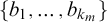 is a basis of
$X_m^{AC}$
is a basis of
$X_m^{AC}$
 it follows that
$d \in \mathrm {acl}^n(\{b_1, \ldots , b_{k_m}\} \cup AC)$
it follows that
$d \in \mathrm {acl}^n(\{b_1, \ldots , b_{k_m}\} \cup AC)$
 . If, for some
$i> k_m$
. If, for some
$i> k_m$
 , we would have that
$b_i \in \mathrm {acl}^n(\{b_1, \ldots , b_{k_m}, d, b_{k_m + 1}, \ldots , b_{i-1}\} \cup C)$
, we would have that
$b_i \in \mathrm {acl}^n(\{b_1, \ldots , b_{k_m}, d, b_{k_m + 1}, \ldots , b_{i-1}\} \cup C)$
 , then we would get

which would contradict (5.3). Hence we conclude that for all
$i> k_m$
 ,
,

But this implies that
$\mathrm {rk}^n(B / C) \geq \beta + 1$
 which contradicts the assumption. Hence there cannot be any
$m \in \{0, \ldots , t-1 \}$
which contradicts the assumption. Hence there cannot be any
$m \in \{0, \ldots , t-1 \}$
 and
$d \in X^C_m$
and
$d \in X^C_m$
 such that
$d \notin \mathrm {acl}^n(\{b_1, \ldots , b_{k_m}\} \cup C)$
such that
$d \notin \mathrm {acl}^n(\{b_1, \ldots , b_{k_m}\} \cup C)$
 , and therefore
$\{b_1, \ldots , b_{k_m}\}$
, and therefore
$\{b_1, \ldots , b_{k_m}\}$
 is a basis of
$X^C_m$
is a basis of
$X^C_m$
 . It follows that
$b_1, \ldots , b_\beta $
. It follows that
$b_1, \ldots , b_\beta $
 is an n-ccs for
$B/C$
is an n-ccs for
$B/C$
 with core sequence of indices
$0 = k_0 < k_1 < \cdots < k_t = \beta $
with core sequence of indices
$0 = k_0 < k_1 < \cdots < k_t = \beta $
 .
.
(ii) Now suppose that
$b_1, \ldots , b_\beta $
 is an n-ccs for
$B/C$
is an n-ccs for
$B/C$
 with core sequence of indices
$0 = k_0 < k_1 < \cdots < k_\delta = \beta $
with core sequence of indices
$0 = k_0 < k_1 < \cdots < k_\delta = \beta $
 . It follows that for all
$m = 0, \ldots , \delta - 1$
. It follows that for all
$m = 0, \ldots , \delta - 1$
 and all
$i = k_m +1, \ldots , k_{m+1}$
and all
$i = k_m +1, \ldots , k_{m+1}$
 ,
,

By Lemmas 5.4 and 5.6, there is an n-ccs
$b^{\prime }_1, \ldots , b^{\prime }_\beta $
 for
$B/AC$
for
$B/AC$
 with core sequence of indices
$0 = l_0 < l_1 < \cdots < l_\gamma = \beta $
with core sequence of indices
$0 = l_0 < l_1 < \cdots < l_\gamma = \beta $
 . By part (i),
$b^{\prime }_1, \ldots , b^{\prime }_\beta $
. By part (i),
$b^{\prime }_1, \ldots , b^{\prime }_\beta $
 is also an n-ccs for
$B/C$
is also an n-ccs for
$B/C$
 with the same core sequence of indices
$0 = l_0 < l_1 < \cdots < l_\gamma = \beta $
with the same core sequence of indices
$0 = l_0 < l_1 < \cdots < l_\gamma = \beta $
 . By Lemma 5.4, we then have
$\gamma = \delta $
. By Lemma 5.4, we then have
$\gamma = \delta $
 and
$l_m = k_m$
and
$l_m = k_m$
 for all
$m = 0, \ldots , \delta $
for all
$m = 0, \ldots , \delta $
 . The same lemma also tells that, for all
$m = 1, \ldots , \delta $
. The same lemma also tells that, for all
$m = 1, \ldots , \delta $
 ,
,

Now we prove that

Suppose that
$d \in \mathrm {acl}^{\mathrm {eq}}(\{b_1, \ldots , b_{k_m}\} \cup AC)$
 . Then there are a formula
$\varphi (u, \bar {x}, \bar {y}, \bar {z})$
. Then there are a formula
$\varphi (u, \bar {x}, \bar {y}, \bar {z})$
 , a tuple
$\bar {b}$
, a tuple
$\bar {b}$
 of elements from
$\{b_1, \ldots , b_{k_m}\}$
of elements from
$\{b_1, \ldots , b_{k_m}\}$
 , a tuple
$\bar {a}$
, a tuple
$\bar {a}$
 of elements from A, and a tuple
$\bar {c}$
of elements from A, and a tuple
$\bar {c}$
 of elements from C, such that
$\mathcal {M}^{\mathrm {eq}} \models \varphi (d, \bar {b}, \bar {a}, \bar {c})$
of elements from C, such that
$\mathcal {M}^{\mathrm {eq}} \models \varphi (d, \bar {b}, \bar {a}, \bar {c})$
 and only finitely many elements satisfy
$\varphi (u, \bar {b}, \bar {a}, \bar {c})$
and only finitely many elements satisfy
$\varphi (u, \bar {b}, \bar {a}, \bar {c})$
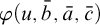 . Let m be such that d and all elements that belong to any of
$\bar {b}$
. Let m be such that d and all elements that belong to any of
$\bar {b}$
 ,
$\bar {a}$
,
$\bar {a}$
 , or
$\bar {c}$
, or
$\bar {c}$
 , are members of
$M_m$
, are members of
$M_m$
 . As
$\mathcal {M}_m$
. As
$\mathcal {M}_m$
 is
$\omega $
is
$\omega $
 -categorical there is a formula
${\unicode{x00FE}}
eta (u, \bar {x}, \bar {y}, \bar {z})$
-categorical there is a formula
${\unicode{x00FE}}
eta (u, \bar {x}, \bar {y}, \bar {z})$
 which isolates
$\mathrm {tp}_{\mathcal {M}_m}(d, \bar {b}, \bar {a}, \bar {c})$
which isolates
$\mathrm {tp}_{\mathcal {M}_m}(d, \bar {b}, \bar {a}, \bar {c})$
 , where ‘
$\mathrm {tp}_{\mathcal {M}_m}$
, where ‘
$\mathrm {tp}_{\mathcal {M}_m}$
 ’ denotes the type computed in
$\mathcal {M}_m$
’ denotes the type computed in
$\mathcal {M}_m$
 . Then only finitely many elements satisfy
${\unicode{x00FE}}
eta (u, \bar {b}, \bar {a}, \bar {c})$
. Then only finitely many elements satisfy
${\unicode{x00FE}}
eta (u, \bar {b}, \bar {a}, \bar {c})$
 , all of them belong to
$M_m$
, all of them belong to
$M_m$
 , and d is one among them. From (5.6) we have
$\mathrm {rng}(\bar {b}) \subseteq \mathrm {acl}^m(\{b^{\prime }_1, \ldots , b^{\prime }_{k_m}\} \cup C)$
, and d is one among them. From (5.6) we have
$\mathrm {rng}(\bar {b}) \subseteq \mathrm {acl}^m(\{b^{\prime }_1, \ldots , b^{\prime }_{k_m}\} \cup C)$
 , so there are a formula
$\psi (\bar {x}, \bar {y}, \bar {z})$
, so there are a formula
$\psi (\bar {x}, \bar {y}, \bar {z})$
 , a tuple
$\bar {b}'$
, a tuple
$\bar {b}'$
 of elements from
$\{b^{\prime }_1, \ldots , b^{\prime }_{k_m}\}$
of elements from
$\{b^{\prime }_1, \ldots , b^{\prime }_{k_m}\}$
 , and a tuple
$\bar {c}'$
, and a tuple
$\bar {c}'$
 of elements from C such that
$\mathcal {M}^{\mathrm {eq}} \models \psi (\bar {b}, \bar {b}', \bar {c}')$
of elements from C such that
$\mathcal {M}^{\mathrm {eq}} \models \psi (\bar {b}, \bar {b}', \bar {c}')$
 and
$\psi (\bar {x}, \bar {b}', \bar {c}')$
and
$\psi (\bar {x}, \bar {b}', \bar {c}')$
 is satisfied by only finitely many tuples. It is now clear that d satisfies the formula

The formula
$\psi (\bar {x}, \bar {b}', \bar {c}')$
 is satisfied by only finitely many tuples, and if
$\bar {b}^*$
is satisfied by only finitely many tuples, and if
$\bar {b}^*$
 is one of them and
$\mathcal {M}^{\mathrm {eq}} \models {\unicode{x00FE}}
eta (d', \bar {b}^*, \bar {a}, \bar {c})$
is one of them and
$\mathcal {M}^{\mathrm {eq}} \models {\unicode{x00FE}}
eta (d', \bar {b}^*, \bar {a}, \bar {c})$
 for some
$d'$
for some
$d'$
 , then
$d'$
, then
$d'$
 and all members of
$\bar {b}^*$
and all members of
$\bar {b}^*$
 belong to
$M_m$
belong to
$M_m$
 , and
$\mathrm {tp}_{\mathcal {M}_m}(d', \bar {b}^*, \bar {a}, \bar {c}) = \mathrm {tp}_{\mathcal {M}_m}(d, \bar {b}, \bar {a}, \bar {c})$
, and
$\mathrm {tp}_{\mathcal {M}_m}(d', \bar {b}^*, \bar {a}, \bar {c}) = \mathrm {tp}_{\mathcal {M}_m}(d, \bar {b}, \bar {a}, \bar {c})$
 , so only finitely many elements satisfy
${\unicode{x00FE}}
eta (u, \bar {b}^*, \bar {a}, \bar {c})$
, so only finitely many elements satisfy
${\unicode{x00FE}}
eta (u, \bar {b}^*, \bar {a}, \bar {c})$
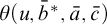 . It now follows that
$\chi (u, \bar {a}, \bar {b}', \bar {c}, \bar {c}')$
. It now follows that
$\chi (u, \bar {a}, \bar {b}', \bar {c}, \bar {c}')$
 is satisfied by only finitely many elements. Hence

This shows the inclusion from left to right in (5.7) and by a similar argument (letting the
$b_i$
 and
$b^{\prime }_i$
and
$b^{\prime }_i$
 switch roles) the converse inclusion follows. This proves (5.7).
For all
$m = 0, \ldots , \delta - 1$
 , let
, let

and note that by (5.7) we also have

Since
$b^{\prime }_1, \ldots , b^{\prime }_\beta $
 is an n-ccs for
$B/AC$
is an n-ccs for
$B/AC$
 with core sequence of indices
$0 = k_0 < k_1 < \cdots < k_\delta = \beta $
with core sequence of indices
$0 = k_0 < k_1 < \cdots < k_\delta = \beta $
 it follows that, for all
$m = 0, \ldots , \delta - 1$
it follows that, for all
$m = 0, \ldots , \delta - 1$
 ,
$\{b^{\prime }_{k_m + 1}, \ldots , b^{\prime }_{k_{m+1}}\}$
,
$\{b^{\prime }_{k_m + 1}, \ldots , b^{\prime }_{k_{m+1}}\}$
 is a basis of
$X_m^{AC}$
is a basis of
$X_m^{AC}$
 , so
$X_m^{AC}$
, so
$X_m^{AC}$
 has dimension
$k_{m+1} - k_m$
has dimension
$k_{m+1} - k_m$
 . From (5.7) it follows that

Fix any
$m \in \{0, \ldots , \delta - 1\}$
 . From (5.5), we get

Suppose, for a contradiction, that there is
$i \in \{ k_m + 1, \ldots , k_{m+1}\}$
 such that
-
• $\mathrm {rk}^n(b_i / \{b_1, \ldots , b_{k_m}\} \cup AC) = 0$
(equivalently,
$b_i \in \mathrm {acl}^n(\{b_1, \ldots , b_{k_m}\} \cup AC)$
), -
• or $b_i \in \mathrm {acl}^n(B_iAC)$
where
$B_i = \{b_{k_m + 1}, \ldots , b_{k_{m+1}}\} \setminus \{b_i\}$
.




Then some proper subset of
$\{b_{k_m + 1}, \ldots , b_{k_{m+1}}\}$
 is a basis of
$X_m^{AC}$
is a basis of
$X_m^{AC}$
 which contradicts our previous conclusion that
$X_m^{AC}$
which contradicts our previous conclusion that
$X_m^{AC}$
 has dimension
$k_{m+1} - k_m$
has dimension
$k_{m+1} - k_m$
 . Hence we conclude that
$\mathrm {rk}^n(b_i / \{b_1, \ldots , b_{k_m}\} \cup AC) = 1$
. Hence we conclude that
$\mathrm {rk}^n(b_i / \{b_1, \ldots , b_{k_m}\} \cup AC) = 1$
 for all
$i = k_m + 1, \ldots , k_{m+1}$
for all
$i = k_m + 1, \ldots , k_{m+1}$
 and that
$\{b_{k_m + 1}, \ldots , b_{k_{m+1}}\}$
and that
$\{b_{k_m + 1}, \ldots , b_{k_{m+1}}\}$
 is independent (in the pregeometry
$\{d \in M_n : \mathrm {rk}^n(d / \{b_1, \ldots , b_{k_m}\} \cup AC) = 1\}$
is independent (in the pregeometry
$\{d \in M_n : \mathrm {rk}^n(d / \{b_1, \ldots , b_{k_m}\} \cup AC) = 1\}$
 ) and hence a basis of
$X_m^{AC}$
) and hence a basis of
$X_m^{AC}$
 . Since the argument holds for all
$m = 0, \ldots , \delta - 1$
. Since the argument holds for all
$m = 0, \ldots , \delta - 1$
 it follows that
$b_1, \ldots , b_\beta $
it follows that
$b_1, \ldots , b_\beta $
 is an n-ccs for
$B/AC$
is an n-ccs for
$B/AC$
 with core sequence of indices
$0 = k_0 < k_1 < \cdots < k_\delta = \beta $
with core sequence of indices
$0 = k_0 < k_1 < \cdots < k_\delta = \beta $
 .
.
Proposition 5.13. Let
$A, C \subseteq M^{\mathrm {eq}}$
 and
$B \subseteq M_n$
and
$B \subseteq M_n$
 where A and B are finite. If
$\mathrm {rk}^n(A / BC) < \mathrm {rk}^n(A / C)$
where A and B are finite. If
$\mathrm {rk}^n(A / BC) < \mathrm {rk}^n(A / C)$
 then
$\mathrm {rk}^n(B / AC) < \mathrm {rk}^n(B / C)$
then
$\mathrm {rk}^n(B / AC) < \mathrm {rk}^n(B / C)$
 .
.
Proof. Let
$A, C \subseteq M^{\mathrm {eq}}$
 and
$B \subseteq M_n$
and
$B \subseteq M_n$
 where A and B are finite. We prove the result by induction on
$\mathrm {rk}^n(B / C)$
where A and B are finite. We prove the result by induction on
$\mathrm {rk}^n(B / C)$
 . If
$\mathrm {rk}^n(B / C) = 0$
. If
$\mathrm {rk}^n(B / C) = 0$
 then, since
$B \subseteq M_n$
then, since
$B \subseteq M_n$
 and by the definition of
$\mathrm {rk}^n$
and by the definition of
$\mathrm {rk}^n$
 ,
$B \subseteq \mathrm {acl}^n(B) \subseteq \mathrm {acl}^n(C)$
,
$B \subseteq \mathrm {acl}^n(B) \subseteq \mathrm {acl}^n(C)$
 so
$\mathrm {acl}^n(BC) = \mathrm {acl}^n(C)$
so
$\mathrm {acl}^n(BC) = \mathrm {acl}^n(C)$
 . Hence (by the definition of
$\mathrm {rk}^n$
. Hence (by the definition of
$\mathrm {rk}^n$
 )
$\mathrm {rk}^n(A / BC) = \mathrm {rk}^n(A / C)$
)
$\mathrm {rk}^n(A / BC) = \mathrm {rk}^n(A / C)$
 and the statement is vacuously satisfied.
The induction step remains. The induction hypothesis will be:
-
(IH) For every finite $B' \subseteq M_n$
, if
$\mathrm {rk}^n(B' / C) < \mathrm {rk}^n(B / C)$
and
$\mathrm {rk}^n(A / B'C) < \mathrm {rk}^n(A / C)$
, then
$\mathrm {rk}^n(B' / AC) < \mathrm {rk}^n(B' / C)$
.




Suppose that
$\mathrm {rk}^n(A / BC) < \mathrm {rk}^n(A / C)$
 . Also let
$\beta = \mathrm {rk}^n(B / C)$
. Also let
$\beta = \mathrm {rk}^n(B / C)$
 . (We will show that
$\mathrm {rk}^n(B / AC) < \beta $
. (We will show that
$\mathrm {rk}^n(B / AC) < \beta $
 .) Then there is an n-ccs
$b_1, \ldots , b_\beta $
.) Then there is an n-ccs
$b_1, \ldots , b_\beta $
 for
$B/C$
for
$B/C$
 with core sequence of indices
$0 = k_0 < k_1 < \cdots < k_\delta = \beta $
with core sequence of indices
$0 = k_0 < k_1 < \cdots < k_\delta = \beta $
 . In particular,
$b_1, \ldots , b_\beta \in \mathrm {acl}^n(B)$
. In particular,
$b_1, \ldots , b_\beta \in \mathrm {acl}^n(B)$
 . We divide the argument into two main cases.
Case 1. Suppose that there is
$s < \beta $
 such that
$\mathrm {rk}^n(A / \{b_1, \ldots , b_s\} \cup C) < \mathrm {rk}^n(A / C)$
such that
$\mathrm {rk}^n(A / \{b_1, \ldots , b_s\} \cup C) < \mathrm {rk}^n(A / C)$
 .
.
We may assume that s is minimal such that the above holds. As
$b_1, \ldots , b_\beta $
 is an n-ccs for
$B/C$
is an n-ccs for
$B/C$
 , hence (by Lemma 5.5) an n-cs for
$B/C$
, hence (by Lemma 5.5) an n-cs for
$B/C$
 , it follows from Lemma 3.5 that

Now the induction hypothesis (IH) implies that

By Lemma 3.5 there is
$t \leq s$
 such that

Let t be minimal such that the above holds. Towards a contradiction, suppose that
$\mathrm {rk}^n(B / AC) = \mathrm {rk}^n(B / C) = \beta $
 . Then there is an n-ccs
$b^{\prime }_1, \ldots , b^{\prime }_\beta $
. Then there is an n-ccs
$b^{\prime }_1, \ldots , b^{\prime }_\beta $
 for
$B/AC$
for
$B/AC$
 with core sequence of indices
$0 = l_0 < l_1 < \cdots < l_\gamma = \beta $
with core sequence of indices
$0 = l_0 < l_1 < \cdots < l_\gamma = \beta $
 . By Lemma 5.12,
$b_1, \ldots , b_\beta $
. By Lemma 5.12,
$b_1, \ldots , b_\beta $
 is also an n-ccs for
$B/C$
is also an n-ccs for
$B/C$
 with core sequence of indices
$0 = k_0 < k_1 < \cdots < k_\gamma = \beta $
with core sequence of indices
$0 = k_0 < k_1 < \cdots < k_\gamma = \beta $
 . By Lemma 5.4 we have
$\gamma = \delta $
. By Lemma 5.4 we have
$\gamma = \delta $
 and
$l_i = k_i$
and
$l_i = k_i$
 for all
$i = 0, \ldots , \delta $
for all
$i = 0, \ldots , \delta $
 . From Lemma 5.4 it follows that if, for any
$m \in \{0, \ldots , \delta - 1\}$
. From Lemma 5.4 it follows that if, for any
$m \in \{0, \ldots , \delta - 1\}$
 , we define

then

Also,
$b_{k_m + 1}, \ldots , b_{k_{m+1}}, b^{\prime }_{k_m + 1}, \ldots , b^{\prime }_{k_{m+1}} \in X_m^{AC}$
 . Let m be such that
$k_m < t \leq k_{m+1}$
. Let m be such that
$k_m < t \leq k_{m+1}$
 . Now (5.9) implies that some proper subset of
$\{b_{k_m + 1}, \ldots , b_{k_{m+1}}\}$
. Now (5.9) implies that some proper subset of
$\{b_{k_m + 1}, \ldots , b_{k_{m+1}}\}$
 is a basis of
$X_m^{AC}$
is a basis of
$X_m^{AC}$
 . But since
$b^{\prime }_1, \ldots , b^{\prime }_\beta $
. But since
$b^{\prime }_1, \ldots , b^{\prime }_\beta $
 is an n-ccs for
$B/AC$
is an n-ccs for
$B/AC$
 with core sequence of indices
$0 = k_0 < k_1 < \cdots < k_\delta = \beta $
with core sequence of indices
$0 = k_0 < k_1 < \cdots < k_\delta = \beta $
 it follows that
$\{b^{\prime }_{k_m + 1}, \ldots , b^{\prime }_{k_{m+1}}\}$
it follows that
$\{b^{\prime }_{k_m + 1}, \ldots , b^{\prime }_{k_{m+1}}\}$
 is a basis of
$X_m^{AC}$
is a basis of
$X_m^{AC}$
 . So there are two bases of
$X_m^{AC}$
. So there are two bases of
$X_m^{AC}$
 with different cardinalities, which is impossible. Thus we conclude that
$\mathrm {rk}^n(B / AC) < \beta $
with different cardinalities, which is impossible. Thus we conclude that
$\mathrm {rk}^n(B / AC) < \beta $
 .
.
Case 2. Suppose that Case 1 does not hold, that is, suppose that for all
$s < \beta $
 ,
$\mathrm {rk}^n(A / \{b_1, \ldots , b_s\} \cup C) = \mathrm {rk}^n(A / C)$
,
$\mathrm {rk}^n(A / \{b_1, \ldots , b_s\} \cup C) = \mathrm {rk}^n(A / C)$
 .
.
Let
$\alpha = \mathrm {rk}^n(A / C)$
 , so by assumption,

Since
$b_1, \ldots , b_\beta $
 is an n-ccs for
$B/C$
is an n-ccs for
$B/C$
 , hence an n-cs for
$B/C$
, hence an n-cs for
$B/C$
 , it follows (by Lemma 3.5 and the assumption that
$B\subseteq M_n$
, it follows (by Lemma 3.5 and the assumption that
$B\subseteq M_n$
 ) that
${B {\kern-1pt}\subseteq{\kern-1pt} \mathrm {acl}^n(B) {\kern-1pt}\subseteq{\kern-1pt} \mathrm {acl}^n(\{b_1, \ldots , b_\beta \} {\kern-1pt}\cup{\kern-1pt} C)}$
) that
${B {\kern-1pt}\subseteq{\kern-1pt} \mathrm {acl}^n(B) {\kern-1pt}\subseteq{\kern-1pt} \mathrm {acl}^n(\{b_1, \ldots , b_\beta \} {\kern-1pt}\cup{\kern-1pt} C)}$
 and hence
$\mathrm {rk}^n(A / BC) = \mathrm {rk}^n(A / \{b_1, \ldots , b_\beta \} \cup C)$
and hence
$\mathrm {rk}^n(A / BC) = \mathrm {rk}^n(A / \{b_1, \ldots , b_\beta \} \cup C)$
 . From the assumption that
$\mathrm {rk}^n(A / BC) < \mathrm {rk}^n(A /C)$
. From the assumption that
$\mathrm {rk}^n(A / BC) < \mathrm {rk}^n(A /C)$
 we now get

Let
$a_1, \ldots , a_\alpha $
 be an n-ccs for
$A/C$
be an n-ccs for
$A/C$
 with core sequence of indices
$0 = l_0 < l_1 < \cdots < l_\gamma = \alpha $
with core sequence of indices
$0 = l_0 < l_1 < \cdots < l_\gamma = \alpha $
 . By Lemma 5.12,
$a_1, \ldots , a_\alpha $
. By Lemma 5.12,
$a_1, \ldots , a_\alpha $
 is also an n-ccs for
$A/\{b_1, \ldots , b_{\beta -1}\}\cup C$
is also an n-ccs for
$A/\{b_1, \ldots , b_{\beta -1}\}\cup C$
 with the same core sequence of indices
$0 = l_0 < l_1 < \cdots < l_\gamma = \alpha $
with the same core sequence of indices
$0 = l_0 < l_1 < \cdots < l_\gamma = \alpha $
 . This implies that,

Since
$b_1, \ldots , b_\beta $
 is an n-ccs for
$B/C$
is an n-ccs for
$B/C$
 also have that

By (5.10) (and Lemma 3.5) there is
$s \leq \alpha $
 such that

Let s be minimal such that the above holds.
If
$b_\beta \in \mathrm {acl}^n(\{b_1, \ldots , b_{\beta -1}\} \cup AC)$
 then
$b_1, \ldots , b_\beta $
then
$b_1, \ldots , b_\beta $
 is not an n-ccs for
$B/AC$
is not an n-ccs for
$B/AC$
 so by Lemma 5.12 we get
$\mathrm {rk}^n(B / AC) < \mathrm {rk}^n(B / C)$
so by Lemma 5.12 we get
$\mathrm {rk}^n(B / AC) < \mathrm {rk}^n(B / C)$
 .
.
Now suppose that
$b_\beta \notin \mathrm {acl}^n(\{b_1, \ldots , b_{\beta -1}\} \cup AC)$
 . As
$a_1, \ldots , a_{s-1} \in \mathrm {acl}^n(A)$
. As
$a_1, \ldots , a_{s-1} \in \mathrm {acl}^n(A)$
 we get
$b_\beta \notin \mathrm {acl}^n(\{b_1, \ldots , b_{\beta -1}, a_1, \ldots , a_{s-1}\} \cup C)$
we get
$b_\beta \notin \mathrm {acl}^n(\{b_1, \ldots , b_{\beta -1}, a_1, \ldots , a_{s-1}\} \cup C)$
 and hence
$\mathrm {rk}^n(b_\beta / \{b_1, \ldots , b_{\beta -1}, a_1, \ldots , a_{s-1}\} \cup C) \geq 1$
and hence
$\mathrm {rk}^n(b_\beta / \{b_1, \ldots , b_{\beta -1}, a_1, \ldots , a_{s-1}\} \cup C) \geq 1$
 . This and (5.11) (together with Lemma 3.9) gives

Since
$a_1, \ldots , a_\alpha $
 is an n-ccs for
$A/\{b_1, \ldots , b_{\beta -1}\} \cup C$
is an n-ccs for
$A/\{b_1, \ldots , b_{\beta -1}\} \cup C$
 we get

Now (5.12)–(5.14) and Assumption 5.1 imply that

and therefore
$b_\beta \in \mathrm {acl}^n(\{b_1, \ldots , b_{\beta -1}\} \cup AC)$
 . Then
$b_1, \ldots , b_\beta $
. Then
$b_1, \ldots , b_\beta $
 is not an n-ccs for
$B/AC$
is not an n-ccs for
$B/AC$
 , so by Lemma 5.12 it follows that
$\mathrm {rk}^n(B / AC) < \mathrm {rk}^n(B / C)$
, so by Lemma 5.12 it follows that
$\mathrm {rk}^n(B / AC) < \mathrm {rk}^n(B / C)$
 . This completes the proof of Proposition 5.13.
Proposition 5.14. (Symmetry of
${\smile} \hspace {-6.8pt}{|^n} $
restricted to
$M_n$
)


Let
$A, C \subseteq M^{\mathrm {eq}}$
 and
$B \subseteq M_n$
and
$B \subseteq M_n$
 . If
$A \underset {C}{{\smile} \hspace {-6.8pt}{|^n}\hspace {-12pt} {\diagup} } B$
. If
$A \underset {C}{{\smile} \hspace {-6.8pt}{|^n}\hspace {-12pt} {\diagup} } B$
 then
$B \underset {C}{{\smile} \hspace {-6.8pt}{|^n}\hspace {-12pt} {\diagup} } A$
then
$B \underset {C}{{\smile} \hspace {-6.8pt}{|^n}\hspace {-12pt} {\diagup} } A$
 .
.
Proof. Suppose that
$A \underset {C}{{\smile} \hspace {-6.8pt}{|^n}\hspace {-12pt} {\diagup} } B$
 where
$B \subseteq M_n$
where
$B \subseteq M_n$
 . Then there is finite
$A' \subseteq A$
. Then there is finite
$A' \subseteq A$
 such that
$\mathrm {rk}^n(A' / BC) < \mathrm {rk}^n(A' / C)$
such that
$\mathrm {rk}^n(A' / BC) < \mathrm {rk}^n(A' / C)$
 . By Lemma 3.11, there is finite
$B' \subseteq B$
. By Lemma 3.11, there is finite
$B' \subseteq B$
 such that
$\mathrm {rk}^n(A' / B'C) < \mathrm {rk}^n(A' / C)$
such that
$\mathrm {rk}^n(A' / B'C) < \mathrm {rk}^n(A' / C)$
 . By Lemma 3.9 and Proposition 5.13,

and hence
$B \underset {C}{{\smile} \hspace {-6.8pt}{|^n}\hspace {-12pt} {\diagup} } A$
 .
.
In Section 4 we saw that, even without Assumption 5.1,
${\smile} \hspace {-6.8pt}{|^n} $
 has all the properties of an independence relation restricted to
$M_n$
has all the properties of an independence relation restricted to
$M_n$
 except, possibly, for the symmetry property. Now we have the following theorem.
Theorem 5.15. Let T be
$\omega $
 -categorical, let
$n < \omega $
-categorical, let
$n < \omega $
 , and suppose that Assumption 5.1 holds for this n. Then
${\smile} \hspace {-6.8pt}{|^n} $
, and suppose that Assumption 5.1 holds for this n. Then
${\smile} \hspace {-6.8pt}{|^n} $
 is an independence relation restricted to
$M_n$
is an independence relation restricted to
$M_n$
 .
.
Proof. By Proposition 5.14,
${\smile} \hspace {-6.8pt}{|^n} $
 has the symmetry property with respect to subsets of
$M_n$
has the symmetry property with respect to subsets of
$M_n$
 . By the results in Section 4
${\smile} \hspace {-6.8pt}{|^n} $
. By the results in Section 4
${\smile} \hspace {-6.8pt}{|^n} $
 has all the other properties of an independence relation, with respect to any subsets of
$M^{\mathrm {eq}}$
has all the other properties of an independence relation, with respect to any subsets of
$M^{\mathrm {eq}}$
 .
.
Under Assumption 5.1 we can strengthen one part of Lemma 3.9 as follows.
Lemma 5.16. Suppose that
$A, B, C \subseteq M^{\mathrm {eq}}$
 where A is finite and
$B \subseteq A$
where A is finite and
$B \subseteq A$
 . Then
$\mathrm {rk}^n(A / C) = \mathrm {rk}^n(B / C) + \mathrm {rk}^n(A / BC)$
. Then
$\mathrm {rk}^n(A / C) = \mathrm {rk}^n(B / C) + \mathrm {rk}^n(A / BC)$
 .
.
Proof. Let
$\beta = \mathrm {rk}^n(B / C)$
 and
$\alpha = \mathrm {rk}^n(A / BC)$
and
$\alpha = \mathrm {rk}^n(A / BC)$
 . By Lemmas 5.4 and 5.6 there is an n-ccs
$b_1, \ldots , b_\beta $
. By Lemmas 5.4 and 5.6 there is an n-ccs
$b_1, \ldots , b_\beta $
 for
$B/C$
for
$B/C$
 with core sequence of indices
$0 = k_0 < k_1 < \cdots < k_s = \beta $
with core sequence of indices
$0 = k_0 < k_1 < \cdots < k_s = \beta $
 . By the same lemmas there is also an n-ccs
$a_1, \ldots , a_\alpha $
. By the same lemmas there is also an n-ccs
$a_1, \ldots , a_\alpha $
 for
$A/BC$
for
$A/BC$
 with core sequence of indices
$0 = l_0 < l_1 < \cdots < l_t = \alpha $
with core sequence of indices
$0 = l_0 < l_1 < \cdots < l_t = \alpha $
 . Since we must have
$\mathrm {acl}^n(B) \subseteq \mathrm {acl}^n(\{b_1, \ldots , b_\beta \} \cup C)$
. Since we must have
$\mathrm {acl}^n(B) \subseteq \mathrm {acl}^n(\{b_1, \ldots , b_\beta \} \cup C)$
 and hence
$\mathrm {acl}^n(BC) = \mathrm {acl}^n((\{b_1, \ldots , b_\beta \} \cup C)$
and hence
$\mathrm {acl}^n(BC) = \mathrm {acl}^n((\{b_1, \ldots , b_\beta \} \cup C)$
 it follows that
$b_1, \ldots , b_\beta , a_1, \ldots , a_\alpha $
it follows that
$b_1, \ldots , b_\beta , a_1, \ldots , a_\alpha $
 is an n-ccs for
$A/C$
is an n-ccs for
$A/C$
 with core sequence of indices
$0 = k_0 < k_1 < \cdots < k_s < k_s + l_1 < k_s + l_2 < \dots k_s + l_t = \beta + \alpha $
with core sequence of indices
$0 = k_0 < k_1 < \cdots < k_s < k_s + l_1 < k_s + l_2 < \dots k_s + l_t = \beta + \alpha $
 . By Lemma 5.6, we must have
$\mathrm {rk}^n(A / C) = \beta + \alpha = \mathrm {rk}^n(B / C) + \mathrm {rk}^n(A / BC)$
. By Lemma 5.6, we must have
$\mathrm {rk}^n(A / C) = \beta + \alpha = \mathrm {rk}^n(B / C) + \mathrm {rk}^n(A / BC)$
 .
.
Corollary 5.17. If
$a_1, \ldots , a_k \in M^{\mathrm {eq}}$
 and
$C \subseteq M^{\mathrm {eq}}$
and
$C \subseteq M^{\mathrm {eq}}$
 , then

6 Connection to rosiness
In the previous section we proved that if the algebraic closure satisfies the exchange property on elements of
$M_n$
 with n-rank 1 (over some
$C \subseteq M^{\mathrm {eq}}$
with n-rank 1 (over some
$C \subseteq M^{\mathrm {eq}}$
 ), then n-independence is an independence relation restricted to
$M_n$
), then n-independence is an independence relation restricted to
$M_n$
 (recall Definition 2.7). In this section we will use this result to make conclusions about (super)rosiness of
$\omega $
(recall Definition 2.7). In this section we will use this result to make conclusions about (super)rosiness of
$\omega $
 -categorical theories. In order to do this we also need to involve the notion of thorn-independence.
Definition 6.1. [Reference Ealy and Onshuus8, Reference Onshuus23]
Let
$\bar {a}, \bar {b}$
 be finite tuples of elements from
$M^{\mathrm {eq}}$
be finite tuples of elements from
$M^{\mathrm {eq}}$
 and let
$C \subseteq M^{\mathrm {eq}}$
and let
$C \subseteq M^{\mathrm {eq}}$
 .
.
-
(1) A formula $\varphi (\bar {x}, \bar {a})$
(with all parameters listed by
$\bar {a})$
strongly divides over C if
$\mathrm {tp}(\bar {a} / C)$
is nonalgebraic (i.e., has infinitely many realizations) and, for some
$k < \omega $
, the set of formulas
$\{\varphi (\bar {x}, \bar {a}') : \mathrm {tp}(\bar {a}' / C) = \mathrm {tp}(\bar {a} / C) \}$
is k-inconsistent (meaning that any set of k of these formulas is inconsistent, in a model of
$T^{\mathrm {eq}}$
). -
(2) A formula $\varphi (\bar {x}, \bar {a})$
thorn-divides over C if there is a finite tuple
$\bar {d}$
of elements from
$M^{\mathrm {eq}}$
such that
$\varphi (\bar {x}, \bar {a})$
strongly divides over
$C\bar {d}$
(=
$C \cup \mathrm {rng}(\bar {d})$
). -
(3) A formula $\varphi (\bar {x}, \bar {a})$
thorn-forks over C if it implies (modulo
$T^{\mathrm {eq}}$
) a finite disjunction of formulas, all of which thorn-divide over C. -
(4) For $A \subseteq M^{\mathrm {eq}}$
, a complete type
$p(\bar {x})$
over A thorn-divides (thorn-forks) over C if there is a formula in
$p(\bar {x})$
which thorn-divides (thorn-forks) over C. -
(5) We say that $\bar {a}$
is thorn-independent from
$\bar {b}$
over C, denoted
$\bar {a} \underset {C}{{\smile} \hspace {-6.8pt}{|^ {{\unicode{x00FE}}
}} } \bar {b}$
, if
$\mathrm {tp}(\bar {a} / C\bar {b})$
does not thorn-fork over C.





The following technical lemma appears in [Reference Ealy and Onshuus8, Remark 3.2], but we prove it to make the arguments that follow self-contained.
Lemma 6.2. Let
$a, b \in M^{\mathrm {eq}}$
 ,
$C \subseteq M^{\mathrm {eq}}$
,
$C \subseteq M^{\mathrm {eq}}$
 and let
$\bar {c}$
and let
$\bar {c}$
 be a sequence of elements from C. If
$M^{\mathrm {eq}} \models \varphi (a, b, \bar {c})$
be a sequence of elements from C. If
$M^{\mathrm {eq}} \models \varphi (a, b, \bar {c})$
 and
$\varphi (x, b, \bar {c})$
and
$\varphi (x, b, \bar {c})$
 strongly divides over C, then
$b \in \mathrm {acl}^{\mathrm {eq}}(aC) \setminus \mathrm {acl}^{\mathrm {eq}}(C)$
strongly divides over C, then
$b \in \mathrm {acl}^{\mathrm {eq}}(aC) \setminus \mathrm {acl}^{\mathrm {eq}}(C)$
 .
.
Proof. The assumption that
$\varphi (x, b, \bar {c})$
 strongly divides over C means that
$\mathrm {tp}(b / C)$
strongly divides over C means that
$\mathrm {tp}(b / C)$
 is nonalgebraic and, for some
$k < \omega $
is nonalgebraic and, for some
$k < \omega $
 ,
$\{\varphi (x, b', \bar {c}) : \mathrm {tp}(b' / C) = \mathrm {tp}(b / C)\}$
,
$\{\varphi (x, b', \bar {c}) : \mathrm {tp}(b' / C) = \mathrm {tp}(b / C)\}$
 is k-inconsistent. As explained in [Reference Onshuus23, Remark 2.1.2], it follows from a compactness argument that there is
${\unicode{x00FE}}
eta (y, \bar {d}) \in \mathrm {tp}(b / C)$
is k-inconsistent. As explained in [Reference Onshuus23, Remark 2.1.2], it follows from a compactness argument that there is
${\unicode{x00FE}}
eta (y, \bar {d}) \in \mathrm {tp}(b / C)$
 such that

Since
$\mathrm {tp}(b / C)$
 is nonalgebraic it follows that
$b \notin \mathrm {acl}^{\mathrm {eq}}(C)$
is nonalgebraic it follows that
$b \notin \mathrm {acl}^{\mathrm {eq}}(C)$
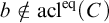 . For a contradiction, suppose that
$b \notin \mathrm {acl}^{\mathrm {eq}}(aC)$
. For a contradiction, suppose that
$b \notin \mathrm {acl}^{\mathrm {eq}}(aC)$
 . Then there are distinct
$b_i$
. Then there are distinct
$b_i$
 , for
$i < \omega $
, for
$i < \omega $
 , such that
$\mathrm {tp}(a, b_i, \bar {c}, \bar {d}) = \mathrm {tp}(a, b, \bar {c}, \bar {d})$
, such that
$\mathrm {tp}(a, b_i, \bar {c}, \bar {d}) = \mathrm {tp}(a, b, \bar {c}, \bar {d})$
 for all i. Then
$M^{\mathrm {eq}} \models \varphi (a, b_i, \bar {c}) \wedge {\unicode{x00FE}}
eta (b_i, \bar {d})$
for all i. Then
$M^{\mathrm {eq}} \models \varphi (a, b_i, \bar {c}) \wedge {\unicode{x00FE}}
eta (b_i, \bar {d})$
 for all
$i < \omega $
for all
$i < \omega $
 , and this contradicts that
$\Phi $
, and this contradicts that
$\Phi $
 is k-inconsistent.
Definition 6.3. We say that
${\smile} \hspace {-6.8pt}{|^n} $
 is symmetric restricted to
$M_n$
is symmetric restricted to
$M_n$
 if for all
$a, b \in M_n$
if for all
$a, b \in M_n$
 , and
$C \subseteq M^{\mathrm {eq}}$
, and
$C \subseteq M^{\mathrm {eq}}$
 , if
$a \underset {C}{{\smile} \hspace {-6.8pt}{|^n} } b$
, if
$a \underset {C}{{\smile} \hspace {-6.8pt}{|^n} } b$
 then
$b \underset {C}{{\smile} \hspace {-6.8pt}{|^n} } a$
then
$b \underset {C}{{\smile} \hspace {-6.8pt}{|^n} } a$
 .
.
Lemma 6.4. Let
$n < \omega $
 ,
$a, b \in M_n$
,
$a, b \in M_n$
 , and
$C \subseteq M^{\mathrm {eq}}$
, and
$C \subseteq M^{\mathrm {eq}}$
 . If
$b \in \mathrm {acl}^n(aC) \setminus \mathrm {acl}^n(C)$
. If
$b \in \mathrm {acl}^n(aC) \setminus \mathrm {acl}^n(C)$
 and
${\smile} \hspace {-6.8pt}{|^n} $
and
${\smile} \hspace {-6.8pt}{|^n} $
 is symmetric restricted to
$M_n$
is symmetric restricted to
$M_n$
 , then
$a \underset {C}{{\smile} \hspace {-6.8pt}{|^n}\hspace {-12pt} {\diagup} } b$
, then
$a \underset {C}{{\smile} \hspace {-6.8pt}{|^n}\hspace {-12pt} {\diagup} } b$
 .
.
Proof. Suppose that
$n < \omega $
 ,
$a, b \in M_n$
,
$a, b \in M_n$
 ,
$C \subseteq M^{\mathrm {eq}}$
,
$C \subseteq M^{\mathrm {eq}}$
 , and
$b \in \mathrm {acl}^n(aC) \setminus \mathrm {acl}^n(C)$
, and
$b \in \mathrm {acl}^n(aC) \setminus \mathrm {acl}^n(C)$
 . Then (by the definition of
$\mathrm {rk}^n$
. Then (by the definition of
$\mathrm {rk}^n$
 )
$\mathrm {rk}^n(b / C) \geq 1$
)
$\mathrm {rk}^n(b / C) \geq 1$
 and
$\mathrm {rk}^n(b / aC) = 0$
and
$\mathrm {rk}^n(b / aC) = 0$
 . It follows that
$b \underset {C}{{\smile} \hspace {-6.8pt}{|^n}\hspace {-12pt} {\diagup} } a$
. It follows that
$b \underset {C}{{\smile} \hspace {-6.8pt}{|^n}\hspace {-12pt} {\diagup} } a$
 , so by the assumed symmetry of
${\smile} \hspace {-6.8pt}{|^n} $
, so by the assumed symmetry of
${\smile} \hspace {-6.8pt}{|^n} $
 restricted to
$M_n$
restricted to
$M_n$
 we have
$a \underset {C}{{\smile} \hspace {-6.8pt}{|^n}\hspace {-12pt} {\diagup} } b$
we have
$a \underset {C}{{\smile} \hspace {-6.8pt}{|^n}\hspace {-12pt} {\diagup} } b$
 .
.
Below we repeat Assumption 5.1 which implies that
${\smile} \hspace {-6.8pt}{|^n} $
 is symmetric restricted to
$M_n$
is symmetric restricted to
$M_n$
 .
.
Assumption 6.5. (Exchange property with respect to n)
Let
$n < \omega $
 and suppose that if
$C \subseteq M^{\mathrm {eq}}$
and suppose that if
$C \subseteq M^{\mathrm {eq}}$
 ,
$2 \leq k < \omega $
,
$2 \leq k < \omega $
 ,
$a_1, \ldots , a_k \in M_n$
,
$a_1, \ldots , a_k \in M_n$
 ,
$\mathrm {rk}^n(a_i / C) = 1$
,
$\mathrm {rk}^n(a_i / C) = 1$
 for all
${i = 1, \ldots , k}$
for all
${i = 1, \ldots , k}$
 , and
$a_k \in \mathrm {acl}^{\mathrm {eq}}(\{a_1, \ldots , a_{k-1}\} \cup C) \setminus \mathrm {acl}^{\mathrm {eq}}(\{a_2, \ldots , a_{k-1}\} \cup C)$
, and
$a_k \in \mathrm {acl}^{\mathrm {eq}}(\{a_1, \ldots , a_{k-1}\} \cup C) \setminus \mathrm {acl}^{\mathrm {eq}}(\{a_2, \ldots , a_{k-1}\} \cup C)$
 , then
$a_1 \in \mathrm {acl}^{\mathrm {eq}}(\{a_2, \ldots , a_k\} \cup C)$
, then
$a_1 \in \mathrm {acl}^{\mathrm {eq}}(\{a_2, \ldots , a_k\} \cup C)$
 .
.
The proof of the next lemma is an adaptation of the proof of Theorem 3.3 in [Reference Ealy and Onshuus8].
Lemma 6.6. Suppose that Assumption 6.5 holds for all
$n<\omega $
 . Let
$\bar {a}, \bar {b} \in M^{\mathrm {eq}}$
. Let
$\bar {a}, \bar {b} \in M^{\mathrm {eq}}$
 and let
$C \subseteq M^{\mathrm {eq}}$
and let
$C \subseteq M^{\mathrm {eq}}$
 . If
$\bar {a} \underset {C}{{\smile} \hspace {-6.8pt}{|^ {{\unicode{x00FE}}
}}\hspace {-12pt} {\diagup} } \bar {b}$
. If
$\bar {a} \underset {C}{{\smile} \hspace {-6.8pt}{|^ {{\unicode{x00FE}}
}}\hspace {-12pt} {\diagup} } \bar {b}$
 then
$\bar {a} \underset {C}{{\smile} \hspace {-6.8pt}{|^n}\hspace {-12pt} {\diagup} } \bar {b}$
then
$\bar {a} \underset {C}{{\smile} \hspace {-6.8pt}{|^n}\hspace {-12pt} {\diagup} } \bar {b}$
 for all sufficiently large
$n < \omega $
for all sufficiently large
$n < \omega $
 .
.
Proof. Let
$m < \omega $
 , let
$\bar {a}$
, let
$\bar {a}$
 and
$\bar {b}$
and
$\bar {b}$
 be finite sequences of elements from
$M_m$
be finite sequences of elements from
$M_m$
 , and let
$C \subseteq M^{\mathrm {eq}}$
, and let
$C \subseteq M^{\mathrm {eq}}$
 . First we show that if
$\mathrm {tp}(\bar {a} / \bar {b}C)$
. First we show that if
$\mathrm {tp}(\bar {a} / \bar {b}C)$
 thorn divides over C, then
$\bar {a} \underset {C}{{\smile} \hspace {-6.8pt}{|^n}\hspace {-12pt} {\diagup} } \bar {b}$
thorn divides over C, then
$\bar {a} \underset {C}{{\smile} \hspace {-6.8pt}{|^n}\hspace {-12pt} {\diagup} } \bar {b}$
 for all
$n \geq m$
for all
$n \geq m$
 . For a contradiction, let
$m \leq n < \omega $
. For a contradiction, let
$m \leq n < \omega $
 and suppose that
$\mathrm {tp}(\bar {a} / \bar {b}C)$
and suppose that
$\mathrm {tp}(\bar {a} / \bar {b}C)$
 thorn divides over C and
$\bar {a} \underset {C}{{\smile} \hspace {-6.8pt}{|^n} } \bar {b}$
thorn divides over C and
$\bar {a} \underset {C}{{\smile} \hspace {-6.8pt}{|^n} } \bar {b}$
 . Then some
$\varphi (\bar {x}, \bar {b}, \bar {c}) \in \mathrm {tp}(\bar {a} / \bar {b}C)$
. Then some
$\varphi (\bar {x}, \bar {b}, \bar {c}) \in \mathrm {tp}(\bar {a} / \bar {b}C)$
 , where
$\bar {c} \in C$
, where
$\bar {c} \in C$
 , thorn divides over C. This means that there is
$D \supseteq C$
, thorn divides over C. This means that there is
$D \supseteq C$
 such that
$\varphi (\bar {x}, \bar {b}, \bar {c})$
such that
$\varphi (\bar {x}, \bar {b}, \bar {c})$
 strongly divides over D.
The assumptions that
$\bar {a} \underset {C}{{\smile} \hspace {-6.8pt}{|^n} } \bar {b}$
 and that
$\mathrm {rng}(\bar {a}) \subseteq M_n$
and that
$\mathrm {rng}(\bar {a}) \subseteq M_n$
 together with the extension property of
${\smile} \hspace {-6.8pt}{|^n} $
together with the extension property of
${\smile} \hspace {-6.8pt}{|^n} $
 (Lemma 4.8) imply that there is
$\bar {a}'$
(Lemma 4.8) imply that there is
$\bar {a}'$
 such that
$\mathrm {tp}(\bar {a}' / \bar {b}C) = \mathrm {tp}(\bar {a} / \bar {b}C)$
such that
$\mathrm {tp}(\bar {a}' / \bar {b}C) = \mathrm {tp}(\bar {a} / \bar {b}C)$
 and
$\bar {a}' \underset {\bar {b}C}{{\smile} \hspace {-6.8pt}{|^n} } D$
and
$\bar {a}' \underset {\bar {b}C}{{\smile} \hspace {-6.8pt}{|^n} } D$
 , so in particular
$\mathrm {rng}(\bar {a}') \subseteq M_n$
, so in particular
$\mathrm {rng}(\bar {a}') \subseteq M_n$
 . The assumption that
$\bar {a} \underset {C}{{\smile} \hspace {-6.8pt}{|^n} } \bar {b}$
. The assumption that
$\bar {a} \underset {C}{{\smile} \hspace {-6.8pt}{|^n} } \bar {b}$
 (and automorphism invariance of
${\smile} \hspace {-6.8pt}{|^n} $
(and automorphism invariance of
${\smile} \hspace {-6.8pt}{|^n} $
 ) gives
$\bar {a}' \underset {C}{{\smile} \hspace {-6.8pt}{|^n} } \bar {b}$
) gives
$\bar {a}' \underset {C}{{\smile} \hspace {-6.8pt}{|^n} } \bar {b}$
 . By transitivity of
${\smile} \hspace {-6.8pt}{|^n} $
. By transitivity of
${\smile} \hspace {-6.8pt}{|^n} $
 we then get
$\bar {a}' \underset {C}{{\smile} \hspace {-6.8pt}{|^n} } \bar {b}D$
we then get
$\bar {a}' \underset {C}{{\smile} \hspace {-6.8pt}{|^n} } \bar {b}D$
 . Due to the saturation assumption about
$\mathcal {M}^{\mathrm {eq}}$
. Due to the saturation assumption about
$\mathcal {M}^{\mathrm {eq}}$
 and since
$\mathrm {tp}(\bar {a} / \bar {b}C) = \mathrm {tp}(\bar {a}' / \bar {b}C)$
and since
$\mathrm {tp}(\bar {a} / \bar {b}C) = \mathrm {tp}(\bar {a}' / \bar {b}C)$
 there is an elementary function
$\sigma $
there is an elementary function
$\sigma $
 , including
$\bar {a}'\bar {b}CD$
, including
$\bar {a}'\bar {b}CD$
 in its domain, such that
$\sigma $
in its domain, such that
$\sigma $
 fixes
$\bar {b}C$
fixes
$\bar {b}C$
 pointwise and
$\sigma (\bar {a}') = \bar {a}$
pointwise and
$\sigma (\bar {a}') = \bar {a}$
 . By automorphism invariance of
${\smile} \hspace {-6.8pt}{|^n} $
. By automorphism invariance of
${\smile} \hspace {-6.8pt}{|^n} $
 we get
$\bar {a} \underset {C}{{\smile} \hspace {-6.8pt}{|^n} } \bar {b}\sigma (D)$
we get
$\bar {a} \underset {C}{{\smile} \hspace {-6.8pt}{|^n} } \bar {b}\sigma (D)$
 . As strong dividing is preserved by elementary functions,
$\varphi (\bar {x}, \bar {b}, \bar {c})$
. As strong dividing is preserved by elementary functions,
$\varphi (\bar {x}, \bar {b}, \bar {c})$
 strongly divides over
$\sigma (D)$
strongly divides over
$\sigma (D)$
 . Without loss of generality, rename
$\sigma (D)$
. Without loss of generality, rename
$\sigma (D)$
 as D. Then
$\bar {a} \underset {C}{{\smile} \hspace {-6.8pt}{|^n} } \bar {b}D$
as D. Then
$\bar {a} \underset {C}{{\smile} \hspace {-6.8pt}{|^n} } \bar {b}D$
 and
$\varphi (\bar {x}, \bar {b}, \bar {c})$
and
$\varphi (\bar {x}, \bar {b}, \bar {c})$
 strongly divides over D.
From
$\bar {a}'\underset {C}{{\smile} \hspace {-6.8pt}{|^n} } \bar {b}D$
 and monotonicity of
${\smile} \hspace {-6.8pt}{|^n} $
and monotonicity of
${\smile} \hspace {-6.8pt}{|^n} $
 we get
$\bar {a} \underset {D}{{\smile} \hspace {-6.8pt}{|^n} } \bar {b}D$
we get
$\bar {a} \underset {D}{{\smile} \hspace {-6.8pt}{|^n} } \bar {b}D$
 which means the same as
$\bar {a} \underset {D}{{\smile} \hspace {-6.8pt}{|^n} } \bar {b}$
which means the same as
$\bar {a} \underset {D}{{\smile} \hspace {-6.8pt}{|^n} } \bar {b}$
 .
.
Since
$\mathcal {M}^{\mathrm {eq}} \models \varphi (\bar {a}, \bar {b}, \bar {c})$
 and
$\varphi (\bar {x}, \bar {b}, \bar {c})$
and
$\varphi (\bar {x}, \bar {b}, \bar {c})$
 strongly divides over D it follows from Lemma 6.2 that
$\bar {b} \in \mathrm {acl}^{\mathrm {eq}}(\bar {a}D) \setminus \mathrm {acl}^{\mathrm {eq}}(D)$
strongly divides over D it follows from Lemma 6.2 that
$\bar {b} \in \mathrm {acl}^{\mathrm {eq}}(\bar {a}D) \setminus \mathrm {acl}^{\mathrm {eq}}(D)$
 . Since
$\bar {b} \in M_n$
. Since
$\bar {b} \in M_n$
 it follows that
${\bar {b} \in \mathrm {acl}^n(\bar {a}D) \setminus \mathrm {acl}^n(D)}$
it follows that
${\bar {b} \in \mathrm {acl}^n(\bar {a}D) \setminus \mathrm {acl}^n(D)}$
 . Since Assumption 6.5 and Proposition 5.14 imply that
${\smile} \hspace {-6.8pt}{|^n} $
. Since Assumption 6.5 and Proposition 5.14 imply that
${\smile} \hspace {-6.8pt}{|^n} $
 has the symmetry property restricted to
$M_n$
has the symmetry property restricted to
$M_n$
 , it follows from Lemma 6.4 that
$\bar {a} \underset {D}{{\smile} \hspace {-6.8pt}{|^n}\hspace {-12pt} {\diagup} } \bar {b}$
, it follows from Lemma 6.4 that
$\bar {a} \underset {D}{{\smile} \hspace {-6.8pt}{|^n}\hspace {-12pt} {\diagup} } \bar {b}$
 and this contradicts the conclusion above that
$\bar {a} \underset {D}{{\smile} \hspace {-6.8pt}{|^n} } \bar {b}$
and this contradicts the conclusion above that
$\bar {a} \underset {D}{{\smile} \hspace {-6.8pt}{|^n} } \bar {b}$
 . Now we have proved that

Now suppose that
$\bar {a}, \bar {b} \in M^{\mathrm {eq}}$
 ,
$C \subseteq M^{\mathrm {eq}}$
,
$C \subseteq M^{\mathrm {eq}}$
 , and
$\bar {a} \underset {C}{{\smile} \hspace {-6.8pt}{|^ {{\unicode{x00FE}}
}}\hspace {-12pt} {\diagup} } \bar {b}$
, and
$\bar {a} \underset {C}{{\smile} \hspace {-6.8pt}{|^ {{\unicode{x00FE}}
}}\hspace {-12pt} {\diagup} } \bar {b}$
 , that is,
$\mathrm {tp}(\bar {a} / \bar {b}C)$
, that is,
$\mathrm {tp}(\bar {a} / \bar {b}C)$
 thorn forks over C. Then there is
$\psi (\bar {x}, \bar {b}, \bar {c})$
thorn forks over C. Then there is
$\psi (\bar {x}, \bar {b}, \bar {c})$
 in
$\mathrm {tp}(\bar {a} / \bar {b}C)$
in
$\mathrm {tp}(\bar {a} / \bar {b}C)$
 which thorn forks, which means that
$\psi (\bar {x}, \bar {b}, \bar {c})$
which thorn forks, which means that
$\psi (\bar {x}, \bar {b}, \bar {c})$
 implies a finite disjunction, say
$\bigvee _{i=1}^s \varphi _i(\bar {x}, \bar {b}, \bar {c}, \bar {d}_i)$
implies a finite disjunction, say
$\bigvee _{i=1}^s \varphi _i(\bar {x}, \bar {b}, \bar {c}, \bar {d}_i)$
 of formulas, all of which thorn divide over C. Let D be the union of all
$\mathrm {rng}(\bar {d}_i)$
of formulas, all of which thorn divide over C. Let D be the union of all
$\mathrm {rng}(\bar {d}_i)$
 . Then every extension of
$\mathrm {tp}(\bar {a} /\bar {b}C)$
. Then every extension of
$\mathrm {tp}(\bar {a} /\bar {b}C)$
 to a complete type
$p(\bar {x})$
to a complete type
$p(\bar {x})$
 over
$\bar {b}CD$
over
$\bar {b}CD$
 thorn divides over C. As D is finite there is
$m < \omega $
thorn divides over C. As D is finite there is
$m < \omega $
 such that all elements in
$\bar {a}\bar {b}D$
such that all elements in
$\bar {a}\bar {b}D$
 belong to
$M_m$
belong to
$M_m$
 . Let
$n \geq m$
. Let
$n \geq m$
 . By (6.1), whenever
$\mathrm {tp}(\bar {a}' / \bar {b}CD)$
. By (6.1), whenever
$\mathrm {tp}(\bar {a}' / \bar {b}CD)$
 extends
$\mathrm {tp}(\bar {a} /\bar {b}C)$
extends
$\mathrm {tp}(\bar {a} /\bar {b}C)$
 then
$\bar {a}' \underset {C}{{\smile} \hspace {-6.8pt}{|^n}\hspace {-12pt} {\diagup} } \bar {b}D$
then
$\bar {a}' \underset {C}{{\smile} \hspace {-6.8pt}{|^n}\hspace {-12pt} {\diagup} } \bar {b}D$
 . By the extension property of
${\smile} \hspace {-6.8pt}{|^n} $
. By the extension property of
${\smile} \hspace {-6.8pt}{|^n} $
 there is
$\bar {a}'$
there is
$\bar {a}'$
 such that
$\mathrm {tp}(\bar {a}' / \bar {b}C) = \mathrm {tp}(\bar {a} / \bar {b}C)$
such that
$\mathrm {tp}(\bar {a}' / \bar {b}C) = \mathrm {tp}(\bar {a} / \bar {b}C)$
 and
$\bar {a}' \underset {\bar {b}C}{{\smile} \hspace {-6.8pt}{|^n} } D$
and
$\bar {a}' \underset {\bar {b}C}{{\smile} \hspace {-6.8pt}{|^n} } D$
 . Now transitivity of
${\smile} \hspace {-6.8pt}{|^n} $
. Now transitivity of
${\smile} \hspace {-6.8pt}{|^n} $
 implies that
$\bar {a}' \underset {C}{{\smile} \hspace {-6.8pt}{|^n}\hspace {-12pt} {\diagup} } \bar {b}$
implies that
$\bar {a}' \underset {C}{{\smile} \hspace {-6.8pt}{|^n}\hspace {-12pt} {\diagup} } \bar {b}$
 . As
$\mathrm {tp}(\bar {a}' / \bar {b}C) = \mathrm {tp}(\bar {a} / \bar {b}C)$
. As
$\mathrm {tp}(\bar {a}' / \bar {b}C) = \mathrm {tp}(\bar {a} / \bar {b}C)$
 we get
$\bar {a} \underset {C}{{\smile} \hspace {-6.8pt}{|^n}\hspace {-12pt} {\diagup} } \bar {b}$
we get
$\bar {a} \underset {C}{{\smile} \hspace {-6.8pt}{|^n}\hspace {-12pt} {\diagup} } \bar {b}$
 .
.
Proposition 6.7. If T is
$\omega $
 -categorical and Assumption 6.5 holds for all
$n < \omega $
-categorical and Assumption 6.5 holds for all
$n < \omega $
 , then thorn-independence has local character.
Proof. By Remark 2.8 it suffices to prove that there do not exist
$a \in M^{\mathrm {eq}}$
 and
$b_\alpha \in M^{\mathrm {eq}}$
and
$b_\alpha \in M^{\mathrm {eq}}$
 , for
$\alpha < \aleph _1$
, for
$\alpha < \aleph _1$
 , such that
$a \underset {(b_i)_{i < \alpha }}{{\smile} \hspace {-6.8pt}{|^ {{\unicode{x00FE}}
}}\hspace {-12pt} {\diagup} } b_\alpha $
, such that
$a \underset {(b_i)_{i < \alpha }}{{\smile} \hspace {-6.8pt}{|^ {{\unicode{x00FE}}
}}\hspace {-12pt} {\diagup} } b_\alpha $
 for all
$\alpha < \aleph _1$
for all
$\alpha < \aleph _1$
 . Towards a contradiction, suppose that there are
$a \in M^{\mathrm {eq}}$
. Towards a contradiction, suppose that there are
$a \in M^{\mathrm {eq}}$
 and
$b_\alpha \in M^{\mathrm {eq}}$
and
$b_\alpha \in M^{\mathrm {eq}}$
 , for
$\alpha < \aleph _1$
, for
$\alpha < \aleph _1$
 , such that
$a \underset {(b_i)_{i < \alpha }}{{\smile} \hspace {-6.8pt}{|^ {{\unicode{x00FE}}
}}\hspace {-12pt} {\diagup} } b_\alpha $
, such that
$a \underset {(b_i)_{i < \alpha }}{{\smile} \hspace {-6.8pt}{|^ {{\unicode{x00FE}}
}}\hspace {-12pt} {\diagup} } b_\alpha $
 for all
$\alpha < \aleph _1$
for all
$\alpha < \aleph _1$
 . Let
$B = \{b_\alpha : \alpha < \aleph _1\}$
. Let
$B = \{b_\alpha : \alpha < \aleph _1\}$
 . By Lemma 3.12, there is a countable
$C \subseteq B$
. By Lemma 3.12, there is a countable
$C \subseteq B$
 such that
$a \underset {C}{{\smile} \hspace {-6.8pt}{|^n} } B$
such that
$a \underset {C}{{\smile} \hspace {-6.8pt}{|^n} } B$
 for all
$n < \omega $
for all
$n < \omega $
 . Let
$\beta = \sup \{\alpha : b_\alpha \in C\}$
. Let
$\beta = \sup \{\alpha : b_\alpha \in C\}$
 . As
$\aleph _1$
. As
$\aleph _1$
 is a regular cardinal and C is countable it follows that
$\beta < \aleph _1$
is a regular cardinal and C is countable it follows that
$\beta < \aleph _1$
 , so
$\beta $
, so
$\beta $
 is a countable ordinal. Let
$B_\beta = \{b_\alpha : \alpha \leq \beta \}$
is a countable ordinal. Let
$B_\beta = \{b_\alpha : \alpha \leq \beta \}$
 so
$B_\beta $
so
$B_\beta $
 is countable and
$C \subseteq B_\beta $
is countable and
$C \subseteq B_\beta $
 . By the monotonicity of
${\smile} \hspace {-6.8pt}{|^n} $
. By the monotonicity of
${\smile} \hspace {-6.8pt}{|^n} $
 we get
$a \underset {B_\beta }{{\smile} \hspace {-6.8pt}{|^n} } B$
we get
$a \underset {B_\beta }{{\smile} \hspace {-6.8pt}{|^n} } B$
 for all
$n < \omega $
for all
$n < \omega $
 . By assumption we have
$a \underset {B_\beta }{{\smile} \hspace {-6.8pt}{|^ {{\unicode{x00FE}}
}}\hspace {-12pt} {\diagup} } b_{\beta + 1}$
. By assumption we have
$a \underset {B_\beta }{{\smile} \hspace {-6.8pt}{|^ {{\unicode{x00FE}}
}}\hspace {-12pt} {\diagup} } b_{\beta + 1}$
 , so Lemma 6.6 (which uses Assumption 6.5) implies that
$a \underset {B_\beta }{{\smile} \hspace {-6.8pt}{|^n}\hspace {-12pt} {\diagup} } b_{\beta + 1}$
, so Lemma 6.6 (which uses Assumption 6.5) implies that
$a \underset {B_\beta }{{\smile} \hspace {-6.8pt}{|^n}\hspace {-12pt} {\diagup} } b_{\beta + 1}$
 for all sufficiently large n. Since
$b_{\beta + 1} \in B$
for all sufficiently large n. Since
$b_{\beta + 1} \in B$
 it follows that
$a \underset {B_\beta }{{\smile} \hspace {-6.8pt}{|^n}\hspace {-12pt} {\diagup} } B$
it follows that
$a \underset {B_\beta }{{\smile} \hspace {-6.8pt}{|^n}\hspace {-12pt} {\diagup} } B$
 for all sufficiently large n. But this contradicts the earlier conclusion that
$a \underset {B_\beta }{{\smile} \hspace {-6.8pt}{|^n} } B$
for all sufficiently large n. But this contradicts the earlier conclusion that
$a \underset {B_\beta }{{\smile} \hspace {-6.8pt}{|^n} } B$
 for all
$n < \omega $
for all
$n < \omega $
 .
.
The following result by Ealy and Onshuus [Reference Ealy and Onshuus8] is crucial for the results that follow.
Theorem 6.8. [Reference Ealy and Onshuus8, Theorem 3.7]
A theory is rosy if and only if thorn independence has local character.
Theorem 6.9. If T is
$\omega $
 -categorical and Assumption 6.5 holds for all
$n < \omega $
-categorical and Assumption 6.5 holds for all
$n < \omega $
 , then T is rosy.
Proof. If T is
$\omega $
 -categorical and Assumption 6.5 holds for all
$n < \omega $
-categorical and Assumption 6.5 holds for all
$n < \omega $
 , then, by Proposition 6.7, thorn independence has local character. By Theorem 6.8, T is rosy.
Definition 6.10. (i) We say that algebraic closure is trivial in
$T^{\mathrm {eq}}$
 if whenever
$\mathcal {M} \models T$
if whenever
$\mathcal {M} \models T$
 ,
$a \in M^{\mathrm {eq}}$
,
$a \in M^{\mathrm {eq}}$
 ,
$B \subseteq M^{\mathrm {eq}}$
,
$B \subseteq M^{\mathrm {eq}}$
 , and
$a \in \mathrm {acl}^{\mathrm {eq}}(B)$
, and
$a \in \mathrm {acl}^{\mathrm {eq}}(B)$
 , then
$a \in \mathrm {acl}^{\mathrm {eq}}(b)$
, then
$a \in \mathrm {acl}^{\mathrm {eq}}(b)$
 for some
$b \in B$
for some
$b \in B$
 .
.
(ii) Let
$n < \omega $
 . We say that algebraic closure in
$T^{\mathrm {eq}}$
. We say that algebraic closure in
$T^{\mathrm {eq}}$
 is trivial up to level n if the following holds for every
$\mathcal {M} \models T$
is trivial up to level n if the following holds for every
$\mathcal {M} \models T$
 : If
$a \in M_n$
: If
$a \in M_n$
 ,
$B \subseteq M_n$
,
$B \subseteq M_n$
 ,
$C \subseteq M^{\mathrm {eq}}$
,
$C \subseteq M^{\mathrm {eq}}$
 , and
${a \in \mathrm {acl}^{\mathrm {eq}}(BC) \setminus \mathrm {acl}^{\mathrm {eq}}(C)}$
, and
${a \in \mathrm {acl}^{\mathrm {eq}}(BC) \setminus \mathrm {acl}^{\mathrm {eq}}(C)}$
 then
$a \in \mathrm {acl}^{\mathrm {eq}}(bC)$
then
$a \in \mathrm {acl}^{\mathrm {eq}}(bC)$
 for some
$b \in B$
for some
$b \in B$
 .
.
Lemma 6.11. Let T be
$\omega $
 -categorical and
$m < \omega $
-categorical and
$m < \omega $
 . If algebraic closure in
$T^{\mathrm {eq}}$
. If algebraic closure in
$T^{\mathrm {eq}}$
 is trivial up to level m then Assumption 6.5 holds for all
$n \leq m$
is trivial up to level m then Assumption 6.5 holds for all
$n \leq m$
 .
.
Proof. Suppose that T is
$\omega $
 -categorical and that algebraic closure in
$T^{\mathrm {eq}}$
-categorical and that algebraic closure in
$T^{\mathrm {eq}}$
 is trivial up to some
$m < \omega $
is trivial up to some
$m < \omega $
 . Fix any
$n \leq m$
. Fix any
$n \leq m$
 and suppose that
$C \subseteq M^{\mathrm {eq}}$
and suppose that
$C \subseteq M^{\mathrm {eq}}$
 ,
$2 \leq k < \omega $
,
$2 \leq k < \omega $
 ,
$a_1, \ldots , a_k \in M_n$
,
$a_1, \ldots , a_k \in M_n$
 ,
$\mathrm {rk}^n(a_i / C) = 1$
,
$\mathrm {rk}^n(a_i / C) = 1$
 for all
$i = 1, \ldots , k$
for all
$i = 1, \ldots , k$
 , and
$a_k \in \mathrm {acl}^{\mathrm {eq}}(\{a_1, \ldots , a_{k-1}\} \cup C) \setminus \mathrm {acl}^{\mathrm {eq}}(\{a_2, \ldots , a_{k-1}\} \cup C)$
, and
$a_k \in \mathrm {acl}^{\mathrm {eq}}(\{a_1, \ldots , a_{k-1}\} \cup C) \setminus \mathrm {acl}^{\mathrm {eq}}(\{a_2, \ldots , a_{k-1}\} \cup C)$
 . Since
$M_n \subseteq M_m$
. Since
$M_n \subseteq M_m$
 and the algebraic closure in
$T^{\mathrm {eq}}$
and the algebraic closure in
$T^{\mathrm {eq}}$
 is trivial up to m it follows that
$a_k \in \mathrm {acl}^{\mathrm {eq}}(a_1)$
is trivial up to m it follows that
$a_k \in \mathrm {acl}^{\mathrm {eq}}(a_1)$
 .
.
For a contradiction, suppose that
$a_1 \notin \mathrm {acl}^{\mathrm {eq}}(\{a_k\} \cup C)$
 . Then
$\mathrm {rk}^n(a_1 / \{a_k\} \cup C) \geq 1$
. Then
$\mathrm {rk}^n(a_1 / \{a_k\} \cup C) \geq 1$
 . Since
$\mathrm {rk}^n(a_k / C) = 1$
. Since
$\mathrm {rk}^n(a_k / C) = 1$
 (and
$a_k \in M_n$
(and
$a_k \in M_n$
 ) we have
$a_k \notin \mathrm {acl}^{\mathrm {eq}}(C)$
) we have
$a_k \notin \mathrm {acl}^{\mathrm {eq}}(C)$
 . It now follows from the definition of
$\mathrm {rk}^n$
. It now follows from the definition of
$\mathrm {rk}^n$
 that
$\mathrm {rk}^n(a_1 / C) \geq 2$
that
$\mathrm {rk}^n(a_1 / C) \geq 2$
 which contradicts the assumption. Hence
$a_1 \in \mathrm {acl}^{\mathrm {eq}}(\{a_k\} \cup C)$
which contradicts the assumption. Hence
$a_1 \in \mathrm {acl}^{\mathrm {eq}}(\{a_k\} \cup C)$
 , which since
$a_1 \notin \mathrm {acl}^{\mathrm {eq}}(C)$
, which since
$a_1 \notin \mathrm {acl}^{\mathrm {eq}}(C)$
 (and algebraic closure in
$T^{\mathrm {eq}}$
(and algebraic closure in
$T^{\mathrm {eq}}$
 is trivial up to m) implies that
$a_1 \in \mathrm {acl}^{\mathrm {eq}}(a_k)$
is trivial up to m) implies that
$a_1 \in \mathrm {acl}^{\mathrm {eq}}(a_k)$
 .
.
Theorem 6.12. If T is
$\omega $
 -categorical with trivial algebraic closure in
$T^{\mathrm {eq}}$
-categorical with trivial algebraic closure in
$T^{\mathrm {eq}}$
 then T is rosy.
Proof. Suppose that T is
$\omega $
 -categorical with trivial algebraic closure in
$T^{\mathrm {eq}}$
-categorical with trivial algebraic closure in
$T^{\mathrm {eq}}$
 . Then, for every
$n < \omega $
. Then, for every
$n < \omega $
 , algebraic closure in
$T^{\mathrm {eq}}$
, algebraic closure in
$T^{\mathrm {eq}}$
 is trivial up to n. Then Lemma 6.11 implies that Assumption 6.5 holds for all
$n < \omega $
is trivial up to n. Then Lemma 6.11 implies that Assumption 6.5 holds for all
$n < \omega $
 . Now Theorem 6.9 implies that T is rosy.
Definition 6.13. [Reference Ealy and Onshuus8, Reference Onshuus23]
Let
$p(\bar {x})$
 be a complete type over some
$A \subseteq M^{\mathrm {eq}}$
be a complete type over some
$A \subseteq M^{\mathrm {eq}}$
 (and we assume that consistency is part of the definition of being a type).
-
(1) We define the $U^{{{\unicode{x00FE}} }}$
-rank of
$p(\bar {x})$
as follows:-
(a) $U^{{{\unicode{x00FE}} }}(p(\bar {x}) \geq 0$
. -
(b) For every ordinal $\alpha $
,
$U^{{{\unicode{x00FE}}
}}(p(\bar {x})) \geq \alpha + 1$
if there is
$b \in M^{\mathrm {eq}}$
and a complete type
$q(\bar {x})$
over
$Ab$
such that
$p(\bar {x}) \subseteq q(\bar {x})$
,
$U^{{{\unicode{x00FE}}
}}(q(\bar {x})) \geq \alpha $
, and
$q(\bar {x})$
thorn forks over A. -
(c) For every limit ordinal $\beta $
,
$U^{{{\unicode{x00FE}}
}}(p(\bar {x})) \geq \beta $
if
$U^{{{\unicode{x00FE}}
}}(p(\bar {x})) \geq \alpha $
for all ordinals
$\alpha < \beta $
. -
(d) For every ordinal $\alpha $
,
$U^{{{\unicode{x00FE}}
}}(p(\bar {x})) = \alpha $
if
$U^{{{\unicode{x00FE}}
}}(p(\bar {x})) \geq \alpha $
and
$U^{ {{\unicode{x00FE}}
}}(p(\bar {x})) \not \geq \alpha + 1$
.
-
-
(2) A theory is superrosy if for every complete type $p(x)$
over
$\emptyset $
there is an ordinal
$\alpha $
such that
$U^{ {{\unicode{x00FE}}
}}(p(x)) = \alpha $
. If in addition
$U^{ {{\unicode{x00FE}}
}}(p(x)) < \omega $
for every complete type
$p(x)$
over
$\emptyset $
, then we say that the theory has finite
$U^{ {{\unicode{x00FE}}
}}$
-rank.


Since thorn forking has the extension property and since
$U^{{{\unicode{x00FE}}
}}(\bar {a} / B) \leq U^{{{\unicode{x00FE}}
}}(\bar {a} / A)$
 if
$A \subseteq B$
if
$A \subseteq B$
 (see, e.g., [Reference Ealy and Onshuus8, Theorem 2.7]) it follows from [Reference Ealy and Onshuus8, Fact 4.4] that the definition of superrosy theory above is equivalent to the one given in [Reference Ealy and Onshuus8, Section 4.1].
Theorem 6.14. If T is
$\omega $
 -categorical with geometric elimination of imaginaries and Assumption 6.5 holds for
$n = 0$
-categorical with geometric elimination of imaginaries and Assumption 6.5 holds for
$n = 0$
 , then T is superrosy with finite
$U^{{{\unicode{x00FE}}
}}$
, then T is superrosy with finite
$U^{{{\unicode{x00FE}}
}}$
 -rank.
Proof. Let T be
$\omega $
 -categorical with geometric elimination of imaginaries and suppose that Assumption 6.5 holds for
$n = 0$
-categorical with geometric elimination of imaginaries and suppose that Assumption 6.5 holds for
$n = 0$
 . It follows from Theorem 5.15 that
${\smile} \hspace {-6.8pt}{|^0} $
. It follows from Theorem 5.15 that
${\smile} \hspace {-6.8pt}{|^0} $
 is an independence relation. Since T has geometric elimination of imaginaries Lemma 4.9 implies that, for all
$n < \omega $
is an independence relation. Since T has geometric elimination of imaginaries Lemma 4.9 implies that, for all
$n < \omega $
 and all
$A, B, C \subseteq M^{\mathrm {eq}}$
and all
$A, B, C \subseteq M^{\mathrm {eq}}$
 ,
$A \underset {C}{{\smile} \hspace {-6.8pt}{|^n} } B$
,
$A \underset {C}{{\smile} \hspace {-6.8pt}{|^n} } B$
 if and only if
$A \underset {C}{{\smile} \hspace {-6.8pt}{|^0} } B$
if and only if
$A \underset {C}{{\smile} \hspace {-6.8pt}{|^0} } B$
 . Hence, for all
$n < \omega $
. Hence, for all
$n < \omega $
 ,
${\smile} \hspace {-6.8pt}{|^n} $
,
${\smile} \hspace {-6.8pt}{|^n} $
 is an independence relation. It follows that Assumption 6.5 holds for all
$n < \omega $
is an independence relation. It follows that Assumption 6.5 holds for all
$n < \omega $
 , so Lemma 6.6 implies that if
$a \underset {C}{{\smile} \hspace {-6.8pt}{|^ {{\unicode{x00FE}}
}}\hspace {-12pt} {\diagup} } b$
, so Lemma 6.6 implies that if
$a \underset {C}{{\smile} \hspace {-6.8pt}{|^ {{\unicode{x00FE}}
}}\hspace {-12pt} {\diagup} } b$
 then
$a \underset {C}{{\smile} \hspace {-6.8pt}{|^n}\hspace {-12pt} {\diagup} } b$
then
$a \underset {C}{{\smile} \hspace {-6.8pt}{|^n}\hspace {-12pt} {\diagup} } b$
 for all sufficiently large n.
To show that T is superrosy with finite
$U^{ {{\unicode{x00FE}}
}}$
 -rank it suffices to show that
$U^{ {{\unicode{x00FE}}
}}(p) < \omega $
-rank it suffices to show that
$U^{ {{\unicode{x00FE}}
}}(p) < \omega $
 for every complete type
$p(x)$
for every complete type
$p(x)$
 over
$\emptyset $
over
$\emptyset $
 . For a contradiction, suppose that
$U^{{{\unicode{x00FE}}
}}(p) \geq \omega $
. For a contradiction, suppose that
$U^{{{\unicode{x00FE}}
}}(p) \geq \omega $
 . Let
$\alpha = \mathrm {rk}^0(a)$
. Let
$\alpha = \mathrm {rk}^0(a)$
 where a is any realization of
$p(x)$
where a is any realization of
$p(x)$
 , so
$\alpha < \omega $
, so
$\alpha < \omega $
 . Take any
$\alpha < \beta < \omega $
. Take any
$\alpha < \beta < \omega $
 . As
$U^{{{\unicode{x00FE}}
}}(p) \geq \beta $
. As
$U^{{{\unicode{x00FE}}
}}(p) \geq \beta $
 there are
$a \in M^{\mathrm {eq}}$
there are
$a \in M^{\mathrm {eq}}$
 realizing
$p(x)$
realizing
$p(x)$
 and
$b_k \in M^{\mathrm {eq}}$
and
$b_k \in M^{\mathrm {eq}}$
 , for
$k \leq \beta $
, for
$k \leq \beta $
 , such that
$a \underset {(b_i)_{i < k}}{{\smile} \hspace {-6.8pt}{|^ {{\unicode{x00FE}}
}}\hspace {-12pt} {\diagup} } b_k$
, such that
$a \underset {(b_i)_{i < k}}{{\smile} \hspace {-6.8pt}{|^ {{\unicode{x00FE}}
}}\hspace {-12pt} {\diagup} } b_k$
 for all
$k \leq \beta $
for all
$k \leq \beta $
 . From our conclusion above it follows that there is
$n' < \omega $
. From our conclusion above it follows that there is
$n' < \omega $
 such that if
$n \geq n'$
such that if
$n \geq n'$
 then
$a \underset {(b_i)_{i < k}}{{\smile} \hspace {-6.8pt}{|^n}\hspace {-12pt} {\diagup} } b_k$
then
$a \underset {(b_i)_{i < k}}{{\smile} \hspace {-6.8pt}{|^n}\hspace {-12pt} {\diagup} } b_k$
 for all
$k \leq \beta $
for all
$k \leq \beta $
 . As
${\smile} \hspace {-6.8pt}{|^n} $
. As
${\smile} \hspace {-6.8pt}{|^n} $
 coincides with
${\smile} \hspace {-6.8pt}{|^0} $
coincides with
${\smile} \hspace {-6.8pt}{|^0} $
 it follows that
$a \underset {(b_i)_{i < k}}{{\smile} \hspace {-6.8pt}{|^0}\hspace {-12pt} {\diagup} } b_k$
it follows that
$a \underset {(b_i)_{i < k}}{{\smile} \hspace {-6.8pt}{|^0}\hspace {-12pt} {\diagup} } b_k$
 for all
$k \leq \beta $
for all
$k \leq \beta $
 . Hence

so
$\mathrm {rk}^0(a) \geq \beta> \alpha $
 , contradicting the choice of
$\alpha $
, contradicting the choice of
$\alpha $
 .
.
Remark 6.15. Due to Lemma 6.11, the conclusion of Theorem 6.14 still holds if the assumption that Assumption 6.5 holds for
$n = 0$
 is replaced by the assumption that algebraic closure in
$T^{\mathrm {eq}}$
is replaced by the assumption that algebraic closure in
$T^{\mathrm {eq}}$
 is trivial up to level 0.
6.1 Epilogue
The work resulting in this article began by considering a sequence
$(\mathcal {B}_n : n < \omega )$
 of finite structures
$\mathcal {B}_n$
of finite structures
$\mathcal {B}_n$
 where
$\lim _{n\to \infty }|B_n| = \infty $
where
$\lim _{n\to \infty }|B_n| = \infty $
 and where all
$\mathcal {B}_n$
and where all
$\mathcal {B}_n$
 have a “uniformly well-behaved” closure operator, where “well-behaved” essentially means that the closure operator is uniformly definable and has the properties of the algebraic closure operator in an
$\omega $
have a “uniformly well-behaved” closure operator, where “well-behaved” essentially means that the closure operator is uniformly definable and has the properties of the algebraic closure operator in an
$\omega $
 -categorical structure. The idea was that such a sequence
$(\mathcal {B}_n : n \in \mathbb {N})$
-categorical structure. The idea was that such a sequence
$(\mathcal {B}_n : n \in \mathbb {N})$
 would generalize the “base sequence” of finite trees with bounded height considered in [Reference Koponen and Tousinejad19] where a closure operator has a crucial role (the operator that collects all ancestors of a set of vertices of the tree). It turns out that if we have such a well-behaved closure operator and the sequence
$(\mathcal {B}_n : n \in \mathbb {N})$
would generalize the “base sequence” of finite trees with bounded height considered in [Reference Koponen and Tousinejad19] where a closure operator has a crucial role (the operator that collects all ancestors of a set of vertices of the tree). It turns out that if we have such a well-behaved closure operator and the sequence
$(\mathcal {B}_n : n \in \mathbb {N})$
 has an additional property (not explained here), then the same sequence has an infinite (countable) limit structure (in a seemingly new sense), say
$\mathcal {M}$
has an additional property (not explained here), then the same sequence has an infinite (countable) limit structure (in a seemingly new sense), say
$\mathcal {M}$
 , which is
$\omega $
, which is
$\omega $
 -categorical. However, only knowing that the limit
$\mathcal {M}$
-categorical. However, only knowing that the limit
$\mathcal {M}$
 is
$\omega $
is
$\omega $
 -categorical did not seem to be of much interest. It was clear that the closure operator on the structures
$\mathcal {B}_n$
-categorical did not seem to be of much interest. It was clear that the closure operator on the structures
$\mathcal {B}_n$
 gives rise to a definable closure operator
$\mathrm {cl}$
gives rise to a definable closure operator
$\mathrm {cl}$
 on
$\mathcal {M}$
on
$\mathcal {M}$
 which is such that
$\mathrm {cl}(A) \subseteq \mathrm {acl}(A)$
which is such that
$\mathrm {cl}(A) \subseteq \mathrm {acl}(A)$
 for all
$A \subseteq M$
for all
$A \subseteq M$
 where
$\mathrm {acl}(A)$
where
$\mathrm {acl}(A)$
 denotes the algebraic closure of A in
$\mathcal {M}$
denotes the algebraic closure of A in
$\mathcal {M}$
 . Since the “nice” properties of
$\mathrm {cl}$
. Since the “nice” properties of
$\mathrm {cl}$
 on all
$\mathcal {B}_n$
on all
$\mathcal {B}_n$
 meant that a notion of rank was possible to define on all
$\mathcal {B}_n$
meant that a notion of rank was possible to define on all
$\mathcal {B}_n$
 , in a uniform way, it followed that a notion of rank (defined in terms of
$\mathrm {cl}$
, in a uniform way, it followed that a notion of rank (defined in terms of
$\mathrm {cl}$
 ) existed in
$\mathcal {M}$
) existed in
$\mathcal {M}$
 . However, if the notion of rank is going to be useful to define a “nice” independence relation in the sense of [Reference Kim and Pillay17], then one has to consider “closure” not only on “real elements” of
$\mathcal {M}$
. However, if the notion of rank is going to be useful to define a “nice” independence relation in the sense of [Reference Kim and Pillay17], then one has to consider “closure” not only on “real elements” of
$\mathcal {M}$
 but also on imaginary elements. Since, for all
$A \subseteq M$
but also on imaginary elements. Since, for all
$A \subseteq M$
 ,
$\mathrm {cl}(A) \subseteq \mathrm {acl}(A)$
,
$\mathrm {cl}(A) \subseteq \mathrm {acl}(A)$
 it seemed to be reasonable, at the present state of affairs at that time, to just forget about the sequence
$(\mathcal {B}_n : n \in \mathbb {N})$
it seemed to be reasonable, at the present state of affairs at that time, to just forget about the sequence
$(\mathcal {B}_n : n \in \mathbb {N})$
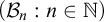 and consider ranks and independence relations defined by the algebraic closure operator in an
$\omega $
and consider ranks and independence relations defined by the algebraic closure operator in an
$\omega $
 -categorical structure. This eventually led to the results presented here. Given these results it may now be more meaningful to go back to considerations of the sequence
$(\mathcal {B}_n : n < \omega )$
-categorical structure. This eventually led to the results presented here. Given these results it may now be more meaningful to go back to considerations of the sequence
$(\mathcal {B}_n : n < \omega )$
 and the connections between the closure operator on all
$\mathcal {B}_n$
and the connections between the closure operator on all
$\mathcal {B}_n$
 (or some generalization of it to take into account “imaginary elements in
$\mathcal {B}_n$
(or some generalization of it to take into account “imaginary elements in
$\mathcal {B}_n$
 ”) and the limit structure
$\mathcal {M}$
”) and the limit structure
$\mathcal {M}$
 .
.
Acknowledgments
I thank the referees for valuable comments which helped me to eliminate a false claim in the introduction of the first version and to clarify some parts of the proofs.
Funding
This work is partially supported by the Swedish Research Council, grant 2023-05238.


 Open access

