


Producing high-value fruit crops in the Northeast and in the Great Lakes region presents both opportunities and challenges for growers. Many of the opportunities are related to the growing trend for local food that generated direct sales to consumers of more than $1.3 billion nationally in 2012. Of this total, approximately $330 million occurred in Michigan, New York, Massachusetts, Pennsylvania, and Wisconsin, which showcases the importance of local foods in these states (NASS 2014c). Many of the challenges facing fruit growers in these regions relate to weather risks such as extreme winter temperature events, late-spring frosts, hail, and excess precipitation occurring during the harvest season (Collier et al. Reference Collier, Fellows, Adams, Semenov and Thomas2008).
National participation levels by perennial fruit crop growers in federal crop insurance programs vary from 80 percent for blueberries to slightly over 50 percent for apricots, and were approximately 75 percent for cherries and plums in 2011 (RMA 2013). As shown in Table 1, the participation levels, measured as acres enrolled in the program as a share of total planted or bearing acres, were greater than 50 percent for most perennial crops in 2014, and the average national participation level was approximately 70 percent. However, this general trend is not consistent across all states. The participation level for cherries, peaches, and pears is relatively low in New York, and single-crop insurance products are unavailable for pears, plums, and strawberries in Michigan.Footnote 1 We also observe the availability of high tunnels (sometimes referred to as climatic modification technologies) for fruit and vegetable producers in the Northeast as an alternative risk management tool. High tunnels are used to mitigate weather risks and also enable an extended growing and harvest window that may lead to higher prices for fruit sold in periods with low supply (Lang Reference Lang2009). In addition to high tunnels and standard crop insurance products, there is interest among some stakeholders for weather-index-based insurance products to hedge against specific weather perils commonly facing specialty crop growers.
Federal Crop Insurance for Perennial Fruit Crops: Participation Rates and Liabilities in 2014

Source: Aggregate data from RMA (2014) and NASS (2014a, 2014b). Bearing acres for pecans is from 2012 Census of Agriculture (NASS 2014e).
Note: An empty cell indicates that the state does not produce (or produces very little) of the crop; N/A indicates either that the state does produce the crop but that crop insurance is not currently available, or that there is no insured acreage for that crop in the Summary of Business Report from RMA (2014).
Fruit growers are increasingly interested in better understanding how the adoption of high tunnels, compared to market-based tools such as crop insurance, will affect yields, local food sales, and farm profitability. Although there is an abundance of literature examining risk management strategies for program crops in the United States, there is very little research evaluating the economic implications of adopting various risk management strategies for specialty crop producers (Lindsey et al. Reference Lindsey, Duffy, Nelson, Ebel and Dozier2009, Belasco et al. Reference Belasco, Galinato, Marsh, Miles and Wallace2013). The purpose of this study is to develop a framework to evaluate various risk management strategies—including high tunnels, crop insurance, and weather insurance—for small- to medium-sized fruit crop growers in the Eastern United States. For each system we simulate a distribution of prices, yields, and costs over 20 years to consider the typical life cycle of a perennial fruit orchard. We provide results that evaluate and rank the different risk management strategies using various criteria.
Our empirical example focuses on fresh sweet cherry production in Michigan and New York State. We focus on sweet cherries in Michigan and New York State for three reasons. First, there is growing demand for sweet cherries produced in the Eastern United States, and the top-producing regions in the East are Michigan and New York. Second, sweet cherries are one of the most profitable fruit crops and therefore present the greatest opportunity to employ different risk management strategies. Third, and perhaps most importantly, sweet cherry producers face a host of weather-related risks in the Eastern United States, which greatly increase the financial risks associated with producing and marketing this crop.
Risk Management for Specialty Crops
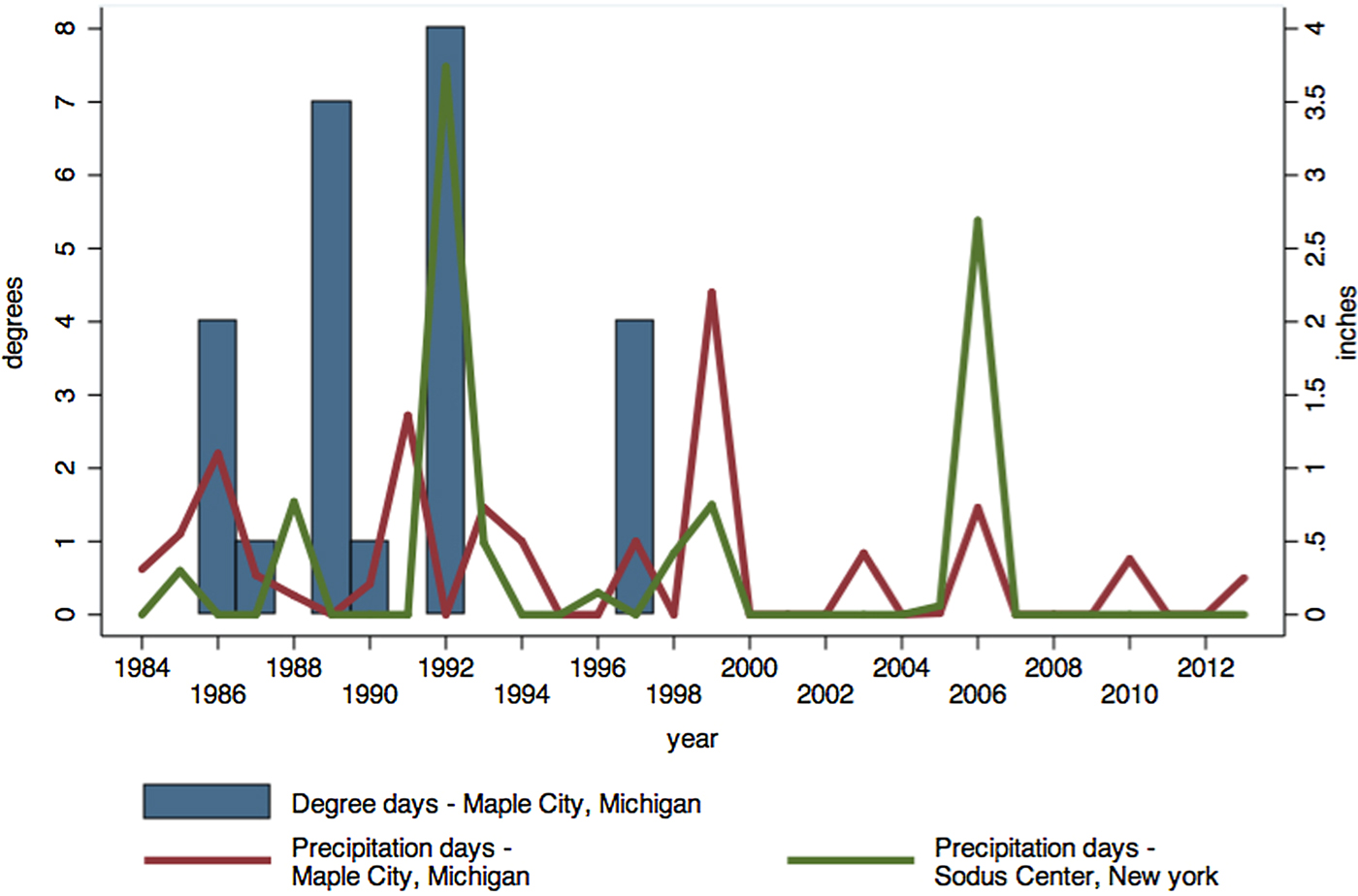
Various unfavorable weather conditions affect specialty crop production, which has led to an increase in the attention given to risk management strategies by growers. Perennial fruit crops in the Northeast are particularly vulnerable to a wide range of weather perils. Frost injuries during the bloom period in late spring have severely affected yields for apples, cherries, and grapes in the Northeast in 2002, 2007, and 2012 (Baule et al. Reference Baule, Gibbons, Briley and Brown2014). For cherry production, there is also a significant risk associated with fruit cracking due to heavy rainfall during the harvest season (Lang Reference Lang2013). Fruit cracking occurs during the fruit ripening stage when excessive water is absorbed through the fruit surface or through the root system, and the skin splits or “cracks” (Simon Reference Simon2006). Fruit that has cracked due to excessive water is not marketable. Figure 1 presents the frequency of two weather events for sweet cherry production in Michigan and New York between 1984 and 2013. The thick bar shows the occurrence of spring frost before and during the bloom stage in Maple City, Michigan measured on the left vertical axis. The thin lines represent the frequency of excessive rainfall during the harvest season (in Maple City, Michigan and in Sodus Center, New York) measured on the right vertical axis.
Spring frost and rain-induced cracking events facing sweet cherry growers in Michigan and New York, 1984–2013. Source: NCEI (2013); Murray (Reference Murray2011); NASS (2006). Note: Degree days measures the sum of the daily differences between the critical temperatures killing 90 percent of the buds during the growth stage in late spring and the observed temperatures. Precipitation days measures the sum of daily precipitation events that exceed 1 inch during the harvest season, which is used to describe a potential rain-cracking event for sweet cherries. The absence of degree days in New York State indicates that there were no observed frost events following the description given above.
The U.S. federal crop insurance program (FCIP) is a safety net that provides ex ante protection against price, yield, or revenue risks facing agricultural producers (Barnett Reference Barnett2014). Total acres insured have nearly tripled from 1989, with approximately 85 percent of major field crop acreage now enrolled. The Federal Crop Insurance Reform Act of 1994 and the Agricultural Risk Protection Act of 2000 both provided additional incentives for enrollment, including higher premium subsidies. Although the increase in premium subsidies was for both major field crops and specialty crops, the participation level in federal crop insurance programs has historically been higher for field crop growers than for fruit and vegetable growers. Acres enrolled in the program as a share of total planted or bearing acres has increased from 17 percent to 73 percent between 1990 and 2011 for fruits and nuts, and from 16 percent to 32 percent for vegetable crops during the same period (RMA 2013).
Revenue-based plans, such as actual revenue history (ARH), have been implemented on a pilot basis for cherries, navel oranges, and strawberries starting in 2009, 2011, and 2012 respectively (FCIC 2010). Under the ARH plan, historical revenue, rather than historical yield, is insured against losses from yield shortfalls, inadequate market prices, or both. For the ARH pilot program that was available to sweet cherry producers in Michigan between 2010 and 2013, state-level participation rates ranged between 44 percent and 55 percent. There were differences in participation rates across coverage levels for this pilot program in Michigan; the 75 percent coverage level accounted for the largest share of total insured acres.
Weather insurance payoffs are derived from cause-oriented weather outcomes that are free from potential manipulation by insurance participants, and therefore weather insurance reduces the costly administrative and operational expenses associated with monitoring farmer behavior. Such transparency between the insured and the insurer relieves concerns of the adverse selection problem and may lower the transaction costs incurred from asymmetric information between two parties (Moschini and Hennessy Reference Moschini and Hennessy2001, Barnett Reference Barnett2014). Given several advantages of weather-index-based insurance over traditional crop insurance programs, weather insurance schemes have been regarded as a potentially effective risk management tool among major program crop producers (Turvey Reference Turvey2001, Vedenov and Barnett Reference Vedenov and Barnett2004, Musshoff, Odening, and Xu Reference Musshoff, Odening and Xu2011). For application to specialty crops, Turvey, Weersink, and Chiang (Reference Turvey, Weersink and Chiang2006) developed a unique method to price weather insurance products for ice wine. Fleege et al. (Reference Fleege, Richards, Manfredo and Sanders2004) found improved income from using weather derivatives to hedge against heat risk for nectarines, raisin grapes, and almonds in California. The use of weather insurance has also attracted the attention of policy makers. Under the Agricultural Act of 2014, subsidized pilot products for weather-index-based insurance became available in 2015 for crops that have no available insurance products or have low participation rates for existing insurance products (Chite Reference Chite2014).
High tunnels are temporary, unheated greenhouses that provide a protected environment for various fruits, vegetables, and cut flowers (Carey et al. Reference Carey, Jett, Lamont, Nennich, Orzolek and Williams2009). Modified growing conditions within the tunnel, via temperature, sunlight, moisture, and pest control may increase marketable yields and enhance fruit quality compared to crops produced in an open field (Waterer Reference Waterer2003, Demchak Reference Demchak2009). Furthermore, if the use of high tunnels can effectively extend the harvest window for a crop, it is expected that it will allow producers to capture premium prices for these crops that are available earlier in the season (Conner et al. Reference Conner, Montri, Montri and Hamm2009, Ward, Drost, and Whyte Reference Ward, Drost and Whyte2011, Curtis et al. Reference Curtis, Yeager, Black, Drost and Ward2014). Others have found that the use of high tunnels may lead to greater economic benefits compared to crop insurance in the production of oranges and strawberries (Lindsey et al. Reference Lindsey, Duffy, Nelson, Ebel and Dozier2009, Belasco et al. Reference Belasco, Galinato, Marsh, Miles and Wallace2013). Part of the interest in high tunnels is due to initiatives within the Environmental Quality Incentives Program (EQIP) that began to provide cost-sharing funds for high tunnel production systems that extend the growing season in an environmentally friendly and energy-efficient manner (NRCS 2011).
However, little is known about the economic implications of using high tunnels for perennial fruit production in the Northeast and Great Lake regions, because the technology has not been widely adopted. Costs for various high tunnel systems are available, yet the benefits from such systems are difficult to assess ex ante. The economic benefits of adopting high tunnels in these regions depend largely on premiums expected for higher quality fruit and fruit that can be produced and marketed earlier in the season (Waterer Reference Waterer2003, Robinson and Dominguez Reference Robinson and Dominguez2013, Maughan et al. Reference Maughan, Curtis, Black and Drost2015).
Conceptual Framework
We develop a simulation model to characterize the distribution of revenues and costs associated with adoption of risk management strategies for sweet cherries in Michigan and New York State. We evaluate the effects for a status quo system plus systems using either high tunnels (the climatic modification technology), revenue-based crop insurance, or weather insurance. We examine and compare the net returns over a 20-year period in a net present value (NPV) analysis. It is possible that a grower will decide to adopt multiple risk management strategies. However, in our analysis we examine each risk management system separately. Because the risk management strategies for sweet cherries in this region are all relatively new, we expect that producers are primarily interested in the relative merits of the systems and will initially consider adoption of individual systems. While an application is made to fresh sweet cherry production in Michigan and New York here, the framework could be used to assess similar questions for other perennial specialty crops in humid continental climate regions where producers have the option to invest in alternative production technologies and purchase insurance products.
The net returns from risk management strategy S is shown in equation 1, where subscript r denotes a region, and subscript t denotes time:
 $$\eqalign{\pi _{{\rm r\comma t}}^{\rm S} =& \underbrace {{P_{{\rm r\comma t}} \cdot Q_{{\rm r\comma t}} - C_{{\rm r\comma t}}^{\rm S}}} _{{\hbox {net returns from crop sale and production\comma NR}_{{\rm r\comma t}}^{\rm C}}} \cr & + \underbrace{{I_{{\rm r\comma t}}^{\rm S} \lpar {\rm \phi} \rpar - \gamma _{{\rm r\comma t}}^{\rm S}}} _{{ \hbox{net return from insurance participation\comma NR}_{{\rm r\comma t}}^{\rm I}}} \cr &\qquad\qquad{\rm where}\quad r = {\rm MI\comma \;}\; {\rm NY\semicolon \; }\; t = 1\comma \; {\rm \ldots}\comma \; 20}$$
 In equation 1,  ${\rm \pi} _{{\rm r\comma t}}^{\rm S}$ represents the profit per acre for system S, which is comprised of net returns from the harvest, ${\rm NR}_{{\rm r\comma t}}^{\rm C} $, and net returns from purchasing insurance, ${\rm NR}_{{\rm r\comma t}}^{\rm I} $. P r,t and Q r,t are the market price and yield, and their product represents the future gross revenue, R r,t = P r,t · Q r,t. Production cost, $C_{{\rm r\comma t}}^{\rm S} = C_{{\rm r\comma t}} + {\rm \chi} _{{\rm r\comma t}}$, is comprised of the cost under the baseline that is held constant under all scenarios, C r,t, and the technology cost (the high tunnel in this study), χ r,t, which includes both the one-time construction cost of the high tunnel and its associated annual variable cost. $I_{{\rm r\comma t}}^{\rm S} $ and $\gamma _{{\rm r\comma t}}^{\rm S} $ represent the indemnities and the premiums, respectively, for different insurance products. In the case of the federal crop insurance program, φ is the level of coverage used to determine the indemnity payout and the associated subsidy. In the analysis of the weather insurance products, φ represents the weather index used to determine the payout function that insures farmers against the crop loss caused by a specific weather event, as well as the premiums.
Uncertainty in future price and production associated with unexpected weather events requires us to carefully consider the stochastic process for prices and yields. Price and Wetzstein (Reference Price and Wetzstein1999) modeled stochastic peach prices and yields, and therefore the stochastic revenue, to determine the optimal entry and exit revenue threshold decision in orchard investment. Richards and Manfredo (Reference Richards and Manfredo2003) priced the revenue insurance for grapes using similar stochastic processes for both price and yield. Uncertainty in price, P, and yield, Q, for sweet cherries could be represented by a geometric Brownian motion process:
 $$\displaystyle{{{\rm d}P} \over P} = {\rm \mu} _P{\rm d}t + {\rm \sigma} _P{\rm d}z_P$$
and
 $$\displaystyle{{{\rm d}Q} \over Q} = {\rm \mu} _Q{\rm d}t + {\rm \sigma} _Q{\rm d}z_Q \comma$$
where dP and dQ represent the change in per-acre price and in per-acre tons of fruit, μ is the drift rate or rate of change in price and yields, and σ is the standard deviation. The percentage change in price and yield, dP/P and dQ/Q, are normally distributed with mean μT and variance σ2T, with increment change in time T. The Wiener process, denoted by dz, represents the time-independent random shock that follows a standard normal distribution and defines the correlation between variables (dzPdzQ = ρdt,  ${\rm d}z_P^2 = {\rm d}z_Q^2 = {\rm d}t$), and ρ is the correlation coefficient between price and yield.
Applying Ito's Lemma, the stochastic process of gross revenue, R = PQ, follows the geometric Brownian motion (Turvey, Woodard, and Liu Reference Turvey, Woodard and Liu2014):
 $$\displaystyle{{{\rm d}R} \over R} = \displaystyle{{\partial R} \over {\partial P}}{\rm d}P + \displaystyle{{\partial R} \over {\partial Q}}{\rm d}Q + \displaystyle{1 \over 2}\displaystyle{{\partial ^2R} \over {\partial P^2}}{\rm d}P^2 + \displaystyle{1 \over 2}\displaystyle{{\partial ^2R} \over {\partial Q^2}}{\rm d}Q^2 + \displaystyle{1 \over 2}\displaystyle{{\partial ^2R} \over {\partial P\partial Q}}{\rm d}P{\rm d}Q$$
where ∂R/∂P = Q, ∂R/∂Q = P, ∂2R/∂P 2 = 0, ∂2R/∂Q 2 = 0 and ∂2R/∂P∂Q = 1. Substituting (2) and (3) into (4) gives the stochastic process for revenue:
 $${\rm d}R = {\rm \mu} _RR{\rm d}t + {\rm \sigma} _PR{\rm d}z_P + {\rm \sigma} _QR{\rm d}z_Q$$
where μR = μP + μQ + ρσPσQ; R is lognormally distributed such that the percentage change in R over time interval T, is normally distributed with mean μRT and variance,  ${\rm \sigma} _R^2 T$, where ${\rm \sigma} _R^2 = {\rm \sigma} _P + {\rm \sigma} _Q + 2{\rm \rho} {\rm \sigma} _P{\rm \sigma} _Q$. By Ito's lemma, the differential of change in logarithm of R over time, d ln (R), occurs with normally distributed mean $\lpar {\rm \mu} _R - \lpar 1/2\rpar {\rm \sigma} _R^2 \rpar T$ and variance ${\rm \sigma} _R^2 T$ (Turvey, Woodard, and Liu Reference Turvey, Woodard and Liu2014). Annual forecasted crop revenue could then be derived from the following lognormal Ito's process:
 $$R_t = R_{t - 1}e^{(({\rm \mu} _P + {\rm \mu} _Q - (1/2){\rm \sigma} _P^2 - (1/2){\rm \sigma} _Q^2 ){\rm d}t + N(0,1,{\rm \rho} ){({\rm \sigma} _P^2 + {\rm \sigma} _Q^2 + 2{\rm \rho} {\rm \sigma} _P{\rm \sigma} _Q)}^{1/2}\sqrt {{\rm d}t} ).}$$
Market price and yield data for fresh sweet cherries in Michigan and New York are available from the USDA's National Agricultural Statistical Service from 1984 to 2013 (NASS 2014a).Footnote 2 Detailed annual cost data for sweet cherry production are not available for Michigan and New York, and therefore we use data from California, Washington, and Oregon to characterize costs in Michigan and New York State (Galinato, Gallardo, and Taylor Reference Galinato, Gallardo and Taylor2010, Grant et al. Reference Grant, Caprile, Coates, Anderson, Klonsky and De Moura2011, West et al. Reference West, Sullivan, Seavert and Long2012). These studies recognized that perennial fruit crops have large establishment costs, annual variable costs, and annual revenue that begins once fruit is produced (typically in the 4th or 5th year in the life cycle of an orchard). We follow this logic in our analysis and include marketable yields (and hence revenue) beginning in year five. However, in our analysis we ignore the initial investment costs for land, trees, and other materials needed to establish an orchard. We assume that the general orchard establishment costs are the same across the risk management strategies (and treat the costs for the high tunnels as an additional establishment cost in that system); effectively we assume that an operator has decided to invest in an orchard, and our analysis provides the analysis to compare the economic effects of adopting different risk-management strategies.
In the cost and return studies that were conducted in the Western U.S. regions for sweet cherries, the total per-acre costs range from $9,848 to $14,456, while the corresponding crop sales per acre range from $11,900 to $22,400, and the resulting cost-revenue ratio ranges from 45 percent to 86 percent. To generate net return flows in our framework, we project future costs by multiplying the gross revenue simulated in equation 6 with an average cost-revenue ratio as shown in equation 7, specific to Michigan and New York respectively,
 $$C_{{\rm r},{\rm t}} = R_{{\rm r},{\rm t}} \cdot \left(\displaystyle{{\tilde C} \over {\tilde R}} \right)\comma$$
 In equation 7,  $\tilde C/\tilde R$ represents the historical cost-revenue ratio and is multiplied by a specific distribution function that is used as a proxy to characterize the cost and revenue relationship, where $\tilde R$ denotes the historical revenue flows. We use Producer Purchase Index for “Other Fruits and Berries” between 1984 and 2013 (BLS 2014) to retrieve the historical cost flows, $\tilde C$.
Calculating Net Returns in Each System
The general framework presented in equation 1 is used to quantify the net returns in each system. The forecasted net returns for growers of sweet cherries in region r (Michigan or New York) under the baseline (status quo) scenario are simply:
 $${\rm \pi} _{{\rm r,t}}^{\rm B} = R_{{\rm r,t}} - C_{{\rm r,t }}\comma$$
where the simulated gross revenues and costs are calculated following equations 6 and 7, respectively. We expand on the calculation of net returns in the baseline system to consider specific factors affecting revenues and costs in each of the other three systems.
High Tunnels
Relative to the net returns described above, the adoption of high tunnels to mitigate risk will lead to increased costs and potentially higher revenue flows. The calculation of net returns in the system that includes high tunnels is outlined in equation 9:
 $${\rm \pi} _{{\rm r,t}}^{{\rm HT}} = \tau \cdot R_{{\rm r,t}} - (C_{{\rm r,t}} + {\rm \chi} _{{\rm r,t }})\comma$$
where τ represents the revenue multiplier due to improvements in fruit quality, increases in yield, and increases in the per-unit price associated with an advanced marketing window. From available experimental data that describe yields and prices for sweet cherries produced under high tunnels in New York during 2010 and 2012, the crop value per acre under the high tunnel system is expected to vary from 1.27 to 3.4 times higher than the crop value without high tunnels. Similar experimental data from research at Michigan State University shows that the value of the crop produced in high tunnels is between 1.3 to 2.5 times higher than the value for fruit produced in an open field.Footnote 3 We consider a range of values between 25 percent and 150 percent (or equivalent revenue multipliers between 1.25 and 2.50) to describe this premium for fruit produced in a high tunnel.
The cost of establishing high tunnels is approximately $40,000 per acre. While high tunnel structures could remain relatively maintenance free, other variable costs including plastic covers every four years ($4,000 per acre) and annual labor costs for various tasks ($1,200 per acre) are expected (Blomgren and Frisch Reference Blomgren and Frisch2007). All of these additional costs specific to the high tunnel system are captured in χr,t.
Revenue-based Crop Insurance
Focusing on the ARH pilot program for sweet cherries, the calculation used to determine net returns for a grower adopting crop insurance needs to consider the costs of enrolling in the program as well as the indemnity. Net returns to the grower are outlined in equation 10:
 $${\rm \pi} _{{\rm r,t}}^{{\rm CI}} = {\rm \pi} _{{\rm r,t}}^{\rm B} + {\rm I}_{{\rm r,t}}^{{\rm CI}} (\delta _{\rm C}) - {\rm \gamma} _{{\rm r,t}}^{{\rm CI }}\comma $$
where  $I_{{\rm r\comma t}}^{{\rm CI}} \lpar {\rm \delta} _{\rm C}\rpar = {\rm Max}\lpar {\rm \delta} _{\rm C} \cdot \tilde R_{\rm r} - R_{{\rm r\comma t}}\comma \; 0\rpar $ is the indemnity as a function of the coverage level, δC; ${\rm \pi} _{{\rm r\comma t}}^{\rm B} $ is the same as it was defined in equation 8. Approved or certified revenue, denoted by $\tilde R_{\rm r}$, is determined by the historical average of grower revenue based on the past four to ten years, while R r,t is the actual revenue in year t and region r. In our analysis, we simulate the actual revenue based on yield and price patterns observed between 1984 and 2013. The crop insurance premium is defined by:
 $${\rm \gamma} _{{\rm r,t}}^{{\rm CI}} = E({\rm Max}({\rm \delta} _{\rm C} \cdot \tilde R_{\rm r} - R_{{\rm r,t}},0)) \cdot (1 - {\rm \zeta} ({\rm \delta} _{\rm C})).$$
For the premium to be actuarially fair, the pre-subsidy premium level is equal to the expected loss or the expected indemnity. The cost of insurance to the grower is determined by subtracting the subsidy (denoted as ζ) from the premium, which, as a percentage of the premium, varies by the level of coverage the grower selects. In our analysis, we consider all the coverage levels, from 50 percent to 75 percent, and subsidies from 67 percent to 55 percent (RMA 2015).
Weather Insurance
Weather insurance products are indexed to weather variables that are linked to specific events affecting crop size, crop prices, or crop quality. For sweet cherry production in the Northeast and in the Great Lakes region, spring frost and summer precipitation (leading to fruit cracking) are the two main weather risks. A hard frost in the late spring (after the budding process has begun) has the capacity to decrease bud survival through the flowering stage. Tolerance to the freezing temperature varies by stage of development as well as by growing environment and crop types; sweet cherries are relatively vulnerable to frost damage compared to other perennial stone fruit crops such as peaches and plums (Miranda, Santesteban, and Royo Reference Miranda, Santesteban and Royo2005).
Two types of weather-index-based insurance programs are considered in our analysis: frost insurance and harvest season rain insurance. The net returns to a grower who adopts weather insurance are described in equation 12.
 $$\eqalign{&{\rm \pi}_{{\rm r\comma t}}^{{\rm WI}} = {\rm \pi} _{{\rm r \comma t}}^{\rm B} + I_{{\rm r\comma t}}^{{\rm WI}} \lpar W\rpar - {\rm \gamma} _{{\rm r\comma t}}^{{\rm WI}} \lpar 1 - {\rm \psi} \rpar \comma \; \quad {\rm where} \cr & \qquad {\rm WI = FI}\comma \; \, {\rm RI\semicolon \; }\, W = W_{{\rm r\comma t}}^{\rm F}\comma \; W_{{\rm r\comma t}}^{\rm E}\comma \; W_{{\rm r\comma t}}^{\rm C}}$$
 Here the frost insurance is denoted by FI, and harvest rain insurance is denoted as RI. The variable  $W_{{\rm r\comma t}}^{\rm F} $ measures the occurrence of spring frost; $W_{{\rm r\comma t}}^{\rm F} $ is the sum of the daily deficit amount in observed temperature falling below the critical thresholds that cause 90 percent bud kill. Since FCIP began to subsidize weather-index-based insurance in 2015, we consider both the unsubsidized and subsidized scenario for weather insurance in our analysis. The subsidy rate is denoted by ψ in equation 12; we set it to 0 to consider the case with no subsidy and also to consider a range of subsidy rates from 10 percent to 50 percent. The indemnity function for frost insurance is:
 $$I_{{\rm r \comma t}}^{{\rm FI}} (W_{{\rm r \comma t}}^{\rm F} ) = {\rm \theta} _{\rm r}^{\rm F} \cdot W_{{\rm r\comma t}}^{\rm F} \comma $$
where  ${\rm \theta} _{\rm r}^{\rm F} $ is the unit payout growers will receive for each degree deficit. The unknown frost index, $W_{{\rm r\comma t}}^{\rm F} $, is approximated by the probabilistic information on potential frost damages, denoted as $\tilde W_{{\rm r}\comma \tilde{\rm t}}^{\rm F} $, generated using detailed historical weather records from 1984 to 2013 as shown in equation 14,
 $$\tilde W_{{\rm r}\comma\tilde {\rm t}}^{\rm F} = \sum\limits_s {\sum\limits_d {{\rm Max}({\rm Z}_{{\rm r \comma s}}^{\rm C} - {\tilde {\rm Z}}_{{\rm r} \comma \tilde {\rm t}{\rm \comma s \comma d}}\comma 0) \comma}} \quad {\rm where}\quad \tilde t = 1984 \comma {\rm \ldots} \comma 2013.$$
 Here we use  $Z_{{\rm r\comma s}}^{\rm C} $ to denote the critical temperature at stage s for 90 percent bud kill, which is commonly used to identify the bud injury at different stages of development (Murray Reference Murray2011); ${\tilde Z}_{{{\rm r}\comma {\tilde t}\comma s\comma {\tilde d}}}$ is the daily temperature observed at stage s from 1984 to 2013; d denotes the number of days in each stage.
We consider two types of harvest rain insurance, and develop two indices to capture the effect of summer precipitation: an excess rain index,  $W_{{\rm r\comma t}}^{\rm E} $, and a cumulative rain index, $W_{{\rm r\comma t}}^{\rm C} $. Similar to the design of the frost index, the excess rain index is characterized by the following indemnity function,
 $$I_{{\rm r \comma t}}^{{\rm RI}} (W_{{\rm r \comma t}}^{\rm E} ) = \theta _{\rm r}^{\rm E} \cdot W_{{\rm r \comma t}}^{\rm E \comma} $$
where  $W_{{\rm r\comma t}}^{\rm E} $ is measured as the sum of daily rainfall during the harvest season exceeding the threshold that causes fruit cracking; and $\theta _{\rm r}^{\rm E} $ is the unit payout growers receive for every excess inch of rainfall. The excess rainfall index, $W_{{\rm r\comma t}}^{\rm E} $, is approximated by the probabilistic information on potential excess rain damages, denoted as $\tilde W_{{{\rm r}\comma {\tilde t}}}^{\rm E} $, generated using detailed historical weather records from 1984 to 2013 as shown in equation 16,
 $${\tilde W}_{{\rm r},{\rm t}}^{\rm E} = \sum\limits_d {{\rm Max}({\tilde V}_{{\rm r},{\tilde{\rm t}},{\rm d}} - V_{\rm r}^{\rm C},0)},\quad {\rm where}\quad {\tilde t} = 1984,\ldots,2013.$$
 In equation 16,  $V_{\rm r}^{\rm C} $ represents the precipitation threshold, $\tilde V_{{\rm r\comma \tilde t\comma d}}$ is the daily precipitation during the period 1984 to 2013, and d denotes the length in days in the harvest season.
The cumulative rainfall index considers the sum of rainfall during the harvest season. Based on the historical precipitation data (Skees et al. Reference Skees, Gober, Varangis, Lester and Kalavakonda2001, Heimfarth and Musshoff Reference Heimfarth and Musshoff2011), the stochastic cumulative rainfall index is specified as
 $${\tilde W}_{{\rm r},{\tilde {\rm t}}}^{\rm C} = \sum\limits_d{{\tilde V}_{{\rm r},{\tilde {\rm t}},{\rm d}}},\quad{\rm where}\quad {\tilde t} = 1984,\ldots,2013,$$
used to approximate the cumulative rainfall in a given period denoted by  $W_{{\rm r\comma t}}^{\rm C} $ such that the payoff for the weather insurance is
 $$I_{{\rm r \comma t}}^{{\rm RI}} (W_{{\rm r \comma t}}^{\rm C} ) = \theta _{\rm r}^{\rm C} \cdot {\rm Max(}W_{{\rm r \comma t}}^{\rm C} - \tilde W_{\rm r} \comma 0) \comma$$
where  $\theta _{\rm r}^{\rm C} $ represents the per-unit amount the grower will be compensated if the observed accumulated rainfall level goes above the strike level, $\tilde W_{\rm r}$.
For all weather insurance products, the actuarially fair premiums are set as equal to the expected loss (or the expected indemnity) discounted by a risk-free interest rate, i, during time interval Δt, if an unfavorable weather event occurs. The calculation of the premium, denoted as  ${\rm \gamma} _{{\rm r\comma t}}^{{\rm WI}} $, is shown in equation 19
 $${\rm \gamma} _{{\rm r \comma t}}^{{\rm WI}} = E(I_{{\rm r \comma t}}^{{\rm WI}} (W)) \cdot \exp ( - i \cdot \Delta t).$$
To price the weather insurance products, we use detailed data on precipitation and temperature collected over the period 1984 to 2013 from the National Climatic Data Center. The weather data are used to specify late spring frost events and harvest rain events for sweet cherry production regions in Michigan and in New York (NCEI 2013). Leelanau County and Wayne County are the top sweet cherry producing counties in Michigan and New York, respectively; they account for 60 percent of total bearing acreage in Michigan and 48 percent of total bearing acreage in New York (NASS 2014d). Therefore, we collect the weather data for Maple City, Michigan and Sodus Center, New York as they are located in the representative counties and both have data available over the period from 1984 to 2013.Footnote 4
Given agronomic information that describes the range of dates for specific crop development stages (i.e., green tip and the key bloom dates), we identify the critical times for spring frost (in April and early May) with temperatures that would kill 90 percent of the buds (Murray Reference Murray2011) in the calculation of the frost index. Because the historical data in New York State do not show any cases of temperatures falling below the critical points, we do not consider this type of weather insurance product in New York. Our rainfall indices are generated based on the information that describes the typical harvest windows in late June and early July in both states (NASS 2006).
In our analysis we set the critical precipitation threshold in the rain index,  $V_{\rm r}^{\rm C} $, to 1 inch; the maximum observed level for this index was 2.2 for Michigan and 3.74 for New York. We set the strike level in the cumulative rainfall index, $\tilde W_{\rm r}$, equal to the mean amount of accumulated rainfall between 1984 and 2013. According to the best-fit distribution of historical weather patterns, we use an exponential distribution to characterize all weather-related indices. The per-unit payouts for each weather index in each state are set by assuming that, in the worst year, indemnities received by the growers will not exceed 25 percent of the highest observed level of crop revenue. A series of simulations are then used to determine the prices and the indemnities for the various weather insurance products (Turvey, Weersink, and Chiang Reference Turvey, Weersink and Chiang2006, Musshoff, Odening, and Xu Reference Musshoff, Odening and Xu2011).
Results
We use Monte Carlo simulation techniques to generate the annual net per-acre return over a 20-year period from adopting various risk management strategies for sweet cherry production in Michigan and New York. We consider the effects for a status quo scenario (no risk management strategy) plus four risk management strategies in Michigan and three risk management strategies in New York (as weather insurance related to frost is not relevant in New York State). Using an iterative procedure we calculate the net present value per acre for each system at a discount rate of 8 percent (Song, Zhao, and Swinton Reference Song, Zhao and Swinton2011). We also consider other discount rates within a reasonable range and find that it does not change the general thrust of the results below. Table 2 shows the key parameters and distribution assumptions for prices and yields (in Michigan and New York) used in the simulation.
Baseline Parameters Used in the Monte Carlo Simulation Analysis

A summary of the results for Michigan is presented in Table 3, and a summary of the results for New York is presented in Table 4. The information in the tables summarizes the distribution of net returns to each risk management strategy. We show six levels of revenue premiums (ranging between 25 percent and 150 percent) for the fruit produced in the high tunnel system; the premiums are based on the observed revenue premiums for cherries produced in both open field and under high tunnels in field experiments in the two regions. We include six levels of coverage for crop insurance from 50 percent to 75 percent, and six subsidy levels for weather insurance from 0 to 50 percent.
Summary Statistics for the NPV Results in Michigan ($/acre)

Summary Statistics for the NPV Results in New York ($/acre)

The results in Table 3 show that, in Michigan, the high tunnel system yields the highest expected returns across all the risk management strategies when we assume a high revenue premium for the marketed fruit (at or above 150 percent). The expected returns to the crop insurance and weather insurance products are greater than the status quo across all the coverage and subsidy levels. The crop insurance strategy provides a relatively high level of expected returns that increase with the coverage level and a relatively low coefficient of variation that remains stable across coverage levels. The coefficient of variation results for the weather insurance products decrease with the subsidy level, indicating that weather insurance would be preferred only when subsidized and as subsidies to the premium increase. Harvest rain insurance generates higher returns compared to crop insurance and compared to high tunnels if we assume low revenue premiums (less than 125 percent). At the 5th percentile of the net returns distribution, the results show that the crop insurance is preferred to all other risk management strategies, and adoption of high tunnels is the riskiest strategy, regardless of the revenue premium. At the 95th percentile, the results show that all the strategies generate higher expected returns than the status quo and that the greatest return occurs with the adoption of the high tunnel system (for all revenue premium levels).
Table 4 shows that in New York State the expected net returns per acre with high tunnels (with a revenue premium at or above 125 percent) are the highest compared to all other strategies. With either crop insurance across the various coverage levels or with weather insurance (harvest rain insurance) across the various subsidy levels, we see higher net returns than with the status quo scenario. Similar to the results in Michigan, we also see that the crop insurance strategy does not always outperform the weather insurance strategy. Crop insurance leads to higher net returns compared to weather insurance only under the highest coverage level (at 75 percent coverage). Weather insurance starts to outperform crop insurance with coverage below 60 percent and when subsidies to premiums exceed 30 percent. The coefficient of variation is the highest for the high tunnel systems that assume higher revenue premiums. The coefficient of variation is relatively stable (between 2 and 3) among the status quo, crop insurance, and weather insurance scenarios. At the 5th percentile, crop insurance would be the preferred strategy (the option with the smallest negative returns), followed by the status quo and weather insurance; at the 5th percentile, the least preferred strategy is high tunnels. At the 95th percentile, the weather insurance strategy generates higher net returns than the crop insurance strategy; however, overall the high tunnel strategy would generate the highest net return.
Discussion
Managing weather risk in the production of specialty crops in humid, cool temperature regions is critical for maintaining fruit quality, ensuring local supply, and generating sustainable profits for growers. The key weather risks involved in growing sweet cherries in Michigan and New York include late-spring frosts (that reduce the quantity of buds) and excessive rain during harvest season (that leads to fruit cracking). Various strategies to mitigate these risks are available and have been considered to some degree by industry stakeholders; these include high tunnels, crop insurance, and weather insurance. The efficacy of different risk management tools varies by region, by producers’ attitudes toward risk, as well as by their exposure to weather events. The purpose of this research is to evaluate the long-term economic impacts of adopting the various risk management strategies for sweet cherry production in Michigan and New York. We develop a framework using Monte Carlo simulation methods that will help farm business managers make better-informed decisions on the adoption of various contemporary risk management tools for specialty crops.
We use historical yield, price, and weather data to simulate the expected net returns under different risk management scenarios. Our findings show that the adoption of high tunnels is the preferred strategy if a relatively large revenue multiplier is assumed.Footnote 5 All of the risk management options outperform the status quo system in both Michigan and New York. Overall, the results indicate that a higher revenue premium would be needed in Michigan (relative to New York) in order for the high tunnel system to dominate the insurance-based strategies.
This research adds to the growing body of work that examines risk management issues for specialty crops by focusing carefully on the tools that can be applied to perennial fruit crops in the Northeast and Great Lakes region of the United States. We also contribute to the development of a modeling framework that could be used to study the economics of alternative risk management tools for a range of specialty crops facing substantial risks related to spring and summer weather events. Although we observe an increase in the number of subsidized crop insurance products available for specialty crop growers, it is not clear that the use of such products is the optimal strategy for managing risk by all fruit and vegetable producers in the Northeast and in the Great Lakes region. Our findings suggest that more consideration should be given to other risk management tools including the high tunnel initiative as part of the EQIP and the pilot weather-index-based insurance programs for specialty crops as proposed in the Agricultural Act of 2014.


 Open access

