




In the late seventeenth and early eighteenth centuries, the Afghans within and beyond the Indian subcontinent faced several significant changes. The rise in Afghan power during this period coincided with the political and economic shifts that took place across Eurasia. The majority of ‘long-distance’ trade shifted from Eurasia to the vast waters of the Indian Ocean. As the trade dwindled on the traditional routes, the powerful empires such as the Ottomans, Safavids, and Mughals faced a decline.Footnote 1 In the Indian subcontinent, the fragmentation of the centralised power of the Mughals created new chances for the emergence of regional Afghan governing bodies. As a result, during this period, various centres of Afghan influence spread throughout central and northern India. Regional kingdoms governed by the Afghans came up in places like Bhopal, Tonk, Kurnool, Farrukhabad, and Rohilkhand.Footnote 2 This article is interested in one such Afghan group—the Rohilla Afghans, who settled in the Katehar region in the present-day state of Uttar Pradesh in India.Footnote 3 Historian Jos Gommans argues that the complex connections involving horse trade, military service, migration, agricultural expansion, and power struggles between the Durrani and the Mughal empires played a crucial role in setting the stage for the rise of the Rohilla Afghans.Footnote 4 The Rohillas belonged to the region of Peshawar and were affiliated with the Yusufzai tribe.Footnote 5 Razak Khan argues that in Persian and Urdu, the term ‘Rohilla’ was initially used to describe ‘Afghan immigrants’ who settled in the Rohilkhand region.Footnote 6 Over time, the term Rohilla, along with ‘Afghan’ and ‘pathan’, became interchangeable, suggesting that these labels were not tied to specific ethnic identities. Instead, the term ‘Rohilla’ became a political and social category that included a diverse group of people.Footnote 7
In the early stages of state formation, the Rohillas navigated the changing political situation of eighteenth-century North India to secure their positions and regional interests. The Rohilla chiefs were engaged in both battles and alliances with various groups such as the Katehariya Rajputs, Jats, Marathas, Awadh Nawabs, and the East India Company. According to Khan, the migration of Afghans from the region of Roh in modern Afghanistan to Rohilkhand in the eighteenth century shows a rich ‘trans-local connected history’ between the two regions. He further states that this movement of people laid the foundation for the rise of ‘Indo-Afghan’ power during that time. Alongside this migration, there was a great exchange of knowledge, culture, and ideas, which flowed freely across pre-colonial South Asia.Footnote 8 At the time of the Rohilla migrations, the Katehar region was under the control of the Katehariya Rajputs, who held the position of zamīndārs (chieftains) in the region. The Rohillas expelled these local Rajput zamīndārs and gained military and political dominance in the region. Subsequently, we see that the Rohilla Afghans assumed the role of statesmen, and their courts evolved into centres of cultural patronage and literary production. These influential elites actively encouraged the production of literary works. Gommans mentions that under the patronage of the Afghan urban elite, these literary endeavours served as vehicles for the dissemination of Afghan cultural heritage, nurturing a ‘renewed’ sense of pride and identity.Footnote 9
The present article adopts a literary historical approach to delve into this rich history. The study of texts has greatly enriched our understanding of the South Asian past in recent years. The historiography of the eighteenth century, which revolved mainly around questions of state formation and political economy till the 1990s, has benefited from this in particular.Footnote 10 In recent years, historians working on Indo-Afghan history have also begun to look at the eighteenth-century Afghan state formation and its related aspects through the lens of textual analysis. For instance, Nile Green has studied texts from the seventeenth and eighteenth centuries to investigate questions about the identity and legitimacy of Afghan communities in northern India.Footnote 11 Christine Noelle-Karimi and Neelam Khoja have analysed the various literary representations of Ahmad Shah Durrani’s reign.Footnote 12 Likewise, Sajjad Nejatie has traced the development of the Abdālī-Durrānī tribal confederacy by analysing a range of historical writings, including genealogies, court records, and local narratives.Footnote 13 Naveena Naqvi, who studies the interimperial world in Afghan North India from 1774 to 1857, also closely looks at a variety of Persian and Urdu texts such as memoirs, biographies, and chronicles, written by service professionals such as soldiers, scribes, and legal officers.Footnote 14 This literary approach has allowed us to understand the representational politics and cultural dimensions of the multitude of texts generated during this period of political shift. The present article builds on this scholarship and expands it by analysing a relatively unexplored text, Ḵẖulāṣat ul-Ansāb, belonging to an important Afghan polity of the eighteenth century. By interpreting some aspects of this text in consideration of the political processes of the time, the article contributes to the historiography of the eighteenth century as well as that of the Afghan state formation in South Asia.
In this article, I focus on the role of emotions in shaping the text Ḵẖulāṣat ul-Ansāb (The Summary of Genealogies), which the Rohilla chief Ḥāfiz̤ Raḥmat Ḵẖān (r. 1749–1774) wrote in Persian around 1770.Footnote 15 I explore how the author’s emotional world, especially his experience of anxiety, shaped both the writing of this text and the larger project of constructing a distinct Afghan identity during a period of intense political change and contest. The main argument of this article is that Ḵẖulāṣat was more than a genealogical account; it was a very personal and emotional response to the political changes and hopes of eighteenth-century North India.
The article is structured in five sections. I begin by introducing the text, its author, and the complex historical context in which it was written. The next four sections examine different emotional layers that influenced the writing of Ḵẖulāṣat. First, I look at how the author’s concern with lineage and family ties reflects his anxiety about the unity and identity of the Rohilla Afghans. Second, I explore how he presents multiple origin narratives and wrestles with the complexity of Afghan genealogy, revealing an unease with how identity is remembered and claimed. Finally, I turn to his search for religious authority. Here, I show how he tried to establish spiritual and political legitimacy in the competitive world of eighteenth-century South Asia. Together, these emotional threads—anxiety, pride, hope, and courage—give us fruitful avenues to understand Ḵẖulāṣat as both a political and emotional document. Rather than reading it through a single lens, I suggest that we see it as a multilayered expression of a Rohilla chief trying to make sense of his world and shape the future of his community.
In recent years, historians have started paying attention to how emotions like anxiety and uncertainty have historically influenced human actions, especially in uncertain political environments. Scholars such as Margrit Pernau and Katherine Butler Schofield have shown that anxiety would often encourage people to reflect more deeply, gather knowledge, and take calculated steps to deal with risk. Pernau emphasises that thinking about the future often stirs not only anxiety but also feelings of terror, along with a strong desire for hope and human connection.Footnote 16 Similarly, in her study of emotions in the history of Hindustani music, Schofield draws upon Hayy al-Arwāh—a music treatise by Miyān Ẕiyāʾ ad-Dīn to point out how anxiety motivated people to engage in active efforts to understand and manage uncertainty. This included behaviours like careful thought, reflection, and information gathering to better assess and respond to potential risks and threats.Footnote 17 In the case of the Rohilla Afghans, and particularly for a leader like Ḥāfiz̤ Raḥmat, anxiety arose from the pressure to secure power, maintain identity, and protect the future in a region where political alliances were shifting rapidly.
While anxiety is clearly an important emotion in this text, it is far from the only one. I expand my argument and reading of Ḵẖulāṣat to include other emotional currents like confidence, strength, determination, and bravery. The decline of the Mughal state, though a source of concern as well as opportunities, also opened new ways for the Rohillas to imagine a different future for themselves. This sense of possibility comes through strongly in the voice of Ḥāfiz̤ Raḥmat. He does not speak only as someone worried about the future, but also as a leader who sees an opportunity for growth. Hence, the text can be read as both of growing self-confidence among Afghan elites and a reflection of certain anxieties around identity and legitimacy. Ḥāfiz̤ Raḥmat’s writing reveals a desire to assert the legitimacy and honour of the Afghans in North India—not just to defend it but also to celebrate and strengthen it. In this light, emotions such as righteousness and courage also shape the text. These values form a key part of Rohilla self-understanding, and they appear throughout Ḵẖulāṣat in the way the author frames the virtues of his ancestors and community. By including these emotional tones, we get a richer and more complete view of how Ḥāfiz̤ Raḥmat navigates the challenges of his time, not just through worry but also through a sense of purpose and belief in his people’s future.
The text and its context
Ḵẖulāṣat ul-Ansāb is an important treatise on early Afghan history, genealogy (nasab), and the discussion of the ancestors (ajdād) of the Afghan tribes. Its author Ḥāfiz̤ Raḥmat assumed rulership in Rohilkhand in 1749 following an invitation from another Rohilla chief, Ἁli Muḥammad Ḵẖān (r. 1725–1749), who by that time had assumed considerable authority in the region. Ἁli Muḥammad Ḵẖān appointed Ḥāfiz̤ Raḥmat as the guardian of his minor sons and the regent of the successor Saʻdullāh Ḵẖān.Footnote 18 After Ἁli Muḥammad Ḵẖān passed away, Ḥāfiz̤ Raḥmat became the leader of the Rohillas in Pilibhit, Badaun, Aonla, and Rampur. He extended his influence beyond politics and invested in architectural developments at places like Bareilly and Pilibhit. He founded the town of Hafizganj to facilitate merchants and traders travelling between Bareilly and Pilibhit.Footnote 19 He also established an intellectual centre in Shahjahanpur for Sunni theologians from Farangi Mahal, a prominent Muslim school in Lucknow.Footnote 20
In the eighteenth century, the ruling elites of new principalities faced constant threats of political upheavals, economic hardships, and cultural rivalries. The looming presence of colonial powers created a sense of insecurity and vulnerability for them. However, at the same time, these struggles also opened up new chances for legitimacy, growth, and building identity. For the Rohilla Afghans who had settled in northern India during this time, the situation was especially complex. On one hand, they saw opportunities to expand their rule and gain power. On the other hand, they were unsure of their place in this changing environment. They had left behind their homeland, and in the new territories they had conquered, they had to establish their authority and carve out a space for themselves. This experience brought emotional struggles as well as opportunities for power with it. In the midst of all this, there was a renewed interest among the Afghan elite in understanding and expressing who they were. This is where a text like Ḵẖulāṣat becomes important.
Ḥāfiz̤ Raḥmat says that the main reason why he wrote this treatise was to teach the Afghans born in India (afg̠ẖānān-i hindūstān zāda) about their past. He wanted them to know about each Afghan tribe and clan, and their subsequent leaders and important figures, so that they could understand their ancestry and lineage better.Footnote 21 He thought that it would benefit them to know about their origins and family history.Footnote 22 Hence, we see that the text provides important reflections on the lineage, tribal history, and ancestry of the Rohillas, establishing their historical roots and connections. Through the long discussion of Afghan tribal history, the text therefore was meant to play a crucial role in reinforcing the shared historical consciousness of the Afghans and legitimising their claims to power.
Ḥāfiz̤ Raḥmat mentions that Ḵẖulāṣat was influenced by earlier works of Afghan history, particularly the early seventeenth-century work Taʾrīkh-i Ḵẖān Jahānī wa Makhzan-i Afghānī of Ni’matullāh ul-Harawī.Footnote 23 Taʾrīkh-i Ḵẖān Jahānī served as a foundational text for most of the Afghan historical writings of the later period. It provided later scholars with a model for documenting and understanding their ‘complicated past’.Footnote 24 It covers Afghan history in great detail, starting from the early times of Yaʻqūb Isrāʾīl and extending up to the rule of the Lodhis and Surs in India. Also, it organises Afghan tribes and subtribes systematically, making it an essential reference for anyone working on Afghan genealogy.Footnote 25 It should be noted that in Ḵẖulāṣat Ḥāfiz̤ Raḥmat did not simply copy everything from Taʾrīkh-i Ḵẖān Jahānī; instead, he carefully selected narratives, focusing mainly on the genealogy and lineage records of Afghan tribes. He deliberately left out sections, such as those discussing Khan Jahan Lodhi and Mughal Emperor Jahangir, as well as information on Afghan tribal Sufis. So here we see that the author curates or reworks past narratives to serve a new political or identity-building purpose. His selective approach shows his thoughts and objectives behind writing Ḵẖulāṣat. By prioritising genealogical records over other kinds of histories, he showed what he considered most relevant for his time. We also have to keep in mind that he was writing in the eighteenth century, a time when the Rohillas were fighting to gain and maintain power in northern India. For them, detailed knowledge of their ancestry and tribal connections was far more important than narratives about Mughal emperors or Afghan elites or Sufi traditions. This explains why Ḥāfiz̤ Raḥmat chose to emphasise lineage records while disregarding other aspects of Afghan history mentioned in Ta ʾrīkh-i Ḵẖān Jahānī. We have to understand that his work was not just a historical record but a strategic effort to preserve and reinforce the identity of the Afghan ruling elite in his era.
We should also note that, as compared to Taʾrīkh-i Ḵẖān Jahānī, Ḵẖulāṣat has received very little attention from historians so far. While Gommans and Green have used Ḵẖulāṣat in their studies of Afghan history, it remains largely unexamined in its own right. Gommans’s research focuses on the contextual factors that influenced Ḥāfiz̤ Raḥmat’s writing, including the reasons behind his emphasis on Afghan ancestry and religious identity.Footnote 26 On the other hand, Green views Ḵẖulāṣat as a new kind of Afghan history. He mentions that this text explicitly shows how ‘sudden shifts in status’ brought about changes in identity and ultimately led to the creation of a tribal history for the Afghans.Footnote 27 Despite their work, many aspects of the text remain to be analysed in detail. Its many layers and nuances have not been the focus of a dedicated study. In my opinion, Ḵẖulāṣat serves as much more than just a historical record: it offers a complex view of how culture, politics, and personal experience come together in one narrative.
I also argue that Ḥāfiz̤ Raḥmat’s focus in the text on the glorification of Afghan lineage and the importance of ancestral consciousness could have also served as a powerful counter-narrative to Mughal attempts to delegitimise Afghan rule in northern India. This becomes particularly evident in the text’s conscious efforts to elevate the Afghan past, presenting it as noble and valorous in contrast to Mughal portrayals. Mughal chroniclers like Abu’l-Fazl deliberately tried to undermine Afghan rulers such as Shēr Shāh Sūr, referring to him dismissively only as Shēr Ḵẖān and depicting his rule as chaotic, deceitful, and manipulative.Footnote 28 This image was part of a broader Mughal strategy to discredit the Afghans and cast them as unreliable and opportunistic. It could be that in response to these kinds of Mughal narratives, Ḥāfiz̤ Raḥmat hoped to restore the dignity of his community by writing about their proud lineage. He emphasises their ancestral connection to the Ghurid Dynasty, their essential role in spreading Islam in India, and their capable leadership during the Delhi Sultanate.Footnote 29 It feels like Ḥāfiz̤ Raḥmat took it very seriously to counter the negative portrayals of Afghans by Mughal chroniclers. He might have believed that the Mughals unfairly tarnished the image of the Afghan people, reducing them to little more than opportunists with no real political or cultural achievements. To correct this perception, he thought to focus on their noble ancestry and the contributions they made in the past. The act of remembering played a key role in this discursive exercise. Let us begin the analysis of the text with that issue.
The need to remember
One of the enduring concerns of Ḵẖulāṣat is about the potential political and cultural amalgamation of Afghans in India. Ḥāfiz̤ Raḥmat notes a decline in their moral commitment towards the community. He says that to address this he took on the crucial task of preserving and stimulating the consciousness of the Rohilla Afghans regarding their nasab. He recognises that such preservation was important for the stability of the Rohilla government and for the Afghans to maintain a strong sense of their identity. In this context, he points out that the younger generation (pusht) of Afghans, who were exposed to an altogether different culture as a result of their migration from Roh to Hindustan, found themselves grappling with identity crises.Footnote 30 He observes that the sudden shifts in their places and positions resulted in the erosion of their nasab, and this left them unable to differentiate between relatives (aqārib, pl. of qarīb) and foreigners.Footnote 31 Over time, they seemed to have lost connection with their roots and were unaware of the families closely related to them.Footnote 32 Consequently, the author laments that there was a lack of awareness amongst them about who was related to whom and the connections between their families.Footnote 33 Recognising the urgency of this situation, the author expresses the need to remember, document, and share the knowledge of family relationships so that the Afghans can connect with each other. He underlines the importance of maintaining familial ties, particularly within the framework of Islamic teachings.
The author says that this eroding sense of identity within his own community was one of the reasons for him to write the text. The objective was clear, to ensure that the younger generation could connect with their ancestors and relatives and uphold the teachings that were integral to their identity.Footnote 34 In consideration of this, Ḥāfiz̤ Raḥmat writes an important cautionary note for the Rohilla Afghans in the treatise. He stresses that individuals who lack knowledge of their ancestry risk being denied their rightful destiny.Footnote 35 Hence, he suggests that the knowledge of one’s lineage was a key factor in the fulfillment of one’s destined path. He further asserts that the preservation of noble birth was essential for personal growth and is equally valued by God. Here, he refers to how this perspective of noble birth extended to the divine selection of Prophet Muḥammad, whose great lineage helped in the acceptance of his teachings by his followers.Footnote 36
Here we see that the author continues to signify the importance of lineage and suggests that the Afghans maintain ties with their kith and kin. This, according to Ḥāfiz̤ Raḥmat, involved understanding and acknowledging one’s lineage, expressing kindness towards parents, and avoiding actions that could lead to tense relationships.Footnote 37 He also suggests that in worldly affairs, one’s lineage and descent often serve as sources of honour and pride.Footnote 38 He further asserts that an individual’s place in society often depends upon their good character and virtuous origin.Footnote 39 This is why, according to him, God chose prophets (anbiyā’ or nabiyyūn, sing. nabī) from respected and well-known tribes—so that people take their messages seriously and not look down upon them.Footnote 40 This assertion also relates to the situation among the Rohillas at that time. It can be inferred here that the migration of the Afghans from their ancestral homeland of Roh to various parts of northern India generated its own set of political, cultural, and emotional challenges. This movement away from familiar surroundings into a new and unfamiliar land disrupted community bonds. In the eyes of Ḥāfiz̤ Raḥmat, this shift created a scenario where the new generation of Afghans seemed to forget what they valued, particularly the importance of family ties and kinship networks. The younger generations of Afghans, born or raised in India, seemed to drift away from the connections that had defined their identity back in Roh. I argue that Ḥāfiz̤ Raḥmat felt a sense of distress over this loss of connection. Hence, this emotional struggle—marked by concern and a strong longing for cultural continuity—played an important role in the writing of Ḵẖulāṣat. The text served as his response to the troubling changes that he witnessed within the Rohilla community. At a time when the community was trying to carve out a political sphere of its own in a new and diverse land, the author saw the preservation of their ethnic and familial unity as essential. His persistent efforts to remind the Rohillas of this need to remember their forebearers, progeny, and blood relations reveal the angst that he experienced. He aims to educate the Rohilla Afghans, who struggled with defining their place in the changing society and asserting their authority amidst power struggles, about their social background. The text not only reminds his compatriots of their community identity but also reiterates and reinforces that identity through the act of narrating the stories associated with their ancestors.
One reason why Ḥāfiz̤ Raḥmat speaks about the value of lineage and kin could also be because of the internal Rohilla politics, especially around questions about Ἁli Muḥammad Ḵẖān’s Afghan origins. The latter was believed to be of Jat origin, which was seen at the time as not very noble. According to Gommans, Ἁli Muḥammad Ḵẖān was initially a ‘captive slave’ who was later adopted by Dā’ūd Khān (1710–1725) and converted to Islam.Footnote 41 He received extensive training in horsemanship and was entrusted with the leadership of Rohilkhand. He emerged as a key figure after Dā’ūd Khān and laid the groundwork for Rohilla rule in Rohilkhand.Footnote 42 If the alleged origins of Ἁli Muḥammad Ḵẖān were true, or even if people believed it, it could have created divisions among the Rohilla elite. As is clear from the discussion till now that the Afghans took great pride in their ancestry, so having a leader whose origin was questioned might have led to tensions or rivalries among them and with other non-Afghan groups. Some political entities might have used this rumour to challenge Ἁli Muḥammad Ḵẖān’s authority or later to question the legitimacy of his family’s claim to power after his death.
Considering how power struggles often work, it is very possible that these doubts about Ἁli Muḥammad Ḵẖān’s background played a role in shaping alliances, rivalries, and political manoeuvring among the Rohillas. It is possible that Ḥāfiz̤ Raḥmat viewed the writing of this text as a way to address lingering doubts about Ἁli Muḥammad Ḵẖān’s ancestry. This could also be a possible factor shaping the text’s rhetoric of identity and legitimacy. Even though he does not clearly mention any Rohilla leaders, he might have been aware that questions surrounding Ἁli Muḥammad Ḵẖān’s background could affect how people perceived the Rohilla community as a whole. So, by mentioning how important a noble lineage is, Ḥāfiz̤ Raḥmat may have been trying to defend or shape how people viewed Ἁli Muḥammad Ḵẖān in the middle of these political changes and challenges. In that context, talking about the importance of a good family background could have been a way to influence how people saw their Rohilla leaders and to shape political opinions.
According to Ḥāfiz̤ Raḥmat, this notion intertwines social perception and divine favour, suggesting that noble lineage was instrumental in getting respect and influence. His reference to God’s habit of choosing messengers from noble tribes shows the tradition of elevating divine emissaries to positions of social influence and respect. It is implied in the text that one’s birth status, encompassing lineage and social prestige, greatly shapes their life journey and the reception of their teachings. He points out that a lack of awareness about one’s family history could also leave an individual feeling disconnected and at a disadvantage. This absence of understanding may result in missing out on the kindness and blessings associated with embracing one’s roots, which Ḥāfiz̤ Raḥmat mentions as a fundamental duty.Footnote 43 This leads us to a related question that Ḥāfiz̤ Raḥmat found worthwhile enough to give a great deal of importance to in his text—the origin of the Rohilla Afghan community. This is what the next section investigates.
The quest for an origin
Ḥāfiz̤ Raḥmat traces the origins of the Afghans back to the ancient Israelites. According to this narrative, the Afghans were referred to as Banī Isrāʾīl (in Arabic), or the children of Israel.Footnote 44 Israel, in this context, represented Yaʻqūb (Jacob), the son of Prophet Isḥāq (Isaac) and grandson of Prophet Ibrāhīm (Abraham).Footnote 45 It is important to keep in mind that the figure of Yaʻqūb is always linked with specific attributes, such as receiving divine guidance, holding a prophetic position, and possessing both strength and vision.Footnote 46 This can also be seen as one of the reasons why the author chose to link the Afghans with the figure of Yaʻqūb as this gave them a noble origin, one that ties them to a line of prophets and a spiritual legacy.
Ḥāfiz̤ Raḥmat particularly links the Afghan people to King T̤ālūt (Saul), a renowned figure in the history of Banī Isrāʾīl.Footnote 47 King T̤ālūt’s story revolves around the Israelites’ attempts for liberation from the oppression inflicted by the Pharaoh (Fir‘awn) during the Exodus in Egypt. The Israelites approached Prophet Ismāʻīl (Ishmael) and requested (darḵẖẉāst namūd) him to appoint a king over them who would lead them in battles against the infidels and free them from oppression.Footnote 48 Keeping the request into consideration, the text says, Prophet Ismāʻīl chose T̤ālūt as the king of all the Israelites. This decision initially displeased the Israelites as they saw T̤ālūt as a person of modest means (T̤ālūt mardī muflis ast).Footnote 49 The text states that despite the initial reservations of the Israelites, Prophet Ismāʻīl persuaded (riẓāmand sāḵẖt) them to accept T̤ālūt’s leadership.Footnote 50 Here, we see that the story of T̤ālūt’s rise to leadership no doubt held great importance for the larger Afghan community, but we also need to focus on its importance for Ḥāfiz̤ Raḥmat specifically. One reason could be that this story mirrored the political challenges and power struggles that Ḥāfiz̤ Raḥmat experienced regarding the Rohilla rule and his position as their leader in northern India. The Afghans, initially seen as outsiders, slowly built their status and authority in various regions of northern India, including Rohilkhand. In this context, by narrating T̤ālūt’s story, Ḥāfiz̤ Raḥmat might have tried to convince the subjects to trust the Afghan leadership. He would have wanted to show that, just like T̤ālūt proved to be a capable and Godly chosen leader despite the initial doubts, so too the Afghan leaders would lead the masses of Rohilkhand to greatness. The narrative helped to amplify the idea that the Rohillas were the chosen ones and that their capabilities as efficient rulers should not be doubted.
Since the author connects the Israelites to the ancestors of the Afghans, his praise of one group becomes the praise of other. The story continues in Ḵẖulāṣat, where the author narrates how after T̤ālūt’s death his successor Dā’ūd (David) took care of T̤ālūt’s family, including his two wives and sons, Baraḵẖīa and Jeremīah.Footnote 51 The text mentions that Jeremīah’s son was Afg̠ẖāna, and all his descendants later became known as Afghans. These descendants settled in the region of Mount Sulaiman and remained loyal to the Islamic faith. In the text, we see that the author gives high praise to the Israelites and in this way he indirectly praises the Afghans. The importance of all this lies in how Ḥāfiz̤ Raḥmat tried to shape the public view of Afghan rule favourably. This also makes clear that the understanding and appreciation of these historical and religious narratives for the Afghans carried great importance in etching on a glorious Rohilla identity.Footnote 52
Clearly, Ḥāfiz̤ Raḥmat takes great care to craft a strong narrative for the Afghan people by discussing their origins in great detail. He put a lot of effort into building this narrative at a time when different political groups were proclaiming their power and influence in northern India. It was to substantiate these claims that the text linked the Afghans to a prestigious lineage of kingship and divine blessings. Ḥāfiz̤ Raḥmat knew that political power needed more than just military strength; it needed a story that could inspire people, one that could explain where they came from and why they deserved to lead. To support this, he connected the Afghan people to a noble and sacred ancestry. He traced their roots back to kings and prophets, drawing from both Jewish and Islamic history. He brought together stories from ancient Israel and early Islam, and weaved them into a shared heritage that placed Afghans among chosen and blessed people of the past.Footnote 53 His intentional selection of these narratives, rooted in biblical and Islamic history, shows his anxiety to claim an exalted origin for his fellow Afghans. This anxiety was palpable in the careful attention he gave to these narratives, particularly those involving King T̤ālūt and various prophets. It served to position the Afghans as inheritors of a great and esteemed legacy.
It is also important to keep in mind that Ḥāfiz̤ Raḥmat’s use of these narratives was not accidental. He clearly understood the emotional and symbolic power of characters from both the Qurʼan and the Bible, as well as the allure of mythical stories, to inspire and influence. By aligning the Afghans with revered religious figures, he strengthened their legitimacy and made a case for their right to rule in Rohilkhand and nearby regions. As is noted that these stories had guided people for centuries, offering lessons in faith and obedience to God. Scholars like John Kaltner and Younus Y. Mirza in their work on the biblical figures in Islam argue that the Qur’an often retells the stories of figures, such as Abraham, Moses, and Jesus, to provide Muslims with examples of how to embrace the teachings of Islam and submit to the ‘will of God’. Understanding these stories as ‘shared traditions’ helps us see how they resonate with various communities, addressing their specific ‘concerns and contexts’ in unique ways.Footnote 54 For the Afghans, these stories similarly offered models of behaviour and belief. The author wanted to guide the Afghans in their understanding of Islam while also connecting them to their historical roots. In the eventuality that these stories would spill beyond the text he wrote, it would allow him to communicate effectively with the masses, as these elements were also highly important to them.
Explaining the importance of genealogies, Sarah B. Savant and Helena De Felipe say in their work on genealogy: ‘genealogies create an aura of continuity with past times and a sense of connectivity … genealogies are often used to create a picture of continuity precisely in times of change when a group’s heritage is scattered across geography and its need to feel rooted in place and time is, as a result, most acute’.Footnote 55 This idea comes through when we look at Ḥāfiz̤ Raḥmat’s writing of the genealogical narratives of the Afghans in the Ḵẖulāṣat. He wrote about the origins and lineages of the Afghan people at a time when they were settling in northern India and facing the challenge of maintaining their unity and identity. Through his writing, Ḥāfiz̤ Raḥmat gave the Afghan community a sense of continuity with earlier times and fostered a feeling of connection among them. He likely felt that this connection was necessary to help the community feel anchored in the new and unfamiliar setting of India.
But even as Ḥāfiz̤ Raḥmat offered his fellow tribesmen a road map to their roots through the compilation of this kind of history, there is a tension and a determination in the urgent need to preserve and validate these familial connections. The act of documenting the origin of the Afghans in itself became a way for him to counter the erasure of collective memory and combat the fragmentation of the Afghan community. It seems like a direct response to the fear of losing collective memory and as grounds for the political claims of the emerging Afghan states. He also understood that ancestry alone was not enough. If the Afghans wanted to strengthen their position in a new land, they needed more than just a heroic past—they needed spiritual weight too. Religion played a major role in this. In order to make the Afghan claim to prestige more robust in the new land, Ḥāfiz̤ Raḥmat felt a strong need to connect their ancestry to important religious figures of Islam. The next section explores how the text aimed for this connection to religious ancestry to shape Afghan identity and their growing political ambitions in India.
Prophetic connections with Islam
Claiming and asserting a family connection to the Prophet Muḥammad was a common and powerful practice in many Muslim societies. People often made these claims to enhance their social status or to support their personal, moral, or material aspirations.Footnote 56 However, carrying the weight of such an exceptional and impressive religious connection could also give rise to feelings of anxiety. When someone’s lineage is profoundly linked to the history and traditions of a particular faith, the expectations that come with it can be complex and overwhelming to handle. This is clear in the case of the Afghans, particularly in the writing of Ḥāfiz̤ Raḥmat. He faced the difficult challenge of maintaining a strong Afghan connection to a prestigious religious ancestry, especially one that was tied directly to the Prophet Muḥammad. He understood that such a claim would lend an element of sacredness to the authority of Rohillas and help justify their rule in northern India. Yet, making such a claim was not an easy or straightforward process. The claim came with its own set of challenges, and a need to constantly validate it might have created a significant burden. We see that to uphold their authority, the Afghans made sure to demonstrate a close relationship with Islam, one way or another. For Ḥāfiz̤ Raḥmat, the pressure to establish this link shows up in his writing. His words reflect not just pride in his people’s lineage but also a serious need to defend it.
One of the important strategies that Ḥāfiz̤ Raḥmat used to legitimise Afghan presence and rule in northern India was by asserting their descent from important religious figures. It was a deliberate effort to give Afghan rule a strong foundation rooted in the sacred history of Islam. To this end, the author focuses heavily on the figure of Qais ‘Abd al-Rashīd, whom he presents as an ideal example of leadership, virtue, and governance. He dedicates a large part of Ḵẖulāṣat to elaborating the accomplishments of Qais. According to him, Qais had close ties with the prophet and stood beside him in many important battles. One of the most important claims, the text makes, is that the prophet himself gave Qais the honorary title (laqab) of ‘Abd al-Rashīd.Footnote 57 Coming from the prophet himself, the title carried immense significance and moral weight. It was more than a name—it was a seal of approval, a sign that Qais held a respected and trusted position in the early Islamic community.
Ḥāfiz̤ Raḥmat also wrote that Qais was present with the prophet during the conquest of Mecca, a key moment in Islamic history.Footnote 58 By including this detail in Ḵẖulāṣat, he placed Qais—and by extension, all Afghans—at the heart of Islam’s most important events. He says that the ancestors of the Afghans did not join Islam later from a distance but were part of the faith from the very beginning. This claim connects the Afghans directly to the prophet himself. The author intended this to give their presence and power in northern India much more political strength. Besides this, Ḥāfiz̤ Raḥmat also mentions how, because of Qais’s strong commitment to Islam and loyalty to the prophet, the latter chose him to spread the Islamic faith among the people of Ghur.Footnote 59 As a result, Qais, along with others, set out on a journey to embrace the divine message of the prophet (bi qaṣd-i mulāzamat fayż-i mawhibat ān khayr al-bashr rawāna shuda).Footnote 60
This part of the story implies two things: first, that Qais was a serious follower and a trusted leader; and second, that the prophet saw something special in the Afghans—that they were committed, brave, and ready to carry the message of Islam.Footnote 61 This emphasis in turn implies the significant role of the Afghans in spreading Islam, indicating that the prophet saw their dedication and chose Qais to lead the mission. Ḥāfiz̤ Raḥmat completes the narrative by saying that Qais successfully fulfilled the task that was assigned to him, and the entire Afghan nation swiftly converted to Islam, showing that the efforts of Qais bore fruit.Footnote 62 This story painted the Afghans as one of the earliest communities to adopt Islam. It also showed that the prophet himself had seen potential in them and had chosen their ancestor for an important religious task.
Ḥāfiz̤ Raḥmat also notes that the prophet held Arab culture in high regard; but he did not limit his appreciation to only his people. He looked beyond them and recognised goodness and moral excellence wherever he saw it, even among people from other backgrounds and communities.Footnote 63 The author shows that Qais, the ancestor of the Afghans, featured prominently among those the prophet admired. The prophet’s recognition of Qais led him to bestow the title of ‘Pathan’ upon him. Ḥāfiz̤ Raḥmat writes that this title became associated with the idea of embracing the Sunna (traditions of the Prophet Muḥammad) and following the path of Islam.Footnote 64 The Ḵẖulāṣat further explains the meaning behind the title ‘Pathan’. It describes a ‘Pathan’ as a plank or board placed under a ship, which forms the foundation that holds the entire vessel together.Footnote 65 In this metaphor, the prophet saw Qais as a foundation, someone strong and steady, on whom the message of Islam would grow and spread. The text implies that the prophet’s decision to name Qais ‘Pathan’ signified his role as a leader and an authority within the Islamic framework. By having the prophet bestow this name upon him, the text affirmed Qais’s role as a guiding force for the community. It recognised him and his children as responsible for upholding and promoting the principles of Islam. This recognition also strengthened the trust and respect his followers placed in him and his descendants.Footnote 66
The frequent references in Ḵẖulāṣat of Qais’s connection with the prophet, the instance of the latter acknowledging the role of the Afghan ancestor in the spread of Islam, lent a great deal of legitimacy to Ḥāfiz̤ Raḥmat’s version of Afghan ancestry. It is evident that Ḥāfiz̤ Raḥmat tapped into this narrative because of its related importance in the wider Islamic tradition. Qais’s conversion at the hands of the prophet himself represents a significant event for the text, one that moulded the Afghan identity within the framework of Islam. In this formulation, the association with the prophet granted a sense of religious legitimacy to the Afghans and their claim to Islamic ethos in the text. Through the figure of Qais, the text implied that Prophet Muḥammad, the central figure in Islam, had granted the Afghans a sense of prestige and authenticity within the larger Muslim community.
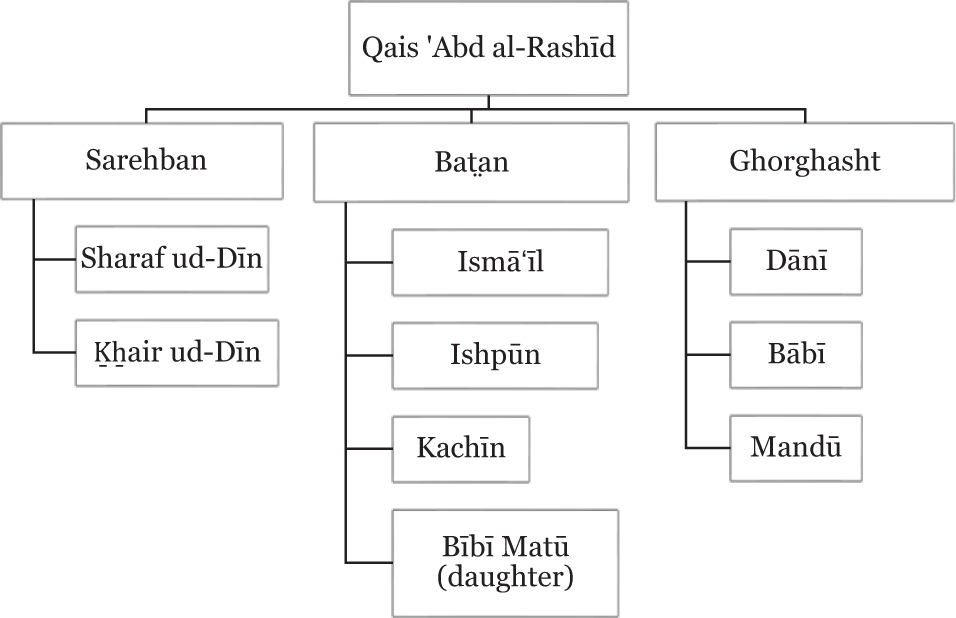
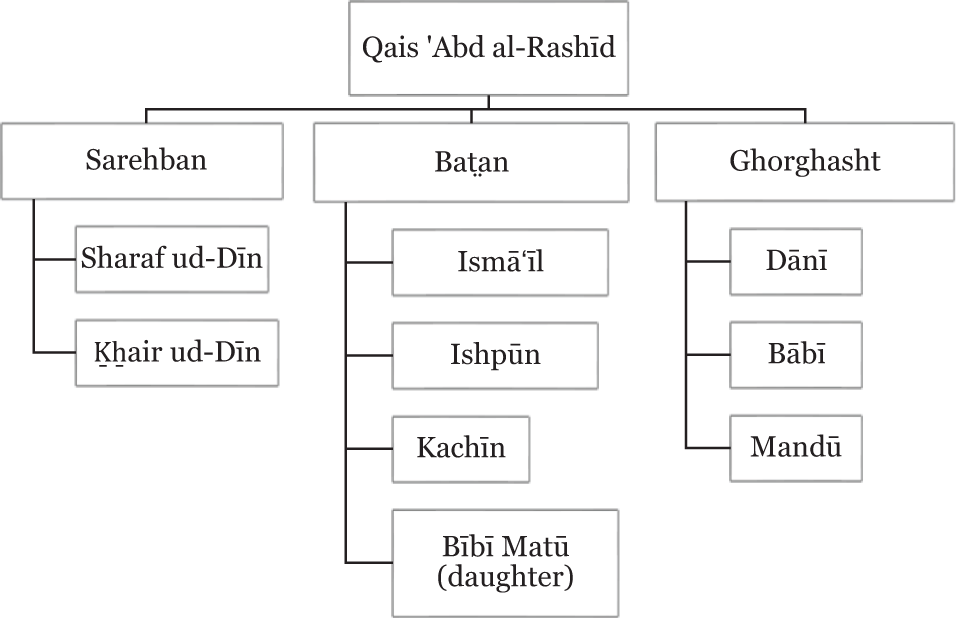
Ḥāfiz̤ Raḥmat also builds on this foundation by tracing the roots of Afghan tribes to Qais’s three sons (farzandān, sing. farzand): Sarehban, Bat̤an, and Ghorghasht.Footnote 67 He claims that each Afghan tribe traced its lineage back to one of these three ancestors, who became the patriarchs of the three main branches of the Afghan tribal structure.Footnote 68 This structure forms the backbone of Afghan identity. Ḥāfiz̤ Raḥmat supports this claim by quoting a couplet of Ḵẖushāl Ḵẖān Ḵẖattāk, a famous Pashto poet. In this couplet, Ḵẖushāl Ḵẖān stresses the importance of these three divisions as fundamental categories for all Afghan tribes. Ḥāfiz̤ Raḥmat writes that Ḵẖushāl Ḵẖān suggests that all the Afghan tribes trace their roots back to the three patriarchs and that there was no one outside of these three categories (jamīʻ aqvām Afāg̠ẖane az īn sih qism bīrūn nābāshand).Footnote 69 In fact, we see that in Ḵẖulāṣat, Ḥāfiz̤ Raḥmat gives a detailed description of all the Afghan tribes that emerged from the progeny of Qais’s sons (see Figure 1 for some of the tribes that emerged from Sarehban, Bat̤an, and Ghorghasht).Footnote 70
Descendants of Qais ‘Abd al-Rashīd. Source: The author.
Mobilisation of past heroes
In addition to claiming a direct connection with the Prophet of Islam, the Ḵẖulāṣat enhances the religious legitimacy of the Afghan people by intertwining their history with the legacy of the Ghaznavid Dynasty (r. 994–1186). It mentions the role of Afghan tribes in the Ghaznavids’ ‘holy wars’ against non-Muslims in India and hence seeks to enhance the status of the Afghans and reflects on their value to bigger political powers like the Ghaznavids. One key episode mentioned in the Ḵẖulāṣat is the military campaigns led by Sultan Maḥmūd (r. 998–1030) into Hindustan. The author says that initially the sultan faced setbacks and returned to his homeland without much success, but he was determined to achieve victory and hence he asked for assistance from the Afghans living in Ghazni and Kandahar (iltijāʼ ba afg̠ẖānān ān nawāḥī burd ki dar Ġaznī wa Kandahār sākin būdand).Footnote 71 In response to his call for assistance for this noble cause, the Afghans assembled a force, and together the army marched into Hindustan and subjugated regions as far as the Deccan (tamāmī mamālik hindūstān rā tā dakan fatḥah namūdah).Footnote 72 In addition to these military victories, the Ḵẖulāṣat describes how Maḥmūd stationed Afghan forces at different places to ensure the enforcement of Islamic faith and law.Footnote 73
The remembrance and representation of Maḥmūd of Ghazni as a great Islamic conqueror has had a rich life in the Persian chronicles of medieval and early modern South Asia.Footnote 74 Stories of Maḥmūd’s conquests in South Asia are often described as grand, aggressive, and full of glory, portraying him as a legendary figure.Footnote 75 It seems that Ḥāfiz̤ Raḥmat was aware of Maḥmūd’s reputation as both a militant upholder and the progenitor of Islamic dynasties in South Asia. Hence, in the Ḵẖulāṣat he clearly links the Afghans to Maḥmūd’s legacy and shows that the Afghans, through their role in Maḥmūd’s campaigns, had carried forward the sultan’s mission. He presents them as followers of Islam as well as rightful heirs to Maḥmūd’s political power and military leadership. Ali Anooshahr, who focuses on rulers like Maḥmūd in his work Ghazi Sultans, argues that these tales follow a clear pattern, emphasising Maḥmūd’s boldness and military prowess. He talks about how the later rulers like Babur in fact tried to copy this image. He suggests that Babur tried to present himself as Ghazi king too, someone who fought for Islam and led with strength. Babur emulated Maḥmūd to honour his memory and gain prestige.Footnote 76 This reveals how rulers and communities would define their identities by connecting themselves with key historical figures, while assigning specific meanings to them. Maḥmūd’s legacy became a tool for later political leaders to gain legitimacy. Hence, the Afghans, by being linked to Maḥmūd, became part of this story, and their role in his campaigns helped them claim a special place in South Asian Islamic history.
The Ḵẖulāṣat further narrates how, after Sultan Maḥmūd’s military campaigns, the Afghan tribes played an important role in the rise and spread of political Islam in India. According to the author, they did not fight battles for land or wealth, rather they offered their services and loyalty to a religious cause.Footnote 77 The author explains that the Afghan forces, especially the tribal chiefs who led these campaigns, were driven by their faith in God and their dedication to the teachings of the Prophet Muḥammad.Footnote 78 These chiefs, who came from noble religious backgrounds, especially those claiming to be Saiyids, viewed each campaign as a sacred act. They believed that anyone who died in these battles would attain eternal happiness in the afterlife as martyrs, while those who lived through them would earn the title of Ghazi, and their sins would be forgiven.Footnote 79 Ḵẖulāṣat imbues these military actions with a strong moral and spiritual backing. Here it is visible that Ḥāfiz̤ Raḥmat cleverly framed the Afghan efforts as acts of religious duty, not as political ambition, by framing an imagined Afghan political history in religious terms. He made it clear that these wars were more than struggles for territory—they were sacred missions in the larger interest of Islam. This way of telling the story serves a clear purpose. It makes the Afghan role in history seem noble and selfless. It also builds a sense of pride and purpose around the Afghan identity.
The other thing to note here is that Ḥāfiz̤ Raḥmat describes the Afghan leaders of these wars as Saiyids (blood descendants of the Prophet Muḥammad). As we know in Islamic societies, Saiyids traditionally occupied an esteemed reputation and they held considerable influence within their communities. In fact many ruling dynasties leveraged the prestige associated with being a Saiyid for political advantage, to rally popular support and legitimise their authority. So by portraying Afghan leaders as Saiyids in Ḵẖulāṣat, Ḥāfiz̤ Raḥmat presented the leaders not as ordinary conquerors but as spiritual figures acting on behalf of God. This narrative gave their military campaigns a sense of divine purpose. Also, the mention of the successes of the Afghans in these battles became very important for him, especially in the conflicts for control over various regions of northern India. Ḥāfiz̤ Raḥmat, by recalling earlier Afghan victories and associating them with powerful historical figures like Maḥmūd of Ghazni, tried to reassure his community and himself. He reminded them and himself that Afghans had once held great power and religious credibility. These memories allowed him to feel a sense of continuity and legitimacy even during times of political fluctuations.
There was also a third way Ḥāfiz̤ Raḥmat claimed religious legitimacy in the Ḵẖulāṣat for his people. While tracing the religious roots, he mentions how the Afghans, his tribe, and even he were connected to a spiritual figure named Shaiḵẖ Kōta.Footnote 80 This connection is more than just a mention, it is central to his argument about legitimacy and sacred lineage. Ḥāfiz̤ Raḥmat describes Shaiḵẖ Kōta’s miraculous deeds and his affiliation to the Qadiriya order (silsilā), one of the oldest Sufi traditions.Footnote 81 He talks in length about the events that showed Shaiḵẖ Kōta’s greatness and unique qualities, often linking these attributes to his Afghan inheritance. One of the stories tells us how Shaiḵẖ Kōta disappeared for a long time. His family and others thought he had died, only to later discover that he had been living in seclusion in a forest, devoting all his time to prayers. What made this story truly special was what happened during this seclusion. The text mentions that during his prayers, wild animals like lions and leopards would come and sit with him peacefully, as if they were drawn to his spiritual energy. Ḥāfiz̤ Raḥmat even says that Shaiḵẖ Kōta would ride these animals, an image that showed control over nature and also a kind of divine presence that even beasts could recognise.Footnote 82 We have to be mindful that these were not stories meant to entertain, rather these were narratives meant to show how powerful and holy Shaiḵẖ Kōta was. Therefore, it can be said that Ḥāfiz̤ Raḥmat’s insertion of these stories in Ḵẖulāṣat was aimed at elevating the Shaiḵẖ, and thereby his own community and self.
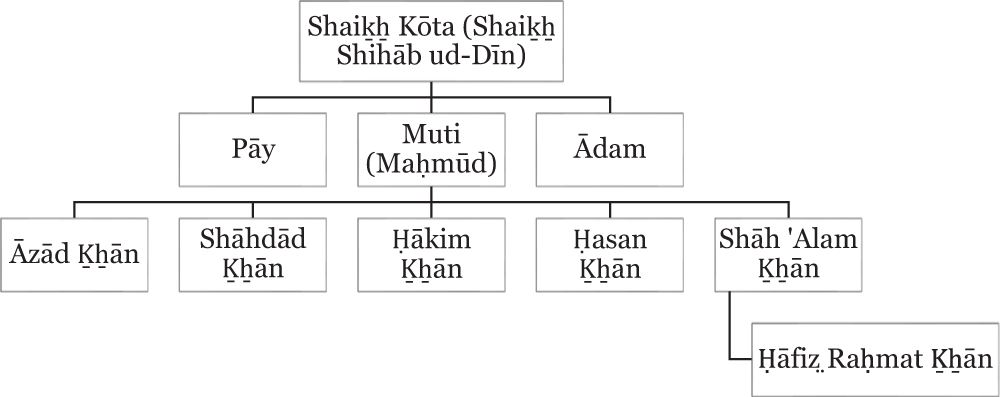
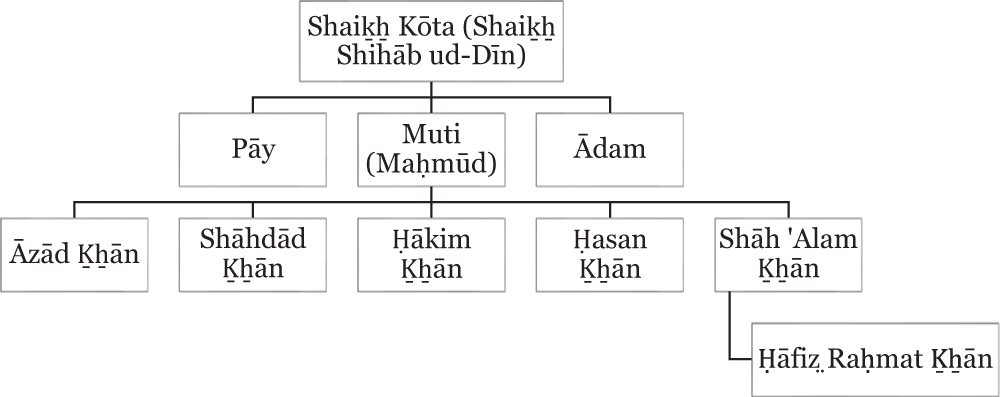
Through such stories, Ḥāfiz̤ Raḥmat consistently emphasises that Shaiḵẖ Kōta was not an ordinary person. He was a man touched by something greater—someone whose presence could tame the wild, and whose prayers could move hearts. But the importance of Shaiḵẖ Kōta went beyond his own life. Ḥāfiz̤ Raḥmat also focuses on the eminence of his descendants.Footnote 83 Among these descendants were Shaiḵẖ Kōta’s three children: Pāy, Maḥmūd, and Ādam. Maḥmūd’s line is especially important in the text. Ḥāfiz̤ Raḥmat made sure to explain that he himself came from this noble line of descendants. He remarks that he was the only living son of Shāh Ἁlam Ḵẖān, Maḥmūd’s son (see Figure 2). This made his claim to respect and leadership stronger because it placed him in the direct bloodline of a man who was both spiritually gifted and socially respected. Overall, this narrative reflects how Ḥāfiz̤ Raḥmat was building a foundation for his authority. By connecting himself to Shaiḵẖ Kōta, he shows that his family’s greatness was given by God, shown through miracles and confirmed by the immense religious devotion of his ancestors. This also helped him shape the identity of his tribe, the Yusufzais. The stories hint at divine blessings and the venerated status of the tribe, stressing their connection to spirituality and their crucial role in their community’s history.
Descendants of Shaiḵẖ Shihāb ud-Dīn. Source: The author.
We have to consider that for Ḥāfiz̤ Raḥmat, tracing his roots to legendary figures like Qais ‘Abd al-Rashīd and Shaiḵẖ Kōta meant much more than telling family stories—it was a way to gain respect and establish his group’s importance among other Afghan groups. These two figures held a great place in the collective memory of Afghan society. Qais ‘Abd al-Rashīd and Shaiḵẖ Kōta grounded Afghans within the local religious landscape. They were local heroes, tied to the land and to the spiritual traditions of the people who lived there. In contrast, someone like Prophet Muḥammad represented the universal appeal of religious legitimacy within the Muslim community, while Muslim conquerors like Maḥmūd of Ghaznī represented strength and dominance in the history of political Islam in South Asia.
By linking his ancestors with early religious figures, Ḥāfiz̤ Raḥmat was not only trying to honour them—he was trying to secure his own authority and that of his community. Jyoti Gulati Balachandran notes that remembering and narrating the virtues and supernatural deeds of one’s ancestors was never an ‘apolitical and value free act’. Instead, people used these memories to interpret the past, establish new social relationships involving power and authority, and address contemporary concerns.Footnote 84 Balachandran refers to the seventeenth-century descendants of Suhrawardī sayyid Sirāj ud-Dīn Muḥammad. She says that by documenting the life of their ancestor, his sayings, superior spiritual lineage, and virtues, the descendants reinforced the high status of the Suhrawardī lineage in the region. Moreover, the act of writing also signified each Suhrawardī descendant’s importance as an inheritor of a distinguished genealogy and spiritual blessings.Footnote 85
Ḥāfiz̤ Raḥmat did something very similar in northern India. Through his writing, he asserted the relevance and authority of Afghans by linking their ancestors’ past glory and virtues to their present position and influence. His reference to legendary and mythical events presented the Afghans as inheritors of a long-standing religious legacy. There is pride in recounting the stories of his ancestors, in tracing a noble line that connects him to a larger Afghan and Islamic history. But that pride stands beside a clear awareness of how quickly fortunes could also turn. Hence, the writing of Ḵẖulāṣat also came from a strong feeling of responsibility and concern. The Rohilla Afghans were trying to hold onto power in a competitive environment, and Ḥāfiz̤ Raḥmat understood that stories about the past could help support their position. So he carefully chose what to include in his narrative and presented the Afghans as a people with a rich and honourable past, as protectors of religious values, and as rightful leaders. He also showed himself as someone who had great knowledge of Islamic history, which helped him claim not just political authority but moral and religious respect as well. In the process, his text became not only a means of addressing his political and social anxieties but also a means of projecting his and his community’s ambition.
Conclusion
The Ḵẖulāṣat ul-Ansāb opens a window into the complex emotional world of Ḥāfiz̤ Raḥmat—a ruler trying to secure Afghan authority and legitimacy in a time of intense political rivalry and shifting power in eighteenth-century South Asia. He saw value in writing about the origin, lineage, and the past achievements of his community. He did this to strengthen the Afghan claims to power and leadership. By linking the Rohillas to respected religious and political figures, and by showing them as protectors of Islam, Ḥāfiz̤ Raḥmat was trying to give their rule greater political and religious legitimacy. This helped the community present itself as more than just a group of military leaders—it allowed them to appear as rightful rulers with a meaningful past and a clear purpose. But, at the same time, writing such a text also hints at the author’s fear—fear of erasure of Afghan identity and of losing ground in a volatile political landscape. Hence, his writing was infused with a sense of determination and responsibility, as he knew the narrative he crafted would shape not only the identity of his people but also the legitimacy of his authority as their leader. Therefore, his writing reflected the confidence and at the same time the anxiety of a leader who felt the weight of responsibility to ensure that his people were seen as worthy of greatness and chosen by divine providence. He wanted to show that the Rohillas, though newly risen, belonged amongst the region’s established powers. Hence, his careful attention to lineage was about identity as well as a political tool for survival.
The anxiety to craft a narrative that inspired pride and unity in his people must have weighed heavily on him. That is why we see the emotional rhythm of the text shifting between hope and uncertainty, ambition and fear, as he struggled to balance his vision with the demands of his time. This emotional complexity shows how the work serves as a reminder that history and identity are linked. For the author, the act of documenting the past was not just an intellectual exercise, it was a way to confront the emotional pressure and challenges that arose from the rapidly changing world around him. In facing these situations, writing for him also became a powerful tool for self-expression, empowerment, and connection. Through it, he found a way to manage the emotional strain of his position and to steady himself and his people in a time of both great challenge and newfound opportunities.
Let us close with a few observations regarding how Ḵẖulāṣat might have been received in the Afghan political milieu. Here, we must first recognise its significance as one of the foundational texts on Afghan genealogical history. Later Afghan historical writings might have drawn upon its content and used its genealogical records and accounts of Afghan origins and tribal structures as reference points. However, we do not have direct evidence that shows how readers at the time responded to this work. There is no clear indication of whether it caused any anxiety or led to further debates among the Afghan community or the non-Afghan subjects of the Rohillas. One way to look at its reception is by examining another historical text: Akhbār uṣ-ṣanādīd, written by Najmul Ghanī Khān Najmī Rāmpurī (1859–1932).Footnote 86 This Urdu work is considered a major contribution to vernacular history writing, specifically in the context of Rampur. It provides an important perspective on the history of the Rohillas and their place in northern India. The author, Najmul Ghanī, mentions that he borrowed information for Akhbār uṣ-ṣanādīd from earlier Afghan and non-Afghan works, including Ḵẖulāṣat, although he does not specify exactly which details he borrowed from each source.Footnote 87 Instead, he presents a broad historical account that brings together multiple sources to trace the history, politics, genealogy, and legacy of the Afghans. However, what can be seen is that the narratives about Afghan genealogy discussed in the Ḵẖulāṣat appear in Akhbār uṣ-ṣanādīd, which shows that both texts shared a close relationship. This also suggests that Najmul Ghanī engaged with existing historical writing rather than creating his own narrative in isolation and he also does not hide these influences.
We also see that unlike Ḵẖulāṣat, Akhbār uṣ-ṣanādīd does not appear to express any form of anxiety regarding Afghan identity or history. Instead, Najmul Ghanī wrote this work at a time when the Rohilla Afghans were already ousted from most of northern India, except for their remaining stronghold in Rampur. This period was crucial for the Rohilla Nawabs of Rampur, as they were trying to solidify their position and re-establish their legitimacy after losing their larger territorial claims.Footnote 88 In this context, writing a comprehensive history of the Afghans and highlighting their past achievements became an important task. Najmul Ghanī’s work served a dual purpose: On one hand, it provided a historical account of the Rohillas, tracing their lineage and origins in a way that reinforced their distinct identity in India. On the other hand, it played a role in shaping the image of the Rohilla rulers as capable leaders who sought the approval and loyalty of their subjects. He followed a method similar to Ḥāfiz̤ Raḥmat’s approach in Ḵẖulāṣat, where history was not just a record of military success but also a guide for good governance and moral conduct. Both of them emphasised the role of history in shaping ideas of civility and governance.Footnote 89
It should be noted that the first volume of Akhbār uṣ-ṣanādīd begins with an account of the origins of the Afghans, their genealogies, and their transformation into the Rohilla identity in India. This structure closely mirrors Ḵẖulāṣat, suggesting that Najmul Ghanī may have been consciously following Ḥāfiz̤ Raḥmat’s model. By doing so, he ensured that the historical narrative of the Rohillas remained intact and relevant to future generations. Through this approach, Najmul Ghanī reinforced the legitimacy of the Rohilla rulers and reminded them of their historical role. His work helped preserve their legacy at a time when their political influence was significantly reduced. Even though we do not have explicit evidence of his engagement with Ḵẖulāṣat beyond citing it as a source, his work carries forward the same historical themes and objectives.Footnote 90 This suggests that Ḵẖulāṣat did influence later historical writings, even if we cannot determine the exact nature of its reception at that time.
As Najmul Ghanī clearly refers to a number of earlier texts, it shows his awareness of the historical tradition in which he was writing. Among the sources he names, Taʾrīkh-i Ḵẖān Jahānī is also one of them.Footnote 91 We have to note here that the same text also influenced the writing of Ḥāfiz̤ Raḥmat. In fact, both Ḵẖulāṣat and Akhbār uṣ-ṣanādīd rely on Taʾrīkh-i Ḵẖān Jahānī, which reveals a continuous thread that links these works across generations. Hence, this pattern of borrowing and reference shows that Akhbār uṣ-ṣanādīd did not emerge in isolation. It grew out of a tradition of Afghan historiography, and Najmul Ghanī played an active role in preserving and reworking this tradition. He did not simply inherit the legacy of earlier texts; he reinterpreted them to serve the intellectual needs of his own time. In this sense, Akhbār uṣ-ṣanādīd stands as a continuation of the early modern Afghan historical tradition. The influence of the Ḵẖulāṣat reaches into this later work, helping shape the way Afghan history was remembered and retold in the nineteenth century.
Conflicts of interest
None.

 Open access

