




1. Introduction: Fish Opera
Tropical Fish Opera (1962) is a work of indeterminate music by American composer Ramón Sender. It was premiered at the San Francisco Conservatory of Music by Sender on accordion, Pauline Oliveros on French horn, Morton Subotnik on clarinet and Loren Rush on double bass (Bernstein and Payne Reference Bernstein, Payne and Bernstein2008: 125). Part of a concert series (1961-1962) produced by the San Francisco Tape Music Center, Sender identifies the work as one of several ‘operas’ that occurred over the course of the series, ‘inasmuch as they frequently included dancers […] and thus contained a theatrical element’ (Bernstein Reference Bernstein and David2008: 294). Like many works of exploratory music written in the 1960s, Tropical Fish Opera subverts orthodox methods of performance practice and musical notation, incorporating into its composition a variety of indeterminate properties. What has made the work a unique and enduring fixture of the 1960s West Coast avant-garde, however, is that Tropical Fish Opera owes both its unorthodox notation and indeterminate properties to the behaviours of fish.
The work is based around blank musical staves, often comprised of gaffer tape, which are fitted to the glass walls of an aquarium. Performers are then tasked with ‘playing’ any fish that happens upon the region behind their respective staves, as if they were musical notes. The closer a fish is to the staff, the louder a performer must play (Bernstein and Payne Reference Bernstein, Payne and Bernstein2008: 125). In subsequent performances of the work that have occurred with larger aquariums consisting of multiple species of fish, SenderFootnote 1 has suggested that each species of fish may correspond to alternative or idiomatic playing techniques. Thus, essentially every musical parameter of Tropical Fish Opera is informed by human performers parsing the movements of fish.
1.1 A vibrant algorithm
The unique premise of Sender’s work results in a compositional novelty; if taken at face value, Tropical Fish Opera can be considered a form of biomimetic sonification, where the movement and schooling behaviours of fish are sought to be directly equivalenced by human musicians. To describe this process of sonification more precisely, information (in the form of physical movement) is generated by a nonhuman entity (one or more fish); this information is then musically equivalenced by a human performer utilising staff notation as an interpretive medium. In other words, the work contains ‘a formalizable and abstracting procedure which (is) applied to the generation of musical structure’ (Nierhaus Reference Nierhaus2009: 2). While these statements may initially come across as redundant, the above quotation, from Algorithmic Composition: Paradigms of Automated Music Generation by Gerhard Nierhaus, is in fact what Nierhaus (Reference Nierhaus2009: 2) identifies as the ‘very general’ criteria which ‘determines the field of application of algorithmic composition’. This means that Tropical Fish Opera, by satisfying these criteria, can be seen as a work of algorithmic music – despite the fact that it does not utilise computational technology or even require extensive computational procedures in its composition.
While this conclusion in itself is fascinating, perhaps more intriguing are the key features of the work that lead to its qualification as a form of algorithmic composition. Namely, the ‘formalisable and abstracting procedure’ contained in Tropical Fish Opera is predominantly generated not by human concepts or activities, but rather by something of more-than-human origin: the behaviours of fish. In fact, if one takes this train of thought even further, it can be compellingly argued that a given performance of Tropical Fish Opera is spontaneously composed as much – or even more – by its participatory fish than it is by its human performers.
Such an interspecific approach to algorithmic composition raises questions about authorship and collaborative creativity. It is clear that aquarium fish differ from mathematical equations or lines of computer code; they are not procedural calculations that transform data from one state to another, but animate, autonomous entities with their own predilections and responses to external stimuli. It is accordingly reasonable to hypothesise that Tropical Fish Opera may even engender a creative feedback loop wherein a fish responds to audible sound from a human musician that, in turn, is signifying the movement of the fish. Given the unusual, and at times self-referential nature of this interaction between two animate entities, is a phenomenological distinction from other forms of algorithmic composition warranted? Furthermore, what happens when more-than-human entities that contribute algorithmic properties to music or sonic art are formally recognised as creative contributors, and what are the ethical implications of refusing to do so?
This article argues that a formalisable and abstracting procedure capable of autonomously altering itself, interacting with its environment, and even choosing how or whether it responds to human interaction, should be recognised as phenomenologically distinct from one that mechanistically processes information. Such an algorithm is no longer a computational algorithm but a vibrant algorithm.Footnote 2 If this premise is accepted, it can be further argued that a computational algorithm (producing a calculable output) can be seen as a compositional tool, while a vibrant algorithm (producing an autonomous output) is better seen as a collaborative entity. Finally, this article will propose (in Section 3) that the ethical conventions of musical collaboration do, in fact, set a precedent for vibrant algorithms to be acknowledged as creative partners.
1.2 Analysis methodology and author positionality
If the vibrant algorithm is to be accepted as both a distinct area of algorithmic composition and a collaborative entity, an operational definition that supports these assertions must first be established. As has been proposed, the features of Tropical Fish Opera that set it apart from other forms of algorithmic composition concern procedural axioms that are obtained from interactions with autonomous, more-than-human entities. Given this premise, the following can logically serve as the working criteria for the vibrant algorithm:
-
1) A formalisable and abstracting procedure is present in the creative process of music or sonic art.
-
2) The creative process also engages collaboratively with at least one more-than-human entity.
-
3) The axioms of the formalisable and abstracting procedure are at least partially and autonomously contributed by the more-than-human entity.
While Tropical Fish Opera appears clearly aligned with this definition, the vibrant algorithm, of course, has yet to be demonstrated from a variety of creative approaches and perspectives. Accordingly, if this definition is to be accepted as a distinct area of algorithmic composition, it must be shown to have a significant and unambiguous creative precedent. This necessitates a robust case set of vibrant algorithm examples: one that is neither inadequate in scope nor needlessly exhaustive. In turn, this implies the necessity of an organising methodology or research framework capable of facilitating the procural of such a case set. Ideally, this framework would exhaustively theorise the various ways in which more-than-human entities can interact and subsequently imbue music and sonic art with algorithmic properties. From there, a sufficient analysis could be attained by identifying a case set that maps to the respective parameters of this framework.
The reader will note that this exact analysis methodology has been followed (in Section 2) through the utilisation of an original research framework and the inclusion of one original creative work (both created by the author). As a composer and academic whose work focuses on ecological music, I have previously raised questions (Protsack Reference Protsack2025) about the apparent lack of a scholarly framework capable of broadly analysing the diverse ways in which music and the more-than-human world can interact. This assertion is discussed at length in the first chapter of my doctoral dissertation, An Entangled Language of Music and Nature: Exploring Musical Ecopoiesis (2025).Footnote 3 Namely, the lack of such a framework serves as a central research question of the dissertation, which subsequently tasks itself with the development of an analytical framework that is capable of achieving this aim. It is for this reason that I have chosen to draw upon this research for the present analysis: I believe it to be particularly suited to its realisation. I acknowledge, however, that this assertion may carry with it a certain degree of familiarity bias, and that other suitable analytical tools I am presently unaware of may in fact exist. Similarly, I realise that it may be seen as dubious to utilise one’s own creative work to illustrate the features of an original research framework. As the composer of A Mind in the Branches (2021), a work that will be discussed in Section 2, I have nevertheless included this work in the discussion as I believe it is a particularly instructive example of what would otherwise be a highly abstract aspect of collaboration with vibrant algorithms. From my perspective, the streamlining this offered to the present analysis outweighed its detractions.
With that said, I have made additional efforts to temper the biases that might arise from these concerns, as well as others I may hold; the remaining vibrant algorithm examples discussed in this article are highly diverse by design – drawing upon the work of composers and musical artists from cultural, economic, and demographic backgrounds that are distinct from my own and its associated privileges. These include a number of examples from Indigenous musical practices found in Oceania, Southeast Asia and (briefly) North America (all discussed in Section 2). While my background as a classically trained male composer of European descent likely carries unconscious, conflicting biases, I am committed to the perspective that the inclusion of non-Western musical practices is imperative in any broad analysis of music. Furthermore, I accept the ample evidence that Indigenous and non-urbanised musical practices demonstrate protocols and conventions that can be understood as uniquely informed by reciprocal relationships with the more-than-human world. This often results in entire areas of eco-musical creative practice that simply have no equivalence in Western musical traditions, and for that reason are indispensable in any related discourse. This assertion will be discussed more thoroughly in Section 3.
2. Musical Ecopoiesis and the ‘SME’
As discussed, an original research framework was required to facilitate the present analysis of vibrant algorithms. This was obtained through the analytical tools offered by musical ecopoiesis (hereafter ME), which is an encompassing term for the interaction between music and the more-than-human world. It is derived from combining ‘music’ with the prefix, eco- (as in ‘ecology’), and the suffix -poiesis (meaning ‘to create’) (Protsack Reference Protsack2025: 5). Accordingly, any creative process in music or sonic art that is engendered, informed or otherwise inspired by the more-than-human world can be seen as ME (Protsack Reference Protsack2025: 5-6). Within the conceptual framework of ME, there are several organising principles; while there are a limitless number of poietic means through which musical practices can engage with the natural world, most of these fall within six contiguous categories that border one another in a variety of ways:
-
1) Passive sonation: an unaltered, in situ sonic aspect of the natural world is incorporated into music. This typically involves works of music that are performed in natural environments, wherein their sonic properties are taken to be part of a musical performance or experience (Protsack Reference Protsack2025: 22).
-
2) Interactive sonation: a physical aspect of the natural world acts as a medium in the production of sound in music. This can either be realised through the utilisation of more-than-human objects or substances to create musical sound (i.e. stones, branches or water), or utilisation of the acoustical properties of natural spaces or substances to enhance or manipulate musical sound (Protsack Reference Protsack2025: 21-22).
-
3) Sonification: a sonic isomorphism of a non-sonic aspect of the natural world is incorporated into music. In other words, a form of non-sonic, quantifiable data or information is translated into musical terms and subsequently incorporated into a musical work (Protsack Reference Protsack2025: 19).
-
4) Simulation: an isomorphic replication of a sonic aspect of the natural world is incorporated into music. Most typically, this simply describes the musical utilisation of field recordings, whether played through loudspeakers or any other synthetic sound-emitting device. That said, highly phonorealistic forms of electronic synthesis or instrumental resynthesis may also be categorised as simulation (Protsack Reference Protsack2025: 18).
-
5) Direct mimesis: a sonic aspect of the natural world is imitated in music. This is perhaps the most prevalent form of ME; the practice of imitating and/or transcribing more-than-human sounds (i.e. birdsong or rainfall) into music transcends most recognised cultural and historical boundaries of musical practice and can be traced to prehistory (Protsack Reference Protsack2025: 17).
-
6) Abstract mimesis: A non-sonic aspect of the natural world is imitated or metaphorically evoked in music. Another highly prevalent form of ME, abstract mimesis may concern anything from musically depicting a waterfall with overlaid, cascading gestures moving downward in register, to tracing the outline of a mountain range with melodic contour (Protsack Reference Protsack2025: 15-16).
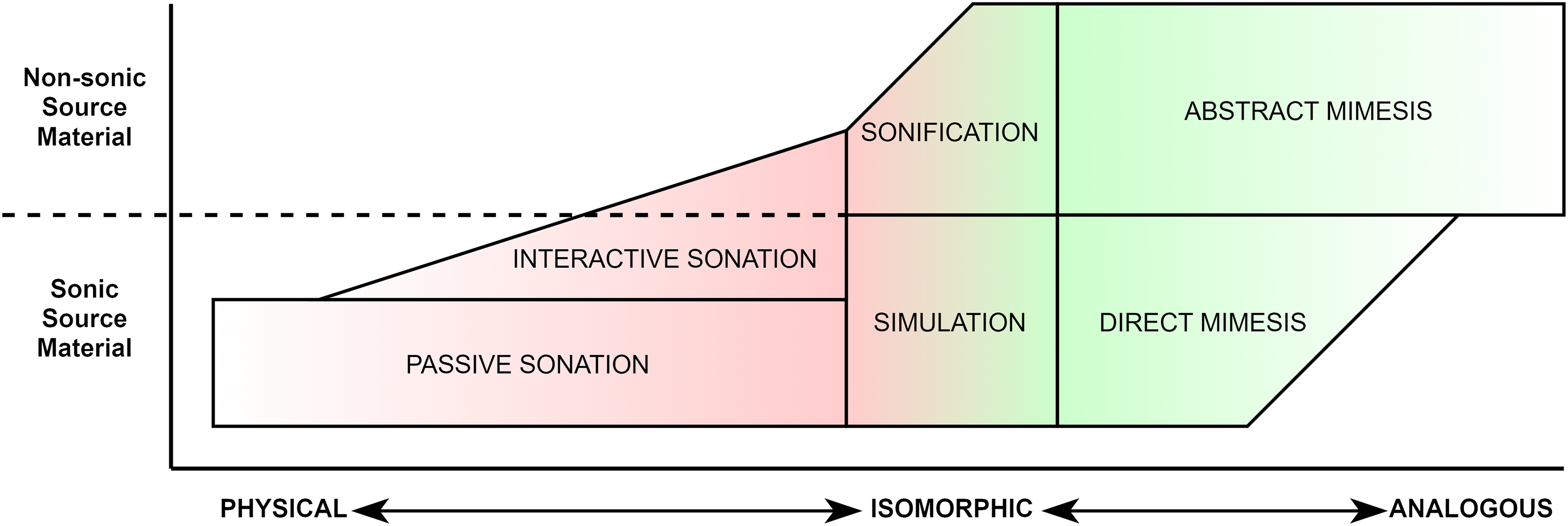
These six categories of ME are distinguished by two separate parameters. Firstly, they are grouped into three overarching creative modalities: physical (passive and interactive sonation), which concerns methodologies that interact with the material world; isomorphic (simulation and sonification), which concerns methodologies that closely replicate aspects of the more-than-human world, and analogous (direct and abstract mimesis), which, in broad terms, concerns musical evocation (or invocation) of the more-than-human world. Secondly, each category is also identified by the origin of its source: specifically, whether it is of sonic or non-sonic origin. When combined, these two parameters produce a contiguous two-dimensional graph, representing an exhaustive spectrum of practices that engage with the more-than-human world. It is accordingly referred to as the spectrum of musical ecopoiesis (SME) (see Figure 1). Being a spectrum of ecopoietic practices, the SME can describe a limitless variety of approaches to ME, including borderline examples that subvert clear categorisation, or even the simultaneous use of multiple SME categories. This furnishes any analysis of musical and more-than-human interaction with an organised, analytical framework that deliberately avoids reducing practices to rigid, structuralist archetypes.
The Spectrum of Musical Ecopoiesis (SME).
While a more fleshed-out discussion of features such as these within the SME might be warranted in another context,Footnote 4 the introduction of its six categories and their associated definitions sufficiently informs the curation of a well-rounded case set of vibrant algorithm examples: one that showcases a variety of highly diverse parameters through which more-than-human entities are capable of embedding algorithmic properties into music and sonic art. Thus, the six regions of the SME will serve as the prevailing conceptual framework for the remainder of this analysis.
2.1 Vibrant algorithms revealed in the SME
Sonification is perhaps the most straightforward category of the SME to begin with for the purpose of this analysis. This is due to the fact that its basic attributes are often inherently algorithmic; the translation of non-sonic entities into sound all but necessitates some kind of formalising and abstracting procedure. As discussed, Tropical Fish Opera is, of course, an example of this. A plurality of instructive examples, however, can be found in The Place Where You Go to Listen (2006), by John Luther Adams, which is a permanent sound and light installation at the University of Alaska Museum of the North in Fairbanks, Alaska. Adams (Reference Adams2009: 8) broadly describes the installation as a musical entity that ‘resonates sympathetically with the world outside’. More specifically, however, The Place draws upon ‘streams of [real-time] data tracing natural phenomena (seismic activity, geomagnetism, cloud cover and visibility, the movements of the sun and moon) [that] are transformed into sound through a process [of] sonification’ (Adams Reference Adams2009: 181). Beyond the sonification of environmental data streams, a prominent source of creative inspiration and, in fact, the very title of the work, ‘refers to Naalagiagvik, a place on the coast of the Arctic Ocean where, according to legend, a spiritually attuned Iñupiaq woman went to hear the voices of birds, whales and unseen things around her’ (Adams Reference Adams2009: ix). Owing to these coalescing sources of inspiration, Adams (Reference Adams2009: 8) asserts that the work is ‘more than a scientific demonstration of natural phenomena. It is a work of art. The essence of this work is the sound of natural forces interacting with the consciousness of the listener. This is not a simulated experience of the natural world. It is a heightened form of experience itself’. Elaborating upon this, he states that in his compositional process wherein the sonic traits of the algorithms were realised, he repeatedly sought ‘to more accurately produce the sounds [he] heard in [his] mind’s ear, which, inevitably, were influenced by what [he] heard in the air’ (Adams Reference Adams2009: 113). This involved an iterative process of seeking out authenticity by ‘mapping, listening and remapping [until Adams] felt a particular sound had “the ring of truth”, resonating in a convincing way with the geophysical force from which it was derived’ (Adams Reference Adams2009: 113). This suggests that the data streams drawn upon in The Place do more than provide raw information for the work to sonify in an aesthetically pleasing way: they inform the most fundamental properties of its sound-world and algorithmic construction. As with Tropical Fish Opera, this suggests an extensive compositional and algorithmic contribution not just from Adams, but from the more-than-human world itself. In other words, The Place is the product of a collaboration between Adams and an autonomous, vibrant algorithm.
Moving to a neighbouring category of the SME, the practice of simulation – much like sonification – can often cause algorithmic properties to arise in music. Soundscape composition, a genre of acousmatic music developed largely at Simon Fraser University in the 1970s and 80s by Hildegarde Westerkamp, Barry Truax and R. Murray Schafer (Truax Reference Truax1996: 53), incorporates extensive use of environmental field recordings into acousmatic procedures that can be identified as formalisable and abstracting. For instance, Truax (Reference Truax1996: 62) states that his pioneering use of granular synthesis with field recordings ‘is used not merely to create drones, but to allow the inner timbral character of the sound to emerge and be observed, as if under a microscope […] in terms of the soundscape composition, the added duration also allows the sound to reverberate in the listener’s memory, providing time for long-term memories and associations to surface’. This deliberate ‘microscopic’ audiation of environmental sound implies that the sound-magnifying properties of granular synthesis are treated as a formalising procedure that, when applied to field recordings, produces a musical output. Clearly, Truax views this output as artistically interesting, not only because it deeply examines the characteristics of environmental sound, but also because it reveals hidden, innate aspects of environmental sound that would otherwise go unnoticed. As an example, Truax (Reference Truax1996: 62) offers his work Pacific (1990), in which the granulation of ‘crashing of waves in the ‘Ocean’ movement […] sounds remarkably like a choir of distant voices when stretched’. Again, a ME process (in this case, simulation) can be observed in which a more-than-human entity (in this case, ocean waves) contributes not only sonic content to a work of music, but the innate characteristics of that content have caused a collaborative process of formalisation and abstraction to emerge. Again, a vibrant algorithm has provided an autonomous, creative input in a musical work.
A more recent example of simulation can be found in the work Arachnid Orchestra: Jam Sessions (2017) by Argentine multimedia artist Thomas Saraceno. Involving musical interaction with live spiders, Saraceno (et al. 2019: 496) describes Arachnid Orchestra as drawing ‘inspiration from the acoustic properties of [spider webs]—and the different signalling behaviours of the spiders themselves—to create a series of musical instruments for playfully communicating with spiders: for both listening to the substrate-borne vibrations they produce, and playing vibrational signals back into the web, in response’. One aspect of the work not related to spider webs, however, involves the real-time amplification of spiders that ‘use their pedipalps, legs or body to drum and produce conspecific vibrational signals (both in mating rituals, and to mark and defend territory)’ (Saraceno et al. Reference Saraceno, Bisshop, Krell, Mühlethaler, Hill, Lakes-Harlan, Mazzoni, Narins, Doberlet and Wessel2019: 500). Thus, spiders that engage in these behaviours were physically placed on ‘circular membranes in various sizes, to which sensitive contact microphones were attached […] to amplify [the spider’s] drumming signals’ (Saraceno et al. Reference Saraceno, Bisshop, Krell, Mühlethaler, Hill, Lakes-Harlan, Mazzoni, Narins, Doberlet and Wessel2019: 500). In other words, Saraceno’s work contains an approach to simulation in which the drumming rituals of spiders are directly amplified by custom percussion instruments and thus formalised and abstracted into musical sound that is audible to humans. Fascinatingly, this implies that a human audience member may at any point be listening to a vibrant algorithm in the form of percussion music that is performed and ‘composed’ in real-time by a spider.
In other regions of the SME, there can be found algorithmic approaches to ME that do not involve modern-day technology, or even strictly computational procedures to be realised. Such approaches to passive sonation can be found in Sonic Meditations, a body of work by Pauline Oliveros, which led to her development of the practice known as Deep Listening (Oliveros Reference Oliveros2005: xviii). Oliveros (Reference Oliveros2005: 31) describes Deep Listening as a process of ‘learning to expand the perception of sounds to include the whole space/time continuum of sound—encountering the vastness and complexities as much as possible. […] Such expansion means that one is connected to the whole of the environment and beyond’. In a noteworthy example of this, the work Collective Environmental Composition (1975/1996) utilises principles of Deep Listening to engage with passive sonation in a way that can be seen as clearly algorithmic:
Collective Environmental Composition
by Pauline Oliveros (1975/1996)
Each participant explores an environment to find a listening place with something interesting to hear and listens for a while.
Each participant invites the other participants to hear their found listening place. There may be one or more places with contrasting sounds.
Each participant finds a way to enhance, nullify or otherwise interact with the sound or sounds that the group goes to hear.
Each participant finds a way to connect all the sounds, either literally, metaphorically or graphically.
A performance agreement is negotiated. (Oliveros Reference Oliveros2005: 31)
The work’s process-driven instructions involve a clearly formalisable and abstracting procedure, wherein the ‘performance agreement’ that is eventually reached is informed by a generative, step-by-step analysis, interaction and manipulation of environmental sound. In fact, four of the five stanzas that comprise the work contain strictly procedural instructions, and only in the final stanza are human performers given complete creative agency to respond. Also worth noting here is Oliveros’s deliberately ambiguous language in the final stanza: a ‘performance agreement is negotiated’. While in every previous stanza, Oliveros has explicitly stated that ‘each (human) participant’ is required to execute the given task, the final stanza makes no direct mention of the participants. This suggests that the performance ‘negotiation’ is guided by a plurality of agencies, extending beyond its human participants. Accordingly, Oliveros’s instructions imply that while human performers are predominantly responsible for executing the basic procedures of Collective Environmental Composition, vibrant algorithms provide a significant, possibly commanding portion of the creative content: informing both its sound-world and the parameters of its compositional form.
Interactive sonation, being a close relative of passive sonation, leads to interesting results when thought of in ways that are algorithmic. For instance, the practice of liquid percussion (also known as water drumming) – a form of music that utilises coastal shallows and other shallow bodies of water as a percussion instrument – can be understood to contain vibrant algorithms when the sonic attributes of water are considered axiomatic to the practice. In general, liquid percussion is realised through various forms of ‘air-water-hand interaction’. (Hurd et al. Reference Hurd, Allen and Belden2017: accompanying notes). A video essay by the American Physical Society identifies three main technique groups of the practice: the ‘slap’, which is ‘short, high frequency, [and] similar to a snare drum’ (Hurd et al. Reference Hurd, Allen and Belden2017: 0:49); the ‘plunge’, which is ‘longer, lower frequency, initial impact = snare, cavity collapse = bass drum’, (Hurd et al. Reference Hurd, Allen and Belden2017: 1:01) and finally, the ‘plow’ which is ‘very long, mid frequency, [and] similar to a cymbal’ (Hurd et al. Reference Hurd, Allen and Belden2017: 1:20). That said, when performed by the Mwerlap – the peoples Indigenous to Vanuatu – Hayward (Reference Hayward2014: 119) notes that liquid percussion is thought of in terms of four basic techniques that were codified in the 1970s by several practitioners, led by Rovan Womal Marego:
kor nē-bē: the sound of water falling over stones.
ne-kea ‘dolphin’: the sound of dolphins flapping their fins on the water.
nē-rē ‘rain’: the sound of rainwater falling on leaves and thatched roof.
vus ero: the sound of people chasing and shepherding fish into nets.
The more-than-human provenance involved in the naming of each Mwerlap liquid percussion technique reinforces notions that the practice interfaces with vibrant algorithms. Hayward (Reference Hayward2014: 120) states this nomenclature implies a ‘set of complex interactions, within which human agency is only one factor amongst others, represent[ing] what Felix Guattari (1993) has referred to as “machinic heterogenesis”, that is, a generative interaction between different agencies’. In other words, a vibrant algorithm.
Of course, physical and isomorphic relationships with the natural world are not the only areas of the SME through which vibrant algorithms can embed themselves into music. For instance, the piano works of Olivier Messiaen are oftentimes based upon extensive direct mimesis of both the sonic and syntactical properties of birdsong; this is utilised to such a degree that his ‘music produces a plethora of sound images and information’. (Cochran, Reference Cochran2017: 182). Thus, the extensive formalisation and abstraction of birdsong, such that it is meant to generate extramusical symbology in Messiaen’s music, can be understood as a vibrant algorithm. In other words, Messiaen’s music does not simply imitate birdsong but fundamentally collaborates with its innate axioms, resulting in a musical language that is both anthropological and ornithological. To further quote Cochran (Reference Cochran2017: 182):
‘Le Traquet stapazin’ from Catalogue d’oiseaux (1956–58) displays five different birdsongs, each one or two bars long and associated with a different bird. In addition to the names of the birds, Messiaen adds a lengthy preface that describes the bird calls, the scene, and the time of day as well as bar-by-bar parenthetical remarks about what the birds are doing: the herring gull’s song sounds as it flies above the sea (bb. 10–11) for example, while the raven sings on the rocks of a cliff (bb. 12–13). The exhaustiveness of textual detail communicates to the score-reader that in his musical translation of natural environment Messiaen strives for a robust and accurate signification of a location’s audible and visible features.
An intriguingly similar but completely separate vibrant algorithm concerning the direct mimesis of birdsong can be found in two genres of song (gisalo and ‘weeping’) practiced by the Kaluli from the Great Papuan Plateau of Papua New Guinea. Namely, Feld (Reference Feld2012: 36) has shown that ‘in gisalo, as well as in weeping, the melodic organization is identical to the [melodic content of] the muni bird call’ (a bird indigenous to the Papuan Plateau); namely, it consistently ‘follow[s] the same three- or four-pitch contour’ (Feld Reference Feld2012: 33). Accordingly, Feld (Reference Feld2012: 33) argues that an entire area of performance practice in Kaluli music is predicated by a deliberate formalisation of the muni bird’s song, and, specifically, is ‘used as a sound metaphor for sadness, expressing the sorrow of loss and abandonment. The reduction to a state of loss becomes equivalent to the state of being a bird’.
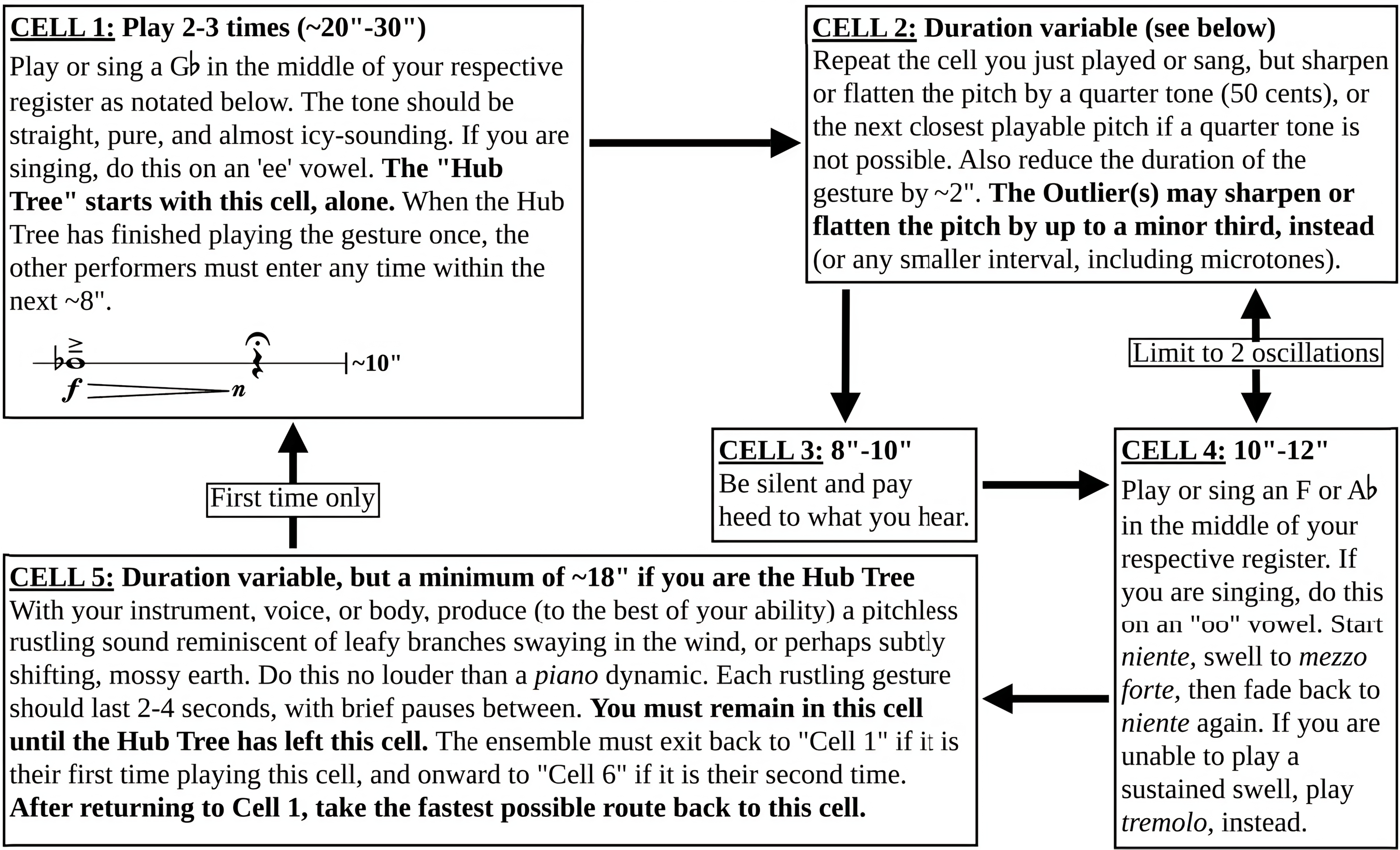
Finally, a vibrant algorithmic approach to abstract mimesis can be found in A Mind in the Branches (2021) for the open ensemble by Nicholas Denton Protsack. In fact, almost every compositional parameter of the work is informed by a formalisable procedure, such that A Mind in the Branches ‘structurally, behaviourally, conceptually and sonically imitates a forest ecosystem’ (Protsack Reference Protsack2025: 170). Focussing exclusively on the aspects of abstract mimesis present in the work, A Mind in the Branches can first and foremost be viewed as a musical evocation of mycelium networks that exist in certain forest ecosystems, wherein a form of ‘communication’ occurs between trees and other plant life within these networks. Through her pioneering research in this field, Simard (Reference Simard2021: 5) has shown that these communicatory networks are aided by the largest trees in the ecosystem – referred to by Simard as ‘mother trees’ or ‘hub trees’ – which help foster the growth of smaller trees and other plants; their healthy proliferation in turn benefiting the hub trees. In basic terms, this occurs through the sharing of complex nutrients that hub trees can synthesise in vaster (surplus) quantities, and, remarkably, also includes the sharing of special protein markers that alert other members of the network to signs of disease or predation (Simard Reference Simard2021: 5). A Mind in the Branches musically formalises this process, in part, by adopting a modular score comprised of interconnected cells. Instead of reading the score in a linear manner, each player autonomously navigates the network of cells, which can be done in numerous ways (see Figure 2). At times, the performers are instructed to collectively alter their navigation of the work, spontaneously responding to specific sounds and gestures that occur. This process becomes particularly apparent in that one player is explicitly assigned the role of ‘hub tree’, and, accordingly, dictates (through sound and other gestures) at various times when the group may enter or exit various sections of the work. Thus, both the interconnected construction of the work and the ways in which performers must navigate it and incorporate communication with one another can be seen as a formalisable and abstracting procedure depicting the behaviours of mycelial networks.
Several musical ‘cells’ that comprise A Mind in the Branches (2021).
Accordingly, as the composer of A Mind in the Branches, I can attest to the extensive role Simard’s research has played in the compositional reality of this work. This to such a degree that the structure which I arrived upon could not have been intellectually conceived of by me, alone. Rather, a great deal of the creative and conceptual process can be attributed to my understanding of the behaviours of mycelial networks in forest ecosystems, and a subsequent desire to reflect in the work conceptual elements of these networks in a way that is collaborative. Again, a vibrant algorithm has played an integral creative role in a work of music – this time, my own.
3. Conclusions: The Ethical Questions of Collaborating with Vibrant Algorithms
In the previously given examples of vibrant algorithms, aspects of the more-than-human world have been shown to contribute fundamental traits to musical practices or works: providing sonic characteristics, creative premises, and engendering various parameters of their algorithmic procedures. As such, these procedures cannot be said to have been solely devised by humans but instead have arisen through collaborative interactions between human and more-than-human entities. With this premise follows a logical conclusion that if the more-than-human world is to be treated as a musical collaborator, then one must adhere to similar ethical standards as they would with any other collaborative artist. This becomes particularly imperative when considering the ethical implications of viewing the natural world as a resource rife with algorithmic properties that can be utilised in musical practices. If one treats these algorithms simply as ‘data’ that can be mined from the natural world, they risk assuming an extractive stance – wherein the autonomy of nature is subjugated for human purposes. If, instead, however, a creative artist wishes to acknowledge the inherent agency of vibrant algorithms, an equitable, collaborative interaction between human and more-than-human entities must be implicitly acknowledged as well.
Scholars such as Robinson (Reference Robinson2020: 189) have brought to the discussion the ethical implications of music that is ‘created for the benefit of the human subject rather than for nonhuman others, including the land’. Specifically, Robinson (Reference Robinson2020: 189) has asserted that
representational landscape compositions resolutely depict (re-sound) the landscape, in contrast to Indigenous cosmologies previously discussed that think of song as being ‘for’ the land, rather than ‘about’ it. […] These works that are ostensibly for [the land] do not in fact operate on the terms of reciprocal relationship wherein what is sounded is intended to have a material impact of sustenance for the lands, as gesture of thanks expressed to the lands.
Several of the Indigenous musical practices previously discussed can be seen to support this statement. For instance, Hayward (Reference Hayward2014: 120-122) argues that Mwerlap liquid percussion techniques ‘originate from natural (inanimate) occurrences (kor nē-bē); natural non-human activities (ne-kea ‘dolphin’); interaction between environmental factors and natural and built human artifices (nē-rē ‘rain’) and human livelihood activities (vus ero) […] [and are] subsequently performed to territorialize ‘their’ spaces in Vanuatu and their temporary spaces in the various locations they have travelled to and performed in’. Similarly, Feld discusses many examples of deeply embedded cultural reciprocities between the Kaluli and their environment, including a particularly striking account in which he was chastised by Jubi, a Kaluli man, for his exclusionary understanding of birdsong relative to Kaluli cosmologies: ‘Listen, to you they are birds, to me they are voices in the forest’, he was told (Feld Reference Feld2012: 45). Reflecting upon this experience, Feld states the following:
Birds are ‘voices’ because Kaluli recognize and acknowledge their existence primarily through sound, and because they are the spirit reflections (ane mama) of deceased men and women. Bird sounds simultaneously have an ‘outside’, from which Kaluli attribute a bird’s identification, and an ‘inside’, from which they interpret the underlying meaning as a spirit communication […] [thus] bird taxonomy intersects with more fundamental daily realities, and most significantly, with sound as a symbolic system.
On the other hand, the examples of non-Indigenous musical practices discussed in this article only show glimpses of true reciprocity with more-than-human entities and vibrant algorithms – at least relative to the degree of reciprocity that Robinson calls for. It is thus indicative that such relationships between humans and more-than-human entities are far from being broadly achieved in Westernised and urbanised musical practices. To illustrate just one example of this, consider the inherent power dynamics present in Tropical Fish Opera between its human performers and captive, aquarium fish. Doing so may prompt an interesting thought experiment: what if, instead of utilising an aquarium of captive fish that are compelled to ‘collaborate’, the work was to occur in a natural reef environment, utilising a submerged human performer in a transparent, air-tight container? How would the musical results of the work differ from Sender’s original, and how would the behaviours of the human performer and any participatory fish differ? Could the music reveal any unseen differences between aquarium and natural reef environments and the ways in which human interaction affects them?
Several related questions will serve as the conclusion of this article: If the vibrant algorithm is to be accepted as a collaborative entity in music, how do we account for and respect its agency? How do we know if a more-than-human entity wants to be musically collaborated with? If we do find that such entities are amenable to collaboration, how do we ascertain the ways in which they would want to be represented as musical collaborators?


 Open access

