

1. Introduction
Bauxite is the primary mineral resource of aluminium, typically forming in tropical to subtropical climates where intense weathering under warm, humid conditions breaks down rock-forming silicates. This process results in residual concentrations of aluminium-rich minerals, such as gibbsite, boehmite and diaspore, along with kaolinite and Fe–Ti oxides (Valeton, Reference Valeton1972; Bárdossy and Aleva, Reference Bárdossy and Aleva1990). While lateritic bauxites typically develop mainly in situ on silicate rocks, karst bauxites form on karstified carbonate substrates, where weathering products accumulate in topographic depressions such as sinkholes and dolinas. These deposits may incorporate material from both local and distant sources, concentrated within the karst system (e.g., Bárdossy, Reference Bárdossy1982; D‘Argenio and Mindszenty, Reference D’Argenio and Mindszenty1995; Kelemen et al. Reference Kelemen, Dunkl, Csillag, Mindszenty, Józsa, Fodor and von Eynatten2023). Karst bauxites commonly occur at major regional unconformities, which typically correspond to apparent stratigraphic gaps between the youngest underlying and the oldest overlying sediments. The gap is the result of subaerial erosion and non-deposition (sensu Sloss, Reference Sloss1963). Since bauxites ‘fill’ the gap, they generally lack direct geochronological markers; their age is traditionally constrained by the age of the oldest overlying sedimentary strata, which marks the termination of bauxitization and bauxite accumulation (e.g., Bárdossy, Reference Bárdossy1982; Brčić et al. Reference Brčić, Dunkl, Mindszenty, Brlek, Trinajstić, Bajo, Bauluz, Mišur, Karius, Šuica, Kukoč, Yuste, Laita and Zeh2023).
In the Alpine–Pannonian region, the cover beds of Cretaceous bauxites – such as paleosols, lignitic clastics, brackish marls and shallow marine limestones – commonly mark the base of regional transgressive successions. Though their facies vary locally, these units consistently span an Albian to Santonian age range and provide the main constraints on the timing of bauxitization (Császár, Reference Császár1996; Siegl-Farkas and Wagreich, Reference Siegl-Farkas and Wagreich1996; Bárdossy and Mindszenty, Reference Bárdossy and Mindszenty2013). In many localities, Cretaceous bauxites are embedded within substantial apparent stratigraphic gaps, often exceeding 100 million years, making them valuable geological archives of long-term subaerial weathering and erosion-controlled landscape evolution during the Cretaceous (Číčel, Reference Číčel1958; Wagreich et al. Reference Wagreich, Zetter, Bryda and Peresson1997; Mindszenty et al. Reference Mindszenty, Csoma, Török and Hertelendi2000; Mindszenty, Reference Mindszenty2010).
This study aims to elucidate the provenance and geochronology of Cretaceous karst bauxites from the Northern Calcareous Alps (NCA), Transdanubian Range (TR), and Western Carpathians (WC). We apply a multi-method approach combining X-ray powder diffraction (XRD), heavy mineral analysis, detrital zircon U–Pb geochronology by laser ablation inductively coupled plasma mass spectrometry (LA-ICP-MS), and U–Pb–He double-dating of single zircon crystals. These data are used to identify sediment sources and assess the role of contemporaneous volcanism. Together, the results provide new insights into the paleogeographic and geodynamic evolution of the Austroalpine realm during the Late Cretaceous.
2. Geological setting
During Early Cretaceous times, the Northern Calcareous Alps and the Transdanubian Range formed a continuous unit within the Austroalpine realm (e.g., Kázmér and Kovács, Reference Kázmér and Kovács1985; Haas et al. Reference Haas, Kovács, Krystyn and Lein1995; Tari and Horváth, Reference Tari and Horváth2010; Héja et al. Reference Héja, Kövér, Csillag, Németh and Fodor2018). Paleogeographic reconstructions based on paleomagnetic data and paleoenvironmental reconstructions suggest that the Austroalpine realm was part of an island system surrounded by the Penninic Ocean to the northwest, the Vardar Ocean branch of the Neotethys Ocean to the northeast, and the Meliata Ocean branch of the Neotethys Ocean to the south/southeast (Csontos and Vörös, Reference Csontos and Vörös2004; Schmid et al. Reference Schmid, Fügenschuh, Kissling and Schuster2004; Csiki-Sava et al. Reference Csiki-Sava, Buffetaut, Ősi, Pereda-Suberbiola and Brusatte2015).
2.a. The Neoproterozoic to Permian basement of the Austroalpine realm
During the late Ediacaran, the Austroalpine realm was situated along the northern margin of the Gondwana terrain as part of the Avalonian-Cadomian Active Margin (e.g., Stampfli and Kozur, Reference Stampfli and Kozur2006; Linnemann, Reference Linnemann2007). This area was an eroding volcanic arc, which shed characteristic Neoproterozoic to Cambrian zircon age populations, while its forelands also accumulated Archean to Neoproterozoic zircons from the exposed cratons of the inner parts of the Gondwana terrain (e.g., Linnemann, Reference Linnemann2007). The opening of the Paleotethys Ocean from Ordovician to Silurian times caused the detachment of several peri-Gondwana microplates, including the future Austroalpine realm. In Middle Devonian time, these microplates drifted northwards and amalgamated into a complex accretionary wedge as a result of collisions between terranes detached from Gondwana (the Hun superterrane) and terranes detached from Eurasia (Hanseatic terranes), as well as collision with arcs derived from the Asiatic Ocean. This event was described as the first Variscan orogenic event, accompanied by high-pressure and low-temperature metamorphism and magmatic activity (Stampfli and Kozur, Reference Stampfli and Kozur2006; and references therein). From early Carboniferous to early Permian times, due to the closure of the Rheno-Hercynian Ocean, the amalgamated terranes of Avalonia drifted north, collided, thrust over and attached to the European plate (e.g., Criniti et al. Reference Criniti, Martín-Martín and Martín-Algarra2023; Criniti et al. Reference Criniti, Martín-Martín, Hlila, Maaté and Maaté2024). This event was the second Variscan orogenic event, finalized by arc-related plutonic activity from late Carboniferous to Permian times (Stampfli and Kozur, Reference Stampfli and Kozur2006). The collision and amalgamation events described above triggered exhumation, erosion and the accumulation of various flysch- and molasse-type sedimentary assemblages, which are now outcropping as metasedimentary rocks in the Greywacke zone and Gurktal nappe complex of the Eastern Alps (Figure 1). Although studies of systematic detrital U-Pb zircon dating on the Eastern Alpine Paleozoic metasedimentary rocks are relatively scarce, the Bohemian Massif, which formed as part of Avalonia, just like the Austroalpine basement, was subjected to intense zircon U-Pb geochronology studies and therefore offers a more complex picture of the Cadomian and Variscan evolution cycles and could be used as an analogue for provenance interpretations (e.g., Linnemann, Reference Linnemann2007; Košler et al. Reference Košler, Konopásek, Sláma and Vrána2014). Moreover, zircons reflecting these orogenic events were frequently recycled into the various Paleozoic-Mesozoic (meta)sedimentary units of the Eastern Alps (Ribes et al. Reference Ribes, Petri, Ghienne, Manatschal, Galster, Karner, Figueredo, Johnson and Karpoff2019; Veselá et al. Reference Veselá, Oriolo, Basei, Lammerer and Siegesmund2022; Siegesmund et al. Reference Siegesmund, Oriolo, Broge, Hueck, Lammerer, Basei and Schulz2023).
Geological overview of Eastern Alps and the western Pannonian Basin without the Cenozoic sedimentary cover (base map compiled after Egger et al. Reference Egger, Krenmayr, Mandl, Matura, Nowotny, Pascher, Pestal, Pistotnik, Rockenschaub and Schnabel1999 and Csontos and Vörös, Reference Csontos and Vörös2004). BM: Bohemian Massif, NCA: Northern Calcareous Alps, Ö: Ötztal, TW: Tauern Window, G: Gurktal, TR: Transdanubian Range. Red circles represent the studied Cretaceous bauxite deposits, from east to west: Ku-Kufstein, Gl-Glanegg, Ru-Russbach, Ul-Unterlaussa, Aj-Ajka, Ih-Iharkút, Ap-Alsopere, Mo-Mojtín. Blue triangles are for the reference samples (a), (b) and (c); see their description in the text.

2.b. The Permo-Triassic carbonate platform evolution of the Austroalpine realm
From Permian to Late Triassic time, the Austroalpine realm became a passive margin subjected to continental molasse to shallow marine sedimentation in a siliciclastic ramp environment on the periphery of the extensive rift basin of the opening Neotethys Ocean (Haas et al. Reference Haas, Kovács, Krystyn and Lein1995). In adjacent peri-Mediterranean paleogeographic domains, continental redbeds were widespread during the early stages of Neotethyan rifting (e.g., Perrone et al. Reference Perrone, Martin-Algarra, Critelli, Decandia, D’Errico, Estevez, Iannace, Lazzarotto, Martin-Martin, Martin-Rojas, Mazzoli, Messina, Mongelli, Vitale, Zaghloul, Moratti and Chalouan2006; Critelli et al. Critelli et al., Reference Critelli, Perri, Arribas and Herrero2018). Subsequently, advanced rifting in the Middle Triassic time caused the uniform Austroalpine ramp to become dissected, and various isolated pelagic carbonate basins and shallow marine/pelagic carbonate platforms developed (Haas and Budai, Reference Haas and Budai1995; Haas et al. Reference Haas, Kovács, Krystyn and Lein1995; Budai and Vörös, Reference Budai and Vörös2006; Rostási et al. Reference Rostási, Raucsik and Varga2011). The process was accompanied by the intense ‘pietra verde’ volcanism, which produced a trachytic tuff assemblage with uniform Anisian-Ladinian zircon ages in the entire Southern Alpine realm (e.g., Castellarin et al. Reference Castellarin, Lucchini, Rossi, Selli and Simboli1988; Storck et al. Reference Storck, Brack, Wotzlaw and Ulmer2019), Transdanubian, Carpathian (Mundil et al. Reference Mundil, Brack, Meier, Rieber and Oberli1996; Pálfy et al. Reference Pálfy, Parrish, David and Vörös2003) and Dinaric region (Smirčić et al. Reference Smirčić, Kolar-Jurkovšek, Aljinović, Barudžija, Jurkovšek and Hrvatović2018) (Figure 2). Ongoing volcanic activity is also documented in Carnian formations (Dunkl et al. Reference Dunkl, Farics, Józsa, Lukács, Haas and Budai2019). In the Late Triassic, the Northern Calcareous Alps and the adjacent Transdanubian Range unit were subjected to extensive shallow marine sedimentation, which culminated in the deposition of several km-thick Late Triassic limestones (Dachstein Limestone) and dolomite (Main Dolomite) sequences (Haas, Reference Haas1988; Rostási et al. Reference Rostási, Raucsik and Varga2011). These Triassic carbonate formations subsequently became significant as substrates for bauxite deposits in the Austroalpine realm (e.g., Haas et al. Reference Haas, Kovács, Krystyn and Lein1995; Héja et al. Reference Héja, Kövér, Csillag, Németh and Fodor2018; Tari and Linzer, Reference Tari and Linzer2018).
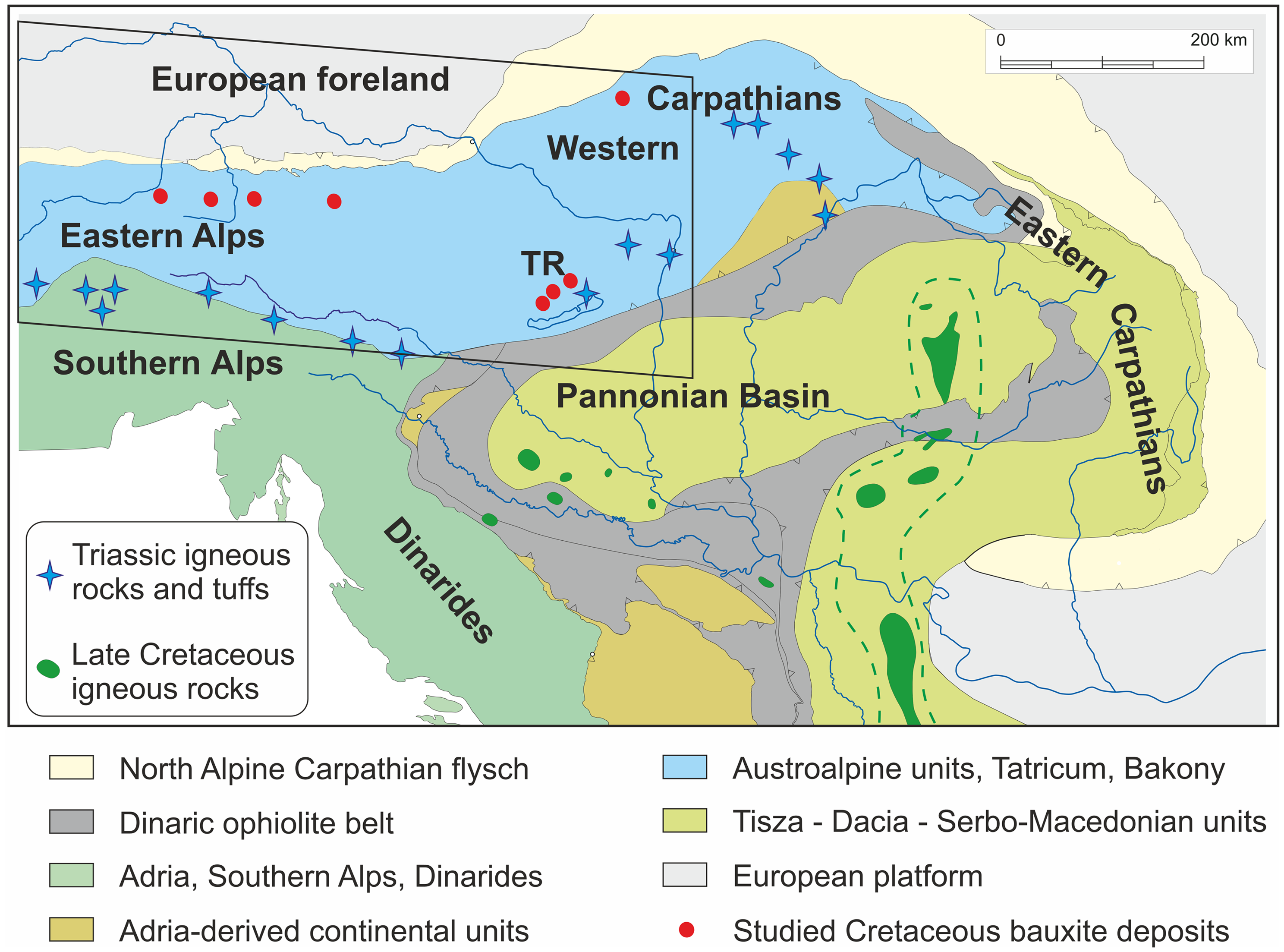
Overview map showing major Triassic volcanic–intrusive complexes. The dashed green line represents the subsurface extension of the Late Cretaceous igneous formations of the Banatitic magmatic belt in the East Alpine–Carpathian realm. The map base indicates the main structural units without their sedimentary cover (after Schmid et al. Reference Schmid, Bernoulli, Fügenschuh, Matenco, Schefer, Schuster and Ustaszewski2008). Distribution of Banatite intrusions and volcanic rocks is based on data from Ciobanu et al. (Reference Ciobanu, Cook and Stein2002), Balen et al. (Reference Balen, Schneider, Massonne, Opitz, Luptáková, Putiš and Petrinec2020) and Šuica et al. (Reference Šuica, Garašić and Woodland2022a, Reference Šuica, Tapster, Mišur and Trinajstić2022b). Triassic igneous occurrences are adapted from Beltrán-Triviño et al. (Reference Beltrán-Triviño, Winkler, von Quadt and Gallhofer2016), Smirčić et al. (Reference Smirčić, Kolar-Jurkovšek, Aljinović, Barudžija, Jurkovšek and Hrvatović2018) and Dunkl et al. (Reference Dunkl, Farics, Józsa, Lukács, Haas and Budai2019). Names of bauxite deposits and sampling coordinates are given in Figure 1 and Table 1. The black rectangle shows the extent of Figure 1.
2.c. Subduction-induced nappe stacking in Jurassic to Early Cretaceous time
In Jurassic to Cretaceous time, paleogeographic reconstructions based on paleomagnetic and paleontological evidence suggest that the Austroalpine realm was part of a mosaic-like assemblage of microcontinental plates surrounded by the Penninic Ocean to the northwest, the Vardar Ocean branch of the Neotethys Ocean to the northeast, and the Meliata Ocean branch of the Neotethys Ocean to the south to southeast (e.g., Csontos and Vörös, Reference Csontos and Vörös2004; Schmid et al. Reference Schmid, Fügenschuh, Kissling and Schuster2004; Gawlick et al. Reference Gawlick, Missoni, Schlagintweit, Suzuki, Frisch, Krystyn, Blau and Lein2009). The Jurassic to Early Cretaceous time was characterized by shallow to progressively more pelagic marine sedimentation, which later served as the youngest substrates of some Northern Calcareous Alps (Glanegg) and Transdanubian Range (Alsópere) bauxites (e.g., Mindszenty et al. Reference Mindszenty, Ottner and Lobitzer2005; Wagreich, Reference Wagreich2003; Gellai et al. Reference Gellai, Knauer and Mindszenty2018). The subduction of the Meliata Ocean, a precursor event of the Eoalpine orogeny, occurred roughly between 198 and 173 Ma, as indicated by volcanic tuff layers produced by an Early Jurassic volcanic arc preserved in the turbiditic Florianikogel Formation of the Northern Calcareous Alps (Hilberg, Reference Hilberg1998, unpub. MSc thesis; Neubauer et al. Reference Neubauer, Hilberg, Handler and Topa1999, Reference Neubauer, Handler and Friedl2001). Simultaneously in the Transdanubian Range, similar to the Eastern Alps (e.g., Bernoulli and Jenkyns, Reference Bernoulli and Jenkyns1974), the carbonate platforms became dissected, and a horst-and-graben pattern developed, forming the predominant morphology that governed post-Jurassic landscape evolution in the area (Vörös and Galácz, 1998; Császár, Reference Császár2008). The onset of the Eoalpine orogeny is marked by the final closure of the Meliata Ocean in the latest Jurassic to Early Cretaceous time (∼149 to 135 Ma), which caused a regional very low- to low-grade metamorphic overprint at the structural base of the Northern Calcareous Alps and the obduction of the Meliata Oceanic plate thrust over the Austroalpine units (Neubauer et al. Reference Neubauer, Fried, Genser, Handler, Mader and Schneider2007; and references therein). This event was recorded by the high abundance of chromian spinels in an oceanic trench-like basin filled with Upper Jurassic, Lower Cretaceous to up to Turonian flysch known as Rossfeld Formation and Bersek Marl Formation in the Northern Calcareous Alps and Transdanubian Range, respectively (Császár and Árgyelán, Reference Császár and Árgyelán1994; Wagreich et al. Reference Wagreich, Faupl and Schlagintweit1995; von Eynatten and Gaupp, Reference von Eynatten and Gaupp1999, Sztanó et. al. Reference Sztanó, Fodor, Császár, Szives, Haas, Knauer, Jocha-Edelényi, Kauer-Gellai, Józsa, Rálisch-Felgenhauer, Harangi, Szentgyörgyi, Bérczi-Makk, M Tóth, Király, Babinszki, Piros, Budai, Gyalog, Halász, Király, Haranginé Lukács and M Tóth2024) and mélange complexes (Gawlick and Missoni, Reference Gawlick and Missoni2019). These synorogenic flysch deposits, mainly of Early Cretaceous age, contain not only chromian spinels but also, in their upper parts, high-pressure metamorphic minerals such as glaucophane, chloritoid, and phengite, indicative of subduction-related high-pressure metamorphic events. However, white mica dating yielded Variscan ages between 360 and 320 Ma (von Eynatten et al. Reference von Eynatten, Gaupp and Wijbrans1996). Therefore, these metamorphic minerals should represent former Cadomian to Variscan tectonic units of the Austroalpine basement exposed during Cretaceous time. Partly contemporaneous with the subduction of the Meliata Ocean, the Austroalpine domain became separated from stable Europe during Early to Middle Jurassic times by the opening of the Penninic Ocean on its northwestern side and became an isolated microcontinent (e.g., Csontos and Vörös, Reference Csontos and Vörös2004; Schmid et al. Reference Schmid, Fügenschuh, Kissling and Schuster2004; Csiki-Sava et al. Reference Csiki-Sava, Buffetaut, Ősi, Pereda-Suberbiola and Brusatte2015).
2.d. The Early to Late Cretaceous nappe stacking events of the Eoalpine orogeny
The subduction of the Meliata Ocean was accompanied by nappe stacking during Early to Late Cretaceous times, progressing from SE to NW, and by amphibolite- to eclogite-facies metamorphism in the basement units, referred to as ‘Eoalpine eclogites’ (Neubauer et al. Reference Neubauer, Fried, Genser, Handler, Mader and Schneider2007 and references therein). As a result of these tectonometamorphic events, Permian to Jurassic continental and carbonate sequences were incorporated into the Austroalpine cover nappes, which were subsequently exposed at the surface. Erosion and subaerial weathering of these nappes led to the formation of Cretaceous bauxite deposits in the Northern Calcareous Alps (e.g., Kufstein, Glanegg, Russbach, Unterlaussa, and Dreistetten) and the Transdanubian Range (e.g., Alsópere and Iharkút) (Figure 1), associated with a major regional unconformity attributed to the so-called ‘pre-Gosau’ deformation phase (Tari and Linzer, Reference Tari and Linzer2018; and references therein).
The timing of bauxite formation differs markedly between the two areas. In the Northern Calcareous Alps, Cretaceous bauxites occur at the base of the Gosau Group and are typically overlain by transgressive sedimentary successions. The age of these cover beds ranges from Turonian to Santonian, depending on locality (Figure 3; e.g., Tari and Linzer, Reference Tari and Linzer2018). In the Transdanubian Range, two distinct terrestrial to shallow marine successions overlie the bauxites: one linked to an Albian unconformity (Császár, Reference Császár1996; Góczán et al. Reference Góczán, Pataki, Rákosi and Tiszay2002) and another reflecting a Santonian phase (Haas, Reference Haas1983, Reference Haas1999; Bárdossy and Mindszenty, Reference Bárdossy and Mindszenty2013).
(a) Stratigraphic columns of the bauxite-bearing Mesozoic sequences in the Transdanubian Range, Northern Calcareous Alps and Western Carpathians based on Császár (Reference Császár1986), Mindszenty et al. (Reference Mindszenty, D’Argenio and Bognár1987), Siegl-Farkas (Reference Siegl-Farkas1991), Siegl-Farkas & Wagreich (Reference Siegl-Farkas and Wagreich1996), Schulz & Heissel (Reference Schulz and Heissel1997), Wagreich (Reference Wagreich2003), Mindszenty et al. (Reference Mindszenty, Ottner and Lobitzer2005) and Tari & Linzer (Reference Tari and Linzer2018). In the case of Transdanubian bauxites, the stratigraphic cover is well preserved, while in the Eastern Alps in the case of some deposits, the sedimentary covers are not known, and for Russbach, the cover is considered to be Tithonian in age (Steiner et al. Reference Steiner, Gawlick, Melcher and Schlagintweit2021); however, this could be a tectonic cover as well. The Mojtín bauxite is assumed to be Cretaceous (see details in 3.c); however, its oldest known cover is Lutetian nummulitic limestone. Representative outcrop photographs of the sampled localities are shown for (b) Unterlaussa (courtesy of Dr. Ferdinand J. Hampl), (c) Iharkút, (d) Alsópere and (e) Mojtín (courtesy of Dr. Gábor Csillag).

Paleogeographic reconstructions suggest that the Northern Calcareous Alps and Transdanubian Range bauxite deposits were relatively close during the Late Cretaceous (Tari Reference Tari1994; Tari and Linzer, Reference Tari and Linzer2018; and references therein). According to Bárdossy and Mindszenty (Reference Bárdossy and Mindszenty2013), they likely shared a similar sediment source. Mindszenty et al. (Reference Mindszenty, Gál-Sólymos, Csordás-Tóth, Imre, Felvári, Ruttner, Böröczky and Knauer1991), Hampl and Melcher (Reference Hampl and Melcher2023), and Hampl et al. (Reference Hampl, Dunkl, Schmidt, Bertrandsson Erlandsson and Melcher2025) reported significant chromian spinel and micaschist fragments from Dreistetten and Unterlaussa in the NCA, but only trace amounts of these grains from the zircon- and tourmaline-rich Iharkút bauxite in the TR. Kyanite, titanite and amphibole were also observed in the Albian Alsópere bauxite. Altogether, the detrital heavy mineral assemblages of Cretaceous bauxites from both regions suggest a mixed provenance, including (ultra)mafic components and exposed continental crust, with contributions from low-grade metamorphic units (Mindszenty et al. Reference Mindszenty, Gál-Sólymos, Csordás-Tóth, Imre, Felvári, Ruttner, Böröczky and Knauer1991).
2.e. Collapse of the Late Cretaceous orogen and the exhumation of the Eoalpine basement
The Austroalpine nappe stacking led to overthickening and, consequently, the collapse of the orogenic wedge (Neubauer et al. Reference Neubauer, Fried, Genser, Handler, Mader and Schneider2007; and references therein). As a result, the northern and southern marginal areas witnessed subsidence along low-angle normal faults, while the basement units were subjected to exhumation, including the Eoalpine eclogites in the central parts (Neubauer et al. Reference Neubauer, Fried, Genser, Handler, Mader and Schneider2007). This uplift event was accompanied by erosion and the accumulation of the up to 2500 m thick Gosau Group (Siegl-Farkas and Wagreich, Reference Siegl-Farkas and Wagreich1996). Neubauer et al. (Reference Neubauer, Fried, Genser, Handler, Mader and Schneider2007) assumed a minimum of 10 km thickness of erosion based on the detrital mica assemblage of Variscan (334 Ma), Permian (280 to 260 Ma), Early Triassic (250 to 241 Ma) and Early Cretaceous (122 to 99 Ma) ages found in the Upper Cretaceous to Eocene Gosau Group, which also cover the bauxites targeted in this study. Thöni (Reference Thöni2006) dated the early Late Cretaceous exhumation period of the Eoalpine eclogites between 90 and 85 Ma with a rapid exhumation rate of 5–10 km/Myr. Detailed heavy mineral studies of the Upper Cretaceous to Paleogene Gosau Group around the Vienna basin concluded the dominance of (ultra)mafic detrital input from the south between Coniacian and Campanian, which disappeared after the Maastrichtian, probably because of the complete erosion of the Meliata ophiolites by the latest Cretaceous (Ruttner and Woletz, Reference Ruttner and Woletz1955; Stern and Wagreich, Reference Stern and Wagreich2013). Garnet geochemistry indicates a high-grade metamorphic source to the south, which existed until Campanian times only and shifted afterwards to a provenance dominated by low-grade metamorphic units; however, the Eoalpine eclogite belt was excluded as a source rock in the study of Stern and Wagreich (Reference Stern and Wagreich2013) because of their 90 to 80 Ma cooling ages. The Gosau-type Late Cretaceous sedimentary units around the Transdanubian Range contain a rather mixed heavy mineral assemblage of zircon-tourmaline-rutile ultrastable, epidote-staurolite-sphene-garnet low- to high-grade metamorphic minerals, granitic apatites, chromian spinels-magnetites-ilmenites representing oceanic basement units and pyroxene-amphibole grains of non-interpreted origin (Árgyelán and Horváth, Reference Árgyelán and Horváth2002).
2.f. The Banatite magmatism
The onset of Banatite magmatism coincided with major geodynamic changes in the Alpine–Carpathian–Dinaric realm, including exhumation of the Eoalpine basement, Cretaceous nappe stacking and bauxite formation. During this time, subduction of the Vardar branch of the Neotethys Ocean was ongoing, triggering long-lasting magmatic and volcanic activity that culminated in the formation of the so-called Banatite Magmatic and Metallogenetic Belt between 90 and 65 Ma. The term ‘banatite’ refers to a regional Late Cretaceous calc-alkaline magmatic suite, predominantly composed of andesites, dacites and granodiorites, related to subduction processes along the European margin (Ciobanu et al. Reference Ciobanu, Cook and Stein2002; von Quadt et al. Reference von Quadt, Moritz, Peytcheva and Heinrich2005; Neubauer, Reference Neubauer2015). The products covered vast areas and can still be traced in the Eastern Carpathians and the Balkanides of the Tisza – Dacia – Serbo-Macedonian units (Figure 2). The early Late Cretaceous paleogeographic position of the banatite occurrences could have been relatively close, ∼200 km or even shorter distance to the Austroalpine realm to the northeast across the Vardar Ocean (e.g., Schmid et al. Reference Schmid, Fügenschuh, Kissling and Schuster2004). Another, coeval, but geochemically more complex Late Cretaceous igneous suite was detected along the Sava River in Croatia and Serbia (e.g., Balen et al. Reference Balen, Schneider, Massonne, Opitz, Luptáková, Putiš and Petrinec2020; Šuica et al. Reference Šuica, Garašić and Woodland2022a, Reference Šuica, Tapster, Mišur and Trinajstić2022b). This could enable volcanic ash to reach the subaerially exposed parts of the Northern Calcareous Alps, where the accumulation of Cretaceous bauxites was already in progress, thus providing a potential tool for the geochronological dating of their maximum sedimentation age.
3. Materials
Each sampling locality (Table 1) is represented by a bulk-rock composite of 3 to 5 kg. In karst terrains, frequent sinkhole deepening and collapse-driven reworking promote deposit-scale mixing; thus, despite heterogeneous source materials, individual samples are reasonably assumed to yield an average provenance signal.
Sample locations and brief descriptions

Inferred stratigraphic ages are based on: 1Schulz and Heissel (Reference Schulz and Heissel1997); 2Wagreich (Reference Wagreich2003); 3Steiner et al. (Reference Steiner, Gawlick, Melcher and Schlagintweit2021); 4Siegl-Farkas and Wagreich (Reference Siegl-Farkas and Wagreich1996); 5Sztanó et al. Reference Sztanó, Fodor, Császár, Szives, Haas, Knauer, Jocha-Edelényi, Kauer-Gellai, Józsa, Rálisch-Felgenhauer, Harangi, Szentgyörgyi, Bérczi-Makk, M Tóth, Király, Babinszki, Piros, Budai, Gyalog, Halász, Király, Haranginé Lukács and M Tóth2024; 6 Číčel (Reference Číčel1958); Boorová and Potfaj (Reference Boorová and Potfaj1997); Aubrecht (Reference Aubrecht2015).
3.a. Bauxite samples of the Northern Calcareous Alps, Eastern Alps
Bauxite samples from the Northern Calcareous Alps were collected from four localities: Kufstein (BXA-1), Glanegg near Salzburg (BXA-2), Russbach near Strobl (BXA-3) and Unterlaussa (UL-1) (Figure 1, Table 1). All samples represent typical karst bauxites, with variable textures ranging from red, pelitomorphic (mudstone-type) to pisolithic or intraclastic (conglomeratic) facies. The Kufstein bauxite rests on deeply karstified Upper Triassic dolomites and forms the basal unit of the Santonian Gosau succession, with a preserved thickness of ∼2 m (Schulz and Heissel, Reference Schulz and Heissel1997). At Glanegg, the bauxite occurs as infill within karstified Upper Jurassic limestones unconformably overlain by polymictic carbonate conglomerates of the Gosau Group (‘Untersberg Marmor’), interpreted as part of a Santonian transgressive sequence (Wagreich, Reference Wagreich2003). In the Russbach area, the bauxite is up to 1.5 m thick and hosted within a tectonically disturbed setting. The immediate contact relationships are obscured, and the surrounding lithologies are dominated by recrystallized Upper Jurassic Plassenkalk (Mindszenty et al. Reference Mindszenty, Ottner and Lobitzer2005; Steiner et al. Reference Steiner, Gawlick, Melcher and Schlagintweit2021). The Unterlaussa bauxite is developed on Upper Triassic carbonates and is uniquely overlain by a conformable sequence of limnic shale and limestone, biostratigraphically dated to the late Turonian based on palynological data (Siegl-Farkas and Wagreich, Reference Siegl-Farkas and Wagreich1996).
3.b. Bauxite and sandstone samples of the Transdanubian Range, Pannonian Basin
Two bauxite localities were sampled from the Transdanubian Range: Alsópere (ARP-1) and Iharkút (IKB-1). They represent two distinct generations of Cretaceous karst bauxites, based on the age of their oldest covers – Albian sediments at Alsópere (Alsópere Bauxite Formation) and Santonian sediments at Iharkút (Halimba Bauxite Formation) (Figure 1, Table 1). The bauxite at Alsópere (ARP-1) is a red, hard, pisolithic to intraclastic variety with an average thickness of ∼5 m. It rests on karstified Late Triassic carbonates and is overlain by Albian brackish water sediments of the Tés Clay-marl Formation (Mindszenty et al. Reference Mindszenty, Gál-Sólymos, Csordás-Tóth, Imre, Felvári, Ruttner, Böröczky and Knauer1991; Császár, Reference Császár1996, Sztanó et al. Reference Sztanó, Fodor, Császár, Szives, Haas, Knauer, Jocha-Edelényi, Kauer-Gellai, Józsa, Rálisch-Felgenhauer, Harangi, Szentgyörgyi, Bérczi-Makk, M Tóth, Király, Babinszki, Piros, Budai, Gyalog, Halász, Király, Haranginé Lukács and M Tóth2024). The red, hard, pisolithic bauxite at Iharkút (IKB-1) occurs in a ∼100 m-deep sinkhole developed in the same Triassic carbonate basement. The sample was collected from the close vicinity of the contact between the bauxite and the karstified host rock. It is characterized by angular dolomite fragments consistent with its position near the walls of the enclosing karstic sinkhole. To further constrain provenance and depositional context, overlying siliciclastic units of the Csehbánya Formation were also sampled. At Iharkút, these include a lignitiferous clayey sandstone (IKS-1) and a polymict conglomerate (IKS-2), interpreted as fluvio-deltaic deposits on an alluvial plain temporarily connected to mainland Europe and known for its vertebrate fossil content (Ősi, Reference Ősi2004). Their Santonian age is confirmed by palynological data (Knauer and Siegl-Farkas, Reference Knauer and Siegl-Farkas1992). An additional sample (AJ-1) was taken from a comparable sandstone interbedded with coal seams near Ajka. This sequence, also dated as of Santonian age based on palynological and nannofossil data (Siegl-Farkas and Wagreich, Reference Siegl-Farkas and Wagreich1996; Bodrogi et al. Reference Bodrogi, Fogarasi, Yazikova, Sztanó and Báldi-Beke1998; Bodor and Baranyi, Reference Bodor and Baranyi2012), is interpreted as a contemporaneous swampy sub-basin separated from Iharkút by a structural high composed of exposed Triassic carbonates (Tari and Horváth, Reference Tari and Horváth2010).
3.c. Bauxite sample from the Western Carpathians
The Mojtín bauxite (MJ-1) from the Strážov Mountains (Figure 1) was included in the sample set on a tentative basis to explore whether bauxitization in this region may have overlapped with the better-constrained Cretaceous events observed elsewhere. The sample was taken from a red, hard, pisolithic bauxite lens exposed in a historical mining trial pit, where the bauxite rests on Middle to Upper Triassic dolomites of the Choč Nappe and is overlain by Lutetian nummulitic limestones (Číčel, Reference Číčel1958; Aubrecht, Reference Aubrecht2015). Since the deposit lacks direct geochronological control, its age can only be inferred from this major unconformity, which spans over 150 million years of an apparent stratigraphic gap, including an unknown period of erosion followed by karstification, plus lateritic weathering and emplacement of the weathering products onto the karst surface. The timing of karstification and bauxitization can be constrained by regional stratigraphic and tectonic relationships. The main thrusting phase in the Central Western Carpathians took place in the middle Turonian, as indicated by the youngest flysch sediments of the Tatric units beneath the Fatric nappe system (Boorová and Potfaj, Reference Boorová and Potfaj1997). However, atop the Fatricum, beneath the Hronic nappe system that hosts the bauxitic paleokarst at Mojtín, the youngest preserved sediments are not younger than Cenomanian. Accordingly, karstification and bauxite accumulation likely occurred during post-Turonian uplift and prolonged emersion, lasting until Eocene times, following the complete erosion of the Upper Triassic to Hauterivian strata.
3.d. Reference samples from the Eastern Alps for provenance comparison
To contextualize the detrital zircon low-temperature thermochronological age distributions obtained on the bauxite and cover sandstone samples, three additional reference samples were selected from units that were exposed during Cretaceous times in the Eastern Alps (Figure 1, Table 1):
-
(a) A red sandstone pebble population sample, following the pebble population dating (PPD) approach of Dunkl et al. (Reference Dunkl, Frisch, Kuhlemann and Brügel2009), was compiled from the Late Miocene Hausruck Conglomerate. In this way, multiple pebbles of the same lithology are selected from an outcrop and processed together to obtain a composite detrital signal representative of their source units. From this Alpine-derived formation, zircon fission-track (ZFT) data of 60 zircon grains were reported by Dunkl et al. (Reference Dunkl, Frisch, Kuhlemann and Brügel2009).
-
(b) A modern sand sample was taken from the Gurk River, which drains both Lower and Upper Austroalpine units, including Eoalpine metamorphic complexes. This sample has been taken to provide a representative modern analogue of zircon-bearing units eroded from the central zone of the Eastern Alps.
-
(c) A Triassic ‘Alpine Buntsandstein’ pebble population sample, consisting of multiple sandstone pebbles collected from a small catchment near Kufstein, was used to represent the lithology of the southern belt of the Northern Calcareous Alps. These samples are used as a potential sedimentary source representing the major siliciclastic members of the NCA.
4. Methods
4.a. X-ray powder diffraction analysis
X-ray powder diffraction analysis of bulk samples with a 45-minute duration on a 65° 2θ range was carried out at the Department of Mineralogy of Eötvös Loránd University, Budapest, and at the Geoscience Center of the Georg-August University, Göttingen.
4.b. From crushing to single-crystal handpicking and embedding
For geochronological and heavy mineral studies, 3 to 5 kg of each sample was crushed and sieved below 250 μm for pre-concentration using a Wilfley-type shaking table (e.g., Sivamohan and Forssberg, Reference Sivamohan and Forssberg1985). After 5% acetic acid treatment, the high-density authigenic, boehmitic-hematitic (roughly 3.02–3.07 g/cm3), clayey bauxite aggregates have been disintegrated by a high-energy Bandelin Sonoplus type ultrasonic homogenizer, which leaves the detrital heavy mineral grains intact. Heavy mineral separation has been done by using a 2.89–2.93 g/cm3 Na-polytungstate solution. Due to the compact nature and mainly boehmitic (magnetic) composition of the bauxites, a further enrichment with a Frantz L-1 magnetic separator, adjusted to 10° side angle and 1.2 A current, was applied.
Several 100 g of each sample were not treated by the magnetic separator (except for bauxites, as described above) and shaking table but further sieved to the 63 to 125 μm fraction for optical heavy mineral studies. Optical heavy-mineral identification was performed on detrital translucent, non-opaque, non-micaceous grains. The target number of grains analysed was approximately 200 per sample, although lower counts were considered where mineral yield was limited. In siliciclastic (i.e., sandstone) samples, ribbon counting was applied following Mange and Maurer (Reference Mange and Maurer1992), with grains identified systematically between 5 and 10 evenly spaced thin counting lines on glass slides. In bauxite samples, detrital heavy-mineral yields were very low; therefore, all identifiable detrital translucent heavy-mineral grains were handpicked, counted (i.e., resembling the fleet method; Schönig, Reference Schönig2024) and mounted on double-sided adhesive tape for subsequent geochronological analyses. The Alsópere bauxite yielded only a low number of zircon grains, insufficient for heavy-mineral analysis.
4.c. U-Pb geochronology
Analyses were carried out at the GÖochron Laboratories, Geoscience Center, University of Göttingen. After handpicking and embedding in 1-inch epoxy cookies, in situ, single-grain U-Pb zircon dating was performed using a Resonetics excimer laser ablation system coupled to a Thermo Element2 sector field ICP-MS following the techniques described by Frei and Gerdes (Reference Frei and Gerdes2009). The details of the analytical specifics are given in the electronic Supplementary Material S1. The long-term precision and accuracy of the zircon U–Pb ages can be estimated by the compilation of data obtained on 16 reference zircons at the time of the analyses of the samples of this study (see details in Kelemen et al. Reference Kelemen, Dunkl, Csillag, Mindszenty, Józsa, Fodor and von Eynatten2023). Cathodoluminescence (CL) images together with the reflected light images of polished grains were used to select the proper positions of laser ablation spots and avoid any fractures, inclusions, metamict cores or other inhomogeneities (‘hectic’ patterns in the CL maps). Laser spots were positioned on the outermost mantle of the grains to date the latest crystallization event and to avoid inherited older cores. The CL images were taken with a JEOL JXA 8900 electron microprobe. Data reduction was performed with UranOS 2.06a software (Dunkl et al. Reference Dunkl, Mikes, Simon and von Eynatten2008) and kernel density estimation (KDE) component analysis by DensityPlotter (Vermeesch, Reference Vermeesch2012). For zircon ages younger than 1500 Ma, the 206Pb/238U age is considered, while for older grains we use the 207Pb/206Pb age (Spencer et al. Reference Spencer, Kirkland and Taylor2016). Data showing more than 10% discordance were excluded from further evaluation (equations applied are placed in the footnote of Supplementary Material S4).
4.d. U-Pb-He double-dating
U-Pb-He double-dating analyses were performed at the GÖochron Laboratories, Geoscience Center, University of Göttingen. The zircon grains were embedded in glass slide-epoxy resin sandwich mounts, and a ∼15 µm-thick layer was removed by polishing to expose their interior. The helium was extracted using an Elemental Scientific NWR213 UV laser in an evacuated high-vacuum gas extraction line. Only 70 µm or wider, randomly picked grains were considered for dating. The laser spots were carefully selected to have a proper distance from inclusions, fractures and the rim of the grain. Helium was extracted by using 75 laser pulses of a 30 μm diameter beam, resulting in a ∼8 μm deep pit. The extracted gas was mixed with a known amount of 3He and purified by cold SAES getter pills and a Ti-Zr getter kept at 450°C (Dunkl et al. Reference Dunkl, Malis, Lünsdorf, Schönig and von Eynatten2024). The residual gas was expanded into a Hiden triple-filter quadrupole mass spectrometer equipped with a positive ion counting detector. Beyond the detection of the 4He/3He ratio, the partial pressures of some rest gases were continuously monitored (H2, CH4, H2O, N2, Ar and CO2). Afterwards, the mounts were placed in an ASI Resolution S155 excimer laser ablation system coupled to a Thermo Element 2 single-collector sector-field mass spectrometer. 50 µm laser spots were centred on the helium ablation pits to determine the U and Th concentrations and the Pb isotope ratios (Dunkl et al. Reference Dunkl, Malis, Lünsdorf, Schönig and von Eynatten2024). The laser is fired for 17 seconds at a repetition rate of 6 Hz at a nominal laser energy of ca 2 J/cm2. The carrier gases were He and Ar. The LGC-1 zircon was chosen as the primary reference material (Tian et al. Reference Tian, Vermeesch, Danišík, Condon, Chen, Kohn, Schwanethal and Rittner2017), as it is homogeneous and yields high He and actinide signals. ZHe ages with a relative error >20% were excluded from further consideration.
5. Results
5.a. Results of the X-ray powder diffraction analysis
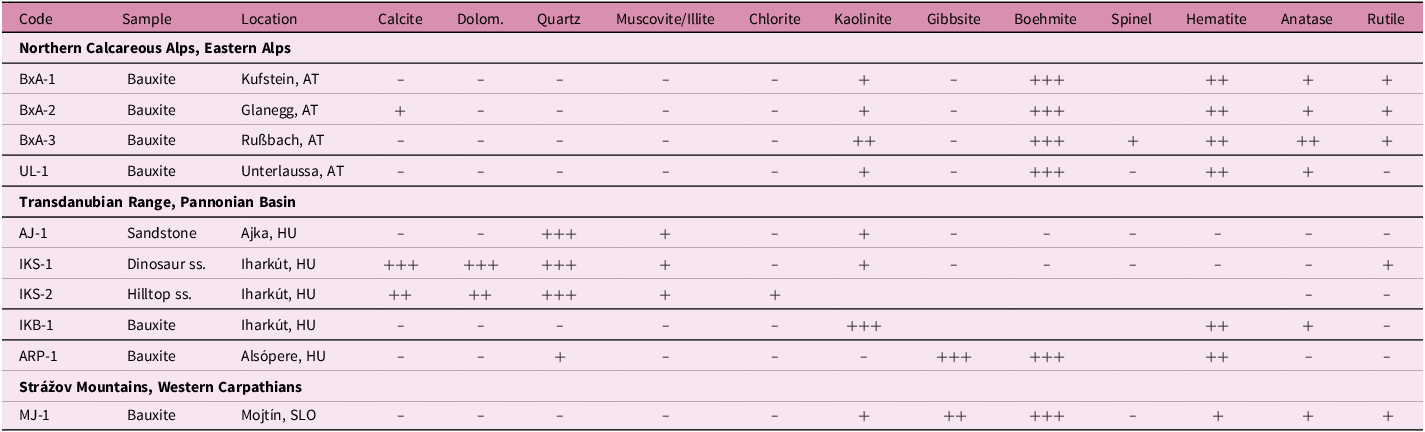
The evaluated XRD diagrams are attached in Supplementary Material S2. The bulk composition of the Northern Calcareous Alps bauxite samples is dominated by boehmite and hematite, while kaolinite and anatase are also present throughout all samples (Table 2). Rutile appears as an additional TiO2 phase in the samples from Kufstein, Glanegg and Russbach. The bauxite from Glanegg also contains identifiable amount of calcite (Table 2). Some spinel phases are detectable in the bauxite from Russbach.
Relative abundances of the major phases in the studied samples by X-ray powder diffraction analyses. The evaluated diffractograms are attached in Supplementary Figure S2
+++ Most intense peaks.
++ Moderately intense peaks.
+ Detectable phases.
In the Transdanubian Range, the IKB-1 bauxite sample taken from the overall boehmitic-gibbsitic Iharkút bauxite (Bárdossy and Mindszenty, Reference Bárdossy and Mindszenty2013) is dominated by kaolinite, followed by hematite and anatase. The presence of intense gibbsite peaks in the bauxite from Alsópere (ARP-1), besides boehmite and hematite, is in contrast with the Northern Calcareous Alps bauxites, which show exclusively boehmite.
Similarly, the bauxite sample from Mojtín in the Western Carpathians is dominated by a boehmite and gibbsite whole-rock composition, with kaolinite and hematite present as well (Table 2). Notably bauxite sample ARP-1 contains some quartz.
The sandstone samples from the Transdanubian Range at Ajka and Iharkút are dominated by quartz, with significant amounts of muscovite/illite and kaolinite (Table 2). The sandstones from Iharkút also contain high amounts of calcite and dolomite.
5.b. Heavy mineral analysis results
For detailed heavy mineral data, see Supplementary Material S3.
5.b.1. Heavy mineral data of the Northern Calcareous Alps bauxites
The Northern Calcareous Alps bauxites are dominated by the ultrastable minerals: zircon and rutile. The ZTR percentages are between 79% (BXA-3) and 100% (BXA-1; Figure 4). The zircon grains are mostly anhedral or rounded, with only a small number of euhedral crystals between 3% and 22% (Supplementary Material S3). Kyanite and sillimanite are present in the bauxite from Russbach. Kyanite is also abundant in the Unterlaussa sample and occurs in minor amounts in the Glanegg bauxite (Figure 4).
Heavy mineral composition of Cretaceous bauxites and related siliciclastic rocks from (a) the Northern Calcareous Alps, (b) the Transdanubian Range and (c) the Western Carpathians. (a) Red bars represent Kufstein (BXA-1, solid), Glanegg (BXA-2, checkered), Russbach (BXA-3, striped) and Unterlaussa (UL-1, cross-hatched) bauxites. (b) Green bars show Ajka sandstone (AJ-1, solid) and Iharkút sandstones (IKS-1, checkered; IKS-2, striped); the orange bar represents Iharkút bauxite (IKB-1). (c) The blue bar shows the Mojtín bauxite (MJ-1). Percentages refer to counted grains (n) given in the legend; ZiEu = percentage of euhedral zircons. A noteworthy feature is the significant amount of kyanite (Russbach, Unterlaussa) and sillimanite (Russbach) in the NCA, implying higher-grade metamorphic source rocks. Detailed heavy mineral data are presented in Supplementary Material S3.

5.b.2. Heavy mineral data of the Mojtín bauxite sample, Western Carpathians
The Mojtín bauxite sample is dominated by zircon, while the presence of rutile is also significant. The ZTR percentage is 100%. 11% of the zircon crystals are euhedral. These values are very similar to the Kufstein sample from the Northern Calcareous Alps (Figure 4).
5.b.3. Heavy mineral data of the Transdanubian Range samples
The zircon–tourmaline–rutile ultrastable association dominates the Transdanubian Range samples (Figure 4). ZTR percentages are typically between 82% and 99%, while in the sandstone from Ajka, it is slightly lower (60%). As in the Northern Calcareous Alps bauxites, zircons in the Transdanubian Range samples are mostly anhedral or rounded, with only 6% to 15% euhedral crystals. A notable exception is the Iharkút bauxite, which stands out in several respects: it contains a distinctly high tourmaline content (∼35%), whereas all other bauxites contain negligible or no tourmaline; it also shows a ∼1:1 zircon-to-rutile ratio, compared to Z/R values of 3 to 6 in the other bauxite samples. In addition, IKB-1 contains significantly more euhedral zircon grains (∼44%) than any of the Northern Calcareous Alps bauxites (Supplementary Material S3). Apatite grains reach 30% in the sandstone from Ajka (AJ-1) and are also significant in the sandstones from Iharkút (IKS-1: 9%, IKS-2: 15%). Sandstones from both localities also contain minor amounts of epidote-group minerals (AJ-1: ∼1% to IKS-2: ∼4%), as well as scattered staurolite, kyanite, sillimanite, garnet and chromium spinel grains (Figure 4).
5.c. Results of the U-Pb analysis
The detrital zircon U–Pb age spectra from the Northern Calcareous Alps and Transdanubian Range samples reveal a wide range of Archean to Triassic concordant ages (Figure 5). Cretaceous ages also occur in a few samples. In the following subchapters, age components are primarily described as from–to ranges of individual concordant ages. For statistical summaries, including kernel density estimate (KDE) weighted mean values and associated 2σ uncertainties, readers are referred to Table 3 and Figure 6. The full set of raw U–Pb data is provided in Supplementary Material S4. Wetherill concordia plots are available in Supplementary Material S5.
Cumulative plot of detrital zircon U-Pb ages (within a 90 to 110% concordance range) from the bauxite and cover sandstone samples. For detailed component analysis, see Figure 6. The raw data are presented in Supplementary Material S4. T: Triassic, P: Permian, V: Variscan, Cal. (Ord.): Caledonian/Ordovician, Cad.: Cadomian.

Summary of the major U-Pb age components identified by DensityPlotter (Vermeesch, Reference Vermeesch2012) in the bauxite and sandstone samples (n = number of concordant data)
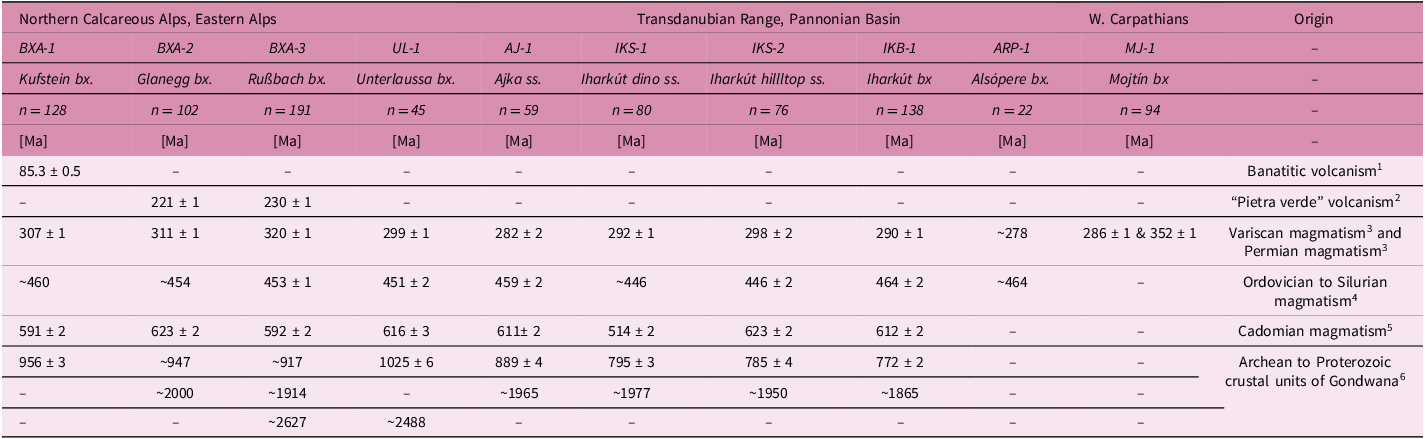
General references to the major sources are indicated with superscript: 1Ciobanu et al. (Reference Ciobanu, Cook and Stein2002); 2Horváth and Tari (Reference Horváth and Tari1987); Pálfy et al. (Reference Pálfy, Parrish, David and Vörös2003); Dunkl et al. (Reference Dunkl, Farics, Józsa, Lukács, Haas and Budai2019); 3Neubauer et al. (Reference Neubauer, Fried, Genser, Handler, Mader and Schneider2007); Újvári et al. (Reference Újvári, Varga, Ramos, Kovács, Németh and Stevens2012); 4Újvári et al. (Reference Újvári, Varga, Ramos, Kovács, Németh and Stevens2012); 5Linneman (Reference Linnemann2007); Neubauer et al. (Reference Neubauer, Fried, Genser, Handler, Mader and Schneider2007); Újvári et al. (Reference Újvári, Varga, Ramos, Kovács, Németh and Stevens2012); Linneman et al. (Reference Linnemann, Gerdes, Hofmann and Marko2014); 6Linneman et al. (Reference Linnemann, Ouzegane, Drareni, Hofmann, Becker, Gärtner and Sagawe2011); Košler et al. (Reference Košler, Konopásek, Sláma and Vrána2014).
Detrital zircon U-Pb ages are presented on bar diagrams and kernel density plots (only the 90 to 110% concordant data are considered). The age components are calculated using Density Plotter (Vermeesch, Reference Vermeesch2012) and summarized in Table 3, including also the ages that are older than 1200 Ma. Note that the single Turonian-aged zircon from Glanegg (∼92 Ma) does not represent a discrete age component. Wetherill concordia plots can be found in Supplementary Material S5.

5.c.1. Zircon U-Pb ages of the Northern Calcareous Alps bauxites
The 462 concordant U-Pb detrital zircon ages from the Northern Calcareous Alps bauxites reveal Tonian (∼1000 to 800 Ma), Cadomian (∼623 to 591 Ma), Ordovician (∼452 Ma) and Late Variscan-Permian (∼323 to 299 Ma) age components widespread in all samples, while some samples show some late Archean and Paleoproterozoic (∼2 Ga) ages (Figures 5 and 6 and Table 3). Significant Middle Triassic age components are recorded in the bauxite from Russbach and Glanegg (age components at 230 and 221 Ma, respectively; Figure 5). A Late Cretaceous zircon U-Pb age component (Santonian, ∼85 Ma) has been revealed in the bauxite from Kufstein, and the Glanegg sample revealed a single Turonian age. Supplementary Material S6 shows example CL images of Late Cretaceous zircon grains.
5.c.2. Zircon U-Pb ages of the Transdanubian range samples
The 469 concordant U-Pb detrital zircon ages from the Transdanubian Range reveal very similar age components to the Northern Calcareous Alps bauxites. Paleoproterozoic (∼1980 to 1860 Ma), Tonian (∼890 to 770 Ma), Cadomian (∼618 to 600 Ma), Ordovician-Silurian (∼464 to 433 Ma) and early Permian (∼298 to 278 Ma) components are widespread among the Ajka and Iharkút samples (Figures 5 and 6, and Table 3). The three cover sandstones from Iharkút and Ajka show a largely comparable provenance signature to the IKB-1 bauxite, although the bauxite sample displays relatively more prominent KDE peaks at Ordovician (∼450 Ma) and Permian (∼290 Ma) ages (Figure 6). In contrast, the Alsópere bauxite lacks any clear Precambrian age components, though this may reflect the relatively low number of concordant grains recovered from this sample.
5.c.3. U-Pb data of the Mojtín bauxite, Western Carpathians
The 94 concordant U-Pb detrital zircon ages from the Mojtín bauxite (MJ-1) show only two well-identifiable age components at Variscan (∼352 Ma) and Permian (∼286 Ma) time (Figures 5 and 6). Scattered ages from 2.6 Ga to 400 Ma are also present.
5.d. U-Pb-He double-dating results
The bauxite samples contain low amounts and typically small heavy minerals; therefore, the number of detrital zircon crystals suitable for (U-Th)/He dating is limited, as this method requires relatively wide crystals (∼70 µm width). We could apply this method to three samples: a sandstone (IKS-2) and a bauxite (IKB-1) from the Transdanubian Range (Iharkút) and the bauxite from Russbach (BXA-3), Northern Calcareous Alps. The raw U-Pb-He data are listed in Supplementary Materials S7. U-Pb age distributions from both the conventional and double-dated zircons are merged and presented in Figure 5.
5.d.1. Zircon (U-Th)/He ages of the bauxite from Russbach, Northern Calcareous Alps
The Russbach sample (BXA-3) is abundant in detrital zircon crystals; thus, it was feasible to select 123 grains that were suitable for double-dating using the laser ablation technique (Figure 7). The interquartile range of the (U-Th)/He age distribution is between 200 and 100 Ma, but it also contains ages between 90 and 65 Ma, which has high diagnostic value (see later). All 123 acquired ages had less than 20% relative error, which means they were suitable for later statistical evaluations and interpretations. The two identified age components are: (1) a diffuse, poorly constrained Late Permian age component at ∼253 Ma and (2) a well-defined late Early Cretaceous (Albian) component at ∼109 Ma.
A: Detrital zircon (U–Th)/He age distributions in two bauxites and a cover sandstone sample. The red line with triangles represents the NCA bauxite (BXA-3), the grey line with squares the Transdanubian sandstone (IKS-2) and the green line with diamonds the Transdanubian bauxite (IKB-1). The yellow bar indicates the most typical late to post-Eoalpine ZFT and ZHe cooling ages in the Austroalpine basement. B: The age components are isolated by DensityPlotter (Vermeesch Reference Vermeesch2012). C: Cumulative plot of low-temperature cooling ages measured for three potential Upper Austroalpine source units of the Cretaceous bauxitic sediments. The black line with short ticks (a) represents Miocene pebbles of Permo–Triassic sandstones (60 zircon FT ages; Dunkl et al. Reference Dunkl, Frisch, Kuhlemann and Brügel2009); the grey line with squares (b) represents modern sand from the Gurk river (60 zircon FT ages); and the black line with crosses (c) represents modern pebbles of Triassic sandstones from the Northern Calcareous Alps (53 zircon (U–Th)/He ages). See analytical data in Supplementary Material S7.

5.d.2. Zircon (U-Th)/He ages of the samples from Iharkút, Transdanubian Range
The bauxite and sandstone samples from Iharkút, Transdanubian Range, yielded 26 and 34 zircon grains, respectively, that were suitable for U–Pb–He double-dating (Figure 7). In the bauxite sample, 25 of the 26 ages fall below 20% relative error (considered for statistical evaluations and interpretations). A notable difference from other samples lies in the older part of the spectrum, which includes a cluster of Paleozoic ages consistent with Variscan magmatism (∼320 Ma). The younger, statistically resolvable age component is ∼129 Ma. In the case of sandstone, 29 of the 34 zircon grains fall within the <20% relative error threshold. This sample shows a broad spread of Cretaceous to Paleozoic ages, with the youngest component at ∼96 Ma and a distinct Late Triassic age group around ∼212 Ma (Figure 7a).
5.d.3. Low-temperature thermochronological age patterns of the Eastern Alpine reference samples
Most zircon (U–Th)/He and fission track ages in the pebble population samples of Permo-Triassic siliciclastic units are older than 100 Ma (Figure 7c). In contrast, ZFT ages in the Gurk River modern sand sample show a tight cluster of cooling ages between 90 and 60 Ma (Figure 7c; raw data are in Supplementary Table S7). This difference represents well the contrast between the thermal histories of the (meta)sedimentary units in the Upper Austroalpine units that experienced weak or no Cretaceous thermal overprint and the lower metamorphic units with typical Late Cretaceous cooling ages (e.g., Neubauer et al. Reference Neubauer, Dallmeyer, Dunkl and Schirnik1995; Elias, Reference Elias1998; Thöni, Reference Thöni1999; Dunkl et al. Reference Dunkl, Malis, Lünsdorf, Schönig and von Eynatten2024).
5.d.4. Comparison of (U–Th)/He age patterns
Although the number of double-dated zircon grains varies between samples, the Russbach bauxite and the two Iharkút samples exhibit broadly similar Jurassic–Cretaceous (U–Th)/He age spectra. However, differences are evident in both the youngest and oldest components. Russbach and the Iharkút sandstone yield significant zircon He ages younger than 100 Ma, whereas the Iharkút bauxite does not and thus yields the oldest of the Cretaceous age components at ∼129 Ma (Figure 7b). The second, older age components vary by sample: Russbach shows a Late Permian (∼253 Ma) component, IKB-1 a Variscan (∼320 Ma) component and IKS-2 a Late Triassic (∼212 Ma) one. Russbach shows the strongest resemblance to the Triassic sandstone from the Eastern Alps, particularly in overall distribution and slope. The strong Late Cretaceous age component of the modern Gurk River sand sample (90–60 Ma) overlaps with the youngest He ages in IKS-2 and BXA-3 samples.
6. Discussion
6.a. Mineral composition of the bauxites
Bauxite composition is dominated by boehmite, hematite and kaolinite, indicating intense subaerial continental weathering (Table 2). The surprisingly high gibbsite and undetectable kaolinite content of the bauxite from Alsópere suggests different formation conditions compared to the other studied locations. Although boehmite was not identified in our bauxite sample from Iharkút, its general presence in this deposit is well documented, while sometimes gibbsite is also present (e.g., Bárdossy and Mindszenty, Reference Bárdossy and Mindszenty2013). The mainly kaolinitic composition is well known for the so-called ‘karst-contact’ bauxite facies to which the collected sample belongs. This term refers to the marginal areas of the deposit close to the host Triassic Main Dolomite. It was subjected to an incomplete bauxitization due to the buffering effect of the surrounding carbonate rocks (Mindszenty, Reference Mindszenty1984). Supposedly, the internal part of the deposit contains fewer diagnostic detrital heavy minerals. That is why the substrate-near position was sampled, where the lower degree of bauxitization can aid the survival of detrital phases that are sensitive to weathering.
6.b. New age constraints for the Cretaceous bauxite sedimentation
At Iharkút and Ajka, the Santonian age was defined by coal-bearing clastic cover units (Knauer and Siegl-Farkas, Reference Knauer and Siegl-Farkas1992). Although the youngest resolvable (U–Th)/He age components, ∼129 Ma (IKB-1) and ∼96, predate the Santonian age, they are fully compatible with the biostratigraphic assignment, since detrital He ages reflect the cooling of the source terrane.
In contrast, the Alpine occurrences have long suffered from ambiguous or missing cover relationships. Our new U–Pb age data from the Kufstein bauxite yield a ∼85 Ma Santonian maximum depositional age (Figure 6), which independently supports earlier biostratigraphic estimates (Schulz and Heissel, Reference Schulz and Heissel1997) and confirms that bauxitization in the Northern Calcareous Alps extended at least into the Santonian. At Glanegg, one single zircon grain yields a Turonian age of ∼92 Ma (Figures 5 and 6), but as this is not supported by additional grains, it does not define a discrete age component and is not considered further in constraining the depositional age (von Eynatten and Dunkl, Reference von Eynatten and Dunkl2012). However, at Unterlaussa, even though we obtained no Cretaceous U-Pb ages, the conformable late Turonian marl–limestone cover provides a robust depositional constraint (Siegl-Farkas and Wagreich, Reference Siegl-Farkas and Wagreich1996), indicating that deposition coeval with bauxitization must have ended by that time.
At Russbach, the latest interpretation assigned the bauxite to the Tithonian age (Steiner et al. Reference Steiner, Gawlick, Melcher and Schlagintweit2021). However, our detrital zircon (U–Th)/He data suggest a younger depositional age: the interquartile age range of 200 to 100 Ma, with ∼65% of the data postdating the Tithonian age (Figure 7), indicates that the Jurassic strata above the deposit are unlikely to represent a sedimentary cover. Instead, they should be interpreted as tectonically emplaced. This interpretation is consistent with the lack of stratigraphic continuity seen at many Northern Calcareous Alps bauxite sites (Figure 3).
For the bauxite at Mojtín, Western Carpathians, the lack of the very characteristic Paleogene volcanogenic zircons that are omnipresent in all studied Paleogene bauxite deposits of the region (Dunkl, Reference Dunkl1992; Brčić et al. Reference Brčić, Dunkl, Mindszenty, Brlek, Trinajstić, Bajo, Bauluz, Mišur, Karius, Šuica, Kukoč, Yuste, Laita and Zeh2023; Kelemen et al. Reference Kelemen, Dunkl, Csillag, Mindszenty, Józsa, Fodor and von Eynatten2023) underlines a most likely Cretaceous age of the bauxite-forming processes.
6.c. Major sources of the Cretaceous bauxites of the Northern Calcareous Alps and Transdanubian Range
Most of the heavy minerals from the Cretaceous bauxites belong to the ultrastable group (Figure 4). Zircon, rutile and tourmaline have been enriched during the selective breakdown of other heavy minerals that were potentially present in the protoliths of the bauxite. The traces of kyanite and sillimanite hint at some medium- to high-grade metamorphic sources. Cretaceous sandstone samples collected from above the bauxites of the Transdanubian Range also contain rather poor heavy mineral assemblages; only apatite, garnet and epidote are present beyond the ultrastable species. Chromian spinel is common both in the Eastern Alpine and Transdanubian Cretaceous siliciclastic formations (Császár and Árgyelán, Reference Császár and Árgyelán1994; Wagreich et al. Reference Wagreich, Faupl and Schlagintweit1995; von Eynatten and Gaupp, Reference von Eynatten and Gaupp1999; Missoni and Gawlick, Reference Missoni and Gawlick2011) and occurs also in the Santonian cover sequence of the Iharkút bauxite, suggesting ultramafic rocks in the catchment area.
6.c.1. Provenance implications of detrital zircon U-Pb ages from the bauxites
The single-grain U-Pb age distributions record practically all major zircon-forming igneous events known in the European and Apulian realms until Cretaceous times. These periods are marked by grey belts in Figure 5. Kernel density plots visualize well distinct Proterozoic, Cadomian, Caledonian (and Ordovician), Variscan, Permian, Triassic and Late Cretaceous age components (Figure 6, Table 3). The late Neoproterozoic and Paleozoic age components, as well as the Triassic age component in the bauxite samples from Glanegg and Russbach, are well constrained, while some Cretaceous and Precambrian clustering of ages are composed of just a few data points.
The relatively consistent, ∼2 Ga age component is present in six out of 10 samples, both in the Alpine and in the Transdanubian ones (Table 3). The diagnostic weight of this component and the oldest, ∼2.5 Ga one is limited as such old zircons can be present in several, much younger sedimentary and igneous formations as recycled grains or inherited cores. The ∼1.0 to 0.75 Ga ages indicate a minor difference between the two studied areas, as in the Northern Calcareous Alps, the ages of this range are typically older than 0.9 Ga, while they are younger in the Transdanubian Range. The Cadomian and Ordovician age components are prominent in both the Alpine and Transdanubian samples, and their distributions appear broadly similar across the regions. The most cardinal difference appears in the Variscan and Permian ages (Table 3). Most Northern Calcareous Alps bauxite (Kufstein, Glanegg, Russbach) show a characteristic late Variscan age component (307–320 Ma), while in the Transdanubian samples and Western Carpathians, early Permian age components (278–298 Ma) are dominating. The easternmost NCA sample from Unterlaussa is in between with a 299 Ma age component.
In the Western Carpathian bauxite occurrence at Mojtín, about half of the detrital zircon grains form a tight early Permian age component at ∼286 Ma, accompanied by a smaller early Variscan group around 352 Ma (Figure 6, Table 3). The dominance of the early Permian population points to a major contribution from post-Variscan magmatic or volcanic sources, which are widespread in the Veporicum and Gemericum (Vozárová et al. Reference Vozárová, Rodionov, Vozár, Lepikhina and Šarinová2016; Villaseñor et al. Reference Villaseñor, Catlos, Broska, Kohút, Hraško, Aguilera, Etzel, Kyle and Stockli2021). However, most of the magmatic rocks in the Western Carpathians are accompanied by sediments (Vozárová and Vozár, Reference Vozárová and Vozár1988) that contain abundant zircons derived from Variscan and older sources (Vozárová and Šarinová, Reference Vozárová and Šarinová2024). The early Variscan source could also be linked to the Veporicum; however, these ages are likewise widespread in the Hronicum (the host unit of the Mojtín bauxite) and Turnaicum units, which are much closer to Mojtín (Vozárová and Šarinová, Reference Vozárová and Šarinová2024).
Permian zircon age components identified in the Transdanubian Range (TR) bauxites and associated cover sandstones are generally older than 280 Ma (Figure 6, Table 3), consistent with early Permian igneous activity in the Transdanubian–South Alpine realm (Visonà et al. Reference Visonà, Fioretti, Poli, Zanferrari and Fanning2007; Szemerédi et al. Reference Szemerédi, Lukács, Varga, Dunkl, Józsa, Tatu, Pál-Molnár, Szepesi, Guillong, Szakmány and Harangi2019). This pattern indicates a southern provenance for the TR deposits.
While Triassic and Late Cretaceous ages are present in the bauxites of the Alps, they are absent from the Transdanubian bauxites (Table 3). Remarkably, the younger Paleogene bauxite deposits in the Transdanubian Range contain plenty of grains derived from Triassic ash layers (pietra verde) of the local carbonate sequences (Kelemen et al. Reference Kelemen, Dunkl, Csillag, Mindszenty, Józsa, Fodor and von Eynatten2023). However, at the time of the deposition of the TR Cretaceous bauxites, the Triassic sources may not yet have been exposed in those parts of the hinterland that were effectively connected to the surface drainage network (Budai et al. Reference Budai, Császár, Csillag, Dudko, Koloszár and Majoros1999), whereas Permian source rocks were already contributing detritus.
Late Cretaceous, zircon-bearing igneous activity is not known from the Eastern Alps. The euhedral/anhedral zircon crystals in the Kufstein bauxite, forming a Santonian age component around 85 Ma, point to a contribution from the Banatite volcanism (Ciobanu et al. Reference Ciobanu, Cook and Stein2002; von Quadt et al. Reference von Quadt, Moritz, Peytcheva and Heinrich2005; Balen et al. Reference Balen, Schneider, Massonne, Opitz, Luptáková, Putiš and Petrinec2020; Šuica et al. Reference Šuica, Garašić and Woodland2022a, Reference Šuica, Tapster, Mišur and Trinajstić2022b), which might be further supported by the single Turonian zircon grain detected in the Glanegg bauxite. The present-day location of the Late Cretaceous intrusive and volcanic bodies is far east of the Northern Calcareous Alps (Figure 2).
6.c.2. Statistical comparison of detrital zircon U–Pb age distributions
To further evaluate the similarities and differences among the detrital zircon U–Pb age distributions of the investigated bauxite and sandstone samples, we applied the Kolmogorov–Smirnov (K–S) statistical test (Figure 8). This method compares the cumulative distributions of zircon age spectra and quantifies their degree of overlap. We report results for both the complete spectra (upper right triangle) and a subset restricted to ages younger than 1200 Ma (lower left triangle) to down-weight the few older, potentially recycled grains. The K–S results show that the Transdanubian sandstones (IKS-1, IKS-2, AJ-1) are mutually consistent and largely indistinguishable from each other, in line with their Santonian depositional context at Iharkút and Ajka. By contrast, the bauxites show less similarity: according to K–S tests, the three NCA bauxites are different from each other, and the two Transdanubian bauxites are different from each other. Between NCA and TR bauxites, however, IKB-1 and BXA-1 show similarities as well as ARP-1 with BXA-2. The bauxite at Unterlaussa shows the most unifying age distribution with similarities with all three other NCA bauxites (BXA 1-3) as well as IKB-1 from the Transdanubian range. In contrast, the Western Carpathian bauxite (MJ-1) shows only limited similarity to all NCA or Transdanubian deposits except for ARP-1 (Figure 8). These patterns suggest that while the sandstone record reflects broadly comparable age distributions, the bauxites record more variable sediment contributions, with IKB-1 and UL-1 standing out as samples that connect otherwise distinct provenance groups. To further explore the relationships, we applied nonmetric multidimensional scaling (MDS) (Vermeesch, Reference Vermeesch2013; Vermeesch et al. Reference Vermeesch, Resentini and Garzanti2016; Figure 9), which visualizes pairwise dissimilarities among the zircon age spectra, with shorter distances indicating higher similarity. The MDS configuration reinforces several of the patterns identified by the K–S tests. It also highlights a strong clustering of Santonian samples across regions, with AJ-1 plotting closer to the Santonian bauxites than to IKS-1 and IKS-2 (Figure 9). A strong similarity is also observed between the Santonian bauxites BXA-1 (Kufstein, NCA) and IKB-1 (Iharkút, TR), indicating that these deposits received detritus from roughly similar source regions. Taken together, these relationships show that the Santonian samples, regardless of region, share broadly comparable zircon age distributions, pointing to overlap in their provenance signatures, whereas IKS-1 and IKS-2 are slightly offset from this Santonian cluster in the MDS plot (Figure 9). The remaining NCA bauxites (BXA-2, BXA-3, UL-1) form a moderate cluster, with UL-1 (late Turonian) plotting closest to the Transdanubian group, consistent with its recurring statistical overlap in the K–S analysis. By contrast, ARP-1 (Albian, TR) and MJ-1 (Carpathian) plot away from the main clusters, reflecting distinct zircon age distributions. Finally, the Kufstein reference sample of Triassic sandstone pebbles (see section 3.4) plots close to most of the NCA bauxites, suggesting potential contributions from Triassic siliciclastic units to the NCA bauxite deposits.
Kolmogorov–Smirnov test of the detrital U-Pb ages obtained on bauxite and sandstone samples. The calculation was performed by the spreadsheet of Guynn and Gehrels (Reference Guynn and Gehrels2010). The upper right triangle is based on all ±10% concordant data, the lower left triangle is based on the concordant ages younger than TR 1200 Ma only. Bold numbers and yellow backgrounds mark p-values >0.05, indicating 95% confidence that the two populations are not statistically different. The colour coding of the sample types follows Figure 5.

Nonmetric multidimensional scaling (MDS) plots of the detrital zircon U–Pb age spectra of bauxite and sandstone samples (plot generated by isoplotR, Vermeesch, Reference Vermeesch2013; Vermeesch et al. Reference Vermeesch, Resentini and Garzanti2016). Colour coding of samples corresponds to Figure 5: red symbols represent Northern Calcareous Alps bauxites, green symbols Transdanubian bauxites, grey symbols Transdanubian sandstones and blue symbols the Western Carpathian bauxite. The black symbol represents a potential end-member sample (Lower Triassic red sandstone) from the Northern Calcareous Alps. Solid lines connect nearest-neighbour samples, while dashed lines indicate additional neighbour relationships that help illustrate clustering.

Overall, the statistical comparisons highlight three key features: (i) the robust cross-regional similarity among Santonian deposits, (ii) the heterogeneous and locally influenced nature of the bauxite record and (iii) the distinct character of the older Albian (ARP-1) and Western Carpathian (MJ-1) samples.
6.c.3. Provenance implications of low-temperature ages
The young ZHe age components of the bauxites (Figure 7) imply that the potential source units experienced Cretaceous cooling with mean ages ranging from 129 to 96 Ma. This timing predates the main Eoalpine exhumation phase that affected most basement formations of the Austroalpine realm (see, e.g., the metamorphic map of Frey et al. Reference Frey, Desmons and Neubauer1999). During this event, broad regions were exhumed from mid-crustal levels, and cooling ages between ∼90 and 75 Ma became widespread (i.e., late Eoalpine cooling ages). This evolution is well reflected in mica K–Ar and Ar–Ar, as well as ZFT and (U–Th)/He ages (Thöni, Reference Thöni2006; Neubauer et al. Reference Neubauer, Fried, Genser, Handler, Mader and Schneider2007; Gemignani et al. Reference Gemignani, Sun, Braun, van Gerve and Wijbrans2017; Dunkl et al. Reference Dunkl, Malis, Lünsdorf, Schönig and von Eynatten2024; Hölzer et al. Reference Hölzer, Wolff, Hetzel and Dunkl2024). Figure 7a shows that these younger (<100 Ma) cooling ages are present in the cover sandstone samples at Iharkút and in the bauxite at Russbach but appear absent from the bauxite at Iharkút. Therefore, the widespread amphibolite-facies Austroalpine metamorphic units of the central Eastern Alps (highlighted in pink in Figures 1 and 10) are unlikely sources for the Transdanubian Range Cretaceous bauxites.
Santonian (∼85 Ma) paleogeographic reconstruction of the central Alpine–Carpathian realm, illustrating paleoprovenance relationships of the studied bauxite deposits. The reconstruction is adapted from Neubauer (Reference Neubauer2015) and Schmid et al. (Reference Schmid, Bernoulli, Fügenschuh, Matenco, Schefer, Schuster and Ustaszewski2008), with modifications for provenance interpretation. Further, debated elements of the paleogeographic reconstruction, like active margins and major strike-slips, can be found in Figure 1 of Neubauer‘s paper. In our version, we distinguish the parts of the future Eastern Alps – Western Carpathian – Transdanubian realm according to their characteristic zircon cooling ages. Red dots mark approximate bauxite localities; white and purple arrows show inferred fluvial transport from source units with distinct cooling signatures; the green arrow indicates possible aeolian input of Banatite Belt volcanic ash. Light blue areas represent oceanic crust. Abbreviations: NCA – Northern Calcareous Alps (incl. Grauwacke Zone); WC – Western Carpathians; SA – Southern Alps; TR – Transdanubian Range; AD – Adriatic microplate; T – Tisza; D – Dacia; M – Moesia.

Two zircon-bearing source units were already exhumed before the Eoalpine metamorphism and are thus considered the most plausible sources of pre-Eoalpine cooling ages:
-
(i) Jurassic–Cretaceous nappe complex: Inferred from syn-orogenic Cretaceous siliciclastic formations, including sandstone framework composition, heavy mineral assemblages, and mica K–Ar and Ar-Ar as well as ZFT ages (Kralik et al. Reference Kralik, Klima and Riedmüller1987; von Eynatten et al. Reference von Eynatten, Gaupp and Wijbrans1996; von Eynatten and Gaupp, Reference von Eynatten and Gaupp1999; Gawlick et al. Reference Gawlick, Missoni, Schlagintweit, Suzuki, Frisch, Krystyn, Blau and Lein2009; Gawlick and Missoni, Reference Gawlick and Missoni2019). The Vardar/Meliata suture zone contributed mainly mafic–ultramafic detritus (e.g., chromian spinel), but the nappe complex also included Mesozoic carbonates and slivers of Paleozoic low-grade metamorphic rocks (von Eynatten and Gaupp, Reference von Eynatten and Gaupp1999; Stern and Wagreich, Reference Stern and Wagreich2013). Late Triassic to Early Cretaceous detrital ZFT ages predominate in these syn-orogenic Cretaceous (mostly Aptian to Turonian) siliciclastic formations (von Eynatten et al. Reference von Eynatten, Gaupp and Wijbrans1996).
-
(ii) Upper Austroalpine Paleozoic and Permo–Triassic units: Including the Grauwacke Zone and the Paleozoic of Graz and Permo–Triassic sandstones of the Northern Calcareous Alps. These units experienced only weak metamorphism during the Jurassic to Early Cretaceous (Neubauer et al. Reference Neubauer, Fried, Genser, Handler, Mader and Schneider2007), allowing preservation of older ZFT and ZHe ages.
Most of the obtained zircon (U-Th)/He ages are older than the late/post-Eoalpine cooling event (90–60 Ma; Figure 7) that is very characteristic for the Eastern Alpine basement. The Iharkút bauxite shows only older than 100 Ma ages and no chromian spinel, implying that the Upper Austroalpine, low-grade units were the most likely major sources of zircons. The presence of the 90–60 Ma (U-Th)/He age range in the Russbach bauxite and the Iharkút cover sandstone implies input from Eoalpine metamorphic sources that experienced Late Cretaceous cooling. Such contrast may reflect shifting sediment sources or progressive erosion of deeper crustal levels between the bauxite formation and the Santonian sandstone deposition in the Transdanubian Range.
6.d. Provenance of the bauxite source material and associated cover sediments
From the Northern Calcareous Alps, mainly northward paleotransport directions were reported for the Upper Cretaceous Gosau Group (e.g., Stern and Wagreich, Reference Stern and Wagreich2013). In contrast, southward paleotransport indicators were found in the bauxitic formation at Iharkút, Transdanubian Range (Bárdossy and Mindszenty, Reference Bárdossy and Mindszenty2013). Considering the new provenance data and the reconstruction of Tari and Linzer (Reference Tari and Linzer2018), the ∼85 Ma Santonian paleogeographic relationship of the two areas can be refined, as illustrated in the schematic model of Figure 10.
According to paleotectonic reconstructions (Csontos and Vörös, Reference Csontos and Vörös2004; Schmid et al. Reference Schmid, Bernoulli, Fügenschuh, Matenco, Schefer, Schuster and Ustaszewski2008; Neubauer, Reference Neubauer2015) and sedimentary–tectonic analyses of the Central Alpine Gosau basins (e.g., Faupl et al. Reference Faupl, Császár and Míšík1997; Neubauer et al. Reference Neubauer, Dallmeyer, Dunkl and Schirnik1995; Wagreich and Siegl-Farkas, Reference Wagreich and Siegl-Farkas1999), the Northern Calcareous Alps (NCA) and Transdanubian Range (TR) were situated on opposite sides of rising central Austroalpine units during Santonian times. These units likely formed an eroding topographic high that influenced sediment routing and restricted direct sediment exchange. The configuration is illustrated in Figure 10, where the exhuming higher-grade metamorphic Austroalpine domain lies between the NCA and TR in Santonian times. The transport arrows highlight divergent sediment pathways, reflecting different catchments that nonetheless tapped broadly overlapping source lithologies.
Detrital zircon U–Pb data support restricted sediment connectivity. Both regions contain Variscan and Permian components, but their proportions differ: the NCA bauxites are dominated by Variscan sources, whereas Permian signatures are more prominent in the TR deposits. Statistical analyses (K–S and MDS; Figures 8 and 9) reveal some cross-regional similarities, for example, between BXA-1 (Kufstein) and IKB-1 (Iharkút), but these overlaps are best explained by the widespread source lithologies rather than direct connectivity. Consistently stronger intra-regional clustering relative to inter-regional links implies significant local controls. These statistical signals are consistent with early heavy-mineral studies that identified a common ultrastable mineral background but emphasized differences in finer fractions between NCA and TR bauxites (Mindszenty et al. Reference Mindszenty, Gál-Sólymos, Csordás-Tóth, Imre, Felvári, Ruttner, Böröczky and Knauer1991). Low-temperature thermochronology provides an additional line of distinction. The TR bauxite IKB-1 lacks <100 Ma zircon (U–Th)/He ages, whereas such young signals occur in the Russbach bauxite (NCA) and in the cover sandstone at Iharkút (IKS-2). Figure 10 interprets these differences as reflecting two contrasting transport pathways: (i) fluvial input into the TR deposits from hanging-wall units that had cooled before ∼85 Ma (white arrow), and (ii) near-synsedimentary input into the NCA and Iharkút sandstone from exhuming amphibolite-facies footwall units with freshly cooled (∼85 Ma) zircon He ages (purple arrow). Aeolian input of Banatite volcaniclastics from the Carpatho-Balkan belt is documented in the NCA Kufstein (∼85 Ma) and Glanegg (single 92 Ma zircon) bauxite deposits (BXA-1, -2) and may have also contributed to other NCA and TR localities.
Overall, while the NCA and TR bauxites share regional provenance components inherited from their common Austroalpine structural history, the combined sedimentological, geochronological and thermochronological data indicate restricted and asymmetric sediment connectivity during the Santonian, consistent with earlier models invoking an eroding Austroalpine high between the NCA and the Central Alpine–Transdanubian domains (Neubauer et al. Reference Neubauer, Dallmeyer, Dunkl and Schirnik1995; Wagreich and Siegl-Farkas, Reference Wagreich and Siegl-Farkas1999). Figure 10 summarizes this configuration, with relief within the central Austroalpine domain modulating sediment routing, fluvial and aeolian transport pathways delivering contrasting provenance signals, while only broad-scale overlap arose from regionally widespread lithologies and volcanic inputs.
7. Conclusions
-
• The bulk composition of the studied Cretaceous bauxites reflects variable weathering and diagenetic conditions. In the Northern Calcareous Alps (Kufstein, Glanegg, Russbach, Unterlaussa), boehmite and hematite dominate. In the Transdanubian Range, the Alsópere bauxite is gibbsitic, whereas the Iharkút deposit (karst-contact facies) is predominantly kaolinitic, although the deposit is generally known to be boehmitic with subordinate gibbsite.
-
• Heavy mineral assemblages in the Cretaceous bauxites are dominated by ultrastable phases (zircon, rutile, tourmaline). Rare occurrences of kyanite and sillimanite indicate input from high-grade metamorphic rocks. Cover sandstones from the Transdanubian Range (Ajka, Iharkút) contain slightly more diverse assemblages, including apatite, garnet, epidote, staurolite and Cr-spinel. The occurrence of Cr-spinel suggests minor ultramafic contributions, while the abundance of rounded zircons and index metamorphic minerals indicates recycling from amphibolite-facies sources.
-
• Detrital zircon (U–Th)/He ages show contrasting signals between the Northern Calcareous Alps and the Transdanubian Range. The Russbach bauxite also shows abundant 90–75 Ma ages reflecting derivation from Eoalpine lower plate units. In contrast, the Iharkút bauxite lacks this youngest signal, recording instead older, Jurassic–Early Cretaceous cooling ages. These differences rule out shared sourcing from the high-grade Austroalpine metamorphic domes and point to distinct catchments in the two regions.
-
• Detrital zircon U–Pb age distributions reveal distinct regional signatures. The Northern Calcareous Alps deposits are characterized by stronger Variscan input, whereas the Transdanubian Range bauxites (Alsópere, Iharkút) are dominated by early Permian age components, consistent with derivation from the Transdanubian–South Alpine magmatic province. In contrast, the Mojtín bauxite in the Western Carpathians, lacking significant pre-Variscan input and reflecting sources within the Veporicum–Hronicum–Turnaicum units, is indicated by a distinct early Permian (∼286 Ma) and a minor early Variscan (∼352 Ma) age component.
-
• Integration of heavy mineral data with zircon U–Pb and (U–Th)/He thermochronology supports a model in which the Late Cretaceous bauxites of the Northern Calcareous Alps and the Transdanubian Range were derived from geographically separate but lithologically overlapping sources. Both regions sampled Variscan–Permian basement and low-grade Paleozoic successions, with possible minor input from ophiolitic units along the Meliata–Vardar suture. The Austroalpine metamorphic core acted as a topographic divide, preventing direct sedimentary connectivity between the two regions.
-
• New zircon U–Pb ages refine the depositional history of the Northern Calcareous Alps bauxites. At Kufstein, a Santonian maximum depositional age of ∼85 Ma is established, consistent with biostratigraphy. At Glanegg, a single 92 Ma zircon grain provides a tentative Turonian signal but does not define a discrete age component. At Russbach, (U–Th)/He ages clearly demonstrate Cretaceous deposition, contradicting earlier interpretations and suggesting that the overlying Jurassic limestones are tectonically emplaced. Overall, these results show that bauxitization in the Alps was diachronous and tectonically controlled during Late Cretaceous times.
Supplementary material
The supplementary material for this article can be found at https://doi.org/10.1017/S0016756826100600
Acknowledgements
The authors are grateful to Attila Ősi for gaining access to the former Iharkút open pit and Gábor Botfalvai for local guidance. The authors specially thank Andreas Kronz, Judit Nagy, Irina Ottenbacher, Cornelia Friedrich and István Bóna for help at various analytical and sample preparation procedures and József Knauer, László Fodor and Franz Neubauer for professional discussions. The authors also thank Salvatore Critelli and an anonymous reviewer as well as the editors Jan Schönig and Peter Clift for their constructive comments and suggestions, which helped to improve the manuscript.
Financial support
The Doctoral School of Earth Sciences, Eötvös Loránd University, Budapest, Hungary, hosted this project (P.K.). The analytical work has been performed at the Geoscience Center of the Georg-August University Göttingen, Germany. The use of equipment in the Goettingen laboratory for correlative Light and Electron Microscopy (GoeLEM – www.mineralogie.uni-goettingen.de) is gratefully acknowledged (I.D., H.v.E.). Additional financial support was provided by the Hungarian Scientific Research Fund (ID: K106197) and the Papp Simon Foundation (P.K.). Furthermore, the Slovakian field campaign was financially assisted by R.A., VEGA 1/0021/25 and APVV 21-0281.
Competing interests
The authors declare none.
CRediT authorship contribution statement
Péter Kelemen: Writing – review and editing, Writing – original draft, Visualization, Validation, Resources, Project administration, Methodology, Investigation, Funding acquisition, Formal analysis, Data curation and Conceptualization. István Dunkl: Writing – review and editing, Resources, Methodology, Investigation, Formal analysis, Funding acquisition and Data curation. Andrea Mindszenty and Roman Aubrecht: Writing – review and editing, Resources and Conceptualization. Michael Wagreich: Writing – review and editing and Conceptualization. Hilmar von Eynatten: Writing – review and editing, Funding acquisition and Data curation. Sándor Józsa: Fieldwork, Supervision and Resources.

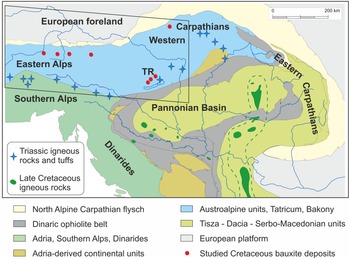
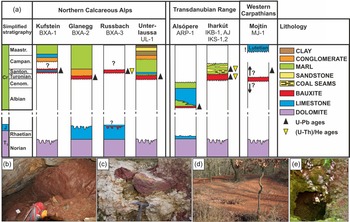


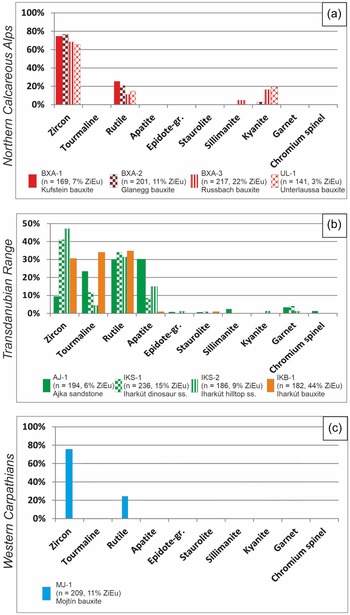


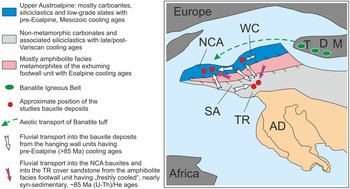


 Open access

