

Recording commingled and fragmentary remains can be a challenging activity, with standardized data collection protocols. Fragmentary remains are more difficult to identify and to contextualize and, when commingled, can limit research questions. Estimating age at death and sex can be difficult to impossible or limited to larger categories such as “adult (18+ years)” or “adolescent+ (12+ years).” Despite the challenges of recording commingled and fragmentary remains, they are found throughout the world and can provide a wealth of data for archaeology and bioarchaeology. Commingled and fragmentary remains have been used to reconstruct mortuary patterns (e.g., Boz and Hager Reference Boz, Hager, Osterholtz, Baustian and Martin2014), notions of group identity (e.g., Osterholtz Reference Osterholtz2015), migration and marriage patterns (e.g., Baustian and Anderson Reference Baustian, Anderson and Osterholtz2016; Gregoricka Reference Gregoricka2013), and so on. Commingled assemblages occur through a number of different mechanisms and are not limited to prehistoric or historic analyses. They may result from museum commingling, natural attritional processes, and intentional commingling as part of the mortuary process, just to name a few different mechanisms (Osterholtz, Baustian, and Martin Reference Osterholtz, Baustian and Martin2014).
The database presented here was developed for the analysis of an assemblage that was ultimately repatriated in accordance with the Native American Graves Protection and Repatriation Act. It is not specific to any one type of commingled assemblage, however, but has been used in the analysis of multiple commingled assemblages from around the world during multiple time periods. When properly analyzed, commingled assemblages can provide a wealth of knowledge and understanding of past mortuary behaviors (see case studies in Osterholtz, Baustian, and Martin, eds. Reference Osterholtz, Baustian, Martin, Osterholtz, Baustian and Martin2014), violence (e.g., Stodder et al. Reference Stodder, Osterholtz, Mowrer, Chuipka, Perry, Stodder and Bollong2010), and marriage/mobility patterns (e.g., Gregoricka Reference Gregoricka2013). If researchers neglect this type of assemblage, they can lose detail and context for archaeological and bioarchaeological interpretation. In keeping with expectations of expedited data collection in accordance with the Native American Graves Protection and Repatriation Act as well as the demands faced by bioarchaeologists around the world, the database detailed here provides a standardized set of observations that can be recorded quickly and consistently.
While both Osteoware (2014) and Standards of Data Collection (Buikstra and Ubelaker Reference Buikstra and Ubelaker1994) present mechanisms for recording commingled and fragmentary remains, neither of these recording systems focuses on the specific issues that commingled remains bring with them. Individual researchers tend to develop their own systems to fit their own analytical needs (e.g., Adams and Konigsberg Reference Adams, Konigsberg, Adams and Byrd2008; Austin Reference Austin2017; Hermann and Devlin Reference Hermann, Devlin, Adams and Byrd2008; Mayus et al. Reference Mayus, Sheridan and Larsen2017; Panakhyo Reference Panakhyo2013; Zejdlik Reference Zejdlik, Osterholtz, Baustian and Martin2014, to name a few). Commingled assemblages can require large-scale, long-term study to fully extract and contextualize meaningful data. Based on the research questions being asked, any number of specializations may be required for their analysis, from taphonomists to trauma specialists, experts in burning, anatomists, and so on. Given the complex nature of such assemblages, it is somewhat understandable that they tend to be relegated to appendices or analyzed with only specific questions in mind. The database presented here attempts to provide a general set of data including fragment identification, age at death and sex estimation, dental observations, trauma recording, and taphonomic observations. The feature-based approach is quick and allows for field lab analysis that can keep pace with excavation. The minimum number of individuals (MNI) and demography of a commingled assemblage can serve as baseline data for subsequent research questions regarding health (e.g., Baustian Reference Baustian2010), violence (e.g., Osterholtz Reference Osterholtz2016), and mortuary processes (e.g., Osterholtz et al. Reference Osterholtz, Lucas, Gonciar and Balos2016), for example. It should be noted, however, that this database can be adapted to investigate research interests not represented by those listed here.
DEVELOPMENT OF THE DATABASE
This database has been developed through analysis of multiple commingled and fragmentary assemblages. The first project in which I was exposed to large numbers of fragmentary human remains was the Animas–La Plata project, a large massacre assemblage dating to around AD 800 in southwestern Colorado. As an excellent example of what has been termed “extreme processing” (Kuckelman et al. Reference Kuckelman, Lightfoot and Martin2000), this assemblage contained approximately 14,000 fragments of human bone that were heavily processed, fragmented, and completely commingled. Long bone shaft fragments were rarely longer than 5 cm in length. The bioarchaeological team conducted the analysis of this assemblage as part of a large-scale cultural resource management project (Osterholtz Reference Osterholtz2013, Reference Osterholtz, Osterholtz, Baustian and Martin2014; Osterholtz and Stodder Reference Osterholtz and Stodder2010; Stodder and Osterholtz Reference Stodder, Osterholtz, Perry, Stodder and Bollong2010; Stodder et al. Reference Stodder, Osterholtz, Mowrer, Chuipka, Perry, Stodder and Bollong2010). A feature-based approach was adapted from the work of Knüsel and Outram (Reference Knüsel and Outram2004; Outram et al. Reference Outram, Knüsel, Knight and Harding2005) to maximize data potential. This feature-based approach, as well as the detailed taphonomic recording, formed the basis for future work with commingled and fragmentary databases. The database used on the Animas–La Plata project was created and maintained by Christina Horton and Trent Reeder (Reeder and Horton Reference Reeder and Horton2007), and its foundational concepts were instrumental in the development of the current database discussed below. The methods used in the Animas–La Plata analysis as well as the interpretation can be found in Stodder and Osterholtz (Reference Stodder, Osterholtz, Perry, Stodder and Bollong2010).
The first assemblage with which the current database was used was the Tell Abraq assemblage. This is a collective funerary assemblage dating to between 2100 and 2000 BC from the United Arab Emirates. The primary research goal was to assess baseline data that would be useful in future research. Previous research had examined the nonadult remains (Baustian Reference Baustian2010) and isolated elements of the adult assemblage (Cope Reference Cope2007; Dutt et al. Reference Dutt, Martin, Prajapati, Keller, Gelovani and Tomlinson2012), but a thorough recording of the entire assemblage had not been conducted. Undergraduate volunteers assisted with the data entry once they had successfully completed a boot camp–style osteology course. This addition of undergraduate research assistants and the large number of bone fragments (more than 26,000) that were to be recorded required the database to be made more user-friendly and allow for relatively quick data collection. Visual recording forms were added, which sped up the overall data entry, cut down on data entry errors, and reduced the need for paper forms, allowing for all elements to be cataloged within a two-year period (Osterholtz, Baustian, Martin, and Potts Reference Osterholtz, Baustian, Martin, Potts, Osterholtz, Baustian and Martin2014; Osterholtz et al. Reference Osterholtz, Baustian and Martin2012). The demographic breakdown and MNI comparisons of crania with postcranial elements were used to examine mortuary processes to argue that male crania are underrepresented in the overall assemblage, which may be indicative of retention of these elements as part of funerary ritual (Osterholtz, Baustian, Martin, and Potts Reference Osterholtz, Baustian, Martin, Potts, Osterholtz, Baustian and Martin2014).
The database was further refined through my dissertation work conducted on the island of Cyprus examining multiple tomb assemblages. These commingled and fragmentary assemblages were analyzed to document the overall number of individuals, their health statuses, demography, and changes in cultural patterns such as subsistence shifts, intensification, and patterns of interpersonal and accidental trauma. Limited access to a large number of curated tomb assemblages meant that data collection needed to be conducted expeditiously. Entheseal data were added to the dataset used for Tell Abraq, as were numerous diagrams depicting zones used in the recording of trauma and pathology (based on the zones used at Sacred Ridge). Over the course of dissertation data collection, I recorded more than 1,000 fragments. These data show a pattern of cultural buffering and adaptation that allowed for health scores to remain good despite archaeological evidence of large-scale cultural shifts and population increases (Osterholtz Reference Osterholtz2015). These results, once contextualized within archaeological frameworks, supported an argument of migration and integration of new populations into existing communities, likely through long-standing trading relationships (Osterholtz Reference Osterholtz2017).
This completed database has since been tested on two large-scale field projects. The first of these was the 2014 season of the Petra Northridge Project, codirected by Megan Perry and S. Tom Parker. Inventory and preliminary analysis of the remains were conducted in Jordan, and a preliminary report was prepared prior to leaving the country. Over the course of the five-week field season, more than 2,000 fragments were analyzed, and the preliminary demography of the tombs was recorded. Sussman and Perry (Reference Sussman and Perry2015) then used the database to analyze remains from the 2012 season as well.
The second project to use the database involved the Iron Age excavations I directed at Măgura Uroiului, in Rapolt, Romania, during the summer of 2015. Seven student volunteers assisted in the recording of both human and faunal remains using the database. The faunal database was adapted from the human version by project zooarchaeologist Virginia Lucas. Again, the focus of this project was to provide baseline data, such as age at death, sex distributions, health status, trauma, and taphonomy. Given a very complex assemblage that included both whole and partial human individuals and whole and partial animals (including the remains of feasting), consistently recording human and animal remains using a single recording methodology allowed us to compare body processing across species. The demographic conclusions were the most striking here: initial results indicated that only adult females and children between 6 and 10 years of age at death were included in the funerary monument, a pattern that would have been lost without careful recording (Osterholtz et al. Reference Osterholtz, Lucas, Gonciar and Balos2016). The discovery of a single adult male cranium during final data collection during the summer of 2016 indicates a complex mortuary assemblage that needs to be better contextualized and compared with additional Iron Age assemblages before an understanding of mortuary processes can be reached for the region.
Most recently, the database has been used to analyze Bronze Age tombs from Croatia associated with the Cetina Valley Survey project site Gusića Gomila II to record baseline demographic and paleopathological data (Lopez et al. Reference Lopez, Paige, Osterholtz and Tomas2018). I have also used this database to record whole burials (Osterholtz Reference Osterholtz2018). This was easily accomplished through the addition of a summary form that allows for the accumulation of notes from the individual element forms.
Use of the database for different assemblages from distinct time periods and geographic locations was intentional, in an effort to maximize efficiency and to expose any flaws in the data recording procedures. Here, I present the database, beginning with its structure and guidelines for recording specific observations useful in the reconstruction of demography, taphonomy, pathological changes, and trauma to different parts of the body.
STRUCTURE OF THE DATABASE
The current iteration of the database is as a FileMaker Pro 15 database. The use of FileMaker allows for the inclusion of a larger number of variables per data sheet than can be recorded in Access. Access databases can only contain a maximum of 250 variables, while in FileMaker this number is unlimited. FileMaker Pro also has the benefit of being cross-platform, allowing both Mac and PC users to contribute data. It is understood that some researchers prefer non-Mac and non-PC operating systems. Ultimately, this is the best direction for research. This FileMaker database represents one method of recording remains in a commercially available format. For researchers lacking significant coding skills (such as me), a commercially available program is a must at this point and a good starting point. The next step in this process would be to engage with those users using non-Mac/non-PC platforms to develop an open-access format not bound by computer operating system. What is presented here is a first step along this road. It is understandably limited to commercially available software that is user-friendly and can be easily adapted to meet the research needs of multiple projects. FileMaker also has the added deficit of being proprietary software. It was chosen for use due to its ability to switch between PC and Mac platforms and its ability to handle large amounts of variables, but the proprietary nature of the program is a limiting factor to its implementation on a large scale.
As presented here, the database also does not link between the various data sheets (as represented by forms). This is to allow individual researchers to link different fields as appropriate to their research questions. Presented here are the bare-bones, adaptable data sheets that can be made to fit the needs of changing research projects. I do not assume a standard set of research questions but present a logical and straightforward way to record a minimal set of data and facilitate the determination of MNI.
RECORDING USING THE DATABASE
Header Data
The header to each form contains information in the figures identified as “grave number,” “fine location,” “recorder,” and “date.” These can be adapted depending on the level of commingling found or if the database is being used to record whole burials. If whole burials are being recorded, the grave number should be the same on all forms, thus linking the forms together with a single identifier. If a heavily commingled and fragmentary assemblage is being analyzed, the “grave number” field can be changed to a unique identifier field, where each individual fragment has a unique number assigned to it. This approach indicates that individuals cannot be identified, and the assemblage will be analyzed on an element-by-element basis. The “fine location” field is designed to allow for excavation notes. The recorder in this instance should reflect the individual doing the data entry/analysis, and the date should reflect the date on which the analysis/data entry was conducted.
Demography
Determining the minimum number of individuals and the demographic breakdown of the individuals in any commingled assemblage provides baseline data for all future analyses. The database is structured to be element-specific. Opening the form for the specific element allows for the recording of all observations related to that element. To the left of the form, diagrams depict the element in question so that the features for the MNI calculations can be scored. Researchers check the box present for the individual feature of the bone. This feature-based approach allows for a very finely recorded assemblage, particularly important in cases of heavy fragmentation, such as that at Sacred Ridge (discussed above).
Recording commingled and fragmentary remains requires simultaneous specificity and flexibility. We need to be careful and specific with terminology but flexible in how we define categories. For example, in assemblages exhibiting high amounts of fragmentation, it may only be possible to estimate an individual's age at death as less than 12 years of age, based on the overall morphology or cortical thickness of the fragments present. This database and its accompanying data dictionary give definitions for age categories. One key to recording commingled and fragmentary remains is to remain consistent in how terminology is used, and researchers are encouraged to keep the data dictionary close at hand during data collection.
Taphonomy
Observations are present for each element, including cut marks, scrape marks, animal processing, pathology, and trauma. These are all recorded by zone, and a diagram is provided for the identification of the zones for each element. A full description of each zone is given in the supplementary materials, as are working definitions of cut marks and scrape marks.
The importance of identifying and locating marks of processing cannot be understated. Both the presence of tool marks and their location are important for their interpretation. Tool marks that occur at muscle insertions may indicate dismemberment, while the same tool marks along the midshaft of a bone might suggest defleshing.
Animal processing is identified as gnawing, chewing, furrows, or punctures, and all are indicative of predation or scavenging of the remains. Burning is scored as present/absent/not scorable (NS). The location of all burning and animal predation is recorded along the same lines as that for tool marks.
Trauma
The identification of ante-, peri-, and postmortem fractures is necessary to understand the fragmentation and commingling of the individuals within the assemblage. The system was used for the identification and recording of antemortem trauma at Tell Abraq (Harrod et al. Reference Harrod, Osterholtz and Martin2013), in the Mississippi State Asylum assemblage (Banks and Osterholtz Reference Banks and Osterholtz2018), and in Bronze Age Cyprus (Osterholtz Reference Osterholtz2015).
Cranial and Dental Recording
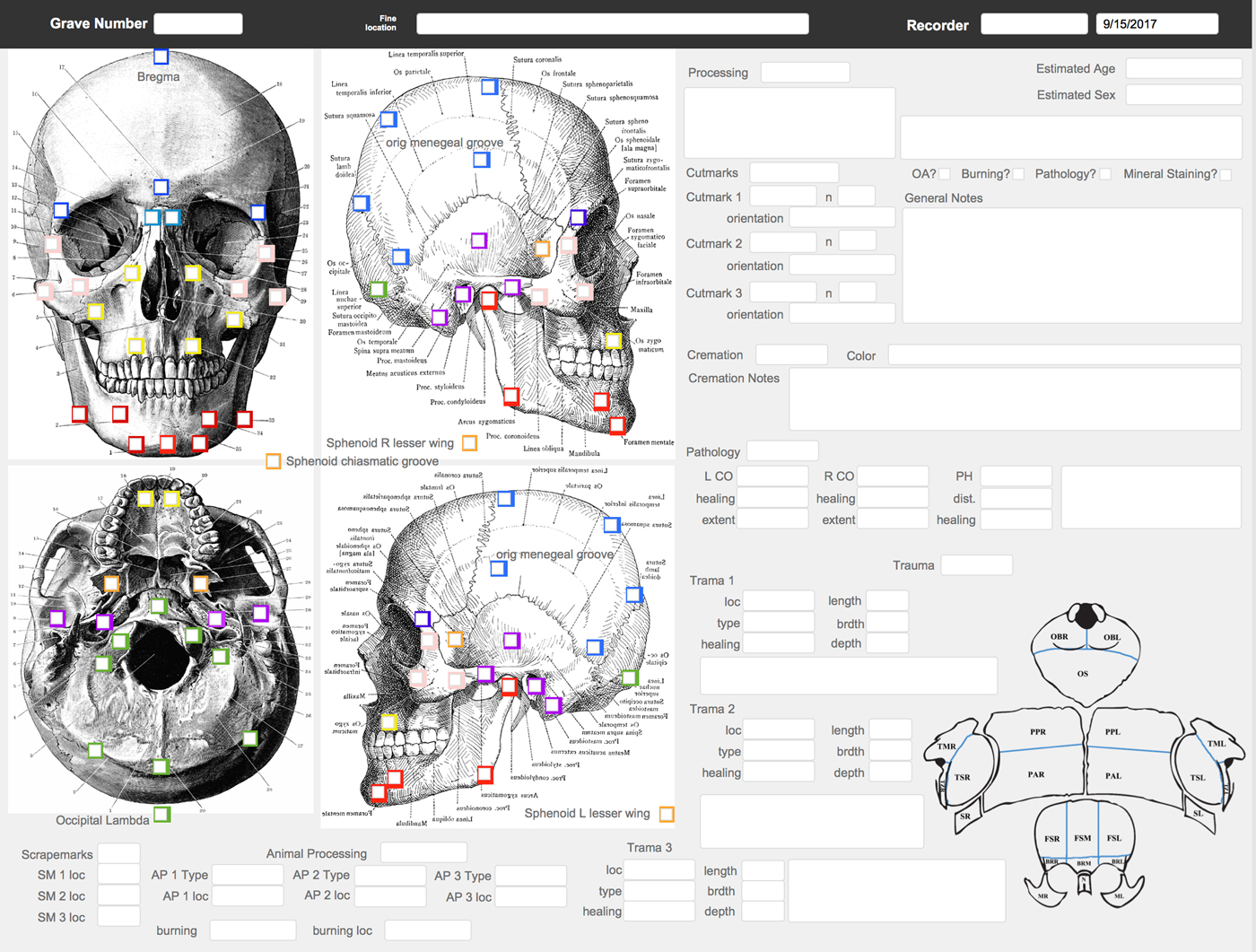
All cranial observations except for dental observations are recorded on a single form (Figure 1). Discussed below are observations specific to the cranial form.
Blank database form for cranial recording.

Processing
Evidence of intentional processing and/or defleshing can be indicative of activities related to death or secondary processing of the remains. Processing is identified in the form of cut marks and signs of burning. Cut marks can be difficult to count accurately, especially if the marks overlap with each other or cross fracture edges. In order to decrease interobserver error, cut marks are recorded according to zone and counted in groups (1, 2–5, 6–10, and 10+ cut marks). The location of cut marks, their number, and their relative depth may be important in distinguishing between postmortem processing and perimortem trauma (Pérez Reference Pérez2002).
Pathological Recording
One of the primary goals of this database is to provide a minimum set of data that can be compared across multiple sites and geographic locations. For the cranium, specifically, the nondental pathology is limited to cribra orbitalia and porotic hyperostosis. As with all other observations, cribra orbitalia and porotic hyperostosis are first recorded as present, absent, or not scored. For cribra orbitalia, each orbital surface is recorded separately. Due to the nature of commingled and fragmentary assemblages (i.e., fragments are incomplete, tend to be poorly preserved, and may be taphonomically compromised), it is important to record whether something was not scorable as opposed to absent. This allows for the creation of frequency data based on presence/absence while removing the individuals scored as “NS.” “NS” is used when the bony surface either is absent on the fragment or is too damaged due to either taphonomic processes or intentional destruction.
Trauma Recording
The majority of cranial traumas are classed as cranial depression fractures; these are classed as penetrating or nonpenetrating. The locations of lesions are recorded using a zonal approach, using the same zones as used for burning, animal predation, and tool marks. The type of fracture is also recorded using a combination of clinical fracture types and types specific to elements, such as LeFort fractures and mandibular fractures. The state of healing is also recorded. Together these attributes help with interpretations of interpersonal violence versus accidental trauma, fracture timing, and the motion/amount of force needed to create the fracture pattern. The maximum length, breadth, and depth of the lesion are also recorded and can be used to classify fractures by size later in analysis.
Dental Recording
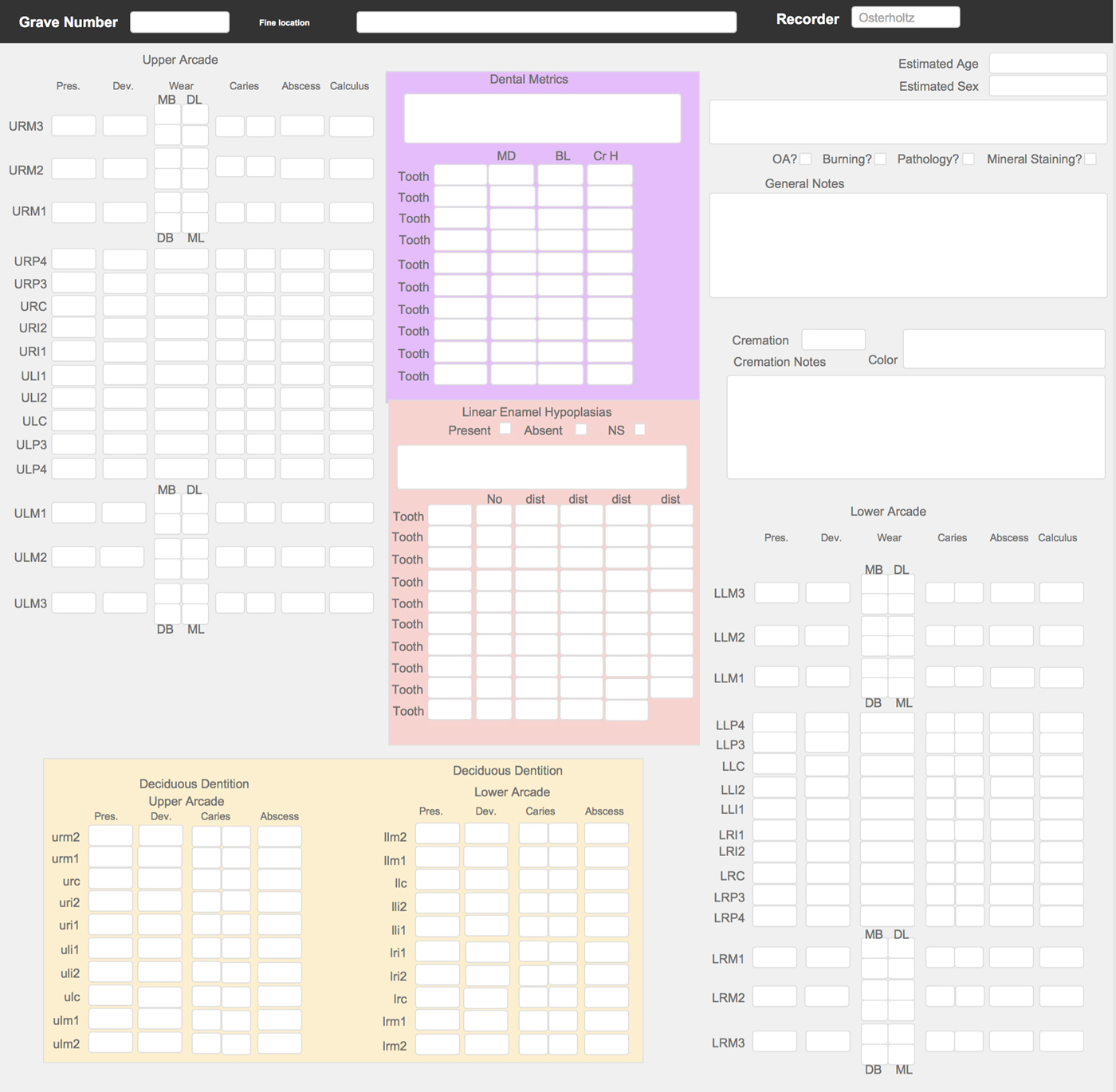
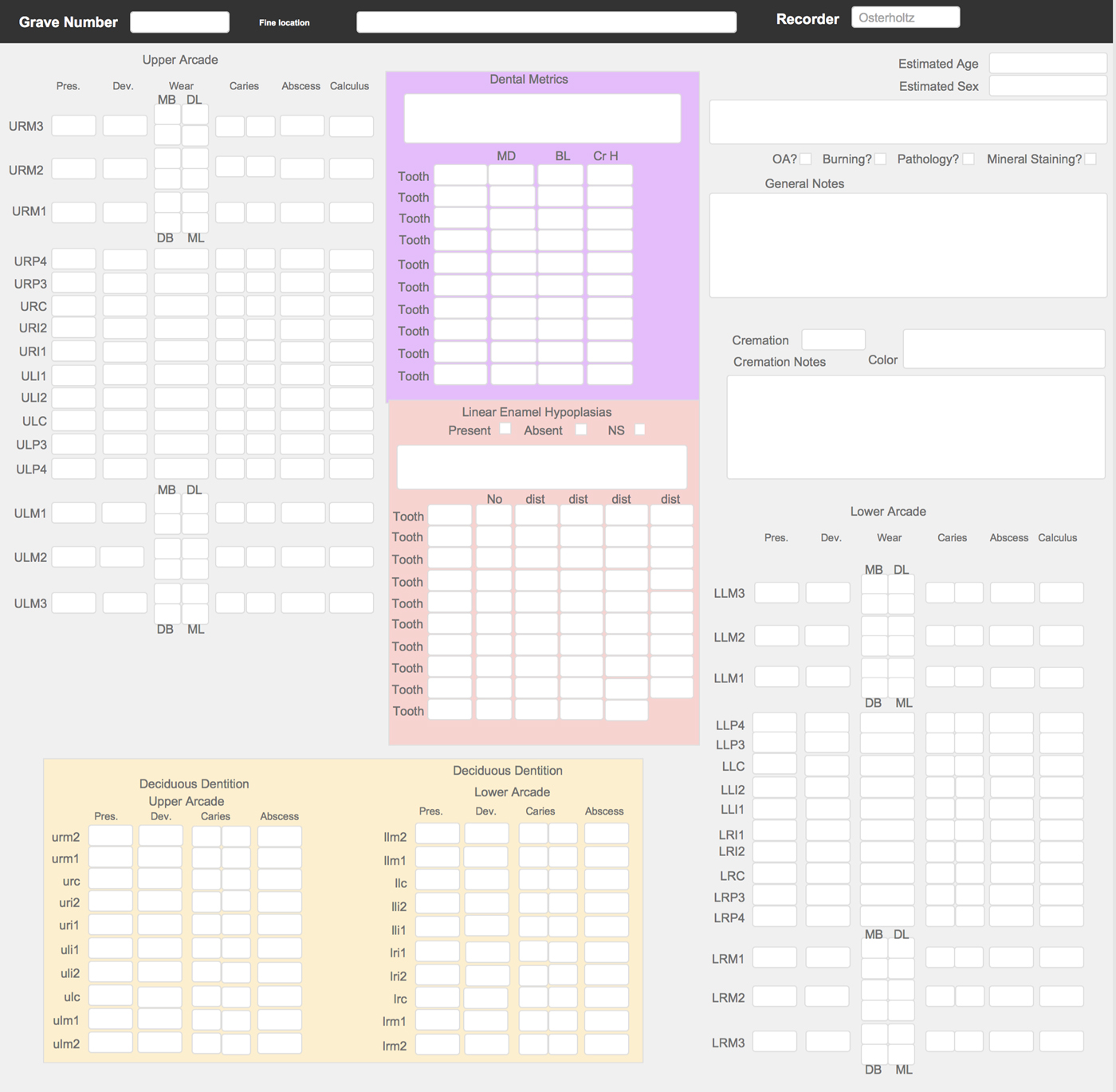
Dental traits are recorded in a fashion very similar to that recommended by Buikstra and Ubelaker (Reference Buikstra and Ubelaker1994), especially observations of presence, development, wear, abscess presence and location, and calculus development. Dental metrics and linear enamel hypoplasias are recorded on the same form in order to keep all pertinent data in a single location (Figure 2).
Blank database form for recording dental traits, developmental defects, pathologies, and metrics.
Postcranial Recording: Long Bones
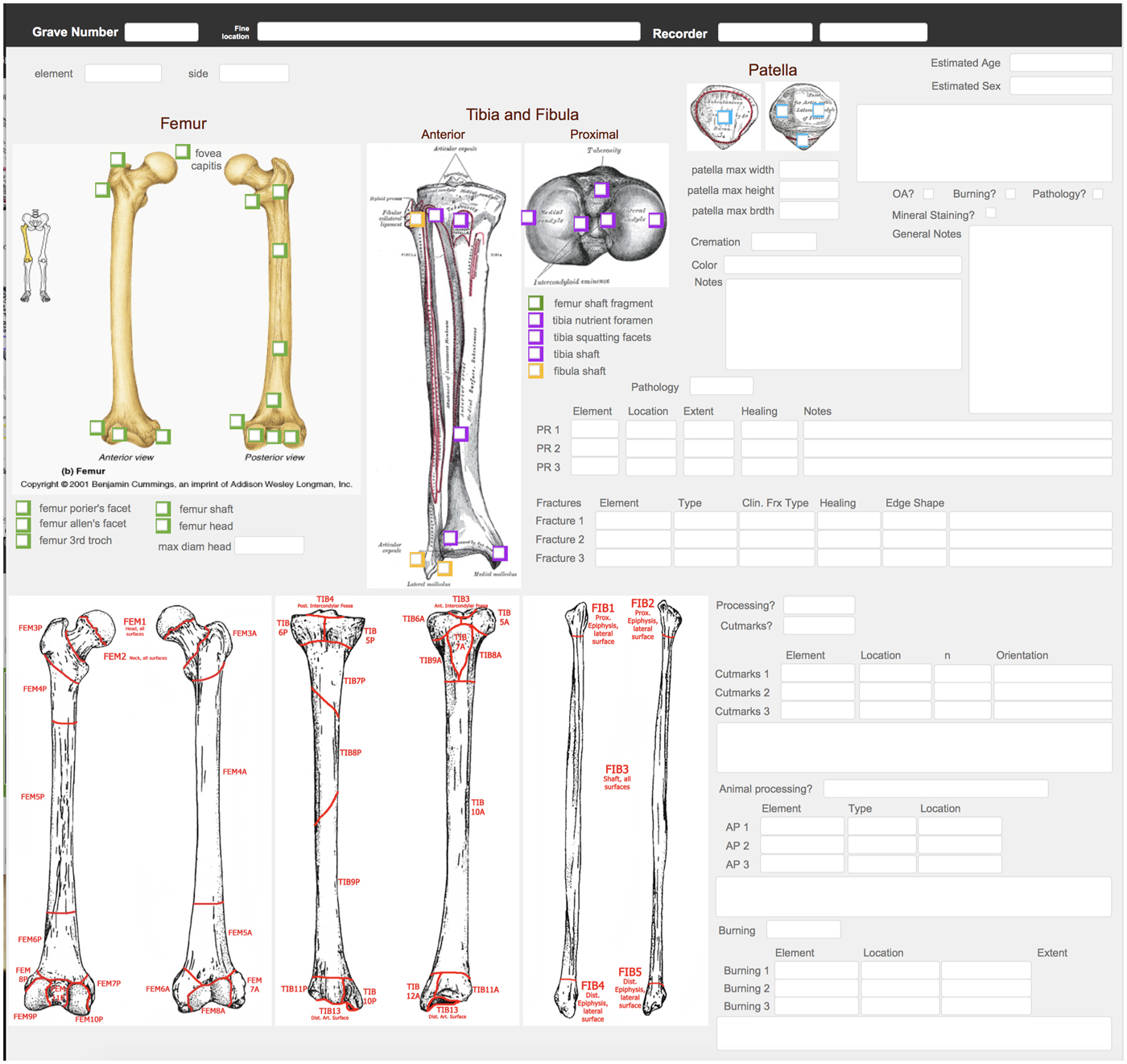
Postcranial elements are recorded by limb, with all the elements from, for example, the arm on a single form feeding into a single spreadsheet. A lower limb will provide the example for this article (Figure 3), but the same observations are recorded for the other limbs.
Blank database form for recording the leg.

Pathological Recording
Pathological observations are also made for postcranial elements. Periosteal reactions are recorded for zones (accompanied by diagrams depicting the specialized zones for each element), extent of reaction, and stage of healing. Each of these observations is accompanied by a memo field for detailed observations of each pathological occurrence. While this is by no means a complete recording of pathological conditions that can affect the skeleton, it is a minimal dataset that can be used no matter how fragmentary the assemblage is. It gives an understanding of the general presence and distribution of pathological changes and, when combined with demographic data relating to age, can provide a general idea of different exposure to infectious agents in nonadults versus adults.
Fracture Recording
Fractures are recorded for the long bones by type, clinical fracture type (where this can be recorded), and edge shape (important for understanding peri- versus postmortem fractures when clinical fracture type cannot be identified). The use of clinical fracture types dates to the Sacred Ridge project, where the goal was to describe the level of force needed to inflict the damage as well as the direction of force. We were also interested in the identification of defensive wounds. For postcranial remains, there is a general distinction made between postmortem fractures in the identification of edge shape and type as well as the identification of clinical fracture types that may help to distinguish between accidental and intentional fractures as well as defensive fracture types. As with all observations, each of these is accompanied by a large memo field for detailed observations.
Taphonomic Recording
Taphonomic changes are recorded in the form of cut marks, animal processing, and burning. Cut marks are recorded along the same lines as those on cranial remains. Zones for the long bones are defined based on muscle markers, roughly following the system put forward by Knüsel and Outram (Reference Knüsel and Outram2004) and Outram and colleagues (Reference Outram, Knüsel, Knight and Harding2005). Using a zonal system allows for the identification of which muscles were intentionally severed, something that may become important in the interpretation of the assemblage.
Postcranial Recording: Os Coxa
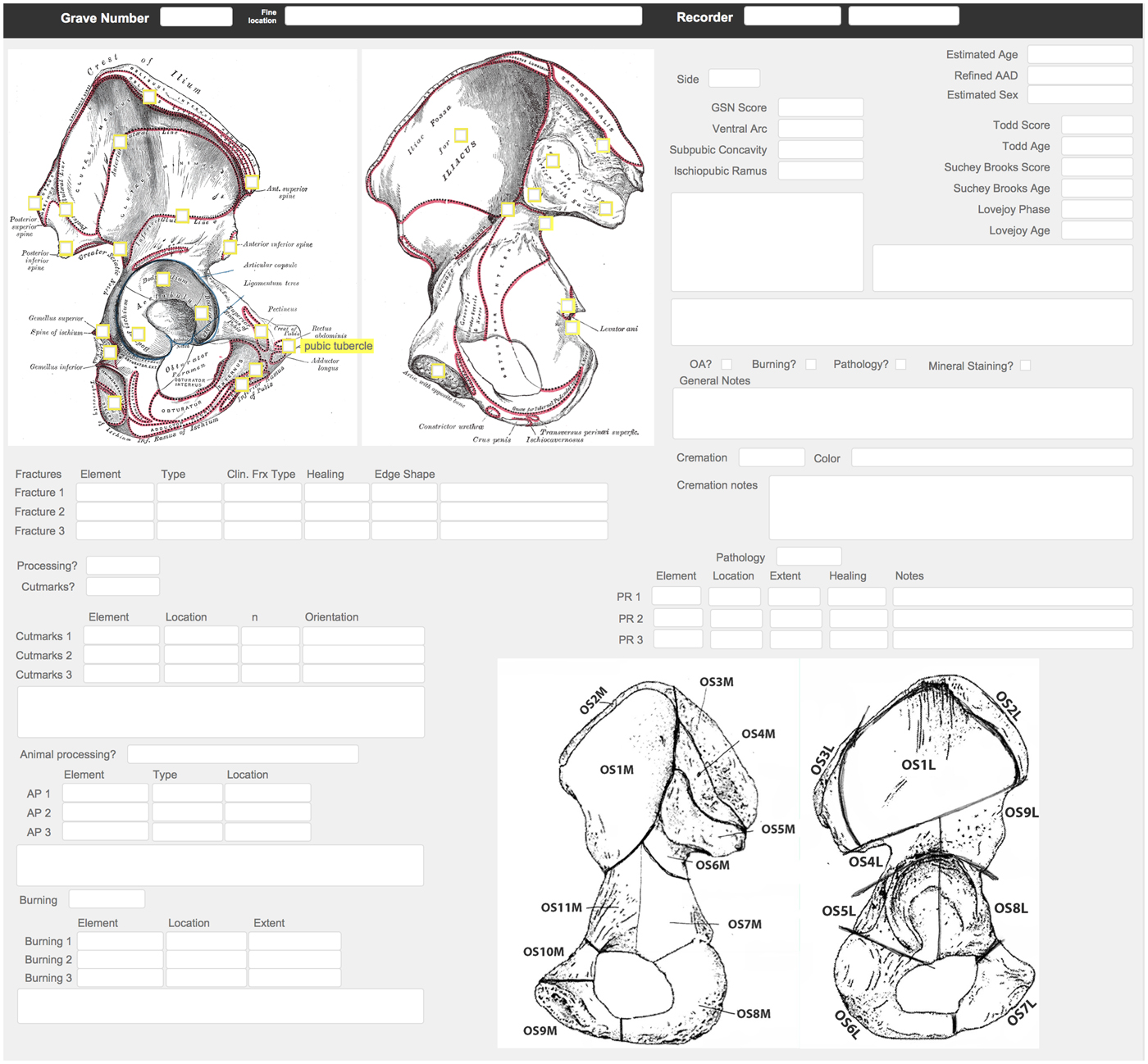
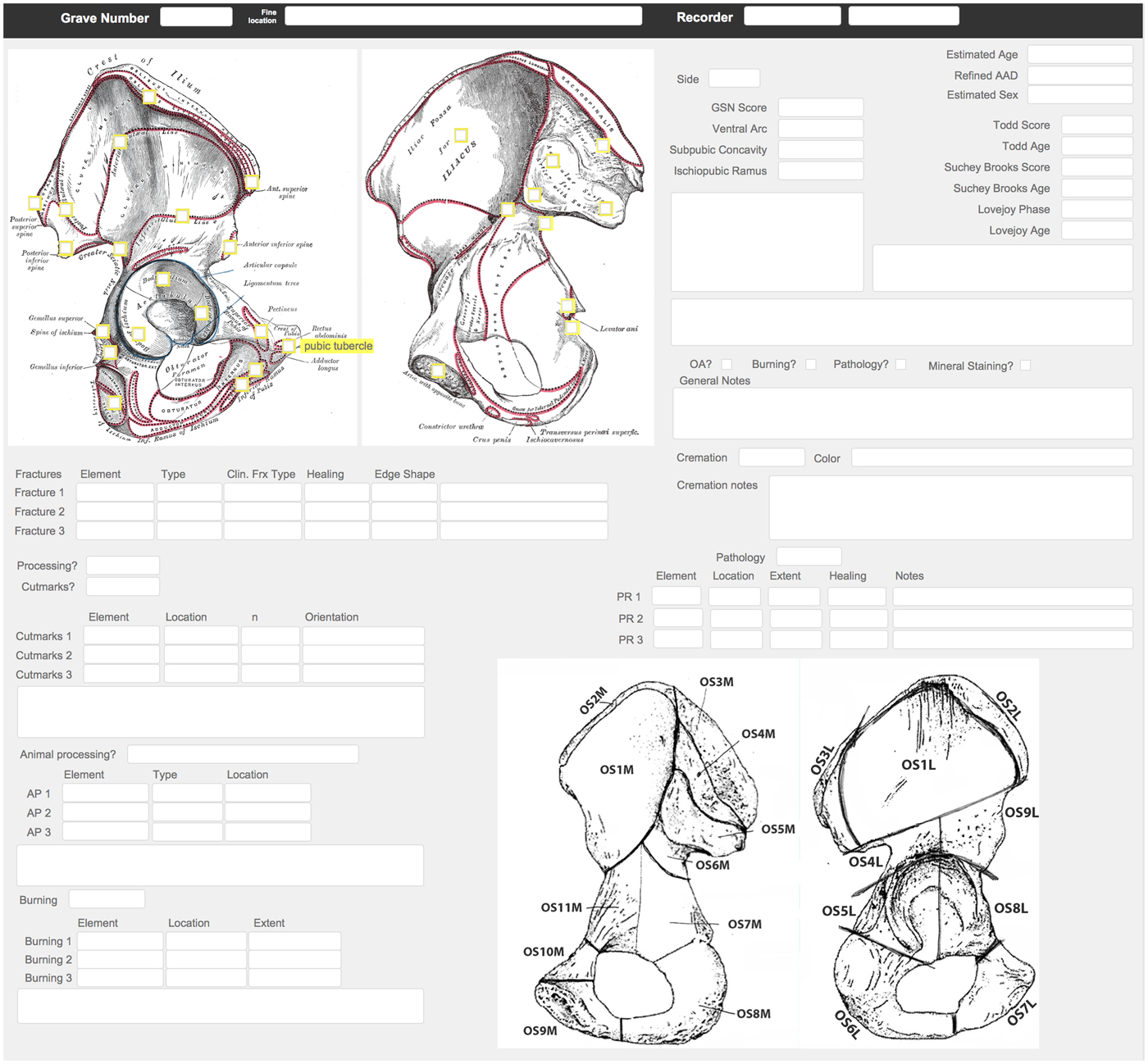
The os coxa is a very complex bone that is incredibly data-rich. In addition to the recording of pathological changes by general area (see the supplementary materials for definitions of each region), extent and healing are recorded for pathological changes to the bony surface. Detailed recording of age at death can be provided, with spaces for the scoring of the pubic symphysis along the lines of Todd (Reference Todd1921) and the Suchey-Brooks method (Brooks and Suchey Reference Brooks and Suchey1990) and using the Lovejoy (Lovejoy et al. Reference Lovejoy, Meindl, Pryzbeck and Mensforth1985) methodology for estimating age at death using the auricular surface. Sex estimation is also separated by methodology, with the Phenice (Reference Phenice1969) traits recorded and scoring of the greater sciatic notch along the lines recommended by Buikstra and Ubelaker (Reference Buikstra and Ubelaker1994; Figure 4).
Blank database form for recording the os coxa.
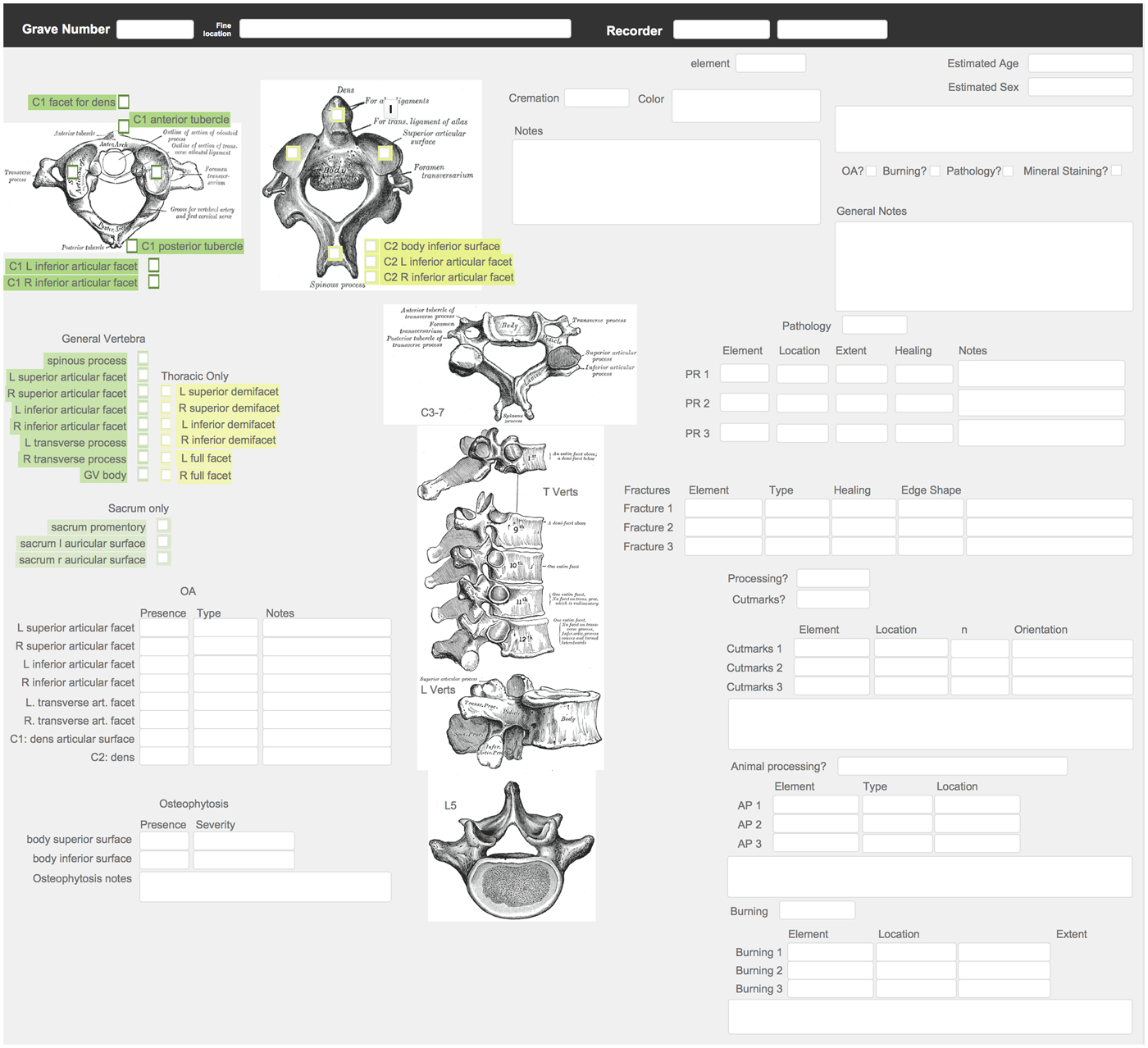
Postcranial Recording: Vertebrae
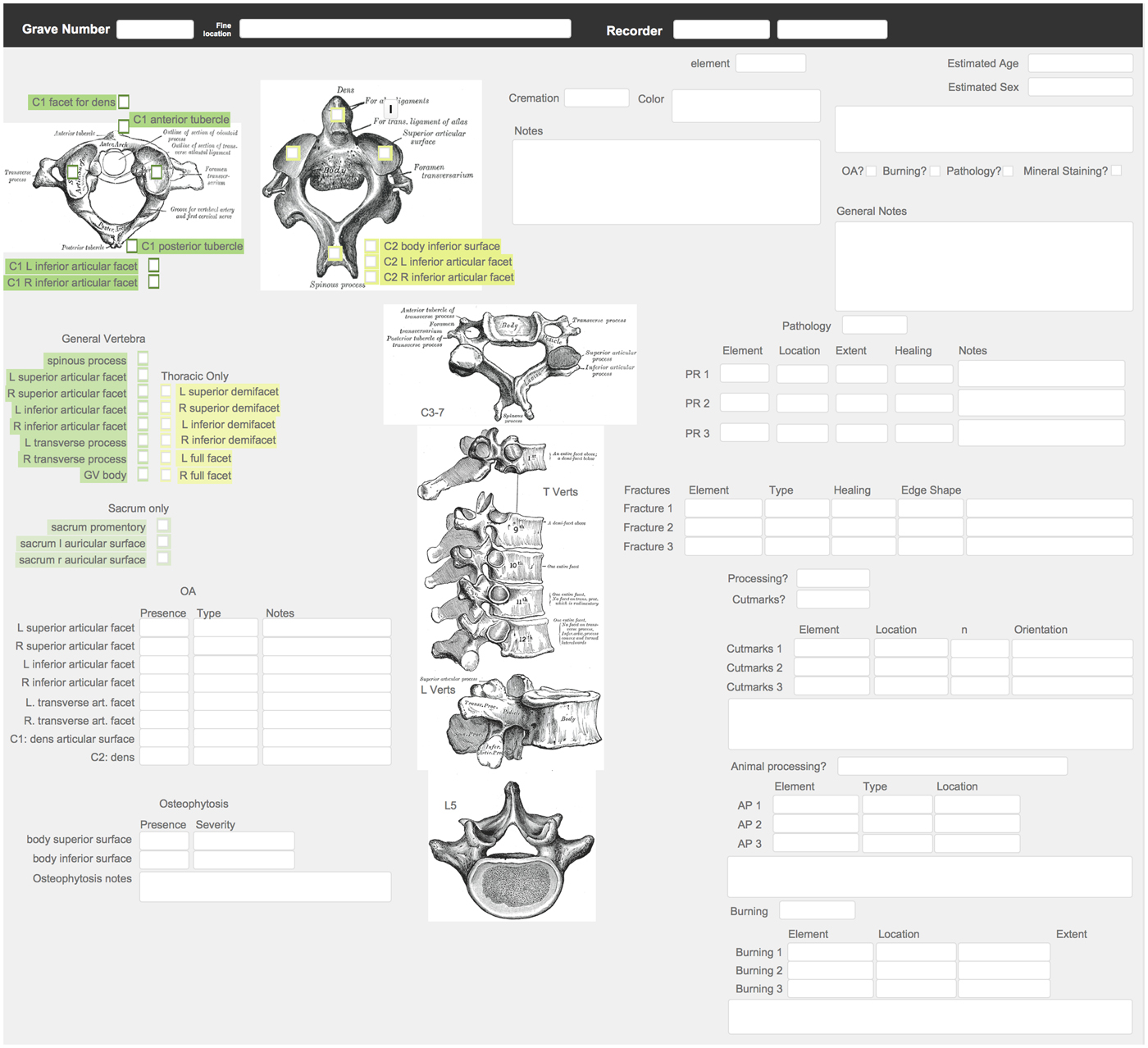
Vertebrae are difficult to record in commingled and fragmented assemblages. In some populations, vertebral shifts and human variation may lead to caudal and/or cranial shifting (e.g., the presence of an L6 or T13 vertebra) and the overrepresentation of anomalies. Tell Abraq, for instance, has higher-than-expected rates of agenesis of the dens, which has been interpreted as indicative of endogamous marriage patterns (Baustian and Anderson Reference Baustian, Anderson and Osterholtz2016).
Cranial and/or caudal shifting may make the identification of specific vertebrae difficult, but even distinguishing between lumbar and thoracic vertebrae may have interpretive power in looking at osteoarthritis patterns in adults (since age at death can only be identified as adult for vertebrae). The recording system uses a sliding scale of identification for vertebrae, with possible identification of specific vertebrae but also allowing for the identification of general vertebrae (Figure 5).
Blank database form for recording the vertebrae.
CONCLUSION
What is presented here is a generalized database designed to capture baseline data on large collections of commingled and fragmentary remains. It represents a minimum of data that should be gathered for each fragment and is customizable to meet the needs of the researcher who chooses to examine this type of assemblage. The benefits of employing this database include that (1) it does not employ paper forms—saving time, money, and resources—while cutting down on data entry errors that tend to occur when paper forms are entered into databases later; (2) it presents a set of data that should be gathered for each and every fragment to ensure a minimum standard that will make certain that baseline data for an assemblage can be analyzed; and (3) it is cross-platform and can be used on both Macs and PCs. As a template it is also available to be adapted to open-source platforms. A preliminary copy of the database can be downloaded from the Mississippi State University Institutional Repository at http://ir.library.msstate.edu//handle/11668/14276. This represents the most recent iteration of the database, but as this database is designed to be flexible enough to accommodate changing research needs, the version available for download should not be seen as the final version.
Acknowledgments
The initial development of the feature-based approach for recording the minimum number of individuals and the identification of zones was developed while I was employed by SWCA Environmental Consultants. Both Elizabeth Perry and Ann Lucy Stodder provided support for this work. Development of the visual forms occurred while I was a graduate student at the University of Nevada, Las Vegas. Debra Martin encouraged me to apply this feature-based approach to the analysis of the Tell Abraq assemblage, which ultimately led to the database presented here. I am very grateful for her support. I would also like to thank the organizers of this special issue for their invitation to submit, as well as the anonymous reviewers whose feedback has made this a far stronger article.
Data Availability Statement
The database, screenshots, and data dictionary are available for download from the Mississippi State University Institutional Repository at http://ir.library.msstate.edu//handle/11668/14276.
Supplemental Materials
For supplemental material accompanying this article, visit https://doi.org/10.1017/aap.2018.35.
Supplemental materials include instructions for use of the database, a data dictionary, and value lists.