

1. Introduction
In recent decades, the academic debate on how to effectively implement the pillars of activation policy has grown. Since the early years of activation and workfare in the 1990s, conditionality and benefit sanctions have been proposed as potential solutions to increase the efficacy of activation policy by reinforcing economic incentives, thereby reducing its unintended and distortive consequences.
In this study, we focus on potential sanctions to social assistance benefits, as a consequence of violations in activation requirements. Although several studies (see Pattaro et al., Reference Pattaro, Bailey, Williams, Gibson, Wells, Tranmer and Dibben2022 for a scoping review on the impacts of benefit sanctions) have tried to disentangle the effects of activation on direct outcomes (recipiency, both in terms of amount and duration) and more indirect variables (job quality and educational attainment), micro-level empirical evidence remains scant on several aspects. Black et al. (Reference Black, Smith, Berger and Noel2003) show that the threat of activation can have a significant effect on recipients of unemployment benefits. Hernæs et al. (Reference Hernæs, Markussen and Røed2017) find that stricter conditionality decreases welfare claims in Norway, which aligns with evidence from similar reforms in other countries (Cammeraat et al., Reference Cammeraat, Jongen and Koning2022). We build on these studies to investigate the use of benefit sanctions. To the best of our knowledge, there is still limited evidence in the literature on whether there is a sanctioning regime in place (Hagelund et al., Reference Hagelund, Øverbye, Hatland and Terum2016). If there is, then it should manifest itself in visible, systematic differences in benefit levels between activated and non-activated recipients of social assistance. If a threat is expected to be real, then there should also be actual sanctions present. We would also argue that for sanctions to play a significant threat, the actual benefit cut needs to be noticeable. The research question we intend to pursue in this article can be formulated as follows: to what extent are sanctions truly being practiced for young social assistance recipients in Norway? Footnote 1
The primary motivation is a concern related to how benefit sanctions are practiced for the allocation of social assistance in Norway. There is no register practice for the use of compulsory activation and sanctions in the Norwegian welfare state (Dahl and Lima, Reference Dahl and Lima2017). This implies that we cannot straightforwardly verify the application of sanctions. Previous research has found indications that sanctions on recipients are arbitrarily enforced (Schram et al., Reference Schram, Soss, Fording and Houser2009), and this is true specifically in the Norwegian case (Vilhena, Reference Vilhena2021; Torsvik et al., Reference Torsvik, Molander and Terum2021). One example is whether noncompliance is perceived as lack of will or lack of ability. “When caseworkers perceive that a lack of capability causes non-compliance, they are more inclined to re-evaluate and adjust activity requirements than to impose sanctions” (Torsvik et al., Reference Torsvik, Molander and Terum2021, p. 83). Beyond this, our study can also shed light on how sanctioning within minimum income schemes can become practically possible. Social assistance is initially intended to provide for necessities (Hagelund et al., Reference Hagelund, Øverbye, Hatland and Terum2016, p. 33). Caseworkers need to find leverage to reduce the assistance without violating the purpose of social assistance, which is to “contribute to social and economic safety and give the individual the opportunity to live independently” (Social Services act, 2009, § 1). Information about practices in local welfare administrations is therefore essential to capture relevant variation in the use of compulsory activation in Norway.
In the literature, it has been stated that the threat of activation works as effectively as the threat of benefit termination (Røed, Reference Røed2013, p. 2). The measurement of this threat has mostly been studied with quasi-experimental designs (Black et al., Reference Black, Smith, Berger and Noel2003). In most of the micro-level evidence with observational data, activation through benefit sanctions is not necessarily a feature that unambiguously emerges from the data, except for when sanctions indeed take place and benefits are reduced. In other words, one can only directly observe benefit cuts for individuals who have been subject to sanctions, without knowing whether the threat of sanctions has indeed exerted its effect on a broader range of welfare recipients who have instead found jobs.
To overcome this limitation, we introduce a novel methodological approach to identify individual-level effects of activation on young welfare recipients by exploiting municipal variation on the introduction of compulsory activation. More precisely, we study whether individuals who are residents in municipalities that have introduced compulsory activation display a stronger relationship between their labor market status and their benefit size. This is done to proxy the effect of sanctions, as there is no register-practice/routine for activation/sanctions. We formulate a working hypothesis to be answered by the model; for individuals living in municipalities where activation has become compulsory (our treatment), the relationship between whether they are active in the labor market and the amount of social assistance received has become stronger through the implementation of benefit sanctions, while the opposite (a weaker relationship) holds true for individuals residing in the municipalities chosen as a control group.
Our results show that there is no different relationship between social assistance benefits and passive labor market status for individuals living in municipalities that practice activation versus those residing in municipalities in which activation is not mandatory. In other words, there is no visible effect of (the threat of) sanctions in place for passive recipients. We discuss the implications of this result in a dedicated discussion section at the end of the paper.
1.1. On Welfare Conditionality, Activation, and Benefit Sanctions
Activation can be understood as the set of welfare policies aimed at reducing long-term unemployment by enhancing the employability of inactive individuals. It separates from social (economic) assistance, which is usually described as “passive” labor market policy. Within the European welfare state context, it is possible to classify activation programs into several categories, such as training, services, and sanctions (for a more detailed description of categories, see Chapter 2 in Kluve et al., Reference Kluve, Card, Fertig and Gora2007). From a theoretical point of view, activation is mainly intended to improve human capital or send positive signaling to potential employers. Activation is also expected to increase the efficiency of labor markets, such as by providing job search assistance, which may increase search intensity (Kluve et al., Reference Kluve, Card, Fertig and Gora2007).
Social assistance is the last-resort minimum income scheme in Norway and is intended to be a short-term solution. Recipients are mainly individuals with weaker labor market attachment who have either exhausted their rights to claim regular unemployment benefits or need supplementary economic assistance due to low income (Hansen Reference Hansen2009). Since the 1990s, welfare administrations in Norwegian municipalities have had the option to demand activation for young recipients of social assistance (age 18 to 29). In other words, municipalities were free to make activation compulsory because the law allowed them to do so. We exploit this information on which municipalities have previously introduced compulsory activation and which municipalities have not (Dahl and Lima, Reference Dahl and Lima2017; Dahl and Hernæs, Reference Dahl and Hernæs2023).
In later years, activation became compulsory at the national level by a political reform in 2017 that demanded that all Norwegian municipalities introduce sanctions on non-active young recipients of social assistance. By this time, many municipalities had already unilaterally adopted such a policy (Hernæs, Reference Hernæs2021). Placing these reforms in a broader context, the gradual introduction of compulsory activation in Norway is in line with policy trends toward more activation documented in several other welfare states (Taylor-Gooby et al., Reference Taylor-Gooby, Gumy and Otto2015). Compulsory activation has received relatively wide support in the Norwegian population, although individuals with weak labor market attachment, who are typically those impacted by activation policy polices, are generally not as supportive (Bugge, Reference Bugge2021). Van Oorschot and Roosma (Reference Van Oorschot and Roosma2017) argue that the social legitimacy of targeted welfare and activation derives from a discussion of obligations of the unemployed and a reflection of “who should get what, and why?”.
Benefit reductions or sanctions are also part of the workfare approach. Bonoli (Reference Bonoli2010) argues that there have been two main approaches to workfare, which are incentive- and investment-based. Previously, the Nordic model was typically characterized by strong investment in human capital through emphasis on training (Bonoli, Reference Bonoli2010, p. 439). The Nordic welfare states have traditionally been characterized by high spending on active labor market policies (Taylor-Gooby et al., Reference Taylor-Gooby, Gumy and Otto2015). The recent policy change in Norway focused on implementing conditionality and sanctions on the workfare system. Thus, there is no longer a clear distinction between investment- and incentive-based approaches in Norway. This would suggest that Norway, following other Nordic neighbors such as Sweden, is moving towards a mixed approach, as seen in other continental welfare states (Bonoli, Reference Bonoli2010, p. 449).
Both compulsory activation and benefit sanctions have received increasing attention from scholars in recent decades (Pattaro et al., Reference Pattaro, Bailey, Williams, Gibson, Wells, Tranmer and Dibben2022; Raffass, Reference Raffass2017; Vooren et al., Reference Vooren, Haelermans, Groot and Maassen van den Brink2019). King and Rueda (Reference King and Rueda2008) argue that highly regulated labor markets, such as the Norwegian one, would promote non-standard employment as cheap labor, and that workfare policies play an important role in this regard. Further, Rueda (Reference Rueda2015) argues that activation policies have become especially common in generous welfare states. Activation policies are formulated as a conditional system but imposed as punitive measures to restrict access to benefits and push recipients into a source of potential “cheap labor” (Rueda, Reference Rueda2015, p. 296). Empirical evidence by Arni et al. (Reference Arni, Lalive and Van Ours2012) finds that benefit sanctions reduce the quality of post-unemployment jobs both in terms of job duration and earnings. In Norway, evaluations of recent activation reform find zero effects on outcomes such as benefit receipt, work, and education (Dahl and Hernæs, Reference Dahl and Hernæs2023). Nelson (Reference Nelson2013) showed that the income adequacy of social assistance in European welfare states, including the Nordic welfare states, decreased steadily from 1990 to 2008. He finds that this was related to an increase in the spending on active labor market policies. He encourages further exploration of the link between passive and active policies (p. 397).
From a social investment perspective, individuals are responsible for their welfare. Policies are therefore shaped to enhance responsibility, mainly through measures of ‘carrots’ and ‘sticks’, where benefit sanctions are an example of the latter. Cantillon and Van Lancker (Reference Cantillon and Van Lancker2013) state that “the line between effort, for which people are held responsible, and circumstances, for which they are not held responsible, is very thin” (Cantillon and Van Lancker, Reference Cantillon and Van Lancker2013, p. 557). This is similar to what Torsvik et al. (Reference Torsvik, Molander and Terum2021) and Vilhena (Reference Vilhena2021) also find to be the reality for the caseworkers who are responsible for applying these policies. Gjersøe et al. (Reference Gjersøe, Leseth and Vilhena2019) find, at the case-worker level, that mandatory activation is implemented by paternalistic decision making, emphasizing interpersonal relations. Normatively, this thin line will increase the risk of arbitrary and unfair practices, which may exacerbate inequalities between recipients. Although politicians have their own interpretation of deservingness, as reflected by the recent law change, other relevant groups, such as administrators and lower-level bureaucrats, also have views on social benefits, which may affect policy implementation (van Oorschot and Roosma, Reference Van Oorschot and Roosma2017, p. 5). These aspects imply that the policy changes do not necessarily take form in the way they were designed by policy makers. This is exemplified by the empirical literature, suggesting that, although the policy is formulated so that sanctions rules are implemented, they are not necessarily imposed as intended.
2. Data Description and Institutional Setting
The data employed in this article were retrieved from different Norwegian administrative registers and made available by Statistics Norway through the interface MicrodataFootnote 2 . This gives us a wide range of variables on individual characteristics, with detailed information on labor market participation, and services received by the welfare administration. The unit of analysis is the individual (rather than households). To start with, we select a subset of the whole population, consisting of all individuals between 18-29, regardless of other characteristics, as this is the part of the population affected by compulsory activation and potential benefit sanctions. The selection model is thus estimated for this group, as their selection probability is different from the overall population (Smedsvik et al., Reference Smedsvik, Iacono and D’Agostino2022), especially because Social Assistance reception is more common within this age group. This is the first sample selection, before we proceed to cutting the sample by focusing on young welfare recipients.
In our analysis, we focus on a given year (2015) and a specific fraction of the population – namely, young individuals between 18 and 29 years of age, since this age group is the target of municipalities’ effort to demand activation as a condition to continue receiving social assistance benefits. Because social assistance is means-tested and recipiency is dependent on take-up, benefits are not randomly assigned to young individuals. We thus initially focus on the entire age group of those 18-29 years old in Norway, consisting of approximately 800,000 individuals in 2015, to control for selection bias (more details on this in the next section on the empirical approach). We later reduce the group to contain all young social assistance recipients in 2015, which consists of 35,802 individuals.
A key piece of information that we employ in our analysis and that lies at the heart of our identifying assumption is the information on practicing compulsory activation in local welfare administrations. This information was retrieved by Dahl and Lima (Reference Dahl and Lima2017) through a survey performed on leaders and other co-workers of local administrations. The respondent was selected by the local office, based on who they found to be the most suitable respondent (Dahl and Lima, Reference Dahl and Lima2017, p. 107). Almost half of the municipalities had a leader as respondent. The survey includes questions about whether they practice compulsory activation and at what time this was initially implemented. This information has also been used for the same purpose in other studies (Bugge, Reference Bugge2020). Since not all municipalities responded to the survey, we excluded recipients in municipalities with missing information about activation practices. The baseline number of municipalities was 418 in 2015, while we only have information on whether or not compulsory activation is implemented in 253 municipalities.
The main conclusion that we can draw from the survey is that municipalities (and local offices in larger cities) who reported to practice compulsory activation also have benefit sanctions as part of this practice (NAV, 2022a). We chose to differentiate between municipalities that voluntarily practiced and those who did not practice compulsory activation back in 2015, prior to the national reform of 2017 that introduced a law requiring all municipalities to introduce compulsory activation. Although the compulsory activation reform was not implemented until 2017, the national assembly passed the law change in 2016, and many municipalities therefore started to apply compulsory activation in 2016 in anticipation of the reform. Hence, to ensure that there is a clear distinction between practicing and non-practicing municipalities, we chose 2015 as the year of the analysis.
The dependent variable of our main analysis is the daily social assistance amount of the recipients in Norwegian kroner in 2015. We also used information from the registers to construct the regressors and covariates, which are mainly related to the labor market status of the receivers. The labor market status in the registers was operationalized as dummy variables indicating the recipient’s primary daily activity, which can either be: (i) employment, (ii) job searching, (iii) passive/inactive, (iv) different types of activation measures through the welfare administration, (v) individuals with reduced work ability, (vi) students, or (vii) others. Passive recipients are individuals who, in line with compulsory activation practice, should be subject to benefit sanctions upon violation of the activation requirements.
The use of linked registers is primarily a strength of the empirical approach in this study. It is worth noting that data from administrative registers entail a lower risk of measurement error since data are reported by third parties, and therefore, the quality of information is generally superior to that of interview data (Hansen, Reference Hansen2009, p. 218). Although, we want to draw some attention to potential errors in the linkage of different registers through unique individual identifiers. The main problems in the Norwegian case primarily concern potential errors related to variation in register routines and administrative processes. Most of the registries are not developed primarily for research purposes, but rather for administrative purposes in public service (Shaw et al., Reference Shaw, Harron, Pescarini, Junior, Allik, Siroky, Campbell, Dundas, Ichihara, Leyland, Barreto and Katikireddi2022). The linkage processes used in Norwegian registers are deterministic (Doidge and Harron, Reference Doidge and Harron2018), using an individual “birth number” to connect information from separate registers to the same individual. The main advantages with this type of matching is that it favors avoiding false matches, with the largest caveat being an increased level of missing cases (Doidge and Harron, Reference Doidge and Harron2018, p. 6).
2.1 Descriptive Statistics
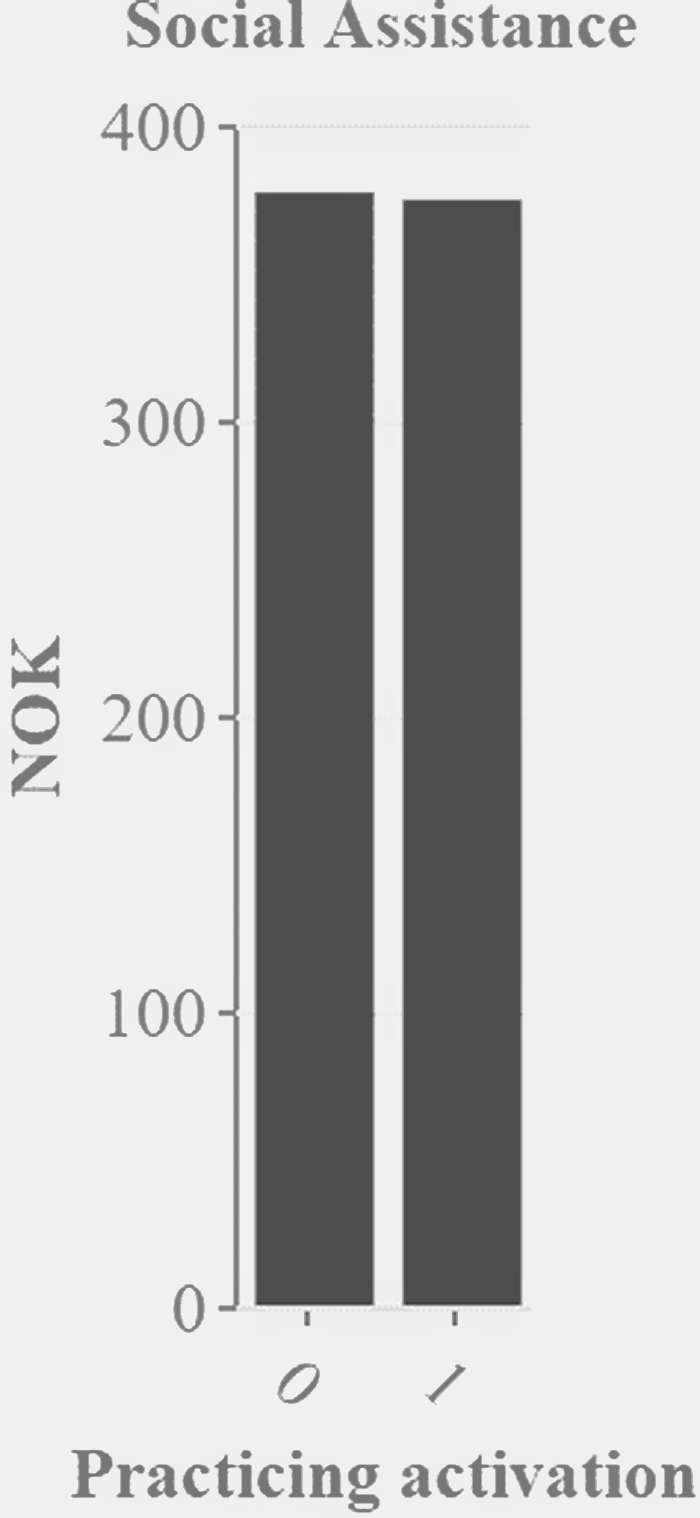
To start with some aggregate descriptive statistics, Figure 1 shows that there is no substantial difference in the average received daily amount (in NOK) (age 18-29) in municipalities with (1) and without (0) compulsory activation. This equivalence in the overall level of generosity in the different samples does not invalidate our identifying assumption, in the sense that we are comparing two groups of municipalities that do not differ overall in the average daily amounts of social assistance. See in addition Table 6 for a test of treatment assignment based on observable differences between municipalities.
Average received daily amounts (in NOK).
Note: Average received daily amount (in NOK) (age 18-29) in municipalities with (1) and without (0) compulsory activation in 2015.
In line with evidence from Figure 1, Figure 2 shows that the densities of the share of residents (percent) receiving social assistance do not differ substantially in municipalities with (1) and without (0) compulsory activation.
Share of residents receiving SA.
Note: share of residents (percent) receiving social assistance in municipalities with (1) and without (0) compulsory activation.
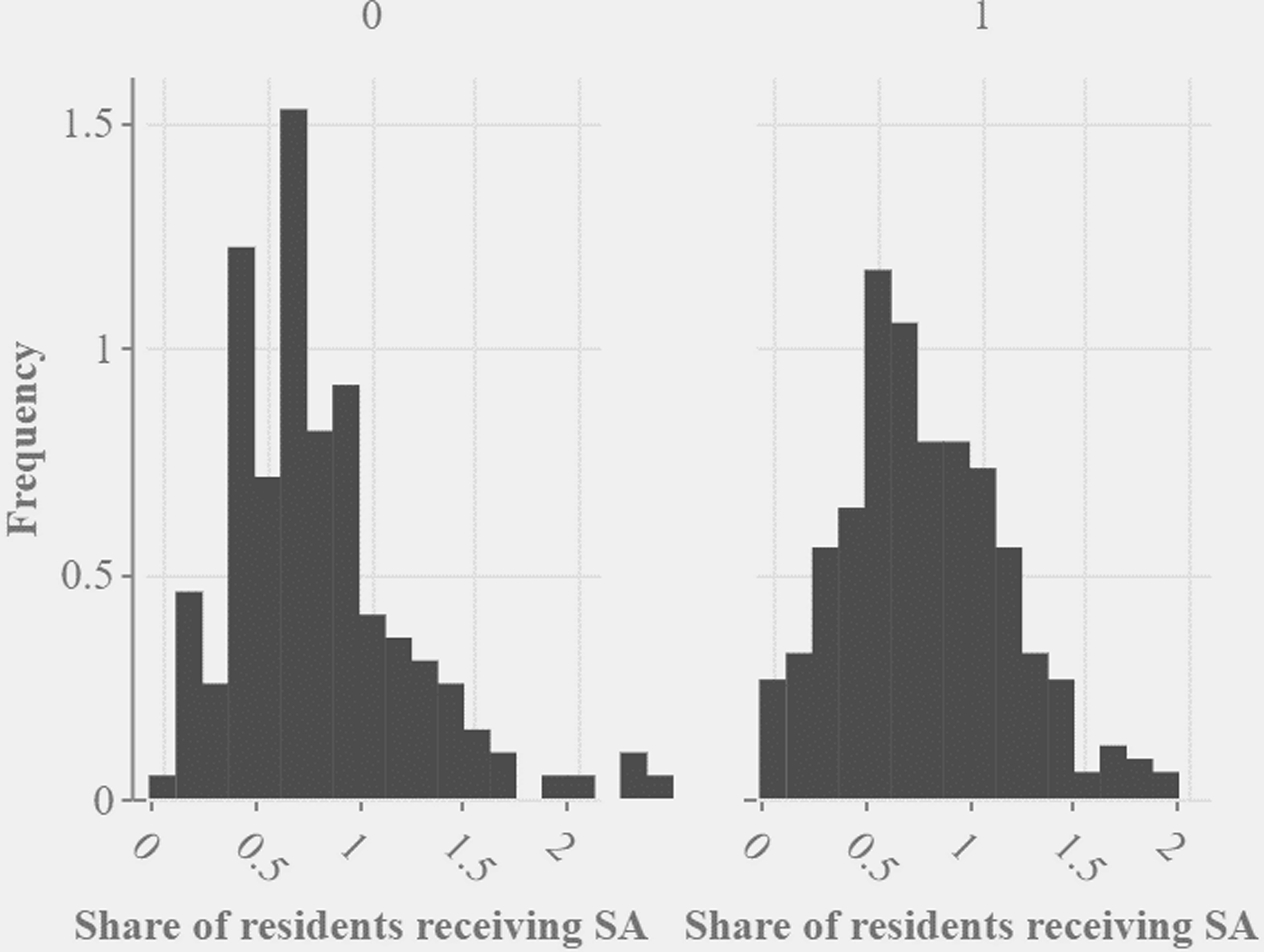
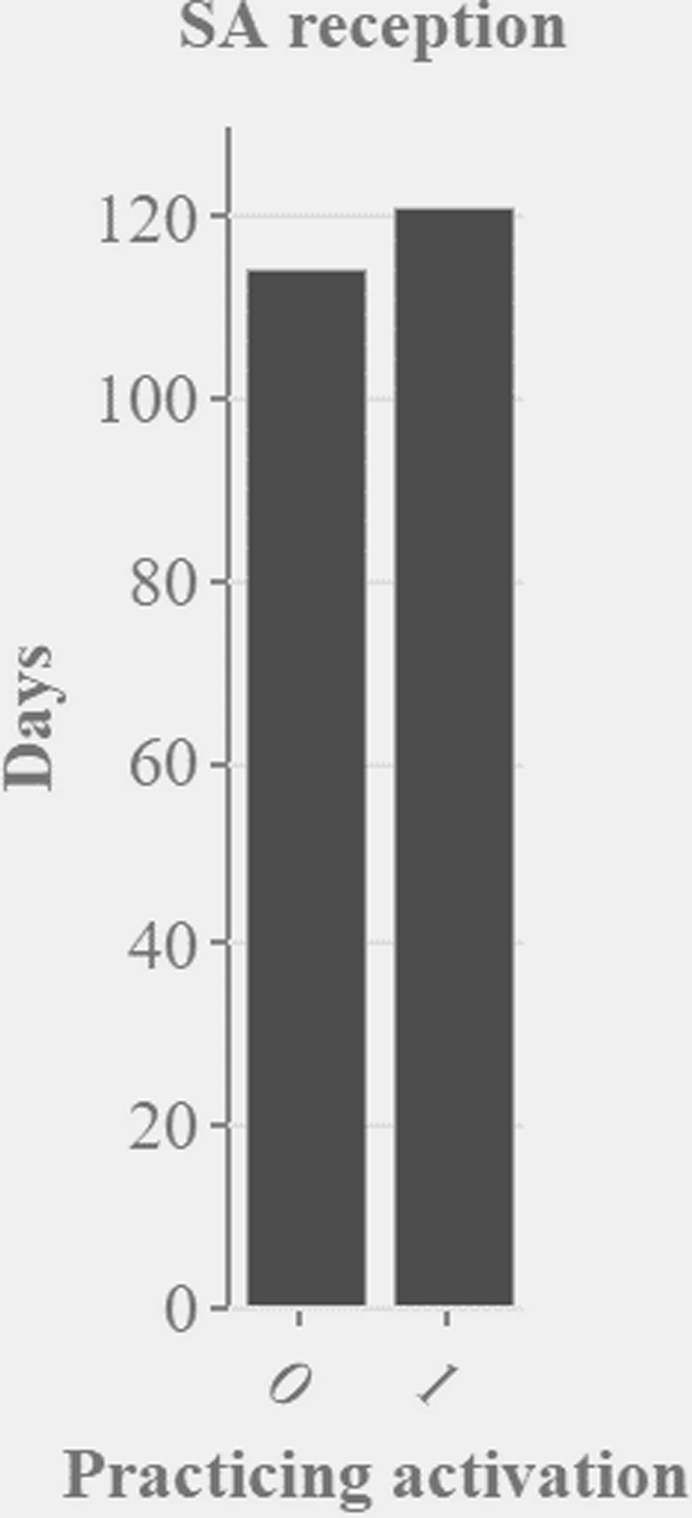
The evidence of Figure 2 shows that both in the set of municipalities with (1) and without (0) compulsory activation, the fraction of residents receiving social assistance does not largely overcome 2%. Figure 3 below focuses on the length of recipiency, showing that the average number of days receiving social assistance (age 18-29) in municipalities with (1) and without (0) compulsory activation is also rather similar.
Length of recipiency (day within/year).
Note: Average number of days receiving social assistance (age 18-29) in municipality with (1) and without (0) compulsory activation, in 2015.
More heterogeneity arises from Figure 4, which shows that there is a significantly larger fraction of social assistance recipients living in municipalities with compulsory activation. This is mainly because many of the large cities in Norway (e.g., Oslo, Bergen, Trondheim, Stavanger) practice activation.
Social assistance recipiency.
Note: Number of young (18-29) social assistance recipients living in municipality with (1) and without (0) compulsory activation in 2015.
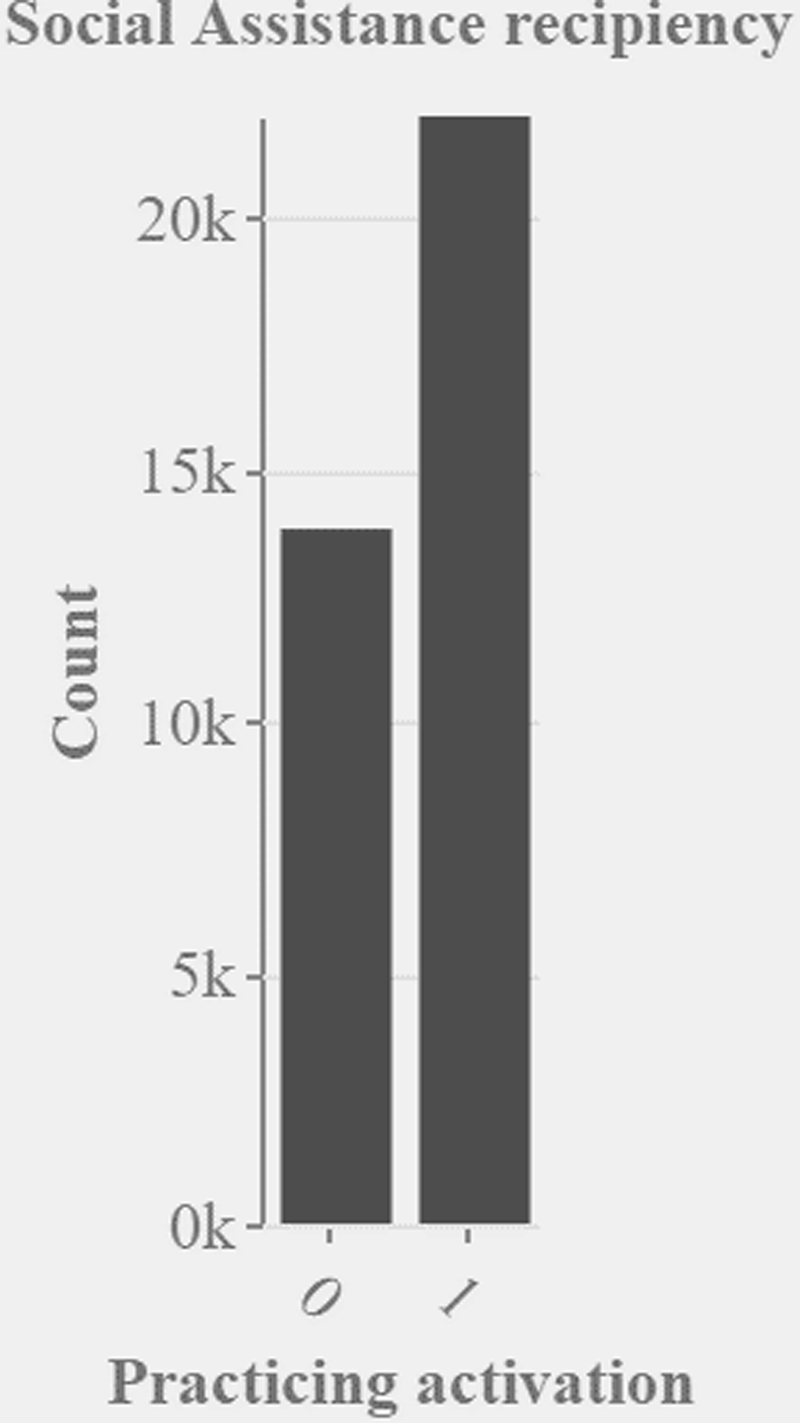
Table 1 below presents our variable definitions and a specification for each of them.
Description of variables
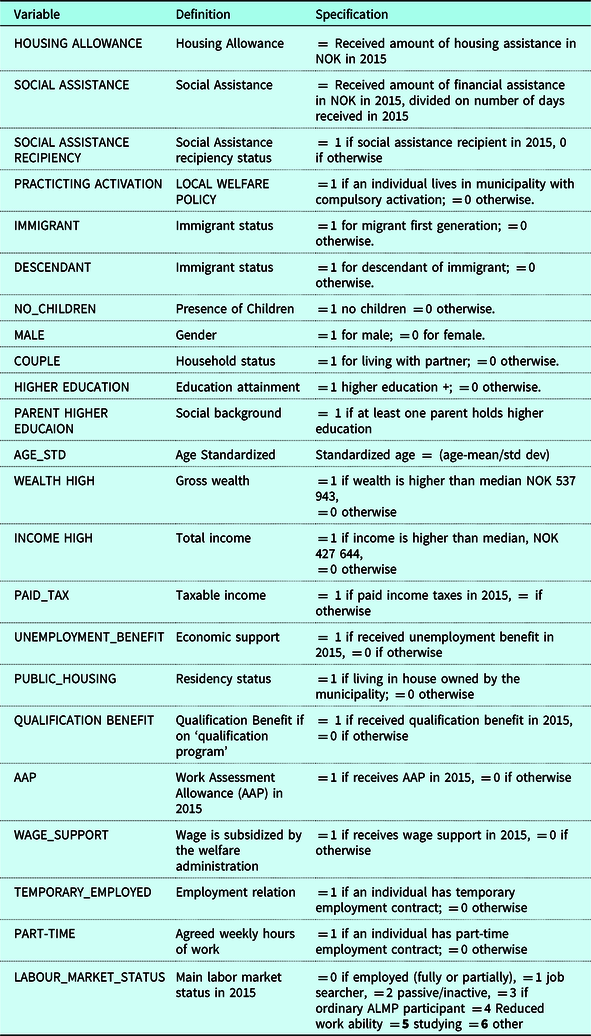
Notes: The variable education attainment was defined according to the ISCED-2011 classification – namely, =1 if schooling was higher than ISCED4.
In the following Table 2, we provide an overview of the labor market status for young recipients of welfare assistance in 2015. Note that although social assistance is a short-term benefit with a mean reception period of approximately four months (this applies to 2015), we employed a very strict definition of “passive” recipients. This means that we only define individuals as passive if they are: (i) unemployed, (ii) not registered as work applicants, or (iii) not participating in labor market activation measures or education throughout the year under analysis. This is done to ensure the reliability in the measure of inactivity.
Labour market status for young recipients
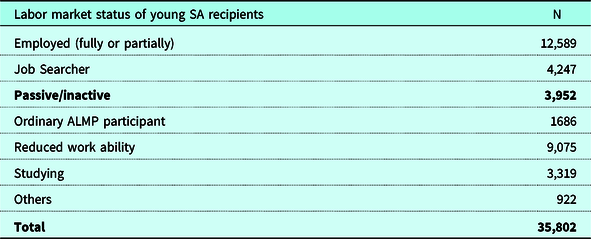
Table 3 below presents some descriptive statistics for the outcome variables and covariates. Notice that since an important fraction of these variables are dummies, they will have a mean that is in between 0 and 1. For social assistance, average received daily amount (in NOK) is 271. Notice that the number of observations in the sample mean corresponds to the total of Table 2 above, as the sample under analysis is equivalent.
Descriptive statistics of outcome variables and covariates
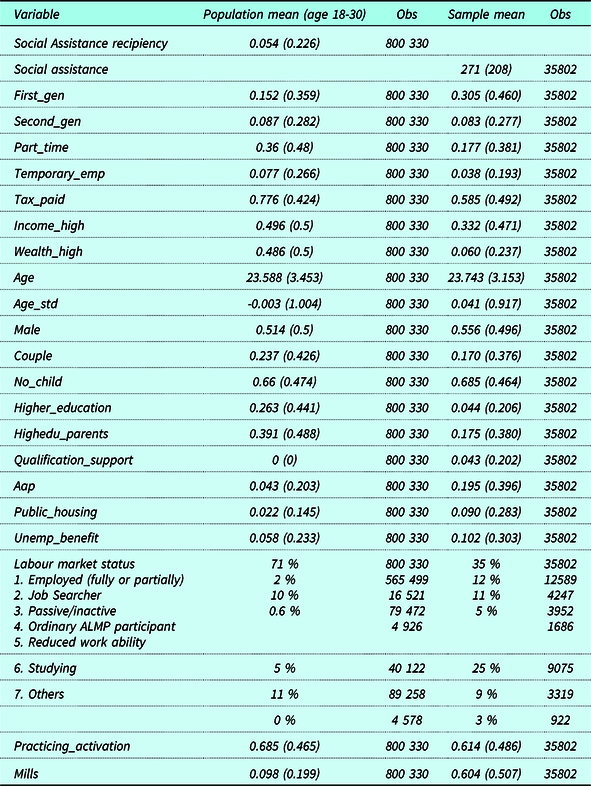
Note. Standard deviation in parentheses.
3. Empirical Approach and Main Results
In this section, we present the analytical approach that we implement to estimate the use of sanctions given by compulsory activation on social assistance recipients. More precisely, we focus on the strength of the relationship between the amount of social assistance and the degree of activation measures, operationalized by dummies summarizing whether young welfare recipients are passive in the labor market in 2015.
Ideally, we would capture the effect that compulsory activation has on every single social assistance recipient after its introduction in the municipality of residence. In practice, since the threat of sanctions is not directly observable, we proxy the effects of compulsory activation by comparing the relationship between recipiency and labor market status dummies (indicating activation) for individuals living in municipalities that practice compulsory activation with individuals residing in municipalities in which activation is not mandatory.
In other words, our identification assumption is that the introduction of mandatory activation in the municipality where a social assistance receiver resides is exogenous to the recipient. We test this assumption later in this section. Notice that our focus is at the individual level, although the treatment variable (practicing activation) is coded at the municipality level. The standard errors are clustered at the municipality level.
First, we controlled for the selection effect by implementing a two-step Heckman procedure (Heckman, Reference Heckman1979). Since social assistance is not randomly assigned and is a feature of a small fraction of the population between 18 and 29 years old, we need to control for potential sample selection bias. To this end, we start by estimating through a probit model the following take-up (or selection) equation:
 $$S{A_{i,k,2015}} = {\alpha _0} + \delta X_{{i,k},2015}^\prime+ {\varepsilon _{i,k,2015}}, $$
in which $S{A_{i,k,2015}}$
is a dummy variable that indicates social assistance recipiency for individual
$S{A_{i,k,2015}}$
is a dummy variable that indicates social assistance recipiency for individual $i$
in municipality
$i$
in municipality $k$
in 2015 (
$k$
in 2015 ( $S{A_{i,k,2015}} = 1$
if the individual receives a positive amount);
$S{A_{i,k,2015}} = 1$
if the individual receives a positive amount); $\delta $
is a vector (hence, in bold) of parameters that controls the degree to which the sample selection biases OLS estimation (i.e.,
$\delta $
is a vector (hence, in bold) of parameters that controls the degree to which the sample selection biases OLS estimation (i.e., $\delta \ne 0$
will introduce the selectivity bias);
$\delta \ne 0$
will introduce the selectivity bias); ${X_{i,k,2015}}$
is a vector (hence, in bold) including a large set of explanatory variables (the treatment dummy – Practicing Activation – indicating whether municipality
${X_{i,k,2015}}$
is a vector (hence, in bold) including a large set of explanatory variables (the treatment dummy – Practicing Activation – indicating whether municipality $k$
of residence for individual
$k$
of residence for individual $i$
has or has not already introduced mandatory activation, age, sex, high education, civil status, social background, income, wealth, employment status, working on a full-time contract, and recipiency of other subsidies and transfers), while
$i$
has or has not already introduced mandatory activation, age, sex, high education, civil status, social background, income, wealth, employment status, working on a full-time contract, and recipiency of other subsidies and transfers), while ${\varepsilon _{i,k,2015}}$
is the error term.
${\varepsilon _{i,k,2015}}$
is the error term.
The results from estimating the take-up equation in Table 3 show that in this age group, being a first-generation immigrant in Norway significantly increases the probability of receiving social assistance, as well as being male and having no children. In contrast, high income or wealth and high education decrease the probability of being a recipient of social assistance, in line with means-testing requirements. More interestingly, residing in a municipality that practices activation slightly decreases the probability of being a receiver of social assistance. Note that we include as a regressor a dummy for individuals who are employed with a full-time contract. This variable only works as an instrument in our take-up equation and will therefore not be used as a covariate in the main model. Notice also that employment status is included as a category in the labor market status variable, but in the main model, we did not differentiate between full-time and part-time employment.
Subsequently, the residuals of this selection equation are used to construct the inverse Mills ratio $\gamma $
:
$\gamma $
:
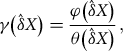 $$\gamma \left( {\hat \delta X} \right) = {{\varphi \left( {\hat \delta X} \right)} \over {\theta \left( {\hat \delta X} \right)}},$$
which we label as $\gamma \left( {\hat \delta X} \right)$
. This factor is a summarizing measure that reflects the effects of all unobserved individual characteristics that are potentially related to social assistance take-up. The value of
$\gamma \left( {\hat \delta X} \right)$
. This factor is a summarizing measure that reflects the effects of all unobserved individual characteristics that are potentially related to social assistance take-up. The value of $\gamma \left( {\hat \delta X} \right)$
for each sample unit controls for potential selection bias and is used in the subsequent (unbiased) OLS estimation. We therefore proceed with the estimation of our main model:
$\gamma \left( {\hat \delta X} \right)$
for each sample unit controls for potential selection bias and is used in the subsequent (unbiased) OLS estimation. We therefore proceed with the estimation of our main model:
 $${Y_{i,k,2015}} = {\beta _0} + {\rho \left( {LM*PA} \right)_{i,k,\bf{2015}}^\prime} + {\vartheta X_{i,k,\bf{2015}}^\prime}+ \omega \gamma \left( {\hat \delta X} \right) + {\varepsilon _{i,k,2015}},$$
in which ${Y_{i,k,\;2015}}$
is our dependent variable reporting the daily amount received of the sum of the two main components of social assistance (as defined in Table 1) for individual
${Y_{i,k,\;2015}}$
is our dependent variable reporting the daily amount received of the sum of the two main components of social assistance (as defined in Table 1) for individual $i$
in municipality
$i$
in municipality $k$
in 2015;
$k$
in 2015; $\rho $
is a vector of coefficients estimating all interactions between
$\rho $
is a vector of coefficients estimating all interactions between $LM$
(representing labor market status for individual
$LM$
(representing labor market status for individual $i$
in municipality
$i$
in municipality $k$
in 2015), and
$k$
in 2015), and $PA$
(the treatment dummy – Practicing Activation – indicating whether municipality
$PA$
(the treatment dummy – Practicing Activation – indicating whether municipality $k$
of residence for individual
$k$
of residence for individual $i$
has or has not already introduced mandatory activation);
$i$
has or has not already introduced mandatory activation); ${X_{i,k,2015}}$
is a vector including an extensive set of covariates (age, sex, high education, civil status, social background, income, wealth, and recipiency of other subsidies and transfers), while
${X_{i,k,2015}}$
is a vector including an extensive set of covariates (age, sex, high education, civil status, social background, income, wealth, and recipiency of other subsidies and transfers), while ${\varepsilon _{i,k,2015}}$
is the error term.
${\varepsilon _{i,k,2015}}$
is the error term.
The results are shown in Tables 4 and 5 below.
Selection equation estimation results
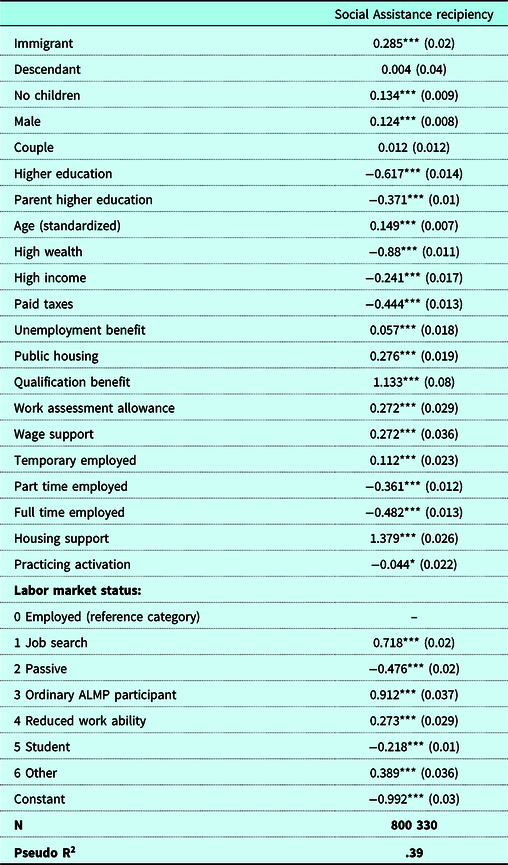
Notes: clustered standard errors (on 418 municipalities) in parentheses. ***p < 0.001, **p < 0.01, *p < 0.05.
OLS estimation results
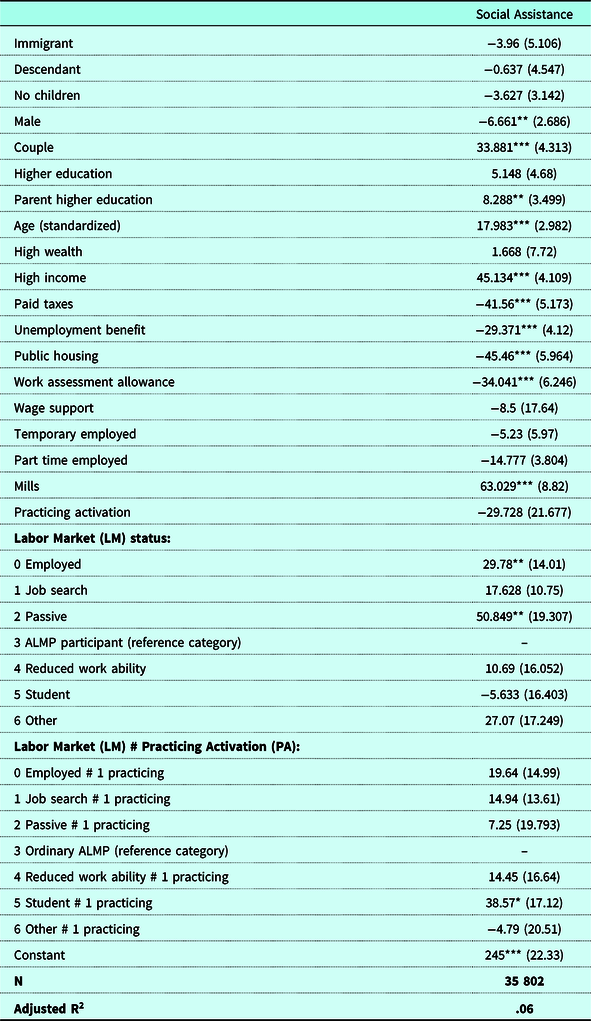
Notes: clustered standard errors (on 253 municipalities) in parentheses. ***p < 0.001, **p < 0.01, *p < 0.05.
First, since we will focus on the comparison of individuals who are passive (labor market status = 2) with those who participate in programs set up by the welfare administration, we use category 3 (ordinary ALMP participant) as the reference category. The results show that being passive results in significantly higher social assistance levels on average than ordinary activation measures (approximately 51 NOK per day of recipiency, with a standard error of 19.307 NOK). The intuition behind this is the following: being on activation measures is economically rewarded either directly by the employer or by the welfare agency, hence reducing the need to sustain living costs through the safety net of social assistance. In other words, individuals who are passive will receive higher levels of social assistance than those who are on measures since the latter open access to other income sources.
Now, at the core of our research question, how does the practice of mandatory activation (and its related threat of sanctions by benefit reduction) affect the relationship between passive labor market status and social assistance recipiency? We could, for instance, hypothesize that for passive individuals, living in a municipality with compulsory activation would lead to a drop in the amount of social assistance benefits (with ordinary ALMP participants as a reference category) compared to individuals living in municipalities that did not yet introduce mandatory activation in 2015. The relationship for the interaction term (2 – Passive # 1 – Practicing) is, however, not statistically significant.
Interestingly, education is the only one of the interaction term $\left({LM*PA} \right)$
coefficients included in the vector
$\left({LM*PA} \right)$
coefficients included in the vector $\rho $
(the last six coefficients before the constant term) that is statistically significant, implying an unambiguous null-effect conclusion of our analysis: there is no different relationship between social assistance benefits and a passive labor market status for individuals living in municipalities that practice activation, with individuals residing in municipalities in which activation is not yet mandatory.
$\rho $
(the last six coefficients before the constant term) that is statistically significant, implying an unambiguous null-effect conclusion of our analysis: there is no different relationship between social assistance benefits and a passive labor market status for individuals living in municipalities that practice activation, with individuals residing in municipalities in which activation is not yet mandatory.
In other words, there is no visible effect of (the threat of) sanctions in place for passive recipients. Our empirical approach does not allow us to go deeper into the reasons and mechanisms behind such practice; however, we believe that quantitatively documenting that compulsory activation is indeed not practiced in its stricter meaning (by cutting benefits to passive individuals) is an important result before conducting further policy evaluation exercises. We discuss the relevance and implications of this result in Section 4.
3.1 Testing for Random Treatment Assignment
Since our identification assumption requires that introduction of mandatory activation in the municipality where a social assistance receiver resides be exogenous to the recipient, we proceed to test this assumption empirically (Wing et al., Reference Wing, Simon and Bello-Gomez2018). One can hypothesize that municipalities with higher fractions of passive individuals were more eager to introduce compulsory activation early on, hence introducing endogeneity in the treatment assignment, which lies at the heart of our identifying assumption. Therefore, we tested for random treatment assignment by analyzing whether we can predict Practicing Activation through a set of regressors at the municipality level. In other words, we specify the following model:
 $$P{A_{k,t}} = {\tau _0} + {\mu X_{k,t - {\bf1}}^\prime }+ {\varepsilon _{k,t}},$$
in which Practicing Activation is again our treatment dummy at the municipality level; ${X_{k,t - 1}}$
is a vector including an extensive set of municipal covariates at
${X_{k,t - 1}}$
is a vector including an extensive set of municipal covariates at $\left( {t - 1} \right)$
(percentage of resident who are immigrants, percentage of unemployed and of social assistance receivers, a dummy for being or not a large municipality, and average age of residents), while
$\left( {t - 1} \right)$
(percentage of resident who are immigrants, percentage of unemployed and of social assistance receivers, a dummy for being or not a large municipality, and average age of residents), while ${\varepsilon _{k,t}}$
is the error term.
${\varepsilon _{k,t}}$
is the error term.
The intuition is the following: if mandatory activation has been specifically introduced to limit the within-municipality increase in social assistance recipients, then we cannot assume the exogeneity of treatment as we did in our main model specification. This endogeneity can be ruled out in case Practicing Activation is not predicted by the regressors in the above model. The results show that none of the regressors is significant, and overall, the model has an adjusted ${R^2} = 0.013$
. In other words, we tend to reject the hypothesis of endogenous treatment assignment.
${R^2} = 0.013$
. In other words, we tend to reject the hypothesis of endogenous treatment assignment.
4. Discussion and Concluding Remarks
The main result of our study shows no significant differences in benefit levels between passive social assistance recipients in municipalities practicing activation and recipients residing in municipalities not practicing compulsory activation. In the following, we discuss the relevance of this result. One can assume that the threat-effect of benefit sanctions relies on the threat being real. For the threat to be real, it needs to influence individuals’ social assistance recipiency in a nonnegligible manner. In other words, if there are noticeable benefit sanctions, then they should have been clearly visible in the results of our main model specification. Our results lead us therefore to conclude that, regardless of the regulations that indeed allow benefit sanctions, sanctioning is not systematically practiced in the treated municipalities.
These results support the findings in Vilhena (Reference Vilhena2021) and Torsvik et al. (Reference Torsvik, Molander and Terum2021) – namely, that caseworkers happen to be sensitive to personal responsibility and that they adjust their activity requirements instead of imposing sanctions. Bugge (Reference Bugge2020) documented that in addition to the laws and regulations of welfare conditionality, caseworkers develop standardized routines while processing cases, suggesting that individuals in similar situations are treated somewhat equally, avoiding the use of sanctions. In the survey answered by local administrations (Dahl and Lima, Reference Dahl and Lima2017), many of the responders reply that strict rules and regulations related to sanctions make them difficult and resource-intensive to carry out.
Due to the lack of direct information, this article has attempted to answer the question on whether benefit sanctions are truly being practiced in Norway. The empirical approach has applied a register-based design, combined with an identification strategy, to proxy the presence of sanctions. This is done by utilizing: available information on the formal sanctioning practice in Norwegian municipalities; and individual information identifying those who should be subject to sanctions in accordance with the social assistance scheme. Based on this, we could assume that any significant difference would be due to a sanctioning practice in selected municipalities. According to the results in our quantitative study, it seems that sanctions are not, or at least only to a limited extent, arbitrarily practiced, as there are no systematic differences in the use of sanctions between the areas that allowed sanctioning and those that did not.
As stated in the introduction, evaluations of the national mandatory activation reform introduced in 2017 have thus far found null effects on recipiency, employment, and education outcomes (Dahl and Hernæs, Reference Hernæs2021). These findings were an important motivation for our work since they raise the question of whether sanctions are truly being practiced. Although there is no straightforward relationship between the lack of effects from the reform (the main result in Dahl and Hernæs, Reference Hernæs2021) and the lack of sanctioning behavior shown in our results, this relationship should at least be discussed in future research. Hagelund et al. (Reference Hagelund, Øverbye, Hatland and Terum2016) state that if there is no clear system for sanctions to be practiced in an effective matter, then there is no real sanctioning system against those who violate the terms to receive benefits. The practical implication of conditionality in welfare benefits then only works as an additional service to those receiving assistance. One limitation with this study is the missing information on when compulsory activation was implemented in each municipality. The model is thus unable to explain any potential influence this can have. We control for potential bias caused by this non-random treatment. As seen in Table 6, there are no significant differences between the municipalities with respect to social assistance recipients and other demographic traits.
Probit estimation results
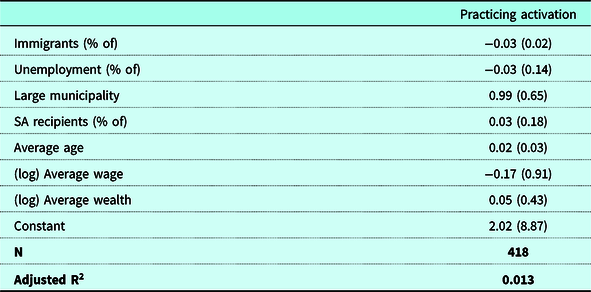
Notes: standard errors in parentheses. ***p < 0.001, **p < 0.01, *p < 0.05.
In conclusion, the recent ongoing implementation of welfare conditionality and benefit sanctions for young social assistance recipients in Norway relates to a broader and important debate about the consequences of these policies in modern welfare states. Following the reason of its advocates, increased welfare conditionality is intended to clarify the role of economic incentives and thereby support young individuals by improving their labor market status (the social investment perspective). Dahl and Hernæs (Reference Dahl and Hernæs2023) indicate that compulsory activation, the way it is implemented in Norwegian municipalities, is a targeted scheme, hitting individuals with low expected gain from activation. Welfare conditionality also plays a role within more critical views, such as King and Rueda’s (Reference King and Rueda2008) and Rueda’s (Reference Rueda2015) description of workfare, where the purpose of (mandatory) activation is to push individuals into (any form of) employment or activation measures by reducing the attractiveness of welfare benefits (Rueda, Reference Rueda2015, p. 298). In this latter view, the unintended consequence for young individuals with weak labor market attachment is that their employment status is likely to be a precarious one characterized by low-wage and nonstandard employment relations.
Which one of these two opposite views receives more support from the data? We leave this research question to future studies. However, we believe that related questions can benefit from replicating our empirical approach (i.e., identifying individual-level effects of activation on young welfare recipients by exploiting municipal variation in the introduction of compulsory activation) in other contexts to identify whether the (individual-level) threat-effect of benefit sanctions is indeed in place. Once that has been done, further investigation of the effect of sanctioning on employment and health outcomes can take place.
The empirical caveat this article attempts to address is the inability to identify the detailed use of sanctions in individual cases. As we have documented, there are only arbitrary use of sanctions at the aggregated level. To study the impact of sanctions the way it is practiced today, it is crucial to have individual register status for when sanctions are imposed, to properly disentangle the individual effects of sanctions.
Acknowledgments
The technology to access the data remotely, Microdata.no, was developed in a collaboration between the Norwegian Centre for Research Data (i) and Statistics Norway as part of the infrastructure project RAIRD, funded by the Research Council of Norway. The codes to replicate the results of this work (upon granted access to Microdata.no) are publicly available on Open Science Framework here: https://osf.io/h3kux/.
Competing interests
The authors declare none.


 Open access

