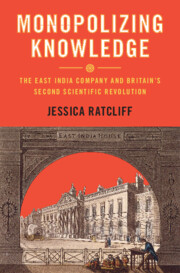


Margaret Tytler’s Model India
The Bengal Government engages Miss Tytler to prepare a set of models of Indian manufactures and agricultural implements for transmission to the East India Company’s Museum in London.
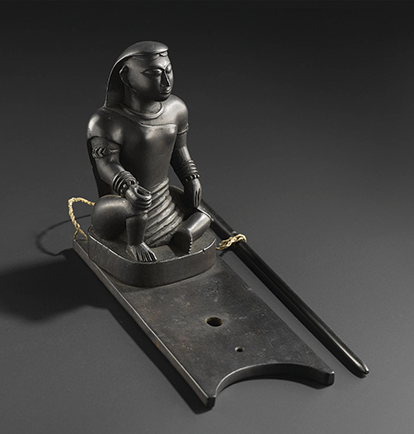
In 1819, Margaret Tytler, a Scotswoman with a self-described “love of science,” accompanied her brother, Dr. John Tytler, on his first assignment with the Bengal Medical Service, where he was assigned to Patna.Footnote 2 Between 1821 and 1823, Tytler embarked on a remarkable project to construct highly detailed scale models of social and economic life in the region (see Figure 7.1). Visiting farms, forests, homes, workshops, mills and distilleries, Tytler employed local artists to draw and measure the tools and instruments of different manufacturers, then hired local makers of toys and statuettes to produce scale models (usually at half an inch to a foot) out of carved stone, wood and leather. Her process was empirical and observation-based. She describes, at one point, being sickened by the fumes in the distillery where she went to measure an apparatus. She also describes being “instructed” by a local distiller, who she calls Mushoo, in the gathering and preparing of herbs to make toddy. Tytler claimed the models are so exacting that, after constructing the model still, she claims, “by means of this model I distilled a tumbler full of spirits.”Footnote 3 In all, she made over sixty precise models of a wide range of workers and their instruments, from bird catchers to millers of grains and oils, to weavers and makers of gold and silver thread to butter churners and poppy lancers. After one set was produced for the Bengal government, Tytler was asked to produce a second set specifically for the India House museum.
Ebony model showing a method of catching birds, produced in Bihar Patna c. 1815–1821, commissioned by Margaret Tytler.
Tytler’s models were early forerunners to a major new focus for the India House museum in the 1850s: the production of detailed industrial intelligence about India’s trades and industries, intended for the use of British manufacturers and traders. As we have seen throughout the book, although Wilkins’s 1798 proposal to the Court of Directors was nearly completely full of items of commercial value or related to understanding Asian trade, the actual shape that the library-museum took was much broader and, at least until the 1840s, bore little relation to Wilkins’s proposal. By the late 1850s, India House would display many hundreds of models similar to those of Tytler’s. As an article in The Times would put it in 1857, an hour spent in the new “model room” would “convey clearer ideas of Indian life and Indian customs than would be gained by the perusal of many dreary volumes.”Footnote 4 This is just one way in which, in the final decades of the Company’s existence, the discourse of knowledge production at India House was increasingly about growing and facilitating trade. This focus was amplified, as we saw in the previous chapter, in the new office of the Reporter on the Products of India, and especially in connection with the Company’s central role in the Great Exhibition.
To be clear, however, focusing on commercial utility in no way meant the abandonment of engagement with questions of broad historical and philosophical interest discussed in the previous chapters. On the contrary, the rise of the economic museum movement in this period involved those very same questions, but now also applied in new ways to questions of how to develop the British–Indian trade. For example, Tytler’s models were accompanied by a manuscript catalog that sets the whole project within a stage-based understanding of civilizational development similar to that of Adam Smith. On the surface, Tytler appears to have produced a relatively straightforward collection of models illustrating common commercial and agricultural practices in Patna. But Tytler’s catalog also folds her observations into a broad theoretical framework of understanding of both economy and empire. She has chosen and ordered the particular models in order to illustrate the progress of civilizational needs according to the stadial theories of Smith, whom she quotes repeatedly. She also references a range of other European influences such as Erasmus Darwin’s “Love of the Plants.” The catalog at times works hard to create a “model” of rural Indian society designed to fit the Smithian economic-material stages of civilization. But it is also clear that Tytler’s worldview has been shaped by her time in North India. For example, she discusses articles from the Asiatic Researches as well as the “Treatise on Agriculture” by one “Mater Jeet Singh Rajah Tikaree” (probably Mitrajit Singh Tikari Raj, a prominent zamindar).Footnote 5 Although in this way Tytler’s analysis is a cosmopolitan production, it also sets this new world within what would be, to the intended audience, a very familiar intellectual register.
This chapter follows the economic turn in Company science at India House in the decades after 1833. The first section considers new institutional developments in the connection between the India House library-museum and collections-based science institutions in the colonies. Increasingly, the India House library and museum would be represented as at the top of a hierarchy of Company science establishments, reaching from London to the presidency governments and out into the rural divisions and settlements. The chapter then turns to the growing economic focus within the India House library-museum. The Company itself was no longer directly participating in trade, but it was responsible for the agricultural, industrial and other trade-related policies for British India. Part of the new responsibilities of the Reporter on the Products of India position were meant to aid the administrators in such areas of state. But the turn to a science of trade and industry was also, in part, the result of the directors more fully embracing the mission of making the library and museum useful for the (British) public. Altogether, with a new, more clearly defined role as a mediator of industrial, educational and scientific relations between the home country and the colonies, these developments combined to bring new energy and purpose to the library and museum at India House. In almost exactly the same moment, however, the decisive undoing of the Company was brewing, fermented not by the free-trade liberals in Britain but instead by the disaffection and defiance among British Indian subjects.
The Library-Museum and Company Science in British India after 1833
In 1840, amid an endless stream of incoming and outgoing books and documents, the library day books briefly record the beginning of the Victorian era with a notice of the deposit of a gilt-framed color print depicting the young queen opening Parliament for the first time in 1838.Footnote 6 By this time, the Company’s collections at India House were overflowing, and Horsfield sought extra storage space in the cellars and attics. More and more, India House was redirecting donations and deaccessioning portions of its collections to other libraries and museums, which were mushrooming up all over what was, by now, the biggest city the world had ever seen. One London guide from 1851 lists eighty libraries.Footnote 7 Another from 1853 describes seventy-seven “literary and scientific institutions,” virtually all of which held some kind of collection.Footnote 8
Perhaps the constant commerce in and out of the Company’s stores is one reason why the curators could worry about a lack of storage space in one memo and, in another, demand more material from India. Various policies were now in place to encourage the regular movement of materials from the colonies to the imperial center. Significantly, it became routine for the Company to cover any port duties on items sent to India House for the museum or library. By at least the 1830s anything designated a “specimen of natural history” was guaranteed a duty-free import.Footnote 9 As the Royal Navy would do for statues, tombs and obelisks shipped to the British Museum from Egypt, the Company regularly footed the transport bill for massively heavy imports, such as the cache of ancient sculptures from Amaravati, or the semi-regular shipments of cases of books weighing over 500 pounds, destined for its library and museum.Footnote 10 Despite, therefore, the loss of the last vestiges of formal monopoly power in 1833, the Company’s ongoing natural monopoly ensured that, Company science in Britain would emerge as an even greater center of accumulation and production, and its place within British scientific networks would continue to expand.
Printed matter from the colonies arrived less as gifts or the results of particular surveys or expeditions and more with the regularity of scheduled export commodities. By the 1840s, the library was trying to keep up with the outputs of British India’s rapidly growing (and closely monitored) periodical press. Each quarter, presidency governments sent out collections of the latest periodicals. Both native-owned and government-aligned or missionary presses were churning out new books in dozens of languages in Calcutta, Bombay, Madras and elsewhere.Footnote 11 At Wilson’s repeated insistence, sets of many of these works were sent back to London. The Calcutta Book Society, for example, supplied not only regional schools and colleges but also the Company’s library and the students of Haileybury with vocabularies, primers and works of literature in Hindustani and many other languages. Many hundreds of copies of works would be exported to London, and much of this was distributed to Haileybury for use in classes or as student prizes. But many more were sold by the Company to bookshops such as Allen & Co. In fact, the Company’s bookselling activities were becoming so regular in the later 1840s that it could be seen to violate the legal ban on Company direct engagement with trade. However, the practice seems to have been to only sell on imported books at cost, as the directors were keen to stress. As was made clear to one assistant librarian: “we are not to be Booksellers, nor have we ever been.”Footnote 12
The curators at India House were now much more active and aggressive in monitoring collections and finds via the Indian periodical press and pushing for the shipment of finds back to Britain. The Court of Directors (or, more likely, the museum staff via the chairmen) kept close tabs on the movements of these collections through various ports, noting, for example, when only portions of a collection were received in London while other parts had been siphoned off into collections in the colonies.Footnote 13 The India House curators’ more aggressive attempts at policing the flow of knowledge resources were in part a matter of the increased self-regard as the center of the Company’s sciences but also in response to the increasing pull of the growing centers of accumulation in the colonies. The number of museums, botanical gardens, libraries and scientific societies in British India had grown rapidly in the last few decades, and that growth was accelerating markedly in the early 1850s. In the wake of the 1833 charter, dozens of colleges and madrassas were established in British India and many of these had their own museums and botanical gardens.Footnote 14 One of the largest college museums was at the Medical College of Calcutta. In terms of large urban institutes, the Bombay Literary Society (f. 1804), Madras Literary Society (f. 1812) and Singapore Institution (f. 1826) all supported libraries and museums. When the Geographical Society of Bombay (f. 1832) formed, the first order of business was to begin establishing a library and collection of maps, manuscripts and instruments.Footnote 15 The fate of numerous colonial collections would be tied to the fluctuations of the Company Museum’s appetite.Footnote 16
Perhaps no colonial institution was more closely tied to the India House library and museum than the Asiatic Society of Bengal (ASB), the collections of which would eventually form the first national museum in British India in 1875. The dynamic between the Company’s Museum in London and the ASB was, during this period at least, quite the reverse of the case of the London societies just described. Nathaniel Wallich had become the first curator of the ASB’s collection in 1814, and (later exports to London aside) he had strongly argued for the importance of establishing libraries and museums in the colonies.Footnote 17 As Wallich had expected, the ASB’s collection grew quickly:Footnote 18 “from China, from New South Wales, from the Cape, and from every quarter of the Honourable Company’s possessions, specimens of natural history, of mineralogy and geology, have flowed in faster than they could be accommodated.” But as collections grow, so do their costs, and by 1836 the ASB, now in debt, was considering putting the collection up for sale. Having grown too big to be funded by a voluntary organization, the collection was proposed as a foundation for the creation of the Government of India’s first national museum. The problem, however, was that India already had a national museum; it just happened to be in London. When approached with the request to fund a national museum by establishing government support for the ASB collections, the governor-general of Bengal, the same George Eden who had co-founded the Zoological Society, passed the decision on to the Home Government, since the Court of Directors were already supporting a library and museum “at considerable expense.” Although Eden believed that “such institutions in Europe, however perfect, do not supersede the necessity of providing similar in India,” he sensed it was unlikely the Court of Directors would then fund a similar institution in India.Footnote 19
Upon hearing that the question would be passed back to London, the ASB requested an interim 200 rupees per month in order to keep its collections in basic maintenance. When the question of a national museum in India finally came in front of the Court of Directors, they replied in 1839 that the Court would not object to that small sum “for the cost of preparing specimens and maintaining the collection in order.” It was silent on the idea of a national museum, although it also sanctioned the Bengal government to spend some small amount of funds on purchases for the ASB museum, so long as “on all such occasions, you will forward to our Museum [that is, the one at India House] a selection from the articles which may have been so procured.”Footnote 20
Meanwhile, back in London, Horsfield kept surveillance on the ASB’s Transactions, which published lists of new donations. He would at times aggressively seek the transfer of material collected by officers on duty. He also interpreted the ASB’s new collection grant as a contract binding it even more clearly to a subordinate position under the London museum. As he reiterated in a letter to the ASB chasing up a missing section of materials from Bhutan and Nepal:Footnote 21
We now call your attention to several points respecting the relation in which the Asiatic Society is placed towards the Company’s Museum in England in consideration of this grant …. For any naturalist or officer who may accompany any mission or deputation on behalf of Government, the most full and complete series resulting from his labors … the most valuable and interesting results of scientific deputations and missions on behalf of Government … are to be dispatched to England for the Company’s Museum by the earliest opportunity.
But the transregional picture of Company collections is more complicated than Horsfield’s demands upon the Calcutta museum might suggest. For one thing, the ASB’s collections were growing overall, as were those of the branch societies in the Madras and Bombay presidencies. Madras, too, was by the 1830s receiving small but regular government subsidies, and it, too, was regularly sending materials back to London. By 1851, Madras had a Government Central Museum, whose 40,000 annual visitors dwarfed the visitor numbers of the India House museum.Footnote 22
Within the Company’s expanding territories, Calcutta, in particular, emitted its own gravitational pull, attracting many donations from across the Company’s territories. This would, for example, be the case for parts of the so-called British Museum in Macao, a library and natural history museum founded by three East India Company supercargoes in 1829.Footnote 23 The collections of the library and museum grew largely from the donations of Company personnel, but private British traders and Portuguese locals also contributed. It grew steadily for several years until 1833 when the East India Company finally lost its China monopoly, when the supercargoes packed it up, along with the rest of the Company’s offices, for transfer back to Calcutta. Some of the material was then donated to the ASB; for example, the trader Robert Inglis donated his collection of birds to the Society’s museum. But much of what would become the well-known parts of this collection – John Reeves’s collection of fishes, for example – would soon make their way to India House in London. As the Journal of the Asiatic Society of Bengal noted sourly, “It had been proposed to transfer the whole [Macao] collection to Calcutta, and as far as concentration is beneficial, it is to be regretted that this munificent intention had been abandoned.”Footnote 24 By the 1840s, the ASB collection was massive, and the Society itself a hive of activity. A typical meeting such as that of May 5, 1847 begins, as reported in the Bombay Times, with a list of gentlemen balloted for election from all over British India, from Pondicherry to Singapore and also as far away as the United States (F. E. Hall Esq. of Harvard University).Footnote 25 Then letters were read. The Court of Directors thanked the Society for recent “important contributions to the Museum of the India House in the Zoological Department,” from the Marine Department a recent meteorological register for “Kyook Phyoo” (Kyaukpyu) in Burma; from the surveyor-general’s office a recent meteorological record from Calcutta; a query from the secretary to the Military Board, requesting information about timber trees in Bengal. Then contributions for publications received through Captain Newbold were listed, including: a notice by Hekekyau Bey, late president of the Ecole Polytechnique of Cairo, on the temples and emerald mines of the eastern desert of Egypt; a notice from Mr. [Brian H.] Hodgson from Darjeeling submitting several essays on natural history; from Captain Hutton, of Mussoorie, a note on the Ovis Ammonvides of Hodgson; from Major Showers, of Moorshadabad, a copy and translation of the Persian inscription on a gun of Aliverdy Khan; from the Reverend Mr. Mason, a note on the Landshells of the Tenasserim Province, and a report from Dr W. B. O’Shaughnessy of the Mint, forwarding an assay of gold dust from the Boundary Commissioner of the Punjab. Then the curators and librarians submitted their monthly reports of additions to the collections and the meeting was adjourned save the final comment: “We should not omit to notice that the tables were as usual covered with numerous and beautiful specimens of objects of Natural History.”
The Science of Trade and Industry
After 1833, as we have seen, some politicians, shareholders and would-be India traders accused the directors of maintaining, in effect, a natural monopoly on knowledge of Asia by way of the library-museum. However, among scientists, savants and a certain sector of the British public, access to Company science was now wider and more active than ever. On the night of March 24, 1835, for example, King’s College held an outdoor lecture series in the Strand by the inventor and professor of experimental philosophy Charles Wheatstone, who used a variety of instruments to illustrate a lecture about sound and vibrations of air.Footnote 26 The centerpiece of the demonstration was one of the Javanese musical instruments brought back to India House by Stamford Raffles. Several complete Gamelan sets survived the ship fire that destroyed the rest of Raffles’s exports from Java, and these had been on display at India House since the 1820s. Wheatstone had asked to borrow the instruments in order to study their acoustical qualities, particularly their “remarkable employment of reciprocal vibration.”Footnote 27 The Raffles collection of Javanese instruments was something of a regular guest on the thriving popular lecture circuit – back in 1828, Michael Faraday had used a set at the Royal Institution during a Friday night lecture on “vibrations producing sound.” In this instance, Faraday had wanted to use a “China Gong supposed to be in the E.I. Company’s Museum.” Wilkins, a member of the Royal Institution himself, had informed him that “we have never been in possession of such a specimen” but suggested Lady Raffles might have something to loan.Footnote 28 In another Royal Institution lecture in 1830, Faraday had displayed the Company’s new “geodetic instrument” that was to be used in the Survey of India.Footnote 29 In 1841, glazed tiles in the Company’s museum were loaned to the Society of Arts.Footnote 30 Models of Indian boats were loaned to the Society of Engineers. In 1853, a set of model ploughs were loaned to the Royal Institution for a lecture on “ploughs of the world.”Footnote 31 Company curators also sometimes gave lectures at the Royal Institution, such as in June 1838 when the newly hired India House curator John Forbes Royle was the speaker at Faraday’s Friday evening lecture series, entertaining the audience with a discourse on “The vegetation of the Himalayan chain in connection with climate.”Footnote 32 Royle also lectured on the materia medica of India at King’s College, for which he sometimes borrowed specimens and samples from the Company’s museum.
These are just a few of the contexts in which objects from the Company’s collections were loaned out for public lectures or events at universities or scientific societies. From the 1820s onward, as discussed in Chapter 5, Company science was strongly represented in Britain’s civic clubs, institutes and societies devoted to science and education. And, from the 1830s onwards, it is in these settings, among the literary and scientific public who filled public lectures and private clubs, that the Company’s collections and their curators played an active role in shaping a more public discourse about Asia in Britain. In the 1830s, the brick-and-mortar location of Company science, within the galleries at India House, was, by all accounts, devoid of interpretation or instruction (i.e. no catalogs, useless labeling). It was instead beyond Leadenhall Street, in the thriving public and civic spaces for research and education, where Company science participated in seemingly endless exercises in comparing, contrasting and ranking the similarities, differences and historical connections between “India” and “Britain” or “Asia” and “Europe.” The Javanese instruments, for example, were integrated into a comparative study of musical knowledge across the world, while at the same time Wheatstone, a prolific inventor, especially of electrical apparatus related to telegraphy, also used the instruments to demonstrate physical theories about the nature of sound.Footnote 33 Royle’s lectures combined the history of medicine with the latest knowledge on the “laws which regulate the geographical distribution of plants,” illustrated with his encyclopedic collection of contemporary Indian medicines.Footnote 34 His ultimate aim was to aid in the discovery of new (to Europe) medicines and treatments, but his method was deeply historical, and he also claims to have been able to “pick up one or two of the lost links in the history of the science”: using new translations of Sanskrit canons by his India House colleague Horace Hayman Wilson, Royle plotted connections between his bazaar collections from India and ancient Greco-Arabic medical treatises (and thus Britain’s own scientific history).Footnote 35 In a similar vein, Henry Thomas Colebrooke’s work on the history of Hindu mathematics and astronomy, which he presented at many scientific society meetings, was devoted to examining Hindu contributions to Arabic (and thus European) history of science.Footnote 36 The glazed tiles were one of numerous museum items lent to the Society for the Encouragement of Arts and Manufactures (the Society of Arts) for the purpose of illustrating the history of different trades and manufactures. Arthur Aikin, a chemist and lecturer at the Society of Arts, found the Company’s museum especially rich in “models, in specimens, and in products illustrative of the arts and manufactures of India, and other oriental countries” and regularly requested Wilkins’s help in locating objects from the museum to use in his presentations.Footnote 37 For example, the tiles, from the ruins of a fifteenth-century mosque in Gauda, as well as specimens of bricks, were used in a historical survey on pottery.Footnote 38 Aikin’s influential lectures on the history of arts and crafts also used, for a chapter on bone-based manufactures, a Chinese lantern from the museum; in a section on the history of iron, manuscripts and specimens from the Company’s library; and, in a section on the history and art of paper making, samples of bark-cloth paper from Java and wood and cotton paper from Kashmir.Footnote 39
Other Company offices and departments, at India House and throughout the presidencies, had always been focused on gathering and analyzing information on the economy and productivity of the colonies. The Company’s vast tax collection apparatus, surely the most information-intensive sector of Company administration by this time, depended upon fine-grained revenue surveys that attempted to measure village finances, landholdings, agricultural productivity, manufacturing and consumption. At the Company’s library and museum, however, until the late 1830s, the projects and publications that came out of India House or Haileybury were no more focused on, for example, manufacturing or agricultural productivity, than those of other institutions such as the British Museum or Royal Society. The distinctly trade-related collection of Tytler’s kind was still rare in the 1820s.Footnote 40 A few other donations and gifts similarly connect directly to the ongoing attempts by British merchants and manufacturers to gain ground in the Indian market. For example, in June 1813 “sixty-one specimens of sacrificial and domestic utensils [in wood] used by the Hindus; transmitted to England as patterns for the manufacturers” arrived.Footnote 41 In the 1820s, Henry Thomas Colebrooke had successfully instituted a study of weights and measures used throughout the Company’s territories.Footnote 42 In general, though, Company collecting remained much more wide-ranging, opportunistic, war-driven and unstructured, and the pursuit of economically useful knowledge more diffuse, until well into the 1830s.
Several factors contributed to this change. One is, in both Britain and the colonies, the steady acceleration in the rate of accumulation and the multiplication of related institutions. By the late 1830s, disciplinarily specific collections were becoming common, and (as we saw after the charter of 1833) India House faced the question of whether it made sense to maintain a Company museum in its broad organization encompassing all things Indian. Already, by 1838, the curators tended to immediately pass on botanical donations to Kew Gardens or the Linnaean Society for storage and cataloging.Footnote 43 A second factor is the expanding influence of liberal utilitarian political views and imperial policies, in particular the discourse of a particularly commercial form of improvement.
A third, closely related, factor is the erosion of the Company’s privileges and therefore its autonomy with respect to other commercial interests. It had always been the case that British manufacturers were more interested in pushing for increasing Britain’s exports to Asia. After 1833, manufacturers could and did exert a much more direct force upon trade and trading policy.Footnote 44 This was the period in which the factory-produced machine loom cotton textiles from Lancashire were just beginning to challenge the long-held dominance of Indian textiles in the global trade. Commerce with Asia was now thrown open to a raft of new players, and the meaning and the value of “commercial knowledge” was rapidly transforming. The British takeover of the Indian textile and manufactures market, and the shift in Indian exports from manufactures to raw cotton that would feed the machine looms in Britain, was still decades away. But there are signs that, as early as 1834, the directors were taking up the idea of developing cash crops for European export with a new level of commitment. Since the late 1790s, some members of the Board of Control (often with the support of Joseph Banks) had periodically tried to push the development of cash crop plantations in India, but there had so far (with the exception of opium for the China trade) been little incentive for the Company to try to make a major shift in Indian agriculture in this direction.
In short, after 1833, the interests of British industry were able to make a stronger impression upon colonial policy, and this was reflected in the new branches of specialization within Company science. Projects came and went for plantations or harvests of the anti-malarial bark of the chinchona, indigo, teak for shipbuilding and, most of all, cotton. From 1836 onward, experiments and trials aimed at expanding cotton production for export were conducted in all three presidencies. A decade on, however, little had changed: in 1847 the majority of cotton production in India was small-scale and sold domestically.Footnote 45 And finally, at the same time, the measures of “improvement” for British India were increasingly tied not only to education or even the spread of Christianity but also to economic and material change.Footnote 46
Nowhere was this new discourse more visible than in the growing “economic museum” movement. London’s first self-described “economic” museum was the Museum of Economic Geology (f. 1835), which opened as a small gallery under the direction of the Ordnance Survey and by 1851 had moved to a purpose-built gallery in Jermyn Street. The Horticultural Society, specializing in commercially useful plants, was the driving force behind the establishment of Kew Gardens as a national botanical garden in 1840, opening up the former royal gardens and plantations to the public, and at the same time developing new varieties for export and commercial development. As we saw in Chapter 6, even the Royal Asiatic Society was, by 1835, expressing its own mission and importance in commercial terms. Some of the first economic museums were established by agricultural societies in British India, such as the Agricultural Society of Western India and the Agricultural and Horticultural Society of India, both of which announced new economic museums in 1847. One article in the Bombay Times captures the vision of these collections and their role in “improvement”:
Few things could be devised more likely to assist … in the extension of improvement. A collection could be formed of all the artificial and mineral productions of the districts – of our dyes, drugs, gums, pigments, ores, gems marbles, limestones, and building stones, of our arms, tools and implements of all sorts, such as would be fruitful alike of instruction and amusement. At home, collections such as this become a sort of show-room for the benefit of the selling and buying classes of the community. [Visitors] have placed before them things long desired had they known where or how they were to be procured. Our bazaars and godowns are full of such things, and people are every month sending home [to Britain] for articles which, had they known it, have long been quite within their reach in Bombay. As illustrative of the productions of the industry of the east, Bombay could quickly form a collection not to be surpassed in any part of the world.Footnote 47
The key difference between these “economic” museums and other kinds of museums is that, as the Bombay Times article explains, the aim is specifically related to communicating commercial or market knowledge: household consumers will discover new things to buy for their home; manufacturers large and small will discover new materials or designs for their workshops or factories; traders will discover new wares to export.
Back in India, Royle (the future Reporter on the Products of India) had been director of the Company’s botanical garden at the former Dutch factory town of Saharanpur (West Bengal) (see Figures 7.2 and 7.3). From that base, and while also acting as medical director of two local hospitals, Royle had amassed a large collection of information and specimens related to the relatively unexplored but politically significant Himalayan region at the northern edge of British influence, and at the geographical dividing line between China and India. Royle hired local collectors to make field trips and investigated the plants and medicines sold locally.Footnote 48 He was focused in particular on Indian materia medica, which he studied with an eye to correlating with ancient Greek medical traditions. The herbarium Royle had brought from Saharanpur contained about 10,000 specimens. Royle’s herbarium was part of a boom in Company botanical collections in London. A few years earlier, another massive herbarium – in fact, the entire collection of the Calcutta Botanical Gardens up to about 1827 – had arrived back in London as well. Nathaniel Wallich, who had taken over as director of the Calcutta Botanical Gardens, returned to London with this vast collection while on a health leave and with the intention of publishing a catalog of the herbarium. Although Wallich had returned to London earlier than was strictly allowed, the directors supported Wallich, providing him an apartment in Soho to work in.Footnote 49 The secretary, writing to Bentinck on Wallich’s return to India, noted that Wallich “has labored hard in the distribution of the collections from India which have been sent throughout Europe and which have gained for the East India Company in the scientific world, as the professors say, immortal fame.”Footnote 50
Royle’s collections from Saharanpur were initially deposited in the Company warehouses, and were later donated to the Linnaean Society, where Royle was an active member (along with the Royal Society, the Geological Society and the Horticultural Society). Starting in 1832, working from his collection, Royle began organizing the publication of a biogeography of the Himalayas. He enlisted the help of many others, making it a collaborative project typical of these large works of natural history. Royle drew on the wide network he had cultivated while at Saharanpur, including: De La Beche (geology), Proby Cautly and Hugh Falconer (fossil drawings), Reverend Hope and Mr. Ogilby (zoology) and, for the botanical section, Robert Brown, George Bentham, Augustus de Candolle, W. J. Hooker and Don Lindley. The publication to come out of this, the Illustrations of the Botany and Other Branches of the Natural History of the Himalayan Mountains, was issued in eleven parts between 1833 and 1839. Many of the original illustrations were produced in India by Indian artists either before his return or while he was in London, sent along by Wallich after his return to Calcutta.Footnote 51 As with many other works of Company science at the time, it was published by Allen & Company of Leadenhall Street.
Plan of the Company’s botanical gardens at Saharanpur, describing such sections as the “Linnaean garden,” “Medicinal garden,” “Agricultural garden” and “Doab canal trees nursery.” In Royle, J. Forbes. Illustrations of the Botany and Other Branches of the Natural History of the Himalayan Mountains: And of the Flora of Cashmere by J. Forbes Royle. Vol. 1, Wm. H. Allen, 1839. https://doi.org/10.5962/bhl.title.449.
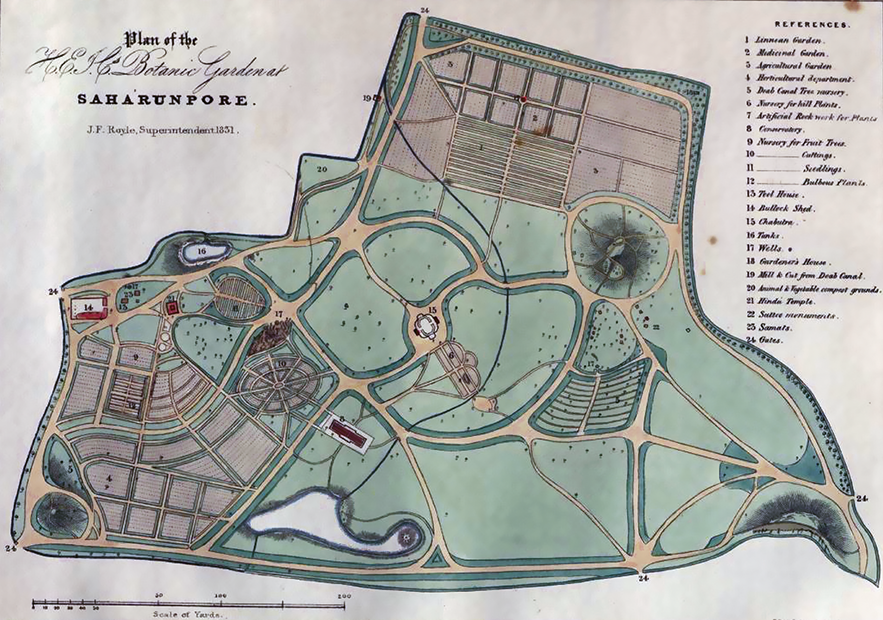
Illustration of the Cassia or Senna plant, from Royle, J. Forbes. Illustrations of the Botany and Other Branches of the Natural History of the Himalayan Mountains: And of the Flora of Cashmere by J. Forbes Royle. Vol. 1, Wm. H. Allen, 1839. https://doi.org/10.5962/bhl.title.449.
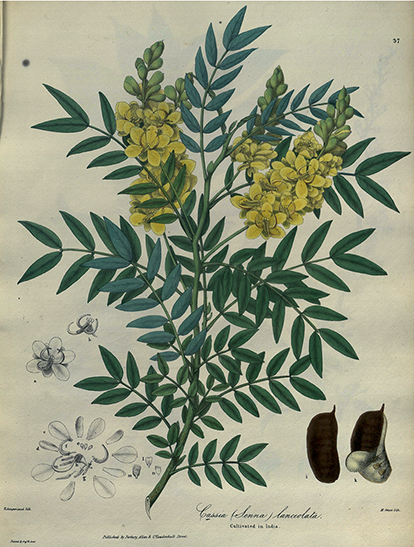
With a focus on the geography of plants, the Illustrations was undoubtedly influenced by Alexander von Humboldt’s work on South America. Royle’s Illustrations was much more than a catalog of plants; it was also a treatise on the influence of climate and altitude on plant distribution, containing suggestions of the historical relationship and contemporary similarities between “European” and “Asian” species. It also incorporated Royle’s interest in the history of Indian materia medica, giving not only a geography of plants but also a historical record of local plant knowledge. For example, it contains an index of plants mentioned in the work that are also mentioned in Persian and Arabic sources (together with the name in Latin and Arabic).
In 1835, Royle was involved in the Royal Asiatic Society’s push to gain public funding (if not also the Company’s museum), and he was the driver behind the Society’s new “agricultural committee.” In 1837, Royle took up the post of professor of materia medica at the new King’s College in London. His first set of lectures were on the “Antiquity of Hindoo Medicine” in which he explored the history and properties of common medicines found in the bazaars of North India.Footnote 52 When, in 1838, Royle was also hired into India House as the first Reporter on the Products of India, his new office was, at first, devoted exclusively to botany (and was sometimes then referred to as the “botanical office” at India House).Footnote 53 According to Company surveyor T. B. Jervis, both Royle and Wilson were of a new generation that saw the Company’s science as particularly “muddling” and “unsatisfactory” with “no practical utility.”Footnote 54 From this time onward, the trajectory of Royle’s work turned sharply toward investigating economically significant natural resources and making the Company museum better serve the needs of British industry and the interests (as understood in Britain) of Indian trade and agriculture. Biogeography – understanding what kinds of plants would flourish under which climatic and soil conditions – was, for Royle, the critical starting point for any plantation or agricultural experiments. After his biogeography of the Himalayas, his publications turned sharply toward economically significant topics, including a survey of the “productive resources” of India, a manual of materia medica, several books on cotton cultivation in India, a catalog of Indian woods for craft and manufacturing, and a catalog of the “fibrous plants” of India, for use in making rope and cord.Footnote 55 Each addressed a pressing natural resource issue of the time. British manufacturing had become hugely dependent upon American cotton produced by slave labor, exposing the British economy to a potentially crippling weakness should the abolition movement succeed in America or should a war break out with the former colony. Wood for manufacturing, ships and furniture was in high demand, and supply concern would lead to the Company’s first forest protection laws.Footnote 56 Cordage was vital to shipping, and Britain relied significantly on imports from Russia, an uneasy situation given the accelerating expansion of the Russian Empire in the 1840s leading up to the Crimean war.Footnote 57
It is important to stress that, at the time, in practice, there were always deep institutional connections between “economic” botany, biogeography and the philosophical natural history explored in Chapter 5. For example, Royle’s office was an important resource for Darwin in the years leading up to his Origin of Species. In the audience at Royle’s Royal Institution lecture in 1838 was the young Charles Darwin, who had just returned from his voyage on HMS Beagle, and who had written to Royle to introduce himself a few weeks before the lecture.Footnote 58 Some of Darwin’s thoughts on the lecture are recorded in his notebooks, where he notes Royle’s argument that “Botanical Provinces will turn out not nearly so confined as now thought” and takes down the evidence presented of similarities in certain genera across continents and vastly different geographies.Footnote 59 The year before, Royle, as secretary of the Geological Society, had worked with Darwin on one of Darwin’s earliest publications for the Society’s journal, on coral formations and points of elevation in the Pacific.Footnote 60 The two remained in correspondence through the 1840s. Darwin also corresponded with others associated with India House, including Horsfield, Edward Blyth (the former curator of the ASB’s museum) and the surveyor and paleontologist Hugh Falconer.Footnote 61 But it was Royle to whom Darwin most often turned for answers to natural historical questions regarding India, evidence of how the Office of the Reporter on the Products of India sat at the intersection of economic botany and philosophical natural history.
Royle’s office was an important resource for Darwin. He enquires about, among other things, a map of coastal elevations that appears in the Calcutta journal Gleanings in Science,Footnote 62 who he should send some unusual seeds toFootnote 63 and if he could borrow copies of a journal published in India, the Transactions of the Agri-Horticultural Society of India. Regarding the latter, Royle was unable to loan it at the time (he seems to have been using it during preparation of a report on cotton), so the courier Darwin had sent returned empty handed.Footnote 64 A few months later, however, Royle comes through and offers to lend it to Darwin, to which Darwin replies and promises: “I will take the greatest care of this valuable work and will return it as soon as I can.” Darwin also immediately asks whether Royle could provide him with another work, “Blacklock’s treatise on sheep” (which Royle had cited in his Essay on the Productive Resources of India regarding sheep-breeding in India).Footnote 65 Upon returning the Transactions, Darwin writes to thank Royle, discussing what he learned of the varieties of domestic animals and plants common in India. He is disappointed to have learned that experiments in introducing new varieties to India are so recent that the effects of climate are unknown. But, in an indication of the moral and scientific value British naturalists placed on the work of Company science in India (as well as Darwin’s desire to stay on Royle’s good side), he closes by expressing his “delight and astonishment” at “the energetic attempts to do good by such numbers of people & most of them evidently not personally interested in the result. Long may our rule flourish in India. I declare all the labor shown in these Transactions is enough by itself to make one proud of one’s countrymen.”Footnote 66
Club and society business also brought Darwin and Royle together. On one occasion, Darwin mentions that Royle had discouraged him from accepting the post of secretary of the Geological Society. On another, Darwin solicited Royle’s support for the election of his brother Erasmus Darwin into the Athenaeum Club. At the foundation of the reformist Philosophical Club of the Royal Society, Royle invites Darwin to join (Darwin, noting with regret he “cannot often dine out,” declines, though he does give his enthusiastic support for the new venture).Footnote 67 Behind Royle’s back, however, Darwin displays a touch of the elitism sometimes directed at salaried medical men and overseas naturalists employed by the Company. To his friend Joseph Dalton Hooker, the botanist son of Kew director William Jackson Hooker, Darwin writes that he is reading Royle’s work on the Himalayas “& I have picked out some things which have interested me, but he strikes me as rather dullish & with all his Materia Medica smells of the Doctor’s shop. I shall ever hate the name of Materia Medica, since hearing [Edinburgh professor Andrew] Duncan’s lectures at 8 o’clock in a winter’s morning – a whole, cold, breakfastless hour on the properties of rhubarb!”Footnote 68
Hooker, for his part, also often references Royle (and sometimes Horsfield) as sources he might have access to in his correspondence with Darwin.Footnote 69 This was especially true, unsurprisingly, during his trip to India in the late 1840s. More surprisingly, Hooker, who, as future director of Kew, often belittled the work of naturalists working in the colonies, displayed some humility with respect to the challenges facing European naturalists in India: “I am perfectly bewildered by the number of facts hourly thrown before me whose importance I can scarce appreciate from my ignorance of Indian Nat-Hist. & all I can do now is to attempt to collect those relating to the larger or more common animals.”Footnote 70
From the Great Exhibition to the Great Rebellion
By 1850, the India House museum was displaying all kinds of new material that had arrived in the wake of the wars of the 1830s and 1840s. A London guidebook from 1851 was particularly impressed by some of the plunder from the recent Anglo-Nepalese war: “a copy of the great cyclopedic aggregate of Tibetan literature, contained in upwards of 300 large oblong volumes, printed with wooden blocks on the paper of the country. There is but one other set of this work in Europe – in the National Library of France, both having been procured by Mr. Hodgson when political resident at Nepal.” Other newly acquired loot and purchases mentioned by the guide include some of Charles Masson’s covert grave-robbed antiquities from Afghanistan (“reliques and curiosities found in the Topes of Afghanistan”). The guide also highlights some of the more spectacular items that had now been on display in India House for nearly fifty years: the huge silk lanterns from China; the large cuneiform tablet from near Baghdad, still undeciphered; a large collection of ancient sculpture from central India (“Hindu idols”); jade and rock scenery carvings from China (“handsome models of the Chinese beau ideal of country village life”); weaponry and musical instruments; and Tipu’s tiger, as well as a treasury of rare and valuable Qurans, “some owned by kings, some miniature copies, very ancient ones dated to the seventh century … many belonged to the library of Tipu Sultan, having been presented to the Company’s library by the captors of Seringapatam.”
The passages leading between the original library and museum were now lined with dresses, fabrics and ornamentation, “some of Indian, some of Malay or Javanese, and some of Abyssinian origin,” as well as “models of boats and instruments of various kinds,” not only the ones commissioned from Margaret Tytler, but now many more scale reproductions of scenes, figures and, in the case of the cosmopolitan city of Lahore, an entire city. Into the natural history display rooms, new “Abyssinian material” – collected on the recent military foray into Abyssinia – is also highlighted, as well as the “very extensive and complete” ornithological collection and the “remarkable” entomological collection, which, like the manuscript collection, is judged “unrivalled.”Footnote 71
Last but not least was the transformed Pay Office on the ground floor, into which all of the items too large or heavy to be taken upstairs were placed. Here the guide describes “more miscellaneous variety of objects”:
Hindu images and specimens of sculpture, a state palankeen [palanquin] and elephant seat and trappings captured at Bhurtpore, Chinese lanterns, a model of the car of Jagannath, and of one of the bhaulis or large wells of Hindustan, and a well-preserved series of the cases enshrining an Egyptian mummy [and] … a collection of eastern Mammalia, and one of Indian fishes.
But the main feature of the large new gallery was the collection of fossils from the Siwalik Hills, “presented partly to the British Museum and partly to the museum of the Company … the most striking object is a cast of the restored shell, upper and lower, of the gigantic tortoise, made up of fossil bones actually found and divided between the Company’s and the British Museum.”
Despite its growth and expansion, however, in 1851 the library and museum at India House was, for the first time, not the place to see the largest collection of materials on Asia in London. For that, the public would have to go to the India Section of the Great Exhibition of the Industry of All Nations, which ran at the purpose-built Crystal Palace from May to October. First conceived by the Society of Arts as a way to boost the quality and range of British manufactures (and to become more competitive with the high-quality production of France, which had a tradition of industrial exhibitions), the idea of an industrial exhibition in London was welcomed by the Board of Trade and the Company, whose chairman, Sir Archibald Galloway, served on the planning commission (as did Francis Edgerton, president of the Royal Asiatic Society).Footnote 72
View of part of the India Section of the Great Exhibition in 1851, showing samples of horn, skins, furs and other materials of interest to manufacturers. Between these displays, in the background, the more famous elephant howdah and other spectacular works are visible. From an illustration by Joseph Nash in Comprehensive Pictures of the Great Exhibition of 1851, Vols. I and II: From the Originals Painted for His Royal Highness Prince Albert. Dickenson Publishers, 1854.
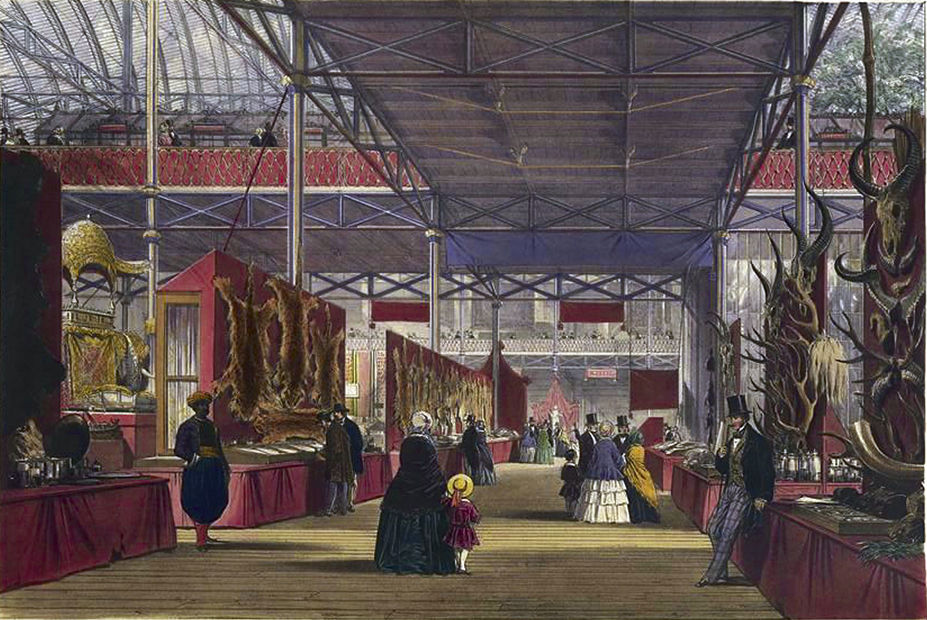
Royle was the critical point of connection between the two. Royle published prodigiously, but he had a much greater impact as a curator and promoter of industrial exhibitions. He was the head of the India section (General Commissioner and Keeper for India) and, as an authority on botany and materia medica, was also given the supervision of two classes of the British section: “Substances Used as Food” and “Vegetable and Animal Substances.” Royle’s vision for the Exhibition of 1851 was to boost Britain’s manufacturing quality and therefore its export trade (see Figure 7.4). The Exhibition, it was hoped, would stimulate innovation by presenting the world of manufacturing materials, techniques and raw materials to the widest possible audience in the most efficient way. From Royle’s perspective, the particular challenge of matching British factories with Asian suppliers was of massive political and economic significance, and the Great Exhibition would, he believed, be the start of a new era for the Indian supply of raw goods for British industry.
But Royle’s was only one vision for the Great Exhibition, and his aims did not go unchallenged. Priti Joshi has traced the processes through which collections were formed in the colonies to be exported, and revealed yet another part of the Exhibition that took a different direction than the planners had imagined. Most importantly, Joshi has shown how dependent were Royle and the London organizers upon the decisions and designs of the local organizing committees, which in many cases were composed of both Indian and British gentlemen. One Anglo-Indian newspaper closely reported on the preparations, and the coverage reveals the diverging visions of what kinds of materials should be sent to represent a region. Royle had widely distributed what the Friend of India (1850) called an “enormous list of articles.”Footnote 73 As might be expected from Royle, the list was heavy on raw materials (plant, animal and mineral) and also asked for samples of manufactures produced with those materials. One report praises the list but worries it does not do enough to distinguish “purely Indian” productions. But just what should represent “purely Indian” productions is up for debate, as when, a few months later, one organizing committee in Bengal submitted its items and the same paper reacted with dismay. The committee had selected many luxurious items produced specifically for the exhibition, such as carved-ivory chairs, jewels, cashmere shawls and a cushion embroidered with the names of Victoria and Albert in diamonds and pearls. The Friend complained that “none of these articles are exactly calculated to display either the resources or peculiarities of India. Indeed we would rather that these magnificent presents had not been sent, as they will tend to revive the old assertion – not yet extinct – that India is land where gold and diamonds are the most common specimens of the mineral world.”Footnote 74 The same pattern repeated itself all over British India, from Bombay to Singapore. Organizing committees, usually made up of a mix of government employees, prominent merchants, civic leaders and educators, were hugely successful in collecting materials to be forwarded on to London. The small port city of Singapore, whose organizing committee included prominent merchants Tan Kim Seng and Syed Omar, contributed 663 items, all shipped tariff-free as with all contributions to the Exhibition.Footnote 75
The end result was a much larger and more eclectic collection than perhaps Royle had expected. Virtually all of the categories that Royal had suggested for collection were well represented in the final exhibition (although not always from the regions that Royle had suggested samples be provided from). However, these were not displayed, as had been the original plan, according to type rather than region, so that, for example, samples of raw cotton from all over the world could be compared side by side. Instead, largely due to time constraints, the exhibitions were organized into regional displays. Furthermore, artisanal luxury items such as jewels, thrones and extravagant textiles were also much more strongly represented, and it was this vision of the opulent orient that garnered most of the press and public attention. Still, for Royle, it was a great success, most importantly as the beginning of, as one commentator put it, “a great transformation in Education.” The Exhibition had convinced many, Royle believed, of the social, economic and scientific significance of a new biogeography. As he put it:
I could almost hope that the time is come, or very nearly so, in which knowledge of natural subjects should be considered a part of general education, and that what is called the study of geography be connected with a general knowledge of the soils, the climate, the plants and the animals of the different regions of the globe, and not be confined, as it often is, to boundaries, to the heights of mountains, the lengths of rivers, and to the bare enumeration of places. Some of the improved views, now entertained on such subjects, must be ascribed to the discovery that so many made of their own ignorance at the Great Exhibition of 1851, which in this, as in so many points, will continue to be, as it has already been, of immense benefit both to producers and consumers in all parts of the world.Footnote 76
Whether or not the Great Exhibition had such a wide effect on geographical thinking, it did result in some radical changes to the Company’s museum spaces in India House. One set of changes was connected to the fact that the scale of the accumulated India donations went well beyond what Royle had imagined. The Company’s warehouses in New Street were modified to enable storage of the articles as they arrived for the Exhibition.Footnote 77 And a radically successful new self-funding mode of accumulation was born. After the Exhibition, the materials were to be auctioned to cover expenses and create a fund for future exhibitions. Before the India materials were auctioned, Horsfield and Royle were permitted to make selections from the exhibition material for the India House collections that remained at the New Street Warehouse:Footnote 78 “In making this selection I have confined myself … to such objects as are in accordance with the primary concerns of the museum, namely: native weaving & apparel; native shipping; figures in clay illustrating the native costumes and trades; native musical instruments; and miscellaneous articles illustrating Indian Ethnology.”
Materials were also donated to a dozen other institutions, and the remainder was auctioned off in June 1852. In that year, the Company also donated over 120 items related to arms, armor and military history to the newly opened Asiatic Room in the Tower of London.Footnote 79 It is worth noting that this seems to be one of the first times Horsfield used “Ethnology” in describing the museum’s collecting interests. Both textiles and musical instruments already had designated gallery spaces, and ship models had also long been collected, but other scale model collections (aside from those Margaret Tytler had commissioned) were only now starting to take up more museum space. From 1851 onward, the focus of the museum would indeed take a strongly “ethnological” turn, but in a way that was directed as much to British manufacturers, who were interested in items of dress and decoration from a commercial vantage, as to the small but growing profession of ethnological science. It is unclear how much, if any, of this material from the Great Exhibition was put on display at that time. Both storage and display space were tight. Horsfield’s request for dry cellar space in the basement of India House to store museum specimens was denied.Footnote 80 At the same time, the New Street Warehouse, where many records were stored, was dealing with a serious rat infestation and new record and book storage space was being installed in the attic and the basement.Footnote 81
It is possible that the popularity of the Great Exhibition, and the Company’s very visible role in it all, helped smooth Company–state relations in the next charter renewal season of 1853. The subject of raw material supplies for British manufactures received a great deal of attention. Now Royle was called in to testify, giving precise and technical reports on topics such as the difference between long-staple American and short-staple Indian cotton, the problem of adulteration in Indian cotton exports, the state of Indigo farm financing around Bombay and ongoing experiments in growing American varieties of cotton. In addition to cotton and indigo, Royle was also asked to report on the progress of the relatively new tea plantations in the north of India, on the prospects of mass production of chinchona and on the sourcing of rope-making fibers such as hemp and flax from India. These were all areas in which British industrialists and politicians worried about global supply chains. It was often Royle’s job to not only report on British India’s current ability to supply raw goods need but also defend the Company’s historical efforts to supply such materials.
The role of museums in colonial relations was also still very much on the minds of legislators. The state of museums in British India was part of the much larger review of the state of “native education” in the wake of the new education laws passed in 1835 that codified T. B. Macaulay’s Anglicist model for the colonies. The tone of the reporting on the state of Indian education is generally self-congratulatory. As a summary from the statistical office at India House put it in 1853: “In its attempts to introduce and extend the pursuit of the higher branches of sound and useful learning the Government may be regarded as completely successful. Every year will add something to the evidence of its success.”Footnote 82 In the previous two decades, the Anglicist model of education – European literature, philosophy and science taught in English – had taken hold on the subcontinent: “English is now the classical language of India,” noted the same report approvingly.Footnote 83 Annual expenditure on education had increased from the £10,000 required of the Company in 1813 to “between £70,000 and £80,000 per annum.”Footnote 84 And a new examination system for native entry into the civil service had been established throughout the presidencies.
During the 1853 charter debates, once again, Haileybury and the directors’ control over the patronage came under severe questioning. Macaulay and others, again, advocated for opening British entry to the Indian civil service to competitive examination rather than continuing to allow the directors to hand-pick the incoming classes to Haileybury. At first it seemed that the Company’s control of the patronage and the Haileybury system would survive intact. The new charter of 1854 kept Haileybury open. However, instead, six months later, at the request of the Board of Control, Parliament would move, without debate, to close Haileybury for good. Two developments were behind the rapid reversal of Haileybury’s fortunes. The first was the successful lobbying by established universities, particularly Oxford, for the charter of 1854 to be amended to include a clause that allowed the Board of Control to decide upon the conditions of admittance to Haileybury. Although the Board might then allow the current director-controlled system to continue, it also opened the door to the possibility of introducing a system of admittance based on competitive examination. And, depending on the nature of the examination, this could be a major boon to British universities. Although there were only about forty Indian civil service entry-level positions per year, it was expected that many hundreds would apply, and, if an entrance exam required the kind of knowledge obtained at university, all of those applicants would be coming from British universities, giving a significant financial and social boost to the university system overall. As Benjamin Jowett, a tutor at Balliol College Oxford, and one of the campaigners, would put it in a letter to William Gladstone, member for Oxford, in July 1854:Footnote 85
I cannot conceive a greater boon which could be conferred upon the University than a share in the Indian appointments. The inducements thus offered would open to us a new field of knowledge: it would give us another root striking into a new soil of society: it would provide what we have always wanted, a stimulus reaching beyond the Fellowships, for those not intending to take [religious] orders: it would give an answer to the dreary question which a College Tutor so often hears asked by a B.A. even after obtaining a first Class & a Fellowship: “What line of life shall I chose, with no calling to take orders & no taste for the Bar & no Connexions who are able to put me forward in life?”
Importantly, the British civil service was, just at this time, also undergoing a review that was considered likely to result in the institution of a competitive examination, and the old universities, in particular, were looking to civil service examination in general as another “root striking into a new soil of society,” as Jowett called it.
The second development was a report on Indian civil service training and education, commissioned immediately after the completion of the new charter. T. B. Macaulay led the commission and was the primary author. Not only did Macaulay make the case for competitive examination but he also proposed a curriculum and structure for the examination process that essentially required a liberal arts B.A. as preparation. Here, Macaulay returns to his well-known arguments in favor of a classical liberal education as the best preparation for India service: mainly because of the value for “higher order thinking” of an education that can “open, invigorate, enrich the mind,” but also because of what, Macaulay assumes, are the limited educational resources for British officers once in India.Footnote 86 Macaulay therefore details a preliminary Indian civil service entrance exam that is heavily devoted to “liberal arts,” with only a small portion of the exam covering Sanskrit and Arabic. Jowett was also a member of the commission, and the report also echoes Jowett’s giddiness at the thought of how the change could energize British universities:Footnote 87
It is with much diffidence that we venture to predict the effect of the new system; but we think we can hardly be mistaken in believing that the introduction of that system will be an event scarcely less important to this country than to India …. We are inclined to think that the [new civil service exams] will produce an effect which will be felt in every seat of learning throughout the realm.
On Macaulay’s plan, the select students who succeed in these exams would then be given “probationary” admittance to the Company. The “probationers” would then be required, within a maximum of two years, to take a second exam dealing explicitly with subjects particular to the post (“Indian History, the science of Jurisprudence, financial and commercial science, the oriental tongues [vernacular languages]”).Footnote 88 The question then arose as to where the probationary studies would be taken: only at Haileybury, or at both Haileybury and other universities? Macaulay noted that, either way, Haileybury would have to be restructured and reorganized, given that entering students would now be mature postgraduates rather than seventeen-year-olds straight out of grammar school.
The Board of Control wholeheartedly adopted Macaulay’s recommendations. Haileybury could still have survived as the main training ground for the probationers. But rather than restructure the entire College, the Board of Control argued, the more economical path would be to close it altogether, devolving the orientalist training to other universities as well.Footnote 89 Eventually other schools devoted to the specialized education for the Indian civil service would be established, such as the Indian Institute at the University of Oxford (f. 1883) and eventually the School of Oriental Studies (f. 1916). With private funding, from the Crown as well as Indian elites and “many old Haileyburians,” the Oxford Indian Institute was well established with a new building on Broad Street near the Bodleian Library, complete with library and museum (now dispersed among other Oxford museums), and would be a center for Indian civil service training for many years.Footnote 90 Thus, in the face of both utilitarian meritocratic ideals and competition from the old universities, the Company’s lucrative control over access to civil service positions was finally and decisively undone.
In the same year that the closure of Haileybury was ordered, plans for a “New Museum” inside India House were approved by the Court of Directors. The Exhibition of 1851 would greatly accelerate of the Company’s move toward explicitly industrial exhibitions and a new understanding of public utility as fundamentally related to commercial utility. Soon yet another industrial exhibition would bring a new wave of donations. In 1854, the New Street Warehouse was again prepared to receive exhibition goods, this time items from Madras for the Paris Exhibition of 1855.Footnote 91 Royle was, again, the head of a major India section. And, again, the curators were able to pick and choose which donations would become India House property. This time, however, construction began on a “New Museum” within India House to house the items from the Paris Exhibition and other industrial exhibitions.Footnote 92 This would be a major expansion of the footprint of the display space at India House. With oriental architecture and a focus on models of life in India, samples of arts and crafts, and an extensive display of raw materials, a whole swath of the interior India House was remade in the image of the Great Exhibition (see Table 7.1, Figure 7.5 and Figure 7.6). The design and expense of these new spaces, which materially and symbolically overwrote old unused spaces, such as the Tea Sale Room that had formerly been at the heart of the Company’s operations, expressed a confident realignment of Company science at India House with the political and public expectations of imperial exhibition and display.
|
|
|
“1852 May 25th Received from Mr Downing the under mentioned articles being portions of the Hon Company’s Collection from the Exhibition for deposit in the Museum as Order of Committee” (BL MSS EUR F/303/7).
The new museum opened under politically desperate circumstances. After months of flashpoints of conflict within the ranks of the Company’s vast Indian army, the first large-scale troop mutiny began at Lucknow in May 1857. The rebellion roiled the northern and central regions of the subcontinent for over two years; the large battles had ended after the Battle of Gwalior in May 1858, but peace was not formally declared until July 1859. At the height of the conflict, the Company’s “New Museum,” as it was called, would open its doors. It had been designed and promoted by Royle. It would open sometime between November 1857 and January 1858. Royle only just got to see it finished; he died in January 1858. Horsfield took over the domain of the New Museum as well, but not for long. In August of that year, Queen Victoria signed a bill transferring the administration of British India from the Company to the Crown.
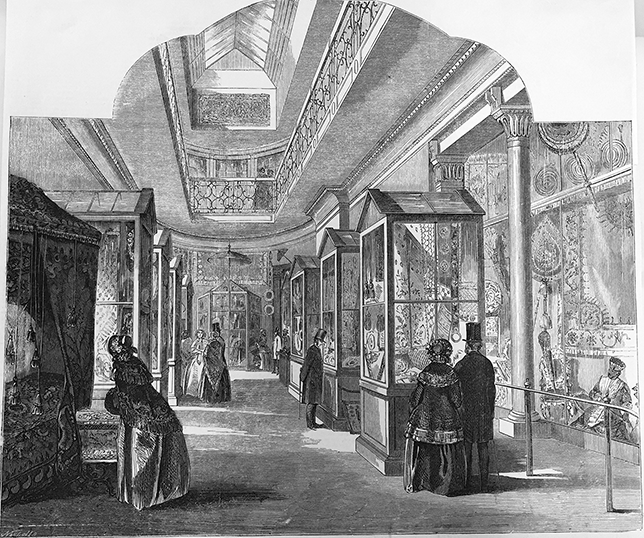
A visitor might begin a tour of the Company’s New Museum at the new dedicated public entrance, passing under the portico and turning right. This led to a lofty horseshoe-shaped ground-floor gallery (see Figure 7.6). The ground floor was lined with towering glazed cases, reaching nearly to the double-height ceiling. The cases were “filled to overflowing with models” – most, apparently, still without labels – hundreds if not thousands of miniatures, usually made of wood or clay but sometimes ivory or semiprecious stones. The subjects ranged in every direction: famous buildings, manufacturing machines and implements, tools for agricultural production, public works, temples, towns and cities. There were models of modes of transportation – palanquins, carts, wagons and dozens of different boats. There were also models of people working at dozens of different tasks – planting, spinning, weaving, barbering, cooking, snake-charming – and of marriages, religious ceremonies, legal proceedings and military exercises. There were model households depicting the comfortable lifestyle of the wealthy classes.Footnote 93
The new gallery in the old tea sale room, transformed by W. Digby Wyatt in an orientalist style.
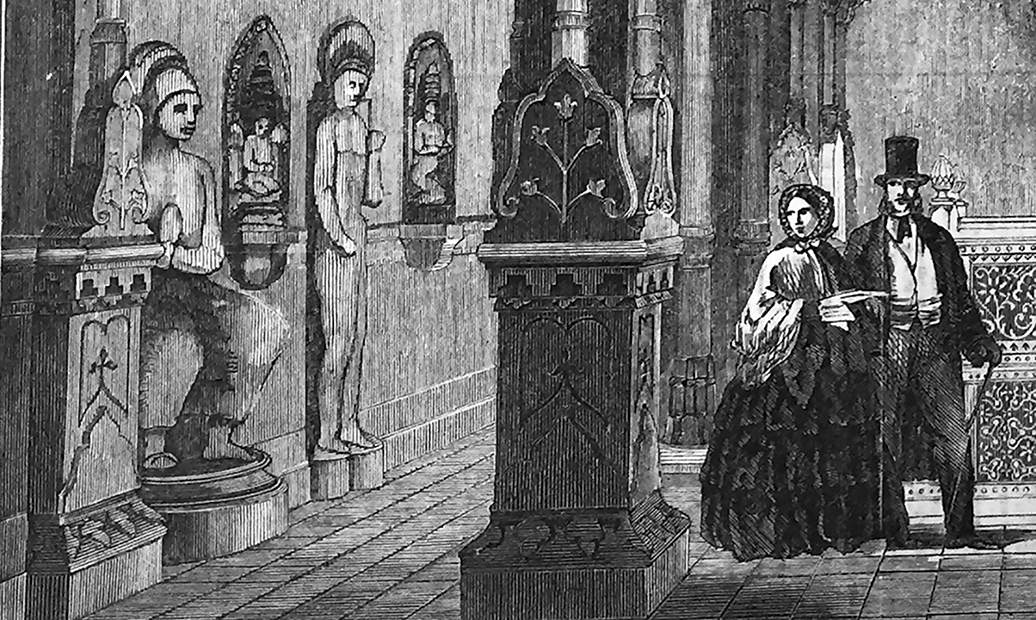
To a public now thoroughly familiar with live exhibitions, panoramas, dioramas and other spectacles on offer in the metropolis, this strange archive, these shelves upon shelves of miniature abstractions of Indian society, may have been less than overwhelming.Footnote 94 Despite Royle’s hopes, the extensive display of raw materials and products made from them – thousands upon thousands of samples – may also not have left much of an impression.
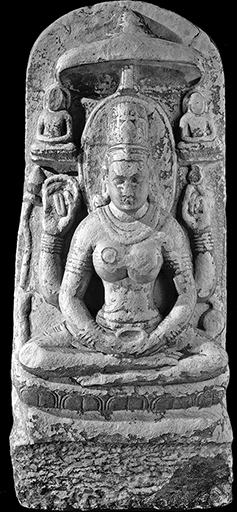
But it wasn’t only this utilitarian encyclopedia of economic opportunity that was carried over from the Great Exhibition into the New Museum. The exoticism and spectacle was just across a hallway and through another wide, large set of doors. Upon entering the former sale room (see Figure 6.2), the experience turned dramatic and sensorial. One of the largest open spaces in India House was now transformed by Matthew Digby Wyatt, secretary of the Great Exhibition and the Company’s surveyor, into a mock “Indian Court” or “Mosque,” the interior remade by rows of delicate columns and archways, the walls lined with innate carvings and stone screens (see Figure 7.5). This space was one of the earliest in a coming wave of “orientalist” architectural design – and Wyatt would become a leader in the genre – so much that an architectural trade journal recommended that any serious student of this style make a pilgrimage to the New Museum.Footnote 95 The curators referred to this new space as the “sculpture gallery,” and in it were placed five large sculptures from Amaravati in southern India that had been collected by Mackenzie and sent back to Britain by Wilson in 1827 (see Figure 7.7).Footnote 96 As the gallery opened, ninety additional sculptures and fragments (the so-called Elliot marbles) from the Amaravati tope were in transport from Madras and destined for the new museum. (By the time they arrived, it was clear the Company was on track to being disbanded, so the sculptures were moved to an old shed at Fife House, where they sat unprotected for nearly a decade.)Footnote 97 But there were also paintings and furnishings such as thrones and palanquins, and soon Horsfield would begin adding other quite different kinds of material. By the summer the walls were also hung with the ghost-white masklike face casts of living subjects recently made by the Prussian explorer-adventurers the brothers Schlagintweit during their covert exploration of the northern territories.Footnote 98
The transformed secretary’s apartment for the new museum at India House. Illustrated London News, March 6, 1858.
Carving from the temple or stupa at Amaravati. Sculpted panel in limestone carved with the goddess Cundā. Intended for the expanded museum at India House, the Amaravati materials arrived just after the Company was dissolved, so became part of the collection at Fife House, next to the new India Office. Now at the British Museum.
Despite the oriental spectacle, however, the real draw to the New Museum was the ongoing rebellion in India. Those periodicals that covered the opening of the New Museum generally didn’t fail to point out that, as Christian weekly Leisure Hour would remark in 1858, “recent events” had brought new interest to such a visit. The India House museum gained much more attention in the context of the rebellion, and the public gaze as reproduced in the periodical press took a harsher view of both the “India” they were being presented with and the Company under whose watch the rebellion broke out. The Journal of the Royal Geographical Society was relatively sanguine when it mused that “Dreadful as the recent much-to-be-deplored events in India have been, they will probably bring great advantages to the human race: India will be more entirely ours, and the progress of Christianity and civilization more certain and rapid.”Footnote 99 Harsher were, for example, commentaries in The Builder, imagining the colossal elephant statues of the Delhi Royal Palace standing at the entrance to a London park, and advocating for a large-scale looting of India along the lines of Napoleon in Egypt (“If ever there was a time when we might justify the removal … of works of art from India is it not now?”).Footnote 100 Although those statues remained, the scale of looting and plundering in the Siege of Delhi during the rebellion was indeed unprecedented.Footnote 101
The opening of the New Museum was but one expression of the Company’s confidence in its knowledge resources and management in the period just before the rebellion. After the rebellion, administrators and observers were thrown into an information panic, as Christopher Bayly has put it, and the whole rebellion came to be seen as a great failure of political intelligence.Footnote 102 As with each of the charter renewal debates, the rebellion spurred an anxious reevaluation of the state of British knowledge of its colonial possessions. But now facing an unprecedented crisis of authority, the anxiety ran much deeper. The underlying assumption was that governance is a problem of knowledge, and the more complete or useful or accurate the knowledge, the stronger and more effective the governance. The cause of the rebellion was often diagnosed as a lack of knowledge on multiple fronts: ignorance on the part of Indians about the aims and intentions of English rulers; ignorance on the part of English people about the beliefs and experiences of Indian people. Part of the expression of crisis now took the form of a reconsideration of just what kind of information is needed by a colonial state such as the Government of India.
Another, perhaps even deeper, concern was the failed promise of the utilitarian focus on spreading “knowledge” among the colonial subjects. The quite explicit plan to generate harmony among the colonized and their foreign rulers through a program of education in modern sciences, English literature, moral philosophy and Anglicist political and economic theory had not, it seems, had the intended effect. Sir Syed Ahmed Khan (1817–1898), a high court judge, political writer and supporter of the Empire, wrote in the Causes of the Indian Mutiny (1862) that, on the part of the British, “the loss of the acquaintance with the Vernacular which prevailed in the old days” was in part to blame. But Khan, a founding member of the Scientific Society of Aligarh and supporter of the Aligarh University, also argued for an expansion of education in “Western science” among Muslims as an inoculation against future clashes.Footnote 103 Critically, however, Khan stressed that if it is to play the intended role of aligning the people of India with their British government, the introduction of Western science and other education reforms cannot be an end in itself. They must be (as the utilitarian promise always held out) a step for Indians toward real, meaningful participation in government. The deepest cause of the mutiny, says Khan, was the barrier to Indian participation in the civil service, and no meaningful route to expanding self-government. In a similar vein, S. C. G. Chukerbutty (1824–1874), a prominent doctor (one of the first to be trained in the UK) and supporter of British rule, called the rebellion a war of “ignorance and fanaticism against knowledge and religious toleration, a war in which the educated native has as great a stake as any European in his country.”Footnote 104 He noted with pride that very few native doctors had joined the rebellion, but he also warned of the dangers posed at the same time by existing barriers for native entry to the Indian Medical Service and the dominance of “European opinions and interests” at the Calcutta Medical College.Footnote 105 This – the place of colonial scientific and educational institutions within the constellation of unresolved contradictions of British liberal imperialism – is the sense in which, according to Khan and others, the mutiny revealed a crisis of knowledge. Christopher Bayly’s conclusion is that – at least in terms of the broad category of political intelligence – Britain’s information-gathering practices had indeed, after the 1830s, changed character, with negative consequences for British rule in India. More was not better, and rationalization did not bring new clarity.Footnote 106
Caught by surprise by the Crown’s swift decision to abolish it, the Company organized its defense and John Stuart Mill and his office issued a Memorandum on the Improvements in the Administration of India during the Last Thirty Years, together with the petition to Parliament to reverse the Crown’s decision.Footnote 107 Here it is argued that the liberal imperial project of the last thirty years has – bar a few bumps such as the ongoing state monopoly on salt production – been more transformative than any other period in the history of the Empire. Mill draws a picture of a rapidly improving colony, covering everything from judicial and land reform to the establishment of police and prisons; the abolition of slavery and forced labor; the protection of oppressed races; the suppression of piracy, extortion, suttee and witchcraft; the establishment of medical schools, hospitals and clinics that now serve over half a million patients a year; the introduction of education at all levels of society from villages to the large metropolitan universities, including initiatives to expand female education; the improvement and extension of irrigation canals, transcontinental roads and railways; and the beginnings of the electric telegraph. Mention of the New Museum come near the end under “Miscellaneous Improvements” where the work of the “unrivalled” Dr. Royle is highlighted, and where the new “Industrial Museum” at India House is presented as evidence of “the accelerating” of the improvement of the productions of India.Footnote 108 Still, after unrolling this long list of “improvements,” Mill is compelled to end with a plea for leniency, given the great informational challenge inherent in being “a Government of foreigners, over a people most difficult to be understood, and still more difficult to be improved – a Government which has had all its knowledge to acquire, by a slow process of study and experience.”Footnote 109
*
We had thought there was really nothing left of the belongings of the old East India Company to be appropriated by the Imperial Government; but we are reminded by a rumor which has recently been in circulation that there is still something left of an Indian character to be fused into the general mass of Imperialism. It is even said that the old Museum and Library of the India-house are to be made over bodily to the gigantic establishment in Great Russell-street, there to become part and parcel of the national collections known by the name of the British Museum.
The New Museum at India House would have given space and resources for a new science of colonial trade and industry. Instead, in the wake of the rebellion, a much deeper reorganization of (what was formerly) Company science was now underway. Despite the rumors, the Company’s collections were not at first transferred to the British Museum. The Government of India Act of 1858 had abolished the Company and transferred administration of British India to the new India Office, located in Whitehall near the Foreign and Colonial Office. The library and museum were moved to a vacant building in Whitehall, Fife House, which was adjacent to the museum of the Royal United Services Institute, where many of the Company’s war trophies had already been donated. The remaining contents of India House were auctioned off – thousands of desks and bookshelves and hundreds of carpets, down to the mantelpieces and lighting fixtures – and in 1860 India House was razed.Footnote 110
The demolition of the Company and its headquarters, and the absorption of the Government of India into the British state, would mark the ideological, formal and material transfer of Company science to the British state. But although British India eventually became folded into Britain’s new “general mass of Imperialism,” most of the resources of Company science would begin to be spun off into other institutions; and although it was initially thought necessary to keep the centers of colonial science in close physical proximity to the Colonial Office, the razing of India House would also mark the beginning of an even more intense separation of certain forms of science from state administration. The abolition of Haileybury would lead to the absorption of orientalist training, civil service exam preparation and scholarship on Asia into Oxford and other universities. Likewise, the abolition of the Company’s library and museum would, over the course of another half-century, in a process deserving a separate study, lead to the absorption of the old Company’s knowledge resources and expertise by new, specialized museums and growing university departments. Under a new welding of public science and educational regimes to a consolidated imperial government, Britain’s growing dominance of the production of science within its empire would take new forms.Footnote 111
Initially at Whitehall, the small gallery space that Fife House provided was devoted to the material that had made up the new museum: raw materials and finished products. No longer would John Stuart Mill be passing rooms full of stuffed birds and pinned insects as he made his way to budget meetings.Footnote 112 Like his father James Mill, John Stuart strongly advocated for the value of centralization and consolidation of knowledge resources within metropolitan centers: “power may be localized,” he wrote in 1861, “but knowledge, to be most useful, must be centralized.”Footnote 113 Both across the Empire and within Britain, a new geography of science was emerging out of the rubble of the old India House. By the end of the century, however, the overlapping worlds of science, company and state had disaggregated. Orientalists, historians and naturalists who once worked side by side (if not always in harmony) at the Company had found new, separate homes in university departments that divided the natural and the social sciences. Only the administrator, now in pursuit of a newly redrawn domain of “political intelligence,” remained part of government. Likewise, the museum and library, which once contained under one roof materials ranging from historical manuscripts to cultural artifacts to natural history specimens, were broken up across other “national” museums: the British Museum, the Natural History Museum and the Victoria and Albert Museum, as well as the new India Museum in Calcutta. The separation of Company and state, and the remaking of Company science into public science, transformed the landscape of the sciences in Britain. What remained constant, however, was the steady accumulation of Britain’s global information resources, and the growing divergence between the scale of Europe’s information stores and those of its colonies.
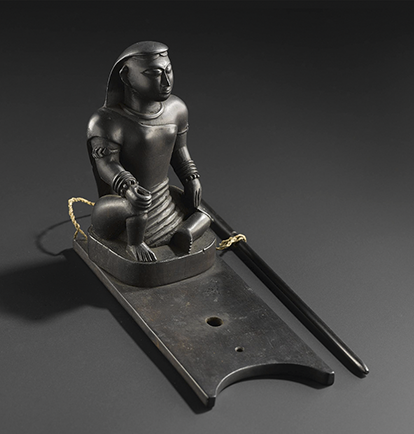
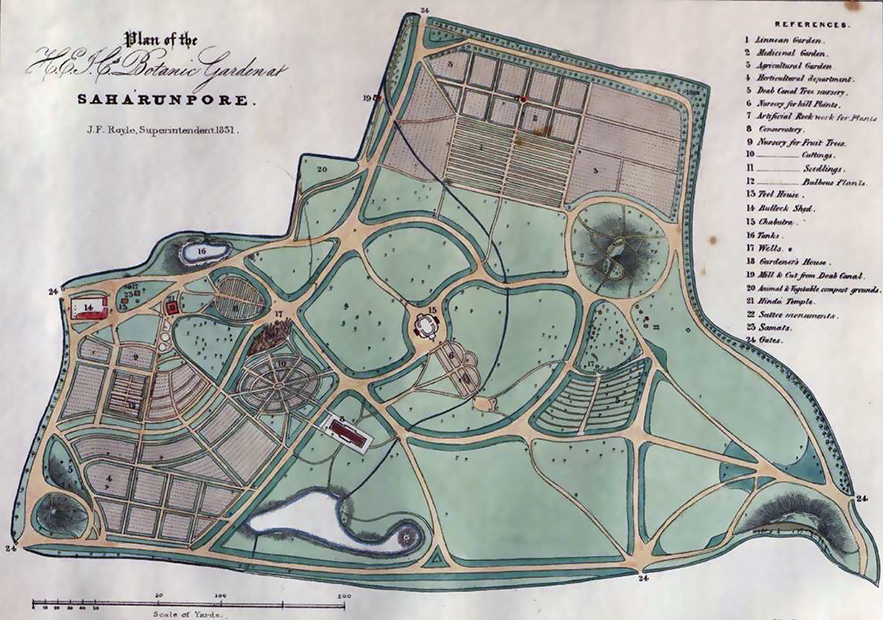
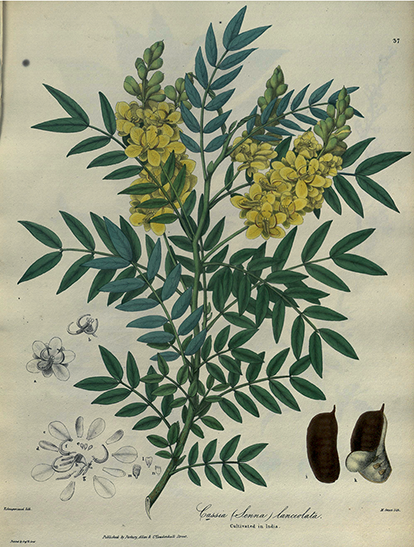
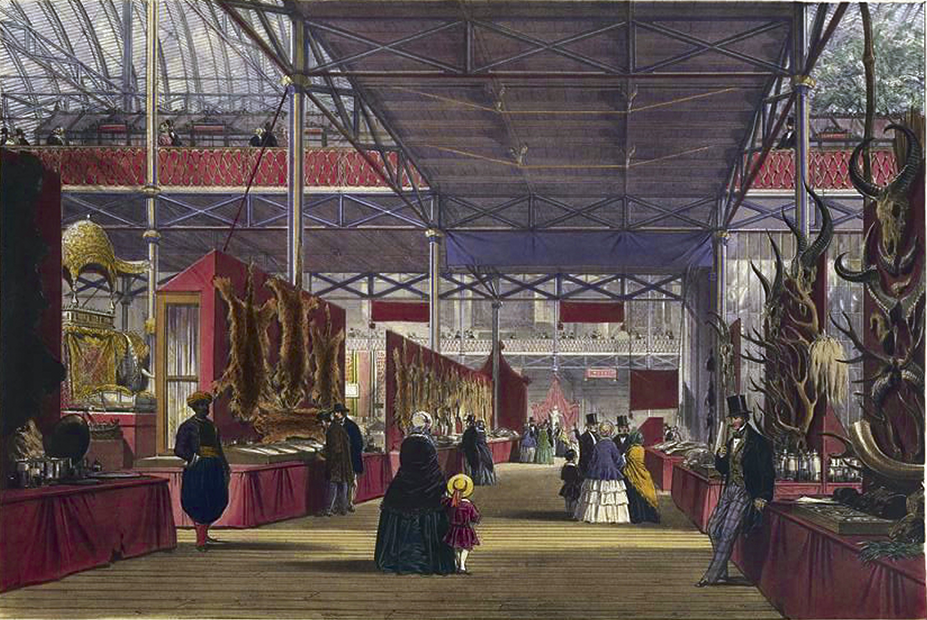
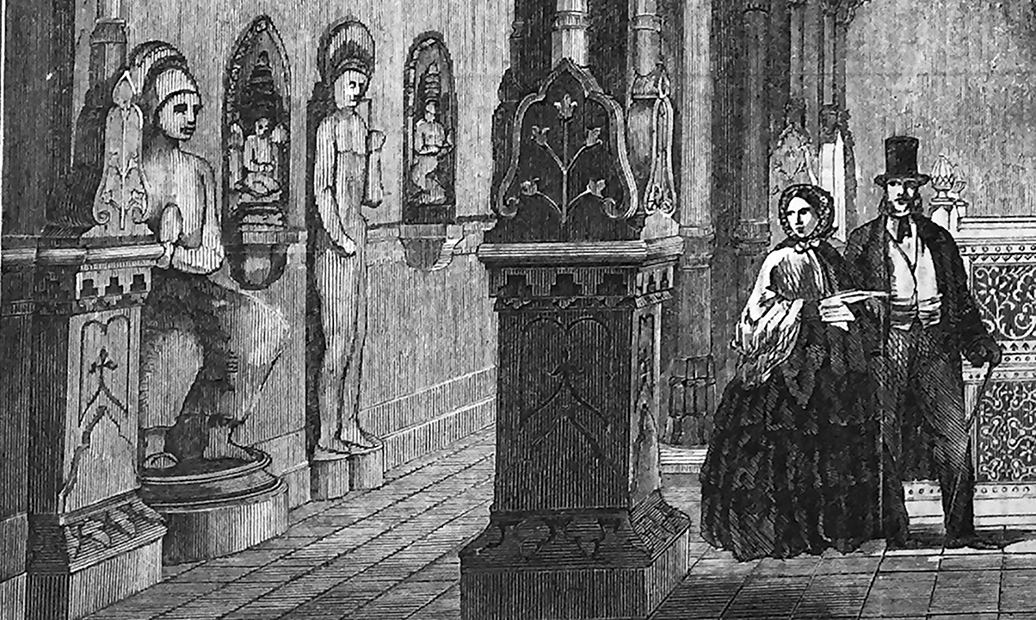
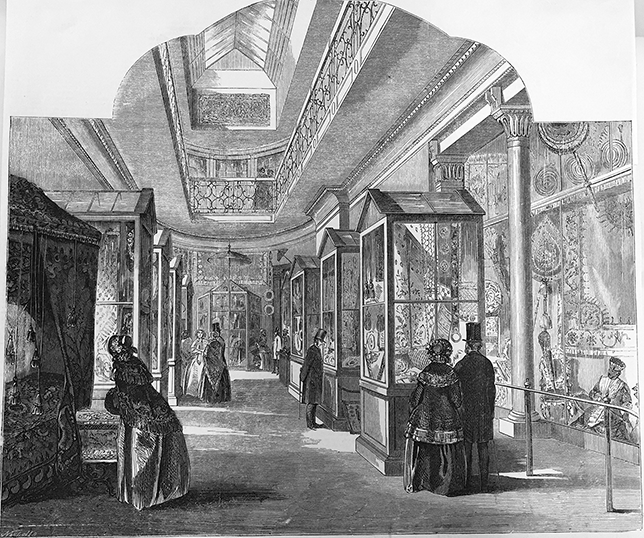
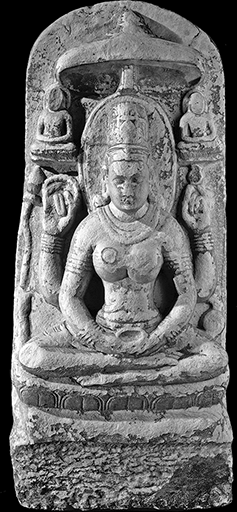

 Open access