

Introduction
In the literature on ecosystem services (ES), the cultural dimensions of ES remain less studied than ecological indicators and economic values (Martín-López et al. Reference Martín-López, Iniesta-Arandia, García-Llorente, Palomo and Casado-Arzuaga2012). As a result, the inclusion of these cultural dimensions in ES assessments used to support environmental management policies remains limited (Vihervaara et al. Reference Vihervaara, Rönkä and Walls2010). Resource management guidelines and policies, and the ES assessments on which they depend, should consider all types of ES, not only those valued by export markets (Martín-López et al. Reference Martín-López, Iniesta-Arandia, García-Llorente, Palomo and Casado-Arzuaga2012; Forsyth Reference Forsyth2015; Tadaki et al. Reference Tadaki, Allen and Sinner2015). A second aspect of ES assessments that is limiting is that they often do not consider the intergenerational dependence on ES. In addition to considering a wider array of ES, conservation policies and management should consider the intergenerational dynamics of livelihood dependence to devise recommendations in line with the historical and projected dependence on the multiple ES a resource provides (Chapman et al. Reference Chapman, Satterfield and Chan2019).
Despite the overwhelming focus on economic values and ecological indicators from the point of view of one generation, there is a limited but notable body of literature addressing the social aspects of ES and a second one investigating the temporal aspect of ES dependence. The first body of literature documents how communities perceive and value the contribution of multiple ES to their livelihoods (Martín-López et al. Reference Martín-López, Iniesta-Arandia, García-Llorente, Palomo and Casado-Arzuaga2012; Wieland et al. Reference Wieland, Ravensbergen, Gregr, Satterfield and Chan2016; Zheng et al. Reference Zheng, Li, Robinson, Liu, Ma and Wang2016; Robinson et al. Reference Robinson, Zheng and Peng2019; He, Gallagher and Min Reference He, Gallagher and Min2021). Most studies highlight how ES values or awareness vary by socio-economic and environmental factors and identify ES bundles and trade-offs (Martín-López et al. Reference Martín-López, Iniesta-Arandia, García-Llorente, Palomo and Casado-Arzuaga2012; Schmerbeck et al. Reference Schmerbeck, Kohli and Seeland2015; Hossain et al. Reference Hossain, Ramirez, Szabo, Eigenbrod, Johnson, Speranza and Dearing2020; Chettri et al. Reference Chettri, Aryal, Thapa, Uddin, Kandel and Karki2021). The second body of literature studies the temporal and spatial dynamics of ES dependence with the goal of landscape management and planning (Kallis and Norgaard Reference Kallis and Norgaard2010; Andersson et al. Reference Andersson, McPhearson, Kremer, Gomez-Baggethun, Haase, Tuvendal and Wurster2015; Plieninger et al. Reference Plieninger, Bieling, Fagerholm, Byg, Hartel and Hurley2015; Hossain et al. Reference Hossain, Dearing, Rahman and Salehin2016; Naudiyal and Schmerbeck Reference Naudiyal and Schmerbeck2018; Huq et al. Reference Huq, Pedroso, Bruns, Ribbe and Huq2020; Cejudo et al. Reference Cejudo, Acosta-González, Ortega-Camacho and Ventura-Sanchez2021). Andersson et al. (Reference Andersson, McPhearson, Kremer, Gomez-Baggethun, Haase, Tuvendal and Wurster2015) characterize the temporal scale of ES by whether their provision is constant, seasonal, or related to individual ecological events. Chettri et al. (Reference Chettri, Aryal, Thapa, Uddin, Kandel and Karki2021) document how communities in the eastern Himalayas perceived ecosystems changes that resulted from land use change over two decades. They stress the need for understanding changes in ES flow dynamics at the local level, as perceived by local people, before such understanding can be integrated with scientific knowledge to develop management policies and interventions that meet sustainable development goals. Most studies in that literature report descriptive statistics of ecosystem dependence measures, often across space and time (Naudiyal and Schmerbeck Reference Naudiyal and Schmerbeck2018; Huq et al. Reference Huq, Pedroso, Bruns, Ribbe and Huq2020). Few studies use regression analyses that identify associations of these measures with household characteristics (e.g., Robinson et al. Reference Robinson, Zheng and Peng2019). It is not possible to tell from these studies, however, whether and how ES dependence by current and future generations relates to dependence by previous generations and whether such relations vary across ES categories.
This study is motivated by the growing but limited literature on ES dependence. We contribute to this literature in two ways. First, we consider multiple ES, including cultural services and the more studied provisioning, supporting, and regulating categories. Second, we make a methodological contribution to ES assessments that considers the relationship of a generation’s dependence on ecosystems services with previous and future generations’ dependence on these services. Together, these contributions allow studying the intergenerational dependence dynamics for the different ES categories. Knowledge resulting from such research can be integrated into ES assessments to inform local conservation policies. It can also inform future economic research on ES, including non-market valuation and the optimal management of resources based on the full spectrum of ES it provides and the intergenerational dynamics of dependence.
We use a case study of the ivory palm in Ecuador to understand which ES are most important to the livelihood of harvester communities, how ecosystem livelihood dependence by the current generation relates to dependence by previous generations, and how it is projected to change for future generations. The novelty of the case study lies in assessing the dependence on 17 ES identified by local harvester communities and provided by the ivory palm, a near-threatened keystone species in Ecuador, Colombia, and Panama.
The ivory palm in tropical South America
The tropical regions of South America are biodiversity hotspots (Villalobos et al. Reference Villalobos, Dobrovolski, Provete and Gouveia2013). One such hotspot is the Chocó-Darien Forest. It is located along the Pacific coast in eastern Panama, western Colombia, and northwestern Ecuador. The region harbors one of the highest biodiversity concentrations and endemism globally and has been degraded by agricultural expansion (Fagua and Ramsey Reference Fagua and Ramsey2019). In western Ecuador, 98% of the original forest cover has been lost to deforestation, making it one of the most threatened moist and dry seasonal forests globally (González-Jaramillo et al. Reference González-Jaramillo, Fries, Rollenbeck, Paladines, Oñate-Valdivieso and Bendix2016). Despite being a threatened biodiversity hotspot, the traditional knowledge of local communities and their perceptions of the value of the local biodiversity and ES in the Chocó-Darien region remain poorly understood (Myers et al. Reference Myers, Mittermeier, Mittermeier, da Fonseca and Kent2000; Cámara-Leret et al. Reference Cámara-Leret, Copete, Balslev, Gomez and Macía2016).
The ivory palm (Phytelephas aequatorialis Spruce), locally known as tagua or cade, is an endemic palm from western Ecuador (Acosta-Solis Reference Acosta-Solis1948). It is a keystone species that is critical for the survival of other species in its ecosystem (Velásquez Reference Velásquez1998; Montúfar et al. Reference Montúfar, Brokamp, Jácome, Valencia, Montúfar, Navarrete and Balslev2013, Brokamp et al. Reference Brokamp, Borgtoft Pedersen, Montúfar, Jácome, Weigend and Balslev2014; Pincebourde et al. Reference Pincebourde, Montúfar, Páez and Dangles2016). The species is also essential for the harvester communities in western Ecuador that depend on the palm’s ES for their livelihood (Montúfar et al. Reference Montúfar, Gehrung, Ayala and Atallah2022). The best-known benefits of this species are its provisioning ES. Communities use the palm leaves and the endosperm of the tree as raw materials for various purposes. For example, communities use the palm’s broad leaves, known as cade in Spanish, to build thatched roofs (Brokamp et al. Reference Brokamp, Borgtoft Pedersen, Montúfar, Jácome, Weigend and Balslev2014). The endosperm of the fruit, known as vegetable ivory or tagua nut in Spanish, is used to produce several products, including substitutes for plastic (like microbeads, S.A Trafino, pers. comm.), handicrafts, jewelry, biodegradable packaging, and figurines (Bolongaro Reference Bolongaro2017; Brokamp Reference Brokamp2015; Montúfar et al. Reference Montúfar, Brokamp, Jácome, Valencia, Montúfar, Navarrete and Balslev2013). Among those products, the most economically significant is the provision of primary material used in the manufacturing of “green” buttons used by the garment industry in Europe and the United States (Barfod et al. Reference Barfod, Bergmann and Pedersen1990). At the end of the 19th century, tagua became Ecuador’s second-largest export product. The export of shelled tagua peaked in 1929 when 25,000 metric tons were exported, with a value of USD 1.2 million (USD 15 million in 2013 terms). Export volumes from the port of Esmeraldas peaked in 1929, 1934, and 1936, even during the Great Depression. They subsequently fell during and after WWII (Acosta-SolisReference Acosta-Solis1948) and have been variable recently. In 2011, Ecuador exported 2000 tons of premanufactured buttons valued at approximately USD 20 million. By 2020, the output had diminished to 365 tons and a value of approximately USD 3.5 million (S.A. Trafino, pers. comm.).
Ivory palms provide many non-market ES which have not been extensively studied in the literature, with a few notable exceptions (Koziol and Pedersen Reference Koziol and Pedersen1993; de la Torre et al. Reference de la Torre, Navarrete, Muriel, Macía and Balslev2008; Cámara-Leret et al. Reference Cámara-Leret, Copete, Balslev, Gomez and Macía2016; Montúfar et al. Reference Montúfar, Gehrung, Ayala and Atallah2022). One of these services is a supporting ES whereby the palm provides a habitat for wildlife and helps maintain biological diversity in its ecosystem as a keystone species (Montúfar et al. Reference Montúfar, Gehrung, Ayala and Atallah2022). In agriculture, the ivory palm provides many regulating services, like providing a habitat for insects that pollinate crops (de la Torre et al. Reference de la Torre, Navarrete, Muriel, Macía and Balslev2008; Pincebourde et al. Reference Pincebourde, Montúfar, Páez and Dangles2016). Finally, the palm provides cultural services by contributing to the identity of the communities and through its use for rituals and adornment (Cámara-Leret Reference Cámara-Leret, Paniagua-Zambrana, Balslev, Barfod, Copete and Macía2014; Cámara-Leret et al. Reference Cámara-Leret, Copete, Balslev, Gomez and Macía2016; Schneider et al. Reference Schneider, Cámara-Leret, Barfod and Weckerle2017).
There is currently no formal conservation strategy for the ivory palm in Ecuador. Since 1945 (after World War II), significant deforestation began on Ecuador’s coast, drastically reducing forest cover and, consequently, the wild populations of tagua (Dodson and Gentry Reference Dodson and Gentry1991). The large and dense tagua populations described by Acosta-Solis in western Ecuador in 1948 have been transformed mainly into commercial crop areas. Still, it is common to observe ivory palms left standing during forest clearing in some areas of western Ecuador, primarily for its marketed non-timber products such as the nuts and the leaves (Brokamp et al. Reference Brokamp, Borgtoft Pedersen, Montúfar, Jácome, Weigend and Balslev2014). One of the drivers of this decline is the prioritization of economic development over species conservation by land and forest management planning (Sierra-Maldonado Reference Sierra-Maldonado1994). As a result, the species is now near-threatened (Montúfar and Pitman Reference Montúfar and Pitman2003), with the main threat to natural populations coming from agricultural expansion (González-Jaramillo et al. Reference González-Jaramillo, Fries, Rollenbeck, Paladines, Oñate-Valdivieso and Bendix2016). Existing natural populations have been reported in few protected areas in the region, and most populations are present in secondary forests, pasture, and agroforestry (Montúfar and Pitman Reference Montúfar and Pitman2003). Recent international trade agreements to develop the ivory nut export industry will likely increase the pressure on this resource even further in the coming years (MPCEIP 2019). The Ecuadorian government is currently drafting a national law for forest exploitation and management and is interested in formulating guidelines for the sustainable harvest of non-timber forest products. As the government develops these guidelines, it is essential to have a holistic understanding of the benefits provided by the ivory palm, as perceived by the communities that live in its surroundings and depend on it. Using focus group discussions in three communities in western Ecuador, Montúfar et al. (Reference Montúfar, Gehrung, Ayala and Atallah2022) find that the most frequently reported uses of the ivory palm were its role as a key species supporting local fauna, the uses of its leaves in the traditional architecture, and as a natural resource that allows them to identify with their traditions. They also report that younger generations have lost cultural connections with tagua during a period that coincides with historically low exports and price dynamics that discourage harvest (Montúfar et al. Reference Montúfar, Gehrung, Ayala and Atallah2022). However, it is not clear to what extent communities depend on the different ES provided by this natural resource for their livelihood, whether provisioning ES are perceived as complementary or substitutive to cultural, regulating, and supporting ES, and how the perception of resource dependence for these ES categories varies for different generations.
We use the livelihood dependence index (LDI) (Naudiyal and Schmerbeck Reference Naudiyal and Schmerbeck2018) to measure livelihood dependence of four distinct generations on the four categories of ES provided by the ivory palm. For each ES category, we analyze how the current and future generations’ perceived dependence relates to the preceding generations’ dependence.
Methodology
Study area
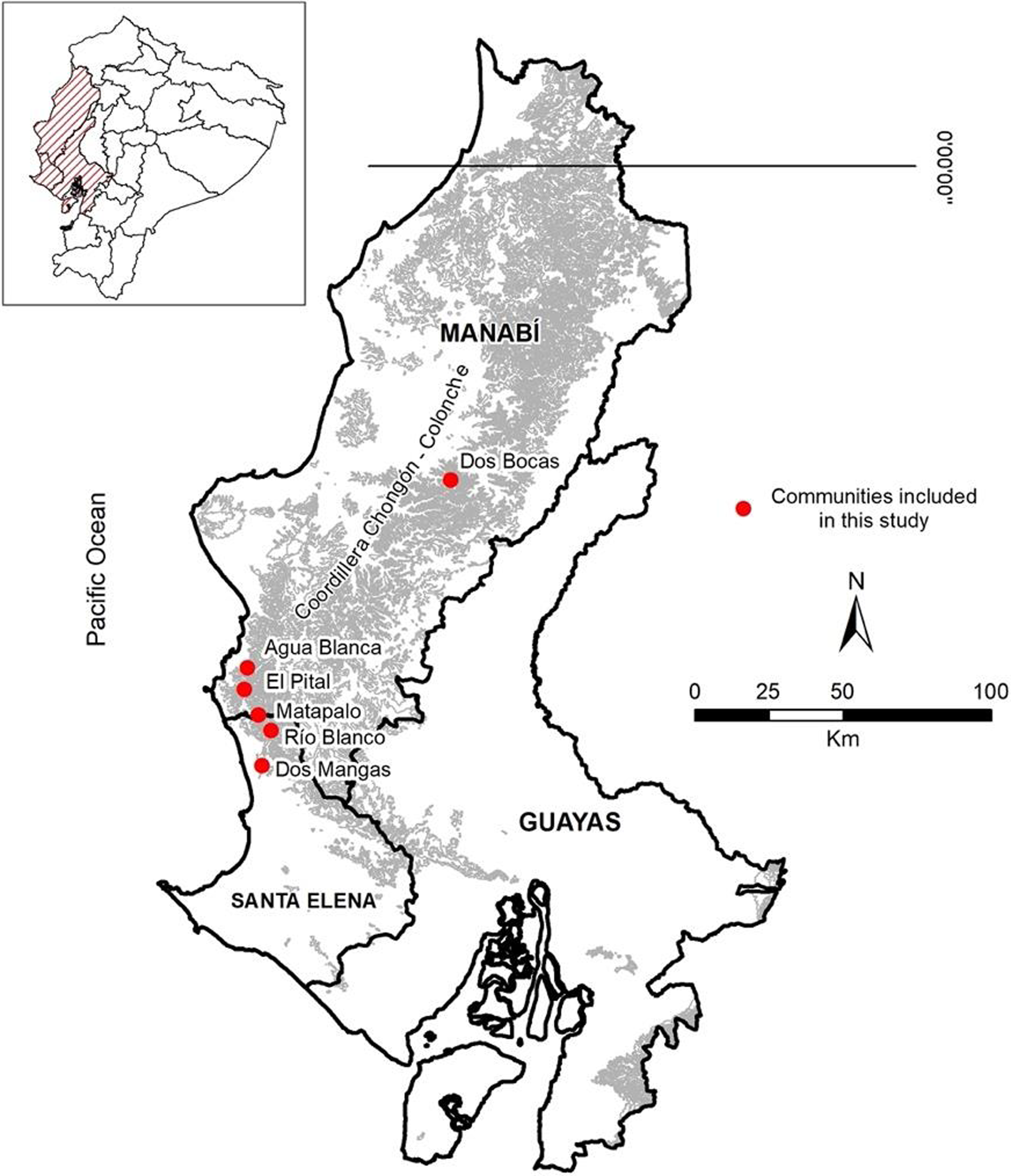
The study area comprises the south-central region of the province of Manabí and the northern region of the province of Santa Elena, both located on Ecuador’s central coast (Fig. 1). These two provinces are the traditional center of tagua harvests, where Ecuadorian tagua exports originate, and where the “green” button industry is located (Montúfar et al. Reference Montúfar, Brokamp, Jácome, Valencia, Montúfar, Navarrete and Balslev2013). This region is characterized by deciduous and semi-deciduous forests below 1000 masl. Ivory palm populations in this region are found in national parks and protected areas, small forest remnants or agroforestry systems, secondary forests, and pastures. The primary sources of revenue of these six localities studied are small-scale agriculture, fishing, handicrafts, timber extraction, tourism, and governmental aid (Cevallos Reference Cevallos2015; Mendoza and Morán Reference Mendoza and Morán2016; Montúfar et al. Reference Montúfar, Gehrung, Ayala and Atallah2022). The harvest of tagua was a traditional activity in the communities studied, but it has decreased significantly, presumably due to the low prices of tagua nuts. All these communities have less than 200 households, and some communities such as Matapalo, Agua Blanca, El Pital, and Rio Blanco have even less than 100 households. All these localities have high rates of unmet needs. Land ownership varies between communities (National Institute of Statistics and Census 2022). Agua Blanca, Matapalo, and Dos Mangas have communal forest management systems. Wild harvesting and subsistence agriculture are most common in El Pital and Matapalo (Cevallos Reference Cevallos2015; Mendoza and Morán, Reference Mendoza and Morán2016) while Agua Blanca relies mainly on tourism (Endere and Zulaica Reference Endere and Zulaica2015; Aguilar et al. Reference Aguilar García, Bailón Pincay, Mero Del Valle and De la Montaña2021).
Map of surveyed communities.
Survey instrument and data collection
The survey instrument had two sections. In the first, we collected household-level, socio-economic and demographic information. In the second, we asked respondents to rate the livelihood dependence of their household on 17 different ES derived from tagua. We use these responses to construct an ecosystem LDI (Naudiyal and Schmerbeck Reference Naudiyal and Schmerbeck2018). Respondents rated the dependence on the resource from the point of view of four generations: that of their grandparents, their parents, their own, and the future generation. We focus on 17 ES that Montúfar et al. (Reference Montúfar, Gehrung, Ayala and Atallah2022) identified as the most representative among 28 identified in focus group discussions. We further classify the ES using the following categories: provisioning, cultural, regulating, and supporting based on the Millennium Ecosystem Assessment report (2015).
We collected responses from 80 harvesters in the six communities: four harvester communities located in the province of Manabí and two communities located in the province of Santa Elena. Harvesters were selected for participation in the survey after being identified by their community leader as tagua harvesters. In El Pital, in addition to nominations by the community leader, we use a snowball sampling strategy to increase the number of participants.
Based on the National Institute of Statistics and Census (2022), the administrative units where these communities are located (parroquias) have an “unmet basic needs poverty” rate of 92% and a functional illiteracy rate of 25%. Their racial and ethnic composition is as follows: 80% mestizos, 12% Montubios, 2% White, 5% Afro-Ecuadorian, and 1% Indigenous.
Data analysis
We measure household livelihood dependence using an index developed in Naudiyal and Schmerbeck (Reference Naudiyal and Schmerbeck2018) based on Schmerbeck et al. (Reference Schmerbeck, Kohli and Seeland2015). Our index takes values 0, 0.25, 0.5, 0.75, or 1, if households report the degree of livelihood dependence on an ES to be “not important at all,” “not very important,” “somewhat important,” “important,” or “vital,” respectively.
We conduct two sets of ordinary least square regression analyses. The first set of regressions has the LDI of each of the four ES categories for the current generation as an outcome variable. For each ES category, we use the average LDI of the ES included in that category. For instance, the LDI for provisioning services is the average of the LDIs for “handicrafts,” “food,” “construction,” “animal feed,” “button production,” and “medicine.” We regress the LDI of the current generation on the LDI of the respondents’ parents and grandparents, in addition to other control variables. In the second set of regressions, the outcome variable is the LDI of the future generation (as perceived and reported by respondents from the current generation) for each of the four ES categories. We regress this variable on the LDI of the respondent, the respondent’s parents, and the respondent’s grandparents, in addition to other control variables. As such, in each of the two sets of regressions, the LDI of a generation is related to the LDI of the previous generations.
Control variables include the distance to the resource (measured in minutes), respondents’ age, education (measured as a dummy that equals one if a respondent has completed elementary education or less and zero if a respondent has completed secondary or university education), the share of family income that comes from tagua, the share of family income that comes from cade, and household expenditures. In the models where the LDI of cultural, regulating, and supporting ES are the outcome variables, we include the LDI of provisioning ES for the respondent, their parents, and their grandparents as explanatory variables. We do so to test whether the dependence of current and past generations on market-based ES is positively or negatively associated with the respondent’s dependence on non-market ES, especially cultural ES. This hypothesis emerged from focus group discussions during which participants expressed concerns that younger generations, who live during times of historically low tagua exports, have lost their cultural traditions associated with tagua (Montúfar et al. Reference Montúfar, Gehrung, Ayala and Atallah2022). In alternative model specifications, we include the share of income from tagua and cade sales as an alternative to the LDI for provisioning ES. We also control for the community fixed effects.
The first set of models has the LDI of the current generation as a dependent variable (Equation 1):
 \begin{align}\ln {\rm{\;}}LD{I_{i,j,c,current}} &= {\hat \beta _0} + {\hat \beta _1}educatio{n_i} + {\hat \beta _2}\;ln \;ag{e_i} + {\hat \beta _3}\;ln \;distanc{e_i} + {\hat \beta _4}\;ln \;incom{e_i}{\rm{\;}}\\
&\quad + {\rm{\;}}{\hat \beta _5}\;ln \;shar{e_{tagua}} + {\hat \beta _6}\;ln \;shar{e_{cade}} + {\hat \beta _7}\;ln \;LD{I_{i,j,{\rm{\;}}parent}}\\
&\quad + {\hat \beta _8}\;ln \;LD{I_{i,j,grandparents}} + {\rm{\;}}{\hat \alpha _c} + {\hat \mu _{i,c}}\end{align}
\begin{align}\ln {\rm{\;}}LD{I_{i,j,c,current}} &= {\hat \beta _0} + {\hat \beta _1}educatio{n_i} + {\hat \beta _2}\;ln \;ag{e_i} + {\hat \beta _3}\;ln \;distanc{e_i} + {\hat \beta _4}\;ln \;incom{e_i}{\rm{\;}}\\
&\quad + {\rm{\;}}{\hat \beta _5}\;ln \;shar{e_{tagua}} + {\hat \beta _6}\;ln \;shar{e_{cade}} + {\hat \beta _7}\;ln \;LD{I_{i,j,{\rm{\;}}parent}}\\
&\quad + {\hat \beta _8}\;ln \;LD{I_{i,j,grandparents}} + {\rm{\;}}{\hat \alpha _c} + {\hat \mu _{i,c}}\end{align}
where $LD{I_{i,j,c,\;current}}$
is the livelihood dependence index of household
$LD{I_{i,j,c,\;current}}$
is the livelihood dependence index of household $i$
(i.e., current generation) on ES category
$i$
(i.e., current generation) on ES category $j$
, where
$j$
, where $j$
is the provisioning, cultural, regulating, or supporting ES category, and where
$j$
is the provisioning, cultural, regulating, or supporting ES category, and where $c$
is the community where the household resides. We log-transformed the LDI variable because it failed the Shapiro–Wilk normality test and log-transformed the explanatory variables for easier interpretation of the estimates.
$c$
is the community where the household resides. We log-transformed the LDI variable because it failed the Shapiro–Wilk normality test and log-transformed the explanatory variables for easier interpretation of the estimates.
The second set of models has the LDI of the future generation, as perceived by respondents, as a dependent variable. It is defined as the LDI of the future generation for each ES category $j$
, as reported by respondent
$j$
, as reported by respondent $i$
(Equation 2).
$i$
(Equation 2).
 \begin{align}{\rm{\;}}LD{I_{i,j,c,future}} &= {\hat \gamma _0} + {\hat \gamma _1}educatio{n_i} + {\gamma _2} \;In \;ag{e_i} + {\hat \gamma _3}\;ln \;distanc{e_i} + {\hat \gamma _4}\;ln \;incom{e_i}{\rm{\;}}\\
&\quad + {\rm{\;}}{\hat \gamma _5}\;ln \;shar{e_{tagua}} + {\hat \gamma _6}\;ln \; shar{e_{cade}} + {\hat \gamma _7}\;ln \;LD{I_{i,j,{\rm{\;}}parent}}\\
&\quad + {\hat \gamma _8}\;ln \;LD{I_{i,j,grandparents}} + {\rm{\;}}{\hat \alpha _c} + {\hat \mu _{i,c}}\end{align}
\begin{align}{\rm{\;}}LD{I_{i,j,c,future}} &= {\hat \gamma _0} + {\hat \gamma _1}educatio{n_i} + {\gamma _2} \;In \;ag{e_i} + {\hat \gamma _3}\;ln \;distanc{e_i} + {\hat \gamma _4}\;ln \;incom{e_i}{\rm{\;}}\\
&\quad + {\rm{\;}}{\hat \gamma _5}\;ln \;shar{e_{tagua}} + {\hat \gamma _6}\;ln \; shar{e_{cade}} + {\hat \gamma _7}\;ln \;LD{I_{i,j,{\rm{\;}}parent}}\\
&\quad + {\hat \gamma _8}\;ln \;LD{I_{i,j,grandparents}} + {\rm{\;}}{\hat \alpha _c} + {\hat \mu _{i,c}}\end{align}
Results and discussion
Descriptive statistics
The majority (81%) of survey respondents are male, consistent with the reports by Montúfar et al. (Reference Montúfar, Gehrung, Ayala and Atallah2022), whereby men tend to be more involved with tagua harvest. Household respondents’ median age is 58 years (mean = 56 years; sd = 15 years). On average, survey participants live with four nuclear family members (mean = 4; sd = 2 members), including spouses and children (Table 1).
Gender, age, and household size by surveyed community
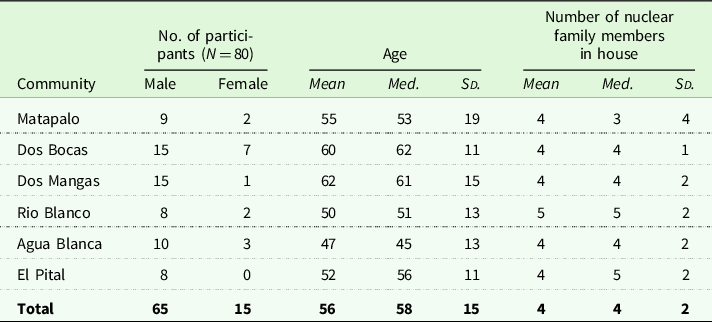
“ Sd.” is standard deviation.
The median harvesting experience is 20 years (mean = 23 years; sd = 17 years). Community members travel 78 minutes on average from the place of residence to the tagua resource, but there is a sizable variation in travel distance across respondents (median = 60 minutes; sd = 58 minutes). The percentage contribution of the palm’s nut (tagua) to total income varies from 7 to 42%, with an average of 21% (median = 10%; sd = 27%). Unsurprisingly, the percent income contribution of tagua is much larger than that of cade (the palm’s leaves) (mean = 3%; median = 0%; sd = 13%). However, tagua contribution to income varies widely across communities: it varies from 42% in El Pital (median = 35%) but only 7% in Agua Blanca (median = 0%) (see Table 2).
Tagua harvest and income variables by surveyed community
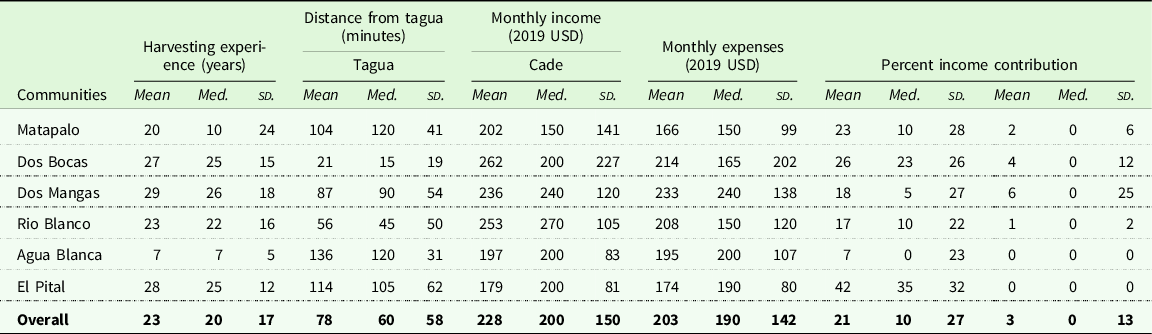
“Med” is median and “ sd.” is standard deviation.
The largest LDI values reported by the respondents for their generation are for non-market ecosystems service categories: cultural, supporting, and regulating. The ivory palm’s contribution as a habitat to fauna is the most important of all ES, with a mean LDI of 0.98 (Table 3). The palm’s contribution to cultural identity and sense of belonging are the two most important cultural ES, with mean LDIs of 0.93 and 0.95, respectively. The most important regulating ES were soil maintenance and pollinator habitat, with mean LDIs of 0.95 and 0.92, respectively. In contrast with these high LDIs for non-market ES, the mean LDIs for provisioning ES ranged from 0.55 for medicine to 0.89 for animal feed. Finally, the mean LDI associated with button production is 0.85.
Current generation livelihood dependence scores for all ecosystem services
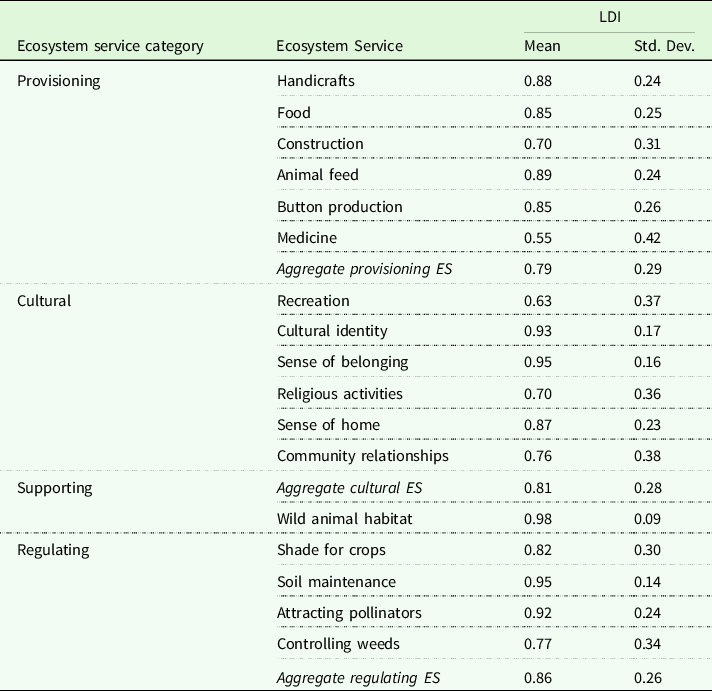
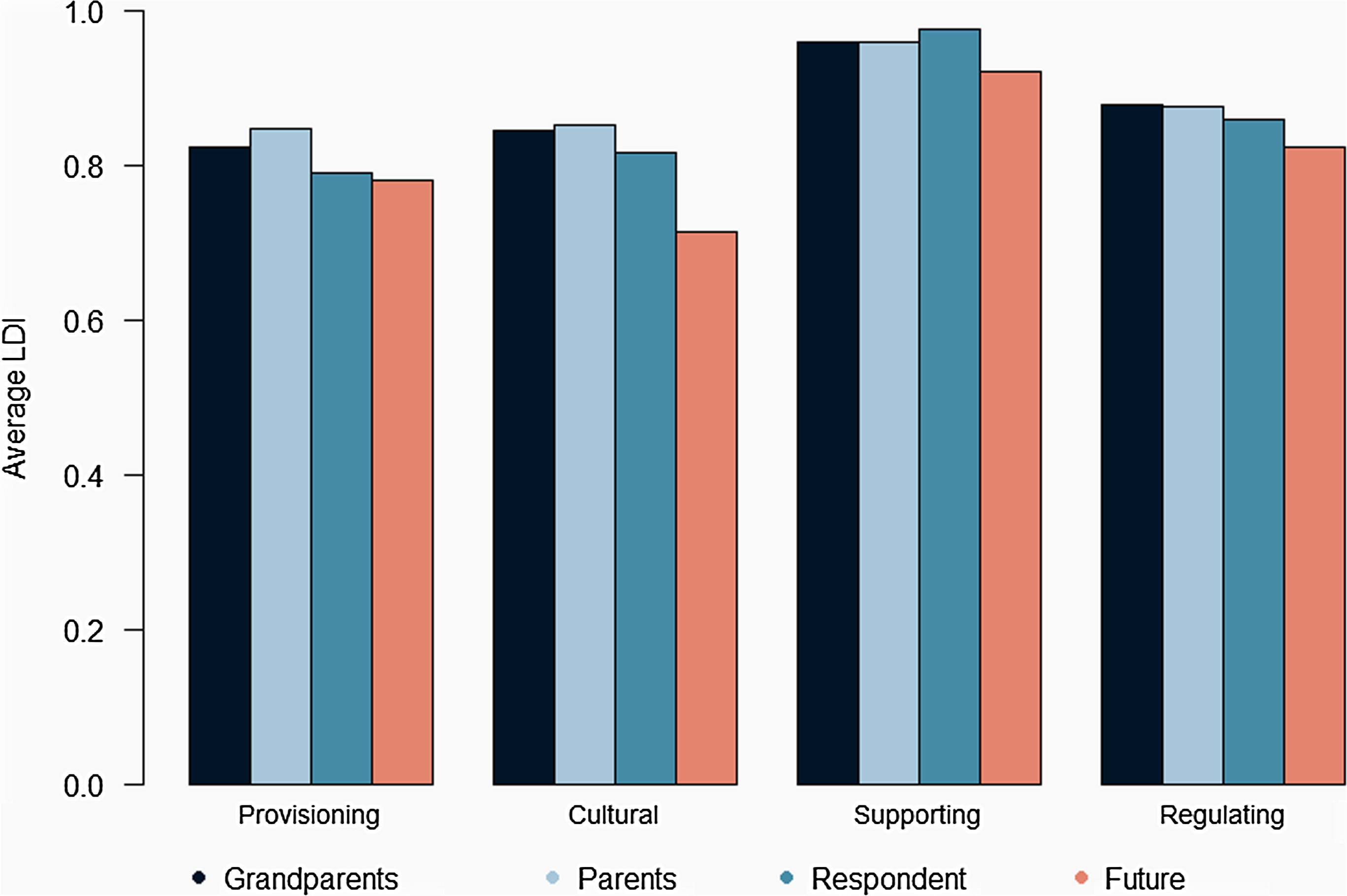
Figure 2 shows the mean LDI for the four ES categories across four generations. For each of the provisioning, cultural, and regulating ES, the LDIs are highest for parents, followed by grandparents, and the current generation. In contrast, the supporting ES LDI is highest for grandparents, followed by the current generation and the parents, in that order. Only in the case of supporting ES, the respondents perceive their livelihood dependence to be higher than that of the other generations. On average, the LDI of the future generation is lower than that of any of the previous generations; although this trend is common to all four ES categories, the decline of LDI for the future generation is the sharpest for cultural ES (it drops from 0.81 for the current generation to 0.71 for the future generation).
Mean LDI by generation and ecosystem service category.
Respondents’ livelihood dependence on the ivory palm’s ES
We report the results of the current generation’s livelihood dependence on the four categories of ES in Table 4 (Model 1; Equation 1). The provisioning ES LDI for the current generation is positively correlated with that of the parents and negatively correlated with that of the grandparents. The estimates are statistically significant at the 1 and 5% levels, respectively. Considering the average age of respondents and assuming childbearing at the age of 20, the grandparents’ generation would correspond to the tagua boom (1928–1940), the parents’ generation would correspond to a period of relatively reduced exports (the 1945s–1960s), and the current generation corresponds to current, historically low exports (Barfod Reference Barfod1989). Under these assumptions, the positive correlation between the current generation’s provisioning ES LDI and their parents’ could result from a lower dependence on tagua exports in both generations. Similarly, the negative correlation with the provisioning ES LDI of their grandparents could be related to the difference in tagua exports across generations; the tagua boom coincides with the generation of grandparents. In contrast, current exports are modest. None of the socio-economic explanatory variables are statistically significant in this model.
Current generation’s livelihood dependence on four ecosystem service categories
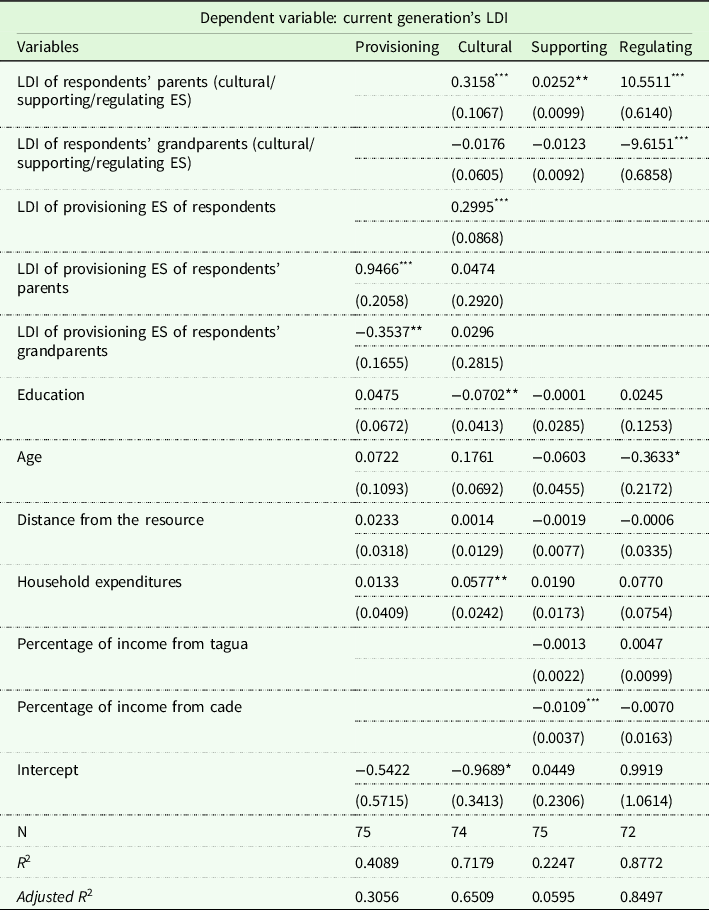
***p < 1%. **p < 5%. *p < 10%; Standard errors in parentheses.
All models include community fixed effects.
The intergenerational relationships between the dependence of the current generation on cultural ES and that of the two previous generations follow the same pattern as in the case of the provisioning ES: the current generation’s LDI is positively correlated with that of their parents and negatively correlated with that of their grandparents. However, only the parents’ LDI estimate is statistically significant (1% level). Interestingly, for the respondent’s generation, a higher provisioning LDI is associated with a higher cultural LDI. This result suggests a complementary relationship between provisioning and cultural ES associated with the ivory palm. He et al. (Reference He, Gallagher and Min2021) report that cultural values in their study are better preserved where provisioning ES are prominent. The estimate on the education variable is negative and significant (5% level), indicating that lower levels of schooling attainment are associated with lower cultural LDI. Higher household expenditures are associated with a higher livelihood dependence on cultural ES from the ivory palm. The estimate is statistically significant at the 5% level.Footnote 1 Higher education attainment by the head of household is associated with a higher livelihood dependence on cultural ES from the ivory palm (the estimate is statistically significant at the 10% level). The education result is consistent with findings in Martín-López et al. (Reference Martín-López, Iniesta-Arandia, García-Llorente, Palomo and Casado-Arzuaga2012) where survey respondents with formal education placed a higher value on cultural services relative to those with no formal education.
The results of the intergenerational dependence on supporting and regulating ES, such as providing shade for crops, attracting pollinators, or controlling weeds, are similar to those of the provisioning and cultural ES. The current generation’s supporting and regulating LDIs correlate positively with the LDIs of their parents (the estimate is statistically significant at the 1% level for both) and negatively correlated with the LDIs of their grandparents (the estimate is statistically significant at the 1% level for regulating and not significant for supporting ES). A higher percentage of income from the palm’s leaves (cade) is associated with a lower supporting ES (habitat for wild animals) LDI. The associated estimate is significant at the 1% level. This result suggests that the provisioning ES of using the palm’s leaves for construction conflicts with supporting ES such as providing habitat for animals; harvesting leaves affects the growth and survival of the palm and, consequently, wild animal habitat; Montúfar et al. (Reference Montúfar, Brokamp, Jácome, Valencia, Montúfar, Navarrete and Balslev2013) document that harvesters recognize the effect of harvesting leaves on the survival of the palm. This trade-off result is consistent with findings in Goldstein et al. (Reference Goldstein, Caldarone, Duarte, Ennaanay, Hannahs, Mendoza and Daily2012), Ziv et al. (Reference Ziv, Baranb, Namc, Rodríguez-Iturbed and Levin2012), and Zheng et al. (Reference Zheng, Li, Robinson, Liu, Ma and Wang2016), where the authors identify a trade-off between regulating and supporting services on one hand and provisioning services on the other hand in the contexts of both terrestrial and aquatic ecosystems.
Livelihood dependence on each ES category for future generations
In this section, we report how respondents perceive the dependence of the future generation’s livelihood on the ivory palm’s ES as a function of the dependence of previous generations and other variables such as education, age, distance to the resource, and income (Model 2; Equation 2).
The future generation’s dependence on provisioning ES is positively associated with the LDI of the respondents and that of the grandparents but is negatively correlated with that of the respondent’s parents. Considering as in the previous section, that the grandparents’ generation experienced the tagua boom and a high dependence on the species provisioning ES, this result suggests that respondents aspire that the future generation will have a similarly high dependence on provisioning LDI, possibly through increased future exports. The associated estimates are statistically significant at the 1% level (Table 5). This projected higher dependence for the next generation could be related to recent commercial initiatives in Ecuador and international trade agreements that aim to revive the tagua export industry and bring it back to its golden age (“La nuez de marfil, tesoro de Ecuador”; MPCEIP, 2019). This finding illustrates how the livelihood dependence on ES might be related to historical market factors such as export dynamics. It complements the literature describing the context dependence of ES values in relation to ecological events such as droughts and floods (Andersson et al. Reference Andersson, McPhearson, Kremer, Gomez-Baggethun, Haase, Tuvendal and Wurster2015). However, the positive correlation between future and present from Model 2 is in contrast with the negative correlation between the respondents’ dependence on provisioning ES and that of their grandparents from Model 1. One plausible interpretation is that, while the current generation sees itself in an era where provisioning LDI is low (relative to that of grandparents), which is captured in Model 1, it also aspires to be at the beginning of a new era where their provisioning LDI and that of their children would become higher, presumably as a result of recent trade agreements (MPCEIP, 2019).
Future generation’s livelihood dependence on four ecosystem service categories, as perceived by the current generation
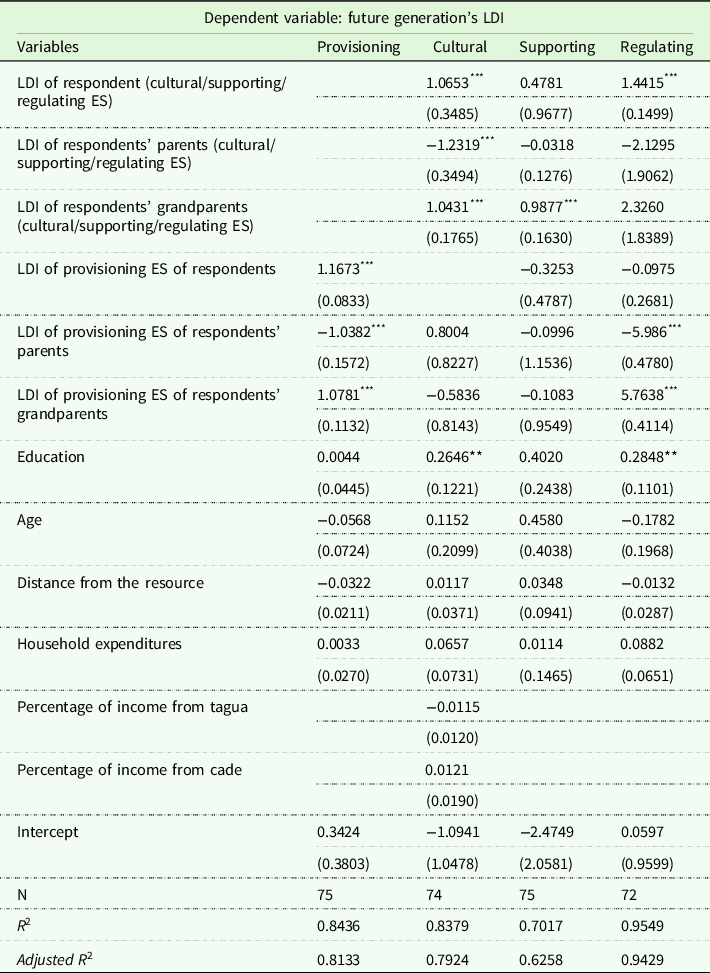
***p < 1%. **p < 5%.
All models include community fixed effects.
The model on the expected cultural LDI for the future suggests similar associations: the future generation’s cultural LDI is positively correlated with the LDI of the respondents and their grandparents and negatively associated with the LDI of the respondent’s parents. The estimates are statistically significant at the 1% level (Table 5). The estimate on the education variable is positively correlated with the cultural LDI of the future generation: respondents with elementary education have expectations or aspirations of a higher dependence on cultural ES by future generations relative to respondents with secondary or university education. The estimate is statistically significant at the 5% level.
The supporting ES LDI for future generations is positively correlated with that of the respondent’s grandparents, and the estimate is statistically significant at the 1% level. The association with age is positive (and significant at the 5% level), suggesting that older respondents expect higher dependence on the ivory palm’s support for wildlife for future generations. The regulating ES LDI for the future generation is positively associated with respondents’ regulating ES LDI, negatively associated with the respondents’ parents’ regulation ES LDI, and positively associated with that of the grandparents’ generation. The estimates are statistically significant at the 1%, 5%, and 1% levels, respectively. Interestingly, the dependence on provisioning ES by the parents and the grandparents of the respondent has a statistically significant correlation of opposite signs with the regulating ES LDI of the future generation (the estimates are statistically significant at the 1% level in both cases; Table 5). The respondents’ parents’ dependence on providing ES such as the nuts or the leaves is negatively associated with the future generation’s dependence on regulating ES, such as attracting pollinators or controlling weeds. The opposite is true for the grandparents’ dependence on provisioning ES. These results might suggest that respondents perceive a negative association between extracting the resource in one generation (e.g., parents’ provisioning ES) and the decreased flow of ES two generations later (e.g., the future’s regulation ES). However, that negative association is reversed and becomes positive when three generations have elapsed between extraction and ES impacts (i.e., between the grandparents’ generation and that of the future). These results are consistent with the findings of Chettri et al. (Reference Chettri, Aryal, Thapa, Uddin, Kandel and Karki2021), whereby communities perceived changes in ecosystems and their services after two decades of land use change. While perceptions are based on lived experiences in their study, it is interesting that similar perceptions exist across generations in our study but in expectation of the future. As in the case of cultural ES, respondents with lower education have expectations or aspirations of a higher dependence on cultural ES by future generations.
Conclusions
Resource management programs and policies focused on promoting provisioning ES, such as programs supporting the harvest and export of tagua nuts, might have consequences on communities’ well-being beyond income and affect cultural, regulating, and supporting ES. Moreover, current and previous dependence on a resource might be associated with how communities expect future generations will depend on that resource. For the ES provided by the ivory palm across generations in Ecuador, our estimates indicate that the current dependence on all ES categories is positively associated with the dependence of the parents’ generation and negatively correlated with that of the grandparents’ generation.
When asked about their expectation for the dependence of the future generation on the ivory palm ES, responses suggested a positive correlation between the respondents’ dependence and that of the future generation, a positive correlation between the dependence of future generations and that of their grandparents, but a negative one between their children’s and their parents’ dependence. In the context of the ivory palm in Ecuador, we hypothesize that these results are related to the prominent role the palm played in the economic well-being of the grandparents’ generation during a period where tagua was the second-largest export from Ecuador. Interestingly, despite the negative association the current generation’s dependence has with that of the grandparents and the low tagua exports their generation, and that of their parents experienced, respondents expect the future generation’s dependence to be positively associated with that of the grandparents’ generation, that is, the generation of the tagua export boom. The results are consistent across ES categories.
We find evidence of a positive association between certain ES categories suggesting complementarities, such as the case of provisioning and cultural ES for the respondent’s generation. In contrast, we find a substitutive association or trade-off between one provision ES (the extraction of the palm’s leaves or cade) and the dependence on supporting ES, such as the provision of wildlife habitat. We find that complementarities between ES categories can also exist across generations, as in the case of the provisioning ES LDI of grandparents and the perceived regulating ES LDI of the future generation.
Interestingly, these relationships in the dependence across ES categories can be dynamic. We find that the relationships between LDIs of different ES categories can be reversed from one generation to the next: the future generation’s regulating ES LDI has a negative association with the LDI of the parents’ provisioning ES but a positive one with the LDI of the grandparents’ generation. These results suggest that conservation policies or market forces that incentivize the provision of one ES category might have different effects on the dependence on other ES categories across generations. For instance, the market dynamics that affected tagua exports from Ecuador across generations have effects beyond income fluctuations and can have repercussions on the cultural services, which might be perceived to differ across generations. The changing associations across ES categories over generations make it harder to predict the impact of policies on ES dependence across generations.
Implications for conservation policy, limitations, and future research
Results from this research can be used in ecosystem assessment reports to inform local conservation policies affecting tagua harvesting communities (Martín-López et al. Reference Martín-López, Iniesta-Arandia, García-Llorente, Palomo and Casado-Arzuaga2012). Of particular importance to such reports and the policies based on them are the perceived intergenerational dynamics of natural resource livelihood dependence and the impact export policies or resource management decisions today can have on the ES dependence of communities across generations. However, because of the non-random sampling strategy, results cannot be interpreted as representative of all harvesting communities in the study region. The results related to the dependence by future generations might be biased given that they are reported by present generations, who could have overstated dependence by future generation to influence policy.
Despite the knowledge this research creates regarding the dependence on multiple ES across generations, results are somewhat limited by their descriptive and associative nature. However, such descriptive livelihood dependence results can be used to generate hypotheses for and guide future economic research on ES. First, future research could study how spatial variation in stated livelihood dependence on the four ES categories might be explained by observed spatial variation in the abundance of the ivory palm. Second, non-market valuation methods can use LDI ranking for the selection of ES benefits that are most important to communities. For instance, the selection of choice experiment attributes is typically based on the literature and focus group discussions. Livelihood dependence data can be collected during focus groups to compute the LDI for multiple ES. These LDI measures can then be used to identify and rank the candidate attributes used in choice experiments when modeling a community’s choices regarding a proposed resource management decision or a payment-for-ES program. Depending on the research questions, this method can ensure that the attributes chosen are related to the ES on which communities depend the most for their livelihoods and go beyond marketed ES that have been overrepresented in the literature. Such an expansion of the ES considered would help address the criticism that economic research on ES is often too biased by and focused on marketed ES to the detriment of cultural and other non-marketed ES (Phillipson et al. Reference Phillipson, Lowe and Bullock2009; Chan et al. Reference Chan, Satterfield and Goldstein2012; Martín-López et al. Reference Martín-López, Iniesta-Arandia, García-Llorente, Palomo and Casado-Arzuaga2012). The LDI survey method used here was useful to identify the ES that communities depend on the most, without a prior researcher bias on one particular type or category of ES. In addition, the regression analyses used here can help identify possible complementarity or substitutive relationships among ES. Such results on ES relationships can be used to formulate hypotheses to be tested using choice experiment surveys (or other non-market valuation methods). They can inform the statistical design of choice experiments to appropriately model interaction effects among attributes representing changes in the levels of multiple ES.
Identifying relationships among the different uses of a natural resource can also help inform the specifications of objective functions in dynamic optimization models aimed at recommending sustainable harvest policies. Such models typically assume an additive objective function where total welfare from a resource is the sum of its extractive, market-based use and its non-extractive, non-market-based use (e.g., Lopes and Atallah Reference Lopes and Atallah2020). Dynamic resource management models can build on the data generated here to specify intergenerational community’s welfare functions composed of multiple ES categories, possibly exhibiting complementary or substitutive relationships that can alternate across generations.
Data availability statement
The data that support the findings of this study are available on request from the corresponding author, S.S.A.
Acknowledgements
We thank the members of the Dos Mangas, Agua Blanca, Dos Bocas, Rio Blanco, El Pital, and Matapalo communities for their openness to be part of this study and their hospitality. We thank the TRAFINO company and its staff, especially Paulina Ormaza and Andrea García, for their support during our fieldwork. Santiago Palacios supported the researchers during the fieldwork. We thank Luis Cardenas who produced our map. We thank Catalina Herrera-Almanza and participants of Northeast Agricultural and Resource Economics Association (NAREA) 2022 Post-Conference Workshop, “Ecosystem Services Foundations for Resilient Communities: Agriculture, Land Use, Coasts and Energy for Human Well-Being,” in Mystic, CT June 14–15, 2022, for their comments and suggestions. Any errors remain ours.
Funding statement
SA and JG thank the University of New Hampshire’s Hamel Center for Undergraduate Research for funding the field work. JS and RM are grateful for funding support from the Pontificia Universidad Católica del Ecuador. The authors also thank the International Joint Laboratory BIOINCA for funding the fieldwork.
Competing interests
The authors declare none.


 Open access

