

CLINICIAN'S CAPSULE
What is known about the topic?
Women experiencing early pregnancy complications frequently seek care in the emergency department (ED), but little information exists about their ED experience.
What did this study ask?
What are the experiences and perceptions of care of women treated for early pregnancy complications?
What did this study find?
These findings highlight the ways in which ED care often does not meet patient expectations or needs.
Why does this study matter to clinicians?
The emotional complexity of this medical situation is often multi-faceted and can produce encounters that are distressing.
INTRODUCTION
Emergency department (ED) utilization during pregnancy varies between 21% and 49%, with a higher frequency of return ED visits compared with non-pregnant ED patients.Reference Cunningham, Magriples and Thomas1–Reference Malik, Kothari and MacCallum3 Although the proportion of visits related to early pregnancy complications, such as miscarriage, threatened loss, or ectopic pregnancy, has yet to be documented, Canadian EDs frequently care for these early pregnant patients, because most have not yet established care with an obstetrical care provider.4
A recent survey of Ontario EDs identified that fragmented care exists in Ontario hospitals without early pregnancy clinic (EPC) services, and reliance on EDs to provide ongoing follow-up for women experiencing complications of early pregnancy is high.Reference Glicksman, McLeod, Thomas and Varner5 The survey also revealed that many Ontario EDs lack the necessary psychological supports to address the emotional needs of women undergoing early pregnancy loss, with less than half having access to on-site counselling supports such as a social worker. Previous research has shown that EDs often fail to provide the compassionate care and emotional support women require during this distressing time.Reference Meaney, Corcoran, Spillane and O'Donoghue6–Reference Van den Berg, Dancet and Erlikh9 These results are worrisome because pregnancy loss can lead to depression, anxiety, and posttraumatic stress disorder, regardless of fetal age.Reference Lok, Yip, Lee, Sahota and Chung10,Reference Marcinko, Marcink, Dordevic and Oreskovic11
The objective of this qualitative study was to better understand the experiences and perceptions of care of women treated for early pregnancy complications in a Canadian ED and EPC with a view to informing areas for improvement.
METHODS
Study design
We conducted a descriptive qualitative study to understand the perceptions, meanings, and perspectives of women of 18 years and older who presented to the ED or EPC of an urban, tertiary care hospital with early pregnancy complications or loss. Complete details of the study design, methods, and analysis are included in Supplemental Appendix A. The study hospital has an EPC model whereby ED patients with early pregnancy complications deemed safe for discharge home are supposed to be referred for urgent, ongoing follow-up.
Data collection
Eligible patients in the ED or EPC were identified by a treating physician or nurse and then approached by a research coordinator, who verbally reviewed and distributed letters of information about the study. Patients who were interested in participating provided their written consent to be contacted 4 weeks after their initial ED visit to schedule an interview. Using a semi-structured interview guide (Supplemental Appendix B), a 45- to 60-minute telephone interview was conducted by a trained qualitative interviewer at 4 to 6 weeks after the ED visit. All interviews were digitally recorded and transcribed verbatim for analysis. Research ethics board approval was obtained from Mount Sinai Hospital in Toronto, Ontario (18-0078-E).
Data analysis
Data analysis occurred in conjunction with data collection in order to continuously monitor emerging themes and general areas for further exploration. Interviews were conducted until thematic saturation had occurred. The data were analysed collaboratively by two qualitative researchers, a clinician, a clinical researcher, and a research student according to standard thematic analysis techniques.Reference Boyatis12 Data management was facilitated using NVivo software (version 11).
RESULTS
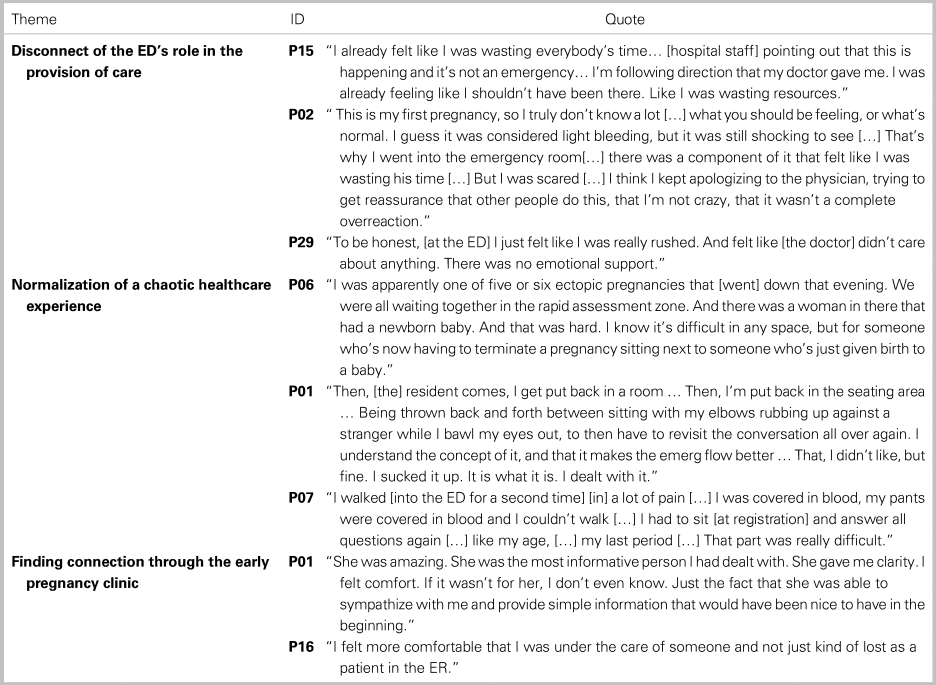
After approaching 56 potential participants, interviews were completed with 30 women between June and August 2018. Our sample included a diverse group of women between the ages of 25 and 45, most of whom had no previous history of miscarriage, and were between 4 and 13 weeks pregnant at the time of their ED visit (Supplemental Appendix C). Three main thematic concepts emerged (Table 1):
Exemplar quotes of themes
Theme 1: Disconnect regarding the ED's role in the provision of care
Participants frequently reported being told by their family physician, infertility specialist, obstetrician, or other healthcare professional to go to the ED for spotting, cramping, bleeding, or pain. However, upon arriving to the ED, they were made to feel as though their symptoms did not warrant ED care or attention. Many participants used terms like “I felt I was wasting their time,” and participants often experienced actual shaming behaviour from hospital staff.
One contrary case was described by a patient with symptoms suggestive of ruptured ectopic pregnancy, who reported positive perceptions of their care, particularly around the sense of urgency of their ED assessment and treatment (P03). However, once ectopic pregnancy rupture was excluded, the patient noted that urgency and attention towards her care was diminished.
Theme 2: Normalization of a chaotic healthcare experience
Women described lengthy hospital encounters involving multiple consultations with various healthcare providers, numerous procedures, and long wait times in a crowded ED environment. Surprisingly, patients felt the waits were expected in a high volume obstetrical centre, and given the hospital's reputation, assumed this was normal and the ED care would be excellent. However, a number of women reported that despite being seen by multiple clinicians, they were often not informed about the side effects, success rate, and next steps regarding treatments administered in the ED for ectopic pregnancy and miscarriage. In addition, very few participants problematized what was substandard care, including one participant who had a missed ectopic pregnancy (P16) and another participant in whom follow-up was not arranged following methotrexate administration for ectopic pregnancy (P01).
Theme 3: Finding connection through the early pregnancy clinic
Most patients interviewed received ongoing follow-up care in the institution's EPC at 12–72 hours after their ED visit. Many women described their tremendous appreciation of the compassionate care provided in the nurse-led clinic. After their EPC visit, participants said they left with a better understanding of their clinical situation and a general sense of being “cared for.” In particular, participants appreciated the emotional support provided during their clinic interactions and reported that these supports were integral to their recovery.
On the contrary, when EPC follow-up had not occurred, patients’ beliefs around their pregnancy outcomes were not accurate. For example, two women strongly believed that an intervention could have been done in the ED to prevent their loss, when, in fact, early pregnancy loss is rarely preventable. Neither had follow-up in the EPC, as participant P006 was greater than 12 weeks gestational age and follow-up was not arranged for participant P012.
DISCUSSION
This study describes the experiences and perceptions of care of women treated for early pregnancy complications in a Canadian ED and EPC. Our findings identified several areas of disconnect throughout the healthcare encounter and highlight the potential for comprehensive, urgent pregnancy-specific follow-up as a means to mitigate the negative experiences of early pregnancy complications and loss.
In this study, women often came to the ED because they felt or were told something was “wrong” with their pregnancy. Similar to previous studies,Reference Van den Berg, Dancet and Erlikh9 patients sought answers, reassurance, care, and expected to receive support and validation in the ED. Not being prioritized in the ED while experiencing the stress and discomfort of early pregnancy complications left women feeling that time was wasted when something could have been done. Previous qualitative studies of patients with early pregnancy complications report that ED staff lack empathy, compassion, and social supports, potentially contributing to adverse psychological outcomes.Reference Meaney, Corcoran, Spillane and O'Donoghue6–Reference Marcinko, Marcink, Dordevic and Oreskovic11 The highly technical clinical care by ED providers to exclude dangerous entities was often at odds with patients’ expectations for more comprehensive, empathetic, supportive care.
Surprisingly, very few patients problematized the often substandard ED care in this study. The prolonged hours spent during these visits were often justified and minimized by the participants, many of whom were unaware that subsequent ED visits could have been prevented with appropriate discharge information and follow-up arrangement by the index ED provider. Similar to previous qualitative studies, participants suggested improved communication for what should be expected during the ED visit, as well as after discharge from the ED, including specific instructions of when to return is needed.Reference Van den Berg, Dancet and Erlikh9
Based on the experiences of women in this study, the EPC model appears better equipped to provide a more tailored, patient-centred experience and greater understanding of early pregnancy complications and loss. EPCs have previously been shown to provide timely, cost-effective care and improved quality of care and patient satisfaction.Reference Bigrigg and Read13,Reference Wendt, Crilly, May, Bates and Saxena14 Urgent follow-up in an EPC does not absolve ED providers from improving care for this and other distressed and grieving patient populations. However, the EPC does provide a buffer for the adverse psychological impact of the chaotic ED environment and offers a safety net for patients when ED care is insufficient or does not meet patient expectations. In areas where an EPC model is not possible, training of nursing or other health professional staff could provide similar support.
This study is not without limitations. This study was performed at a single, urban tertiary care centre with access to an EPC. Patient experiences may not be generalizable to all Canadian hospitals.
CONCLUSIONS
Complications in early pregnancy that require women to attend an ED create untenable situations for both the women experiencing them and the EDs caring for them. The emotional complexity of this medical situation is often multi-faceted and can produce encounters that are distressing. However, the EPC model shows promise in mitigating some of these issues and warrants further study.
Supplementary material
The supplementary material for this article can be found at https://doi.org/10.1017/cem.2019.398.
Acknowledgements
This study would not have been possible without the support of Dr. Kristin Blakely-Kozman.
Competing interests
None declared.



