


1. Introduction
The pharmaceutical packaging industry is highly regulated and standardised since packaging must ensure the safe distribution and use of medication. Factors such as the physical form of the medication must be considered as different packaging forms and materials can be used for medications which are, for instance, in solid, semi-solid, liquid, or gaseous dosage forms (Reference Pal, Pandey, Thakur, Khadam, Dutta, Arushi and SinghPal et al., 2024). To ensure medication safety, and consequently consumer safety, pharmaceutical packaging must be both compliant with regulations as well as easily usable by their target market (Reference Akram, Khanna, Shukla and SharmaAkram et al., 2025). Within this context, it is necessary to ensure that human-centred design (HCD) and user experience (UX) are integrated within a pharmaceutical packaging product. Whilst safety-critical sectors such as food packaging or medical devices share similar requirements, this study focuses on the pharmaceutical industry due to its unique regulatory stringency and the high-risk nature of medication errors. This specific boundary allows for a deeper investigation into how proactive, design-led processes can replace traditional downstream compliance. Despite this, the logic of balancing compliance and usability is applicable to other safety-critical environments.
To preface, a distinction must be made between human-centred design and user-centred design (UCD). Whilst both approaches aim to involve the user throughout the design process, HCD typically includes all potential users and stakeholders whereas UCD tends to solely include end-users, thus making HCD a broader approach to design (Reference Campese, Amaral and MascarenhasCampese et al., 2020). Therefore, this research shall focus on HCD with respect to older people as the primary end-user of pharmaceutical packaging products and shall continue building on the work presented by Reference Bianco, Farrugia, Pizzuto and CasciniBianco et al. (2025). Whilst packaging designers and quality and risk professionals are not the target end-users, they are integral when considering the design process as well as the risk analysis and management needed to develop a safe and useful product. Within the pharmaceutical industry, quality and risk management are a mandatory and regulatory requirement to ensure that a product maintains its quality and efficacy throughout its lifecycle to safeguard low product risk levels (Reference Ibrahim and SharmaIbrahim & Sharma, 2025). Within this context, the objective of this research is to develop a design support framework that integrates risk management principles into the early stages of pharmaceutical packaging design, enabling designers to make informed decisions that balance user needs, regulatory expectations and product safety.
Material selection and processing for pharmaceutical packaging are particularly critical as packaging must not interact with the medication it holds, must be bio-compatible, and must be free from any contaminants that could compromise the medication’s stability or effectiveness (Reference Sabee, Uyen, Ahmad and HamidSabee et al., 2022). Additionally, the selected material must comply with requirements related to chemical stability, including for instance, reduced leaching characteristics for glass packaging (Reference Pal, Pandey, Thakur, Khadam, Dutta, Arushi and SinghPal et al., 2024).
All pharmaceutical packaging has inherent risks that stem from potential hazards that may be mechanical, climatic, environmental, biological or chemical in nature (Reference Mandal, Khanam, Karmakar, Pal, Barma, Chakraborty, Bera and PoddarMandal et al., 2022). The effects of any of the risks stemming from such hazards directly affect the quality and integrity of the medication within a package, which can have detrimental effects on the consumer (Reference Lv, Liu, Chen, Cai and LiLv et al., 2025).
Considering these challenges, the design problem addressed in this research is the absence of a structured method to help packaging designers identify, evaluate and mitigate these risks early in the design process. Designers currently lack a dedicated tool that links user requirements, regulatory constraints and risk considerations, often resulting in reactive redesigns and fragmented communication with quality teams. This research therefore proposes an exploratory framework to provide guidance, reduce uncertainty in design decisions and support designers in developing packaging that is both safe and user appropriate. To guide this exploration, the research addresses the following question: ‘How can an AI-enabled design support system effectively integrate risk management and multi-UX requirements in the early stages of pharmaceutical packaging design?’.
The remainder of this paper is structured as follows: Section 2 outlines a review of related work to determine how risk management is tackled within the pharmaceutical packaging industry. Section 3 presents the preliminary design support framework, with a particular focus on how risk management and mitigation is tacked within the context of design support. Section 4 discusses the implications of this framework, its potential value and relevance to industrial practices. Finally, Section 5 provides concluding remarks and highlights the contribution of this research to pharmaceutical packaging design.
2. Review of related work
A literature review was conducted to identify and analyse existing approaches or tools aimed at providing support related to risk management and compliance to design engineers within the context of pharmaceutical packaging. To complete this task, the following research question was inquired, aimed at generating a focus for the literature search:
“How is risk management tackled within the pharmaceutical packaging industry?”
Consequently, the following search string was formulated:
(“risk management” OR “risk mitigation”) AND “product design” AND “pharmaceutical packaging”
The inclusion and exclusion criteria employed during the search have been presented in Table 1 and the systematic flow of the literature review as well as the databases used have been depicted in Figure 1.
Inclusion and exclusion criteria applied when filtering studies

Flow of the literature review search

A major technical approach to packaging risk control is the application of Quality by Design (QbD) and Process Analytical Technology (PAT). QbD is a systematic development approach built on pre-defined objectives, scientific understanding of product and process behaviour, and rigorous quality risk management (Reference Haider, Akram, Kishore, Mishra, Guptha, Jain and BajwaHaider et al., 2024). Reference SinghSingh (2019) and Reference Mallikarjun, Kumari, Kumar and SowmyaMallikarjun et al. (2022) emphasise that QbD and PAT frameworks are effective in identifying critical process parameters and quality attributes early, enabling risk-based control strategies and in-line monitoring that reduce the likelihood of packaging failures. However, these approaches are primarily process- and compliance-driven, offering limited consideration of how risk information is communicated to, or operationalised by, packaging designers during early-stage decision making.
At a systems level, Reference Patil, Raut and RathodPatil et al. (2023) frame risk management as an organisational practice and describe quality assurance programmes that combine validation, documentation, change control, and formal risk assessment to minimise packaging-related non-conformities. Similarly, Reference LyapustinaLyapustina (2018) highlights regulatory expectations for documented, systematic, and packaging-specific risk assessments, whilst Reference SchindelSchindel (2023) underscores the importance of formal engineering practices such as failure mode and effects analysis and lifecycle validation to generate auditable evidence of risk controls. Whilst these studies establish robust governance structures for risk management, they largely treat risk as an outcome of procedural compliance rather than as a design variable that can be actively explored, visualised, or negotiated by different stakeholders during the packaging design process.
Supply chain integrity and traceability are recurrent themes in risk management and mitigation. Reference Haji, Kerbache, Sheriff and Al-AnsariHaji et al. (2021) analyse the global threat posed from counterfeit medication, arguing that packaging-based security features such as serialisation, tamper-evidence and track-and-trace technologies are critical risk controls for protecting distribution chains. Reference ChallenerChallener (2022) reinforces this view, noting that effective mitigation requires the integration of packaging design with supply chain governance systems to prevent diversion and counterfeiting, which present significant safety and reputational risks. These contributions are strong in addressing downstream risks, yet their primary focus is on technological and organisational controls, offering limited insight into how designers assess trade-offs between usability, security, cost and regulatory constraints in the early stages of packaging development.
Reference Song, Tang, Liu, Chen, Liang, Yuan, Lin, Zhu, Fan, Shi, Zhao, Yang, Zhang, Mikos and ZhangSong et al. (2022) extend the discussion of risk management by linking it with regulatory science, highlighting how emerging biomaterials and medical-grade materials introduce new uncertainties that must be addressed through regulatory clarity and robust safety and efficacy evaluation. Their analysis stresses that regulatory oversight applies to the final medical product as a system rather than to individual components, reinforcing the importance of system-level risk assessment across materials, processes and packaging. Whilst this perspective aligns closely with pharmaceutical packaging challenges, it emphasises regulatory outcomes rather that the mechanisms by which designers can be supported in managing uncertainty during their conceptual development.
Sustainability further complicates pharmaceutical packaging risk management. Reference Bhadoriya, Patil, Vinchurkar, Mane and ParambathBhadoriya et al. (2024) and Reference Alaranta and MiettinenAlaranta & Miettinen (2024) demonstrate that recyclable and bio-based packaging introduce new risks related to barrier performance, shelf life, and regulatory compliance, requiring early lifecycle and performance assessments. Reference Banerjee, Bandyopadhyay and RayBanerjee et al. (2025) describe how in-process controls can mitigate contamination and mechanical damage, yet these controls remain largely embedded within manufacturing and quality systems rather than within designer-facing decision-support tools.
Reference Bianco, Farrugia, Pizzuto and CasciniBianco et al. (2025) move closer to addressing this limitation by explicitly examining risk management from a packaging design perspective. Their study highlights that risks are most effectively manages through early identification, regulatory alignment, and structured quality control practices, but also argues that packaging designers currently lack dedicated tools to support safer decision making. Whilst their work identifies requirements for such tools, it does not propose or operationalise a framework that integrates risk management with UX considerations or multi-stakeholder design workflows.
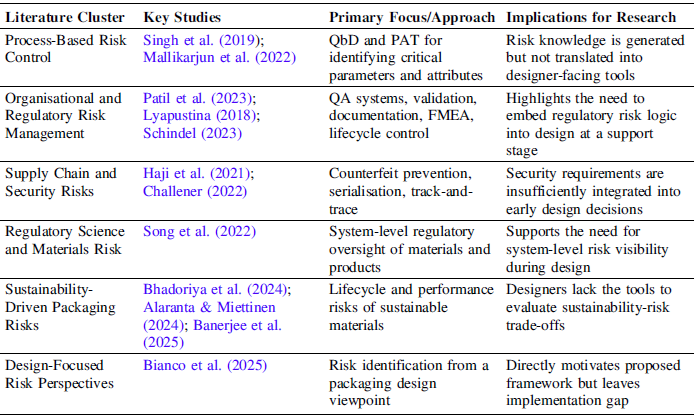
Overall, the literature demonstrates that pharmaceutical packaging risk management is well developed in terms of technical controls, regulatory compliance, and supply chain governance (Table 2). However, these approaches remain fragmented with limited integration between risk management practices and design support systems. In particular, there is a lack of frameworks that embed risk considerations within designer-facing tools whilst also accounting for usability, collaboration, and multi-UX. This paper addresses this gap by introducing a design support framework that integrates risk management principles with UX considerations, enabling designers and stakeholders to engage with risk proactively throughout the packaging design process. Emphasis is placed on how risk management is operationalised within the framework, rather than treated solely as a downstream compliance activity.
Studies identified in literature review

3. PSURMUX framework
The Product SUpport when balancing Risk Management and multi-User eXperience (PSURMUX) framework considers multiple users, focusing on older people as primary end users, with caregivers and nurses as secondary users. A preliminary version of this framework has been built following studies conducted with relevant stakeholders (Figure 2). The studies conducted with packaging design engineers and quality and risk professionals have been presented in Reference Bianco, Farrugia, Pizzuto and CasciniBianco et al. (2025). The framework was developed following a structured approach wherein the requirements identified in Reference Bianco, Farrugia, Pizzuto and CasciniBianco et al. (2025) were directly used to map out the framework modules.
Interaction between study outcomes and development of the PSURMUX framework

A simplified version of the preliminary PSURMUX framework is presented in Figure 3. PSURMUX is aimed at supporting packaging designers by adopting a multi-user approach that identifies design requirements and carries them into risk management and mitigation strategies. The intention is to ensure that pharmaceutical packaging is developed to be safe, effective and sustainable through proactive and predictive design, thereby avoiding reactive and costly redesign measures (Reference Behera, Dave, Mishra, Barachi and KumarBehera & Dave, 2024).
Simplified version of the preliminary PSURMUX design support framework

The PSURMUX framework is intended to provide support during the task clarification and embodiment design stages of the design process established by Reference Pahl and BeitzPahl & Beitz (1988). Whilst these stages are traditional, this design model is often followed less precisely by contemporary designers who require more agility. The introduction of AI disrupts this model by allowing for rapid and predictive risk assessments during embodiment design that would otherwise rely on manual human review. The conceptual design stage is not considered as, from the previous studies referred to in Figure 2, design engineers expressed that AI should not be introduced during highly creative phases to avoid influencing designer intuition or introducing unintended bias. Conversely, since the framework is targeted towards proactive and predictive risk management, its integration is focused on the embodiment design stage, where key product features are defined and risks can be systematically assessed. At each module, information is communicated to the designer through a design support tool, ensuring a consistent and reliable flow of insights back to the designer.
It must also be mentioned that a hybrid AI model is integrated within the framework, consisting of four AI systems that enable feature recognition into early packaging design to improve product safety, regulatory compliance and usability (Figure 4):
-
1. Retrieval-Augmented Generation (RAG) – this model combines generative AI with information retrieval to produce more accurate and up-to-date responses (Reference Tural, Örpek and DestanTural et al., 2024). This is essential within pharmaceutical packaging since designers must ensure their products meet evolving standards, regulatory guidelines, material specifications and risk-related data. The RAG model will therefore be used within the framework to extract data from academic literature, standards, regulations and online databases directly relevant to pharmaceutical packaging requirements and risk considerations.
-
2. Large Language Model (LLM) – this model is based on neural networks designed to understand context and meaning in sequences of data and is trained using unsupervised learning, meaning that it learns patterns from large amounts of unlabelled text without needing extensive manual data labelling (Nvidia, 2025). The integration of an LLM with a RAG model allows the LLM to use large and updated resources, thereby generating more accurate and meaningful results (Reference Tural, Örpek and DestanTural et al., 2024). Within the context of pharmaceutical packaging, the LLM will support designers by analysing large volumes of technical, safety and regulatory data, and classifying information into themes relevant to packaging usability, compliance and design constraints. This supports informed decision-making that is based on industrial expectations.
-
3. Convolutional Neural Network (CNN) – this model is effective for image classification as it can automatically extract and recognise spatial features (Reference Purwono, Ma’arif, Rahmaniar, Fathurrahman, Frisky and HaqPurwono et al., 2022). A CNN is introduced within the framework as a direct response to designer requirements as most designers indicated a preference for inputting not only textual technical data, but also images derived from CAD models (Reference Bianco, Farrugia, Pizzuto and CasciniBianco et al., 2025). Applying a CNN algorithm to these images enables the automated detection and identification of design elements that may introduce mechanical, usability or safety risks for users.
-
4. Expert System – this approach is particularly relevant since packaging designers highlighted the need for clear and traceable guidance on risk mitigation and regulatory compliance. Encoding such knowledge into explicit rules ensures that decision-making remains transparent and auditable, which is essential in a safety-critical and regulation-driven domain such as pharmaceutical packaging, where designers must comply with strict requirements related to safety, labelling, materials, usability and risk control. Such a system can provide step-by-step guidance on identifying risks, selecting compliant materials and ensuring usability for diverse user groups. Although expert systems require ongoing maintenance as regulations and best practices evolve (Reference Gaba, Schwilden and StoeckelGaba, 1995) (GeeksforGeeks, 2025), designing the rule base to be modular and updatable ensures that knowledge maintenance remains manageable whilst supporting designers in meeting pharmaceutical quality and risk expectations.
The use of AI is critical as it enables the automatic identification of latent hazards from CAD images and large technical datasets that would otherwise be overwhelming for designers to process manually on their own. To address the lack of faith in AI accuracy, the framework treats AI as a ‘human-in-the-loop’ decision-support aid, ensuring that AI-generated failure modes are auditable against explicit expert rules.
Hybrid AI system integrated within the PSURMUX framework

A case study shall be considered via a pharmaceutical packaging application, namely blister packs as primary packaging, to illustrate how the preliminary PSURMUX framework would benefit and aid design engineers within the pharmaceutical packaging industry. The purpose of this case study is to demonstrate how the framework would assist in identifying failure modes for specific user demographics, namely older people, rather than proving the framework’s empirical efficacy. The focus of this paper lies within the third frame of the PSURMUX framework (Risk Management and Compliance). The full frame is presented in Figure 5.
PSURMUX frame 3: risk management and compliance

Within this frame, the performance predictions established from the previous frame (DF3: Design Simulation and Digital Twin, Figure 3), in conjunction with process parameters and prior defect data provided by the designer, are fed into an LLM algorithm through which potential product failure modes, such as the product being difficult to open for blister packs, are generated (RMC1). For blister packaging, examples of such inputs include historical defect data such as incomplete seals or delamination. These inputs provide the LLM with enough context to identify realistic failure modes that are relevant to blister packaging design.
In RMC2, a quality and risk expert system is established to provide valuable insight into risk management and quality control. This expert system refers to Alex, the quality and risk persona (Reference Bianco, Farrugia, Pizzuto and CasciniBianco et al., 2025), who is embedded in the system along with validated knowledge sources that include standards and regulations as well as academic literature and databases related to risk management and quality control within the pharmaceutical packaging industry. When analysing examples of blister packs, the expert system may determine, for instance, that a potential effect of the identified risk – for example difficulty to open – is the user being unable to access their medication. Such a risk is not only a functional failure but is also a significant UX issue as it directly affects the product’s ease of use, user confidence and the overall interaction between the user and the packaging, particularly for older people with reduced dexterity, strength and mobility in their hands.
In RMC3, the expert system analyses the potential failure modes identified in RMC1 and outputs potential effects of product failure and consequently, potential causes of failure. These risks are then fed into the LLM system which generates a risk management plan and quality control strategy. For the case of the blister pack, this may include recommendations such as reducing foil thickness or increasing blister cavity size to reduce the breaking force required at weak points. These recommendations are provided to the designer, and at this stage, an iterative loop is present wherein the designer is either satisfied with the results and proceeds with the product as is, or they can go back to the previous frame (DF3: Design Simulation and Digital Twin, Figure 3). The designer may therefore use the recommendations to adjust the blister pack design before re-entering the framework with an improved product design. The interaction between the expert system and the designer within RMC3 is aimed at minimising potential overloading from the design department to the quality department within a company and aims to make this interaction as seamless as possible by having an expert system tackle basic quality control and risk management.
4. Discussion
The preliminary PSURMUX framework presented in this paper offers a novel approach to design support within the pharmaceutical packaging industry, with particular emphasis on designing for multiple user demographics, including vulnerable populations such as older people. Designing for such diverse end users inherently increases the complexity of packaging development since usability, accessibility, safety and regulatory compliance must all be addressed. Within this context, integrating risk management early in the design process becomes essential. Effective risk-led decision making not only supports compliance within industrial and regulatory standards but also ensures that design choices proactively mitigate potential user-related risks before they become embedded in the final packaging product. Future innovations in packaging technologies, such as the integration of smart features to develop smart pharmaceutical packaging solutions, introduce entirely new layers of complexity and bringing about novel risks that have not been traditionally considered within existing risk management practices. These emerging technologies emphasise an even stronger need for design frameworks that can proactively identify, evaluate and manage risks associated with the functionalities that exist beyond conventional packaging.
A key contribution of this preliminary framework is the explicit linkage between user-informed design requirements and risk-management considerations. By highlighting user diversity, the framework positions risk management as an enabler of design rather than an administrative burden, thereby encouraging designers to view safety, usability and compliance as interconnected components of the design process. This aligns with recent literature that emphasises the need for more holistic, human-centred approaches to risk management in highly regulated industries where user needs and risk mitigation strategies are often kept separate rather than integrated.
The incorporation of an AI expert system represents a further advancement in the operationalisation of this integration. Built upon the user persona representing the quality and risk profession described in Reference Bianco, Farrugia, Pizzuto and CasciniBianco et al. (2025), this expert system can provide designers with an updated, consistent and context-aware reference point for identifying and addressing potential risks. Such a system functions as an initial layer of quality and risk assessment and mitigation, enabling a designer to resolve fundamental issues without the over-reliance on specialised quality departments. In an industrial setting, this has the potential to reduce bottlenecks, minimise unnecessary back and forth between departments and ensure that only genuinely complex or highly severe issues require escalation to quality experts.
Additionally, enabling designers to conduct basic quality and risk checks independently supports a more collaborative and efficient workflow. Early engagement with risk considerations can minimise costly late-stage redesigns and reduce the likelihood of non-compliance issues arising following hand-over to quality teams. The expert system therefore not only acts as a knowledge repository, but also as a mechanism for improving communication and mutual understanding between design and quality professionals. Such improvements could contribute to cultural shifts within an organisation which can ultimately foster a sense of shared ownership over risk management and can reinforce its role as a design-driving process rather than a reactive constraint. When compared to sectors such as medical device manufacturing, the framework’s robustness is enhanced by its ability to provide traceability and rule-based guidance that balances strict safety compliance with user accessibility in mind.
It must also be noted that implementing this framework would involve significant trade-offs, such as the initial investment in AI-integration versus long-term gains in safety – potential risks may include regulatory validation challenges for AI-assisted design. This may fuel the necessity for an organisational culture shift to move risk management from quality departments to design teams.
Whilst the framework in its current form is preliminary, the concepts explored within this paper highlight the potential benefits of integrating HCD, risk management and AI-enabled decision making support within pharmaceutical packaging development. At this stage, early indications suggest that bridging design and risk management in this way can support the creation of safer, more effective and usable pharmaceutical packaging whilst aligning with industrial expectations for efficiency, compliance and innovation. Given its early stages, the framework has not yet been prototyped into a proof-of-concept design support tool.
4.1. Future work
The preliminary PSURMUX framework shall be validated with design engineers within the pharmaceutical packaging industry. Following this validation, the feedback obtained will be used to improve the framework and develop a finalised version of the PSURMUX framework which shall then be implemented within a design support tool that is intended to act as the bridge between the user (the design engineer) and the framework. A final validation and evaluation shall follow which encompasses both the finalised PSURMUX framework and the design support tool (Figure 2, Section 3).
5. Conclusion
This paper presented a preliminary version of the PSURMUX framework, offering a novel approach to design support within the pharmaceutical packaging industry by explicitly linking product design with risk management activities. At present, packaging design engineers lack dedicated tools or systems to guide risk-related decision making, despite extensive literature highlighting the importance of integrating risk management into pharmaceutical packaging processes. The PSURMUX framework addresses this gap by embedding risk-based thinking directly into product design efforts, thereby enabling the development of safer, more effective and more efficient packaging solutions. The integration of a dedicated AI system further enhances the framework by supporting seamless decision making that aligns with real-world user needs and regulatory expectations. The study is currently limited by its conceptual nature and the lack of industrial testing. Future work will focus on the improvement of the PSURMUX framework and the eventual development of a functional design support tool and concrete validation and verification with professional design engineers to evaluate its practical usability in real-world pharmaceutical workflows.




 Open access

