




In October 2017, Game-Labs, a Ukrainian video game company that created the popular Ultimate General series of strategy games, was looking for a new historical game to work on. The company was leaning toward making a game about modern Chinese history. The Game-Labs developers claimed that they had done “deep research” on China in the Opium War and Taiping Civil War period (1840s to 1860s), and they believed that a game about this historical period would be interesting “from gameplay, history and story aspects.”Footnote 1
Although based in Ukraine, Game-Labs has a strong global perspective. The Ultimate General series is set during the American Civil War (1861–1865), which occurred in the same historical period as China’s Opium War and Taiping Civil War. Indeed, historian Stephen Platt has argued that the American Civil War and the two Chinese wars were interconnected events, insofar as they simultaneously threatened Britain’s relationships with the United States and China, two of its largest economic markets in the nineteenth century. Britain’s policies toward one market or country would influence its policies toward the other, thereby shaping their outcomes.Footnote 2 Therefore, from an academic historical perspective, there was a certain degree of continuity between the Ultimate General series and a potential new game based on the Opium War and the Taiping Civil War.
However, video games are also products that need a market, and Chinese players would naturally be the primary consumers for a game about Chinese history. To understand Chinese players’ preferences, the Game-Labs developers posted a question in Chinese on Steam, a leading video game distribution platform, seeking feedback on a potential game about the Opium War and the Taiping Civil War. This post quickly attracted attention and received a total of 184 comments, making it one of Game-Labs’ most commented-on posts on Steam. While some players were excited about Game-Labs’ interest in modern China, many warned that the period was a dark chapter in China’s history that might be difficult to market. One commenter stated that developing a game focused on modern China was “Probability [sic] not a good idea, this period is not terribly liked by most Chinese players since the ignorant [sic] and tragedy behind it.”Footnote 3
Meanwhile, some comments suggested that it would not be the players opposing a game focused on modern Chinese history, but rather the Chinese government, which considers the country’s modern history a sensitive topic: “Although Chinese players are willing to see such a game that [is] based on our own history, the government doesn’t think the same way. Talking about modern history is a sensitive topic in China. It’s a good ideal [sic], but not the best choice. Don’t get yourself in trouble.” Game-Labs heeded these warnings and ultimately abandoned the project, stating, “We’ve understood that this historical period is [a] very sensitive topic for China and not the best choice.”Footnote 4
Game-Labs’ eagerness to enter the Chinese market, while proceeding with great caution, mirrors the recent experiences of many international companies. The enormous Chinese market is attractive to international companies. Yet the escalating tensions between China and the West, along with a new wave of Chinese consumer nationalism since 2016, constantly pose challenges for international companies engaging with the Chinese market.Footnote 5
Was Game-Labs overreacting to online comments? It is difficult to know since the game the company proposed never materialized. Modern Chinese history is indeed a sensitive topic in China. The Chinese Communist Party (CCP) uses it to justify its rule over the country, as the following sections will discuss. The warning from Chinese players to Game-Labs revealed their understanding that video games, far from being a trivial medium devoid of cultural function, could present historical arguments with potential to displease the Chinese government. However, critics of Game-Labs’ proposed project overlooked that 20 years earlier, Beijing Golden Disc Electronic Co. Ltd. had developed a game titled The Opium War that addressed the same sensitive topic. Golden Disc completed and released their game, in which players controlled Qing troops battling the British expeditionary force, through official distribution channels and promoted it in Chinese newspapers. This study first seeks to answer how Golden Disc was able to turn the Opium War into a game 20 years prior.
Adam Chapman has emphasized that a productive way to study historical games is to treat them as akin to more established and orthodox forms of history like books and films, and to ask “what kind of offers of engagements with history they make to players.”Footnote 6 In China, books and films have long been the primary vehicles for conveying the historical meanings of the Opium War from the state and scholars to the public. In comparison, video games, with their inherent interactivity, produce historical meaning distinctly and enable a unique engagement with the past.
As Ian Bogost argues, games persuade and express not merely through static content like text or images (moving or still) but through their fundamental procedurality, meaning their reliance on rules and processes to generate outcomes and arguments.Footnote 7 Bogost defines this as “procedural rhetoric, the art of persuasion through rule-based representations and interactions rather than the spoken word, writing, images, or moving pictures.” This unique persuasive power stems from the computer’s core ability to execute rules and symbolic manipulations.Footnote 8 Therefore, with the release of The Opium War, Chinese game developers joined the ranks of writers, producers, scholars, and state builders in crafting historical meanings and arguments about this sensitive period.
In light of Marshall McLuhan’s insight that “the medium is the message,” this study explores the crucial question: can a video game, by utilizing its distinct mode of meaning-making, generate historical meanings that diverge from those found in more orthodox forms of history like books and films?Footnote 9 It finds that the historical meaning generated by The Opium War differed significantly from conventional portrayals in books and films, precisely because of its procedurality and the developers’ skillful adaptation of the Opium War historiography. This combination of procedurality and historiographical adaptation allowed Golden Disc to offer players the possibility of a Qing victory – a direct contradiction of the deterministic orthodox narrative – thereby enabling a more interactive, contingent, and complex engagement with the history of the Opium War.
Past scholarship on Chinese historical video games and the associated challenges
The study of historical video games, especially Western historical games, is a growing subfield within game studies. Since William Uricchio’s article “Simulation, History and Computer Games,” scholars have argued for the value of video games in exploring historical scenarios and engaging with the past.Footnote 10 Video games are not an inferior platform for historical representation: as Matthew Kapell and Andrew Elliott note, the process by which game developers create historical games bears many similarities to that of professional historians writing books. It involves selecting facts and forming a narrative relevant to those who select the facts.Footnote 11 To take video game developers’ role in making meaning out of the past for millions of people seriously, Adam Chapman coins the term “developer-historian.” He further develops a formalist approach to studying historical video games.Footnote 12
The above scholarship has moved debate beyond the worthiness of historical video games for study and into examining how games represent the past and influence players’ understanding of (primarily Western) history. Chris Kempshall, for instance, explores how the historical memory about World War I as a problematic war affects its portrayal in video games.Footnote 13 Esther Wright analyzes Rockstar’s promotional materials to understand how the company crafts its historical narratives.Footnote 14 Recently, Robert Houghton studied video games based on medieval history and culture, arguing that while these games are influenced by medievalist and ludic tropes, they still offer a unique form of medievalism.Footnote 15
Despite progress in contemporary scholarship on historical video games, a critical dual gap persists: a Western-centric bias in historical game studies and a lack of inquiry into whether video games, through procedural rhetoric, offer a unique and contingent engagement with Chinese history. Currently, there are few studies on Chinese historical video games. The first Chinese anthology of academic papers on video game research, A Digital Game Studies Reader, appeared only in 2020. It includes just a few articles on the history of China’s video game industry and the changing public attitudes towards games.Footnote 16 Detailed research on video games as a form of history is lacking. Despite this lacuna, historical video games have long been one of the most popular genres in China, shaping the historical perspectives of millions,Footnote 17 underscoring the urgent need for more critical analysis of them.
My study aims to address this dual gap in the historiography by adopting Bogost’s concept of “procedural rhetoric.” This concept articulates video games’ fundamental characteristics in the construction of arguments and the influence on audiences, compared with other media or forms of history. Video games are not just texts, images, and moving pictures; they rely on rules and processes to create meaning.Footnote 18 By utilizing the concept of procedural rhetoric, this study examines how The Opium War, one of the earliest historical video games made by a mainland Chinese company, leveraged video games’ unique persuasive power to allow players to experience China’s modern history in a distinct, interactive, and contingent manner.
While noting the lack of scholarly works on Chinese historical video games, it is also necessary to acknowledge and analyze the challenges developers face when designing video games focused on Chinese history, especially the modern period. Many Chinese players cautioned Game-Labs against making a game about China’s Opium War and the Taiping Civil War.Footnote 19 These concerns were not entirely unfounded. Since coming to power in 1949, the CCP has used the country’s “century of humiliation” (encompassing the period 1839 to 1945, or from the beginning of the First Opium War to the end of the War of Resistance against Japan) as a fundamental justification for its rule over China. The sanctioned interpretation being that in the face of this extended national survival crisis, different classes proposed different plans to save the country, but only the CCP’s socialist revolution was able to succeed.Footnote 20
While the post-Mao period of “Reform and Opening up” brought about significant economic liberalization, political reform has not accompanied it. The CCP employs subtle but pervasive methods to manage cultural content.Footnote 21 Cultural products, including films and television dramas, operate in an environment where all broadcast media remain state-owned, and compulsory pre- and post-broadcasting censorship is rigorously imposed by institutions like the State Administration of Radio, Film, and Television. Beyond explicit regulations, internal directives, and speeches from CCP leaders, particularly from the Propaganda Department, often exert a more profound influence on media operations than formal laws. This fosters a climate where media professionals instinctively practice self-censorship to avoid political risk and preserve economic interests.Footnote 22 This tight control ensures that the content of cultural products in China often reinforces conventional, patriotic narratives, including the state-sanctioned narrative about modern Chinese history, as seen in the continued production of “main melody” films that mythologize key revolutionary moments.Footnote 23 Should a cultural product’s portrayal of modern Chinese history diverge from the official account, prohibition is its customary fate. For instance, the 2003 historical drama series Towards the Republic was accused by several intellectuals of wrongly depicting modern Chinese history and was subsequently banned from rebroadcasting.Footnote 24
Therefore, the Golden Disc developers were likely aware of the risk of government censorship when they designed The Opium War. However, in 1997, the game was situated within a distinct and advantageous political and market context. At that time, a wave of what Maggie Jiang has called “consumer nationalism” swept across China,Footnote 25 as China was set to regain sovereignty over Hong Kong, a territory it had lost to Britain as a result of the Opium War. Many organizations and individuals were making products, including Baijiu (a traditional Chinese liquor), commemorative coins, and films, to commemorate the Opium War and celebrate the return of Hong Kong.Footnote 26 These products were frequently favored by the Chinese government and enjoyed great popularity in the market.
For instance, the production of the historical epic film The Opium War was initially a private endeavor. However, the local governments of Sichuan, Shanghai, and Zhejiang provinces provided substantial support throughout the planning and filming stages. Furthermore, the film’s promotion and distribution phase involved participation by central government leaders. On April 13, 1997, a trial screening of The Opium War was held in Zhongnanhai, to which leaders from the central government and various ministries were invited.Footnote 27 The film went on to achieve remarkable commercial success, becoming the highest-grossing Chinese-language film in mainland China in 1997.Footnote 28 It was within this unique climate – where state-endorsed nationalism and commercial viability converged – that Golden Disc identified the strategic opportunity to develop its own game about the Opium War.
Designing a patriotic Opium War video game
The Opium War is a strategy game that allows players to command Qing forces against British troops in large-scale battles. This choice of genre is unsurprising, given the Golden Disc developers’ design experience, particularly that of its lead developer, Yang Nanzheng. Yang Nanzheng was a junior officer in the Chinese army who participated in the Sino-Vietnamese War of 1979. Troubled by the Chinese army’s outdated command system, Yang dedicated himself to introducing new information technology into the military, but his efforts received little attention. Disappointed, Yang realized that in order to promote new technologies, it was necessary to start by changing people’s mindsets. He later chose to retire from the military and devoted himself to developing military video games, hoping to gradually change people’s perspectives on modern warfare through this medium. During this period, he joined Golden Disc and established its gaming division. In 1993, Yang developed his first game, Magic Eagle, which was also the first military strategy game to emerge in mainland China. Magic Eagle achieved notable commercial success. Shortly thereafter, Yang and his colleagues developed and released two additional military strategy games: The Bosnian War and Genghis Khan.Footnote 29 Thus, by the time Golden Disc was in the planning stages for The Opium War game, its developers had already acquired substantial expertise within the military strategy game genre.
Another critical decision that improved The Opium War’s commercial prospects was positioning it as a Chinese patriotic video game. This was necessary for the game to capitalize on the confluence of official approval and market enthusiasm for cultural products related to the Opium War around 1997. The developers made sure that Chinese nationalist messages stood out in the game’s promotional materials, including articles and packaging art, as these materials would be the players’ first encounter with the game. In newspaper articles before the game’s release, Golden Disc asserted that The Opium War was designed for patriotic education.Footnote 30 Physical copies of the game were emblazoned with the following statement in red text: “Dedicated to the Return of Hong Kong.” Beneath this was an image depicting a Qing military battery engulfed in flames and a British warship. Upon installation, players would see the text “Dedicated to the Return of Hong Kong” again, followed by an opening cut scene featuring the signing of the 1984 Sino-British Joint Declaration, which confirmed the return of Hong Kong to China (see Figure 1). In 1997, this combination of design elements made it instantly clear to players that this was a patriotic game.
The Opium War’s opening cutscene featuring the signing of the 1984 Sino-British Joint Declaration, which confirmed the return of Hong Kong to China.

However, as Bogost has forcefully argued, “video games are not fundamentally characterized by their ability to carry images [or texts and moving pictures], but by their capacity for operationalizing rules.”Footnote 31 Video games, as procedural systems, persuade and express ideas through rule-based representations and systems.Footnote 32 To effectively use a video game to convey an idea, game developers should build a system of rules where the very act of engaging with the game’s core mechanics and pursuing its goals constitutes the argument.Footnote 33
By 1997, the Golden Disc developers had accumulated considerable experience in developing and marketing video games. They understood that for The Opium War to function as a genuinely patriotic video game, it was not enough to simply declare its patriotic intent in promotional materials – they needed to design in-game rules and explicit game goals that operationalized Chinese nationalism. While framing The Opium War as a patriotic game was essential for its approval and commercial viability in China in 1997, the developers at Golden Disc still retained considerable freedom in designing the game’s rules and objectives, allowing them to shape how Chinese nationalism was expressed through the game system.
The developers chose to manifest this intent through a pivotal end-game rule: if a player commanding the Qing forces successfully defeats the British army in the game’s final military campaign – the Lower Yangzi Campaign – they achieve the goal of preventing the signing of the Treaty of Nanjing.Footnote 34 This in-game objective had a decisive effect on the historical experience that was presented to players. The Treaty of Nanjing forced the Qing government to cede Hong Kong to Britain and is widely regarded as the beginning of China’s “century of humiliation.” By allowing the possibility of averting the signing of the treaty, the game transforms the act of playing into a powerful form of expression and creates a counterfactual history.
This counterfactual game goal was Golden Disc’s strategy to operationalize Chinese nationalism within the wider context of the political environment of the time. The Chinese government framed the return of Hong Kong on July 1, 1997, as a form of redress for the historical injustices China had suffered since its defeat in the Opium War. As the People’s Daily, the CCP’s official newspaper, declared on July 1, “The time has come for the Chinese nation to wash away a century of humiliation and hold its head high with pride.”Footnote 35 The Golden Disc developers aimed to integrate this feeling of “washing away national humiliation” into the gameplay experience. Indeed, the first page of the game’s 110-page manual opens with a highly emotive passage: “157 years ago, the Chinese were defeated in this war [the Opium War]. From that point forward, the Descendants of the Dragon began to suffer and bleed, trampled under the feet of foreigners. Stripped of their spirit, they were treated as less than dogs! China, which had once possessed the most brilliant civilization in the world, began to endure the most unbearable and profound humiliation imaginable… Was this war from 157 years ago destined to make the Chinese bow their heads? No! None of the Chinese children believes that! So let us begin, using our wisdom and courage to defeat the damned invaders.”Footnote 36 The game manual indicates that the developers at Golden Disc positioned the counterfactual game goal as a core selling point. They hoped this feature would firmly hold players’ attention.
On the surface, in 1997, a year of soaring nationalist sentiment in China, a game that sold itself as allowing players to avoid signing the Treaty of Nanjing should have been celebrated both by players and the government. This, however, was not the case. While certainly effective at attracting attention, it was a risky design, rather than a guaranteed success. This is evident from two lengthy articles published by Yang Nanzheng around the time of the game’s release. In these articles, Yang dedicated considerable space to discussing several academic questions that were seemingly unrelated to the game itself: whether history can be gamified; whether revolutionary historical themes are suitable for video games; and, most importantly, whether providing multiple/counterfactual endings would make a mockery of history or artificially alter it.Footnote 37 While Yang’s answers to these questions will be detailed later, the very fact that he chose to explore these issues during the crucial promotional period for The Opium War suggests that Golden Disc worried that the game’s inherent counterfactuality might provoke controversy and perhaps even government intervention. It is, therefore, symbolically significant that one of the articles was titled, “Crossing the ‘Forbidden Zone’ of Gaming.”Footnote 38
Why then, in 1997, did the game’s counterfactual goal constitute a transgression into a “forbidden zone,” rather than a safe choice? The answer lies in the orthodox historical narrative of the Opium War. While the orthodox narrative of the Opium War is well established, a brief summary of its core deterministic claims is essential here. This narrative was faithfully represented by the Chinese state in 1984, when the Academy of Military Sciences – an institute of the PLA operating under the CCP’s Central Military Commission – published The History of Modern Chinese Warfare. Adopting the tone of Marxist revolutionary historiography, this official view diagnosed Britain as a “thriving capitalist empire” and the Qing as a “declining feudal one,” concluding it was essentially impossible for decaying feudalism to withstand the challenge posed by emerging capitalism.Footnote 39 Although China’s professional historians began moving beyond this rigid revolutionary historiography with the start of the Reform and Opening-up period, the understanding that the Qing was backward and doomed to lose persisted. Historian Mao Haijian’s monumental book, The Qing Empire and the Opium War, epitomizes this view. In fact, conducting a detailed study, Mao Haijian reached an even more pessimistic conclusion than the Academy of Military Sciences, as he claimed that the Qing, “bound to lose a military confrontation,” “ought to have concluded any reasonably favorable treaty with Britain” at the “earliest possible opportunity.”Footnote 40
Therefore, the orthodox historical narrative of the Opium War, as presented by the Chinese state and Chinese professional historians, largely through books, has concluded that the Qing dynasty was bound to lose the Opium War. Even in a year like 1997, in which nationalism was reaching a high tide in China, emphasizing this inevitability was by no means unpatriotic. On the contrary, the Qing’s defeat by Britain, a formidable capitalist power, served as the very justification for China’s subsequent modernization and revolutions. After all, had the Qing been fully capable of defeating the British in the mid-to-late nineteenth century, this would undermine the Marxist historiography that the feudal dynastic system was a root cause of China’s backwardness, thereby vitiating the CCP’s justification for the series of revolutionary regimes that culminated in the founding of the People’s Republic of China in 1949.
The 1997 film The Opium War constructs its ending along the lines discussed above. As the film approaches its conclusion, it shows a scene of Chinese and British representatives signing the Treaty of Nanjing, accompanied by a textual overlay which states: “Chinese soldiers and civilians bravely resisted the British forces at Humen, Sanyuanli, Dinghai, Ningbo, and Zhenjiang, but ultimately failed due to political corruption and military backwardness… [Britain] thereby occupied the entire Hong Kong region.”Footnote 41 The film concludes with a title card: “On July 1, 1997, the Chinese government resumed the exercise of sovereignty over Hong Kong, 157 years after the Opium War…”Footnote 42 The film does not shy away from the historical fact of the Qing’s defeat. Instead, it deliberately depicts the signing of the Treaty of Nanjing and then uses the scene and the final title card to convey the deeply nationalist message that the Qing dynasty could not save China; only the new, communist system could truly wash away the nation’s humiliation. It is precisely within this cultural atmosphere – in which depicting Qing China’s defeat in the Opium War was not considered unpatriotic, but rather served as an important expression of nationalism – that the counterfactual game goal of The Opium War game constituted a transgression into a “forbidden zone.”
Notably, a Chinese game about the Opium War did not have to have a counterfactual goal to express patriotism at this time. Lin Zexu’s Opium Ban, released in 1996, was an action game where players controlled a single protagonist fighting individual enemies. The players’ main goal was to assist Lin Zexu in destroying opium at Humen, a discrete event seen as a historical victory for China, even as it incited a broader conflict.Footnote 43 Thus, the game goal of Lin Zexu’s Opium Ban turns a historical victory for China into a ludic and patriotic victory for the players. The fact that game developers have various ways to express their ideas further illustrates that video games are an art form worthy of serious academic study.
However, while the Golden Disc developers actively ventured into this “forbidden zone,” they did not seek to overturn the orthodox narrative of the Opium War. Such an endeavor would have presented immense political challenges. In fact, entire sections related to the Opium War from The History of Modern Chinese Warfare, which encapsulated the orthodox narrative, were reprinted in the manual of Golden Disc’s game, accounting for more than half of its 110 pages.Footnote 44 This revealed that the developers diligently sought endorsement within the orthodox framework. They found it in the Marxist historiographical concept of “historical inevitability and contingency.”
The concept that history involves both inevitability and contingency is fundamental in orthodox Chinese Marxist historiography, but it is also a somewhat flexible concept.Footnote 45 In the 1980s, the Chinese historical academic community was gradually recovering from the turmoil of the Cultural Revolution (1966–1976).Footnote 46 During this period, Chinese historians developed new perspectives on the inevitability and contingency of history, arguing that this concept had different levels, was relative, and encompassed various types.Footnote 47 These new perspectives allowed historians to explore a broader range of fields. Thus, at the time, some historians claimed that studying historical contingency could help history truly flourish as a discipline in China.Footnote 48
Echoing Chinese historians, Yang Nanzheng employed the concept of historical inevitability and contingency to rationalize the counterfactual historicity of The Opium War in allowing players to prevent the signing of the Treaty of Nanjing. According to Yang, in his 1997 article “Using Video Games for Patriotic Education: A Review of the Upcoming CD-ROM Game The Opium War,” the overall trend of historical development is characterized by inevitability, as humanity is destined to move towards science, enlightenment, and advancement. For Yang, this overall trend during the Opium War meant that feudalism (Qing China) was inevitably inferior to capitalism (Britain), and a serious historical game should respect and represent this inevitable trend of history.Footnote 49
However, Yang also argued that recognizing the role of contingency in the occurrence of specific historical events and figures is crucial. Failing to do so would contradict the Marxist view of history and lead to rigid thinking. In the context of the Opium War, Yang insisted that there was a degree of contingency in the processes and outcomes of specific battles. If the Qing had employed the right personnel and coordinated effectively in specific battles, they might have defeated the British. This contingency in specific battles provided the creative space for the Golden Disc to construct a procedural argument about the Opium War: that victories in individual battles were possible for the Qing, and a sufficient number of these victories could have averted the signing of the Treaty of Nanjing with the British, even though the Qing remained the weaker empire.Footnote 50 Such a counterfactual and nuanced argument could not be easily made in more orthodox forms of history, like books and films.
In making this argument, Yang Nanzheng not only embraced the unique potential of video games as a medium, but he also wielded the concepts of inevitability and contingency to strategically differentiate his product from influential foreign games. At the time, the Japanese video game company Koei’s Romance of the Three Kingdoms series was extremely popular in China. This series, according to Yang, represented a type of unserious game that violated the concept of historical inevitability by affording players the ability to use unknown commoners to unify China during the Three Kingdoms period. Yang implied that his company, in contrast, developed serious historical video games that adhered to both inevitability and contingency.Footnote 51 Yang articulated the above ideas in print. However, because Yang was a game developer, it is necessary to analyze his game to see how he and his colleagues incorporated the inevitability and contingency of the Opium War into the procedural system they created for Chinese players, thereby enabling players to experience the war differently.
Playing with inevitability and contingency in The Opium War
The Golden Disc developers embedded their interpretation of history directly into The Opium War’s rule-based representations, such as weapon designs and mission difficulties. In the game, the weapons of the Qing army controlled by the players are far inferior to those of the British, and to win, they also need to meet other demanding conditions. The game was intentionally designed to immerse players in the harsh reality of the Qing dynasty’s historical disadvantage against the British Empire. While book authors and film directors could claim that the Qing’s backwardness made its defeat inevitable, The Opium War developers, on the other hand, chose to make meeting the conditions for victory challenging rather than completely impossible. By utilizing the concept of historical contingency, the game allows players to feel responsible for the outcomes of specific in-game battles between China and Britain. The game’s core experience is this tension: it procedurally represents the inevitability of the Qing’s overwhelming military inferiority, while simultaneously affording the player the opportunity to nonetheless achieve victories through contingency.
This core tension between historical inevitability and player-driven contingency is delivered through the game’s main structure of conducting five major military campaigns from the history of the Opium War. In each campaign, there are two main missions for players to pursue. The first mission is to raise funds for the frontline troops (see Figure 2), while the second mission involves leading Qing troops into battle against the British (see Figure 3). This battle component contains two tasks: deploying Qing forces across a large map that includes multiple towns, ports, and islands, and commanding the Qing forces in a series of conflicts against the British on specific battlefields, typically a town or maritime area.
The interface of the fundraising mission.

The interface of the Chuanbi Battle campaign.

The first campaign is the Chuanbi Battle campaign. At the start, players learn through a cut scene about the historical background: In June 1839, after Lin Zexu successfully destroyed opium shipments at Humen, the British dispatched a fleet to blockade the waters off Guangdong and prepared to advance on Guangzhou. At this critical moment, players assume the role of a newly appointed official whom they can name. The player-character, a male, arrives in Beijing, the capital of the Qing Empire, to pursue the first main mission by persuading the Daoguang emperor and the various princes and ministers to allocate military funds to him. Players will discover that, even with a major war looming, it is incredibly difficult to raise funds for the army from the Qing government.
According to the orthodox narrative, officialdom in the late Qing was highly corrupt because China’s feudal society had reached its final stage, and this corruption was one of the reasons for Qing’s inevitable backwardness compared to Britain. The History of Modern Chinese Warfare, which the manual of The Opium War quotes from at length, argues that the corruption of the highest authorities was among the main reasons for the Qing Empire’s defeat in the war.Footnote 52 The Golden Disc developers operationalized this understanding of the Qing officialdom in the first mission.
Once the mission begins, the user takes control of the player-character, who is alone on the bustling streets of Beijing, surrounded by non-player characters (NPCs) such as vendors, scholars, nobles on horseback, and maids. The emperor, princes, and ministers who can provide money to the player-character reside in large mansions guarded by yamen runners. The player-character interacts with the NPCs by asking, “How can I meet the princes and ministers in the capital city?” Different NPCs respond differently to the question. Vendors say, “I have just come here to do business and don’t concern myself with the matters of the authorities.” Scholars on the street say, “Let’s not talk about state affairs.” Nobles on horseback scold the player-character, telling him to get out of their way. The maids scream because a strange male – the player-character – has attempted to speak to them. The reactions of NPCs indicate the general apathy of ordinary people towards politics in late Qing society, even as a war with foreign powers was imminent. The creation of this atmosphere is meant to hint to players that it was not easy to acquire funds from the emperor and the officials.
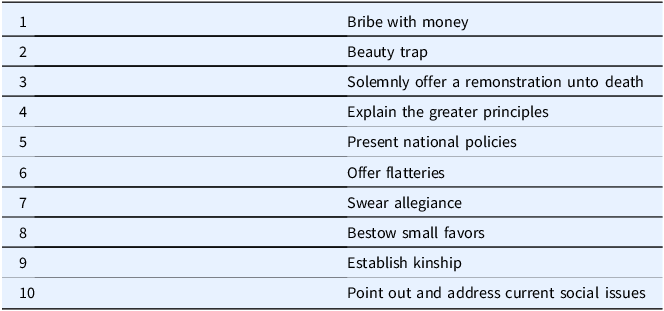
If the player-character approaches the officials’ mansions directly, he will be thrown out by the yamen runners. However, some NPCs will reveal that a letter of introduction is needed to meet the officials. Players can acquire this letter from a pawnshop manager, who will also share information about the preferences and recent activities of the emperor and officials. These pieces of information provide players with clues for selecting appropriate schemes to persuade officials. The game includes a morally ambiguous set of ten schemes (see Table 1).
Ten schemes to persuade the emperor and the officials

When interacting with an official, players must choose one scheme from the set of ten as their response. Only one scheme is correct and will earn the player a reward or military funds. Of the remaining nine schemes, eight are incorrect and will result in the player-character being severely beaten by the official. One scheme, however, will anger the official enough to execute the player-character, ending the game and forcing a restart. Players cannot mindlessly attempt different schemes, as choosing incorrectly three times in a row with the same official will result in the player-character being beaten to death, also leading to a game over. Therefore, to progress, players must analyze the preferences and recent activities of the officials, which they receive from the pawnshop manager.
The game developers aimed for players to learn through their analysis of officials’ preferences and activities that the officialdom of the Qing Empire was highly corrupt. While some officials were honest and capable, many were corrupt and mediocre. Moreover, the game establishes that corrupt officials advocate for peace with the British, while honest officials support banning the opium trade and going to war. The portrayal of the peace advocates as corrupt and the war advocates as honest is a simplistic but long-standing trope. According to a Taiwanese historian, scholars during the Opium War were already making such characterizations.Footnote 53 Nevertheless, in the game, both honest and corrupt officials can reward the player-character with money for frontline troops. When interacting with honest officials, players should choose schemes that align with moral principles. Conversely, when dealing with corrupt officials, the approach should be the opposite.
For example, the pawnshop manager tells the player-character that Mujangga, a Grand Councilor and a proponent of peace with Britain, is highly skilled in flattery and favors sycophants, while he despises those who discuss national policies. Therefore, if the player-character chooses the scheme to “present national policies” when interacting with Mujangga, he will be executed, and the game will be over. The correct scheme to earn players money from Mujangga is to “present flatteries.” In a corrupt environment, the player-character is forced to use an immoral scheme to raise funds for a moral cause: fighting the British invaders.
Mujangga’s preferences are clear, but not every official the player-character interacts with is as straightforward. For example, players learn from the pawnshop manager that “the Daoguang emperor is inherently timid and lacks a sense of the bigger picture; he is arrogantly self-important and places great emphasis on the hierarchical rituals between ruler and subjects.” This information does not clarify whether the emperor favors war or peace with Britain. Historically, the Daoguang emperor’s stance indeed wavered between war and peace.Footnote 54 Due to his ambiguous attitude, players cannot easily determine which of the ten schemes is the correct approach. Choosing incorrectly could end the game immediately. In my first playthrough, I failed the fundraising mission of the Chuanbi Battle campaign by selecting the wrong scheme three times when dealing with the Daoguang emperor. This game setting reminds players of the difficulty in aiding the corrupt Qing to defeat Britain in the Opium War.
The fundraising mission is difficult to complete, but it can be skipped to some extent, because players do not have to interact with every available official. In the Chuanbi Battle campaign, they can simply earn money from Mujangga, which is easy, and then proceed to the second mission. Winning the campaign depends on meeting the conditions for victory in the second mission. The second mission thus tests the developers’ ability to balance playability and historicity. While the fundraising mission is largely fictional, the battles in the second mission are historical. If the players win the second mission, they change history in the game.
In the second mission, players quickly discover that commanding the Qing forces to defeat the British is even more challenging than the first fundraising mission. Foremost, in the game, like in history, the British forces possess more advanced weaponry and equipment than the Qing. For instance, the British navy’s three-masted warships in the game can destroy the Qing’s two-masted ships with a single broadside. Although players can use funds from the fundraising mission to upgrade the Qing’s ships to three-masted or even anachronistic ironclad warships, they will still struggle in naval battles against the British. Ironclads require too many resources to upgrade and do not offer an overwhelming advantage over the British warships in the game. Moreover, even if players win a naval conflict against the British, it does not guarantee victory in the Chuanbi Battle campaign.
To win the Chuanbi Battle campaign for the Qing, players must annihilate the British forces and ensure that none of the four towns – Shajiao, Dajiao, Pinghu, and Hengdang – are lost during the entire campaign. In subsequent campaigns, they must defend even more towns while annihilating the British forces. These victory conditions are stringent and challenging. The British have a powerful navy, and their landing sites and attack directions are somewhat random. The Qing forces, controlled by the players, are disadvantaged by outdated equipment. If players spread their forces too thinly in order to defend everywhere, it is as if they have no defenses. However, concentrating forces on specific towns risks losing the campaign if the British capture undefended towns. These victory conditions are stricter than the reality of the Opium War, during which the Qing forces often continued to fight even when several of the must-defend towns in the game were occupied by the British.
The Golden Disc developers set a high bar for players to achieve victory. Yet, this high victory bar was not a flaw, but an essential part of the game’s core experience and procedural argument. This then begs the question: does the great difficulty make The Opium War frustrating to play? According to Jesper Juul, failure in video games is perceived as most negative and frustrating when a player believes that they can never succeed, regardless of practice or improvement. This psychological state stems from attributing failure to a “stable cause” – a factor that the player believes cannot be changed. Juul explains that games that imply a player is not improving, or that the deficiency is global and stable, make failure painful and less motivating.Footnote 55 While video games inherently induce feelings of inadequacy, they sustain player motivation by offering the promise of redemption or escape from that inadequacy, which typically involves improving one’s skills.Footnote 56
If the developers designed The Opium War game in such a way that the historical inevitability of the Qing forces’ military backwardness made victory truly impossible, no matter how much a player practiced or improved, such a design would align well with the orthodox narrative, but would severely harm the gameplay experience. The game would induce profound discouragement in the player and obviate the possibility, promised in the marketing materials, of allowing Chinese players to “wash away national humiliation.” The developers of The Opium War avoided this pitfall by utilizing the concept of historical contingency. That is, players can defeat the British if they are skillful enough.
The developers even included a “Winning Strategies” section in the manual to assist players. They recommend creating situations where Qing forces outnumber the enemy in small areas and quickly withdraw after eliminating one or two enemy units. Due to the Qing forces’ poorly equipped mobile units, players should combine the use of mobile units with stationary but heavily fortified gun turrets.Footnote 57 By recommending strategies, the developers make it clear to players that skill matters in The Opium War.
Still, the developers understood that the winning strategies they recommended were complicated and challenging to implement. Therefore, players can progress through the game regardless of the outcomes of previous campaigns. In this way, players can continue to play the second campaign – the Zhoushan campaign – even if they lose the first campaign. This design artfully prevents players from becoming frustrated by overly difficult battles and conforms to the course of history, as history did not cease to evolve because the Qing Empire lost particular battles to Britain.
Starting from the second campaign, the outcome of the previous battle significantly influences the direction of the game’s story. If players triumph in the first campaign, they receive a reward from the more bellicose Daoguang emperor. Officials who originally supported the war against the British become more motivated, making it easier for the player-character to receive substantial military funding from them. Meanwhile, officials favoring peace adopt a more self-preserving stance. The rewards from the emperor and the war advocates allow players to strengthen their military forces before the next campaign. However, the British forces’ equipment and troop strength increase proportionally as the Qing forces grow stronger. Thus, the rewards do not significantly reduce the game’s difficulty. This design choice conveys the developers’ understanding of historical inevitability and prevents players from forming the impression that a corrupt feudal dynasty could easily defeat a capitalist power.
If, however, the players lose the first campaign, the war advocates become discouraged, and the emperor starts favoring the peace advocates. The next campaign becomes more challenging due to the lack of rewards from previous victories. In this scenario, players can easily experience a series of defeats, ultimately mirroring the historical progress of the war for the Qing Empire. Thus, the developers faced a final design challenge: what did they want players to feel after completing their historical game?
Considering the high degree of difficulty of The Opium War’s battles, most players would have lost the war with the British, at least in their first playthrough. This outcome likely differed from the expectations of those players because the game developers marketed their game as a tribute to the 1997 handover of Hong Kong and a patriotic game where Chinese players could eliminate British invaders.Footnote 58 Yet, lowering the difficulty level of the battles was not a design direction for the Golden Disc developers. They aimed to construct a procedural argument that it was historically inevitable that the Qing forces were much weaker than the British forces, and that the player needed to be highly skilled to defeat the British. Thus, the developers had to find a way to help Chinese players appreciate in-game losses to the British and encourage them to replay and improve their skills.
The developers’ solution was to recognize the player-character as a patriotic hero by enshrining the character in the in-game Monument to the Opium War Heroes – designed to resemble the Monument to the People’s Heroes in Beijing – regardless of how many victories or defeats players experience in the game’s five campaigns.Footnote 59 Even if players do not win a single campaign, the inscription on the monument will still commend the player-character as a “Patriotic Martyr.” The developers hoped to use this approach to appease Chinese players who played The Opium War with the intent to defeat the “damned invaders” and to encourage them to replay and improve their skills. If players win all five campaigns – effectively securing a defeat of the British invaders in the game – the player-character is awarded the more prestigious title of “Forerunner of China’s Anti-Invasion War” or “Hero of China.”Footnote 60
Yang Nanzheng revealed that in the initial game script, if players won all five campaigns, they could play two additional campaigns that would allow players to use the Qing Empire to conquer India and Britain. Ultimately, Yang cut these two campaigns because he wanted to convey to players that even if they won all the battles and defeated the invaders, they could only be heroes of the resistance against the British expeditionary force, because “for China to truly become strong, it must reform the feudal system and follow the path of socialism.”Footnote 61 In Yang’s historical game, it should be inevitable that feudalism is more backward than capitalism. Therefore, he could not allow players the ability to use the feudal Qing Empire to conquer capitalist Britain.
The launch and impact of The Opium War
The Golden Disc developers successfully launched The Opium War in 1997. From their perspective, the game was a serious historical game that possessed significant market potential. However, the market performance of The Opium War was less than satisfactory. The official version of The Opium War was released in Beijing in the form of a CD-ROM, but sales stalled just two weeks after its launch. Moreover, in major markets such as Shanghai and Guangzhou, players were unable to purchase the game. In Yang Nanzheng’s own words, The Opium War’s official CD-ROMs did not even make it out of Beijing.Footnote 62 This situation was partly related to the rampant piracy in the Chinese software market during the 1990s, which hindered the sales of official copies of games.Footnote 63 In the case of The Opium War, four pirated versions emerged in Beijing shortly after its release.Footnote 64
However, some video games became popular among Chinese players through pirated copies, like Heroes of the Three Kingdoms 2.Footnote 65 In contrast, even pirated copies of The Opium War did not become widespread. Consequently, on Douban, the leading Chinese social media site for reviewing cultural products, The Opium War has no score because not enough people have reviewed it.Footnote 66 Heroes of the Three Kingdoms 2, in comparison, has 2,175 reviews and a score of 8.9 out of 10 on Douban. Many of these reviewers state that Heroes 2 is a part of their childhood memories, even though they only played the pirated version.Footnote 67 While pirated games make it hard for developers to profit, they are not usually the reason a game fails to have an impact.
Determining the exact reasons why a game is overlooked can be challenging. The Opium War was developed during the early stages of the Chinese game industry, and its developers had a limited understanding of the market. The official recommended system requirements for The Opium War included a Pentium or higher processor, 16 MB of RAM, 1 MB of hard drive space, and a double-speed or faster CD-ROM drive.Footnote 68 A computer with similar specifications cost at least 6000 yuan in 1997.Footnote 69 In February 1997, it was considered a breakthrough when Chinese domestic computer brands like Lenovo and Founder reduced the prices of their personal computers from over 10,000 yuan to 9000 yuan.Footnote 70 However, even at these prices, computers were still beyond the reach of an average Chinese household in 1997. In that year, the annual per capita disposable income of urban residents nationwide was 5160 yuan.Footnote 71 In such a market, it was difficult for Golden Disc’s game to stand out, even though it was a patriotic game designed to celebrate the historical return of Hong Kong to China.
Conclusion: Beyond the orthodox narrative
This article begins with the aborted plan of Game-Labs, a Ukrainian video game company, to develop a game set in China’s modern history. Game-Labs abandoned its plan to make a game about modern China because Chinese players’ comments led them to conclude that this part of history is “too sensitive” for video games. Modern Chinese history is indeed sensitive in China, as it is a significant part of the CCP’s justification for its rule over the country. However, modern Chinese history is by no means a forbidden zone for video games. As early as 1997, the mainland Chinese game company Golden Disc created a game based on the history of the Opium War. Moreover, by utilizing the officially endorsed yet flexible concept of the inevitability and contingency of history, the game’s developers afforded players a unique way to experience the Opium War that went beyond the scope of orthodox historical narrative, precisely due to the game’s procedural nature and its ability to construct counterfactual arguments.
The orthodox historical narrative emphasizes that the Qing Empire’s defeat in the Opium War was inevitable, a result of Britain’s more advanced stage of social development, which was a decisive force transcending individual factors. Under this orthodox narrative, the surrender of the Qing forces upon encountering British warships is condoned, but this clearly conceals the complexity of history.Footnote 72 Although Britain’s military strength was indeed superior to that of the Qing during the Opium War, a question remains: if the Qing forces had resisted tenaciously, could British warships have achieved an effortless victory without careful preparation?
The historical narrative presented by The Opium War is more complex than the orthodox historical view. On the one hand, players in the game can experience the immense gap in military strength between the Qing and Britain. On the other hand, through its unique procedurality and the concept of historical contingency, the game reintroduces the human element into the historical process, so that the outcomes of specific in-game battles depend on the player’s actions. When skilled players win enough specific battles, they can even avoid the signing of the Treaty of Nanjing, thereby breaking through the limitations of the orthodox narrative of modern Chinese history. In this sense, although The Opium War was undeniably designed for nationalist purposes, it is not a “propagame” that was explicitly created to sell and reinforce the ruling elite’s narrative of history.Footnote 73
In recent years, a new historiographical trend in China’s modern history has emerged. It emphasizes that China’s modern history was dynamic and multidimensional, challenging established narratives like the incompetence of the late Qing Empire, the inevitability of modernization, and the decline of China’s tradition and religion.Footnote 74 The historical experience that the Golden Disc provided players in The Opium War resonates with this new historiographical trend. Specifically, just as scholars like Prasenjit Duara seek to “rescue history from the nation” by challenging singular, deterministic state narratives in text,Footnote 75 The Opium War’s procedural rhetoric achieves a similar goal through rules and processes. The game’s capacity for contingency rescues the Opium War from the orthodox, teleological narrative of the Qing’s inevitable defeat, thereby reintroducing the very human and historical complexity that the new scholarly trend has highlighted.
Video games have become increasingly important in our society. It is regrettable that no other game featuring the Opium War as its main theme has been released since 1997. Hopefully, subsequent video game developers will build upon the foundation laid by Golden Disc, leveraging the inherent procedural nature of video games to provide players with even more enhanced and multidimensional experiences of modern Chinese history.
Acknowledgements
I would like to thank the two anonymous reviewers, whose insightful comments have significantly improved this article. I also wish to express my gratitude to Prof. Han Xiaorong and Prof. Pan Lu for their strong support as I venture into the new research field of the cultural history of video games. Finally, I am deeply grateful to Adrian Wu, whose technical assistance made it possible for me to play The Opium War.



 Open access

