





Introduction
Coalition cabinets face an intricate delegation problem in international negotiations. Ministerial-level meetings in forums such as the G7, the OECD, the WTO, and the Council of the EU (hereafter Council) require delegation to individual ministers who are then responsible for negotiating on behalf of their respective cabinets. This excludes a great number of coalition parties from any direct participation in the negotiations. It also creates a risk of ministerial drift where ministers at the negotiating table pursue party instead of coalition goals. Given voters’ difficulty in assigning responsibility within coalition governments (e.g., Fisher and Hobolt Reference Fisher and Hobolt2010; Klüver and Spoon Reference Klüver and Spoon2020; Fortunato, Lin, Stevenson et al. Reference Fortunato2021), collective responsibility creates a rift between the insider – the coalition party whose minister is responsible for negotiations – and the outsiders – the coalition partners who are sidelined. While insiders have strong incentives to cater to their constituents by engaging in ministerial drift, outsiders want to hedge against this risk.
How can coalitions enforce coalition compromises in international negotiations? An emerging literature on coalition policymaking in the EU highlights the importance of domestic institutions for constraining ministers (Finke and Dannwolf Reference Finke and Dannwolf2013; Finke and Herbel Reference Finke and Herbel2015, Reference Finke and Herbel2018; Franchino and Wratil Reference Franchino and Wratil2019; Kostadinova and Kreppel Reference Kostadinova and Kreppel2022), similar to studies of domestic policymaking (e.g., Thies Reference Thies2001; Martin and Vanberg Reference Martin and Vanberg2011; Moury Reference Moury2011; Klüver, Bäck, and Krauss Reference Klüver, Bäck and Krauss2023). While these institutions can constrain ministerial leeway, their availability varies substantially across countries, cabinets, and intergovernmental arenas, leaving many outsiders vulnerable to the risks posed by ministerial drift. I argue that such outsiders can intervene from the sidelines with a more ad hoc tool: they can dissent publicly from their coalition partner. In so doing, they send a clear signal to other delegations in the Council that the insider’s position lacks domestic backing. By making intracoalition conflict observable, the outsider enables negotiators from other countries to detect ministerial drift, thereby limiting the insider’s ability to present a partisan position as having the backing of the coalition as a whole.Footnote 1 Ultimately, this also has the potential to weaken the insider’s bargaining position, which may be precisely in the interest of the outsider.
This paper investigates the conditions under which sidelined coalition parties engage in public dissent in international negotiations. Because these negotiations largely occur behind closed doors, it is difficult to observe any direct effects of dissent on bargaining outcomes. Nevertheless, analyzing when and why coalition outsiders dissent publicly provides insights into their strategic motivations.Footnote 2 To this end, the paper develops a formal model that starts with the assumption that both formal constraining powers and overt dissent can constrain ministerial leeway.
The model predicts that dissent by the outsider hinges on its policy misalignment with the insider relative to the other countries with whom the coalition negotiates. Moreover, it yields the insight that misaligned outsiders only benefit from dissent when the domestic institutional setting lacks constraining powers. When domestic constraints can be imposed, coalition parties cannot benefit from overt dissent under any circumstances. Importantly, this is theoretically and empirically distinct from coalition parties disagreeing with one another for purely ideological reasons or as a signal to voters (e.g., Nonnemacher and Spoon Reference Nonnemacher and Spoon2023).
The European Union (EU) offers an ideal setting to test this argument. In the Council of the EU, ministers from member states are delegated to negotiate on behalf of their governments, creating the very delegation problem described above (Franchino and Wratil Reference Franchino and Wratil2019; Rieger Reference Rieger2025a). The EU’s bicameral structure also enables members of the European Parliament (MEPs) to engage with the same legislative proposals as the Council, allowing them to express their dissent through public roll call votes (RCVs). Analyzing over 85,000 RCVs cast by outsider parties from 152 coalition governments between 2004 and 2019, I find that these sidelined parties are more likely to dissent when they are more misaligned with their coalition partners than with other Council members, but only when they lack formal domestic constraining powers.
These findings contribute to our understanding of coalition governance, international negotiations, and EU policymaking. In particular, they add to an emerging literature showing that domestic coalition politics shape behavior at the international level (Finke and Dannwolf Reference Finke and Dannwolf2013; Finke and Herbel Reference Finke and Herbel2015, Reference Finke and Herbel2018; Franchino and Wratil Reference Franchino and Wratil2019; Kostadinova and Kreppel Reference Kostadinova and Kreppel2022; Nonnemacher and Spoon Reference Nonnemacher and Spoon2023; Rieger Reference Rieger2025a, Reference Rieger2025b). They also highlight that overt dissent may play a complementary role for formal oversight institutions. For negotiations in other intergovernmental arenas such as the G7, the OECD, and the WTO, where national-level oversight institutions are less established, this may be particularly useful for coalition partners on the sidelines. In these settings, outsiders may also voice their dissent on social media, in interviews with traditional media outlets, or in public speeches. Further, the paper highlights a novel link in the bicameral political system of the EU, wherein the lower chamber enables governing parties that are excluded from the upper chamber to intervene in the policymaking process. This ties in nicely with findings that emphasize the role of parliaments for resolving coalition conflict in domestic settings (e.g., Martin and Vanberg Reference Martin and Vanberg2004, Reference Martin and Vanberg2005, Reference Martin and Vanberg2011). In EU policymaking, parliament plays a similarly crucial role in resolving the delegation problems that afflict coalition governments.
Domestic and international coalition policymaking
To understand what motivates parties in (international) coalition policymaking, it is instructive to see the fundamental tension of multiparty governance: Coalition partners typically differ in their ideological backgrounds and policy positions, which frequently creates internal tensions and conflict over policy. Yet, despite their differences, coalition parties engage in joint policymaking in a system in which voters hold them individually accountable at the ballot box (see Huber Reference Huber1996; Laver and Shepsle Reference Laver and Shepsle1996; Martin and Vanberg Reference Martin and Vanberg2011). The very nature of multiparty government in parliamentary systems thus encourages parties to cater to their constituents. Because voters generally dislike compromises between coalition partners and because they punish parties that they perceive to compromise their policy platforms, coalition parties are incentivized to pursue party goals (Fortunato Reference Fortunato2019, Reference Fortunato2021; Fortunato and Stevenson Reference Fortunato and Stevenson2013; Plescia, Ecker, and Meyer Reference Plescia, Ecker and Meyer2022; Rieger Reference Rieger2025a).
What enables coalition parties to translate this intent into action is that cabinets rely heavily on delegating policymaking tasks to individual ministers (e.g., Thies Reference Thies2001; Martin and Vanberg Reference Martin and Vanberg2005, Reference Martin and Vanberg2014; Klüver and Bäck Reference Klüver and Bäck2019). This creates a host of delegation problems, most notably the risk of ministerial drift where ministers deviate from the coalition compromise in favor of their own party. Yet, in spite of this risk, there is ample evidence that actual coalition policy output is much more reflective of compromise than ministerial autonomy (Goodhart Reference Goodhart2013; Martin and Vanberg Reference Martin and Vanberg2014; Thomson et al., Reference Thomson, Royed, Naurin, Artés, Costello, Ennser-Jedenastik, Ferguson, Kostadinova, Moury, Pétry and Praprotnik2017). Reconciling these seemingly contradictory findings, a vast literature has identified a number of institutional mechanisms for reining in ministerial drift. Broadly speaking, such mechanisms facilitate or enforce compromises by implementing constraints and reducing information asymmetries among coalition partners within the executive (e.g., Thies Reference Thies2001; Lipsmeyer and Pierce Reference Lipsmeyer and Pierce2011; Moury Reference Moury2011; Klüser and Breunig Reference Klüser and Breunig2023; Klüser Reference Klüser2024; Klüver, Bäck, and Krauss Reference Klüver, Bäck and Krauss2023) or in legislative-executive relations (e.g., Martin and Vanberg Reference Martin and Vanberg2004, Reference Martin and Vanberg2005, Reference Martin and Vanberg2011, Reference Martin and Vanberg2020; Carroll and Cox Reference Carroll and Cox2012).
This broad body of research has almost exclusively focused on the national level. Yet, coalitions are frequently involved in policymaking in international negotiations – many of which are held at the ministerial level. Among the G7 countries, there are 23 such meetings scheduled for 2024 in various policy areas.Footnote 3 In the EU, several of the different sectoral configurations of the Council meet on a monthly basis, and similar meetings are held within the OECD, among trade ministers in the WTO, as well as foreign ministers in the Council of Europe. All of these negotiations take place among ministers responsible for the same specific portfolio in their respective countries. Coalition parties that do not control the relevant portfolio are thus excluded from direct involvement in these talks, making them outsider parties.
This creates similar delegation problems to those encountered in domestic settings. First, international negotiations create information asymmetries between insiders and outsiders. Because such negotiations frequently take place behind closed doors, insiders have access to exclusive information on the state of negotiations and the position-taking of other negotiators. Second, international negotiations create a risk of ministerial drift with consequences for policy outcomes at the international level (Franchino and Rahming Reference Franchino and Rahming2003) as well as repercussions in the domestic sphere (Rieger Reference Rieger2025a).
Resolving these issues requires the ability of coalition parties to monitor and constrain their coalition partners. A key difference to domestic policymaking, however, is that it requires significantly more focus on preemptive constraints. Although monitoring and constraining can be substitutes (cf., Thies Reference Thies2001), formal constraining powers are especially crucial in international negotiations because identifying ministerial drift is only a first step. Without amending powers, however, coalition partners would have little leverage to rein it in. Importantly, there is less room for intermediary scrutiny of government behavior in international negotiations. Instead, they require substantial preparation on behalf of the participating governments to then be concluded within a few days of concentrated negotiations. Consequently, even with perfect information, coalition partners can hardly intervene once the negotiations are underway. It is thus essential that outsiders are able to tie the hands of the minister before the negotiations take place. At this point, the information asymmetry has also not extended as far as it might during the negotiations themselves, which further highlights the importance of constraining powers.
The functioning of institutional constraints is straightforward and demonstrable. Having been specifically designed to restrict ministerial autonomy, such mechanisms include formalized coordination processes within the executive (Kassim Reference Kassim2013; Franchino and Wratil Reference Franchino and Wratil2019), shadowing by junior ministers (Thies Reference Thies2001; Lipsmeyer and Pierce Reference Lipsmeyer and Pierce2011), coalition agreements (Kostadinova and Kreppel Reference Kostadinova and Kreppel2022; Klüver, Bäck, and Krauss Reference Klüver, Bäck and Krauss2023), and parliamentary constraining powers (Franchino and Wratil Reference Franchino and Wratil2019; Winzen Reference Winzen2022). All of these require coalition partners to take action domestically at the time of cabinet formation or during the preparation phase for a specific negotiation. In the context of international negotiations, specifically the EU, two recent studies show that these institutions are indeed effective (Franchino and Wratil Reference Franchino and Wratil2019; Kostadinova and Kreppel Reference Kostadinova and Kreppel2022) and loyal. Using expert-coded government positions at the initiation of the legislative process and thus prior to the negotiations, both studies demonstrate that ministers represent coalition compromises when they are constrained by their coalition partners. Finke and Herbel (Reference Finke and Herbel2015) find that coalition parties make use of parliamentary institutions to monitor and scrutinize their coalition partner’s behavior in EU affairs. However, whether or not coalition parties can directly prevent ministerial drift in the EU chiefly hinges on the availability of constraining powers.
This institutional resolution of delegation problems is not available to all sidelined coalition parties. In fact, there is considerable variation in the availability of these mechanisms across countries (Kassim Reference Kassim2013; Winzen Reference Winzen2022). Moreover, the studies on coalition policymaking in the EU also bear testimony to the fact that these are highly context-specific institutions. Whether a coordinated approach to EU affairs provides similar levels of monitoring and constraining power in other intergovernmental arenas is questionable at best. As a result, many outsiders remain prone to the risk of ministerial drift in international negotiations.
Public dissent by outsiders
This does not mean that outsiders who lack institutional constraining powers have to be passive bystanders. Instead, they can publicly dissent from their coalition partner to signal disagreement to both the minister and other negotiators at the table. In the following, I outline how and why dissent can function as a substitute for formal constraining powers. A key assumption of the theoretical argument is that this can help outsiders contain ministerial drift. While the fact that international negotiations largely take place behind closed doors renders a test of this assumption infeasible, it generates testable implications about when outsider dissent is likely to occur. Before deriving these expectations with a formal model, I first discuss why it is reasonable to assume that dissent can have this constraining effect.
The key mechanism through which public dissent keeps the insider from negotiating at their discretion is by making disagreement common knowledge. As a result, other negotiators are able to determine whether the insider’s position reflects the coalition compromise or deviates from it. Further, if it deviates, they are able to infer whether the deviation is the result of ministerial drift or intracoalition logrolling. While in the absence of this common knowledge, the insider can credibly take a partisan position and present it as having majority support in its member state, this is no longer feasible once the outsider has dissented publicly. As a result, the only position the insider can still credibly take is a compromise position, while any attempt at ministerial drift is immediately recognized as lacking the necessary backing of the insider’s coalition partner. From the perspective of the insider, this also means that the compromise position is the best option they have if they do not want to cede all bargaining power. In the event that the insider still attempts ministerial drift, negotiators who are more in line with the outsider can openly highlight the lack of coalition backing, undermining the insider’s credibility and limiting their ability to advance a partisan position. In short, the argument here is not so much that the insider suddenly starts acting in the interest of the collective coalition or faces reputational loss vis-à-vis other negotiators, but that every negotiator knows which position has majority support in the member state and which does not. As a result, public dissent can alleviate the delegation problem for the outsider by having other negotiators at the negotiating table that can act as informal watchdogs, even while sidelined.
In addition to changing the informational landscape, true dissent may also weaken the insider’s bargaining power more generally. A negotiator that has not coordinated its bargaining position with their coalition partners, and is viewed as such, will be less effective in the negotiations.Footnote 4 Importantly, this weakening of the insider may be precisely in the interest of the outsider. Consider the extreme case where an outsider is fully aligned with the majority of other negotiators, but not their compatriot minister. This outsider would prefer the negotiation outcome where their insider is completely silenced in the negotiations. Consequently, outsiders may dissent to weaken their own coalition partners’ bargaining power in international negotiations.
Another mechanism through which dissent may prevent ministerial drift is by simply providing the insider with additional information. Ministerial drift need not be strategic or malicious, but may also occasionally occur because insiders are not aware of disagreement within their coalition. This is especially true in the context of highly technical and complex EU legislation and when the matter of contention does not map onto existing dividing lines in the coalition. Consequently, outsiders may opt for overt dissent when policy coordination is not very institutionalized. In such settings, dissent may thus also affect ministerial behavior more immediately. In summary, overt dissent can be viewed as a substitute for domestic constraining powers. Only when both are absent, is it reasonable to assume that insiders have considerable leeway, which allows them to speak authoritatively on behalf of a unified coalition even when taking overtly partisan positions.
Empirical implications: When do outsiders dissent?
As mentioned before, empirically testing this theoretical argument presents significant challenges. The primary obstacle is the notorious lack of transparency in international negotiations. Even in the well-established and increasingly transparent Council of the EU, studying ministerial behavior remains exceptionally difficult. Although formal votes are recorded, they are often unanimous or serve as signals to domestic audiences (Hagemann, Hobolt, and Wratil Reference Hagemann, Hobolt and Wratil2017). While speeches in the Council are recorded and have been studied (Wratil and Hobolt Reference Wratil and Hobolt2019; Wratil, Wäckerle, and Proksch Reference Wratil, Wäckerle and Proksch2023), access to the deliberations remains limited and comes with its own set of methodological difficulties.Footnote 5 In other intergovernmental arenas, transparency is even lower, which effectively precludes any comprehensive analysis of ministerial behavior.
Fortunately, however, the theory also offers clear implications for outsider behavior. Since the argument is that dissent is an overt signal, it must be observable and is therefore suitable for study. In the following section, I thus formalize the theory to derive expectations regarding when outsiders are likely to express overt dissent. To do so, I propose a model of two coalition parties, one insider and one outsider, that act sequentially in a two-stage game. In this section, I limit myself to describing the setup, providing some intuition, and summarizing the predictions of the model. The full model is described and analyzed in the Online Appendix A. Below, I also discuss alternative explanations and extensions of the theoretical argument.
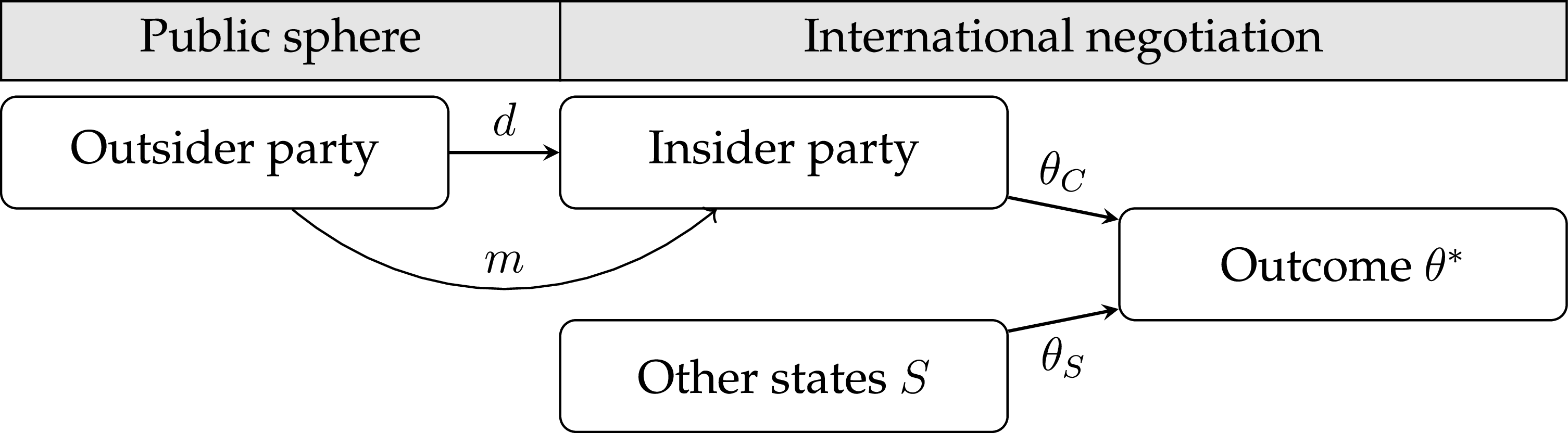
Both insider and outsider parties are assumed to be policy-seeking utility maximizers with unimodal preferences in a one-dimensional policy space. I further assume that actors have complete and perfect information. Figure 1 illustrates the sequencing of the game. In the first stage, the outsider can choose between dissenting publicly ( $d = 1$
) or remaining silent (
$d = 1$
) or remaining silent ( $d = 0$
) as well as employing constraining mechanisms (
$d = 0$
) as well as employing constraining mechanisms ( $m = 1$
) or not (
$m = 1$
) or not ( $m = 0$
), depending on whether they are available or not. In the second stage, the insider takes a position in the international negotiations with other countries. For simplicity, the other countries in the negotiation are modeled as a single unitary actor that takes a position in the same policy space. The outcome of the negotiations (
$m = 0$
), depending on whether they are available or not. In the second stage, the insider takes a position in the international negotiations with other countries. For simplicity, the other countries in the negotiation are modeled as a single unitary actor that takes a position in the same policy space. The outcome of the negotiations ( ${\theta ^{\rm{*}}}$
) is a weighted average of the positions taken by the insider (
${\theta ^{\rm{*}}}$
) is a weighted average of the positions taken by the insider ( ${\theta _C}$
) and the other countries (
${\theta _C}$
) and the other countries ( ${\theta _S}$
) that takes into account their respective bargaining power. Ultimately, this outcome determines both parties’ utility.
${\theta _S}$
) that takes into account their respective bargaining power. Ultimately, this outcome determines both parties’ utility.
Overview of game.

Crucially, the outsider chooses whether to dissent with an eye to how it would affect the position-taking of the insider in the following stage and if it leads to a more favorable negotiation outcome. In line with the theoretical arguments made above, outsiders can enforce the coalition compromise through institutional constraining or by overt dissent. The latter also potentially weakens the bargaining position of the coalition vis-à-vis other countries in the negotiation.Footnote 6 I define the coalition compromise as a Nash bargaining solution between the two parties’ ideal points where the position of the other countries serves as the status quo and fallback option. This incorporates the idea that failure to coordinate internal compromises effectively results in zero bargaining power for the coalition in the international negotiations.Footnote 7 When overt dissent and institutional constraining powers are both absent, the insider has much more leeway in choosing a bargaining position. The insider thus chooses a position that results in a negotiation outcome, which maximizes their own utility, given some feasibility constraints.
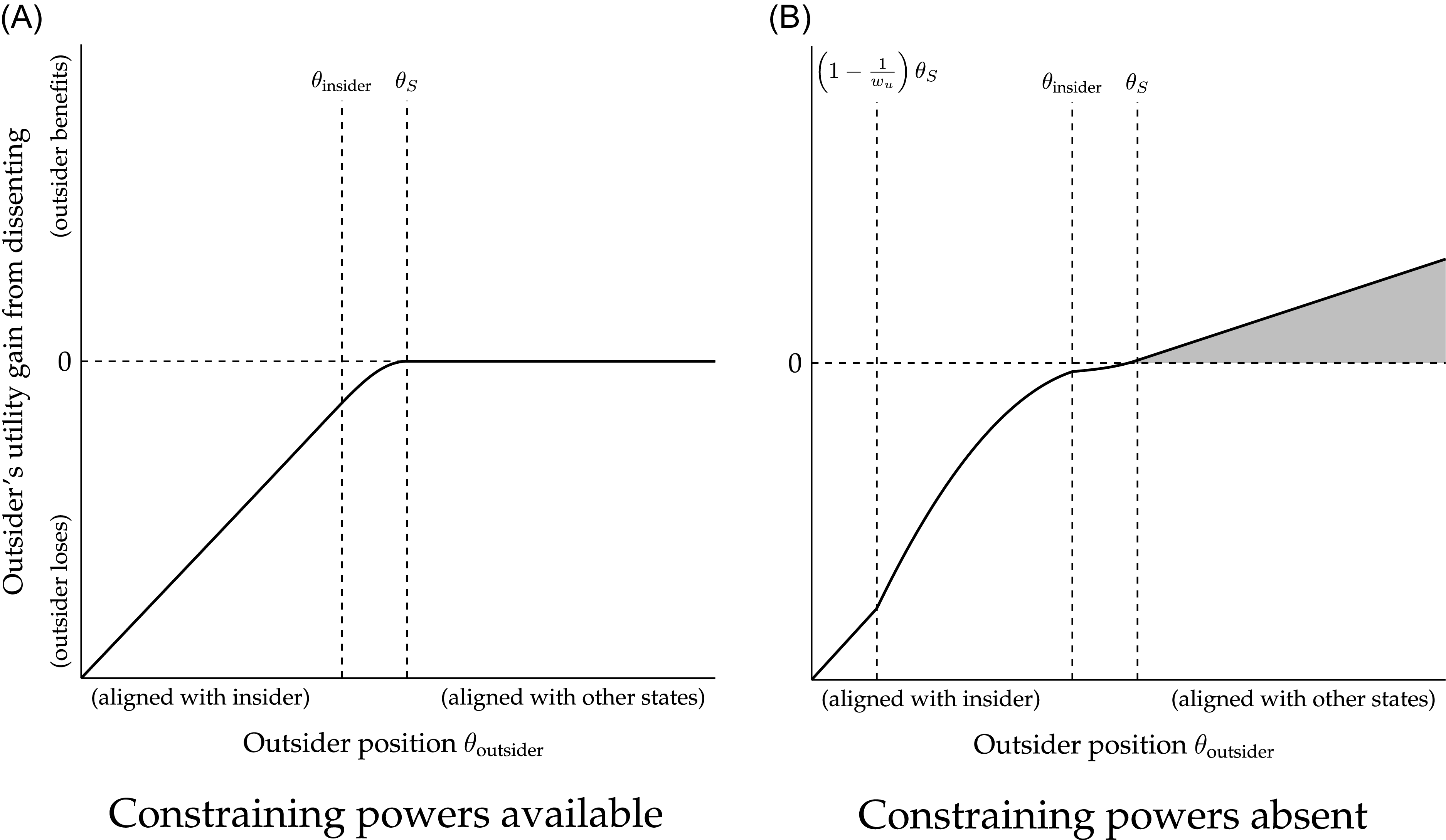
Given complete information, the outsider can determine whether it benefits from dissenting. Figure 2 illustrates the outsider’s utility gain from dissenting under the two conditions: when constraining powers are available (panel A) or absent (panel B). The figure plots the difference in utility between dissenting and not dissenting as a function of the outsider’s policy misalignment with its coalition partner relative to the other states at the negotiating table. As illustrated by panel A, the outsider never benefits from dissenting publicly when constraining powers are available. Given the theoretical argument, this makes sense: outsiders can enforce the compromise internally, and the only effect of a dissenting vote is a reduction in bargaining power, thereby resulting in an overall loss of utility in most cases. Panel B, on the other hand, illustrates that when outsiders cannot rely on internal constraining powers, they can benefit from overt dissent under certain circumstances: when the outsider is sufficiently misaligned with the insider, overt dissent becomes a viable strategy. The point after which overt dissent leads to positive utility gains depends on the concrete setting, but always lies between the positions of the insider and the other countries. In summary, this formal analysis yields the following prediction:
Outsider party’s utility gain from dissenting when constraining powers are available (panel A) and when they are absent (panel B) as a function of the outsider’s relative misalignment. Shaded area highlights when the outsider gains from dissenting. Refer to Appendix A for further details.

H1: Outsiders dissent publicly when they are misaligned with their own coalition partner relative to the other countries in the international negotiations, but only when constraining powers are absent.
Another important factor to consider is salience. The importance of ideological distance for coalitions depends crucially on the salience that partners assign to different issues (e.g., Höhmann and Sieberer, Reference Höhmann and Sieberer2020; Falcó-Gimeno, Reference Falcó-Gimeno2014; Ecker and Meyer, Reference Ecker and Meyer2020; de Marchi and Laver, Reference de Marchi and Laver2020). Specifically, preference tangentiality captures the extent to which coalition partners attach similar or complementary importance to a given issue, which is crucial for the need for oversight (Falcó-Gimeno, Reference Falcó-Gimeno2014): when tangentiality is low, i.e., when both insider and outsider care equally about an issue, delegation risks are bigger because both have stakes in the outcome. As a result, there is more need for oversight. When tangentiality is high, compromises tend to be self-enforcing and the need for oversight is diminished. I extend the formal model to incorporate this logic in the Online Appendix A. This yields the insight that dissent should be less relevant as an alternative to constraining powers when preference tangentiality is high. In summary, this leads to the following refinement of hypothesis ${{\rm{H}}_1}$
.
${{\rm{H}}_1}$
.
H2: Hypothesis ${{\rm{H}}_1}$
holds when preference tangentiality is low but not otherwise.
${{\rm{H}}_1}$
holds when preference tangentiality is low but not otherwise.
It is worth highlighting how the theoretical argument differs from an alternative explanation: dissent may simply be the result of policy differences between the insider and the outsider, while constraining institutions alleviate this conflict by enabling more consensual policymaking within the coalition.Footnote
8
This would mean that there is nothing strategic about outsider behavior. The straightforward empirical implication of this argument is that dissent is more frequent when the distance between insider and outsider increases and when constraining powers are absent. In other words, dissent in this alternative explanation should be independent of the other negotiators. Importantly, it is true that dissent with the coalition partner does not automatically mean an endorsement of the position of the other negotiators.Footnote
9
In contrast to hypothesis ${{\rm{H}}_1}$
, this yields the following alternative hypothesis:
${{\rm{H}}_1}$
, this yields the following alternative hypothesis:
H3: Outsiders dissent publicly when they disagree with their coalition partner, irrespective of other countries in the international negotiations, but only when constraining powers are absent.
Empirical analysis
Case selection: Ministerial drift and dissent in the EU
To test these hypotheses, I turn to the EU and international negotiations in the Council, where ministers from different countries bargain over important policy decisions on a regular basis. It is arguably the most established and influential of intergovernmental arenas. Moreover, in the past two decades, about $80$
% of newly formed cabinets in EU countries were coalition governments.Footnote
10
It is thus an ideal case for testing the theory of outsider dissent. Before moving to the operationalization, I first discuss some idiosyncrasies of EU policymaking to assess the extent to which the theoretical argument applies.
$80$
% of newly formed cabinets in EU countries were coalition governments.Footnote
10
It is thus an ideal case for testing the theory of outsider dissent. Before moving to the operationalization, I first discuss some idiosyncrasies of EU policymaking to assess the extent to which the theoretical argument applies.
Policymaking in the Council creates outsiders because the negotiations take place in policy-area-specific Council configurations and because member state governments typically delegate to individual ministers to negotiate on their behalf. The institutional setup of policymaking in the Council is thus exceptionally conducive to the risk of ministerial drift. Yet, while outsider parties are excluded from the Council, they deal with the same legislative file in the European Parliament (EP). This is crucial because it ensures that outsiders are aware of the agenda for future Council negotiations, allowing them to probe into what their coalition partners will deal with during legislative meetings in the Council. In other words, this minimizes information asymmetries prior to the negotiations. More importantly, it gives sidelined parties the opportunity to dissent in a direct, public, and recorded form, namely, parliamentary votes. While various forms of observable dissent are conceivable, this allows me to focus on dissent in RCVs.Footnote 11
For the purposes of signaling to the Council, RCVs should be particularly suitable because they are highly likely to reach all ministers in the Council. Even though voting dissent in national legislatures represents a last resort option of voicing disagreement (Proksch and Slapin, Reference Proksch and Slapin2015), voting in the EP is much less reliant on securing the majority of votes from every national coalition government, thereby making voting dissent less costly and, in turn, more viable as a signaling tool (cf., Nonnemacher and Spoon, Reference Nonnemacher and Spoon2023). As parliaments have become increasingly common in international organizations (Rocabert, Schimmelfennig, Crasnic et al. Reference Rocabert, Schimmelfennig, Crasnic and Winzen2019), voting dissent can also serve outsider parties in other intergovernmental arenas.
Voting in the EP as a form of dissent also follows the sequence of the formal model. In the various legislative procedures of the EU, the EP is generally the first mover.Footnote 12 Yet, both the EP and the Council examine and negotiate the legislative proposal simultaneously. For example, the General Data Protection Regulation (2012/0011/COD) for which first-reading negotiations in the Council took place regularly between 7 December 2012 and 11 April 2016 while the EP approved with amendments on 12 March 2014.Footnote 13 Consequently, the role of the EP as a co-legislator enables outsider MEPs to keep tabs on the insider, thereby increasing their chance of detecting ministerial drift in the Council.
Informal policymaking in the EU
Students of EU policymaking will recognize a critical issue: policymakers increasingly rely on informally reached early agreements between the European Parliament (EP) and the Council (Reh, Héritier, Bressanelli et al. Reference Reh, Héritier, Bressanelli and Koop2013; Brandsma Reference Brandsma2015). These so-called trilogues take place between the leading figures in the responsible committee and (shadow) rapporteurs for the EP, representatives of the Council presidency, and representatives of the Commission. On the one hand, trilogues have led to more simultaneous bargaining (Farrell and Héritier Reference Farrell and Héritier2004), which bolsters the link between the EP and the Council. It thereby lends credence to the argument that MEPs can truly gain insight into Council affairs to detect and prevent ministerial drift in the early phases of the legislative process. This also highlights the importance of constraining powers to tie the hands of ministers once more. On the other hand, the rise of trilogues raises the question of why outsiders would opt for overt dissent.
Since trilogues establish a direct link between the EP and Council in simultaneous negotiations, why would outsiders not voice their dissent in these informal negotiations? In other words, why would they opt for overt dissent instead of the backchannel established by trilogues? While this cannot be ruled out entirely, I argue that it is highly unlikely for a simple reason: trilogues feature only a relatively small number of participants compared to the number of outsider parties. As a result, participants from both the Council and the Parliament side can gatekeep any intracoalition disagreement, thereby making trilogues ineffective as a backchannel. Overt dissent, on the other hand, is much more effective and broadly usable for outsiders to ensure that their disagreement is heard by the ministers in the Council, regardless of whether negotiations are fully sequential or more simultaneous.
The rise of informal policymaking in the EU also raises the question of whether parliamentary votes do not take place too late in the legislative process. If voting in both the parliament and the Council only takes place after a consensus has been reached, how can outsiders still expect to prevent ministerial drift in the latter? To alleviate such concerns, it is important to note that trilogues primarily aim at reaching inter-institutional agreements. As such, the goal is not necessarily to please every coalition and take into account all potential disagreements. For dissenting votes to still be consequential, there must be some possibility for them to affect ministerial behavior in the Council. Even if the Council just rubberstamped the trilogue outcome without further negotiations, dissenting votes are still a signal that can become important in the future. For one, the conclusion of the legislative file is never certain. As a result, outsiders cannot rule out the possibility that the process will advance to another reading or trilogue negotiation stage. Even if they could, policymaking in the EU is a repeated game, and dissent may also send an important signal for preventing ministerial drift in negotiations over other legislation down the line. In combination with the fact that outsider dissent is relatively cheap, outsider coalition parties have little to lose from using their votes to publicly dissent regardless of the comprehensiveness of trilogue negotiations. Whether they always succeed is another question. In conclusion, the increasing prevalence of trilogues does not significantly impact the applicability of the theoretical argument to policymaking in the EU.
Domestic institutional constraints in EU affairs
Because the institutions that alleviate delegation problems in multiparty governments are highly context-specific, it is also worth laying out how cabinets differ in this regard. For coalition policymaking in the EU, two sets of institutions are particularly important (Finke and Herbel Reference Finke and Herbel2015; Franchino and Wratil Reference Franchino and Wratil2019): executive institutions that define how governments structure and coordinate EU affairs internally (Kassim Reference Kassim2003, Reference Kassim2013) and parliamentary institutions that enable oversight over the executive (Winzen Reference Winzen2012, Reference Winzen2022). For the reasons outlined before, institutions that enable outsiders to constrain their partners are particularly relevant for this study.
Among various executive and parliamentary institutions, there are some that are more suited for this purpose than others. Within the realm of executive institutions, some member states coordinate all major questions in EU policymaking, others take a more selective approach (Kassim Reference Kassim2003, Reference Kassim2013). A comprehensive approach to coordination means that cabinet members are coordinating before any decision-making in the Council takes place. This gives outsiders the chance to observe the intended position-taking of the minister and, as a result, gives them a domestic route for having their concerns taken into account in the position-taking by the minister. Similarly, within the realm of parliamentary institutions, Winzen (Reference Winzen2012, Reference Winzen2022) shows that some national parliaments can actively constrain or delay position-taking by the government. For example, the EU committee in the Austrian Nationalrat can directly mandate a specific position or vote choice for ministers (Art. 23e B-VG). Also, here, it is straightforward to see how these institutions enable outsiders to impose constraints on the negotiating minister, and research shows that outsiders initiate national parliamentary scrutiny when they are misaligned with the minister (Finke and Dannwolf Reference Finke and Dannwolf2013).
In contrast, and as discussed before, monitoring may play less of a role for coalitions in the context of international negotiations because it is not preemptive. Monitoring institutions are specifically designed to reduce information asymmetries between coalition partners. For instance, Winzen (Reference Winzen2012, Reference Winzen2022) highlights monitoring powers of EU affairs committees, such as the right to request documents from the government on its intended position. On the executive side, coordination mechanisms may be more or less centralized, for example, by the prime minister or a dedicated EU affairs minister (Kassim Reference Kassim2003, Reference Kassim2013). By centralizing responsibility and resources, these institutions should make it less demanding for outsiders to overcome information asymmetries. While important for the overall information landscape – especially for domestic oversight, these monitoring institutions cannot directly constrain ministerial behavior.
Data
The empirical analysis builds on a number of data sources. The main dependent variable is voting dissent in the EP at the party-vote level, for which I use RCVs from the 6th through 8th term of the EP, covering the period from 2004 to 2019 (Hix, Frantescu, Hagemann et al. Reference Hix, Frantescu, Hagemann and Noury2022). I only use votes relating to the first reading of a legislative proposal by the Commission. After excluding observations where MEPs were absent or did not vote, the MEP-level votes fall into one of three categories: yay, nay, or abstain.
To aggregate the votes to the party level and to merge with other data sources, I manually assign partyfacts IDs (Döring and Regel Reference Döring and Regel2019). This enables me to identify the MEPs belonging to government parties using the ParlGov database (Döring and Manow Reference Döring and Manow2019). Next, I determine the insider party for each member state for a given vote. To achieve this, I first identify the responsible Council configuration on the basis of the vote’s policy area as coded by Hix, Frantescu, Hagemann et al. (Reference Hix, Frantescu, Hagemann and Noury2022).Footnote 14 At the country-year level, I then identify the insider party for each Council configuration by matching participant lists with the WhoGov database (Nyrup and Bramwell Reference Nyrup and Bramwell2020). The lists were obtained from the official website of the Council,Footnote 15 and the matching was done using a fuzzy string matching approach within each country sample. I code parties as being responsible in a given configuration if they had at least one minister participating in a meeting of that configuration in a year.Footnote 16 Using this approach, more than one party from a coalition can be the insider party on a given vote.Footnote 17 For a given country, the insider vote is then defined as the simple majority vote of all MEPs belonging to an insider party.
Likewise, I compute the party-level vote for each party as the simple majority vote of its MEPs. At this stage, I subset the data to votes by outsider parties from coalitions that form the relevant cases for the analysis. For each outsider vote, I then verify whether it is in line with the insider. This yields the binary dependent variable measuring dissent, which is equal to one when the party dissented from the insider and zero otherwise.Footnote
18
In the final sample of 86,067 party-level votes by outsiders, $24$
% are dissenting votes.
$24$
% are dissenting votes.
To construct the independent variables, I merge this outcome with a number of variables stemming from ParlGov (Döring and Manow Reference Döring and Manow2019) and the Manifesto Project (Volkens, Krause, Lehmann et al. Reference Volkens, Krause, Lehmann, Matthies, Merz, Regel and Wesels2019). I build on a modified version of Wratil’s (Reference Wratil2022) harmonization of these two sources, which accounts for a number of idiosyncrasies in both data sets. Throughout, I use parties’ policy positions on a logit scale (Lowe, Benoit, Mikhaylov et al. Reference Lowe, Benoit, Mikhaylov and Laver2011), which are obtained by matching a number of policy dimensions defined by Lowe, Benoit, Mikhaylov et al. (Reference Lowe, Benoit, Mikhaylov and Laver2011), Laver and Shepsle (Reference Laver and Shepsle1990), and Volkens, Krause, Lehmann et al. (Reference Volkens, Krause, Lehmann, Matthies, Merz, Regel and Wesels2019) with the ten Council configurations as described above.Footnote 19 In contrast to more generic left-right positions, this captures the logic of the theoretical argument that bargaining within the Council and conflict within the coalition are policy-oriented and not necessarily along more overt divisions such as generic left-right positions. However, I also replicate the analysis with left-right positions in the Online Appendix E.5.
To capture the party-specific incentives to dissent, I use the difference in absolute distances between the outsider and the insider and the Council, respectively. Relating this back to the formal model, this ensures that the independent variable takes into account whether the Council position lies to the right or the left of the insider. At a given point in time for a vote in a specific policy area (indices omitted), the relative misalignment ${{\rm{\Delta }}_j}$
of an outsider party
${{\rm{\Delta }}_j}$
of an outsider party $j$
is thus defined as
$j$
is thus defined as ${{\rm{\Delta }}_j}:=\left|\ {{\theta _j} - {\theta _{{\rm{insider}}}}\left|\ -\ \right|{\theta _j} - {\theta _{{\rm{Council}}}}} \right|$
where $\theta$
denotes the policy positions of the various actors, similar to the notation in the formal model. To obtain the insider position for the cases where there is more than one insider party, I use a weighted average of party positions with weights equal to the parties’ relative share of seats in the national parliament. For the Council position, denoted
$\theta$
denotes the policy positions of the various actors, similar to the notation in the formal model. To obtain the insider position for the cases where there is more than one insider party, I use a weighted average of party positions with weights equal to the parties’ relative share of seats in the national parliament. For the Council position, denoted ${\theta _{{\rm{Council}}}}$
, I first compute seat-weighted government positions, which are then averaged across all member states excluding the member state of
${\theta _{{\rm{Council}}}}$
, I first compute seat-weighted government positions, which are then averaged across all member states excluding the member state of $j$
with weights proportional to their voting power in the Council.Footnote
20
$j$
with weights proportional to their voting power in the Council.Footnote
20
The relative misalignment ${\rm{\Delta }}$
thus captures the extent to which party
${\rm{\Delta }}$
thus captures the extent to which party $j$
aligns better with others in the Council than the insider position. When the policy distance between the party and the insider exceeds that between the party and the Council, the variable is greater than zero. Vice versa, it is smaller than zero when the party is more closely aligned with the insider than the average Council position. To illustrate further, consider the Conte I cabinet in Italy, which was formed in June 2018 by Lega and the Movimento 5 Stelle (M5S). In this coalition, M5S held the Ministry of Justice, and indeed all Italian party-affiliated participants in the Justice and Home Affairs (JHA) Council during its tenure belonged to the M5S, making it the insider for any legislation in this field. The policy positions place Lega at
$j$
aligns better with others in the Council than the insider position. When the policy distance between the party and the insider exceeds that between the party and the Council, the variable is greater than zero. Vice versa, it is smaller than zero when the party is more closely aligned with the insider than the average Council position. To illustrate further, consider the Conte I cabinet in Italy, which was formed in June 2018 by Lega and the Movimento 5 Stelle (M5S). In this coalition, M5S held the Ministry of Justice, and indeed all Italian party-affiliated participants in the Justice and Home Affairs (JHA) Council during its tenure belonged to the M5S, making it the insider for any legislation in this field. The policy positions place Lega at $1.89$
and M5S at
$1.89$
and M5S at $0.68$
, while the EU average hovered around
$0.68$
, while the EU average hovered around $1.06$
. Consequently, the outsider Lega’s relative misalignment is
$1.06$
. Consequently, the outsider Lega’s relative misalignment is ${{\rm{\Delta }}_{{\rm{Lega}}}} = \left| {1.89 - 0.68\left|\ -\ \right|1.89 - 1.06} \right| = 1.21 - 0.83 = 0.38$
indicating that it is more closely aligned with the Council position than with the M5S. For better comparison, I rescale this variable to have a variance equal to one. The mean of this rescaled version is about
${{\rm{\Delta }}_{{\rm{Lega}}}} = \left| {1.89 - 0.68\left|\ -\ \right|1.89 - 1.06} \right| = 1.21 - 0.83 = 0.38$
indicating that it is more closely aligned with the Council position than with the M5S. For better comparison, I rescale this variable to have a variance equal to one. The mean of this rescaled version is about $ -0.054$
, which indicates that outsiders are on average slightly more aligned with the insider than the Council.
$ -0.054$
, which indicates that outsiders are on average slightly more aligned with the insider than the Council.
Using the same data, I also measure several other variables. First, I generate a measure of relative misalignment using the CMP’s generic left-right positions by replacing all policy-specific positions. Second, I operationalize an alternative to the misalignment measure by computing the share of member states whose policy position is closer to the outsider than the insider. This share of potential allies reflects the idea that dissent should be more frequent when the outsider has more support among the other negotiators in the Council. Finally, I measure preference tangentiality within each coalition as the standard deviation of the coalition parties’ salience of the policy dimension (Falcó-Gimeno Reference Falcó-Gimeno2014).
Next, constraining powers are measured by combining the classification of executive coordination of countries by Kassim, (Reference Kassim2003: 92, Reference Kassim2013: 290)Footnote
21
with measures of national parliamentary oversight by Winzen (Reference Winzen2021). Specifically, I focus on those parts that enable outsiders to constrain ministers in the Council, namely the comprehensiveness of executive coordination and formal constraining powers of the national parliament. Both of these measures range from $0$
(low power) to
$0$
(low power) to $1$
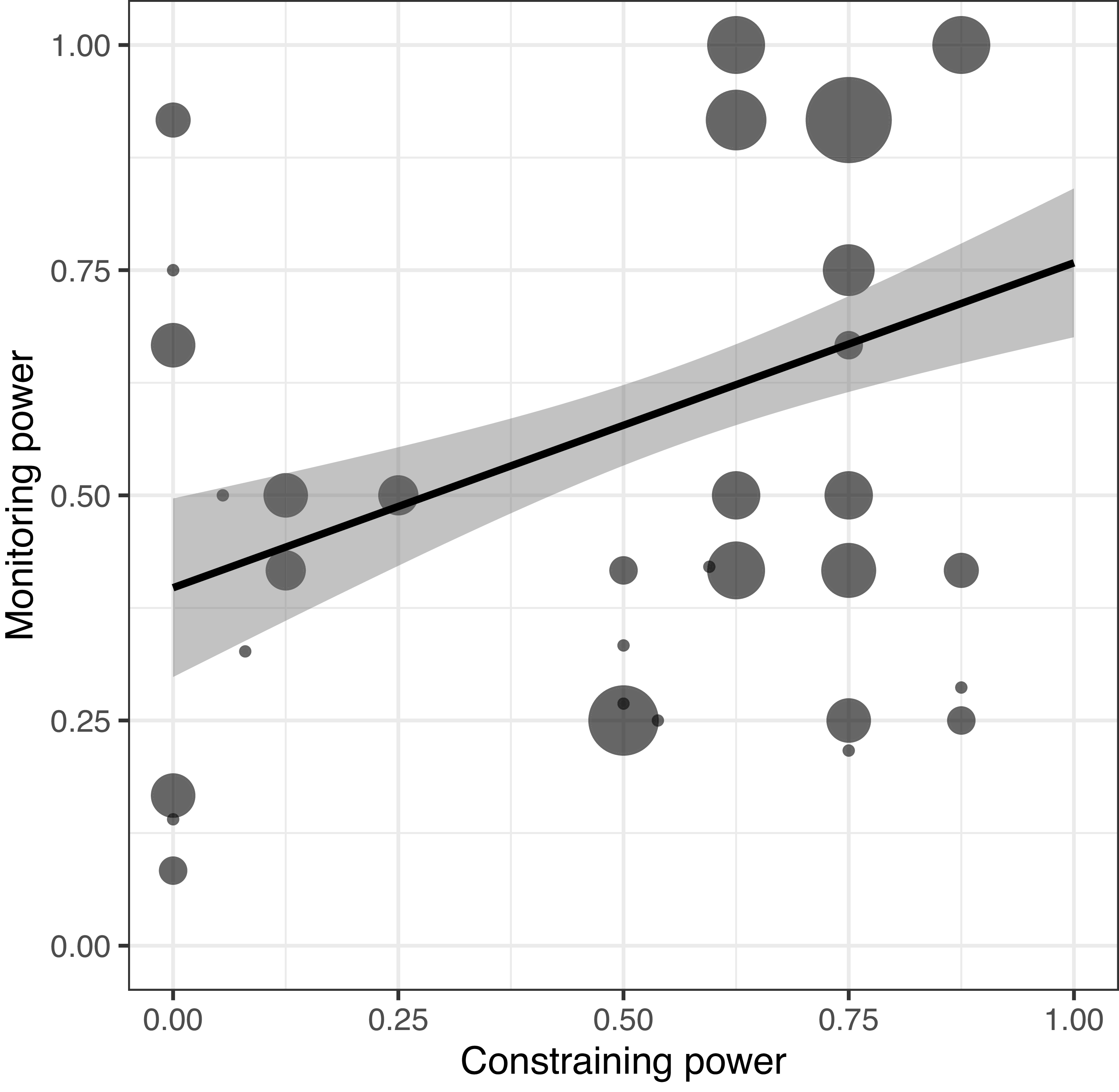
(high power), which I combine by taking the simple average. To test whether these truly matter more than other domestic institutions, I also create an analogous measure of the monitoring powers of outsiders that help them to obtain information from ministers by combining the degree of centralization of EU affairs coordination within the executive (Kassim Reference Kassim2003, Reference Kassim2013) with the monitoring powers of the national parliament (Winzen Reference Winzen2021). Interestingly, while they are correlated, the relationship between these two factors, shown in Figure 3, is relatively weak. This underscores that there are different approaches to oversight over EU affairs (cf., Winzen Reference Winzen2012, Reference Winzen2022) and that some outsiders are indeed unable to rely on institutional constraining and monitoring powers.
$1$
(high power), which I combine by taking the simple average. To test whether these truly matter more than other domestic institutions, I also create an analogous measure of the monitoring powers of outsiders that help them to obtain information from ministers by combining the degree of centralization of EU affairs coordination within the executive (Kassim Reference Kassim2003, Reference Kassim2013) with the monitoring powers of the national parliament (Winzen Reference Winzen2021). Interestingly, while they are correlated, the relationship between these two factors, shown in Figure 3, is relatively weak. This underscores that there are different approaches to oversight over EU affairs (cf., Winzen Reference Winzen2012, Reference Winzen2022) and that some outsiders are indeed unable to rely on institutional constraining and monitoring powers.
Scatter plot of monitoring and constraining powers.
Sample consists of all coalitions used in the analysis. Size of points corresponds to the number of cabinets sharing the same combination of values. Solid line indicates linear relationship (Pearson $r = 0.34$
,
$r = 0.34$
, $p \lt .001$
).
$p \lt .001$
).

Statistical model
Outsider dissent is modeled with a series of binary logistic regressions. Because of the observational nature of the data, it is paramount to consider factors resulting in spurious relationships. To illustrate a potential issue, consider small parties. Not only are small parties often ideologically distant from larger coalition partners, but they also have stronger incentives to differentiate themselves. For instance, they may rely more heavily on clear issue ownership and visibility to maintain electoral support. As a result, they may be more likely to dissent. Failing to account for party size could therefore lead to a spurious positive relationship between these two key variables in the analysis.
Instead of attempting to control for individual variables, I opt for cabinet-party interaction fixed effects. By adding party and cabinet IDs in an interaction, this accounts for any idiosyncrasies of parties, coalitions, and specific parties within specific coalitions. This is important because the same party may act in a certain way in one coalition but behave fundamentally differently in another. With these fixed effects, all remaining variation in the relative misalignment stems from changes in the Council position and in the case of coalition governments with more than two parties from different insider positions.
A similar concern regards vote characteristics that may affect the results. To illustrate, suppose that during one legislative term, less contentious issues are voted on, resulting in more lopsided votes and thus a lower baseline of dissent. If the coalitions in government skew to one side or another of the relative misalignment during this term, the results may be driven or suppressed by mere happenstance. While this particular issue may be resolved with fixed effects for the legislative term, the most fine-grained solution is to include fixed effects for vote IDs. This also resolves a host of issues, such as more complicated time trends that would be difficult to capture with explicitly coded control variables or year fixed effects.
These fixed effects yield a model that resembles a two-way fixed effects (TWFEs) model with cabinet-parties as the unit and votes as the time component. However, because of the continuous independent variable and the fact that there are no ‘untreated’ observations in the present analysis, the design is not a difference-in-differences, where an ongoing econometric debate has highlighted potential limitations of simple TWFE models (e.g., Callaway and Sant’Anna Reference Callaway and Sant’Anna2021). Notwithstanding, the fixed effects do account for the most pressing concerns about the validity of the results. As a robustness check, the analysis is also replicated with several alternative fixed effects in the Online Appendices E.8 and E.9. Furthermore, to alleviate concerns about heterogeneous effects which are a necessary condition for the issues in classic difference-in-differences designs, I also conduct a leave-one-out sensitivity analysis of the main model in the Online Appendix E.10 which demonstrates that the effects are very stable.
Results
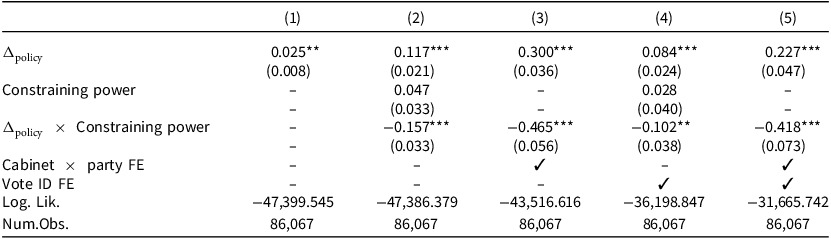
When do outsider coalition parties use dissenting votes in the EP? To answer this question, Table 1 contains estimates for several binary logistic regression models. As the positive coefficient in Model 1 shows, outsiders are generally more likely to dissent when they are more misaligned with their coalition partner. However, this general effect is small with the corresponding average marginal effect (AME) amounting to an increase in the probability of dissent by about $0.5$
percentage points (pp) for an increase of
$0.5$
percentage points (pp) for an increase of ${{\rm{\Delta }}_{{\rm{policy}}}}$
by one standard deviation.
${{\rm{\Delta }}_{{\rm{policy}}}}$
by one standard deviation.
Binary logistic regression estimates. Standard errors in parentheses

+ p < 0.1, *p < 0.05, **p < 0.01, ***p < 0.001.
As the remaining models show, this becomes considerably more pronounced when taking into account the availability of constraining powers. Without such powers, the marginal effect of ${{\rm{\Delta }}_{{\rm{policy}}}}$
amounts to
${{\rm{\Delta }}_{{\rm{policy}}}}$
amounts to $3.5$
pp in Model 5.Footnote
22
Given the relatively low baseline of outsider dissent, this is a substantial increase by about
$3.5$
pp in Model 5.Footnote
22
Given the relatively low baseline of outsider dissent, this is a substantial increase by about $15$
% in the frequency of dissent. Crucially, however, this effect decreases as constraining powers become more available. As a result, relative misalignment becomes substantially and statistically insignificant for outsiders with average constraining powers. In fact, when constraining powers are held at the empirical maximum, an increase in the misalignment with the insider even leads to a slight decrease in the outsider’s dissent probability by
$15$
% in the frequency of dissent. Crucially, however, this effect decreases as constraining powers become more available. As a result, relative misalignment becomes substantially and statistically insignificant for outsiders with average constraining powers. In fact, when constraining powers are held at the empirical maximum, an increase in the misalignment with the insider even leads to a slight decrease in the outsider’s dissent probability by $2.2$
pp. Importantly, these findings are consistent across the various fixed effects models, which support the validity of the relationship.Footnote
23
$2.2$
pp. Importantly, these findings are consistent across the various fixed effects models, which support the validity of the relationship.Footnote
23
To make these findings more tangible, Figure 4 plots the predicted probabilities as a function of outsider parties’ relative misalignment with the insider based on Model 5 in Table 1. The figure clearly demonstrates that outsiders without constraining powers are substantially more likely to dissent when they become increasingly misaligned with their coalition partner. The predicted probabilities also highlight that the effect is quite sizable. Outsiders that can constrain their partners, on the other hand, clearly do not employ public dissent when they are misaligned. Instead, the higher levels of dissent when insider and outsider are aligned and have strong constraining institutions are more in line with a two-level game logic where highly coordinated coalition partners dissent strategically to increase their bargaining power at the international stage. However, this finding is not as robust as the pattern found in the case of low constraining powers.
Predicted probabilities of dissent. Based on Model 5 in Table 1 using M5S in Conte I cabinet and vote 8-10163 as the baseline. Shaded areas represent $95$
% confidence intervals.
$95$
% confidence intervals.

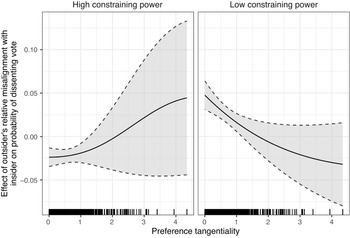
Next, I assess the role of salience for the outsider’s decision to dissent. To do so, I add preference tangentiality to the models in a three-way interaction with the relative misalignment and constraining powers. The results are visualized in Figure 5 with full regression output relegated to the Online Appendix E.2. When constraining powers are absent (right panel), the figure shows that ${{\rm{\Delta }}_{{\rm{policy}}}}$
indeed plays the largest role when preference tangentiality is low and gets reduced as preference tangentiality increases. As a result, when preferences are conflictual, the marginal effect is about
${{\rm{\Delta }}_{{\rm{policy}}}}$
indeed plays the largest role when preference tangentiality is low and gets reduced as preference tangentiality increases. As a result, when preferences are conflictual, the marginal effect is about $4.8$
pp or an increase by
$4.8$
pp or an increase by $20$
%. At the same time, preference tangentiality does not significantly affect the relationship when constraining powers are available (left panel).
$20$
%. At the same time, preference tangentiality does not significantly affect the relationship when constraining powers are available (left panel).
Marginal effect of ${{\rm{\Delta }}_{{\rm{policy}}}}$
for varying preference tangentiality. Based on Model A7 in Table A5 using M5S in Conte I cabinet and vote 8-10163 as the baseline. Shaded areas represent
${{\rm{\Delta }}_{{\rm{policy}}}}$
for varying preference tangentiality. Based on Model A7 in Table A5 using M5S in Conte I cabinet and vote 8-10163 as the baseline. Shaded areas represent $95$
% confidence intervals.
$95$
% confidence intervals.

In summary, the findings clearly provide strong support for the theoretical argument. In line with hypothesis ${{\rm{H}}_1}$
, outsiders rely on overt dissent to signal disagreement when they are relatively misaligned with their coalition partner, but only when institutional constraining powers are absent. Further, hypothesis
${{\rm{H}}_1}$
, outsiders rely on overt dissent to signal disagreement when they are relatively misaligned with their coalition partner, but only when institutional constraining powers are absent. Further, hypothesis ${{\rm{H}}_1}$
is supported by the result that this relationship is especially pronounced when preference tangentiality is low and dampened otherwise. To assess the robustness of these findings, the next section provides an evaluation of key alternative explanations.
${{\rm{H}}_1}$
is supported by the result that this relationship is especially pronounced when preference tangentiality is low and dampened otherwise. To assess the robustness of these findings, the next section provides an evaluation of key alternative explanations.
Alternative explanations and robustness
I now turn to the alternative explanation that there is nothing strategic about the outsider’s behavior and that, instead, dissent is driven by conflict among coalition partners, irrespective of others in the Council. To assess this, I fit several additional models. First, I replace ${{\rm{\Delta }}_{{\rm{policy}}}}$
with a full interaction of its two components. This enables a distinction between intracoalition conflict and the role of the outsider’s alignment with other negotiators. The results, visualized in Figure 6, provide strong grounds to dismiss the alternative explanation:Footnote
24
In the absence of constraining powers (right panel), the positive effect of intracoalition conflict is indeed limited to the setting where the outsider is aligned with others in the Council. When the distance between the outsider and the Council increases, intracoalition conflict no longer has this effect. This runs counter to the alternative explanation summarized in hypothesis
${{\rm{\Delta }}_{{\rm{policy}}}}$
with a full interaction of its two components. This enables a distinction between intracoalition conflict and the role of the outsider’s alignment with other negotiators. The results, visualized in Figure 6, provide strong grounds to dismiss the alternative explanation:Footnote
24
In the absence of constraining powers (right panel), the positive effect of intracoalition conflict is indeed limited to the setting where the outsider is aligned with others in the Council. When the distance between the outsider and the Council increases, intracoalition conflict no longer has this effect. This runs counter to the alternative explanation summarized in hypothesis ${{\rm{H}}_3}$
under which one would expect a positive effect for any distance between the outsider and the Council.
${{\rm{H}}_3}$
under which one would expect a positive effect for any distance between the outsider and the Council.
Marginal effect of distance between outsider and insider for varying distances between outsider and Council. Based on Model A3 in Table A4 using M5S in Conte I cabinet and vote 8-10163 as the baseline. Shaded areas represent $95$
% confidence intervals.
$95$
% confidence intervals.

Second, I also loosen the assumption of a unitary Council. Instead, I compute the share of potential allies, i.e., the member states whose policy position is closer to the outsider than the insider. This alternative measure reflects the idea that dissent should be more frequent when the outsider has more support among the other negotiators in the Council. The results of models using this alternative measure, shown in the Online Appendix E.6, produce very similar results to the main analysis.
Relatedly, under this alternative explanation, other consensual institutions, such as monitoring powers, should be similarly important in leading to more consensual behavior – rendering public dissent unnecessary. To address this, I also analyze the role of institutional settings more generally. First, I replicate the main analysis where I replace constraining powers with monitoring powers. The results, shown in the Online Appendix E.3, clearly demonstrate that monitoring powers do not exhibit the same moderating effect. Instead, the interaction with ${{\rm{\Delta }}_{{\rm{policy}}}}$
even points in the opposite direction. The results thus clearly support the notion that dissent is only complementary to constraining powers but not other institutions.
${{\rm{\Delta }}_{{\rm{policy}}}}$
even points in the opposite direction. The results thus clearly support the notion that dissent is only complementary to constraining powers but not other institutions.
Because of the importance of these institutional measures, I also assess which of their individual components drive the observed effects. To do so, I replicate the analysis with these individual components. The results, reported in the Online Appendix E.4, suggest that both executive coordination and parliamentary constraints contribute to the findings presented here. However, in line with Franchino and Wratil’s (Reference Franchino and Wratil2019) findings, I find that executive mechanisms seem to dominate.
Another alternative explanation relates to party groups in the EP, which constitute key reference points for MEPs (van Vliet, Chueri, Törnberg et al. Reference van Vliet, Chueri, Törnberg and Uitermark2024). Within party groups, voting cohesion is very high (e.g., Faas Reference Faas2003; Hix and Noury Reference Hix and Noury2009) and parties clearly self-select into groups on the basis of their ideological background. Moreover, parties belonging to the ‘grand coalition’ in the EP tend to deliver the necessary majorities. As a result, party group membership is neither independent of dissent nor of the main independent variable if coalition parties belong to different party groups. While the cabinet-party fixed effects address most of this issue, it is also possible to account for this more directly by adding group-term fixed effects to the models. The results, shown in the Online Appendix E.8, produce nearly identical results to the main analysis.
A further explanation is that the results may be driven purely by cabinets where more centrist outsiders are using dissent to control their more extreme coalition partners. To alleviate this concern, I replicate the main analysis for a subset of cabinets where all parties are centrist. The results in the Online Appendix E.7 show that outsiders in these cabinets do not behave differently from those in the full data set.
Finally, as a robustness check, I also replicate the analysis with another alternative measure of outsiders’ ideological incentives to dissent. Specifically, I replace the policy-specific positions in the computation of ${\rm{\Delta }}$
with the CMP’s general left-right score. The results, presented in the Online Appendix E.5, show that the findings are nearly identical. In fact, misalignment on the left-right dimension produces effects that are even larger in magnitude.
${\rm{\Delta }}$
with the CMP’s general left-right score. The results, presented in the Online Appendix E.5, show that the findings are nearly identical. In fact, misalignment on the left-right dimension produces effects that are even larger in magnitude.
Conclusion
International negotiations create serious delegation problems for multiparty governments. For instance, in the EU, the legislative process excludes a great number of coalition parties from any direct involvement in the negotiations taking place in the Council. Against this backdrop, this paper has examined the role of public dissent by sidelined coalition parties. Theoretically, the paper has argued that outsider dissent makes conflict within the coalition observable and thereby ministerial drift detectable for other negotiators. To achieve preferable policy outcomes, outsiders should thus dissent strategically when they disagree with their own coalition partners and align more closely with other negotiators in the Council, especially when lacking institutional mechanisms for constraining their coalition partners internally.
A careful examination of voting dissent in over 85,000 party-level RCVs in the EP shows that observed dissent closely aligns with this theoretical expectation: when constraining powers are not available, outsiders that are more misaligned with their own coalition partner than with other negotiators are substantially more likely to cast a dissenting vote. Further analysis shows that this is especially true when the issue at stake is similarly salient to both coalition parties. This provides strong evidence for the claim that public dissent plays a crucial role in delegation in international negotiations. While the empirical evidence cannot gauge the actual effect on ministerial drift due to the intransparent nature of international negotiations, the analysis aligns well with the strategic incentives of outsiders, while alternative explanations are systematically ruled out.
This has important implications for other intergovernmental arenas such as the G7, the OECD, and the WTO, where it is arguably even more difficult to enforce constraints internally. In these arenas, overt dissent provides a universally applicable signaling tool. Despite parliaments having become increasingly common in international organizations (Rocabert, Schimmelfennig, Crasnic et al. Reference Rocabert, Schimmelfennig, Crasnic and Winzen2019), most of these forums do not provide outsiders with the opportunity to use votes to signal their dissent.Footnote 25 Nevertheless, this does not imply that outsiders cannot make their dissent heard. The focus on voting dissent in this paper is a matter of convenience rather than necessity. In other contexts, outsiders might use speeches, social media, or news platforms to express their disagreement publicly. Exploring other intergovernmental settings and alternative forms of overt dissent offers a promising avenue for future research.
The findings also contribute to an emerging literature on coalition policymaking in the EU (Finke and Dannwolf Reference Finke and Dannwolf2013; Finke and Herbel Reference Finke and Herbel2015, Reference Finke and Herbel2018; Franchino and Wratil Reference Franchino and Wratil2019; Kostadinova and Kreppel Reference Kostadinova and Kreppel2022; Rieger Reference Rieger2025a, Reference Rieger2025b). The findings of this study provide further evidence that domestic coalition dynamics matter within the realm of EU policymaking. They also highlight that overt dissent may play a complementary role for crucial oversight institutions. More specifically, it shows that parliamentary oversight can also be performed by the EP and not only by national parliaments. Analogous to national parliaments in domestic coalition policymaking (Martin and Vanberg Reference Martin and Vanberg2011), the EP plays a crucial role in coalition policymaking in the EU.
This also sheds light on the role of bicameralism for coalition policymaking. Since the beginning of European integration, the EP’s empowerment has been formidable, making it a strong co-legislator alongside the Council (for an overview, see Hix and Hoyland Reference Hix and Hoyland2013). By the same token, member states in the Council have seen a relative loss of power. Yet, while the strong role of the EP may be a nuisance for insider coalition parties, it is also the source of an accessible opportunity to signal voting dissent in EU policymaking for outsiders. Although the relationship between bicameralism and coalition formation or termination is well-studied (e.g., Druckman and Thies Reference Druckman and Thies2002; Druckman, Martin, and Thies Reference Druckman, Martin and Thies2005; Thürk, Hellström, and Döring Reference Thürk, Hellström and Döring2021), its effects on coalition policymaking and legislative behavior remain largely unexplored (but see Thies Reference Thies2001). Against the backdrop of the findings presented here, future research should investigate comprehensively how this factor helps coalition parties overcome delegation problems in policymaking.
Beyond academic debates, this study also addresses issues of democratic representation and accountability for citizens throughout the world. The decisions made by (multiparty) governments in international negotiations have immediate and far-reaching consequences for significant portions of the global population. Against this backdrop, ministerial drift poses a risk of systemic bias, potentially leading to policies that are incongruent even with the preferences of supporters of some governing parties. Although one might expect such drift to cancel out across negotiators, this is unlikely because party ideology shapes portfolio assignments (Budge and Keman Reference Budge and Keman1990; Bäck, Debus, and Dumont Reference Bäck, Debus and Dumont2011). Ministers from different countries are thus likely to drift in the same direction (cf., Franchino and Rahming Reference Franchino and Rahming2003). Resolving delegation problems at the international level is therefore crucial to ensuring that policies align with the preferences of the citizens who voted these government parties into office. This is particularly relevant for EU policymaking, which has become an increasingly prominent issue in domestic politics (Hooghe and Marks Reference Hooghe and Marks2009).
Supplementary material
The supplementary material for this article can be found at https://doi.org/10.1017/S1475676526101121.
Data availability statement
Replication data and code are available in the supplementary material of this article.
Acknowledgement
An earlier version of this paper was presented at the 2024 Annual Congress of the Swiss Political Science Association, the 2024 Annual Conference of the European Political Science Association, and the 2024 Annual Meeting of the American Political Science Association. I am grateful to Frank Schimmelfennig, Jonathan Slapin, Massimo Troncone, Georg Vanberg, Ioannis Vergioglou, Christopher Wratil, as well as the participants of the EUP Winter Retreat 2024 for their constructive feedback. I also thank Alessandro Nai and four anonymous reviewers for their helpful comments. Any remaining errors are my own.
Funding statement
The author received no financial support for the research.
Competing interests
The author declares none.







 Open access

