


Caring for an elderly individual with a disability is stressful. It can contribute to physical and psychiatric morbidity in family carers Reference Vitaliano, Zhang and Scanlan1-Reference Broe, Jorm, Creasey, Casey, Bennett and Cullen3 and also increase their mortality. Reference Schulz and Beach4 In particular, high rates of psychiatric morbidity have been observed in carers of people with mental health problems. Most research has been completed with carers of people with dementia; Reference Schulz, O'Brien, Bookwala and Fleissner2,Reference Mahoney, Regan, Katona and Livingston5,Reference Schulz and Martire6 it shows those carers have increased rates of stress, distress, psychological illness, depression and anxiety. Research also confirms higher rates of depression in carers of people with other psychiatric disorders. Reference Livingston, Manela and Katona7 Carers of older adults with depression have poorer mental health and perceived quality of life than those of older adults who do not have depression. Reference Sewitch, McCusker, Dendukuri and Yaffe8 Carers’ psychological well-being is of great importance when considering community care for older adults with mental health needs for two reasons: to prevent and treat psychological and psychiatric morbidity in the carers themselves, and to enable the patient to live in their own home for as long as possible. Carer depression and stress predicts entry into care homes in older people, Reference Nobili, Riva, Tettamanti, Lucca, Liscio and Petrucci9,Reference Arai, Sugiura, Washio, Miura and Kudo10 and carer stress is the main social reason for admission to acute psychogeriatric wards and a predictor of increased length of stay. Reference Draper and Luscombe11 Viewing carers as part of the primary care population, screening for depression can improve carers’ outcomes compared with usual care, Reference Pignone, Gaynes, Rushton, Burchell, Orleans and Mulrow12 particularly when identification is coupled with effective disease management for depression in older adults - reducing depressive symptoms and improving health status. Reference Banerjee, Shamash, Macdonald and Mann13-Reference Gallo, Bogner, Morales, Post, Lin and Bruce15
Postal surveys are commonly used in medical research. Response rates for samples from electoral rolls, health authority registers and health service registers range from 21 to 51%. Reference Harrison and Cock16-Reference Campbell and Waters18 Increasingly, health providers mail service information to patients and carers, which commonly precedes their first contact with services. We set up a project in which we used the routine mailing from our mental health service to help identify carer depression prior to initial contact, with the intention of enabling the early detection of carer psychological distress and thus improving services for carers.
Method
Consecutive patients routinely referred to a community mental health team for older adults in south London were posted information on local services and trust policy on confidentiality prior to an initial visit by a clinician. As part of this information pack a covering letter, the 15-item Geriatric Depression Scale (GDS) Reference Shiekh and Yesavage19 for the carer and a questionnaire collecting basic information on carer's circumstances were included for family carers to complete and return in an addressed envelope (no postage provided). Following the initial mailing, no prompts to return the forms where made.
Responders completed a carer information sheet which collected information (tick box options) in four areas.
-
1. Relationship to the patient (son or daughter/husband or wife/grandson or granddaughter/sister or brother/friend or neighbour/other, please specify).
-
2. How close they lived to their relative/friend (in the same house/locally/less than 50 miles away/more than 50 miles away).
-
3. How often they saw their relative (daily/2-4 h per week/4-6 h per week/once a week/fortnightly or less.
-
4. Whether they had other commitments and responsibilities as well as caring for their friend/relative and the nature of the commitments (full-time work/part-time work/children or family/caring for other relatives or friends/other, please specify).
For non-responders this information was collected from the patients’ notes. Depression was defined as a GDS score of 5 and above for the responders and by DSM-III-R clinically-based impression in the non-responders.
Results
Forms were sent to 148 patients. Notes were unavailable for 2 patients (missing data); 97 patients had a regular family carer and 49 did not. Of the 97 family carers, 32 (33%) completed and returned the carer forms either by post or at the initial visit to the service. The notes of the 65 patients, whose carers did not return the forms, were reviewed for clinical evidence of depression in the carer. This information is routinely available, as clinical staff collect information on the carers’ well-being as part of a carer assessment of need. Of the 32 carers who returned the questionnaires, all completed the carer information sheet and 31 completed the GDS.
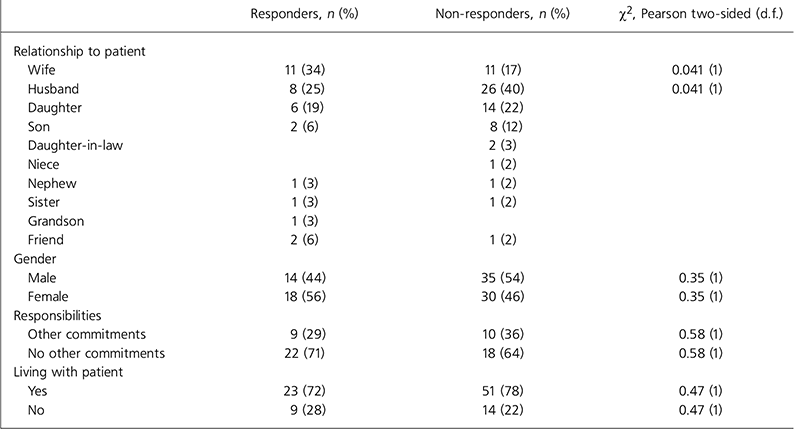
Details of the responders and non-responders are shown in Table 1. Although there was no statistically significant gender difference between responders and non-responders (Pearson chi-squared P = 0.35, d.f. = 1), there were statistically significantly greater numbers of wives compared with husbands completing and returning the forms (Pearson chi-squared P =0.041, d.f.=1). There was no statistically significant difference in co-residence of carers with regard to rates of response to the forms (Pearson chi-squared P =0.47, d.f.=1).
Characteristics of responders and non-responders
| Responders, n (%) | Non-responders, n (%) | χ2, Pearson two-sided (d.f.) | |
|---|---|---|---|
| Relationship to patient | |||
| Wife | 11 (34) | 11 (17) | 0.041 (1) |
| Husband | 8 (25) | 26 (40) | 0.041 (1) |
| Daughter | 6 (19) | 14 (22) | |
| Son | 2 (6) | 8 (12) | |
| Daughter-in-law | 2 (3) | ||
| Niece | 1 (2) | ||
| Nephew | 1 (3) | 1 (2) | |
| Sister | 1 (3) | 1 (2) | |
| Grandson | 1 (3) | ||
| Friend | 2 (6) | 1 (2) | |
| Gender | |||
| Male | 14 (44) | 35 (54) | 0.35 (1) |
| Female | 18 (56) | 30 (46) | 0.35 (1) |
| Responsibilities | |||
| Other commitments | 9 (29) | 10 (36) | 0.58 (1) |
| No other commitments | 22 (71) | 18 (64) | 0.58 (1) |
| Living with patient | |||
| Yes | 23 (72) | 51 (78) | 0.47 (1) |
| No | 9 (28) | 14 (22) | 0.47 (1) |
When considering the other commitments that carers might have, information was available on all 31 responders but only on 28 non-responders. There was no statistically significant difference in commitments between responders and this subset of non-responders (Pearson chi-squared P = 0.58, d.f. = 1).
Depression rates in carers
Of the 31 responders, 13 (42%) had depression as defined by a GDS score of 5 or above; 3 of the 65 non-responders (4.6%) had depression as defined by DSM-III-R-based clinical interview. The prevalence of depression in the responder group was significantly higher than in the non-responder group (Mann–Whitney U: responders, mean rank 60.63; non-responders, mean rank 42.72; two-tailed significance P<0.001).
Comparing carers who had depression with those who did not, the only significant association from the carer information sheet was that significantly more wives than husbands had depression (Pearson chi-squared P = 0.022, d.f. = 1).
Discussion
The aim of this audit was to see whether a simple postal survey of carers, prior to first contact with mental health services for the patient, could help identify carer depression and therefore enable early intervention to maximise carer health for the benefit of the carer and the patient.
Limitations
It must be acknowledged that this study has limitations. The most important is that carer depression in responders and non-responders was ascertained using different methods. This was because we did not wish to interfere with the normal clinical process except by the addition of the postal questionnaire. We chose the GDS cut-off point of 5 as this is reported to show good correlation to DSM–III–R clinical diagnosis of major and minor depression. Reference Gerety, Williams, Mulrow, Cornell, Kadri and Rosenberg20,Reference Jongenelis, Pot, Eisses, Gerritsen, Derksen and Beekman21 The assessments of depression in the non-responders were made by well-qualified clinicians used to administering clinically-based interviews and versed in assessing carers’ needs and psychiatric morbidity as part of clinical practice.
A further important limitation is the low response rate (33%). This is similar to other postal studies but it is clear that there may have been selection bias in the responders. However, it was the purpose of the audit to see whether this response bias would make this method of identifying depression unhelpful in this carer group. The selection bias appeared to work in favour of capturing cases of depression, with those who responded having much higher levels of depression than those who did not. The responder group therefore included much of the population at high risk for depression.
Strengths
This study provides information on responders and non-responders in clinical practice in a representative psychiatric population. The results may be generalised to old age psychiatric service users presenting to secondary care and the intervention was simple and required no extra resources.
The rate of depression in our overall group of carers of older adults with psychiatric disorders was 17%, similar to that observed by Livingston et al Reference Livingston, Manela and Katona7 in their community study (24%). In our overall sample, significantly more female spousal carers had depression compared with male spousal carers, a finding that highlights the vulnerability of this group also observed by other researchers. Reference Vitaliano, Zhang and Scanlan1,Reference Mahoney, Regan, Katona and Livingston5-Reference Livingston, Manela and Katona7,Reference Miller and Cafasso22,Reference Yee and Schulz23
We found significantly higher rates of depression in responders compared with non-responders (42 v.5%). Responders in this study could be seen as those seeking help for themselves by completing a GDS and this would account for both the significantly higher rates of depression in responders and for similar rates of depression in studies looking at carers seeking help. Our findings correlate well with Gallagher et al's, Reference Gallagher, Rose, Rivera, Lovett and Thompson24 who in their study of family caregivers of relatives with dementia found rates of depression of 46% in those seeking help to increase their coping skills.
Rates of postal response might have been improved by the payment of postal costs back to the unit (Harrison et al Reference Harrison, Holt and Elton17 found the best response rates of 40.5% where post stamps were provided). None the less, the findings of this study suggest that pre-assessment postal screening of individuals referred to old age mental health services may have a useful part to play in the early identification of depression in carers, at minimal additional cost.
Declaration of interest
None.


 Open access


eLetters
No eLetters have been published for this article.