

Introduction
The global adoption of ever stricter climate-related goals has highlighted natural resources such as lithium, as key for decarbonizing the world economy. Several middle-income countries have seen this as an opportunity, expanding production and export quotas to meet rapidly rising global demand while reinforcing their extractive economic structures; meanwhile, others see this as an opportunity to upgrade in the commodity value chain hoping to escape the middle-income trap (MIT)Footnote 1. But can developing economies effectively escape the middle-income trap using natural resource production and exports? This paper addresses this question by focusing on the case of the failed upgrading of the lithium industry in Chile.
The MIT refers to a moment in development where nations are unable to compete on cost with less developed countries, but they are also unable to compete on quality and innovation with the most technologically advanced onesFootnote 2. The trap, then, portrays them as being caught between low-wage manufacturers and high-wage innovators.Footnote 3 Although in classical formulations the MIT was associated with the manufacturing sector, in practice many middle-income countries, particularly those in Latin America, are resource-rich countries experiencing fast deindustrialization, and therefore, many scholars have set out to understand the dynamics of the MIT in this context.Footnote 4 According to Palma and Pincus “Natural resource exporters experience the trap when their ‘extractivist’ strategies run out of steam and new engines of productivity growth, such as the processing of raw materials fail to materialize”Footnote 5. The dynamics of resource extraction is associated with rents from “natural capital” that need to be invested in new (industrial) capital in order to escape the MIT –let alone replenish nonrenewable resourcesFootnote 6; when this is not the case, it is argued, political economic dynamics lead to a competition over the appropriation of natural-resource rents rather than for technological innovation, weakening business demand for state-led industrial policy. In the extreme, the competition over natural-resource rents can lead to a true “curse” where state capture becomes the norm, weakening the rule of law and the capacity of the state to lead developmental processes.Footnote 7
Contradicting these accounts, recent works have studied successful experiences of MIT escape through natural resources.Footnote 8 These consider that the upgrading of value chains from lower-value extractive activities to higher-value manufacturing and/or services involving higher productivity and technology act as indicators of MIT escape.Footnote 9 Whereas those that proposed the term envisaged the exit from the MIT as part of a trade and financial openness agenda, scholars have recently underscored the key importance of industrial policy and the building of state developmental capacities for upgrading to take place. In other words, in resource-rich MIT countries, resources can become a curse or a blessing depending on how state institutions are built and state capacity becomes crucial for escaping the MIT. In this context, how to explain the experience of countries which, despite considerable state capacities, have not been able to overcome the MIT?
We contend that the inability to capture these situations lies in the neglect of the role of businesses in the politics of the MIT.Footnote 10 The excessive focus on states’ bureaucratic capacities over the role of businesses has foregone the analysis of the state’s embeddedness in business networks and to what extent businesses own developmental capacities can either support the state’s or erode them.Footnote 11 We believe that a stronger focus on business can help us understand failed experiences of upgrading in sectors or countries otherwise characterized by relatively high state capacities. In this paper, we advance in this direction by combining the literature on developmental states and the literature on business power to point to a hitherto under-researched aspect of the relationship between states and businesses in the context of resource-rich countries trapped in the MIT: institutional business power.
Institutional business power refers to the power resources accrued to the private sector that arise from state retrenchment processes.Footnote 12 As a result of this, states lose key bureaucratic capacities and businesses retain the power to affect policy implementation through multiple channels. Using these insights, we claim that institutional business power can become a major constraint on industrial upgrading policies, the deployment of the developmental capacities of the state and the overcoming of the MIT. We argue that this is particularly so in countries with a strong past of neoliberal transformations where states have lost capacities to the private sector through processes of deregulation, privatization and liberalization. Specifically, we explain how the monopolization of information and technical expertise by private companies benefitting from previous state retrenchment processes prevents state bureaucrats and public companies from entering into new industries and makes it more difficult to implement far-reaching industry upgrading plans. We use the case of the failed upgrading of the lithium industry Chile to illustrate these dynamics.
Although Chile is formally a high-income country, its developmental problems have for long been considered similar to those of its Latin American peers in terms of its resource dependence and the inability of the country to compete on quality manufacturing or services with advanced ones.Footnote 13 Although some scholars have pointed to recent technological advances and backward linkages with advanced services in some key natural-resource-based industries as indicators of MIT escapeFootnote 14, the country is still a vastly natural-resource exporter with very limited participation in technological progress and innovation. This contrasts with the country’s high state capacity for its development level.Footnote 15
These conditions seemed set for a change in the case of the lithium industry in the mid-2010s. Then, the Bachelet government devised a series of policy strategies aimed at upgrading the Chilean lithium industry ranging from the inclusion of new conditions in the lease contracts signed with extracting companies, the attraction of MNCs for technology transfer, and the use of the state-owned copper producing giant CODELCO to enter the lithium production market hitherto dominated by two private conglomerates, and force them to enter new links of the value chain. However, after a decade of implementation of the new policies and despite a few scattered examples, Chile has largely failed to attract new investments on lithium technologies and the country has continued to export lithium with very little technological sophistication. We claim that one key explanation for this is business institutional power and how this ended up eroding what are otherwise high-state capacities.Footnote 16
We build our insights based on a case study of the Bachelet government’s attempt to upgrade the lithium industry in Chile using process tracing methods. The analysis is based on secondary information from newspaper articles and 31 interviews with participants in the process.Footnote 17 The article contributes to the literature on the politics of the middle-income trap (MIT) and global value chains by incorporating more forcefully the role of business strategies and actions in preventing upgrading. At the same time, it contributes to the research on business-state relationships through a deeper integration of the literatures on business power and on the developmental state, especially in contexts of acute state retrenchment. This is particularly relevant given current critiques of developmental state scholarship and its neglect of politics.Footnote 18
The article is structured as follows. In the first section, we frame our study in the developmental state literature, discussing the role of businesses in it. Next, we develop the idea of business institutional power and how it erodes state developmental capacities, establishing working hypotheses that we later contrast with our empirical data. In the next section, we contextualize our case study, analyzing the lithium value chain and Chile’s place in it, and we describe the policy processes under analysis. In section four, we analyze the failed upgrading of the lithium industry in Chile, focusing on the specific channels by which institutional business power eroded the state’s capacity to advance its industry upgrading plans. In the conclusion, we underscore the threat that business institutional power poses for state industry upgrading in the context of countries with strong past neoliberal experiences, and how the concept can be used to understand state weaknesses in other domains.
State capacity, business power, and the middle-income trap
Until recently, the idea of value chain upgrading from natural resources seemed an oxymoron –in fact, natural resources were seen more as a “curse” than as a blessing when it comes to development processes.Footnote 19 For several considerations, developmentalist ideas and experiences highlighted the incapacity of natural resources to act as grounds for industry upgrading and focused on the development of the manufacturing industry as a quintessential component of “latecomer” development.Footnote 20 Recent works, however, have underscored the role of the natural-resource sector as a first step for value chain upgrading.
Scholars suggest that the growing global demand for natural resources presents a window of opportunity for countries caught in the middle-income trap (MIT).Footnote 21 This strategy involves using natural resource sectors to develop capabilities that are likely to be at the center of the next technological disruptions, such as biotechnology, nanotechnology, bioelectronics, and new materials. While some argue that natural resource sectors have low entry barriers, making it easy for countries to enter them,Footnote 22 others contend that natural resource sectors can present linkages to firms in the manufacturing and service sectors, a potential role for innovation and economic growth in these new technologies.Footnote 23 The challenge is to adequately insert natural resource-based industries in global value chains while upgrading the technological capabilities and innovation potential of domestic firms. Authors underscore that to use the “window of opportunity” for escaping the MIT through natural resources, countries need to devise industrial policies rooted in the state’s developmental capacities and embeddedness in business networks.Footnote 24
State capacity is closely linked to the state bureaucracy. According to Mazzuca, Weberian bureaucracies have played a crucial role in enhancing the quantity, quality, and efficiency of goods and services provided by governments worldwide.Footnote 25 Chalmers Johnson argued that meritocratic promotion processes and an esprit de corps within state bureaucracies are essential to the state’s contribution to development.Footnote 26 The “developmental” state bureaucracies of East Asian countries were able to leverage these features by maintaining autonomy from specific interests and avoiding capture.Footnote 27 This approach enabled them not only to set and pursue autonomous goals and long-term industrial upgrading policies but also to learn and incorporate the voice of the private sector.
This second part of the equation, that is, the contribution of individual companies and “developmental” private sector organizationsFootnote 28 to strengthening state capacities, has been less studied than the bureaucratic capacities of the state, but it is no less relevant. In fact, Amsden found that “reciprocity” among business and state actors, as well as a “communications network” transmitting information throughout them, were critical to minimizing government failure in the successful East Asian experiences.Footnote 29 Business organizations provide valuable resources to undertake costly coordination activities among firms in a wide range of industrial policy issues including skills formation, setting industry standards, technology adoption, addressing market downturns through capacity reduction or rationalization, among others. In developing countries, Doner and Schneider argue, many of the functions of business associations are “developmental” because they “are designed to improve the functioning of both states and markets”.Footnote 30
Now, if the path is known, why aren’t MIT countries transiting it? This question is particularly intriguing in economies where the rule of law is respected and states enjoy a relatively high bureaucratic capacity. We argue that the answer lies in the role of businesses. In countries where states have developed bureaucracies capable of leading developmental processes but businesses have not developed paramount capacities, the latter often use their resources and associations not to promote inter-firm cooperation and/or to collaborate with the state in its regulatory efforts, but to engage in distributional struggles and organizing to oppose state regulation.Footnote 31 There, businesses strengthen their distributive instead of their policymaking responses to state’s actionsFootnote 32, using diverse business power channels like structural powerFootnote 33, instrumental powerFootnote 34, and –most importantly in this paper– institutional powerFootnote 35 to curb state regulatory effortsFootnote 36. Crucially, we contend that business power thus wielded not only reduces the developmental capabilities of private companies and their associations, but also erodes state capacity –in our case, state capacity in the domain of industry promotion and value-chain upgrading (see Figure 1). If state capacity is defined by bureaucratic scope plus autonomy from special interests, different types of business power diversely affect them.Footnote 37 While structural and instrumental power reduce the state’s capacity to set autonomous industrial upgrading goals by subjecting policymakers to business pressure through disinvestment threats and diverse influence channels (formal and informal lobby, revolving door, etc.), business institutional power directly erodes the state’s bureaucratic capacities (regulatory, administrative, policy implementation) by subjecting bureaucrats to business monopoly of information and technical expertise. Together, they affect the necessary embeddedness of state actions in business networks. We develop the link between institutional business power and state capacity in the next section.
Business power and its effect on states developmental capacities.
Source: authors’ elaboration

Neoliberalization, institutional business power, and the erosion of bureaucratic capacity
Several scholars have studied the effects of neoliberalization on the subsequent political-economic regimes, particularly the continuity of neoliberal trajectories, based on the constellation of actors and coalitions that helped install neoliberal reforms.Footnote 38 While they have studied how neoliberal reforms created feedback effects that materialized as support for the maintenance of the status quo later on, or what is the other side of the coin, opposition to state industrial policy efforts through traditional channels of business power like instrumental and structural power,Footnote 39 few authors have studied how these very processes have resulted in an erosion of the state’s capacity to re-enact industrial policies aimed at industry upgrading. We claim that one important aspect deterring upgrade through industrial policy, and even more, the formation of a developmental state, is precisely the feedback effects derived from previous privatization processes. These effects have constrained the state’s capacity to formulate and implement long-term development strategies by weakening its internal resources, including knowledge infrastructures, policy instruments, and bureaucratic expertise. We study in particular the role of information and technical knowledge for building state regulatory and administrative capacities.
To conceptualize this, we take the idea of business institutional power. According to Busemeyer and Thelen, this “arises when policymakers invite or allow private actors to share in the delivery of public responsibilities, setting in motion feedback effects that over time enhance the power of private interests vis-à-vis publicly accountable government actors”.Footnote 40 According to the authors, deregulation and privatization processes—and we can add, liberalization—make the state dependent on private businesses for a series of valuable collective goods, creating feedback effects in time that affect not only the state’s capacity to act in those areas foregone to the private sector, but also to recover or rebuild them.Footnote 41 When states retrench from key areas of the economy, bureaucracies stop being invested in the day-to-day operation of these areas and therefore lose their capacities to regulate them—least so operate directly as a producer of required public goods and services.
In this paper, we treat value chain upgrading—a decision often taken by private companies—as akin to the type of public goods analyzed by Busemeyer and Thelen and therefore, subject to business institutional power.Footnote 42 Technological innovation and capability building have both private and public good aspects.Footnote 43 In fact, more often than not firms’ investment and innovation decisions depend on a complex mix of public-private arrangements, innovation systems, and more importantly, state visions and policies that promote different types of industry upgrading paths. Given that countries in the middle-income trap (MIT) are caught between low-wage manufacturers and high-wage innovators, the capacity to exit it depends crucially on the ability of companies, industries and countries to create and strengthen collective technological and productive capabilities associated with innovation processes.Footnote 44 When these are subject to business institutional power, states lose the ability to promote them.
Busemeyer and Thelen identify three ways through which business institutional power is “created” (see Table 1).Footnote 45 First, through delegation, that is, when states reduce regulations and/or make a “conscious decision to share the regulatory space”; second, through privatization, or when states retreat “from the provision of some private function”.Footnote 46 Finally, from accretion or when private actors take the initiative to move into an arena either previously dominated by the state or where the state has not yet set foot, assuming a “central intermediating role”Footnote 47.
Busemeyer and Thelen identify several sources of variation in institutional power that are useful for our analytical purposes because they allow assessing not just the presence of institutional power, but also its strength or degree (see Table 1).Footnote 48 The first is the degree of the state’s reliance on continuing private provision. In our case, this is related to the maintenance of updated information about how the sector operates in order to set the necessary regulations and implement policies. The second is the credibility of businesses’ exit threats to oppose state’s policy initiatives, exemplified in situations when the state is unable to innovate or to upgrade an industry without the help of private –in this case, privatized– companies. According to the authors, business institutional power is strongest when both conditions are present.Footnote 49 We include a third: the degree of dominance of private companies over a specific economic or policy sector to reflect changing perceptions of the legitimacy of private versus state solutions/ownership associated with accretion.
Finally, the authors mention three consequences of business institutional power that we consider, following Bogliaccini and MadariagaFootnote 50, to be the empirical manifestations of each of its dimensions or mechanisms. First, state retrenchment or privatization can result in private actors providing the infrastructure required to deliver public goods making the state’s own independent delivery system decay or be dismantled.Footnote 51
This erodes states’ key ability to “gather and organize basic information about themselves, their territories, and the populations they govern”Footnote 52 in order to act upon them, and the maintenance of related technical expertise within state bureaucracies,Footnote 53 impairing both states’ regulatory capacity, that is, their capacity to set regulations and enforce them, and administrative capacity, notably policy implementation.
The second possible consequence of business institutional power is the increase of fiscal costs: “where private actors assume some of the financing for providing the [relinquished] public services, the state will be increasingly hard-pressed to substitute public-private arrangements with full-fledged public institutions. Especially in times of fiscal austerity, the costs of business exit for the state grow over time”Footnote 54. This consequence will be higher where states count with few resources (both financial as well as organizational) to recover their activities from the private sector, e.g. setting up state facilities and enterprises that can lead innovation in an industry or setting up new state bureaucratic agencies to lead sectoral innovation processes.
Last but not least, the authors name the establishment of expectations with regard to the participation of private versus public actors in specific industries, that is, normative considerations that are diffused among the public and influence public opinion regarding “the most appropriate division of labor between public and private sector in fulfilling public responsibilities”.Footnote 55 This is closely tied with overall sentiments about state/market provision of public goods, opinions about the privatization of public companies but much more specifically, with the degree of economic nationalism regarding one specific industry.
Following the above, we propose a refinement of the framework developed by Busemeyer and Thelen. In their formulation, only the mechanism of delegation has implications for the erosion of state capacity. We contend that this aligns with two specific dimensions of state capacity: administrative and regulatory, understood as the bureaucracy’s ability to implement policies effectively, as well as the ability to design, enforce, and monitor rules governing market activity.Footnote 56 Now, we believe that the other two mechanisms of institutional business power, privatization, and accretion, can also have consequences for state capacity. For instance, the increased fiscal costs that Busemeyer and Thelen associate with privatization are directly connected with the state’s fiscal capacity—that is, the state’s institutional ability to extract resources from society, particularly through a broad and efficient tax system.Footnote 57 Similarly, the normative backlash that they identify as a consequence of accretion, signals challenges in political capacity, that is the state’s ability to steer society, set priorities, and build legitimacy, particularly by shaping expectations about the respective roles of public and private actors in strategic sectors.Footnote 58 In sum, depending on their degree or strength, the different mechanisms of institutional power can erode different dimensions of state capacity (see Table 1). The last column on Table 1 summarizes the empirical findings that we review below based on our theoretical expectations. It shows that in the Chilean case, only the first mechanism (delegation) was at work.
Institutional business power and consequences on state capacity

Source: authors’ elaboration based on Busemeyer and Thelen. Reference Busemeyer and Thelen2020. “Institutional Sources of Business Power.” World Politics. 72(3), 448–480.
Following this analytical framework, in the next section, we describe Chile’s position in the lithium value chain, and the policies aimed at upgrading it.
The middle-income trap and the upgrading of the lithium value chain in Chile
Lithium serves various industries, with over one third of its usage attributed to high-technology sectors, notably lithium-ion battery manufacturingFootnote 59. The surge in demand for lithium-ion batteries, driven largely by the electric vehicle (EV) industry, has significantly impacted the lithium value chain. These batteries constitute 30%–40% of an EV’s value, with demand projected to increase ten-fold by 2030, and lithium demand expected to rise six-fold during the same periodFootnote 60.
The Li-ion battery value chain involves five steps: 1) extracting raw lithium from brine or hard rock, 2) processing it into lithium carbonate and lithium hydroxide, 3) manufacturing cell components, 4) assembling batteries, and 5) recycling batteries. Lithium hydroxide is used in cathode production and combined with nickel, cobalt, manganese, and aluminum during manufacturing.
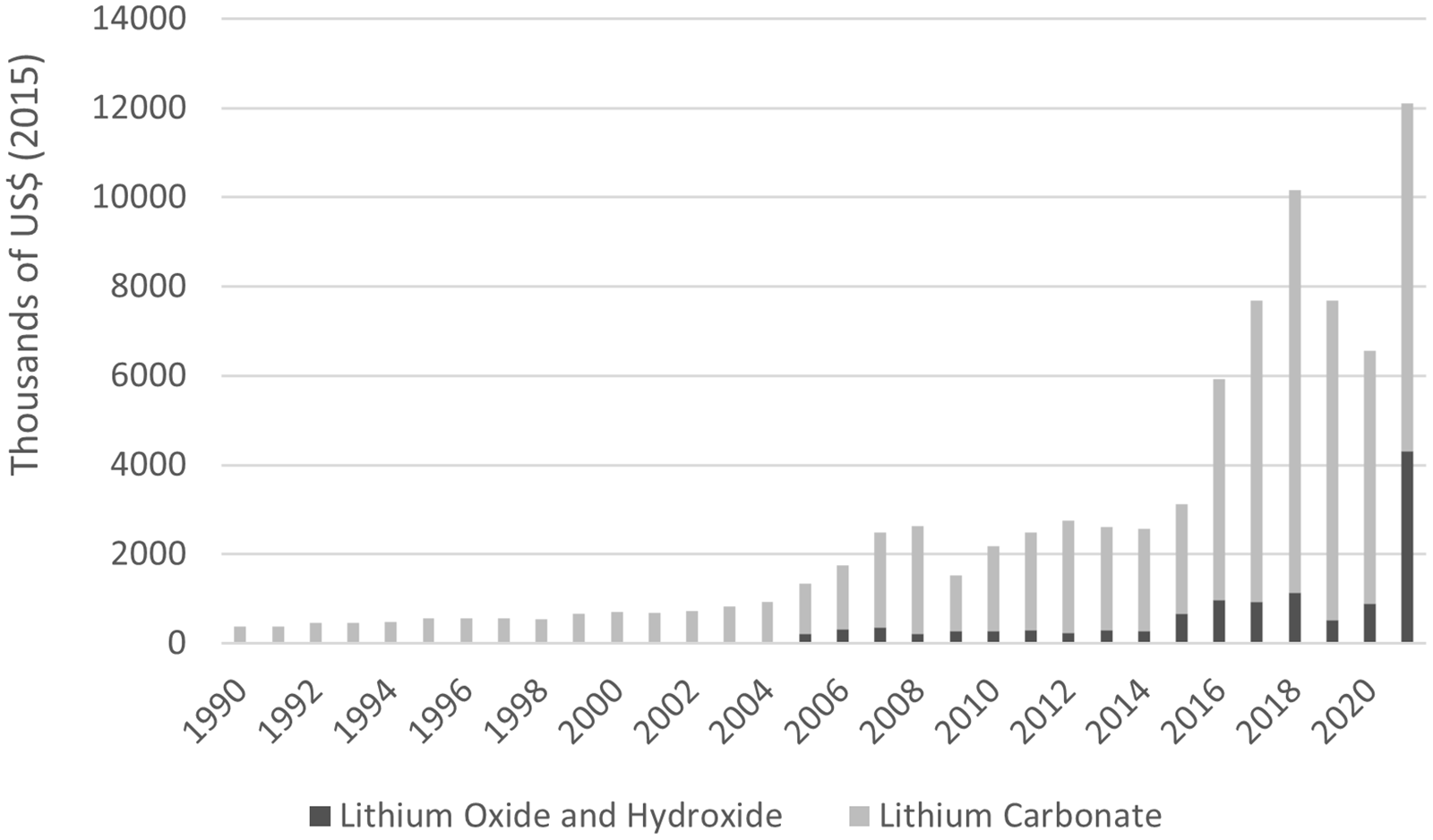
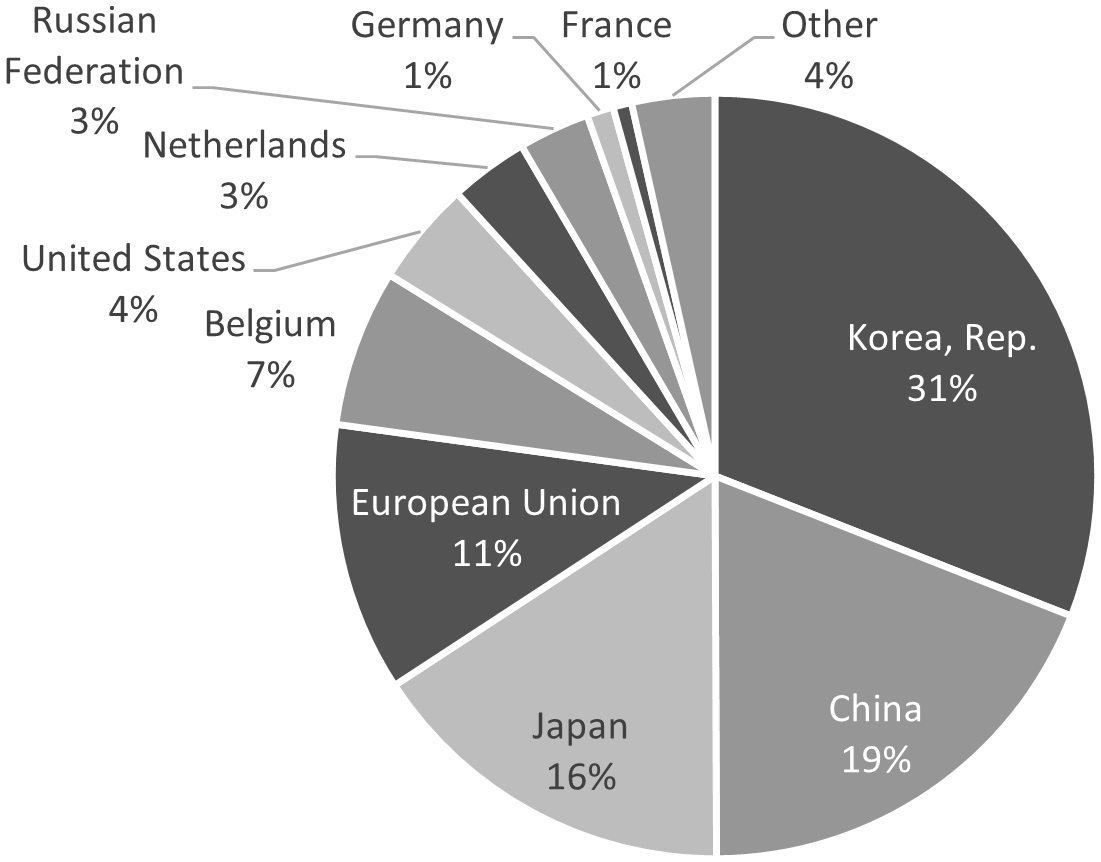
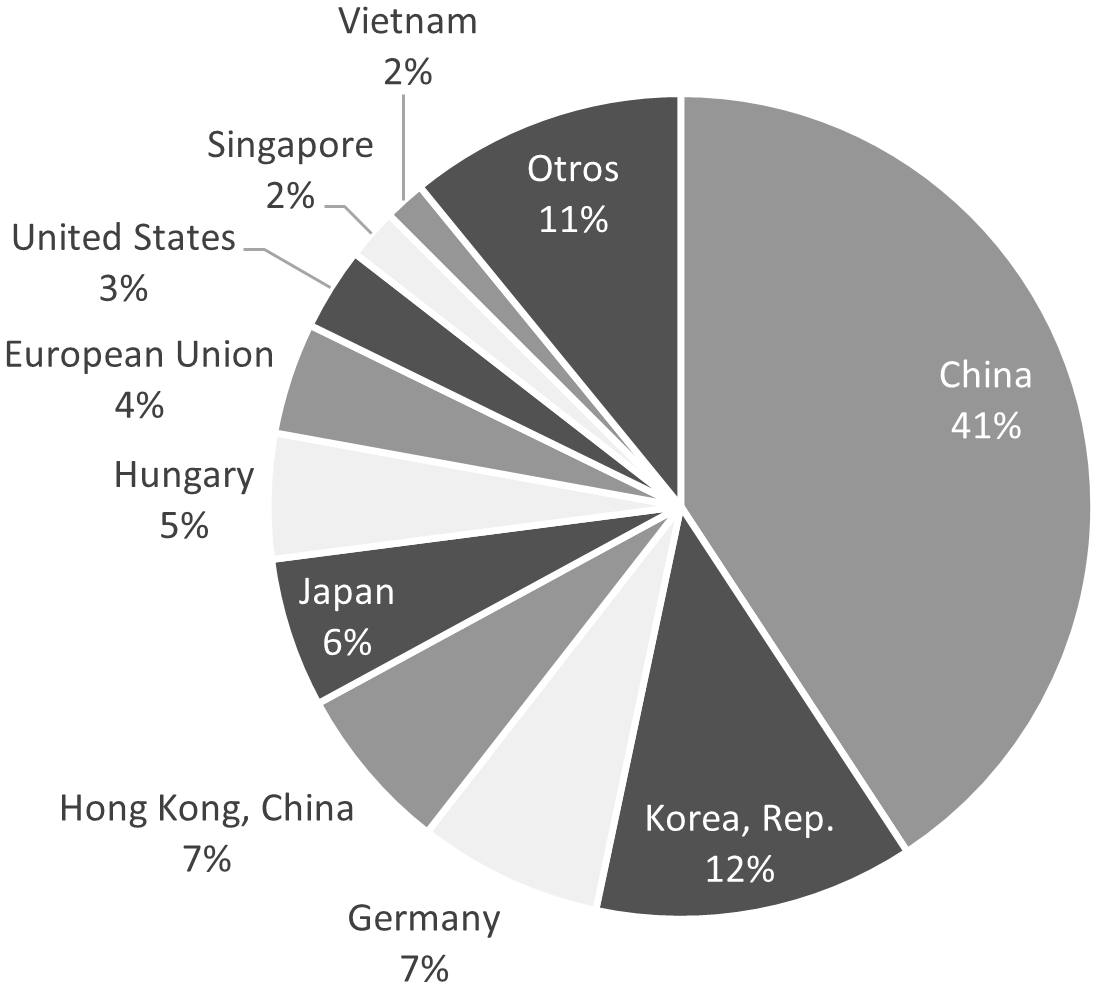
Chile’s position in lithium global value chains became more and more important during the 2010s, when the mineral’s world price started to climb because of rising demand for technologies associated with decarbonization.Footnote 61 As shown in Figure 2, Chile’s lithium exports value grew almost sixfold in fifteen years (from 2006 to 2021). The country is today among the top-3 producers and exporters in the world and has the largest known reserves. However, exports have remained in the lowest value-added segments of raw material processing and no incursions have been made in the higher links. Interestingly from a value chain perspective, Chile’s main export markets for low-processed lithium materials (China, South Korea, Japan, and the European Union) are also the countries with higher exports in the higher segments of the value chain, namely batteries (see Figures 3 and 4).
Chile, lithium exports 1990–2020.
Source: Authors’ elaboration based on the COMTRADE database.
Top-10 destination countries for Chilean lithium products, 2017–2021.
Source: Authors’ elaboration based on the COMTRADE database. It considers lithium carbonate and hydroxide.
Top-10 countries exporting li-ion batteries, 2017–2021.
Source: Authors’ elaboration based on the COMTRADE database. It considers HS 2012 code 850760

Upgrading in the lithium value chain: Chile’s policies
Since the early 2010s, various governments have pursued strategies to promote lithium production in Chile, each with distinct objectives.Footnote 62 While the right-wing administration of Sebastián Piñera (2010–2014) focused primarily on boosting local production and exports through renegotiating exploitation contracts to increase extraction quotas, the center-left government led by Michelle Bachelet (2014–2018) questioned Chile’s role in the global value chain. During Bachelet’s tenure, there was a growing consensus among experts and the center-left coalition about the necessity not only to increase production for global markets but also to incentivize higher value-added activities. Bachelet convened a panel of experts to develop policies addressing lithium production and governance of the salt flats where it is extracted.
The new policy pursued three interconnected objectives. First, expanding the local production of lithium while addressing regulatory issues that had been lingering for years like higher monetary contributions from lithium companies to the state. Second, promoting the development of higher value-added lithium products. This included the founding of new research centers focused on lithium technological applications, establishing new production contracts to promote greater investment in R&D by private companies, incentivizing foreign direct investment in higher value-added segments of the industry such as cathode manufacturing, and even using a public company—in this case, the copper giant CODELCO—to increase production and innovation capacities. Third, the policy also involved generating mitigation measures to protect the environment and communities living near the salt flats where the mineral is extracted.
While this agenda stalled during the second presidency of Sebastián Piñera (2018–2022), it regained strength during the presidency of Gabriel Boric (2022-). In 2023, Boric announced a new National Lithium Policy that followed the footsteps of the previous Bachelet proposals. Among other, it proposed the creation of the National Lithium Company to start production and innovation processes in new production sites, announced the renegotiation of exploitation contracts with existing companies to increase public revenues from private lithium production, and announced new research and development centers dedicated to research on technological applications for lithium using additional revenues from lithium extraction.Footnote 63
The main argument of this article is that these policies have largely failed in terms of the upgrading of the Chilean lithium industry because of business institutional power. Due to this, we argue that the new policies also run the risk of suffering similar challenges. We analyze this in detail in the next section.
Failed upgrading and institutional business power
In this section, we analyze the presence, strength, and consequences on state capacity of each mechanism of business institutional power: delegation, privatization, and accretion. The idea is to understand whether and how business institutional business power has shaped the ability of the Chilean lithium industry to upgrade. Based on our empirical material, we find that while the three types are present in the Chilean case, only the first, delegation, has had consequences for state capacity. We conclude based on this, that one important reason why industry upgrading has failed in the lithium sector in Chile is business institutional power. The formalized process-tracing framework that underpins this analysis is detailed in Appendix 1.
Delegation: The state’s pact with private power
Delegation refers to a path of institutional business power in which the state assigns or shares the implementation of industrial activities—such as production, investment, or technological development—with private actors, rather than concentrating these functions within the public sector (Busemeyer and Thelen, Reference Busemeyer and Thelen2020). In the context of lithium, this approach is particularly relevant to understanding how Chile has structured its industry. The Chilean state opted to delegate key roles to private companies while retaining regulatory authority and, in some cases, strategic oversight. However, although the state retained regulatory and oversight authority on paper, our analysis reveals that through delegation, the state lost key information and technical capacity to the private sector that became then a crucial hindrance for a more active role during Bachelet’s government.
A brief historical recount is necessary to understand how delegation was shaped. Long before its use for electromobility was known, lithium was considered a strategic element to produce thermonuclear bombs. Due to this, the military dictatorship of Augusto Pinochet (1973–1990) declared lithium a strategic resource with special protection from the state. Decree No. 2,886 of 1979, gave lithium a legal status distinct from that of other minerals, placed it under the auspices of the Chilean Commission for Nuclear Energy and established that no concessions of state lithium belongings could be given to private parties–as was the case with all other minerals.Footnote 64 This was later ratified in the Organic Law on Mining Concessions of 1982 and the Mining Code of 1983.
Now, the latter legislation excluded mining titles established before 1979, many of which belonged to specific public companies. The state promotion agency, CORFO, and other public companies such as the copper giant CODELCO owned significant parts of the salt flats where lithium is produced, a situation that prevails until now.Footnote 65 Because these belongings existed before the new legislation enacted by Pinochet, it became possible to exploit them. Since then, there have been three ways of exploiting mining properties in Chilean legislation: directly through the state or its companies, through administrative concessions, or through special operations contracts between the state and a private entityFootnote 66. Given the neoliberal gist of economic policy during the dictatorship, officials used the last two to grant lithium exploitation rights to private companies.
During the 1980s, two joint-venture companies were created to exploit lithium with CORFO as an important shareholder providing the legal rights necessary to conduct the mining operations (see Table 2). The first was the Chilean Lithium Society (SCL) formed in 1980 between CORFO and Foote Mineral, a US-based company. The contract signed between CORFO and SCL gave the latter exclusivity to operate in Atacama for a period of 8 years.Footnote 67 Later, in 1983 CORFO signed an agreement with two other companies: US-based Amax Exploration Inc., and Molymet, of Chilean capital, forming Minsal (Sociedad Minera Salar de Atacama). This was responsible for managing the operations in the salt flats. These were the predecessors of the two companies that dominate the sector today, Sociedad Química y Minera de Chile (SQM) and Albemarle.
-
a. How strong was delegation: State’s dependency on continued private provision
Formation of SQM and Albemarle from the 1980s privatization process

Source: Authors’ elaboration based on Lagos (Reference Lagos2012).
After the process of delegation of lithium extraction activities, state dependency on the two private companies for both production and innovation intensified. We identify three interrelated dimensions of this dependency. First and foremost, the concentration of information and technical knowledge about production and innovation processes within these private companies. Second, the resulting inability of the state to replace these firms, that is, terminate existing contracts to displace these powerful actors if needed. Third, the appropriation of key assets—most notably, water rights essential for lithium production—which means that, even in the event of a replacement, incoming firms would find it virtually impossible to operate without the cooperation of the incumbents. This leads us to conclude that delegation had crucial consequences for the development of the lithium industry in the country.
First, the very process of leasing the operation of lithium extraction to private companies reinforced the state’s reliance on private technical knowledge and expertise. Since the state agency CORFO ceased to have ownership in the mining companies but owned the mining underlying properties, specific contracts were implemented to regulate the exploitation of lithium under the new structure. For instance, a leasing contract for CORFO’s mining properties was established with SQM, which would last until 2030. This agreement stipulated that SQM would pay a rent for the occupation of the salt flat that would be determined based on a percentage of the sales derived from extracting the minerals. The contract included other obligations such as the upkeep of the mining properties to ensure their good condition. A similar agreement was reached with Albemarle.
Now, these exploitation contracts did not stipulate conditions other than these basic ones. Notably, they did not include nor leave space for conditions that have been identified in the literature as key for industry upgrading.Footnote 68 Over time, SQM and Albemarle developed a high level of technical expertise and specialized knowledge of the industry that has not been transferred to the state. One interviewee highlighted the lack of strategic vision of the state for not including additional conditionalities–even under democratic governments:
“the Frei [1994–2000] government made a very brutal delivery of lithium to the companies. I mean, if you look at the contract, it’s a contract that has no restrictions, it’s like giving away everything” (Interview 1 – National Lithium Commission).
One explanation for this was the little strategic character of lithium in those years–particularly after the military uses were discarded. Another interviewee makes this case clearer:
“the truth is that the importance that lithium was going to have in the technological development that runs from the middle of the 21st century was never visualized at that time. There was no element to think that it was going to be a highly strategic sector; not only for Chile, but for humanity in general. That must be mentioned and understood as well to explain why there was so little development of public policies in this sector, because it was actually quite minor in the 90s”. (Interview 9 – Ministry of Mining)
Still, this had important consequences when the state realized it wanted to take a more active role in the industry. Since lithium production from brines is a relatively simple process, one could think that in order to promote higher value added in the industry, the state could have resorted to technical capacity and practices from before the privatization of the industry, or the state could have resorted to its accumulated experience in other mining operations, for example, through the state-owned copper giant CODELCO.
Regarding the first point, a closer examination indicates that until the mid-1990s, when lithium production was already in private hands, it was not a prominent part of the companies’ production plans. SQM, for example, only began producing lithium carbonate in 1997, and by 2000, revenue from the sale of lithium and iodine combined accounted for only about 26% of its operations, and most extraction related to nitrates and sodiumFootnote 69. This suggests that there was little relevant experience with lithium extraction prior to privatization that the state could draw upon.
In terms of the second point, one important component of Bachelet’s policy (2014–2018) to upgrade lithium production processes was indeed the use of CODELCO to enter the industry and start investing in higher value-added segments. Now, although it is true that Chile has never targeted the copper industry for the type of value chain upgrading discussed here, even if this were the case, it would have been difficult to transfer this knowledge from the copper industry to the lithium industry, which highlights the importance of private monopolization of information and technical knowledge of the industry. On this point, it is important to note the differences in the technical operation of lithium production from brines, as found in Chile, and traditional mining industries. Interviews revealed that private lithium producers hold the technical knowledge regarding lithium mining from brines, while public actors such as CODELCO and other regulatory agencies have experience with traditional mining and, therefore, lack expertise in this form of production. Furthermore, engineering and geology programs in the country mainly concentrate on traditional mining practices, with only a few now starting to include lithium mining in their curricula. The Ministry of Mining’s management of this resource reinforced the lack of skills necessary to understand the lithium sector, as noted by a high-ranking government official.
“For us miners, lithium mining in Chile is not really mining as such, it is more like an agricultural production process, let’s say. You pump brine, concentrate it in pools, harvest those salts from the brine, and take it to a chemical plant to treat it. If you look at it objectively, there is little mining component as such; there is no mining technique, no mining plan, no mine development, etc. Therefore, it is a sector that is a bit peripheral to mining. It responds to some mining variables because we are talking about the subsurface, ultimately, but it is very different from the traditional mining sector.” (Interview 9 – Ministry of Mining)
In other words, ever since the privatization of lithium companies, the state has remained unaware of the realities of lithium exploitation and innovation and it cannot draw upon experience previous to the privatization process and/or existing experience on other mining processes, heavily depending on the expertise accumulated within private lithium producers.
State dependency manifested not only in a general dependency on the private sector for production and innovation, but specifically, dependency on the two companies favored by the privatization of lithium production. With few players able to develop this activity in the country, replacing these companies came to be seen as a risk to the country’s global competitiveness. One case in place was the attempt by Sebastián Piñera (2010–2014) to increase production quotas. In 2012, a bidding process was opened to assign new exploitation quotas in the Atacama Salar. The result was a highly publicized political scandal: the bid favored SQM and as it was found, the company had bribed the undersecretary of mining to establish a clause in the bid that only this company could fulfill. Now, even in this context, public officials recognized the difficulty of terminating the SQM contract and adjudicating it to another company. In relation to the possibility of taking SQM to a trial and opening a new bidding process, one interviewee commented:
“the trial was not convenient for Chile. Because in practice, what it [the government] wanted was there to be economic activity. And if the government won the trial, the company would have been released from its obligation to produce. The mineral belongings would return to the state, and this would make it necessary to make a new bid. Then, if you make the new bid, you end up realizing that the market and industrial organization are quite concentrated. Very few companies operating, very few buyers, very few uses.” (Interview 19, CORFO)
Eventually, state officials recognized that taking SQM off the map would have simply left Chile off the race in the world’s lithium market and therefore, the best scenario was actually to renegotiate contracts with the company instead of putting an end to them.Footnote 70
The final point in the delegation processes of lithium is the dependency associated with the control by producing companies of key resources, in this case, water. Although the extraction of lithium from brine is a relatively simple process, it requires large amounts of waterFootnote 71, a resource that is scarce in the Chilean salt flats located in the driest desert on earth. To promote new economic sectors, during the Pinochet dictatorship water rights were given for free and at perpetuity to those requesting them for economic activity.Footnote 72 In the case of lithium production, the two private companies acquired the water rights needed for their production processes but are not obliged to sell them if they lose the operations contracts with the state. This asymmetry not only entrenches the position of incumbent firms but also reveals the state’s limited institutional and legal capacity to reclaim or reassign critical productive assets in strategic sectors. This further complicated the possibility of replacing incumbent actors in the industry. One journalistic investigation argued that this amounted to a true “check dam” to protect the business, effectively blocking any attempt by the state to renegotiate contracts.Footnote 73 In this sense, the concentration of control over essential inputs like water reflects a structural weakness in the Chilean state’s capacity to regulate, coordinate, and plan within the lithium sector. Without effective tools to reassert authority over key resources, the state remains dependent on private actors not only for production but also for the basic means required to pursue its own industrial and environmental goals.
-
b. The consequences of delegation: Erosion of regulatory and administrative capacity
The above analysis revealed that delegation had crucial impacts on the information available to the state bureaucracy and its knowledge about productive and innovation processes in the lithium industry. We contend that this severely reduced the state’s regulatory and administrative capacity.
Lack of information directly affected the ability of the state to regulate the sector (regulatory capacity), even considering the relatively light regulatory pressure existing in Chile.Footnote 74 In fact, lithium companies have often provided only partial information to CORFO and other state agencies about their operations, which resulted in the industry monopolizing data that public companies and other state institutions did not have access to, an “information asymmetry” that according to one interviewee affected the state’s capacity to regulate the industry:
“There’s a significant information asymmetry between private entities that are exploiting lithium in the Atacama salt flat and the state. The state is almost naked in terms of being able to regulate and determine what to do with this industry since it lacks a lot of information.” (Interview 7, National Lithium Commission)
A direct consequence of this lack of information was in fact, the inability of the state to enforce existing regulations, particularly those related to the contractual obligations for companies to disclose information on exploitation quotas and sales to calculate rental payments. The lease contracts stipulated that the rent amount payable by the lithium companies to CORFO would be determined by companies themselves based on sale prices. However, for years, CORFO failed to monitor these calculations.Footnote 75 In May 2013, CORFO conducted an internal audit that exposed SQM’s failure to pay some US$5 million (US$ of 2013) in rents over the course of just one year (between 2012 and 2013).Footnote 76 This eventually led to a protracted legal process between the state and SQM to recover the lost revenues. Albeit the state did win several concessions during this process (e.g. a payback, increased rental payments and other financial contributions -including an amount for R&D purposes-), it ended up consolidating the power of the firm in the sector; notably, the state tripled the existing extraction quota for SQM, which exponentially increased its sales and profits during the ensuing lithium price boom, strengthening the country’s existing place in the value chain.
From the point of view of the companies, it is clear that even this light regulation was below optimal, and that they would want to operate more freely to increase extraction instead of complying with state-led value-chain upgrading initiatives. As one interviewee explained:
“I think one of the main limitations we face in Chile is that the mineral is classified as strategic. This means that the State must either operate it directly or grant concessions for its properties. However, we have quotas. For example, we could produce more using the same brine, but we can’t, as we are constrained by the quotas set by the State—quotas that take time to acquire and are difficult to obtain.” (Interview 29, business sector)
Another consequence of the lack of information regards data on lithium exports. Years ago, Weil et al. discovered significant differences in the figures reportedFootnote 77 by different bodies such as customs, port authorities, and the Nuclear Energy Commission regarding the values of lithium production and salesFootnote 78. One interviewee recalls that this even carried the potential of a diplomatic impasse as it was found that SQM was selling lithium for nuclear purposes to a country prohibited by the United Nations (Interview 1, National Lithium Commission). Despite efforts at strengthening oversight capacity, the interviewee suggested that private companies possess all the relevant information about the sector, and that this directly affects the state’s capacity to regulate them, let alone execute public policies.
“Making a policy about lithium in Chile is super difficult. The vested interests are brutal, and it’s very challenging to create a government policy that’s realistic without an agreement with the private sector. Accessing complete information is very difficult. The two companies in Chile, SQM and Albemarle, have all the truthful information about everything.” (Interview 1, National Lithium Commission)
There is evidence that this weakened regulatory capacity -in this case, regulatory enforcement- directly affected some of the value chain upgrading policies of the Bachelt government. During this period, lease contracts included a novel clause: lithium-extracting companies would be allowed to increase exploitation quotas if they offered lithium at preferential prices for companies producing higher value-added products in Chile. One such contract was signed with Albemarle in 2016 and a bid was established to attract companies interested in producing higher value-added products. Notable bidders included Korea’s Posco and Samsung, as well as China’s Suchuam Fulin.
However, after a lengthy negotiation to implement the new regulation, Albemarle decided not to follow the spirit of the contract and twist its interpretation not to be forced to sell lithium at below market price. The company contended that the contract obliged it to “offer” lithium at below price, not actually sell it, which resulted in the fallout of the government’s intentions. Although the government took the company to an arbitration process in 2021 that after three years of negotiations resulted in a compensation payment in its favor, the underlying clause did not materialize and Albemarle won the possibility to continue augmenting its extraction quota.Footnote 79
In 2022, the Boric administration advanced a new round of contract renegotiations with similar intentions, this time with SQM. In early 2023 the government announced with great fanfare that two of the world leaders in battery production, BYD and Tsingshan, signed contracts with CORFO to receive lithium carbonate produced by SQM at below-market prices in exchange for the installation of battery component production plants in the Antofagasta region. While the plants were supposed to be ready by May 2025, in late April 2025, the construction phase had still not begun. In an interview, the CEO of BYD Americas, Stella Li, suggested that, among other things, the company was withholding the investments since the fall in the international prices of lithium made the deal no longer attractive to the company.Footnote 80 Later, in early May, both companies officially desisted from the announced investments.Footnote 81 After this, one executive from the sector declared that “there are no conditions for the industrialization of lithium in Chile”.Footnote 82
This case exemplifies a significant erosion of the Chilean state’s regulatory capacity in the governance of lithium extraction. The inability to enforce contractual provisions—such as ensuring that companies comply with agreed pricing mechanisms—demonstrates not only weak legal enforceability but also the limited authority of the state to discipline private actors operating in strategic sectors, as modern industrial policy would require. The reinterpretation of contractual clauses by Albemarle, and the state’s ensuing—but still unresolved—recourse to international arbitration, reveals a structural asymmetry in state–business relations. Furthermore, the lack of reliable information on production and exports, which enabled SQM to withhold substantial rent payments, underscores the fragility of regulatory oversight mechanisms. In both cases, the state’s diminished capacity to monitor, enforce, and sanction private actors compromises its ability to steer strategic sectors in line with national development objectives. In fact, while new investment contracts have been announced, after a lengthy process market actors are skeptical about the chances of Chile to catch up in the context of a rapidly evolving global market for battery production as well as declining agreement across the internal political spectrum to continue the policy beyond the Boric government.Footnote 83 In their eyes, Chile appears to be taking one step forward and two steps back in its effort to move up the value chain.Footnote 84
The second consequence of delegation on state capacity relates to the knowledge about the production and innovation processes in the industry, which affects the state’s capacity to implement its policies, a key dimension of administrative capacity. The erosion of the latter can be most clearly seen in the case of CODELCO and the idea to use the company to strengthen lithium production and innovation processes. The strategy of using SOEs—even in extractive sectors—to enter new economic sectors and promote them is not new. For example, the Korean iron and steel company Posco, an eminent example of the developmental state, has successfully entered the lithium market, including the production of raw materials for cathodes (lithium carbonate and hydroxide). Posco has invested not only in lithium, but on other battery materials such as nickel and graphite, as well as in stage four of the value chain, that is, the recycling of battery materialFootnote 85. In the case of Chile, despite the view that CODELCO should play a central role in the production and industrialization of lithium, its actions have been largely marginal. We argue that this stems directly from how delegation reduced technical expertise within the state bureaucracy.
According to Evans, in the 1970s when the Chilean state nationalized the copper industry and created CODELCO, “the Copper Department’s twenty years of experience in monitoring copper TNCs was the foundation for taking over production”.Footnote 86 In the case of lithium, it was exactly the contrary; thirty years of monopolization of information and technical expertise by private companies has had a direct influence in CODELCO’s incapacity to enter the market, like Posco did in Korea.
Despite its intentions to participate in the lithium market for years, CODELCO has not yet made significant progress in the exploitation of the mineral, less so entering higher value-added segments. In 2012, CODELCO first announced its intention to enter the lithium market by exploiting the Maricunga Salt Flat, of which it was the owner. That same year, Gerardo Jofré, CODELCO’s CEO, recognized that it would have to start lithium exploitation in partnership with another private company, the Japanese Mitsui, which had been a strategic partner of CODELCO in other projects. However, initial attempts to collaborate were not fruitful and were left unfinished. A new CODELCO CEO did not prioritize lithium due to the internal productivity issues and labor conflicts within the state-owned company. By 2017, when the lithium policy was announced by Bachelet, no actual operations had been established. Bachelet renewed the intentions of using CODELCO to exploit lithium, this time through a Special Contract for Lithium Operation emitted by CORFO. This gave CODELCO legal authorization to exploit the Maricunga and Pedernales salt flats. But even though some of the largest lithium operations take place in Chile, such was the disconnection between the company and the lithium extraction operations that the then CEO Nelson Pizarro had to travel to China to learn about lithium extraction.
During the Boric administration (2024–2026), the state pleaded to create a new public company altogether, the National Lithium Company. However, it was soon revealed that this would not start direct operations but would do it only in a joint-venture with private capital. In the end, Boric decided to use CODELCO to create such joint ventures. This required significant communications efforts to explain why the public company should partner with private ones–most eminently, companies that were involved in bribery and other scandals in previous years. As the then CEO of CORFO, José Miguel Benavente, explained, “The state knows, but in a very general way… some geomorphological characteristics but not the real business (sic). That is why it took so long to come up with a strategy”Footnote 87. More eloquently, Minister of Finance Mario Marcel said that “the state does not have experience in this industry in spite of being a proprietor” and that by joining with private capital the idea was to “get the knowledge to understand [how the industry works] from the inside”.Footnote 88 Ironically, the Chilean state is now expecting to join forces with the very companies that have a history of regulatory and contract breaches directly affecting its capacity to promote the upgrading of the lithium industry in the country. In other words, the lack of technical expertise within the state—which resulted from the process of delegation above described—reduced the capacity to implement the new policy of using SOEs to enter the lithium market (state’s administrative capacity), limiting therefore one of the main ways through which the state intended to push the industry toward higher value-added segments.
In turn, we briefly analyze the presence, strength and consequences of the other two mechanisms of business institutional power, privatization and accretion. Our empirical finding is that only privatization was present while accretion was not. Still, this was not particularly strong–that is, the state had resources to counter it–and therefore its effects on state capacity were limited.
In spite of privatization, the state retains capacity
In terms of institutional power, privatization refers to “the state’s retreat—partial or wholesale— from the provision of some public function, which it cedes to private actors, often in the supposed interest of greater efficiency”.Footnote 89 During the late 1980s and early 1990s, the state agency CORFO sold all its shares in lithium public companies, including the newly formed ones for lithium exploitation. This left lithium exploitation formally under the control of two private companies, albeit the underlying mineral assets remained per law in state’s hands. SCL was completely privatized in 1989 when CORFO sold its stake to Rockwood Lithium. In 2012, the company was acquired by US-based mining giant Albemarle. Similarly, Minsal was privatized in 1995 when CORFO’s and Amax’s shares were sold to SQM, a former public chemical company that had itself been privatized in the early 1980s. This means that even though property of the minerals remained in the hands of the original proprietors, notably CORFO in the case of the Atacama salt flat–the primary site of lithium production in Chile–, the production operation and the resulting technological innovation processes were entirely left to the two private companies controlling production and commercialization. As of now, SQM and Albemarle are the companies that continue to monopolize the exploitation of lithium in Chile. In 2022, they represented a combined 36% of world lithium production, 20% and 16% respectively.Footnote 90 Hence, although the state initially declared lithium a strategic resource not subject to the type of privatization that occurred in other mineral industries, dictatorship and democratic governments’ officials devised a process of privatization in which property remained in the hands of state agencies, but two large private companies were allowed to extract and commercialize the mineral without intervention from the state nor the agencies holding the underlying mineral belongings. According to Busemeyer and Thelen, the strength of this mechanism depends on the credibility of exit threats, that is, how costly it would be for the state to resume its activities in the sector if private companies were to shed their investments.
Even though the industry’s concentration in only two companies increases on paper the effects of eventual exit threats, only one of them, Albemarle, could pose a credible exit threat due to its foreign ownership. Albemarle operates mostly in other countries, such as China, Germany, and AustraliaFootnote 91, whereas SQM’s profits come almost exclusively from its operations in Chile. SQM started internationalizing in the mid-1990s, but only in terms of bond issuing and commercial operations; only since 2017 the company began a strategy of diversifying production to other countries but as for 2023, SQM still concentrated 80% of its production operations in Chile’s Atacama salt flat.Footnote 92 In addition to this, there is evidence that before the late 2010s, lithium did not figure prominently as a concern for policymakers, unlike copper production and its industry conditions. One interviewee from CODELCO confirmed this:
“If you simulated the price of lithium, you would say: “Okay, the price of lithium triples”. Even so, lithium was a business that was a tenth of the copper business. So, it was never such a big thing… it was an important business, but not that important.” (Interview 17, SOE)
In other words, although the state retreated completely from the lithium sector, an exit threat on the part of private companies was credible only in the case of Albemarle, which reduced the scope of this type of institutional power.
The reduced effect of privatization on state capacity can be seen, following the framework of the institutional business power discussion, in the impact on fiscal costs, that is, the costs the state would have to incur to replace private companies if they were to execute their exit threats. In the case of lithium, fiscal costs of a re-deployment of public ownership in the sector were not particularly high. This is due to the possibility—part of the policies of the Bachelet and Boric governments—of using the copper giant CODELCO to step into lithium production operations. Despite the stark Chilean privatization processes, a few key companies remained in the hands of the state chief among them CODELCO. CODELCO is the largest copper-producing company in Chile and the world, representing 29% and 7% of total production, respectively.Footnote 93 It employs more than 60 thousand people (between direct and indirect employment) and in 2022 alone it counted with a surplus of US$2.7 billion.Footnote 94 This economic capacity was an important reason why the dictatorship finally decided to leave it in state’s hands. Therefore, in the case of lithium, the challenge of financial capacity does not represent a major constraint for the Chilean state; rather, it was the lack of information and knowledge about the operation of lithium—a consequence of delegation—which represented the main obstacle as analyzed above.
Accretion: The public does not favor private companies over public ones
The third mechanism through which institutional business power can be exercised is accretion, which refers to the gradual expansion of private companies’ influence and their eventual control over lithium production. According to Busemeyer and Thelen, this has the potential of creating a normative backlash against state alternatives, which we have translated as affecting the state’s political capacity—specifically, the state’s diminished ability to legitimize public sector involvement.
In the Chilean case, private firms currently account for 100% of production in the sector. However, as evidenced above, this outcome was made possible precisely through state-sponsored delegation and privatization, not because firms themselves expanded into a new sector, as would be the case if accretion was present. In theoretical terms, this dynamic would be expected to trigger a normative backlash, that is, public support for continued private control in the industry remains stronger than support for public participation. In line with the lack of accretion in Chile, we don’t see this type of normative backlash. In fact, certain cultural elements help to understand why public companies in general—and production of minerals in particular—are still preferred over private production among the Chilean public, even after several rounds of across the board deregulation, privatization and liberalization processes.
Figure 5 shows results of the Latinobarómetro opinion poll, a representative poll for several available years. It asks respondents to show their degree of agreement with the following statement: “The privatization of public companies has been beneficial for the country”. As the data shows, the disagreement (disagree or strongly disagree) is pervasive and growing over the years. In the three years available that coincide with the initiation of discussions about lithium policy in Chile (2010, 2011, 2013), an average of 71% disagrees with the statement.
Public opinion on the results of the privatization of public companies.
Source: Latinobarómetro survey, several years. Available at: https://www.latinobarometro.org/

In fact, with respect to the management of natural resources there is a strong cultural attachment to state involvement. The nationalization of the copper industry during the 1960s and 1970s involved a high degree of nationalistic sentiment. Even the full nationalization achieved during the high times of political conflict in the Allende government, was approved unanimously in Parliament. This consensus not only prevented the privatization of CODELCO during the dictatorship, but more generally, explains the nationalism with which the management of natural resources is seen. One example illustrating this is the following. In 2020, during the process for writing a new constitution for the country, an opinion poll found that the “re-nationalization” of natural resources ranked fourth among the populations’ priorities, behind access to health, education and pensions, and above issues like gender equality, the right to work, or the protection of children and adolescentsFootnote 95. We interpret this as suggesting that the Chilean public was not particularly inclined to defend the primacy of private lithium production over a public alternative.
In sum, our analysis suggests that the effects of institutional business power on state capacity have been significant, and that this has affected the ability of the state to carry the said policies intended to upgrade the industry. The key to this has been the loss of the capacity to generate, process and use information about the status of the lithium industry which has weakened the state’s regulatory –that is, oversight and enforcement–and administrative–that is, policy implementation–capacities. This erosion of capacity was the outcome of an institutional configuration in which key knowledge and operational capabilities became concentrated in private hands, leaving public agencies unable to fulfill core state functions required for industry upgrading in the lithium sector.
Conclusions
In this paper, we have attempted to understand the failed upgrading of the lithium value chain in Chile, an indicator of the country’s middle-income trap situation. We claim that the literature has analyzed in detail the effects of state’s developmental capacities but has not put enough attention to the politics behind the middle-income trapFootnote 96, particularly the effects of business and its power not just to block state policy, but to reduce state’s developmental capacities altogether. We contend that the latter has been the case in Chile.
We used the concept of business “institutional power” to show how neoliberal reforms undermined the capacity of the Chilean state to move the lithium industry toward higher value-added segments. Particularly, delegation processes relinquished state control over lithium mining activities. Two private companies, one in the hands of Chilean capital (SQM), the other in the hands of global capital (Albemarle) have not only controlled lithium production and the possibilities of value chain upgrading, but at the same time, failed to comply with state regulations regarding exploitation quotas, duties, and others. Their monopolization of key industry information and technical knowledge has reduced state’s regulatory and administrative capacities.
The retreat from lithium exploitation and light regulatory pressure left the state unaware of detailed operations information like the meeting of extraction quotas and actual sales prices, reducing the capacity of the state to enforce lease contracts. With respect to value chain upgrading, a history of contract breaches allowed private companies to disregard new regulations conditioning the further expansion of lithium extraction to relationships with higher value-added activities. Crucially with regards to the middle-income trap, the highly specialized knowledge developed and monopolized by the private lithium industry since its privatization made it difficult to replace incumbent companies by, for example, state-owned enterprises that could increase competition in the industry and advance more directly in value-added production. At the same time, the control over water resources accrued in the privatization process, made it even harder to finalize non-performing contracts and award exploitation contracts to new companies more willing to follow state policies. Ultimately, this has had an impact on the state’s policy implementation capacity, with public companies like CODELCO unable to enter the lithium business to replace private ones.
While some observers take an optimistic view of the Boric administration’s lithium policy, it is still too early to claim success. For instance, while the original policy aimed to create a new state-owned lithium company,Footnote 97 the government ultimately decided to set joint-ventures between state-owned copper giant CODELCO and private companies to implement the strategy because of the lack of technical expertise. Similarly, while extra resources thanks to a renegotiation of exploitation contracts has allowed the state to found public research institutes aimed at increasing innovation capabilities, these initiatives pale when compared with the stark increase in extraction quotas and sales of Albemarle and SQM which have therefore reinforced their dominance of the industry. This reflects how expectations and ambitions have shifted over time.Footnote 98 In fact, the long-term outlook of these policies remains uncertain as the slow progress of the policy contrasts with rapidly evolving trends in the global market and market signals already casting doubt on the continuity and viability of these efforts. In any case, a comprehensive evaluation of these developments will require further research once the current phase of policy implementation concludes. If no new developments occur in the country’s participation in global lithium value chains, this would reinforce our assessment; if on the contrary, Chile starts moving into higher value-added segments production and exports, new studies may shed light on the conditions under which state initiatives are able to build developmental capacities in the business community and eventually strengthen industrial policy efforts.Footnote 99
In general terms, we believe that the concept of institutional business power is useful for understanding how neoliberal reforms involving deregulation, privatization and liberalization affect state developmental capacities, especially in the developing world, and can impair the state’s ability to regulate and enforce the law, let alone, implement desired public policies. In addition to expanding the scope of the concept of institutional business power on diverse public policy domains, further research on global value chains and the middle-income trap should delve deeper into the connections between the diverse types of business power–structural, instrumental and institutional–, and investigate how they reinforce and complement each other. We believe that doing so is crucial to a more complete understanding of the circumstances leading to failed industry-upgrading experiences in countries caught in the middle-income trap.
Appendix
List of interviews
-
1. Industrial Civil Engineer. National Lithium Commission. Public/Political sector
-
2. Master in Governance of Risk. CORFO. Public/Political sector
-
3. PhD in Economics. CORFO. Public/Political sector
-
4. BA in Economics. Terram Foundation. Civil Society Organization.
-
5. Lawyer. National Lithium Commission. Public/Political sector
-
6. Geographer. Albemarle. Business
-
7. Lawyer. National Lithium Commission. Academic
-
8. PhD in Political Economy. National Lithium Commission. Public/Political sector
-
9. BA in Economics. Ministry of Mining. Public/Political sector
-
10. Lawyer. CORFO. Public/Political sector
-
11. Civil Engineer. Albemarle. Business sector
-
12. Lawyer. Albemarle. Business sector
-
13. Civil Engineer. CORFO. Public/Political sector
-
14. Accountant. Ministry of Mining. Public/Political sector
-
15. Economist. Civil Service. Public/Political Sector
-
16. Chemical Civil Engineer. Consultant. Business sector.
-
17. PhD in Economics. University of Chile. Academic and business sector.
-
18. Union leader. SQM. Business sector
-
19. Industrial Civil Engineer. Lithium Committee CORFO. Public/Political sector
-
20. Industrial Civil Engineer. CChNC. Public/Political sector
-
21. Civil Engineer. USM. Academic and business sector
-
22. Civil Engineer. CODELCO. Business sector
-
23. PhD in Social Sciences. UBA. Academic
-
24. PhD in Social Sciences. UNSAM. Academic
-
25. Civil Engineer. Consultant. Business sector
-
26. PhD in Rural Development. OPSAL. Civil Society
-
27. PhD in Engineering. Antofagasta University. Academic
-
28. Civil Engineer. SQM. Business sector.
-
29. Geologist. Consultant. Business sector
-
30. Economist. COCHILCO. Public/Political sector
-
31. Architect. CORFO. Public/Political sector




 Open access

