


1. Introduction
Federally supported risk management programs for United States (US) livestock producers have existed for more than two decades. Among these programs, Livestock Risk Protection (LRP) was introduced in 2003 as a federally subsidized insurance tool available to cattle producers to help manage downside price risk (Turner et al., Reference Turner, Tsiboe, Baldwin, Williams, Dohlman, Astill, Raszap Skorbiansky, Abadam, Yeh and Knight2023). It was originally offered in 10 pilot states and later to all 50 states.Footnote 1 However, participation in LRP remained minimal between 2003 and 2018 attributed largely to the complexity of the insurance policy (Boyer et al., Reference Boyer, DeLong, Griffith and Martinez2024, Reference Boyer, Park, DeLong, Griffith and Martinez2023; Boyer and Griffith, Reference Boyer and Griffith2023) and limited state availability.
To increase awareness and to reduce these barriers, the United States Department of Agriculture (USDA) began funding producer-focused education projects informing and educating producers on LRP and other federally subsidized programs. These funding efforts included fixed allocations for specific states and regional risk management education centersFootnote 2 that allocated funds through a competitive application process. For example, the Extension Risk Management Education (ERME) program began funding projects and workshops educating feeder cattle producers shortly after the introduction of LRP in 2003 (Larson and Jose, Reference Larson and Jose2003). Funded projects were carried out through extension initiatives of the USDA, land grant universities, producer associations, and private sources.
The Bipartisan Budget Act of 2018 removed the $20 million annual funding cap for federal support for livestock insurance, which enabled the USDA Risk Management Agency (USDA-RMA) to increase the maximum subsidy rate for LRP from 13% to 55% (Glauber, Reference Glauber2022). Additionally, a select group of producers, including beginning farmers and ranchers and military veterans, are eligible for an additional 10% subsidy (Hewlett et al., Reference Hewlett, Parsons and Tranel2020). The Agricultural Improvement Act of 2018, commonly referred to as the 2018 Farm Bill, similarly enhanced USDA’s activities in risk management education efforts aimed at making products more accessible and understood among producers (Hagerman et al., Reference Hagerman, Schaefer, Van Leuven, Tsiboe, Young and Zereyesus2025). These changes to risk management educational expenditures and LRP policy changesFootnote 3 resulted in a subsequent large uptake of LRP by US feeder cattle producers.
The objective of this paper is to quantify the impact of USDA-funded education on the adoption of LRP. We conduct a national analysis using a nationwide database of state × year LRP purchases and USDA surveys of beef cow inventory to calculate producer market share: the total number of LRP policies earning premium divided by beef cow operations within the state. We then estimate the extensive and intensive margins of LRP utilization using a two-part model. Our key variable of interest is the number of days of education workshops offered within each state × year. We analyze the educational main effect and interaction with the subsidy rate, controlling for economic, policy, and production factors. We then examine how these effects vary between when LRP was made available to purchase in a state (i.e., pilot and non-pilot states).
Results show that the use of LRP is concentrated in a handful of Midwestern states. In the extensive margin, education workshops significantly and positively increase the likelihood of LRP policies earning premiums across pilot and non-pilot states. In non-pilot states, education workshops exhibit a stronger effect on insurance adoption, while higher subsidy rates are dominant in pilot states. More importantly, we report a potential substitution between these two variables in both sub-samples, suggesting that higher subsidies may reduce the marginal effect of education. Further, we note a potential temporal saturation of education in pilot states. These results on the extensive margin indicate that education played a stronger role in non-pilot states and had a larger effect when subsidies were lower.
While education increased the odds of producers in a state using LRP, it was not significantly associated with the intensity of LRP utilization (intensive margin) within a state. Its economic impact was negligible in pilot and non-pilot states and our pooled sample. Base subsidy rates are consistently positive and significant across all samples, with the strongest effect in pilot states. Taken together, these results from both extensive and intensive margins suggest that risk management education workshops are a driver of LRP utilization at the extensive margin. Education workshops provided valuable information about insurance products and were particularly effective in non-pilot states, as well as potentially during the early adoption phase in pilot states. However, they did not significantly increase the volume of insurance products sold (intensive margin) once a state began selling the product. Rather, financial incentives from subsidies dominate LRP utilization at the intensive margin.
The results help clarify a large body of literature on LRP adoption. Prior research has emphasized the importance of policy factors, such as subsidy rates and insurance characteristics like coverage level, in explaining producer participation (Boyer et al., Reference Boyer, DeLong, Griffith and Martinez2024; Boyer and Griffith, Reference Boyer and Griffith2023; Merritt et al., Reference Merritt, Griffith, Boyer and Lewis2017). Our findings extend this work by showing that the effect of subsidy rates is heterogeneous across states. Higher base subsidy rates are consistently and positively associated with greater intensity of LRP use (intensive margin) in all samples: pooled, pilot, and non-pilot states, but they are linked to participation decisions (extensive margin) only in pilot states. This suggests that in states with longer exposure to LRP (pilot states), subsidies shape not only the level of insurance use (intensity) but also whether producers participate in the program, whereas in newer environments, education but not subsidies drive the initial adoption decision.
Our findings also contribute to the literature emphasizing the influence of economic indicators on insurance adoption. We observe a greater likelihood of LRP adoption associated with lower feeder cattle prices in both pooled and pilot states, a result that contrasts with Boyer et al. (Reference Boyer, DeLong, Griffith and Martinez2024). This implies that as cattle prices rise producers are less likely to use LRP. However, as prices volatility increases the likelihood of LRP adoption increases. This pattern aligns with prior research suggesting that volatility heightens producers’ exposure to risk, thereby increasing the expected utility of insurance (Schnitkey, Reference Schnitkey2016; Sherrick et al., Reference Sherrick, Barry, Ellinger and Schnitkey2004) even if the price volatility elevates premium costs (Coelho et al., Reference Coelho, Mark and Azzam2008).Footnote 4
Finally, our findings address a gap in the literature on the role of education in shaping insurance decisions. Previous studies suggested that risk management education lowers informational barriers and behavioral biases (Hall et al., Reference Hall, Knight, Coble, Baquet and Patrick2003), but evidence on its effectiveness has been mixed. Some studies report that education expands adoption by increasing familiarity with insurance products (Gaurav et al., Reference Gaurav, Cole and Tobacman2011), while others show that learning about basis risk or alternative strategies reduces producer demand (Osiemo et al., Reference Osiemo, Cecchi, Bulte and Mwongera2026). Our results offer new evidence on the long-term effects of educational initiatives aimed at promoting LRP-based risk management within the US feeder cattle market. Education workshops consistently increased the probability of LRP participation at the extensive margin, exerting a more pronounced effect in non-pilot states, but their impact on the intensive margin remained economically negligible. This complements earlier findings on the positive role of awareness on adopting new insurance products, such as in Pasture, Rangeland, and Forage (PRF) (Goodrich and Davidson, Reference Goodrich and Davidson2024) and studies that suggested the need for education to US cattle producers in order to reduce the behavioral bias on insurance adoption (Boyer et al., Reference Boyer, DeLong, Griffith and Martinez2024; Davidson and Goodrich, Reference Davidson and Goodrich2023; Hall et al., Reference Hall, Knight, Coble, Baquet and Patrick2003; Hellerstein et al., Reference Hellerstein, Higgins and Horowitz2013).
2. Background
2.1. LRP policy
LRP is administered under the Federal Crop Insurance Program (FCIP), jointly administered by the USDA-RMA and the Federal Crop Insurance Corporation (FCIC). The FCIP provides subsidized LRP policies to cattle producers through private insurance companies. Insurance companies, in turn, get support on operational and administrative costs by the FCIP (USDA Risk Management Agency, 2024a). It was first offered in 2003 to a select group of pilot states: Colorado, Iowa, Kansas, Nebraska, Nevada, Oklahoma, South Dakota, Texas, Utah, and Wyoming (Larson and Jose, Reference Larson and Jose2003). USDA-RMA later expanded LRP over the years and reached all counties in all fifty states by 2019 (USDA Risk Management Agency, 2025a).
LRP protects feeder cattle producers against a decline in national feeder cattle prices. The insurance policy establishes a price floor (i.e., coverage price) while allowing producers to benefit from the upward movement of price. The coverage price is derived from expected prices based on Chicago Mercantile Exchange (CME) Feeder Cattle futures contracts. Producers insure total pounds of production across different cattle types and weights and pay a subsidized premium based on the coverage price. If at the end of the coverage period the actual ending price, measured by the CME Feeder Cattle Index, is below the insured coverage price then producers receive an indemnity minus any premium costs. Producers choose the insurance period (13, 17, 21, 26, 30, 34, 39, 43, 47, or 52 weeks), coverage level (75–100% of the expected price), and number of head insured (up to 25,000 annually) within a commodity year (July 1–June 30). Coverage is available for calves, steers, heifers, predominantly Brahman cattle, and predominantly dairy cattle, including unborn calves, across two weight categories (100–599 and 600–1,000 pounds) (USDA Risk Management Agency, 2025b).
2.2. LRP utilization
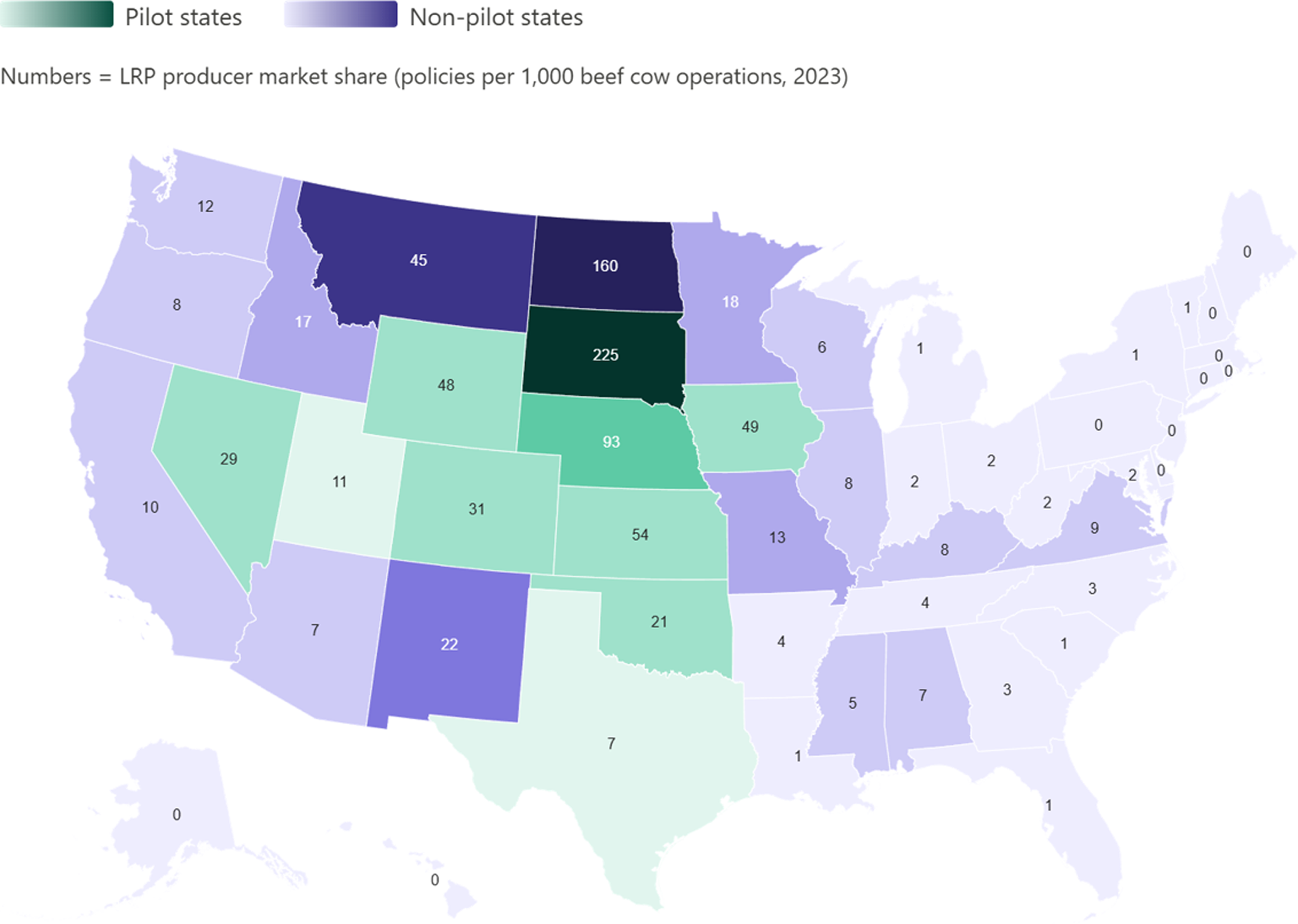
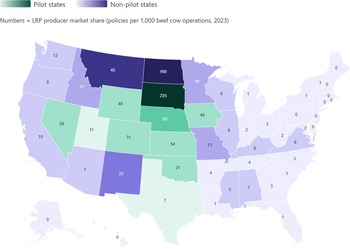
Between 2003–2019 there was negligible participation in LRP, but since the policy changes, participation rates have increased (USDA Risk Management Agency, 2024b). As measured with LRP producer market share, Figure 1 shows that LRP usage is largely concentrated in Midwestern states, for instance, South Dakota bought as high as 225 LRP policies per thousand beef cow operations in 2023, while some other states still have not utilized LRP.
The Bipartisan Budget Act of 2018 was a major policy change for LRP as it removed the annual funding cap on livestock insurance (Glauber, Reference Glauber2022), enabling USDA-RMA to reform and expand LRP. Later in 2019, USDA-RMA increased the subsidy rate from 13% to 20%, and further to 35% in 2020, for coverage levels at and above 95%. In 2019 and 2020, USDA-RMA also increased the insurable head limits per commodity year, shifted the premium payment due date to the end of the insurance period, and allowed cattle to be sold 60 days prior to the contract expiration, which offered improved liquidity to producers (Hewlett et al., Reference Hewlett, Parsons and Tranel2020).
2.3. Risk management education
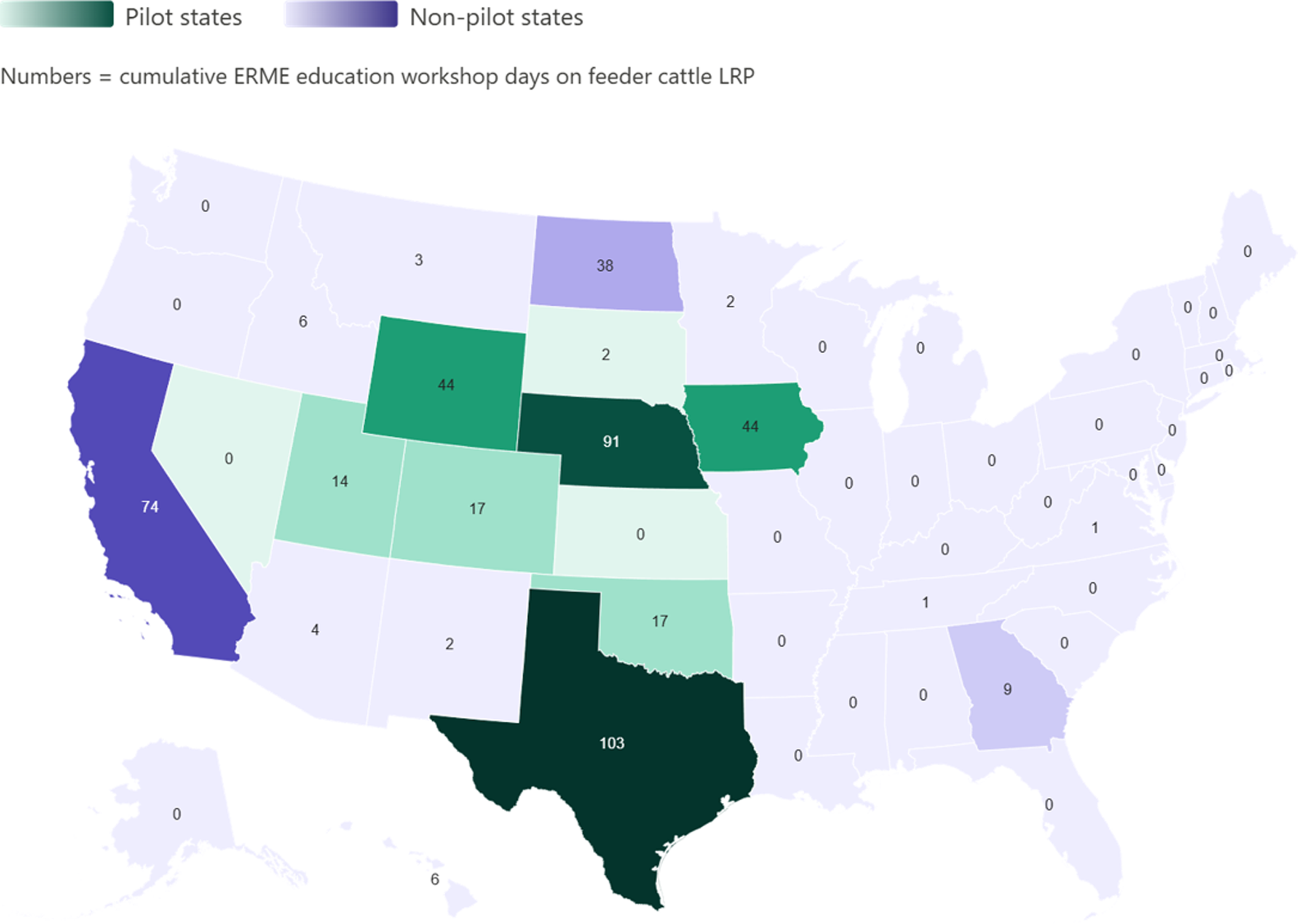
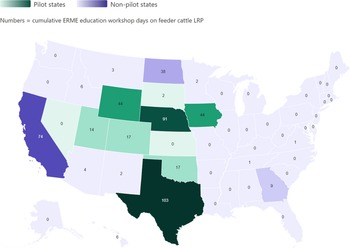
The USDA has made efforts to educate cattle producers in the US about risk management. For instance, the United States Department of Agriculture-National Institute of Food and Agriculture (USDA-NIFA) competitively funds regional ERME centers (4 regional centers and one digital center) to, in turn, administer regional competitive grant programs that fund producer-focused education projects, including those addressing LRP. Figure 2 presents the cumulative number of days devoted to education workshopsFootnote 5 on feeder cattle LRP for producers funded through the ERME program within each commodity year. These figures serve as a proxy for educational efforts related to LRP and demonstrate that producers’ knowledge of the product has increased over time and across states.
Cumulative number of ERME funded workshop days on feeder cattle LRP (2003–2023) by pilot and non-pilot states.
Sources: Extension Risk Management Education (2025) and authors’ calculations.
3. Econometric strategy
3.1. Conceptual framework
Following Goodwin (Reference Goodwin1993) and Sherrick et al. (Reference Sherrick, Barry, Ellinger and Schnitkey2004), we employ a standard expected utility maximization framework where a representative feeder cattle producer maximizes their expected utility of the end-of-period wealth subject to economic, environmental, and production constraints. This framework suggests that the variability of returns matters for risk-averse producers given the concave nature of the utility function. This implies that feeder cattle producers may prefer lower but more certain end-of-period wealth through price risk management tools, like LRP, over the possibility of a sharp price decline. Thus, feeder cattle producers demand LRP not because it increases expected wealth but because it reduces return variability and increases the expected utility of end-of-period wealth. In this study, we analyze the utilization of LRP as a function of several key observable variables:Footnote 6 risk management education, policy, economic, producer characteristics, and other fixed effects: $Use_{it}=f(\textit{Educatio}n_{i,t},\textit{Polic}y_{t},\textit{Economic}_{t},\textit{Produce}r_{i},\textit{State}_{i}\times Year_{t},)$
3.2. Review of econometric models and the measure of insurance participation
There is no standard method of measuring insurance participation.Footnote 7 Instead, economists have used both qualitative and quantitative proxies to estimate insurance participation. One common approach is to indicate the insurance choice where 1 if insured and 0 otherwise (Boyer et al., Reference Boyer, DeLong, Griffith and Martinez2024; Coble et al., Reference Coble, Knight, Pope and Williams1997; Knight and Coble, Reference Knight and Coble1997; Richards, Reference Richards2000). In this study, we focus on the role of education in influencing LRP utilization. Specifically, we analyze the relationship between ERME-funded education workshops and LRP utilization using a measure of producer market share, defined as the average number of LRP policies earning premiums divided by the total number of beef cow operations in a given state and commodity year. We select producer market share as our preferred dependent variable because it offers a more nuanced indicator of insurance usage at the producer level and captures how education workshops may enhance producers’ knowledge of LRP.
3.3. Empirical model
Our dataset contains approximately 25% of state × years where the number of LRP policies earning premium is zero. Since we only account for LRP eligible states by year, we consider those zeros as “true zeros,” meaning that “no participation” is due to economic reasons, not because of structural constraints. We account for “zero” or “positive values” in policies earning premium using a two-part model following Duan et al. (Reference Duan, Manning, Morris and Newhouse1983), assuming that the utilization of LRP follows two steps.
First, producers decide to participate in LRP (i.e., at least one LRP policy earns a premium) which we refer to as the extensive margin of LRP utilization (see Equation (2)). For a given state i in year t, an LRP policy earns a premium (L it ) as a function of education workshops, E it , and a set of economic, production, and policy covariates (X it ) within each state × year. The probability a policy earns a premium is given by: ${\rm P(L}_{it} \gt 0 \mid {\rm X}_{it}) = \frac{\exp\left(\gamma_1 {\rm E}_{it} + \beta_1 {\rm X}_{it}\right)} {1 + \exp\left(\gamma_1 {\rm E}_{it} + \beta_1 {\rm X}_{it}\right)}.$
where, γ 1 and β1 are the associated vector of coefficients.
Second, producers decide the level of participation (i.e., producer market share), which we refer to as the intensive margin (see Equation (3)). Since the values of LRP producer market share are bounded between 0 and 1, we restrict the sample to positive observations and estimate the intensive margin of LRP utilization using a fractional logistic regression model, following Papke and Wooldridge (Reference Papke and Wooldridge1996). The expected level of LRP producer market share (S it ), conditional on participation in LRP for state i in year t, is specified as: ${\rm E}\left( {{{\rm S}_{it}}\left| {{{\rm X}_{it}}} \right.} \right) = {{{\rm{exp}}\left( {{\gamma _2}{{\rm E}_{it}} + {{\rm \beta} _2}{{\rm X}_{it}}} \right)} \over {1 + {\rm{exp}}\left( {{\gamma _2}{{\rm E}_{it}} + {{\rm \beta} _2}{{\rm X}_{it}}} \right)}}$
where S it ∈ [0, 1] and γ 2 and β2 are the associated vector of coefficients.
Average marginal effects (AMEs) are calculated using the delta method for both the extensive and intensive margins of LRP utilization. The AMEs represent the average change in the probability of LRP utilization at each margin associated with a one-unit change in each covariate, averaged across all state × year observations.
3.4. Identification
Our identification strategy addresses three primary concerns: the prevalence of zeros in the dependent variable, potential endogeneity of the education workshop variable, and temporal heterogeneity in the education effect.
First, approximately 25% of state-year observations in our sample record zero LRP policies earning premium. Because we restrict the sample to state-years in which LRP was available, these zeros reflect non-participation rather than program ineligibility. Using a single-equation model would conflate the factors driving the participation decision with those governing the level of participation. We therefore adopt the two-part framework described in Section 3.3, estimating the extensive margin (Equation (2)) and intensive margin (Equation (3)) separately. This approach allows our variable of interest, education workshop, to exert distinct effects at each stage of the utilization decision.
Second, although ERME funding for feeder cattle LRP education is broadly available to all states, the allocation of workshops is unlikely to be exogenous. States with lower baseline participation or a greater perceived need for outreach may be more likely to pursue funding and host workshops, introducing potential selection bias. If this unobserved “need for education” is positively correlated with workshop activity and negatively correlated with LRP participation, omitting it could bias our estimated education effect downward. We mitigate this concern by including a lagged LRP participation covariate in both the extensive and intensive margin specifications which controls for the state’s prior utilization trajectory, thus absorbing persistent unobserved heterogeneity that could confound our estimate of education workshop days.
Third, the effect of education workshops may evolve over time as the LRP program matures and producer familiarity grows. To account for this, we estimate an augmented specification that interacts education workshop days with a state-by-year time trend. This interaction allows our marginal effect of education workshop days to vary across the sample period and serves as a robustness check on the stability of the baseline education effect.
4. Data
We create a panel dataset for all fifty states by year of LRP-feeder cattle usage from 2003 to 2023 using data from USDA-RMA’s yearly Summary of Business report. Since not all states were eligible for LRP until 2019, we classify each state as pilot or non-pilot by year using Grunewald et al. (Reference Grunewald, Mintert, Barnaby and Dhuyvetter2005), Larson and Jose (Reference Larson and Jose2003), and RMA’s map viewer (USDA Risk Management Agency, 2025a) to determine LRP availability by state × year.
We construct a set of risk management education, policy, economic, policy, and production variables as potential drivers of LRP utilization. Our primary variable of interest is risk management education represented by the number of completed days of education workshops on LRP for feeder cattle producers within a given commodity year, as reported by the four regional and one digital ERME centers. Although producers might receive education from alternative sources, such as state or private insurance providers thereby adding to the total educational effort, the ERME program provides the most comprehensive systematically documented measure of educational efforts. Thus, completed ERME education workshops on LRP for feeder cattle producers serve as a proxy for the practical knowledge gained by producers through formal education workshops during our observed period.
Policy factors can make the products more or less desirable. The USDA-RMA made a number of policy changes which included expanding the insurable animal head limit and shifting premium due date to the end of the LRP endorsement period. However, the increase in subsidies has been the dominate question from producers. We focus on the shift in subsidy rates at a coverage level of 95% or above, as this range accounted for over 90% of LRP endorsements purchased during our study period. We refer to this as the base subsidy rateFootnote 8 and expect the base subsidy rate to be positively associated with LRP utilization, as it reduces insurance cost.
Economic factors could impact producers’ decision to participate in LRP. We account for these factors using the mean and standard deviation of the CME Feeder Cattle Index, which measures a seven-day rolling average of cash sales of feeder cattle within 12 states as reported by the United States Department of Agriculture, Agricultural Marketing Service (USDA-AMS). We expect that producers will be more likely to adopt LRP policies as cattle prices rise, as the higher prices offset the realized insurance costs. Additionally, larger (smaller) price volatility is expected to increase (decrease) insurance uptake.Footnote 9
Producer characteristics can also influence LRP utilization. We proxy these characteristics using data from the USDA’s beef cow inventory survey. Because LRP is primarily designed for smaller cow–calf operations, we expect producers in states with small to mid-sized herds to be more likely to adopt LRP than those operating very large herds. Accordingly, we allow for a nonlinear relationship between insurance utilization and herd size to estimate the herd size that derives that largest amount of utility from LRP.
5. Results
5.1. Summary statistics
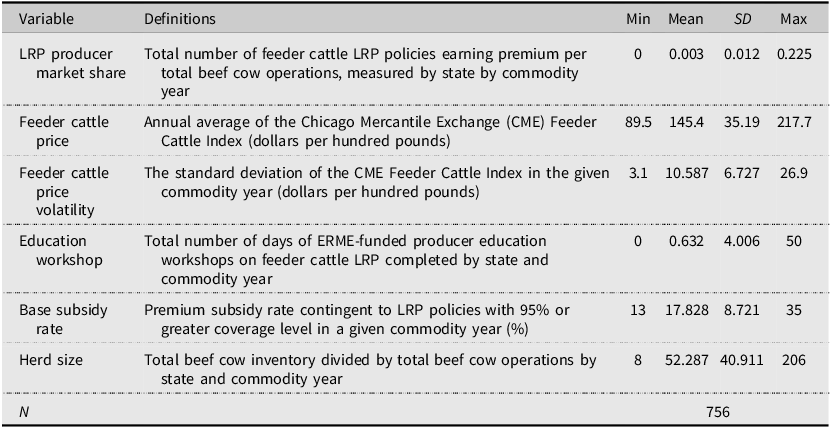
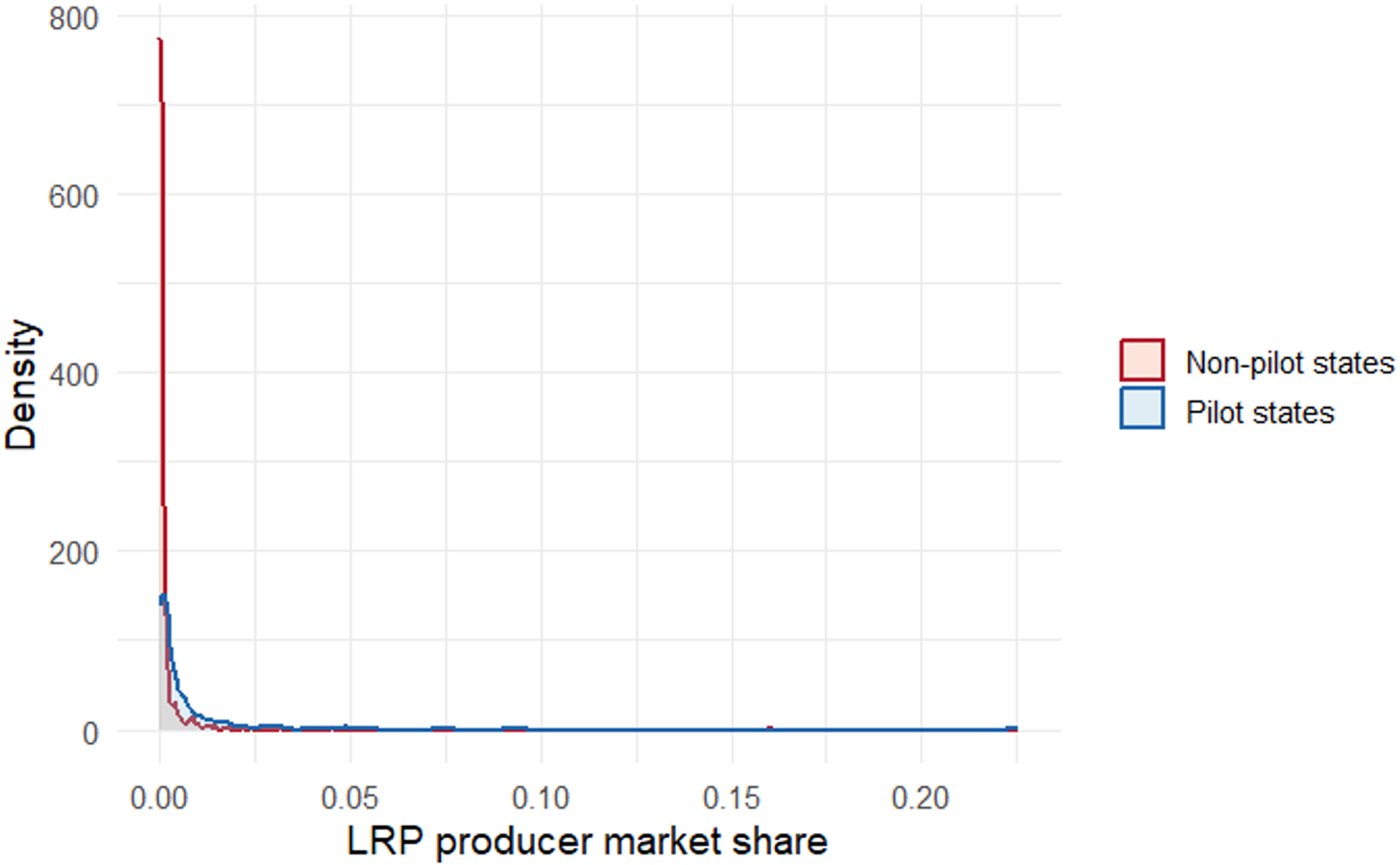
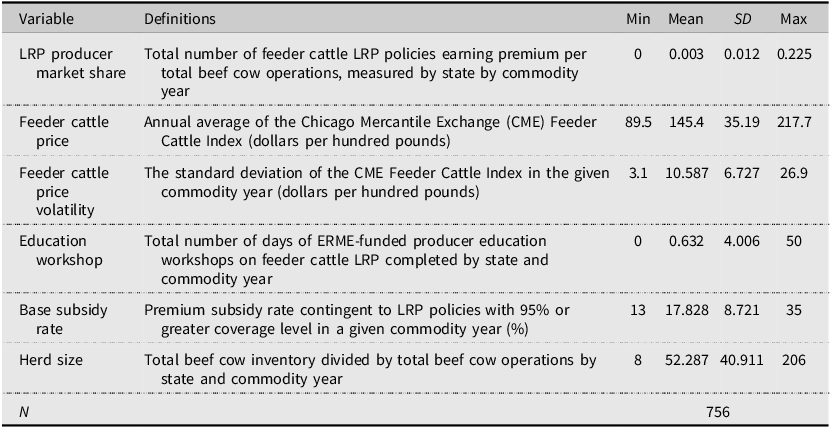
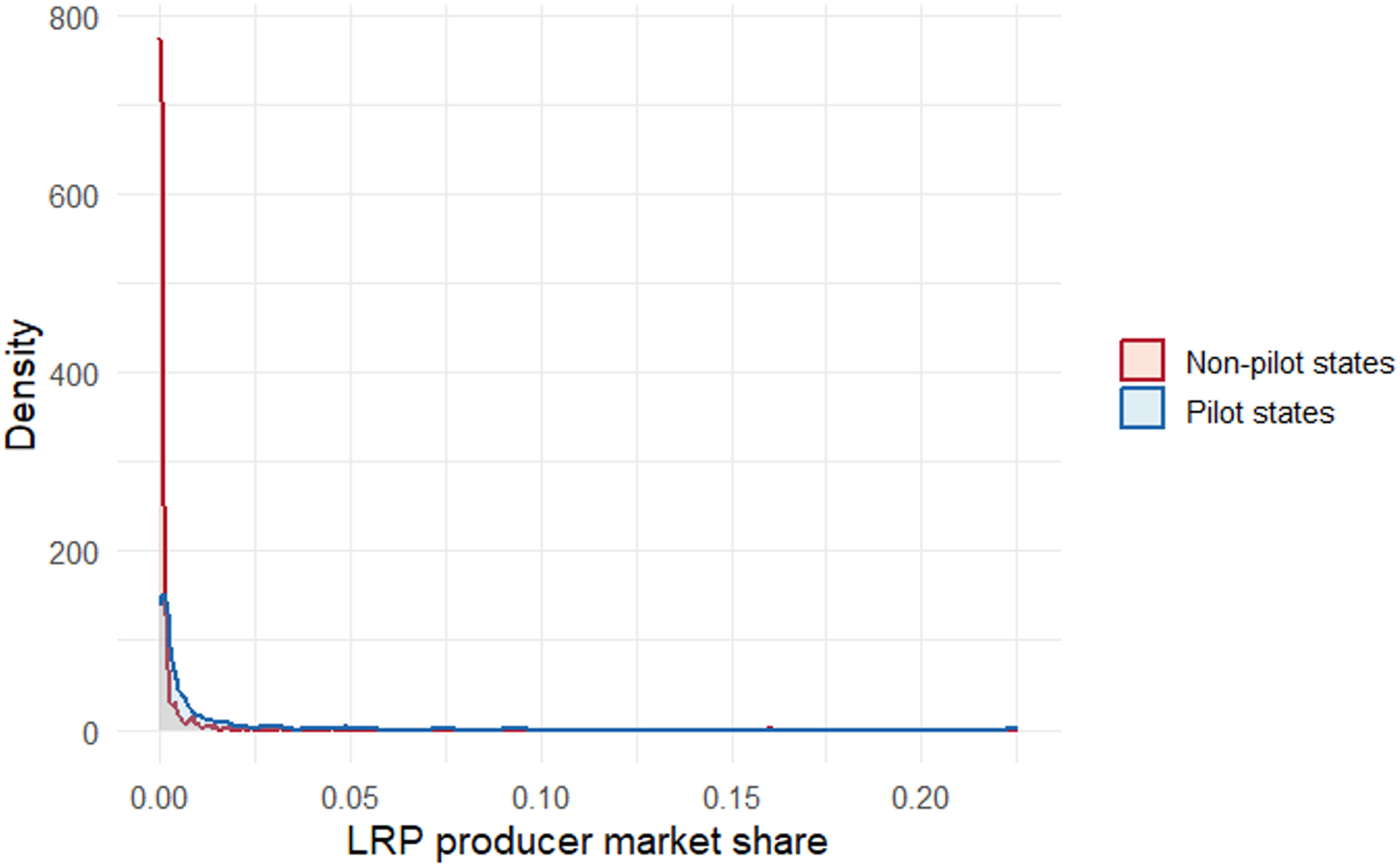
Table 1 presents the summarized statistics, and Figure 3 shows the distribution of LRP producer market share in both pilot and non-pilot states. Both show a similar pattern of variation: 0 to 0.15 (non-pilot states) and 0 to 0.22 (pilot states) policies earning premium per beef cow operation for each state × year and average close to zero (0.003 policies). This suggests that LRP usage is concentrated in few states. Figure 1 further shows that only a small fraction of the beef cow operations within a state used LRP in the 2023 commodity year. Risk management education efforts were also limited at that time. ERME funded workshops on feeder cattle LRP average 0.63 days per state-year but vary widely (SD = 4.006) from 0 to a maximum of 50 days. Education workshops are concentrated in a few state-year observations, with the majority recording no ERME funded workshop days. The 2003–2023 cumulative distribution of education workshop days in Figure 2 above confirms that Midwestern states provided more education, with Texas being the largest recipient (103 workshop days). California was a notable exception, with a total of 74 workshop days. In contrast, most states outside the Midwest exhibited low to no recorded ERME-funded education workshops for feeder cattle LRP. The average base subsidy rate was 18% for each state × year,Footnote 10 and the average herd size nationally between 2003–2023 was 52.
Summary statistics, 2003–2023
Notes: Min = minimum, Max = maximum, SD = standard deviations.
5.2. Effect on the extensive margin of LRP utilization
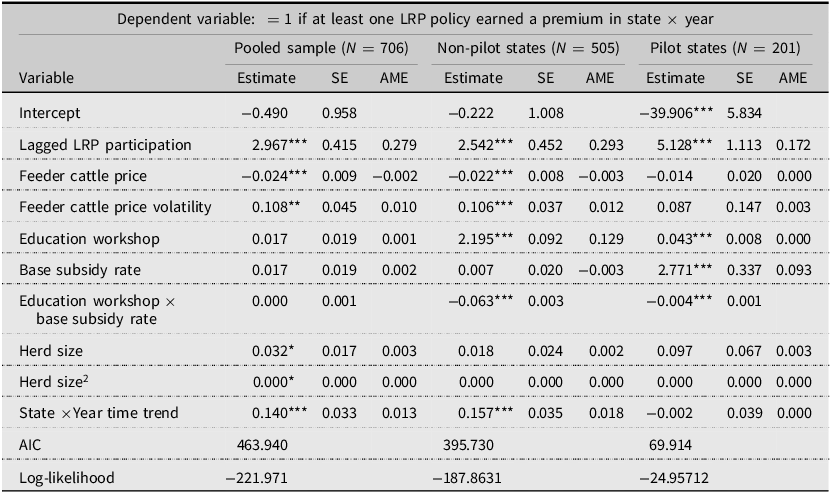
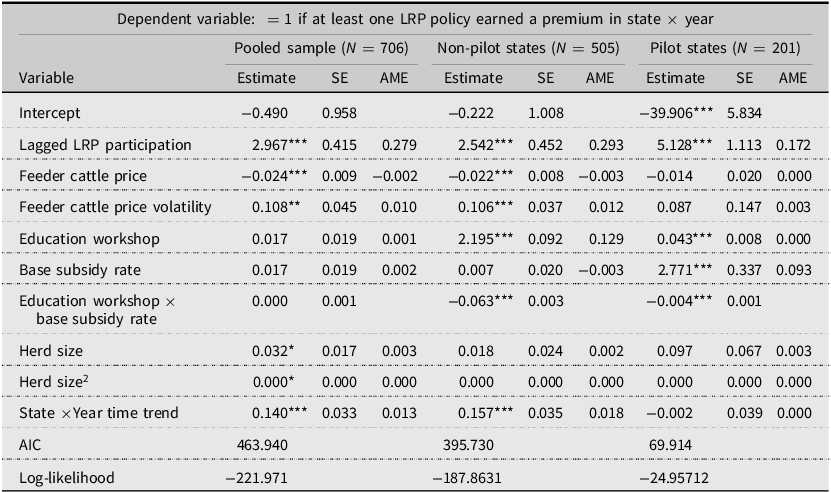
Table 2 shows estimate from the extensive margin of LRP utilization using a binary logit regression in non-pilot states, pilot states, and pooled across all states. We report log-odd coefficients, standard errors clustered by state, and average marginal effects (AMEs) for factors affecting the decision to participate in LRP. We cluster standard errors at the state level to account for potential within-state correlations that may arise from variation in workshop formats, producer risk preferences, or their attitudes toward risk management practices. We scaled the education workshop variable by ×10 in the model to adjust for scaling issues in the regression results.
Log estimates on decision to participate in LRP (Extensive Margin), 2003–2023
Notes: Education workshop is scaled to ×10. SE refers to standard error clustered by state.
AME denotes average marginal effect, computed by averaging marginal effects across all state × year observations. *, **, and *** refer to p < 0.1, p < 0.05, and p < 0.01, respectively.
The results indicate that education workshops significantly (p < 0.01) and positively affect LRP participation decisions in both non-pilot and pilot states, whereas the marginal effect is stronger in non-pilot states. The marginal effect of education workshops depends on both the direct effect and the interaction with base subsidy rate. On average, an additional education workshop day increases the probability of at least one producer participating in LRP within a state by 1.29 percentage point in non-pilot states, while the effect is economically negligible in pilot states (Table 2). The base subsidy rate is only significant in pilot states, indicating that a higher subsidy rate is positively associated with insurance participation in pilot states, and it exhibits a large marginal effect (9.3%). The interaction between education workshops and base subsidy rates is significant in non-pilot and pilot states but not in the pooled sample implying that in states where producers are relatively new to LRP (non-pilot states), education dominates the insurance participation decision. This contrasts with states where producers are familiar with LRP (pilot states), for which a higher base subsidy rate dominates the participation decision.
We conducted joint hypothesis tests on the base subsidy rate and its interaction with education and found no statistically significant combined effect at the extensive margin for the pooled sample and non-pilot states. This indicates that the base subsidy rate is not a binding constraint in these samples. In contrast, the joint effect is statistically significant in pilot states, which confirms that the base subsidy rate does influence LRP participation and that education modifies the effect of subsidies on enrollment in these states. Further, our results show a negative significant coefficient on the interaction between the education workshop and base subsidy rate in both pilot and non-pilot state sub-samples (Table 2). This pattern suggests a potential substitution between education and subsidy in pilot and non-pilot states, indicating that a higher subsidy rate may offset the positive effect of education in the LRP enrollment decision.
Feeder cattle prices negatively and significantly (p < 0.01) affect the extensive margin but only in pooled and non-pilot states, whereas feeder cattle volatility is significant and positive. This indicates that as the CME Feeder Cattle Index trends higher in value, feeder cattle producers are less likely to use LRP whereas if the CME Feeder Cattle Index is more volatile LRP utilization increases. Herd size is only significant and positive in the pooled sample and exhibits a quadratic relationship implying an optimal herd size associated with the maximum likelihood of insurance participation. In the pooled sample, producers who have 94 beef cows are the most likely to participate in LRP.Footnote 11
5.3. Effect on the intensive margin of LRP utilization
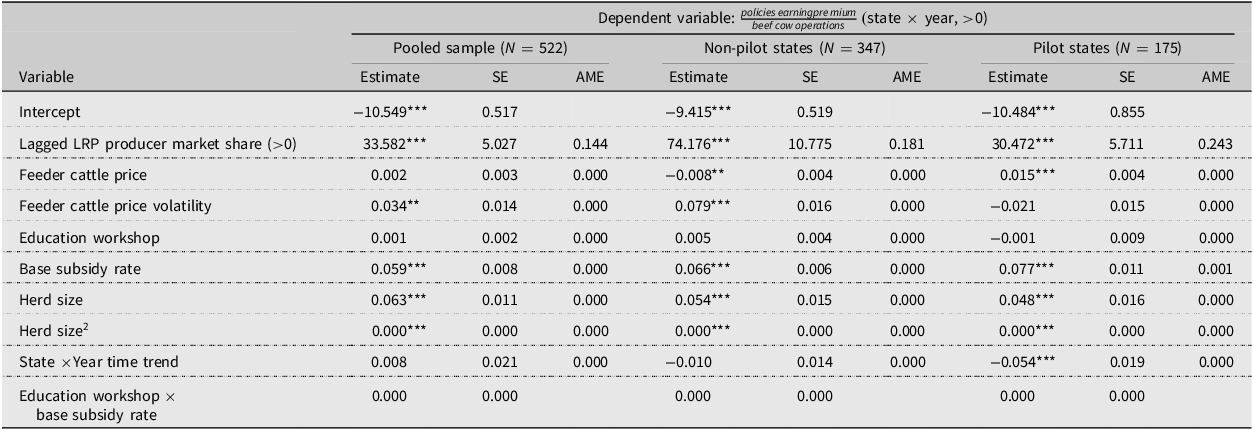
Table 3 displays the results of the intensity of LRP utilization (intensive margin) using a fractional logistic model across our three samples. Like in the extensive margin, we adjust the education workshop variable by × 10 in the intensive margin. Results indicate that education workshops are not significant across all three samples: pooled sample, pilot, and non-pilot states. Our estimated AMEs of education workshops are nearly zero, indicating that the economic impact of an additional education workshop day is negligible at the intensive margin. This suggests that the role of an education workshop is to provide information rather than increase sales of LRP. The base subsidy rate exhibits a positive and significant effect on the intensive margin of producer market share across all three samples: pooled, non-pilot, and pilot states, while its marginal effect is stronger in pilot states, and economically negligible in non-pilot states and the pooled sample. A one-unit increase in the base subsidy rate increases LRP producer market share by 0.1 percentage point in pilot states at the intensive margin. This suggests that the subsidy rate plays a dominant role in LRP utilization in pilot states. Unlike the extensive margin, we did not find a statistically significant interaction between education workshops and the base subsidy rate in any of three samples at the intensive margin.
Log-odd estimates for the intensity of LRP utilization (Intensive Margin), 2003–2023
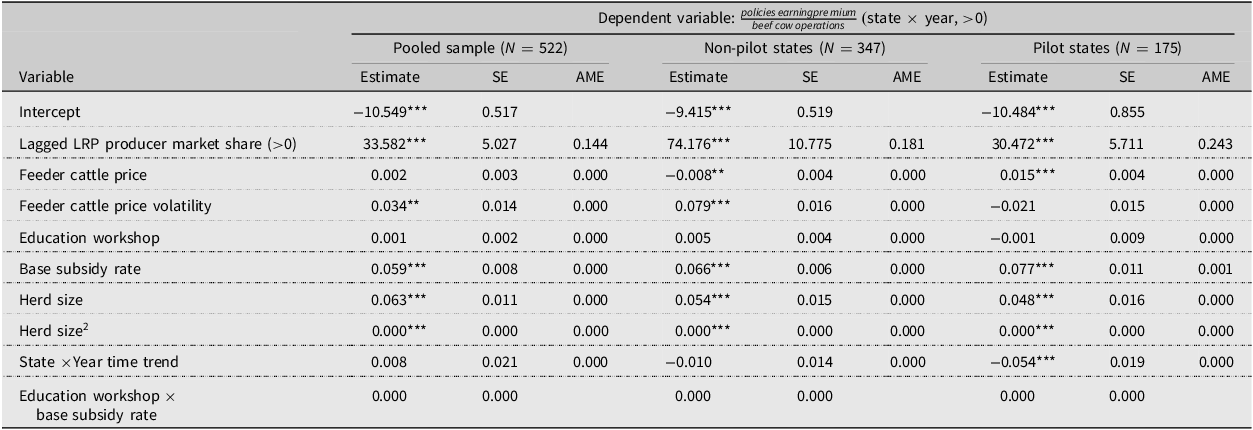
Table 3. Long description
The table presents the results of the intensity of LRP utilization (intensive margin) using a fractional logistic model across three samples: pooled sample, non-pilot states, and pilot states. The table has 12 rows and 9 columns. Column headers are Variable, Pooled sample (N = 522) Estimate, Pooled sample (N = 522) SE, Pooled sample (N = 522) AME, Non-pilot states (N = 347) Estimate, Non-pilot states (N = 347) SE, Non-pilot states (N = 347) AME, Pilot states (N = 175) Estimate, Pilot states (N = 175) SE, Pilot states (N = 175) AME. Row 1: Intercept, -10.549***, 0.517,, -9.415***, 0.519,, -10.484***, 0.855, . Row 2: Lagged LRP producer market share (>0), 33.582***, 5.027, 0.144, 74.176***, 10.775, 0.181, 30.472***, 5.711, 0.243. Row 3: Feeder cattle price, 0.002, 0.003, 0.000, -0.008**, 0.004, 0.000, 0.015***, 0.004, 0.000. Row 4: Feeder cattle price volatility, 0.034**, 0.014, 0.000, 0.079***, 0.016, 0.000, -0.021, 0.015, 0.000. Row 5: Education workshop, 0.001, 0.002, 0.000, 0.005, 0.004, 0.000, -0.001, 0.009, 0.000. Row 6: Base subsidy rate, 0.059***, 0.008, 0.000, 0.066***, 0.006, 0.000, 0.077***, 0.011, 0.001. Row 7: Herd size, 0.063***, 0.011, 0.000, 0.054***, 0.015, 0.000, 0.048***, 0.016, 0.000. Row 8: Herd size^2, 0.000***, 0.000, 0.000, 0.000***, 0.000, 0.000, 0.000***, 0.000, 0.000. Row 9: State x Year time trend, 0.008, 0.021, 0.000, -0.010, 0.014, 0.000, -0.054***, 0.019, 0.000. Row 10: Education workshop x base subsidy rate, 0.000, 0.000, 0.000, 0.000, 0.000, 0.000, 0.000, 0.000, 0.000.
Notes: Education workshop is scaled to ×10. SE refers to standard error clustered by state.
AME denotes average marginal effect, computed by averaging marginal effects across all state × year observations. ** and *** refer to p < 0.05 and p < 0.01, respectively.
Feeder cattle price is significant in both non-pilot and pilot states, while it is negatively and positively associated across these states respectively at the intensive margin of LRP. Herd size exhibits a significant positive and quadratic effect in all three samples. There is an optimal herd size associated with maximum producer market share at the intensive margin. Our model estimates that producers with 120 and 123 beef cows in non-pilot and pilot states have the highest usage of LRP at intensive margins.
6. Discussion
Our analysis reveals heterogeneous effects of education workshops on LRP insurance utilization across different state categories and utilization margins. Education workshops demonstrate a positive and statistically significant effect (p < 0.01) on the extensive margin of LRP utilization across both sub-samples: non-pilot states and pilot states, with a strong effect in non-pilot states. However, we did not find statistically and economically significant effect of education on the intensive margin of the insurance utilization This is consistent with the 2023 cross-sectional distributions in Figures 1 and 3, where regardless of pilot status, the variation in producer market share in already participating states does not align systematically with the intensity of education workshops. This suggests that once producers adopt LRP, the intensity of utilization (intensive margin) is governed by factors other than education. Overall, we find that education workshops have a greater impact on the extensive margin of LRP, particularly in states where producers have limited prior exposure to the product. Even though we proxy pilot states with program familiarity, we note that these states fundamentally differ from the non-pilot states in terms of other unobserved factors, such as cattle density, market access, and other factors.
The role of base subsidy rates presents a substitution pattern. While the base subsidy rates show no significant effect on the extensive margin in the pooled sample and non-pilot states, they positively and significantly influence participation decisions in pilot states. Conversely, the base subsidy rates demonstrate consistent positive effects on the intensive margin across all samples. This observation suggests that education primarily facilitates initial participation decisions, particularly in states with less insurance familiarity, while subsidy rates become the dominant factor for pilot states. Furthermore, our robustness check (Table S1, Appendix), suggests potential temporal saturation of education, particularly in pilot states, suggesting that education mattered more during early ramp up in those states. For example, in pilot states, education’s role has diminished over time as familiarity with the product increased. In contrast, education remained an active and growing driver of adoption in non-pilot states.
Our findings align with existing literature suggesting that education enhances product understanding among producers with limited experience or risk literacy, thereby reducing behavioral biases (Boyer et al., Reference Boyer, DeLong, Griffith and Martinez2024; Hall et al., Reference Hall, Knight, Coble, Baquet and Patrick2003). This effect is particularly pronounced among small- and medium-sized operations (Takahashi et al., Reference Takahashi, Muraoka and Otsuka2020). In a previous study about participation in a newer insurance product PRF, Goodrich and Davidson (Reference Goodrich and Davidson2024) found that awareness about PRF, particularly from an insurance agent, was positively linked to enrollment decision. However, our study links education workshops with insurance participation, given that these workshops are conducted primarily by university and non-profit employees. This plays an important role in how LRP is taught where the focus is on fundamental understanding rather than convincing producers to buy the product. This could be why we found that education has a role on the extensive margin (participation decision) but has a negligible economic impact on the intensive margin of LRP utilization.
Our results extend beyond existing literature on the usage of new insurance products in that we show a potential substitution effect between education and base subsidy rates that is meaningful for producers making LRP participation decisions in non-pilot states. In markets with established insurance participation (i.e., pilot states), higher subsidy environments act to crowd out the impact of education workshops. One reason this could occur is that producers understand the cost barriers, making them more responsive to premium reductions through increased subsidies. This mechanism would be consistent with Boyer and Griffith’s (Reference Boyer and Griffith2023) observations regarding decreased premium costs following subsidy increases in 2019 and 2020.
Market (economic) conditions significantly influence LRP participation patterns. The estimated coefficient (Table 2) suggests that feeder cattle prices negatively and significantly affect the extensive margin in the pooled and non-pilot states holding feeder cattle price volatility constant. At the intensive margin (Table 3), cattle prices exhibit significant but negative and positive effects in non-pilot and pilot states, respectively. We earlier hypothesized a positive price relationship on LRP participation given LRP operates as a subsidized put option, effectively increasing perceived revenue at risk at higher prices. Our findings at the extensive margin do not align with the findings reported from a producers’ survey by Boyer et al. (Reference Boyer, DeLong, Griffith and Martinez2024). They report that cattle producers were more likely to purchase LRP when the feeder cattle price was stronger. In contrast, our findings of a negative price relationship on LRP participation (extensive margin) at higher prices suggest both behavioral and economic explanations. First, when feeder cattle prices are moving higher (as they generally did from late 2020 through 2025), producers may believe that downside price risk is reduced and exhibit less demand for price protection. Second, from an economic standpoint, despite the premium subsidy, a higher price translates into a higher premium cost that may reduce producer interest in purchasing price coverage.
Price volatility exhibits a significant and positive effect at both extensive and intensive margins in pooled and non-pilot states holding feeder cattle price constant. This finding is consistent with studies done with row crop producers that suggests increased expected utility of insurance as price volatility increases producers’ exposure to risk (Sherrick et al., Reference Sherrick, Barry, Ellinger and Schnitkey2004). However, our finding contradicts some literature that found deterred insurance participation due to increased premium costs at volatile markets (Coelho et al., Reference Coelho, Mark and Azzam2008). Nevertheless, Schnitkey (Reference Schnitkey2016) report that insurance participation among US row crop producers still remained high at higher coverage levels despite volatility raising premium costs. In our additional analysis, we found that the interaction effect of feeder cattle price and price volatility was not significant at p < 0.1 in both pooled and non-pilot states at extensive margin, suggesting that the effects of these two factors can coexist but do not offset each other on LRP participation. Our main analysis shows that producers respond to both price and volatility, and that the volatility effect is greater than the price effect.
Farm structure also plays a crucial role in LRP utilization. Pooled sample at the extensive margin and all samples at the intensive margin exhibited a positive and quadratic relationship of herd size. States characterized by smaller average operation sizes demonstrated greater LRP utilization compared to those dominated by large operations. This further showed that LRP, as designed with its institutional features, is most utilized for smaller to medium-sized operations, which often cannot fulfill size of 50,000 lbs. per contract in future and options market. These findings are consistent with previous literature that smaller operations prefer less administratively burdensome risk management tools (Thomas O. Knight and Coble, Reference Knight and Coble1997; Sherrick et al., Reference Sherrick, Barry, Ellinger and Schnitkey2004).
7. Conclusion
This study contributes to the agricultural insurance literature by analyzing 21 years of state-level LRP utilization data, showing that education workshops are a critical driver in the insurance adoption decision. The heterogeneous effects of education across states in insurance participation provide important insights for policy design. Samples from both pilot and non-pilot states at the extensive margin demonstrate potential substitution between the base subsidy rate and education, such that increased subsidies may diminish the marginal impact of educational programs.
We acknowledge some limitations of the study. Our measure of education workshop days funded by ERME alone does not fully capture the overall educational efforts on feeder cattle LRP. For instance, there may be educational efforts in various states regardless of the number of ERME funded workshops, whether from public or private entities. Further, education of LRP happened more broadly among academic and private industry over the last several decades but there is no way to accurately quantify these efforts. Regardless of these limitations, our findings have significant implications for agricultural risk management policy. Policymakers should consider the maturity of local insurance markets when allocating resources between educational programs and subsidy support. In emerging markets, combining robust educational initiatives with moderate subsidy rates may yield optimal participation outcomes. In established markets, however, direct subsidy support may prove more cost-effective than additional educational investments.
Future research should explore the economic and policy implications of these trade-offs between education workshops and subsidy rates. Additionally, extending this framework could be an important avenue to analyze localized educational efforts. This extension could focus on separate or joint usage of LRP with other risk management tools at the county or producer level, where data permits that could provide more granular insights into optimal policy design.
Supplementary material
The supplementary material for this article can be found at https://doi.org/10.1017/aae.2026.10052.
Data availability statement
The datasets used in this research were created from publicly available data sourced from the websites of USDA-RMA, USDA-NASS, CME, and ERME. The authors are happy to provide the constructed datasets and replication codes upon request.
Acknowledgements
The authors thank participants at the 2024 North Central ERME Advisory Council Meeting, the 2024 ERME Annual Meeting, the 2024 AAEA Annual Meeting, and the 2023 CAP In-Service Meeting for valuable feedback during the early stages of this research. They also thank the three anonymous reviewers and Drs. Jay Parsons, James MacDonald, and Matt Stockton for insightful comments and suggestions.
Author contribution
Conceptualization: B.D.L. and E.J.D.; Methodology: M.C., B.D.L., and E.J.D.; Formal Analysis: M.C., B.D.L., and E.J.D.; Data Curation: M.C.; Writing – Original Draft: M.C.; Writing – Review and Editing: M.C., B.D.L., and E.J.D.; Supervision: B.D.L.; Funding Acquisition: B.D.L.
Financial support
This work was supported by USDA/NIFA under Award Number 2021-70,027-34,694.
Competing interests
Lubben is the director of the North Central Extension Risk Management Education Center, which is supported by USDA/NIFA under Award Number 2021-70,027-34,694.
AI contributions to research
AI platforms, such as ChatGPT and Elicit, were used to support literature search. Grammarly was used to assist with grammar refinement.


 Open access

