

I Introduction
Announcing that Thomas Jefferson (1743–1826) proposed boring a hole in the noses of women convicted of certain moral offences, and introducing an eye-for-an-eye system of retaliation (lex talionis) for anyone who disfigured any other person, tends to provoke a strong reaction. Even among those who see paradox in the author of the Declaration of Independence promoting equality of humanity while owning slaves, the punishments put forward by Jefferson in his proposed overhaul of capital offences in Virginian criminal law seem strange and anachronistic for a man thought preoccupied with eighteenth-century tastes for civility and legal reform.
Jefferson's proposals were the result of impressive research on common and statutory laws, preserved in his ample manuscript annotations in modern and Old English, Latin and French. They never became law: thus, while frequently acknowledged as anomalous to Jefferson's broader humanitarian principles, they have received less attention from Jefferson scholars.Footnote 1 Markus Dirk Dubber judged the bill a ‘remarkable failure’ in comparison to Jefferson's other reforms, symptomatic of the Early Republic's widespread inability to grapple with the philosophy and extent of legitimate punishment, and the relationships between legal persons and authority.Footnote 2 Maurizio Valsania has recently offered fascinating close scrutiny of Jefferson's corporeality and attitudes towards others’ bodies, but omits discussion about these proposals for punitive mutilation.Footnote 3 Yet Kathryn Preyer argued that the bill, along with Jefferson's proposals for religious freedom, property reform and free education, formed ‘part of a single broad and energetic program of reform’, and further scholars have traced the revolutionary effects of many of his proposals.Footnote 4 Jefferson also included the provisions in Notes on the State of Virginia (1787), thus giving them a much wider, international circulation. To understand Jefferson's proposals it is necessary to examine the fate of equivalent crimes and punishments in the law codes he examined, especially Britain's, and to compare the legal and wider connotations of facial disfigurement that made these proposals coherent in Virginia when they had long ceased elsewhere.
Prior to American independence, the common law of England was imported into the colonial courts, its decisions widely available in printed proceedings, and the Privy Council remained the highest appellate court. Jefferson's ‘A Bill for Proportioning Crimes and Punishments in Cases Heretofore Capital’ was Bill 64 of the 126 bills prepared by himself, Edmund Pendleton and George Wythe for the revision of Virginia's laws. The criminal laws were initially assigned to George Mason, but Jefferson soon took over after Mason's retirement.Footnote 5 The committee submitted the bills to the legislature in 1779. Bill 64 restricted execution to first degree murder and treason (more narrowly defined), and predominantly prescribed hard labour in the public works, and transplantation for slaves. The lack of a prison in the commonwealth precluded extensive incarceration.
The two provisions that deal with facial disfigurement, as written in Jefferson's fair manuscript copy, are as follows:
Whosoever shall be guilty of rape, polygamy, or sodomy with man or woman shall be punished, if a man, by castration, if a woman, by cutting thro’ the cartilage of her nose a hole of one half inch diameter at the least.
and
Whosoever on purpose and of malice forethought shall maim another, or shall disfigure him, by cutting out or disabling the tongue, slitting or cutting off a nose, lip or ear, branding, or otherwise, shall be maimed or disfigured in like sort: or if that cannot be for want of the same part, then as nearly as may be in some other part of at least equal value and estimation in the opinion of a jury, and moreover shall forfeit one half of his lands and goods to the sufferer.Footnote 6
The collection was put to the Assembly in the sessions of 1785–6, but only fifty-six bills were enacted into law.Footnote 7 James Madison suggested to Jefferson (by then in Paris) that desire to retain horse stealing as a capital offence had contributed significantly to the defeat of the entire bill.Footnote 8 The offences subsequently remained capital.
II Eighteenth-century law: death and violence
The committee had agreed that the revisions to the criminal law should significantly reduce use of the death penalty, and Jefferson desired them ‘strict and inflexible but proportioned to the crime’.Footnote 9 He was influenced by writers like Cesare Beccaria, William Eden, Jean-Jacques Rousseau and Montesquieu, who emphasised proportionality of punishment and restriction of the death penalty as guarantors of individual rights and a check on state abuse.Footnote 10 The spectacle, ritual and vigour of corporal and capital punishments played a key role in performances of power by developing states in early modern Europe, and would arguably continue to do so in the fragile Early Republic.Footnote 11 Judicial wounds to the face allowed for the ongoing stigmatisation of the individual alongside perpetual testimony to the power of authority.
The rise of a progressive penology from the late eighteenth century, emphasising reform rather than retribution, and especially the turn toward imprisonment, would significantly decrease or remove corporal and capital punishments from most European and American jurisdictions. Scholars have highlighted a decreasing acceptance of violence in Britain over the course of the eighteenth century, which accompanied the decline in public corporal punishments and eventually the death penalty.Footnote 12 As Randall McGowen notes, scholarship on early modern punishments has nevertheless substantially complicated understanding of the move from bodily punishments to the mind (as Michel Foucault famously framed it), highlighting the role of shame, pain, sympathy and salvation within the symbolic universe in which these punishments operated.Footnote 13 Medievalists have also highlighted the legitimation required for the infliction of disfiguring violence by rulers in that period.Footnote 14 Violence did not disappear from the British Atlantic: one facet of the tense distinction between not only Britons and colonised peoples, but Britons living in Britain against those in the colonies, was acceptance of violence in peripheral zones, combined with emphasis on legal and customary niceties, which concealed contests of authority and justice.Footnote 15 Scholars of colonialism have complicated the modernising narrative of crime and punishment by highlighting ways in which penal practices followed different paths in colonies and regions within them, the fact that these subsequently affected the metropoles, and that violence toward subjugated groups and individuals was integral to Enlightenment philosophies.Footnote 16 Within a colony, infliction of ‘English’ punishments, even on settlers, was a means of reiterating authorities’ and the community's adherence to ideals of civilisation.Footnote 17 The American South remained rooted in codes of honour, including expectations of violence to defend it – whether eye-gouging, the duel or nose-pulling – and militarily active.Footnote 18
Studies of Jefferson's attitude toward physical punishments have focused on his reticence to use physical violence on his own slaves: he has been considered a ‘better’ sort of slave-owner in this respect, preferring to sell off troublemakers.Footnote 19 However, Jefferson's relation to violence has come under revision in light of insights into the manner in which violence was entrenched and strategically manoeuvred in the period. There is also vital and growing scholarship on the disabling of enslaved communities.Footnote 20 As Tristan Stubbs notes, Enlightenment patriarchs like Jefferson in many cases displaced blame for violence onto figures such as overseers, while their own force was ‘subsumed into gentler rhetoric’.Footnote 21 Jefferson's strategic use of supervision at Monticello also introduced what scholars have recognised as principles of the panopticon to his plantation.Footnote 22
Jefferson argued that writers like Beccaria ‘had satisfied the reasonable world of the unrighteousness and inefficacy of the punishment of crimes by death’.Footnote 23 Jefferson's legal commonplace book demonstrates his extensive engagement with Beccaria's views.Footnote 24 He stopped short of following Beccaria's call for abolition of the death penalty, nor does Stuart Banner find much evidence for disapproval of the punishment across colonial America.Footnote 25 Beccaria also objected to differentiation of punishments for repeat offenders, which was a major source of mutilation punishments in the American context, including the benefit of clergy that Jefferson removed.Footnote 26 Text added to the final bill suggests he was not alone in the opinion that ‘a hope of impunity’ encouraged offenders, and therefore the best thing for a strong law was the image of fair inflexibility.Footnote 27 Jefferson argued that restriction of the death penalty would be more humane, but also that ‘cruel and sanguinary laws’ accompanied by too much judicial discretion discouraged prosecutions, and induced local judges to listen to evidence with ‘bias’, and ‘smother testimony’.Footnote 28 The same publicness and deep ingratiation within local communities that made the application of the law, and especially shaming punishments such as the pillory, so effective, also threatened its impartial application.
Jefferson demonstrates a volte-face around the efficacy of shaming for criminal reform. Even when sending a draft of Bill 64 to Wythe, he expressed concern that the punishments would ‘exhibit spectacles in execution whose moral effect would be questionable’.Footnote 29 Nevertheless, the opening of the bill referred hopefully to the ‘reformed’ individuals serving as ‘living and long continued spectacles to deter others from committing the like offences’.Footnote 30 He also retained shaming punishments like the pillory, and ducking for pretensions to witchcraft. Nevertheless, in his autobiography Jefferson expressed dissatisfaction with the way humiliating public labour in Pennsylvania ‘with shaved heads and mean clothing … produced in the criminals such a prostration of character, such an abandonment of self-respect, as, instead of reforming, plunged them into the most desperate and hardened depravity of morals and character’.Footnote 31 His inclination was thereafter toward imprisonment, in which he coincided with the general shift across the country.Footnote 32
III Jefferson's sources
Jefferson covered Bill 64 in neat annotations. The key legal authorities he cites are Fleta, Bracton and Britton. ‘Fleta’ (fl. 1290–1300) is the name used for the author of a Latin treatise on English law (Fleta) that updated and reorganised Henry of Bratton's (d. 1268) slightly earlier De legibus et consentudinibus Angliae. The text only survives in one manuscript, but the later Anglo-Norman Britton, based on Fleta, enjoyed much greater circulation in the fourteenth century. Fleta was then revitalised as a legal authority in the early seventeenth century by Sir Edward Coke.Footnote 33 Jefferson owned the first printed edition of Fleta in Latin (1647), a 1640 edition of Britton (also Latin) and Edmund Wingate's 1640 English translation of Bracton. He also draws on his copies of Coke's Institutes of the Laws of England (1628), the 1759 translation of Sir Henry Finch's legal digest (Law, or, a Discourse thereof) and Sir William Blackstone's Commentaries on the Laws of England (1765–9).Footnote 34 Coke and Blackstone were the most widely read legal authorities in Virginia, making them sensible sources to highlight, although Jefferson always preferred what he considered Coke's Whig mentality over Blackstone's Toryism.Footnote 35
Jefferson framed his use of medieval law codes very carefully. He professed his role in the criminal law revisions as being ‘in general … to reduce the law to its antient Saxon condition, stripping it of all the innovations & rigorisms of subsequent times, to make it what it should be’.Footnote 36 The revision of the laws played an important part in the negotiation of independent American identity. Europe and especially Britain continued to be the benchmark against which American elites measured civility and rule of law, and this inferiority anxiety was a major driver of legal reforms.Footnote 37 While all states addressed the status of laws inherited from England, some were content to distinguish American legal identity by retaining common law unless ‘repugnant’ to the constitution.Footnote 38 One of the ways in which Jefferson negotiated a break between ‘English’ and ‘American’ was to return to the world of the pre-Norman-conquest Anglo-Saxon, positioning America as the inheritor of this tradition, and encouraging study of the laws, language and culture. He considered his own Whig politics, grounded in the rights of Parliament and the people, to be based ultimately in Anglo-Saxon codes, while the Tory focus on hereditary rule and arbitrary authority found its roots in the Norman influence.Footnote 39
This positioning also accounts for notable omissions from Virginian law. The most significant are T he Lawes Divine, Morall and Martiall (Dale's laws), active in Virginia from 1611–18 but shaping Virginia's authoritarian legal style through the seventeenth century.Footnote 40 The Lawes followed contemporary models from the Star Chamber in prescribing ear-cutting for accessories to the destruction of livestock (article 21), or perpetrators of a range of food adulterations and thefts (article 37), among other mutilations (there were no provisions for boring the nose).Footnote 41 They had been published in London to reassure English investors that Virginia was being run strictly and efficiently, and in close alignment with English law, thus representing a deviation from Jefferson's desired Anglo-Saxon models.Footnote 42
IV The face in Virginia
Jefferson's provisions to both prevent and enforce forms of disfigurement attest to the importance of appearance. There has been increasing attention paid to Jefferson's own face and body – health, decorum, dress and the construction of what biographers following Merrill D. Peterson have assessed as his ‘impenetrable’ image.Footnote 43 The circulation of political portraiture, including Jefferson's, was a valuable tool for the embodiment of ‘abstract ideals of civic virtue’ in post-revolutionary America.Footnote 44 At the same time, portraits were afflicted with the classic conundrum of balancing esteemed qualities of beauty and dignity, including influence from physiognomy, with the need to present a recognisable likeness.
There was significant interest in appearance and identity among highly mobile populations disturbed by war, with frequent emigration to and between colonies, including receipt of banished legal, religious, political or criminal dissidents, where traditional markers like dress and speech did not necessarily correlate with social rank, national identity or free status.Footnote 45 Visiting America in 1833, Alexis de Tocqueville commented on the ease with which offenders could move from state to state, avoiding recognition for their crimes in new communities.Footnote 46 Identity papers, passes for servants and slaves, hygiene practices, racial science, tattoos and other features were harnessed for the sake of constructing, defining and reading difference between bodies.Footnote 47 From the selective outward identification of specific deviant groups and individuals, the development of the passport from the late eighteenth century marked a new interest in a system of identification and surveillance applicable to all citizens.Footnote 48 The physiognomical theories of Johann Casper Lavater contributed to scrutiny of character in the face, and Jefferson was himself intrigued by racialised differences (and hierarchies) between bodies, including facial distinctions.Footnote 49
V Bill 64: reducing capital offences
This was the context in which Jefferson presented Bill 64. The initial committee plan of January 1777 did not include specific punishments for disfiguring or maiming, and only stipulated castration for rape, sodomy and bestiality.Footnote 50 On 1 November 1778 Jefferson sent the bill to Wythe, asking him to ‘scrupulously … examine and correct it’, including his notes on the law's sources. In this letter he suggests that he has ‘strictly observed the scale of punishments settled by the Committee, without being entirely satisfied with it’:
The lex talionis, altho’ a restitution of the Common law, to the simplicity of which we have generally found it so advantageous to return will be revolting to the humanised feelings of modern times. An eye for an eye, and a hand for a hand will exhibit spectacles in execution whose moral effect would be questionable; and even the membrum pro membro of Bracton or the punishment of the offending member, altho’ long authorised by our law, for the same offence in a slave, has you know been not long since repealed in conformity with public sentiment. This needs reconsideration.Footnote 51
Jefferson expressed similar sentiments in his later autobiography, professing ‘How … [the lex talionis] came to obtain our approbation I do not remember.’Footnote 52 It is also absent from the only surviving record of the committee's meeting – Mason's notes – suggesting that its inclusion was actually all Jefferson.Footnote 53 Examining Jefferson's research through his notes, and the legal attitudes toward disfigurement in relevant jurisdictions can help to shed light on this decision.
Bestiality
Jefferson reasoned that bestiality was not ‘injurious to society in any great degree’ and was therefore outside the rights of criminal law. He also remarked that it ‘will ever be properly and severely punished by universal derision’, thus revealing his reliance on community shaming efforts.Footnote 54 There were very infrequent cases in the Commonwealth, which scholars have interpreted as reluctance among communities to prosecute the action as capital, rather than an accurate indication of the number of occurrences.Footnote 55 While we await a full analysis of Jefferson and animal rights, his quasi-vegetarianism and idealism in regard to agriculture and the civilising potential of animal husbandry (especially for Native Americans) are well-established parts of his character.Footnote 56
Suicide
Probably influenced by Beccaria, Jefferson quietly rescinded the forfeiture of property by anyone who committed suicide, considering it not only a useless deterrent to one really ‘so weary of his existence here’ but one that in practice had only led to fictitious judgements of insanity in order to preserve the inheritance of bereaved families.Footnote 57 Terri L. Snyder highlights Jefferson's accordance with wider secularisation in the understanding of suicide, and that local authorities and juries had been reluctant to take action against suicides when it meant forgoing the deceased's property to the Crown and forcing local authorities to support their family.Footnote 58
Polygamy
Jefferson added polygamy himself, acknowledging that according to Blackstone it had only been a capital offence in England since 1604, where instead the law was satisfied with its ‘nullity’.Footnote 59 Polygamy was omitted from the final bill: it therefore remained capital in Virginia until 1819, when it was replaced with up to ten years’ incarceration, representing what John Witte judges the ‘typical’ easing of its punishment across the country.Footnote 60 Jefferson might have been influenced as much by Pennsylvania's non-capital punishment as by general liberalism, but his ultimate reluctance to remove the crime speaks to the seriousness with which he judged the offence.
Rape
Jefferson had admitted to Madison in December 1786 that, in contrast to the success of his religious freedom bill, his lex talionis measures failed to find much approval in Europe. Utilising ‘retaliation’ for rape was judged ‘indecent and unjustifiable’. He appears to be speaking only of male castration since he goes on to express concern that women will use a false rape charge as an ‘instrument of vengeance against an inconstant lover’.Footnote 61 The Virginian legislature had severely restricted punitive castration, and in the nineteenth century it was limited to enslaved men convicted of raping a white woman; other jurisdictions like New Jersey and Pennsylvania extended this punishment to Native American and white men, respectively, even if there is no evidence for the latter that the sentence was ever carried out.Footnote 62
Sodomy
Virginia, leading the five southern colonies, had adopted the Tudor definition and capital punishment for sodomy without enacting its own statutes on the matter.Footnote 63 Subsequent English cases had established high levels of proof of penetration, the irrelevance of consent, etc., and it remained a rare prosecution; John M. Murrin cites only one confirmed sodomy trial in colonial Virginia.Footnote 64 It seems unlikely that women would actually be considered legally capable of sodomy in practice (or similarly, rape), but Jefferson does include this possibility both through the specific punishment, and through including a supporting gloss from Finch that sodomy denoted ‘carnal copulation against nature, to wit, of man or woman in the same sex’.Footnote 65
VI Disfigurement as a crime
My search of the limited evidence we have for court decisions in Virginia has failed to unearth any cases offering significant revision of, or prosecution under, laws against inflicting disfiguring injuries.Footnote 66 Prior to the Revolution, English statutory and common law was therefore the most relevant corpus available. The first reference for any lawyer of the period was of course Blackstone's Commentaries. Blackstone discusses common law mayhem's stress on utility, specifically for battle: thus, ‘cutting off [a man's] ear, or nose, or the like, are not held to be mayhems at common law; because they do not weaken but only disfigure him’. Nevertheless, ‘striking out his eye or foretooth’ was classically mayhem, showing the aesthetic component that carried into the common law.Footnote 67 In his notes, Jefferson quotes further from Britton and Fleta on the definition of mayhem as injury affecting capacity for battle.Footnote 68 Meanwhile, early modern statutes offered limited protection from crimes against the person not resulting in death.Footnote 69 Maliciously cutting out the tongue or eyes was felony under 5 Hen. 4. c. 5.Footnote 70 This was followed by 37 Hen. 8 c. 6, which targeted malicious cutting of the ears, with a necessary exemption for ears cut ‘by authority of law’.Footnote 71
The most important statutory intervention occurred in 1670, and became known as the Coventry Act. This formed the basis of all subsequent colonial disfigurement statutes, including Jefferson's revision. The Act rendered it an unclergyable felony to
on purpose and of malice forethought and by lyeing in waite … unlawfully cutt out, or disable the Tongue, putt one out an Eye, slitt the Nose, cutt off a Nose or Lipp, or cutt off, or disable any Limbe or Member of any Subjectt of his Majestie with intention in soe doeing to maime or disfigure in any the manners before mentioned such his Majestyes Subject [or to be one of] their Councellours Ayders and Abetters (knowing of and privy to the Offence as aforesaid)[.]Footnote 72
Sir John Coventry had provoked James Scott, 1st Duke of Monmouth, by remarking on Charles II's fondness for actresses in a parliamentary debate. Subsequently, over twenty-five of the duke's men lay in wait and cut Coventry's nose almost clean from his face. Injuries to the nose carried specific symbolic weight, but debates show that Parliament's swift statutory response was as driven by the fact it was an attack on a sitting member as by horror at discovering the wound's legal weakness.Footnote 73 The Lords were the most adamant that intention must be explicitly required for felony without benefit of clergy, and that a provision for lying in wait should prevent any ‘genuine’ fights that happened to result in otherwise actionable injuries from coming under the statute.Footnote 74 These requisites would significantly restrict the Act's application. Where they were not met, the defendant was liable for only a fine and imprisonment. The limitations of the Act prompted further legislation to protect officials: 9 Anne c. 16 made it an unclergyable felony to attempt to kill, or strike, assault or wound a privy counsellor in the execution of his office. Like Coventry, this Act was a direct response to a contemporary event, after the Marquis de Guiscard stabbed the Chancellor of the Exchequer, Robert Harley, in the chest with a penknife in March 1711.Footnote 75
The Virginia General Assembly issued an Act closely following Coventry in 1752. It allowed benefit of clergy, but did not require ‘malice’ or ‘lying in wait’.Footnote 76 Another 1772 Act focused on ‘gouging, plucking or putting out an eye, biting, kicking, or stamping upon’ an individual, which if ‘wilful or malicious’ should be met with a suit for damages, and the offender whipped if he failed to pay. A suit could also be brought by a third party if the victim failed to act, with damages split between the prosecutor and churchwardens for the support of parish poor.Footnote 77 The Privy Council overruled the law for applying a criminal penalty to a civil suit.Footnote 78 Elliot J. Gorn noted that the shift of emphasis in this statute reflected concern about the rough fighting popular in the Virginia backcountry, where eye-gouging was a winning blow, but without acknowledging the extent to which statutes enacted in different colonies merely built upon the Coventry Act.Footnote 79
In the absence of Virginian cases, English trials against the Coventry Act can shed significant light on the reception of disfigurement in the period, and legal attitudes to its restitution. In general, the reticence which met application of the Act and its capital punishment are commensurate with Jefferson's rescinding of the death penalty. They also illuminate the vagaries of the Act's application that led to dissatisfaction in the legal profession. Jefferson had informed Pendleton in his plans for the bill of his desire to ‘let the judge be a mere machine’.Footnote 80 Coventry Act cases had seen them anything but.
Few cases were easily resolved. The very first was a notable exception, in which siblings William, Robert and Mary Dine were indicted for attacking Jane King in 1677. It was a sensational trial, widely reported, and they were executed. But most prosecutions, even if successful, produced worrying questions of law. In the case cited by Blackstone, and widely elsewhere, a lawyer, Arundel Coke (aka Cooke), was found guilty of slitting the nose of his brother-in-law Edward Crispe, with the assistance of John Woodburne, in Suffolk, 1721.Footnote 81 The trial became infamous for Coke's attempted defence that he had intended to murder Crispe, and therefore did not meet the statute's criteria, and the Lord Chief Justice Sir Peter King's rather convoluted ruling on the nature of intent in felony cases to ensure that they did not escape on such a defence. Southwell JP Ralph Heathcote attacked the ruling in a legal treatise that Jefferson owned, stating ‘that no true man of the Profession was ever heard to speak with temper upon the Case’. Believing that they did indeed intend to kill rather than disfigure Crispe, Heathcote argued that the Act was wrongfully construed, ‘and the same constructive violence, in the interpretation of Laws, might often hang an honest man as well as a knave’.Footnote 82 A related standard in English and therefore prior Virginian law made it murder to accidentally kill someone in commission of an unlawful act, regardless of intention; Jefferson's bill explicitly rescinded this equivalence, formalising the need to prove intention for either manslaughter or murder.
In another widely cited case, William Lee was indicted under the Act in 1763 for cutting his sleeping wife Agnis's neck with a razor. Here, the prosecution failed because he did not disfigure her face.Footnote 83 The Act was invoked in the high-profile case of William, Earl of Devonshire, striking Colonel Culpeper in the palace of Whitehall in 1687, though with quick resolution that the lack of premeditation and significant injury precluded it.Footnote 84 The 1765 trial of Barny Carrol and William King included an exchange with the attending surgeon about whether Cranley Thomas Kirby's nose was ‘slit’ (as per the Act), or ‘divided’, ‘incised’, ‘cut’, ‘wounded’, etc, which was a recurring course of defence (e.g by Coke/Cooke). They were found guilty, as was Thomas Hand for wounding Joseph Holloway in the arm with a pistol in 1770.Footnote 85 In contrast, Samuel Dale failed to have Thomas Brooks's assault on him upgraded to a felony after he lost the sight in his eye, because unable to prove that Brooks had lain in wait with intent.Footnote 86
The actions required to satisfy ‘lying in wait’ in Britain were substantially expanded by a ruling from Justice Sir James Eyre in the trial of Thomas Mills in April 1783, which held it sufficient ‘for a man who has a purpose in his mind to do such kind of mischief, and deliberately watches an opportunity to do it’.Footnote 87 It would have little effect, however, as the 1803 revision of the legislation removed the requirement entirely: it remained an unclergyable felony in Lord Ellenborough's Act (43 Geo. III, c. 58 [1803]), before being subsumed by the Offences against the Person Act (1861), which remains in force. Commentators reasoned that by expanding the parameters to ‘grievous bodily harm’, the statute had more flexibility to incorporate wounds falling short of mayhem, and in places of the body generally covered and thus not ‘disfiguring’.Footnote 88
While revisions of Coventry throughout America are beyond the scope of this article, two examples show the diversity of responses. North Carolina still divided the offences according to the principles in the Henrician vs Coventry statutes, and included disfiguring punishment. Their 1791 revision stipulated that anyone who would ‘of malice aforethought, unlawfully cut out or disable the tongue, or put out an eye of any person with intent to murder, maim or disfigure’, and their accomplices, will be pilloried, including loss of both ears, and whipped (first offence), then executed for a second offence. For other actions against the nose, lip, ear or ‘any limb or member’, performed ‘on purpose’ and ‘with intent to murder, or to maim or disfigure’ (thus a more capacious act than that requiring malice and lying in wait), the punishment was only six months’ imprisonment and a fine.Footnote 89 New Jersey, in contrast, combined the different actions in 1796 into an offence punishable by fine and/or up to seven years’ imprisonment with hard labour.Footnote 90 All jurisdictions took the offence seriously, and many removed or nuanced the criteria for malice and/or lying in wait. The early Virginian revisions had already omitted the waiting requirement, shifting the onus onto the action and its intention. Jefferson noted the lack of restriction to ‘wilful and malicious’ actions in the older laws, citing further research in Finch, Bracton, Blackstone and others.Footnote 91 In the final text sent to the Assembly, the bill omitted the requirement for ‘malice forethought’, thus further removing the subjective assessment of the accused's mental state from the role of the judiciary and bringing it closer in Jefferson's view to the older laws.Footnote 92
When a revised felony Act was passed on 17 December 1792, it did not include a requirement to ‘lie in wait’, but stipulated that the eligible disfigurements must be inflicted deliberately. It did not preclude benefit of clergy, as the legislature did in the same period for offences like ‘buggery, with man or beast’, horse stealing and rape.Footnote 93 It was not until 1796 that the Commonwealth abolished benefit of clergy and restricted the death penalty to first-degree murder, facilitated in part by the construction of a new jail (opening in 1800).Footnote 94 Inefficiencies in prosecution may have encouraged the reduction of capital offences.Footnote 95 Some corporal punishments remained: misbehaviour within the jail could prompt extendable solitary confinement on bread and water and/or ‘moderate’ whipping/s.Footnote 96
The 1796 provision for disfigurement offered two forms for the offence: in the first, it reintroduced the requirement for ‘lying in wait’ alongside acting ‘on purpose and of malice aforethought’; on the other hand, it removed these requirements for any who ‘shall voluntarily, maliciously and of purpose, pull or put out an eye while fighting or otherwise’, giving theoretically greater protection against the local eye-gouging brawls, rather than the traditionally symbolic nose. If guilty, the offender and his or her ‘aiders, abettors and counsellors’ would be jailed for two to ten years, and fined up to $1,000, ‘three fourths whereof shall be for the use of the party grieved’.Footnote 97 Such compensation rules also removed any need for a separate civil suit by the victim.Footnote 98
This Act was revised again in 1803. In addition to returning hanging to high treason, it was the first to explicitly exclude slaves as defendants from its provisions.Footnote 99 A notable case of 1811 held that it could nevertheless protect slaves themselves from malicious disfiguring violence.Footnote 100 The revision again rescinded the ‘lying in wait’ requirement, and created a new two-part offence wherein the key difference was the weapon used: biting, or stabbing or shooting. In each case, the penalty remained the same as in the 1796 Act.Footnote 101 The case of John Somerville, charged with maiming John G. Jackson in 1808 (he was ultimately found guilty of misdemeanour assault), still retains reference to ‘lying in wait’, suggesting it remained an informally aggravating factor even outside of the active statute.Footnote 102 Nevertheless, Henry St George Tucker focused on mayhem as permanent injury that ‘disabled’ the individual from fighting, and the capacity for the court to increase damages if it thought the jury had been too lenient.Footnote 103
While obviously a reduction from the death penalty, Jefferson's suggestion that an assailant should be disfigured ‘in like manner’ was extraordinary. In the bill he cites Fleta, Britton (which prescribed loss of the equivalent member for men, but loss of the offending hand for women) and the law of King Alfred (Ll. Ælfr. 19. 40), rather than Bracton on membrum pro membro as he referenced in his letter to Wythe.Footnote 104 He omits Blackstone, who considered the action arcane and inadequate; however, he may have been influenced by Blackstone's opinion that one of its drawbacks was inability of repetition, in providing for retaliation against a part judged equivalent.Footnote 105 There are precedents for this equivalency in English law. Among the provisions for aggravated cases of affray, for example, anyone convicted for striking another with a weapon (or drawing with intent to do so) in a church or churchyard would be excommunicated, and ‘have one of his ears cut off; or, having no ears, be branded with the letter F in his cheek’.Footnote 106 It seems unusual for Jefferson to leave such an open field for the judging of this equivalency, given his professed intention to remove wiggle room in courts, but this too carries antecedents in the medieval wergeld that awarded damages for injury based on intricate valuations of body parts.
VII Disfigurement as a punishment
The use of disfiguring punishments was by no means unknown in either Europe or America, even if Jefferson was a lone voice for the lex talionis. Branding the hand for benefit of clergy remained a key form of both judicial discretion and physical marking employed by British and American courts, and Arthur Scott demonstrated its frequent use in pre-revolutionary Virginia.Footnote 107 Acts like Coventry had to specifically preclude benefit of clergy for felonies. Until 1623 women could not claim benefit of clergy, and thereafter only for petty thefts; in 1691, clergy was extended to them as freely as men.Footnote 108 Many individuals transported to Virginia would have carried such marks, such as Sarah Plint, indicted for theft on 16 January 1766 and transported for seven years after previously being branded for marrying five husbands.Footnote 109
Branding offenders also served as an ongoing shaming punishment. To do so in the face, or inflict other permanent injury on the only part of the body almost universally uncovered, was acknowledged as a weighted action. While other facial branding had been used in Britain in the seventeenth century, clergy branding ‘in the most visible part of the cheek nearest the nose’ only appeared from 1699 to 1706, before it returned to the thumb until abolition in 1779.Footnote 110 The introduction formed part of a general harshening of property laws in the 1690s, but local authorities were hesitant.Footnote 111 In repealing the sentence, Parliament noted that rather than acting as a deterrent or corrective, ‘such offenders, being rendered thereby unfit to be entrusted in any honest and lawful way, become the more desperate’, and in the minds of rehabilitative penal reformers like William Eden the use of stigmatising marks impeded reintegration of a reformed individual into society.Footnote 112 Later American critics of judicial mutilations similarly emphasised that such practices were antithetical to civil societies, and that they fixed the individual as a permanent member of a criminal class unable to start afresh in another colony.Footnote 113 Branding on the cheek for offences like counterfeiting coins did, however, remain on the books.Footnote 114 Other facial marks were also inflicted: in London, 1731, Japhet Crook, alias Sir Peter Stranger, had his ears cut, and nostrils slit by the public hangman under an Elizabethan forgery statue.
Facial marking would continue to be used in British colonies against subordinated bodies: from the branding and judicial disfiguring of enslaved individuals in the West Indies, to the use of forehead tattoos known as godna detailing criminal status in Indian penal law.Footnote 115 Yet, even if corporal punishments such as floggings remained in use in Britain and its colonial regions, forms of legitimate violence designed to ensure lasting stigmatisation were employed by the independent American authorities against their own citizens much later.Footnote 116
Jefferson observed that some of Bill 64's punishments had precedent in the treatment of slaves. From testimonies, runaway advertisements and other sources, we see slaves marked in a wide variety of ways. Ear-cropping is a recurring one, as is the branding of the master's initials or the letter ‘R’ for ‘runaway’ on the face and/or body.Footnote 117 A Virginia law of 1699 stipulated that a slave convicted of hog-stealing once would be whipped, and twice would have both ears torn at the pillory.Footnote 118 The sentence was extended to any free person in 1748.Footnote 119 The threat was also thought a good equivalent to swearing on the Bible in capital trials of slaves: ‘Negros, Mulattos, or Indians, not being christians’ required to testify were to be informed that if they gave false evidence they would lose both ears at the pillory and be whipped.Footnote 120 Formal and informal disfigurements are found throughout British and American slaveholding regions, and were emphasised by anti-slavery writers keen to reveal how ‘American taskmasters … notch the ears of men and women, cut pleasant posies in the shrinking flesh, learn to write with pens of red-hot iron on the human face.’Footnote 121 Lewis Clark, an escaped slave from Kentucky testifying to abolitionists in 1842, also highlighted that disfigurement outside statute was hardly unexpected: ‘The law [of Kentucky] don't allow ’em to brand a slave, or cut off his ear; but if they happen to switch it off with a cow hide, nobody says anything about it.’Footnote 122 Early laws based on English vagrancy punishments had marked runaway servants: in 1643 a second-offender’s cheek was branded with ‘R’, before this moved to the shoulder in 1658, and the hair close-cropped for all offenders.Footnote 123 But restrictions grew, while runaway slaves continued to be branded or dismembered (such as losing toes). Into the nineteenth century, slaves faced capital charges for disfiguring white people in cases where white perpetrators would face only fines, pillory or imprisonment.Footnote 124 As Kirsten Fisher notes, the continuation of such practices in the face of increased restraint against white bodies was one way in which racial difference was ingrained.Footnote 125
But despite a significant imbalance in the acceptance, range and frequency of such punishments, corporal punishment including disfigurement was also used on free individuals well into the nineteenth century. Alongside execution, which might be followed by dissection or hanging in chains, public whipping and other forms of judicial mutilation ensured that the body was deeply integrated into ‘a public economy of punishment’.Footnote 126 Ear-cropping is the most frequent disfigurement meted out as a punishment in colonial America, including Virginia, and carried British precedents.Footnote 127 In 1624, the ship captain Robert Cornish (alias Williams) was executed in Virginia for forcibly sodomising one of the ship's boys, William Couse. A number of men linked to the case criticised the execution (on unknown grounds), two of whom were punished by the loss of an ear and either one year of indentured servitude or whipping.Footnote 128 North Carolina included ear-cropping among its penalties for perjury: those guilty were fined, ineligible to give further testimony in any court, and pilloried for an hour before their ears were cut off and nailed to the pillory until sunset.Footnote 129 New England was the most enthusiastic in its use of branding and other marks, but even Pennsylvania – which Virginia would shortly look to after the success of its new penitentiary – only removed remaining branding, ear cropping, etc., in 1786.Footnote 130 The army employed branding well into the nineteenth century after it had left other (white) judicial punishments, especially for desertion. William Chester Minor, a Yale-trained surgeon in the Union army, wrote a traumatised account of being tasked with branding an Irish deserter in 1864.Footnote 131 Marking the bodies of criminals was one way in which criminal identity could, in theory, be fixed, but this was never certain: cases of innocent disfigurement resembling the legal practices were recorded in Kentucky courts, so that the individual could be defended against misreadings.Footnote 132
In a rare gap, Jefferson offers no citations for cutting women's noses. His letter to Pendleton shows an early intention to use castration to punish ‘rape, buggery, &c.’ but makes no mention of nose-cutting, or the use of retaliation for disfigurement.Footnote 133 There is a long global tradition of inflicting nasal wounds upon sexual transgressors, with cases stretching from antiquity to the present, across Egypt, Europe and the Middle East, through Southeast Asia and the Pacific islands.Footnote 134 Punitive rhinotomy was practised by the Blackfeet in the late nineteenth century, although it is not known how widely or for how long this might have existed in America.Footnote 135 It was the status of injuries to the nose as inhonesta vulnera – dishonouring wounds – that was in part responsible for the emphatic punishment prescribed by Coventry and related legislation.Footnote 136 While male and female noses were protected by his disfigurement law, the distinction between castration and nose-boring for the other offences shows his gendering of official judicial actions against this part of the body.
As with the Hebraic ‘eye for eye’, there was biblical precedent for rhinotomy as a punishment for female sexual transgression (Ezekiel 23:25). Slitting the nose of adulterous or otherwise sexually transgressive women was a widely known threat in early modern Britain. While King Edgar had used nose-cutting for some thefts, it was Cnut (r. 1016–35) and Archbishop Wulfstan of York (fl. 1002–23) who introduced nasal mutilation – along with loss of the ears – for women convicted of adultery.Footnote 137 Jefferson does not refer to Cnut here, but does elsewhere. His omission of Cnut 30.4–5, which carried over Edgar's law of talion, is also strange. In the Report of the Revisors, the term was altered from ‘cutting’ to ‘boring’. This may have been intended to suggest restraint, but it also more closely echoes established laws in neighbouring jurisdictions, especially boring the tongue in New England. A final clue appears in Jefferson's legal commonplace book. Here, he closely paraphrases a comment from Henry Home, Lord Kames's history of the criminal law that according to Diodorus Siculus, in ancient Egypt, ‘he who committed a rape was castrated. A woman committing adultery, lost her nose, that she might not again allure men to wantonness.’Footnote 138 Kames holds this an example of Egypt's ‘perfection’ of the criminal law, since ‘revenge is thereby kept within the strictest bounds, and confined to its proper objects’.Footnote 139 Diodorus may have overstated the neat equivalency in this case, since adultery was more commonly met with death, but castration and rhinotomy were certainly used elsewhere.Footnote 140 While a different crime, the note shows the alignment of rhinotomy with female sexual transgression, their ‘allure’ to men, and the equivalency with male castration, which evidently had some appeal to Jefferson.
VIII Conclusion
In Notes on the State of Virginia, Jefferson presented his revised criminal code in an elegant table, arranged according to punishment: Life, Limb, and Labour. The provisions under question are set out as follows:Footnote 141
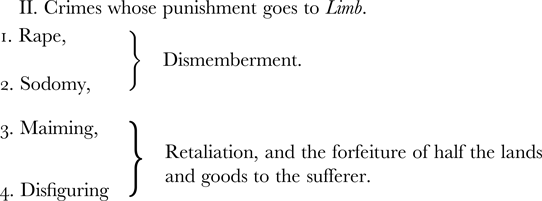
There is an element of obfuscation in placing castration behind the broader category of ‘dismemberment’. Moreover, these laws had not passed when Jefferson published the book. The summary echoes Jefferson's two ostentatiously careful manuscripts of Bill 64, the notes arranged in columns to mirror legal heroes like Coke.Footnote 142 These carefully elucidate the precedents upon which Jefferson was relying to put forward a code he desired to be marked by ‘accuracy, brevity and simplicity’.Footnote 143 Where Dumas Malone had seen the extensive notes as evidence of Jefferson's interest in the topic, Julian Boyd saw the annotations as Jefferson's ‘pedantic ostentation’, and Dubber an excuse to ‘practice his penmanship’.Footnote 144
Considering the annotations and research alongside the problematic history of the Coventry Act in practice, however, illuminates why the keen lawyer struggled to find an adequate means of revising the provisions against disfigurement – one that even he grew to dislike. When Beccaria's appeal against capital punishment gained traction among reformers, those still in favour of the punishment were compelled to defend it with unprecedented vigour: Vic Gatrell notes that ‘elaborate pleading’ was newly necessary, ‘because older certainties had become uneasy’.Footnote 145 Jefferson's exhausting annotations of the corporal punishments hint at similar strain to justify punishments that might seem ‘revolting’. Virginia's simplifying of the Coventry Act's requirements of intention and circumstance, for all they fluctuated in different revisions, represented attempts to combat the real problems that the Act had faced in practice in Britain, and criticisms of its application. Replacing the death penalty for this and the other offences with proportional punishments was supposed to increase efficacy, justice and rationality in post-revolutionary Virginian law. I am inclined to agree with Peterson that Jefferson was in a sense ‘trapped by a misplaced desire for simplicity’, in striving for a code so straightforward, proportional and logical that mercy could never be at ‘the eccentric impulses of whimsical capricious designing men’.Footnote 146 Neither an out-of-the blue aberration, nor an overlooked hangover from earlier law, Jefferson's lex talionis approach to facial disfigurement as both a crime and a punishment drew on precedents from medieval England and closer to home, and reflected the anxious balance of punishment of body and mind at work in eighteenth-century legal reforms.

 Open access

