

Introduction
In 2023, the local elections for municipal and county councils were the major political event in Norway. The year also proved to be another challenging one for the government, marked by several scandals involving conflict-of-interest violations. Former Prime Minister and Conservative Party leader, Erna Solberg, was also caught up in a scandal when it was revealed by the media that her husband had engaged in extensive stock market trading during her tenure as Prime Minister.
Election report
The main political event in Norway in 2023 was the local elections on 11 September. Municipal and county councils have fixed four-year terms. The previous election in 2019 was a big win for the centre-left of Norwegian politics, but that result was reversed in 2023. The two parties on the right, the Conservative Party (Høyre) and the Progress Party (Fremskrittspartiet) were the main winners, in addition to a newcomer: The Industry and Business Party (Industri-og Næringspartiet), which gained 3 per cent of the vote in its first contested local election. The party benefitted from criticism of the government's handling of rising energy costs in Norway. The losers in the election were the two centre-left parties that are in government at the national level: The Labour Party and The Centre Party. Majorities in local councils switched from the centre-left to the centre-right in a number of municipalities, including the four largest cities in Norway: Oslo, Bergen, Trondheim and Stavanger.
A substantial share of media coverage in the election campaign, and the immediate aftermath of the election, focused on a series of political scandals (see ‘Issues in National Politics’). The governing Labour and Centre Party coalition was particularly affected prior to the election by scandals involving government ministers. The Conservative Party received its share of negative media coverage after the election when it was revealed that the husband of the party's leader, Erna Solberg, had engaged in stock trading during her time as Prime Minister, which raised questions about conflicts of interest.
Health care, energy costs, taxes and other ‘cost-of-living issues’ were often raised in policy debates during the election campaign.
Cabinet report
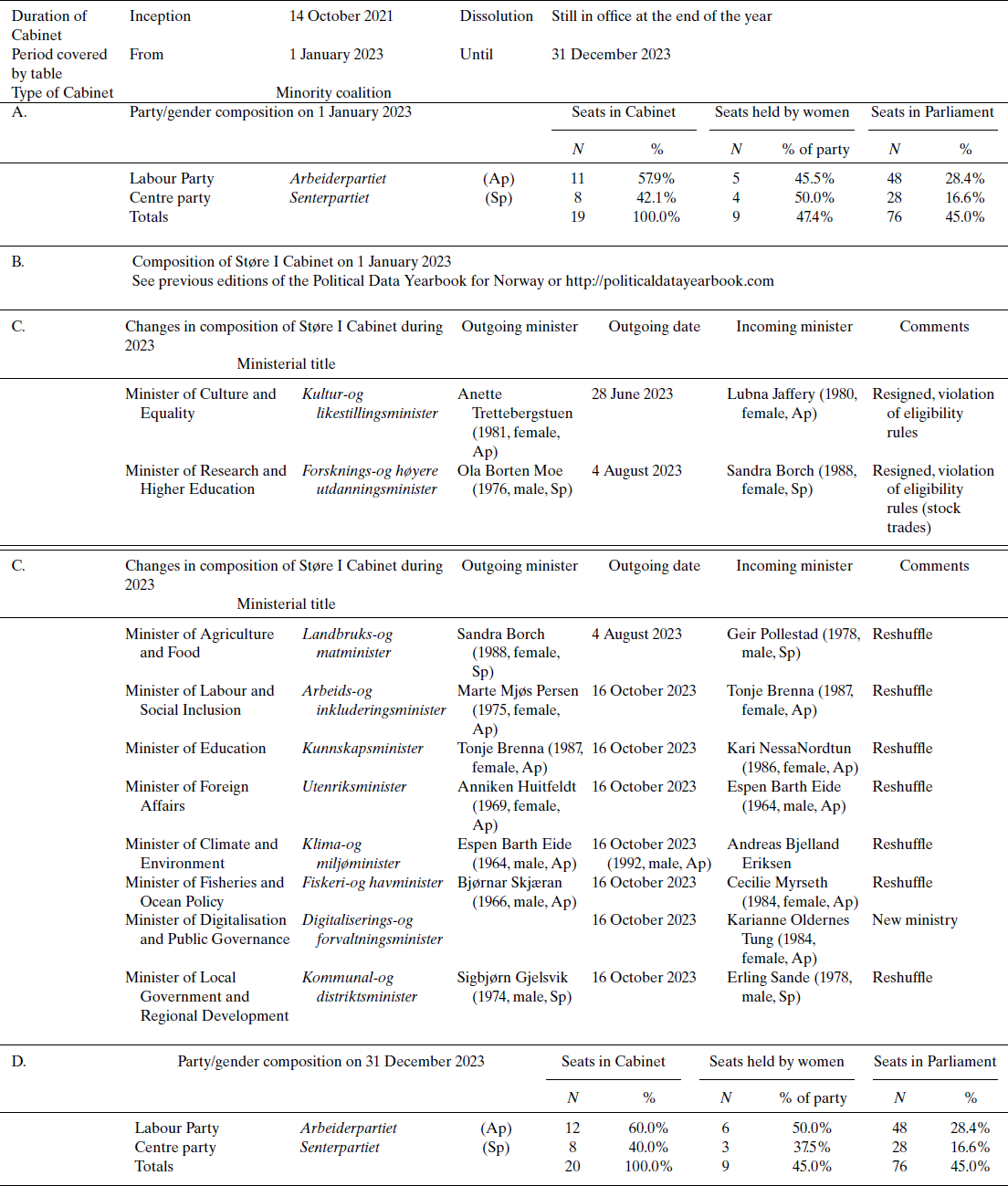
In January 2023, Norway's Cabinet consisted of a coalition of the Labour Party (11 seats) and the Centre Party (eight seats), headed by Prime Minister Jonas Gahr Støre from the Labour Party. Of the total 19 ministers (including the Prime Minister) in the Cabinet, nine were women—47 per cent of Cabinet ministers.
In October 2023, a Minister of Digitalisation and Public Governance was added to the Cabinet, increasing the number of seats to 20. The new minister was Karianne Oldernes Tung of the Labour Party. Labour now held 10 seats and the Centre Party eight seats. The gender composition was 50/50 (see Table 1).
Cabinet composition of Støre I in Norway in 2023

Source: regjeringen.no (Norwegian government's website), 2023.
Due to scandals related to conflicts of interest, Minister of Culture and Equality Anette Trettebergstuen (Labour Party) resigned and was replaced by Lubna Jaffery (Labour Party) in June. In August, Minister of Research and Higher Education Ola Borten Moe (Centre Party) resigned following another scandal involving conflicts of interest and was replaced by Sandra Borch (Centre Party). Geir Pollestad (Centre Party) was instated in Borch's old position as Minister of Agriculture and Food.
After the losses in the local elections for the two governing parties, and partially as a result of a series of political scandals (see ‘Issues in national politics’ below), there was a major reshuffle of the government. Such changes are not uncommon after the local elections, which are held at the midway point of the national parliamentary term. In this reshuffle, Minister of Labour and Social Inclusion Marte Mjøs Persen (Labour Party) was replaced by Tonje Brenna (Labour Party), who was then replaced by Kari Nessa Nordtun (Labour Party) as Minister of Education. Minister of Foreign Affairs Anniken Huitfeldt (Labour Party) was replaced by Espen Barth Eide (Labour Party), who was replaced by Andreas Bjelland Eriksen (Labour Party) as Minister of Climate and Environment. Minister of Fisheries and Ocean Policy Bjørnar Skjæran (Labour Party) was replaced by Cecilie Myrseth (Labour Party). Minister of Local Government and Regional Development Sigbjørn Gjelsvik (Centre Party) was replaced by Erling Sande (Centre Party).
Parliament report
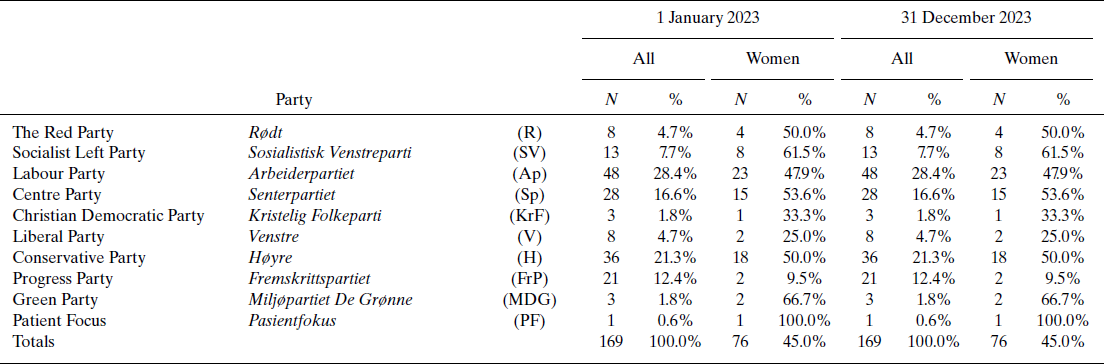
There were no changes in the composition of the Parliament in 2023 (Table 2)
Party and gender composition of the Parliament (Stortinget) in Norway in 2023

Source: www.stortinget.no (Norwegian Parliament's website), 2021.
Political party report
Audun Lysbakken stepped down as party leader for the Socialist Left Party after 11 years at the party convention in March. He was replaced as leader by Kirsti Bergstø, who was unopposed at the party convention after the other main plausible candidate for the leadership position, Kari Elisabeth Kaski, announced earlier that she would not be seeking the position.
Bjørnar Moxnes resigned after 11 years as leader of the Red Party. His resignation followed a somewhat bizarre case where he was caught stealing a pair of Ray-Ban sunglasses at Oslo Airport. Moxnes first framed the theft as a mistake, while released security camera footage suggested otherwise. Moxnes was replaced as party leader by Marie Sneve Martinussen, who had served as deputy leader of the party for Moxnes’ duration as leader (since 2012).
Changes in political parties are shown in Table 3.
Changes in political parties in Norway in 2023

Institutional change report
The were no major institutional changes in 2023.
Issues in national politics
While the main political event in the country in 2023 was the local elections, political life in Norway was also rocked by a series of political scandals. The case involving the Red Party leader, Moxnes, received massive media coverage in the summer (see Political Party Report). Furthermore, two ministers in the centre-left government had made appointments that raised conflict-of-interest concerns. The Minister of Education Tonje Brenna, a rising star in the Labour Party, who was elected deputy leader in May, appointed a friend to the board of a foundation. The Minister of Culture and Equality, Anette Trettebergstuen, made several appointments of people with whom she had a personal relationship. Trettebergstuen had to leave her post as government minister, whereas Brenna was kept on. The difference in outcome between the two cases was widely criticized. Brenna also received criticism from a parliamentary committee that investigated these cases. In the reshuffling of ministers in October (following the poor showing of the governing parties in the local elections), Brenna became Minister of Labour and Social Inclusion—an important position for a Labour Party politician.
In July, a news story broke that the Minister of Research and Higher Education, Ola Borten Moe, of the Centre Party, had purchased stock in a Norwegian arms manufacturing company just before the government handed a contract to a subsidiary of that company. In doing so, he violated conflict of interest regulations. There was later an investigation by the police into possible insider trading, but the investigation was dropped, and charges were never filed. Borten Moe resigned from his Cabinet position and announced that he would not seek re-election to Stortinget (Parliament).
About a month later, the Foreign Minister, Anniken Huitfeldt, announced that her husband had owned stocks that put her in a conflict-of-interest situation because she was part of the Cabinet that made decisions that affected those companies. Huitfeldt was initially kept on as minister but was involuntarily replaced in the reshuffling in October.
The scandal that nevertheless provoked the most attention and debate involved the former Prime Minister and leader of the Conservative Party, Erna Solberg. The initial news story in August said that her husband, Sindre Finnes, had owned and traded stocks during her time as Prime Minister, again raising the possibility of a conflict of interest and possible insider trading. Information about the case was limited in the beginning, until two days after the local elections, when Solberg held a press conference and released information about her husband's stock trades. The volume of trading was shocking to most people: 3600 trades in the 8-year period Solberg was Prime Minister. Solberg said that her husband had done this behind her back.Footnote 1 Again, in this case, the police opened an investigation into possible insider trading and then dropped the case. This affair spurred a lot of media coverage and criticism of Solberg. Some criticized the timing of the release of information, just after the election, and there were widespread calls for her resignation as party leader, and thereby also as a candidate for Prime Minister in the next election. Solberg remained in her position. While the party and her personal standing in public opinion polls declined somewhat,Footnote 2 the effect of the scandal on public opinion seemed moderate.
A case involving the rights of the Sami indigenous population in Norway created difficulties for the government and spurred large protests in 2023. The case was about a wind farm (wind turbines) that had been built in the Fosen area in Trøndelag County, where reindeer herding was carried out—a practice that is recognized as part of Sami culture and heritage. After a lengthy legal process, the Norwegian Supreme Court decided that the wind farm violated the rights of the Sami people. The government's decision, many years earlier, to allow the wind farm was deemed invalid. The reason this came up in 2023 was the symbolic occurrence that 500 days after the Supreme Court's decision, the government had not done anything about the case. Large-scale protests ensued, invoking comparisons to previous contentious fights for Sami rights that have occurred at various points in Norwegian history. The case dragged on for much of the year until a settlement between the reindeer herders and the government was reached in December.
After the Hamas attack on Israel on 7 October, the Norwegian government declared Hamas to be a terrorist organisation, which they had not done previously. Later in October, the government issued a condemnation of the scale of bombing and destruction in Gaza resulting from the Israeli response. The war in Gaza prompted numerous debates and demonstrations in Norway, the vast majority of which were critical of the Israeli government's actions.
Other issues in Norwegian politics included the government's continued support for Ukraine's defence against the Russian invasion. This came up several times through the year when the government announced various measures of financial aid or the delivery of military equipment.
A proposal to discontinue most of the services at two hospitals in Nordland County in the North of Norway led to local protests and conflicts between local politicians and the national government.


 Open access

