


Introduction
Recent decades have seen an increase in comparative effectiveness research, pragmatic clinical trials, and randomized quality improvement trials, which have the potential to improve clinical decisions and patient outcomes [Reference Abbasi, Curtis and Califf1]. However, debates persist surrounding when it is appropriate to forgo prospective informed consent for such trials, and how institutional review boards (IRBs) should apply the regulatory criteria for waivers and alterations of consent.
Under the Common Rule (the U.S. federal policy governing human subjects research), IRBs may allow waivers or alterations of informed consent for clinical trials if 5 criteria are met: “(1) The research involves no more than minimal risk to the subjects; (2) The research could not practicably be carried out without the requested waiver or alteration; (3) If the research involves using identifiable private information or identifiable biospecimens, the research could not practicably be carried out without using such information or biospecimens in an identifiable format; (4) The waiver or alteration will not adversely affect the rights and welfare of the subjects; and (5) Whenever appropriate, the subjects or legally authorized representatives will be provided with additional pertinent information after participation” [2,3]. IRBs may also allow waivers of informed consent for certain studies of public benefit or service programs.
The U.S. Food and Drug Administration (FDA) recently implemented a final rule to harmonize its regulatory criteria for waivers and alterations of informed consent with the Common Rule [2]. Previously, FDA only allowed waivers of consent for emergency research under the Exception from Informed Consent (EFIC) pathway [4]. FDA indicated that it would subsequently issue draft guidance to inform, among other issues, what constitutes “minimal risk” when comparing approved interventions. This guidance would be the first provided by a federal regulator on minimal risk interventional research [4]. However, this guidance has not yet been disseminated.
In the absence of federal guidance, IRBs have expressed uncertainty about making regulatory determinations about when a waiver of informed consent is appropriate [Reference Mehl, Morain and Sugarman5,Reference Casey, Semler and Brown6]. In 2014, the Office for Human Research Protection released a draft guidance on assessing risks in trials comparing standard of care interventions (which has not been finalized) [7]. Some IRBs have taken this draft guidance to mean that randomized studies cannot proceed with waivers of informed consent because randomization inherently poses more than minimal risks to patient-subjects [Reference Casey, Semler and Brown6]. Other IRBs have approved randomized trials of standard of care interventions with waivers of informed consent [Reference Casey, Semler and Brown6, Reference Zhang, Nicholls and Carroll8].
Given the newly harmonized FDA rule and the anticipated FDA guidance, we conducted a systematic review of recent, high-impact clinical trials to better understand the prevalence, characteristics, regulatory pathways, and scale of practice-changing trials that are being conducted in the United States (U.S.) without prospective written informed consent.
Materials and methods
We reviewed abstracts of all original research articles published between May 2023–April 2024 in the two highest-impact U.S. clinical journals, the New England Journal of Medicine and JAMA. Studies meeting the National Institutes of Health definition of “clinical trial”[9] with at least one U.S. site were included. Full-text journal articles and supplementary materials, such as trial protocols, were retrieved to confirm eligibility.
Study title, first author name, journal, and publication date were extracted for each eligible trial.
One author (J.C., M.S., S.D., A.M, E.Q., or K.S.) independently reviewed trial materials for details on consent approach, total participants enrolled, trial region, trial intervention, level of randomization, and funder. A second author (J.C. or M.S.) reviewed and adjudicated difficult cases.
Trials not requiring prospective written informed consent were subject to additional analysis. Two authors (C.P. & S.M.) independently reviewed each trial’s materials to identify: the number of U.S. patient-subjects enrolled, regulatory pathway used, discussion of rationale(s) for waiving prospective written informed consent, and plans for notifying trial patient-subjects. When information was not available, study team members emailed investigators directly. Disagreements were resolved by an additional author (J.C.).
Study data were collected and managed using REDCap electronic data capture tools hosted at Vanderbilt University Medical Center [Reference Harris, Taylor, Thielke, Payne, Gonzalez and Conde10].
Results
A total of 149 trials met inclusion criteria. Of these, 100 were published in the New England Journal of Medicine and 49 in JAMA. 134 trials required prospective written informed consent prior to enrollment, and 15 did not.
Across the 149 trials, 2,985,414 patient-subjects were enrolled at all sites. Of these, 48 trials were conducted only in the U.S., and 101 were conducted both inside and outside the U.S.
A total of 103 trials evaluated the safety or efficacy of a new drug, device, or approach, and 46 trials compared the safety or effectiveness of existing drugs, devices, or approaches.
Trials were randomized at the patient level (n = 135), cluster level (n = 12), or had other randomization schemes (n = 2). Trials were funded by industry (n = 102), federal (n = 49), institutional (n = 6), and other (n = 4) sources.
Trials without prospective written informed consent
Three regulatory pathways were used for trials not requiring prospective written informed consent: 13 were conducted under a waiver of informed consent (45 CFR 46.116(f)); 1 was conducted under the FDA’s EFIC pathway; and 1 was exempt from regulatory review (45 CFR §46.104 (d)(5) – study of public benefit or service program).
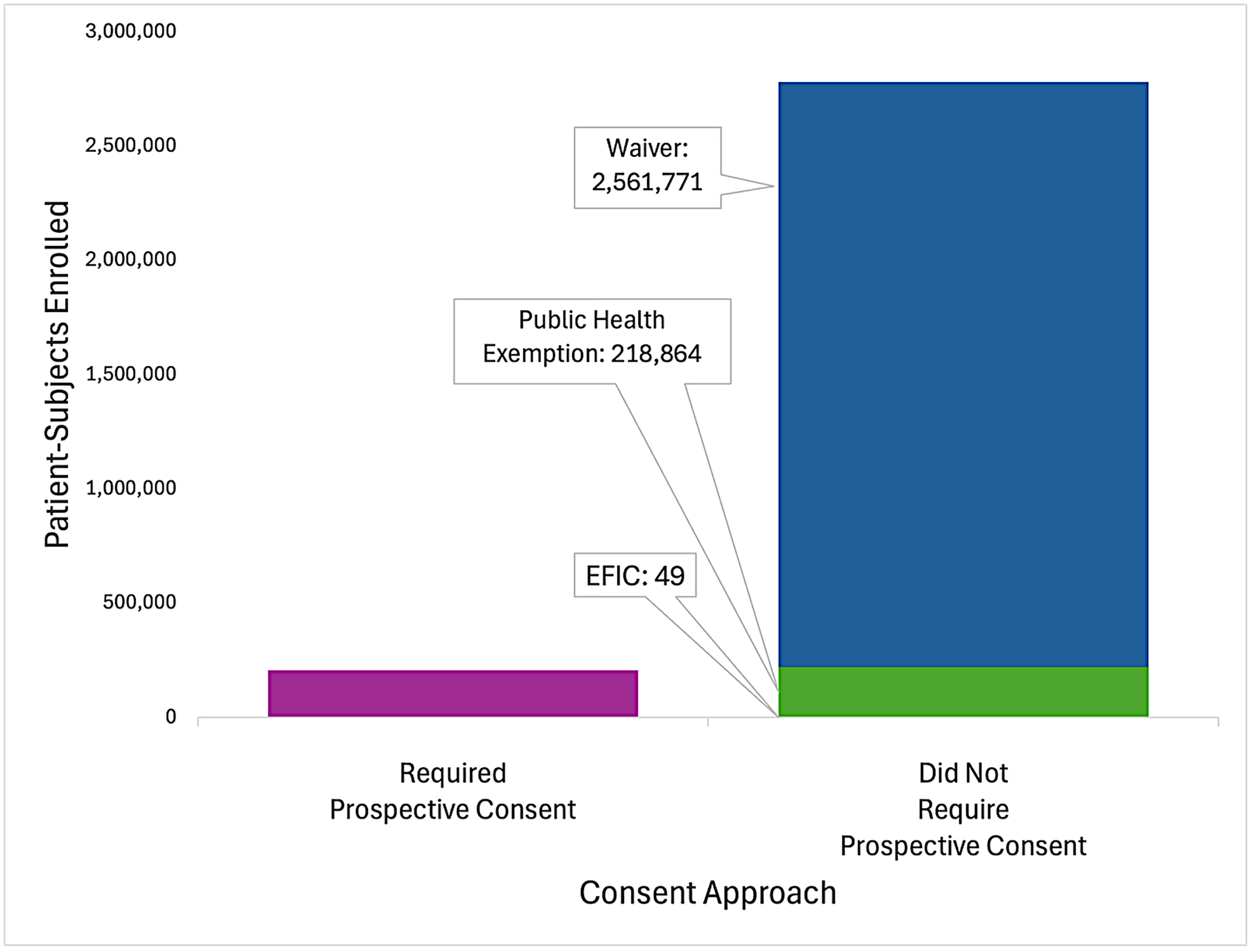
Of the 15 trials not requiring prospective written informed consent, 13 were conducted only in the U.S and 2 had both U.S. and non-U.S. sites. Within the U.S. sites, 2,780,684 patient-subjects were enrolled in trials not requiring prospective written informed consent. This represents 93.1% of total patient-subjects enrolled in the broader sample of all 149 trials (Figure 1).
Of the U.S. patient-subjects who participated in trials not requiring prospective written informed consent, 2,561,771 were enrolled under a waiver of consent (with one trial representing over half of this enrollment), 49 were enrolled under EFIC (in a trial with 1 of 26 sites based in the U.S.), and 218,864 were enrolled under the exemption for studies of public benefit or service programs (Figure 1).
Number of patient-subjects enrolled in U.S. sites for trials that did not require prospective written informed consent compared to number of patient-subjects enrolled in trials that required prospective written informed consent with at least one U.S. site. Number of patient-subjects enrolled in trials that did not require consent are divided by regulatory pathway.

Figure 1. Long description
The bar graph compares the number of patient-subjects enrolled in trials that required prospective written informed consent versus those that did not. The x-axis represents the consent approach, divided into two categories: Required Prospective Consent and Did Not Require Prospective Consent. The y-axis represents the number of patient-subjects enrolled, ranging from 0 to 3,000,000. The graph features two bars: a purple bar for trials that required prospective consent and a blue bar for trials that did not. The purple bar is significantly shorter, indicating fewer patient-subjects enrolled, while the blue bar is much taller, indicating a higher number of patient-subjects enrolled. Annotations within the graph specify the number of patient-subjects enrolled under different consent approaches: Waiver with 2,561,771 patient-subjects, Public Health Exemption with 218,864 patient-subjects, and E F I C with 49 patient-subjects. The graph highlights that a majority of trials did not require prospective consent, resulting in a higher number of enrolled patient-subjects. All values are approximated.
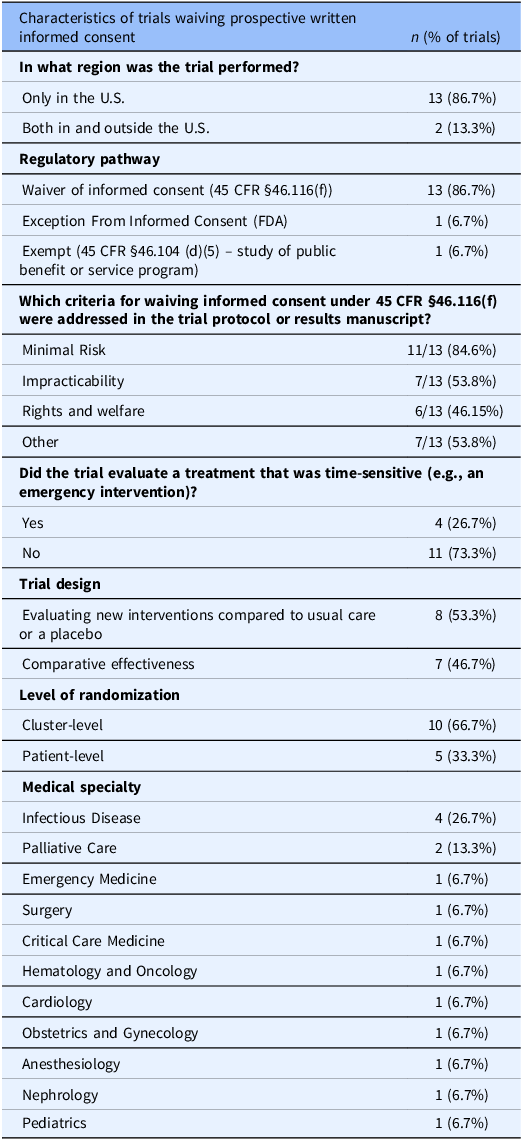
Of trials not requiring prospective written informed consent, 4 involved time-sensitive interventions, whereas 11 did not (Table 1). A total of 8 trials compared the addition of a new intervention or care process to usual care, and 7 trials used a comparative effectiveness design comparing two existing approaches. 10 trials were cluster randomized, and 5 trials were individually randomized.
Characteristics of trials waiving prospective written informed consent

Table 1. Long description
The table presents data on trials that waived prospective written informed consent, detailing various characteristics. It includes information on the regions where trials were performed, with 13 trials conducted only in the U S and 2 both in and outside the U S. The regulatory pathways are categorized into waiver of informed consent, exception from informed consent, and exempt status. Criteria for waiving informed consent under 45 CFR 46.116(f) are listed, with minimal risk being the most common. The table also indicates whether trials evaluated time-sensitive treatments and their design, such as evaluating new interventions or comparative effectiveness. The level of randomization is specified as either cluster-level or patient-level. Medical specialties involved range from infectious disease to pediatrics.
Note: Table 2 describes the characteristics of the 15 trials that did not require prospective informed consent.
The 15 trials not requiring prospective written informed consent corresponded to the following medical specialties: Infectious Disease (n = 4); Palliative Care (n = 2); Emergency Medicine (n = 1); Surgery (n = 1); Critical Care Medicine (n = 1); Hematology and Oncology (n = 1); Cardiology (n = 1); Obstetrics and Gynecology (n = 1); Anesthesiology (n = 1); Nephrology (n = 1); Pediatrics (n = 1).
Rationales for waiving consent
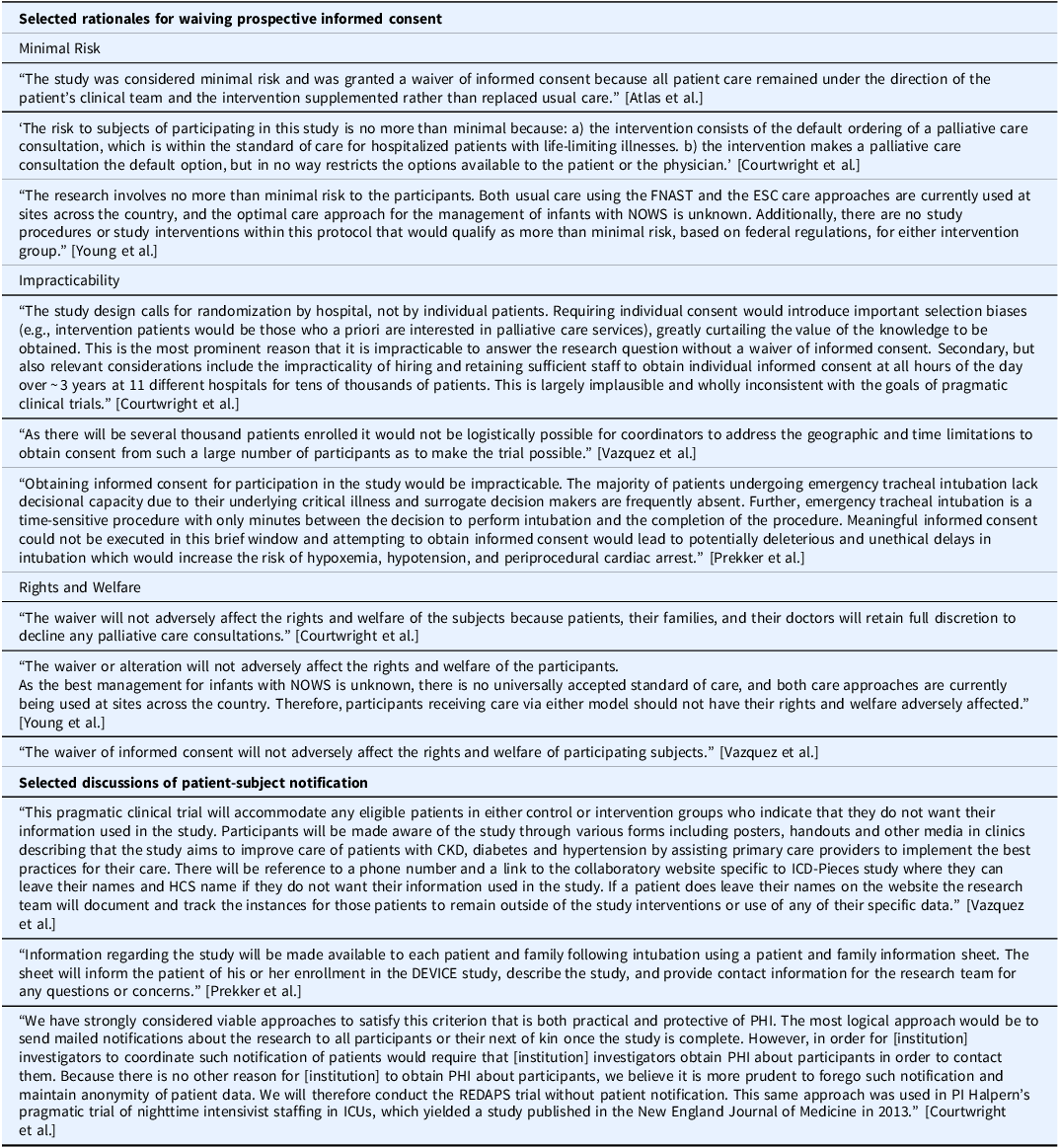
Among the 15 trials not requiring prospective written informed consent, 14 provided discussion of the rationale(s) for not obtaining written consent and 9 discussed patient-subject notification (Table 2). Of the 13 trials obtaining a waiver under 45 CFR §46.116(f), 11 cited minimal risk. Impracticability, rights and welfare of patient-subjects, and other reasons were cited for 7, 6, and 7 trials, respectively. [Full rationales are available in Appendix 1.] One trial’s materials contained no reference to the consent approach.
Selected rationales for waiving prospective informed consent

Table 2. Long description
A table titled ’Characteristics of trials waiving prospective written informed consent’ presents data on 15 trials. The table includes columns for regions where trials were performed, regulatory pathways, criteria for waiving informed consent, time-sensitivity of treatments, trial design, and medical specialties involved. Key data points include that 86.7% of trials were conducted only in the U.S., 84.6% addressed minimal risk criteria, and 66.7% used cluster-level randomization. Medical specialties range from Infectious Disease to Pediatrics.
Discussion
In anticipation of forthcoming FDA guidance on the types of interventional trials that might be considered minimal risk, we conducted a review of interventional trials with U.S. sites published in the top two U.S. medical journals over a one-year period to understand the features and consent approaches of practice-changing interventional trials being conducted in the U.S. We found that one in ten were conducted without requiring prior informed consent – a figure consistent with prior scholarship [Reference Dhamanaskar and Merz11,Reference Zhang, Nicholls and Carroll8]. Importantly, however, while trials without informed consent accounted for only a small proportion of trials overall, they accounted for the overwhelming majority of total patient-subjects in our sample (93.1%), enrolling nearly 3 million individuals.
Trials not requiring prospective written informed consent in our sample more often used cluster randomization (66.7%), which is consistent with prior studies [Reference Dhamanaskar and Merz11,Reference Zhang, Nicholls and Carroll8]. Diverging from prior studies, the majority of trials not requiring prospective written informed consent in our sample did not evaluate time-sensitive interventions (73.3%) [Reference Dhamanaskar and Merz11].
Among trials not requiring prospective written informed consent, three different regulatory pathways were used. Of these, waivers of consent were the most used and accounted for the overwhelming proportion of patient-subjects enrolled. Only 1 trial used the EFIC pathway, enrolling 49 U.S. patient-subjects.
Our findings suggest that trials conducted without prior informed consent are fielded across a variety of clinical specialties and have been embraced by the medical community. While these trials feature similar designs, they are approved and overseen using a variety of regulatory pathways.
We found substantial heterogeneity in the extent to which publicly available trial materials included rationales for waiving prospective written informed consent. Some studies provided extensive details relating to each regulatory criterion, while other studies did not address criteria in detail (or at all). In general, minimal risk and impracticability were more commonly addressed relative to other justifications. While not required, investigators can improve research practices by clearly outlining their rationales for obtaining waivers of consent and plans for patient-subject notification in both IRB submissions and public-facing trial manuscripts and protocols. Doing so promotes the value of transparency and may promote the development of better guidance and standards for clinical trial design and conduct.
Our research is limited in that we could not access IRB submissions, which may have provided further information about how investigators characterized their studies as satisfying regulatory requirements for waiving informed consent. Additionally, reviewing trials from the top two U.S. medical journals may offer a view into cutting-edge trial methodology but may not reflect the broader clinical trial enterprise.
Overall, there is an urgent need for further guidance from U.S. regulators for IRBs and investigators in making determinations about when waiving informed consent is appropriate, especially for interventional research, including when that research can appropriately be considered as minimal risk. Almost 3 million Americans were enrolled in interventional randomized trials that did not require prospective written informed consent over a single year; multiple of those trials generated knowledge that changed clinical guidelines and clinical care. For example, results from the DEVICE trial of video vs. direct laryngoscopy informed changes to the UpToDate guidance for airway management for anesthesia in adults and an American College of Emergency Physicians clinical policy [Reference Parotto12–Reference Godwin, Hahn and Friedman14]. To ensure support the conduct of this socially valuable research while ensuring rigorous oversight and protections, the FDA and OHRP should further clarify expectations regarding interventional randomized trials conducted without prospective written informed consent.
Supplementary material
The supplementary material for this article can be found at https://doi.org/10.1017/cts.2026.10751.
Author contributions
Caleigh Propes: Conceptualization, Data curation, Formal analysis, Investigation, Methodology, Visualization, Writing – original draft, Writing – review & editing; Jonathan D. Casey: Conceptualization, Data curation, Formal analysis, Investigation, Methodology, Project administration, Resources, Software, Supervision, Writing – review & editing; Matthew W. Semler: Conceptualization, Data curation, Formal analysis, Investigation, Methodology, Project administration, Resources, Software, Supervision, Writing – review & editing; Stephanie C. DeMasi: Data curation, Formal analysis, Investigation, Writing – review & editing; Amelia L. Muhs: Data curation, Formal analysis, Investigation, Writing – review & editing; Edward T. Qian: Data curation, Formal analysis, Investigation, Writing – review & editing; Kevin Seitz: Data curation, Formal analysis, Investigation, Writing – review & editing; Stephanie Morain: Conceptualization, Data curation, Formal analysis, Funding acquisition, Investigation, Methodology, Project administration, Resources, Supervision, Writing – review & editing.
Funding statement
This work was supported by a grant from The Greenwall Foundation.
Competing interests
There are no conflicts to report.


 Open access

