





Introduction
The V-Dem Democracy Report 2023 shows a bleak picture for democratization, identifying 42 autocratizing countries in 2022 (compared to 13 in 2002) (Papada, Altman, Angiolillo et al. Reference Papada, Altman, Angiolillo, Gastaldi, Köhler, Lundstedt, Natsika, Nord, Sato, Wiebrecht and Lindberg2023). Democratic backsliding in established democracies had not traditionally been a heavily studied topic, but more recently, it has begun to draw scholarly attention. For example, one prominent response to the 2016 US presidential election was Levitsky and Ziblatt’s (Reference Levitsky and Ziblatt2018) How Democracies Die. The authors identify two norms that ‘… stand out as fundamental to a functioning democracy: mutual toleration and institutional forbearance’ (Levitsky and Ziblatt Reference Levitsky and Ziblatt2018: 102).Footnote 1 The focus of this research note lies on the former of these norms. I argue that mutual toleration might be linked to specific institutional rules, which, in turn, might affect democratic decline.
The question is through which institutions mutual toleration most likely manifests itself. I argue that one possible answer lies within the legislature and the power granted to the opposition. Even though several contributions have highlighted the importance of the legislature for successful democratization (Barkan Reference Barkan2009b; Fish Reference Fish2006), it has not been among the institutions traditionally focused on in the literature on democratic stability. Furthermore, several scholars emphasize the importance of loser consent for democratic stability (Anderson et al. Reference Anderson, Blais, Bowler, Donovan and Listhaug2005; Przeworski Reference Przeworski1991). Accordingly, democratic consolidation is inherently about attitudes. It seems surprising that research on the institutional determinants of democratic stability has not focused on the role of the institution that represents citizens and especially the losers of democratic elections: the legislature in general and the power granted to oppositions in particular (Wegmann Reference Wegmann2023).
However, it is important to note that the institutionalization of opposition power does not necessarily have to be based on idealistic norms of mutual toleration; it can have other origins. A vast literature on legislative organization presents different explanations for specific rules based on rational, non-idealistic choices. For example, scholars have highlighted distributive goals of MPs (Shepsle and Weingast Reference Shepsle and Weingast1981, Reference Shepsle and Weingast1987), partisan goals of majority parties (Cox and McCubbins Reference Cox and McCubbins2005), the need for policy expertise (Krehbiel Reference Krehbiel1991), or the ideological balance of power in legislative chambers (Schickler Reference Schickler2010) as influencing legislative organization. Furthermore, the power of the opposition is also dependent on the majority status of the government. In minority government settings, opposition parties might have more power to influence policies despite potentially weak institutionalized power.Footnote 2 But, even opposition power based on non-idealistic origins could foster mutual toleration and affect democratic decline.
To test whether strong opposition power is related to democratic decline, I present both descriptive and regression analyses and thereby offer several contributions to the existing literature. First, this research note adds to the literature on institutional determinants of democratic stability by focusing on a somewhat neglected institution and actor, respectively: the legislature and the opposition. Second, the results point to the importance of opposition power for the stability of democratic regimes, giving credence to a growing literature on the importance of the opposition. Finally, by showing that institutionalization of legislative opposition power has effects on the political system as a whole, this research note adds to the growing literature connecting legislative studies to extra-legislative consequences. Overall, these results show that the role of the legislature, and opposition power more specifically, should play a more prominent role in research on democratic stability.
Why opposition matters
Recently, legislative scholars have started to pay more attention to the role of oppositions in the democratic process (for an overview, see e.g., Helms Reference Helms2022). These contributions mainly touch on three different areas. First, scholars have analyzed institutional structures and presented different attempts to categorize oppositions and different measures of the power granted to them. Among the earliest contributions is Dahl (Reference Dahl1966b), who distinguishes oppositions along six different features: organizational cohesion, competitiveness, identifiability, goals, strategies, and the site of encounter between the government and the opposition (Dahl Reference Dahl and Dahl1966a).Footnote 3 Among the first contributions, measuring the power of oppositions in the legislature was Strøm’s (Reference Strøm1990) measure of committee strength. Strøm (Reference Strøm1990) argues that parliamentary procedures and structures lead to a policy influence differential between the government and the opposition, where a lower policy influence differential indicates more power of the opposition compared to the government. While not explicitly focusing on oppositions, Döring’s (Reference Döring1995) volume presents a comprehensive account of parliamentary organization in Western Europe. More recent contributions have focused on the specific rights granted to opposition actors in the legislative arena. For example, Garritzmann (Reference Garritzmann2017) proposes measuring opposition power along the two dimensions of control and presentation of alternatives, and presented data for 21 parliamentary democracies. Wegmann (Reference Wegmann2022) measures opposition power along three stages of the policy-making process (initiation, debate, and veto) and presents data for 54 countries.
Second, legislative scholars have focused on the legislative behavior of opposition parties. For example, scholars have analyzed legislative voting with a focus on the level of conflict between opposition and government parties (De Giorgi and Ilonszki Reference De Giorgi and Ilonszki2018; Hix and Noury Reference Hix and Noury2016; Louwerse et al. Reference Louwerse, Otjes, Willumsen and Öhberg2017; Tuttnauer Reference Tuttnauer2018). Moving beyond legislative conflict manifested in voting behavior, research has also focused on the role of parliamentary obstruction and its consequences (Binder Reference Binder1999; Koß Reference Koß2015). Furthermore, a vast literature exists on the scrutiny role of opposition parties, including parliamentary questions as a tool to either control the government or perform constituency service (De Giorgi and Ilonszki Reference De Giorgi and Ilonszki2018; Holzhacker Reference Holzhacker2005; Martin Reference Martin2011). Other scholars have focused more generally on the potential of opposition parties to influence government behavior and policy-making (Green-Pedersen and Mortensen Reference Green-Pedersen and Mortensen2010; Seeberg Reference Seeberg2013).
Finally, legislative scholars have begun analyzing extra-legislative consequences of particular parliamentary procedures and opposition behavior (Fortunato Reference Fortunato2021). For example, scholars have analyzed the relationship between investiture rules or committee strength and (minority) government formation (Cheibub, Martin and Rasch Reference Cheibub, Martin and Erik Rasch2021; Rasch, Martin and Cheibub Reference Rasch, Martin and Anotnio Cheibub2015; Strøm Reference Strøm1990). Several contributions have also focused on electoral consequences of legislative behavior (Bouteca, Smulders, Maddens et al. Reference Bouteca, Smulders, Maddens, Devos and Wauters2019; Bowler Reference Bowler2010; Marcinkiewicz and Stegmaier Reference Marcinkiewicz and Stegmaier2019; Williams and Indridason Reference Williams and Indridason2018).
As this literature shows, legislative scholars have started to increasingly pay attention to the role and behavior of opposition parties as well as their consequences for the functioning of parliament. However, the extra-legislative consequences of opposition behavior for democratic regimes, more generally, have not figured prominently in legislative studies. Similarly, the research on democratization and democratic stability has paid comparatively little attention to the role of the legislature and the opposition. Traditionally, research on democratic consolidation has largely focused on broad institutional categorizations such as the difference between parliamentary and presidential regimes, majoritarian and consensus democracies, different electoral systems, or federal structures (Wegmann Reference Wegmann2023: 31). This focus on the government and broad institutional categorizations is surprising as the legislature has repeatedly been identified as an important institution for democratic consolidation (Barkan Reference Barkan and Barkan2009a, Reference Barkan2009b; Fish Reference Fish2006; Tusalem Reference Tusalem2023).
More recently, however, the literature on democratic resistance to autocratization has more prominently focused on the role of the legislature and the opposition. For example, Gamboa (Reference Gamboa2022: 6) shows that oppositions that resort to moderate institutional strategies (compared to more radical or extra-institutional strategies) are more likely to prevent democratic erosion. Furthermore, a growing literature has focused on the most prominent cases of recent autocratization, such as Bolivia, Colombia, Ecuador, Thailand, Venezuela, Turkey, and Poland (Cleary and Öztürk Reference Cleary and Öztürk2022; Gamboa Reference Gamboa2022, Reference Gamboa2023; Moroska-Bonkiewicz and Domagała Reference Moroska-Bonkiewicz and Domagała2023; Selçuk and Hekimci Reference Selçuk and Hekimci2020). These contributions largely focus on the opposition and highlight its crucial role in countering authoritarian developments. However, they focus on the role and behavior of the opposition once autocratization is already underway and do not focus on the role of the legislature and the opposition for democratic decline in the first place.
Research on democratic consolidation has repeatedly pointed to the importance of political support (Claassen Reference Claassen2019; Diamond Reference Diamond1999; Eckstein Reference Eckstein1966; Lipset Reference Lipset1959; Welzel and Inglehart Reference Welzel, Inglehart, Inglehart, Welzel, Haerpfer, Bernhagen and Welzel2009). In this regard, research has especially emphasized the role of electoral losers (i.e., the opposition). For example, Przeworski (Reference Przeworski1991: 15) has highlighted that the central question regarding democratic consolidation is why losers ‘(…) comply with the outcomes [of elections] and continue to participate rather than subvert democratic institutions’. Even though a large research tradition has examined the consequences of institutional design for political support (Anderson, Blais, Bowler et al. Reference Anderson, Blais, Bowler, Donovan and Listhaug2005; Bernauer and Vatter Reference Bernauer and Vatter2012; Leemann and Stadelmann-Steffen Reference Leemann and Stadelmann-Steffen2022), the legislature as the central institution representing losers does not figure prominently in these contributions.
However, if ‘democracy is a system in which parties lose elections’ (Przeworski Reference Przeworski1991: 10), the opposition is an inherent part of every democratic regime. And if some degree of political support for democracy ‘as the only game in town’ (Linz Reference Linz1990a: 5; Linz and Stepan Reference Linz and Stepan1996) is vital for democratic regimes to survive, this support is not only vital at the citizen level but equally so at the elite level. Therefore, I argue that mutual toleration (Levitsky and Ziblatt Reference Levitsky and Ziblatt2018) is crucial in the legislature, where government and opposition (i.e., winners and losers of democratic elections) directly face each other. Institutionalizing mutual toleration through the power granted to the opposition could contribute to more democratic stability by providing countries with more inclusive procedures to resolve conflicts or situations of stress.Footnote 4
This line of argumentation comes close to the scholarly work that emphasizes that consensus democracies include a wider variety of interests in decision-making. Lijphart (Reference Lijphart1999: 275), for example, has emphasized that ‘(…) consensus democracy is better at representing – in particular, representing minority groups and minority interests, representing everyone more accurately, and representing people and their interests more inclusively’. But these classifications focus on how governments are formed and neglect the role of the opposition and the legislature. Extending the above rationale to the polity more generally, a positive effect could be expected for polities that grant strong power to oppositions in the legislature. Not only the norm of mutual toleration, but also its institutionalization through power granted to the opposition in the legislative arena could play a crucial role in democratic stability. Hence, I expect countries that grant strong opposition power in parliament to be less likely to experience democratic decline.
However, the question of sequence is of importance here, as different causal links might exist apart from the one presented before. First, once in power, autocratic leaders might deliberately weaken opposition power in the legislative chamber. As a consequence, one would observe a rule change in parliamentary procedures to weaken opposition rights after a democratic decline. At the same time, we would observe countries with strong opposition power experiencing a democratic decline. Second, governing parties might change parliamentary rules to constrain opposition power before we observe a decline in democratic institutions. In these cases, we would observe democratic decline in countries with weak opposition power.
Data and case selection
To measure the institutionalization of opposition power, I rely on the policy-making power of opposition players (PPOP) index. PPOP measures opposition power based on official parliamentary standing orders and national constitutions, including the following seven variables: bill introduction, agenda setting, amendments, committee structures, committee procedures, executive power, and referendums. The final measure of PPOP ranges from 0 to 1, with higher scores indicating ‘… a reduction in the policy influence differential and thereby more power of opposition players as compared with the government’ (Wegmann Reference Wegmann2022: 4).Footnote 5
To measure democratic decline, I rely on V-Dem’s four-point electoral democracy index (EDI). Accordingly, country-years are classified as ‘autocratic’, ‘electoral authoritarian’, ‘minimally democratic’, and ‘democratic’ (Coppedge et al. Reference Coppedge, Gerring, Lindberg, Teorell, Skaaning, Altman, Bernhard, Steven Fish, Glynn, Hicken, Knutsen, Paxton, McMann, Pemstein, Staton, Andersson, Zimmerman, Mechkova and Miri2017: 341). A decline is coded as 1 for years that show a lower score at time t compared to time t−1, and 0 otherwise. This measure captures the notion of substantive and significant change in the level of democracy. As I am not investigating specifically whether weaker opposition power leads to greater democratic decline, but am interested in whether countries with weak opposition power are generally more likely to experience decline, a binary variable seems to more properly capture the theoretical argument.Footnote 6 However, I use two alternative measures as further robustness checks. First, I measure democratic decline based on the continuous V-Dem electoral democracy index (EDI) ranging from 0 to 1 following Lührmann et al. (Reference Lührmann, Grahn, Morgan, Pillai and Lindberg2019).Footnote 7 Second, I use Polity IV (Marshall et al. Reference Marshall, Jaggers and Robert Gurr2018) and code as a decline country-years that show a lower score at time t compared to time t−1, and 0 otherwise.
For the regression analyses, I consider several control variables. Among the most prominent hypotheses in the literature on democratic stability is that presidential regimes tend to be less stable than parliamentary ones (Linz Reference Linz1990b). Similarly, a vast literature exists on the influence of electoral systems on regime stability. Several authors mention the risk presented by majoritarian systems for the stability of especially heterogeneous countries, and point to the positive influence of a proportional electoral formula and decentralization combining bicameralism and federalism (Diamond Reference Diamond1999; Lijphart Reference Lijphart2008). Finally, a long research tradition points to the correlation between economic performance and the overall stability of a democratic regime (Bernhard, Reenock and Nordstrom Reference Bernhard, Reenock and Nordstrom2003; Bernhard et al. Reference Bernhard, Nordstrom and Reenock2001). Therefore, GDP/capita is added to the analyses as a control variable. Finally, I add democratic experience, which is the number of consecutive years coded as ‘minimally democratic’ or ‘democratic’ by the four-point electoral democracy index (Coppedge et al. Reference Coppedge, Gerring, Altman, Bernhard, Fish, Hicken, Kroenig, Lindberg, McMann, Paxton, Semetko, Skaaning, Staton and Teorell2011), and time since standing orders, which is the number of years since the standing orders used to measure the PPOP came into force.
To analyze the probability of a democratic regime remaining stable, I apply transition models based on Epstein et al. (Reference Epstein, Bates, Goldstone, Kristensen and O’Halloran2006). Such models estimate the probability of a change in the dependent variable from time t−1 to time t. Thereby, conditions present in one period (i.e., whether a country is a democracy or not) affect the probabilities of transition in the subsequent period (i.e., remaining stable or showing a democratic decline). To analyze the effect of institutionalized opposition power on democratic stability at time t, dependent on whether the country was democratic at time t−1, the models include interactions of opposition power and the lagged dependent variable (democratic decline). Following the expectations, results should show a negative effect for opposition power in countries that were already democratic at time t−1 to decline at time t.
As PPOP is coded based on official standing orders and constitutions in 2015 (Wegmann Reference Wegmann2022: 13), the results in the following section are limited to covering the range of available information on the institutionalization of opposition power (PPOP). This strategy ensures that the rules coded to determine the degree of opposition power came into force before the potential democratic decline is observed. Research shows that relying on the assumption of institutional stability is a risky strategy bound to bias results (Sieberer et al. Reference Sieberer, Meißner, Keh and Müller2016). However, the sequence question might be important here and necessitate further research. Governing parties might change parliamentary rules to constrain opposition power before we observe a decline in democratic institutions. Unfortunately, a time-variant measure of PPOP is not available, and only considering the country-years after the coming into force of the standing orders used for coding seems appropriate in this case.
A closer look at the sample still shows considerable variance in the countries included. In total, 47 countries are included in the sample. The countries cover all world regions and are diverse in their institutional settings. The sample includes presidential and parliamentary regimes, countries using different electoral systems, and both centralized and federal countries. Furthermore, countries range in their democratic experience, including very young democracies with only a couple of years of democratic experience and established ones with more than 100 years of democratic history. Due to the selection criteria discussed above, the sample shows considerable variance in the years covered. For some countries (e.g., Denmark or Kenya), few observations are available, whereas for other countries (e.g., Brazil, Guatemala, or Turkey), a longer period of more than 20 years can be covered. A list of all countries included in the sample is available in Table A.2 in the online Appendix.
The stabilizing effect of institutionalized opposition power
Assessing the influence of the policy-making power of opposition players on democratic decline necessarily raises the question of endogeneity. Strong opposition power could be a mere effect of stable democracies, developing only over time. If this is the case, one should observe weak opposition power among younger democracies and stronger power among older ones. But if the causal direction does not necessarily lead from the stability of democracy to the level of power granted to opposition players, results should also show stable democracies with weak opposition power and relatively young ones with strong opposition power.
Figure 1 shows the correlation between democratic experience in years and the level of policy-making power of opposition players (PPOP). Each country-year is shown as one observation in light gray. Darker points therefore represent more observations of the same level of policy-making power of opposition players for a given year of democratic experience. Results show that the strong policy-making power of opposition players is not a mere consequence of the democratic experience. A considerable share of observations of the strong policy-making power of opposition players occurs in countries with fewer than 40 years of democratic experience. At the same time, not all countries with considerable democratic histories (more than 80 years of democratic experience) grant strong power to opposition players. The question, then, is how do opposition power and democratic decline relate?
Policy-making power of opposition players and democratic experience.

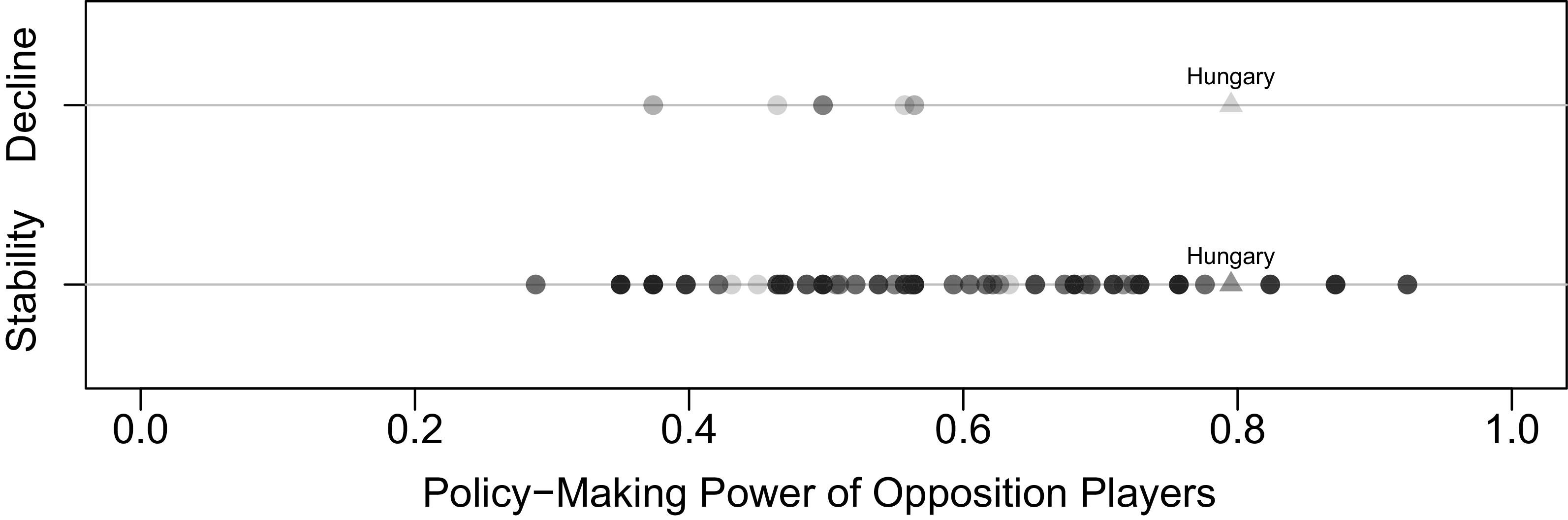
Figure 2 shows the distribution and density of country-years of democratic stability and decline for different levels of institutionalized opposition power.Footnote 8 As the unit of analysis again is a country-year, each observation is shown as a dot in light gray. Hence, darker areas represent more observations for a given level of policy-making power of opposition players, whereas lighter areas indicate fewer observations. Results show a wide range of policy-making power of opposition players in democratically stable countries (lower line in Figure 2). Countries with scores of policy-making power of opposition players around 0.4 show stable country-years, as do countries with scores above 0.9. This indicates that the strong policy-making power of opposition players is not a necessary condition for democratic stability. However, as Figure 2 also shows, only one country (Hungary) with a score of policy-making power of opposition players above 0.6 shows country-years in democratic decline (upper line in Figure 2). These descriptive results might be an initial hint toward a link between institutionalized opposition power and democratic stability. However, the weak policy-making power of opposition players is not a necessary condition for democratic decline (as Hungary falsifies such a hypothesis).
Policy-making power of opposition players and democratic decline.

One possible explanation for the pattern observed in Hungary might be a specific combination of parliamentary procedures and government majority that is not captured in the data measuring opposition power. In other words, despite formally granting strong power to the opposition as measured with PPOP, other rules might dull this power. For example, Hungary has a rather strong committee system that grants considerable power to the opposition. However, the FIDESZ-KDNP government introduced two important changes to the legislative process after 2010. First, an additional committee (the Committee on Legislation) with a clear government majority was created. The Committee on Legislation issues recommendations on all proposed bills and their amendments. Second, before a final vote in the plenary, the designated committee sends its recommendations to the Committee on Legislation. The Committee on Legislation then sends its own amended version to the floor (Nikolenyi and Friedberg Reference Nikolenyi and Friedberg2019: 364). It follows that, although formally there may be significant opposition power, the power of the newly established Committee on Legislation, combined with the comfortable majority of the government party in the legislature, seriously limits the opposition’s ability to have a say.
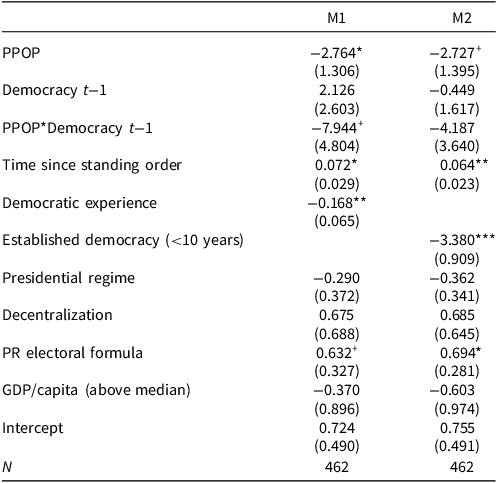
To illustrate the relationship between opposition power and democratic decline in more detail, Table 1 shows the results of logistic regressions with a dependent variable of democratic decline based on the ordinal V-Dem electoral democracy index. Model 1 shows results including democratic experience in years as the control variable, whereas Model 2 includes a dummy variable scoring 1 for established democracies with more than ten years of democratic experience. Hungary is not included in these models as it seems to be an outlier.Footnote 9 Table A.3 in the online Appendix shows the same models including Hungary. In addition, Table A.3 shows two models with the measure of decline based on Lührmann et al. (Reference Lührmann, Grahn, Morgan, Pillai and Lindberg2019: note 9) with and without Hungary, respectively. As a further robustness check, additional models were run dropping one country at a time (not yielding any significantly different results than the ones in Table 1). Finally, a closer investigation of changes in levels of opposition power in the countries experiencing democratic decline was conducted to identify possible cases that do not fit the theoretical account presented above. None of the countries shows a change in the power granted to opposition actors preceding or following a democratic decline. Again, the one exception is Hungary, which shows a democratic decline in 2014 and also reduced the number of standing committees from 20 to 14 in the same year. However, this change would not affect the measure of opposition power used here, as only fewer than 10 standing committees are considered weak opposition power (Wegmann Reference Wegmann2022: 9).
Democratic decline

Clustered standard errors in parentheses.
***p < 0.001, **p < 0.01, *p < 0.5, +p < 0.1.
Logit regression, dependent variable: Democratic decline.
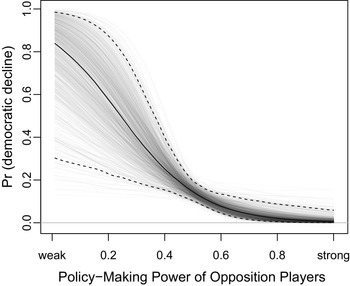
Results in Table 1 show coefficients in the expected direction. Strong policy-making power of opposition players (PPOP) shows a negative coefficient, indicating that countries with strong institutionalization of opposition power are less likely to show democratic decline.Footnote 10 To illustrate these results, Figure 3 shows predicted probabilities of democratic decline based on the results of Model 2 in Table 1. The figure shows probabilities dependent on the level of policy-making power of opposition players with control variables held constant at their mean, median, or mode.Footnote 11 I follow King et al. (Reference King, Tomz and Wittenberg2010) and use a simulation-based approach to illustrate these results. Hence, the density of lines in Figure 3 represents the uncertainty associated with the estimated probabilities. In addition, 95 percent confidence intervals are shown in dashed lines. Figure A.2 in the Appendix shows results based on Model 1 in Table 1.
Predicted probabilities of democratic decline.

Results show a high level of uncertainty for relatively weak opposition power (below a score of 0.4). This result is in line with the descriptive evidence presented in Figure 2 above: Strong opposition power is not a necessary condition for democratic stability, as many countries with rather weak policy-making power of opposition players are democratically stable over time. However, Figure 3 shows a significant decrease in the probability of democratic decline for countries that grant stronger power to opposition players, reaching a predicted probability of democratic decline below 2.0 percent at a PPOP score of 0.8. More specifically, a country with a PPOP score of 0.2 (the lowest score in the present sample is 0.18) has a 58.2 percent probability of showing democratic decline, all else equal. For a country with a PPOP score of 0.9 (the highest PPOP score in the sample is 0.92), this probability decreases to 1.0 percent, all else equal. Despite the high uncertainty for countries with rather weak opposition power, this change in predicted probabilities is statistically significant. Compared to a country with weak PPOP (score of 0.2), Figure 3 shows a significant decrease in the probability of seeing a democratic decline starting from a PPOP score of about 0.49, all else equal.
As these results show, strong opposition power does not seem to be a sufficient condition for democratic stability, nor is weak opposition power necessary for democratic decline. The case of Hungary contradicts both conditions. However, the results in Figure 3 show a statistically significant effect of the strong policy-making power of opposition players on the probability of democratic decline. Hence, these results might be in line with research on constitutional design and its link to democratic breakdown (Dahl Reference Dahl1998: 128). Strong opposition power might not play a crucial role in highly favorable or highly unfavorable settings; however, in countries where conditions are mixed, the institutionalization of opposition power might significantly contribute to reducing the risk of democratic decline. The preliminary results presented here clearly point to the necessity of further analyses in future research.
Conclusion
In this research note, I present a first glimpse at the relationship between strong power granted to the opposition in the legislature and democratic decline. I argue that the legislature, as the one institution where opposition and government actors face each other, is of crucial importance to the stability of democracies. Therefore, granting power to the opposition in the legislature might be one form of institutionalizing mutual toleration, which is a fundamental norm for the functioning of democracy (Levitsky and Ziblatt Reference Levitsky and Ziblatt2018). Based on the results presented here, I advocate for a more detailed focus on the role of the legislature more generally, and power granted to the opposition in particular, for democratic decline and stability.
Although only preliminary, the presented analyses show three important results. In the first step, descriptive evidence shows that the strong policy-making power of opposition players is not a mere consequence of democratic experience. Second, results show that the strong policy-making power of opposition players is not a necessary condition for democratic stability. However, descriptive results also show that all country-years of democratic decline are associated with a policy-making power of opposition players below 0.6, with one important exception: Hungary. Third, regression analyses show a negative and statistically significant relationship between the strong policy-making power of opposition players and democratic decline. Hence, democracies with stronger power granted to opposition players during the policy-making process are significantly less likely to show democratic decline.
These results show that future research should try to investigate the potential causal relationship and especially address the problems of endogeneity, both not satisfactorily addressed in this research note, more closely. This includes not only examining longer time periods and more cases, but also considering potential changes in the power granted to opposition players over time or other institutional characteristics granting power to opposition actors. The case of Hungary shows the necessity of taking a closer look at parliamentary rules, moving beyond the operationalization of opposition power followed here. Similarly, future research should investigate the relationship between the degree of opposition power and the extent of democratic decline. Moreover, additional research should investigate the potential influence of strong opposition power dependent on other regime characteristics. For example, strong opposition power might have different dynamics in parliamentary and presidential regimes or different electoral systems. Moreover, even though these results indicate a positive relationship between opposition power and democratic stability, they should be seen as preliminary evidence only. In particular, the unrepresentative sample due to limited data availability might influence these results and raise questions about external validity.Footnote 12 Additionally, a closer investigation of the question of why the opposition gets power in the first place might contribute to understanding the dynamics and consequences of legislative rules. Finally, future research should explore alternative causal explanations. For example, strong opposition power might lead to more satisfaction with the political system. In turn, countries with higher levels of satisfaction might experience less popularity of anti-democratic behavior. Strong opposition power might also simply make it harder for anti-democratic forces to grab power.
Supplementary material
The supplementary material for this article can be found at https://doi.org/10.1017/S1475676525100637.
Data availability statement
Replication material for this study is available at https://doi.org/10.7910/DVN/5FFTWL.
Acknowledgements
I am grateful to the participants at the Conference of the ECPR Standing Group on Parliaments 2023 for their valuable feedback. Especially, I thank Guido Panzano and Or Tuttnauer for their comments and suggestions, as well as Nadescha Bachayov, Lucas Leemann, Gesche Sienknecht, and Kate Thulin for their assistance. Moreover, I thank Stefanie Bailer, Simon Hug, Jonas Pontusson, and Catherine de Vries for feedback on a much more preliminary version of the manuscript. Additionally, I thank the editors and anonymous reviewers for their insightful comments, which greatly improved this research note.
Funding statement
No funding received.
Competing interests
The author declares none.



 Open access

