


To better understand the beginnings of asylum periodicals, it is useful to look at their endings. Most asylum periodicals had only brief runs. Contemporary commentators such as Dr Judson Andrews suggested that this was due to ‘the changeable character of the population of institutions, and the loss of novelty to both patients and the public’.1 At the end of its own rather lengthy run of twenty-one years in 1878, Excelsior reflected on the reasons for asylum periodicals’ short lives. It concluded that publications ceased because the editors, be they patients or physicians, left the institutions, faced lack of interest and support, or became incapable or unwilling to run the publications.2 In the nineteenth century, prominent, long-lasting periodicals were the exception, rather than the norm, so asylum periodicals’ ephemerality is not unusual. These observations, however, draw attention to the editor as a key figure in asylum publishing. The beginnings of the practice in Britain and the United States reveal its dependence on individual agency and entrepreneurship. Focusing on the brief histories of two of the first asylum periodicals in Britain and America – the Retreat Gazette of the Hartford Retreat in Connecticut (1837) and Chronicles of the Monastery at the Glasgow Royal Asylum in Scotland (1842) – I will show that these early endeavours were highly personal projects. Through them, patients navigated and sought to control, as much as they could, their institutional reality.
I should note that the two titles I have selected are not the earliest known to have existed. They were preceded by at least two other publications: the manuscript weekly ‘Glasgow North Briton’ of the Glasgow Royal Asylum (1835–1836) and the weekly newspaper of High Beech Asylum in Essex (c. 1836–1837).3 Information about them is however limited to brief mentions in institutional and medical publications. The annual report for the Glasgow Royal Asylum published in January 1836 states that:
In addition to our usual means of diverting the mind from its morbid impressions, one of our patients has lately assumed the office of editor of a weekly manuscript newspaper, which he has chosen to denominate the Glasgow North Briton. This literary production, to which several patients contribute amusing and abundantly characteristic articles, is at present very popular, and having been hitherto free from any objectionable matter, is generally circulated among our reading patients.4
These words were echoed in the local and national press: between February and March that year, reprints of that statement can be found in nearly a dozen newspapers across the country.5 Copies of the publication cannot be found in the preserved institutional records held at the NHS Greater Glasgow and Clyde Archives, and no further information about its patient-editor has been gathered. The description of the project nevertheless provides a general idea of its set-up: the periodical was initiated and led by a single individual, who attracted the contributions of several other fellow patients.
The High Beech publication is even more obscure. In his Essay on the Classification of the Insane (1837), Dr Matthew Allen reflected on the entertainments offered in his institution, remarking that: ‘For some months we published a weekly newspaper of considerable interest.’6 It is unclear whether the periodical was printed or manuscript, but since no reports in the press have been found, it is likely that it was either handwritten, or printed only for internal circulation. It is unclear if the publication was in any way associated with two recognisable literary names connected with that asylum. Poet John Clare was admitted as a patient on 16 July 1837, and Alfred Tennyson had moved to the area in the spring of the same year and often visited his brother, who was a voluntary patient.7 Dating the periodical precisely is difficult, but Óscar Martínez Azumendi has persuasively argued that it was likely launched before 1837 and discontinued in that year or earlier.8 Though no further details about the publication are known, the widespread resonance of the news about the ‘Glasgow North Briton’ creates the possibility that the Scottish manuscript weekly inspired the High Beech publication. As shown in Chapter 2, this was a common mechanism through which periodical publishing in asylums spread across the institutions.
The End of Barber Badger’s Career and the Beginning of Asylum Publishing in the United States: The Retreat Gazette (1837)
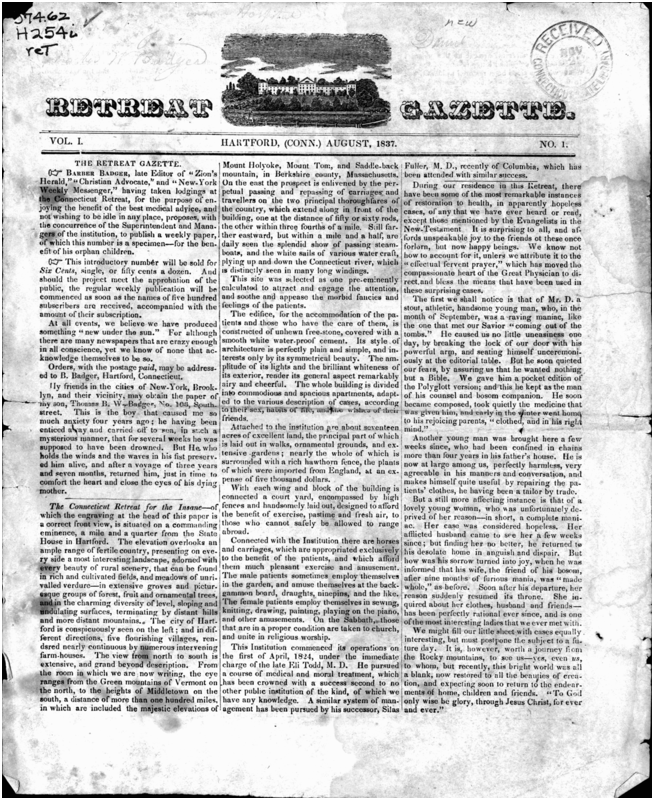
Compared to the obscure publications of High Beech and the Glasgow Royal Asylum, the Retreat Gazette (1837) of the Hartford Retreat in Connecticut offers a better glimpse at the origins of periodical publishing in asylums. The Gazette’s founder and main contributor, Barber Badger (1792–1854), was a well-known printer and newspaper editor prior to entering the institution. A native of Coventry, Connecticut, Badger began his career in 1816, when he published the Naval Temple: Containing a Complete History of the Battles Fought by the Navy of the United States. He launched the Rhode Island Religious Intelligencer in 1821, and two years later he was appointed as editor of the Zion’s Herald in Boston. In 1826, he moved to New York to become the first editor of the Christian Advocate, and from 1828 he assisted Rev Nathan Bangs in that task.9 In July 1831, Badger launched his own Badger’s Weekly Messenger. Its advertisement to subscribers, found in the American Antiquarian Society’s collections, suggests that by that time Badger was a well-known name in the American publishing scene: it features over seventy recommendations from colleagues based as far as South Carolina and Ohio.10 The publication was renamed the New York Weekly Messenger in the following year and continued under Badger’s editorship until the summer of 1836.11 In July 1837, he was already in the Hartford Retreat: the Retreat Gazette appeared under his name in August that year (see Figure 3.1). The asylum periodical thus belonged to a series of titles that Badger launched and ran.
Front page of the first issue of the Retreat Gazette, dated August 1837.
Established in 1824, the Hartford Retreat was the idea of Dr Eli Todd (1769–1833) and his colleagues at the Hartford County Medical Society, who were determined to create an institution modelled after the York Retreat in England. The original building admitted 44 patients who were offered boarding at rates varying between $3.50 and $12 per week. Connecticut residents benefited from lower fees.12 Male and female patients were segregated, with each sex inhabiting a different wing, though social mingling was allowed at dinners and events. The building was surrounded by seventeen acres of land, suitable for exercise and walks. Following the tenets of the moral treatment, the Retreat operated under what the committee of visiting physicians in 1830 described as the ‘law of kindness’.13 At least in theory, violence was forbidden and restraints were minimised, implemented only when ‘necessary for the welfare of the patients’.14 In practice, this meant that the more restless and troublesome patients, as well as those considered to be ‘idiotic’ or ‘demented’ were kept in the basement rooms of the wings. Prior to 1840, the physician superintendent was not required to live on-site. He resided in town and continued to supplant his income from managing the institution by maintaining his private practice.15
Eli Todd became the first superintendent of the Retreat and a pioneer of the moral treatment of insanity in America. Under his governance, the Hartford Retreat became a stepstone in other prominent physicians’ careers. Among Todd’s pupils were Samuel B. Woodward, who headed the Worcester Lunatic Asylum, and William Rockwell, who became the first superintendent of the Vermont Asylum for the Insane.16 In 1840, Amariah Brigham, an influential psychiatrist who later founded the American Journal of Insanity, took over the Hartford Retreat. The Connecticut institution was therefore an important medical centre that attracted physicians interested in insanity and set an example for other mental institutions in America.
At the time of Badger’s admission to the Retreat in the summer of 1837, however, the institution was experiencing difficulties. Under the pressures of overcrowding, it had expanded in 1832 and then had a housing capacity for ninety patients. Like other establishments of its kind, its management was plagued by financial difficulties, aggravated by the Panic of May 1837, which triggered a seven-year-long period of recession and uncertainty.17 The Retreat was also going through a crisis of leadership. As the blank space across the title ‘Physician’ in the May 1834 report’s list of officers suggests, finding a replacement for Eli Todd after his death in late 1833 had proven to be a challenge.18 Despite practically running the asylum during the last months of Todd’s life, which were marked by illness and frailty, Todd’s assistant and Retreat apothecary, William Rockwell, was not perceived as a suitable candidate for the position. After an unsuccessful attempt to attract Samuel B. Woodward, the hiring committee chose Silas Fuller, a physician who had made a name for himself as an able surgeon. Prior to his new appointment, Fuller had managed a private asylum within his own home, and he continued practising privately even after heading the Retreat in June 1834, making it impossible to get fully invested in his new job.19 His distraction from his duties is reflected by the halt in the publishing of annual reports during his superintendency. The tensions surrounding his frequent absences erupted in an argument with the steward, resulting in Fuller’s resignation in January 1840.20
It is amidst this turbulent time that Badger entered the Retreat and launched the Retreat Gazette. His professional skills and experience as a printer and editor enabled the inception of the publication. Describing himself as ‘not wishing to be idle in any place’, Badger commenced the periodical as an extension of his usual occupation.21 His reputation in the local publishing circles likely helped him access the equipment necessary for his project. The editor portrays the production of the first issue as the result of the solidarity and charity of some of the leading printers and publishers in the area:
We tender our acknowledgments to our brother artists of the city of Hartford, whose generosity has enabled us to print this paper. Mr. Canfield kindly loaned us the press and type – Mr. Hurlbut the brass rules – Messrs. Case & Tiffany the ornamental letters which, with the beautiful engraving, compose the title. The engraving does much credit to the head, as well as to the heart of Mr. Clark, the young gentleman who executed it.22
Philemon Canfield owned the biggest printing office in Hartford, with ten presses including the first steam presses in Connecticut. Case, Tiffany, & Co. was founded in 1836, and in 1838 it purchased Canfield’s.23 The young ‘Mr Clark’ was likely Seth Howard Clark (1814–1888), an engraver in Hartford. In this expression of gratitude, the Gazette appears to be a highly collaborative project between several publishing firms and professionals. In that respect, it is not unlike Badger’s earlier projects, especially his Weekly Messenger, which also outlined the provenance of all equipment and materials employed in its production:
The paper on which this specimen number is printed was manufactured at the extensive establishment of Messrs. D. & J. Ames, in Springfield, Mass. The type is from the foundry of James Conner, Esq. of this city [New York]. And the press work is executed on a Napier press, at the office of the New York Observer. The Supplement is printed on a similar press, at the office of the Journal of Commerce. The composition was done in the office of S. Hoyt & Co. To the latter gentlemen, to the Editors of the New York Observer, and of the Journal of Commerce, to Mr. Conner, and to all others who have generously forwarded this enterprise, the Editor of the Weekly Messenger tenders the homage of a grateful heart [emphases in original].24
The difference between the Retreat Gazette and Badger’s Weekly Messenger was that the editor required the support of a few more stakeholders. Prior to the start of the publication, Badger also secured the ‘concurrence of the Superintendent [Dr Silas Fuller] and the Managers of the institution’.25 The launch of the Gazette was therefore facilitated by the relationships between several actors and communities – book trade professionals, physicians, and patients. Furthermore, the connection with Case, Tiffany, & Co. that Badger potentially established continued to serve the Retreat until at least the early 1880s, as the printing company took on the publication of the annual reports once it resumed in 1840.
Badger was the link that brought all actors together, and his past and present life fuelled the publication. Only two issues of the Retreat Gazette appeared, and its brief existence is closely tied to Badger’s fate. Originally, the publication was intended as a weekly and was to be sold for six cents each, fifty cents for a dozen, or $2 annually. In the first issue of August 1837, the editor promised that ‘should the project meet the approbation of the public, the regular weekly publication will be commenced as soon as the names of five hundred subscribers are received’.26 Within a few days, the publication was warmly welcomed by the local and the national press. The Hartford Courant claimed that: ‘It is well filled with sprightly and amusing matter, calculated to entertain miscellaneous readers. At the same time, it contains sound moral and religious sentiments.’27 A review in the New York Journal of Commerce, widely reprinted by other newspapers, praised it too: ‘We see no evidence of a deranged mind, but much of a fertile and imaginative one.’28 As the favourable review suggests, the Retreat Gazette was a success. The first issue had an impressive circulation of 4,000 and attracted major public figures as subscribers, such as the Governor of Connecticut and Dr Woodward, the superintendent of the Worcester Lunatic Asylum.29 In comparison, it had taken Badger three years to bring the circulation of the Zion’s Herald to 5,000.30 Having ‘received the decided approbation of the inhabitants of this free and enlightened Republic’, Badger continued his work.31
The second issue, however, was delayed. It appeared in September, and it was the last number to be published. As the positive reviews indicate, the bumpy, irregular publication and the Retreat Gazette’s untimely termination cannot be explained by a lack of interest in the project. A closer look at its contents suggests that the fate of the periodical was decided by events in its editor’s life. From the first issue, the Gazette presented itself as a highly personal project. Though employing the conventional editorial ‘we’ most of the time, the introductory article to the first number uses first- and third-person singular. It immediately introduces the editor as ‘Barber Badger, late Editor of “Zion’s Herald,” “Christian Advocate,” and “New-York Weekly Messenger”’. It also states that, in addition to providing occupation to Badger while in the Retreat, the newspaper was initiated ‘for the benefit of his orphan children’.32 Badger named his son, Thomas B. W. Badger, as the New York–based distributor of the paper, finding an opportunity to mention the family’s recent history:
This is the boy that caused me so much anxiety four years ago; he having been enticed away and carried off to sea, in such a mysterious manner, that for several weeks he was supposed to have been drowned. But He who holds the wind and the waves in his fist preserved him alive, and a voyage of three years and seven months, returned him, just in time to comfort the heart and close the eyes of his dying mother.33
A brief notice confirms that Badger’s wife had passed away earlier that year:
DIED. At the residence of her husband, No. 15, King-street, New York, on the 15th of March last, Mrs. Sarah B. Badger – the wife of the editor of this paper …. Her aged parents mourn for a dutiful daughter, her afflicted husband for a lovely wife, and her four orphan children for the best of mothers.34
The notice is unusual, for the inclusion of such an announcement five months after the event makes it sound less like news than an intimate expression of inconsolable grief. The notice once again draws attention to the editor’s family and their tragedy, the alleviation of which emerges as the central purpose of the Gazette.
The first issue’s closing paragraphs support this proposition. The producers of most American asylum periodicals that appeared later were happy to receive other reading materials in exchange for their own publications. Badger, however, unambiguously focused on recruiting paying subscribers. Addressing fellow periodical editors and proprietors, he wrote:
Our brethren of the type and quill, who may be disposed to exchange with us, must be aware that their papers will be of very little service to crazy people. We, however, will readily exchange with those who will so far interest themselves in our favor as to procure a list of subscribers who will pay [emphasis in original]. If they do that for us, it will be more than many of them have been able to do for themselves.35
Badger’s exclusive interest in monetary remuneration suggests that the alleviation of his family’s financial issues resulting from his wife’s death and his institutionalisation was his periodical’s primary objective. The Retreat Gazette was Badger’s personal project through which he intended to continue earning a living and provide for his children.
The close connection between editor and newspaper was a double-edged sword. The newspaper’s reliance on a single individual inevitably tied its fate to that person’s resource. On the one hand, Badger’s extensive connections with the printing trade and openness about his struggles in the newspaper might have factored in the publication’s success by inspiring sympathy among his colleagues, friends, and the local community. On the other hand, Badger’s mental state determined the existence of the publication and its regular publication. In the introduction to the second number, the editor reveals that the delay of the publication was in fact directly caused by concerns over his well-being: ‘Some … have expressed their fears that our health may not permit us to issue the paper in regular weekly numbers.’ The issue also features the following reflection on the effects of modernity: ‘Civilization has changed our character of mind as well as body. We live in a state of unnatural excitement-unnatural because it is partial, irregular and excessive. Our muscles waste for want of action; our nervous system is worn out by excess of action.’36 Though unattributed, the quote originally appeared in The Effects of the Principal Arts, Trades, and Professions, and of Civic States and Habits of Living, on Health and Longevity (1831) by British physician Charles Turner Thackrah and was picked up and reprinted in the American press in 1837. The insertion of the passage situates Badger’s anxieties about the effects of his work in the broader discussions about the harmful effects of industrialisation typical of his time.37 Considering the dangers of overexertion, Badger reduced the frequency of his newspaper to semi-monthly, adjusting the price to $1 per year. ‘This,’ he added ‘will meet the approbation of our friends – afford us more time to mature each number, and probably contribute to the restoration of our health.’38 This is the first open expression of faith that producing the newspaper could promote healing.39 Balance was key, however: if unregulated, the intensity of the labour could be detrimental to one’s health.
In James Mudge’s History of the New England Conference of the Methodist Episcopal Church (1910), Badger appears as an important figure in the Church’s publishing activities. He ran his publications with ease, increased their circulation and improved the reputation of each, before moving on to the next project.40 A closer look at the periodicals Badger edited, however, reveals that his career as a religious newspaper editor was defined by the search for a healthy work equilibrium. In the years leading to his admission to the Hartford Retreat, Badger suffered recurrent episodes of mental distress that were caused, in his own view, by the mental overwork that editing involved. The earliest known major breakdown occurred in the mid-1820s and was likely the reason he suddenly quit his job as an editor of the Zion’s Herald. His unexpected resignation left the paper’s proprietors baffled: ‘His departure was so sudden as to prevent a formal leave of his patrons at that time.’41 In a letter to the newspaper he had now abandoned, Badger explained his move as motivated by an opportunity ‘to pursue the same arduous but delightful employment in another part of the same vineyard’, namely, as an editor of the Christian Advocate. However, he later reflected on this episode, revealing that the reason for his departure was the mental strain of his employment:
My occupation was that of a printer, and while I labored at the business, my health was good …. [B]ut after I became the editor of ‘Zion’s Herald’, … my health began to decline, gradually, and almost imperceptibly, until the disease finally terminated in a confirmed nervous head-ache … I relinquished my editorial duties altogether, with a view of trying the effect of manual labor. Accordingly, in the month of August last, I selected a small sized printing press, and commenced operation as a pressman. The result has been entirely successful.42
At the time of writing this account, likely in late 1832, Badger had already suffered a few more spells of ill health. In the winter of 1830–1831, while he was an assistant editor of the Christian Advocate and Journal and Zion’s Herald, an ‘almost entire prostration of [his] health’ urged him to consider changing ‘as soon as circumstances might permit, a scene of duty so arduous and absorbing, for one allowing time for travel and scope for muscular exertion’.43 This change did not take place until 6 June 1831, when he announced his relinquishment of his editorial duties and reflected on his experience of the past seven years and a half:
Through health and sickness, through seasons of hope and many dark hours of despondency, God will be the subscriber’s witness how much his heart has been engaged in his work – how great has been his solicitude to discharge, in some measure corresponding to its importance, a duty so weighty and momentous; and how great his anxiety, when his declining health has, for days, weeks, and months, unfitted him to sustain labour of an occupation which presses heavily on the mind, and, from its sedentary nature, severely tasks even the robust frame and firm constitution.44
Badger’s withdrawal from his trade did not last long, though. A few days later, he circulated the prospectus of his new project, Badger’s Weekly Messenger. Forty thousand copies of the first number were to be issued on 4 July and distributed across the whole country.45 In the advertisements in the press, Badger assured his new readers that his retreat to recover his health would ‘not interfere with the success of his publication, – competent editorial assistance having been engaged to conduct the paper during his occasional recesses’.46 As he progressed in his career, Badger was thus forced to accommodate for the detrimental impact of his work on his mental health.
A whole month elapsed before the second issue appeared, suggesting that Badger’s absence slowed down the work on the newspaper after all. Afterwards, the publication ran smoothly, bar some typographical mistakes that were noted by his colleagues and a scrambled pagination after the forty-seventh issue.47 The contents of the newspaper indicate, however, that by June the next summer Badger was suffering again. The issue for 4 July 1832 indicates that he had left New York on 27 June for Middletown, Connecticut, hoping that the change of scenery would restore his ‘impaired health’.48 His recovery was cut short, however, by his decision to join his family in New York on 18 July to be with them amidst the epidemic of cholera raging in the city.49
In late June 1836, Badger’s health deteriorated again, and he went away on another healing trip, this time to Hartford, Connecticut.50 This was meant to be a short absence, but an article he wrote for the literary journal Poughkeepsie Casket suggests that he was still there in late September. According to his account, Badger, in a ‘debilitated state of health’, and his physician paid a visit to poet Lydia Huntley Sigourney.51 From 1831 onwards, Sigourney’s works, original and reprinted, had appeared regularly in Badger’s newspaper, then called the New York Weekly Messenger and Young Men’s Advocate. Upon his visit, the editor thanked the poet ‘for having sustained my feeble steps in my early walks in the paths of literature’ and requested ‘an article or two wherewith to sustain the character of my paper’.52 Sigourney kindly obliged him, agreeing to lend her local fame once again to support his newspaper. It is uncertain whether the poem ‘On Sickness’, which she wrote and sent to him only a few hours later, was included in Badger’s publication. Within a month, Badger’s name was removed from the front page of the New York Weekly Messenger and Young Men’s Advocate.
Beyond the death of his wife in March 1837, there is little information about Badger’s life and movements during the year preceding his admission into the Hartford Retreat. What is known about him clarifies the role of the Retreat Gazette in the editor’s life. Beyond supporting his family, the asylum periodical reflected his struggles with work-related stress. Whether his own or the physicians’, the concerns about his health, which necessitated the reduction of the periodical’s frequency, were founded on a decade of recurrent suffering and distress that rendered him incapable of working consistently as an editor. In the asylum, Badger once again had to find the right balance to turn his work into a restorative occupation rather than a source of debilitating pressure. The purpose of the periodical hence underwent a shift in focus between the two issues. The second number contains no more mentions of his family matters. From a project explicitly intended to support his struggling family financially, the Retreat Gazette was recognised as a potential cure, which might speed up his reintroduction into society as a provider for his children. Both of these purposes are, however, closely intertwined with Badger’s personal and professional life, and so is the end of the periodical, resulting from his discharge from the Retreat unrecovered.53 Badger died in 1854, without producing any other known publications.54 The Retreat Gazette was therefore his last notable work, marking the potential closure of his career as a newspaper editor. His invisibility from the records, however, leaves the chance that in the last years of his life, he returned to the kind of work that he found remedial: printing.
Learning to Print: John Reid Adam’s Chronicles of the Monastery (1842)
The first asylum periodical printed in Scotland was also a patient-driven initiative. The Glasgow Royal Asylum (also known later as the Gartnavel Royal Hospital) acquired a press in 1842 and started issuing the weekly Chronicles of the Monastery in the same year. It is hard to tell whether the physicians or patients of the Gartnavel were aware of the American predecessor of their publication, as no British libraries seem to hold copies of the Retreat Gazette, and there is little evidence that contemporary British and Scottish periodicals reviewed it.55 It is also unclear whether its producers were aware of its direct predecessor, the manuscript ‘Glasgow North Briton’. The launch of the Chronicles was the responsibility of two enthusiastic individuals with no previous professional experience in the book trade. One of them remains unidentified, but the other was John Reid Adam (1806–1866), a Scottish merchant with poetic aspirations who taught himself how to print in the asylum.56 The Chronicles was free and circulated only within the institution. Like the Retreat Gazette, it had a short run, but no copies of it seem to have survived. It is still possible to learn more about the periodical and the role it had in the institution by piecing together Adam’s life. His biography also reveals his direct and indirect involvement in at least two other asylum periodicals.
Most of what is known about John Reid Adam comes from John Reid Adam himself. Throughout his life, he produced a substantial body of autobiographical poetry and prose, published independently or in asylum periodicals. Using Adam’s own narratives alongside asylum documentation, newspaper articles about his adventures, and other sources, I have managed to identify him as the individual behind the pseudonym ‘IRAM’ (or ‘Iram’). This is a close abbreviation of the name he believed he deserved, John Reid Adam Maxwell, of the rich Maxwell family of the Pollok estate in Renfrewshire.57 Catherine Reilly has claimed that Adam did indeed inherit the estate, but I have not been able to find any connection between John Reid Adam of Colinslee and the Maxwells other than geographical proximity.58 Nevertheless, Adam used that pseudonym for the rest of his life and was financially capable of spending the last seventeen years of his life as a private patient in the Royal Edinburgh Asylum. Even if not a Maxwell, he had the means to support his maintenance at the institution.
The Glasgow Royal Asylum was founded in 1814 in Dobbie’s Loan to accommodate the insane patients of the Town’s Hospital. It received a Royal charter in 1824. In 1840, a large plot of land in Gartnavel was purchased, and by mid-1843 the new building was ready to accommodate the patients. Like other early asylums in Britain, the Glasgow Royal was originally run by laymen, but as the century progressed, its administration was overtaken by medical professionals. In 1840, William Hutcheson became its first resident physician, but he fulfilled the duties of superintendent and wrote the annual reports for most of the decade. While practices in the Gartnavel did not always fit with the postulates of the moral treatment, there were marked attempts under the first superintendents to adopt the new principles.59 For instance, both Hutcheson and his successor, Dr Alexander Mackintosh, were proud advocates of non-restraint, although they did not adhere to it consistently.60
The Glasgow Royal Asylum received John Reid Adam as a private patient on 22 October 1839. At the time of admission, Adam was in a state of delirium tremens due to alcohol abuse, following several difficult years of financial troubles related to his family’s bleaching business and to the death of his infant son.61 Despite discomforts such as ‘rare belly-fulls’ and the unpleasant business of digging up a well, he claims to have received ‘kind and humane treatment … under the care of Dr. Hutcheson’.62 He seems to have enjoyed his stay enough to refuse to leave. Though deemed to be cured on 27 July 1841, he arranged to remain in the asylum as a voluntary boarder.63 In his own words, this decision was driven by concerns for his unstable financial situation. He remained in the asylum,
to see if any compromise could be effected with my grandfather’s trustees, when I might have been enabled to enter into some respectable line of business. But having been on a visit to my parents and sisters, some months ago, I learned that there was just as little prospect of a satisfactory adjustment as ever.64
It is unclear how long he stayed there voluntarily, but in November the following year he was officially admitted as a patient once again.65
Launched seven years after the manuscript ‘Glasgow North Briton’, Chronicles of the Monastery was the Glasgow Asylum’s first printed publication. It was published for ten weeks in 1842, during Adam’s voluntary stay at the Gartnavel. We learn about it from the Gartnavel Minstrel, Adam’s poetry collection which he produced himself, after leaving the institution and finding employment as a printer in Glasgow 1845:66
The Doctor ever willing to encourage all rational amusement, readily furnished another boarder and myself with a small press and a font of types, with which we commenced a Weekly Periodical as Co-Editors. My department lay chiefly in providing for the ‘Poets Corner’.67
It is likely that some of the poetry appearing in Adam’s Minstrel was reprinted from the pages of the asylum periodical. This is certainly true of the ‘Introductory Address’ to the Chronicles, a poetic piece of thirty-nine, four-line stanzas that welcomed readers to the new publication, promised original writing and news about asylum life, and invited contributions. The poem claims that the purpose of the periodical was to ‘cause on beauty’s rosy cheek / Perhaps a pretty dimple’.68 However, another intention surfaces throughout the poem, evident even in the reference to ‘beauty’s rosy cheek’. The ‘Address’ is particularly insistent on encouraging writings from the ladies in the asylum: ‘But most of all, we fondly hope, / The sisterhood so fair, / Will send some cutting articles.’69 Seven stanzas are dedicated to persuading the female patients to share their writings, and, towards the end of the poem, the speaker adds: ‘The sisterhood we seldom see, / They’re rather out of view.’70 These lines reflect one of the realities in the Gartnavel that Adam clearly struggled to accept: patients were separated by gender. Clearly, one of the purposes of the Chronicles was to bridge this divide and enable interaction that was otherwise denied or limited.
The introductory poem also shows that the periodical offered its editors a chance for voicing complaints. In comparison to the Retreat Gazette and most asylum periodicals that appeared later in the century, the Chronicles seems quite bold in that respect. Throughout the poem, the speaker adopts a playful tone. Using light-hearted jokes and puns, he outlines the different aspects of asylum life that the Chronicles will report on, including negative experiences such as ‘the cold water cure’ and the ‘game of hush or whist’ played by the clinical assistants.71 He also mentions the threat of punishment that the more vocal patients faced:
Perhaps emboldened by his status as a voluntary boarder, Adam employed a highly subversive tone that pushed the limits of his privilege and freedom. Though the ‘Address’ clearly seeks to soften its own criticism by flattering those in power and appealing to their generosity, it presents the Chronicles as a platform where institutional tensions could be discussed and ironised.
The boldness in the poem is also palpable in the title of the periodical. An explanatory note in the Gartnavel Minstrel discloses its origins: ‘The Asylum had been by some of the inmates, facetiously termed the Monastery of La Trappe: hence the origin of the title given to our periodical.’73 By the time of publication, the Monastery of La Trappe had become a well-known curiosity. Numerous pieces of travel writing in the periodical press told of this convent, taking especial interest in two of the characteristics of the order, namely, their oath of silence and their intense preoccupation with death. La Belle Assemblée compared life at La Trappe to ‘a living grave’, while the Weekly Entertainer states that:
The living may be said to reside with the dead; and that they may be continually reminded of their mortal state, a grave is always left open for the reception of the next that dies; and we are told, that each individual of the fraternity prayed sincerely that he himself might soon become the occupier.74
In Scotland, Tait’s Edinburgh Magazine observed in 1841 that ‘those who become its [La Trappe’s] members, cease altogether to meddle with the world’.75 The image of the silent, isolated monks awaiting their mortal end must have inspired the Gartnavel patients’ inside joke. It is unclear whether the association was inspired by the clinical assistants’ ‘game of hush and whist’ that silenced patients like the monks, or the parallel was gloomier, referring to the potentially oppressive, isolated life in the institution. Either way, the new publication promised to disrupt the deathly silence and brighten the days of the inhabitants of the Gartnavel ‘monastery’.
Beyond Adam’s Minstrel, the Chronicles is discussed in the physician’s annual report for 1842. There, Dr Hutcheson presents the acquisition of the printing press and its operation as an expansion of the array of activities offered to patients:
To the occupations mentioned in my last Report, we have added printing. Having procured a small press and a supply of types, and given one or two of the most intelligent Patients a few hints, they very soon overcame the mechanical difficulties, and acquired so much expertness, that at one time I entertained a sanguine hope that this Report would have been printed within the Asylum, by my friends. … No sooner had the printers acquired a certain degree of expertness, than a periodical commenced; and the contributions of the inmates, exclusive of those too absurd to be printed, were far more than sufficient to fill its pages. It went on vigorously for ten weeks, when, owing to the discharge of some of its contributors, the paper was abandoned.76
Dr Hutcheson’s statement highlights the importance of the press and the Chronicles to Adam, as well as the institution. The provision of occupation to the boarders was motivated by the physician’s hopes of producing the annual reports in-house. For Adam, however, publishing the periodical was much more than a pastime. It was a chance to acquire and practice a new skill, which changed the course of his life. In the Gartnavel Minstrel he wrote that:
It is therefore to the indulgence granted me by the Physician, sanctioned by the board of directors, added to the kind encouragement I have received from Dr. [Thomas] Prichard [the Physician’s Assistant] and others in the house, that I am chiefly indebted for the practical knowledge of letterpress printing, and consequently in the power of publishing my own productions, chiefly by individual exertions.77
After his discharge, Adam pursued printing professionally and published his own writing. He wrote that his works ‘would never have been brought before the public in this, or any other form’, had it not been for his admission into the Gartnavel.78 The Chronicles thus mark the starting point of Adam’s career as a printer and poet. Despite its limited readership, it was the first platform where he could express his creative urges.
Even as a voluntary boarder in the institution, Adam’s access to resources depended on the good will of the superintendent. Hutcheson was also able to decide what material was ‘too absurd to be printed’, as he himself put it.79 Furthermore, according to the records of the Gartnavel, Adam was readmitted officially as a patient on 8 November 1842 and stayed until he was deemed ‘cured’ on 22 September 1844. The annual reports for 1843 and 1844 do not indicate that the Chronicles was reinstated after Adam’s return. However, there is evidence that the printing office of the institution continued to be in operation after his discharge and potentially even during his stay. The annual report for 1845, for instance, was printed at Gartnavel. Though the printing of later reports was outsourced once more, the printing office was regularly improved, suggesting that the press was employed for other jobs. An account of the work tasks completed by patients during 1845 reports the ‘fitting up [of the] Printing Office with Tables, Boards, Shelves, &c.’, while in the following year, male inmates ‘alter[ed] a Frame for holding TypeCases,&c. [sic] for Printing Office’.80 By the early 1850s, the press had seemingly fallen into disuse. It remained inactive until 1853, when a few enthusiastic patients asked to produce a periodical once again – an event that is discussed in Chapter 4.
Tracing Adam’s life beyond his discharge from the Glasgow Royal Asylum and the publication of the Gartnavel Minstrel shows that he continued his literary career in London. By the autumn of 1845, he was in the city, trying to make a career out of his interests in poetry and theatre. A notice of Adam’s upcoming performance appeared in Bell’s Life for 19 October: ‘Mr J. R. Adam … has engaged the [Western] Literary and Scientific Institution, Leicester-square, for the 28th.’81 In the following report, Bell’s Life states that the event was attended by ‘a numerous audience’ and consisted of ‘original compositions of great merit, readings from the finest parts of “Hamlet” and “Macbeth,” and other interesting selections from the older dramatic writers’.82 It congratulates Adam for one piece in particular – ‘the “Ode to Wellington,” a rhetorical effusion, which charmed us with the power and truth of its style, and the brilliancy of its delivery’.83 By early 1846, Adam’s talent for reciting poetry had earned him a name as the ‘Scottish Improvisatore’, and he was employing his printing skills to circulate his poetry more widely.84 Following the favourable review of the ‘Ode to Wellington’, Adam published it alongside other pieces, using his own ‘Lilliputian Press’ on 20 Sermon Lane, St Paul’s, in January 1846.85 In the summer, Adam had another volume of his published, this time by H. Peet on Earle Street. The Iron Dukes’ Veterans: A Poetical Memoir of the Waterloo Heroes Assembled in the Ante-Room for the Apsley House Banquet was intended to be distributed among the guests of the annual event that took place on 18 June 1846. For the purpose, it was ‘originally printed in large type, so as to be legible to the aged veterans themselves’.86 The special printing requirements can potentially explain why Adam did not print the collection himself. Brief reviews of the book appeared in both Bell’s Life and the Times: the former called the author ‘a man of strong mind and natural genius’, while the Times congratulated him for the ‘humble, but earnest rhymes’.87 Beyond publishing his poetry, Adam made several unsuccessful attempts to contact theatre directors to launch his career as an actor.88 His passion for composing and reciting poetry eventually secured him a job: in the summer of 1846, he became the Invisible Poet of Cremorne Gardens.89 In that position, Adam, hidden out of view, would ask visitors of the gardens to write their names on slips of paper and drop them through a letterbox. At the price of two pence, he would produce four-line verses, offering a rhyme for each visitor’s name.90
The employment in Cremorne Gardens must have been a very important achievement for Adam. After more than a year of trying to capture the attention of the London public and theatre world, he was finally allowed to make a living out of his passion for poetry. The poems he wrote during that year and published later in his collection All Sorts (1856, 1859) demonstrate that he took great pride in his work there. Several of the poems he included were produced during his employment there and are dedicated to the place and the people who managed or visited it. In each of them, he dedicates a few lines to the ‘Bard unseen’ and his cot.91 In the 1859 edition of the collection, he also added sixty-nine of the poems he produced for the visitors of the Poet’s Cottage at Cremorne, most of which were written for women.92 Their inclusion in the collection over ten years after their original production shows that Adam preserved them, as he saw them as precious fruits of his poetic inspiration he was proud to share.
In the spring of 1848, however, Adam’s life took a turn for the worse. The Times reports that, after producing ‘poetic effusions … of so degenerate a character as to have given offence to the visitors’, he lost his job in Cremorne Gardens.93 Driven to desperation by the loss of the job that he had worked so hard to secure, he went to the Gardens once more and delivered ‘an open air lecture upon “The transition of the soul from the body after death”’.94 What followed was a squabble with the managers of the gardens, leading to an assault on a policeman and the beginning of a series of detainments. Adam was first sent to Westminster Bridewell prison, then to Hanwell Lunatic Asylum. Eventually, he was transferred back to Scotland: from 15 September 1849 until his death in 1866 he resided in the Royal Edinburgh Asylum. The case notes from the date of his admission state that: ‘His friends attribute his insanity to the death of one of his children, to whom he was passionately attached, to the conduct of his wife and partly to dissipation.’95 Further entries show that, while initially peaceful and content, by the summer of 1850, he was growing restless and increasingly anxious about his confinement.96
Though not always pleased with his detainment, in Edinburgh Adam had opportunities to display his talents. He was a regular participant in theatre performances at Morningside and by April 1853, he was referred to as ‘the sprightly and indefatigable’ stage manager of the institution.97 He also engaged in scene painting for the regular asylum balls.98 Within a year, he got himself involved in the printing office of the institution.99 In addition to the two editions of his All Sorts, he published a volume of verse about his travels to Malta as a young man and became a key contributor to the periodical of the asylum, the Morningside Mirror. The Mirror was launched in 1845, the same year in which the institution acquired a press. It was a single-column eight-page monthly in a compact octavo format that was allegedly produced entirely in-house by patients.100 A survey of the periodical reveals that, under the pseudonym ‘Iram’, Adam was one of the main contributors to the magazine between 1850 and 1860. During his most active year (1854), nearly half of the pages of the periodical were filled with his works.101 At the peak of his literary activity, he composed original poems that served as the mottos for volumes nine to twelve.102 He also ran the rubric ‘Monthly Retrospect’, where he recounted the major occurrences in the asylum. In an 1858 note from the Mirror’s editor, he is referred to as ‘Our Own Reporter’.103 For a few years of his stay, Adam established himself as a dominant presence on the pages of the Mirror, shaping and defining the periodical.
Both in the Glasgow and the Edinburgh asylums, Adam’s literary function was reflected by a prominent and privileged position in the institutions. At Morningside, this allowed him to be present at all the important events he reported on. While his status as a private patient already secured him access to luxuries such as better accommodation and board, his creativity and his involvement with the Mirror reinforced his privileged position. On one particular occasion, he mentions that he was one of ‘among a selection of the ladies and gentlemen of the first-class inmates’ who were taken out of the asylum for a trip.104 He was allowed to leave the asylum to go to the theatre and other amusements in town.105 His poetic and dramatic talents were also employed during special events, and he gave recitals praising the staff and the institution.106 Adam was therefore not merely present and informed about all the affairs in Morningside but was a central participant in events involving both patients and staff. His involvement with the Mirror and the recreational programme of the institution thus both reflected and reinforced his position in the asylum. In 1860, the signature of ‘Iram’ stopped appearing in the periodical. He passed away six years later in the same institution, leaving a deep mark in the history of asylum periodicals in Britain.
The stories of the founders of the first asylum periodicals show that these publications were driven primarily by single individuals’ ambitions and needs. The overtly stated aims of these projects were the provision of occupation and amusement for the patients, but understanding their functions fully requires them to be situated in the contexts of their founders’ lives. The Retreat Gazette marked the ending of Barber Badger’s fifteen-year-long career as a prominent newspaper editor – a career repeatedly interrupted by breakdowns resulting from work-related stress and personal loss. The Chronicles of the Monastery, on the other hand, was John Reid Adam’s first publishing project. It equipped him with the skills to pursue his passion for writing and theatre professionally, publicise his story and poetry, and gain privileges in the Royal Edinburgh Asylum later. Early asylum periodicals thus embodied their founders’ struggles and allowed them to navigate the complexities of life within and beyond institutions. This is characteristic of later publications too. Even though physician-superintendents got more involved as editors, contributors, or agents soliciting contributions from patients, asylum periodicals fulfilled important functions in patients’ lives that were determined by their personal circumstances and aims. For the most part, these were patient-driven initiatives that allowed inmates of institutions to make sense of and shape their experience.

 Open access