


1. Introduction
Design transforms existing situations into desirable ones, resulting in tangible products or valuable services. Over time, manufacturers have increasingly combined products and services to gain market share and remain competitive (Reference Shihundla, Mpofu and AdenugaShihundla, 2019). Product and Service Systems (PSS) offer superior user value and economic benefits, while promoting sustainable development (Reference Geum and ParkGeum & Park, 2011). A PSS includes products, services, infrastructure, processes, and a network of stakeholders (Reference Coreynen, Vanderstraeten, van Witteloostuijn, Cannaerts, Loots and SlabbinckCoreynen et al., 2020; Reference Gaiardelli, Pezzotta, Rondini, Romero, Jarrahi, Bertoni and CavalieriGaiardelli et al., 2021). PSS value offerings are categorized as Product-Oriented, Use-Oriented, and Result-Oriented (Reference TukkerTukker, 2004). Industry 4.0’s digitalization has led to data-driven smart PSS (Antonova, Reference Antonova2018; Carsten et al., Reference Carsten, Monika, Jörg and Benedikt2018; Tomiyama, Reference Tomiyama2001). Six characteristics of products and services highlight PSS design drivers, with product design driven by functions and service design by user needs (Reference Moreno Grandas, Blessing, Yang and WoodMoreno Grandas et al., 2015).
Representation provides valuable information to designers and significantly aids idea generation (Reference McKoy, Vargas-Hernández, Summers and ShahMcKoy et al., 2001), making it a key area of research for services and PSS (Vasantha, 2012). As OEMs focus more on services around products, we aim to cover both under a common ontology, enhancing consistency, integration, and collaboration. This paper examines the SAPPhIRE model’s (Chakrabarti et al., 2005) potential to represent services, building on its proven benefits in product design, and setting the stage for its application in service design.
2. Literature review
2.1. Design representation of service systems
A detailed study on ontologies in product design, service design, and PSS proposed a PSS ontology using ten root concepts: user needs, stakeholders, PSS-Design, product life cycle, use phase, infrastructure, business elements, business models, supply network, and benefits (Vasantha et al., 2011). Service modelling, like engineering modelling, describes service constituents: Service Provider, Service Content, Service Channel, and State Change, along with their interactions and graphical representation (Reference Shimomura and TomiyamaShimomura & Tomiyama, 2002). Molecular modelling for services includes Service Element, Product Element, and the bond between them (Reference ShostackShostack, 1982). Representation often considers multiple views or dimensions, such as stakeholder, service, systems, and operational views (Reference Fakhfakh, Jankovic, Hein, Chazal and DauronFakhfakh et al., 2021), or higher dimensions like product, customer, value, actor, service, business model, interaction context, and time (Reference KimKim, 2020). These works capture the complexities of modern service systems involving people, processes, and products (or technology). Service designers use service blueprints to graphically represent services, including User Actions, Onstage/Visible Contact Employee Actions, Backstage/Invisible Contact Employee Actions, Support Processes, and Physical Evidence (Reference Bitner, Ostrom and MorganBitner et al., 2008). Researchers extended service blueprints to smart services (Reference Li and LuLi & Lu, 2021) and PSS (Reference Chuang, Lee and YaoChuang et al., 2022). For example, a new PSS blueprint includes Product Area, Service Area, and Supporting Area, showing product usage throughout its lifecycle and the service flow from management to user (Reference Geum and ParkGeum & Park, 2011). Another PSS blueprint has four layers: user action, product area, PS Platform area, and Support process, each with Name, Attribute, and Operation information (Reference Moon, Oh, Kim and HwangMoon et al., 2013). A holistic PSS blueprint focuses on product functions instead of physical representation and includes Product Functions (Hardware and Software), User Activities, Provider Activities, and Supporting infrastructure (Reference Herzberger, Behncke, Schenkl and LindemannHerzberger et al., 2013).
The review shows that due to the similarity between PSS and services, the service blueprint concept is extended to PSS to illustrate connections between products, services, and actors. However, blueprints do not describe causality among constituents or connect to user state changes. They also do not explain the rationale for integrating products and services, including causal relationships. Understanding causality in services or product-service combinations is crucial as it explains their functionality and value addition by changing the user’s situation or state. Therefore, a causal model can be useful for analyzing and synthesizing Services or PSS.
2.2. Extending SAPPhIRE model to services
The SAPPhIRE model represents the causality of natural and engineered systems, detailing the interaction of physical entities with their surroundings (Reference Venkataraman and ChakrabartiVenkataraman et al., 2009). It can link multiple models to describe complex systems and is useful for design ideation, synthesis, and measuring creativity. Its powerful nature extends its application to two situations: (a) Covering the entire product lifecycle (Design, Manufacturing, Operations/In-service) by introducing a new construct, ‘Observation,’ to measure state changes and decide on corrective or preventive actions. The ‘Action’ construct becomes optional, depending on ‘State Change’ observations (Reference McSorley, Fortin and HuetMcSorley et al., 2014). (b) Modifying SAPPhIRE constructs to represent services, capturing causality among service constituents and assessing novelty (Reference Borgianni, Cascini and RotiniBorgianni et al., 2012).
The first research uses the SAPPhIRE model to describe product behaviour over its lifecycle, recognizing the need for follow-up actions based on state changes during the in-service phase. However, it does not integrate service offerings to enhance user value. The second research modifies SAPPhIRE constructs to explain service causality but does not detail the basic building blocks of service delivery processes or the conditions enabling service delivery. It also does not address how to model complex situations (or state changes) in services using SAPPhIRE. Importantly, neither research explains Product and Service integration rules or a schema using a causal ontology like SAPPhIRE. Therefore, previous research (Reference Bhattacharya and ChakrabartiBhattacharya & Chakrabarti, 2023) investigates the causal relationships among service components in Service Systems, using the SAPPhIRE model of causality (Chakrabarti et al., 2005) with its seven layers of abstraction. This research extends SAPPhIRE constructs to include both services and products. However, the SAPPhIRE model has not been previously applied in service design, leaving its ability and effectiveness to represent services unknown.
Figure 1 shows the SAPPhIRE model, and definition of SAPPhIRE constructs:
SAPPhIRE Model of Causality for Product and Service (Reference Bhattacharya and ChakrabartiBhattacharya & Chakrabarti, 2023)

-
Parts: In a product, parts are the constituent entities and their immediate interfaces. In service, these are the service actors and infrastructure carrying out the customer interactions.
-
oRgan: These elements act like enabling conditions without which the interactions will not occur. In a product, these are the attributes of the product Parts or conditions for the interaction of the Parts. In service, these are the attributes of the service Parts or conditions for the interaction of the Parts.
-
Input: These are the external elements (material, energy or information) necessary for the interactions.
-
Effect: Applicable Rules or Laws governing the interactions. In a product, these are the laws of nature (physical or biological), in service, these are the applicable rules or policies governing the service.
-
Phenomenon: These are the interactions in a Product or Services. These interactions create the transfer or transformation of material, energy or information. In a product, this is the physical interaction of an entity with its surrounding. In service, these are the interactions between customers and service actors.
-
State Change: Resulting Change of State caused by the Phenomena
-
Action: Interpretation of the State Changes
3. Research question and research method
3.1. Research opportunity and research question:
Designers often use solutions from analogous designs to innovate (Reference Christensen and SchunnChristensen & Schunn, 2007). Representation and modalities are crucial in analogies (Linsey et al., 2007), computational analogical reasoning (Reference Hill, Santoro, Barrett, Morcos and LillicrapHill et al., 2019), and data-driven design by analogy (Reference Jiang, Hu, Wood and LuoJiang et al., 2022). Design by Analogy is effective for generating novel ideas (Reference Fu, Murphy, Yang, Otto, Jensen and WoodFu et al., 2015) and is applied in service design (Reference Moreno, Yang, Blessing and WoodMoreno et al., 2014) and product-service systems (Reference Moreno Grandas, Blessing, Yang and WoodMoreno et al., 2015). The SAPPhIRE model (Chakrabarti et al., 2005) is proven to enable design-by-analogy method by synthesizing and analysing design concepts and assessing novel product configurations (Venkataraman et al., Reference Venkataraman and Chakrabarti2009; Sarkar & Chakrabarti, Reference Sarkar and Chakrabarti2011). However, its application in service design remains unexplored. Evaluating the SAPPhIRE model’s ability to represent services could pave the way for its use in design of services and product-service systems. This study aims to investigate whether the SAPPhIRE model can capture and represent all necessary details of a service. Hence, the main research objective is to find out, “Can a SAPPhIRE model capture and represent all the necessary details of a Service?”
3.2. Research method
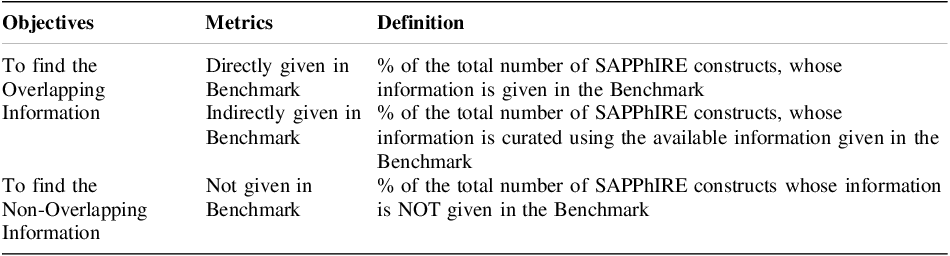
To find an answer, the SAPPhIRE representations of three services are compared with the Object Process Methodology (Reference DoriDori, 2011). This comparison seeks to answer: (a) Can the SAPPhIRE model represent the service information in the benchmark model (overlapping information)? and (b) Does the SAPPhIRE model require additional information not in the benchmark (non-overlapping information)? First, SAPPhIRE models are created for the services. Then, these models are compared against the benchmarks to check how much information required by the SAPPhIRE model is covered by the benchmark and how much is not. Table 1 shows the metrics used for this comparison in each example.
Metrics used in model comparison

4. Validation results and discussion
4.1. Validation results
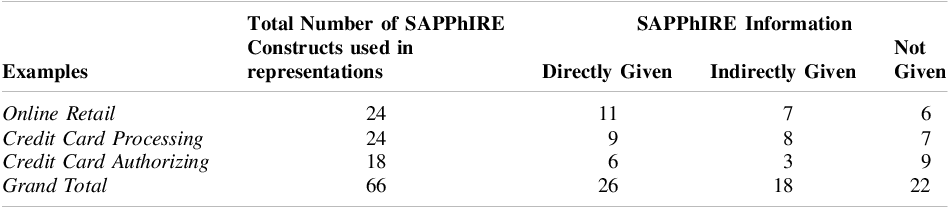
SAPPhIRE models are reconstructed for three example services: (a) Online Retailing, (b) Credit Card Processing, and (c) Credit Card Authorization (Reference DoriDori, 2001). Multi-instance SAPPhIRE models are used to represent the causal chain of service interactions. Since ‘Action’ is a subjective interpretation of a State Change, it is excluded from this study, leaving six SAPPhIRE constructs with internal connections. Representations of the three examples using the SAPPhIRE Model and OPM are provided in the Appendix. Table 2 summarizes the comparison of the SAPPhIRE models for all three examples.
SAPPhIRE model comparison summary

The breakdown of the ‘Directly Given’, ‘In Directly Given’ and ‘Not Given’ categories by SAPPhIRE constructs is shown in Figure 2.
Breakdown of the ‘Directly Given’, ‘Indirectly Given’ and ‘Not Given’ information

The three examples are representative services whose models are created by benchmarks, From the SAPPhIRE representations of the three examples, we see that SAPPhIRE representations can represent 50% more information than represented by OPM model, thereby producing a richer representation. The following are the salient observations from the performance comparison study:
-
Nearly one-third of the SAPPhIRE constructs did not have any relevant information found from the OPM models. ‘Parts’ and ‘Phenomena’ have most of the relevant information available. For state change, input, and organ, we can construct the relevant information for some of the models. However, for the construct Effect, relevant information is missing totally.
-
The SAPPhIRE Constructs can be used to describe all the service elements given in the examples and we did not find any service element that could not be described using SAPPhIRE. SAPPhIRE model increases the richness of the service description by providing specific details.
-
We see that the service actors and service activities or interactions are always given. However, these are not enough to describe the services. SAPPhIRE helps to complete the description by bringing in other required details, namely, the applicable service rules (Effect), the external inputs for the service, the state change produced and the conditions or attributes (Organ).
-
In the ‘Online Retail’ example, input, conditions or attributes (Organ) and the State Change of every Service Interaction are explicit. However, service rules are missing. In the ‘Credit Card Processing’ example, the conditions or attributes (Organ) are missing for some of the Service Interactions in addition to Service rules. In the ‘Credit Card Authorizing’ example, State Changes are missing in addition to the service rules and the conditions or attributes (Organ). Additionally, the interdependencies of the Service Activities in this example are not given.
-
The SAPPhIRE constructs can capture the purpose of a service element. For example, a ‘service catalogue’ and a shopping ‘cart’ are necessary for online retailing. A ‘service catalogue’ is necessary for selecting and adding items to the shopping ‘cart’. The shopping ‘transaction amount’ will not be known if the ‘cart’ is empty.
-
The input construct of the SAPPhIRE model explains what external input is necessary for the service to initiate. For example, customer choice from the catalogue is necessary to select and add items to the shopping cart. Another example is the transaction amount and the credit card details, which are input for credit card processing.
-
The service rules set by law or company policies that govern service offerings and activities are not called out explicitly in the OPM model. This is necessary to capture in a service description to make the service activity compliant. If the law changes, these service activities and service offerings can change. For example, while ‘processing the credit card’, the credit card details cannot be saved on the merchant server without the consent of the customer, as per Indian law.
-
Services produce a state change in the customer’s situation. While the ultimate state change is meant for the customer, there could be internal state changes that will lead to the final state change. For example, when the shopping cart is filled, the transaction amount will be known, and the transaction amount input will be necessary for payment to change the status of the goods to ‘sold’. Hence, knowing all the state changes is necessary.
-
Real-life services have more than one service action. Each of these service actions involves interactions with the customer and the processing of material, energy or information. For example, in ‘Online Retail’, the customer is involved in 4 service actions, namely, selecting and adding items to the virtual cart, checking out the virtual cart, submitting the Credit Card and processing it. Through multi-instance models, SAPPhIRE can represent the interdependencies of service interactions.
-
Conditions and attributes are necessary for service interactions. For example, having sufficient funds on the credit card is necessary for the credit card processing company to process the payment for a transaction. The SAPPhIRE model, with its construct called Organ, can capture these conditions and attributes.
4.2. Discussion
We observed that SAPPhIRE model can represent the operation of a service with a great deal of detail compared to the benchmark. SAPPhIRE model can represent not only the service actors, service artifacts and service activities but also the external input to the service and the state change it produces. It captures the service rules that are the foundation for all service interactions. SAPPhIRE model describes not only how does the service work but also why it works in that way. In addition to service components such as service actors, service artifacts and service activities, SAPPhIRE also explains underlying conditions or attributes through its Organ construct, the Service Rules that are necessary for the service interactions to take place through the Effect construct, the external input to the service through its Input construct and the output of the service through its State Change construct.
5. Conclusions and future work
The research question of this paper is, “Can a SAPPhIRE model capture and represent all the necessary details of a Service?” Validation results in section 4 show that the SAPPhIRE model can create rich service representations and explain outcomes through causal relationships between constructs. This causal representation fosters a deeper understanding of system behaviour, enabling targeted and effective solutions. It allows designers to predict intervention effects, conduct root cause analysis, and assess configuration novelty, leading to robust and adaptable designs. Relevant information for SAPPhIRE constructs can be obtained from past design documents or ideation sessions with experts. However, potential downsides like added complexity, resource demands, and uncertainty need to be studied. Future research will empirically study the application of the SAPPhIRE model in service design, PSS design, and its broader interdisciplinary relevance, such as in business operations.
Appendix: SAPPhIRE Representation of Services
SAPPhIRE Representation and Object Process Methodology (OPM) Representation of Service Examples reported in the Literature (Reference DoriDori, 2001).
Example 1 - Online Retailing:
OPM Representation (Reference DoriDori, 2001):

SAPPhIRE Representation:

Example 2 - Credit Card Processing:
OPM Representation (Reference DoriDori, 2001):

SAPPhIRE Representation:

Example 3 - Credit Card Authorization:
OPM Representation (Reference DoriDori, 2001):

SAPPhIRE Representation:




 Open access

