




1 Introduction
1.1 On quantifier elimination
A common objection to the model-theoretic study of operator algebras [Reference Farah, Hart and Sherman29–Reference Farah, Hart and Sherman31, Reference Goldbring, Hart and Sinclair38] is that one needs to consider formulas with an arbitrarily large number of alternations of quantifiers. Since a typical human mind has difficulty parsing formulas such as $(\forall x_1)(\exists x_2)(\forall x_3)(\exists x_4)(\forall x_5)\psi (x_1,x_2,x_3,x_4 ,x_5)$
for a nontrivial relation
$(\forall x_1)(\exists x_2)(\forall x_3)(\exists x_4)(\forall x_5)\psi (x_1,x_2,x_3,x_4 ,x_5)$
for a nontrivial relation $\psi $
, it is natural to ask whether, for some theories, a given formula is equivalent to something simpler. In particular, a theory
$\psi $
, it is natural to ask whether, for some theories, a given formula is equivalent to something simpler. In particular, a theory $\mathrm {T}$
admits elimination of quantifiers if every formula is equivalent modulo
$\mathrm {T}$
admits elimination of quantifiers if every formula is equivalent modulo $\mathrm {T}$
to a quantifier-free formula (or in the metric setting, if every formula can be approximated by quantifier-free formulas).
$\mathrm {T}$
to a quantifier-free formula (or in the metric setting, if every formula can be approximated by quantifier-free formulas).
Quantifier elimination has been isolated as a desirable property of theories from the very beginnings of model theory. Chang and Keisler [Reference Chang and Keisler18, Section 5.1] wrote, “Each time the method is applied to a new theory we must start from scratch in the proofs, because there are few opportunities to use general theorems about models. On the other hand, the method is extremely valuable when we want to beat a particular theory into the ground.” Unfortunately–or fortunately, depending on one’s disposition—the only tracial von Neumann algebras whose theories admit quantifier elimination are of type I (i.e., a direct integral of matrix algebras), as the first author showed in [Reference Farah26] (special cases were noted earlier in [Reference Goldbring, Hart and Sinclair38]). Experts in operator algebras should not find it surprising that no II $_1$
factor has a theory that can be “beaten into the ground”!
$_1$
factor has a theory that can be “beaten into the ground”!
Our first main result concerns which type I algebras admit quantifier elimination and confirms the conjecture from [Reference Farah26].
Theorem A. Let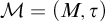 $\mathcal {M} = (M,\tau )$
be a WOT-separable tracial von Neumann algebra. Then the following are equivalent.
$\mathcal {M} = (M,\tau )$
be a WOT-separable tracial von Neumann algebra. Then the following are equivalent.
-
(1) $\operatorname {\mathrm {Th}}(\mathcal {M})$
admits quantifier elimination.
$\operatorname {\mathrm {Th}}(\mathcal {M})$
admits quantifier elimination. -
(2)
$\mathcal {M}$
is type I and any two projections p and q in
$\mathcal {M}$
with
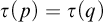
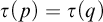
$\tau (p) = \tau (q)$
are conjugate by an automorphism of
$\mathcal {M}$
.


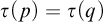

Since the quantifier-free type of a projection is determined by its trace, condition (2) asserts that projections with the same quantifier-free type are conjugate by an automorphism. We also give a more explicit description of when $\mathcal {M}$
admits quantifier elimination in Section 3.2.
$\mathcal {M}$
admits quantifier elimination in Section 3.2.
Special cases of tracial von Neumann algebras that admit quantifier elimination have been known for some time. For instance, a diffuse commutative tracial von Neumann algebra corresponds to an atomless probability space, which Ben Ya’acov and Usvyatsov showed admit quantifier elimination in [Reference Ben Yaacov and Usvyatsov13, Example 4.3] and [Reference Ben Yaacov10, Fact 2.10]. For further discussion, see [Reference Berenstein, Henson and Goldbring14] and [Reference Jekel and Goldbring51, Section 2.3]. The matrix algebras $M_n(\mathbb {C})$
also admit quantifier elimination thanks to the multivariate Specht’s theorem [Reference Jing54]. Indeed, this result shows that two matrix tuples are unitarily conjugate if and only if they have the same
$M_n(\mathbb {C})$
also admit quantifier elimination thanks to the multivariate Specht’s theorem [Reference Jing54]. Indeed, this result shows that two matrix tuples are unitarily conjugate if and only if they have the same $*$
-moments under the trace, or equivalently, the same quantifier-free type.Footnote
1
$*$
-moments under the trace, or equivalently, the same quantifier-free type.Footnote
1
The question of quantifier elimination for $\mathrm {II}_1$
factors was studied in [Reference Goldbring, Hart and Sinclair38, Section 2], which showed that the hyperfinite factor
$\mathrm {II}_1$
factors was studied in [Reference Goldbring, Hart and Sinclair38, Section 2], which showed that the hyperfinite factor $\mathcal {R}$
does not admit quantifier elimination, and this argument was observed in [Reference Goldbring, Hart and Goldbring37] to generalize to McDuff factors. Furthermore, the results of [Reference Goldbring, Hart and Sinclair38, Section 3] imply that Connes-embeddable factors not elementarily equivalent to
$\mathcal {R}$
does not admit quantifier elimination, and this argument was observed in [Reference Goldbring, Hart and Goldbring37] to generalize to McDuff factors. Furthermore, the results of [Reference Goldbring, Hart and Sinclair38, Section 3] imply that Connes-embeddable factors not elementarily equivalent to $\mathcal {R}$
are not model complete, hence also do not admit quantifier elimination. The first author [Reference Farah26] extended this argument to refute quantifier elimination for
$\mathcal {R}$
are not model complete, hence also do not admit quantifier elimination. The first author [Reference Farah26] extended this argument to refute quantifier elimination for $\mathrm {II}_1$
factors in general, and showed that tracial von Neumann algebras with a type
$\mathrm {II}_1$
factors in general, and showed that tracial von Neumann algebras with a type $\mathrm {II}_1$
summand never admit quantifier elimination. We also give another argument for this fact in Remark 5.5.
$\mathrm {II}_1$
summand never admit quantifier elimination. We also give another argument for this fact in Remark 5.5.
1.2 On model completeness
Model completeness, introduced by Abraham Robinson, can be viewed as a poor person’s version of quantifier elimination. A theory is model complete if every embedding between its models is elementary. While quantifier elimination means that every formula can be approximated by quantifier-free formulas, model completeness is equivalent to every formula being approximable by existential formulas (see §2.4). Thus, both quantifier elimination and model completeness are forms of quantifier reduction.
Another characterization of model completeness for $\operatorname {\mathrm {Th}}(\mathcal {M})$
, under the assumption of the Continuum Hypothesis, is that for every separable
$\operatorname {\mathrm {Th}}(\mathcal {M})$
, under the assumption of the Continuum Hypothesis, is that for every separable $\mathcal {A}$
and
$\mathcal {A}$
and $\mathcal {B}$
elementarily equivalent to
$\mathcal {B}$
elementarily equivalent to $\mathcal {M}$
, every embedding
$\mathcal {M}$
, every embedding $\mathcal {A} \to \mathcal {B}$
extends to an isomorphism
$\mathcal {A} \to \mathcal {B}$
extends to an isomorphism $\mathcal {A}^{\mathcal {U}} \to \mathcal {B}^{\mathcal {U}}$
for some ultrafilter
$\mathcal {A}^{\mathcal {U}} \to \mathcal {B}^{\mathcal {U}}$
for some ultrafilter $\mathcal {U}$
[Reference Farah25, Corollary 16.6.5].Footnote
2
Operator algebraists will recognize this property as a generalization of the property of the hyperfinite II
$\mathcal {U}$
[Reference Farah25, Corollary 16.6.5].Footnote
2
Operator algebraists will recognize this property as a generalization of the property of the hyperfinite II $_1$
factor
$_1$
factor $\mathcal {R}$
, that every embedding of
$\mathcal {R}$
, that every embedding of $\mathcal {R}$
into its ultrapower is unitarily equivalent to the diagonal embedding (the latter is elementary by Łoś’s theorem). By a standard ultrapower argument, this implies that every embedding of
$\mathcal {R}$
into its ultrapower is unitarily equivalent to the diagonal embedding (the latter is elementary by Łoś’s theorem). By a standard ultrapower argument, this implies that every embedding of $\mathcal {R}$
into a model of its theory,
$\mathcal {R}$
into a model of its theory, $\operatorname {\mathrm {Th}}(\mathcal {R})$
, is elementary; this property was studied in [Reference Atkinson, Goldbring and Kunnawalkam Elayavalli6] under the name of “generalized Jung property.” Note, however, that every embedding of
$\operatorname {\mathrm {Th}}(\mathcal {R})$
, is elementary; this property was studied in [Reference Atkinson, Goldbring and Kunnawalkam Elayavalli6] under the name of “generalized Jung property.” Note, however, that every embedding of $\mathcal {R}$
into its ultrapower being elementary does not mean that
$\mathcal {R}$
into its ultrapower being elementary does not mean that $\mathcal {R}$
is model complete, since model completeness would require that every
$\mathcal {R}$
is model complete, since model completeness would require that every $\mathcal {M}$
elementarily equivalent to
$\mathcal {M}$
elementarily equivalent to $\mathcal {R}$
also has the same property.
$\mathcal {R}$
also has the same property.
Among tracial von Neumann algebras, type I algebras are model complete [Reference Farah26] and algebras with a type II $_1$
summand are generally not model complete. Indeed, the only possible model complete theory for Connes-embeddable
$_1$
summand are generally not model complete. Indeed, the only possible model complete theory for Connes-embeddable $\mathrm {II}_1$
factors is
$\mathrm {II}_1$
factors is $\operatorname {\mathrm {Th}}(\mathcal {R})$
[Reference Goldbring, Hart and Sinclair38, Proposition 3.2]. Moreover, [Reference Goldbring, Hart and Sinclair38, Corollary 3.4] showed that if the Connes embedding problem has a positive solution, then there is no model complete theory of a
$\operatorname {\mathrm {Th}}(\mathcal {R})$
[Reference Goldbring, Hart and Sinclair38, Proposition 3.2]. Moreover, [Reference Goldbring, Hart and Sinclair38, Corollary 3.4] showed that if the Connes embedding problem has a positive solution, then there is no model complete theory of a $\mathrm {II}_1$
factor; however, a negative solution of the Connes embedding problem was announced in [Reference Ji, Natarajan, Vidick, Wright and Yuen53], so the question of characterizing model complete theories of II
$\mathrm {II}_1$
factor; however, a negative solution of the Connes embedding problem was announced in [Reference Ji, Natarajan, Vidick, Wright and Yuen53], so the question of characterizing model complete theories of II $_1$
factors was still open. It was conjectured in [Reference Farah26] that tracial von Neumann algebras with a nontrivial type
$_1$
factors was still open. It was conjectured in [Reference Farah26] that tracial von Neumann algebras with a nontrivial type $\mathrm {II}_1$
summand are never model complete, and our second main theorem establishes this conjecture under a mild additional hypothesis that the
$\mathrm {II}_1$
summand are never model complete, and our second main theorem establishes this conjecture under a mild additional hypothesis that the $\mathrm {II}_1$
factors in the decomposition satisfy that
$\mathrm {II}_1$
factors in the decomposition satisfy that $M_2(\mathcal {M})$
approximately embeds into
$M_2(\mathcal {M})$
approximately embeds into $\mathcal {M}$
.
$\mathcal {M}$
.
Theorem B. If $\mathcal {M}$
is a
$\mathcal {M}$
is a $\mathrm {II}_1$
factor such that
$\mathrm {II}_1$
factor such that $M_2(\mathcal {M})$
embeds into
$M_2(\mathcal {M})$
embeds into $\mathcal {M}^{\mathcal {U}}$
for some ultrafilter
$\mathcal {M}^{\mathcal {U}}$
for some ultrafilter $\mathcal {U}$
, then
$\mathcal {U}$
, then $\operatorname {\mathrm {Th}}(\mathcal {M})$
is not model complete.
$\operatorname {\mathrm {Th}}(\mathcal {M})$
is not model complete.
More generally, let $\mathcal {M}$
be a separable tracial von Neumann algebra with direct integral decomposition
$\mathcal {M}$
be a separable tracial von Neumann algebra with direct integral decomposition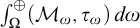 $\int _\Omega ^{\oplus } (\mathcal {M}_\omega ,\tau _\omega )\,d\omega $
. Suppose that on a positive measure set,
$\int _\Omega ^{\oplus } (\mathcal {M}_\omega ,\tau _\omega )\,d\omega $
. Suppose that on a positive measure set, $\mathcal {M}_\omega $
is a
$\mathcal {M}_\omega $
is a $\mathrm {II}_1$
factor such that
$\mathrm {II}_1$
factor such that $M_2(\mathcal {M}_\omega )$
embeds into
$M_2(\mathcal {M}_\omega )$
embeds into $\mathcal {M}_\omega ^{\mathcal {U}}$
for some ultrafilter
$\mathcal {M}_\omega ^{\mathcal {U}}$
for some ultrafilter $\mathcal {U}$
. Then
$\mathcal {U}$
. Then $\operatorname {\mathrm {Th}}(\mathcal {M})$
is not model complete.
$\operatorname {\mathrm {Th}}(\mathcal {M})$
is not model complete.
The assumption that $M_2(\mathcal {M})$
embeds into an ultrapower of
$M_2(\mathcal {M})$
embeds into an ultrapower of $\mathcal {M}$
is closely related to [Reference Goldbring and Hart36, Proposition 4.17], and is immediate in several cases of interest. For instance if
$\mathcal {M}$
is closely related to [Reference Goldbring and Hart36, Proposition 4.17], and is immediate in several cases of interest. For instance if $\mathcal {M}$
is Connes embeddable this holds because
$\mathcal {M}$
is Connes embeddable this holds because $M_2(\mathcal {M})$
embeds into
$M_2(\mathcal {M})$
embeds into $\mathcal {R}^{\mathcal {U}}$
and hence into
$\mathcal {R}^{\mathcal {U}}$
and hence into $M^{\mathcal {U}}$
(of course, Theorem B in the Connes embeddable case also follows from [Reference Goldbring, Hart and Sinclair38]). Another case where this condition is automatic is if
$M^{\mathcal {U}}$
(of course, Theorem B in the Connes embeddable case also follows from [Reference Goldbring, Hart and Sinclair38]). Another case where this condition is automatic is if $\mathcal {M}$
is existentially closed in the class of
$\mathcal {M}$
is existentially closed in the class of $\mathrm {II}_1$
factors, since by definition there is an embedding of
$\mathrm {II}_1$
factors, since by definition there is an embedding of $M_2(\mathcal {M})$
into
$M_2(\mathcal {M})$
into $\mathcal {M}^{\mathcal {U}}$
extending the diagonal embedding. The condition also holds automatically if
$\mathcal {M}^{\mathcal {U}}$
extending the diagonal embedding. The condition also holds automatically if $\mathcal {M}$
is McDuff, and more generally if its fundamental group is nontrivial; see Section 6.2. Although there are
$\mathcal {M}$
is McDuff, and more generally if its fundamental group is nontrivial; see Section 6.2. Although there are $\mathrm {II}_1$
factors such that
$\mathrm {II}_1$
factors such that $M_2(\mathcal {M})$
does not embed into
$M_2(\mathcal {M})$
does not embed into $\mathcal {M}$
[Reference Popa and Vaes60, Theorem C], it is unknown at this point whether there exists any
$\mathcal {M}$
[Reference Popa and Vaes60, Theorem C], it is unknown at this point whether there exists any $\mathrm {II}_1$
factor such that
$\mathrm {II}_1$
factor such that $M_2(\mathcal {M})$
does not embed into
$M_2(\mathcal {M})$
does not embed into $\mathcal {M}^{\mathcal {U}}$
. Since such an object would not be Connes-embeddable, it would no doubt be difficult to construct. In Section 6.2, we will discuss several conditions equivalent to
$\mathcal {M}^{\mathcal {U}}$
. Since such an object would not be Connes-embeddable, it would no doubt be difficult to construct. In Section 6.2, we will discuss several conditions equivalent to $M_2(\mathcal {M})$
embedding into
$M_2(\mathcal {M})$
embedding into $\mathcal {M}^{\mathcal {U}}$
.
$\mathcal {M}^{\mathcal {U}}$
.
The proof of Theorem B is divided into two parts. In the case of a $\mathrm {II}_1$
factor, we use a random matrix construction to create two tuples with similar behavior for their one-quantifier types, while their full types are distinguished by one having factorial commutant when the other does not. In fact, this approach gives explicit sentences distinguishing their types (see Section 4.5). The matrix construction shares some common ideas with [Reference Farah26], but also uses more substantial random matrix results such as Hastings’s quantum expander theorem [Reference Hastings45] and concentration of measure for random unitaries. Thus, this is a first application of the combination of model theory and random matrix theory envisaged in [Reference Jekel and Goldbring51, Section 6]. Already in [Reference Farah and Jang24, Section 5] it was predicted that deeper analysis of model theory of II
$\mathrm {II}_1$
factor, we use a random matrix construction to create two tuples with similar behavior for their one-quantifier types, while their full types are distinguished by one having factorial commutant when the other does not. In fact, this approach gives explicit sentences distinguishing their types (see Section 4.5). The matrix construction shares some common ideas with [Reference Farah26], but also uses more substantial random matrix results such as Hastings’s quantum expander theorem [Reference Hastings45] and concentration of measure for random unitaries. Thus, this is a first application of the combination of model theory and random matrix theory envisaged in [Reference Jekel and Goldbring51, Section 6]. Already in [Reference Farah and Jang24, Section 5] it was predicted that deeper analysis of model theory of II $_1$
factors will necessarily involve free probability.
$_1$
factors will necessarily involve free probability.
The extension to general tracial von Neumann algebras then requires two cases. If the von Neumann algebra is a direct integral over a diffuse space, with fibers $M_\omega $
, there is a direct argument to show the failure of model completeness when
$M_\omega $
, there is a direct argument to show the failure of model completeness when $M_2(\mathcal {M}_\omega )$
embeds into
$M_2(\mathcal {M}_\omega )$
embeds into $\mathcal {M}_\omega ^{\mathcal {U}}$
(Lemma 5.4). The remaining piece is the observation that if
$\mathcal {M}_\omega ^{\mathcal {U}}$
(Lemma 5.4). The remaining piece is the observation that if $\mathcal {M}_1 \oplus \mathcal {M}_2$
is model complete, then both
$\mathcal {M}_1 \oplus \mathcal {M}_2$
is model complete, then both $\mathcal {M}_1$
and
$\mathcal {M}_1$
and $\mathcal {M}_2$
are model complete (Lemma 5.1).
$\mathcal {M}_2$
are model complete (Lemma 5.1).
1.3 Organization of this paper
In Section 2, we recall background on tracial von Neumann algebras and continuous model theory, including specific tests for quantifier elimination and model completeness. In Section 3.1, we prove Theorem A, and in Section 3.2, we give several more explicit tests for quantifier elimination. In §4, we prove Theorem B in the case of $\mathrm {II}_1$
factors. Then in Section 5, we prove the general case, relying on the fact that model completeness passes to direct summands (Section 5.1). In the final section we give closing remarks: in Section 6.1 we discuss topological properties of theories of von Neumann algebras that have quantifier elimination or model completeness, Section 6.2 is about the condition of
$\mathrm {II}_1$
factors. Then in Section 5, we prove the general case, relying on the fact that model completeness passes to direct summands (Section 5.1). In the final section we give closing remarks: in Section 6.1 we discuss topological properties of theories of von Neumann algebras that have quantifier elimination or model completeness, Section 6.2 is about the condition of $M_2(\mathcal {M})$
embedding to
$M_2(\mathcal {M})$
embedding to $\mathcal {M}^{\mathcal {U}}$
, and Section 6.3 is about quantifier elimination and model completeness in the non-tracial setting.
$\mathcal {M}^{\mathcal {U}}$
, and Section 6.3 is about quantifier elimination and model completeness in the non-tracial setting.
2 Preliminaries
2.1 Tracial von Neumann algebras
We assume familiarity with tracial von Neumann algebras, and recommend [Reference Ioana and Goldbring49] for an introduction to the topic, as well as the standard reference books [Reference Blackadar15, Reference Dixmier22, Reference Kadison and Ringrose56, Reference Sakai61, Reference Takesaki62, Reference Zhu65]. In particular, we use the following notions and conventions:
-
• A tracial von Neumann algebra is a finite von Neumann algebra with a specified tracial state.
-
• The tracial state on
$\mathcal {M}$
will usually be denoted by
$\tau $
or
$\tau _{\mathcal {M}}$
. -
• The normalized trace on
$M_n(\mathbb {C})$
will be denoted by
$\operatorname {\mathrm {tr}}_n$
. -
• We also write
$\left \lVert x \right \rVert _2 = \tau (x^{*}x)^{1/2}$
when x is an element of a tracial von Neumann algebra, and in particular when x is a matrix,
$\left \lVert x \right \rVert _2 = \operatorname {\mathrm {tr}}_n(x^{*}x)^{1/2}$
is the normalized Hilbert–Schmidt norm. -
• The completion of
$\mathcal {M}$
with respect to
$2$
-norm is denoted
$L^2(\mathcal {M})$
. -
• Inclusions and embeddings of tracial von Neumann algebras
$\mathcal {N} \subseteq \mathcal {M}$
are assumed to be trace-preserving
$*$
-homomorphisms. -
• If
$\mathcal {N} \subseteq \mathcal {M}$
, we denote by
$E_{\mathcal {N}}: \mathcal {M} \to \mathcal {N}$
the canonical conditional expectation; there is a unique conditional expectation that preserves the trace, and it is the restriction of the orthogonal projection
$L^2(\mathcal {M}) \to L^2(\mathcal {N})$
.








2.2 Continuous model theory
We also assume some familiarity with continuous model theory, specifically model theory for metric structures; see, e.g., [Reference Ben Yaacov, Berenstein, Henson, Usvyatsov, Chatzidakis, Macpherson, Pillay and Wilkie11, Reference Hart and Goldbring44]. In particular:
-
• The structures under consideration are metric spaces, and the metric d is one of the symbols in the language. The structure can have multiple sorts; for instance, for a von Neumann algebra, there is one sort for each operator norm ball.
-
• Relation symbols are
$\mathbb {R}$
-valued, so in particular formulas will take values in
$\mathbb {R}$
rather than evaluating to true/false. The relation symbols and function symbols are required to be uniformly continuous across all models. -
• Formulas are created in the usual recursive fashion with connectives from classical model theory replaced by continuous functions on
$\mathbb {R}$
, and the quantifiers
$\forall $
and
$\exists $
replaced with
$\sup $
and
$\inf $
(over appropriate bounded subsets of the von Neumann algebra). -
• For a language
$\mathcal {L}$
, and an
$\mathcal {L}$
-structure
$\mathcal {M}$
, by the theory of
$\mathcal {M}$
(denoted
$\mathrm {Th}(\mathcal {M})$
) we mean the set of all
$\mathcal {L}$
-sentences
$\varphi $
such that
$\varphi ^{\mathcal {M}} = 0$
, except in Section 6.1, where it is more convenient to consider the theory as a bounded functional on the algebra of all formulas into
$\mathbb R$
. -
• For an n-tuple
$\mathbf {a}$
coming from a structure
$\mathcal {M}$
, the type of
$\mathbf {a}$
is the map
$\operatorname {\mathrm {tp}}^{\mathcal {M}}(\mathbf {a}): \varphi \mapsto \varphi ^{\mathcal {M}}(\mathbf {a})$
which assigns to each
$\mathcal {L}$
-formula
$\varphi (x_1, \ldots , x_n)$
the value of
$\varphi ^{\mathcal {M}}(\mathbf {a})$
. More generally, we say that any map
$\mu $
which assigns a value
$\varphi (\mu ) \in \mathbb {R}$
to each
$\mathcal {L}$
-sentence
$\varphi $
in n-variables is an n-type. For any fixed n, the space of all n-types is denoted
$\mathbb {S}_n$
. Moreover, for a theory
$\mathrm {T}$
, by
$\mathbb {S}_n(\mathrm {T})$
we denote the space of n-types that arise in models of
$\mathrm {T}$
. -
• Quantifier-free formulas are those constructed recursively using connectives but no quantifiers. The quantifier-free type
$\operatorname {\mathrm {qftp}}^{\mathcal {M}}(\mathbf {a})$
is the restriction of
$\operatorname {\mathrm {tp}}^{\mathcal {M}}(\mathbf {a})$
to quantifier-free formulas. -
• The set
$\mathbb {S}_n(\mathrm {T})$
is equipped with the logic topology, which is the topology of pointwise convergence on
$\mathcal {L}$
-formulas, i.e., the weak
$^{*}$
-topology. This makes
$\mathbb {S}_n(\mathrm {T})$
into a compact Hausdorff space. Dually, each formula
$\varphi $
defines a continuous function on
$\mathbb {S}_n(\mathrm {T})$
. -
• For any cardinal
$\kappa $
, we recall that a structure
$\mathcal {M}$
is
$\kappa $
-saturated if every consistent type with parameters from a set
$A \subseteq M$
with
$|A| \leq \kappa $
is realized by some tuple
$\mathbf {a}$
from
$\mathcal {M}$
. (For operator algebraists, we note that a type is consistent with the theory of
$\mathcal {M}$
if it is in the weak
$^{*}$
-closure of the maps
$\operatorname {\mathrm {tp}}^{\mathcal {M}}(\mathbf {a})$
for tuples
$\mathbf {a} \in \mathcal {M}$
. Thus, countable ultraproducts of structures are countably saturated.)




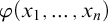


The language for tracial von Neumann algebras as metric structures was developed in [Reference Farah, Hart and Sherman30], and other useful references include [Reference Jekel50, Section 2] and [Reference Goldbring, Hart and Goldbring37]. The sorts in this language are operator-norm balls, the functions are addition, multiplication, scalar multiplication, and adjoint, and the relation symbols are $\operatorname {\mathrm {Re}} \operatorname {\mathrm {tr}}$
and the distance
$\operatorname {\mathrm {Re}} \operatorname {\mathrm {tr}}$
and the distance $d(x,y) = \left \lVert x - y \right \rVert _2$
. All ultraproducts considered in this work are tracial; see [Reference Farah, Hart and Sherman31, Section 2.2] for a formal construction of tracial ultraproducts, and [Reference Farah25, Section 16] or [Reference Hart and Goldbring44, Sections 2 and 6] for more background on ultrafilters and ultraproducts in continuous model theory.
$d(x,y) = \left \lVert x - y \right \rVert _2$
. All ultraproducts considered in this work are tracial; see [Reference Farah, Hart and Sherman31, Section 2.2] for a formal construction of tracial ultraproducts, and [Reference Farah25, Section 16] or [Reference Hart and Goldbring44, Sections 2 and 6] for more background on ultrafilters and ultraproducts in continuous model theory.
2.3 Definable sets
Lastly, in many arguments below we will need the notion of a definable set. These are sets that we are able to quantify over, without formally being a part of our language; see for instance [Reference Ben Yaacov, Berenstein, Henson, Usvyatsov, Chatzidakis, Macpherson, Pillay and Wilkie11, Theorem 9.17] and [Reference Farah, Hart, Lupini, Robert, Tikuisis, Vignati and Winter28, Definition 3.2.3 and Lemma 3.2.5]. In particular, when a is a definable element in some structure, then we can refer to it as if it were an interpretation of a constant symbol in our language. We will use the following characterization of definable sets over a subset A relative to a structure $\mathcal {M}$
, and refer the reader to [Reference Ben Yaacov, Berenstein, Henson, Usvyatsov, Chatzidakis, Macpherson, Pillay and Wilkie11, Section 9], [Reference Goldbring and Iovino34, Section 2], and [Reference Farah, Hart, Lupini, Robert, Tikuisis, Vignati and Winter28, Section 3] for more information on definability.
$\mathcal {M}$
, and refer the reader to [Reference Ben Yaacov, Berenstein, Henson, Usvyatsov, Chatzidakis, Macpherson, Pillay and Wilkie11, Section 9], [Reference Goldbring and Iovino34, Section 2], and [Reference Farah, Hart, Lupini, Robert, Tikuisis, Vignati and Winter28, Section 3] for more information on definability.
Fact 2.1. Fix a structure $\mathcal {M}$
and some subset
$\mathcal {M}$
and some subset $A \subseteq M$
. Suppose
$A \subseteq M$
. Suppose $Z \subseteq M^n$
is a closed subset. Then Z is a definable set in
$Z \subseteq M^n$
is a closed subset. Then Z is a definable set in $\mathcal {M}$
over A if and only if for every
$\mathcal {M}$
over A if and only if for every $\epsilon> 0$
, there exist
$\epsilon> 0$
, there exist $\delta> 0$
and a formula
$\delta> 0$
and a formula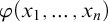 $\varphi (x_1, \ldots , x_n)$
, possibly using parameters from A, such that for any
$\varphi (x_1, \ldots , x_n)$
, possibly using parameters from A, such that for any $\mathbf {x} \in M^n$
,
$\mathbf {x} \in M^n$
,
 $$\begin{align*}\varphi^{\mathcal{M}}(\mathbf{x}) < \delta \implies d(\mathbf{x}, Z) \leq \epsilon. \end{align*}$$
If we say a set is definable in $\mathcal {M}$
, then we mean it is definable in
$\mathcal {M}$
, then we mean it is definable in $\mathcal {M}$
over the empty set.
$\mathcal {M}$
over the empty set.
2.4 Quantifier elimination and model completeness
Recall that a theory $\mathrm {T}$
is said to admit quantifier elimination if every
$\mathrm {T}$
is said to admit quantifier elimination if every $\mathcal {L}$
-formula
$\mathcal {L}$
-formula $\varphi $
can be approximated uniformly across all models of
$\varphi $
can be approximated uniformly across all models of $\mathrm {T}$
by quantifier-free
$\mathrm {T}$
by quantifier-free $\mathcal {L}$
-formulas. We will use the following characterization of quantifier elimination in terms of types. A closely related statement for positive bounded logic is given in [Reference Henson, Iovino, Finet and Michaux46, Proposition 14.21]. The statement given here follows for instance from the proof of [Reference Jekel and Goldbring51, Lemma 2.14].
$\mathcal {L}$
-formulas. We will use the following characterization of quantifier elimination in terms of types. A closely related statement for positive bounded logic is given in [Reference Henson, Iovino, Finet and Michaux46, Proposition 14.21]. The statement given here follows for instance from the proof of [Reference Jekel and Goldbring51, Lemma 2.14].
Lemma 2.2. Let $\mathrm {T}$
be an
$\mathrm {T}$
be an $\mathcal {L}$
-theory. Then the following are equivalent:
$\mathcal {L}$
-theory. Then the following are equivalent:
-
(1)
$\mathrm {T}$
admits quantifier elimination. -
(2) For every n and every
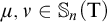
$\mu , \nu \in \mathbb {S}_n(\mathrm {T})$
, if
$\mu $
and
$\nu $
agree on quantifier-free formulas, then
$\mu = \nu $
.



There is an analogous characterization for model completeness, which can be regarded as a folklore result since it closely parallels what happens in discrete model theory (see, e.g., [Reference Hirschfeld47, Theorem 2.2]). Recall that an inf formula, or existential formula, is a formula obtained by preceding a quantifier-free formula with one or more $\inf $
-quantifiers.
$\inf $
-quantifiers.
Lemma 2.3. Let $\mathrm {T}$
be an
$\mathrm {T}$
be an $\mathcal {L}$
-theory. Then the following are equivalent:
$\mathcal {L}$
-theory. Then the following are equivalent:
-
(1)
$\mathrm {T}$
is model complete, i.e., if
$\mathcal {M}$
and
$\mathcal {N}$
are models of
$\mathrm {T}$
, then every embedding
$\mathcal {M} \to \mathcal {N}$
is an elementary embedding. -
(2) For every n and every pair
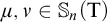
$\mu , \nu \in \mathbb {S}_n(\mathrm {T})$
, if
$\psi (\mu ) \leq \psi (\nu )$
for every
$\inf $
-formula
$\psi $
, then
$\mu = \nu $
. -
(3) For every
$\mathcal {L}$
-formula
$\varphi $
and
$\epsilon> 0$
, there exists an inf-formula
$\psi $
such that
$|\varphi - \psi | < \epsilon $
(on the appropriate sort or domain) for all models of
$\mathrm {T}$
.





The proof is similar to the quantifier elimination case, but more technical. Since it has not been explicitly given in the literature for metric structures to our knowledge, we include the proof as an appendix. The fact that quantifier elimination implies model completeness is immediate since Lemma 2.2 (1) implies Lemma 2.2 (3), or alternatively since Lemma 2.2 (2) implies Lemma 2.3 (2).
3 Quantifier elimination for tracial von Neumann algebras
3.1 Proof of Theorem A
Toward the proof of Theorem A, first note that we can restrict our attention to type I algebras. Indeed, the first author already showed that any tracial von Neumann algebra with a type II $_1$
summand does not admit quantifier elimination [Reference Farah26, Theorem 1] (another argument is given in Remark 5.5 below). The next lemma will similarly allow us to eliminate summands of the form
$_1$
summand does not admit quantifier elimination [Reference Farah26, Theorem 1] (another argument is given in Remark 5.5 below). The next lemma will similarly allow us to eliminate summands of the form $M_n(\mathbb {C}) \otimes L^\infty [0,1]$
with
$M_n(\mathbb {C}) \otimes L^\infty [0,1]$
with $n \geq 2$
, by showing that if either (1) or (2) in Theorem A happens, then there can be no such summands.
$n \geq 2$
, by showing that if either (1) or (2) in Theorem A happens, then there can be no such summands.
Lemma 3.1. Suppose that $\mathcal {M}$
is a tracial von Neumann algebra. Assume either that
$\mathcal {M}$
is a tracial von Neumann algebra. Assume either that $\operatorname {\mathrm {Th}}(\mathcal {M})$
admits quantifier elimination or that any two projections of the same trace are conjugate by an automorphism of
$\operatorname {\mathrm {Th}}(\mathcal {M})$
admits quantifier elimination or that any two projections of the same trace are conjugate by an automorphism of $\mathcal {M}$
. Then
$\mathcal {M}$
. Then $\mathcal {M}$
cannot have a direct summand of the form
$\mathcal {M}$
cannot have a direct summand of the form $M_n(\mathbb {C}) \otimes L^\infty [0,1]$
for
$M_n(\mathbb {C}) \otimes L^\infty [0,1]$
for $n \geq 2$
.
$n \geq 2$
.
Proof. By contrapositive, suppose that $\mathcal {M}$
has a direct summand of the form
$\mathcal {M}$
has a direct summand of the form $M_n(\mathbb {C}) \otimes L^\infty [0,1]$
. In
$M_n(\mathbb {C}) \otimes L^\infty [0,1]$
. In $M_n(\mathbb {C}) \otimes L^\infty [0,1]$
, consider the projections
$M_n(\mathbb {C}) \otimes L^\infty [0,1]$
, consider the projections $p = 1 \otimes \mathbf {1}_{[0,1/n]}$
and
$p = 1 \otimes \mathbf {1}_{[0,1/n]}$
and $q = E_{1,1} \otimes 1$
, where
$q = E_{1,1} \otimes 1$
, where $E_{1,1}$
is the canonical matrix unit in
$E_{1,1}$
is the canonical matrix unit in $M_n(\mathbb {C})$
. These two projections have the same trace, hence they have the same
$M_n(\mathbb {C})$
. These two projections have the same trace, hence they have the same $*$
-moments, i.e., the same quantifier-free type. However, they do not have the same type because p is central and q is not central in
$*$
-moments, i.e., the same quantifier-free type. However, they do not have the same type because p is central and q is not central in $M_n(\mathbb {C}) \otimes L^\infty [0,1]$
, hence also in
$M_n(\mathbb {C}) \otimes L^\infty [0,1]$
, hence also in $\mathcal {M}$
. So
$\mathcal {M}$
. So $\mathcal {M}$
cannot admit quantifier elimination. Furthermore, since p and q do not have the same type, they cannot be conjugate by an automorphism of
$\mathcal {M}$
cannot admit quantifier elimination. Furthermore, since p and q do not have the same type, they cannot be conjugate by an automorphism of $\mathcal {M}$
.
$\mathcal {M}$
.
Therefore, it suffices to prove Theorem A in the case where $\mathcal {M}$
is a direct sum of an optional
$\mathcal {M}$
is a direct sum of an optional $L^\infty [0,1]$
term and matrix algebras. Let us decompose
$L^\infty [0,1]$
term and matrix algebras. Let us decompose $\mathcal {M}$
as follows:
$\mathcal {M}$
as follows:
 $$\begin{align*}\mathcal{M} = (L^\infty[0,1], \alpha_0) \oplus \left( \bigoplus_{j \in J} (M_{n_j}(\mathbb{C}), \alpha_j) \right). \end{align*}$$
Here $\alpha _j$
, for
$\alpha _j$
, for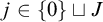 $j\in \{0\}\sqcup J$
, are the weights of the direct summands. Thus
$j\in \{0\}\sqcup J$
, are the weights of the direct summands. Thus $\alpha _0+\sum _{j\in J} n_j \alpha _j=1$
.
$\alpha _0+\sum _{j\in J} n_j \alpha _j=1$
.
We rely on the following classification of the automorphisms of $\mathcal {M}$
(for background on the structure theory for finite-dimensional algebras, see, e.g., [Reference Davidson21, Section 3.1], [Reference Jones and Sunder55, Section 3.2]). Every automorphism of
$\mathcal {M}$
(for background on the structure theory for finite-dimensional algebras, see, e.g., [Reference Davidson21, Section 3.1], [Reference Jones and Sunder55, Section 3.2]). Every automorphism of $\mathcal {M}$
is a composition of the following:
$\mathcal {M}$
is a composition of the following:
-
(1) A direct sum of automorphisms of each component (a measure-space automorphism of
$L^\infty [0,1]$
and a unitary conjugation of each
$M_n(\mathbb {C})$
term), -
(2) Swaps of matrix algebras
$M_n(\mathbb {C})$
of the same dimension and the same weight.


We first focus on the atomic portion.
Lemma 3.2. Suppose that $\mathcal {M}$
is a tracial von Neumann algebra such that any two projections of the same trace are conjugate by an automorphism of
$\mathcal {M}$
is a tracial von Neumann algebra such that any two projections of the same trace are conjugate by an automorphism of $\mathcal {M}$
. Then any two matrix summands of
$\mathcal {M}$
. Then any two matrix summands of $\mathcal {M}$
with a common dimension greater than or equal to 2 must have different weights.
$\mathcal {M}$
with a common dimension greater than or equal to 2 must have different weights.
Proof. Suppose there is some $j, k \in J$
so that
$j, k \in J$
so that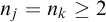 $n_j = n_k \geq 2$
, and
$n_j = n_k \geq 2$
, and $\alpha _j = \alpha _k$
. Let p be a projection of rank
$\alpha _j = \alpha _k$
. Let p be a projection of rank $2$
in the
$2$
in the $M_{n_j}(\mathbb {C})$
summand, and let q be a projection of rank
$M_{n_j}(\mathbb {C})$
summand, and let q be a projection of rank $1$
in both the
$1$
in both the $M_{n_j}(\mathbb {C})$
and
$M_{n_j}(\mathbb {C})$
and $M_{n_k}(\mathbb {C})$
summands (and p, q are both 0 in all other summands). Then
$M_{n_k}(\mathbb {C})$
summands (and p, q are both 0 in all other summands). Then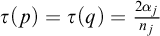 $\tau (p) = \tau (q) = \frac {2 \alpha _j}{n_j}$
, but p and q are not conjugate by any automorphism.
$\tau (p) = \tau (q) = \frac {2 \alpha _j}{n_j}$
, but p and q are not conjugate by any automorphism.
Proof of Theorem A.
(1) $\implies $
(2). Suppose that
$\implies $
(2). Suppose that $\mathcal {M}$
admits elimination of quantifiers. In order to deal with the diffuse
$\mathcal {M}$
admits elimination of quantifiers. In order to deal with the diffuse $L^\infty $
term and the atomic terms separately, we first show that the central projection
$L^\infty $
term and the atomic terms separately, we first show that the central projection $1_{L^\infty }$
is a definable element (see Section 2.3). Note that for each k, the set
$1_{L^\infty }$
is a definable element (see Section 2.3). Note that for each k, the set
 $$\begin{align*}S_k = \{e_1,\dots,e_k \in P(\mathcal{M}) \cap Z(\mathcal{M}): e_i e_j = 0, \tau(e_j) = \alpha_0/k \text{ for } i, j = 1, \dots, k \} \end{align*}$$
is definable using the definability of the center (see [Reference Farah, Hart and Sherman29, Lemma 4.2]) and the stability of projections. Moreover, if x is any element satisfying
 $$\begin{align*}\inf_{(e_1,\dots,e_k) \in S_k} d\left(x,\sum_{j=1}^k e_j \right) \leq \epsilon, \end{align*}$$
then x is $\epsilon $
-close to a central projection that is divisible into k central projections of trace
$\epsilon $
-close to a central projection that is divisible into k central projections of trace $\alpha _0/k$
. If k is large enough, then the sum of the weights of discrete summands that are less than or equal to
$\alpha _0/k$
. If k is large enough, then the sum of the weights of discrete summands that are less than or equal to $\alpha _0/k$
will be less than
$\alpha _0/k$
will be less than $\epsilon ^2$
. Hence,
$\epsilon ^2$
. Hence, $\sum _{j=1}^k e_j$
will be
$\sum _{j=1}^k e_j$
will be $2\epsilon $
-close to
$2\epsilon $
-close to $1_{L^\infty }$
. So
$1_{L^\infty }$
. So $1_{L^\infty }$
is definable.
$1_{L^\infty }$
is definable.
Let $p, q$
be two projections with the same trace. As noted in the proof of Lemma 3.1, p and q then have the same quantifier-free type and hence they have the same type. Because
$p, q$
be two projections with the same trace. As noted in the proof of Lemma 3.1, p and q then have the same quantifier-free type and hence they have the same type. Because $1_{L^\infty }$
is definable, every formula over
$1_{L^\infty }$
is definable, every formula over $L^\infty $
and every formula over
$L^\infty $
and every formula over $\mathcal {N} := \mathcal {M} \ominus L^\infty $
can be expressed as a definable predicate over
$\mathcal {N} := \mathcal {M} \ominus L^\infty $
can be expressed as a definable predicate over $\mathcal {M}$
. Thus,
$\mathcal {M}$
. Thus, $1_{L^\infty } p$
and
$1_{L^\infty } p$
and $1_{L^\infty }q$
have the same type in
$1_{L^\infty }q$
have the same type in $L^\infty [0,1]$
and
$L^\infty [0,1]$
and $(1_{\mathcal {N}})p$
and
$(1_{\mathcal {N}})p$
and $(1_{\mathcal {N}})q$
have the same type in
$(1_{\mathcal {N}})q$
have the same type in $\mathcal {N}$
. Then,
$\mathcal {N}$
. Then, $1_{L^\infty } p$
and
$1_{L^\infty } p$
and $1_{L^\infty }q$
are two projections of the same trace in
$1_{L^\infty }q$
are two projections of the same trace in $L^{\infty }[0,1]$
and therefore conjugate by an automorphism. Meanwhile,
$L^{\infty }[0,1]$
and therefore conjugate by an automorphism. Meanwhile, $(1 - 1_{L^\infty })p$
and
$(1 - 1_{L^\infty })p$
and $(1 - 1_{L^\infty })q$
have the same type in
$(1 - 1_{L^\infty })q$
have the same type in $\mathcal {N}$
, hence they are conjugate by an automorphism in some elementary extension
$\mathcal {N}$
, hence they are conjugate by an automorphism in some elementary extension $\tilde {\mathcal {N}}$
of
$\tilde {\mathcal {N}}$
of $\mathcal {N}$
. Since
$\mathcal {N}$
. Since $\mathcal {N}$
is type I and atomic,
$\mathcal {N}$
is type I and atomic, $\tilde {\mathcal {N}}$
must equal
$\tilde {\mathcal {N}}$
must equal $\mathcal {N}$
(see [Reference Farah and Ghasemi27, Proposition 4.3] or [Reference Jekel52, Proposition 3.7(2)]). Thus,
$\mathcal {N}$
(see [Reference Farah and Ghasemi27, Proposition 4.3] or [Reference Jekel52, Proposition 3.7(2)]). Thus, $(1_{\mathcal {N}})p$
and
$(1_{\mathcal {N}})p$
and $(1_{\mathcal {N}})q$
are conjugate by an automorphism of
$(1_{\mathcal {N}})q$
are conjugate by an automorphism of $\mathcal {N}$
, and so p and q are conjugate by an automorphism of
$\mathcal {N}$
, and so p and q are conjugate by an automorphism of $\mathcal {M}$
.
$\mathcal {M}$
.
(2) $\implies $
(1) Let
$\implies $
(1) Let $\mathrm {T} := \operatorname {\mathrm {Th}}(\mathcal {M})$
. We must check that every
$\mathrm {T} := \operatorname {\mathrm {Th}}(\mathcal {M})$
. We must check that every $\mathrm {T}$
type is determined by its quantifier-free type. First note that all
$\mathrm {T}$
type is determined by its quantifier-free type. First note that all $\mathrm {T}$
types can be realized in
$\mathrm {T}$
types can be realized in $\mathcal {M}$
; indeed,
$\mathcal {M}$
; indeed, $\mathcal {M}^{\mathcal {U}}$
is countably saturated (see Section 2.2) and is a direct sum of
$\mathcal {M}^{\mathcal {U}}$
is countably saturated (see Section 2.2) and is a direct sum of $L^\infty [0,1]^{\mathcal {U}}$
and
$L^\infty [0,1]^{\mathcal {U}}$
and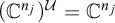 $(\mathbb {C}^{n_j})^{\mathcal {U}} = \mathbb {C}^{n_j}$
and
$(\mathbb {C}^{n_j})^{\mathcal {U}} = \mathbb {C}^{n_j}$
and ${M_{n_j}(\mathbb {C})^{\mathcal {U}} = M_{n_j}(\mathbb {C})}$
. Any tuple of elements in
${M_{n_j}(\mathbb {C})^{\mathcal {U}} = M_{n_j}(\mathbb {C})}$
. Any tuple of elements in $L^\infty [0,1]^{\mathcal {U}}$
has the same type as some tuple in
$L^\infty [0,1]^{\mathcal {U}}$
has the same type as some tuple in $L^\infty [0,1]$
, and swapping out the element in the
$L^\infty [0,1]$
, and swapping out the element in the $L^\infty [0,1]^{\mathcal {U}}$
summand for one of the same type will not change the type of the overall element in
$L^\infty [0,1]^{\mathcal {U}}$
summand for one of the same type will not change the type of the overall element in $\mathcal {M}^{\mathcal {U}}$
.
$\mathcal {M}^{\mathcal {U}}$
.
Fix some $\mathbf {x} = (x_1,\dots ,x_k)$
and
$\mathbf {x} = (x_1,\dots ,x_k)$
and $\mathbf {y} = (y_1,\dots ,y_k)$
in
$\mathbf {y} = (y_1,\dots ,y_k)$
in $\mathcal {M}$
with the same quantifier-free type. We shall build a sequence of automorphisms
$\mathcal {M}$
with the same quantifier-free type. We shall build a sequence of automorphisms $\sigma _n$
of
$\sigma _n$
of $\mathcal {M}$
such that
$\mathcal {M}$
such that $\sigma _n(\mathbf {x}) \rightarrow \mathbf {y}$
, so
$\sigma _n(\mathbf {x}) \rightarrow \mathbf {y}$
, so $\operatorname {\mathrm {tp}}^{\mathcal {M}}(\mathbf {x}) = \operatorname {\mathrm {tp}}^{\mathcal {M}}(\mathbf {y})$
. Since there are no identical matrix summands with the same weight by Lemma 3.2, the only possible automorphisms of
$\operatorname {\mathrm {tp}}^{\mathcal {M}}(\mathbf {x}) = \operatorname {\mathrm {tp}}^{\mathcal {M}}(\mathbf {y})$
. Since there are no identical matrix summands with the same weight by Lemma 3.2, the only possible automorphisms of $\mathcal {M}$
are those which are a direct sum of automorphisms of each component, possibly composed with swaps of copies of
$\mathcal {M}$
are those which are a direct sum of automorphisms of each component, possibly composed with swaps of copies of $\mathbb {C}$
which have the same weight. This motivates the following decomposition of
$\mathbb {C}$
which have the same weight. This motivates the following decomposition of $\mathcal {M}$
, where we group together copies of
$\mathcal {M}$
, where we group together copies of $\mathbb {C}$
which have the same weight:Footnote
3
$\mathbb {C}$
which have the same weight:Footnote
3
 $$ \begin{align} \mathcal{M} = (L^\infty[0,1], \alpha_0) \oplus \left( \bigoplus_{j \in J_1} (\mathbb{C}, \alpha_j)^{\oplus n_j} \right) \oplus \left( \bigoplus_{j \in J_2} (M_{n_j}(\mathbb{C}), \alpha_j) \right). \end{align} $$
We will build the automorphisms on each summand of (3.1) separately.
We start with the matrix summands. Let $p_j$
,
$p_j$
, $j \in J_2$
, be the central projection onto the jth summand
$j \in J_2$
, be the central projection onto the jth summand $M_{n_j}(\mathbb {C})$
, where
$M_{n_j}(\mathbb {C})$
, where $n_j \geq 2$
. We claim that
$n_j \geq 2$
. We claim that $p_j\mathbf {x} = (p_j x_1,\dots ,p_j x_k)$
and
$p_j\mathbf {x} = (p_j x_1,\dots ,p_j x_k)$
and ${p_j \mathbf {y} = (p_j y_1,\dots ,p_j y_k)}$
have the same quantifier-free type in
${p_j \mathbf {y} = (p_j y_1,\dots ,p_j y_k)}$
have the same quantifier-free type in $M_{n_j}(\mathbb {C})$
. Let f be a self-adjoint non-commutative
$M_{n_j}(\mathbb {C})$
. Let f be a self-adjoint non-commutative $*$
-polynomial. For Borel
$*$
-polynomial. For Borel $E \subseteq \mathbb {R}$
, we have
$E \subseteq \mathbb {R}$
, we have $\tau (1_E(f(\mathbf {x}))) = \tau (1_E(f(\mathbf {y})))$
, so by assumption there is some automorphism
$\tau (1_E(f(\mathbf {x}))) = \tau (1_E(f(\mathbf {y})))$
, so by assumption there is some automorphism $\sigma $
conjugating
$\sigma $
conjugating $1_E(f(\mathbf {x}))$
to
$1_E(f(\mathbf {x}))$
to $1_E(f(\mathbf {y}))$
. As noted above, the automorphism
$1_E(f(\mathbf {y}))$
. As noted above, the automorphism $\sigma $
must fix
$\sigma $
must fix $p_j$
, so
$p_j$
, so $\sigma (p_j 1_E(f(\mathbf {x}))) = p_j 1_E(f(\mathbf {y}))$
. Hence,
$\sigma (p_j 1_E(f(\mathbf {x}))) = p_j 1_E(f(\mathbf {y}))$
. Hence, $\tau (p_j 1_E(f(\mathbf {x}))) = \tau (p_j 1_E(f(\mathbf {y})))$
, or equivalently
$\tau (p_j 1_E(f(\mathbf {x}))) = \tau (p_j 1_E(f(\mathbf {y})))$
, or equivalently ${\operatorname {\mathrm {tr}}_{n_j}(1_E(f(p_j \mathbf {x}))) = \operatorname {\mathrm {tr}}_{n_j}(1_E(f(p_j \mathbf {y})))}$
. Since E was arbitrary,
${\operatorname {\mathrm {tr}}_{n_j}(1_E(f(p_j \mathbf {x}))) = \operatorname {\mathrm {tr}}_{n_j}(1_E(f(p_j \mathbf {y})))}$
. Since E was arbitrary, $f(p_j \mathbf {x})$
and
$f(p_j \mathbf {x})$
and $f(p_j \mathbf {y})$
have the same empirical spectral distribution, hence also
$f(p_j \mathbf {y})$
have the same empirical spectral distribution, hence also ${\operatorname {\mathrm {tr}}_n(f(p_j \mathbf {x})) = \operatorname {\mathrm {tr}}_n(f(p_j \mathbf {y}))}$
. This holds for all f, so the multivariate Specht’s theorem [Reference Jing54] implies that
${\operatorname {\mathrm {tr}}_n(f(p_j \mathbf {x})) = \operatorname {\mathrm {tr}}_n(f(p_j \mathbf {y}))}$
. This holds for all f, so the multivariate Specht’s theorem [Reference Jing54] implies that ${u_j p_j\mathbf {x}u_j^{*} = p_j \mathbf {y}}$
for some unitary
${u_j p_j\mathbf {x}u_j^{*} = p_j \mathbf {y}}$
for some unitary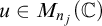 $u \in M_{n_j}(\mathbb {C})$
.
$u \in M_{n_j}(\mathbb {C})$
.
The same argument as in the matrix case shows that when $p_j$
for
$p_j$
for $j \in J_1$
is the central projection onto some summand of the form
$j \in J_1$
is the central projection onto some summand of the form $\mathbb {C}^{n_j}$
,
$\mathbb {C}^{n_j}$
, $n_j \geq 1$
, with each copy of
$n_j \geq 1$
, with each copy of $\mathbb {C}$
having the same weight
$\mathbb {C}$
having the same weight $\alpha _j$
, we obtain that
$\alpha _j$
, we obtain that $\operatorname {\mathrm {qftp}}^{\mathbb {C}^{n_j}} (p_j \mathbf {x}) = \operatorname {\mathrm {qftp}}^{\mathbb {C}^{n_j}}(p_j \mathbf {y})$
, so some automorphism (i.e., permutation)
$\operatorname {\mathrm {qftp}}^{\mathbb {C}^{n_j}} (p_j \mathbf {x}) = \operatorname {\mathrm {qftp}}^{\mathbb {C}^{n_j}}(p_j \mathbf {y})$
, so some automorphism (i.e., permutation) $\pi _j$
of
$\pi _j$
of $\mathbb {C}^{n_j}$
sends
$\mathbb {C}^{n_j}$
sends $p_j \mathbf {x}$
to
$p_j \mathbf {x}$
to $p_j \mathbf {y}$
.
$p_j \mathbf {y}$
.
Finally, let $p_0$
be the central projection onto the
$p_0$
be the central projection onto the $L^\infty [0,1]$
summand. Then
$L^\infty [0,1]$
summand. Then ${p_0 = 1 - \sum _{j \in J_1 \sqcup J_2} p_j}$
, where
${p_0 = 1 - \sum _{j \in J_1 \sqcup J_2} p_j}$
, where $p_j$
is the central projection onto the jth summand of
$p_j$
is the central projection onto the jth summand of $\mathcal {M}$
. Hence, for any non-commutative
$\mathcal {M}$
. Hence, for any non-commutative $*$
-polynomial f,
$*$
-polynomial f,
 $$\begin{align*}\tau(p_0 f(\mathbf{x})) = \tau(f(\mathbf{x})) - \sum_{j \in J_1 \sqcup J_2} \tau(p_j f(\mathbf{x})) = \tau(f(\mathbf{y})) - \sum_{j \in J_1 \sqcup J_2} \tau(p_j f(\mathbf{y})) = \tau(p_0 f(\mathbf{y})), \end{align*}$$
so we again obtain that $\operatorname {\mathrm {qftp}}^{L^\infty }(p_0 \mathbf {x}) = \operatorname {\mathrm {qftp}}^{L^\infty } (p_0 \mathbf {y})$
. By [Reference Jekel and Goldbring51, Lemma 2.16], there is a sequence of automorphisms
$\operatorname {\mathrm {qftp}}^{L^\infty }(p_0 \mathbf {x}) = \operatorname {\mathrm {qftp}}^{L^\infty } (p_0 \mathbf {y})$
. By [Reference Jekel and Goldbring51, Lemma 2.16], there is a sequence of automorphisms $\alpha _n$
of
$\alpha _n$
of $L^\infty [0,1]$
such that
$L^\infty [0,1]$
such that $\alpha _n(\mathbf {x}) \to \mathbf {y}$
.
$\alpha _n(\mathbf {x}) \to \mathbf {y}$
.
To conclude, let $\sigma _n$
be the direct sum of the automorphisms in each summand of
$\sigma _n$
be the direct sum of the automorphisms in each summand of $\mathcal {M}$
given by the arguments above, that is,
$\mathcal {M}$
given by the arguments above, that is,
 $$\begin{align*}\sigma_n = \alpha_n \oplus \bigoplus_{j \in J_1} \pi_j \oplus \bigoplus_{j \in J_2} \operatorname{Ad}_{u_j}. \end{align*}$$
Then $\sigma _n(\mathbf {x}) \to \mathbf {y}$
, so
$\sigma _n(\mathbf {x}) \to \mathbf {y}$
, so $\operatorname {\mathrm {tp}}^{\mathcal {M}}(\mathbf {x}) = \operatorname {\mathrm {tp}}^{\mathcal {M}}(\mathbf {y})$
. Hence,
$\operatorname {\mathrm {tp}}^{\mathcal {M}}(\mathbf {x}) = \operatorname {\mathrm {tp}}^{\mathcal {M}}(\mathbf {y})$
. Hence, $\mathcal {M}$
admits elimination of quantifiers by Lemma 2.2.
$\mathcal {M}$
admits elimination of quantifiers by Lemma 2.2.
3.2 Tests for quantifier elimination
The criterion for quantifier elimination of Theorem A, though simple, does not clearly indicate how to decide if a tracial von Neumann algebra admits quantifier elimination based on a given description as a direct sum of matrix algebras. So we now give more explicit criteria, starting with the following characterization in terms of possible obstructions.
Proposition 3.3. A separable tracial von Neumann algebra $\mathcal {M}$
admits quantifier elimination if and only if all the following conditions hold:
$\mathcal {M}$
admits quantifier elimination if and only if all the following conditions hold:
-
(1)
$\mathcal {M}$
is type I. -
(2)
$\mathcal {M}$
has no summands of the form
$M_n(\mathbb {C}) \otimes L^\infty [0,1]$
for
$n \geq 2$
. -
(3) If
$\mathcal {M}$
has an
$L^\infty [0,1]$
summand with weight
$\alpha _0$
, and if p and q are two projections in the atomic part, then either
$\tau (p) = \tau (q)$
or
$|\tau (p) - \tau (q)|> \alpha _0$
. -
(4) If p and q are two projections in the atomic part with
$\tau (p) = \tau (q)$
, then we have (letting
$E_ {Z(\mathcal {M})}$
denote the center-valued trace in
$\mathcal {M}$
)
$E_{Z(\mathcal {M})}[p] = \sigma \circ E_{Z(\mathcal {M})}[q]$
where
$\sigma $
is an automorphism of
$\mathcal {M}$
given by a permutation of one-dimensional summands with the same weight.











Proof. Suppose $\mathcal {M}$
admits quantifier elimination. Then [Reference Farah26, Theorem 1] implies (1) and Lemma 3.1 implies (2).
$\mathcal {M}$
admits quantifier elimination. Then [Reference Farah26, Theorem 1] implies (1) and Lemma 3.1 implies (2).
For (3), suppose for contradiction that there are two projections p and q in the atomic part with $0 < |\tau (p) - \tau (q)| \leq \alpha _0$
, and without loss of generality suppose that
$0 < |\tau (p) - \tau (q)| \leq \alpha _0$
, and without loss of generality suppose that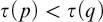 $\tau (p) < \tau (q)$
. Let
$\tau (p) < \tau (q)$
. Let $p'$
be a projection in
$p'$
be a projection in $L^\infty [0,1]$
such that
$L^\infty [0,1]$
such that $\tau (p') = \tau (q) - \tau (p)$
. Then q and
$\tau (p') = \tau (q) - \tau (p)$
. Then q and $p' + p$
have the same trace but are not equivalent by an automorphism, so by Theorem A,
$p' + p$
have the same trace but are not equivalent by an automorphism, so by Theorem A, $\mathcal {M}$
does not have quantifier elimination.
$\mathcal {M}$
does not have quantifier elimination.
For (4), let p and q be projections in the atomic part with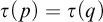 $\tau (p) = \tau (q)$
. By Theorem A, p and q are conjugate by an automorphism. Hence also
$\tau (p) = \tau (q)$
. By Theorem A, p and q are conjugate by an automorphism. Hence also $E_{Z(\mathcal {M})}[p]$
and
$E_{Z(\mathcal {M})}[p]$
and $E_{Z(\mathcal {M})}[q]$
are conjugate by an automorphism. In light of Lemma 3.2, every automorphism must fix the central projections associated with
$E_{Z(\mathcal {M})}[q]$
are conjugate by an automorphism. In light of Lemma 3.2, every automorphism must fix the central projections associated with $M_n(\mathbb {C})$
terms for
$M_n(\mathbb {C})$
terms for $n \geq 2$
. Thus,
$n \geq 2$
. Thus, $E_{Z(\mathcal {M})}[p]$
and
$E_{Z(\mathcal {M})}[p]$
and $E_{Z(\mathcal {M})}[q]$
must have equal components in each of the
$E_{Z(\mathcal {M})}[q]$
must have equal components in each of the $M_n(\mathbb {C})$
summands for
$M_n(\mathbb {C})$
summands for $n \geq 2$
. So they differ by an automorphism that merely permutes the one-dimensional summands.
$n \geq 2$
. So they differ by an automorphism that merely permutes the one-dimensional summands.
Conversely, assume (1)–(4). Let p and q be two projections of the same trace. Using (3), the traces of p and q in the $L^\infty [0,1]$
summand must agree, so there is an automorphism of
$L^\infty [0,1]$
summand must agree, so there is an automorphism of $\mathcal {M}$
such that
$\mathcal {M}$
such that $\alpha (p) - q$
is in the atomic part of
$\alpha (p) - q$
is in the atomic part of $\mathcal {M}$
. So assume without loss of generality that p and q are in the atomic part. By (4), after applying an automorphism, we can assume that
$\mathcal {M}$
. So assume without loss of generality that p and q are in the atomic part. By (4), after applying an automorphism, we can assume that $E_{Z(\mathcal {M})}[p] = E_{Z(\mathcal {M})}[q]$
. Hence, the components of p and q in each direct summand
$E_{Z(\mathcal {M})}[p] = E_{Z(\mathcal {M})}[q]$
. Hence, the components of p and q in each direct summand $M_n(\mathbb {C})$
of
$M_n(\mathbb {C})$
of $\mathcal {M}$
(where
$\mathcal {M}$
(where $n \geq 1$
), have the same rank, and hence are unitarily conjugate. Overall, p and q are conjugate by an automorphism. By Theorem A,
$n \geq 1$
), have the same rank, and hence are unitarily conjugate. Overall, p and q are conjugate by an automorphism. By Theorem A, $\mathcal {M}$
admits quantifier elimination.
$\mathcal {M}$
admits quantifier elimination.
Next, we describe how to test condition (4) for the atomic part in terms of the weights in the direct sum decomposition. As motivation, recall that by Lemma 3.2, two matrix algebras of the same dimension cannot have the same weight. In fact, there are many more constraints of a similar nature. For instance, if
 $$\begin{align*}\mathcal{M} = (\mathbb{C},1/2) \oplus (\mathbb{C},1/3) \oplus (\mathbb{C},1/6), \end{align*}$$
then $1 \oplus 0 \oplus 0$
and
$1 \oplus 0 \oplus 0$
and $0 \oplus 1 \oplus 1$
have the same trace but are not automorphically conjugate. Another example is if
$0 \oplus 1 \oplus 1$
have the same trace but are not automorphically conjugate. Another example is if
 $$\begin{align*}\mathcal{M} = (\mathbb{C},2/5) \oplus (M_3(\mathbb{C}),3/5), \end{align*}$$
then $\mathcal {M}$
does not admit quantifier elimination since a rank
$\mathcal {M}$
does not admit quantifier elimination since a rank $2$
projection in the second summand has the same trace as
$2$
projection in the second summand has the same trace as $1$
in the first summand. Hence, we must consider various ways that zero could be written as a linear combinations of ranks of projections from different summands. More generally, as in Proposition 3.3 (3), quantifier elimination requires that no number smaller than
$1$
in the first summand. Hence, we must consider various ways that zero could be written as a linear combinations of ranks of projections from different summands. More generally, as in Proposition 3.3 (3), quantifier elimination requires that no number smaller than $\alpha _0$
can be written as such a linear combination. This gives essentially all the conditions that are needed, though one must also handle the one-dimensional summands carefully since Lemma 3.2 only applies for
$\alpha _0$
can be written as such a linear combination. This gives essentially all the conditions that are needed, though one must also handle the one-dimensional summands carefully since Lemma 3.2 only applies for $n \geq 2$
.
$n \geq 2$
.
Proposition 3.4. Let $\mathcal {M}$
be a separable tracial von Neumann algebra. Then
$\mathcal {M}$
be a separable tracial von Neumann algebra. Then $\mathcal {M}$
admits quantifier elimination if and only if
$\mathcal {M}$
admits quantifier elimination if and only if $\mathcal {M}$
has a decomposition of the form:
$\mathcal {M}$
has a decomposition of the form:
 $$\begin{align*}\mathcal{M} = (L^\infty[0,1], \alpha_0) \oplus \left( \bigoplus_{j \in J_1} (\mathbb{C}, \alpha_j)^{\oplus n_j} \right) \oplus \left( \bigoplus_{j \in J_2} (M_{n_j}(\mathbb{C}), \alpha_j) \right), \end{align*}$$
where for some countable sets $J_1, J_2$
, such that
$J_1, J_2$
, such that
-
(1) The weights satisfy
$\alpha _0 \geq 0$
and
$\alpha _j> 0$
for
$j \in J_1 \cup J_2$
, and the weights sum to
$1$
. -
(2) The indices
$\alpha _j$
for
$j \in J_1$
are distinct, that is, we have grouped together all one-dimensional summands of the same weight in our decomposition. -
(3) For all choices of integers
$|r_j| \leq n_j$
for
$j \in J_1 \cup J_2$
which are not all zero, we have
$$\begin{align*}\left| \sum_{j \in J_1} r_j \alpha_j + \sum_{j \in J_2} \frac{r_j \alpha_j}{n_j} \right|> \alpha_0. \end{align*}$$


Proof. Suppose $\mathcal {M}$
admits quantifier elimination. We already know
$\mathcal {M}$
admits quantifier elimination. We already know $\mathcal {M}$
decomposes into an optional
$\mathcal {M}$
decomposes into an optional $L^\infty [0,1]$
term and an atomic part. By grouping the one-dimensional terms with the same weight, we obtain a direct sum decomposition satisfying conditions (1) and (2). It remains to check condition (3). By contrapositive, suppose that there exist integers
$L^\infty [0,1]$
term and an atomic part. By grouping the one-dimensional terms with the same weight, we obtain a direct sum decomposition satisfying conditions (1) and (2). It remains to check condition (3). By contrapositive, suppose that there exist integers $|r_j| \leq n_j$
satisfying
$|r_j| \leq n_j$
satisfying
 $$\begin{align*}\left| \sum_{j \in J_1} r_j \alpha_j + \sum_{j \in J_2} \frac{r_j \alpha_j}{n_j} \right| \leq \alpha_0. \end{align*}$$
For $j \in J_1$
, let
$j \in J_1$
, let $p_j$
and
$p_j$
and $q_j$
be projections in
$q_j$
be projections in $(\mathbb {C},\alpha _j)^{\oplus n_j}$
such that
$(\mathbb {C},\alpha _j)^{\oplus n_j}$
such that
 $$\begin{align*}\operatorname{\mathrm{rank}}(p_j) = \max(r_j,0), \qquad \operatorname{\mathrm{rank}}(q_j) = \max(-r_j,0). \end{align*}$$
Similarly, for $j \in J_2$
, let
$j \in J_2$
, let $p_j$
and
$p_j$
and $q_j$
be projections in
$q_j$
be projections in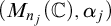 $(M_{n_j}(\mathbb {C}),\alpha _j)$
with the same rank conditions. Thus,
$(M_{n_j}(\mathbb {C}),\alpha _j)$
with the same rank conditions. Thus, $\operatorname {\mathrm {rank}}(p_j) - \operatorname {\mathrm {rank}}(q_j) = r_j$
. Finally, let
$\operatorname {\mathrm {rank}}(p_j) - \operatorname {\mathrm {rank}}(q_j) = r_j$
. Finally, let
 $$\begin{align*}t = \sum_{j \in J_1} r_j \alpha_j + \sum_{j \in J_2} \frac{r_j \alpha_j}{n_j}, \end{align*}$$
and let $p_0$
and
$p_0$
and $q_0$
be projections in
$q_0$
be projections in $(L^\infty [0,1],\alpha _0)$
such that
$(L^\infty [0,1],\alpha _0)$
such that $\tau (p_0) = \max (-t,0)$
and
$\tau (p_0) = \max (-t,0)$
and $\tau (q_0) = \max (t,0)$
, so that
$\tau (q_0) = \max (t,0)$
, so that $\tau (p_0) - \tau (q_0) = -t$
. Let
$\tau (p_0) - \tau (q_0) = -t$
. Let
 $$\begin{align*}p = p_0 \oplus \bigoplus_{j \in J_1} p_j \oplus \bigoplus_{j \in J_2} p_j, \qquad q = q_0 \oplus \bigoplus_{j \in J_1} q_j \oplus \bigoplus_{j \in J_2} q_j. \end{align*}$$
By construction,
 $$\begin{align*}\tau(p) - \tau(q) = \tau(p_0) - \tau(q_0) + \sum_{j \in J_1} \alpha_j r_j + \sum_{j \in J_2} \frac{\alpha_j r_j}{n_j} = 0. \end{align*}$$
However, p and q are not automorphically conjugate. Indeed, $r_j$
is nonzero for some j. If
$r_j$
is nonzero for some j. If $j \in J_1$
, the components of p and q in the central summand
$j \in J_1$
, the components of p and q in the central summand $(\mathbb {C},\alpha _j)^{\oplus n_j}$
have different ranks, and
$(\mathbb {C},\alpha _j)^{\oplus n_j}$
have different ranks, and $(\mathbb {C},\alpha _j)^{\oplus n_j}$
is invariant under automorphisms because we grouped together all the terms with the same weight. Similarly, if
$(\mathbb {C},\alpha _j)^{\oplus n_j}$
is invariant under automorphisms because we grouped together all the terms with the same weight. Similarly, if $j \in J_2$
, then the components of p and q in
$j \in J_2$
, then the components of p and q in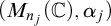 $(M_{n_j}(\mathbb {C}),\alpha _j)$
have different ranks, and by Lemma 3.2,
$(M_{n_j}(\mathbb {C}),\alpha _j)$
have different ranks, and by Lemma 3.2,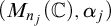 $(M_{n_j}(\mathbb {C}),\alpha _j)$
must be invariant under automorphisms since there is only one summand with a given dimension and weight. Hence, if (3) does not hold, then
$(M_{n_j}(\mathbb {C}),\alpha _j)$
must be invariant under automorphisms since there is only one summand with a given dimension and weight. Hence, if (3) does not hold, then $\operatorname {\mathrm {Th}}(\mathcal {M})$
does not admit quantifier elimination.
$\operatorname {\mathrm {Th}}(\mathcal {M})$
does not admit quantifier elimination.
Conversely, suppose $\mathcal {M}$
has a decomposition satisfying (1)–(3). Consider two projections
$\mathcal {M}$
has a decomposition satisfying (1)–(3). Consider two projections $p = p_0 \oplus \bigoplus _{j \in J_1 \sqcup J_2} p_j$
and
$p = p_0 \oplus \bigoplus _{j \in J_1 \sqcup J_2} p_j$
and $q= q_0 \oplus \bigoplus _{j \in J_1 \sqcup J_2} q_j$
in
$q= q_0 \oplus \bigoplus _{j \in J_1 \sqcup J_2} q_j$
in $\mathcal {M}$
with the same trace. Then
$\mathcal {M}$
with the same trace. Then
 $$\begin{align*}\tau(p_0) - \tau(q_0) = \sum_{j \in J_1 \sqcup J_2} \frac{\alpha_j (\text{rank}(q_j) - \text{rank}(p_j))}{n_j}. \end{align*}$$
Hence,
 $$\begin{align*}\left| \sum_{j \in J_1} \alpha_j (\operatorname{rank}(q_j) - \operatorname{rank}(p_j)) + \sum_{j \in J_2} \frac{\alpha_j (\operatorname{rank}(q_j) - \operatorname{rank}(p_j))}{n_j} \right| = |\tau(p_0) - \tau(q_0)| \leq \alpha_0. \end{align*}$$
By condition (3), this forces $\operatorname {\mathrm {rank}}(p_j) = \operatorname {\mathrm {rank}}(q_j)$
for all
$\operatorname {\mathrm {rank}}(p_j) = \operatorname {\mathrm {rank}}(q_j)$
for all $j \in J_1 \sqcup J_2$
. In particular, for
$j \in J_1 \sqcup J_2$
. In particular, for $j \in J_1$
,
$j \in J_1$
, $p_j$
and
$p_j$
and $q_j$
are projections in
$q_j$
are projections in $(\mathbb {C},\alpha _j)^{\oplus n_j}$
with the same rank and hence conjugate by an automorphism permuting the summands. Moreover, for
$(\mathbb {C},\alpha _j)^{\oplus n_j}$
with the same rank and hence conjugate by an automorphism permuting the summands. Moreover, for $j \in J_2$
,
$j \in J_2$
, $p_j$
and
$p_j$
and $q_j$
are projections in
$q_j$
are projections in $M_{n_j}(\mathbb {C})$
with the same rank, hence they are unitarily conjugate. Finally, since
$M_{n_j}(\mathbb {C})$
with the same rank, hence they are unitarily conjugate. Finally, since $p_j$
and
$p_j$
and $q_j$
have the same trace for
$q_j$
have the same trace for $j \in J_1 \sqcup J_2$
, we deduce that
$j \in J_1 \sqcup J_2$
, we deduce that $p_0$
and
$p_0$
and $q_0$
have the same trace in
$q_0$
have the same trace in $L^\infty [0,1]$
and hence they are conjugate by a measure-preserving transformation. Patching the automorphisms on each summand together, p and q are automorphically conjugate. Thus, by Theorem A,
$L^\infty [0,1]$
and hence they are conjugate by a measure-preserving transformation. Patching the automorphisms on each summand together, p and q are automorphically conjugate. Thus, by Theorem A, $\mathcal {M}$
has quantifier elimination.
$\mathcal {M}$
has quantifier elimination.
4 Model completeness for
$\mathrm {II}_1$
factors

This section proves Theorem B in the case of a $\mathrm {II}_1$
factor
$\mathrm {II}_1$
factor $\mathcal {M}$
. The proof is a more sophisticated variant of [Reference Farah26, Lemma 2.1], which was in turn based on [Reference Brown17, Corollary 6.11].
$\mathcal {M}$
. The proof is a more sophisticated variant of [Reference Farah26, Lemma 2.1], which was in turn based on [Reference Brown17, Corollary 6.11].
Our construction is based on random matrix theory. Let $\mathbb {U}_n$
denote the unitary group of
$\mathbb {U}_n$
denote the unitary group of $M_n(\mathbb C)$
. As a compact Lie group,
$M_n(\mathbb C)$
. As a compact Lie group, $\mathbb {U}_n$
has a unique left-invariant probability measure, called the Haar measure. By a Haar random unitary, we mean a
$\mathbb {U}_n$
has a unique left-invariant probability measure, called the Haar measure. By a Haar random unitary, we mean a $\mathbb {U}_n$
-valued random variable
$\mathbb {U}_n$
-valued random variable $U^{(n)}$
whose probability distribution is the Haar measure, i.e.,
$U^{(n)}$
whose probability distribution is the Haar measure, i.e., $\mathbb {E}[f(U^{(n)})] = \int _{\mathbb {U}_n} f(u)\,d\operatorname {Haar}(u)$
for every continuous function f on
$\mathbb {E}[f(U^{(n)})] = \int _{\mathbb {U}_n} f(u)\,d\operatorname {Haar}(u)$
for every continuous function f on $\mathbb {U}_n$
. Let
$\mathbb {U}_n$
. Let $U_1^{(n)}$
,
$U_1^{(n)}$
, $U_2^{(n)}$
,
$U_2^{(n)}$
, $U_3^{(n)}$
, and
$U_3^{(n)}$
, and $U_4^{(n)}$
be independent Haar random unitaries. We assume throughout that they are on the same probability space
$U_4^{(n)}$
be independent Haar random unitaries. We assume throughout that they are on the same probability space $(\Omega ,\mathcal {F},P)$
.
$(\Omega ,\mathcal {F},P)$
.
Consider the tensor decomposition $\mathcal {M} \cong M_n(\mathbb {C}) \otimes \mathcal {M}^{1/n}$
, where
$\mathcal {M} \cong M_n(\mathbb {C}) \otimes \mathcal {M}^{1/n}$
, where $\mathcal {M}^{1/n}$
is the
$\mathcal {M}^{1/n}$
is the $1/n$
compression of
$1/n$
compression of $\mathcal {M}$
[Reference Murray and von Neumann58, Sections 2.6–2.8]; for each n, we fix a decomposition for the entire argument, and write
$\mathcal {M}$
[Reference Murray and von Neumann58, Sections 2.6–2.8]; for each n, we fix a decomposition for the entire argument, and write $\mathcal {M} = M_n(\mathbb {C}) \otimes \mathcal {M}^{1/n}$
. We set
$\mathcal {M} = M_n(\mathbb {C}) \otimes \mathcal {M}^{1/n}$
. We set
 $$\begin{align*}\mathbf{X}^{(n)} = (X_1^{(n)},X_2^{(n)},X_3^{(n)}) = (U_1^{(n)} \otimes 1_{\mathcal{M}^{1/n}},U_2^{(n)} \otimes 1_{\mathcal{M}^{1/n}}, U_3^{(n)} \otimes 1_{\mathcal{M}^{1/n}}) \end{align*}$$
and
 $$\begin{align*}\mathbf{Y}^{(n)} = (Y_1^{(n)},Y_2^{(n)},Y_3^{(n)}) = ((U_1^{(n)} \oplus U_1^{(n)}) \otimes 1_{\mathcal{M}^{1/2n}}, (U_2^{(n)} \oplus U_2^{(n)}) \otimes 1_{\mathcal{M}^{1/2n}}, (U_3^{(n)} \oplus U_4^{(n)}) \otimes 1_{\mathcal{M}^{1/2n}}). \end{align*}$$
Fix a free ultrafilter $\mathcal {U}$
on
$\mathcal {U}$
on $\mathcal {N}$
and consider
$\mathcal {N}$
and consider $\mathbf {X}(\omega ) = [\mathbf {X}^{(n)}(\omega )]_{n \in \mathcal {N}}$
and
$\mathbf {X}(\omega ) = [\mathbf {X}^{(n)}(\omega )]_{n \in \mathcal {N}}$
and $\mathbf {Y}(\omega ) = [\mathbf {Y}^{(n)}(\omega )]_{n \in \mathbb {N}}$
. Thus,
$\mathbf {Y}(\omega ) = [\mathbf {Y}^{(n)}(\omega )]_{n \in \mathbb {N}}$
. Thus, $\mathbf {X}$
and
$\mathbf {X}$
and $\mathbf {Y}$
are intuitively tuples of random elements of
$\mathbf {Y}$
are intuitively tuples of random elements of $\mathcal {M}^{\mathcal {U}}$
; however, we have to proceed carefully because
$\mathcal {M}^{\mathcal {U}}$
; however, we have to proceed carefully because $\mathbf {X}$
and
$\mathbf {X}$
and $\mathbf {Y}$
are not necessarily measurable functions of
$\mathbf {Y}$
are not necessarily measurable functions of $\omega $
(see [Reference Gao and Jekel33, Section 6]). Thus, formally, our arguments are based on first fixing an outcome
$\omega $
(see [Reference Gao and Jekel33, Section 6]). Thus, formally, our arguments are based on first fixing an outcome $\omega $
for which the
$\omega $
for which the $\mathbf {X}^{(n)}$
’s satisfy some conditions, and then using the values of
$\mathbf {X}^{(n)}$
’s satisfy some conditions, and then using the values of $\mathbf {X}$
and
$\mathbf {X}$
and $\mathbf {Y}$
associated with this
$\mathbf {Y}$
associated with this $\omega $
.
$\omega $
.
4.1 Outline of the proof
The outline of the argument is as follows:
-
(1) Almost surely, for every
$\inf $
-formula
$\varphi $
,
$\varphi ^{\mathcal {M}^{\mathcal {U}}}(\mathbf {Y}) \leq \varphi ^{\mathcal {M}^{\mathcal {U}}}(\mathbf {X})$
. -
(2) Almost surely, the commutant
$\mathbf {X}' \cap \mathcal {M}^{\mathcal {U}}$
is given by
$$\begin{align*}\mathcal{A} = \prod_{n \to \mathcal{U}} (\mathbb{C} 1_{M_n(\mathbb{C})} \otimes \mathcal{M}^{1/n}) \subseteq \prod_{n \to \mathcal{U}} (M_n(\mathbb{C}) \otimes \mathcal{M}^{1/n}). \end{align*}$$
-
(3) Almost surely, the commutant
$\mathbf {Y}' \cap \mathcal {M}^{\mathcal {U}}$
is given by
$$\begin{align*}\mathcal{B} = \prod_{n \to \mathcal{U}} [(\mathbb{C} 1_{M_n(\mathbb{C})} \oplus \mathbb{C} 1_{M_n(\mathbb{C})}) \otimes \mathcal{M}^{1/2n}] \subseteq \prod_{n \to \mathcal{U}} (M_{2n}(\mathbb{C}) \otimes \mathcal{M}^{1/2n}). \end{align*}$$
-
(4) Consequently,
$\mathbf {X}' \cap \mathcal {M}^{\mathcal {U}}$
has trivial center but
$\mathbf {Y}' \cap \mathcal {M}^{\mathcal {U}}$
does not and so
$\mathbf {X}$
and
$\mathbf {Y}$
do not have the same type. -
(5) By Lemma 2.3 together with (1) and (4),
$\operatorname {\mathrm {Th}}(\mathcal {M})$
is not model complete.





The notation explained above will be fixed throughout the section. Moreover, we continue with the standing assumption that $M_2(\mathcal {M})$
embeds into
$M_2(\mathcal {M})$
embeds into $\mathcal {M}^{\mathcal {U}}$
for some ultrafilter
$\mathcal {M}^{\mathcal {U}}$
for some ultrafilter $\mathcal {U}$
, but this will only be used in the proof of (1), in Lemma 4.3.
$\mathcal {U}$
, but this will only be used in the proof of (1), in Lemma 4.3.
4.2 Concentration of measure and approximate embedding
For step (1), we use the following concentration of measure estimate which is based on the log-Sobolev inequality of Gross [Reference Gross41]. The application of concentration in random matrix theory is due to Ben Arous and Guionnet [Reference Ben Arous and Guionnet8]; see also [Reference Guionnet42] and [Reference Anderson, Guionnet and Zeitouni2, Sections 2.3 and 4.4].
Proposition 4.1 (See [Reference Anderson, Guionnet and Zeitouni2, Section 4.4 and Appendix F.6] and [Reference Meckes57, Theorems 5.16 and 5.17]).
Let ${f: \mathbb {U}_n^{\times m} \to \mathbb {R}}$
be an L-Lipschitz function with respect to
${f: \mathbb {U}_n^{\times m} \to \mathbb {R}}$
be an L-Lipschitz function with respect to $\left \lVert \cdot \right \rVert _2$
. Let
$\left \lVert \cdot \right \rVert _2$
. Let $\mathbf {U}^{(n)}$
be a random element of
$\mathbf {U}^{(n)}$
be a random element of $\mathbb {U}_n^{\times m}$
with probability distribution given by the Haar measure. Then for some positive constant c independent of n, for all
$\mathbb {U}_n^{\times m}$
with probability distribution given by the Haar measure. Then for some positive constant c independent of n, for all $\delta> 0$
,
$\delta> 0$
,
 $$\begin{align*}\mathbb{P}( |f(\mathbf{U}^{(n)}) - \mathbb{E}[f(\mathbf{U}^{(n)})]| \geq \delta) \leq e^{-cn^2 \delta / L^2}. \end{align*}$$
Lemma 4.2. For every $3$
-variable formula
$3$
-variable formula $\varphi $
, there is a constant
$\varphi $
, there is a constant $C(\varphi )$
such that
$C(\varphi )$
such that
 $$ \begin{align} \lim_{n \to \mathcal{U}} \varphi^{\mathcal{M}}(\mathbf{X}^{(n)}) = C(\varphi) \text{ for a.e. } \omega \in \Omega. \end{align} $$
In particular, $\lim _{n \to \mathcal {U}} \operatorname {\mathrm {tp}}^{\mathcal {M}}(\mathbf {X}^{(n)})$
is almost surely constant.
$\lim _{n \to \mathcal {U}} \operatorname {\mathrm {tp}}^{\mathcal {M}}(\mathbf {X}^{(n)})$
is almost surely constant.
Proof. To prove the claims, it suffices to show (4.1) holds almost surely for each $\varphi $
in a countable dense set of formulas (as usual in measure theory, “almost surely” distributes over countable conjunctions).
$\varphi $
in a countable dense set of formulas (as usual in measure theory, “almost surely” distributes over countable conjunctions).
In fact, the dense set of formulas can be chosen to be Lipschitz. Indeed, a formula will be Lipschitz as long as the atomic formulas and the connectives used are all Lipschitz; the quantifiers do not cause any issue since the supremum of a family of L-Lipschitz functions is L-Lipschitz. The atomic formulas are traces of non-commutative polynomials, and for every non-commutative polynomial p and $R> 0$
, there is some L such that
$R> 0$
, there is some L such that $\tau (p)$
is L-Lipschitz with respect to
$\tau (p)$
is L-Lipschitz with respect to $\left \lVert \cdot \right \rVert _2$
on each operator norm ball of radius R. The connectives in the language are continuous functions
$\left \lVert \cdot \right \rVert _2$
on each operator norm ball of radius R. The connectives in the language are continuous functions $\mathbb {R}^m \to \mathbb {R}$
, which can all be approximated on compact sets by Lipschitz functions.
$\mathbb {R}^m \to \mathbb {R}$
, which can all be approximated on compact sets by Lipschitz functions.
So assume that $\varphi $
is an L-Lipschitz formula in three variables. Note that
$\varphi $
is an L-Lipschitz formula in three variables. Note that $\mathbf {X}^{(n)}$
depends in a Lipschitz manner upon
$\mathbf {X}^{(n)}$
depends in a Lipschitz manner upon $\mathbf {U}^{(n)} = (U_1^{(n)},U_2^{(n)},U_3^{(n)})$
; indeed, the mapping
$\mathbf {U}^{(n)} = (U_1^{(n)},U_2^{(n)},U_3^{(n)})$
; indeed, the mapping $M_n(\mathbb {C}) \to \mathcal {M}$
given by
$M_n(\mathbb {C}) \to \mathcal {M}$
given by $u \mapsto u \otimes 1_{\mathcal {M}^{1/n}}$
is
$u \mapsto u \otimes 1_{\mathcal {M}^{1/n}}$
is $1$
-Lipschitz. In particular,
$1$
-Lipschitz. In particular, $\varphi ^{\mathcal {M}}(\mathbf {X}^{(n)})$
is an L-Lipschitz function of
$\varphi ^{\mathcal {M}}(\mathbf {X}^{(n)})$
is an L-Lipschitz function of $\mathbf {U}^{(n)}$
. Therefore, applying Proposition 4.1 with
$\mathbf {U}^{(n)}$
. Therefore, applying Proposition 4.1 with $\delta = 1/n$
,
$\delta = 1/n$
,
 $$\begin{align*}\mathbb{P}( |\varphi^{\mathcal{M}}(\mathbf{X}^{(n)}) - \mathbb{E}[\varphi^{\mathcal{M}}(\mathbf{X}^{(n)})])| \geq 1/n) \leq e^{-cn / L^2}. \end{align*}$$
By the Borel–Cantelli lemma, this implies that almost surely
 $$\begin{align*}\lim_{n \to \infty} |\varphi^{\mathcal{M}}(\mathbf{X}^{(n)}) - \mathbb{E}[\varphi^{\mathcal{M}}(\mathbf{X}^{(n)})]| = 0, \quad \text{hence} \quad \lim_{n \to \mathcal{U}} \varphi^{\mathcal{M}}(\mathbf{X}^{(n)}) = \lim_{n \to \mathcal{U}} \mathbb{E}[\varphi^{\mathcal{M}}(\mathbf{X}^{(n)})]. \end{align*}$$
Lemma 4.3. Almost surely, for every $\inf $
-formula
$\inf $
-formula $\varphi $
in three variables,
$\varphi $
in three variables,
 $$ \begin{align} \lim_{n \to \mathcal{U}} \varphi^{\mathcal{M}}(\mathbf{Y}^{(n)}) \leq \lim_{n \to \mathcal{U}} \varphi^{\mathcal{M}}(\mathbf{X}^{(n)}). \end{align} $$
Proof. Let $\tilde {\mathbf {X}}^{(n)}$
be defined analogously to
$\tilde {\mathbf {X}}^{(n)}$
be defined analogously to $\mathbf {X}^{(n)}$
but with
$\mathbf {X}^{(n)}$
but with $U_4^{(n)}$
in place of
$U_4^{(n)}$
in place of $U_3^{(n)}$
, that is,
$U_3^{(n)}$
, that is, $\tilde {\mathbf {X}}^{(n)} = (U_1^{(n)} \otimes 1_{\mathcal {M}^{1/n}}, U_2^{(n)} \otimes 1_{\mathcal {M}^{1/n}}, U_4^{(n)} \otimes 1_{\mathcal {M}^{1/n}})$
. Since
$\tilde {\mathbf {X}}^{(n)} = (U_1^{(n)} \otimes 1_{\mathcal {M}^{1/n}}, U_2^{(n)} \otimes 1_{\mathcal {M}^{1/n}}, U_4^{(n)} \otimes 1_{\mathcal {M}^{1/n}})$
. Since $\tilde {\mathbf {X}}^{(n)}$
has the same probability distribution as
$\tilde {\mathbf {X}}^{(n)}$
has the same probability distribution as $\mathbf {X}^{(n)}$
, the almost sure limit of
$\mathbf {X}^{(n)}$
, the almost sure limit of $\operatorname {\mathrm {tp}}^{\mathcal {M}}(\tilde {\mathbf {X}}^{(n)})$
agrees with that of
$\operatorname {\mathrm {tp}}^{\mathcal {M}}(\tilde {\mathbf {X}}^{(n)})$
agrees with that of $\mathbf {X}^{(n)}$
.
$\mathbf {X}^{(n)}$
.
In the following, we fix an outcome $\omega $
in the probability space such that the limit as
$\omega $
in the probability space such that the limit as $n \to \mathcal {U}$
of the type of
$n \to \mathcal {U}$
of the type of $\mathbf {X}^{(n)}$
and the type of
$\mathbf {X}^{(n)}$
and the type of $\tilde {\mathbf {X}}^{(n)}$
at
$\tilde {\mathbf {X}}^{(n)}$
at $\omega $
agree with the almost sure limits given by Lemma 4.2. Let
$\omega $
agree with the almost sure limits given by Lemma 4.2. Let $\varphi $
be an existential formula. Then
$\varphi $
be an existential formula. Then $\varphi $
can be expressed as
$\varphi $
can be expressed as
 $$\begin{align*}\varphi(x_1,x_2, x_3) = \inf_{z_1, \dots, z_k} \psi(x_1,x_2, x_3, z_1,\dots,z_k), \end{align*}$$
where $\psi $
is a quantifier-free formula and each
$\psi $
is a quantifier-free formula and each $z_j$
ranges over the unit ball. Since
$z_j$
ranges over the unit ball. Since $\mathcal {M}^{\mathcal {U}}$
is countably saturated (see Section 2.2), there exists some
$\mathcal {M}^{\mathcal {U}}$
is countably saturated (see Section 2.2), there exists some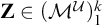 $\mathbf {Z} \in (\mathcal {M}^{\mathcal {U}})_1^k$
such that
$\mathbf {Z} \in (\mathcal {M}^{\mathcal {U}})_1^k$
such that $\varphi ^{\mathcal {M}^{\mathcal {U}}}(\mathbf {X}) = \psi ^{\mathcal {M}^{\mathcal {U}}}(\mathbf {X},\mathbf {Z})$
. Now because
$\varphi ^{\mathcal {M}^{\mathcal {U}}}(\mathbf {X}) = \psi ^{\mathcal {M}^{\mathcal {U}}}(\mathbf {X},\mathbf {Z})$
. Now because $\mathbf {X}$
and
$\mathbf {X}$
and $\tilde {\mathbf {X}}$
have the same type in
$\tilde {\mathbf {X}}$
have the same type in $\mathcal {M}^{\mathcal {U}}$
, there also exists some
$\mathcal {M}^{\mathcal {U}}$
, there also exists some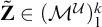 $\tilde {\mathbf {Z}} \in (\mathcal {M}^{\mathcal {U}})_1^k$
such that
$\tilde {\mathbf {Z}} \in (\mathcal {M}^{\mathcal {U}})_1^k$
such that $(\mathbf {X},\mathbf {Z})$
and
$(\mathbf {X},\mathbf {Z})$
and $(\tilde {\mathbf {X}},\tilde {\mathbf {Z}})$
have the same quantifier-free type.
$(\tilde {\mathbf {X}},\tilde {\mathbf {Z}})$
have the same quantifier-free type.
In the hypotheses of Theorem B, we assumed there is an embedding $i: M_2(\mathcal {M}) \to \mathcal {M}^{\mathcal {V}}$
for some ultrafilter
$i: M_2(\mathcal {M}) \to \mathcal {M}^{\mathcal {V}}$
for some ultrafilter $\mathcal {V}$
.Footnote
4
Let
$\mathcal {V}$
.Footnote
4
Let $i^{(n)}$
be the corresponding embedding
$i^{(n)}$
be the corresponding embedding
 $$\begin{align*}i^{(n)}: \mathcal{M}^{1/n} = M_2(\mathcal{M})^{1/2n} \to (\mathcal{M}^{\mathcal{V}})^{1/2n} \cong (\mathcal{M}^{1/2n})^{\mathcal{V}}. \end{align*}$$
Then let
 $$\begin{align*}i^{\mathcal{U}} = \prod_{n \to \mathcal{U}} (\operatorname{\mathrm{id}}_{M_n(\mathbb{C})} \otimes i^{(n)}): \mathcal{M}^{\mathcal{U}} &= \prod_{n \to \mathcal{U}} (M_n(\mathbb{C}) \otimes \mathcal{M}^{1/n})\\ &\quad \to \prod_{n \to \mathcal{U}} (M_n(\mathbb{C}) \otimes (\mathcal{M}^{1/2n})^{\mathcal{V}}) \cong ((\mathcal{M}^{1/2})^{\mathcal{V}})^{\mathcal{U}}. \end{align*}$$
Consider $i^{\mathcal {U}}(\mathbf {X}) \oplus i^{\mathcal {U}}(\tilde {\mathbf {X}})$
and
$i^{\mathcal {U}}(\mathbf {X}) \oplus i^{\mathcal {U}}(\tilde {\mathbf {X}})$
and $i^{\mathcal {U}}(\mathbf {Z}) \oplus i^{\mathcal {U}}(\tilde {\mathbf {Z}})$
as elements of
$i^{\mathcal {U}}(\mathbf {Z}) \oplus i^{\mathcal {U}}(\tilde {\mathbf {Z}})$
as elements of
 $$\begin{align*}M_2(((\mathcal{M})^{1/2})^{\mathcal{V}})^{\mathcal{U}}) = (\mathcal{M}^{\mathcal{V}})^{\mathcal{U}} = (\mathcal{M}^{\mathcal{U}})^{\mathcal{V}}. \end{align*}$$
Note that $(i^{\mathcal {U}}(\mathbf {X}) \oplus i^{\mathcal {U}}(\tilde {\mathbf {X}}), \, i^{\mathcal {U}}(\mathbf {Z}) \oplus i^{\mathcal {U}}(\tilde {\mathbf {Z}}))$
has the same quantifier-free type as
$(i^{\mathcal {U}}(\mathbf {X}) \oplus i^{\mathcal {U}}(\tilde {\mathbf {X}}), \, i^{\mathcal {U}}(\mathbf {Z}) \oplus i^{\mathcal {U}}(\tilde {\mathbf {Z}}))$
has the same quantifier-free type as $(\mathbf {X},\mathbf {Z})$
, and in particular,
$(\mathbf {X},\mathbf {Z})$
, and in particular,
 $$\begin{align*}\varphi^{(\mathcal{M}^{\mathcal{U}})^{\mathcal{V}}}(i^{\mathcal{U}}(\mathbf{X}) \oplus i^{\mathcal{U}}(\tilde{\mathbf{X}})) \leq \psi^{(\mathcal{M}^{\mathcal{U}})^{\mathcal{V}}}(i^{\mathcal{U}}(\mathbf{X}) \oplus i^{\mathcal{U}}(\tilde{\mathbf{X}}), \, i^{\mathcal{U}}(\mathbf{Z}) \oplus i^{\mathcal{U}}(\tilde{\mathbf{Z}})) = \varphi^{\mathcal{M}^{\mathcal{U}}}(\mathbf{X}). \end{align*}$$
On the other hand,
 $$\begin{align*}i^{\mathcal{U}}(\mathbf{X}) \oplus i^{\mathcal{U}}(\tilde{\mathbf{X}}) = j(\mathbf{Y}), \end{align*}$$
where j is the diagonal embedding
 $$\begin{align*}j: \mathcal{M}^{\mathcal{U}} \to (\mathcal{M}^{\mathcal{U}})^{\mathcal{V}} \text{ or equivalently } \prod_{n \to \mathcal{U}} (M_{2n}(\mathbb{C}) \otimes \mathcal{M}^{1/2n}) \to \prod_{n \to \mathcal{U}} (M_{2n}(\mathbb{C}) \otimes (\mathcal{M}^{1/2n})^{\mathcal{V}}). \end{align*}$$
Hence,
 $$\begin{align*}\varphi^{\mathcal{M}^{\mathcal{U}}}(\mathbf{Y}) = \varphi^{(\mathcal{M}^{\mathcal{U}})^{\mathcal{V}}}(j(\mathbf{Y})) = \varphi^{(\mathcal{M}^{\mathcal{U}})^{\mathcal{V}}}(i^{\mathcal{U}}(\mathbf{X}) \oplus i^{\mathcal{U}}(\tilde{\mathbf{X}})) \leq \varphi^{\mathcal{M}^{\mathcal{U}}}(\mathbf{X}). \end{align*}$$
This proves the asserted inequality (4.2).
4.3 Spectral gap and quantum expanders
For steps (2) and (3) from Section 4.1, we want precise control over the commutants of the $\mathbf {X}$
and
$\mathbf {X}$
and $\mathbf {Y}$
. Hence, we will use the notion of spectral gap for an inclusion
$\mathbf {Y}$
. Hence, we will use the notion of spectral gap for an inclusion $\mathcal {N} \subseteq \mathcal {M}$
of tracial von Neumann algebras. For
$\mathcal {N} \subseteq \mathcal {M}$
of tracial von Neumann algebras. For $d \in \mathbb {N}$
and
$d \in \mathbb {N}$
and $C> 0$
, we say that
$C> 0$
, we say that $\mathcal {N} \subseteq \mathcal {M}$
has
$\mathcal {N} \subseteq \mathcal {M}$
has $(C,d)$
-spectral gap if there exist
$(C,d)$
-spectral gap if there exist $x_1$
, …,
$x_1$
, …, $x_d$
in the unit ball
$x_d$
in the unit ball $B_1^{\mathcal {N}}$
such that
$B_1^{\mathcal {N}}$
such that
 $$ \begin{align} d(y,\mathcal{N}' \cap \mathcal{M})^2 \leq C \sum_{j=1}^d \left\lVert [x_j,y] \right\rVert_2^2 \text{ for } y \in \mathcal{M}, \end{align} $$
where $\mathcal {N}' \cap \mathcal {M} = \{z \in \mathcal {M}: [z,x] = 0 \text { for } x \in \mathcal {N}\}$
. If this is true for some d and C, we say that
$\mathcal {N}' \cap \mathcal {M} = \{z \in \mathcal {M}: [z,x] = 0 \text { for } x \in \mathcal {N}\}$
. If this is true for some d and C, we say that $\mathcal {N} \subseteq \mathcal {M}$
has spectral gap. In the case
$\mathcal {N} \subseteq \mathcal {M}$
has spectral gap. In the case $\mathcal {N} = \mathcal {M}$
, note that
$\mathcal {N} = \mathcal {M}$
, note that $\mathcal {N}' \cap \mathcal {M}$
reduces to the center
$\mathcal {N}' \cap \mathcal {M}$
reduces to the center $Z(\mathcal {M})$
, and in this case, we will say simply that
$Z(\mathcal {M})$
, and in this case, we will say simply that $\mathcal {M}$
has spectral gap. The relevance of spectral gap for continuous logic was already observed by Goldbring [Reference Goldbring and Iovino34], who showed that spectral gap for
$\mathcal {M}$
has spectral gap. The relevance of spectral gap for continuous logic was already observed by Goldbring [Reference Goldbring and Iovino34], who showed that spectral gap for $\mathcal {N} \subseteq \mathcal {M}$
implies that
$\mathcal {N} \subseteq \mathcal {M}$
implies that $\mathcal {N}' \cap \mathcal {M}$
is a definable set with parameters from
$\mathcal {N}' \cap \mathcal {M}$
is a definable set with parameters from $\mathcal {N}$
.
$\mathcal {N}$
.
It is well known that when the $x_j$
’s in (4.3) are unitaries, the inequality can be reformulated in the following way, which will motivate our use of quantum expanders.
$x_j$
’s in (4.3) are unitaries, the inequality can be reformulated in the following way, which will motivate our use of quantum expanders.
Lemma 4.4. Let $\mathcal {N} \subseteq \mathcal {M}$
be an inclusion of tracial von Neumann algebras and
$\mathcal {N} \subseteq \mathcal {M}$
be an inclusion of tracial von Neumann algebras and $\epsilon> 0$
, let
$\epsilon> 0$
, let $u_1$
, …,
$u_1$
, …, $u_d$
be unitaries in
$u_d$
be unitaries in $\mathcal {N}$
. Then the following are equivalent:
$\mathcal {N}$
. Then the following are equivalent:
-
(1) For
$a \in \mathcal {M}$
,
$$\begin{align*}\left\lVert a - E_{\mathcal{N}' \cap \mathcal{M}}(a) \right\rVert_2^2 \leq \frac{1}{\epsilon} \sum_{j=1}^d \left\lVert [u_j,a] \right\rVert_2^2. \end{align*}$$
-
(2) For
$a \in \mathcal {M}$
,
$$\begin{align*}\left\lVert \sum_{j=1}^d u_j(a - E_{\mathcal{N}' \cap \mathcal{M}}(a)) u_j^{*} + u_j^{*}(a - E_{\mathcal{N}' \cap \mathcal{M}}(a))u_j \right\rVert_2 \leq (2d - \epsilon) \left\lVert a - E_{\mathcal{N}' \cap \mathcal{M}}(a) \right\rVert_2. \end{align*}$$


Proof. Let $T: L^2(\mathcal {M}) \to L^2(\mathcal {M})^d$
be given by
$T: L^2(\mathcal {M}) \to L^2(\mathcal {M})^d$
be given by $T(a) = ([u_1,a], \dots , [u_d,a])$
. By elementary computation,
$T(a) = ([u_1,a], \dots , [u_d,a])$
. By elementary computation,
 $$\begin{align*}T^{*}T(a) = 2d\,a - \sum_{j=1}^d u_jau_j^{*} - \sum_{j=1}^d u_j^{*}au_j. \end{align*}$$
Let $\mathcal {P} = \mathcal {N}' \cap \mathcal {M}$
. Note that T vanishes on
$\mathcal {P} = \mathcal {N}' \cap \mathcal {M}$
. Note that T vanishes on $\mathcal {P}$
and
$\mathcal {P}$
and $a - E_{\mathcal {P}}(a)$
is the orthogonal projection of a onto
$a - E_{\mathcal {P}}(a)$
is the orthogonal projection of a onto $\mathcal {P}^{\perp }$
. Therefore, condition (1) can be restated as
$\mathcal {P}^{\perp }$
. Therefore, condition (1) can be restated as $\epsilon \left \lVert a \right \rVert _2^2 \leq \left \lVert T(a) \right \rVert _2^2 = \left \langle a,T^{*}T(a) \right \rangle $
for
$\epsilon \left \lVert a \right \rVert _2^2 \leq \left \lVert T(a) \right \rVert _2^2 = \left \langle a,T^{*}T(a) \right \rangle $
for $a \in \mathcal {P}^{\perp }$
, which is equivalent to the spectrum of
$a \in \mathcal {P}^{\perp }$
, which is equivalent to the spectrum of $T^{*}T |_{\mathcal {P}^{\perp }}$
being contained in
$T^{*}T |_{\mathcal {P}^{\perp }}$
being contained in $[\epsilon ,\infty )$
. Meanwhile, condition (2) can be restated as
$[\epsilon ,\infty )$
. Meanwhile, condition (2) can be restated as $\left \lVert (2d - T^{*}T)|_{\mathcal {P}^{\perp }} \right \rVert \leq 2d - \epsilon $
; since
$\left \lVert (2d - T^{*}T)|_{\mathcal {P}^{\perp }} \right \rVert \leq 2d - \epsilon $
; since $\left \lVert T^{*}T \right \rVert \leq 2d$
, this is equivalent to the above.
$\left \lVert T^{*}T \right \rVert \leq 2d$
, this is equivalent to the above.
Quantum expanders are defined as follows. For $\epsilon> 0$
and
$\epsilon> 0$
and $d \geq 2$
, a
$d \geq 2$
, a $(d,\epsilon )$
-quantum expander is a sequence of d-tuples of
$(d,\epsilon )$
-quantum expander is a sequence of d-tuples of $n \times n$
unitaries
$n \times n$
unitaries $U_1^{(n)}$
, …,
$U_1^{(n)}$
, …, $U_d^{(n)}$
such that for
$U_d^{(n)}$
such that for $A \in M_n(\mathbb {C})$
,
$A \in M_n(\mathbb {C})$
,
 $$ \begin{align} \left\lVert \sum_{j=1}^d U_j^{(n)} (A - \operatorname{\mathrm{tr}}_n(A)) (U_j^{(n)})^{*} \right\rVert_2 \leq (d - \epsilon) \left\lVert A - \operatorname{\mathrm{tr}}_n(A) \right\rVert_2. \end{align} $$
This estimate has the same form as Lemma 4.4 except that the latter is symmetrized with respect to $u_j$
and
$u_j$
and $u_j^{*}$
. We remark that
$u_j^{*}$
. We remark that ${(U_1^{(n)}, \dots , U_d^{(n)}, (U_1^{(n)})^{*}, \dots , (U_d^{(n)})^{*})}$
is a
${(U_1^{(n)}, \dots , U_d^{(n)}, (U_1^{(n)})^{*}, \dots , (U_d^{(n)})^{*})}$
is a $(2d,2\epsilon )$
-quantum expander whenever
$(2d,2\epsilon )$
-quantum expander whenever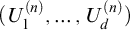 $(U_1^{(n)}, \dots , U_d^{(n)})$
is a
$(U_1^{(n)}, \dots , U_d^{(n)})$
is a $(d,\epsilon )$
-quantum expander; this follows because the adjoint of the map
$(d,\epsilon )$
-quantum expander; this follows because the adjoint of the map $A \mapsto \sum _{j=1}^d U_j^{(n)} A (U_j^{(n)})^{*}$
is the map
$A \mapsto \sum _{j=1}^d U_j^{(n)} A (U_j^{(n)})^{*}$
is the map $A \mapsto \sum _{j=1}^d (U_j^{(n)})^{*} A U_j^{(n)}$
.
$A \mapsto \sum _{j=1}^d (U_j^{(n)})^{*} A U_j^{(n)}$
.
The following relationship between spectral gap and quantum expanders is immediate from applying Lemma 4.4 with $\mathcal {N} = \mathcal {M} = M_n(\mathbb {C})$
and
$\mathcal {N} = \mathcal {M} = M_n(\mathbb {C})$
and $\mathcal {N}' \cap \mathcal {M} = \mathbb {C} 1$
.
$\mathcal {N}' \cap \mathcal {M} = \mathbb {C} 1$
.
Corollary 4.5. Unitaries $U_1^{(n)}$
, …,
$U_1^{(n)}$
, …, $U_d^{(n)}$
witness
$U_d^{(n)}$
witness $(d,1/\epsilon )$
spectral gap for
$(d,1/\epsilon )$
spectral gap for $M_n(\mathbb {C})$
if and only if
$M_n(\mathbb {C})$
if and only if $(U_1^{(n)},\dots ,U_d^{(n)},(U_1^{(n)})^{*},\dots ,(U_d^{(n)})^{*})$
is a
$(U_1^{(n)},\dots ,U_d^{(n)},(U_1^{(n)})^{*},\dots ,(U_d^{(n)})^{*})$
is a $(2d,\epsilon )$
-quantum expander.
$(2d,\epsilon )$
-quantum expander.
Our argument uses Hastings’s result that random unitaries give quantum expanders with high probability [Reference Hastings45]; a similar result with matrix amplifications was shown by Pisier [Reference Pisier59], and a generalization to other unitary representations was proved in [Reference Bordenave and Collins16]. We remark as well that various other constructions of quantum expanders could have been used instead. (A rich variety of deterministic constructions exists, for instance, based on discrete Fourier transforms on non-abelian groups [Reference Ambainis, Smith, Jansen, Khanna, Rolim and Ron1, Reference Ben-Aroya, Schwartz and Ta-Shma9], quantum versions of Margulis expanders [Reference Gross and Eisert40], systematic adaptation of classical expanders [Reference Harrow43], and zig-zag constructions [Reference Ben-Aroya, Schwartz and Ta-Shma9, Section 4].) Moreover, if G is a group with property (T) (see [Reference Bekka, de la Harpe and Valette7] for background) with generators $g_1$
, …,
$g_1$
, …, $g_d$
, and
$g_d$
, and $(\pi _j)_{j \in \mathbb {N}}$
is a sequence of irreducible unitary representations of G on
$(\pi _j)_{j \in \mathbb {N}}$
is a sequence of irreducible unitary representations of G on $\mathbb {C}^{n_j}$
, then
$\mathbb {C}^{n_j}$
, then $(\pi _j(g_1),\dots ,\pi _j(g_d))$
is a
$(\pi _j(g_1),\dots ,\pi _j(g_d))$
is a $(d,\epsilon )$
-quantum expander where
$(d,\epsilon )$
-quantum expander where $\epsilon $
is related to the Kazhdan constant; thus, for instance, one can obtain quantum expanders from irreducible representations of
$\epsilon $
is related to the Kazhdan constant; thus, for instance, one can obtain quantum expanders from irreducible representations of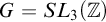 $G = SL_3(\mathbb {Z})$
. Property (T) groups and quantum expanders can be applied in many of the same contexts; see for instance the two proofs of [Reference Ioana48, Lemma 4.3].
$G = SL_3(\mathbb {Z})$
. Property (T) groups and quantum expanders can be applied in many of the same contexts; see for instance the two proofs of [Reference Ioana48, Lemma 4.3].
For the reader’s convenience, we recall the precise statement of Hastings’ result.
Theorem 4.6 (Hastings [Reference Hastings45], see also [Reference Pisier59, Lemma 1.8]).
Let $U_1^{(n)}$
, …,
$U_1^{(n)}$
, …, $U_d^{(n)}$
be independent Haar random unitary matrices, and consider the (random) map
$U_d^{(n)}$
be independent Haar random unitary matrices, and consider the (random) map $\Phi ^{(n)}: M_n(\mathbb {C}) \to M_n(\mathbb {C})$
,
$\Phi ^{(n)}: M_n(\mathbb {C}) \to M_n(\mathbb {C})$
,
 $$\begin{align*}\Phi^{(n)}(A) = \frac{1}{2d} \sum_{j=1}^d (U_j^{(n)} A (U_j^{(n)})^{*} + (U_j^{(n)})^{*}AU_j^{(n)}). \end{align*}$$
Let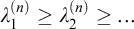 $\lambda _1^{(n)} \geq \lambda _2^{(n)} \geq \dots $
be the eigenvalues of
$\lambda _1^{(n)} \geq \lambda _2^{(n)} \geq \dots $
be the eigenvalues of $\Phi ^{(n)}$
(here
$\Phi ^{(n)}$
(here $\lambda _1^{(n)} = 1$
with eigenspace the span of the identity matrix). Then almost surely
$\lambda _1^{(n)} = 1$
with eigenspace the span of the identity matrix). Then almost surely
 $$\begin{align*}\lim_{n \to \infty} \lambda^{(n)}_2 = \frac{\sqrt{2d - 1}}{d}. \end{align*}$$
Proof. The situation above is the Hermitian case with $D = 2d$
in Hastings’s terminology. Hastings [Reference Hastings45] at the top of the second page asserts convergence in probability of
$D = 2d$
in Hastings’s terminology. Hastings [Reference Hastings45] at the top of the second page asserts convergence in probability of $\lambda _2^{(n)}$
. Hastings’s arguments in fact yield almost sure convergence. Indeed,
$\lambda _2^{(n)}$
. Hastings’s arguments in fact yield almost sure convergence. Indeed, $\liminf _{n \to \infty } \lambda _2^{(n)} \geq \sqrt {2d-1} / d$
follows from a deterministic lower bound on
$\liminf _{n \to \infty } \lambda _2^{(n)} \geq \sqrt {2d-1} / d$
follows from a deterministic lower bound on $\lambda _2^{(n)}$
in [Reference Hastings45, equation (12)] which gives (using
$\lambda _2^{(n)}$
in [Reference Hastings45, equation (12)] which gives (using $\lambda _H=2\sqrt {D-1}/D=\sqrt {2d-1}/d$
, see [Reference Hastings45, equation (3)]),
$\lambda _H=2\sqrt {D-1}/D=\sqrt {2d-1}/d$
, see [Reference Hastings45, equation (3)]), $\lambda _2 \geq \frac {2d-1}d(1-O(\ln (\ln (n))/\ln (n))$
.
$\lambda _2 \geq \frac {2d-1}d(1-O(\ln (\ln (n))/\ln (n))$
.
For the converse inequality, at the end of Section II.F, Hastings shows that for $c>1$
, the probability that
$c>1$
, the probability that $\lambda _2^{(n)}$
is greater than
$\lambda _2^{(n)}$
is greater than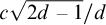 $c \sqrt {2d - 1}/ d$
is bounded by
$c \sqrt {2d - 1}/ d$
is bounded by
 $$\begin{align*}c^{-(1/4)n^{2/15}} (1 + O(\log(n)n^{-2/15})). \end{align*}$$
Because this is summable, the Borel–Cantelli lemma implies that almost surely we have $\limsup _{n \to \infty } \lambda _2^{(n)} \leq c \lambda _H$
. Since
$\limsup _{n \to \infty } \lambda _2^{(n)} \leq c \lambda _H$
. Since $c> 1$
was arbitrary, this yields almost sure convergence.
$c> 1$
was arbitrary, this yields almost sure convergence.
Corollary 4.7. Let $d> 1$
, and let
$d> 1$
, and let $U_1^{(n)}$
, …,
$U_1^{(n)}$
, …, $U_d^{(n)}$
be Haar random unitary matrices. Then almost surely, for sufficiently large n, we have for all
$U_d^{(n)}$
be Haar random unitary matrices. Then almost surely, for sufficiently large n, we have for all $A \in M_n(\mathbb {C})$
,
$A \in M_n(\mathbb {C})$
,
 $$ \begin{align} \left\lVert A - \operatorname{\mathrm{tr}}_n(A) \right\rVert_2^2 < \frac{d}{(d-1)^2} \sum_{j=1}^d \left\lVert [A,U_j^{(n)}] \right\rVert_2^2. \end{align} $$
Proof. Let $\Phi ^{(n)}$
be as in the previous theorem. Note that
$\Phi ^{(n)}$
be as in the previous theorem. Note that $\ker (\operatorname {\mathrm {tr}}_n)$
is the orthogonal complement of
$\ker (\operatorname {\mathrm {tr}}_n)$
is the orthogonal complement of $\mathbb {C} 1$
, which is the
$\mathbb {C} 1$
, which is the $\lambda _1^{(n)}$
-eigenspace of
$\lambda _1^{(n)}$
-eigenspace of $\Phi ^{(n)}$
. Hence,
$\Phi ^{(n)}$
. Hence,
 $$\begin{align*}\left\lVert \sum_{j=1}^d (U_j^{(n)} (A - \operatorname{\mathrm{tr}}_n(A)) (U_j^{(n)})^{*} + (U_j^{(n)})^{*} (A - \operatorname{\mathrm{tr}}_n(A)) U_j^{(n)}) \right\rVert_2 \leq 2d \lambda_2^{(n)} \left\lVert A - \operatorname{\mathrm{tr}}_n(A) \right\rVert_2. \end{align*}$$
This means that $U_1^{(n)}$
, …,
$U_1^{(n)}$
, …, $U_d^{(n)}$
satisfy Lemma 4.4 (2) with
$U_d^{(n)}$
satisfy Lemma 4.4 (2) with $\mathcal {N} = \mathbb {C}$
,
$\mathcal {N} = \mathbb {C}$
, $\mathcal {M} = M_n(\mathbb {C})$
, and
$\mathcal {M} = M_n(\mathbb {C})$
, and $2d - \epsilon ^{(n)} = 2d \lambda _2^{(n)}$
. Hence, by Lemma 4.4, the
$2d - \epsilon ^{(n)} = 2d \lambda _2^{(n)}$
. Hence, by Lemma 4.4, the $U_j^{(n)}$
witness spectral gap for
$U_j^{(n)}$
witness spectral gap for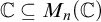 $\mathbb {C} \subseteq M_n(\mathbb {C})$
with constant
$\mathbb {C} \subseteq M_n(\mathbb {C})$
with constant $\epsilon ^{(n)} = 2d(1 - \lambda _2^{(n)})$
. By Hastings’s theorem, almost surely,
$\epsilon ^{(n)} = 2d(1 - \lambda _2^{(n)})$
. By Hastings’s theorem, almost surely,
 $$\begin{align*}\frac{1}{\epsilon^{(n)}} = \frac{1}{2d(1 - \lambda_2^{(n)})} \to \frac{1}{2d - 2 \sqrt{2d-1}} = \frac{d + \sqrt{2d-1}}{2(d^2 - 2d + 1)}. \end{align*}$$
We can bound the right-hand side by $d / (d-1)^2$
because
$d / (d-1)^2$
because $\sqrt {2d - 1} < d$
.
$\sqrt {2d - 1} < d$
.
4.4 Controlling the relative commutants
Lemma 4.8. Let $\mathcal {A}_n = 1_{M_n(\mathbb {C})} \otimes \mathcal {M}^{1/n}$
and let
$\mathcal {A}_n = 1_{M_n(\mathbb {C})} \otimes \mathcal {M}^{1/n}$
and let $\mathcal {A} = \prod _{n \to \mathcal {U}} \mathcal {A}_n$
. Then almost surely, for all
$\mathcal {A} = \prod _{n \to \mathcal {U}} \mathcal {A}_n$
. Then almost surely, for all $a \in \mathcal {M}^{\mathcal {U}}$
,
$a \in \mathcal {M}^{\mathcal {U}}$
,
 $$\begin{align*}d(a,\mathcal{A})^2 \leq \frac{3}{4} \sum_{j=1}^3 \left\lVert [X_j,a] \right\rVert_2^2. \end{align*}$$
In particular, $\mathcal {A} = \{\mathbf {X}\}' \cap \mathcal {M}^{\mathcal {U}}$
.
$\mathcal {A} = \{\mathbf {X}\}' \cap \mathcal {M}^{\mathcal {U}}$
.
Proof. By Corollary 4.7 with $d = 3$
, for sufficiently large n and
$d = 3$
, for sufficiently large n and $A \in M_n(\mathbb {C})$
, we have almost surely
$A \in M_n(\mathbb {C})$
, we have almost surely
 $$\begin{align*}\left\lVert A - \operatorname{\mathrm{tr}}_n(A) \right\rVert_2^2 \leq \frac{3}{4} \sum_{j=1}^3 \left\lVert [A,U_j^{(n)}] \right\rVert_2^2. \end{align*}$$
Because this is an inequality between linear operators on a Hilbert space, we may tensorize with the identity on $L^2(\mathcal {M}^{1/n})$
(see, e.g., [Reference Goldbring, Jekel, Elayavalli and Pi39, Lemma 4.18]), to obtain for
$L^2(\mathcal {M}^{1/n})$
(see, e.g., [Reference Goldbring, Jekel, Elayavalli and Pi39, Lemma 4.18]), to obtain for $a \in M_n(\mathbb {C}) \otimes \mathcal {M}^{1/n} = \mathcal {M}$
that
$a \in M_n(\mathbb {C}) \otimes \mathcal {M}^{1/n} = \mathcal {M}$
that
 $$\begin{align*}\left\lVert a - E_{\mathcal{A}_n}[a] \right\rVert_2^2 \leq \frac{3}{4} \sum_{j=1}^3 \left\lVert [a,X_j^{(n)}] \right\rVert_2^2 \text{ for } a \in \mathcal{M}. \end{align*}$$
Then in the ultralimit, we obtain
 $$\begin{align*}\left\lVert a - E_{\mathcal{A}}[a] \right\rVert_2^2 \leq \frac{3}{4} \sum_{j=1}^3 \left\lVert [a,X_j] \right\rVert_2^2 \text{ for } a \in \mathcal{M}^{\mathcal{U}}, \end{align*}$$
since conditional expectations commute with ultraproducts. This is the desired estimate for $\mathcal {A}$
. For the final claim,
$\mathcal {A}$
. For the final claim, $\mathcal {A} \subseteq \{\mathbf {X}\}' \cap \mathcal {M}^{\mathcal {U}}$
is immediate from the construction of
$\mathcal {A} \subseteq \{\mathbf {X}\}' \cap \mathcal {M}^{\mathcal {U}}$
is immediate from the construction of $\mathbf {X}$
, and the opposite inclusion follows from the spectral gap estimate that we just proved.
$\mathbf {X}$
, and the opposite inclusion follows from the spectral gap estimate that we just proved.
The analogous statement for $\mathbf {Y}$
is more delicate, and this is where we use the specific way that
$\mathbf {Y}$
is more delicate, and this is where we use the specific way that $\mathbf {X}$
and
$\mathbf {X}$
and $\mathbf {Y}$
were constructed from
$\mathbf {Y}$
were constructed from $U_1^{(n)}$
, …,
$U_1^{(n)}$
, …, $U_4^{(n)}$
; this part of the argument was simplified due to the suggestion of Adrian Ioana and it is a close relative to the proof of [Reference Ioana48, Lemma 4.6].
$U_4^{(n)}$
; this part of the argument was simplified due to the suggestion of Adrian Ioana and it is a close relative to the proof of [Reference Ioana48, Lemma 4.6].
Lemma 4.9. For a II $_1$
factor
$_1$
factor $\mathcal {M}$
and for
$\mathcal {M}$
and for $\mathcal {B}$
and
$\mathcal {B}$
and $\mathbf {Y}$
as defined in Section 4.1, almost surely, for
$\mathbf {Y}$
as defined in Section 4.1, almost surely, for $b \in \mathcal {M}^{\mathcal {U}}$
,
$b \in \mathcal {M}^{\mathcal {U}}$
,
 $$\begin{align*}d(b,\mathcal{B})^2 \leq 7 \sum_{j=1}^3 \left\lVert [Y_j,b] \right\rVert_2^2. \end{align*}$$
In particular, $\{\mathbf {Y}\}' \cap \mathcal {M}^{\mathcal {U}} = \mathcal {B}$
.
$\{\mathbf {Y}\}' \cap \mathcal {M}^{\mathcal {U}} = \mathcal {B}$
.
Proof. To prove the estimate for $\mathcal {B}$
, the same tensorization and ultralimit argument as in the proof of Lemma 4.8 apply, and so it suffices to show that for
$\mathcal {B}$
, the same tensorization and ultralimit argument as in the proof of Lemma 4.8 apply, and so it suffices to show that for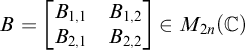 $B = \begin {bmatrix} B_{1,1} & B_{1,2} \\ B_{2,1} & B_{2,2} \end {bmatrix} \in M_{2n}(\mathbb {C})$
, we have
$B = \begin {bmatrix} B_{1,1} & B_{1,2} \\ B_{2,1} & B_{2,2} \end {bmatrix} \in M_{2n}(\mathbb {C})$
, we have
 $$ \begin{align*} \left\lVert \begin{bmatrix} B_{1,1} & B_{1,2} \\ B_{2,1} & B_{2,2} \end{bmatrix} - \begin{bmatrix} \operatorname{\mathrm{tr}}_n(B_{1,1}) & 0 \\ 0 & \operatorname{\mathrm{tr}}_n(B_{2,2}) \end{bmatrix} \right\rVert_2^2 &\leq 7 \sum_{j=1}^3 \left\lVert [B,Y_j^{(n)}] \right\rVert_2^2 \\ &= 7 \Bigg( \sum_{j=1}^2 \left\lVert \begin{bmatrix} U_j^{(n)} B_{1,1} - B_{1,1} U_j^{(n)} & U_j^{(n)} B_{1,2} - B_{1,2} U_j^{(n)} \\ U_j^{(n)} B_{2,1} - B_{2,1} U_j^{(n)} & U_j^{(n)} B_{2,2} - B_{2,2} U_j^{(n)} \end{bmatrix} \right\rVert_2^2 \\ &+ \left\lVert \begin{bmatrix} U_3^{(n)} B_{1,1} - B_{1,1} U_3^{(n)} & U_3^{(n)} B_{1,2} - B_{1,2} U_4^{(n)} \\ U_4^{(n)} B_{2,1} - B_{2,1} U_3^{(n)} & U_4^{(n)} B_{2,2} - B_{2,2} U_4^{(n)} \end{bmatrix} \right\rVert_2^2 \Bigg). \end{align*} $$
Equivalently, we want to show that
 $$ \begin{align*} \left\lVert B_{1,1} - \operatorname{\mathrm{tr}}_n(B_{1,1}) \right\rVert_2^2 &+ \left\lVert B_{2,2} - \operatorname{\mathrm{tr}}_n(B_{2,2}) \right\rVert_2^2 + \left\lVert B_{1,2} \right\rVert_2^2 + \left\lVert B_{2,1} \right\rVert_2^2 \\ &\leq 7 \Big( \sum_{j=1}^3 \left\lVert [B_{1,1},U_j^{(n)}] \right\rVert_2^2 + \sum_{j=1}^3 \left\lVert [B_{2,2},U_j^{(n)}] \right\rVert_2^2 \\ & \quad + \sum_{j=1}^2 \left\lVert [B_{1,2},U_j^{(n)}] \right\rVert_2^2 + \left\lVert U_3^{(n)} B_{1,2} - B_{1,2} U_4^{(n)} \right\rVert_2^2 \\ & \quad + \sum_{j=1}^2 \left\lVert [B_{2,1},U_j^{(n)}] \right\rVert_2^2 + \left\lVert U_4^{(n)} B_{2,1} - B_{2,1} U_3^{(n)} \right\rVert_2^2 \Big). \end{align*} $$
From Corollary 4.7, we already know
 $$\begin{align*}\left\lVert B_{1,1} - \operatorname{\mathrm{tr}}_n(B_{1,1}) \right\rVert_2^2 \leq \frac{3}{4} \sum_{j=1}^3 \left\lVert [B_{1,1},U_j^{(n)}] \right\rVert_2^2, \end{align*}$$
and similarly for the $B_{2,2}$
term. Thus, it remains to estimate the
$B_{2,2}$
term. Thus, it remains to estimate the $B_{1,2}$
and
$B_{1,2}$
and $B_{2,1}$
terms. We will handle the
$B_{2,1}$
terms. We will handle the $B_{1,2}$
term and show that
$B_{1,2}$
term and show that
 $$ \begin{align} \left\lVert B_{1,2} \right\rVert_2^2 \leq 7 \left( \sum_{j=1}^2 \left\lVert [B_{1,2},U_j^{(n)}] \right\rVert_2^2 + \left\lVert U_3^{(n)} B_{1,2} - B_{1,2} U_4^{(n)} \right\rVert_2^2 \right); \end{align} $$
the argument for the $B_{2,1}$
term is symmetrical. First, we note that by Corollary 4.7 with
$B_{2,1}$
term is symmetrical. First, we note that by Corollary 4.7 with $d = 2$
, we have almost surely for sufficiently large n,
$d = 2$
, we have almost surely for sufficiently large n,
 $$ \begin{align} \left\lVert B_{1,2} - \operatorname{\mathrm{tr}}_n(B_{1,2}) \right\rVert_2^2 \leq 2 \sum_{j=1}^2 \left\lVert [B_{1,2},U_j^{(n)}] \right\rVert_2^2. \end{align} $$
Thus, it remains to estimate $\operatorname {\mathrm {tr}}_n(B_{1,2})$
. We note that
$\operatorname {\mathrm {tr}}_n(B_{1,2})$
. We note that
 $$ \begin{align*} |\operatorname{\mathrm{tr}}_n(B_{1,2})| \left\lVert U_3^{(n)} - U_4^{(n)} \right\rVert_2 &= \left\lVert U_3^{(n)} \operatorname{\mathrm{tr}}_n(B_{1,2}) - \operatorname{\mathrm{tr}}_n(B_{1,2}) U_4^{(n)} \right\rVert_2 \\ &\leq \left\lVert U_3^{(n)}(B_{1,2} - \operatorname{\mathrm{tr}}_n(B_{1,2})) - (B_{1,2} - \operatorname{\mathrm{tr}}_n(B_{1,2})) U_4^{(n)} \right\rVert_2 \\ & \quad + \left\lVert U_3^{(n)} B_{1,2} - B_{1,2} U_4^{(n)} \right\rVert_2 \\ &\leq 2 \left\lVert B_{1,2} - \operatorname{\mathrm{tr}}_n(B_{1,2}) \right\rVert_2 + \left\lVert U_3^{(n)} B_{1,2} - B_{1,2} U_4^{(n)} \right\rVert_2. \end{align*} $$
Note that $\mathbb {E} \operatorname {\mathrm {tr}}_n((U_3^{(n)})^{*} U_4^{(n)}) = 0$
, and so by Proposition 4.1, we have
$\mathbb {E} \operatorname {\mathrm {tr}}_n((U_3^{(n)})^{*} U_4^{(n)}) = 0$
, and so by Proposition 4.1, we have $\operatorname {\mathrm {tr}}_n((U_3^{(n)})^{*} U_4^{(n)}) \to 0$
almost surely, and thus
$\operatorname {\mathrm {tr}}_n((U_3^{(n)})^{*} U_4^{(n)}) \to 0$
almost surely, and thus $\left \lVert U_3^{(n)} - U_4^{(n)} \right \rVert _2^2=\left \lVert 1-(U_3^{(n)})^{*} U_4^{(n)} \right \rVert _2^2 \to 2$
almost surely, and hence is eventually larger than
$\left \lVert U_3^{(n)} - U_4^{(n)} \right \rVert _2^2=\left \lVert 1-(U_3^{(n)})^{*} U_4^{(n)} \right \rVert _2^2 \to 2$
almost surely, and hence is eventually larger than $9/5$
. Hence, we have that for sufficiently large n,
$9/5$
. Hence, we have that for sufficiently large n,
 $$\begin{align*}|\operatorname{\mathrm{tr}}_n(B_{1,2})| \leq \sqrt{5/9}\ \left( 2 \left\lVert B_{1,2} - \operatorname{\mathrm{tr}}_n(B_{1,2}) \right\rVert_2 + \left\lVert U_3^{(n)} B_{1,2} - B_{1,2} U_4^{(n)} \right\rVert_2 \right). \end{align*}$$
By the Cauchy–Schwarz inequality and our previous estimate for $\left \lVert B_{1,2} - \operatorname {\mathrm {tr}}_n(B_{1,2}) \right \rVert _2$
,
$\left \lVert B_{1,2} - \operatorname {\mathrm {tr}}_n(B_{1,2}) \right \rVert _2$
,
 $$ \begin{align*} |\operatorname{\mathrm{tr}}_n(B_{1,2})|^2 &\leq \frac{5}{9} (1 + 1/8) \left( 4 \left\lVert B_{1,2} - \operatorname{\mathrm{tr}}_n(B_{1,2}) \right\rVert_2^2 + 8 \left\lVert U_3^{(n)} B_{1,2} - B_{1,2} U_4^{(n)} \right\rVert_2^2 \right) \\ &\leq \frac{5}{8} \left( 4 \cdot 2 \sum_{j=1}^2 \left\lVert [B_{1,2},U_j^{(n)}] \right\rVert_2^2 + 8 \left\lVert U_3^{(n)} B_{1,2} - B_{1,2} U_4^{(n)} \right\rVert_2^2 \right) \\ &= 5 \sum_{j=1}^2 \left\lVert [B_{1,2},U_j^{(n)}] \right\rVert_2^2 + 5 \left\lVert U_3^{(n)} B_{1,2} - B_{1,2} U_4^{(n)} \right\rVert_2^2. \end{align*} $$
Hence, using this and (4.7),
 $$ \begin{align*} \left\lVert B_{1,2} \right\rVert_2^2 &= \left\lVert B_{1,2} - \operatorname{\mathrm{tr}}_n(B_{1,2}) \right\rVert_2^2 + \operatorname{\mathrm{tr}}_n(B_{1,2})^2 \\ &\leq \left(2 + 5 \right) \sum_{j=1}^2 \left\lVert [B_{1,2},U_j^{(n)}] \right\rVert_2^2 + 5 \left\lVert U_3^{(n)} B_{1,2} - B_{1,2} U_4^{(n)} \right\rVert_2^2 \\ &\leq 7 \left( \sum_{j=1}^2 \left\lVert [B_{1,2},U_j^{(n)}] \right\rVert_2^2 + \left\lVert U_3^{(n)} B_{1,2} - B_{1,2} U_4^{(n)} \right\rVert_2^2 \right) \end{align*} $$
as desired.
Remark 4.10. In the spirit of Goldbring’s work on spectral gap and definability [Reference Goldbring and Iovino34], our bound on the distance to the relative commutant in Lemma 4.8 shows that $\mathcal {A} = \{\mathbf {X}\}' \cap \mathcal {M}^{\mathcal {U}}$
is a definable set with parameters
$\mathcal {A} = \{\mathbf {X}\}' \cap \mathcal {M}^{\mathcal {U}}$
is a definable set with parameters $\mathbf {X}$
(see Section 2.3). Similarly, Lemma 4.9 implies that
$\mathbf {X}$
(see Section 2.3). Similarly, Lemma 4.9 implies that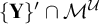 $\{\mathbf {Y}\}' \cap \mathcal {M}^{\mathcal {U}}$
is definable with parameters
$\{\mathbf {Y}\}' \cap \mathcal {M}^{\mathcal {U}}$
is definable with parameters $\mathbf {Y}$
.
$\mathbf {Y}$
.
4.5 Conclusion of the proof of Theorem B in the
$\mathrm {II}_1$
factor case

Proof of Theorem B in the
$\mathrm {II}_1$
factor case.

Referring to the outline of the proof stated in Section 4.1, we have shown (1) in Lemma 4.3, (2) in Lemma 4.8, and (3) in Lemma 4.9. Item (1) shows that, almost surely, $\varphi ^{\mathcal {M}^{\mathcal {U}}}(\mathbf {X}) \leq \varphi ^{\mathcal {M}^{\mathcal {U}}}(\mathbf {Y})$
for all
$\varphi ^{\mathcal {M}^{\mathcal {U}}}(\mathbf {X}) \leq \varphi ^{\mathcal {M}^{\mathcal {U}}}(\mathbf {Y})$
for all $\inf $
-formulas. If
$\inf $
-formulas. If $\mathcal {M}$
were model complete, then
$\mathcal {M}$
were model complete, then $\mathbf {X}$
and
$\mathbf {X}$
and $\mathbf {Y}$
would have the same type by Lemma 2.3. Hence, to finish the argument, it suffices to show that
$\mathbf {Y}$
would have the same type by Lemma 2.3. Hence, to finish the argument, it suffices to show that $\mathbf {X}$
and
$\mathbf {X}$
and $\mathbf {Y}$
do not have the same type.
$\mathbf {Y}$
do not have the same type.
In fact, we claim that $\mathbf {X}$
and
$\mathbf {X}$
and $\mathbf {Y}$
do not even have the same two-quantifier type. Consider the formula
$\mathbf {Y}$
do not even have the same two-quantifier type. Consider the formula
 $$ \begin{align*} \psi(x_1, x_2, x_3)& = \\ &\inf_{z_1} \left[ 1 - \left\lVert z_1 \right\rVert_2^2 + |\operatorname{\mathrm{tr}}(z_1)|^2 + 7 \sum_{j=1}^3 \left\lVert [x_j,z_1] \right\rVert_2^2 + \sup_{z_2} \left[ \left\lVert [z_1,z_2] \right\rVert_2^2 \dot{-} 28 \sum_{j=1}^3 \left\lVert [x_j,z_2] \right\rVert_2^2 \right] \right], \end{align*} $$
where $z_1$
and
$z_1$
and $z_2$
range over the unit ball. Then the condition
$z_2$
range over the unit ball. Then the condition $\psi (x_1,x_2, x_3)=0$
attempts to assert the existence of
$\psi (x_1,x_2, x_3)=0$
attempts to assert the existence of $z_1$
with
$z_1$
with $\|z_1\|_2=1$
and
$\|z_1\|_2=1$
and $\operatorname {\mathrm {tr}}(z_1)=0$
such that
$\operatorname {\mathrm {tr}}(z_1)=0$
such that $z_1$
commutes with
$z_1$
commutes with $x_j$
for
$x_j$
for $j = 1,2,3$
and also commutes with every
$j = 1,2,3$
and also commutes with every $z_2$
in the relative commutant of
$z_2$
in the relative commutant of $\{x_1,x_2, x_3\}$
.Footnote
5
We will find a self-adjoint unitary
$\{x_1,x_2, x_3\}$
.Footnote
5
We will find a self-adjoint unitary $z_1$
that commutes with
$z_1$
that commutes with $Y_j$
for
$Y_j$
for $j = 1,2,3$
, has zero trace, and commutes with everything in the relative commutant of
$j = 1,2,3$
, has zero trace, and commutes with everything in the relative commutant of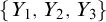 $\{Y_1,Y_2, Y_3\}$
; this will suffice to show that
$\{Y_1,Y_2, Y_3\}$
; this will suffice to show that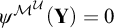 $\psi ^{\mathcal {M}^{\mathcal {U}}}(\mathbf {Y})=0$
.
$\psi ^{\mathcal {M}^{\mathcal {U}}}(\mathbf {Y})=0$
.
Indeed, $\{\mathbf {Y}\}' \cap \mathcal {M}^{\mathcal {U}} = \mathcal {B}$
is a direct sum of two copies of
$\{\mathbf {Y}\}' \cap \mathcal {M}^{\mathcal {U}} = \mathcal {B}$
is a direct sum of two copies of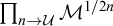 $\prod _{n \to \mathcal {U}} \mathcal {M}^{1/2n}$
so it has a central projection p of trace
$\prod _{n \to \mathcal {U}} \mathcal {M}^{1/2n}$
so it has a central projection p of trace $1/2$
. Let
$1/2$
. Let $z_1 = 2p - 1$
, so that
$z_1 = 2p - 1$
, so that $\left \lVert z_1 \right \rVert _2^2 = 1$
and
$\left \lVert z_1 \right \rVert _2^2 = 1$
and $\operatorname {\mathrm {tr}}(z_1) = 0$
and
$\operatorname {\mathrm {tr}}(z_1) = 0$
and $\sum _{j=1}^3 \left \lVert [Y_j,z_1] \right \rVert _2 = 0$
. Also for every
$\sum _{j=1}^3 \left \lVert [Y_j,z_1] \right \rVert _2 = 0$
. Also for every $z_2$
, we have
$z_2$
, we have
 $$\begin{align*}\left\lVert [z_1,z_2] \right\rVert_2^2 \leq \left( \left\lVert [z_1,E_{\mathcal{B}}[z_2]] \right\rVert_2 + 2 \left\lVert z_1 \right\rVert d(z_2,\mathcal{B}) \right)^2 = 4 d(z_2,\mathcal{B})^2 \leq 28 \sum_{j=1}^3 \left\lVert [Y_j,z_2] \right\rVert_2^2, \end{align*}$$
because of Lemma 4.9 and the fact that $[z_1,E_{\mathcal {B}}[z_2]] = 0$
.
$[z_1,E_{\mathcal {B}}[z_2]] = 0$
.
On the other hand, we claim that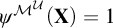 $\psi ^{\mathcal {M}^{\mathcal {U}}}(\mathbf {X}) = 1$
. Because the ultraproduct
$\psi ^{\mathcal {M}^{\mathcal {U}}}(\mathbf {X}) = 1$
. Because the ultraproduct $\mathcal {M}^{\mathcal {U}}$
is countably saturated (see Section 2.2), there is some
$\mathcal {M}^{\mathcal {U}}$
is countably saturated (see Section 2.2), there is some $z_1 \in \mathcal {M}^{\mathcal {U}}$
that attains the infimum in the formula. Let
$z_1 \in \mathcal {M}^{\mathcal {U}}$
that attains the infimum in the formula. Let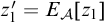 $z_1^{\prime } = E_{\mathcal {A}}[z_1]$
. Because
$z_1^{\prime } = E_{\mathcal {A}}[z_1]$
. Because $\mathcal {A}$
is a factor, a Dixmier averaging argument (see, e.g., [Reference Farah, Hart and Sherman29, Lemma 4.2]) shows that
$\mathcal {A}$
is a factor, a Dixmier averaging argument (see, e.g., [Reference Farah, Hart and Sherman29, Lemma 4.2]) shows that
 $$\begin{align*}\left\lVert z_1^{\prime} \right\rVert_2^2 - |\operatorname{\mathrm{tr}}(z_1^{\prime})|^2 =\|z-\operatorname{\mathrm{tr}}(z)\|_2^2\leq \sup_{z_2 \in \mathcal{A}_1} \left\lVert [z_1^{\prime},z_2] \right\rVert_2^2, \end{align*}$$
where $\mathcal {A}_1$
is the unit ball of
$\mathcal {A}_1$
is the unit ball of $\mathcal {A}$
. Using choices of
$\mathcal {A}$
. Using choices of $z_2 \in \mathcal {A}$
witnessing this inequality as candidates for the supremum in
$z_2 \in \mathcal {A}$
witnessing this inequality as candidates for the supremum in $\psi $
, we conclude
$\psi $
, we conclude
 $$\begin{align*}\psi^{\mathcal{M}^{\mathcal{U}}}(\mathbf{X}) \geq 1 - \left\lVert z_1 \right\rVert_2^2 + |\operatorname{\mathrm{tr}}(z_1)|^2 + d(z_1,\mathcal{A})^2 + \left[ \left\lVert z_1^{\prime} \right\rVert_2^2 - |\operatorname{\mathrm{tr}}(z_1^{\prime})|^2 + 0 \right], \end{align*}$$
where we have also applied the spectral gap inequality from Lemma 4.8 to get the $d(z_1, \mathcal {A})^2$
term. Noting that
$d(z_1, \mathcal {A})^2$
term. Noting that $d(z_1,\mathcal {A})^2 = \left \lVert z_1 - z_1^{\prime } \right \rVert _2^2 = \left \lVert z_1 \right \rVert _2^2 - \left \lVert z_1^{\prime } \right \rVert _2^2$
and that
$d(z_1,\mathcal {A})^2 = \left \lVert z_1 - z_1^{\prime } \right \rVert _2^2 = \left \lVert z_1 \right \rVert _2^2 - \left \lVert z_1^{\prime } \right \rVert _2^2$
and that $\operatorname {\mathrm {tr}}(z_1^{\prime }) = \operatorname {\mathrm {tr}}(z_1)$
, the entire expression evaluates to
$\operatorname {\mathrm {tr}}(z_1^{\prime }) = \operatorname {\mathrm {tr}}(z_1)$
, the entire expression evaluates to $1$
. For the upper bound
$1$
. For the upper bound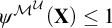 ${\psi ^{\mathcal {M}^{\mathcal {U}}}(\mathbf {X}) \leq 1}$
, simply take
${\psi ^{\mathcal {M}^{\mathcal {U}}}(\mathbf {X}) \leq 1}$
, simply take $z_1 = 0$
.
$z_1 = 0$
.
Remark 4.11 (Lack of quantifier elimination for
$\mathrm {II}_1$
factors).

Our argument also gives another proof of [Reference Farah26, Theorem 1], that a $\mathrm {II}_1$
factor never admits quantifier elimination, even without the assumption that
$\mathrm {II}_1$
factor never admits quantifier elimination, even without the assumption that $M_2(\mathcal {M})$
embeds into
$M_2(\mathcal {M})$
embeds into $\mathcal {M}^{\mathcal {U}}$
. Indeed, this assumption was only used to relate the existential types of
$\mathcal {M}^{\mathcal {U}}$
. Indeed, this assumption was only used to relate the existential types of $\mathbf {X}$
and
$\mathbf {X}$
and $\mathbf {Y}$
. It is immediate from Lemma 4.2 that the quantifier-free type of
$\mathbf {Y}$
. It is immediate from Lemma 4.2 that the quantifier-free type of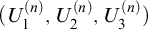 $(U_1^{(n)},U_2^{(n)},U_3^{(n)})$
converges almost surely as
$(U_1^{(n)},U_2^{(n)},U_3^{(n)})$
converges almost surely as $n \to \mathcal {U}$
, and the quantifier-free type of
$n \to \mathcal {U}$
, and the quantifier-free type of $(U_1^{(n)},U_2^{(n)},U_4^{(n)})$
converges to the same limit, hence so does the quantifier-free type of
$(U_1^{(n)},U_2^{(n)},U_4^{(n)})$
converges to the same limit, hence so does the quantifier-free type of $(U_1^{(n)}\oplus U_1^{(n)},U_2^{(n)} \oplus U_2^{(n)},U_3^{(n)} \oplus U_4^{(n)})$
. Therefore,
$(U_1^{(n)}\oplus U_1^{(n)},U_2^{(n)} \oplus U_2^{(n)},U_3^{(n)} \oplus U_4^{(n)})$
. Therefore, $\mathbf {X}$
and
$\mathbf {X}$
and $\mathbf {Y}$
have the same quantifier-free type almost surely. In fact, by Voiculescu’s asymptotic freeness theory [Reference Voiculescu63, Reference Voiculescu64],
$\mathbf {Y}$
have the same quantifier-free type almost surely. In fact, by Voiculescu’s asymptotic freeness theory [Reference Voiculescu63, Reference Voiculescu64], $\mathbf {X}$
and
$\mathbf {X}$
and $\mathbf {Y}$
are almost surely triples of freely independent unitaries whose spectral measures are uniform over the circle. However, the argument given above shows that
$\mathbf {Y}$
are almost surely triples of freely independent unitaries whose spectral measures are uniform over the circle. However, the argument given above shows that $\mathbf {X}$
and
$\mathbf {X}$
and $\mathbf {Y}$
do not have the same type, so that
$\mathbf {Y}$
do not have the same type, so that $\mathcal {M}$
does not admit quantifier elimination.
$\mathcal {M}$
does not admit quantifier elimination.
Remark 4.12 (Alternative approaches to the proof).
Theorem B in the $\mathrm {II}_1$
factor case can be proved in various ways using other constructions of quantum expanders, similar to how IF used spectral gap property (T) groups to show a lack of quantifier elimination for
$\mathrm {II}_1$
factor case can be proved in various ways using other constructions of quantum expanders, similar to how IF used spectral gap property (T) groups to show a lack of quantifier elimination for $\mathrm {II}_1$
factors in [Reference Farah26, Lemma 2.1]. Let
$\mathrm {II}_1$
factors in [Reference Farah26, Lemma 2.1]. Let $U_1^{(n)}$
, …,
$U_1^{(n)}$
, …, $U_d^{(n)}$
be a sequence of deterministic matrices such that
$U_d^{(n)}$
be a sequence of deterministic matrices such that $U_1^{(n)}$
, …,
$U_1^{(n)}$
, …, $U_d^{(n)}$
and their adjoints are a
$U_d^{(n)}$
and their adjoints are a $(2d,\epsilon )$
-quantum expander. Let
$(2d,\epsilon )$
-quantum expander. Let $U_{d+1}^{(n)}$
and
$U_{d+1}^{(n)}$
and $U_{d+2}^{(n)}$
be independent Haar random unitaries. Then the above argument for Theorem B in the factor case could also be done using
$U_{d+2}^{(n)}$
be independent Haar random unitaries. Then the above argument for Theorem B in the factor case could also be done using
 $$\begin{align*}\mathbf{X}^{(n)} = (U_1^{(n)} \otimes 1_{\mathcal{M}^{1/n}}, \dots, U_d^{(n)} \otimes 1_{\mathcal{M}^{1/n}}, U_{d+1}^{(n)} \otimes 1_{\mathcal{M}^{1/n}}), \end{align*}$$
and
 $$\begin{align*}\mathbf{Y}^{(n)} = ((U_1^{(n)} \oplus U_1^{(n)}) \otimes 1_{\mathcal{M}^{1/2n}}, \dots, (U_d^{(n)} \oplus U_d^{(n)}) \otimes 1_{\mathcal{M}^{1/2n}}, (U_{d+1}^{(n)} \oplus U_{d+2}^{(n)}) \otimes 1_{\mathcal{M}^{1/2n}}). \end{align*}$$
Indeed, concentration of measure (Proposition 4.1 and the proof of Lemma 4.2) still apply to a mixture of deterministic matrices and Haar random unitaries, and hence Lemma 4.3 still goes through. The arguments for Lemma 4.8 and 4.9 only use the fact that $U_1^{(n)}$
, …,
$U_1^{(n)}$
, …, $U_d^{(n)}$
is an expander and that
$U_d^{(n)}$
is an expander and that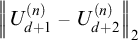 $\left \lVert U_{d+1}^{(n)} - U_{d+2}^{(n)} \right \rVert _2$
converges to
$\left \lVert U_{d+1}^{(n)} - U_{d+2}^{(n)} \right \rVert _2$
converges to $\sqrt {2}$
as
$\sqrt {2}$
as $n \to \infty $
. Further comments on alternative proofs can be found in the first arXiv version of this paper.
$n \to \infty $
. Further comments on alternative proofs can be found in the first arXiv version of this paper.
5 Model completeness for tracial von Neumann algebras
It is now straightforward to extend Theorem B from II $_1$
factors to arbitrary tracial von Neumann algebras as outlined in the introduction.
$_1$
factors to arbitrary tracial von Neumann algebras as outlined in the introduction.
5.1 Model completeness and direct sums
Lemma 5.1. If the theory of a tracial von Neumann algebra $\mathcal {M}$
is model-complete, then the theory of every direct summand of
$\mathcal {M}$
is model-complete, then the theory of every direct summand of $\mathcal {M}$
is model-complete.
$\mathcal {M}$
is model-complete.
Proof. Let $\mathcal {M}$
be a tracial von Neumann algebra which decomposes as a direct sum
$\mathcal {M}$
be a tracial von Neumann algebra which decomposes as a direct sum $\mathcal {M}_1 \oplus \mathcal {M}_2$
with weights
$\mathcal {M}_1 \oplus \mathcal {M}_2$
with weights $\alpha $
and
$\alpha $
and $1 - \alpha $
. Assume the theory of
$1 - \alpha $
. Assume the theory of $\mathcal {M}$
is model complete; we will prove that the theory of each one of
$\mathcal {M}$
is model complete; we will prove that the theory of each one of $\mathcal {M}_1$
and
$\mathcal {M}_1$
and $\mathcal {M}_2$
is model complete.
$\mathcal {M}_2$
is model complete.
Let $\mathcal {N}_1 \equiv \mathcal {M}_1$
and
$\mathcal {N}_1 \equiv \mathcal {M}_1$
and $\mathcal {N}_2 \equiv \mathcal {M}_2$
, and
$\mathcal {N}_2 \equiv \mathcal {M}_2$
, and $\iota _1: \mathcal {M}_1 \to \mathcal {N}_1$
and
$\iota _1: \mathcal {M}_1 \to \mathcal {N}_1$
and $\iota _2: \mathcal {M}_2 \to \mathcal {N}_2$
be trace-preserving
$\iota _2: \mathcal {M}_2 \to \mathcal {N}_2$
be trace-preserving $*$
-homomorphisms; we need to show that
$*$
-homomorphisms; we need to show that $\iota _1$
and
$\iota _1$
and $\iota _2$
are elementary. Let
$\iota _2$
are elementary. Let $\mathcal {N}$
be the direct sum of
$\mathcal {N}$
be the direct sum of $\mathcal {N}_1$
and
$\mathcal {N}_1$
and $\mathcal {N}_2$
with weights
$\mathcal {N}_2$
with weights $\alpha $
and
$\alpha $
and $1 - \alpha $
. Note that by [Reference Farah and Ghasemi27],
$1 - \alpha $
. Note that by [Reference Farah and Ghasemi27], $\mathcal {N} \equiv \mathcal {M}$
since the theory of
$\mathcal {N} \equiv \mathcal {M}$
since the theory of $\mathcal {N}$
is uniquely determined by the theories of the direct summands. By model completeness of
$\mathcal {N}$
is uniquely determined by the theories of the direct summands. By model completeness of $\mathcal {M}$
, the map
$\mathcal {M}$
, the map $\iota = \iota _1 \oplus \iota _2: \mathcal {M} \to \mathcal {N}$
is elementary.
$\iota = \iota _1 \oplus \iota _2: \mathcal {M} \to \mathcal {N}$
is elementary.
Let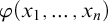 $\varphi (x_1,\dots ,x_n)$
be an
$\varphi (x_1,\dots ,x_n)$
be an $\mathcal {L}_{\operatorname {\mathrm {tr}}}$
-formula, and we will show that
$\mathcal {L}_{\operatorname {\mathrm {tr}}}$
-formula, and we will show that $\varphi ^{\mathcal {N}_1}(\iota _1(\mathbf {a})) = \varphi ^{\mathcal {M}_1}(\mathbf {a})$
for
$\varphi ^{\mathcal {N}_1}(\iota _1(\mathbf {a})) = \varphi ^{\mathcal {M}_1}(\mathbf {a})$
for ${\mathbf {a} = (a_1,\dots ,a_n) \in \mathcal {M}_1^n}$
. Because prenex formulas are dense in the space of all formulas [Reference Ben Yaacov, Berenstein, Henson, Usvyatsov, Chatzidakis, Macpherson, Pillay and Wilkie11, Section 6], assume without loss of generality that
${\mathbf {a} = (a_1,\dots ,a_n) \in \mathcal {M}_1^n}$
. Because prenex formulas are dense in the space of all formulas [Reference Ben Yaacov, Berenstein, Henson, Usvyatsov, Chatzidakis, Macpherson, Pillay and Wilkie11, Section 6], assume without loss of generality that
 $$\begin{align*}\varphi(x_1,\dots,x_n) = \inf_{y_1} \sup_{y_2} \dots \inf_{y_{2m-1}} \sup_{y_{2m}} F(\operatorname{\mathrm{Re}} \operatorname{\mathrm{tr}}(p_1(\mathbf{x},\mathbf{y})),\dots,\operatorname{\mathrm{Re}} \operatorname{\mathrm{tr}}(p_k(\mathbf{x},\mathbf{y}))), \end{align*}$$
where $y_1$
, …,
$y_1$
, …, $y_{2m}$
are variables in the unit ball,
$y_{2m}$
are variables in the unit ball, $F: \mathbb {R}^k \to \mathbb {R}$
is continuous, and
$F: \mathbb {R}^k \to \mathbb {R}$
is continuous, and $p_1$
, …,
$p_1$
, …, $p_k$
are non-commutative
$p_k$
are non-commutative $*$
-polynomials. Define
$*$
-polynomials. Define
 $$\begin{align*}\psi(x_1,\dots,\tilde{x}_n,z) = \inf_{y_1} \sup_{y_2} \dots \inf_{y_{2m-1}} \sup_{y_{2m}} F\left(\frac{1}{\alpha} \operatorname{\mathrm{Re}} \operatorname{\mathrm{tr}}(p_1(\mathbf{x},z\mathbf{y})),\dots, \frac{1}{\alpha} \operatorname{\mathrm{Re}} \operatorname{\mathrm{tr}}(p_k(\mathbf{x},z\mathbf{y})) \right), \end{align*}$$
where $z\mathbf {y} = (zy_1,\dots ,zy_{2m})$
. Observe that
$z\mathbf {y} = (zy_1,\dots ,zy_{2m})$
. Observe that
 $$\begin{align*}\varphi^{\mathcal{M}_1}(a_1,\dots,a_n) = \psi^{\mathcal{M}}(a_1 \oplus 0,\dots,a_n \oplus 0, 1 \oplus 0), \end{align*}$$
because $(1 \oplus 0)(y \oplus y') = y \oplus 0$
. Similarly,
$(1 \oplus 0)(y \oplus y') = y \oplus 0$
. Similarly,
 $$\begin{align*}\varphi^{\mathcal{N}_1}(\iota_1(a_1),\dots,\iota_1(a_n)) = \psi^{\mathcal{N}}(\iota(a_1 \oplus 0),\dots,\iota(a_n \oplus 0), \iota(1 \oplus 0)). \end{align*}$$
The mapping $\iota : \mathcal {M} \to \mathcal {N}$
is elementary, and hence
$\iota : \mathcal {M} \to \mathcal {N}$
is elementary, and hence
 $$\begin{align*}\psi^{\mathcal{N}}(\iota(a_1 \oplus 0),\dots,\iota(a_n \oplus 0), \iota(1 \oplus 0)) = \psi^{\mathcal{M}}(a_1 \oplus 0,\dots,a_n \oplus 0, 1 \oplus 0). \end{align*}$$
This shows $\varphi ^{\mathcal {N}_1}(\iota _1(\mathbf {a})) = \varphi ^{\mathcal {M}_1}(\mathbf {a})$
, so the mapping
$\varphi ^{\mathcal {N}_1}(\iota _1(\mathbf {a})) = \varphi ^{\mathcal {M}_1}(\mathbf {a})$
, so the mapping $\iota _1$
is elementary as desired. The same argument applies to
$\iota _1$
is elementary as desired. The same argument applies to $\iota _2$
. Therefore,
$\iota _2$
. Therefore, $\mathcal {M}_1$
and
$\mathcal {M}_1$
and $\mathcal {M}_2$
are model complete.
$\mathcal {M}_2$
are model complete.
Remark 5.2. Similarly, if $\mathcal {M} = (\mathcal {M}_1,\alpha ) \oplus (\mathcal {M}_2,1-\alpha )$
and if
$\mathcal {M} = (\mathcal {M}_1,\alpha ) \oplus (\mathcal {M}_2,1-\alpha )$
and if $\operatorname {\mathrm {Th}}(\mathcal {M})$
admits quantifier elimination, then
$\operatorname {\mathrm {Th}}(\mathcal {M})$
admits quantifier elimination, then $\operatorname {\mathrm {Th}}(\mathcal {M}_j)$
admits quantifier elimination for
$\operatorname {\mathrm {Th}}(\mathcal {M}_j)$
admits quantifier elimination for $j = 1$
,
$j = 1$
, $2$
. To see this, consider n-tuples
$2$
. To see this, consider n-tuples $\mathbf {x}$
and
$\mathbf {x}$
and $\mathbf {y}$
in
$\mathbf {y}$
in $\mathcal {M}_1$
that have the same quantifier-free type in
$\mathcal {M}_1$
that have the same quantifier-free type in $\mathcal {M}_1$
(i.e., they have the same
$\mathcal {M}_1$
(i.e., they have the same $*$
-moments). Then
$*$
-moments). Then $(x_1 \oplus 0, \dots , x_n \oplus 0, 1 \oplus 0)$
and
$(x_1 \oplus 0, \dots , x_n \oplus 0, 1 \oplus 0)$
and $(y_1 \oplus 0, \dots , y_n \oplus 0,1\oplus 0)$
have the same quantifier-free type in
$(y_1 \oplus 0, \dots , y_n \oplus 0,1\oplus 0)$
have the same quantifier-free type in $\mathcal {M}$
. Therefore, by Lemma 2.2, they have the same type in
$\mathcal {M}$
. Therefore, by Lemma 2.2, they have the same type in $\mathcal {M}$
. As we saw above, for each formula
$\mathcal {M}$
. As we saw above, for each formula $\varphi $
, there exists
$\varphi $
, there exists $\psi $
such that
$\psi $
such that $\varphi ^{\mathcal {M}_1}(x_1,\dots ,x_n) = \psi ^{\mathcal {M}}(x_1 \oplus 0, \dots , x_n \oplus 0, 1 \oplus 0)$
(and similarly for the
$\varphi ^{\mathcal {M}_1}(x_1,\dots ,x_n) = \psi ^{\mathcal {M}}(x_1 \oplus 0, \dots , x_n \oplus 0, 1 \oplus 0)$
(and similarly for the $y_j$
’s), and hence
$y_j$
’s), and hence $\mathbf {x}$
and
$\mathbf {x}$
and $\mathbf {y}$
have the same type in
$\mathbf {y}$
have the same type in $\mathcal {M}_1$
, and so
$\mathcal {M}_1$
, and so $\operatorname {\mathrm {Th}}(\mathcal {M}_1)$
has quantifier elimination by Lemma 2.2.
$\operatorname {\mathrm {Th}}(\mathcal {M}_1)$
has quantifier elimination by Lemma 2.2.
Remark 5.3. The relationship between model theoretic properties and direct sums/integrals is an important topic of recent study; [Reference Farah and Ghasemi27] showed how to determine the theory of the direct integral from that of the integrands, and the opposite direction was studied for von Neumann algebras in [Reference Gao and Jekel33], both of which are now special cases of the general theory of direct integrals developed by Ben Yaacov, Ibarlucía, and Tsankov [Reference Ben Yaacov, Ibarlucía and Tsankov12]. Based on these works, it is plausible that model completeness of a direct integral implies model completeness of the integrands almost everywhere in general, but we leave this as a question for future research.
5.2 Conclusion of the proof of Theorem B
By Lemma 5.1, because we already proved Theorem B in the case of $\mathrm {II}_1$
factors, we can eliminate any direct summands that are
$\mathrm {II}_1$
factors, we can eliminate any direct summands that are $\mathrm {II}_1$
factors satisfying that
$\mathrm {II}_1$
factors satisfying that $M_2(\mathcal {M}_\omega )$
embeds into
$M_2(\mathcal {M}_\omega )$
embeds into $\mathcal {M}_\omega ^{\mathcal {U}}$
. It remains to handle the diffuse part of the direct integral decomposition for
$\mathcal {M}_\omega ^{\mathcal {U}}$
. It remains to handle the diffuse part of the direct integral decomposition for $\mathcal {M}$
, which actually turns out to be much easier.
$\mathcal {M}$
, which actually turns out to be much easier.
Lemma 5.4. Let $(\mathcal {M},\tau ) = \int _{[0,1]} (\mathcal {M}_\omega ,\tau _\omega )\,d\omega $
, where
$(\mathcal {M},\tau ) = \int _{[0,1]} (\mathcal {M}_\omega ,\tau _\omega )\,d\omega $
, where $\mathcal {M}_\omega $
is a separable
$\mathcal {M}_\omega $
is a separable $\mathrm {II}_1$
factor such that
$\mathrm {II}_1$
factor such that $M_2(\mathcal {M}_\omega )$
embeds into
$M_2(\mathcal {M}_\omega )$
embeds into $\mathcal {M}_\omega ^{\mathcal {U}}$
. Then
$\mathcal {M}_\omega ^{\mathcal {U}}$
. Then $\mathcal {M}$
is not model complete.
$\mathcal {M}$
is not model complete.
Proof. Let $\mathcal {N} = L^\infty [0,1] \otimes \mathcal {M}$
. Note that
$\mathcal {N} = L^\infty [0,1] \otimes \mathcal {M}$
. Note that
 $$\begin{align*}\mathcal{N} = \int_{[0,1]^2} \mathcal{M}_\omega \,d\omega \,d\omega'. \end{align*}$$
Thus, the distribution of $\operatorname {\mathrm {Th}}(\mathcal {M}_\omega )$
over
$\operatorname {\mathrm {Th}}(\mathcal {M}_\omega )$
over $[0,1]^2$
is the same as the distribution of the
$[0,1]^2$
is the same as the distribution of the $\operatorname {\mathrm {Th}}(\mathcal {M}_\omega )$
over
$\operatorname {\mathrm {Th}}(\mathcal {M}_\omega )$
over $[0,1]$
. Therefore, it follows from [Reference Farah and Ghasemi27, Theorem 2.3] that
$[0,1]$
. Therefore, it follows from [Reference Farah and Ghasemi27, Theorem 2.3] that $\mathcal {M} \equiv \mathcal {N}$
. Moreover,
$\mathcal {M} \equiv \mathcal {N}$
. Moreover, $\mathcal {N} \oplus \mathcal {N} \cong \mathcal {N}$
. Now fix an ultrafilter
$\mathcal {N} \oplus \mathcal {N} \cong \mathcal {N}$
. Now fix an ultrafilter $\mathcal {U}$
on
$\mathcal {U}$
on $\mathbb {N}$
and note that
$\mathbb {N}$
and note that $M_2(\mathcal {M}_\omega )$
embeds into
$M_2(\mathcal {M}_\omega )$
embeds into $\mathcal {M}_\omega ^{\mathcal {U}}$
for all
$\mathcal {M}_\omega ^{\mathcal {U}}$
for all $\omega $
, hence
$\omega $
, hence $M_2(\mathcal {N})$
embeds into
$M_2(\mathcal {N})$
embeds into $\mathcal {N}^{\mathcal {U}}$
. Consider a trace preserving
$\mathcal {N}^{\mathcal {U}}$
. Consider a trace preserving $*$
-homomorphism
$*$
-homomorphism
 $$\begin{align*}\mathcal{N} \to \mathcal{N} \oplus \mathcal{N} \to M_2(\mathcal{N}) \to \mathcal{N}^{\mathcal{U}}, \end{align*}$$
where the first map is an isomorphism and the second map is the block diagonal embedding. Then $1 \oplus 0$
is central in
$1 \oplus 0$
is central in $\mathcal {N} \oplus \mathcal {N}$
but
$\mathcal {N} \oplus \mathcal {N}$
but $1 \oplus 0$
is not central in
$1 \oplus 0$
is not central in $M_2(\mathcal {N})$
. Hence, our homomorphism does not map
$M_2(\mathcal {N})$
. Hence, our homomorphism does not map $Z(\mathcal {N})$
into
$Z(\mathcal {N})$
into $Z(\mathcal {N}^{\mathcal {U}})$
, so it is not elementary.
$Z(\mathcal {N}^{\mathcal {U}})$
, so it is not elementary.
Proof of Theorem B.
Suppose $\mathcal {M}$
has a direct integral decomposition where
$\mathcal {M}$
has a direct integral decomposition where $\mathcal {M}_\omega $
is a
$\mathcal {M}_\omega $
is a $\mathrm {II}_1$
factor such that
$\mathrm {II}_1$
factor such that $M_2(\mathcal {M}_\omega )$
embeds
$M_2(\mathcal {M}_\omega )$
embeds $\mathcal {M}_{\omega }^{\mathcal {U}}$
, for
$\mathcal {M}_{\omega }^{\mathcal {U}}$
, for $\omega $
in some positive measure set. If the positive measure set has an atom, then
$\omega $
in some positive measure set. If the positive measure set has an atom, then $\mathcal {M}$
has a direct summand
$\mathcal {M}$
has a direct summand $\mathcal {N}$
which is a
$\mathcal {N}$
which is a $\mathrm {II}_1$
factor such that
$\mathrm {II}_1$
factor such that $M_2(\mathcal {N})$
embeds into
$M_2(\mathcal {N})$
embeds into $\mathcal {N}^{\mathcal {U}}$
. The results of the previous section show that
$\mathcal {N}^{\mathcal {U}}$
. The results of the previous section show that $\mathcal {N}$
is not model complete, hence by Lemma 5.1,
$\mathcal {N}$
is not model complete, hence by Lemma 5.1, $\mathcal {M}$
is not model complete.
$\mathcal {M}$
is not model complete.
If there is no atom in our positive measure set, then $\mathcal {M}$
has a direct summand of the form
$\mathcal {M}$
has a direct summand of the form $\mathcal {N} = \int _{[0,1]} \mathcal {N}_\alpha \,d\alpha $
where the integral occurs with respect to Lebesgue measure and
$\mathcal {N} = \int _{[0,1]} \mathcal {N}_\alpha \,d\alpha $
where the integral occurs with respect to Lebesgue measure and $\mathcal {N}_\alpha $
is a
$\mathcal {N}_\alpha $
is a $\mathrm {II}_1$
factor such that
$\mathrm {II}_1$
factor such that $M_2(\mathcal {N}_\alpha )$
embeds into
$M_2(\mathcal {N}_\alpha )$
embeds into $\mathcal {N}_\alpha ^{\mathcal {U}}$
. Hence, by Lemma 5.4,
$\mathcal {N}_\alpha ^{\mathcal {U}}$
. Hence, by Lemma 5.4, $\mathcal {N}$
is not model complete, and so by Lemma 5.1,
$\mathcal {N}$
is not model complete, and so by Lemma 5.1, $\mathcal {M}$
is not model complete.
$\mathcal {M}$
is not model complete.
Remark 5.5. A similar argument recovers the result of the first author that the theory of any separable tracial von Neumann algebra with a type $\mathrm {II}_1$
summand never admits quantifier elimination [Reference Farah26]. An algebra satisfying the assumptions of Theorem B either has a
$\mathrm {II}_1$
summand never admits quantifier elimination [Reference Farah26]. An algebra satisfying the assumptions of Theorem B either has a $\mathrm {II}_1$
factor as a direct summand, or it has a type
$\mathrm {II}_1$
factor as a direct summand, or it has a type $\mathrm {II}_1$
direct summand with diffuse center. If there is a type
$\mathrm {II}_1$
direct summand with diffuse center. If there is a type $\mathrm {II}_1$
direct summand
$\mathrm {II}_1$
direct summand $\mathcal {N}$
, then
$\mathcal {N}$
, then $\operatorname {\mathrm {Th}}(\mathcal {N})$
does not have quantifier elimination by Remark 4.11 and hence by Remark 5.2,
$\operatorname {\mathrm {Th}}(\mathcal {N})$
does not have quantifier elimination by Remark 4.11 and hence by Remark 5.2, $\operatorname {\mathrm {Th}}(\mathcal {M})$
does not have quantifier elimination. On the other hand, suppose
$\operatorname {\mathrm {Th}}(\mathcal {M})$
does not have quantifier elimination. On the other hand, suppose $\mathcal {N}$
is a type
$\mathcal {N}$
is a type $\mathrm {II}_1$
direct summand of
$\mathrm {II}_1$
direct summand of $\mathcal {M}$
with diffuse center. In this case, we argue similarly to Lemma 3.1;
$\mathcal {M}$
with diffuse center. In this case, we argue similarly to Lemma 3.1; $\mathcal {N}$
has a central projection of trace
$\mathcal {N}$
has a central projection of trace $1/2$
, and also a non-central projection of trace
$1/2$
, and also a non-central projection of trace $1/2$
, and hence
$1/2$
, and hence $\operatorname {\mathrm {Th}}(\mathcal {N})$
does not have quantifier elimination. So by Remark 5.2,
$\operatorname {\mathrm {Th}}(\mathcal {N})$
does not have quantifier elimination. So by Remark 5.2, $\operatorname {\mathrm {Th}}(\mathcal {M})$
does not have quantifier elimination.
$\operatorname {\mathrm {Th}}(\mathcal {M})$
does not have quantifier elimination.
6 Further remarks
6.1 Topological properties
In this section, we study the topological properties of the set of theories that admit quantifier elimination (and those that are model complete), and in particular we will see that quantifier elimination is generic among purely atomic tracial von Neumann algebras (though a lack of quantifier elimination is generic for tracial von Neumann algebras in general).
There is a natural topology on the space of complete theories, where basic open sets have the form
 $$\begin{align*}\{ \mathrm{T} \models |\varphi_1 - c_1| < \epsilon_1, \dots, |\varphi_k - c_k| < \epsilon_k \} \end{align*}$$
for some finite list of formulas $\varphi _1$
, …,
$\varphi _1$
, …, $\varphi _k$
, real numbers
$\varphi _k$
, real numbers $c_1$
, …,
$c_1$
, …, $c_k$
, and positive
$c_k$
, and positive $\epsilon _1$
, …,
$\epsilon _1$
, …, $\epsilon _k$
. In fact, this topology can be understood in functional analytic terms as follows. The sentences of a fixed language
$\epsilon _k$
. In fact, this topology can be understood in functional analytic terms as follows. The sentences of a fixed language $\mathcal {L}$
form a real algebra that has a natural norm (see the last sentence of [Reference Farah25, Definition D.2.4]). A complete theory in language
$\mathcal {L}$
form a real algebra that has a natural norm (see the last sentence of [Reference Farah25, Definition D.2.4]). A complete theory in language $\mathcal {L}$
is naturally identified with a bounded homomorphism from this algebra into
$\mathcal {L}$
is naturally identified with a bounded homomorphism from this algebra into $\mathbb {R}$
([Reference Farah25, Definition D.2.8]), and the topology on the space of complete theories then agrees with the weak-
$\mathbb {R}$
([Reference Farah25, Definition D.2.8]), and the topology on the space of complete theories then agrees with the weak- $*$
topology. The space of theories is metrizable whenever the language
$*$
topology. The space of theories is metrizable whenever the language $\mathcal {L}$
is separable (which is the case for tracial von Neumann algebras). Moreover, if
$\mathcal {L}$
is separable (which is the case for tracial von Neumann algebras). Moreover, if $\mathcal {C}$
is a class of
$\mathcal {C}$
is a class of $\mathcal {L}$
-structures that is closed under elementary equivalence, then
$\mathcal {L}$
-structures that is closed under elementary equivalence, then $\mathcal {C}$
is axiomatizable if and only if
$\mathcal {C}$
is axiomatizable if and only if $\operatorname {\mathrm {Th}}_{\mathcal {C}}=\{\operatorname {\mathrm {Th}}(\mathcal {M}): \mathcal {M} \in \mathcal {C}\}$
is a closed set and every model of some theory in
$\operatorname {\mathrm {Th}}_{\mathcal {C}}=\{\operatorname {\mathrm {Th}}(\mathcal {M}): \mathcal {M} \in \mathcal {C}\}$
is a closed set and every model of some theory in $\operatorname {\mathrm {Th}}_{\mathcal {C}}$
belongs to
$\operatorname {\mathrm {Th}}_{\mathcal {C}}$
belongs to $\mathcal {C}$
.
$\mathcal {C}$
.
A very basic observation is that quantifier elimination and model completeness define sets that are neither open nor closed in the space of theories of tracial von Neumann algebras.
Proposition 6.1. The following sets of theories of tracial von Neumann algebras are not closed (equivalently, the corresponding classes are not axiomatizable):
-
(1) Those which admit quantifier elimination.
-
(2) Those which do not admit quantifier elimination.
-
(3) Those which are model complete.
-
(4) Those which are not model complete.
Proof. We use the following observation several times: For any two tracial von Neumann algebras $\mathcal {M}_0$
and
$\mathcal {M}_0$
and $\mathcal {M}_1$
, the theory of
$\mathcal {M}_1$
, the theory of $\mathcal {M}_\alpha = (\mathcal {M}_0,1-\alpha ) \oplus (\mathcal {M}_1,\alpha )$
depends continuously on
$\mathcal {M}_\alpha = (\mathcal {M}_0,1-\alpha ) \oplus (\mathcal {M}_1,\alpha )$
depends continuously on $\alpha \in [0,1]$
. This idea was used in [Reference Goldbring and Hart35, Proposition 5.1]. Indeed, one can show by induction that for each formula
$\alpha \in [0,1]$
. This idea was used in [Reference Goldbring and Hart35, Proposition 5.1]. Indeed, one can show by induction that for each formula $\varphi $
, the quantity
$\varphi $
, the quantity $\varphi ^{\mathcal {M}_\alpha }(x_1 \oplus x_1^{\prime }, \dots , x_n \oplus x_n^{\prime })$
is continuous in
$\varphi ^{\mathcal {M}_\alpha }(x_1 \oplus x_1^{\prime }, \dots , x_n \oplus x_n^{\prime })$
is continuous in $\alpha $
uniformly over
$\alpha $
uniformly over $x_j$
and
$x_j$
and $x_j^{\prime }$
in the unit ball.
$x_j^{\prime }$
in the unit ball.
Now we proceed to the main claims:
-
(1)
$M_n(\mathbb {C})$
admits quantifier elimination. Fixing an ultrafilter
$\mathcal {U}$
on the natural numbers,
$\lim _{n \to \mathcal {U}} \operatorname {\mathrm {Th}}(M_n(\mathbb {C})) = \operatorname {\mathrm {Th}}(\prod _{n \to \mathcal {U}} M_n(\mathbb {C}))$
, which does not admit quantifier elimination by [Reference Farah26] since the matrix ultraproduct is a
$\mathrm {II}_1$
factor.Footnote
6
-
(2) Consider
$(M_n(\mathbb {C}),1-\alpha ) \oplus (\mathcal {R},\alpha )$
. This does not admit quantifier elimination when
$\alpha> 0$
but does admit quantifier elimination when
$\alpha = 0$
. -
(3) This follows from the same argument as (1).
-
(4) This follows from the same argument as (2) since
$(M_n(\mathbb {C}),1-\alpha ) \oplus (\mathcal {R},\alpha )$
is not model complete by Theorem B.








While the sets of theories defined by quantifier elimination and model completeness are not open or closed, they are $G_\delta $
-sets. In fact, this holds for separable metric languages in general. We remark that the analogous statement also holds for countable languages in discrete model theory (and the analog of Proposition 6.1 is true for some languages). Hence, the descriptive complexity of these sets does not increase when we pass from discrete structures to metric structures (in stark contrast, there is a bizarre increase in complexity for sets of omissible types [Reference Farah and Magidor32]).
$G_\delta $
-sets. In fact, this holds for separable metric languages in general. We remark that the analogous statement also holds for countable languages in discrete model theory (and the analog of Proposition 6.1 is true for some languages). Hence, the descriptive complexity of these sets does not increase when we pass from discrete structures to metric structures (in stark contrast, there is a bizarre increase in complexity for sets of omissible types [Reference Farah and Magidor32]).
Proposition 6.2. Let $\mathcal {L}$
be a separable language of metric structures. Both the set of complete theories that admit quantifier elimination and the set of complete theories that are model complete are
$\mathcal {L}$
be a separable language of metric structures. Both the set of complete theories that admit quantifier elimination and the set of complete theories that are model complete are $G_\delta $
sets.
$G_\delta $
sets.
Proof. Consider quantifier elimination. Since the language is separable, choose for each n a countable dense set $\mathcal {F}_n$
of formulas in n variables (if there are multiple sorts, then we choose such a set for each tuple of sorts). For each n and
$\mathcal {F}_n$
of formulas in n variables (if there are multiple sorts, then we choose such a set for each tuple of sorts). For each n and $\varphi \in \mathcal {F}_n$
, for each
$\varphi \in \mathcal {F}_n$
, for each $k \geq 1$
, let
$k \geq 1$
, let $G_{\varphi ,k}$
be the set of complete theories
$G_{\varphi ,k}$
be the set of complete theories $\mathrm {T}$
such that there exists a quantifier-free formula
$\mathrm {T}$
such that there exists a quantifier-free formula $\psi $
such that
$\psi $
such that $\mathrm {T}$
models
$\mathrm {T}$
models
 $$\begin{align*}\sup_{x_1,\dots,x_n} |\varphi(x_1,\dots,x_n) - \psi(x_1,\dots,x_n)| < \frac{1}{k}. \end{align*}$$
Then $G_{\varphi ,k}$
is open and
$G_{\varphi ,k}$
is open and $\bigcap _{\varphi , k} G_{\varphi ,k}$
is precisely the set of theories that admit quantifier elimination, since it suffices to approximate a dense subset of formulas by quantifier-free formulas. The argument for model completeness works the same way using Lemma 2.3 (3).
$\bigcap _{\varphi , k} G_{\varphi ,k}$
is precisely the set of theories that admit quantifier elimination, since it suffices to approximate a dense subset of formulas by quantifier-free formulas. The argument for model completeness works the same way using Lemma 2.3 (3).
So the set of theories of tracial von Neumann algebras with quantifier elimination is non-closed, non-open, and $G_\delta $
. We now show it is meager, since in fact the set of theories of type I von Neumann algebras is meager. Our proof goes by way of spectral gap.
$G_\delta $
. We now show it is meager, since in fact the set of theories of type I von Neumann algebras is meager. Our proof goes by way of spectral gap.
Lemma 6.3. Let $d \in \mathbb {N}$
and
$d \in \mathbb {N}$
and $C> 0$
. The complete theories of tracial von Neumann algebras with
$C> 0$
. The complete theories of tracial von Neumann algebras with $(C,d)$
-spectral gap form a closed set with dense complement.
$(C,d)$
-spectral gap form a closed set with dense complement.
Proof. By [Reference Farah, Hart and Sherman29, Lemma 4.2], the center $Z(\mathcal {M})$
is definable relative to the theory of tracial von Neumann algebras. Hence, similar to [Reference Farah, Hart, Lupini, Robert, Tikuisis, Vignati and Winter28, Definition 3.2.3 and Lemma 3.2.5] in the
$Z(\mathcal {M})$
is definable relative to the theory of tracial von Neumann algebras. Hence, similar to [Reference Farah, Hart, Lupini, Robert, Tikuisis, Vignati and Winter28, Definition 3.2.3 and Lemma 3.2.5] in the $\mathrm {C}^{*}$
-algebra case,
$\mathrm {C}^{*}$
-algebra case,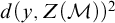 $d(y,Z(\mathcal {M}))^2$
is a definable predicate (or it is a formula in an expanded language with a sort added for
$d(y,Z(\mathcal {M}))^2$
is a definable predicate (or it is a formula in an expanded language with a sort added for $Z(\mathcal {M})$
). Thus, consider the sentence
$Z(\mathcal {M})$
). Thus, consider the sentence
 $$\begin{align*}\inf_{x_1,\dots,x_d \in B_1^{\mathcal{M}}} \sup_{y \in B_1^{\mathcal{M}}} \left( d(y,Z(\mathcal{M}))^2 \dot{-} C \sum_{j=1}^d \left\lVert [x_j,y] \right\rVert_2^2 \right) = 0. \end{align*}$$
Note that $\mathcal {M}$
has
$\mathcal {M}$
has $(C,d)$
-spectral gap, then
$(C,d)$
-spectral gap, then $\mathcal {M}$
satisfies this sentence. The converse holds when
$\mathcal {M}$
satisfies this sentence. The converse holds when $\mathcal {M}$
is countably saturated because we can choose some
$\mathcal {M}$
is countably saturated because we can choose some $x_1$
, …,
$x_1$
, …, $x_d$
that realize the infimum. Since every complete theory had a countably saturated model, the set of theories of von Neumann algebras with
$x_d$
that realize the infimum. Since every complete theory had a countably saturated model, the set of theories of von Neumann algebras with $(C,d)$
-spectral gap is equal to the set of theories satisfying this sentence, hence is closed. To see that its complement is dense, note that for every tracial von Neumann algebra
$(C,d)$
-spectral gap is equal to the set of theories satisfying this sentence, hence is closed. To see that its complement is dense, note that for every tracial von Neumann algebra $\mathcal {M}$
, the direct sum
$\mathcal {M}$
, the direct sum $(\mathcal {M},1-\alpha ) \oplus (\mathcal {R},\alpha )$
does not have spectral gap, and
$(\mathcal {M},1-\alpha ) \oplus (\mathcal {R},\alpha )$
does not have spectral gap, and $\operatorname {\mathrm {Th}}((\mathcal {M},1-\alpha ) \oplus (\mathcal {R},\alpha )) \to \mathcal {M}$
as
$\operatorname {\mathrm {Th}}((\mathcal {M},1-\alpha ) \oplus (\mathcal {R},\alpha )) \to \mathcal {M}$
as $\alpha \to 0$
.
$\alpha \to 0$
.
Proposition 6.4. The following properties define meager sets in the space of complete theories of tracial von Neumann algebras.
-
(1) Tracial von Neumann algebras with spectral gap.
-
(2) Type
$\mathrm {I}$
tracial von Neumann algebras. -
(3) Tracial von Neumann algebras whose theory admits quantifier elimination.

Proof. (1) By Lemma 6.3 the $(C,d)$
-spectral gap property defines a closed set whose complement is dense. Taking the union over C and d in
$(C,d)$
-spectral gap property defines a closed set whose complement is dense. Taking the union over C and d in $\mathbb {N}$
yields a meager
$\mathbb {N}$
yields a meager $F_\sigma $
set.
$F_\sigma $
set.
(2) Hastings’s result (see Theorem 4.6 and Corollary 4.7 above) shows that matrix algebras $M_n(\mathbb {C})$
have spectral gap for a fixed C and d (for instance one can take
$M_n(\mathbb {C})$
have spectral gap for a fixed C and d (for instance one can take $d = 2$
and
$d = 2$
and $C = 2$
). It is straightforward to check that a direct integral of tracial von Neumann algebras with
$C = 2$
). It is straightforward to check that a direct integral of tracial von Neumann algebras with $(2,2)$
-spectral gap also has
$(2,2)$
-spectral gap also has $(2,2)$
-spectral gap. Hence, all separable type
$(2,2)$
-spectral gap. Hence, all separable type $\mathrm {I}$
tracial von Neumann algebras have
$\mathrm {I}$
tracial von Neumann algebras have $(2,2)$
-spectral gap, so their theories are contained in the meager set from (1).
$(2,2)$
-spectral gap, so their theories are contained in the meager set from (1).
(3) Quantifier elimination can only hold for the theories of type I tracial von Neumann algebras [Reference Farah26, Theorem 1].
As the set of theories of von Neumann algebras with quantifier elimination is meager in the space of all theories, we now consider its topological properties within the space of theories of type I von Neumann algebras. In light of Theorem A, tracial von Neumann algebras $\mathcal {M}$
whose theories admit quantifier elimination come in two varieties, those with an
$\mathcal {M}$
whose theories admit quantifier elimination come in two varieties, those with an $L^\infty [0,1]$
summand and those without. First, those
$L^\infty [0,1]$
summand and those without. First, those $\mathcal {M}$
with an
$\mathcal {M}$
with an $L^\infty [0,1]$
summand can only have finitely many matrix algebra summands, since projections in the atomic part cannot have trace smaller than the weight
$L^\infty [0,1]$
summand can only have finitely many matrix algebra summands, since projections in the atomic part cannot have trace smaller than the weight $\alpha _0$
of the
$\alpha _0$
of the $L^\infty [0,1]$
summand by Proposition 3.3 (3). Fix natural numbers k and
$L^\infty [0,1]$
summand by Proposition 3.3 (3). Fix natural numbers k and $n_1$
, …,
$n_1$
, …, $n_k$
, and consider
$n_k$
, and consider
 $$\begin{align*}\mathcal{M} = (L^\infty[0,1],\alpha_0) \oplus \bigoplus_{j=1}^k (M_{n_j}(\mathbb{C}),\alpha_j). \end{align*}$$
From 3.4, we can see that the set of weights $(\alpha _0,\dots ,\alpha _k)$
such that
$(\alpha _0,\dots ,\alpha _k)$
such that $\mathcal {M}$
admits quantifier elimination is an open subset of the k-simplex, as we can see from Proposition 3.4. However, it is not dense since everything in the closure must satisfy
$\mathcal {M}$
admits quantifier elimination is an open subset of the k-simplex, as we can see from Proposition 3.4. However, it is not dense since everything in the closure must satisfy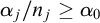 $\alpha _j/n_j \geq \alpha _0$
for
$\alpha _j/n_j \geq \alpha _0$
for $j \geq 1$
.
$j \geq 1$
.
Second, we have purely atomic $\mathcal {M}$
. As noted in [Reference Farah and Ghasemi27, Section 3], purely atomic algebras can be parameterized by
$\mathcal {M}$
. As noted in [Reference Farah and Ghasemi27, Section 3], purely atomic algebras can be parameterized by $\rho _{\mathcal {M}}(m,n)$
for
$\rho _{\mathcal {M}}(m,n)$
for $m, n \geq 1$
, where for each
$m, n \geq 1$
, where for each $m \in \mathbb {N}$
, the values
$m \in \mathbb {N}$
, the values $\rho _{\mathcal {M}}(m,1) \geq \rho _{\mathcal {M}}(m,2) \geq \dots $
are the weights of the central projections associated with
$\rho _{\mathcal {M}}(m,1) \geq \rho _{\mathcal {M}}(m,2) \geq \dots $
are the weights of the central projections associated with $M_m(\mathbb {C})$
terms in the direct sum decomposition. If there are only finitely many
$M_m(\mathbb {C})$
terms in the direct sum decomposition. If there are only finitely many $M_m(\mathbb {C})$
terms, we set
$M_m(\mathbb {C})$
terms, we set $\rho _{\mathcal {M}}(m,n) = 0$
for n larger than the number of such terms. Let
$\rho _{\mathcal {M}}(m,n) = 0$
for n larger than the number of such terms. Let
 $$\begin{align*}\Delta = \left\{ (\alpha_{m,n})_{m,n\geq 1}: \alpha_{m,n} \geq \alpha_{m,n+1} \geq 0, \sum_{m,n \geq 1} \alpha_{m,n} = 1 \right\}. \end{align*}$$
We view $\Delta $
as a metric space with respect to the
$\Delta $
as a metric space with respect to the $L^1$
metric. The resulting topology on
$L^1$
metric. The resulting topology on $\Delta $
agrees with the topology of pointwise convergence (however,
$\Delta $
agrees with the topology of pointwise convergence (however, $\Delta $
is not compact because elements of
$\Delta $
is not compact because elements of $\Delta $
can converge pointwise to zero).
$\Delta $
can converge pointwise to zero).
Lemma 6.5. For $\vec {\alpha } = (\alpha _{m,n})_{m,n \geq 1}$
, let
$\vec {\alpha } = (\alpha _{m,n})_{m,n \geq 1}$
, let
 $$\begin{align*}\mathcal{M}_{\vec{\alpha}} = \bigoplus_{m,n \geq 1} (M_m(\mathbb{C}), \alpha_{m,n}) \end{align*}$$
be the associated purely atomic tracial von Neumann algebra. The map $\vec {\alpha } \mapsto \operatorname {\mathrm {Th}}(\mathcal {M}_{\vec {\alpha }})$
is a homeomorphism onto its image.
$\vec {\alpha } \mapsto \operatorname {\mathrm {Th}}(\mathcal {M}_{\vec {\alpha }})$
is a homeomorphism onto its image.
Proof. [Reference Farah and Ghasemi27, Theorem 2.3] implies that the theory of $\mathcal {M}_{\vec {\alpha }}$
depends continuously on the weights
$\mathcal {M}_{\vec {\alpha }}$
depends continuously on the weights $\vec {\alpha }$
. The construction in [Reference Farah and Ghasemi27, Lemma 3.2] shows that
$\vec {\alpha }$
. The construction in [Reference Farah and Ghasemi27, Lemma 3.2] shows that $\alpha _{m,n} = \rho _{\mathcal {M}_{\vec {\alpha }}}(m,n)$
can be recovered from
$\alpha _{m,n} = \rho _{\mathcal {M}_{\vec {\alpha }}}(m,n)$
can be recovered from $\operatorname {\mathrm {Th}}(\mathcal {M}_{\vec {\alpha }})$
. In particular, one can see from this that for each
$\operatorname {\mathrm {Th}}(\mathcal {M}_{\vec {\alpha }})$
. In particular, one can see from this that for each $m, n \geq 1$
, if
$m, n \geq 1$
, if $\vec {\alpha } \in \Delta $
and the theory of
$\vec {\alpha } \in \Delta $
and the theory of $\mathcal {N}$
is sufficiently close to that of
$\mathcal {N}$
is sufficiently close to that of $\mathcal {M}_{\vec {\alpha }}$
, then
$\mathcal {M}_{\vec {\alpha }}$
, then $\rho _{\mathcal {N}}(m,n)$
will be close to
$\rho _{\mathcal {N}}(m,n)$
will be close to $\alpha _{m,n}$
.
$\alpha _{m,n}$
.
Proposition 6.6. The set of $\vec {\alpha } \in \Delta $
such that
$\vec {\alpha } \in \Delta $
such that $\operatorname {\mathrm {Th}}(\mathcal {M}_{\vec {\alpha }})$
has quantifier elimination is comeager.
$\operatorname {\mathrm {Th}}(\mathcal {M}_{\vec {\alpha }})$
has quantifier elimination is comeager.
Proof. Let $\mathcal {M}_{\vec {\alpha },k} = \bigoplus _{1 \leq m,n \leq k} (M_m(\mathbb {C}),\alpha _{m,n}) \subseteq \mathcal {M}_{\vec {\alpha }}$
, and let
$\mathcal {M}_{\vec {\alpha },k} = \bigoplus _{1 \leq m,n \leq k} (M_m(\mathbb {C}),\alpha _{m,n}) \subseteq \mathcal {M}_{\vec {\alpha }}$
, and let $\mathcal {M}_{\vec {\alpha },k}^{\perp }$
be the direct sum over the complementary indices. Let
$\mathcal {M}_{\vec {\alpha },k}^{\perp }$
be the direct sum over the complementary indices. Let $\tau _{\vec {\alpha }}$
be the trace on
$\tau _{\vec {\alpha }}$
be the trace on $\mathcal {M}_{\vec {\alpha }}$
. Let
$\mathcal {M}_{\vec {\alpha }}$
. Let
 $$\begin{align*}\epsilon_k(\vec{\alpha}) = \min \{ |\tau_{\vec{\alpha}}(p) - \tau_{\vec{\alpha}}(q)|: p, q \text{ projections in } \mathcal{M}_{\vec{\alpha},k} \text{ with } \tau(p) \neq \tau(q) \}. \end{align*}$$
Let
 $$\begin{align*}G_k = \{ \vec{\alpha} \in \Delta: 1 - \sum_{1 \leq m,n \leq k} \alpha_{m,n} < \epsilon_k(\vec{\alpha}) \}. \end{align*}$$
Note that $G_k$
is open in
$G_k$
is open in $\Delta $
, hence also
$\Delta $
, hence also $\bigcup _{k \geq \ell } G_k$
is open. Moreover, contains the set of
$\bigcup _{k \geq \ell } G_k$
is open. Moreover, contains the set of $\vec {\alpha }$
such that
$\vec {\alpha }$
such that $\vec {\alpha }$
is supported on
$\vec {\alpha }$
is supported on $\{1,\dots ,k\}^2$
, and so
$\{1,\dots ,k\}^2$
, and so $\bigcup _{k \geq \ell } G_k$
is dense. Therefore,
$\bigcup _{k \geq \ell } G_k$
is dense. Therefore,
 $$\begin{align*}G = \bigcap_{\ell \in \mathbb{N}} \bigcup_{k \geq \ell} G_k \end{align*}$$
is comeager. Furthermore,
 $$\begin{align*}F = \{\vec{\alpha} \in \Delta: \alpha_{m,n} \text{ are linearly independent over } \mathbb{Q}\} \end{align*}$$
is comeager because non-vanishing of $\mathbb {Q}$
-linear combinations is a countable family of open conditions. Hence,
$\mathbb {Q}$
-linear combinations is a countable family of open conditions. Hence, $F \cap G$
is comeager.
$F \cap G$
is comeager.
We claim that if $\vec {\alpha } \in F \cap G$
, then
$\vec {\alpha } \in F \cap G$
, then $\mathcal {M}_{\vec {\alpha }}$
admits quantifier elimination. Let p and q be projections of the same trace in
$\mathcal {M}_{\vec {\alpha }}$
admits quantifier elimination. Let p and q be projections of the same trace in $\mathcal {M}_{\vec {\alpha }}$
. For each k, write
$\mathcal {M}_{\vec {\alpha }}$
. For each k, write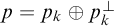 $p = p_k \oplus p_k^{\perp }$
and
$p = p_k \oplus p_k^{\perp }$
and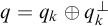 $q = q_k \oplus q_k^{\perp }$
with respect to the decomposition
$q = q_k \oplus q_k^{\perp }$
with respect to the decomposition $\mathcal {M}_{\vec {\alpha }} = \mathcal {M}_{\vec {\alpha },k} \oplus \mathcal {M}_{\vec {\alpha },k}^{\perp }$
. If
$\mathcal {M}_{\vec {\alpha }} = \mathcal {M}_{\vec {\alpha },k} \oplus \mathcal {M}_{\vec {\alpha },k}^{\perp }$
. If $\vec {\alpha } \in G_k$
, then by construction of
$\vec {\alpha } \in G_k$
, then by construction of $G_k$
, we have
$G_k$
, we have
 $$\begin{align*}|\tau_{\vec{\alpha}}(p_k) - \tau_{\vec{\alpha}}(q_k)| = |\tau_{\vec{\alpha}}(p_k^{\perp}) - \tau_{\vec{\alpha}}(q_k^{\perp})| < \epsilon_k(\vec{\alpha}), \end{align*}$$
which forces $\tau _{\vec {\alpha }}(p_k) = \tau _{\vec {\alpha }}(q_k)$
by definition of
$\tau _{\vec {\alpha }}(p_k) = \tau _{\vec {\alpha }}(q_k)$
by definition of $\epsilon _k(\vec {\alpha })$
. Now let
$\epsilon _k(\vec {\alpha })$
. Now let $p_{m,n}$
and
$p_{m,n}$
and $q_{m,n}$
be the components of p and q respectively in the direct summand
$q_{m,n}$
be the components of p and q respectively in the direct summand $(M_m(\mathbb {C}),\alpha _{m,n})$
. Because the
$(M_m(\mathbb {C}),\alpha _{m,n})$
. Because the $\alpha _{m,n}$
’s are linearly independent over
$\alpha _{m,n}$
’s are linearly independent over $\mathbb {Q}$
, the condition that
$\mathbb {Q}$
, the condition that $\tau _{\vec {\alpha }}(p_k) = \tau _{\vec {\alpha }}(q_k)$
forces that
$\tau _{\vec {\alpha }}(p_k) = \tau _{\vec {\alpha }}(q_k)$
forces that $\operatorname {\mathrm {tr}}_m(p_{m,n}) = \operatorname {\mathrm {tr}}_m(q_{m,n})$
for
$\operatorname {\mathrm {tr}}_m(p_{m,n}) = \operatorname {\mathrm {tr}}_m(q_{m,n})$
for $m, n \leq k$
. Because
$m, n \leq k$
. Because $\vec {\alpha } \in G$
, we know that
$\vec {\alpha } \in G$
, we know that $\vec {\alpha } \in G_k$
for infinitely many k, and thus
$\vec {\alpha } \in G_k$
for infinitely many k, and thus $\operatorname {\mathrm {tr}}_m(p_{m,n}) = \operatorname {\mathrm {tr}}_m(q_{m,n})$
for all
$\operatorname {\mathrm {tr}}_m(p_{m,n}) = \operatorname {\mathrm {tr}}_m(q_{m,n})$
for all $m, n$
, which means that p and q are conjugate by an automorphism. Therefore, by Theorem A,
$m, n$
, which means that p and q are conjugate by an automorphism. Therefore, by Theorem A, $\operatorname {\mathrm {Th}}(\mathcal {M}_{\vec {\alpha }})$
admits quantifier elimination.
$\operatorname {\mathrm {Th}}(\mathcal {M}_{\vec {\alpha }})$
admits quantifier elimination.
6.2 Matrix amplification and approximate embedding
In Theorem B, we assumed the condition that $M_2(\mathcal {M})$
embeds into
$M_2(\mathcal {M})$
embeds into $\mathcal {M}^{\mathcal {U}}$
. While this condition holds automatically if
$\mathcal {M}^{\mathcal {U}}$
. While this condition holds automatically if $\mathcal {M}$
is Connes-embeddable or if
$\mathcal {M}$
is Connes-embeddable or if $\mathcal {M}$
is existentially closed, we do not know if it holds for all
$\mathcal {M}$
is existentially closed, we do not know if it holds for all $\mathrm {II}_1$
factors. In this section, we investigate this problem by giving a series of equivalent conditions. This expands upon the results about the “universal fundamental group” by Goldbring and Hart [Reference Goldbring and Hart36, Proposition 4.17].Footnote
7
$\mathrm {II}_1$
factors. In this section, we investigate this problem by giving a series of equivalent conditions. This expands upon the results about the “universal fundamental group” by Goldbring and Hart [Reference Goldbring and Hart36, Proposition 4.17].Footnote
7
Recall that for $\mathrm {II}_1$
factors
$\mathrm {II}_1$
factors $\mathcal {M}$
and
$\mathcal {M}$
and $\mathcal {N}$
, the statement
$\mathcal {N}$
, the statement $\operatorname {\mathrm {Th}}_{\exists }(\mathcal {M}) = \operatorname {\mathrm {Th}}_{\exists }(\mathcal {N})$
means that for every
$\operatorname {\mathrm {Th}}_{\exists }(\mathcal {M}) = \operatorname {\mathrm {Th}}_{\exists }(\mathcal {N})$
means that for every $\inf $
-sentence
$\inf $
-sentence $\varphi $
, we have
$\varphi $
, we have $\varphi ^{\mathcal {M}} = \varphi ^{\mathcal {N}}$
. An equivalent statement is that for some ultrafilter
$\varphi ^{\mathcal {M}} = \varphi ^{\mathcal {N}}$
. An equivalent statement is that for some ultrafilter $\mathcal {U}$
, we have that
$\mathcal {U}$
, we have that $\mathcal {M}$
embeds into
$\mathcal {M}$
embeds into $\mathcal {N}^{\mathcal {U}}$
and
$\mathcal {N}^{\mathcal {U}}$
and $\mathcal {N}$
embeds into
$\mathcal {N}$
embeds into $\mathcal {M}^{\mathcal {U}}$
. For instance, when
$\mathcal {M}^{\mathcal {U}}$
. For instance, when $\mathcal {M}$
is Connes-embeddable, then
$\mathcal {M}$
is Connes-embeddable, then $\operatorname {\mathrm {Th}}_{\exists }(\mathcal {M}) = \operatorname {\mathrm {Th}}_{\exists }(\mathcal {R})$
. We will show that the condition of
$\operatorname {\mathrm {Th}}_{\exists }(\mathcal {M}) = \operatorname {\mathrm {Th}}_{\exists }(\mathcal {R})$
. We will show that the condition of $M_2(\mathcal {M})$
embedding into
$M_2(\mathcal {M})$
embedding into $\mathcal {M}^{\mathcal {U}}$
is equivalent to
$\mathcal {M}^{\mathcal {U}}$
is equivalent to $\operatorname {\mathrm {Th}}_{\exists }(\mathcal {M}^t) = \operatorname {\mathrm {Th}}_{\exists }(\mathcal {M})$
for some or all
$\operatorname {\mathrm {Th}}_{\exists }(\mathcal {M}^t) = \operatorname {\mathrm {Th}}_{\exists }(\mathcal {M})$
for some or all $t \in (0,\infty ) \setminus \{1\}$
, where
$t \in (0,\infty ) \setminus \{1\}$
, where $\mathcal {M}^t$
is the tth compression/amplification of
$\mathcal {M}^t$
is the tth compression/amplification of $\mathcal {M}$
.
$\mathcal {M}$
.
Proposition 6.7. Let $\mathcal {M}$
be a
$\mathcal {M}$
be a $\mathrm {II}_1$
factor. Then
$\mathrm {II}_1$
factor. Then
 $$ \begin{align*} \lim_{t \to \infty} \operatorname{\mathrm{Th}}_{\exists}(\mathcal{M}^t) &= \operatorname{\mathrm{Th}}_{\exists}(\mathcal{M} \otimes \mathcal{R}), \\ \lim_{t \to 0} \operatorname{\mathrm{Th}}_{\exists}(\mathcal{M}^t) & \text{ exists.} \end{align*} $$
Proof. Consider an existential sentence $\varphi = \inf _{x_1,\dots ,x_n} \psi (x_1,\dots ,x_n)$
where
$\varphi = \inf _{x_1,\dots ,x_n} \psi (x_1,\dots ,x_n)$
where $\psi $
is a quantifier-free formula and
$\psi $
is a quantifier-free formula and $x_j$
ranges over the unit ball. We can express
$x_j$
ranges over the unit ball. We can express
 $$ \begin{align} \psi(\mathbf{x}) = F(\operatorname{\mathrm{Re}} \operatorname{\mathrm{tr}}(p_1(\mathbf{x})), \dots, \operatorname{\mathrm{Re}} \operatorname{\mathrm{tr}}(p_k(\mathbf{x}))) \end{align} $$
for some non-commutative $*$
-polynomials
$*$
-polynomials $p_j$
and a continuous real-valued function F. By rescaling the input variables to F, assume without loss of generality that
$p_j$
and a continuous real-valued function F. By rescaling the input variables to F, assume without loss of generality that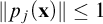 $\left \lVert p_j(\mathbf {x}) \right \rVert \leq 1$
when
$\left \lVert p_j(\mathbf {x}) \right \rVert \leq 1$
when $x_1$
, …,
$x_1$
, …, $x_n$
are in the unit ball. Let
$x_n$
are in the unit ball. Let $\omega _F$
be the modulus of continuity of F with respect to the
$\omega _F$
be the modulus of continuity of F with respect to the $\ell ^\infty $
-norm on
$\ell ^\infty $
-norm on $[-1,1]^k$
. Suppose that
$[-1,1]^k$
. Suppose that $s < t$
. Write
$s < t$
. Write
 $$\begin{align*}t = ms + \epsilon, \text{ where } m \in \mathbb{N} \text{ and } \epsilon \in [0,t/s). \end{align*}$$
Let $\iota _{s,t}: \mathcal {M}^s \to \mathcal {M}^t$
be the non-unital
$\iota _{s,t}: \mathcal {M}^s \to \mathcal {M}^t$
be the non-unital $*$
-homomorphism
$*$
-homomorphism $\iota _{s,t}(x) = x^{\oplus m} \oplus 0_{\mathcal {M}^\epsilon }$
, and note that
$\iota _{s,t}(x) = x^{\oplus m} \oplus 0_{\mathcal {M}^\epsilon }$
, and note that
 $$\begin{align*}|\operatorname{\mathrm{tr}}^{\mathcal{M}^t}(\iota_{s,t}(y)) - \operatorname{\mathrm{tr}}^{\mathcal{M}^s}(y)| \leq \frac{\epsilon}{t} \left\lVert y \right\rVert \leq \frac{s}{t} \left\lVert y \right\rVert. \end{align*}$$
Hence, from (6.1) and the uniform continuity of F,
 $$\begin{align*}\psi^{\mathcal{M}^t}(\iota_{s,t}(\mathbf{x})) \leq \psi^{\mathcal{M}^s}(\mathbf{x}) + \omega_F(s/t), \text{ hence } \varphi^{\mathcal{M}^t} \leq \varphi^{\mathcal{M}^s} + \omega_F(s/t). \end{align*}$$
For each $s \in (0,\infty )$
, we have
$s \in (0,\infty )$
, we have
 $$\begin{align*}\limsup_{t \to \infty} \varphi^{\mathcal{M}^t} \leq \liminf_{t \to \infty} \left[ \varphi^{\mathcal{M}^s} + \omega_F(s/t) \right] = \varphi^{\mathcal{M}^s}. \end{align*}$$
Since s was arbitrary, it follows that $\lim _{t \to \infty } \varphi ^{\mathcal {M}^t} = \inf _{t \in (0,\infty )} \varphi ^{\mathcal {M}^t}$
. A similar argument shows that
$\lim _{t \to \infty } \varphi ^{\mathcal {M}^t} = \inf _{t \in (0,\infty )} \varphi ^{\mathcal {M}^t}$
. A similar argument shows that $\lim _{t \to 0^+} \varphi ^{\mathcal {M}^t} = \sup _{t \in (0,\infty )} \varphi ^{\mathcal {M}^t}$
. It remains to show that the limit as
$\lim _{t \to 0^+} \varphi ^{\mathcal {M}^t} = \sup _{t \in (0,\infty )} \varphi ^{\mathcal {M}^t}$
. It remains to show that the limit as $t \to \infty $
agrees with
$t \to \infty $
agrees with $\operatorname {\mathrm {Th}}_{\exists }(\mathcal {M} \otimes \mathcal {R})$
. First, note that
$\operatorname {\mathrm {Th}}_{\exists }(\mathcal {M} \otimes \mathcal {R})$
. First, note that $\mathcal {M}$
embeds into
$\mathcal {M}$
embeds into $\mathcal {M} \otimes \mathcal {R}$
, so also
$\mathcal {M} \otimes \mathcal {R}$
, so also $\mathcal {M}^t$
embeds into
$\mathcal {M}^t$
embeds into $(\mathcal {M} \otimes \mathcal {R})^t = \mathcal {M} \otimes \mathcal {R}^t \cong \mathcal {M} \otimes \mathcal {R}$
. Thus, for each
$(\mathcal {M} \otimes \mathcal {R})^t = \mathcal {M} \otimes \mathcal {R}^t \cong \mathcal {M} \otimes \mathcal {R}$
. Thus, for each $\inf $
-sentence
$\inf $
-sentence $\varphi $
, we have
$\varphi $
, we have $\varphi ^{\mathcal {M} \otimes \mathcal {R}} \leq \lim _{t \to \infty } \varphi ^{\mathcal {M}^t}$
. For the opposite inequality, note that
$\varphi ^{\mathcal {M} \otimes \mathcal {R}} \leq \lim _{t \to \infty } \varphi ^{\mathcal {M}^t}$
. For the opposite inequality, note that $\mathcal {M} \otimes \mathcal {R}$
embeds into
$\mathcal {M} \otimes \mathcal {R}$
embeds into $\mathcal {N} = \prod _{n \to \mathcal {U}} \mathcal {M} \otimes M_n(\mathbb {C})$
.
$\mathcal {N} = \prod _{n \to \mathcal {U}} \mathcal {M} \otimes M_n(\mathbb {C})$
.
Proposition 6.8. Let $\mathcal {M}$
be a
$\mathcal {M}$
be a $\mathrm {II}_1$
factor. Then the following are equivalent:
$\mathrm {II}_1$
factor. Then the following are equivalent:
-
(1)
$M_2(\mathcal {M})$
embeds into
$\mathcal {M}^{\mathcal {U}}$
for some ultrafilter
$\mathcal {U}$
. -
(2)
$\alpha \mathcal {M} \oplus (1 - \alpha ) \mathcal {M}$
embeds into
$\mathcal {M}^{\mathcal {U}}$
for some ultrafilter
$\mathcal {U}$
and some
$\alpha \in (0,1)$
. -
(3)
$\operatorname {\mathrm {Th}}_{\exists }(\mathcal {M}) = \operatorname {\mathrm {Th}}_{\exists }(\mathcal {M} \otimes \mathcal {R})$
. -
(4)
$\operatorname {\mathrm {Th}}_{\exists }(\mathcal {M}^t) = \operatorname {\mathrm {Th}}_{\exists }(\mathcal {M})$
for all
$t> 0$
. -
(5)
$\operatorname {\mathrm {Th}}_{\exists }(\mathcal {M}^t) = \operatorname {\mathrm {Th}}_{\exists }(\mathcal {M})$
for some
$t \neq 1$
. -
(6)
$\lim _{t \to \infty } \operatorname {\mathrm {Th}}_{\exists }(\mathcal {M}^t) = \lim _{t \to 0} \operatorname {\mathrm {Th}}_{\exists }(\mathcal {M}^t)$
. -
(7) There exists a McDuff
$\mathrm {II}_1$
factor
$\mathcal {N}$
such that
$\operatorname {\mathrm {Th}}_{\exists }(\mathcal {M}) = \operatorname {\mathrm {Th}}_{\exists }(\mathcal {N})$
. -
(8) There exists a Gamma
$\mathrm {II}_1$
factor
$\mathcal {N}$
such that
$\operatorname {\mathrm {Th}}_{\exists }(\mathcal {M}) = \operatorname {\mathrm {Th}}_{\exists }(\mathcal {N})$
.

















Proof. (1) $\implies $
(2) because
$\implies $
(2) because $(1/2) \mathcal {M} \oplus (1/2) \mathcal {M}$
is contained in
$(1/2) \mathcal {M} \oplus (1/2) \mathcal {M}$
is contained in $M_2(\mathcal {M})$
.
$M_2(\mathcal {M})$
.
(2) $\implies $
(3). Let
$\implies $
(3). Let $\iota : \alpha \mathcal {M} \oplus (1 - \alpha ) \mathcal {M} \to \mathcal {M}^{\mathcal {U}}$
be an embedding where
$\iota : \alpha \mathcal {M} \oplus (1 - \alpha ) \mathcal {M} \to \mathcal {M}^{\mathcal {U}}$
be an embedding where $\mathcal {U}$
is an ultrafilter on index set I. Let
$\mathcal {U}$
is an ultrafilter on index set I. Let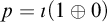 $p = \iota (1 \oplus 0)$
. Let
$p = \iota (1 \oplus 0)$
. Let $\Delta : \mathcal {M} \to \alpha \mathcal {M} \oplus (1 - \alpha ) \mathcal {M}$
be the diagonal map. Then
$\Delta : \mathcal {M} \to \alpha \mathcal {M} \oplus (1 - \alpha ) \mathcal {M}$
be the diagonal map. Then $\Delta (\mathcal {M})$
commutes with p and hence
$\Delta (\mathcal {M})$
commutes with p and hence $\operatorname {Ad}_p \circ \iota \circ \Delta $
gives an embedding
$\operatorname {Ad}_p \circ \iota \circ \Delta $
gives an embedding $\mathcal {M} \to p(\mathcal {M}^{\mathcal {U}})p$
since
$\mathcal {M} \to p(\mathcal {M}^{\mathcal {U}})p$
since $\mathcal {M}$
is a
$\mathcal {M}$
is a $\mathrm {II}_1$
factor. Now p lifts to a family of projections
$\mathrm {II}_1$
factor. Now p lifts to a family of projections $(p_i)_{i \in I}$
with
$(p_i)_{i \in I}$
with $\operatorname {\mathrm {tr}}^{\mathcal {M}}(p_i) = \operatorname {\mathrm {tr}}^{\mathcal {M}^{\mathcal {U}}}(p) = \alpha $
. Since
$\operatorname {\mathrm {tr}}^{\mathcal {M}}(p_i) = \operatorname {\mathrm {tr}}^{\mathcal {M}^{\mathcal {U}}}(p) = \alpha $
. Since $p_i$
is unitarily conjugate to some fixed projection
$p_i$
is unitarily conjugate to some fixed projection $p_0 \in \mathcal {M}$
for all i, we have
$p_0 \in \mathcal {M}$
for all i, we have $p \mathcal {M}^{\mathcal {U}} p = \prod _{i \to \mathcal {U}} p_i \mathcal {M} p_i = (p_0 \mathcal {M} p_0)^{\mathcal {U}}$
. In other words,
$p \mathcal {M}^{\mathcal {U}} p = \prod _{i \to \mathcal {U}} p_i \mathcal {M} p_i = (p_0 \mathcal {M} p_0)^{\mathcal {U}}$
. In other words, $\mathcal {M}$
embeds into an ultraproduct of
$\mathcal {M}$
embeds into an ultraproduct of $\mathcal {M}^{\alpha }$
. This also implies that
$\mathcal {M}^{\alpha }$
. This also implies that $\mathcal {M}^t$
embeds into an ultraproduct of
$\mathcal {M}^t$
embeds into an ultraproduct of $\mathcal {M}^{t\alpha }$
for each
$\mathcal {M}^{t\alpha }$
for each $t \in (0,\infty )$
. Hence,
$t \in (0,\infty )$
. Hence, $\mathcal {M}^{1/\alpha ^k}$
embeds into an ultraproduct of
$\mathcal {M}^{1/\alpha ^k}$
embeds into an ultraproduct of $\mathcal {M}$
for each
$\mathcal {M}$
for each $k \in \mathcal {N}$
. Thus, for an
$k \in \mathcal {N}$
. Thus, for an $\inf $
-formula
$\inf $
-formula $\varphi $
,
$\varphi $
,
 $$\begin{align*}\varphi^{\mathcal{M} \otimes \mathcal{R}} = \lim_{t \to \infty} \varphi^{\mathcal{M}^t} = \lim_{k \to \infty} \varphi^{\mathcal{M}^{1/\alpha^k}} \leq \varphi^{\mathcal{M}} \leq \varphi^{\mathcal{M} \otimes \mathcal{R}}. \end{align*}$$
Hence, $\operatorname {\mathrm {Th}}_{\exists }(\mathcal {M}) = \operatorname {\mathrm {Th}}_{\exists }(\mathcal {M} \otimes \mathcal {R})$
.
$\operatorname {\mathrm {Th}}_{\exists }(\mathcal {M}) = \operatorname {\mathrm {Th}}_{\exists }(\mathcal {M} \otimes \mathcal {R})$
.
(3) $\implies $
(1). Note
$\implies $
(1). Note $M_2(\mathcal {M})$
embeds into
$M_2(\mathcal {M})$
embeds into $\mathcal {M} \otimes \mathcal {R}$
, which embeds into
$\mathcal {M} \otimes \mathcal {R}$
, which embeds into $\mathcal {M}^{\mathcal {U}}$
.
$\mathcal {M}^{\mathcal {U}}$
.
(3) $\iff $
(4). When (3) holds,
$\iff $
(4). When (3) holds, $\mathcal {M}$
and
$\mathcal {M}$
and $\mathcal {M} \otimes \mathcal {R}$
are embeddable into each other’s ultrapowers, which implies that
$\mathcal {M} \otimes \mathcal {R}$
are embeddable into each other’s ultrapowers, which implies that $\mathcal {M}^t$
and
$\mathcal {M}^t$
and $(\mathcal {M} \otimes \mathcal {R})^t \cong \mathcal {M} \otimes \mathcal {R}^t \cong \mathcal {M} \otimes \mathcal {R}$
are embeddable into each other’s ultrapowers. Hence,
$(\mathcal {M} \otimes \mathcal {R})^t \cong \mathcal {M} \otimes \mathcal {R}^t \cong \mathcal {M} \otimes \mathcal {R}$
are embeddable into each other’s ultrapowers. Hence, $\operatorname {\mathrm {Th}}_{\exists }(\mathcal {M}^t) = \operatorname {\mathrm {Th}}_{\exists }(\mathcal {M} \otimes \mathcal {R}) = \operatorname {\mathrm {Th}}_{\exists }(\mathcal {M})$
for all
$\operatorname {\mathrm {Th}}_{\exists }(\mathcal {M}^t) = \operatorname {\mathrm {Th}}_{\exists }(\mathcal {M} \otimes \mathcal {R}) = \operatorname {\mathrm {Th}}_{\exists }(\mathcal {M})$
for all $t \in (0,\infty )$
. Conversely, if
$t \in (0,\infty )$
. Conversely, if $\operatorname {\mathrm {Th}}_{\exists }(\mathcal {M}) = \operatorname {\mathrm {Th}}_{\exists }(\mathcal {M}^t)$
for all t, then we have
$\operatorname {\mathrm {Th}}_{\exists }(\mathcal {M}) = \operatorname {\mathrm {Th}}_{\exists }(\mathcal {M}^t)$
for all t, then we have $\operatorname {\mathrm {Th}}_{\exists }(\mathcal {M} \otimes \mathcal {R}) = \lim _{t \to \infty } \operatorname {\mathrm {Th}}_{\exists }(\mathcal {M}^t) = \operatorname {\mathrm {Th}}_{\exists }(\mathcal {M})$
.
$\operatorname {\mathrm {Th}}_{\exists }(\mathcal {M} \otimes \mathcal {R}) = \lim _{t \to \infty } \operatorname {\mathrm {Th}}_{\exists }(\mathcal {M}^t) = \operatorname {\mathrm {Th}}_{\exists }(\mathcal {M})$
.
(4) $\implies $
(5) is immediate.
$\implies $
(5) is immediate.
(5) $\implies $
(6). As in the proof of Proposition 6.7 or in (2)
$\implies $
(6). As in the proof of Proposition 6.7 or in (2) $\implies $
(3), since
$\implies $
(3), since $\mathcal {M}^t$
and
$\mathcal {M}^t$
and $\mathcal {M}$
embed into each other’s ultrapowers, the same holds for
$\mathcal {M}$
embed into each other’s ultrapowers, the same holds for $\mathcal {M}^{t^k}$
for each
$\mathcal {M}^{t^k}$
for each $k \in \mathbb {Z}$
, which implies (6).
$k \in \mathbb {Z}$
, which implies (6).
(6) $\implies $
(4). This follows immediately from the fact that for any
$\implies $
(4). This follows immediately from the fact that for any $\inf $
-sentence
$\inf $
-sentence $\varphi $
, we have
$\varphi $
, we have $\lim _{t \to \infty } \varphi ^{\mathcal {M}^t} = \inf _{t \in (0,\infty )} \varphi ^{\mathcal {M}^t}$
and
$\lim _{t \to \infty } \varphi ^{\mathcal {M}^t} = \inf _{t \in (0,\infty )} \varphi ^{\mathcal {M}^t}$
and $\lim _{t \to 0} \varphi ^{\mathcal {M}^t} = \sup _{t \in (0,\infty )} \varphi ^{\mathcal {M}^t}$
, which we showed in the proof of Proposition 6.7.
$\lim _{t \to 0} \varphi ^{\mathcal {M}^t} = \sup _{t \in (0,\infty )} \varphi ^{\mathcal {M}^t}$
, which we showed in the proof of Proposition 6.7.
(3) $\implies $
(7)
$\implies $
(7) $\implies $
(8) is immediate by definition.
$\implies $
(8) is immediate by definition.
(8) $\implies $
(2). By assumption
$\implies $
(2). By assumption $\mathcal {M}$
embeds into
$\mathcal {M}$
embeds into $\mathcal {N}^{\mathcal {U}}$
. Since
$\mathcal {N}^{\mathcal {U}}$
. Since $\mathcal {N}$
has property Gamma, there exists a projection
$\mathcal {N}$
has property Gamma, there exists a projection $p \in \mathcal {N}^{\mathcal {U}}$
that commutes with the image of
$p \in \mathcal {N}^{\mathcal {U}}$
that commutes with the image of $\mathcal {M}$
(provided that ultrafilter
$\mathcal {M}$
(provided that ultrafilter $\mathcal {U}$
is on a sufficiently large index set). Then
$\mathcal {U}$
is on a sufficiently large index set). Then $\mathcal {M}$
and p generate a copy of
$\mathcal {M}$
and p generate a copy of $\alpha \mathcal {M} \oplus (1 - \alpha ) \mathcal {M}$
in
$\alpha \mathcal {M} \oplus (1 - \alpha ) \mathcal {M}$
in $\mathcal {N}^{\mathcal {U}}$
, where
$\mathcal {N}^{\mathcal {U}}$
, where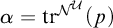 $\alpha = \operatorname {\mathrm {tr}}^{\mathcal {N}^{\mathcal {U}}}(p)$
. Finally,
$\alpha = \operatorname {\mathrm {tr}}^{\mathcal {N}^{\mathcal {U}}}(p)$
. Finally, $\mathcal {N}^{\mathcal {U}}$
embeds into
$\mathcal {N}^{\mathcal {U}}$
embeds into $\mathcal {M}^{\mathcal {V}}$
for some ultrafilter
$\mathcal {M}^{\mathcal {V}}$
for some ultrafilter $\mathcal {V}$
, hence (2) holds.
$\mathcal {V}$
, hence (2) holds.
Remark 6.9. By the usual arguments concerning countable saturation, if $\mathcal {M}$
is separable, then it suffices to consider some or all free ultrafilters on
$\mathcal {M}$
is separable, then it suffices to consider some or all free ultrafilters on $\mathbb {N}$
for conditions (1) and (2).
$\mathbb {N}$
for conditions (1) and (2).
Remark 6.10. Similar reasoning shows that if $\mathcal {M}^t$
embeds into
$\mathcal {M}^t$
embeds into $\mathcal {M}^{\mathcal {U}}$
for some
$\mathcal {M}^{\mathcal {U}}$
for some $t> 1$
, then
$t> 1$
, then $\mathcal {M} \models \operatorname {\mathrm {Th}}_{\exists }(\mathcal {M} \otimes \mathcal {R})$
, and hence
$\mathcal {M} \models \operatorname {\mathrm {Th}}_{\exists }(\mathcal {M} \otimes \mathcal {R})$
, and hence $\operatorname {\mathrm {Th}}_{\exists }(\mathcal {M}) = \operatorname {\mathrm {Th}}_{\exists }(\mathcal {M} \otimes \mathcal {R})$
. Therefore, if these conditions fail, then
$\operatorname {\mathrm {Th}}_{\exists }(\mathcal {M}) = \operatorname {\mathrm {Th}}_{\exists }(\mathcal {M} \otimes \mathcal {R})$
. Therefore, if these conditions fail, then $\mathcal {M}^s$
does not embed into
$\mathcal {M}^s$
does not embed into $(\mathcal {M}^t)^{\mathcal {U}}$
for any
$(\mathcal {M}^t)^{\mathcal {U}}$
for any $s> t$
. Thus, all the existential theories of
$s> t$
. Thus, all the existential theories of $\mathcal {M}^t$
for
$\mathcal {M}^t$
for $t \in \mathbb {R}_+$
are distinct and the first-order fundamental group is trivial.
$t \in \mathbb {R}_+$
are distinct and the first-order fundamental group is trivial.
Compare [Reference Goldbring and Hart36, Proposition 4.16] which showed that if the first-order fundamental group of $\mathcal {M}$
is not all of
$\mathcal {M}$
is not all of $\mathbb {R}_+$
, then it is countable and hence there are continuum many non elementary equivalent matrix amplifications of
$\mathbb {R}_+$
, then it is countable and hence there are continuum many non elementary equivalent matrix amplifications of $\mathcal {M}$
. The same argument of course applies to the fundamental group for the existential theory. Note also from [Reference Goldbring and Hart35, Proposition 5.1] that a negative solution to Connes embedding immediately implies the existence of continuum many existential theories of type
$\mathcal {M}$
. The same argument of course applies to the fundamental group for the existential theory. Note also from [Reference Goldbring and Hart35, Proposition 5.1] that a negative solution to Connes embedding immediately implies the existence of continuum many existential theories of type $\mathrm {II}_1$
algebras (but not factors).
$\mathrm {II}_1$
algebras (but not factors).
6.3 The non-tracial setting
What major elementary classes of self-adjoint operator algebras admit quantifier elimination? The question for $\mathrm {C}^{*}$
-algebras (both unital and non-unital) has been resolved in [Reference Eagle, Farah, Kirchberg and Vignati23] and the results of the present paper, together with [Reference Farah26], resolve the question in case of tracial von Neumann algebras. What remains is the case of von Neumann algebras with arbitrary faithful normal states, in particular type
$\mathrm {C}^{*}$
-algebras (both unital and non-unital) has been resolved in [Reference Eagle, Farah, Kirchberg and Vignati23] and the results of the present paper, together with [Reference Farah26], resolve the question in case of tracial von Neumann algebras. What remains is the case of von Neumann algebras with arbitrary faithful normal states, in particular type $\mathrm {III}$
von Neumann algebras. Metric languages for the non-tracial setting were given in [Reference Arulseelan, Goldbring, Hart and Sinclair5, Reference Dabrowski20]; see [Reference Ando and Goldbring3, Reference Ando and Haagerup4] for ultraproducts in the non-tracial setting.
$\mathrm {III}$
von Neumann algebras. Metric languages for the non-tracial setting were given in [Reference Arulseelan, Goldbring, Hart and Sinclair5, Reference Dabrowski20]; see [Reference Ando and Goldbring3, Reference Ando and Haagerup4] for ultraproducts in the non-tracial setting.
For non-tracial factors, quantifier elimination and model completeness can depend on the choice of state. For instance, on $M_3(\mathbb {C})$
consider the state
$M_3(\mathbb {C})$
consider the state $\varphi (A) = \operatorname {\mathrm {tr}}_3(AH)$
where
$\varphi (A) = \operatorname {\mathrm {tr}}_3(AH)$
where $H = \operatorname {\mathrm {diag}}(h_1,h_2,h_3)$
with
$H = \operatorname {\mathrm {diag}}(h_1,h_2,h_3)$
with $h_1> h_2 > h_3$
. Let
$h_1> h_2 > h_3$
. Let $t \in (0,1)$
such that
$t \in (0,1)$
such that $h_2 = th_1 + (1-t)h_3$
, and let
$h_2 = th_1 + (1-t)h_3$
, and let
 $$\begin{align*}P = \begin{bmatrix} t & 0 & t^{1/2}(1-t)^{1/2} \\ 0 & 0 & 0 \\ t^{1/2}(1-t)^{1/2} & 0 & 1 - t \end{bmatrix}, \qquad Q = \begin{bmatrix} 0 & 0 & 0 \\ 0 & 1 & 0 \\ 0 & 0 & 0 \end{bmatrix}. \end{align*}$$
Then P and Q are projections and $\varphi (P) = \varphi (Q)$
but they are not conjugate by a state-preserving automorphism of
$\varphi (P) = \varphi (Q)$
but they are not conjugate by a state-preserving automorphism of $M_3(\mathbb {C})$
. Hence, the theory of
$M_3(\mathbb {C})$
. Hence, the theory of $(M_3(\mathbb {C}),\varphi )$
does not admit quantifier elimination.
$(M_3(\mathbb {C}),\varphi )$
does not admit quantifier elimination.
However, in the type $\mathrm {III}_1$
setting, the Connes–Størmer transitivity theorem [Reference Connes and Størmer19] implies that all states are approximately unitarily equivalent, and hence for any two states the associated Ocneanu ultraproducts
$\mathrm {III}_1$
setting, the Connes–Størmer transitivity theorem [Reference Connes and Størmer19] implies that all states are approximately unitarily equivalent, and hence for any two states the associated Ocneanu ultraproducts $(\mathcal {M},\varphi )^{\mathcal {U}}$
and
$(\mathcal {M},\varphi )^{\mathcal {U}}$
and $(\mathcal {M},\psi )^{\mathcal {U}}$
are isomorphic, and so
$(\mathcal {M},\psi )^{\mathcal {U}}$
are isomorphic, and so $(\mathcal {M},\varphi )$
and
$(\mathcal {M},\varphi )$
and $(\mathcal {M},\psi )$
are elementarily equivalent. In fact, we believe the random matrix argument given here likely will adapt to the type
$(\mathcal {M},\psi )$
are elementarily equivalent. In fact, we believe the random matrix argument given here likely will adapt to the type $\mathrm {III}_1$
setting. Indeed, let
$\mathrm {III}_1$
setting. Indeed, let $\mathrm {T}$
be the theory of some type
$\mathrm {T}$
be the theory of some type $\mathrm {III}_1$
factor
$\mathrm {III}_1$
factor $(\mathcal {M},\varphi )$
. Since
$(\mathcal {M},\varphi )$
. Since $\mathcal {M}$
is type
$\mathcal {M}$
is type $\mathrm {III}$
, we have
$\mathrm {III}$
, we have $\mathcal {M} \cong \mathcal {M} \otimes M_n(\mathbb {C})$
. Thus, the ultraproduct
$\mathcal {M} \cong \mathcal {M} \otimes M_n(\mathbb {C})$
. Thus, the ultraproduct $(\mathcal {N},\psi ) = \prod _{n \to \mathcal {U}} (M_n(\mathbb {C}),\operatorname {\mathrm {tr}}_n) \otimes (\mathcal {M},\varphi )$
is a model of
$(\mathcal {N},\psi ) = \prod _{n \to \mathcal {U}} (M_n(\mathbb {C}),\operatorname {\mathrm {tr}}_n) \otimes (\mathcal {M},\varphi )$
is a model of $\mathrm {T}$
. The random matrix construction of Section 4 yields two elements
$\mathrm {T}$
. The random matrix construction of Section 4 yields two elements $\mathbf {X}$
and
$\mathbf {X}$
and $\mathbf {Y}$
in this ultraproduct such that
$\mathbf {Y}$
in this ultraproduct such that $f^{\mathcal {N},\psi }(\mathbf {Y}) \leq f^{\mathcal {N},\psi }(\mathbf {X})$
for inf-formulas f,
$f^{\mathcal {N},\psi }(\mathbf {Y}) \leq f^{\mathcal {N},\psi }(\mathbf {X})$
for inf-formulas f, $\{\mathbf {X}\}'$
and
$\{\mathbf {X}\}'$
and $\{\mathbf {Y}\}'$
are definable sets with respect to parameters
$\{\mathbf {Y}\}'$
are definable sets with respect to parameters $\mathbf {X}$
and
$\mathbf {X}$
and $\mathbf {Y}$
respectively,Footnote
8
and
$\mathbf {Y}$
respectively,Footnote
8
and $\{\mathbf {X}\}'$
is a
$\{\mathbf {X}\}'$
is a $\mathrm {III}_1$
factor and
$\mathrm {III}_1$
factor and $\{\mathbf {Y}\}'$
is not. Because
$\{\mathbf {Y}\}'$
is not. Because $\mathrm {III}_1$
factors are an axiomatizable class [Reference Arulseelan, Goldbring, Hart and Sinclair5, Proposition 8.8], this means that
$\mathrm {III}_1$
factors are an axiomatizable class [Reference Arulseelan, Goldbring, Hart and Sinclair5, Proposition 8.8], this means that $\mathbf {X}$
and
$\mathbf {X}$
and $\mathbf {Y}$
cannot have the same type.
$\mathbf {Y}$
cannot have the same type.
In the type $\mathrm {III}_\lambda $
setting for
$\mathrm {III}_\lambda $
setting for $\lambda \in (0,1)$
, we do not know if this argument goes through because we would have to pay more attention to the choice of state, and the random matrix argument requires having models with a tensor product decomposition
$\lambda \in (0,1)$
, we do not know if this argument goes through because we would have to pay more attention to the choice of state, and the random matrix argument requires having models with a tensor product decomposition $(M_n(\mathbb {C}),\operatorname {\mathrm {tr}}_n) \otimes (\mathcal {M},\varphi )$
. In the type
$(M_n(\mathbb {C}),\operatorname {\mathrm {tr}}_n) \otimes (\mathcal {M},\varphi )$
. In the type $\mathrm {III}_0$
and type
$\mathrm {III}_0$
and type $\mathrm {II}_\infty $
setting, another issue arises, namely that type
$\mathrm {II}_\infty $
setting, another issue arises, namely that type $\mathrm {III}_0$
and type
$\mathrm {III}_0$
and type $\mathrm {II}_\infty $
factors are not axiomatizable classes [Reference Arulseelan, Goldbring, Hart and Sinclair5, Corollary 8.6 and Proposition 8.3], so examining factoriality of the relative commutant of
$\mathrm {II}_\infty $
factors are not axiomatizable classes [Reference Arulseelan, Goldbring, Hart and Sinclair5, Corollary 8.6 and Proposition 8.3], so examining factoriality of the relative commutant of $\mathbf {X}$
and
$\mathbf {X}$
and $\mathbf {Y}$
may not distinguish their types. Likely, a different approach is needed in these cases.
$\mathbf {Y}$
may not distinguish their types. Likely, a different approach is needed in these cases.
Appendix A Model completeness and inf-formulas
This section proves the characterization of model completeness for theories of metric structure in terms of types and formulas.
Lemma A.1. Let $\mathrm {T}$
be an
$\mathrm {T}$
be an $\mathcal {L}$
-theory. Then the following are equivalent:
$\mathcal {L}$
-theory. Then the following are equivalent:
-
(1)
$\mathrm {T}$
is model complete, i.e., if
$\mathcal {M}$
and
$\mathcal {N}$
are models of
$\mathrm {T}$
, then every embedding
$\mathcal {M} \to \mathcal {N}$
of
$\mathcal {L}$
-structures is an elementary embedding. -
(2) For every n and every pair
$\mu , \nu \in \mathbb {S}_n(\mathrm {T})$
, if
$\psi (\mu ) \leq \psi (\nu )$
for every
$\inf $
-formula
$\psi $
, then
$\mu = \nu $
. -
(3) For every
$\mathcal {L}$
-formula
$\varphi $
and
$\epsilon> 0$
, there exists an inf-formula
$\psi $
such that
$|\varphi - \psi | < \epsilon $
(on the appropriate sort or domain) for all models of
$\mathrm {T}$
.


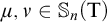



Proof. (3) $\implies $
(1). Assume that (3) holds. Let
$\implies $
(1). Assume that (3) holds. Let $\mathcal {M} \to \mathcal {N}$
be an inclusion of models of
$\mathcal {M} \to \mathcal {N}$
be an inclusion of models of $\mathrm {T}$
. Let
$\mathrm {T}$
. Let $\varphi $
be an n-variable formula and let
$\varphi $
be an n-variable formula and let $\mathbf {x} = (x_1,\dots ,x_n)$
be a tuple of the appropriate sort from
$\mathbf {x} = (x_1,\dots ,x_n)$
be a tuple of the appropriate sort from $\mathcal {M}$
. Let
$\mathcal {M}$
. Let $\epsilon> 0$
. Then by (3), there exist inf-formulas
$\epsilon> 0$
. Then by (3), there exist inf-formulas $\psi _1$
and
$\psi _1$
and $\psi _2$
such that
$\psi _2$
such that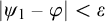 $|\psi _1 - \varphi | < \epsilon $
and
$|\psi _1 - \varphi | < \epsilon $
and $|\psi _2 - (-\varphi )| < \epsilon $
in all models of
$|\psi _2 - (-\varphi )| < \epsilon $
in all models of $\mathrm {T}$
. In particular,
$\mathrm {T}$
. In particular,
 $$\begin{align*}\varphi^{\mathcal{N}}(\mathbf{x}) \leq \psi_1^{\mathcal{N}}(\mathbf{x}) + \epsilon \leq \psi_1^{\mathcal{M}}(\mathbf{x}) + \epsilon \leq \varphi^{\mathcal{M}}(\mathbf{x}) + 2 \epsilon, \end{align*}$$
and symmetrically $-\varphi ^{\mathcal {N}}(\mathbf {x}) \leq -\varphi ^{\mathcal {M}}(\mathbf {x}) + 2 \epsilon $
. Since
$-\varphi ^{\mathcal {N}}(\mathbf {x}) \leq -\varphi ^{\mathcal {M}}(\mathbf {x}) + 2 \epsilon $
. Since $\epsilon $
was arbitrary, we have
$\epsilon $
was arbitrary, we have $\varphi ^{\mathcal {M}}(\mathbf {x}) = \varphi ^{\mathcal {N}}(\mathbf {x})$
, so the embedding
$\varphi ^{\mathcal {M}}(\mathbf {x}) = \varphi ^{\mathcal {N}}(\mathbf {x})$
, so the embedding $\mathcal {M} \to \mathcal {N}$
is elementary.
$\mathcal {M} \to \mathcal {N}$
is elementary.
(1) $\implies $
(2). Suppose
$\implies $
(2). Suppose $\mathrm {T}$
is model complete. Let
$\mathrm {T}$
is model complete. Let $\mu $
and
$\mu $
and $\nu $
be n-types satisfying the hypothesis for (2). Let
$\nu $
be n-types satisfying the hypothesis for (2). Let $\kappa $
be the density character of
$\kappa $
be the density character of $\mathcal {L}$
, and fix a
$\mathcal {L}$
, and fix a $\kappa ^+$
-saturated model
$\kappa ^+$
-saturated model $\mathcal {M}$
of
$\mathcal {M}$
of $\mathrm {T}$
. Then
$\mathrm {T}$
. Then $\mathcal {M}$
contains some
$\mathcal {M}$
contains some $\mathbf {x}$
with type
$\mathbf {x}$
with type $\mu $
and some
$\mu $
and some $\mathbf {y}$
with type
$\mathbf {y}$
with type $\nu $
. By the downward Löwenheim–Skolem theorem [Reference Ben Yaacov, Berenstein, Henson, Usvyatsov, Chatzidakis, Macpherson, Pillay and Wilkie11, Proposition 7.3], there exists an elementary substructure
$\nu $
. By the downward Löwenheim–Skolem theorem [Reference Ben Yaacov, Berenstein, Henson, Usvyatsov, Chatzidakis, Macpherson, Pillay and Wilkie11, Proposition 7.3], there exists an elementary substructure $\mathcal {N} \preceq \mathcal {M}$
containing
$\mathcal {N} \preceq \mathcal {M}$
containing $\mathbf {y}$
with density character at most
$\mathbf {y}$
with density character at most $\kappa $
. Let
$\kappa $
. Let $\mathbf {z}$
be a family indexed by some set I of cardinality
$\mathbf {z}$
be a family indexed by some set I of cardinality $\kappa $
that is dense in
$\kappa $
that is dense in $\mathcal {N}$
. For every finite
$\mathcal {N}$
. For every finite $F \subseteq I$
, every
$F \subseteq I$
, every $k\geq 1$
, and every k-tuple of quantifier-free formulas
$k\geq 1$
, and every k-tuple of quantifier-free formulas $\varphi _1, \dots , \varphi _k$
in
$\varphi _1, \dots , \varphi _k$
in $n + |F|$
variables, consider the formula
$n + |F|$
variables, consider the formula
 $$\begin{align*}\psi(u_1,\dots,u_n) = \inf_{(v_i)_{i \in F}} \max_{j=1,\dots,k} |\varphi_j(u_1,\dots,u_n, (v_i)_{i \in F}) - \varphi_j^{\mathcal{M}}(y_1,\dots,y_n,(z_i)_{i \in F})|. \end{align*}$$
By assumption $\psi ^{\mathcal {M}}(x_1,\dots ,x_n)\leq \psi ^{\mathcal {M}}(y_1,\dots ,y_n) = 0$
. Therefore, for any
$\psi ^{\mathcal {M}}(x_1,\dots ,x_n)\leq \psi ^{\mathcal {M}}(y_1,\dots ,y_n) = 0$
. Therefore, for any $\epsilon> 0$
, there exists
$\epsilon> 0$
, there exists $(w_i)_{i \in F}$
such that
$(w_i)_{i \in F}$
such that $|\varphi _j^{\mathcal {M}}(y_1,\dots ,y_n,(w_i)_{i \in F}) - \varphi _j^{\mathcal {M}}(x_1,\dots ,x_n,(z_i)_{i \in F})| < \epsilon $
for all
$|\varphi _j^{\mathcal {M}}(y_1,\dots ,y_n,(w_i)_{i \in F}) - \varphi _j^{\mathcal {M}}(x_1,\dots ,x_n,(z_i)_{i \in F})| < \epsilon $
for all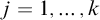 $j = 1, \ldots , k$
. By saturation, this implies that there exists a family
$j = 1, \ldots , k$
. By saturation, this implies that there exists a family $\mathbf {w}$
indexed by I in
$\mathbf {w}$
indexed by I in $\mathcal {M}$
such that
$\mathcal {M}$
such that $(\mathbf {x},\mathbf {w})$
has the same quantifier-free type as
$(\mathbf {x},\mathbf {w})$
has the same quantifier-free type as $(\mathbf {y},\mathbf {z})$
. In particular, the substructure
$(\mathbf {y},\mathbf {z})$
. In particular, the substructure $\tilde {\mathcal {N}}$
of
$\tilde {\mathcal {N}}$
of $\mathcal {M}$
generated by
$\mathcal {M}$
generated by $(\mathbf {x},\mathbf {w})$
is isomorphic to the substructure
$(\mathbf {x},\mathbf {w})$
is isomorphic to the substructure $\mathcal {N}$
generated by
$\mathcal {N}$
generated by $(\mathbf {y},\mathbf {z})$
. So
$(\mathbf {y},\mathbf {z})$
. So $\tilde {\mathcal {N}}$
is a model of
$\tilde {\mathcal {N}}$
is a model of $\mathrm {T}$
and by model completeness the inclusion
$\mathrm {T}$
and by model completeness the inclusion $\tilde {\mathcal {N}} \to \mathcal {M}$
is elementary. Therefore,
$\tilde {\mathcal {N}} \to \mathcal {M}$
is elementary. Therefore,
 $$\begin{align*}\operatorname{\mathrm{tp}}^{\mathcal{M}}(\mathbf{x}) = \operatorname{\mathrm{tp}}^{\tilde{\mathcal{N}}}(\mathbf{x}) = \operatorname{\mathrm{tp}}^{\mathcal{N}}(\mathbf{y}) = \operatorname{\mathrm{tp}}^{\mathcal{M}}(\mathbf{y}), \end{align*}$$
and $\mu = \nu $
as desired.
$\mu = \nu $
as desired.
(2) $\implies $
(3). Our argument uses point-set topology on
$\implies $
(3). Our argument uses point-set topology on $\mathbb {S}_n(\mathrm {T})$
and is motivated by Urysohn’s lemma and the Stone–Weierstrass theorem.
$\mathbb {S}_n(\mathrm {T})$
and is motivated by Urysohn’s lemma and the Stone–Weierstrass theorem.
Claim 1. For every type $\mu $
and neighborhood
$\mu $
and neighborhood $\mathcal {O}$
of
$\mathcal {O}$
of $\mu $
, there exist inf-formulas
$\mu $
, there exist inf-formulas $\psi _1,\dots , \psi _k$
and
$\psi _1,\dots , \psi _k$
and $\delta> 0$
such that for types
$\delta> 0$
such that for types $\nu $
, if
$\nu $
, if $\psi _j(\nu )> \psi _j(\mu ) - \delta $
for
$\psi _j(\nu )> \psi _j(\mu ) - \delta $
for $j = 1, \dots k$
, then
$j = 1, \dots k$
, then $\nu \in \mathcal {O}$
.
$\nu \in \mathcal {O}$
.
Fix $\mu $
and a neighborhood
$\mu $
and a neighborhood $\mathcal {O}$
, and suppose for contradiction that no such inf-formulas exist. Then for every
$\mathcal {O}$
, and suppose for contradiction that no such inf-formulas exist. Then for every $\delta> 0$
and every finite collection of inf-formulas
$\delta> 0$
and every finite collection of inf-formulas $\psi _1$
, …,
$\psi _1$
, …, $\psi _k$
, there exists some type
$\psi _k$
, there exists some type $\nu \in \mathbb {S}_n(\mathrm {T}) \setminus \mathcal {O}$
satisfying
$\nu \in \mathbb {S}_n(\mathrm {T}) \setminus \mathcal {O}$
satisfying $\psi _j(\nu )> \psi _j(\mu ) - \delta $
for
$\psi _j(\nu )> \psi _j(\mu ) - \delta $
for $j = 1, \dots k$
. Since
$j = 1, \dots k$
. Since $\mathbb {S}_n(\mathrm {T}) \setminus \mathcal {O}$
is compact, there exists some
$\mathbb {S}_n(\mathrm {T}) \setminus \mathcal {O}$
is compact, there exists some $\nu \in \mathbb {S}_n(\mathrm {T}) \setminus \mathcal {O}$
satisfying
$\nu \in \mathbb {S}_n(\mathrm {T}) \setminus \mathcal {O}$
satisfying $\psi (\nu ) \geq \psi (\mu )$
for all inf-formulas
$\psi (\nu ) \geq \psi (\mu )$
for all inf-formulas $\varphi $
. By (3), this implies
$\varphi $
. By (3), this implies $\nu = \mu $
, which contradicts
$\nu = \mu $
, which contradicts $\nu \in \mathbb {S}_n(\mathrm {T}) \setminus \mathcal {O}$
.
$\nu \in \mathbb {S}_n(\mathrm {T}) \setminus \mathcal {O}$
.
Claim 2. For every type $\mu $
and neighborhood
$\mu $
and neighborhood $\mathcal {O}$
, there exists an inf-formula
$\mathcal {O}$
, there exists an inf-formula $\psi $
taking values in
$\psi $
taking values in $[0,1]$
such that
$[0,1]$
such that $\psi (\mu )>0$
and, for all types
$\psi (\mu )>0$
and, for all types $\nu $
, if
$\nu $
, if $\psi (\nu )> 0$
, then
$\psi (\nu )> 0$
, then $\nu \in \mathcal {O}$
.
$\nu \in \mathcal {O}$
.
Let $\psi _1$
, …,
$\psi _1$
, …, $\psi _k$
and
$\psi _k$
and $\delta $
be as in Claim 1, and set
$\delta $
be as in Claim 1, and set
 $$\begin{align*}\psi = \min_j \max(\psi_j - \psi_j(\mu) + \delta, 0), \end{align*}$$
which is an inf-formula by the monotonicity of $\max $
and
$\max $
and $\min $
.
$\min $
.
Claim 3. Let $\mathcal {E}_0$
and
$\mathcal {E}_0$
and $\mathcal {E}_1$
be disjoint closed subsets of
$\mathcal {E}_1$
be disjoint closed subsets of $\mathbb {S}_n(\mathrm {T})$
. Then there exists an inf-formula
$\mathbb {S}_n(\mathrm {T})$
. Then there exists an inf-formula $\psi $
taking values in
$\psi $
taking values in $[0,1]$
such that
$[0,1]$
such that $\psi |_{\mathcal {E}_0} = 0$
and
$\psi |_{\mathcal {E}_0} = 0$
and $\psi |_{\mathcal {E}_1} = 1$
.
$\psi |_{\mathcal {E}_1} = 1$
.
By Claim 2, for each $\mu \in \mathcal {E}_1$
, there exists a nonnegative inf-formula
$\mu \in \mathcal {E}_1$
, there exists a nonnegative inf-formula $\psi _\mu $
such that
$\psi _\mu $
such that $\psi _\mu (\mu )>0$
and if
$\psi _\mu (\mu )>0$
and if $\psi _\mu (\nu )> 0$
, then
$\psi _\mu (\nu )> 0$
, then $\nu \in \mathbb {S}_n(\mathrm {T}) \setminus \mathcal {E}_0$
. Let
$\nu \in \mathbb {S}_n(\mathrm {T}) \setminus \mathcal {E}_0$
. Let $\mathcal {O}_\mu = \{\nu : \psi _\mu (\nu )> 0\}$
. These neighborhoods form an open cover of the compact set
$\mathcal {O}_\mu = \{\nu : \psi _\mu (\nu )> 0\}$
. These neighborhoods form an open cover of the compact set $\mathcal {E}_1$
, and hence
$\mathcal {E}_1$
, and hence $\mathcal {E}_1$
can be covered by finitely many of these neighborhoods, say
$\mathcal {E}_1$
can be covered by finitely many of these neighborhoods, say $\mathcal {O}_{\mu _1}$
, …,
$\mathcal {O}_{\mu _1}$
, …, $\mathcal {O}_{\mu _k}$
. Thus,
$\mathcal {O}_{\mu _k}$
. Thus, $\sum _{j=1}^k \psi _j$
is strictly positive on
$\sum _{j=1}^k \psi _j$
is strictly positive on $\mathcal {E}_1$
and attains some minimum
$\mathcal {E}_1$
and attains some minimum $\delta> 0$
on this set. Then
$\delta> 0$
on this set. Then
 $$\begin{align*}\psi = \min \left( 1, \frac{1}{\delta} \sum_{j=1}^k \psi_j \right) \end{align*}$$
is an inf-formula with the desired properties.
Claim 4. For every formula $\varphi $
and
$\varphi $
and $\epsilon> 0$
, there exists an inf-formula
$\epsilon> 0$
, there exists an inf-formula $\psi $
such that
$\psi $
such that $|\varphi - \psi | < \epsilon $
in every model of
$|\varphi - \psi | < \epsilon $
in every model of $\mathrm {T}$
.
$\mathrm {T}$
.
By affine transformation, assume without loss of generality that $0 \leq \varphi \leq 1$
. Let
$0 \leq \varphi \leq 1$
. Let $k \in \mathbb {N}$
with
$k \in \mathbb {N}$
with $1/k < \epsilon $
. For
$1/k < \epsilon $
. For $j = 1$
, …, k, the sets
$j = 1$
, …, k, the sets $\{\varphi \leq (j-1)/k\}$
and
$\{\varphi \leq (j-1)/k\}$
and $\{ \varphi \geq j/k\}$
are disjoint and closed in
$\{ \varphi \geq j/k\}$
are disjoint and closed in $\mathbb {S}_n(\mathrm {T})$
. By Claim 3, there exists an inf-formula
$\mathbb {S}_n(\mathrm {T})$
. By Claim 3, there exists an inf-formula $\psi _j$
such that
$\psi _j$
such that $0 \leq \psi _j \leq 1$
and for
$0 \leq \psi _j \leq 1$
and for $\nu \in \mathbb {S}_n(\mathrm {T})$
,
$\nu \in \mathbb {S}_n(\mathrm {T})$
,
 $$\begin{align*}\varphi(\nu) \leq (j-1)/k \implies \psi_j(\nu) = 0, \qquad \varphi(\nu) \geq j/k \implies \psi_j(\nu) = 1. \end{align*}$$
Let
 $$\begin{align*}\psi = \frac{1}{k} \sum_{j=1}^k \psi_j. \end{align*}$$
Then for types $\nu $
, if
$\nu $
, if $\varphi (\nu ) \in [(j-1)/k,j/k]$
, then
$\varphi (\nu ) \in [(j-1)/k,j/k]$
, then $\psi _1(\nu )$
, …,
$\psi _1(\nu )$
, …, $\psi _{j-1}(\nu )$
are
$\psi _{j-1}(\nu )$
are $1$
and
$1$
and $\psi _{j+1}(\nu )$
, …,
$\psi _{j+1}(\nu )$
, …, $\psi _k(\nu )$
are zero, so that
$\psi _k(\nu )$
are zero, so that $\psi (\nu ) \in [(j-1)/k,j/k]$
. Hence,
$\psi (\nu ) \in [(j-1)/k,j/k]$
. Hence, $|\varphi (\nu ) - \psi (\nu )| \leq 1/k < \epsilon $
for all
$|\varphi (\nu ) - \psi (\nu )| \leq 1/k < \epsilon $
for all $\nu \in \mathbb {S}_n(\mathrm {T})$
as desired.
$\nu \in \mathbb {S}_n(\mathrm {T})$
as desired.
Acknowledgments
We are grateful to the Fields Institute for hosting all three authors during the Thematic Program on Operator Algebras in Fall 2023 (IF as an organizer, DJ as a postdoc, and JP as a visitor). We are grateful to Adrian Ioana for suggesting an argument that simplified the proof of Lemma 4.9, and Ben Hayes for discussion of alternative proofs. We thank Brent Nelson, Narutaka Ozawa, Isaac Goldbring, and Hiroshi Ando for discussions about type $\mathrm {III}$
factors.
$\mathrm {III}$
factors.
Funding
IF and DJ were partially supported by the Discovery grant “Logic and $\mathrm {C}^{*}$
-algebras” from the Natural Sciences and Engineering Research Council (Canada). JP was partially supported by the National Science Foundation (US), grant DMS-2054477. DJ acknowledges support from the Danish Independent Research Fund, grant 1026-00371B, and the Horizon Europe Marie Skłodowksa-Curie Action FREEINFOGEOM, grant 101209517.
$\mathrm {C}^{*}$
-algebras” from the Natural Sciences and Engineering Research Council (Canada). JP was partially supported by the National Science Foundation (US), grant DMS-2054477. DJ acknowledges support from the Danish Independent Research Fund, grant 1026-00371B, and the Horizon Europe Marie Skłodowksa-Curie Action FREEINFOGEOM, grant 101209517.










 Open access

