


1. Introduction
Among the different varieties of sedimentary rocks, namely clastic, chemical and organo-chemical, shales are the most abundant worldwide (> 70% of sedimentary cover) and are traditionally considered suitable for understanding the nature, scale, heterogeneity and physical sedimentation parameters in low-energy depositional environments. Constituted dominantly of clays, transported in suspension, and subordinately of silt/sand, shales record significant clues on operative depositional processes in ancient shelves. Shales also provide a signature of sediment provenance and basin tectonics, thereby complementing inferences drawn from studies on sandstones and carbonates (Schieber, Reference Schieber1986, Reference Schieber1989, Reference Schieber1990, Reference Schieber, Bennett, Bryant and Hulbert1991; Sarkar et al. Reference Sarkar, Banerjee, Chakraborty and Bose2002 a, b; Potter et al. Reference Potter, Mynard and Depetris2005; Kasanzu et al. Reference Kasanzu, Maboko and Manya2008; Srivastava et al. Reference Srivastava, Sinha, Deep, Singh and Upreti2018). The generation of mud is dependent on climate, lithology and the relief of the source area, and, once produced, is redistributed by slides, slumps, mass flows and currents (terrestrial and basinal) at different scales. It is generally believed that low settling velocity and flocculation allow even weak currents to disperse clay-sized particles over large areas; it has also been argued from recent flume studies (Schieber, Reference Schieber2016) that flocculated mud can be transported by currents able to move bedload sand. This new understanding has brought shale sedimentology to the forefront; what was previously interpreted as a deep stagnant environment from laminated shale successions may possibly now be interpreted as belonging to an energetic and dynamic depositional environment. Careful studies of marine shale successions have revealed evidence of the operation of close-spaced multidirectional events such as distal tidal currents, storm-wave impingement and unidirectional currents (bottom flow, turbidites) on the muddy sea floor. In this backdrop, it is important to emphasize that the study of argillaceous formations present in the rock record can provide geological information to improve knowledge of issues that is are either very poorly understood or so far unaddressed. However, sedimentologists generally treated shale formations briefly, neglecting the geological information obtainable from sub-microscopic grain sizes and lithological homogeneity. Process-related facies analysis in terms of physical characteristics of shales is seldom carried out (e.g. Schieber, Reference Schieber1986; Sarkar et al. Reference Sarkar, Banerjee, Chakraborty and Bose2002 a).
We therefore focus on the argillaceous intervals of the Palaeo-Mesoproterozoic Vindhyan Basin, central India, which records a sedimentation history of > 500 Ma (>1631 ± 5 Ma (Ray et al. Reference Ray, Martin, Veizer and Bowring2002) to 1000 Ma (Malone et al. Reference Malone, Meert, Banerjee, Pandit, Tamrat, Kamenov, Pradhan and Sohl2008)), spanning the period of Earth’s history that included drastic and irreversible changes in the lithosphere, hydrosphere, atmosphere and biosphere. We attempt a synthesis of the physical characteristics of six different argillaceous (shale) intervals (Arangi, Koldaha, Rampur, Bijaygarh, Rewa and Sirbu) from the Vindhyan Supergroup exposed within the Son valley sector. From the collation of data generated in this study along with available data in literature, we have attempted to summarize the current understanding in terms of palaeo-flow dynamics, sediment dispersal pattern, depositional setting and cyclicity, and basin tectonics.
2. Geological setting and stratigraphic framework
The cratonic Proterozoic sedimentary basins of India are comparable with the Proterozoic basins of North America, Australia and the Siberian platform with respect to age, duration of basin history, size, sediment thickness and depositional systems (Preiss & Forbes, Reference Preiss and Forbes1981; Kale & Phansalkar, Reference Kale and Phansalkar1991; Patranabis-Deb, Reference Patranabis-Deb2004; Wani & Mondal, Reference Wani and Mondal2011). The Vindhyan Basin, hosted within the Bundelkhand Craton (3.3–2.5 Ga; Crawford & Compston, Reference Crawford and Compston1969; Mondal et al. Reference Mondal, Goswami, Deomurari and Sharma2002) and exposed over an area of 178 000 km2 (Tandon et al. Reference Tandon, Pant and Casshyap1991), represents the largest Proterozoic basin of India; it consists of an approximately 4500-m-thick mixed siliciclastic–carbonate package that is deformed and unmetamorphosed (Fig. 1a, b). The basin is bound by the Aravalli–Delhi orogenic belt (2500–900 Ma; Roy, Reference Roy and Roy1988) in the west and the Satpura orogen (1600–850 Ma; Verma, Reference Verma1991) in the south and east. The Bundelkhand granite massif occurs at the centre of the basin and divides it into two sub-basins: the Son Valley Vindhyans in the east and the Rajasthan Vindhyans to the west (Fig. 1a). Much of the northern part of the basin, along with the Aravalli–Delhi fold belt and the Bundelkhand granite gneiss, is overlain by recent Gangetic alluvium. The southern part of the Vindhyan Basin is covered by Deccan lava (Krishnan, Reference Krishnan1968), and its edge is marked by a major structural lineament known as the Narmada–Son Lineament. It is agreed that, subsequent to the stabilization of the Aravalli–Bhandara craton with a post-orogenic granitic intrusion at c. 2.5 Ga (Eriksson et al. Reference Eriksson, Mazimdar, Sarkar, Bose, Altermann and Van der Marwe1999; Roger et al. Reference Roger, Feraud, de Beaulieu, Thouveny, Coulon, Cocheme, Andrieu and Williams1999), the craton thickness reduced as a result of continued rifting. These rifts accommodated sediments of early Proterozoic age, such as the Gwalior, Bijawar and Mahakoshal groups (Mazumder et al. Reference Mazumder, Bose and Sarkar2000; Bose et al. Reference Bose, Sarkar, Chakraborty and Banerjee2001; Chakraborty et al. Reference Chakraborty, Pant, Paul, Mazumdar and Eriksson2015). Unconformably overlying early riftogenic sediments, the Vindhyan Supergroup occurs as a largely undeformed sediment package, dominated by immature siliciclastics and carbonate-rich sediments in its lower part and mature siliciclastics in its upper part. The Supergroup is subdivided into two groups – the Lower Vindhyan (Semri Group) and Upper Vindhyan (Kaimur, Rewa and Bhander) – separated by a basin-wide unconformity and its correlative conformity (Bose et al. Reference Bose, Sarkar, Das, Banarjee, Mandal and Chakraborty2015; Mandal et al. Reference Mandal, Choudhuri, Mondal, Sarkar, Chakraborty and Banerjee2019; Fig. 1b).
(a) Geological map of the Vindhyan basin (modified after Krishnan & Swaminath, Reference Krishnan and Swaminath1959) with locations of study area. (b) Stratigraphy of the Vindhyan Supergroup exposed at the Son Valley highlighting the studied shale intervals (bright green) with physical characteristics, operative processes, palaeogeography and available isotopic dates. Lst. – limestone; MC-ICPMS – multicollector inductively coupled plasma mass spectrometry; Sh. – shale; Sst. – sandstone; SHRIMP – sensitive high-resolution ion microprobe.

3. Vindhyan shales
Six argillaceous formations of the Vindhyan Supergroup, covering nearly the entire sedimentation history of the basin with variegated facies development, are used for documenting depositional processes, depositional cyclicity and sediment dynamics. Since the argillaceous successions are repeatedly intercepted by coarser clastic intervals at different stratigraphic levels, the coarser clastic intervals are also discussed here to highlight spatio-temporal variations in depositional parameters on muddy shelves in response to different allokinetic or autokinetic triggers. Further, the proliferation of algal mats significantly influenced the sedimentation on the Vindhyan shelf, including shaping and/or morphing the bedforms, and is therefore considered to be important in shale sedimentology (Sarkar et al. Reference Sarkar, Banerjee, Samanta, Chakraborty, Chakraborty, Mukhopadhyay and Singh2014).
The three lower Vindhyan shales (Arangi, Koldaha and Rampur) are described in Sections 3.a–3.c, and the three upper Vindhyan shales (Bijaygarh, Rewa and Sirbu) are described in Sections 3.d–3.e below.
3.a. Arangi shale
Overlying the conglomerates and coarse-grained sandstones of the Deoland Formation, the Arangi shale (70–200 m) forms the lowermost shale interval in the Vindhyan sediment package. Because of extremely poor exposure, characterization of this shale unit is very sketchy and mostly described as greenish-grey to dark-grey shale with khaki siltstones and fine sandstones (Singh, Reference Singh, Valdiya, Bhatia and Gour1973; Gupta et al. Reference Gupta, Jain, Srivastava and Mehrotra2003). Gupta et al. (Reference Gupta, Jain, Srivastava and Mehrotra2003) reported coaly matter and pyrite disseminations from wave-rippled and flaser-bedded fine sandy interbeds present within the black carbonaceous to porcellanitic shale. We sampled a section of Arangi shale approximately 1.8 m thick exposed at the Dalla cement factory, Dalla, Uttar Pradesh (Fig. 2a). In contrast to previously reported lithology, the dominant lithology is marked by dark-grey to black fissile shale punctuated by millimetre-thick silt interbeds, rich in feldspar. The silt interbeds are laterally discontinuous, have sharp contacts with encasing shale, and are internally massive or plane laminated (Fig. 2a). The shale beds do not reveal the presence of any wave or current feature. Interestingly, samples from this shale unit have yielded very high (3.6–8.4%) total organic carbon (TOC) values.
(a) Litholog showing greenish-grey to dark-grey Arangi shale overlying Deoland Formation at Dalla, Uttar Pradesh. Note the fining-upwards stacking character. (b) Cyclic limestone – black shale alternation at the basal part of the Kajrahat limestone, illustrating the superimposition of depositional cyclicities. Field photographs showing (i) the algal micro-laminite; (ii) micro flutes and load structures; (iii) micro hummocks; and (iv) limestone beds with sharp erosional base and gradational top. Note the NW-wards palaeoflow direction of the micro flutes (hammer and pen length, 29 and 13.5 cm).

Upwards, the Arangi shale gradationally passes to the Kajrahat limestone; a limestone–shale heterolithic succession marks the transition (Fig. 2b). The limestone (calcarenite) interbeds within the heterolithic package have a sharp and, more often than not, erosional contact with underlying black shales, but there is a gradational contact with overlying shales (Fig. 2b(iv)). Often, soles of the calcarenite beds are marked with small flute casts which are found as loaded and record a northwesterly palaeoflow azimuth (Fig. 2b(ii)). Internally, these beds are either plane laminated or wavy laminated with laminae having a centripetal dip, thereby mimicking micro-hummocky structure (Fig. 2b(iii)). Interbedded shale units are black in colour, fissile and pyritiferous. Millimetre-thick stringers of pyrite can be observed paralleling laminations of shale. Higher upwards, the heterolithic limestone–shale packages are found in alternation with metre-thick bedded algal-laminated limestone units (Fig. 2b(i)). AK Singh (unpub. PhD thesis, University of Delhi, 2015) identified two orders of cyclicity in the shale-rich basal succession, namely: (1) cyclic alternation between limestone and shale; and (2) alternation between heterolithic facies and amalgamated algal laminite bedsets.
3.a.1. Sedimentation and depositional environment
The lack of any current or wave feature, including a storm signature, favour deposition of this dark-grey shale succession distally offshore below the storm wave base (Bose et al. Reference Bose, Banerjee and Sarkar1997; Eriksson et al. Reference Eriksson, Condie, Tirsgaard, Mueller, Altermann, Miall, Aspler, Catuneanu and Chiarenzelli1998; Sarkar et al. Reference Sarkar, Banerjee, Chakraborty and Bose2002 a). Thin silt interbeds with sharp non-erosional contact with encasing shale are interpreted as products of plume deposition in a distal shelf environment, supplied from a distal delta during high-energy events such as a storm (Fig. 2a; PP Chakraborty, unpub. PhD thesis, University of Jadavpur, 1996; Chakraborty & Sarkar, Reference Chakraborty and Sarkar2005). The supply of such plume materials offshore from a distal delta is reported from both modern (Okada & Ohta, Reference Okada and Ohta1993) and ancient geological records (Chakraborty & Bose, Reference Chakraborty and Bose1992; Sarkar et al. Reference Sarkar, Banerjee, Chakraborty and Bose2002 a; Chakraborty et al. Reference Chakraborty, Sarkar, Das and Das2009; Sarkar et al. Reference Sarkar, Sengupta, McArthur, Ravenscroft, Bera, Bhushan, Samanta and Agrawal2009).
From undoubted signatures of storm-induced flow within calcarenite limestone interbeds and their alternation with pyrite-bearing shale, it is inferred that the carbonate tempestites emplaced onto distal shelf beyond the oxygen minimum zone. Also, the calcarenite–shale alternation, with a stochastic, quasi-periodic bed thickness distribution of calcarenite beds, is interpreted as the signature of first-order depositional cyclicity within the Kajrahat shale. Crinkly algal micro-laminated bedded limestones are identified as the products of stratiform, benthic microbial mat growth predominantly within shallow water, possibly in an intertidal to peritidal domain (Grotzinger, Reference Grotzinger1989; Pratt et al. Reference Pratt, James, Cowan, Walker and James1992; Sarkar & Bose, Reference Sarkar and Bose1992; Sarkar et al. Reference Sarkar, Chakraborty, Bose and Bhattacharyya1996). In these environments, laminites commonly record a combination of precipitation of fine-grained carbonate with benthic microbial mats and a trapping of detrital sediment (Grotzinger, Reference Grotzinger1986; Hamon & Merzeraud, Reference Hamon and Merzeraud2008). The repeated gradual transition between distal shelf facies and shallow-water algal laminite bed-defining metre-thick cycles (Fig. 2b) possibly signify prograding depositional cycles of second order, developed during the process of distal to proximal shelf transition on Kajrahat carbonate platform (cf. Grotzinger, Reference Grotzinger1989).
3.b. Koldaha shale
The Koldaha shale occurs as the lower member of the Kheinjua Formation within the lower Vindhyan Group (Fig. 1b), and ranges in thickness from 350 to 600 m (Gupta et al. Reference Gupta, Jain, Srivastava and Mehrotra2003). As a variegated shale unit, the Koldaha shale gradationally overlies the Porcellanite Formation, comprising dark-grey to greenish-grey splintery shale with sand and/or silt interbeds, and conformably passes into the overlying Churhat sandstone (Bose et al. Reference Bose, Sarkar, Chakraborty and Banerjee2001; Samanta et al. Reference Samanta, Mukhopadhyay and Eriksson2016). Rasmussen et al. (Reference Rasmussen, Bose, Sarkar, Banerjee, Fletcher and McNaughton2002) constrained the age of Koldaha sediments as 1.60–1.63 Ga using U–Pb SHRIMP of zircon grains obtained from a tuffaceous interbed within this shale interval (Fig. 1b). Apart from recurrent punctuations caused by metre-thick coarse arenaceous intervals, the Koldaha shale succession registers repeated alternation of shale beds with storm-driven sandstone interbeds in widely varying volumetric proportion.
3.b.1. Argillaceous intervals
Three different types of shale units, classified on the basis of shale:sandstone ratio and thickness as well as the internal character of sandstone interbeds, define a major part of the Koldaha sedimentation history. The first interval (KDSH A; Fig. 3a(i), (ii)) is characterized by dark-grey to greenish-grey shale, often splintery with rare thin (< 2 cm) silt interbed(s) (average shale:sandstone ratio = 4.88). The bases of the silt units are dominantly planar, while the tops are locally undulated with small wave ripples. Wrinkle structures (amplitude < 1 mm; Fig. 3a(ii)) with widely varying relief, geometry and lateral continuity are noted on the bedding planes of silt interbeds. On close inspection, the shales reveal light- and dark-grey intertwined stripes showing growth of microbial mat, preserved in the absence of bioturbation (cf. Schieber, Reference Schieber1998; Chakraborty & Sarkar, Reference Chakraborty and Sarkar2005). In the absence of any sand interbed or any kind of wave- or current-related feature, this argillaceous interval suggests deposition in a prodeltaic outer-shelf setting near storm wave base (Banerjee, Reference Banerjee2000; Bose et al. Reference Bose, Sarkar, Chakraborty and Banerjee2001; Samanta et al. Reference Samanta, Mukhopadhyay and Eriksson2016). The presence of wrinkle structures on bedding planes is probably due to gentle wave agitation on microbially mediated cohesive fine sand and/or silt surfaces during storm events (cf. Banerjee & Jeevankumar, Reference Banerjee and Jeevankumar2005).
(a) Correlative composite litholog of Koldaha shale between Shikarganj and Churhat consisting of (i) dark-grey to greenish-grey shale (KDSH A) with (ii) wrinkle marks on its bedding surface. Note wedging of arenaceous intervals towards both east and west. Also note the opposing (E- and W-wards) palaeocurrent from coarse arenaceous intervals present at different stratigraphic levels of Koldaha shale succession. (b) Composite and (c) detailed litholog of Koldaha shale from Son River and Ghooghta village sections. Note the presence of silty shale with weakly graded sandstone beds (KDSH B) of truncated Bouma sequence with (iii, iv) soft sediment deformation structures and (v) micro-hummocks in Son River section, and mauve- to red-coloured wavy bedded shale (KDSH C) with (vi) flute and brush marks, (vii) hummocks, (viii) symmetric gutters and (ix) sandstone interbeds with pinch and swell geometry in Ghooghta village section. Also note the W-wards palaeoflow of flutes (F) and NW–SE trend of gutters (hammer and pen length, 29 and 13.5 cm; person height, 175 cm; coin and cap diameter, 2.2 and 5 cm).

The second interval (KDSH B; average shale:sandstone ratio = 2.95) is marked by faintly laminated or massive grey, silty shale interrupted by centimetre-thick sheet sandstone beds with rare current ripples (average wavelength = 10 cm, amplitude = 2.2 cm; Fig. 3b). The sandstone beds are either massive or weakly graded with mudstone intraclasts near the base. Bases of these beds are carved with various sole structures such as flute, brush and tool marks, and internally these beds often show the presence of truncated Tabe or Tabce successions of Bouma (Reference Bouma1962; Fig. 3b(iii)). Soft sediment deformation (SSD) structures, namely convolute lamination, flame and load structures (Fig. 3b(iv)), are common within these beds. Parallel-laminated, fine-grained sandstone grades to wavy-bedded silty argillite mimicking micro-hummock geometry (Fig. 3b(v)), with average wavelength 8 cm and amplitude 2 cm.
The sandstone interbeds with truncated ‘Bouma’ subdivisions are attributed to turbidite deposition from light-density flows or buoyant plumes in a mud-depositing environment. Such low-density flows in an otherwise very-low-energy environment can be generated by slope instability, storm-wave liquefaction of upslope fine-grained sediments (cf. Nelson, Reference Nelson1982), or dense fluvial bedloads that form turbid underflows on the seafloor (Boggs, Reference Boggs2006; Bera et al. Reference Bera, Sarkar, Chakraborty, Loyal and Sanyal2008). The thin, laterally extensive nature of interbeds without any amalgamation and relatively low volume of sand are suggestive of a distal depositional setting. A base-of-slope setting seems plausible in view of the frequent occurrence of soft sediment deformation features (cf. Postma & Drinia, Reference Postma and Drinia1993; Chakraborty et al. Reference Chakraborty, Sarkar, Bose and Paliwal1998). The occasional sharp-based, fining-upwards sandstone interbeds recording upwards gradation from parallel lamination to hummocky cross-stratification are the result of gradually waning storm-induced traction currents, that is, late-stage storm-current activity below fair-weather wave base (Swift et al. Reference Swift, Hudelson, Bernner and Thompson1987). Argillite drapes represent settling of fines, suspended during storm activity or under normal conditions (Chandler, Reference Chandler1984).
Greenish, mauve to red-coloured wavy-bedded shale represents the third argillaceous interval (KDSH C) with interbeds of thin siltstone (< 8 cm) and fine-grained sandstone (maximum recorded thickness, c. 20 cm; Fig. 3c); the volumetric ratio of sandstone to shale varies widely between 23 and 52%. The sandstone interbeds have sharp, erosional bases and gradational tops with parallel- to wavy-parallel lamination grading upwards into ripple cross-lamination. These beds either grade upwards into mudstone or are capped by wave or combined flow ripples with nearly straight crests, locally bifurcated and unidirectionally oriented foresets. Thicker sandstone interbeds are undulatory with pinch-and-swell bed geometry (Fig. 3c(ix)), and internally display small-scale hummocky cross-stratification with average wavelength and amplitude 22 cm and 8.5 cm, respectively (Fig. 3c(vii)). The soles of these sandstone beds bear swarms of brush marks or flute casts with NW–SE-trending symmetric and asymmetric gutters (Fig. 3c(vi), (viii)).
This shale unit is inferred to be a product of a storm-dominated inner to distal shelf, often extending up to storm wave base. Hummock-bearing sandstone interbeds with sharp, erosional bases and internal grading giving way upwards into combined flow-rippled bed tops indicate episodic storm deposition of sand in a normally mud-depositing environment, and suggest a high-energy gradient on the shelf (Dott & Bourgeois, Reference Dott and Bourgeois1982; Duke, Reference Duke1985; Bose et al. Reference Bose, Chaudhuri and Seth1988; Chakraborty & Bose, Reference Chakraborty and Bose1992; Banerjee, Reference Banerjee2000). The intervening shale represents hemipelagic sedimentation during post-storm or fair-weather conditions, with a shallowing-upwards depositional pattern.
3.b.2. Arenaceous intervals
The Koldaha shale is interrupted by two major arenaceous intervals: (1) polymictic conglomerates with pebbly feldspathic poorly sorted sandstone (KDSH D); and (2) multi-storeyed, poorly sorted quartzo-feldspathic sandstone (KDSH E; Fig. 4a, b). The latter (KDSH D) consists of polymictic conglomerate of thickness c. 3 m (maximum clast size, c. 55 cm), successively overlain with pebbly, granular sandstone and coarse-grained granular sandstone. Conglomerates have non-erosive lower contacts and occasionally show normal concentration grading with the presence of pebbly and bouldery, angular or tabular clasts (size range, 0.5–55 cm) of shale, siltstone and porcellanite set in coarse, granular sandy matrix, indicating its matrix-supported character. The bed sets of conglomerates change inclination with change in bed dip from 2° (topset) to 30° (foreset) in an easterly direction (Fig. 4a(i)). Clasts are usually oriented with their long axes sub-parallel to the dip of the foreset beds. The maximum extent and height of the foreset was recorded as 12.5 m (in an E–W-aligned transect) and c. 2.5 m, respectively. Large-scale slump structures (average width, c. 60 cm; Fig. 4a(i)) are noted at the transition between the topset and the foreset strata. The pebbly granular sandstone and coarse-grained granular sandstones are planar to trough cross-stratified with average set and co-set thickness of 10 cm and 35 cm, respectively. Pebbles are often found strewn along the trough cross-strata with an E-wards palaeoflow direction (Fig. 4a).
(a) Relative stratigraphic position of coarse arenaceous intervals (fan delta (KDSH D) and fluvial origin (KDSH E)) in Koldaha shale. Note (i) the very large cross-stratification and slump structures in polymictic conglomerate (KDSH D) and (ii, iii) the trough cross-stratification in poorly sorted fluvial sandstone (KDSH E). (b) A composite litholog of Koldaha shale showing third-order tectonic and/or eustatic cycles bounded by coarse arenaceous units. Note the typical progradational stacking motif within individual third-order cycles recorded in the Kosta village section.

Matrix-supported conglomerates with chaotic pebble- to boulder-sized clasts and non-erosional bases bear indication of deposition from high-density mass flows (Lowe, Reference Lowe1982; Vallance, Reference Vallance, Sigurdsson, Houghton, Mcnutt, Rymer and Stix2000; Mulder & Alexander, Reference Mulder and Alexander2001). The local presence of normal concentration grading, particularly at the basal parts of foreset strata, indicates deposition from subaqueous debris flows (Nemec & Steel, Reference Nemec, Steel, Koster and Steel1984; Pivnik, Reference Pivnik1990). The crude horizontal-bedded coarse-grained sandstones that alternate with some of these debris-flow products may represent high-density turbidity flows (similar to the ‘gravitational winnowing’ of Postma, Reference Postma, Koster and Steel1984) or coarse tails that follow behind debris flows. The overlying planar and trough cross-stratified pebbly and/or granular and poorly sorted granular sandstones are interpreted as the products of fluvial deposition. Overall, this conglomeratic unit is interpreted as the product of a tectonically triggered localized fan delta with suggestive Gilbert-type geometry. The very-coarse-grained character with the presence of angular, pebbly and boulder clasts derived from underlying strata (shale, porcellanite, etc.), the small aerial extent, the wedging out of the entire unit in a downcurrent (E-wards) direction over a lateral width of c. 18 km with a decline in clast size, and the presence of structures indicating basinal instability (slumps, convolutes, etc.) all indicate the possibly fault-related tectonics-triggered supply of these fan delta sediments onto the shelf from a source in the west. While near-horizontal alluvial strata sets recording E-directed palaeoflow constitute the topset for this delta, the inclined strata sets composed of debris-flow products represent its foreset part. The signatures of slope instability and sediment failure within mass flows at the topset–foreset transition are well corroborated by the occurrence of convolutes, slump structures and small-scale faults. The argillaceous interval KDSH B (grey silty shale), which immediately underlies this conglomerate and/or granular sandstone package and hosts sandstone interbeds of low-density turbidite origin, represents the prodeltaic part of the inferred delta.
The other arenaceous interval (KDSH E) is characterized by the metre-thick multi-storeyed, poorly sorted quartzo-feldspathic sandstone present at two stratigraphic levels within the Koldaha shale succession (Fig. 4a(ii), (iii)). Each sandstone package displays a thickening-upwards stacking motif (Fig. 4b), where upwards coarsening of grain size culminates with the occurrence of granular lag at the tops of both the units (Bose et al. Reference Bose, Banerjee and Sarkar1997; Banerjee & Jeevankumar, Reference Banerjee and Jeevankumar2003). These sandstone units show tabular, fining-upwards cycles with multi-storeyed trough cross-stratifications (set and co-set thickness of c. 8 cm and c. 25 cm, respectively) with WNW-directed palaeoflow (Fig. 4a(ii), (iii)). Bose et al. (Reference Bose, Banerjee and Sarkar1997) reported rain prints, rain-impact ripples, desiccation marks, adhesion ripples and translatent strata from these sandstone packages, and also documented W-directed wedging of both units.
Poor sorting, tabular bed geometry, profusely present trough cross-stratifications displaying a unimodal palaeocurrent and fining-upwards depositional motif all indicate the fluvial origin of these sandstone units (Jones et al. Reference Jones, Frank and Fielding2006; Long, Reference Long, Martel, Turner and Fisher2011; Chakraborty et al. Reference Chakraborty, Das, Das, Saha and Balakrishnan2012). The downcurrent wedging character for both sandstone packages in tandem with the first arenaceous interval indicate their supply from some localized slope with a much lower gradient compared to that of KDSH D. However, unlike KDSH D that wedges out towards the east, these sandstone packages wedge out towards the west. The W-directed palaeocurrent present within the sandstone packages suggests supply of these packages from a source in the east at times of intermittent relative fall in sea level. Sea-level fall and the emergence of the Koldaha shelf is attested by the occurrence of desiccation marks and aeolian features.
3.b.3. Depositional cyclicity
The argillaceous and arenaceous intervals of the Koldaha shale together constitute three different orders of cyclicity.
3.b.3.a. First-order cyclicity
This order of cyclicity represents the basic building block of the shale succession, in which basinal shale alternates with individual storm- or sediment-gravity-flow-deposited sandstones (average cycle thickness, 30–200 cm; Fig. 3). Considering the origin of sandstone interbeds as products of meteorological storms and shales as products of in situ sedimentation, this cyclicity is identified as a climate-driven event, depicting alternations between fair weather and high-magnitude storm-weather events. However, the sheet sandstones within KDSH B are interpreted as products of delta-fed mass flows in a prodeltaic set-up. The climate and tectonics individually or in combination can guide discharge variation in a fan delta (Nelson, Reference Nelson1982; Nemec & Steel, Reference Nemec, Steel, Koster and Steel1984; Jones et al. Reference Jones, Frank and Fielding2006). The sedimentation dynamics within a delta, namely channel switching, can also control the recurrence interval and volume of clastic supply in a prodelta setting. However, considering the omnipresent slump structures, convolutes and small-scale extensional structures within the sandstone interbeds of KDSH B (Fig. 3b), it is presumed that the supply of turbidites in the Koldaha prodelta setting is triggered mostly by tectonic forcing.
3.b.3.b. Second-order cyclicity
These cycles are of thickness 2–20 m and represented either by thickening- or thinning-upwards trends in sandstone interbed thickness (Fig. 3b, c). As well as an increase in the sandstone bed thickness, an individual thickening-upwards cycle is characterized by a transition from a dark-grey, silt-free shale to reddish silty shale and an increase in lenticularity of sandstone interbeds up-cycle. In contrast, the thinning-upwards cycles display a decrease in the sandstone:shale ratio and an increase in the dominance of dark-grey shale upwards. While dark-grey to black shale of distal shelf origin (KDSH A) marks the top of the thinning-upwards cycles, the heterolithic sandstone-red silty shale of proximal shelf origin (KDSH C) marks the top of the thickening-upwards cycles. However, storm bed thickness changes erratically between these orders of cycles, indicating a fluctuating sand depositional budget. Storm intensity and frequency, and its angle of direction with the shoreline and shelf gradient, individually or in combination, possibly controlled the budget (Myrow & Southard, Reference Myrow and Southard1996; S Banerjee, unpub. PhD thesis, University Jadavpur, 1997). These thickening- and thinning-upwards cycles are progradational or retrogradational in character. While gradual, progressively shallowing progradational cycles dominate the Koldaha succession, the thinning-upwards retrogradational cycles are rare, abrupt and often marked by disproportionate thicknesses of distal-shelf sand-free dark-grey to green shale. The fan delta association (KDSH D) is encased within one such fining-upwards retrogradational cycle, whereas the other two fluvial sandstone units (KDSH E) represent the tops of thickening-upwards progradational cycles (Fig. 4a). The occurrence of a fan delta showing slump folds, convolutes and other soft-sediment deformation structures, in association with a retrogradational cycle, indicates that tectonically triggered sudden subsidence prompted the deposition of disparately thick distal-shelf shale immediately above the fan delta.
3.b.3.c. Third-order cyclicity
Clusters of second-order cycles define third-order cycles, and resemble the third-order cycles of Vail’s curve (Vail et al. Reference Vail, Mitchum, Thomson and Payton1977; Fig. 4b; average thickness, 60–130 m). Stratigraphically, thickening-, coarsening-upwards stratal packages and thinning- and fining-upwards packages are considered as products of alternate highstand and transgressive systems tracts (Van Wagoner et al. Reference Van Wagoner, Posamentier, Mitchum, Vail, Sard, Loutit, Hardenbol, Wilgus, Hastings, Kendall, Posamentier, Ross and Van Wagoner1988; Banerjee, Reference Banerjee2000). The disparately thick distal-shelf shale units (KDSH A) mark maximum bathymetry on the Koldaha shelf and are identified as products of maximum flooding. In contrast, stacks of progradational cycles with an increasing-upwards sandstone:shale ratio, topped by fluvial sandstones, mark the highstand depositional history on the Koldaha shelf. Although no time constraint is available, from the thickness of these cycles (tens of metres), Banerjee (Reference Banerjee2000) correlated these cycles with Vail’s third-order curve (cf. Posamentier & Vail, Reference Posamentier, Vail, Wilgus, Hastings, Kendall, Posamentier, Ross and Van Wagoner1988). Similar interpretations of cycles commonly related to glacio-eustasy are equally available (Cloeting, Reference Cloeting, Kleinspehn and Paola1988; Miall, Reference Miall2000), favouring tectonic forcing. The occurrence of palaeoseismic features at different stratigraphic levels of the Koldaha shale prompted us to correlate these cycles with tectonic forcing. Indeed, Bose et al. (Reference Bose, Banerjee and Sarkar1997) suggested the continuation of rifting within the Vindhyan Basin up to the time of Koldaha sedimentation.
3.c. Rampur shale
The approximately 85-m-thick Rampur shale is encased between the fine-grained marine siliciclastics of Kheinjua Formation (Sarkar et al. Reference Sarkar, Banerjee, Chakraborty and Bose2002 a) below and the flaggy, bedded limestones of Rohtas Formation above (Fig. 5). Overall, the shale unit represents a fining-upwards succession, comprising well-sorted, fine-grained cross-stratified sandstone at the base, successively overlain by heterogeneous silty shale and siltstone and pyritiferous black shale, often interbedded with beds of siliceous tuff (Fig. 5). U–Pb zircon SHRIMP dating of interbedded tuff within the black shale reveals its deposition at c. 1599 ± 8 Ma (Rasmussen et al. Reference Rasmussen, Bose, Sarkar, Banerjee, Fletcher and McNaughton2002). The age of the Rohtas limestone overlying the Rampur shale is dated as 1601 ± 130 Ma by Ray et al. (Reference Ray, Veizer and Davis2003) and 1599 ± 48 Ma by Sarangi et al. (Reference Sarangi, Gopalan and Kumar2004) using Pb–Pb systematics. However, we consider the age of c. 1599 ± 8 Ma for Rampur shale more appropriate and convincing due to its lower error margin.
Composite litholog of Rampur shale showing fining-upwards stacking motif, reconstructed from observations of the Kudri and Rampur nekin sections. Note the high-angle relationship of wave ripple and gutter trend. (a) Well-sorted fine-grained sandstone with wave ripples. (b) Detailed litholog and representative field photographs at Kudri section showing greenish-grey shale with (i) sand lens, (ii, iii) asymmetric gutters and (iv) hummock structures. (c) A slightly deformed black shale – tuff layer alternation at the top of Rampur shale, interpreted as the product of condensation.

3.c.1. Sedimentation dynamics
The depositional history of the Rampur shale is described under three broad subdivisions. The basal lithounit is a buff-coloured, well-sorted, fine-grained sandstone with planar, quasi-planar to hummocky cross-stratification. NW–SE-oriented wave ripples occur as surface bedforms of sandstone beds (10–15 cm thick; Fig. 5a). Sarkar et al. (Reference Sarkar, Banerjee, Chakraborty and Bose2002 a) reported the presence of poorly sorted glauconite-rich sandstone pods with erosional bases and crude bi-convex laminae geometry within these quartz-rich sandstones.
The middle lithounit is characterized by greenish-grey shale of thickness c. 60 m with isolated fine-grained sandstone lenses that are normally graded, at times with the occurrence of mud clasts at their bases (Fig. 5b). These olive-green shales contain c. 1.1% TOC. Lenticular sand beds commonly show gutter casts, asymmetric in geometry. The average width and depth of gutters are measured as 32 cm and 12 cm, respectively, with their ratios ranging from 1.82 (base) to 3.38 (top) in a section of thickness c. 18 m recorded near Kudri village (Figs 1a, 5b(i)). Gutters are straight or slightly meandering and maintain a general NNW–SSE trend (Fig. 5b(i), (iii)). Internally, gutter fills are massive, plane-laminated or convex-up hummocky (Fig. 5b(ii), (iv)). Sole marks such as groove, prod and rare skip marks at the base of gutters show a parallel or near-parallel trend with that of the gutters (Bose et al. Reference Bose, Sarkar, Chakraborty and Banerjee2001; Sarkar et al. Reference Sarkar, Banerjee, Chakraborty and Bose2002 a; AK Singh, unpub. PhD thesis, University of Delhi, 2015).
The greenish-grey shale grades upwards into finely laminated paper-thin black shale, completely devoid of any sand and/or silt interbed. The presence of dark black stringers, blebs and clots of organic matter, along with diagenetic pyrite, are characteristics of this shale (Fig. 5c). High TOC content of 2–5% corroborate this observation (Singh et al. Reference Singh, Chakraborty and Sarkar2018). The buff-coloured tuffaceous layers in alternation with black or grey shale often exhibit quenching cracks and normal grading.
3.c.2. Depositional environment
The Churhat sandstone of the Kheinjua Formation that underlies the Rampur shale comprises fine-grained marine siliciclastics (Bose et al. Reference Bose, Banerjee and Sarkar1997) and is modelled as a product of sea-level highstand (Bose et al. Reference Bose, Sarkar, Chakraborty and Banerjee2001; Sarkar et al. Reference Sarkar, Banerjee, Chakraborty and Bose2002 a; Samanta et al. Reference Samanta, Mukhopadhyay and Eriksson2016). The initiation of shelf sedimentation of the Rampur shale is considered as a signature of transgression in the basin and defined as the product of a transgressive systems tract (Bose et al. Reference Bose, Sarkar, Chakraborty and Banerjee2001). The lower part of the Rampur shale is indicative of sedimentation in the lower shoreface and/or inner shelf within storm wave base (Fig. 5a). The quasi-planar and hummocky cross-stratification indicate the storm-infested nature of the shelf (Arnott, Reference Arnott1993) with mud deposition from suspension during the waning stages of storms (Sarkar et al. Reference Sarkar, Banerjee, Chakraborty and Bose2002 a; AK Singh, unpub. PhD thesis, University of Delhi, 2015; Fig. 5a).
Greenish-grey shale without any current or wave features, as well as the absence of any sub-aerial emergence features (e.g. desiccation cracks), are interpreted as the product of suspension settlement in a shelf setting beyond fair-weather wave base (Fig. 5b). The sandstone interbeds with hummocks, gutters and sole marks are formed during high-energy events such as storms (Myrow, Reference Myrow1992; Chakraborty, Reference Chakraborty1995; Sarkar et al. Reference Sarkar, Banerjee, Chakraborty and Bose2002 a, b). Gutters with near-consistent trend are the products of strong basal shear generated in the course of early storm flow, in which dragged particles grazed the surface and generated groove marks paralleling the gutters. While gutters and grooves record long-term storm-flow direction, the prod marks at high angles to gutters and grooves register instantaneous peak velocity of storm waves (Chakraborty, Reference Chakraborty1995; Stow et al. Reference Stow, Huc and Bertrand2001). The asymmetric nature of the gutters is a reflection of current influence and storm flow on the Rampur shelf being more of a combined flow character, rather than purely wave-dominated. The increase in width:depth ratio of gutters upsection is indicative of progressively deeper shelf bathymetry. It is inferred that with an increase in bathymetry and flow path, there was decline in storm energy and gutters lost incision power and spread sideways. An inner- to middle-shelf domain is inferred.
Black fissile shale devoid of sand or silt interbeds and wave and/or current features is an indication of its deposition in a distal/outer-shelf setting beyond storm wave base (Fig. 5c). Reducing anoxic conditions in the Rampur distal shelf is inferred by the occurrence of pyrite. Samanta et al. (Reference Samanta, Mukhopadhyay, Mondal and Sarkar2011) considered the blebs and clots of dark black stringers within these shales as imprints of microbial mat growth. A gradual increase in bathymetry through the Rampur shale depositional history is inferred. Important changes noted upwards through the succession include: (1) a decrease in the number and thickness of sand interbeds, and an increase in shale:sand ratio; (2) a change in the colour of shale from green- to dark-grey to black; (3) an increase in width:depth ratio of gutters; and (iv) the occurrence of volcaniclastic rocks at the topmost level of the Rampur shale immediately below the Rohtas limestone. The black pyritiferorus shale with interbeds of fine-grained volcaniclastic rocks at the top of this transgressive sequence is interpreted as the product of condensation (Kidwell, Reference Kidwell, Einseile, Ricken and Seilacher1991; Bose et al. Reference Bose, Sarkar, Chakraborty and Banerjee2001). From consistent wave ripple crest orientation within both Khienjua Formation and the Rampur shale, an E–W-oriented palaeoshoreline is inferred for the Lower Vindhyan succession (Fig. 5a).
3.d. Bijaygarh shale
Bounded between silicified shale (Bose et al. Reference Bose, Sarkar, Chakraborty and Banerjee2001; Ramakrishnan & Vaidyanadhan, Reference Ramakrishnan and Vaidyanadhan2010) below and the scarp sandstone above (Chanda & Bhattacharyya, Reference Chanda, Bhattacharyya, Valdiya, Bhatia and Gaur1982), the Bijaygarh shale consists of a pyritiferous black shale and heterolithic sandstone-shale facies, and is best developed in the eastern and southeastern parts of the Son valley (Fig. 6a, b). Unlike Rewa and Bhander formations, the Kaimur Formation is intruded by lamproites with its surface expression in the Majhgawan region that was radiometrically dated (based mainly on Ar–Ar, Rb–Sr and K–Ar) as c. 1050 Ma (Crawford & Compston, Reference Crawford and Compston1969; Kumar et al. Reference Kumar, Kumari, Dayal, Murthy and Gopalan1993; Gregory et al. Reference Gregory, Meert, Pradhan, Pandit, Tamrat and Malone2006). A more precise age of c. 1210 ± 52 Ma for the Bijaygarh shale is assigned by Tripathy & Singh (Reference Tripathy and Singh2015) using an Re–Os geochronometer.
Detailed litholog of Bijaygarh shale at Churk railway cutting section, showing progradational stacking motif with the occurrence of mud–pebble conglomerates in the topmost part. (a) Photograph showing pyritiferous black fissile shale at Amjhore, Bihar. (b) (i, ii) Representative photographs showing heterolithic sand–shale lithounit with gutters. Note the near-parallel orientation of wave ripple trend and gutter trend.

3.d.1. Sedimentation dynamics
Singh (Reference Singh1980) and Chakraborty (Reference Chakraborty1995) documented the Bijaygarh shale succession as being of fining-upwards character with an increasing shale:sandstone ratio up the succession. However, detailed observation and measurement in the present study at Churk railway cutting section (Fig. 1) revealed a clear thickening and coarsening-upwards stacking motif. The black shale of offshore origin without any sand and/or silt interbed gives way upwards to the heterolithic sandstone–shale lithofacies, which suggests deposition within storm wave base (Fig. 6a). Pyrite, in the form of dissemination, massive or bedded (maximum 0.8 m thick at Amjhore, Bihar), has been reported from this shale with framboidal and euhedral habit (Sarkar et al. Reference Sarkar, Chakraborty, Mishra, Bera, Sanyal and Paul2010). Microcrystalline quartz is seen with pyrite grains in the form of a ‘teeth-and-socket’ structure (Sur et al. Reference Sur, Schieber and Banerjee2006; Sarkar et al. Reference Sarkar, Chakraborty, Mishra, Bera, Sanyal and Paul2010). At places, black, wispy carbonaceous laminae are also found in alternation with pyrite laminae.
Alternation between greyish fissile shale and sharp-based lenticular sandstone constitutes the heterolithic subdivision (Fig. 6b). While shale interbeds are structure-less, fissile with laterally variable thickness, the fine-grained (0.1–0.23 mm in size) sandstone interbeds have a sharp base, sharp to gradational top, and are internally plane to hummocky cross-stratified. Although most hummocks assume isotropic geometry with clear centripetally dipping laminations (cf. Harms et al. Reference Harms, Southard, Spearing and Walker1975, Reference Harms, Southard and Walker1982), asymmetric geometry can also be noticed in some cases, where laminations dip preferentially in one direction (cf. Duke et al. Reference Duke, Arnott and Cheel1991; Chakraborty, Reference Chakraborty1995). The average wavelength and amplitude of hummocks are 1.63 m and 0.18 m, respectively. Most of these sandstone interbeds are floored by straight to sinuous gutter casts and sole marks (prod and groove marks) that are observed on the walls of gutters (Fig. 6b(i), (ii)). The trends of gutters and wave ripples are similar, with a broad NE–SW orientation (Fig. 6b(i), (ii)). However, prod marks occur at a high angle to the gutter trend (Fig. 6b(ii)). Intermittently, the shale–sandstone heterolithic unit is punctuated by lenticular mud–pebble conglomerate beds topped by wave ripples with a ripple index of > 8. The increase in thickness of these conglomerate units can be noticed up the Bijaygarh shale succession.
3.d.2. Depositional environment
The sedimentation in the Bijaygarh shale started in an anoxic deep offshore (distal shelf) setting, as is clearly evident from (1) its black colour; (2) the presence of pyrite; and (3) the absence of any significant sand and/or silt interbed or wave and/or current feature (Fig. 6a). The alternation between wispy carbonaceous and pyritiferous laminae is inferred as the product of microbial growth of cyanobacterial origin (Schieber, Reference Schieber1989, Reference Schieber1999; Sur et al. Reference Sur, Schieber and Banerjee2006; Sarkar et al. Reference Sarkar, Chakraborty, Mishra, Bera, Sanyal and Paul2010). The teeth-and-socket intergrowth between pyrite and quartz is suggestive of an early diagenetic origin of pyrite, which is also endorsed by its framboidal growth (Sarkar et al. Reference Sarkar, Chakraborty, Mishra, Bera, Sanyal and Paul2010). Chakraborty et al. (Reference Chakraborty, Banerjee, Das, Sarkar, Bose and Bhattacharya1996) related the occurrence of a felsic tuffaceous unit at the topmost part of the Bijaygarh shale over a large aerial extent to the intrabasinal volcanism associated with major regression in the basin.
From orientation and infilling characters of gutters and their mutual relationship with trends of bed-top wave ripples, the operation of geostrophic current is suggested on the Bijaygarh shale shelf, and both long-term unidirectional current and instantaneous wave action controlled the orientation and filling history of the gutters. We interpret this as a combined flow regime, whereby geostrophic current is superimposed by wave action (Fig. 6a, b). The increase in bed thickness, degree of bed amalgamation and grain size of the sandstone interbeds up the Bijaygarh shale succession support the progradational history of the Bijaygarh shale and transition from offshore distal shelf to inner shelf. This contention is also corroborated by the occurrence of mud–pebble conglomerate units in association with storm packages in the inner-shelf deposits, and their increasing thickness up the succession (Fig. 6a, b). The confinement of mud–pebble conglomerates to the upper part of the Bijaygarh shale succession confirms inner-shelf palaeogeography as the storm return flow is likely to be the strongest, able to rip up mud clasts from the muddy substratum. The abundance and recurrence of sandstone interbeds within the Bijaygarh shale package is possibly controlled by the frequency and intensity of meteorological events, that is, storms on the shelf. With continuing progradation, the shelf succession of the Bijaygarh shale gives way upwards to nearshore conditions (Fig. 6b).
3.e. Rewa shale
Rewa shale, an informal term coined by Chakraborty & Sarkar (Reference Chakraborty and Sarkar2005) combining the earlier proposed Panna shale and Jhiri shale (Auden, Reference Auden1933), forms the lower part of the Rewa Formation and comprises three units: the Asan sandstone sandwiched between the Panna shale below and the Jhiri shale above (Bose et al. Reference Bose, Sarkar, Chakraborty and Banerjee2001). The shale succession, best exposed at the Sohagighat section, is composed of shale and sandstone interbeds with wave and sole features representing a storm-dominated shelf succession (Fig. 7a). Previous studies (Chakraborty & Chaudhuri, Reference Chakraborty and Chaudhuri1990; Chakraborty et al. Reference Chakraborty, Banerjee, Das, Sarkar, Bose and Bhattacharya1996; PP Chakraborty, unpub. PhD thesis, University of Jadavpur, 1996; Bose et al. Reference Bose, Sarkar, Chakraborty and Banerjee2001; Chakraborty & Sarkar, Reference Chakraborty and Sarkar2005; Chakraborty, Reference Chakraborty2006) described the shaly, shelfal succession of the Rewa shale as a deep-water succession punctuated by wedge-shaped sandstone and/or conglomerate bodies occurring at multiple stratigraphic levels. Chakraborty & Sarkar (Reference Chakraborty and Sarkar2005) interpreted these wedge-shaped sandstone and/or conglomerate units as regressive wedges with varying depositional environment. In the absence of any radiometric age, the discovery of a Chuaria–Tawuia association from the Rewa shale allowed assignment of a broad age range of 700–1100 Ma for this shale succession (Rai et al. Reference Rai, Shukla and Gautam1997).
(a) Composite litholog of the Rewa shale on the left (adapted from Chakraborty, Reference Chakraborty2006) and detailed measured litholog at Sohagighat section on the right. Lithologs representing (b) green shale lithounit with fining-upwards depositional package, (c) greenish-black fissile shale with impersistent silt laminae, (d) stacking pattern in reddish-brown shale lithounit showing thickening-upwards depositional package, and (e) spatially discontinuous metres-thick multi-storeyed sandstone lithounit at three different stratigraphic levels (person height, 175 cm). HCS – hummocky cross-stratification.

3.e.1. Sedimentation dynamics
Sedimentation in the Rewa shale started with the deposition of greenish shale interbedded with hummocky cross-stratified sheet sandstone. Shale laminae are persistent and thin, whereas sandstones are fine-grained, relatively thick (2–8 cm) and internally hummocky cross-stratified with domal geometry (Fig. 7a, b; cf. Harms et al. Reference Harms, Southard, Spearing and Walker1975). Hummocks are commonly developed on sets of plane laminae without erosion (cf. Brenchley & Newall, Reference Brenchley and Newall1982; active hummock of Bose & Chanda, Reference Bose and Chanda1986; Bose et al. Reference Bose, Chaudhuri and Seth1988). The amplitude and wavelength of hummocks vary over the ranges 8–10 cm and 1–2 m, respectively.
The greenish shale grades upwards into greenish-black to black shale without any persistent sandstone interbed (Fig. 7a–c). An alternation between laterally persistent, relatively thick shale (average, 18 cm thick) and siltstone laminae (average, 0.8 cm) form the basic framework for this shale. Shale laminae are dark, intertwined and do not persist laterally for more than 6 cm, whereas siltstone laminae are internally massive and laterally persistent. The basic motif of shale–siltstone interlaminae is interrupted infrequently by laterally discontinuous, sharp-based and wave-ripple-topped, well-sorted, medium-grained sandstone layers, stacked in a thickening-upwards motif (Fig. 7c).
Both green and black shale, in turn, are overlain by reddish-brown shale interbedded with fine-grained rippled sandstones (2–40 cm thick) (Fig. 7a, d). The sandstone beds are sheet-like in geometry with internal laminations being sigmoidal, long-toed and of low angle in the downcurrent direction; in places, these give way into hummocks. Mud is mainly restricted to millimetre-thick veneers, which thicken within the ripple troughs. Internally, sandstone bodies comprise a basal lag of oxidized mud clasts followed up by plane lamination, co-sets of wave lamination including hummocky cross-stratification, and sandy ripples on top. Gutter and flute casts are frequently present at their soles (cf. Bose & Chaudhuri, Reference Bose and Chaudhuri1990), and their orientation is at a high angle to the trend of wave ripples on bedding planes (Fig. 7d).
A spatially discontinuous metres-thick multi-storeyed coarse-grained siliciclastic package comprising conglomerate and coarse- to medium-grained sandstone punctuates the Rewa shale succession at the Sohagighat section (Fig. 7a, e). In a fining-upwards stacking motif, the siliciclastic lithopackage begins with a conglomerate unit at its base, and is successively overlain by multi-storeyed lenticular sandstone. Lenticular sandstones are characterized by a concave-up erosional base and conglomerate at their bases internally, followed by medium-grained sandstone. Sandstones become cleaner, finer and better-sorted moving up the storey, and the medium-grained sandstones are internally plane-laminated and trough cross-stratified. Symmetric ripples, with average wavelength and amplitude 4 cm and 0.6 cm, respectively, mantle these sandstones. Palaeocurrent measurements from ripples and trough cross-stratifications suggest W-directed bedform migration (Fig. 7e; Chakraborty & Sarkar, Reference Chakraborty and Sarkar2005; AK Singh, unpub. PhD thesis, University of Delhi, 2015).
3.e.2. Depositional environment
Greenish shale is more or less similar to black shale, except for the lower shale:sand ratio compared with black shale. It is therefore inferred that while black shale was deposited distally offshore below storm wave base, greenish shale represents its shallow counterpart in the more proximal part of the shelf above the storm wave base. The occurrence of small hummocky cross-stratifications (< 1 m) within sandstone interbeds of green shale clearly indicate the storm-infested character of proximal shelf (Bourgeois, Reference Bourgeois1980; Hunter & Clifton, Reference Hunter and Clifton1982; Bose & Chaudhuri, Reference Bose and Chaudhuri1990). A lack of evidence of reworking on top of inferred storm-generated beds indicates that deposition of these beds took place below fair-weather wave base, but within storm wave base (Bose et al. Reference Bose, Chaudhuri and Seth1988).
The upwards transitions from green shale to both black and reddish-brown shale imply depositional environment of the green shale midway between the inner (red brown shale) and outer (black shale) shelf. The slow transgression and regression of sea level on the Rewa shelf was responsible for the retrogradational and progradational transitions (Fig. 7b–e).
All three types of shale units are free of emergence features except for some selective 2-m-thick intervals at every upwards transition from the greenish shale to reddish-brown shale. The emergence features include runzel marks, rain prints, rain-induced ripples and polygonal sand-filled cracks of possible desiccation origin, along with interference and superimposed ripples and salt pseudomorphs (PP Chakraborty, unpub. PhD thesis, University of Jadavpur, 1996; Chakraborty & Sarkar, Reference Chakraborty and Sarkar2005). The emergence features, particularly the mud cracks, may penetrate the topmost level of greenish shale immediately underlying the sharp green to reddish-brown shale transition, but more often remain confined to the basal zone of the overlying reddish-brown shale. Considering the inferred palaeogeographic setting of the different shale lithounits, the presence of emergence features at specific stratigraphic levels indicates multiple events of large-scale regression. In fact, the coarser terrigenous package that intervenes the Rewa shale succession at the Sohagighat section (inferred as regressive deposits; Chakraborty, Reference Chakraborty2006) coincides with one such sharp upwards transition from greenish to reddish-brown shale (Fig. 7c, d).
3.f. Sirbu shale
The Sirbu shale, bounded by Lower Bhander sandstone of coastal playa origin below and marginal marine Upper Bhander sandstone above, forms the youngest argillaceous succession in the Vindhyan sedimentation history (Chanda & Bhattacharyya, Reference Chanda, Bhattacharyya, Valdiya, Bhatia and Gaur1982; Bose & Chaudhuri, Reference Bose and Chaudhuri1990; Bose et al. Reference Bose, Chakraborty and Sarkar1999; Sarkar et al. Reference Sarkar, Chakraborty, Banerjee, Bose, Altermann and Corcoran2002 b). From reports of putative occurrence of carbonaceous megafossils, cyanobacteria, acritarchs and Ediacara fauna in Sirbu shale and underlying Lakheri limestone, a broad age range of c. 650–1000 Ma (Neoproterozoic) is suggested for the Bhander Group (Kumar & Srivastava, Reference Kumar and Srivastava1997, Reference Kumar and Srivastava2003; De, Reference De2003, Reference De2006; Prasad, Reference Prasad2007; Srivastava, Reference Srivastava2009). However, recent studies involving detrital zircon geochronology and palaeomagnetism from the Upper Bhander sandstone (Malone et al. Reference Malone, Meert, Banerjee, Pandit, Tamrat, Kamenov, Pradhan and Sohl2008) and Pb–Pb isotope ages from the Lakheri limestone (Gopalan et al. Reference Gopalan, Kumar, Kumar and Vijayagopal2013) allowed a strong suggestion for the c. 1000 Ma closure of Bhander sedimentation in general, and a marginally older age (> 1000 Ma) for the Sirbu shale in particular. Except for a few oolitic and stromatolitic carbonate beds occurring at its base, the Sirbu shale is represented by a monotonous shale succession until it is overlain by shallow-marine terrestrial sandstones of the Upper Bhander sandstone (Bose et al. Reference Bose, Chakraborty and Sarkar1999; Sarkar et al. Reference Sarkar, Chakraborty, Banerjee, Bose, Altermann and Corcoran2002 b; AK Singh, unpub. PhD thesis, University of Delhi, 2015).
3.f.1. Sedimentation dynamics and depositional environment
3.f.1.a. Carbonate intervals
Carbonates at the basal part of the Sirbu shale are represented by stromatolite–algal laminite and oolitic limestone (Fig. 8). Large cabbage-headed stromatolites (average column width and height, 26 cm and 9.1 cm; width:height ratio, 2.5–3.2) with domal, hemispheroidal geometry inflate upwards into algal laminite. Columns are symmetrically developed (column wall inclination, c. 30–40°C) with shallow columnar area, giving a cabbage-like shape (Fig. 8a). The sand-sized stromatolitic fragments and pyrite grains are found dispersed in shallow trough-shaped intercolumnar areas. In the tabular oolitic limestone (30 cm thick) unit, allochems including ooids, peloids and intraclasts are found floating within micritic and/or sparitic orthochemical groundmass (Fig. 8b).
Litholog showing (a) stromatolite–algal laminite and (b) tabular oolitic limestone from basal part of the Sirbu shale (hammer length, 29 cm).

The occurrence of concentric ooids with circular cross-sections, peloids and intraclasts is suggestive of ooid shoal development in a high-energy coastline. In contrast, stromatolites with cabbage-headed geometry, symmetrical growth of the column, high width:depth ratio, narrow intercolumn, laterally persistent laminae and dispersed pyrite grains all indicate low-energy, euxinic conditions, possibly at the back of a barrier (Sarkar et al. Reference Sarkar, Chakraborty, Bose and Bhattacharyya1996; Chakraborty, Reference Chakraborty2004). Considering the shallow-water bathymetry, a peritidal depositional condition including an oolite shoal, lagoons and intertidal flats is postulated.
3.f.1.b. Terrigenous intervals
Above the carbonates, the Sirbu shale succession commences with greenish-black shale, characterized by repeated alternation between laterally persistent thick shale and thin siltstone laminae (sand:shale ratio, 0.02; Fig. 9a). Shale laminae are intertwined and wrinkled, forming dark shaly wisps, whereas lenticular siltstone laminae are internally massive, plane-laminated or cross-stratified without any wave features, channel-cut or emergence feature, and therefore suggest deposition beneath the storm wave base, in a calm and quiet distal offshore setting. The presence of intertwined dark shaly wisps indicates the role of microbial mats in deposition (Schieber, Reference Schieber1986, Reference Schieber1998; Sarkar et al. Reference Sarkar, Chakraborty, Banerjee, Bose, Altermann and Corcoran2002 b, 2005; Singh et al. Reference Singh, Anand, Pandey and Chakraborty2013).
Detailed litholog of the Sirbu shale from Nagod, Rampur hill and Beehita sections showing stacking of metres-thick progradational packages. Note the invariable occurrence of slump folds and slide planes at the topmost sandstone bed of each progradational package. (a) Greenish-black shale with thin siltstone laminae, (b) green shale interbedded with thick tabular sandstone, (c) grey shale with impersistent lenticular sand bed showing normal grading, (d) reddish-brown silty shale with laterally persistent tabular sandstone showing similar gutter and wave ripple trend, and (e) photographs showing characteristics of fining-upwards tabular sandstone unit at Beehita section, encased between greenish-black and green shale lithounit (hammer and pen length, 29 and 14 cm; person height, 165 cm; coin diameter, 2.6 cm); LBS – Lower Bhander sandstone, UBS – Upper Bhander sandstone.

The greenish-black shale is overlain by green shale, often interbedded with tabular sandstone and higher sand:shale ratio (0.05; Fig. 9b). Internally, these sandstone interbeds show plane lamination and hummocky cross-stratification with amplitude and wavelength of 5–10 cm and 15–22 cm, respectively. Increased sand:shale ratio and hummocky cross-stratification suggests a storm-infested shoreward setting, in comparison to sand-free greenish-black shale that represents a distal offshore setting.
The green shale further grades upwards into grey shale, frequently interbedded with lenticular sand beds (Fig. 9c), with still higher sand:shale ratio (0.09). These lenticular sand beds occur with sharp base, gradational top, are internally normal graded with U-shaped gutters (width, 10 cm; depth, 2 cm) and wave ripples. Gutter and wave ripple trends have a high-angle relation to each other, whereas prod marks on the walls of gutters have a similar NW–SE trend to that of the gutters (Fig. 9c). A grey colour, relatively higher sand:shale ratio and the presence of gutters reveal deposition in mid-shelf at a depth shallower than that of the green and black shale. The orientation of gutters, prod marks and wave ripples suggests the operation of geostrophic flow on the Sirbu shelf, with shale interbeds as the products of suspension fallout and sandstone interbeds the product of high-energy flows.
The grey shale is gradually succeeded by reddish-brown silty shale, marked by the presence of fine-grained, laterally persistent, tabular sand beds (Fig. 9d) and the highest sand:shale ratio (0.42). Sand beds are massive, plane-laminated, convex-up or sigmoidal cross-laminated with sharp base and a gradational to sharp top with NE–SW-orientated symmetric ripples on bedding planes (Fig. 9d). The bases of these beds are marked by symmetric gutters. The reddish-brown colour, high sand:shale ratio and thick sandstone interbeds with wave ripples suggest an inner shelf – distal shoreface setting within the fair-weather wave base.
A sandstone unit of thickness c. 35 cm interrupts the Sirbu shale succession at its lower part, and is exposed around the Beehita area (Fig. 9e). The sandstone is tabular in geometry, fining-upwards in character and encased between greenish-black shale below and green shale above. No repetition of this unit is noticed in the Sirbu shale succession, which is of thickness c. 130 m. Internally, the fine-grained sandstone bed shows a patchy mud–pebble conglomerate unit overlain by a quasi-planar lamination, planar lamination and co-sets (average set thickness, c. 5 cm) of trough cross-stratification (Fig. 9e). An exceptionally well-preserved development of a microbial-mat-induced structure (MISS) is observed on the bed surface (Fig. 9e). Wave and current ripples (average wavelength and amplitude, 19 and 1.5 cm, respectively) of NW–SE-aligned ripple trend are also common on its bed surface (Fig. 9e). The sharp erosional base, normal size grading and the presence of structural sequence resembling the Bouma Tabc cycle point to a mass-flow event as a result of a tectonic or climatic perturbation (Kuehl et al. Reference Kuehl, Hariu and Moore1989; Shanmugam et al. Reference Shanmugam, Poffenberger and Toro Alava2000; Carvajal & Steel, Reference Carvajal and Steel2006; Shanmugam, Reference Shanmugam2006). The prolific growth of bacterial mat indicates the otherwise starved condition of the basin where the mass flow became emplaced.
The carbonate package at the basal part of the Sirbu shale succession records the initiation of its deposition on the coastal playa of the Lower Bhander sandstone with the rise in relative sea level (Fig. 8). From the occurrence of a thin openwork conglomerate layer with early pore cement immediately above the stromatolites, Sarkar et al. (Reference Sarkar, Chakraborty, Banerjee, Bose, Altermann and Corcoran2002 b) suggested the formation of the transgressive lag in high-energy conditions with the rapid rise in sea level on the Sirbu shelf, and therefore substantial transgression (cf. Smith & Lowe, Reference Smith, Lowe, Fisher and Smith1991; Walker & Plint, Reference Walker, Plint, Walker and James1992; Chakraborty & Paul, Reference Chakraborty and Paul2008). The rapid sea-level rise possibly pushed Sirbu shelf depth below the photic zone and forced the termination of carbonate production, as evident from the occurrence of greenish-black and green shale directly above the stromatolites (Figs 8, 9). However, the occurrence of grey and reddish-brown shale with relatively thick sand interbeds towards the top of the Sirbu shale succession suggests the shallowing and prograding character of the shelf in its transition to the Upper Bhander sandstone. The stacking of a number of metres-thick thickening-upwards (shoaling) hemicycles constitutes the overall progradational stacking motif. We identified these metres-thick hemicycles (2–20 m in thickness) as sets of higher-frequency sequences of lower hierarchical rank (cf. Zecchin & Catuneanu, Reference Zecchin and Catuneanu2013), and noticed the invariable presence of deformational structures such as slump fold, slump scar, slide plane etc. at the topmost sandstone interbed of each hemicycle (Fig. 9). Acknowledging the high degree of variability in the expression of sequence-stratigraphic units and their bounding surfaces, namely parasequence, small-scale cycle, etc. and the methodological confusions generated, Catuneanu et al. (Reference Catuneanu, Bhattacharya, Blum, Dalrymple, Eriksson, Fielding, Fisher, Galloway, Gianolla, Gibling, Giles, Holbrook, Jordan, Kendall, Macurda, Martinsen, Miall, Nummedal, Posamentier, Pratt, Shanley, Steel, Strasser and Tucker2010) argued for uniformity in expression and suggested the use of the sequence concept for the classification of high-frequency cycles related to transgression and regression in shallow-water settings. Bose et al. (Reference Bose, Sarkar, Chakraborty and Banerjee2001) and Sarkar et al. (Reference Sarkar, Chakraborty, Banerjee, Bose, Altermann and Corcoran2002 b) surmised a stepped progradation for the Sirbu shale with each progradational cycle terminated by flooding caused by repeated basin-floor subsidence. A decline in the rate of subsidence and an increase in the rate of sediment flux possibly resulted in long-term progradation during the Sirbu shale depositional history.
4. Discussion
4.a. Controls on depositional dynamics
4.a.1. Operative processes, variabilities and controls on stratal stacking
The process-based sedimentological study of the Vindhyan shales clearly indicates their deposition in a marine realm with environmental settings ranging from distal shoreface to distal shelf beyond storm wave base (Singh, Reference Singh1980; Chakraborty, Reference Chakraborty1995; Bose et al. Reference Bose, Sarkar, Chakraborty and Banerjee2001, Reference Bose, Sarkar, Das, Banarjee, Mandal and Chakraborty2015; Sarkar et al. Reference Sarkar, Banerjee, Chakraborty and Bose2002 a, b; Fig. 10a–f). Like most documented Precambrian shelf deposits (Schieber, Reference Schieber1989; Jackson et al. Reference Jackson, Simpson and Eriksson1990; Lindsey & Gaylord, Reference Lindsey and Gaylord1992; Tirsgaard & Sønderholm, Reference Tirsgaard and Sønderholm1997; Eriksson et al. Reference Eriksson, Condie, Tirsgaard, Mueller, Altermann, Miall, Aspler, Catuneanu and Chiarenzelli1998; Sarkar et al. Reference Sarkar, Banerjee, Chakraborty and Bose2002 a; Chakraborty & Sarkar, Reference Chakraborty and Sarkar2005), the Vindhyan shelf was also frequently infested by storms that led to the operation of both storm return flow and geostrophic flow. While signatures of storm return flow are observed from Rampur, Rewa and Sirbu shale successions (Figs 5a, b, 7d, 9c) as a result of the high-angle relationship between wave ripple and gutter trend within the storm deposits, unequivocal evidence for the operation of geostrophic current is documented from the Bijaygarh shale succession (Fig. 6b). The shelf gradient would definitely have played a major role in the character of storm-flow operation, and return flow would have been favoured in relatively higher-gradient shelves. Nonetheless, a strong energy gradient is recorded from the proximal to distal Vindhyan shelf as represented by a decrease in thickness, lenticularity and degree of amalgamation of storm deposits, which also helped in deciphering relative bathymetry of the shelf in otherwise fossil-poor conditions. The occurrence of hummocky cross-statification, wave ripples and prod marks with reversing orientation are all evidence of an oscillatory component in the flow, whereas asymmetric gutters, flutes and wave and current ripples are evidence of the operation of a current component. However, we could not detect any systematic change in the nature of sole markings (gutter, flute, prod and brush marks) in storm products of different depth. The orientation of fair-weather wave ripples recorded from shale successions suggests that the Vindhyan shoreline trend varied from E–W-aligned to NE–SW-aligned, and remained persistent throughout its depositional history. Wherever the operation of geostrophic current is interpreted (e.g. Bijaygarh shale), the orientation of the sole features indicates that the seawards or W-wards down-welling flow was deflected and became shore-parallel. In addition to tempestites, the operation of the turbiditic flows on the Vindhyan shelf is also documented from the Koldaha and Sirbu shale successions, either in a prodeltaic setting (in the case of Koldaha) or as lone tectonically and/or climatically triggered sandy mass flow (in the case of the Sirbu shale) (Figs 3b, 9e). The frequent presence of deformational structures (convolute bedding, diapiric and loading structures) in such deposits attests to a relatively higher slope of depositional palaeosurface and high sedimentation rates.
Depositional models for (a) Arangi, (b) Koldaha, (c) Rampur, (d) Bijaygarh, (e) Rewa and (f) Sirbu shales. A half-graben model is proposed for both Arangi and Koldaha shales. While the hanging wall of the half-graben is represented by the Kajrahat Carbonate platform during the deposition of the Arangi shale, it was a fluvial system in the hanging wall during the deposition of the Koldaha shale. Note the oppositely oriented palaeocurrent for the fan and fluvial system in the Koldaha basin. Note also the termination of rift-stage sedimentation and the establishment of the shelf system with a well-developed energy gradient from proximal to distal in Rampur shale onwards.

Stratal stacking patterns of shale successions indicate depositional cyclicities of different orders as well as their varied forcing mechanisms. Developed in an overall transgressive (Arangi and Rampur shales) or regressive (Koldaha, Bijaygarh, Rewa and Sirbu shales) depositional motif, the shale units record imprints of different depositional controls that vary from event-scale to basin-scale. The most fundamental among these controls is the alternation between individual sand and/or silt bed and shale. If the identification of sandstone and/or siltstone interbeds within shale successions as products of meteorological storms is correct, then the alternation between fair-weather and extreme-weather products can be considered as first-order cyclicity. Working on stratigraphic records, Hamblin & Walker (Reference Hamblin and Walker1979) estimated storm recurrence interval on a shelf as 4033–12 000 years, which far exceeds the span of human life (Dott, Reference Dott1996). Considering it as a skewed record, heavily biased towards major storm events, Banerjee (Reference Banerjee1996, Reference Banerjee2000) argued for storm periodicity in relation to the Milankovitch climatic cycles. The next order of cycles, often metres to tens of metres in thickness, involves a number of beds and/or bed sets and is represented in the form of both a progradational (coarsening-upwards) or retrogradational (fining-upwards) stacking motif, and interpreted as high-frequency sequences following the recently accepted nomenclature of sequence stratigraphic units and their bounding surfaces (Catuneanu et al. Reference Catuneanu, Bhattacharya, Blum, Dalrymple, Eriksson, Fielding, Fisher, Galloway, Gianolla, Gibling, Giles, Holbrook, Jordan, Kendall, Macurda, Martinsen, Miall, Nummedal, Posamentier, Pratt, Shanley, Steel, Strasser and Tucker2010; Catuneanu, Reference Catuneanu2017). While those cycles of uniform character (e.g. progradational; Koldaha and Sirbu shales) stack together to build up the overall stacking fabric of shale formations (Figs 3, 4, 9), an alternation between cycles of two different characters, namely progradational and retrogradational, build up the stacking motif in some other shale formations (e.g. the Rewa shale) (Fig. 7). Undoubtedly, the balance between the rate of accommodation space generation (basinal tectonics and/or sea-level change) and the sand depositional budget (dependent on intensity, proximity or incidence angle of storm, as well as the advancement or recession of shoreline) controlled these cycles, which, in the absence of age data, could not be underpinned with any specific mechanism. Only in the Sirbu shale, where penecontemporaneous deformation structures (e.g. slump structures or slide planes) invariably occur at the topmost part of each progradational cycle, and the immediate superjacent cycle starts with deepest-water facies, could a tectonic origin for the cycles be advanced with certainty.
4.a.2. Coarse arenaceous intervals: fingerprints of tectonics and sea-level variations
With ongoing rifting in the basement leading to opening of the basin, there was deepening of the Arangi shelf. This led to the deposition of grey to black shales with intermittent feldspathic siltstone interbeds on the steeply dipping footwall, whereas carbonate sediments on the hanging wall were reworked and transported to a mud-depositing environment by high-energy flows such as storms (Fig. 10a). Coarse arenaceous intervals with grain size ranging from boulder and/or pebbly to medium sand alternate with other shale units. As well as demonstrating a wide variation in grain size, these units also vary in their depositional character and environmental settings. The conglomeratic and granule-bearing feldspathic sandstone wedge at the lower part of the Koldaha shale shows a clear imprint for the base-of-slope delta formed at the margin of a fault scarp due to the activation of the basin margin fault following the deposition of porcellanite. This is evident from the presence of angular boulders and pebbles of underlying lithology, namely porcellanite, shale and sandstones of Deoland within conglomerate. The faulted margin possibly acted as the footwall for the Koldaha half-graben basin, which triggered the supply of coarse detritus in the form of a fan and also caused large-scale subsidence in the basin near the footwall (Fig. 10b). The occurrence of disparately thick distal shelf shale (dark-grey to greenish shale) immediately above the fan deposit corroborates this idea. However, the other two inferred fluvial arenaceous units with W-wards palaeocurrent and wedge-out direction suggest the operation of fluvial systems from the eastern side, that is, the hanging wall of the Koldaha rift basin, and thus support the half-graben model for Koldaha shale deposition. (Fig. 10b; cf. Leeder & Gawthorpe, Reference Leeder, Gawthorpe, Coward, Dewey and Hancock1987; Lambiase, Reference Lambiase and Katz1990). The emplacement of fluvial systems on the Koldaha shelf at two stratigraphic levels indicates a relative fall in sea level and its emergence and subsequent development of intraformational unconformity (Bose et al. Reference Bose, Banerjee and Sarkar1997; Samanta et al. Reference Samanta, Mukhopadhyay and Eriksson2016). Unlike Koldaha shale, Rampur shale shows a uniform fining- and thinning-upwards character, indicating an overall transgressive depositional motif, as it was deposited on a quiet shelf ranging in bathymetry from inner to outer shelf. The quiet shelf setting was achieved with attenuation of rift tectonics in the basin following the deposition of the Koldaha shale (Bose et al. Reference Bose, Banerjee and Sarkar1997; Fig. 10c). However, as with shelves in other time domains, the Rampur shelf was also infested by storm currents (Sarkar et al. Reference Sarkar, Banerjee, Chakraborty and Bose2002 a; AK Singh, unpub. PhD thesis, University of Delhi, 2015).
Unlike the lower Vindhyan shales that were mostly deposited under the influence of rift tectonics, the Bijaygarh shale of the upper Vindhyan was deposited in a stable shelf with a coarsening- and thickening-upwards progradational depositional motif. Commencing its sedimentation as pyritiferous black shale in an anoxic distal shelf setting, the Bijaygarh shelf prograded to a sandstone–shale package of inner shelf – distal shoreface setting (Fig. 10d). A mutual relation between gutters and wave ripples within the storm-originated beds of the Bijaygarh shale allowed the documentation of a geostrophic current on the Bijaygarh shelf. The multi-storied, fining-upwards poorly sorted arenaceous packages that intercept the Rewa shale succession at multiple stratigraphic levels, with (1) distinctive lenticular bed geometry and (2) conglomeratic lag enriched in pebbly oxidized rip-up mud clasts, bear a clear indication for the incursion of fluvial systems onto the shelf, at least up to the inner shelf at different time intervals in the course of sedimentation of the Rewa shale (Figs 7a, 10e). Unlike all shale units, sedimentation in the Sirbu shale initiated in a peritidal setting as evident from the occurrence of carbonate lithounits, which later transformed into a shelf-like setting where depositional settings ranged from storm-influenced inner to outer shelf (Fig. 10f). The properties of the singular arenaceous bed (c. 35 cm thick) present within the Sirbu shale succession – sharp upper and lower boundaries, normal grading, rip-up mud-pebble conglomerate at the base and Bouma Tabc cycles – indicate its event-based origin by the operation of an erosive and waning turbiditic flow onto the Sirbu shelf, in which deposition occurred in essentially starved shelf conditions as evident from the prolific growth of bacterial mat. A possible climatic and/or tectonic pulse led to mass failure in the proximal part, and may have triggered a turbiditic flow and deposited the sandstone bed in a distal starved shelf. From the above discussion, the coarse arenaceous beds (sandstone and/or conglomerate) within the Vindhyan shale successions are products of different processes that operated on an event- to basin-scale. However, their occurrence is not unequivocal evidence of a fall in relative sea level, and they do not display the same depositional mechanism as such a process.
4.b. Clues about basin tectonics
In the absence of high-resolution geophysical data, workers have relied heavily on process-based physical sedimentology (Bose et al. Reference Bose, Banerjee and Sarkar1997, Reference Bose, Sarkar, Chakraborty and Banerjee2001; Sarkar et al. Reference Sarkar, Banerjee, Chakraborty and Bose2002 a; b; Chakraborty, Reference Chakraborty2006; Chakraborty et al. Reference Chakraborty, Das, Das, Saha and Balakrishnan2012) and sediment geochemistry (Chakrabarti et al. Reference Chakrabarti, Basu and Chakrabarti2007; Paikaray et al. Reference Paikaray, Banerjee and Mukherji2008; Shukla et al. Reference Shukla, George and Ray2019) for the extrapolation of tectonic controls on the evolution of the Vindhyan Basin. The decades of study, although under debate and inconclusive, have projected widely varying tectonic models extending from an intracratonic setting (Chanda & Bhattacharyya, Reference Chanda, Bhattacharyya, Valdiya, Bhatia and Gaur1982; Soni et al. Reference Soni, Chakraborty, Jain and Radhakrishna1987), to a foreland setting (Chakraborty & Bhattacharyya, Reference Chakraborty, Bhattacharyya and Bhattacharya1996; Chakrabarti et al. Reference Chakrabarti, Basu and Chakrabarti2007; Shukla et al. Reference Shukla, George and Ray2019) to a temporarily evolved rift-sag setting (Sarkar et al. Reference Sarkar, Banerjee and Chakraborty1995; Bose et al. Reference Bose, Banerjee and Sarkar1997, Reference Bose, Sarkar, Chakraborty and Banerjee2001; Sarkar et al. Reference Sarkar, Chakraborty, Banerjee, Bose, Altermann and Corcoran2002 b). In particular, trace-element data, Nd isotope-based studies and seismic reflection studies (Chakrabarti et al. Reference Chakrabarti, Basu and Chakrabarti2007; Mandal et al. Reference Mandal, Vaidya, Sen, Periyasamy and Sarkar2018; Shukla et al. Reference Shukla, George and Ray2019) speculate on the initiation of the Vindhyan basin as a foreland basin with the existence of a subduction-related arc system. Interestingly, proponents of a foreland setting differ in their subduction model. Chakrabarti et al. (Reference Chakrabarti, Basu and Chakrabarti2007) and Shukla et al. (Reference Shukla, George and Ray2019) conceived subduction of the Bundelkhand craton under the Bastar and Aravalli cratons; however, from consideration of seismic reflection stack imaging, Mandal et al. (Reference Mandal, Vaidya, Sen, Periyasamy and Sarkar2018) suggested the opening of the Vindhyan Basin in an extensional strike-slip mode that followed subduction and collision between the Bundelkhand craton and the Mewar craton. However, none of these studies supported their claims with field-based documentation such as the basin-scale variation in stratigraphic thickness of different formations and the pervasive northwesterly palaeocurrent from different stratigraphic levels of the Vindhyan succession present in the Son valley.
Our field-based sedimentology from argillaceous intervals suggests rift-guided sedimentation in the Vindhyan Basin up to the time of deposition of the Koldaha shale, which later transformed into sag tectonics during the deposition of the upper Vindhyans and thereby supports the tectonic model proposed by Bose et al. (Reference Bose, Sarkar, Chakraborty and Banerjee2001) (Figs 2–4,10a, b). The occurrence of basin instability structures such as slumps, small-scale listric faults, conjugate faults, contorted beds and joints within the Koldaha shale are indicative of horizontal-extension-related regional tectonics (Sarkar et al. Reference Sarkar, Banerjee and Chakraborty1995; Bose et al. Reference Bose, Banerjee and Sarkar1997; AK Singh, unpub. PhD thesis, University of Delhi, 2015; Samanta et al. Reference Samanta, Mukhopadhyay and Eriksson2016). The small-scale deformation structures observed at various stratigraphic levels of the Kajrahat Formation and Koldaha shale bear indication of a SW-wards regional slope, whereas large-scale normal faults with conglomeratic fan delta sediments at their toes point to a persistent NE-wards dipping slope. An almost E–W-elongated basin, flanked by two converging slopes dipping towards each other, is inferred (Bose et al. Reference Bose, Banerjee and Sarkar1997). The very-coarse-grained conglomeratic sediments within the Koldaha shale containing angular clasts of underlying rock deposited on the western flank suggest the existence of a very steeply sloped gradient, whereas comparatively finer-grained fluvial sediments on the eastern flank indicate the presence of a much gentler slope. The existence of a steep western flank along with a gentle eastern slope is evidence of a half-graben-like tectonic setting for the deposition of the Lower Vindhyans up to the Koldaha shale (Fig. 10b).
Our idea is supported by a seismic sounding study (Kaila et al. Reference Kaila, Murty and Mall1989) that identified block tectonics as an active mechanism throughout the geological history of the basin. The continuation of such an extensional regime can also be corroborated by the depositional cycles recorded within Arangi and Koldaha shales (Figs 2a, b, 3a–c, 4a, b; Bose et al. Reference Bose, Sarkar, Chakraborty and Banerjee2001; AK Singh, unpub. PhD thesis, University of Delhi, 2015). The fact that the transition from rift to sag stage occurred immediately after the deposition of the Koldaha shale is evident from significant lateral facies continuity from the Rampur shale onwards, and can also be observed in the argillaceous intervals of the Upper Vindhyan (Fig. 10c–f). The progradational cycles within the Sirbu shale, punctuated by soft sediment deformation structures (slump fold, slump scar, slide plane, etc.) in the topmost sand bed of these cycles indicate episodic subsidence of the basin floor and the creation of basin accommodation. The decades of study have therefore refined our outlook on tectonic evolution of the Vindhyan Basin, although further authentication and augmentation seems warranted on the basis of high-resolution basin-scale subsurface geophysics.
5. Conclusion
In combining data from the existing literature with the addition of new process-based sedimentary data, this paper critically examines six different shale members (Arangi, Koldaha, Rampur, Bijaygarh, Rewa and Sirbu) of the Vindhyan Supergroup exposed in the Son Valley, central India and attempts to understand the depositional dynamics operative on the Vindhyan shelf. It is inferred that Vindhyan shales were deposited largely in a marine-shelf environment with relative bathymetry ranging from inner (near to fair-weather wave base) to distal (below storm wave base) shelf conditions. The depositional history of Koldaha, Rewa and Sirbu shales was punctuated by thick arenaceous intervals interpreted as fan delta and braided fluvial deposition during the intermittent sea-level lowstand, or as event deposition during sea-level highstand. It is also evident that the Vindhyan shelf was storm-infested throughout its sedimentation history, as each shale unit exhibits the profuse presence of gutters, prod marks, skip marks, hummocks and wave ripples (except for the Arangi shale, which records deposition below storm wave base). The mutual orientation of flow vectors (gutters, prods and wave ripples) also provided clues regarding the operations of both storm return flow and geostrophic current on the Vindhyan shelf. The sediment stacking pattern and depositional cycles record fining-upwards transgressive depositional systems for Arangi and Rampur shale, whereas the thinning- and fining-upwards (retrogradational) as well as thickening- and coarsening-upwards (progradational) stacking patterns are indicative of the transgressive and highstand regressive depositional history described by the Koldaha, Bijaygarh, Rewa and Sirbu shales.
Acknowledgements
AKS is grateful to the director, Birbal Sahni Institute of Palaeosciences, Lucknow for providing necessary facilities and permission (BSIP/RDCC/Publication no. 14/2020-21) to publish this manuscript. PPC acknowledges funding from the Department of Science and Technology (DST), New Delhi and infrastructural facility from the Department of Geology, University of Delhi. Research funding from the Council of Scientific and Industrial Research (CSIR) and the University of Delhi is also gratefully acknowledged. Professor Patrick Eriksson and an anonymous reviewer are also thanked for their constructive reviews.
Conflict of interest
None.
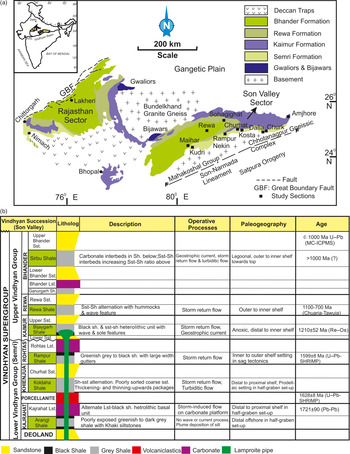
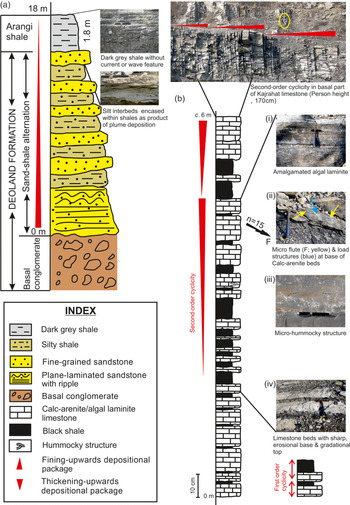
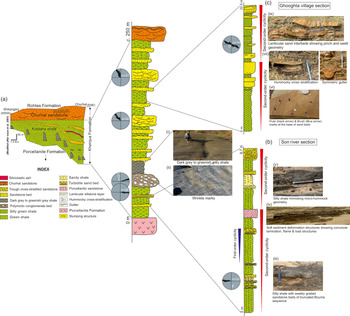
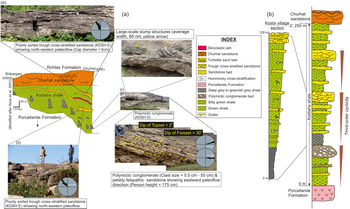
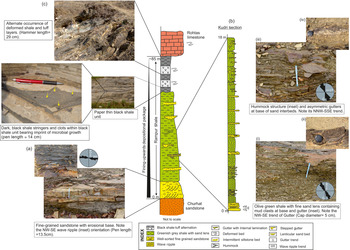
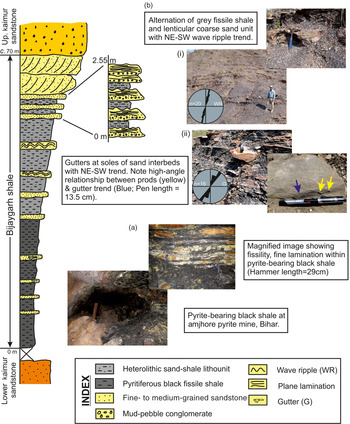
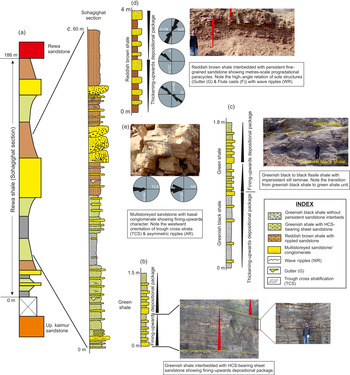
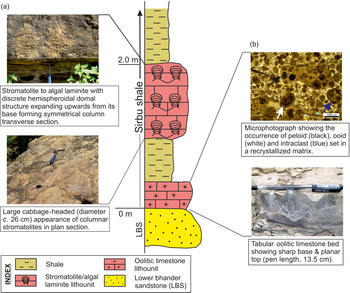
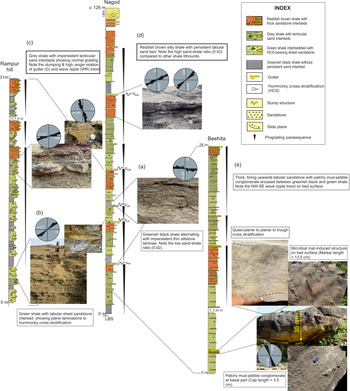
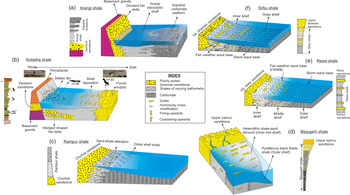

 Open access

