


We must reinforce our management of all types and levels of propaganda on the cultural front, perfect and carry out related administrative systems, and allow absolutely no opportunity or outlet for incorrect thinking or viewpoints to spread.Footnote 1
My husband watched a film as a child and thought then that he would like to have a foreign wife.Footnote 2
TV dramas and films are key tools in the PRC’s propaganda and mediums for constructing desired national images and shaping social attitudes.Footnote 3 In the reform era, TV entertainment became the most powerful mode for shaping gender and national identities and forming Chinese subjectivities.Footnote 4 This chapter offers a close reading of Chinese TV drama representations and narratives on Chinese–Russian romantic relations from the early 1990s till the late 2010s. I show how the fictionalisation of state-sanctioned and censored narratives of these romantic relations has changed over the course of China’s reform era. I relate these images and stories to the geopolitical questions of China’s self–other relations, to socioeconomic development vis-à-vis Russia’s economic decline and to population concerns in both countries. Weaving my discussion of Chinese TV drama representations of intimate encounters with broad political and public discourses on China–Russia relations, this chapter documents the shape of cinematic geopolitics and the politics of race, body, sexuality and gender in the China Dream. I argue that the TV dramatisation of Chinese–Soviet and post-Soviet intimate relations has contributed to constructing the Slavic woman as an object of national desire and the preferred choice of foreign wife, exciting and mirroring the collective expectations of male Chinese audiences. They became what Parker and co-authors described as ‘spectacular bodies’, embodying representational tropes and practices that evoke a specific kind of romantic and erotic investment.Footnote 5 This contributes to enabling hyperreal constructs like the ‘Russian brides village’ and a widespread belief in the popularity of Chinese–Russian marriages among the Chinese public. The prospect of finding a Slavic wife operates as an almost fulfilled promise – an unavoidable reality accompanying China’s economic success that elevates the status of Chinese men in the eyes of potential foreign brides. The focus on a white European woman desiring to marry a Chinese man highlights the racialised and gendered undercurrents of China’s dream of global power.
Studies of visual culture and popular geopolitics have highlighted the importance of cultural products, including cinema and TV productions, in constructing knowledge about the world, self and relationships with others.Footnote 6 Televised graphic narratives and images reflect power relations and construct identities in non-linear and non-cognitive ways.Footnote 7 The affective power, emotions and feelings that visual images elicit are as important as the meanings they generate.Footnote 8 In the 1990s, when TV was the main source of information and entertainment, Pierre Bourdieu wrote about the reality effect of television and how it influenced the beliefs and emotions of its audiences, together with its ability to bring to life new ideas and phenomena.Footnote 9 Since then, the centrality of visual culture in shaping our perceptions of and relations with the world has been reasserted by the proliferation of social media and its circulation of images in many different media. TV and cinematic representations, like other kinds of visual media and artefacts, not only reflect and manufacture societal and geopolitical concerns; they also shape structures of feeling by provoking collective responses to cultural referents, historical events and narratives of a shared community.Footnote 10 They shape and reflect common and individual desires and are therefore implicated in the making of political subjectivities.Footnote 11
In addition to shaping knowledge and feelings of their populations, states use cultural products to actively construct and mediate their foreign relations through discursive and mediatised practices. Popular media, Sean Carter and Klaus Dodd argue, are an ‘intrinsic’ part of contemporary international politics.Footnote 12 The growing field of visual international politics draws attention to how popular culture (including film and TV) constitutes international politics.Footnote 13 For example, Roland Bleiker argues that the ‘difference between the represented and its representation is the very location of politics’.Footnote 14 It gives rise to the narratives of national identities and histories, their heroes and foes, disciplining affective foreign relations. Furthermore, visual media reflect how national security and sovereign concerns are gendered and closely intersected with the spheres of intimate and family relations.Footnote 15 They stress the importance of understanding intertextual contexts in which media narratives are produced, consumed and interpreted by the audiences.Footnote 16
Since Communist China was established, substantial resources of the information and propaganda department have been dedicated to producing national images films aimed at boosting Chinese soft power. Televised and cinematic entertainment has been used to shape the understanding and feelings of Chinese viewers on the issues of the CCP’s central concerns. In the early reform period, Chinese TV dramas became an important source of knowledge about history, the new morality and attitudes towards China–foreign relations.Footnote 17 From the 1990s, when TV sets entered the homes of the majority of people, Chinese TV dramas started to play a prominent role in conjuring up and expressing their audiences’ cosmopolitan and national dreams and serving as a conduit between popular discourse, state ideologies and personal aspirations.Footnote 18 For example, in her analysis of a popular TV drama Best Time, Shaohua Guo traces the entanglements between discourses of competing cosmopolitan masculinities and the party-state’s ambition to redefine China’s role in global politics.Footnote 19 Guo notes that a televised competition to name the best qualities in a man served as a metaphor for China’s fantasy about its rise to a dominant position in the world.Footnote 20 TV production continues to be closely monitored and guarded by censors and Party organs to promote particular ways of thinking and feeling. In recent years, Chinese TV productions have increasingly included foreigners in their shows and dramas in an attempt to present a globalising character of China. Depictions of transnational marriages symbolise China’s embracing of cosmopolitanism and transformation into a global modern power.Footnote 21 At the same time, it is common for these representations to highlight foreigners’ submission to Chinese norms. As noted by Geng Song, the foreigners included in Chinese TV shows often stress their love and affection for China.Footnote 22 I examine TV narratives and representations of Chinese–Russian romance as a metaphor for the China Dream and a key medium for constructing fantasies about transnational intimate relations.
The Xi era since 2012 has been characterised by the proliferation of cultural propaganda for the purpose of buttressing China’s positive image globally. In this process, Chinese masculinity emerged as central to China’s rise in the world, characterised by the competition of men and their fantasies of global power. China’s top grossing film Wolf Warrior II (2017) became a popular case study for China’s imaginings of its role in the Global South and its contest with the West in dominating the world order. In this cinematic nationalist fantasy, China developed as ‘supplanting the domination of the West rather than saving the Global South from foreign domination’.Footnote 23 Chinese masculine qualities are portrayed as superior in relation not only to Black but also to white men.Footnote 24 In order to assert its place as a global power, China redefines and reimagines its masculinity and sexual culture in a way that productions like Wolf Warrior II endorse.
The role of gender, race and sexuality in China’s visual representations reflects the contours of China’s national identity and self–other relations. The three TV drama series and a film discussed in this chapter point to prominent moments in Chinese–Russian relations at their inception and during the post-Soviet period when their bilateral relations were growing apace. Fictional stories, inspired or partly shaped by real events, historical occurrences and recognisable places, make these visual constructs believable and interesting to the viewers. These constructs also contribute to creating a hyperreality in which the desire for national rejuvenation is manifested in the creation of particular embodied cultural tropes through racialised and gendered representations of self–other relations. The Chinese national desire to achieve enhanced international status has created a domestic demand for the media to address intercultural romantic relations and families. Karen Kelsky notes in her analysis of 1980s and 1990s popular Japanese culture that the topic of the white man was ‘sold’ to Japanese women as an object of desire in order to meet Western men’s fantasies about Asian women.Footnote 25 In a similar fashion, the idea of a post-Soviet Slavic woman has been presented to Chinese audiences to satisfy their desire for suitable, historically justifiable and accessible foreign wives. These visual narratives create a varied and multifaceted yet consistent theme about the way that the historical developmental trajectories in China and post-Soviet Russia have become intertwined through historical, political and now cross-border marriage connections.
I first introduce the three TV dramas within the social-political contexts in which they emerged and then discuss the common themes raised in these productions, including their representations of post-Soviet Slavic femininities and Chinese masculinities, the interplay of intimacy and geopolitics and changing family and societal mores.
2.1 Televised Portraits of Chinese–Slavic Romance
The events unfolding in the three TV dramas I discuss take place in the north-east of China, Manchuria.Footnote 26 After the long period of strictly enforced border control that was introduced in the 1930s and became increasingly militarised throughout the 1960s, contacts between ordinary people were re-established only after the borders reopened in the early 1990s. Russian Girls in Harbin (1993; 俄罗斯姑娘在哈尔滨 Eluosi guniang zai Haerbin) was the first Chinese TV production about cross-border friendship and romance to be made after the signing of the 1991 Sino–Russian Border agreement that led to the reopening of the border. Directed by Sun Sha, a native of Jilin, the drama presented the first glimpses of daily post-Soviet reality that Chinese TV viewers had had since the 1969 border conflict.
This series draws the historical connections between the first post-Cold War Chinese–Russian romance and the tangled history of relations between Russia and China. The years from the late nineteenth to the early twentieth century, during which the Russian Empire expanded its territory and its imperial ambitions in the Far East by constructing and operating the East China Railway, provide the historical context to the deep connections between the two countries. Russian Girls in Harbin starts at the time when the newly independent Russia faces a deep economic crisis and people must survive through their cross-border shuttle trade and barter. In the far-eastern Russian city of Vladivostok, a recent graduate named Olya earns her living by selling the family treasures in the clothes market in Suifenhe. One day she loses nearly all the daily income she has earned at the market when she exchanges her father’s original military trench coat for a bag of fake Adidas tops. A Chinese stranger steps in to help her retrieve the coat. Committed to finding the man to express her gratitude to him, Olya decides to go to China to look for him. Russian Girls in Harbin explores the relations between Olya and Tiancheng during their courtship, which can be seen as a metaphor for the early contacts between post-Soviet Russia and early reform-era China. The two young people regularly meet at the border market, which was the main source of livelihood for post-Soviet and Chinese people in the early 1990s. By watching the relationship between these two young people, Chinese TV viewers became familiar with the sociocultural context of early post-Soviet Russia.
In 2012, the year when Xi Jinping became China’s paramount leader and Vladimir Putin was re-elected as Russia’s president for the third time, two TV dramas, A Northeast Love Story (东北爱情故事 Dongbei Aiqing Gushi) and My Natasha (我的娜塔莎 Wode Natasha), were produced. A Northeast Love Story is a 26-episode TV drama that rehearses similar themes of intercultural romance, yet goes deeper in its exploration of the daily life of two Chinese–Russian couples living in the countryside in China’s north-east. The TV series was filmed in Sihecun village, mentioned earlier, a fact that contributed to its reputation during the 2000s as China’s Russian brides village. The series opens with the return of two friends, Jiaqi and Haitao, to their home village with their Russian wife and girlfriend, respectively, after making a fortune selling goods at a market in Moscow. When Jiaqi brings his Russian wife Katya home, the news stirs the quiet village community, provoking conflicts and heated discussions over the character of traditional Chinese family lives and inter-racial and intercultural relations. While Katya and Jiaqi’s relationship is registered and recognised, Haitao and Dunya, the main protagonists of the TV drama, are at the courting stage of their relationship. Their third friend, business partner Dongsheng, stays behind in Russia. As the viewers subsequently find out, he does not want to go back home without finding a Russian bride.
This series explores Chinese–Russian cross-border family life, intercultural communication, gender relations, clashing norms and the rural–urban divide. In it these Chinese–Russian romances transcend internal conflicts and connect Chinese men and Russian women in a common pursuit of economic success and personal happiness. The drama highlights the transformation of the independent and strong-willed Russian women protagonists into obedient, domestic and fertile daughters-in-law who adapt to the interests of their Chinese husbands and Chinese families.
My Natasha is a Second World War love story between a Chinese resistance fighter named Tiande and a female Soviet officer, Natasha, that spans fifty years. It shows the deeply intertwined trajectories of the Soviet and Chinese people through their shared border and common legacy of war, socialism, Party connections and struggles against Japan. The Heilongjiang (Amur) river that connects and separates the two countries features prominently in the TV drama as a metaphor for the powerful, immemorial ties between the two cultures and people who cannot be separated by the natural barrier binding the two states. The events unfold on the north-east front, where the Japanese, Soviet and Chinese armies clashed in the 1940s. Tiande and Natasha are united by their strong patriotic love of their respective countries – and fight for their countries and their respective nation’s survival and liberation. The cultural significance and prominence of this TV drama are highlighted by the fact that the leading actress Ilisha (Irina Kaptelova) received the first ‘best foreign actress’ award at the 2012 TV drama awards, ‘Made in China’.
The three productions show that romantic relations and marriages between Russian women and Chinese men are safe and in China’s national interest. At the same time, it is notable that they contain no explicit reference to relationships between Chinese women and Russian men. This reflects that conjugal relations in China are a gendered national security issue, where dating foreign men is seen as risky and therefore needs to be controlled. Writing of her involvement in the Chinese TV production of Foreign Babes in Beijing, Rachel DeWoskin recalls that the topic of foreign men dating Chinese women, a much more widespread phenomenon, was censored because it was perceived as a threat to Chinese nationhood.Footnote 27 Similarly, in the representation of the foreign man–Chinese woman transnational family in the popular TV Drama A Modern Family (2001), a foreign husband (Italian in this case) is presented as a violent and abusive drunkard and gambler.Footnote 28 Similar narrative techniques and tropes of these relationships can be observed in all three TV productions under discussion here. Only educated or well-trained, fair-skinned blonde women who are prepared to submit to the Chinese patriarchal order receive a favourable representation as desirable foreign wives to be welcomed into a Chinese family.
Chinese visual creations not only present Russian women as stereotypically pleasing objects of desire. They also emphasise the instrumental role they play in assisting Chinese men (and the Chinese nation) to realise their masculine potential. In the dramas, foreign girlfriends and wives endow their men with the confidence and strength to achieve success in their projects towards self-realisation (as businessmen or soldiers). Through their dedication to their love and their reproductive qualities, these female characters make an active contribution to Chinese families and ultimately to the development of China. In return, the Chinese men are depicted as lifting their foreign wives out of the poverty and broken families in which they were mired in their home country, bringing out their femininity and assisting them in fulfilling their domestic roles as wives and mothers. These visual tropes conform with the officially endorsed gender and family norms in both societies. When Putin returned to power as the president of Russia in 2012, the promotion of traditional family values became a prominent theme of his presidency.Footnote 29 Similarly, public discourses on happy housewives have been a key governing tool during Xi’s rule.Footnote 30 In 2014, for instance, the All-China Women’s Federation launched a public campaign titled ‘In Search of the Most Beautiful Family’ (寻找最美家庭 xunzhao zuimei jiating) to celebrate families that combined socialist ideals with traditional Chinese values and gender roles.Footnote 31 The meaning of beauty in the context of this campaign and reforming China more broadly should be understood as not only referring to physical appearance but also to the moral code informed by the Party’s ideology.
Beyond the recognisable similarities in their gender norms, since the 1990s the Russian people have occupied a special place in popular Chinese media representations of foreigners. In the continuum of self–other relations that define China’s relation with the foreign world (and particularly with the West, as represented by the USA), Russia and China do not appear as complete strangers on the opposite ends of this spectrum. The complexity of their relations gets obscured through a generalised China–West lens. China and Russia are intimately connected by a host of historical, geographical and sociopolitical factors. While it has been customary to examine the representations of all foreigners in Chinese popular culture as the Western Other, shaping the construction of Chineseness and maintaining the self–other boundary,Footnote 32 I suggest that a relational approach that is sensitive to nuances in degrees of connectedness and relatedness captures more accurately the way that TV dramas deal with Chinese–Russian relations. The three TV series stress close physical ties between the two countries and their people – a thin strip of the Heilongjiang river separates Natasha and Tiande in My Natasha, placing them in close proximity to each other, yet separated by the political and ideological context. Russian Girls in Harbin revives and builds on the historical connections between Russia and China through their linked network of railway routes. A Northeast Love Story emphasises the role of cross-border trade that boosts the development of the two societies and deepens relations between their peoples. Russian femininities and Chinese masculinities are depicted as compatible and complementary – Russian women make Chinese men stronger, more manly and successful, while Chinese men bring out the feminine qualities in Russian women. They are united by their common historical experiences, economic conditions and strong sense of patriotism. Through the encounters with and consumption of these positive visual narratives of Russian–Chinese love stories, the audience is constructed as a desiring subject that can entertain the fantasy of ‘taming’ post-Soviet women and possessing their own ‘Natasha’.
2.2 Post-Soviet Slavic Femininities and Chinese Masculinities
The masculinisation of white women has been a popular trope in Chinese media ever since the start of the reform era and the development of commercial advertising.Footnote 33 A double gendered and racialised dynamic has characterised the reform period’s media representations of Russian women and their relationships with Chinese men. Unlike current dominant images of Chinese women representing them as modest, infantile and timid, this shift redresses the gender ideologies of the Mao period, which masculinised Chinese women’s labour for the socialist project, only to reverse this discursive approach in the reform period. Instead, since the late 1970s the Chinese media has attributed to white women fictional qualities and stereotypes customarily reserved for men.
The visual portrayal of Russian women in Chinese drama series does just this. The representations of these characters feature prominently their physical characteristics and sense of strong will and self-esteem. For example, a description of Russian Girls in Harbin in Baidu, a popular Chinese search engine, stresses not only the main protagonist’s natural beauty but also her strong and independent character: ‘Russian women are not only beautiful, but also strong’ (俄罗斯姑娘不光美丽还很坚强 Eluosi guniang bu guang meiliang hai hen jianqiang).Footnote 34 Olya in Russian Girls in Harbin is beautiful, educated and talented but poor. She goes to China to become financially independent. Yet, despite her poverty, she knows her value in this Chinese society – ‘I am a better breed than you’ (良种 liang zhong) she tells a Chinese restaurant owner during a job interview. The restaurant boss is dazzled by Olya’s boldness: ‘I can see that you have character (挺有性格的 ting you xingge de)’ and offers her a job (episode 12). Even Olya’s father refers to her as his son in a moment of drunken despair – he relies on her strength and independence for moral support in his old age (episode 18). The explicit reference to ‘breeding’ conveys the popular eugenic idea that organises populations into a hierarchy of races whose characteristics are biologically determined.
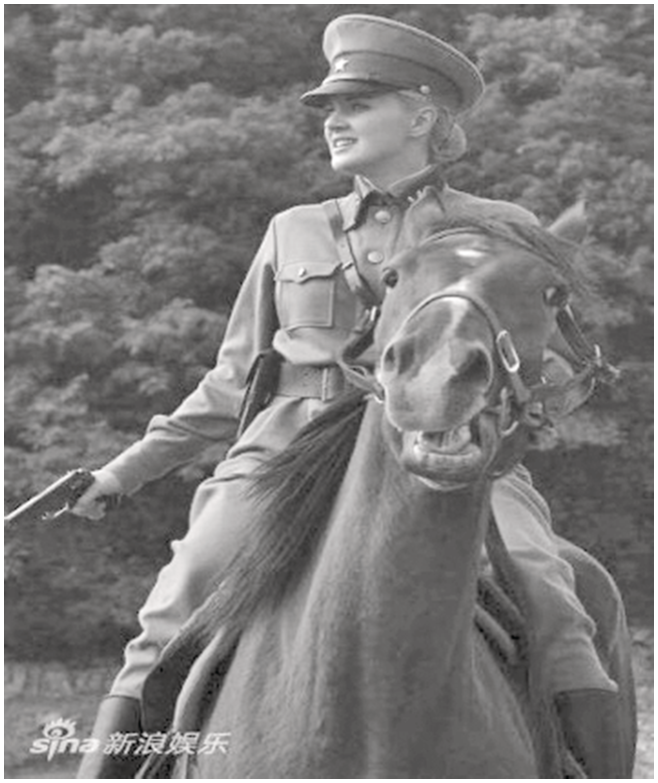
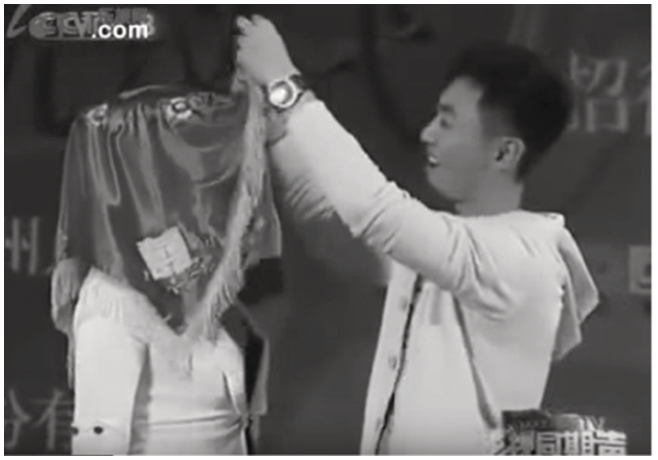
The first encounter between Soviet soldier Natasha and Chinese anti-Japanese fighter Pang Tiande in My Natasha is reminiscent of combat films. Their meeting takes place after the Soviet army in Manchuria has captured a group of Chinese resistance fighters. Natasha calls Tiande in to be interrogated (9:02) and the episode ends with an open physical fight between them. During the interrogation, Tiande’s tone changes when he hears Natasha speaking fluent Chinese. He suddenly feels at ease and begins to flirt with her, making fun of Natasha’s spoken Chinese. As Communist soldiers fighting for their respective countries and with their sense of duty to their respective national causes, Tiande and Natasha initially have no romantic interest in each other. Tiande calls Natasha a devil (魔鬼 mogui), referring to her brave, strong and even aggressive disposition. This is an unusual portrayal of a female character for a Chinese audience. At first, Natasha appears the antithesis of Chinese canons of femininity. The most famous female soldier in the Chinese literary tradition is Mulan, who had to conceal her female identity under her armour. In contrast, Natasha does not need to hide her beauty and strength. She openly trains Chinese soldiers in military combat and martial arts, prepares them for field fighting and teaches them Russian (Fig. 2.1). The unfamiliar facets of a female character that Natasha presents to Chinese audiences – beauty, boldness, assertiveness and physical strength – are combined naturally in this story. Yet, even before the release of the TV drama, the submissive nature of Natasha’s character was emphasised in a ceremony where Irina Kaptelova, the Ukrainian actress cast for this role, was revealed to the Chinese public.Footnote 35 In a scene reminiscent of a traditional Chinese wedding, a male TV presenter unveiled her face from behind a red headscarf (Fig. 2.2). This combination of strong independent agency that can be brought under control by the skilful hands of a Chinese man is characteristic of Chinese visual representations of Soviet and post-Soviet women.
Natasha, My Natasha, episode 1.
The face of the actress selected to play Natasha is unveiled to the Chinese public.
Another character trait that these TV productions emphasise is the outspoken and forthright demeanour of the Russian women. In A Northeast Love Story, independent-minded Katya and Dunya express their thoughts freely in front of their Chinese families and other villagers. They do not hold back their views, even from the village head and the Communist Party leader. They talk back to their husbands and their parents-in-law, who find them difficult to ‘manage’. When the village women get together to discuss domestic violence in one of the families, Dunya and Katya forcefully criticise the abuser’s violent behaviour. Combined with this directness is the emphasis the show places on these women’s unrestrained emotions and sexuality. Both take the sexual initiative in their own hands without waiting for their Chinese partner to make the first move. For example, in My Natasha, Natasha is the one to initiate intimacy with Tiande (episode 8). This emphasis on their directness complements dominant representations of the hypersexuality of the Soviet heroine. The desire to possess and dominate white women for sexual consumption is explicit here, yet these sentiments do not turn into the fear and abjection in the women that has been noted in other studies of Chinese representations of white women.Footnote 36 Nevertheless, these visual constructs show that Slavic women can be successfully tamed and folded into the Chinese patriarchal order.
In contrast, the Chinese partners of these heroines appear from the screen portrayals as timid, chaste, caring and gentle. In Russian Girls in Harbin, a Russian researcher recounts her observations about Chinese men with the detached objectivity of a scholar (episode 6). According to her, Chinese men are stable (稳重 wenzhong), kind (善良 shanliang) and warm-hearted (热心 rexin) and they love their spouses very much (6:17, 6:18). Similarly, in My Natasha, Natasha’s father speaks with affection about Chinese people in front of Tiande. According to him, they are good, kind-hearted and honest people (episode 8). When Tiande asks Natasha why her father likes Chinese people, she explains that he had fallen in love with a Chinese woman who had looked after him and Natasha when she was a toddler, after her biological mother had died. The Chinese woman’s relatives did not agree to her marriage to a foreigner, so she escaped to the Soviet Union to live with Natasha’s father. When, after several years, she went back to China, Natasha’s father could not endure their separation and turned to alcohol.
Fang Tiancheng in Russian Girls in Harbin is an example of benevolent Chinese masculine values, combining traditional and modern qualities. He is a photographer and a bread maker as well as a biker with rounded and soft body lines who wears leather, and is a keen collector of weapons, which are displayed on the wall of his flat. Tianchen teaches Olya skills in market trading: how to create an environment that will entice customers to enter the shop; how to talk to customers; how to negotiate a price and sell the product. Olya is an attraction in herself and Tiancheng is convinced that, because she plays her shopkeeping role skilfully, their enterprise will be successful. Russia is a symbol of fashionable and trendy products, and Tiancheng uses Olya as a marketing tool to attract customers. Their relationship is symbolic of China–Russia relations since the 1990s, where power relations have been shifting in favour of China.
The story of Olya and Tianchen is inconclusive. Olya’s social and familial ties with Russia are weakened by its poor economic situation and deteriorating moral landscape. At the end of the series, Olya’s friends are preparing for their trip to Russia for the winter holiday. Even though she longs to spend the New Year break in Russia with her friends, at the last minute she decides to stay behind with Tiancheng in Harbin. While the viewer does not get to know the end of their story, the film lays an important foundation for the popular imagination about the possibility of such a relationship in a reformed China. Not only are Russian women willing to come to China to enter romantic relations with Chinese men, but their traits, values and experiences make them ideal partners at both personal and societal levels.
2.3 Politics and Intimacy
The dramatisation of Chinese–Soviet and post-Soviet relationships in these three productions sends explicit messages about the deep connection between intimate relations and politics in these two states. The underlying theme is that cross-border marriages affect the individuals concerned, their families and their respective states. Cross-border family relationships promote closer inter-state relationships and can influence them even further.
For example, in Russian Girls in Harbin, Tiancheng and Olya discuss political and economic issues on several occasions. According to Tiancheng, Chinese people are forgiving and do not harbour any feelings of resentment for the past (不计较前仇 bu ji jiao qian chou), except towards Japan (episode 9, 5:12). However, China itself has suffered from prejudice, unequal treatment and asymmetrical relations with its neighbours. Tiancheng observes that the Soviet people had a poor opinion of Chinese people and did not treat China equally. He notes that they behaved almost as if the Chinese were in debt to the Soviets (我们照样还你们的债 women zhaoyang huan nimen de zhai), despite China’s continuous support of them. Olya is not interested in politics; her main concern is economic survival: ‘Please don’t discuss international politics issues with me. I am only concerned with earning a bit more money,’ she says at one point. This emphasises the apparently apolitical character of foreign women entering Chinese society.
In My Natasha, the topic of fostering friendship between China and the Soviet Union through a marriage between members of each country is often discussed. Tiande believes that his devotion to Natasha will have an influence on relations between the two countries: ‘When we marry, whether in China or the Soviet Union, our love will contribute to our countries’ friendship’ (episode 9). He hopes that the Communist solidarity and deep affection between the two people will overcome their difficulties. However, as viewers observe, for decades inter-party suspicion and competition between the countries prevent Natasha and Tiande from being together.
The TV drama depicts the two states as political and ideological partners, yet at a critical moment in the story, when Chinese cultural treasures are at risk of being taken from the Japanese occupation forces and transported to the Soviet Union, Tiande shows where his true loyalty and dedication lie. When the Soviet intention comes to light, the Chinese and Soviet anti-occupation forces plan an operation to disrupt it and to deliver the Chinese cultural heritage objects they have rescued to a safe place. Natasha is in charge of this operation. The Soviet plan is to take the relics to Russia, but Tiande has a plan of his own. He wants to keep these treasures in Chinese territory under the control of the Chinese Communist Party. Although he is a Soviet soldier, his allegiance lies with China: ‘We are Chinese and need to think about our country.’ He wants to prevent a repetition of the foreign invasion in 1860 when innumerable artefacts were looted from the Summer Palace in Beijing. His defiant actions here endanger his relationship with Natasha, who is angry with Tiande for ignoring her order. She feels betrayed and powerless and tells Tiande that she is breaking up with him. At the moment when his love for both China and Natasha are tested, Tiande’s patriotic sentiments take priority over his feelings for Natasha. He is ready to sacrifice his personal needs for China’s national interests.
In A Northeast Love Story, the parents of Jiaqi, who has recently returned from Russia, ask their son to stop seeing his wife, Katya, sparking a family conflict and a village-wide dispute. The village head, whose son Haitao is also dating a Russian woman, steps in to mediate in Jiaqi’s family’s intergenerational conflict. The following dialogue between Jiaqi’s father and the village head unfolds:
‘Do you know what nationality (国籍 guoji) Katya holds?’
‘Yes, Russian.’
‘And what kind of relations are between Russia and China right now?’
‘Friendly.’
‘Exactly. So, by breaking your son’s relations with Katya, you might break China’s friendly relations with Russia.’
These episodes from TV dramas indicate the importance that the drama creators and censors approving the scripts attributed to romantic relations as extensions of China’s national interest and foreign relations. The link between personal and state relations is interdependent where the value of international love is judged in terms of its service to Party goals. According to this logic, close relations between individuals across national borders lead to stronger inter-state relations. Moreover, the dramas hint that these intimate relations confront the important demographic challenges faced by both societies. In episode 7 of Russian Girls in Harbin, Olya and Fangchen walk around a shopping mall to the sound of the Soviet song, ‘White Dance’, which is about a grieving bride whose groom has left for military service in Afghanistan. While she is waiting for him, with her bridal dress being prepared for the wedding, her dreams are dashed – the groom is killed, ‘cursing the white dress and the white flags of yesterday’s hope’. This theme provides another important layer to the sociopolitical context in Russia in the early 1990s. The withdrawal of troops from Afghanistan, completed in February 1989, left thousands of Soviet families grieving over their men’s lost lives – and brides-to-be with unrealised dreams of ‘wearing a white dress for their wedding’. As the song comes to an end, Olya and Fangchen walk out of the shopping mall to meet all the Russian women featured in the film. By interweaving multiple connections at the sociopolitical, historical and personal levels, the film alludes to the deep links between Russia and China and suggests that ethnically mixed couples can change the course of history in the two countries.
2.4 Dynamic China, Stagnant Russia
The characters and relationships in the three series are shaped by the changing socioeconomic and moral environments in their societies. In Russian Girls in Harbin and A Northeast Love Story, Russia is presented as economically poor and resistant to change. China, in contrast, appears as a dynamic and fast-changing society. China emerges as a source of invaluable knowledge, while Russia is depicted as a source of natural resources that can quickly turn people into millionaires. Zhenya, one of the characters in Russian Girls in Harbin, is a Russian researcher working on a doctoral dissertation about the history of a Russian beer factory in Harbin. Through her research, she aims to examine the way in which Russia’s past and present intersect with the development of China. She notes that, although she cannot change Russia, she intends to describe everything she sees in China in her book (episode 15). Her goal is to use her experiences to document the contrasts between the two countries in which China is embracing modernisation while Russia is struggling to keep up.
In episode 11 of Russian Girls in Harbin, Fang Tiancheng goes to Vladivostok in search of Olya and ends up going to a pop music concert one evening. One of the songs, entitled ‘Chinese Love, Slanted Eyes’, is about a Russian woman’s love for a Chinese man (18:00). After the concert, Tiancheng goes to the war memorial park with a model of a Soviet submarine, where he joins children on an ice slide. This sequence is the only impression the viewer gets of ordinary life in post-Soviet Russia – bleak, cold and harsh – through the eyes of the main Chinese character. Another reference to the living conditions in Russia is found in a letter that one of Olya’s friends receives from her parents. The parents are concerned about their daughter’s life in China and the fact that she is not married yet. The women discuss this letter and agree that in Russia people think that life in China is hard for women, but in fact it is much better than in Russia – in China they eat and live very well.
2.5 Desperate Women from the Former Soviet Union Seeking to Better Themselves in China
Russian Girls in Harbin depicts a growing number of women from Russia coming to China in search of work (episode 12). One Russian female trader even tries to suggest sex work to Olya as a ‘quick way to make money’ and offers to find her a man (26:30). She implies that this is the usual way to earn a living when ‘life pushes you too hard’ (esli zhizn’ zastavit). Later, the viewers see a desperate young Russian woman who resorts to sex work in the character of Olya’s co-worker, Svetlana, from Vladivostok (episode 13). She has sex for money with the manager of the hotel where she and Olya work. Svetlana justifies her decision as an act of survival:
Our father left us and went to Moscow to earn a living. My mother was left with three children. I have a younger brother and sister. We need money. My mother is hoping I can earn money in Harbin. We are both from Vladivostok. Don’t abandon me, Olya, forgive me, I will definitely change.
In contrast to the deteriorating economic and moral landscape of Russia, the dominant theme in the show’s representations of China is the narrative of self-improvement and individual economic success. These attributes stand out in Russian Girls in Harbin and A Northeast Love Story. In the former, Tiancheng offers his own formulation of China’s reform-era motto: ‘Getting rich and becoming successful have different meanings. … In order to succeed, I have to work hard and be disciplined’ (堂堂正正 tangtang zhengzheng). This is juxtaposed with the situation in Russia which is represented as a morally degraded society where it is easy to get rich fast by selling off the country’s natural resources and former state-owned enterprises (episode 16). Oleg, Olya’s ex-boyfriend, who is a stereotypical post-Soviet businessman, personifies this trait. He is depicted as a vain and self-centred individual who has turned into ‘a money-making robot’ (episode 18). Virtuous and benevolent Chinese masculinity is juxtaposed to the images of corrupt and vain Russian men.
A shopping mall occupies a prominent place in this TV drama as the visual and material symbol of modernity, development and consumption, as well as of individual self-realisation during China’s reform period, depicted by consuming luxurious products, wearing Italian leather outfits and admiring beautiful people in advertisements. Olya and Tiancheng ‘jump into the ocean’ (下海 xiahai) to try their luck at these new market opportunities by opening a small clothing stall (episode 7). The juxtaposition of the images of white models smiling from billboards and Olya is striking. Unlike the frozen images of models on the posters, Olya is real, accessible and willing to learn and follow the rules of living in China.
Furthermore, it is not enough to be financially successful in China. In A Northeast Love Story, most of the young generation from the village look for business opportunities in Russia, but the two who are most successful, Jiaqi and Haitao, are those who have Russian women partners. Their friend Dongsheng insists that he wants to return to Russia, because ‘he definitely needs to find a Russian wife. It is a must and an urgent matter for him’ (必须儿马上的 bixu er mashang de). Dongsheng is not the only one who looks up to the two men in the village who have Russian partners. At a farewell party for the young people going to work in Russia, one of the Chinese workers getting ready to leave expresses his admiration for Haitao: ‘I want to learn from you, to earn a lot of money and find a Russian wife’ (episode 13). A Russian wife is depicted as a talisman for local men to help them in their entrepreneurial and masculine accomplishments.
2.6 Changing Family Mores
The three televised dramas signal the changing societal attitudes that are transforming values and gendered national characteristics in China and former Soviet states. The transformation of parental values and attitudes in both societies is key to the creation and reflection of Chinese national desire. The Chinese depictions of family relations in Russia in these TV productions emphasise its deteriorating social fabric and failing family ties. Alcoholism is endemic and widespread. The drunken Russian father is an ever-present theme in both My Natasha and Russian Girls in Harbin. In both cases the father is presented as unreliable, unproductive and weak. Olya’s father is remarried to a young woman who does not work and who moved in with him after Olya’s mother married an Italian (episode 16). Racial prejudices are widespread – Olya’s father cannot believe it when she tells him that she went to China to be with Tiancheng, who had ‘saved her’. Her father cannot accept that his daughter could fall in love with a Chinese man. Similarly, in My Natasha, Tiande’s father struggles to understand that his son cannot find a suitable woman in China. To him, Natasha is too forthright and direct and, because she does not hide her emotions, she cannot play the quiet role expected of Chinese wives. While Tiande’s father opposes his son’s marriage to Natasha, he agrees that he can take Natasha as a second wife. She is not cultured enough to be the main and only spouse, yet she is acceptable as a second wife for his son. He expects her to bear a child, and the fact that Tiande and Natasha have not had any children during the four years they have been together worries him.
A similar theme runs through A Northeast Love Story, where one of the Russian wives, Katya, does not want to have children and takes contraceptives to prevent them. Her husband Jiaqi yields to his wife’s wishes until his parents start questioning his loyalty to the family and remind him of his responsibility to look after them in their old age. Jiaqi agrees that his main duty towards them is to pass on their surname to a new generation. Although it takes a long time to persuade Katya to have children, Jiaqi’s parents are not disappointed when, at the end of the series, she gives birth to twins, thus exceeding their expectations. Not only are the Slavic women independent and strong-willed, they are also healthy and fertile and able to bear Chinese descendants. These films emphasise the difficulties these women face in being absorbed into Chinese patriarchal social structures and the transformation that is needed in parental attitudes towards the idea of a foreign daughter-in-law. Dunya surrenders to the authority of Haitao’s parents and accepts the Chinese kinship system and her place in the social hierarchy. In the final episode, she calls her Chinese mother-in-law ‘mama’ – thus symbolising her transformation into an obedient, albeit foreign, daughter-in-law. In Russian Girls in Harbin, Olya gives up her plan to earn an independent living and, although she has been fired from the restaurant, she decides to stay with Tiancheng rather than going back to Russia with her friends. Collectively, these visual products create an image of the Slavic woman who is not only fetishised for the Chinese male gaze but constructed as an object of desire that is both attainable and willing to be conquered.
2.7 Competing Femininities
In all three dramas, Slavic women contend with Chinese women for the role of the romantic partner to their chosen man. They all win the contest, yet Chinese women do not easily give up the fight. In episode 15 of Russian Girls in Harbin, Dongsheng’s ex-girlfriend says: ‘You men, how can you be like that? – foreign is better than local for you (洋的比土的好 yang de bi tu de hao). If I go to Moscow and stand in Red Square, I will be a foreign gal there too!’ She thus conveys a relational value of racialised gendered bodies across international spaces.
In episode 6 of My Natasha, during their escape to the Soviet side of the war front, Natasha and Tiande are intercepted by a group of Chinese resistance fighters, and the daughter of their commander, called the Red Girl, falls in love with Tiande. She asks her father to arrange a wedding for them. Surprised by this abrupt turn of events, Tiande rejects her marriage proposal with the excuse that his priority is to fight for the liberation of his motherland rather than to pursue romance. Yet when the Red Girl pursues Tiande, Natasha interferes and announces that she and Tiande are a couple and that they have sworn to be faithful to each other. The Red Girl challenges Natasha to an arm-wrestling fight to resolve the dispute and loses to Natasha. After this, she agrees to arrange a wedding ceremony for Natasha and Tiande. According to Chinese customs, Natasha and Tiande become wife and husband, yet when they are left alone in the newly-weds’ chamber for the night, Tiande is unable to respond to Natasha’s plea for a kiss and they admit that what happened earlier was a performance rather than a real ceremony. In the contest for national survival represented by the fight between the two women, Slavic femininity is depicted as having more physical strength and reproductive power.
2.8 Chinese–Slavic Intimacies in the Age of China–Russia Strategic Partnership
Another special year in China–Russia relations was 2019. In addition to marking seventy years since the establishment of the PRC, Putin and Xi signed a joint statement on strengthening global strategic stability. As if to celebrate a new wave of growing relations, a joint 2019 Chinese–Russian film production called How I Became Russian (Kak ya stal Russkim) marks a symbolic pinnacle of visual representations of Chinese–Slavic (explicitly Russian in this case) intimate encounters over the previous thirty years. The film is an adaptation of a twenty-part Russian TV drama with the same title about an American man falling in love with a Russian woman which became very popular and earned high praise among critics and viewers in China. It became classroom material for lessons on Russian culture and lifestyle.Footnote 37 In the cinematic interpretation of the original drama, the Chinese man takes the place of the American character, symbolic of the deepening relations between China and Russia in their joint struggle against American global domination. Like the three TV drama series discussed in this chapter, the film purveys popular stereotypes, societal challenges and the prospects of intercultural relations. This romantic comedy is aimed at both Chinese and Russian audiences and was released simultaneously in Chinese- and Russian-language versions. It builds on deeply geopolitical content that amplifies the themes that were raised in the earlier TV series discussed in this chapter.
The main characters, Peng and Ira, meet in Shanghai, where Ira is on holiday, taking a break (in her own words) from her domineering and controlling father. Peng helps Ira when she chokes on a fishbone in a restaurant and their relationship quickly progresses from there. After the week in which they are together, Ira’s holiday comes to an end and she returns to Russia. Peng masters the Russian language in record time and goes to look for her. He finds her at her workplace in the Bolshoi Theatre in Moscow. Peng’s intentions are serious. Meeting Ira’s father and asking for his permission to marry Ira is next on his agenda. They travel together into the deep Russian countryside. Peng copes with the bitter Russian winter and gets a lift in a decommissioned Soviet tank to Ira’s family home. The backdrop music to his journey is from ‘Katyusha’, a Soviet song from the Second World War era that is very recognisable in China. Ira’s father, Anatoly, is an archetype of Russian masculinity – a heavy drinker and a keen hunter who decorates his house with trophies from his hunting adventures. His first reaction when meeting Peng is to refuse his request outright. He asks if Peng is a Buryat, Bashkir, Eskimo or Yakut (all recognised ethnic minorities within the Russian Federation). He cannot grasp the possibility that Peng might be Chinese. He does not take Peng seriously and uses every opportunity to insult him. He calls him ‘пень’ (stump) and ‘ping-pong’ and draws parallels between a marriage with him and Chinese products that break easily and quickly: ‘I don’t need a Chinese brak [faulty product or marriage]Footnote 38 here,’ Anatoly barks. He also compares Russian–Chinese couples with the relationship between dogs and cats. ‘No one looks like you [Peng] in our family and there is no place for you here … A cat and a dog can’t live together,’ he concludes. This view is shared by others in the household. The family housemaid, Petrovna, does not understand or approve of Ira’s choice of fiancé. Although she is prepared to flirt with Ruben, a man from Armenia, the idea of a Chinese fiancé is hard for her to accept. Her idea of what constitutes ‘a normal husband’ does not extend to Chinese men:
Petrovna: Can’t you find a normal one?
Ira: Just because he has slanted eyes doesn’t mean he’s not normal. He feels and understands everything.
Petrovna: Our men are better.
Ira: Petrovna, if our men are better, why are you making out with Uncle Ruben? [Armenian]
Petrovna: Ruben is supporting me.
Ira: Peng is also supporting me – he came here for me, learnt Russian and is coping with all father’s tests.
In an attempt to get rid of this unwanted Chinese fiancé, Ira’s father challenges Peng to a series of ‘traditional’ Russian entertainments – a game of Russian roulette, a Russian sauna followed by a dip in icy water, and a bear hunt. Peng eagerly agrees to participate and stoically survives these challenges. After the game of Russian roulette, Ira’s father has nightmares about a growing number of mixed-race baby boys taking over his country house. To his great distress, new babies are constantly being delivered to the house. At one point in the dream, the door suddenly opens onto a brightly lit state award ceremony where Anatoly is presented with a medal for the ‘National Granddad of the Russian Federation’, for his contribution to its demographic growth and to international friendship. As the host of the ceremony pins the medal onto Anatoly’s chest, a woman from the audience cries out ‘Russia is saved!’ The constant supply of Chinese-Russian baby boys saves Russia from an imminent demographic catastrophe. Anatoly’s nightmare turns into a dream celebrating a solution to Russia’s population problem and elevates Anatoly to a Russian national hero.
The film contrasts Peng’s soft and gentle personality with the hypermasculine qualities of Ira’s father Anatoly. During the challenges Anatoly makes him face, Peng proves that he is willing and equal to, and in some ways better than, Ira’s father (it is Peng who kills the bear on their hunting trip). During these trials, Anatoly gradually warms to Peng and eventually accepts him into his Russian family. Anatoly announces that, like a true Russian, he does not ‘give up on his own’. In the concluding phrase of the film Peng reflects on his ‘Russian experiences’ and summarises them thus: ‘Russian people live through a chain of suffering. Through different ordeals people get purer and stronger. Faith and love are key. … And this is how I became Russian.’
Like other visual productions discussed in this chapter, the film builds on and develops several layers of meaning and symbols that are characteristic of Chinese and Russian societies. One of the meanings created by the film is that both Chinese and Russian families and the wider society can learn to find Chinese–Russian intermarriage both acceptable and desirable. This is shown in Peng’s single-minded pursuit of Ira and Anatoly’s gradual transformation from an outright racist who resists the idea of a Chinese son-in-law into accepting Peng as a member of his family and the father of his future grandchildren. The film stresses the patriarchal culture of the two societies, where changing the patriarch’s views about marriage remains central to the accomplishment of overall societal change.Footnote 39
The symbols and narratives of these visual productions are not solely fruits of the imagination but are socially coded and reflect the challenges, questions and dilemmas confronted by the cultures meeting them. The hyperreality created by the visual discourses and symbols in these four dramas builds on their material and ideational elements. The key message stemming from them is that marriage norms in China and Russia are being transformed towards accepting mixed-raced marriages. However, these transformations are set within clearly defined gender and societal norms. The heteronormative patriarchal family is the foundation in both societies and gender roles are clearly and unambiguously presented. The interplay of gender and race is coded. The ‘Russian wife–Chinese husband’ model of an inter-racial family is openly endorsed across both sociopolitical spaces.
One notable area of silence across all TV dramas and film is the topic of immigration regulations and visas required for foreigners staying in China. The characters in the TV dramas move seamlessly across territorial borders and paper walls. None of the characters talks about the money, energy and time that they spend on the visa applications, police registration and regular visa renewal procedures that foreigners in China go through. The TV dramas promote intimate relations, marriage and procreation across territorial and cultural Chinese–post-Soviet borders, but do not acknowledge the significance of political and paper borders. In contrast, as my discussion in the following chapters shows, dealing with immigration regulations and citizenship laws is important to foreign spouses in China.

 Open access