

Introduction
This paper presents new evidence in support of the Reference LeavesleyLeavesley et al. (2002) claim that human occupation of the Bismarck Archipelago, Papua New Guinea (PNG), began by at least 39 500 bp, 4000 years prior to previous evidence. It presents new 14C determinations and an analysis of the shell for evidence of diagenesis that may influence the age estimates.
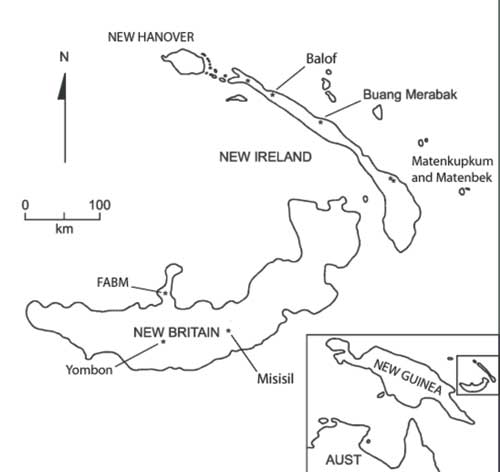
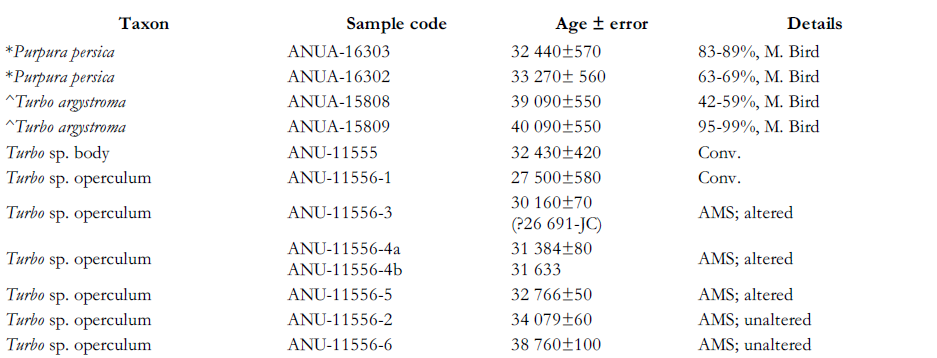
Reference LeavesleyLeavesley et al. (2002) presented a preliminary report of new radiocarbon determinations that indicated that human occupation in the Bismarck Archipelago began at about 39 500 bp (see Figure 1). The interpretation was based on four AMS 14C determinations from two shells excavated from the lowest excavation unit (spit 40) in Buang Merabak, a central New Ireland cave site in PNG. Samples were prepared by Dr M Bird and AMS measurements were done at the ANU AMS facility by Dr K Fifield. Two ages derived from a Turbo argystroma shell were statistically overlapping with a central value of 39,590±550 (Table 1: ANUA-15808 and ANUA-15809), and two ages from a Purpura persica also were overlapping, with a central value of 32 355±550 (Table 1: ANUA-16302 and ANUA-16303). The difference of ~7000 years between these two specimens was unexpected, as they were taken from the same spit in the excavation.
The New Britain and New Ireland Pleistocene sites (Reference AllenAllen 2003: fig 1).


To investigate the discrepancy between these ages, and to evaluate which sample gave the more reliable estimate for the age of spit 40, further dating was undertaken. It is well known that shell dates may be unreliable if the shells contain any traces of secondary or replacement carbonate. Hence, thin sections were prepared of each specimen for microscopic evaluation of their diagenetic condition, in order to assess their reliability.
Methods
A new series of seven shell samples were selected for radiocarbon analysis, from the same stratigraphic level (spit 40) and context as for the samples reported by Reference LeavesleyLeavesley et al. (2002). One specimen was a Turbo sp. shell; the other six were Turbo sp. opercula. The Turbo shell was entirely dissolved in HCl and the produced CO2 was converted to benzene for conventional 14C dating in the ANU Radiocarbon Laboratory, following methods described by Reference GuptaGupta and Polach (1985). The opercula were processed for AMS dating. Each specimen was cut in half and a thin section was prepared from one half. An aliquot of the other half was crushed, cleaned and digested to produce CO2, which was reduced with granulated iron and hydrogen to graphite. After pressing to form AMS targets, samples were measured in the ANU AMS facility (Reference BirdBird et al. 1999).
Results
The radiocarbon determinations for the initial occupation of Buang Merabak are listed in Table 1. The list includes eight new determinations, together with the four determinations run by Bird (Reference LeavesleyLeavesley et al. 2002). One of the new determinations is from a Turbo sp. shell from spit 39 (ANU-11555), and all others are from Turbo sp. opercula from spit 40.
The new results from spit 40 show an age-range of over 11,000 years, from 27 500±580 bp (ANU-11556-1) to 38 760±100 bp (ANU-11556-6). The result from spit 39 lies within this range. The spread of ages implies either that deposit of spits 39 and 40 accumulated over a considerable period and is also mixed, or that at least some of the radiocarbon dates differ from the true sample ages, owing to post-depositional contamination. As the specimens all were thoroughly cleaned, contamination, if present, is likely to have been introduced diagenetically.
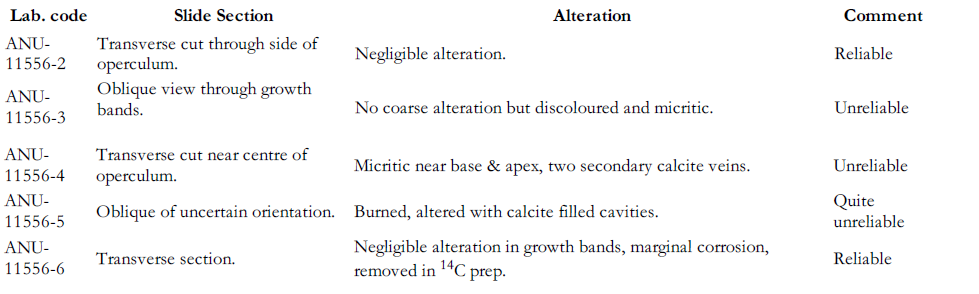
Microscopic thin-section examination of the Turbo sp. opercula from spit 40 revealed significant differences between specimens. Observations are summarised in Table 2.

Three specimens were significantly altered. In ANU-11556-3 and ANU-11556-4, the original dense, fine texture of the operculum was locally altered to fine, micritic calcite was crossed by thin veins of secondary calcite, while ANU-11556-5 was strongly discoloured, suggesting burning, and included cavities filled with relatively coarse calcite. The radiocarbon ages obtained for all three were judged to be unreliable. By way of contrast, samples ANU-11556-2 and ANU-11556-6 show very little evidence of diagenesis and, on the basis of thin section examination, their radiocarbon ages judged to be reliable.
Discussion
Sample ANU-11556-6, which is one of the two specimens judged to be reliable, gave an age of 38,760±100 bp, which is in good agreement with the mean result of 39 590 for ANUA 15808/15809, reported by Reference LeavesleyLeavesley et al. (2002) (Table 1). Together, these results indicate that the site was occupied at 39 500 bp. However, accumulation of the basal part of the deposit (spit 40) appears to have been very slow, and mixing appears to have occurred, as there is no vertical separation between these samples and ANU-11556-2, which also is judged to be reliable but gave an age of 34 080±60.
The new data also support the suggestion that the shells in both 14C series reflect cultural midden material rather than natural shell. All the samples were derived from a matrix of human food refuse and stone artefacts. While the Reference LeavesleyLeavesley et al. (2002) samples were near-complete shells the determinations reported here were derived from opercula. The presence of opercula suggests that the shells were deposited in the cave while they were still attached. Opercula do not stay attached to their parent shell for long after the shellfish has died suggesting that the shellfish was highly likely to have been alive when it was brought to the site. The presence of the opercula suggests that the shellfish and opercula were removed from the shell within the cave. This method is consistent with human shellfish collection strategy in which the shellfish were collected live and transported to their place of consumption before being cooked and eaten.
The presence of opercula in the deposit also reduces the likelihood of 'old shell' being brought to the cave with the first human inhabits. The likelihood of 'old shell' surviving in a natural (non-sedimentary) coastal environment is considered to have been low. However, if this was the case then it must be considered even more unlikely that Turbo sp. would survive with opercula intact to be found 4000 years later and subsequently taken to the cave to be mixed with the in situ midden material.
Conclusion
The data presented above suggests that the earliest colonists of New Ireland arrived at least 39 590 years ago. This is the oldest 14C determination for human behaviour in New Ireland and New Guinea. New Ireland's geographic position off the east coast of Pleistocene Sahul indicates that the human colonisation of the region was a relatively rapid event.
Acknowledgements
Thanks to Michael Bird (St Andrew's), Matthew Spriggs, Glenn Summerhayes, Peter Hiscock (ANU) and Christopher Clarkson (LCHES). In Papua New Guinea, thanks to the traditional owners of Buang Merabak Tuvu Telexas and Michael Boxos in Konongusngus village and Nick Araho and Herman Mandui (National Museum and Art Gallery) in Port Moresby.