

Introduction
Law enforcement is a distinct government function that possesses the discretionary authority to employ monetary sanctions in the form of fines, forfeitures, and related fees. The consequences of this discretion for individuals can be substantial, although the complete extent of its consequences may not be fully recognized. Some high-profile civil rights lawsuits show how ordinary citizens may wind up bearing large financial burdens from police encounters. For example, in Ingram versus County of Wayne, Detroit police twice seized a vehicle from a city resident named Melisa Ingram and charged a $900 redemption fee the first time and a $1,800 fee the second time, along with extra towing and storage fees. Traffic citations represent a more commonly experienced financial burden from police encounters among average individuals. According to estimates based on car insurance applications, nearly 10% of drivers in the US had speeding tickets on their record as of 2022 (Insurify 2022). The cost of a speeding ticket includes not only the one-time charge but also a spike in insurance rates, which can be less visible (The Zebra 2022). When people fail to pay off the fines on time, especially people who are economically underprivileged, the financial burden may proliferate through late fees. For example, in California, police citations for minor offenses, like jaywalking, which initially incur a fine of as little as $35, can add a “civil assessment fee” of up to $300 if the person misses a payment deadline or fails to show up in court (Dinzeo Reference Dinzeo2022).
In many places, revenues from monetary sanctions law enforcement are allowed to be used to supplement the budget of the law enforcement agencies or the state and local governments within which the agencies operate (Makowsky Reference Makowsky2019). As an example, an equitable sharing program allows state and local police agencies to collaborate with the Department of Justice or the Department of the Treasury for civil asset forfeiture and receive up to 80% of the proceeds (Knepper et al. Reference Knepper, McDonald, Sanchez and Pohl2020). One of the consequences of this collaboration is that agencies may be tempted to engage in so-called ‘profit-driven law enforcement.’ A problem is that the original mission to fight crime and maintain peace and safety may get disregarded by the demand for money. In a way, it can be viewed as a classic principal-agent problem: the agent chases budget interests and shirks from its responsibility to work for the people’s best interests. The apparent conflict of interest is a major factor undermining public perceptions of and attitudes toward the agencies, which are critical bases for police-community relations and policing by consent. Not only do citizens who are levied monetary sanctions may experience frustration and even anger, but those who learn about the agencies’ benefits from these revenues may also react negatively.
The debates around profit-driven law enforcement have been around for quite a while. In the US during the 1980s, for instance, critics argued that the Drug War was a failed policy; yet it persisted mainly because of the lucrative rewards it offered to police and prosecutorial agencies (Blumenson and Nilsen Reference Blumenson and Nilsen1998). Despite numerous reforms that have made progress, the problem continues to persist. A major dilemma complicating the reform is the difficulty in disentangling profit-driven motives of the agencies from their legitimate law enforcement activities aimed at improving public order and safety. Attempts to add constraints on the agencies’ use of monetary sanctions might face counterarguments–or pro-authority rhetoric, for that matter–justifying the role of financial penalties as a less intrusive enforcement mechanism compared to physical detention. This instrumental view is not entirely without empirical grounding. For instance, studies have shown that traffic citations and penalty-point systems may, to an extent, have a deterrent effect on curbing dangerous driving behaviors and traffic accidents (e.g. Luca Reference Luca2015; Killias et al. Reference Killias, Villettaz and Nunweiler-Hardegger2016; Rebollo-Sanz et al. Reference Rebollo-Sanz, Rodríguez-López and Rodríguez-Planas2021).
Against this backdrop, this study adopts a design-oriented approach (Barzelay Reference Barzelay2019) and explores a new prescriptive proposal: redirecting revenues from law enforcement monetary sanctions to funding local nonprofits. The main idea is to allocate these revenues to independent nonprofits in local communities rather than to the law enforcement agencies themselves, or the government branches within which the agencies operate. This approach aims to address the conflict of interest that arises when agencies benefit directly from the revenues, without limiting their authority in administering monetary sanctions as a policy tool. In other words, it restructures the incentives for agencies in relation to financial penalties without compromising the inherent instrumental role of the monetary sanctions. Meanwhile, the redirected revenues can still contribute to the public interest through nonprofits, which are inherently mission-oriented and, in part, reliant on external funding to expand their operations. Ultimately, this approach is expected to improve public attitudes toward law enforcement agencies, as individuals will no longer view financial penalties as being motivated by the agencies’ self-serving budgetary interests. Our proposal is particularly well-suited to countries where the nonprofit sector plays a significant role in public service delivery, as is the case in the US. Footnote 1
The body comprises four sections. First, we address issues pertaining to the political economy of law enforcement in conjunction with the growing fiscal strain on governments across nations. Next, we review existing reform proposals aimed at rectifying profit-driven law enforcement and highlight the distinctive contribution of our own design proposal by drawing on relevant theoretical insights. Third, we present supportive evidence from a randomized vignette experiment involving a sample representative of US adults in terms of age, gender, race/ethnicity, and region (n = 1,030). The findings suggest that reallocating revenues from police fines to local nonprofits, as opposed to the police themselves, positively affects people’s perceptions of agency performance and trust in the agency. We discuss the broader implications of our proposal, as well as potential implementation challenges that should be considered when converting our proposal into a substantive policy design in practice.
Fiscal stress in government and the political economy of law enforcement
Since the Tax Revolt that swept across the US in late 1970s, especially in the wake of California’s adoption of Proposition 13 in 1978, mass opinion has rarely been in favor of expansion of government taxation. A tax increase is understood as an extremely risky agenda for elected office holders who are sensitive to voter sentiments. Numerous studies have shown that reelection prospects drop significantly when politicians implement or publicly advocate for a tax increase (Sobel Reference Sobel1998; Niemi et al. Reference Niemi, Stanley and Vogel1995; Mikesell Reference Mikesell1978; Besley and Case Reference Besley and Case1995). While cross-national comparisons of government taxation and expenditures are complicated, income taxes combined with mandatory social-insurance contributions for Americans are generally lower compared to most of the economically developed nations (Desilver Reference Desilver2017). The budget constraints have been more severely experienced by state and local governments that do not have the same access to deficit spending or other means to cope with fiscal distress that the federal government enjoys (Deller et al. Reference Deller, Maher, Amiel and Stallmann2013; Joyce and Mullins Reference Joyce and Mullins1991).
This financial pressure has had a significant effect on the political economy of law enforcement. Fines, forfeitures, and related fees that are used during law enforcement bring lucrative cash that complements the weakening tax bases of the government, especially at the local level. The dependency of municipalities on law enforcement revenues to keep up with service demands and secure operational continuity is getting stronger and more institutionalized (Colgan Reference Colgan2017; Shoub et al. Reference Shoub, Christiani, Baumgartner, Epp and Roach2021). In some cases, the money goes directly to the law enforcement agencies. For example, speeding ticket revenues are allowed to fund court or law enforcement operations in most US states (Boddupalli and Mucciolo Reference Boddupalli and Mucciolo2022). In one out of every ten police forces, fine and forfeiture revenues cover approximately one-third of the operating expenses (Makowsky Reference Makowsky2019). Equitable sharing is a particularly controversial example. According to the Comprehensive Crime Control Act of 1984, the federal government may partner with state and local police agencies for civil asset forfeiture and allocate up to 80% of the proceeds to the participating agencies as a kickback (Executive Office for Asset Forfeiture 1994). Blumenson and Nilsen (Reference Blumenson and Nilsen1998) made a relevant observation: “At a time when state and local government budgets are shrinking, equitable sharing offers a new source of income, limited only by the energy police and prosecutors are willing to commit to seizing assets.” (p. 51)
The fact that law enforcement revenues may directly benefit the agencies creates a path towards a classic principal-agent problem where the agencies are tempted to chase self-interest rather than exercising their authority in the public’s best interests. Profit motivation was also pointed out as the culprit in an array of recent high-profile incidents of police misconduct and unwarranted use of excessive force. Most notably, in the aftermath of the police killing of Michael Brown in Ferguson, Missouri, the US Department of Justice investigated the case and concluded that the city police were under pressure to bring revenues from traffic tickets to help the local government cope with weakening tax bases (US Department of Justice 2015).
Ferguson’s law enforcement practices are shaped by the City’s focus on revenue rather than public need. This emphasis on revenue has comprised the institutional character of Ferguson’s police department, contributing to a pattern of unconstitutional policing, and has also shaped its municipal court, leading to procedures that raise due process concerns and inflict unnecessary harm on members of the Ferguson community. (p. 2)
There is ample empirical evidence that the incentive to raise money affect the agencies’ decisions to utilize financial penalties. Makowsky and Stratmann (Reference Makowsky and Stratmann2009) showed that when drivers are non-residents from out of town, they are more likely to get ticketed with a higher fine. This implies that the police are serving their local government’s preferences by exporting taxes to non-residents. In a similar vein, Makowsky et al. (Reference Makowsky, Stratmann and Tabarrok2019) found that police arrests of minorities increase with local deficits when retaining revenues from forfeited property is made easier. More recently, Su (Reference Su2020) found that in California from 2004 to 2015, counties increased traffic fines per capita by more than 40 cents after a 10-percentage point decline in tax revenue in the previous year but did not reduce traffic fines when there was an increase in tax revenue. The study concluded that county governments are likely viewing traffic fines as an easy source of cash to offset tax revenue loss. Goldstein et al. (Reference Goldstein, Sances and Young You2020) further showed that police departments in municipalities that generate a greater proportion of their revenue from fees display significantly lower rates of solving violent and property crimes.
The shift in focus from public safety to public finance may undermine public attitudes toward law enforcement agencies. The apparent conflict of interest will likely lead people to question whether the agencies are acting like pirates in pursuit of money rather than as devoted servants of the community. Not only do the people who are directly subject to the financial penalties experience a sense of frustration and even anger, but also those who encounter information about how financial penalties may benefit law enforcement agencies may feel that the agencies are abusing their authority for budgetary reasons. Over time, this rift may widen: low trust in the agencies hampers law enforcement by consent (Goldsmith Reference Goldsmith2005), further escalating tensions in officer-civilian encounters and attracting more aggression (Lea and Young Reference Lea and Young1984; Goldsmith Reference Goldsmith2002). This creates a vicious cycle that erodes the foundation of ‘policing by consent’, a modern approach to governing law and order in democratic societies.
Redirecting law enforcement revenues toward funding local nonprofits: A design proposal
Extensive studies have examined various reform initiatives pertaining to profit-centered law enforcement. For instance, many argue that the courts should perform more thorough examinations of the due process behind financial penalties (e.g. Reynolds and White Reference Reynolds and White2020). Others claim that abolishing the controversial aspects of police discretion, such as civil forfeiture that does not necessitate arrest or criminal conviction, is the most urgent (e.g. Chigbrow Reference Chigbrow2021). Some economists and criminologists suggest that law enforcement revenues may be deposited in the state’s general fund and redistributed to municipalities strictly based on the population size, which is referred to as “per capita municipal block grants” (Makowsky Reference Makowsky2019, p. 15).
These proposals promote positive changes and have their own strengths. However, a key dilemma that complicates the issue is the fact that it is inherently difficult to untangle the agencies’ pursuit of profits from their genuine dedication to law enforcement operations. Are the revenues generated from fines and forfeitures merely incidental outcomes of legitimate performance? Or are they intentional results driven by a money-seeking motivation that agencies are not fully transparent about? Worrall and Kovandzic (Reference Worrall and Kovandzic2008) recognized the dilemma and made the following statement: “Our study lends a measure of support to the arguments espoused by forfeiture’s critics, namely that forfeiture may be pursued for financial reasons. We cannot, however, … assert that forfeiture supersedes other criminal justice goals, such as enforcement of antidrug laws.” (p. 219) Indeed, financial penalties are often justified and supported as an indispensable, less-intrusive alternative to physical detention, arguing that these cannot be eliminated in the profession of law enforcement.
One way to overcome this dilemma is to redirect revenues from monetary sanctions in law enforcement to an independent external entity. By cutting the ties between the revenues and the agencies or their affiliated government entities, potential conflicts of interest are alleviated. As such, it becomes significantly less likely that the use of financial penalties will be driven by the agencies’ self-serving budget interests, without any constraints over the agencies’ use of financial penalties. The idea builds upon the core assertions in the bureaucratic control literature (McCubbins and Schwartz Reference McCubbins and Schwartz1984; Weingast Reference Weingast1984; Weingast and Moran Reference Weingast and Moran1983; Miller and Whitford Reference Miller and Whitford2007), highlighting the importance of a proper incentive structure for public bureaucrats to promote their responsiveness to public interest. As Moe (Reference Moe1984, p. 756) stated, “The agent has his own interests at heart, and is induced to pursue the principal’s objectives only to the extent that the incentive structure imposed in their contract renders such behavior advantageous.” Having the right incentive structure overcomes various limitations of external controls, which can inadvertently undermine agency morale (Marvel and McGrath Reference Marvel and McGrath2016).
Local nonprofit organizations emerge as strong candidates to serve as the external, independent entities to which law enforcement revenues can be redirected. Nonprofit organizations occupy a crucial role in public service delivery, operating with the primary goal of addressing various social, environmental, and cultural issues. They are uniquely characterized by their distinct mission-driven nature (Salamon Reference Salamon2012). As tax-exempt organizations serving public purposes, nonprofits benefit from tax-deductible donations, thereby further recognizing their contribution to public welfare and encouraging increased private donations. In exchange for these fiscal advantages, nonprofits are required to maintain stringent financial transparency and accountability. They are bound by non-distributional constraints, ensuring that residual incomes must not be distributed among any stakeholders, and their involvement in political and lobbying activities is limited. Failure to comply with these legal obligations may lead to the revocation of their tax-exempt status. These defining attributes, including being mission-driven, adhering to non-distributional constraints, and maintaining a non-political nature, partly explain why members of society tend to hold higher trust in the nonprofit sector compared to their public and for-profit counterparts (Chapman et al. Reference Chapman, Hornsey and Gillespie2021; Hansmann Reference Hansmann1980; Young Reference Young1998; Van Slyke Reference Van Slyke2007; Herzlinger Reference Herzlinger1996).
Nonprofits at a local level tend to represent community values more closely (Shier et al. Reference Shier, McDougle and Handy2014). They address specific community issues, including homelessness, education, health care, and environmental conservation, which are closely related to community welfare but are either overlooked or inadequately served by other sectors. Their activities are often specifically tailored to the distinct contexts and needs of the communities they serve. Additionally, local nonprofits demonstrate active engagement within their communities by soliciting input, encouraging participation and volunteerism, and nurturing a communal purpose. This extensive level of community interaction not only democratizes their operational approach but also bolsters public trust (Becker et al. Reference Becker, Boenigk and Willems2021; Chapman et al. Reference Chapman, Hornsey and Gillespie2021). Such facets – a shared sense of purpose and active public engagement – mean that support for these nonprofits is viewed not just as backing the organizations themselves, but as a more effective and targeted investment in community needs and priorities.
Allocating revenues from monetary sanctions in law enforcement to local nonprofits will further enhance people’s perceptions of agency performance and trust in the agencies. The body of research on causal attribution and the folk concept of intentionality provides micro-level theoretical support for this expectation. In many areas of everyday life, such as reading newspapers or socializing with colleagues at work, people make attributions about “why” certain events occurred, looking for salient causes of social reality (Wegener and Petty Reference Wegener and Petty1998; Heider Reference Heider1958; Kelley Reference Kelley1973). Causal attribution is rooted in a fundamental human desire to be in control of the surrounding environment (Regan Reference Regan, Harvey, Ickes and Kidd1978). When the event to be explained is an “intentional” human behavior, the intention in itself seldom has any explanatory value (D’Andrade Reference D’Andrade, Holand and Quinn1987). For example, “Why are the police ticketing drivers on the road?” – “Because they intend to ticket drivers.” Instead, people make sense of the behavioral intention by referring to the “reasons behind the intention” (Heider Reference Heider1958, p. 110; see also pp. 125–129) which cites the actor’s beliefs and desires. This is called a reason explanation (Malle Reference Malle1999): “Why are the police ticketing drivers on the road?” – “Because they intend to ticket drivers in order to collect cash.” When there are salient background factors that enable reasonable speculations about the actor’s beliefs and desires, such as culture or a situational context, a reason explanation extends to a causal history explanation (O’Laughlin and Malle Reference O’Laughlin and Malle2002; Malle and Knobe Reference Malle and Knobe1997; Malle Reference Malle1999; Malle et al. Reference Malle, Knobe, O’Laughlin, Pearce and Nelson2000): “Why are the police ticketing drivers on the road?” – “Because they intend to ticket drivers in order to make some cash, given that traffic ticket fines are sent to the police themselves.”
When the law enforcement revenues go to the agencies or related government entities, people will likely be suspicious about the self-serving, profit-generating motivation. This is a subjective inference that does not necessarily require verification from hard evidence. Even when the agencies use financial penalties for legitimate operation and collect revenues as an unintended byproduct, the apparent conflict of interest is sufficient for people to infer a corrupt, profit-chasing motive. Sending law enforcement revenues to local nonprofits that maintain no direct ties with the agencies precludes the emergence of a causal history explanation. This, in turn, should translate into more positive public perceptions about the agencies’ performance and public trust in the agencies.
Hypothesis 1–1: Allocating revenues from monetary sanctions in law enforcement to local nonprofits rather than the enforcement agencies will positively affect people’s judgment of the agencies’ performance.
Hypothesis 1–2: Allocating revenues from monetary sanctions in law enforcement to local nonprofits rather than the enforcement agencies will positively affect people’s trust in the agencies.
Both the outcome and process of government operation are important pillars of public trust in government (Van Ryzin Reference Van Ryzin2011). In this respect, the instrumental utility of financial penalties in law enforcement should also affect people’s judgment of the agencies’ performance and trust in the agencies, in addition to how the revenues are allocated. The request for effectiveness in maintaining law and order is not as purely utilitarian as it may seem. It is in part a normative condition upon which the authority of law enforcement agencies is validated and justified (Bottoms and Tankebe Reference Bottoms and Tankebe2012; Tankebe Reference Tankebe2013). Na et al. (Reference Na, Lee and Kang2023) conceptualizes police effectiveness as a public value, which refers to “an appraisal of what is created by government on behalf of the public” (Nabatchi Reference Nabatchi2012, p S310). They argue that people’s attitudes about the police hinge on their perceptions of police effectiveness because effectiveness is a key public value “that should be pursued by the police as a publicly funded government institution” (p. 4). From this point of view, fines, forfeitures, and related fees must be enforced in ways that effectively contribute to public safety and order in order to enhance public attitudes toward the agencies (Sun et al. Reference Sun, Wu, Hu and Farmer2017; Tankebe Reference Tankebe2013; Kochel et al. Reference Kochel, Parks and Mastrofski2013).
Hypothesis 2–1: A positive association between monetary sanctions in law enforcement and their intended outcomes will positively affect people’s judgment of the agency’s performance.
Hypothesis 2–2: A positive association between monetary sanctions in law enforcement and their intended outcomes will positively affect people’s trust in the agency.
Methods
Data
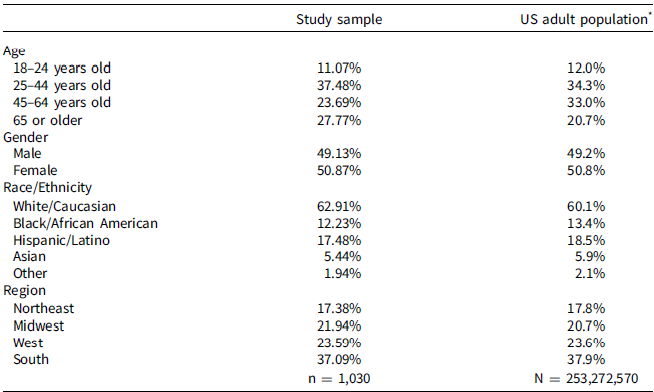
We conducted a randomized vignette experiment involving a sample representative of US adults in terms of age, gender, race/ethnicity, and region (n = 1,030). The experiment was embedded in an online survey that consisted of multiple vignettes presented in random order. The online survey was distributed through Qualtrics in March 2022. Our sample was drawn by quota sampling. Convenience sampling was employed until the four pre-identified demographic characteristics of our sample resembled that of our theoretical population: US adults. By virtue of quota sampling, we gained an increased assurance that the results would be roughly generalizable despite the absence of perfect random sampling. As presented in Table 1, our study sample resembled the US adult population in terms of the four quota demographics.
Descriptive statistics
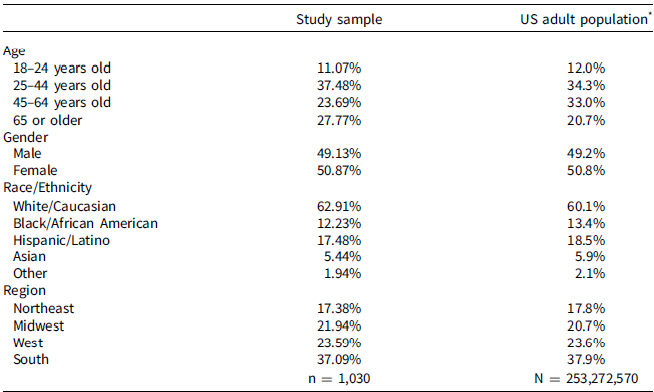
* The demographic information about the US adult population for 2020 is retrieved from the US. Census Bureau 2020 ACS 5-year estimates.
Experimental vignette and treatments
A caveat is that since survey vignettes are artificial, the results may not exactly hold the same in a real-world setting. This is a limitation of vignette experiments that was discussed in prior studies in the field (e.g. Andersen and Jakobsen Reference Andersen and Jakobsen2017). Nevertheless, a survey vignette experiment is the best-suited design for the current study. Our treatment—i.e. redirecting law enforcement revenues for local nonprofit funding—is practically impossible to investigate in a field or lab experiment setting. Observational data are also scarce, which limits the application of alternative causal inference methods or correlational analysis involving statistical techniques or adjustments.
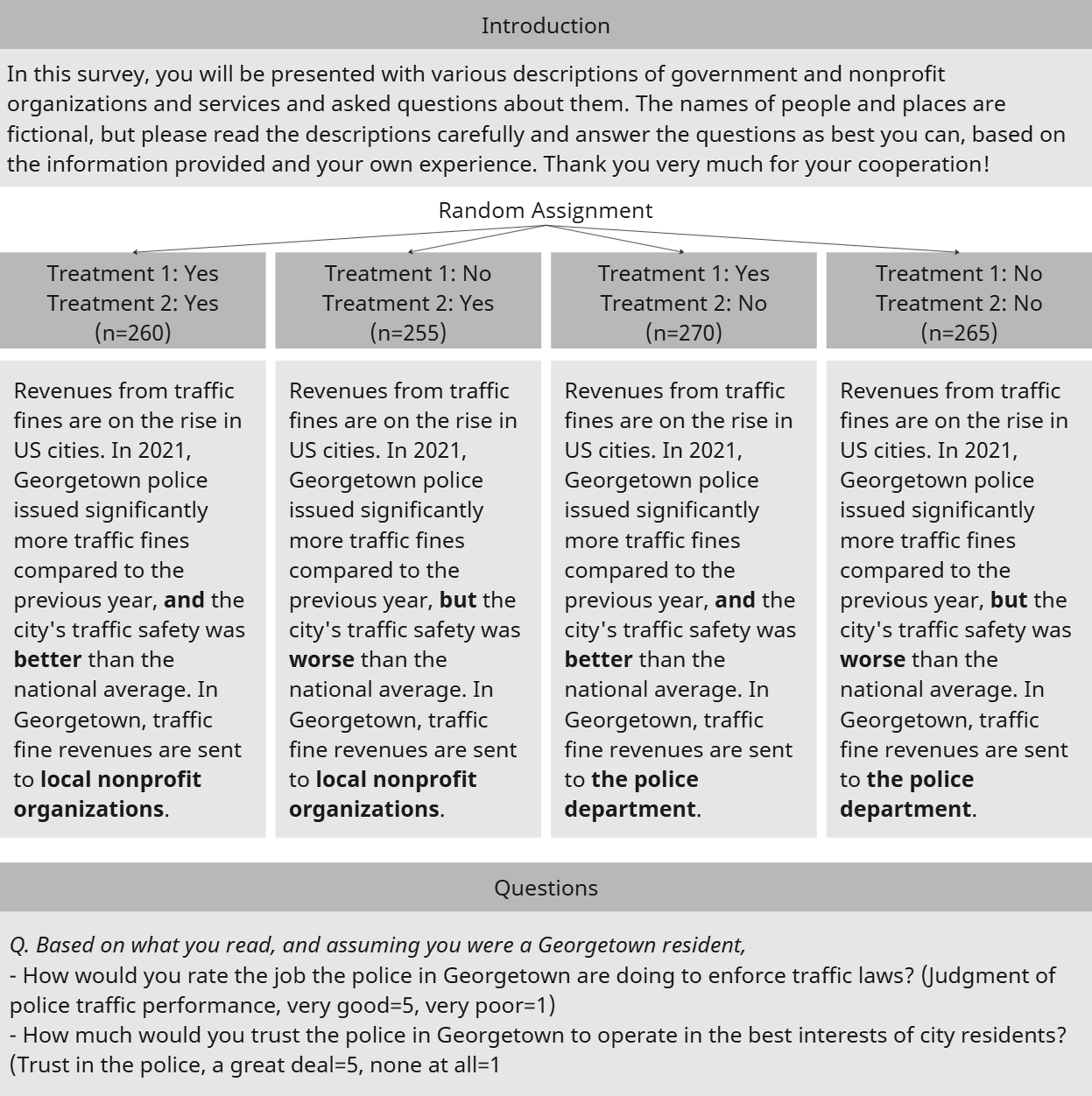
The vignettes contained two independent treatments which resulted in a two-by-two between-subject design (the wordings of the vignette and the logic of random assignment are presented in Figure 1). The vignette was contextualized in traffic fines, which is a common financial penalty that average Americans experience from police encounters. It started with a brief statement: ‘Revenues from traffic fines are on the rise in US cities.’ This reflects the reality that several major US cities, such as Chicago and Washington D.C., are experiencing increased revenues from law enforcement fines (Fines and Fees Justice Center 2024). The first treatment manipulated whether there was a decent positive association between the police’s use of traffic fines and the city’s traffic safety (Yes versus No). The second treatment manipulated whether the traffic fine revenues were allocated to local nonprofit organizations as opposed to the police themselves (Yes versus No). It must be noted that the second treatment manipulates the mechanism of revenue allocation rather than the sectoral identity of the agency (e.g. public versus nonprofit), which is relevant to another body of literature that explores sectoral perceptions and biases (e.g. Meier et al. Reference Meier, Song, Davis and Amirkhanyan2022). Furthermore, the treatment focuses on reallocating law enforcement revenues to local nonprofits without further specifying the sub-sectors in which the nonprofits operate (e.g. education, health, or religion), the size of their clientele, or the extent of their commercial activities. While these may serve as important contextual factors, exploring effect heterogeneity falls outside the scope of this study and is reserved for future research.
Vignette and random assignment.
Note: Treatments that are highlighted in bold were not highlighted in the actual vignettes. The two survey questions were displayed in random order to prevent item-order bias in the measurements.
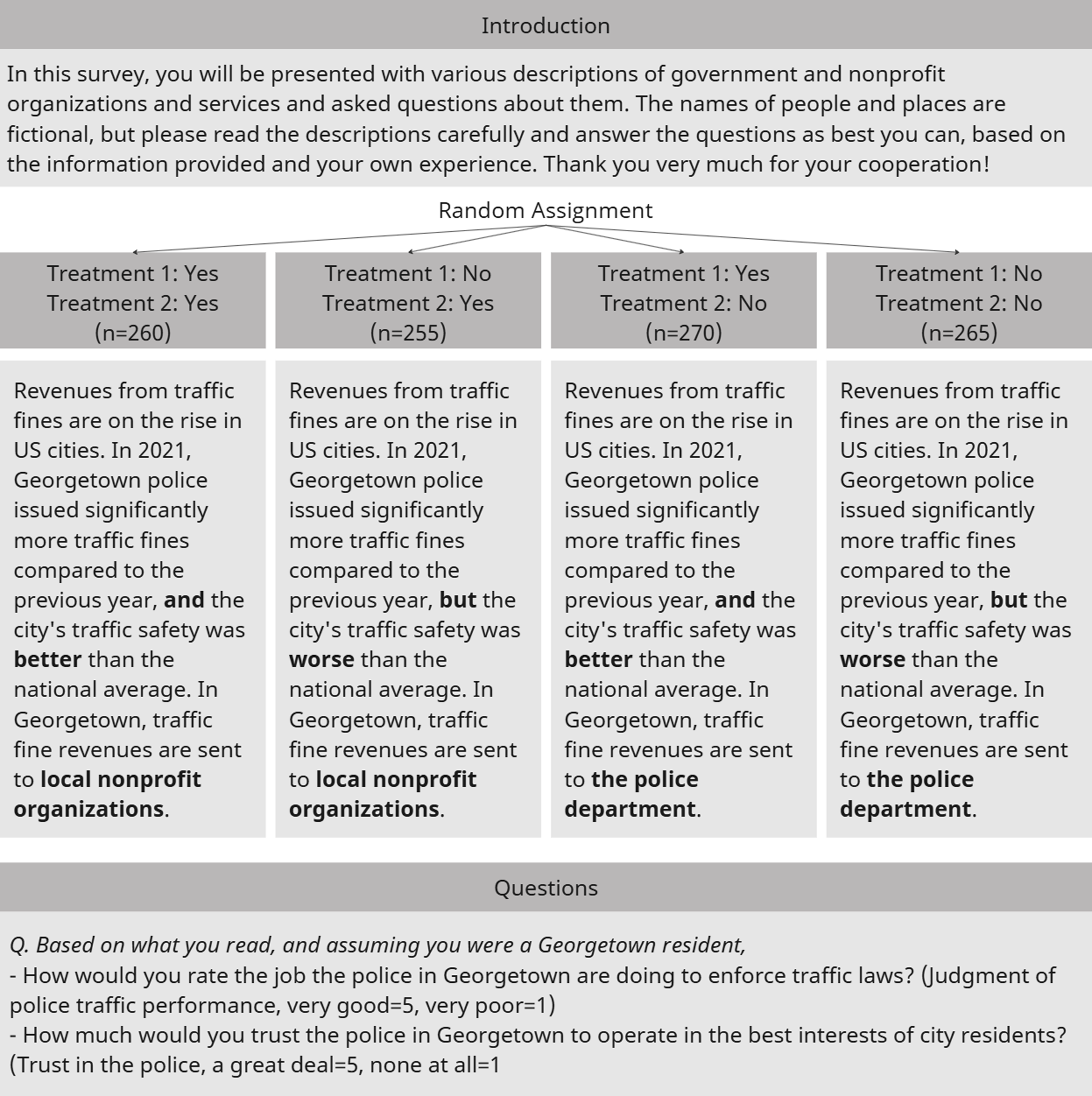
As shown in Figure 1, the two treatments were designed in such a way that the text variations across different experimental conditions were kept to a minimum. This ensures that our treatments manipulated precisely what we intended to manipulate while not causing other unintended changes at the same time. Results from balance tests suggest that the two experimental treatments were successfully randomized; the treatment group and the control group did not differ statistically at the 0.05 alpha level in terms of age, gender, race, political orientation, and region.
After the participants read their assigned vignette, they were asked to answer two questions about police traffic performance and trust in police, respectively (see Figure 1), which served as the dependent variables. Single-item measures are known to have psychometric shortcomings (e.g. Kruyen et al. Reference Kruyen, Emons and Sijtsma2013), but they are often used for pragmatic reasons in applied settings, such as preventing respondents’ fatigue which may affect the quality of their responses (Credé et al. Reference Credé, Harms, Niehorster and Gaye-Valentine2012). Survey experiments are still fundamentally surveys, and reducing respondents’ cognitive load is essential for ensuring high-quality data (Dillman et al. Reference Dillman, Smyth and Christian2014; Sweller et al. Reference Sweller, Paul, Kalyuga, Sweller, Ayres and Kalyuga2011). First, the judgment of police traffic performance measure directly asked the respondents to rate the performance of the police in enforcing traffic laws, which is widely used to measure perceived government performance in various policy domains (e.g. Riccucci et al. Reference Riccucci, Van Ryzin and Lavena2014). Trust in police measure was constructed based on the conceptual definition of benevolence as a key dimension of trust, “assessment of a trustee’s willingness to act in the best interest of the trustor” (Jones and Shah Reference Jones and Shah2016, p. 394), which has been commonly adopted as a single-item measure of trust in government agencies in public policy and administration research (e.g. Grimmelikhuijsen and Knies Reference Grimmelikhuijsen and Knies2017).
Results
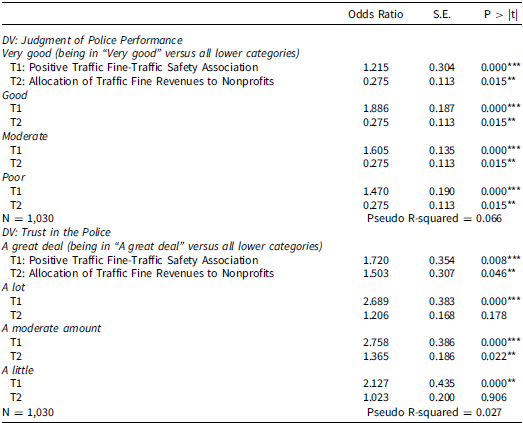
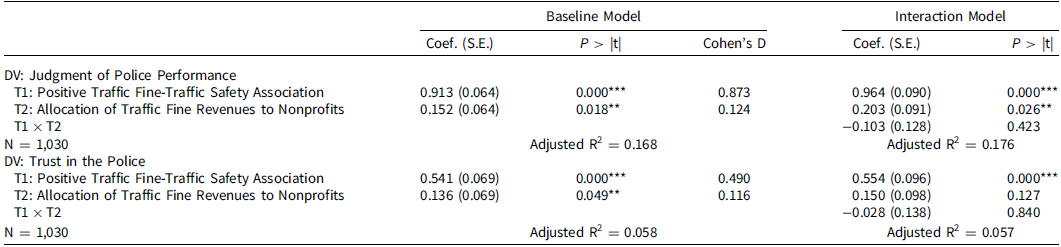
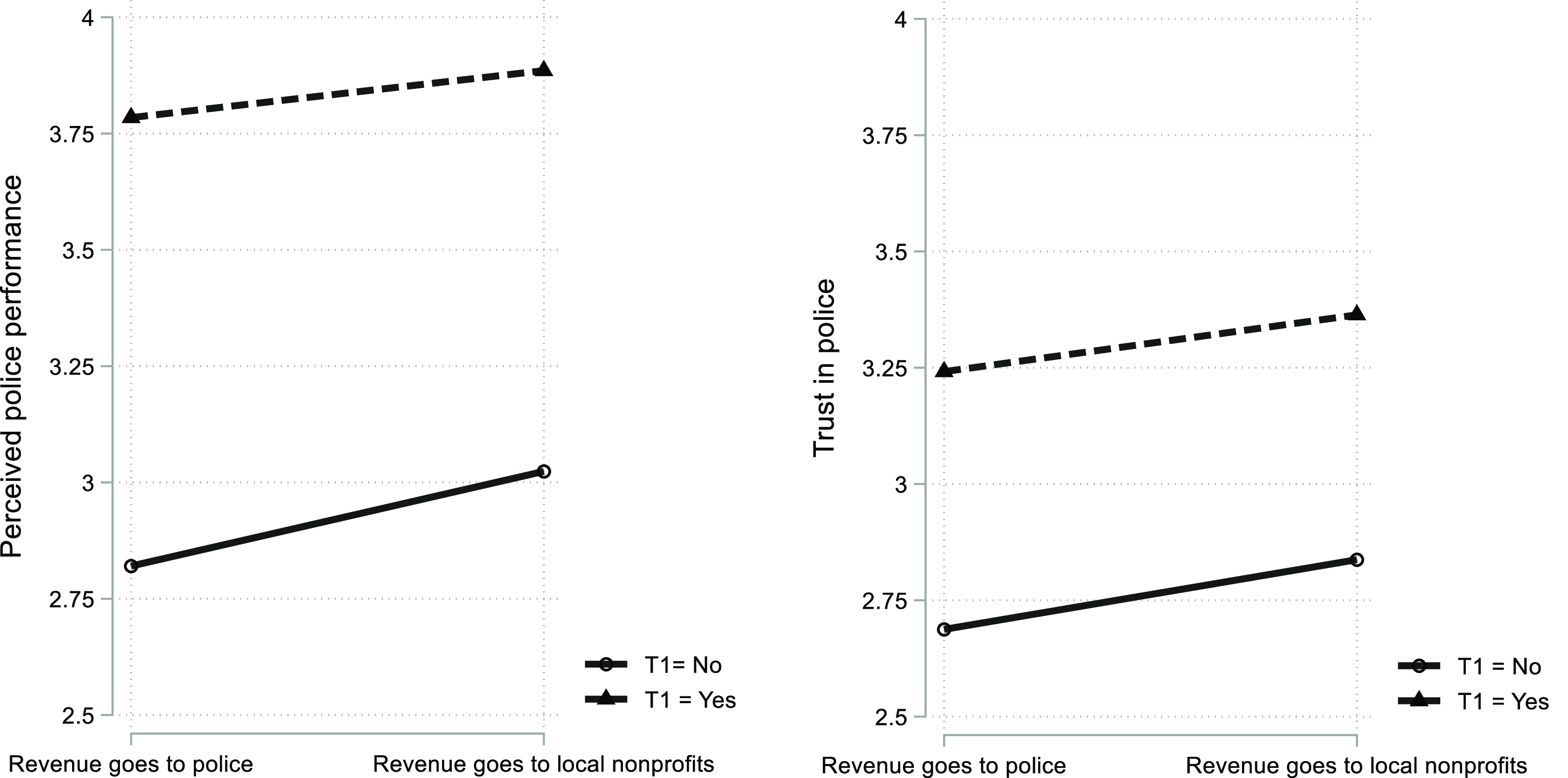
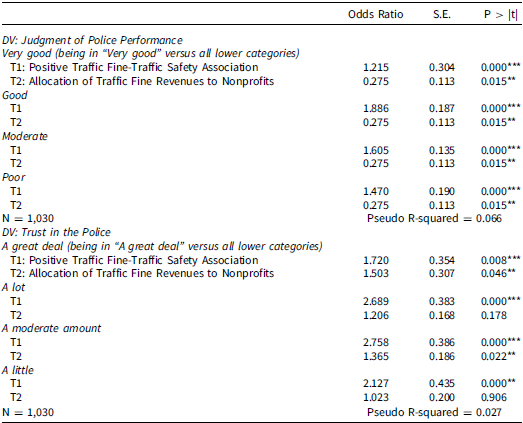
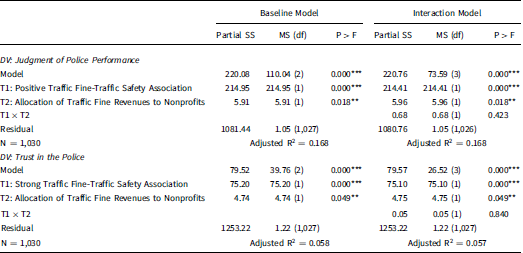
Full results are summarized in Table 2 and visualized in Figure 2. The main analyses Footnote 2 assumed that the dependent variables were measured on a continuous scale. The results were largely consistent when they were treated as ordinal variables in a follow-up generalized ordinal logit regression analysis (see Table A1 in the appendix to find detailed information).
Linear regression results summary (main findings)
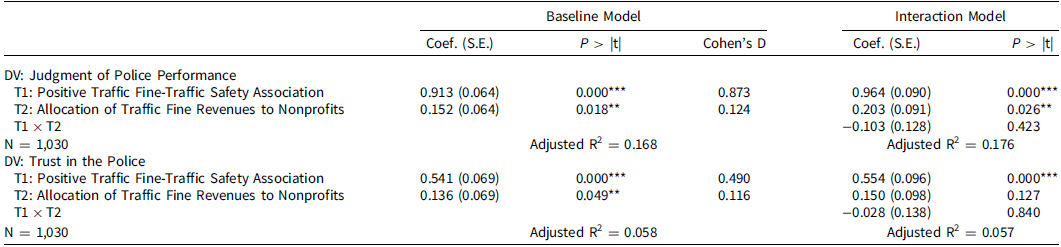
Note: p < 0.05: **, p < 0.01: ***, two-tailed test.
Visualization of treatment effects.
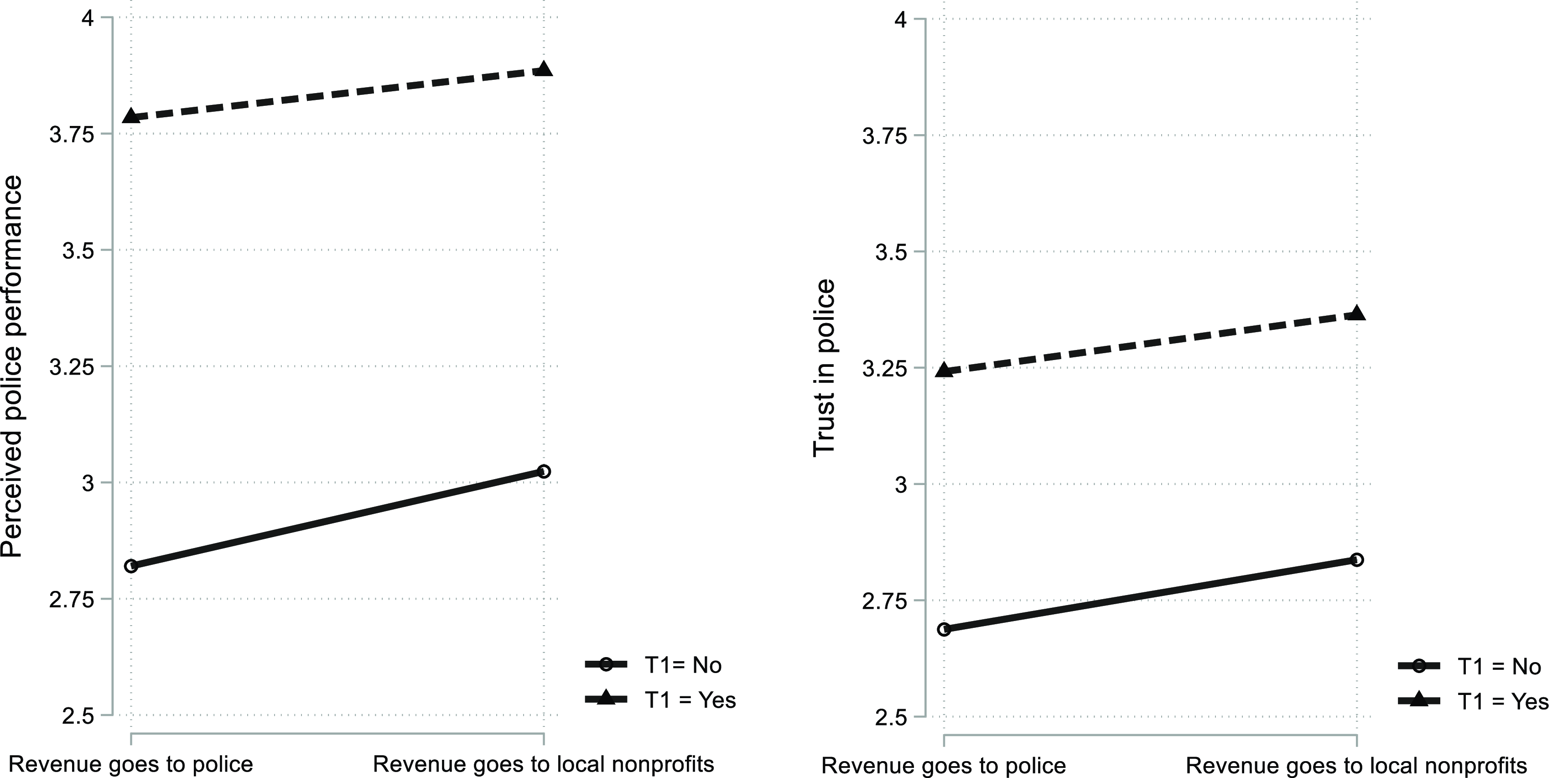
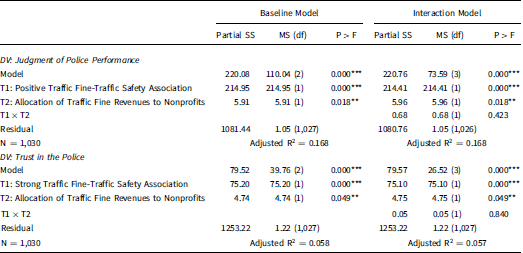
First, when the traffic fine revenues were allocated to local nonprofits as opposed to the police themselves, there was a positive effect on people’s judgment of police performance (Coef. = 0.152, p-value = 0.018) as well as trust in police (Coef. = 0.136, p-value = 0.049). Therefore, both Hypothesis 1–1 and Hypothesis 1–2 are supported. Next, when the police issued significantly more fines and the city traffic safety improved accordingly—namely, the traffic fines displayed a decent instrumental effectiveness, there was also a positive effect on people’s judgment of police performance (Coef. = 0.913, p-value = 0.000) as well as trust in police (Coef. = 0.541, p-value = 0.000). Therefore, both Hypothesis 2–1 and Hypothesis 2–2 are supported. These results indicate the importance of ensuring and demonstrating the effectiveness of financial penalties for public perception. Lastly, the interaction effect between the two treatments was not significant for people’s judgment of police traffic performance (Coef. = 0.103, p-value = 0.423) and trust in police (Coef. = 0.028, p-value = 0.840). This implies that the two treatments played out independently to affect the outcome variables.
It is worth noting that the effect size of the second treatment was relatively small for both people’s judgment of police performance (Cohen’s D = 0.124) and trust in police (Cohen’s D = 0.116). In comparison, the effect size of the first treatment was larger for people’s judgment of police traffic performance (Cohen’s D = 0.873) and for trust in police (Cohen’s D = 0.490). The disparities in practical significance between the two treatments might have resulted from a treatment order effect. It could have been the case that the first treatment took up most of the participants’ attention. Another possibility arises from the design of our first vignette treatment. The first treatment – i.e. whether there was a positive association between the police’s use of traffic fines and the city’s traffic safety – was represented by the phrases ‘better than average’ and ‘worse than average’ in our vignette. These wordings are somewhat stronger than alternative contrasts such as ‘above average’ and ‘below average,’ thereby amplifying the treatment effect. Finally, it could have been simply the case that people are less sensitive to where the traffic fine revenues go than they are concerned with the instrumental values of traffic citations. These are unverified speculations that should be considered in future research.
Discussion
Under tightening budget constraints, revenues from monetary sanctions in law enforcement are a significant temptation for the agencies and related state institutions to make up for their crumbling tax bases and meet the increasing service demands. Alongside this political economy of law enforcement, reasonable criticism for profit-driven law enforcement has emerged, namely, that law enforcement is being exploited as a lucrative business. Prioritization of money over safety and order outcomes undermines government responsiveness, which is a pivotal normative principle in a democratic state (Waterman and Meier Reference Waterman and Meier1998; Saltzstein Reference Saltzstein1992; Cook and Wood Reference Cook and Wood1989; Gailmard Reference Gailmard, Bovens, Goodin and Schillemans2014; Bovens et al. Reference Bovens, Goodin and Schillemans2014). This further undermines public attitudes toward law enforcement agencies Footnote 3 , as people attribute the imposition of monetary sanctions to the agencies’ self-serving budgetary motives and question their integrity.
Redirecting law enforcement revenues to local nonprofit organizations represents a prescriptive policy design with potential merits. Most importantly, this approach helps correct the incentive structure for law enforcement agencies, removing conflicts of interest without necessarily limiting the use of monetary sanctions as a policy tool. In doing so, it avoids potential pushback from pro-authority rhetoric arguing that monetary sanctions are a necessary instrument to enforce the law, uphold social order, and recoup administrative costs. Additionally, this approach could reduce public suspicion of profit-driven law enforcement practices and improve attitudes toward law enforcement agencies—a reasonable expectation that is empirically supported by the vignette experiment of this study. By resolving the apparent conflict of interest, people are less likely to associate monetary sanctions in law enforcement with profit-driven motives and more likely to develop positive perceptions towards the agencies. The findings provide a reason for the law enforcement agencies themselves to welcome the proposed approach, as they would no longer need to be concerned about backlash and criticism whenever fines, forfeitures, or related fees are administered as part of their legitimate operation.
Redirecting law enforcement revenues to local nonprofits will help expand their community-based activities, thereby meeting local needs and expectations (Salamon and Toepler Reference Salamon and Toepler2015; Weisbrod Reference Weisbrod1975). While some studies have cautioned against the adverse consequences of nonprofits’ reliance on government funding, such as loss of autonomy (Pfeffer and Salancik Reference Pfeffer and Salancik1978; Schmid et al. Reference Schmid, Bar and Nirel2008; Salamon Reference Salamon, Elliott and Salamon2002), goal displacement (Jung and Moon Reference Jung and Moon2007), crowding-out of private contributions (Andreoni and Payne Reference Andreoni and Payne2003), and bureaucratization (Anheier et al. Reference Anheier, Toepler and Wojciech Sokolowski1997), others have adopted a more optimistic view. They suggest that enhanced financial stability and capacity (Grønbjerg Reference Grønbjerg1993) enable nonprofits to scale up their programs and operations, support their political activities (Chavesc et al. Reference Chavesc, Stephens and Galaskiewicz2004), expand their clientele, and foster innovation (Steuerle et al. Reference Steuerle, Abramson, Steele, Hodgkinson, Elizabeth and Eugene Steuerle2017; Young and Casey Reference Young, Casey, Elizabeth and Eugene Steuerle2017). This is evidenced in the US, where the expansion of nonprofits was stimulated and promoted in part by the government’s financial support (Lecy and van Slyke Reference Lecy and van Slyke2013; Smith and Lipsky Reference Smith and Lipsky1993). A steady revenue stream from the public sector may also enhance the credibility and reputation of nonprofits (Austin Reference Austin2003; Lee Reference Lee2021), attracting more private donors in what is referred to as ‘crowd-in effects’ (Heutel Reference Heutel2014; Thornton Reference Thornton2014). As noted by new governance theory, government support for nonprofits is “a logical and theoretically sensible compromise” (Salamon Reference Salamon1995, p. 48–49). Indeed, nonprofits are vital partners in implementing public programs and promoting societal well-being (Smith and Lipsky Reference Smith and Lipsky1993; Young and Casey Reference Young, Casey, Elizabeth and Eugene Steuerle2017; Weisbrod Reference Weisbrod1975).
While our design proposal demonstrates promising benefits, it is important to acknowledge and discuss potential implementation challenges. First, law enforcement agencies heavily reliant on fine and forfeiture revenues may resist the proposed change. The new system may leave these agencies vulnerable to budget shortfalls, complicating their management and performance. As such, a smooth transition that accompanies ways to help agencies maintain managerial continuity and prevent resistance to change is recommended. Second, more debates are needed as to the optimal use of the allocated funds within the nonprofit sector. For example, directing law enforcement revenues to commercialized nonprofits that already charge high fees to their customers may raise concerns, particularly from a social equity perspective. Third, some law enforcement agencies collaborate with local nonprofits to jointly tackle public safety problems. Allocating law enforcement revenues to nonprofits in such cases could complicate the relationship and potentially create incentives for collusion. One approach to address this concern could be to prioritize domains that are distinct from policing and law enforcement, such as arts, education, religion, humanities, environment, or animals. Last but not least, the process of allocating revenue to nonprofit organizations must be equitable and transparent. Transparency and clear communication regarding the allocation and intended community impact of the redirected funds are crucial for maintaining the primary goals and public trust. The funding source must not undermine the nonprofits’ mission or public perception. Additionally, determining which nonprofits should receive how much funding can become a complex task. Nonprofits, driven by their own interests in maximizing budgets, may engage in political conflicts or other unexpected problems arising from the new revenue source. To mitigate these issues, it is essential to establish an adequate system of monitoring and evaluation. This system should assess the outcomes and impacts of the funding, ensuring that it aligns with the intended objectives and provides tangible benefits to the community. Such oversight not only fosters accountability but also guides future allocations, ensuring the effectiveness and fairness of the funding process. These challenges represent just a few of the many potential issues that may arise when our proposed design is translated into policy prescriptions in practice.
Our study builds on the view of public administration as a design-oriented professional discipline (Barzelay Reference Barzelay2019). Over the past few decades, the field of public administration has been increasingly filled with studies that focus on descriptions of, or causations between, pre-existing theoretical constructs. Meanwhile, the number of case studies of outstanding successes or experimentation with new prescriptions have decreased. Arguably, this trend has shrunk the role of academic research in crafting new arrangements that are oriented towards problem-solving. To convert existing conditions to preferred ones and address pressing societal challenges, which is done in other comparable fields such as engineering or medicine, scholarly work should take part in designing policies and institutions that did not exist before, or are not copied (Barzelay Reference Barzelay2019).
Data availability statement
Replication materials are available in the Journal of Public Policy Dataverse: https://doi.org/10.7910/DVN/IBIR3T
Acknowledgements
N/A.
Funding statement
The authors acknowledge funding from the Chancellor’s Seed Grant Program at Rutgers University–Newark.
Competing interests
N/A.
Appendix
Generalized ordered logistic regression summary (baseline models)
Note: p < 0.05: **, p < 0.01: ***, two-tailed test.
Analysis of variance (ANOVA) results summary
Note: p < 0.05: **, p < 0.01: ***, two-tailed test.


 Open access

