



In the summer of 1996, whilst visiting villages in northern Shaanxi province, a farmer invited us to stay with him and his family, which included his wife, his son and two daughters. We knew that since the mid-1980s, villagers were legally permitted to have a second child if the first was a girl, but we were surprised to see three children all under the age of ten. The farmer introduced his eldest daughter and youngest son by their names, but he presented the middle daughter as the “non-existent one” with a smile and a wink. He told us that his first daughter was registered but that when his second child, a daughter, was born they did not register her and instead waited to have another child. The third child was a boy; they registered him as the “second” child. This family contradicted our understanding of the “missing girls” and the high sex ratio at birth (SRB) statistic reported in the 1990 census. Soon after our visit with the farmer, we observed unregistered girls in other villages. After 2000, we continued to observe these missing girls in the countryside and also read about cases of unregistered girls in the Chinese and English language press. However, it was unclear whether or not we were observing unusual cases or a more widespread phenomenon of underreported births across rural China.
Although family planning policy began in the early 1970s with the “later, longer, fewer” campaign (late marriage, longer time between births and fewer children) to limits births, the SRB became increasingly skewed in China after the introduction of the single-child policy in 1979.Footnote 1 The SRB is the number of males born for every 100 females: in 1982, it was 108; in 1990 it was 112; in 2000 it had grown to 117; and by 2010 it had reached 118. This is an extremely high SRB compared to the global average of 105, and the gap between 105 and 118 suggests significantly fewer females in the population. Scholars generally point to three factors to explain the skewed SRB. One is sex-selective abortion through the use of ultrasound technology that allows parents to know the gender of the fetus within 16 to 20 weeks of conception.Footnote 2 Second is female infanticide: parents intentionally deny baby girls proper health care, which then leads to early infant death.Footnote 3 The third is unreported births and delayed registration.Footnote 4 The first two explanations reflect females who are truly missing within the population. The third explanation suggests that the girls are alive but hidden from the census count at early ages (i.e. not included in the SRB statistic). Evidence exists for all three explanations but sex-selective abortions and female infanticide seem to dominate the literature.
A number of scholars who research the missing girls take a demographic and cultural approach to explain why villagers use sex-selective abortion and infanticide to limit the size and gender makeup of the family. Many of these key studies were conducted in the 1990s and early 2000s using data from the 1982, 1990 and 2000 China censuses as well as national, provincial and local fertility surveys. These scholars drew international attention to possible causes and consequences of the skewed SRB.Footnote 5 Most studies and reports suggest that the vast majority of these girls are truly missing from society owing to the cultural preference for sons. This is associated with the virilocal marriage system whereby girls are raised by their natal family but then live with their husband's family after marriage. Traditionally, daughters are considered to be “born into another's family.” As a result, there is no social or economic incentive for families, especially in the countryside, to have daughters. It is the combination of a pervasive cultural norm which favours sons and a strong central policy to limit births that explains the missing girls in China.
While previous studies have contributed much to the literature, many of these studies take a top-down approach to examining central policy outcomes. However, between the national family planning policy and individual parental decisions come local politics and uneven policy implementation. Indeed, we believe the story of the “missing girls” is a political one as well as a demographic and cultural one. We adopt the street-level bureaucrat theory of policy implementation, as well as a top-down and bottom-up approach, to explain how “out-of-plan” births and the late registration of females and males have been pervasive in rural China throughout the 1980s, 1990s and since 2000.
Birth registration laws and local implementation of family planning may explain much of the skewed SRB statistic. The national law on birth registration states that children must be registered within 30 days of birth, but this was difficult to achieve in the countryside during the 1980s and 1990s. In fact, some studies suggest that delayed registration is a significant issue in rural China.Footnote 6 A 2002 UNICEF report related to the rights of children suggests that in the 1990s over six million births in China were unregistered.Footnote 7 Ironically, these studies make no direct inference between late registration and the missing girls. During our own 2014 interviews in two counties with township and county family planning officials, we found that the average time for birth registration varied across the two counties from between three and nine months. In addition, the county family planning officials we interviewed estimated that throughout the 1990s and early 2000s, about 10 to 15 per cent of births were registered late (i.e. at least one year after birth). While sex-selective abortion and infanticide exist, we find that late registration has a significant influence on post-birth sex ratios, especially in older cohorts.
Nevertheless, the issue that continues to plague demographers and social scientists is how to count those who are missing. No one will report that they have killed their child, no doctor will catalogue illegal ultrasounds performed at his or her clinic, and few township and county officials (leading cadres) are willing to admit to failures in family planning implementation and to undercounting births. However, demographers analyse the China census data with unique and sophisticated statistical models to estimate the number of truly and nominally missing females. For example, Yong Cai and William Lavely use the 2000 China census and reverse survival method to approximate the number of females who would have been born between 1980 and 2000.Footnote 8 They compare the estimated normal SRB with the actual (nominal) number of female cohorts, and find that there are about 12.8 million fewer females in those cohorts born between 1980 and 2000. However, 8.5 million are truly missing owing to sex-selective abortion and infanticide, while 4.3 million are nominally missing because of late or non-registration (alive but not in the SRB statistic). While Cai and Lavely have shown that the number of unregistered girls may be higher than previous studies have found, the number remains low, especially given that estimates regarding the truly missing females range from 30 to 20 million.Footnote 9 Moreover, most studies from the 1990s and early 2000s examine 0- to 10-year-old cohorts using data from the 1990 and 2000 censuses. We examine 0- to 20-year-olds and include the 2010 census. In addition, we compare pre-single child policy cohorts (born before 1980) with the post-1980 and 1990 cohorts.
We find millions of unreported female births that “appear” in older cohorts, and this also reflects a cultural shift regarding the value of girls in China. The “preference for sons” cultural argument suggests that parents see sons as necessary for elderly care and contributions to family income, while daughters are viewed as a burden. However, scholars suggest that over the last few decades, and especially since the introduction of economic reforms, daughters have contributed more to their natal families (i.e. increased their value).Footnote 10 Still, the 1990, 2000 and 2010 censuses show that unreported male births are overwhelmingly registered between the ages of one and ten years old but that the vast majority of children registered after the age of ten are females. This implies an administrative bias towards sons whereby they are registered earlier than daughters, rather than a strict son preference (i.e. fewer daughters).
This paper proceeds as follows. The first section presents the three competing explanations for the missing girls, starting with sex-selective abortion, infanticide and then delayed birth registration. The second section provides the political explanation for the uneven implementation of the family planning policy as well as regulations on birth registration. Local leaders (street-level bureaucrats) have strong incentives and opportunities to underreport births within their jurisdiction. The third section is a comparison of birth cohorts. We use descriptive statistics to evaluate the national census data and compare the actual increase in post-1980 birth cohorts with pre-1980 birth cohorts. We find that both males and females appear in older, post-1980 cohorts, with a larger proportion of females appearing in older (10- to 20-year-old) cohorts. In the closing discussion, we suggest that the uneven policy implementation, birth registration system and incentives for villagers to keep their daughters may explain a large proportion of the missing girls.
Sex-selective Abortion and Infanticide
The use of ultrasound to determine the gender of a fetus was widely reported on in rural China throughout the 1990s and early 2000s. The widespread availability of B-scan ultrasonography began in the 1980s, just after the introduction of the single-child policy. China produced its first B-scan machine in 1979, and by 1987, there were an estimated 13,000 ultrasound units in China.Footnote 11 Scholars suggest that access to this technology has a significant influence on the SRB. Yuyu Chen, Hongbin Li and Lingsheng Meng combined two unique datasets using county-level birth records and the diffusion of B-scan machines across counties in China during the 1980s and 1990s.Footnote 12 They found that counties without ultrasound technology have an average SRB of 107, as opposed to 109 for counties that have the available technology. Their results suggest that local access to ultrasound technology explains about 40 to 50 per cent of the skewed SRBs.
Indeed, several scholars estimate that the B-scan accounts for 15 to 30 million missing females.Footnote 13 For instance, Weixing Zhu, Li Lu and Therese Hesketh analysed the 2005 intercensus one-per cent national sample and concluded that access to ultrasound technology resulted in over one million more males being born in 2005.Footnote 14 Extrapolating from the one-per cent survey, they found over 18 million more males than females under the age of ten. Indeed, access and use of ultrasound became so prevalent that it drew the attention of the central government. In 1986, the National Commission for Family Planning and the Ministry of Health officially prohibited the use of ultrasound technology for prenatal diagnosis except in cases where the health of the mother or fetus was in danger.Footnote 15 There were also significant penalties for doctors, hospitals and clinics caught violating this ban. However, the regulation was unevenly enforced and villagers found ways to access illegal ultrasounds. Junhong Chu conducted an in-depth case study of several villages near her home town in 2000 and found that the majority of women interviewed were aware of where and how to obtain illegal ultrasounds and many even knew how much they cost.Footnote 16
Despite the possible widespread use of ultrasound technology in the 1980s and 1990s, many scholars admit no direct data exist that can provide an accurate number or even a complete estimate of the number of illegal ultrasounds performed in China during the 1980s and 1990s. According to one study from the British Medical Journal, “The precise role of sex selective abortion in the sex imbalance has been unclear, not least because the practice is illegal in China and obtaining reliable figures is difficult.”Footnote 17 Thus, demographers need to use indirect estimation methods on the use of ultrasound to determine whether or not the females are truly missing from the population.
Another explanation, but a less common practice, is infanticide and early infant death. Some scholars suggest that millions of females die within their first year.Footnote 18 Studies suggest that in the 1980s and 1990s, infant females were two to three times more likely to die than males. In a 1999 case study of 3,600 pregnancies in Anhui province, Zhuochun Wu, Kirsi Viisainen and Elina Hemminki found that the risk of death for female infants was three times more likely than for males in their first year.Footnote 19 Shuzhuo Li, Chuzhu Zhu and Marcus Feldman also found in a 1994 single-county study in Shaanxi province that the female infant mortality rate was 46, while that for males was 32 per 1,000 births.Footnote 20 Indeed, data from the 2000 China population census show the death rates for infants under the age of one to be 9 per 1,000 for males and 11 for females in urban areas, but 28 per 1,000 for males and 41 for females in rural areas.Footnote 21 Thus, national and provincial case study evidence points to higher female infant mortality rates.
Late Registration
The other explanation is the underreporting of female births.Footnote 22 The SRB is a measure of formally registered infants and does not take into account children who are registered several months after birth.Footnote 23 According to Article 7 of the “Regulations concerning the household registration of the People's Republic of China (PRC),” newborn children in the countryside must be formally registered within 30 days of birth. Families that fail to do so can face stiff fines. However, the registration policy is unevenly implemented and rural children can be officially registered at six or nine months of age. Thus, we define official registration as children who are formally registered with the population and family planning bureau as well as with the local public security bureau within 12 months of birth. Late or delayed registration is defined as children who are formally registered after they turn one. These children should appear in older cohorts.
Cai and Lavely compare cohorts in the 1990 and 2000 census data and find that a number of males and females who are missing from the 1990 census appear in the 2000 census.Footnote 24 The difference is between the SRB and the sex ratio of older cohorts. They compare estimates of a normal SRB with the actual number of girls in the 2000 census, and suggest that one-third of the missing girls are hidden within the population at the time of the census count. Indeed, poor quality data and record keeping may not be the only reason for this discrepancy between the SRB and older cohorts. Rather, a key factor is villagers' motives and actions to hide these girls from the census takers. Still, Cai and Lavely find that, despite the increase in the number of males and females between 1990 and 2000 owing to late registration, the sex ratio for the 10-year-old cohorts in 2000 remains high.
Some researchers suggest that villagers and local cadres have an interest in underreporting births and this may explain a larger proportion of the missing girls.Footnote 25 It is well documented that the family planning policy in China is unevenly implemented, especially in the countryside. In their 2000 study, William Skinner, Mark Henderson and Jianhua Yuan demonstrate how the number of registered children varies with the distance to urban centres.Footnote 26 Families in more remote villages can have as many as three or four children. Indeed, since the late 1980s, villagers have had stronger motives for hiding young girls, as the girls can contribute to household income by picking up the slack in farming when the men leave the village for work.Footnote 27 In addition, it is not uncommon for daughters to care for their own elderly parents.Footnote 28 Still, it is difficult to hide young children in a community setting such as a small village. Village leaders and township officials are aware of these policy infractions. However, local officials are reprimanded for excess or out-of-plan births. As a result, it is in their interest to underreport these births to the higher authorities.Footnote 29 Indeed, much of the underreporting may be owing to families and local officials attempting to hide girls (i.e. mutual non-compliance). We argue that a large proportion of the missing girls may be the result of a massive uncoordinated cover up to hide policy infringements. One factor is local officials lacking the capacity and willingness to implement family planning fully.
Street-level Family Planning
Our key argument is that county and town officials have unevenly implemented family planning policy across China, which has allowed for a greater number of unregistered births in the countryside. In China as well as in other countries, the central government announces policy and local officials carry out implementation. The point of contention is the interaction between the central state's capacity to influence local officials and the willingness of local officials to implement central policies, especially unpopular policies. In 1980, Michael Lipsky theoretically captured this interaction through an evaluation of local officials who deliver public services, for example teachers, social workers and police officers.Footnote 30 He referred to these frontline officials for the state as “street-level bureaucrats.” These are the public servants who “interact directly with citizens in the course of their jobs, and have substantial discretion in the execution of their work.”Footnote 31 The key term is “local discretion” to implement central policy. Kevin O'Brien and Lianjiang Li adopted this framework for China when evaluating the selective policy implementation of village and town cadres in the countryside.Footnote 32 The model fit well, especially given the relative autonomy of leading cadres at the town and county levels. Melanie Manion has suggested a similar level of cadre discretion and autonomy regarding the promotion process.Footnote 33 Separately, Maria Edin and Pierre Landry have also demonstrated how the cadre management system in China provides opportunities for selective policy implementation at different administrative levels in China.Footnote 34
The cadre management system is based on the appointment and promotion schedule for leading cadres, including Party secretaries and government heads as well as deputies at the town, county and municipal levels. For these leading cadres, promotion to higher administrative levels depends on fulfilling policy obligations passed down from the higher administration one level above.Footnote 35 All promotion and personnel matters for leading cadres are handled through the Party organization department at the next level up in the administrative hierarchy. The mechanisms used by higher authorities to control lower-level officials include the one-level-down management system and the cadre exchange system.Footnote 36 In the one-level-down management system, officials at each level have the authority to appoint their own subordinates. Leading cadres are also transferred every three to five years. This can be a lateral movement or an upward promotion, depending on how well the cadre fulfils policy obligations.
The street-level bureaucrat theory may explain the uneven implementation of family planning and widespread practice of late registration, especially during the 1990s and early 2000s. For local officials, family planning is a priority policy, and higher authorities set local birth quotas. In short, limiting the allowed number of births within the local cadres' jurisdictions is an important measure of performance.Footnote 37 However, this also means that if local officials are unable or unwilling to enforce theses quotas fully (i.e. forcing villagers to limit births), they will end up with above quota or out-of-plan births. As a result, leading cadres have a strong incentive to underreport these births or accept doctored reports that provide the perception of policy compliance.Footnote 38 Villagers also have an incentive to hide births, especially if they want to avoid the fines until a later date. Thus, we might observe a relatively large but uncoordinated street-level effort to hide and cover up population control policy infringement.
Registration and Birth Cohorts
Studies on China's birth registration process using population data from 1950 to 2000 suggest a trend regarding the oscillating effectiveness and unification of the registration system. In a comprehensive study of Chinese population statistics during the 1950s and 1960s, Basil Ashton and his colleagues found that the birth registration process was about 80 per cent complete in 1953 and about 90 per cent complete by 1964.Footnote 39 One factor that contributed to the increase in birth registration was the introduction in 1958 of the “Regulations of the People's Republic of China on hukou registration.” The hukou 户口 or household registration law represented the formal establishment of a unified policy for rural and urban residents. Indeed, the economic and administrative formation of communes in the countryside and work units in the cities created centralized and relatively stable social conditions whereby census-taking and birth registration were more easily accomplished. State welfare benefits in the communes and the work units were directly connected to birth registration and the hukou system: “people in both urban and rural areas placed great emphasis on Hukou registration since the Hukou had a great deal to do with the allocation of people's basic supplies. [The birth registration] situation during this period was much better than in all other periods.”Footnote 40
However, social and political changes in the 1980s had an effect on birth registration, and particularly in the countryside. In the early 1980s, collective farming was dismantled in favour of the household responsibility system. This system allocated plots of land based on family size to each rural household. As a result, there was a greater incentive for villagers to have larger families in order to work the land and take advantage of the economic reforms. Rural communes were replaced with more autonomous village committees and township governments. This decentralization of the local administrative system also created a more complicated birth registration process. Ironically, this occurred at the same time as the single-child policy was being implemented in 1980. The outcome was a more complex registration process as well as greater incentives for villagers to hide second or third out-of-plan births. According to one study, more than 30 million children between the ages of one and ten were undercounted in the 2000 census owing to the significant underreporting of births in the 1990s.Footnote 41
One way to identify the extent of late registration within the population is to examine birth cohorts from the census data. We start with two general assumptions. First, if all births are recorded with little or no underreporting, then we will observe a natural decrease in older cohorts. Between 1950 and 1980, there were few political or policy reasons for delayed registration or the concealment of births for either families or local officials. Therefore, we expect fewer additional children in these older cohorts. For instance, if there were 1.1 million children in the 1970 birth cohort, then we would expect slightly fewer 20-year-olds in 1990 owing to natural death rates. The second assumption is that if incentives to hide births exist, then we would expect late registration. That is, the number of children in older cohorts will increase despite natural death rates. Using the same example, if there were 1.1 million children for the 1990 birth cohort, then we might observe about 1.2 million 20-year-olds in 2010 (an additional 100,000).
Given these two assumptions, we test three hypotheses. H1: If a segment of the population is truly missing, then it will not appear in older cohorts. That is, the population at birth will not increase and the SRB will remain the same, or change with a decreasing population in older cohorts. H2: If late registration is occurring, then we will observe an increase of males and females in the population. These children exist but they are not included in SRB statistics. This suggests an uneven implementation of the single-child policy. Finally, H3: If an administrative bias towards sons exists, then we expect a larger proportion of registered females in older cohorts. Given the current incentives to have out-of-plan births and the administrative bias towards sons, we expect a larger proportion of male children who are registered before they are ten years old, but a greater proportion of females registered after they are ten years old.
The data in this analysis come from the China Statistical Year Books and the last four official national censuses: 1982, 1990, 2000 and 2010.Footnote 42 Of course, there are documented problems with the China census data that date back to the early 1980s.Footnote 43 However, most studies on the missing girls use the same census data, and in particular, the SRB statistics from the 1982, 1990 and 2000 censuses.
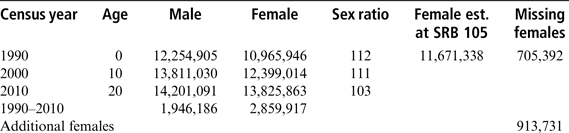
We use the backward projection method to determine the actual number of missing females, as well as descriptive statistics to ascertain whether or not late registration is observed in older cohorts. The backward projection method estimates the number of expected females if the sex ratios were at the normal range.Footnote 44 This provides an estimation of missing females at each age.Footnote 45 Table 1 displays the backwards projection for the 2010 census (20 years). The estimated number of missing females from 2010 to 1990 is 13.7 million. This is similar to the estimate given by Cai and Lavely of 12.8 million missing females for 2000 to 1980. The average is about 7 million per decade, with an estimated 21 million missing girls.Footnote 46 If we include an undercount in female death rates (see below), it is possible that there are over 20 million missing girls. The descriptive statistics compare census counts by sex and single years of age. For example, we compare the number of births and sex ratio of those born in 1990 with the number and sex of 10-year-olds in the 2000 census and 20-year-olds in the 2010 census. This is the same method used by Zeng Yi and colleagues, and by Daniel Goodkind to examine changes in the population between the 1982, 1990 and 2000 censuses.Footnote 47
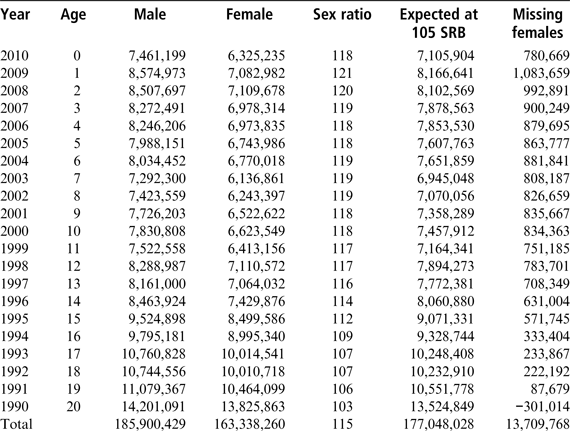
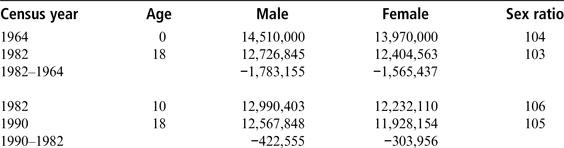
Table 2 displays the age and gender of the population born in 1964 and 1972. The SRB in 1964 is 104 and the sex ratio for the 18-year-old cohort in 1982 is 103. The sex ratio decreases for this cohort, as well as the actual population (by 3.3 million). The number of deaths for this cohort is relatively high, especially for the post-Great Leap Forward period.Footnote 48 However, the literature suggests a higher mortality rate for children under 15 years old in the 1960s and early 1970s.Footnote 49 The infant mortality rate actually increases in the early 1960s after the Great Leap Forward, from 88 deaths per 1,000 births in 1963 to 96 in 1964.Footnote 50 For the 1972 birth cohort (10-year-olds in the 1982 census), we observe a decline in the sex ratio and population. In fact, throughout the 1960s and 1970s there is a similar pattern of declining population for each birth cohort. The data suggests little incentive for late registration during this period and confirms the first hypothesis.
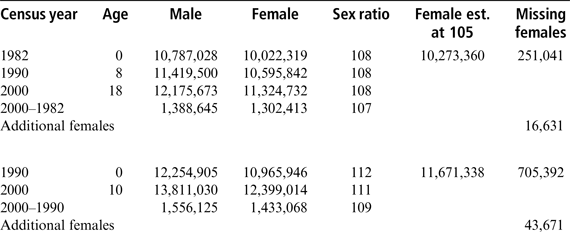
However, family incentives change after 1980 and we observe more widespread underreporting of births, with additional children appearing in older cohorts. Table 3 displays the demographic changes for the 1982 birth cohort in the 1990 census (age 10) and 2000 census (age 18). Within the first two years of fully implementing the family planning policy, we observe a significant increase in the number of additional children born after 1982. For the 1982 birth cohort (age 18 in 2000), there is an additional 2.6 million 18-year-olds. This confirms the second hypothesis and suggests that families and local officials have stronger incentives to hide out-of-plan births. The data in Table 3 also confirm the results of both Goodkind and Zeng et al. regarding the relatively large undercount during this period.Footnote 51 However, Goodkind finds that despite the dramatic increase in the number of children, the difference between males and females is negligible.Footnote 52 Table 3 exhibits the same findings. The sex ratio for the additional children from 1982 to 2000 is 107. When we adjust the additional count to the expected number of females for the 1982 SRB, the difference is only 16,631. Thus, additional females only explain about 7 per cent of the estimated missing girls from the 1982 birth cohort. For the 1990 birth cohort in the 2000 census, we find the same pattern where additional females only make up 6 per cent of the estimated missing females from the 1990 birth cohort.
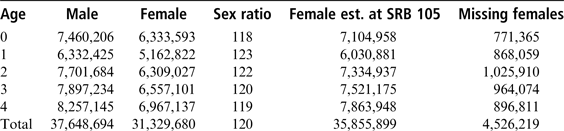
Indeed, the highest estimation of missing girls is in the first few years after birth. Table 4 shows an approximate 4.5 million missing females from birth to four years old in the 2000 census, with an average sex ratio of 120. Referring back to Table 1, the SRB in the 2010 census is 118 and the sex ratio remains at 118 or higher for all age groups under ten. Indeed, Tables 3 and 4 suggest that despite significant underreporting of births, most female infants and girls seem to be truly missing from the population. This confirms much of the literature on the missing girls published in the 1990s and early 2000s.Footnote 53
2000 Census Age 0–4 Estimates of Missing Females Based on Normal SRB (105)
Source:
NBS 2001.
However, when examining age cohorts and backward projections for the 1990, 2000 and 2010 censuses, we find that the sex ratio decreases after the age of 15 and tends to become more normal after the age of 20. In the 1990 census, the SRB in the early 1970s was 105 for 18-year-olds (born in 1972) and 103 for 20-year-olds (born in 1970). In the 2010 census, the SRB in the early 1990s was 107 for 18-year-olds (born in 1992) and 103 for 20-year-olds (born in 1990). That is, sex ratios for 18- and 20-year-olds born in the early 1990s were similar to those born in the early 1970s without the single-child policy or incentives for late registration. For the 2010 census, this suggests a significant number of females appear in the population after the age of ten.
Table 5 compares estimates of missing girls from three separate age groups for the census years 1990, 2000 and 2010. The sex ratio for 10-year-olds in 2000 is similar to the SRB in 1990 at 111. However, the sex ratio drops to 103 for 20-year-olds in 2010, with an additional 4.8 million undercounted births (i.e. late registration) and over 900,000 more females than males. The pattern and numbers are the same when we examine the different age groups, such as aged two years in 1990 and aged 22 years in 2010, with additional females ranging from 550,000 to 950,000 for each cohort. Moreover, life expectancy for males and females over the age of ten has been increasing during the 1980s and 1990s.Footnote 54 If we consider a lower bound conservative estimate of 550,000 undercounted or additional females per year from 1990 to 2010, then there are possibly 11 million more females (or 16.5 million since 1980). This confirms the administrative bias hypothesis.
Female Infant Deaths and Adoptions
Female infant death rates and adoptions are also factors that can influence the population count and estimates of older cohorts in China. Indeed, a significant undercount of live females suggests a strong possibility of underreported female infant deaths. In her county study, M. Giovanna Merli found substantial underreporting in both birth and infant deaths.Footnote 55 Another study found that 27 per cent of infant deaths were underreported in the 1980s, with a higher proportion of unreported female deaths.Footnote 56 Table 6 shows the reported death rates for rural births in 1990, 2000 and 2010. Between 1990 and 2000, there is a dramatic rise in rural female infant deaths, from 29 to 41 per 1,000, with only a slight rise in male infant mortality. However, we also observe a significant decrease in the female (as well as overall) infant mortality rate for the rural population after 2000. In order to take into account underreporting of female infant deaths, we use the highest reported female infant death rate for the rural population, at 41 per 1,000, and estimate the number of female deaths if this rate was on a parity with the male death rate at 28 per 1,000.Footnote 57 The difference is about 50,000 female infant deaths. This is about 32 per cent of the actual reported infant deaths. An upper bound estimate of 50,000 underreported female deaths per year from 1990 to 2010 suggests an additional one million missing females. Thus, female infant deaths may only account for a small proportion of the missing girls.

Adoption is another factor that may account for a portion of the missing females. Kay Johnson reports that the majority of adoptions in China are domestic (i.e. Chinese families) and that there were about 6,000 international adoptions a year in the late 1990s,Footnote 58 of which about 80 per cent were with parents in the United States. Data from the Civil Affairs Statistical Yearbook support Johnson's earlier findings and show that, between 1996 and 2008, there were 543,000 registered adoptions, and only 105,000, or 20 per cent, were with foreign parents.Footnote 59 According to the intercountry adoption data from the US Department of State, the US received 71,000 Chinese adopted children from 1999 to 2013, and the vast majority were females.Footnote 60 An upper bound estimate of 8,000 international adoptions per year suggests an additional 160,000 missing females from 1990 to 2010. This makes up an even smaller proportion of the estimated missing girls than female infant deaths.
While international adoptions only comprise a very small proportion of missing girls, domestic adoptions constitute a larger percentage of existing girls who “appear” in older cohorts. The majority of orphans are abandoned female infants who are unregistered and do not appear in the SRB statistic.Footnote 61 However, once adopted they are registered by their new family. Given the time spent in the orphanage and adoption process, we assume that most of these children are officially registered many months after birth. Therefore, domestic adoptions fall into the category of unreported female births. Moreover, unlike international adoptions, most of the girls adopted within China may “appear” in subsequent census counts after the age of one. An upper bound estimate of domestic adoptions is about 35,000 a year, with a total of 700,000 from 1990 to 2010. Thus, we believe domestic adoptions account for about 6 per cent of the 11 million additional females.
When we take into account estimates of female death rates and international adoptions as well as the 13.7 million estimated missing females (Table 1), we have a rough estimate of about 15 million missing girls from 1990 to 2010. We find 11 million additional, unreported female births that explain 73 per cent of the missing girls. With an upper bound estimate of one million female infant deaths for this time period, female infant deaths may account for 7 per cent of the missing girls. Finally, given the estimates, we believe that sex-selective abortion accounts for about 20 per cent of the missing females. Unlike adoption and reported death rates, it is more challenging to quantify the actual number of illegal abortions. Nevertheless, previous literature on sex-selective abortion provides solid evidence that this is an important second factor in explaining the missing females, especially in the 1990s.
Conclusion
The data show that our initial observations of unregistered girls in 1996 and after 2000 were not unusual cases but rather they pointed to a more widespread phenomenon of underreporting female (and male) births across rural China. The census data show a dramatic increase in reported females after the age of ten, and in particular after the age of 15. This suggests a large number of young women are not being officially registered until their teens. There are several reasons behind the late registration of an infant or teenage girl. First, like the family we visited in 1996, some rural families may put off formally registering a girl until they have a son. This is because, since the mid-1980s, villagers can legally have a second child if the first is a girl. However, if the family's second child is a girl, then parents may decide not to register the second daughter until after a son is born, and then formally register the son as the “second” child.
Second, parents who have an out-of-plan birth must pay a hefty fine and may want to delay payment until a later date. Unless the fine is paid, the out-of-plan child will not receive a birth certificate or hukou. Villagers may put off official registration until they can pay the fine. Moreover, if they have an out-of-plan son and daughter, they may decide to pay the fine for the son and register him first.
A third reason behind late registration is the distinction between elementary and junior high school enrolment in rural areas, especially in the 1980s and 1990s. Up until 2002, almost all villages had an elementary school. These schools were managed locally and it was possible for children to attend elementary school without a hukou. However, junior high schools are typically in the neighbouring town or county seat and not in the village. Owing to the distance, rural students have to live in dormitories, and enrolment requires registration and fees. This suggests that rural parents are willing to invest in the education of their daughters. Indeed, one study examining the gender gap in rural education found that, “rural parental educational attitudes and practices toward boys and girls are more complicated and less uniformly negative for girls than commonly portrayed.”Footnote 62 Thus, it is possible that some of the missing girls were able to attend elementary school without registration, but then needed to be registered formally after the age of 12 in order to attend junior high school.
The final incentive for registration is marriage. According to the Marriage Law of 1980, the legal age for marriage is 22 for men and 20 for women. However, in order to apply for a marriage certificate, couples must have proper hukou. Indeed, the most dramatic increase in female late registration is between the age of 20 and 24 years old. Thus, the desire for a marriage certificate may be a factor behind the increased number of females that appears in the census at a later age.
While villagers have incentives for delaying the registration of births, they could not do so without the intentional and unintentional complicity of local officials which makes it possible for so many out-of-plan children, and in particular the additional females, to exist. Unintentional complicity springs from the ineffectual administrative coordination between local government agencies. For example, a survey of one county in Shaanxi by the non-government organization, Plan International, found a lack of effective coordination and oversight between public security bureaus and family planning offices.Footnote 63 Although both are responsible for issuing birth certificates, in many instances neither agency considered birth registration as their responsibility. As a result of this weak coordination, cadres unintentionally provide an opportunity for out-of-plan births.
Yet, street-level bureaucrats at the town and county level also have strong incentives to interfere with local population reporting and intentionally underreport policy infractions. In the 1990s, the single-child policy had become a policy priority and promotion depended on keeping the number of births within established targets. However, villager resistance to limiting births was fierce and villagers came up with inventive ways to circumvent the policy. At the same time, many township and county leading cadres would massage the local birth statistics to make sure that they remained within their assigned birth quotas set by higher authorities. Thus, the missing girls may be the consequence of a massive uncoordinated effort between villagers who have the incentives to delay registrations and local officials who wish to hide policy infringements.
Acknowledgement
We are grateful to Liu Renjing, Han Yuxian, Ru Tong, Wang Xiaohong, Gao Qiufeng, Liu Hongyan, Lu Meichen, Jia Fang and Shi Meini for their research assistance in China. We would like to thank Melanie Manion, Bruce Dickson, Zhong Yong, Lu Xiaobo, Martin Whyte and the reviewers for their very insightful suggestions regarding earlier drafts of the article. This research was supported by the “111 Project,” grant number B16031.
Biographical notes
Shi Yaojiang is professor and director of the Centre for Experimental Economics in Education, Shaanxi Normal University, China.
John James Kennedy is associate professor, department of political science, University of Kansas, Lawrence, USA.



