

INTRODUCTION
Humans are increasingly emitting greenhouse gases, resulting in global climate change (IPCC 2014). The USA contributes to 21% of the world's greenhouse gas emissions, and household consumption accounts for more than 80% of these emissions (Jones & Kammen Reference Jones and Kammen2011); c. 98% of the emissions derive from energy consumption (Attari et al. Reference Attari, DeKay, Davidson and de Bruin2010). Although direct household impacts (such as use of products and services in homes) make up about one-third of US energy consumption, much more energy is consumed through indirect household impacts (such as energy consumption associated with the production and delivery of products and services) because energy use is embedded in the production, transportation and disposal of consumer goods and services (Bin & Dowlatabadi Reference Bin and Dowlatabadi2005). Because housing uses the most energy, and is the least efficient sector in terms of energy use, it holds the key for reducing greenhouse gas emissions (Peterson et al. Reference Peterson, Peterson and Liu2013). Households in the US can reduce energy consumption by approximately 30% without impacting general quality of life, which would cut approximately 11% of total US energy consumption (Gardner & Stern Reference Gardner and Stern2008). Furthermore, most US residents would like to reduce their emissions by changing their behaviour, and many people believe that they are doing so (Gardner & Stern Reference Gardner and Stern2008).
However, consumers and scholars often fail to differentiate environmental behaviours with drastically different environmental impacts. For example, a US household emits an average of 48 tonnes of CO2 per year, where transportation, home energy and food account for approximately 32, 21 and 15% of the household CO2 emissions, respectively (Bin & Dowlatabadi Reference Bin and Dowlatabadi2005; Jones & Kammen Reference Jones and Kammen2011). Many previous studies have focused on environmental behaviours that have relatively low impacts on energy or material use (Gatersleben et al. Reference Gatersleben, Steg and Vlek2002). These studies may provide little insight into environmental behaviours that have major impacts on the environment (Gatersleben et al. Reference Gatersleben, Steg and Vlek2002); thus people who have been identified as behaving more pro-environmentally may not necessarily have less impact on the environment. This creates a need for research addressing how predictors of environmental behaviour vary across more and less significant behaviours.
Many studies on pro-environmental behaviours have used green consumerism – purchasing and consuming products that are marketed as benign or beneficial for the environment (Mainieri et al. Reference Mainieri, Barnett, Valdero, Unipan and Oskamp1997) – as a measure of behaving pro-environmentally. Examples include purchasing locally produced products or products that are made of recycled materials. Compared to the impacts of household energy use, the positive environmental contributions from green consumerism are quite low (Peterson et al. Reference Peterson, Peterson and Liu2013), indeed green consumerism may scarcely reduce the environmental impact of consumption (Alfredsson Reference Alfredsson2004; Csutora Reference Csutora2012). The focus on green consumerism may have emerged from the relative simplicity of changing brands when shopping and the aggressive marketing of green products intended to capitalize on green premiums (Gatersleben et al. Reference Gatersleben, Steg and Vlek2002). Engaging in green consumerism may also be considered a symbolic way to demonstrate environmental values to peers (Pedersen & Neergaard Reference Pedersen and Neergaard2006). Furthermore, once people are engaged in some pro-environmental behaviours, they may have less impetus to engage in others (Moisander Reference Moisander2007).
Studies on the drivers of environmental behaviour have found consistent, sometimes weak, correlations between pro-environmental attitudes and behaviours (Buttel Reference Buttel1987; Dunlap et al. Reference Dunlap, Van Liere, Mertig and Jones2000). Weak correlations between attitudes and behaviours were partially due to low correlations among different types of environmental behaviours (Mainieri et al. Reference Mainieri, Barnett, Valdero, Unipan and Oskamp1997). Females and more educated people were more likely to engage in pro-environmental behaviours (Stern et al. Reference Stern, Dietz and Kalof1993; Scott & Willits Reference Scott and Willits1994; Vaske et al. Reference Vaske, Donnelly, Williams and Jonker2001; Hunter et al. Reference Hunter, Hatch and Johnson2004). Findings on the relationship between income and environmental behaviour are mixed. Some studies find a positive relationship between income and pro-environmental behaviour, suggesting that people may often emphasize environmental quality after their material needs are well satisfied (Van Liere & Dunlap Reference Van Liere and Dunlap1980; Scott & Willits Reference Scott and Willits1994; Jones & Kammen Reference Jones and Kammen2011). However, others have found similar pro-environmental attitudes among people of poor countries (Brechin & Kempton Reference Brechin and Kempton1994; Dunlap & Mertig Reference Dunlap and Mertig1995; Brechin Reference Brechin1999; Dunlap & York Reference Dunlap and York2008), and even found that people who have experienced environmental harm may be more likely to engage in pro-environmental behaviour than their wealthier counterparts (Chen et al. Reference Chen, Peterson, Hull, Lu, Hong and Liu2013). Findings on the relationship between age and environmental behaviour are also mixed (Scott & Willits Reference Scott and Willits1994; Stern et al. Reference Stern, Dietz and Guagnano1995; Tindall et al. Reference Tindall, Davies and Mauboules2003).
Different types of environmental behaviours have different impacts on people's lives, and are often affected by different drivers; however, the drivers of different environmental behaviours are unclear. People with more pro-environmental attitudes were more likely to engage in green consumerism (Mainieri et al. Reference Mainieri, Barnett, Valdero, Unipan and Oskamp1997; Roberts & Bacon Reference Roberts and Bacon1997; Gatersleben et al. Reference Gatersleben, Steg and Vlek2002). Females, older people and people with higher education were more likely to engage in green consumerism (Mainieri et al. Reference Mainieri, Barnett, Valdero, Unipan and Oskamp1997; Gatersleben et al. Reference Gatersleben, Steg and Vlek2002). The relationship between pro-environmental attitudes and energy use is unclear. Pro-environmental attitudes affected people's energy use in some studies (Roberts & Bacon Reference Roberts and Bacon1997; Barr et al. Reference Barr, Gilg and Ford2005; Nelson et al. Reference Nelson, McHale and Peterson2012), but not in others (Becker et al. Reference Becker, Seligman, Fazio and Darley1981; Gatersleben et al. Reference Gatersleben, Steg and Vlek2002; Abrahamse & Steg Reference Abrahamse and Steg2009). Households with a higher income and more people tended to consume more energy (Gatersleben et al. Reference Gatersleben, Steg and Vlek2002; Abrahamse & Steg Reference Abrahamse and Steg2009), though high income households consumed less energy per unit of area (Nelson et al. Reference Nelson, McHale and Peterson2012). In addition, people who choose to tolerate warmer inside temperatures in the summer or cooler inside temperatures in the winter used less energy (Becker et al. Reference Becker, Seligman, Fazio and Darley1981; Nelson et al. Reference Nelson, McHale and Peterson2012; Brounen et al. Reference Brounen, Kok and Quigley2013).
Collectively these diverse findings indicate that marketing may hijack environmental attitudes so that intentionally green behaviour decisions are aimed at relatively insignificant green consumerism, and social and structural variables primarily drive more meaningful behaviours, including home and transportation energy usage. In this research, we explored the driving forces of three types of environmental behaviours, namely green consumerism, housing electricity consumption and vehicle fuel consumption. We evaluated the effects of attitudinal and demographic factors, and social and structural conditions on these environmental behaviours, and assessed correlations among different environmental behaviours.
METHODS
Data collection
Our case study was conducted in Chapel Hill (North Carolina, USA). The educational attainment of residents in this area is relatively high; 24% of residents have a Master's degree or above, compared to a nation-wide average of only 7% (Social Explorer 2010). Community regulations promoting recycling and energy conservation, and the prevalence of buy local and buy green stores suggest green consumerism is relatively salient and common in this area. We conducted mail-in surveys with 535 randomly selected households in 2013. We received 186 responses, and only one of them was not appropriately completed, resulting in 185 valid responses (35% response rate). In order to identify potential for differences between respondents and non-respondents, we randomly selected 36 households from non-respondents and reached 34 households. We asked three questions to these 34 households, namely the age and ethnicity of respondents and the floor area of households. Independent sample t-tests (for age and floor area) and a chi-square test (for ethnicity) showed no significant differences (p > 0.05) between the respondents and non-respondents for these variables.
In our survey, green consumerism was measured using respondents’ engagement in purchasing six green products that are commonly used in green consumerism studies: fair-trade coffee or tea, phosphate-free laundry detergent, recycled writing paper, recycled toilet paper, organic food and locally produced products (Sparks & Shepherd Reference Sparks and Shepherd1992; Roberts Reference Roberts1996; Gilg et al. Reference Gilg, Barr and Ford2005). We measured how often the respondents purchased green products using a five-category rating scale, ranging from ‘never’ to ‘always’. We asked respondents about their monthly electricity bills for June, July and August of 2012. Because respondents’ electricity was supplied through Duke Energy Corporation, the same electricity prices applied to all respondents. Therefore, an aggregation of three summer month bills was used as an indicator of housing electricity consumption. In order to measure the vehicle fuel consumption, we asked the make, model, year and distance driven in the respondents’ primary vehicle during the past year. We then used this data in combination with the fuel efficiency for each vehicle from fueleconomy.gov to calculate the annual fuel consumption for each vehicle.
Respondents’ environmental attitudes were measured with the New Ecological Paradigm (NEP) scale (Dunlap et al. Reference Dunlap, Van Liere, Mertig and Jones2000). The NEP measures an individual's environmental worldview in five aspects: the realization of limits to growth, anti-anthropocentrism, belief in the fragility of the balance of nature, rejection of human exemptionalism and belief in future eco-crisis. Respondents were asked about their perceptions of 15 statements by choosing a value for each statement from five-category Likert responses ranging from strongly disagree to strongly agree. Agreement with eight positively narrated statements corresponds to higher measures, while responses to the seven negatively narrated statements were reversed so that disagreement with these statements corresponds to higher measures. Past studies have found higher NEP scores among members of environmental organizations than that of the general public (Dunlap & Van Liere Reference Dunlap and Van Liere1978; Widegren Reference Widegren1998; Dunlap et al. Reference Dunlap, Van Liere, Mertig and Jones2000; Dunlap & Michelson Reference Dunlap and Michelson2002). Studies have also found significant correlations between NEP score and pro-environmental behaviour and intentions (Vining & Ebreo Reference Vining and Ebreo1992; Scott & Willits Reference Scott and Willits1994; Stern et al. Reference Stern, Dietz and Guagnano1995; Schultz & Oskamp Reference Schultz and Oskamp1996; Tarrant & Cordell Reference Tarrant and Cordell1997; Schultz & Zelezny Reference Schultz and Zelezny1998).
We measured seven sociodemographic variables that were often used in past studies of environmental behaviours (Scott & Willits Reference Scott and Willits1994; Tarrant & Cordell Reference Tarrant and Cordell1997; Chen et al. Reference Chen, Peterson, Hull, Lu, Hong and Liu2013): gender (female = 1, male = 0), age (categorical with increments of 10 years), education (categorical), household size (1, 2, 3, 4, 5, 6 or more), ethnicity (white = 1, others = 0), income (categorical) and home ownership (own = 1, other = 0). We included these variables in our analysis in order to control for confounding effects and compared our results with past studies on environmental attitudes and behaviour. In our analyses of electricity consumption, we also included three housing structural variables that may affect housing energy use (Abbott & Meentemeyer Reference Abbott and Meentemeyer2005; Nelson et al. Reference Nelson, McHale and Peterson2012; Brounen et al. Reference Brounen, Kok and Quigley2013): year built (categorical), thermostat temperature setting (25.6°C or above = 1, other = 0) and floor area of the house (categorical). We also included a variable in our analyses of vehicle fuel consumption to measure the use of alternative transportation: bus, bike and walk (took a bus or used biking or walking for transportation in the past month = 1 and 0 otherwise).
Analytical methods
We calculated Cronbach's alpha on respondents’ engagement in purchasing six green products to measure their internal consistency. Due to a high level of internal consistency among measures of purchasing six types of green products (Cronbach's alpha = 0.75), we aggregated these measures in a green consumerism scale that could range from 6 to 30, with a higher score corresponding to higher engagement in green consumerism. We also calculated Cronbach's alpha on responses to 15 NEP statements that indicated a high internal consistency (Cronbach's alpha = 0.79). Despite multi-dimensionality in the NEP, we used the items as a scale (as is typically done). We aggregated item scores in a NEP score ranging from 15 to 75, with a higher score corresponding to more pro-environmental attitude. We used ordinary least squares (OLS) regression models to explore relationships between environmental attitudes (NEP score) and three types of environmental behaviours: green consumerism, summer electricity consumption and vehicle fuel consumption. We tested potential correlations among different types of environmental behaviours using these models. We also controlled for a group of demographic, social and structural characteristics often used in environmental behaviour studies (Scott & Willits Reference Scott and Willits1994; Mainieri et al. Reference Mainieri, Barnett, Valdero, Unipan and Oskamp1997; Tarrant & Cordell Reference Tarrant and Cordell1997; Brechin Reference Brechin1999; Vaske et al. Reference Vaske, Donnelly, Williams and Jonker2001; Gatersleben et al. Reference Gatersleben, Steg and Vlek2002; Hunter et al. Reference Hunter, Hatch and Johnson2004; Abbott & Meentemeyer Reference Abbott and Meentemeyer2005; Abrahamse & Steg Reference Abrahamse and Steg2009; Jones & Kammen Reference Jones and Kammen2011; Brounen et al. Reference Brounen, Kok and Quigley2013). All statistical analyses were conducted using STATA 11 (STATA Corp., College Station, Texas, USA).
RESULTS
Respondents of the survey had a mean green consumerism score of 18.70 (Table 1). Their average summer 2012 electricity bill was US$377.73, and they consumed 1729.88 litres of fuel on average in 2012. The mean NEP score of respondents was 56.24. The sample was 63% female, with the mean age of 4.42 corresponding to a range of 41–50 years old, and the mean education level of 5.23 corresponded to a level between bachelor's degree and graduate degree (Table 1). Most respondents (83%) were white, mean household size was 2.54, and the mean annual household income level was 4.63 corresponding to approximately US$75,000. Most of the homes were built after 1980, the mean floor area level of the homes was 3.46 corresponding to approximately 180 m2. Approximately 61% of the respondents owned a home. Only 22% of the respondents had a thermostat temperature setting above 25.6°C. Among respondents in the sample, 68% reported taking a bus or using biking or walking for transportation in the previous month (Table 1).
Summary statistics of environmental behaviours, environmental attitude, and demographic, social and structural characteristics of respondents. NEP = New Ecological Paradigm.

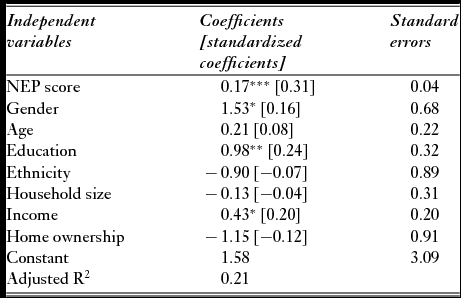
The green consumerism score was significantly positively correlated with respondents’ environmental attitudes (Table 2). One unit increase in NEP score increased the green consumerism score by 0.17. Several sociodemographic factors were also significantly correlated with the green consumerism scale (Table 2). Being female increased the green consumerism score by 1.53. Educational and income levels were also significantly positively correlated with the green consumerism score.
Ordinary least squares of green consumerism scale on environmental attitudes (NEP) and sociodemographic factors. *p ≤ 0.05; **p ≤ 0.01; ***p ≤ 0.001; n = 185. NEP = New Ecological Paradigm.
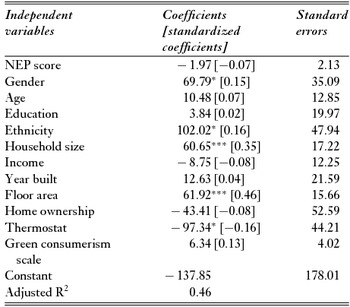
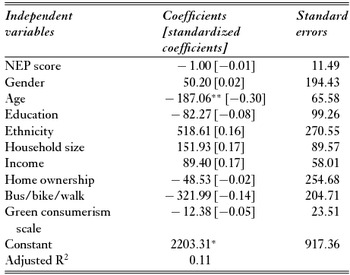
Unlike green consumerism, neither the summer electricity bill nor the vehicle fuel consumption were correlated with the NEP score (Tables 3 and 4). On average, the summer electricity bill of female respondents was US$69.79 higher than that of male respondents (Table 3). White respondents spent an average of US$102.02 more on summer electricity than other respondents. One unit increase in household size increased the summer electricity bill by an average of US$60.65. The summer electricity bill was also significantly affected by structural variables (Table 3). One unit increase in respondents’ housing floor area increased the summer electricity bill by US$61.92 on average. In addition, the summer electricity bill of respondents whose thermostat temperature setting above 25.6°C was US$97.34 less on average than other respondents. Younger respondents’ fuel consumption was significantly greater than their older counterparts (Table 4). Neither the summer electricity bill nor the vehicle fuel consumption were correlated with the green consumerism scale (Table 3 and 4).
Ordinary least squares of summer electricity bill on environmental attitudes (NEP), sociodemographic and structural factors, and green consumerism scale. *p ≤ 0.05; ***p ≤ 0.001; n = 185. NEP = New Ecological Paradigm.
Ordinary least squares of vehicle fuel consumption on environmental attitudes (NEP), sociodemographic and structural factors, and green consumerism scale. *p ≤ 0.05; **p ≤ 0.01; n = 185. NEP = New Ecological Paradigm.
DISCUSSION
Our findings suggest the relationship between pro-environmental attitudes and behaviour may only hold for the less important but more heavily marketed pro-environmental behaviours. Most environmental behaviour studies utilize the theories of reasoned action and planned behaviour (Fishbein & Ajzen Reference Fishbein and Ajzen1975; Ajzen Reference Ajzen1991) to suggest pro-environmental attitudes directly or indirectly promote pro-environmental behaviours (Buttel Reference Buttel1987; Kaiser et al. Reference Kaiser, Wölfing and Fuhrer1999; Dunlap et al. Reference Dunlap, Van Liere, Mertig and Jones2000). We found that pro-environmental attitudes were significantly correlated with well marketed but low impact behaviours identified as green consumerism, but were not correlated with high impact behaviours (Bin & Dowlatabadi Reference Bin and Dowlatabadi2005; Jones & Kammen Reference Jones and Kammen2011) driving household electricity or vehicle fuel consumption. These activities are typically not conspicuous and do not promote social status. Because status competition only promotes publicly visible environmental behaviour (Griskevicius et al. Reference Griskevicius, Tybur and Van den Bergh2010), our findings suggest policy should be developed to make environmental behaviours more conspicuous (for example using programmable thermostats) thereby promoting social status (Sexton & Sexton Reference Sexton and Sexton2014). Making household energy usage data publicly evaluable, even at the neighborhood level, would achieve both goals (Peterson et al. Reference Peterson, Peterson and Liu2013). Indeed, simply mailing people energy usage of similar households has instigated a 3% drop in electricity and gas consumption of householders (Allcott & Mullainathan Reference Allcott and Mullainathan2010). Similar impacts may be achieved by promoting information related to household transportation (for example walkability scores) during real-estate transactions.
These efforts to promote meaningful environmental behaviours, however, must compete with massive marketing efforts to capitalize on green premiums for a diverse array of products, also known as greenwashing. A distinction between greenwashing, where dubious claims are made, and green marketing, where the claims are more accurate, can be made, but in practice very few products marketed in either way have meaningful environmental impacts relative to household energy usage and transportation choices (Laufer Reference Laufer2003; Ramus & Montiel Reference Ramus and Montiel2005). Although studies have found that green consumerism has little or no effects on reducing the environmental impacts of consumption (Alfredsson Reference Alfredsson2004; Csutora Reference Csutora2012), most consumers may obtain their knowledge about green products from green marketing that aims at capturing green premiums. This may explain why green consumerism is seen as relatively simple and as having low impacts on people's daily lives (Gatersleben et al. Reference Gatersleben, Steg and Vlek2002; Pedersen & Neergaard Reference Pedersen and Neergaard2006) relative to reducing household energy consumption despite the relatively simple actions householders can take that can produce 30–40% reductions in household energy usage without negatively impacting their lifestyle (Dietz et al. Reference Dietz, Gardner, Gilligan, Stern and Vandenbergh2009; Peterson et al. Reference Peterson, Peterson and Liu2013). The lack of correlation between environmental attitudes and energy consumption in this study may also reflect the NEP measuring general environmental attitudes, which can be different from attitudes toward more specific actions (Mainieri et al. Reference Mainieri, Barnett, Valdero, Unipan and Oskamp1997; Gatersleben et al. Reference Gatersleben, Steg and Vlek2002).
Our findings regarding relationships between income, education level and gender support the general disconnect found between environmental attitudes and significant environmental behaviours. Specifically, our finding that females participated in green consumerism more than males corroborates indications that females have more pro-environmental attitudes and are more likely to participate in pro-environmental behaviour than males (Dietz et al. Reference Dietz, Stern and Guagnano1998; Vaske et al. Reference Vaske, Donnelly, Williams and Jonker2001). However, we found that in Chapel Hill the gender difference was reversed when moving from green consumerism to more meaningful behaviours, and that households of female respondents actually used more energy than those of male respondents. This observation, however, should be the subject of future research since intuitive explanations for higher household energy usage are not obvious, and multiple interpretations are possible. For instance, households where women responded being more likely to have women who spend time at home during work hours and thus use more energy.
Income and education provided more evidence for the disconnect between green consumerism and more meaningful environmental behaviours. Both variables have long been associated with pro-environmental attitudes and behaviours (Van Liere & Dunlap Reference Van Liere and Dunlap1980; Scott & Willits Reference Scott and Willits1994; Jones & Kammen Reference Jones and Kammen2011), and both were positively related to green consumerism but not related to household energy usage or vehicle fuel consumption. Recent research on income suggests more pro-environmental attitudes and behaviour among economically disadvantaged people (Brechin & Kempton Reference Brechin and Kempton1994; Dunlap & Mertig Reference Dunlap and Mertig1995; Brechin Reference Brechin1999; Dunlap & York Reference Dunlap and York2008; Chen et al. Reference Chen, Peterson, Hull, Lu, Lee, Hong and Liu2011), particularly when they are disproportionately exposed to environmental harm (Chen et al. Reference Chen, Peterson, Hull, Lu, Hong and Liu2013). Respondents in our study site had higher educational levels than the nation's average (Social Explorer 2010), which often leads to more pro-environmental attitudes (Buttel Reference Buttel1987; Scott & Willits Reference Scott and Willits1994; Dunlap et al. Reference Dunlap, Van Liere, Mertig and Jones2000), and higher NEP scores than those typically reported in other case studies (Peterson et al. Reference Peterson, Chen and Liu2008; Pienaar et al. Reference Pienaar, Lew and Wallmo2015; Steel et al. Reference Steel, Pierce, Warner and Lovrich2015). Given this context, we should have detected a relationship between significant environmental behaviours and environmental attitudes even if a relatively high threshold in environmental attitudes is required to elicit significant environmental behaviour. These results suggest that improving pro-environment attitudes through education may not be effective in reducing human behaviours that have high impacts on the environment.
We also found age negatively correlated with vehicle fuel consumption, which was intuitive given many older people do not need to drive for work purposes or to provide transportation for children living at home (Barr et al. Reference Barr, Gilg and Ford2005). Electricity consumption was positively correlated with household size and housing floor area, and was negatively correlated with thermostat temperature setting, which is consistent with past studies (Poortinga et al. Reference Poortinga, Steg and Vlek2004; Nelson et al. Reference Nelson, McHale and Peterson2012). White respondents reported higher electricity consumption than other ethnic groups, probably due to the inequities in housing for minorities and the differences in lifestyles and environmental values among different ethnic groups (Johnson et al. Reference Johnson, Bowker and Cordell2004; Nelson et al. Reference Nelson, McHale and Peterson2012).
Our results suggest that social and structural constraints are more important than attitudinal and individual level demographic factors in determining home electricity consumption. Conservation efforts that aim to reduce humans’ environmental impacts, especially greenhouse gas emissions, would do better to focus on either addressing social and structural constraints or competing effectively with the green consumerism marketing professionals. The limited role of structural variables on vehicle fuel use may reflect recall bias associated with distance driven among respondents. Because summer electricity usage was based on utility bills, relationships in the model predicting household electricity usage are probably more rigorous. Future research using direct observation of vehicle distance driven or fuel consumption would reduce any recall bias problems, but the observation itself may alter behaviour unless participants are unaware of study intentions (Barr et al. Reference Barr, Gilg and Ford2005).
ACKNOWLEDGEMENTS
We gratefully acknowledge the financial support from the US National Science Foundation (grant number DEB-1313756) and The University of North Carolina at Chapel Hill. We thank Ms. Audrey Jo for assistance in data collection, and the editor in chief, the associate editor and two anonymous reviewers for their constructive criticisms on an earlier draft of this paper.



