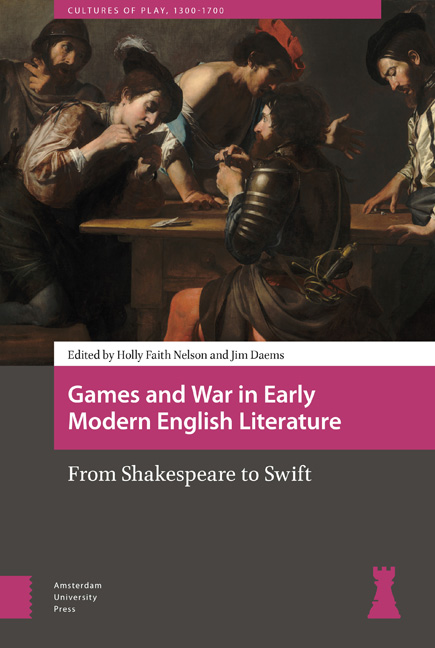

This pioneering collection of nine original essays carves out a new conceptual path in the field by theorizing the ways in which the language of games and warfare inform and illuminate each other in the early modern cultural imagination. They consider how warfare and games are mapped onto each other in aesthetically and ideologically significant ways in the early modern plays, poetry or prose of William Shakespeare, Thomas Morton, John Milton, Margaret Cavendish, Aphra Behn, and Jonathan Swift, among others. Contributors interpret the terms 'war games' or 'games of war' broadly, freeing them to uncover the more complex and abstract interplay of war and games in the early modern mind, taking readers from the cockpits and clowns of Shakespearean drama, through the intriguing manuals of cryptographers and the ingenious literary wargames of Restoration women authors, to the witty but rancorous paper wars of the late seventeenth and early eighteenth centuries.
Loading metrics...
* Views captured on Cambridge Core between #date#. This data will be updated every 24 hours.
Usage data cannot currently be displayed.
This section outlines the accessibility features of this content - including support for screen readers, full keyboard navigation and high-contrast display options. This may not be relevant for you.
Accessibility compliance for the PDF of this book is currently unknown and may be updated in the future.
