

Introduction
Macrofractures — fractures visible with the naked eye or with a hand lens — are relied on at present to ascertain whether certain stone artefacts were used as hunting weapons (Lombard & Pargeter 2008). However, the limits of the macrofracture method, and of macrofracture formation, have only been partially assessed (see Fischer et al. 1984; Reference OdellOdell 1988; Reference LombardLombard 2005). This paper aims to show the usefulness of experimental archaeology in assessing the macrofracture method for identifying Stone Age hunting weaponry. Two human and cattle trampling experiments were conducted in southern Malawi in March 2010 on a total sample of 450 unretouched milky quartz, dolerite and quartzite flakes with the aim to investigate the formation of macrofractures under non-hunting conditions. The experimental flakes were manufactured by the author using a hard hammer direct percussion method. Knapping debris from the manufacture of these experimental flakes was also analysed for macrofractures.
General background
When and where different hunting weapon types appear in the archaeological record are contentious issues (Villa & Soriano 2010). This is in part because few hunting weapons made on organic materials survive, thus forcing archaeologists to rely on contextual evidence to interpret prehistoric hunting technologies (Lombard & Phillipson 2010). A large part of this evidence is derived from the study of stone artefacts and their breakage patterns (Reference DockallDockall 1997). The types of weapons used and people's reliance on these weapons have behavioural implications for how we perceive Stone Age capacities (Shea & Sisk 2010). For instance, projectile weaponry may have assisted in diet and niche broadening and in the expansion of modern humans out of Africa after c. 50 000 years ago by providing a flexible technology enabling humans to focus more intensely on some food sources and more widely on others (Reference SheaShea 2006, 2009). Establishing which artefacts were used for hunting, and which types of hunting weapons were used, is therefore important for understanding prehistoric human behaviour and cognitive capacity.
Background to the macrofracture method
Macrofracture analyses uses the types, frequencies and patterns of macrofractures on stone tools, especially diagnostic impact fractures (DIFs) (Fischer et al. 1984; Reference LombardLombard 2005). DIFs are macrofractures that have been shown, through experiments, to be associated with stone artefacts used as impact weapon tips. The assumption is that these fractures are caused by impact during use (e.g. hunting), and that different variations of this use will leave different breakage patterns on the tools (Reference DockallDockall 1997).
Four main DIF breakage types are usually understood to exist: step terminating bending fractures; spin-off fractures >6mm; bifacial spin-off fractures; and impact burinations (for details see Fischer et al. 1984 and Reference LombardLombard 2005). Step terminating fractures and spin-off fractures have been referred to as the primary DIF types to identify the potential use of stone-tipped weaponry (e.g. Reference LombardLombard 2005, 2007; Lombard & Pargeter 2008; Villa et al. 2009). Snap, feather and hinge terminating fractures and tip crushing are recorded during macrofracture analyses to describe the complete range of damage seen on a tool. Such damage can result from a variety of other activities (such as human and cattle trampling) and should not be used alone as potential indicators of projectile impact (Villa et al. 2009: 855).
Archaeological applications
The macrofracture method has been applied in diverse settings to address archaeological questions involving the hunting functions of stone artefacts. By studying and interpreting archaeological and experimental macrofracture patterns and frequencies archaeologists have, for example, initiated discussions into the origins of projectile technology (Lombard & Phillipson 2010), subsistence and risk management strategies in South Africa (Lombard & Parsons 2008) and the role of hunting technologies in the transition to food production during the Levantine Neolithic (Yaroshevich et al. 2010). Outside Africa the method has been tested at bison kill sites in North America (Frison et al.1976) and applied in various archaeological contexts in Belgium (Crombé et al. 2001), southern England (Barton & Bergman 1982), Denmark (Fischer et al. 1984), Ukraine (Reference NuzhnyiNuzhnyi 1990), Lebanon (Bergman & Newcomer 1982) and Israel (Reference SheaShea 1988).
Cattle and human trampling outside a cattle kraal in southern Malawi.

Limitations
Current macrofracture experiments are contributing to our database of hunting-related fracture types and have begun to show which variables are important for the formation of macrofractures and which are not. At present the formation of macrofractures is suggested to be independent of raw material type, artefact shape and size (Lombard et al. 2004). However, this remains a suggestion and we cannot be certain that all macrofractures were formed in a particular way. Differences in hafting positions, propulsion velocity and mode of delivery (thrusting, throwing or propulsion) may have affect the formation, patterns and combinations of macrofractures.
The experiments
My experiments were designed to address the following questions:
-
1. Do macrofractures (DIFs in particular) occur on unretouched stone flakes when trampled by humans or cattle?
-
2. Do DIFs form on hard hammer direct percussion knapping debris?
-
3. Do these fractures occur on parts of flakes that analysts would associate with hunting activities, such as tips?
These questions were assessed in two series of trampling experiments involving cattle and humans. A rectangular area measuring 3 × 2m was demarcated outside a cattle kraal in southern Malawi (Figure 1). This was large enough to allow for the distribution of 100 stone flakes (150 for the second cattle trampling experiment, which included 50 quartzite flakes). The area was excavated to a depth of 12cm for the cattle trampling experiments. The base 2cm were covered with soil to prevent the lowest flakes from sitting on a harder substratum, which could cause them to break more easily (cf. Reference Gifford-Gonzalez, Damrosch, Damrosch, Pryor and ThunenGifford-Gonzalez 1985; Reference NielsenNielsen 1991; McBrearty et al. 1998). Half of each raw material sample (25 pieces each of milky quartz, dolerite and quartzite) was placed at a depth of 10cm, and the other half just below the surface. The aim was to assess whether the formation of macrofractures was affected by the depth at which they were placed during cattle trampling. The cattle trampled the area for 15 minutes twice a day for 27 days, whilst the two human trampling experiments were conducted for 30 minutes each.
Results
The focus of the results presented here is on the different DIFs from the trampled and knapped pieces, their raw material and the macrofracture types encountered (Table 1).

The greatest distinction in DIF frequencies was between the trampling and knapping experiments. Trampling produced a generally higher number of DIFs compared with the knapping. Differences between human and cattle trampling were slight although the cattle trampling experiments produced marginally higher DIF frequencies. Snap and hinge/feather fractures were the most frequent non-diagnostic macrofractures in all the experiments.
The four (0.88%) step terminating fractures in direct association with the tips of trampled pieces and 2 (0.006%) step terminating fractures found on the knapping debris suggest that caution be exercised when small frequencies of step terminating fractures are recorded on archaeological samples. Impact burinations were noted on all of the knapping debris as well as in the cattle and second human trampling experiments. Eight (2.44%) impact burinations were found in association with tips making this the most common DIF type in the experiments. These results suggest that small numbers of burination spalls on archaeological samples should also be viewed with caution in macrofracture analyses. No bifacial spin-off fractures were noted on the trampling and knapping flakes. These fractures therefore appear to be the most reliable DIF type. A single unifacial spin-off fracture >6mm was noted amongst the knapping debris.
The properties of the three raw material types used did seem to affect the rate at which macrofractures form. This is related to their brittleness, not their hardness. Brittle raw materials, such as milky quartz and quartzite, have edges that tend to fracture more often than less brittle materials, such as dolerite. The depth below the surface at which an artefact was placed also affected the rate at which macrofractures form. The reasons behind this are obvious as more soil protects the flakes. However, the initial placement of the flakes did not determine where they were eventually found, as soil is a dynamic medium and artefacts shift up and down during trampling (cf. Reference VillaVilla 1982).
Discussion
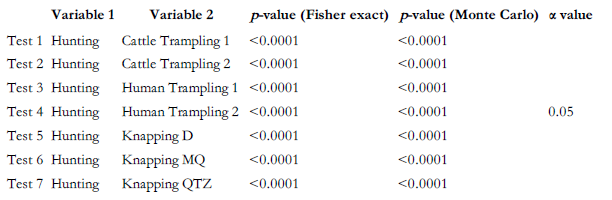
Assessing the macrofracture method Here the macrofracture method is assessed by comparing and contrasting the trampling and knapping experimental results presented in this study to previous hunting macrofracture experiments using a two-tailed Fisher's exact test (Table 2). This is to see whether hunting produces significantly different DIF frequencies to trampling and knapping. The results of the exact test show that trampling and knapping produce DIF frequencies that are significantly different from hunting experiments (p < 0.0001).

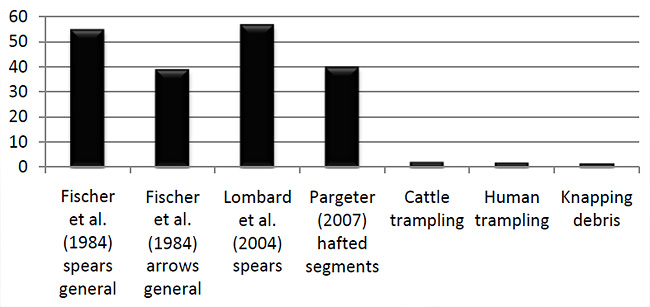
The trampling and knapping assemblages also appear different to the Fischer et al. (1984), Lombard et al. (2004) and Reference PargeterPargeter (2007) hunting experiments when compared on the level of DIF means (Figure 2). Similar longitudinal impact and bending forces are probably responsible for the small number of trampling and knapping DIFs as for the hunting DIFs. The high proportion of step terminating fractures and impact burinations suggests that the experimental tools were also subject to frequent bending forces during trampling and knapping.
Comparison of DIF means from three hunting experiments and the experimental samples in this study.

Introducing a hypothetical margin of error in macrofracture analyses The DIFs noted on the trampling and knapping assemblages never exceeded 3% of the total number of flakes or debris (Figure 3). I therefore suggest that this frequency (= 3%) be considered a margin of error for future macrofracture analyses. When artefact assemblages have DIF frequencies in excess of 3%, activities besides post-depositional processes, such as trampling, can be taken as contributing to their formation and this hypothetical margin of error should be considered. The first 3% of DIFs in any macrofracture analysis can be used to represent the unintentional fracturing of stone artefacts in the past through processes that are perhaps not accounted for in other ways.
Overall DIF frequencies from the five experimental assemblages (HT: Human trampling; CT: Cattle trampling; Knap D: Knapping debris).

Conclusion
In this paper the potential for trampling and knapping to cause macrofractures and DIFs has been demonstrated. Step terminating fractures and impact burinations were the most common DIF types encountered and need to be used with some caution when they are found in small frequencies (= 3%) in future macrofracture analyses. Bifacial spin-off fractures appear to be the most diagnostic impact fracture type as none were found in these experiments. Only one spin-off fracture >6mm was recorded. The DIFs noted on the trampling and knapping experimental assemblages never exceeded 3% of the total number of flakes or debris. This frequency (= 3%) can be considered a margin of error for macrofracture analyses in the future. Other potential factors affecting the formation of macrofractures need to be investigated in future experimental programs. These results support the suitability of the macrofracture method for detecting Stone Age hunting weaponry but the method does have a margin of error and should, where possible, be used in conjunction with other use-trace analyses to investigate the hunting function of stone artefacts.
Acknowledgements
I wish to thank my supervisors Dr Marlize Lombard, Prof. Christopher Henshilwood and Dr Geeske Langejaans who gave support, advice and input into this project. I would also like to thank my students at the Catholic University of Malawi for participating in the experiments and to the PAST and NRF foundations for financial assistance.