


1. Introduction
The lack of knowledge among practitioners is still named as one of the main reasons why the potential of additive manufacturing (AM) remains unexploited (Reference Hofmann, Ferchow and MeboldtHofmann et al., 2023). The term ‘design for additive manufacturing’ (DfAM) has become established in this field and describes the knowledge base regarding AM, such as methods, tools, and guidelines (Reference Pradel, Zhu, Bibb and MoultriePradel et al., 2018). Despite extensive research in this domain, methodological knowledge rarely reaches practitioners (Reference HajaliHajali, 2024).
Novices in DfAM face numerous challenges. The early stages of product development, although highly promising for AM potentials, remain particularly underserved in terms of accessible design support (Reference Blösch-Paidosh and SheaBlösch-Paidosh & Shea, 2018). A further barrier lies in the mismatch between available knowledge and the way designers prefer to learn. While knowledge transfer in DfAM is mostly based on support such as methods, tools, and guidelines, etc. (Reference Pradel, Zhu, Bibb and MoultriePradel et al., 2018), novices in the field of DfAM value most the interaction with an expert who can explain reasoning processes, contextualise methods, and adapt explanations dynamically (Reference Obi, Pradel, Sinclair, Bibb and EvansObi et al., 2024). Recent advances in artificial intelligence, e.g. large language models (LLMs) open new opportunities to bridge this gap by simulating expert-like interactions and providing on-demand methodological guidance (Reference Khan, Chen, Feng and MoonKhan et al., 2025). One example is an approach that uses LLM with a customised database (via Retrieval-Augmented Generation) for knowledge acquisition in the field of DfAM (Reference Chandrasekhar, Chan, Ogoke, Ajenifujah and Barati FarimaniChandrasekhar et al., 2024). However, most current studies focus primarily on technical or geometric aspects of AM (e.g., manufacturing parameters, material behaviour) rather than on human-centred challenges such as learning, trust, and acceptance (e.g. Reference Liu, Zhu and YeLiu et al., 2020). Existing models of technology acceptance (such as UTAUT-AI-Roles according to (Reference Jiang, Niu, Wang, Yuan and ChenJiang et al., 2024)) should be leveraged to gain a deeper understanding of how the use of AI within the development process influences developers’ perceptions, decision-making, and ways of working.
To address this gap, the present study explores which aspects of expertise are most valued by novices in the context of DfAM, and how these preferences influence their perception of an AI system acting as a substitute for a human expert. Understanding these factors is essential for designing AI-supported frameworks that not only provide accurate information but also emulate the qualities of expert–novice interaction that novices find most beneficial.
The overall aim of this research is to identify which characteristics of expert support are perceived as most valuable by novices in the field of DfAM, and to explore how these characteristics could be translated into AI-driven systems that simulate expert–novice interaction.
This study seeks to contribute to a better understanding of the human factors that influence the acceptance and perceived usefulness of AI-based expert substitutes in design processes. The results are intended to inform the design of AI-supported frameworks that combine methodological accuracy with the interpersonal and cognitive qualities typically associated with human expertise. This paper addresses the following three research questions (RQ).
-
• RQ1: Which aspects of expert behaviour and communication do novices in DfAM consider most important for their learning and decision-making processes?
-
• RQ2: How do novices perceive the replacement of a preferred human expert by an AI system, and what factors influence their trust and willingness to engage with such a system?
-
• RQ3: How can the most valued expert characteristics be modelled or replicated within an AI-based design support framework?
By answering these questions, this study aims to lay the groundwork for the design and evaluation of AI-mediated expert systems that align with the cognitive and emotional needs of novices, thereby improving the accessibility and usability of DfAM knowledge in early product development.
2. DfAM knowledge acquisition
DfAM encompasses methods, tools, and design principles that enable developers to deliberately leverage the potential of additive manufacturing (Reference Gibson, Rosen, Stucker and KhorasaniGibson et al., 2021). In the early phase of product development, key decisions are made regarding function, product/system architecture, and manufacturing strategy (Reference Schmitt and GerickeSchmitt & Gericke, 2020). Nevertheless, additive manufacturing is often only considered in later stages, which limits its innovation potential (Reference Renjith, Park and Okudan KremerRenjith et al., 2020). Especially for novices in the DfAM context, uncertainties and a lack of orientation in these early phases represent a central hurdle (Reference Pradel, Zhu, Bibb and MoultriePradel et al., 2018). This highlights the need for structured support to facilitate access to relevant DfAM approaches and decision-making processes. Inexperienced users face particular challenges here, including a lack of knowledge about the potential, limitations and economic aspects of additive manufacturing, which makes it difficult to make informed design decisions (Reference Lindemann, Reiher, Jahnke and KochLindemann et al., 2015).
Previous studies show that novices prefer to learn from experienced experts. They especially value explanations that make thought processes understandable and provide context-related feedback (Reference Obi, Pradel, Sinclair, Bibb and EvansObi et al., 2024). This suggests that successful DfAM support must not only provide technical information, but also accompany learning and decision-making processes in a didactic sense.
AI systems, such as large language models (LLM) offer the possibility of making dispersed knowledge accessible and thus supporting especially novices in complex decision-making processes. Generative language models can provide context-related assistance and thereby theoretically simulate the role of an expert (Reference Li, Zammit and FrancalanzaLi et al., 2025). However, their reliability depends largely on the extent to which they are linked to structured domain knowledge. Without such a knowledge base, there is a risk of imprecise or incorrect outputs (Reference Li, Zammit and FrancalanzaLi et al., 2025). For the DfAM context, this means that the usefulness of AI-based systems does not depend only on their technical performance but also on their ability to act in an explainable, trustworthy, and adaptive way. Those qualities who typically attributed to human expertise (Reference FerreiraFerreira, 2018).
The fact that the topic of trust between humans and machines is not a new one is demonstrated by a research field that investigates the acceptance of technical systems. An early representative of which variants have also been derived to include AI is the Technology Acceptance Model (TAM), which identifies perceived usefulness and ease of use as central influencing factors (Reference DavisDavis, 1989). The extended Unified Theory of Acceptance and Use of Technology (UTAUT) additionally considers social influences and contextual conditions (Reference Venkatesh, Morris, Davis and DavisVenkatesh et al., 2003). These models also form the theoretical basis for the acceptance dimensions used in this study. More recent models transfer these foundations to AI contexts. TAM-AI-Personality (Reference Ibrahim, Münscher, Daseking and TelleIbrahim et al., 2024) adds personality factors and attitudes toward AI, while UTAUT-AI (Reference Kelly, Kaye and Oviedo-TrespalaciosKelly et al., 2023) integrates dimensions such as trust, fairness, and transparency. UTAUT-AI-Roles (Reference Jiang, Niu, Wang, Yuan and ChenJiang et al., 2024) finally distinguishes between AI systems as tools and those that take on human expert roles. Together, they provide the theoretical framework for understanding the perception and acceptance of AI-supported expert assistance, that can also be used in the DfAM context.
3. Study design
To gain a more comprehensive understanding of the perception of human and AI-supported expert assistance in DfAM, an exploratory online survey was conducted following Atteslander’s work (Reference Atteslander, Ulrich and HadjarAtteslander et al., 2023). The aim was to (1) identify key challenges and support needs of DfAM novices, (2) capture characteristics and communication styles of experts that are perceived as particularly helpful, and (3) investigate the acceptance and perception of AI-based support systems. This objective was aligned with the formulated research questions (RQ1–RQ3). Regarding those research questions, a set of assumptions was derived from the theoretical foundations of this work. Those five assumptions serve as an analytical framework for interpreting the empirical results. They do not represent testable hypotheses but structure the exploratory analysis:
-
1. Novices require primarily cognitive orientation in early development phases.
-
2. Building trust requires communication that is traceable and responsively designed.
-
3. Perceived autonomy significantly influences the acceptance of support systems.
-
4. The accepted use of AI assistance systems requires technical availability and reliability.
-
5. For AI systems, professional competence and a correct knowledge base take precedence – not interpersonal qualities.
These assumptions serve as interpretive guidelines and connect the theoretical background with the analysis of the survey results.
The survey follows of a mixed-methods design according to (Reference Schreier, Echterhoff, Bauer, Weydmann and HussySchreier et al., 2023), that is based on the goal of combining the strengths of quantitative and qualitative data collection. The quantitative components serve to capture frequencies, manifestations, and tendencies within the sample. In addition, qualitative information enables deeper insights into the underlying patterns of argumentation and perception among the participants. The integration of both data types takes place during the results analysis, where quantitative trends are contextualised through qualitative statements. For a data collection format used a standardised online questionnaire. This included closed items (single-choice, multiple-choice, and Likert scales) as well as open questions to capture free-text comments. The use of a four-point Likert scale without a neutral category was intended to obtain clear response tendencies. Different types of questions should provide variety for participants and help to make the questionnaire as diverting as possible. Prior to the data collection, a pretest was conducted to ensure comprehensibility and technical functionality. Participation was open to individuals working in technical or product-development-related context. Recruitment took place via university mailing lists, professional networks, personal networks and social media (Linkedin). Due to the exploratory nature of the research, no statistical representativeness was sought; instead, the aim was to make visible a range of perspectives within a relevant target group.
Recruitment through academic and engineering networks led to an overrepresentation of technically oriented academic profiles. As a result, individuals with extensive industrial DfAM experience, non-technical roles, and users from sectors with low AM experience are underrepresented. The results should therefore be understood as exploratory indications within the investigated target group. The quantitative analysis of the data were evaluated using descriptive statistics in cases where a quantitative statement was possible. These include means (av.), standard deviations (dev.), and absolute and relative frequencies. The analysis was conducted using common spreadsheet or statistical software. Inferential statistical methods were not used, as the study did not aim to test causal relationships. The qualitative data from the open questions were analysed using content-inductive coding. The responses were segmented into meaning units and iteratively grouped into thematic categories. Categories and subcategories were repeatedly compared with the original material to ensure consistency and transparency.
The integration of qualitative and quantitative findings takes place within the presentation of results. The two data types are merged along the underlying assumptions by combining numerical trends with thematic patterns from the open responses. This triangulated analysis enables a differentiated examination of participants’ assessments and reasoning.
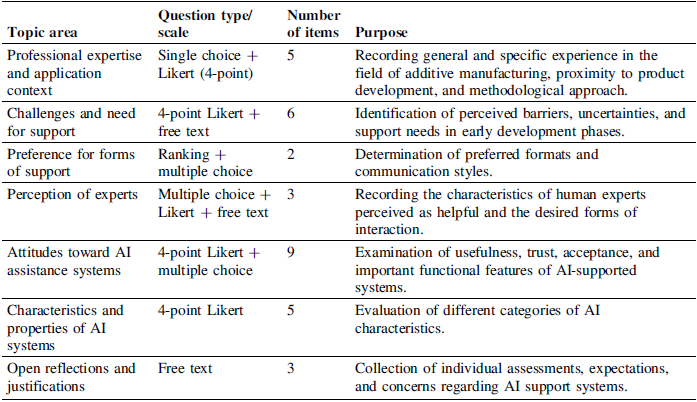
The questionnaire design consisted of seven thematic sections with a total of 34 items (see Table 1) and was theoretically aligned with models of technology acceptance (TAM, UTAUT) and concepts of learning-oriented support in the design context. The items were structured in a modular way and comprised a total of seven thematic sections (see Table 1). These covered the areas of professional background, previous experience with additive manufacturing, challenges in early development phases, desired type of support, perception of human experts, attitudes toward AI-based assistance systems, and open reflections.
Questionnaire design

3.1. Results
A total of 42 individuals participated in the survey. The participants work in various areas of product development, including research and development (59.5%), design engineering (42.9%), project management (38.1%), concept development (26.2%), manufacturing (23.8%), simulation and validation (19%), and product planning (16.7%). Additional fields of activity include production planning (11.9%), studies or vocational training (21.4%), and other areas (4.8%). Among all survey respondents, 30% reported occasional involvement in the design of product architectures for components and structures. A further 45% indicated frequent involvement, whereas 20% stated that they are rarely involved in such activities. Only 5% reported no involvement at all. The professional experience of activities related to product architecture design varies greatly. 15% have less than one year of experience, 20% have between one and two years of experience. The remaining respondents were evenly distributed, with 32.5% each having three to five years, and more than five years of relevant experience.
Only 16.7% have never used additive manufacturing either privately or professionally. Of the remaining participants, 57.1% stated that they had used it privately, and even 64.3% had already used it in a professional context. A total of 31.4% of AM users reported having designed or commissioned no more than ten components. Another 22.8% indicated experience with designing or commissioning between eleven and fifty components. Nearly half of the respondents (45.7%) stated that they had personally designed or commissioned more than fifty components. From the set of questions addressing the adaptation of components to specific AM-conditions, several notable findings emerged. Approximately 90% of participants with prior experience in additive manufacturing (AM) reported having modified design features such as wall thicknesses or overhangs to accommodate AM-related constraints. Moreover, around 75% of reported AM users indicated that they had substantially adapted the overall component design to leverage the capabilities of AM. However, more then 85% participant with AM experience considered themselves to have never fully exploited the potential offered by AM. Additionally, 77.8% (n = 36) indicate that they have encountered problems in the development of additively manufactured components while 60.5% (n = 38) would have wished for support in such situations. At the same time, 64.1% of respondents reported that they did not follow a systematic methodological approach. Moreover, more than half indicated that they were either unfamiliar with the term of Design for Additive Manufacturing (33.0%) or had only encountered it superficially (23.8%). 28.6% stated that they had previously applied DfAM, and 14.3% reported using DfAM on a regular basis. Even among the six participants who stated that they regularly use DfAM, four said that they do not usually take a methodical approach when developing components for additive manufacturing.
Regarding learning and interaction preferences, independent/autonomous familiarisation with new subject areas, only 17% consider them to be rather unimportant, while the remaining participants consider them to be rather important (42,5%) or very important (40%). A similar result is shown by the question regarding the importance of personal contact with an expert. Only one participant considered this unimportant. 12.5% considered personal contact to be rather unimportant, 40% considered it rather important and 45% considered it very important. No participant would reject working with a chatbot to learn about new subjects in the field of DfAM. However, just under 20% would rate their willingness as low. More than twice as many participants (43.9%) indicate a high willingness, and a good third (36.3%) even rate it as very high. In open responses, negative experiences in aspects such as reliability, misinformation, inconsistent outputs, data quality, and transparency are mentioned. There is a tendency for participants with more professional experience to indicate less willingness to use an AI tool to explore the topic of DfAM in more depth. Only around 17 percent of participants with more than 5 years of experience in product development say they would be willing to do so. Among those with 3-5 years of professional experience, the figure was 33 percent, and among those with up to two years of professional experience, it was as high as 43 percent.
Novices require primarily cognitive orientation in early development phases
Regarding DfAM-related challenges, 77.8% of participants report having encountered problems during the development of additively manufactured components, and 60.5% would have wished for support in such situations. Moreover, 64.1% state that they do not follow a methodological approach, while 86.8% indicate that the potential of additive manufacturing has not yet been fully exploited. Among the desired functions of a potential AI tool, method suggestions (71.4%), support in problem analysis (64.3%), and cues toward relevant questions (64.3%) are mentioned in particular. Feedback on the planned application of unfamiliar methodological approaches is rated with a mean value of 3.1 (dev. = 0.8; n = 35); overall, 85.9% assess the corresponding item as important or very important. In open responses, feedback, guided practice, visualisations of processes, and indications of potential sources of error are mentioned.
Useful features of an AI tool (n=42)

Building trust requires communication that is traceable and responsively designed
The characteristics of human experts that are most often rated as important are expertise in the field of additive manufacturing (66.7%), clear communication (59.5%) and experience (54.8%). In fourth place are teaching skills (45.2%) and in fifth place, practical examples (42.9%). Open-ended responses also mention transparent thought processes, the presentation of solutions and objective feedback. In addition, uncertainties regarding possible misinformation and the consistency of results are mentioned. Another major issue for respondents appears to be cyber security, which was mentioned very frequently. It was also emphasised that a critical evaluation of the results is necessary and only possible if the user is able to verify every statement made by the AI tool.
Valued expert qualities (n=42)

Perceived autonomy significantly influences the acceptance of support systems
A large majority of participants (<80%) state that taking individual project goals into account is important or very important and that familiarisation with new subject areas should be a personal responsibility. This is also reflected in the participants’ highest-rated statement that an AI tool should suggest methods (71.4%), and only a quarter of participants do not consider it important that there should be a choice of several alternatives. Furthermore, only around 5% of respondents stated that it would be unacceptable or rather unacceptable to them if an AI tool did not provide perfect solutions, but only hints or guidance. One participant notes concerns about autonomy, as it is suspected that the dependence on a limited and unrepresented solution space may influence certain methodological approaches.
The accepted use of AI assistance systems requires technical availability and reliability
The willingness to use a chatbot is demonstrated, among other things, by the fact that no one would rule out working with a chatbot per se. In addition, 23.8% cite the availability of an expert or assistance system as a relevant factor for the use of DfAM methods. Around a third of participants say that reliability is particularly important when it comes to experts. In open-ended responses, requirements for AI systems such as reliability, transparent functionality, consistent results, error-free output and access to a sufficiently large knowledge base are mentioned. In addition, negative experiences are reported, particularly with regard to incomplete, inaccurate or difficult to understand information.
For AI systems, professional competence and a correct knowledge base take precedence, not interpersonal qualities
The rating of different characteristics of an AI tool that mimics expert characteristics has shown that cognitive attributes are of high importance to most respondents. Only around 10% stated that these were not very important or not important at all. When it came to ethical/moral attributes, a large majority (around 75%) stated that these attributes were important to them. The respondents considered a visually human appearance and emotional characteristics (e.g. empathy) to be the least important. There is considerable disagreement regarding social/communicative characteristics (e.g. politeness, social norms). These are considered important by 11.9%, but a majority of 35.7% consider them to be rather unimportant and 28.6% consider them to be very unimportant.
The free-text responses show that a stable and complete knowledge base is a fundamental prerequisite for trust in such a system. In their view, it should not be ‘human’ but should point out possible uncertainties and sources through clear communication.
Indicated importance of mimic human interactions by an AI tool

4. Discussion
Support needs and challenges of DfAM novices
The study shows that novices experience considerable uncertainty and a lack of methodological orientation during early DfAM phases. Around four-fifths of respondents report difficulties with AM development tasks, and more than 60% would like additional support in such situations. At the same time, many participants work without a methodological approach and consider the potential of AM in their past projects as largely untapped. However, their need for support does not primarily concern technical knowledge, but cognitive orientation: desired are method suggestions, assistance with problem analysis, and cues toward relevant questions. Open comments emphasise feedback, guided practice, visualization of decision-making processes, and indications of typical errors. What is needed, therefore, is a form of support that fulfills both process-related and metacognitive functions – no ready-made solutions, but transparent, well-reasoned, decision-oriented guidance.
Characteristics of human experts that are particularly valued
The most frequently mentioned expert characteristics are technical competence, clear communication, experience, didactic skills, and practice-oriented examples. These qualities are less socio-emotional and primarily cognitive-explanatory. Novices appreciate clear structure, traceable thought processes, and context-related interpretation. For AI systems, this means they do not need to imitate social interaction, but should provide functions that reflect the cognitive qualities of human expertise: problem structuring, relevance cues, application context, and transparent decision logics. As many novices struggle to formulate suitable questions themselves, AI should also actively contribute to clarifying the problem.
Perceived role and acceptance of AI systems
Attitudes toward AI in DfAM are generally positive; at the same time, acceptance is clearly tied to conditions. The central prerequisite is reliability: AI outputs should be correct, consistent, up to date, and traceable. Frequently mentioned concerns relate to generic, imprecise, or contradictory answers as well as a lack of transparency. In the DfAM context, AI is understood primarily as a cognitive tool, not as a social interaction partner. Accordingly, cognitive characteristics such as analytical capability and methodological guidance receive the highest ratings, while social, emotional, or anthropomorphic qualities are of little relevance. Trust in AI is therefore based more on technical correctness and transparency than on human-like interaction.
Importance of autonomy for acceptance
A key finding is the importance of autonomy. Ninety-five percent accept AI support in the form of cues, guiding questions, or methodological suggestions, whereas ready-made solutions are viewed much more critically. Novices prefer support that strengthens their decision-making ability rather than replacing decisions. This aligns with acceptance models such as UTAUT(-AI). The results can be placed within a classification of this approach, which describes the role of AI from a tool to a decision-making authority. Qualitative responses likewise show a desire for guided practice, discussions, feedback, and flexible but non-directive support. Accordingly, AI in DfAM should be designed as a cognitive coach – a form of guidance that highlights options, marks risks, and structures thinking processes. Other opinions in this survey suggest that it is more desirable as a passive tool, as trust is currently limited due to negative experiences in the past.
Conditions for trust in an AI system
Trust is a fundamental prerequisite for the use of AI. It is based primarily on epistemic criteria: correctness, clarity, traceability, and transparency regarding uncertainties. Users explicitly request indications of limitations or alternative interpretations; answers that appear authoritative but are unclear undermine trust. Systems that foster trust must therefore provide understandable explanations, disclose sources and assumptions, make uncertainties visible, avoid generic outputs, and minimize inconsistencies – for example through knowledge-based approaches or context-related validation.
Which AI functions are particularly valuable in the DfAM context?
The most important AI functions are methodological guidance, support in problem analysis, and cues toward relevant questions. These directly reflect the central challenges of DfAM novices. Cognitive characteristics are rated highest overall, while social or emotional aspects play hardly any role. AI is thus understood as a cognitive co-pilot that structures complex information, opens perspectives, and makes decision paths transparent – not as a human-like interaction partner.
Methodological implications and limitations
The study follows an exploratory mixed-methods approach. With regard to the global distribution, age and precise use of AI by participants, the study lacks information that would be necessary to generalise the results for a specific user group. The sample (N = 42) does not allow for representativeness, but it does reveal clear patterns in needs, preferences, and acceptance criteria. The results align well with established acceptance models (TAM, UTAUT, UTAUT-AI) and extend them with specific requirements for the early DfAM phase, particularly the need for cognitive orientation and guided decision-making. The participants were recruited manually, which leads to sampling bias; however, the participants exhibit the most important characteristics to be relevant for this study. The participants demonstrate varying levels of expertise in different areas (e.g., AM experience, DfAM experience, designing). However, with the exception of a few participants, all can be classified as novices in the field of DfAM, and only a few are not involved in decisions relating to product architecture in a professional context. Here, even 65% of regular users of DfAM (who could be considered DfAM experts) stated that they tended not to take a methodical approach when developing components for AM. And around 83% stated that they did not feel they had already exploited the potential of AM and would have liked support in achieving this.
Limitations arise from subjective self-reports within the likert-skala, and the focus on expectations rather than actual interactions. When deriving the results with regard to an AI tool to support DfAM, there are a number of aspects to consider. On the one hand, the design of the AI tool was not clearly described in order to minimise any preconceptions and influence on how participants might prefer to imagine such an approach. However, this also leaves a lot of room for interpretation. This space can be filled all the more with previous experiences. And according to the participants, these previous experiences with AI are sometimes strongly influenced by bad experiences (e.g. misinformation). A seemingly greater affinity among participants with less experience, and probably also among younger participants, suggests that the individual experiences of potential users could continue to increase more strongly in the future. If this survey had been conducted at a slightly later date, the perceptions and trust in AI might have been different. In this study, the early phases are described as those whose activities deal with the development of the product architecture. This term was also explained to avoid misunderstandings. Further, clearer definitions were avoided so as not to overwhelm participants with too much information.
5. Conclusion and outlook
This study set out to explore how novices in Design for Additive Manufacturing (DfAM) perceive expert behaviour, how they evaluate the substitution of a human expert by an AI system, and which characteristics of expertise should be replicated in AI-supported design assistance. By addressing these questions (RQ1–RQ3), the work provides a nuanced understanding of the cognitive, communicative, and trust-related factors that shape the acceptance of AI-based expert substitutes in early product development.
With respect to RQ1, the findings reveal that novices primarily value cognitive and explanatory characteristics in an AI-tool. Participants emphasise domain-specific competence, clear and structured communication, didactic skills, and practice-oriented examples. These preferences show a strong focus on metacognitive guidance: novices do not only seek information, but orientation in reasoning processes, transparency in decision pathways, and support in structuring complex design problems. Emotional or interpersonal qualities, by contrast, play only a minor role. This indicates that effective DfAM support must prioritise clarity, traceability, and cognitive scaffolding rather than social imitation. Furthermore, expert should be expected to value honesty more highly than the good feeling that unfulfillable promises can trigger in novices. Both human experts and AI systems rate empathy lowest in this regard. A beautifully worded untruth may be comforting in the short term, but it does not bring about real progress when accurate and reliable information is crucial.
Addressing RQ2, the results show generally positive attitudes toward AI systems, but acceptance is highly conditional. Trust in AI depends heavily on technical reliability, transparency, and the quality of its knowledge base. Participants express concerns regarding misinformation, inconsistent outputs, and opaque reasoning. At the same time, AI is predominantly perceived as a cognitive tool rather than a human-like interaction partner. Autonomy emerges as a key factor: novices prefer AI that assists, structures, and guides, but does not prescribe decisions or replace their agency. These insights align with findings from technology acceptance models and emphasise the importance of epistemic trustworthiness over social mimicry.
The user’s autonomy should always be preserved. At the same time, an AI-tool that is used as a teaching aid has also an educational purpose. This includes occasionally taking the user out of their comfort zone, but in a way that challenges them without overwhelming or discouraging them.
Regarding RQ3, the study indicates that the most valued expert characteristics can indeed be modelled within AI-supported frameworks, particularly aspects such as structured reasoning, relevance cues, problem analysis, and methodological suggestions. However, to emulate the qualities novices expect from expert support, AI-tools must be designed to make thought processes explicit, adapt explanations to user needs, and transparently communicate uncertainties or limitations. The findings show that replicating cognitive expert attributes is both feasible and highly relevant, whereas socio-emotional attributes appear unnecessary for this application context.
Overall, the results underscore that AI-based design support in DfAM should be conceptualised as a cognitive copilot: a system that structures decision-making, offers methodological orientation, and provides context-sensitive guidance, rather than as a socially anthropomorphised expert substitute. The study thus offers a foundation for designing AI-mediated frameworks that align with novice expectations and learning preferences, while also identifying key requirements for trust, reliability, and acceptance.
Future research should extend the exploratory insights through empirical validation using interactive prototypes. Such studies could investigate how novices behave during real design tasks when supported by AI, how trust evolves over time, and which interaction patterns lead to effective learning and decision-making. In this study, it would have been interesting to delve a little deeper into the sometimes negative experiences with AI and learn more about how these arose. Whether this was due to a limitation of the AI used or whether a lack of structure and restriction of the AI used was the reason. In addition, further work is needed to operationalise and evaluate mechanisms for transparent explanations, uncertainty communication, and structured problem analysis within AI systems. Expanding the knowledge base through tightly integrated, domain-specific repositories may further enhance reliability and reduce the risk of incorrect outputs. Ultimately, robust prototyping and longitudinal evaluation will be essential to determine how AI-supported expert systems can meaningfully complement human expertise and foster more effective, accessible, and systematic DfAM use in early product development.


 Open access

