





Introduction
Major depressive disorder (MDD) is one of the leading causes of disability worldwide, characterized by persistent low mood, anhedonia, and significant impairments in cognitive and emotional functioning (Hasin et al., Reference Hasin, Sarvet, Meyers, Saha, Ruan, Stohl and Grant2018). In addition to affective symptoms, individuals with MDD frequently exhibit deficits in emotion regulation, reward processing, and working memory, which contribute to substantial impairment in social, occupational, and daily life activities (Campbell et al., Reference Campbell, Green, Davies, Demou, Howe, Harrison, Smith, Howard, McIntosh, Munafò and Katikireddi2022; Marx et al., Reference Marx, Penninx, Solmi, Furukawa, Firth, Carvalho and Berk2023). Globally, MDD affects ~4–5% of the population, imposing a significant public health burden (Yan et al., Reference Yan, Zhang, Wang, Yan, Liu, Tian and Tian2024).
The underlying neural mechanisms of MDD-related dysfunctions involve abnormalities in large-scale brain networks, including the default mode network, emotion processing network, executive function network, and reward network (An et al., Reference An, Tang, Xie, Tong, Liu, Tao and Feng2024). Key brain regions implicated in these networks – such as the parahippocampal gyrus, anterior cingulate cortex, middle frontal gyrus, lentiform nucleus, claustrum, and caudate nucleus – play critical roles in cognitive control, emotional regulation, and reward evaluation (Gao et al., Reference Gao, Feng, Ouyang, Zhou, Bao, Li, Zhuo, Hu, Li, Zhang, Huang and Huang2024; Long et al., Reference Long, Qin, Pan, Fan and Li2024). Dysfunction in these circuits has been linked to working memory impairments, emotional dysregulation, and diminished reward sensitivity, which are central to MDD pathophysiology (Ling et al., Reference Ling, Cancan, Xinyi, Dandan, Haisan, Hongxing and Chunming2024; Zhao et al., Reference Zhao, Wu, Li, Liu, Lu, Lin and Shao2024).
Despite substantial evidence suggesting prefrontal cortex dysfunction during working memory tasks in MDD, existing findings remain inconsistent (Harvey et al., Reference Harvey, Fossati, Pochon, Levy, LeBastard, Lehéricy and Dubois2005; Kerestes et al., Reference Kerestes, Bhagwagar, Nathan, Meda, Ladouceur, Maloney and Blumberg2012a; Matsuo et al., Reference Matsuo, Glahn, Peluso, Hatch, Monkul, Najt, Sanches, Zamarripa, Li, Lancaster, Fox, Gao and Soares2007). Some studies report reduced dorsolateral prefrontal cortex activation, suggesting impaired executive function and cognitive control (Kerestes et al., Reference Kerestes, Ladouceur, Meda, Nathan, Blumberg, Maloney, Ruf, Saricicek, Pearlson, Bhagwagar and Phillips2012b). Conversely, other studies have identified hyperactivation of the left dorsolateral prefrontal cortex, which may reflect compensatory recruitment of neural resources (Harvey et al., Reference Harvey, Fossati, Pochon, Levy, LeBastard, Lehéricy and Dubois2005; Matsuo et al., Reference Matsuo, Glahn, Peluso, Hatch, Monkul, Najt, Sanches, Zamarripa, Li, Lancaster, Fox, Gao and Soares2007). Harvey et al. (Reference Harvey, Fossati, Pochon, Levy, LeBastard, Lehéricy and Dubois2005) found that increased prefrontal activation during an N-back task correlated with greater cognitive effort in MDD individuals. Furthermore, pharmacological studies indicate that vortioxetine, an antidepressant, reduces right dorsolateral prefrontal cortex and left hippocampal activation during working memory tasks, suggesting a potential role for pharmacological interventions in modulating brain function (Fan et al., Reference Fan, Li, Du, Yan, Ni, Wei, Zhao, Yang and Ma2024; Smith et al., Reference Smith, Browning, Conen, Smallman, Buchbjerg, Larsen, Olsen, Christensen, Dawson, Deakin, Hawkins, Morris, Goodwin and Harmer2018). These inconsistencies may stem from differences in experimental paradigms, sample characteristics, or methodological approaches, highlighting the complexity and variability of prefrontal circuit alterations in MDD.
Reward processing deficits in MDD are similarly heterogeneous. Some studies have found increased activation in the bilateral anterior cingulate cortex, right middle frontal gyrus, and right cerebellum during reward anticipation (Dichter, Kozink, McClernon, & Smoski, Reference Dichter, Kozink, McClernon and Smoski2012). Others report heightened right putamen activation in response to monetary and pleasant stimuli, suggesting differential neural responses to reward types (Schiller, Minkel, Smoski, & Dichter, Reference Schiller, Minkel, Smoski and Dichter2013; Smoski, Rittenberg, & Dichter, Reference Smoski, Rittenberg and Dichter2011). Recent meta-analyses indicate that, beyond the striatal and anterior cingulate regions, MDD individuals also show enhanced activation in the posterior cingulate cortex, insula, and supplementary motor area during reward-related tasks (Bartra, McGuire, & Kable, Reference Bartra, McGuire and Kable2013; Sescousse, Caldú, Segura, & Dreher, Reference Sescousse, Caldú, Segura and Dreher2013). However, Smoski et al. (Reference Smoski, Felder, Bizzell, Green, Ernst, Lynch and Dichter2009) reported reduced anterior cingulate cortex and subgenual cingulate activation during reward anticipation, suggesting stage-dependent abnormalities in reward processing. Dysfunction in key reward-related regions, such as the nucleus accumbens, caudate, and putamen, varies based on whether MDD individuals process monetary rewards or social incentives (Keren et al., Reference Keren, O’Callaghan, Vidal-Ribas, Buzzell, Brotman, Leibenluft, Pan, Meffert, Kaiser, Wolke, Pine and Stringaris2018; Ng, Alloy, & Smith, Reference Ng, Alloy and Smith2019; Zhang et al., Reference Zhang, Chang, Guo, Zhang and Wang2013). These findings underscore the complex and task-dependent nature of reward processing deficits in MDD.
Emotion processing impairments in MDD are consistently associated with hyperactivation in the parahippocampal gyrus, insula, and caudate nucleus (Lemke et al., Reference Lemke, Probst, Warneke, Waltemate, Winter, Thiel, Meinert, Enneking, Breuer, Klug, Goltermann, Hülsmann, Grotegerd, Redlich, Dohm, Leehr, Repple, Opel, Brosch, Meller and Dannlowski2022; Schräder et al., Reference Schräder, Herzberg, Jo, Hernandez-Pena, Koch, Habel and Wagels2024; Tak et al., Reference Tak, Lee, Park, Cheong, Seok, Sohn and Cheong2021). Increased parahippocampal gyrus activation has been linked to dysregulated emotional memory processing, potentially exacerbating negative emotional biases in MDD (Tak et al., Reference Tak, Lee, Park, Cheong, Seok, Sohn and Cheong2021). Similarly, heightened activity in the amygdala (Schräder et al., Reference Schräder, Herzberg, Jo, Hernandez-Pena, Koch, Habel and Wagels2024), insula (Lemke et al., Reference Lemke, Probst, Warneke, Waltemate, Winter, Thiel, Meinert, Enneking, Breuer, Klug, Goltermann, Hülsmann, Grotegerd, Redlich, Dohm, Leehr, Repple, Opel, Brosch, Meller and Dannlowski2022), and superior temporal gyrus (Koch et al., Reference Koch, Stegmaier, Schwarz, Erb, Reinl, Scheffler, Wildgruber and Ethofer2018) suggests exaggerated responses to emotionally salient stimuli. However, findings on anterior cingulate cortex activation remain inconsistent, while some studies report reduced anterior cingulate activation during emotional regulation tasks (Alders et al., Reference Alders, Davis, MacQueen, Strother, Hassel, Zamyadi, Sharma, Arnott, Downar, Harris, Lam, Milev, Müller, Ravindran, Kennedy, Frey, Minuzzi and Hall2019; Zhang et al., Reference Zhang, Wu, Pei, Ma, Dong, Gao and Zhang2022a,Reference Zhang, Zhang, Ma, Qi, Wang and Taob). However, findings regarding anterior cingulate cortex activation remain inconsistent. Some studies report reduced anterior cingulate cortex activation during emotion regulation tasks, suggesting impaired top-down control of emotional responses (Alders et al., Reference Alders, Davis, MacQueen, Strother, Hassel, Zamyadi, Sharma, Arnott, Downar, Harris, Lam, Milev, Müller, Ravindran, Kennedy, Frey, Minuzzi and Hall2019; Zhang et al., Reference Zhang, Wu, Pei, Ma, Dong, Gao and Zhang2022a,Reference Zhang, Zhang, Ma, Qi, Wang and Taob). Moreover, discrepancies exist in neural responses to negative emotional stimuli between MDD patients and healthy controls (HCs) (Alders et al., Reference Alders, Davis, MacQueen, Strother, Hassel, Zamyadi, Sharma, Arnott, Downar, Harris, Lam, Milev, Müller, Ravindran, Kennedy, Frey, Minuzzi and Hall2019; Aust et al., Reference Aust, Filip, Koelsch, Grimm and Bajbouj2013; Zhang et al., Reference Zhang, Wu, Pei, Ma, Dong, Gao and Zhang2022a,Reference Zhang, Zhang, Ma, Qi, Wang and Taob). For instance, diminished activation has been observed in the anterior cingulate cortex, right inferior temporal gyrus, lateral occipital cortex, and fusiform gyrus in response to positive stimuli (Alders et al., Reference Alders, Davis, MacQueen, Strother, Hassel, Zamyadi, Sharma, Arnott, Downar, Harris, Lam, Milev, Müller, Ravindran, Kennedy, Frey, Minuzzi and Hall2019). Additionally, MDD patients exhibit significantly lower accuracy in emotional conflict tasks, along with reduced engagement of key neural regions involved in facial perception and emotional processing, although their differential responses to fearful and happy facial expressions remain nonsignificant (Alders et al., Reference Alders, Davis, MacQueen, Strother, Hassel, Zamyadi, Sharma, Arnott, Downar, Harris, Lam, Milev, Müller, Ravindran, Kennedy, Frey, Minuzzi and Hall2019). While abnormal neural activation in emotion processing is consistently reported in MDD, findings remain heterogeneous.
Functional magnetic resonance imaging (fMRI) has emerged as a pivotal tool for elucidating the neural underpinnings of cognitive and emotional dysfunctions in MDD. Despite extensive research, findings remain inconsistent, with reported variability in brain activation patterns across different regions and task paradigms. This heterogeneity has hindered the development of a unified model of MDD-related neural alterations. To address these discrepancies, a comprehensive meta-analysis is essential for synthesizing existing evidence and identifying consistent neural correlates of working memory, reward processing, and emotion regulation in MDD. Therefore, we conducted a systematic review and activation likelihood estimation (ALE) meta-analysis of fMRI studies to provide a more robust and integrative understanding of the functional brain networks implicated in MDD, with a particular focus on the brain networks involved.
Methods
Literature search and selection
Study selection was conducted in accordance with the PRISMA guidelines (Radua et al., Reference Radua, Rubia, Canales-Rodríguez, Pomarol-Clotet, Fusar-Poli and Mataix-Cols2014) (Supplementary Material 1). This review was registered with PROSPERO (CRD42025639318). Systematic search was conducted for relevant studies in the PubMed, Embase, Web of Knowledge, ScienceDirect, and CNKI databases up to 3 December 2024. We used the following key words (using both free-text and MeSH search): ((“fMRI”[tw] OR “f mri”[tw] OR fmr imag*[tw] OR functional magnetic*[tw] OR “functional magnetic resonance imaging”[tw] OR “functional mri”[tw] OR “functional mr”[tw] OR (“Magnetic Resonance Imaging”[mesh] AND “functional”[tw]) OR ((“Magnetic Resonance Imaging”[mesh] OR MR imag*[tw] OR “MRI”[tw] OR “magnetic resonance”[tw]) AND (“Functional Neuroimaging”[Mesh:noexp] OR functional imag*[tw] OR functional neuroimag*[tw]))) AND (“depression”[Mesh] OR “Depressive Disorder”[Mesh] OR “depression”[tw] OR “Depressive Disorder”[tw] OR “major depressive disorder”[tw] OR “major depression”[tw] OR “depressive”[tw] OR “depressed”[tw] OR “depression neurosis”[tw] OR “melancholia”[tw] OR Depressive disorder* [tw] OR depress* [tw] OR depression disease* [tw] OR depressive disease* [tw] OR “Depression Disease” [tw] OR depressive Disease*[tw]) NOT (“Animals”[mesh] NOT “Humans”[mesh]).
Studies were considered eligible according to the following criteria: (1) task-related fMRI studies on MDD; (2) reporting of whole-brain analyses results in standard stereotaxic space (Montreal Neuroimaging Institute [MNI] or Talairach); (3) with populations aged ≥18 years; (4) studies had to include a task assessing at least one of the domains (i.e. working memory, reward processing, or emotion processing); and (5) studies that compared adult individuals with MDD with HCs. Exclusion criteria included: (1) might influence brain function and any contraindications for receiving an MRI scan; (2) literature reviews, systematic reviews, meta-analyses, methodological articles, case reports, letters, conference abstracts, and editorials were excluded; (3) studies using only region of interest or seed voxel-based analyses; and (4) no reported coordinates. Two physicians independently conducted the literature search, and disagreements were managed by discussion to reach a consensus. Finally, the studies were grouped into at least one of the three domains.
Data extraction
Data were extracted by two independent investigators (QZ and YZH). Information was extracted from each experiment on (1) the first author’s name, publication year, patient, and control demographics (age, sex, and sample size); (2) medication situation and task type (working memory, reward, or emotional); (3) peak MNI or Talairach coordinates (x, y, z); (4) Depression severity and comorbidity. Coordinates reported in Talairach space were converted to MNI space for consistent analysis. These coordinates were subsequently utilized for the ALE meta-analysis.
Quality and risk of bias assessments
To evaluate the methodological rigor of the included studies, we employed the Newcastle–Ottawa Quality Assessment Scale (NOS), a standardized instrument for assessing nonrandomized studies. Based on the total score, the risk of bias (ROB) was classified into three categories: low (7–9), moderate (4–6), and high (<4).
In addition, we referred to the domains outlined in the ROB 2 tool, developed by the Cochrane Collaboration. These domains include participant selection, deviations from intended interventions, handling of missing data, outcome measurements, and the selection of reported results. Each domain was rated as ‘low risk’, ‘some concerns’, or ‘high risk’, and an overall risk judgment was made accordingly. The quality assessments were independently conducted by two authors (QZ and YZH), and any discrepancies were resolved through discussions and consultations with other team members.
ALE meta-analysis
Meta-analysis were conducted using GingerALE 3.0.2 software ( http://brainmap.org/ale/ ) (Moser et al., Reference Moser, Doucet, Lee, Rasgon, Krinsky, Leibu, Ing, Schumann, Rasgon and Frangou2018). First, all coordinates were automatically converted to MNI using GingerALE Talaraich to MNI built-in converter. Then, differences in brain activation among regions associated with each domain were analyzed separately using the ALE method. The ALE approach uses modeling of activation locations (foci) by a three-dimensional Gaussian function, calculating the overlap of the distributions across experiments using the spatial uncertainty of the foci. It forms a probabilistic map of the likelihood that each voxel was activated by an experiment. The analyses for each domain involved two analyses of contrasts. First, we analyzed the activation in brain areas that were more active in the brains of individuals with MDD compared to HCs, indicating hyperactivation in individuals with MDD. Second, we analyzed the activation in brain areas that were more active in the brains of HCs compared to MDD, indicating hypoactivation in MDD. The resulting thresholded ALE map was then computed using a cluster-forming threshold of p < 0.001 and a cluster-level threshold of p < 0.05 with a minimum cluster size of suprathreshold voxels exceeding 50 mm3 (Eickhoff et al., Reference Eickhoff, Nichols, Laird, Hoffstaedter, Amunts, Fox, Bzdok and Eickhoff2016).
Although all included studies reported sex distribution, the absence of sex-specific activation coordinates prevented a dedicated sex-stratified ALE analysis.
Jackknife sensitivity and meta-regression analyses
A Jackknife sensitivity analysis was performed using GingerALE 2.3 software to assess the robustness of the results. Specifically, each study was systematically excluded one at a time, and the ALE meta-analysis was recalculated on the remaining data to evaluate the influence of individual studies on the overall spatial convergence patterns. Initially, the Jackknife analysis was conducted for all task types to examine the overall replicability of the results. Subsequently, separate analyses were performed for working memory tasks, reward tasks, and emotion tasks, with each analysis repeated N times, excluding one study per iteration. Brain regions that remained significant across the majority of iterations were considered stable and highly reliable.
A meta-regression analysis was performed using SDM-PSI 6.21 to assess whether study-level covariates – including age, gender distribution, medication status, depression severity, and comorbidities – significantly contributed to the variability of the observed effects.
Control for task heterogeneity
Given the inherent variability in task designs and stimulus types across the included studies, which may contribute to heterogeneity in the observed activation patterns, several methodological strategies were implemented to minimize potential confounding factors (Hasin et al., Reference Hasin, Sarvet, Meyers, Saha, Ruan, Stohl and Grant2018). Only task-based fMRI studies that reported whole-brain analyses in standard stereotaxic space were included, ensuring consistency in methodology across different paradigms (Marx et al., Reference Marx, Penninx, Solmi, Furukawa, Firth, Carvalho and Berk2023). The studies were categorized into three primary functional domains – working memory, reward processing, and emotion processing. Separate ALE analyses were performed for each domain to reduce cross-task variability (Campbell et al., Reference Campbell, Green, Davies, Demou, Howe, Harrison, Smith, Howard, McIntosh, Munafò and Katikireddi2022). Jackknife sensitivity analyses were conducted to assess the stability of the primary activation clusters, ensuring that the findings were not driven by any single study or task paradigm.
Results
Literature search
A total of 8,946 articles were retrieved through the search, of which 69 (including 14 studies on working memory, 14 studies on reward processing, and 41 studies on emotion processing) met the inclusion criteria for the meta-analysis (Figure 1) (Aizenstein et al., Reference Aizenstein, Andreescu, Edelman, Cochran, Price, Butters and Reynolds2011; Alders et al., Reference Alders, Davis, MacQueen, Strother, Hassel, Zamyadi, Sharma, Arnott, Downar, Harris, Lam, Milev, Müller, Ravindran, Kennedy, Frey, Minuzzi and Hall2019; Anderson et al., Reference Anderson, Juhasz, Thomas, Downey, McKie, Deakin and Elliott2011; Beauregard, Paquette, & Lévesque, Reference Beauregard, Paquette and Lévesque2006; Brassen et al., Reference Brassen, Kalisch, Weber-Fahr, Braus and Büchel2008; Cao et al., Reference Cao, Liao, Cai, Peng, Liu, Zheng, Liu, Zhong, Tan and Yi2021; Chechko et al., Reference Chechko, Augustin, Zvyagintsev, Schneider, Habel and Kellermann2013; Dichter et al., Reference Dichter, Kozink, McClernon and Smoski2012; Dillon, Dobbins, & Pizzagalli, Reference Dillon, Dobbins and Pizzagalli2014; Enneking et al., Reference Enneking, Dzvonyar, Dück, Dohm, Grotegerd, Förster and Redlich2020; Fales et al., Reference Fales, Barch, Rundle, Mintun, Snyder, Cohen and Sheline2008; Fang et al., Reference Fang, Lynn, Huc, Fogel, Knott and Jaworska2022; Feeser et al., Reference Feeser, Schlagenhauf, Sterzer, Park, Stoy, Gutwinski and Bermpohl2013; Frodl et al., Reference Frodl, Scheuerecker, Albrecht, Kleemann, Müller-Schunk, Koutsouleris and Meisenzahl2009; Furey et al., Reference Furey, Drevets, Hoffman, Frankel, Speer and Zarate2013; Goodin et al., Reference Goodin, Lamp, Hughes, Rossell and Ciorciari2019; Gotlib et al., Reference Gotlib, Sivers, Gabrieli, Whitfield-Gabrieli, Goldin, Minor and Canli2005; Grimm et al., Reference Grimm, Beck, Schuepbach, Hell, Boesiger, Bermpohl and Northoff2008; Hall, Milne, & Macqueen, Reference Hall, Milne and Macqueen2014; Harvey et al., Reference Harvey, Fossati, Pochon, Levy, LeBastard, Lehéricy and Dubois2005; Hempel et al., Reference Hempel, Barnhofer, Domke, Hartling, Stippl, Carstens and Grimm2024; Hooley et al., Reference Hooley, Gruber, Parker, Guillaumot, Rogowska and Yurgelun-Todd2009; Huang et al., Reference Huang, Fan, Lee, Liu, Chen, Lin and Lee2019; Kalin et al., Reference Kalin, Davidson, Irwin, Warner, Orendi, Sutton, Mock, Sorenson, Lowe and Turski1997; Keller et al., Reference Keller, Zweerings, Klasen, Zvyagintsev, Iglesias, Mendoza Quiñones and Mathiak2021; Kerestes et al., Reference Kerestes, Bhagwagar, Nathan, Meda, Ladouceur, Maloney and Blumberg2012a; Klug et al., Reference Klug, Enneking, Borgers, Jacobs, Dohm, Kraus and Redlich2024; Koch et al., Reference Koch, Stegmaier, Schwarz, Erb, Reinl, Scheffler, Wildgruber and Ethofer2018; Korgaonkar et al., Reference Korgaonkar, Grieve, Etkin, Koslow and Williams2013; Le et al., Reference Le, Borghi, Kujawa, Klein and Leung2017; Lee et al., Reference Lee, Liu, Wai, Ko and Lee2013; Lemke et al., Reference Lemke, Probst, Warneke, Waltemate, Winter, Thiel, Meinert, Enneking, Breuer, Klug, Goltermann, Hülsmann, Grotegerd, Redlich, Dohm, Leehr, Repple, Opel, Brosch, Meller and Dannlowski2022; Li et al., 2013; Ma et al., Reference Ma, Zhang, Zhang, Su, Yan, Tan, Zhang and Yue2021; Mannie et al., Reference Mannie, Taylor, Harmer, Cowen and Norbury2011; Martin-Soelch et al., Reference Martin-Soelch, Guillod, Gaillard, Recabarren, Federspiel, Mueller-Pfeiffer, Homan, Hasler, Schoebi, Horsch and Gomez2021; Matsuo et al., Reference Matsuo, Glahn, Peluso, Hatch, Monkul, Najt, Sanches, Zamarripa, Li, Lancaster, Fox, Gao and Soares2007; Mielacher et al., Reference Mielacher, Scheele, Kiebs, Schmitt, Dellert, Philipsen, Lamm and Hurlemann2024; Miskowiak et al., Reference Miskowiak, Glerup, Vestbo, Harmer, Reinecke, Macoveanu and Vinberg2015; Mitterschiffthaler et al., Reference Mitterschiffthaler, Williams, Walsh, Cleare, Donaldson, Scott and Fu2008; Murrough et al., Reference Murrough, Collins, Fields, DeWilde, Phillips, Mathew and Iosifescu2015; Norbury, Godlewska, & Cowen, Reference Norbury, Godlewska and Cowen2014; Ritchey et al., Reference Ritchey, Dolcos, Eddington, Strauman and Cabeza2011; Roiser et al., Reference Roiser, Levy, Fromm, Nugent, Talagala, Hasler and Drevets2009; Rosenblau et al., Reference Rosenblau, Sterzer, Stoy, Park, Friedel, Heinz and Ströhle2012; Rupprechter et al., Reference Rupprechter, Stankevicius, Huys, Series and Steele2021; Schiller et al., Reference Schiller, Minkel, Smoski and Dichter2013; Schöning et al., Reference Schöning, Zwitserlood, Engelien, Behnken, Kugel, Schiffbauer, Lipina, Pachur, Kersting, Dannlowski, Baune, Zwanzger, Reker, Heindel, Arolt and Konrad2009; Schräder et al., 2024; Schwefel et al., Reference Schwefel, Kaufmann, Gutmann, Henze, Fydrich, Rapp and Heinzel2023; Shi et al., Reference Shi, Wang, Yi, Zhu, Zhang, Yang and Yao2015; Smith et al., Reference Smith, Browning, Conen, Smallman, Buchbjerg, Larsen, Olsen, Christensen, Dawson, Deakin, Hawkins, Morris, Goodwin and Harmer2018; Smoski et al., Reference Smoski, Felder, Bizzell, Green, Ernst, Lynch and Dichter2009, Reference Smoski, Rittenberg and Dichter2011; Tak et al., 2021; Takamura et al., Reference Takamura, Okamoto, Okada, Toki, Yamamoto, Ichikawa, Mori, Minagawa, Takaishi, Fujii, Kaichi, Akiyama, Awai and Yamawaki2017; Taylor et al., Reference Taylor, Stein, Simmons, He, Oveis, Shakya, Sieber, Fowler and Jain2024; Ubl et al., Reference Ubl, Kuehner, Kirsch, Ruttorf, Flor and Diener2015; Vasic, Walter, Sambataro, & Wolf, Reference Vasic, Walter, Sambataro and Wolf2009; Victor et al., Reference Victor, Furey, Fromm, Öhman and Drevets2010, Reference Victor, Furey, Fromm, Öhman and Drevets2013; Wang et al., Reference Wang, Labar, Smoski, Rosenthal, Dolcos, Lynch and McCarthy2008, Reference Wang, Xu, Cao, Gao, Li, Liu and Zhang2012; Whitton et al., Reference Whitton, Kakani, Foti, Van’t Veer, Haile, Crowley and Pizzagalli2016; Yi et al., Reference Yi, Dichter, Reese, Bell, Bartuska, Stein and Daughters2019; Zhang et al., Reference Zhang, Wu, Pei, Ma, Dong, Gao and Zhang2022a,Reference Zhang, Zhang, Ma, Qi, Wang and Taob). In total, 69 whole-brain-based fMRI studies were included, which accrued 2,073 individuals with MDD (1,192 [57.5%] female) and 2,009 HCs (1,104 [54.9%] female). For working memory, we included 14 studies with 442 individuals with MDD (235 [53%] female) and 406 HCs (210[52%] female). Fourteen studies were included, with a total of 312 individuals with MDD (185 [59%] female) and 290 HCs (155 [53%] female) for reward processing. Forty-one studies were included, with a total of 1,319 individuals with MDD (772 [59%] female) and 1,313 HCs (739 [56%] female) for emotion processing (Supplementary Tables S1–S2).
PRISMA flow diagram of study selection.

Meta-analysis results
Meta-analyses across all task types
Compared with HCs, MDD exhibited hyperactivation in the bilateral parahippocampal gyrus, bilateral subcallosal gyrus, bilateral lentiform nucleus, left claustrum, left insula, and left anterior cingulate cortex, and hypoactivation in the right lentiform nucleus, right parahippocampal gyrus, right fusiform gyrus, left anterior cingulate cortex, left precentral gyrus, left middle frontal gyrus, and left lingual gyrus across all task types (Figure 2 and Table 1).
Meta-analytic mapping of functional brain alterations across all task types. Note: MDD, major depressive disorder; HC, healthy control.

Applying the ALE method to study brain functional activity changes across all task types in MDD

Note: MDD, major depressive disorder; HC, healthy control; MNI, Montreal Neuroimaging Institute; ALE, activation likelihood estimation; BA, Brodmann area; NA, not applicable.
Meta-analyses across working memory, reward processing, and emotion processing
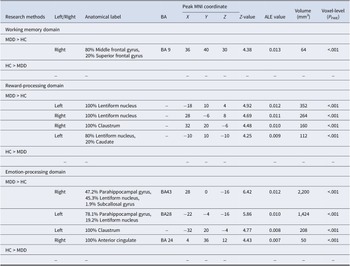
Compared with HCs, MDD showed hyperactivity in the right middle frontal gyrus and right superior frontal gyrus during working memory (Figure 3). During reward processing, hyperactivation was observed in the bilateral lentiform nucleus, right claustrum, and left caudate, as well as in the bilateral parahippocampal gyrus (Figure 4). During emotion processing, hyperactivation was observed in the bilateral lentiform nucleus, right subcallosal gyrus, right anterior cingulate, and left claustrum (Figure5). Compared with HCs, hypoactivation in MDD was not found during working memory, reward processing, and emotion processing (Table 2).
Meta-analytic mapping of functional brain alterations in the working memory domain. Note: Red circles show area of hyperactivation; MDD, major depressive disorder; HC, healthy control.

Meta-analytic mapping of functional brain alterations in the reward processing domain. Note: Red circles show area of hyperactivation; MDD, major depressive disorder; HC, healthy control.

Meta-analytic mapping of functional brain alterations in the reward-processing domain. Note: Red circles show area of hyperactivation; MDD, major depressive disorder; HC, healthy control.

Applying the ALE method to study brain functional activity changes in working memory, reward processing, and emotion processing in MDD

Note: MDD, major depressive disorder; HC, healthy control; MNI, Montreal Neuroimaging Institute; ALE, activation likelihood estimation; BA, Brodmann area.
Publication bias analysis results
The included studies demonstrated no significant risk of publication bias, as assessed using the NOS. Among the 69 studies, the overall ROB was low for all 69 research items (Supplementary Table S3). Each of the 69 studies was evaluated using the ROB 2 tool. Most studies exhibited low risk; however, three studies in the Working Memory Tasks domain (Kerestes et al., Reference Kerestes, Bhagwagar, Nathan, Meda, Ladouceur, Maloney and Blumberg2012a; Lee et al., Reference Lee, Liu, Wai, Ko and Lee2013; Matsuo et al., Reference Matsuo, Glahn, Peluso, Hatch, Monkul, Najt, Sanches, Zamarripa, Li, Lancaster, Fox, Gao and Soares2007), three studies in the Reward Tasks domain (Dichter et al., Reference Dichter, Kozink, McClernon and Smoski2012; Smoski et al., Reference Smoski, Rittenberg and Dichter2011; Takamura et al., Reference Takamura, Okamoto, Okada, Toki, Yamamoto, Ichikawa, Mori, Minagawa, Takaishi, Fujii, Kaichi, Akiyama, Awai and Yamawaki2017), and eight studies in the Emotion Tasks domain raised concerns (Aizenstein et al., Reference Aizenstein, Andreescu, Edelman, Cochran, Price, Butters and Reynolds2011; Li et al., Reference Li, Xu, Cao, Gao, Wang, Wang and Zhang2013; Miskowiak et al., Reference Miskowiak, Glerup, Vestbo, Harmer, Reinecke, Macoveanu and Vinberg2015; Mitterschiffthaler et al., Reference Mitterschiffthaler, Williams, Walsh, Cleare, Donaldson, Scott and Fu2008; Shi et al., Reference Shi, Wang, Yi, Zhu, Zhang, Yang and Yao2015; Wang et al., Reference Wang, Xu, Cao, Gao, Li, Liu and Zhang2012; Zhang et al., Reference Zhang, Wu, Pei, Ma, Dong, Gao and Zhang2022a,Reference Zhang, Zhang, Ma, Qi, Wang and Taob). Detailed information is provided in Supplementary Figures S1–S3.
Jackknife sensitivity and meta-regression analyses results
We applied the Jackknife resampling method to systematically exclude one study at a time and then repeated the meta-analysis to evaluate the stability of brain activity alterations in MDD. For all task types, the following regions demonstrated high reproducibility: the right lentiform nucleus, right parahippocampal gyrus, and left parahippocampal gyrus were replicated in 54 out of 60 iterations; the left claustrum, left anterior cingulate, and left insula were replicated in 55 out of 60 iterations; and the right subcallosal gyrus, left anterior cingulate, left lentiform nucleus, and left claustrum were replicated in 50 out of 60 iterations (Supplementary Table S4). For working memory tasks, the right middle frontal gyrus was replicated in 11 out of 12 iterations, and the right superior frontal gyrus was replicated in 10 out of 12 iterations (Supplementary Table S5). For reward tasks, the left lentiform nucleus, right lentiform nucleus, and left lentiform nucleus were consistently replicated in all 12 iterations. In contrast, the right claustrum and left caudate were replicated in 11 out of 12 iterations (Supplementary Table S6). For emotion tasks, the right parahippocampal gyrus was replicated in 34 out of 36 iterations, the left parahippocampal gyrus and right anterior cingulate were replicated in 33 out of 36 iterations, the right lentiform nucleus and left claustrum were replicated in 32 out of 36 iterations, and the right subcallosal gyrus and left lentiform nucleus were replicated in 30 out of 36 iterations (Supplementary Table S7).
Meta-regression analysis indicated no significant impact from differences in age, gender, medication, severity of MDD, and comorbidities between groups.
Discussion
This study utilized ALE meta-analysis to investigate differences in brain activation patterns in MDD during emotion processing, reward processing, and working memory tasks. Our findings revealed significant neural abnormalities across these cognitive domains, primarily involving the emotion regulation network, reward network, and executive function network. While distinct brain regions were engaged in each task, the lentiform nucleus and claustrum consistently exhibited abnormal activation across all three domains, suggesting these regions may be core neurobiological markers of MDD.
In emotion and reward processing, dysfunctional activation of the lentiform and claustrum nuclei may contribute to emotion dysregulation and motivational deficits in MDD. In working memory tasks, hyperactivation of the middle frontal gyrus likely reflects persistent impairments in cognitive control. Collectively, these findings offer new insights into the neurobiological underpinnings of MDD and highlight potential biomarkers for diagnosis and intervention.
Working memory processing in MDD
Our meta-analysis demonstrated hyperactivation of the right middle frontal gyrus and right superior frontal gyrus in MDD during working memory tasks. These regions are critical for cognitive control and executive function, as well as emotion regulation and affective processing. The middle frontal gyrus and superior frontal gyrus facilitate attentional control, information updating, and working memory maintenance, which are essential for task performance under cognitive load (Otstavnov, Nieto-Doval, Galli, & Feurra, Reference Otstavnov, Nieto-Doval, Galli and Feurra2024).
Prior studies have shown that both MDD patients and HCs exhibit activation in the dorsolateral prefrontal cortex, anterior cingulate cortex, and parietal cortex during working memory tasks (Harvey et al., Reference Harvey, Fossati, Pochon, Levy, LeBastard, Lehéricy and Dubois2005). However, Matsuo et al. (Reference Matsuo, Glahn, Peluso, Hatch, Monkul, Najt, Sanches, Zamarripa, Li, Lancaster, Fox, Gao and Soares2007) found that MDD patients exhibit significantly increased left dorsolateral prefrontal cortex activation during n-back tasks, while simultaneously showing reduced anterior cingulate cortex activation. This suggests that heightened prefrontal engagement may reflect increased cognitive effort or compensatory mechanisms in response to diminished neural efficiency.
Under high working memory demands, emotional interference may exacerbate cognitive resource depletion, leading to greater difficulty in task execution. Neuroimaging studies indicate that the superior frontal gyrus and other prefrontal regions play a crucial role in cognitive-emotional integration, coordinating neural activity to meet task demands (Raschle et al., Reference Raschle, Fehlbaum, Menks, Euler, Sterzer and Stadler2017). Hyperactivation of these regions in MDD may indicate an imbalance in emotion-cognition interaction, further supporting dysfunctional prefrontal mechanisms as a hallmark of cognitive deficits in MDD.
These findings suggest that excessive activation in the prefrontal cortex could magnify the impact of emotional distractions, exacerbating working memory deficits in MDD. Future interventions targeting these prefrontal circuits – such as cognitive training, neurofeedback, or neuromodulation techniques – may help improve cognitive and affective regulation in MDD.
Reward processing in MDD
Our results indicate hyperactivation of the lentiform nucleus, claustrum, and caudate nucleus – all components of the striatal system – during reward processing in MDD. The striatum plays a key role in reward anticipation, motivational regulation, and hedonic experience, interacting extensively with the prefrontal cortex, insula, cingulate cortex, and amygdala (Combrisson et al., Reference Combrisson, Basanisi, Gueguen, Rheims, Kahane, Bastin and Brovelli2024).
The lentiform and caudate nuclei are closely linked to dopaminergic signaling, which is central to reward processing and expectation formation (Hahn et al., Reference Hahn, Reed, Murgaš, Vraka, Klug, Schmidt, Godbersen, Eggerstorfer, Gomola, Silberbauer, Nics, Philippe, Hacker and Lanzenberger2025). Dopaminergic inputs to the striatum regulate reward sensitivity, influencing motivational states and decision-making (Spring & Nautiyal, Reference Spring and Nautiyal2024). The observed striatal hyperactivation in MDD suggests aberrant reward sensitivity, potentially exacerbating mood instability and anhedonia.
These findings align with prior meta-analyses (Bartra et al., Reference Bartra, McGuire and Kable2013), which demonstrated heightened reward-related activation in MDD. Such overactivation may disrupt the balance between reward anticipation and outcome processing, contributing to maladaptive reward learning and motivational deficits.
Moreover, striatal hyperactivation in MDD may reflect maladaptive reinforcement learning, leading to inappropriate emotional responses to reward stimuli (Ren et al., Reference Ren, White, Nacke, Mayeli, Touthang, Al Zoubi, Kuplicki, Victor, Paulus, Aupperle and Stewart2024). This dysregulation could also underlie goal-directed behavior impairments, particularly in tasks requiring reward anticipation and decision-making (Boisvert, Dugré, & Potvin, Reference Boisvert, Dugré and Potvin2024).
From a clinical perspective, abnormal striatal activation in MDD suggests a potential target for neuromodulation-based interventions. Noninvasive brain stimulation techniques, such as repetitive transcranial magnetic stimulation or deep brain stimulation targeting the striatal-prefrontal circuit, may offer novel therapeutic strategies to improve reward processing and motivation-related deficits in MDD.
Emotion processing in MDD
During emotion processing tasks, MDD patients exhibited hyperactivation in the lentiform nucleus, claustrum, anterior cingulate cortex, and parahippocampal gyrus – regions involved in emotion regulation and cognitive control. The lentiform and claustrum nuclei, as part of the striatal system, are essential for emotion-motivation integration (Cox & Witten, Reference Cox and Witten2019). Their heightened activation in MDD suggests an exaggerated neural response to emotionally salient stimuli, a pattern consistent with previous findings (Wang et al., Reference Wang, Xu, Cao, Gao, Li, Liu and Zhang2012). This reinforces the role of these regions in emotion and motivation regulation and highlights their potential involvement in dysregulated affective processing in MDD.
The anterior cingulate cortex and parahippocampal gyrus also exhibited significant hyperactivation in MDD, further emphasizing disruptions in emotion regulation networks. The anterior cingulate cortex is widely recognized for its role in emotional regulation and attentional control (Wang et al., Reference Wang, Nie, Zhang, Wei, Zeng, Zhang and Lin2024). In MDD, excessive anterior cingulate cortex activation may be linked to prolonged emotional interference and increased emotional intensity, reflecting impaired top-down regulation of affective responses. This aligns with previous studies demonstrating that MDD patients struggle to disengage from emotional stimuli, leading to greater cognitive-affective burdens (Pan, Qi, Zhou, & Xu, Reference Pan, Qi, Zhou and Xu2024).
Similarly, parahippocampal gyrus hyperactivation was observed, indicating potential abnormalities in emotional memory processing, affect recognition, and emotional salience detection (Tak et al., Reference Tak, Lee, Park, Cheong, Seok, Sohn and Cheong2021). Beyond its well-documented role in memory function, the parahippocampal gyrus is also involved in emotion and social cognition processing. Its excessive activation may contribute to heightened emotional reactivity, ultimately disrupting cognitive performance. These findings are in line with previous studies, suggesting that parahippocampal overactivation in MDD may intensify negative emotional experiences, leading to persistent affective dysregulation (Lemke et al., Reference Lemke, Probst, Warneke, Waltemate, Winter, Thiel, Meinert, Enneking, Breuer, Klug, Goltermann, Hülsmann, Grotegerd, Redlich, Dohm, Leehr, Repple, Opel, Brosch, Meller and Dannlowski2022). Furthermore, the dual role of the parahippocampal gyrus – as both an emotional memory storage site and a regulatory hub – suggests a possible mechanism for emotional dysregulation in MDD (Bellace, Williams, Mohamed, & Faro, Reference Bellace, Williams, Mohamed and Faro2013). Overactivation of this region may create an ‘amplification effect’ in emotional memory processing, whereby past emotional experiences repeatedly interfere with current cognitive function, exacerbating mood instability and cognitive deficits (Yick, Buratto, & Schaefer, Reference Yick, Buratto and Schaefer2016). Consequently, parahippocampal dysfunction may represent a critical neurobiological marker of emotional dysregulation and cognitive impairment in MDD.
In summary, this study highlights distinct brain activation differences between MDD patients and HCs across working memory, emotion, and reward-processing domains, offering new insights into MDD’s neurobiological underpinnings. These findings deepen our understanding of its neural mechanisms and suggest potential targets for diagnosis and intervention.
Limitations
The present meta-analysis included fMRI studies with varying task designs and stimulus types, which could introduce heterogeneity between studies and potentially limit the interpretability of the results. To address this limitation, we categorized the included studies into three primary functional domains – working memory, reward processing, and emotion processing – and conducted separate ALE analyses for each domain. This strategy effectively reduced the impact of cross-task variability and enhanced the clarity of our interpretations. Additionally, Jackknife sensitivity analyses were performed, which confirmed the stability of the primary activation patterns across studies, indicating the robustness of our findings despite the methodological differences among the included studies. Future research incorporating more standardized task paradigms and stimuli will be crucial in further validating and refining these results.
Conclusion
This ALE meta-analysis identified distinct brain activation differences in MDD across working memory, reward, and emotion-processing tasks. Despite task-specific variations, consistent hyperactivation of the lentiform and claustrum nuclei in emotion and reward processing suggests that the striatum plays a central role in their interaction. These findings highlight the parallel coexistence of neurocognitive abnormalities in MDD and offer potential targets for future interventions.
Supplementary Material
The supplementary material for this article can be found at http://doi.org/10.1017/S0033291726103419.
Data availability statement
The original contributions presented in the study are included in the article/Supplementary Material, further inquiries can be directed to the corresponding author.
Acknowledgments
The authors would like to express their sincere gratitude to the staff of the Department of Radiology and the Department of Psychiatry of Women and Children at the Second People’s Hospital of Guizhou Province for their valuable support.
Author contribution
Qin Zhang and Yongzhe Hou conceived the study, designed the research methodology, and led the writing of the manuscript. Hui Ding and Jianqiao Li contributed to data collection, performed the data analysis, and assisted in drafting the manuscript. Qin Zhang and Yongzhe Hou contributed equally to this work and share first authorship.
Funding statement
This work was supported by the Key Advantageous Discipline Construction Project of Guizhou Provincial Health Commission in 2025 (QZ), the 2025 Guizhou Provincial Administration of Traditional Chinese Medicine (No. QZYY-2025-048) (QZ), the 2025 Health Commission of Guizhou Province Project (No. gzwkj2025-045) (YZH), the 2025 Health Commission of Guizhou Province Project (No. gzwkj2025-488) (HD), and the 2024 Health Commission of Guizhou Province Project (No. gzwkj2024-475) (QZ).
Competing interests
The authors declare none.




 Open access

