


Introduction
The question of ‘how populism is distributed over the political spectrum’ is a central empirical puzzle in populism research (Rooduijn & Akkerman, Reference Rooduijn and Akkerman2017, p. 193; Meijers & Zaslove, Reference Meijers and Zaslove2021; Norris, Reference Norris2020). Despite being frequently considered as a ‘thin‐centred’ ideology that can be adapted by any host ideology (Mudde, Reference Mudde2004), conventional wisdom, but also political science research, suggests that certain host ideologies are more likely to be combined with populism than others.Footnote 1 For example, it is obvious that many parties from the radical right are also strongly populist (Mudde, Reference Mudde2007).
But how exactly are parties' ideological positions and their degree of populism connected? This question has already received notable academic attention. One strand of literature advocates the idea of a U‐shaped relationship between parties' general left‐right placement and their degree of populism (e.g., Rooduijn & Akkerman, Reference Rooduijn and Akkerman2017; Meijers & Zaslove, Reference Meijers and Zaslove2021). According to these studies, populism is more prevalent at the fringes of the political spectrum, while moderate parties are rather unlikely to hold strong populist orientations. Other studies distinguish between different ideological dimensions – such as economic or cultural left‐right positions – to explain variations in the degree of populism of parties (Hutter et al., Reference Hutter, Altiparmakis, Vidal, Hutter and Kriesi2019; Kriesi et al., Reference Kriesi, Grande, Lachat, Dolezal, Bornschier and Frey2006; Kriesi & Hutter, Reference Kriesi, Hutter, Hutter and Kriesi2019). However, this notion is often solely focused on the strong relationship between right‐wing positions on cultural issues, such as nativism, and the high degree of populism among radical right parties (see, e.g., Mudde, Reference Mudde2007, Chapter 5). By predominantly focusing on one dimension of the two‐dimensional policy space and by analyzing mostly populist radical right parties, these approaches also do not provide an integrated perspective on how different forms of host ideologies and populism are connected. Moreover, some of these studies do not aim at explaining different degrees of populism among parties, but rather to classify parties in dichotomous categories (e.g., populist and non‐populist) – a view that is increasingly contested in the literature on populism (e.g., Meijers & Zaslove, Reference Meijers and Zaslove2021).
Given the approaches and findings described above, the contribution of this paper to the literature is twofold. First, given the large variety of existing studies on the relationship between ideological positions and populism, we offer an integrated perspective on how the two‐dimensional policy space and both left‐ and right‐wing populism are related. Thus, we move beyond models which explain the degree of populism solely among right‐wing (or rarely left‐wing) parties and provide an explicit model to understand parties' degree of populism. Following work which highlights the strong illiberal nature of populism (Dahl, Reference Dahl1982; Pappas, Reference Pappas2016), we argue that populism is particularly prevalent among parties which strongly focus on collectivist positions on their dominant issue dimension. These collectivist positions, which we consider to be more likely to be illiberal, are found mainly on the left end of the economic left‐right dimension and the right end of the cultural left‐right dimension.Footnote 2 Thus, the two‐dimensional policy space is vital for understanding populism. Second, we introduce the importance of the policy dimension salience as a moderator of the relationship between populism and ideological positions. Previous research often assumes that radical positions are directly connected to populism (Rooduijn & Akkerman, Reference Rooduijn and Akkerman2017). In contrast, the core argument of this paper is that not all dimensions are equally important for understanding parties' degree of populism. Only when parties put strong emphasis on the radical collectivist position of their host ideology, we expect these parties to be populist.
To test our assumption, we rely on the POPPA expert survey data (Meijers & Zaslove, Reference Meijers and Zaslove2021) and combine it with the Chapel Hill Expert Survey Data 2019 (CHES; Bakker et al., Reference Bakker, Hooghe, Jolly, Marks, Polk, Rovny, Steenbergen and Vachudova2020). We find strong empirical support for the described patterns. Furthermore, the findings remain robust when using different data sources, various model specifications, and even when excluding some notable observations which might drive our findings. Our results provide a fruitful new perspective on how populism is distributed in the policy space and can build the foundation for future research on the analysis of party positions, party competition as well as populism.
The case for the two‐dimensional policy space
Recently, Norris (Reference Norris2020, pp. 17–18) stated that ‘scholars need to identify varieties of populists distributed across a multidimensional issue space […] rather than assuming that all can be neatly categorized by their “extreme” right‐wing position along a single Left‐Right dimension’. In this regard, Norris challenges previous research findings which often rely on a uni‐dimensional measure for party ideology to explain parties' levels of populism. Such studies have found that populism appears to be more prevalent at the fringes of the political spectrum (Meijers & Zaslove, Reference Meijers and Zaslove2021; Rooduijn & Akkerman, Reference Rooduijn and Akkerman2017). Meijers and Zaslove (Reference Meijers and Zaslove2021) show a clear U‐shaped relationship between general left‐right placements and the degree of populism. Rooduijn and Akkerman (Reference Rooduijn and Akkerman2017) demonstrate a similar pattern but provide an additional argument by stating that it is a party's radicalness on the general left‐right dimension which matters for their degree of populism.Footnote 3
Other studies deviate from such a one‐dimensional perspective by highlighting that specific dimensions of the two‐dimensional policy space – structured along an economic and cultural left‐right dimension (e.g., Heath et al., Reference Heath, Evans and Martin1994; Mair, Reference Mair, Dalton and Klingemann2007) – are relevant for understanding parties' degree of populism. Particularly noteworthy in this regard are studies which demonstrate that especially the cultural left‐right dimension is a strong predictor for populism among right‐wing parties (Hooghe et al., Reference Hooghe, Marks and Wilson2002; Hutter et al., Reference Hutter, Altiparmakis, Vidal, Hutter and Kriesi2019; Kriesi & Hutter, Reference Kriesi, Hutter, Hutter and Kriesi2019). Similarly, Kriesi et al. (Reference Kriesi, Grande, Lachat, Dolezal, Bornschier and Frey2006, 925) discuss demarcation and integration positions on economic and cultural issues to locate political parties and describe party competition. For example (and in line with our argument below), they place the populist right on a demarcation (that is exclusive) position on the cultural dimension but rather scattered across the economic dimension.
Based on this work, we do not contend that there is a U‐shaped relationship between the general left‐right placement of parties and their degree of populism. Building on the ideas put forward by Hooghe et al. (Reference Hooghe, Marks and Wilson2002), Kriesi et al. (Reference Kriesi, Grande, Lachat, Dolezal, Bornschier and Frey2006) and Bernhard and Kriesi (Reference Bernhard and Kriesi2019), the argument of this paper is that the relationship between populism and ideological positions can be better understood when considering a two‐dimensional policy space in combination with the parties' salience of the respective dimension.
Populism and host ideologies
The general left‐right scale is an important measure for analyzing party competition, but its uni‐dimensionality can mask important variation in parties' core ideologies. On this general scale, parties favouring strong liberal economic policies might be placed in a similar position as culturally strongly conservative parties because both can be considered as ‘right‐wing’ on their core issue emphasis. It is for such reasons that political scientists often rely on two‐dimensional conceptions of party competition to differentiate between economic and cultural left‐right positions (e.g., Heath et al., Reference Heath, Evans and Martin1994).
Why is the two‐dimensional space important for understanding parties' level of populism? At the heart of our argument is the well‐established notion that populist ideology relies on the distinction between the ‘pure people’ and an ‘evil elite’. Both groups are seen as homogeneous and the relationship between the two is antagonistic (Mudde, Reference Mudde2004). However, ‘the people’ and ‘the elite’ are deliberately undefined entities in the definition of populism (Stanley, Reference Stanley2008). Who belongs to the people or the elite is subject to the populists. In terms of Laclau's (Reference Laclau2005) theory of populism, ‘the people’ and ‘the elite’ are empty signifiers. The terms are detached from an actual object and used by populists to construct collective identities. Thus, populists make use of empty signifiers to ‘construct cohesive communities’ in which ‘internal cleavages in intergroup conflict’ are suspended (Pasitselska & Baden, Reference Pasitselska and Baden2020, pp. 667–668). This allows different populist actors, for example, left‐ and right‐wing populists, to describe themselves as representatives of ‘the people’ and to fight against ‘the elite’ while referring to different societal groups with these terms.
It is important to note that the use of such empty signifiers is not exclusive to populists. Even non‐populist actors can refer to ‘the people’ or an abstract ‘elite’. The crucial distinction between populist and non‐populist actors is the assumption of homogeneity within these groups and that populists are the true and only representatives of ‘the people’ (Wodak, Reference Wodak2017, p. 554). Populism relies on rather simplistic collective identities in which heterogeneity within ‘the people’ or ‘the elite’ is neglected in favour of a more salient group attribute (de Zavala et al., Reference Zavala, Lantos, Keenan, Forgas, Crano and Klaus2021; Forgas & Crano, Reference Forgas, Crano, Forgas, Crano and Klaus2021). Moreover, ‘the people’ and ‘the elite’ depend on each other as it is the construction of the ‘evil elite’, which simultaneously defines who ‘the people’ are (and vice versa; e.g., Wodak, Reference Wodak2017, pp. 555–556). In contrast, non‐populist actors can construct ‘the people’ or ‘the elite’ by acknowledging the heterogeneity of these groups, advocating a pluralist view of the society.
According to our argument, it is this focus on collective identities which makes populism particularly likely to occur among certain thick ideologies. The ‘thick ideological’ foundation of radical left parties, that is socialism or communism, emphasizes the essential role of the economy for the structure of the society and power relationships (March, Reference March2012, Reference March2017). As such, radical left parties tend to see almost all parts of politics as being structured by economic conflicts in which the working class (‘the people') is oppressed by an economic elite. For the radical right, however, the economy plays a subordinate role (Rovny & Polk, Reference Rovny and Polk2020). The radical right constructs ‘the people’ based on national or ethnic identities, that is a nativist worldview (Mudde, Reference Mudde2007). The elite, in contrast, is evil as it threatens this collective identity by implementing liberal‐progressive policies.
What is particularly noteworthy for our argument is the different emphasis that radical left and radical right parties put on different dimensions of the two‐dimensional policy space. While radical left parties emphasize economic issues (March, Reference March2017), the radical right operates on a cultural dimension (see also Bernhard & Kriesi, Reference Bernhard and Kriesi2019). In other words, they combine radical positions on a certain dimension with a high salience of these dimensions for their party profile (Wagner, Reference Wagner2012). We argue that this combination of positions and salience on certain endpoints of the two‐dimensional policy space makes the occurrence of populism particularly likely. While the economic and cultural dimension of the policy space address very different policies, it can be argued that both dimensions have an individualistic (liberal) and collectivist (illiberal) endpoint. On the economic dimension, the liberal endpoint emphasizes individualism while the socialist endpoint emphasizes a collective identity (of the working class). On the cultural dimension, the authoritarian endpoint defines a collective identity with a focus on aspects such as ethnicity or nationality, while the liberal‐progressive counterpart emphasizes individual freedoms and diversity. Due to the focus of populism on collective and homogeneous identities, radical left‐ and right‐wing ideologies are more likely to be populist. The creation of a homogeneous group, which is primarily characterized by an overarching unifying characteristic, is inherent to these ideologies.
Salience of dimensions
According to the argument presented above, we argue that the two‐dimensional policy space holds important insights into which parties tend to be more populist. However, this approach also raises new challenges. If liberal ideologies should be less likely to be populist, then what should we expect for parties which combine, for example, liberal economic positions with illiberal cultural left‐right positions – as is often the case with populist radical right parties (Kitschelt & McGann, Reference Kitschelt and McGann1997)? Do we expect these two dimensions to cancel each other out? Or, how do these policy positions translate into populism?
To solve this puzzle, we point towards the important role of dimensional salience. Existing research has demonstrated that it is not only relevant which positions a party takes but which issues are emphasized by them (Green‐Pedersen, Reference Pedersen2007; Hooghe & Marks, Reference Hooghe and Marks2018; Petrocik, Reference Petrocik1996). We understand dimensional salience as a weight (or moderator) which explains why positions on non‐salient dimensions should not matter for a party's degree of populism. More specifically, we expect that if a party focuses on a dimension on which it holds a liberal/non‐collectivist position then this party should be less populist, even if it takes a more collectivist position on the other dimension. In contrast, a party which holds the same positions but puts more emphasis on the dimension with the collectivist, and thus illiberal, position is expected to be more populist. For example, we would expect a culturally right‐wing party to be populist in case culture is their core issue emphasis, even if this party holds rather liberal views on the economic left‐right dimension (as outlined by Kitschelt & McGann, Reference Kitschelt and McGann1997). For example, the Austrian Freedom Party (FPÖ) used to be fairly market‐oriented in their economic programme in the late 1990s. Yet, its degree of populism remained stable through time since its strongly right‐wing position on the cultural dimension remained intact. Likewise, radical left parties with a strong emphasis on the economy are expected to be populist, even when they hold rather liberal views on the cultural dimension. On the cultural dimension, in contrast, radical left parties show large variation (Gomez et al., Reference Gomez, Morales and Ramiro2016). These profiles range from more traditional left‐wing parties, which tend to be centrist on cultural issues (such as the Dutch Socialist Party or the German Die Linke) to progressive left‐wing parties which put forward left‐wing positions on cultural issues (such as the Spanish Podemos or Syriza in Greece). We anticipate that these parties share a clear and strong left‐wing economic profile which induces a high level of populism, while positions on the cultural dimension, in contrast, vary and are less relevant for these parties’ degree of populism.
Thus, the main argument of this paper is that parties are particularly likely to become populist when they combine a radical collectivist ideological position with a high salience of this dimension. The salience of the respective dimension is of particular importance. A party might take a rather radical left‐wing economic position, but we would not necessarily expect this party to be populist when the salience of the economic dimension is low and the party takes a rather liberal position on the cultural dimension. Of course, we acknowledge that empirically radical policy positions and salience are not independent (Wagner, Reference Wagner2012). However, this only reinforces our argument that parties with a strong focus on a rather collectivist ideology will strongly care about this ideology and, thus, be more likely to be populist.
Of course, the relationship theorized here is probabilistic and not deterministic. It is also possible for economically focused neo‐liberal parties or parties that take a liberal stance on the cultural dimension to become populist. Essentially, the fluid and non‐deterministic nature of the empty signifiers ‘the people’ and the ‘the elite’ allows any political actor to provide new interpretations of who ‘the people’ and ‘the elite’ are. For example, Forgas and Crano (Reference Forgas, Crano, Forgas, Crano and Klaus2021) argue that left‐wing identity politics – which would be located on the liberal‐progressive endpoint of the cultural dimension – might also lend itself to populism as it constructs collective identities between historically marginalized and privileged groups. Likewise, economic libertarians might also become more populist when they generally oppose ‘the state’ and construct ‘the people’ as all citizens that need to be protected from the state (Gamble, Reference Gamble, Freeden, Sargent and Stears2013). Despite these examples of how other endpoints of the political space might be connected to populist ideas, the crucial point for our argument is that collectivist ideologies – socialism/communism on the left, and nativism/nationalism on the right – are inherently more suitable to align with a populist ideology as they essentially require the assumption of an oppressed or disadvantaged homogeneous group that holds different views than the ruling elite. In contrast, economic and cultural liberal ideologies rest on some sort of acknowledgment of pluralist ideas and heterogeneity within the society.Footnote 4 As Freeden and Stears (Reference Freeden, Stears, Freeden, Sargent and Stears2013, p. 331) summarize, it is ‘widely accepted’ that liberalism, ‘[d]espite its multiple varieties, … is often described as an individualist creed, celebrating a particular form of freedom and autonomy, involving the development and protection of systems of individual rights, social equality, and constraints on the interventions of social and political power’.
Comparison and advantages to other approaches
To further demonstrate the advantages of considering the two‐dimensional policy space for analyzing the prevalence of populism, we compare our approach to the seminal study of Rooduijn and Akkerman (Reference Rooduijn and Akkerman2017), which argues that radical parties from the left and right both tend to be populist. Rooduijn & Akkerman (Reference Rooduijn and Akkerman2017) base their analysis (mostly) on the one‐dimensional left‐right scale and show that left‐right positions are no longer a relevant predictor once it is controlled for the ‘radicalness’ of a party on the general left‐right scale. In contrast, we argue that a party's classification as ‘radical’ depends on their position in the two‐dimensional policy space and issue emphasis. However, we also contend that this idea is implicitly included in the study by Rooduijn and Akkerman (Reference Rooduijn and Akkerman2017) due to the way the authors measure the radicalness of a party. Specifically, Rooduijn and Akkerman (Reference Rooduijn and Akkerman2017) classify radical left parties as those parties which have been labelled as ‘communist’ by the Comparative Manifesto Project (CMP) (Volkens et al., Reference Volkens, Burst, Krause, Lehmann, Matthieß, Merz, Regel, els and Zehnter2022). Radical right parties are those which were labelled as ‘nationalist’ by the CMP. The concepts of ‘communism’ as well as ‘nationalism’ are in line with our argument, as communism clearly indicates a collectivist and illiberal emphasis of a party on the left end of the economic left‐right dimension, while nationalism is considered the collectivist and illiberal end of the cultural dimension. Thus, the conceptualization of ‘radicalness’ by Rooduijn and Akkerman (Reference Rooduijn and Akkerman2017) reflects our argument regarding the two illiberal ends of the left‐right spectrum.
Given this similarity in the arguments, why do we consider our approach more suitable? There are multiple reasons. First, we are not aware of generally accepted classifications of parties as either ‘radical’ or ‘non‐radical’. While some scholars have made suggestions on how such a classification might look (Meijers & Zaslove, Reference Meijers and Zaslove2021; Zulianello, Reference Zulianello2020), there is no universally accepted definition and empirical approach. Therefore, when labelling certain parties as ‘radical’ and others as ‘non‐radical’, one has to rely on a classification which might be subject to theoretical and methodological debates. Additionally, the classification of parties as ‘radical’ or ‘non‐radical’ might not be independent from their level of populism, precisely because qualitative coding of radicalness might suffer from a conflation of both concepts. However, the literature is fairly explicit in the necessity to disentangle effects from ideology and populism (Bonikowski, Reference Bonikowski2017; Van Hauwaert & Van Kessel, Reference Hauwaert and Kessel2018).
Second, classifying parties as ‘radical’ or ‘non‐radical’ implies a dichotomous concept. The problem with dichotomous classifications is that they run at risk of creating ‘borderline cases’ in which it is contested whether a party should be included or excluded from the respective category; that is, whether a party is ‘radical’ or ‘non‐radical’. This problem does not occur if one thinks of radicalness as a continuous concept in which parties can be more or less radical than others – comparable to how one thinks of parties as being more or less populist.Footnote 5 Thus, an empirically driven approach, such as ours, is substantially less prone to idiosyncratic classifications.
Finally, Rooduijn and Akkerman (Reference Rooduijn and Akkerman2017) also measure radicalness of parties continuously based on their position on the general (one‐dimensional) left‐right scale. A party is usually considered to be radical when it is located at one of the ends of the left‐right dimension. However, our critique of using a one‐dimensional left‐right scale applies here as well. There is little doubt that right‐wing parties are considered to be more radical the more they move to the right on the ‘cultural’ left‐right dimension; that is, when they become more nativist and authoritarian (Mudde, Reference Mudde2007, pp. 24–26). Their positions on the economic dimension, in contrast, are usually irrelevant for the classification of a party as belonging to the radical right (see Mudde, Reference Mudde2007, Chapter 5). This is fundamentally different for left‐wing parties. A left‐wing party is rarely classified as ‘radical’ due to their strong liberal stance on the cultural left‐right dimension. Instead, the classification of parties as belonging to the ‘radical left’ still relies on their positions on economic issues (see, e.g., Krause, Reference Krause2020, pp. 1370–1371). Thus, the concept of radicalness is best captured by using a two‐dimensional approach.
This connection between radicalness and left‐right positions underlines that our argument and the conceptualization of radicalness in Rooduijn and Akkerman (Reference Rooduijn and Akkerman2017) do not contradict each other. However, relying on the two‐dimensional policy space is advantageous because it solves the two other problems regarding the concept of radicalness, which we discussed above. First, how to measure parties’ positions on the economic and cultural left‐right dimension is well established in the literature and measures derived from expert surveys or party manifestos show a high degree of correlation (Laver, Reference Laver2014). As a consequence, there should be little methodological debate on how these concepts are measured. Second, party positions are measured continuously and thus do not result in the problem of including or excluding certain ‘borderline cases’ as is the case with dichotomous classifications.
Data
We mainly rely on two data sources for analyzing how populism clusters in the two‐dimensional policy space: the recently released ‘Populism and Political Parties Expert Survey’ (POPPA) data by Meijers and Zaslove (Reference Meijers and Zaslove2021) and the (most recent) Chapel Hill Expert Survey 2019 (CHES; Bakker et al., Reference Bakker, Hooghe, Jolly, Marks, Polk, Rovny, Steenbergen and Vachudova2020).
The POPPA data provide information about parties' degree of populism of more than 200 parties in 29 European countries, based on the evaluation of party experts in the respective countries. Populism is measured as the factor score of five scales: manichean, indivisible, general will, people‐centrism, and anti‐elitism. The data also provide a direct measure of economic left‐right positions measured on an 11‐point scale ranging from 0 (economic left) to 10 (economic right). However, the POPPA data do not provide a direct measure for cultural left‐right positions, but rather positions on several issues which usually strongly correlate with the cultural left‐right dimension. These issues are immigration, nativism, law and order, and lifestyle. Each of these items is measured on the same 11‐point scale as the economic left‐right positions. We use a simple factor analysis of these items to estimate a one‐dimensional measure for cultural left‐right positions. The factor analysis confirms that the four variables load on the same dimension with factor loadings of always >0.85 and an explained variance of 86.9 per cent. As the factor score is measured on a different scale than the economic left‐right position in the POPPA data, we z‐standardize both variables to a mean of 0 and standard deviation of 1.
Our argument further relies on measures of salience for both dimensions. To this end, we use CHES data from 2019, which include salience measures for the economic and cultural left‐right dimension.Footnote 6 This is important for our analysis as we expect that the position of parties on the economic or cultural dimension matters for a party's degree of populism, depending on whether the respective dimension, is important for the party or not. To measure which dimension is considered more important by a party, we subtract the cultural left‐right salience score from the economic left‐right salience score for each party. Thus, negative values indicate that the cultural left‐right dimension is more salient for a party and positive values imply that the economic dimension is more salient. This approach has the advantage that it clearly identifies parties with a predominant focus on economic or cultural issues as these parties will have either high negative or positive values. Only parties for which both dimensions are of similar salience will have scores close to zero. Figure F in the online appendix provides an overview of the distribution of this variable.
The use of this salience measure has two potential problems. First, one might argue that instead of using such a one‐dimensional indicator of salience, it is more reasonable to use the salience measure for each dimension separately. We acknowledge such critique and re‐run all our analysis using the salience for both dimensions as separate moderators and the results are robust (see Section C in the online appendix). Second, since dimensional emphasis is a moderating variable, it implies that it will interact with the continuous party positions. However, as explained in detail by Hainmueller et al. (Reference Hainmueller, Mummolo and Xu2019), interaction effects between two continuous variables can be highly model dependent. It is thus solely for methodological reasons that we decide to classify each party's dimensional emphasis as belonging to one of the three following groups: (1) economic focus, (2) balanced focus and (3) cultural focus. These groups are created by taking the terciles of the variable which measures the differences in the dimension salience (see Section F in the online appendix for a description of these terciles).Footnote 7
Finally, it can be argued that the POPPA data are well designed for measuring parties' level of populism but that the economic and cultural left‐right measures of the CHES data are more established in the literature. Therefore, we compare the measures of economic and cultural left‐right positions in the POPPA and CHES data and report it in the online appendix. Both dimensions show high degrees of correlation: $\rho = 0.945$ for the economic left‐right dimension and $\rho = 0.912$ for the cultural left‐right dimension (see also Section A in the online appendix). In addition, we re‐ran all models using the economic and cultural left‐right positions from the CHES data and the results remain robust (see online appendix Section B).
Results
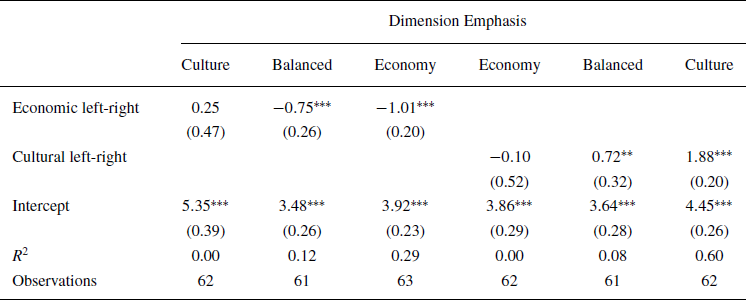
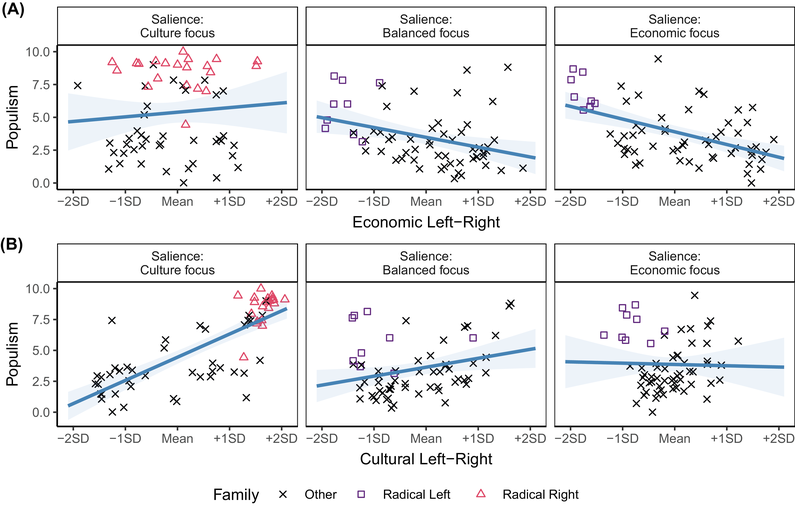
Table 1 and Figure 1 report the main findings of the empirical analysis. In Table 1, we regress a party's degree of populism on its economic and cultural left‐right positions, respectively. Each regression is run separately depending on a party's dimensional emphasis.Footnote 8 Figure 1 visualizes the results reported in Table 1 and additionally highlights the positions of the parties which are described as belonging to the ‘radical left’ and ‘radical right’ in the POPPA data.
Effect of economic and cultural left‐right positions on populism conditional on relative dimensional emphasis

Note: Table 1 displays results from OLS regression models in which the dependent variable is a party's level of populism (ranging from 0 to 10). Independent variables are a party's economic and cultural left‐right positions. Data for populism and economic left‐right positions are taken directly from the POPPA dataset (Meijers & Zaslove, Reference Meijers and Zaslove2021). Cultural left‐right positions are measured based on a factor analysis of various issue positions included in the POPPA data (see main text for details). These variables are all z‐standardized (mean = 0; sd = 1). Dimension emphasis is measured as the difference between salience of the economic and cultural left‐right dimension for each party. Salience measures are taken from the Chapel Hill Expert Survey 2019 (Bakker et al., Reference Bakker, Hooghe, Jolly, Marks, Polk, Rovny, Steenbergen and Vachudova2020) and merged with the POPPA data. $^{***}{\it p} < 0.01$
,
$^{***}{\it p} < 0.01$
, $^{**}{\it p} <0.05$, $^*{\it p} < 0.1$.
Relationship between (A) economic and (B) cultural left‐right positions and populism conditional on dimensional emphasis [Colour figure can be viewed at wileyonlinelibrary.com]
Notes: The blue line displays linear fit (see Table 1 for model details). The shaded area displays 95 per cent confidence intervals. Coloured observations (purple squares and red triangles) identify radical left and radical right parties according to the classification used in the POPPA data.

The results clearly support our argument. We first look at the impact of a party's left‐right position on its degree of populism. As can be clearly seen, the economic left‐right position has no effect on parties with a strong emphasis on the cultural dimension. The effects are insignificant and also the R 2 value of 0 indicates the absence of any relationship between populism and economic positions for culturally focused parties. However, as the relative focus on economic issues increases, the left‐right positions begin to matter. This gets visible by the increased effect sizes as well as the strong increase in R 2 values. For parties with a balanced dimension emphasis, a significant negative effect of the economic left‐right position can be observed. This effect becomes even stronger for parties with a strong emphasis on the economic dimension. This means that parties tend to become more populist when they take economically left positions and also have a strong emphasis on economic issues. The change in the effect sizes is also accompanied by a large increase in the R 2 values.
We observe a very similar pattern for the cultural left‐right dimension. Again, for parties with low levels of salience for this dimension, the positions on the cultural left‐right dimension are not correlated with the degree of populism. But again, as the relative salience of this dimension increases, the relationship between cultural left‐right positions and populism becomes clearly visible. In this case, the relationship is slightly more pronounced, as indicated by the larger effect sizes as well as higher R 2. As the visualization in Figure 1 suggests, this is due to the group of parties belonging to the ‘radical right’ for which the correlation between cultural positions and populism is particularly strong.
For the rather heterogeneous group of parties with balanced focus, we observe mild trends in line with our argument. Since these parties put some emphasis on the relevant dimension, our argument anticipates a negative (positive) correlation with economic (cultural) positions. The data are in line with this expectation. When inspecting this group of parties in more detail, we find that some radical left parties are also included in this category, while radical right parties are completely absent and only fall into the category of culturally focused parties. Particularly, by and large, left‐wing populist parties in the balanced category seem to be somewhat more left‐wing in cultural terms and less left‐wing in economic terms. This suggests that these are typical representatives of more progressive radical left parties (such as Podemos in Spain), whereas the parties with an economic focus tend to be more traditional left‐wing populist parties (such as the Dutch Socialist Party or the German Die Linke).
Overall, the empirical findings are highly consistent with our argument, as we demonstrate that parties are systematically more populist if they hold collectivist positions on their salient dimension. Radical positions on non‐salient dimensions, in contrast, are irrelevant for parties' populism score. Moreover, it should be noted that the observed effects are stronger for the relationship between cultural left‐right positions and populism than for the economic left‐right dimension. This might be the result of the strongly coherent position of the populist radical‐right on the cultural dimension, while being more blurry on the economic dimension.
Robustness checks
To further test for the robustness of our findings, we utilize six additional tests and an online tool for further investigation. First, we replicate the results but replace the relative dimensional salience measure with the absolute salience of the respective dimension. As the results in online appendix Section C demonstrate, the findings are largely the same. Second, we replace all POPPA‐based party position measures with the measures from CHES and show that the results do not change substantially (see online appendix Section B). Third, we use the recently published Global Party Survey (Norris, Reference Norris2020) to replicate the findings for the same sample of countries. Even when using these data, we find similar patterns (see online appendix Section D). We provide an R Shiny App, which allows testing of further combinations of the different datasets.Footnote 9
Fourth, we exclude radical right and radical left parties from the estimation sample to investigate whether our findings are entirely driven by these parties. Our results suggest that this is not the case (see online appendix Section G). Fifth, we disentangle the cultural left‐right positions to ensure that our findings are not entirely driven by nativism. Again, our findings in online appendix Section H suggest that all dimensions equally contribute to the findings. Finally, we disentangle the five sub‐dimensions of populism in the POPPA data. We show that our findings are stable across different components of the populism score (see Section I in the online appendix).
Conclusion and discussion
In this study, we have provided a more fine‐grained perspective on the relationship between parties' ideological positions and degree of populism. According to our argument, populism is best understood as a combination of economic or cultural left‐right positions in combination with their dimensional emphasis. This is so, because these parties focus on thick ideologies which rely on rather collectivist assumptions about the structure of the society and, thus, make them prone to populism. These theoretical assumptions are supported by our empirical analysis using different data sources on ideological positions, salience and populism.
Our approach refines previous studies which usually either analyzed the one‐dimensional relationship between the general left‐right scale and populism or focused rather separately on the relationship between cultural and economic left‐right positions. While the observed U‐shaped relationship of the general left‐right dimension and populism in previous studies is not incorrect (Rooduijn & Akkerman, Reference Rooduijn and Akkerman2017), the approach outlined in this study provides an integrated perspective beyond specific types of populist parties (see also Bernhard & Kriesi, Reference Bernhard and Kriesi2019). Further, it reveals potential mechanisms behind this pattern which remain hidden when using the one‐dimensional approach. Moreover, our approach also refines studies which already consider the two‐dimensional approach by highlighting how a strong focus on collectivist ideology, and specifically the combination with salience, contributes to high levels of populism among parties.
While the patterns identified in expert survey data provide evidence for our theoretical assumptions, it is also important to discuss potential weaknesses of our approach. One challenge for our approach is to explain ‘valence populism’, which is defined as populism of parties that avoid taking a clear position on any dimension of the policy space (Zulianello, Reference Zulianello2020, p. 329). Given this lack of clear positions of valence populists, it is not possible to use their ideological positions for explaining their degree of populism. Thus, the occurrence of valence populism is a challenge for all scholars who want to explain populism based on certain policy positions. Therefore, providing a better understanding of valence populism is important for future research on populism. One potential explanation could be that valence populists later adapt ‘thick’ ideological positions consistent with our approach. Such an argument would be consistent with theoretical work on the nature of the populist ideology. This work points out that such a ‘thin‐centred ideology’ necessitates a thick ideology to survive, at least in the long run (Stanley, Reference Stanley2008; Mudde & Kaltwasser, Reference Mudde and Kaltwasser2017, p. 7). Several empirical examples illustrate this pattern. The Norwegian Progress Party started as an anti‐tax and anti‐elite party without clear positions in the two‐dimensional policy space. This phase was characterized by high levels of instability and varying electoral success. Only when the party embraced immigration as a core theme, did it stabilize and institutionalize as the right‐wing populist party we know today (Jupskås, Reference Jupskås, Akkerman, de Lange and Rooduijn2016). We observe similar movement among other cases, such as the early German Alternative für Deutschland and its radical anti‐Euro position (Arzheimer, Reference Arzheimer2015) or Movimento 5 Stelle in Italy (Hutter et al., Reference Hutter, Altiparmakis, Vidal, Hutter and Kriesi2019, p. 369). These parties moved towards more substantial positions in the two‐dimensional policy space to consolidate and institutionalize their party and electoral success. Such an argument is also consistent with the idea of De Vries and Hobolt (Reference Vries and Hobolt2020) that challenger parties use populist rhetoric strategically to advocate their positions. Likewise, Dai and Kustov (Reference Dai and Kustov2022) demonstrate that populism is more prevalent among actors who have low chances of winning. Overall, this research suggests that populism might also be frequently used by non‐established parties as a strategy to gain votes, regardless of their host ideologies. We would hypothesize that such actors reduce their degree of populism once they become more established and when their host ideology does not lend itself to populism as expressed by our argument above. However, an empirical test of this argument requires data on the development of parties' level of populism over time. Such data are currently not available (Jankowski & Huber, in press).Footnote 10 Thus, once such data are available, we think that many important questions about the factors affecting the development of populism within parties can and should be addressed.
Moreover, future research can build on the approach described in this paper and address important questions which have to remain unanswered here. Most importantly, the regional focus of the analysis can be broadened as POPPA and CHES data only cover countries from Europe. In addition, it seems relevant to analyze whether the described mechanisms can be also found at the voter level. As voters tend to have less coherent belief systems compared to parties, the relationship between host ideologies and populism might be more idiosyncratic as observed at the party level.
Acknowledgements
We would like to thank various reviewers and the editors of the European Journal of Political Research for their helpful and constructive comments on previous versions of this manuscript. We are also grateful to Andreas Dür, Steven van Hauwaert and Andrej Zaslove for their comments. Replication files are available from the Harvard Dataverse: https://doi.org/10.7910/DVN/IQ3UL7 Robert and Michael rotate the order of authors across various publications.
Online Appendix
Additional supporting information may be found in the Online Appendix section at the end of the article:
Figure A1: Correlation between (A) economic and (B) cultural left‐right positions between POPPA and CHES 2019 data
Table A1: Effect of economic and cultural left‐right positions on populism conditional on issue salience (based on CHES data)
Table A2: Effect of economic and cultural left‐right positions on populism conditional on issue salience (absolute salience approach)
Table A3: Effect of economic and cultural left‐right positions on populism conditional on issue salience (absolute salience approach)
Table A4: Effect of economic and cultural left‐right positions on populism conditional on issue salience (based on GPS data)
Figure A2: Effects of cultural and economic left‐right positions on populism conditional on dimensional emphasis (different bandwidth for classifying parties as balanced or not)
Figure A3: Density plot and terciles of the difference in dimension emphasis variable
Table A5: Effect of economic and cultural left‐right positions on populism when excluding populist radical right parties
Table A6: Effect of economic and cultural left‐right positions on populism when excluding populist radical left parties
Table A7: Factor analysis to capture Cultural Left‐Right positions
Table A8: Effect of immigration positions on populism
Table A9: Effect of nativism on populism
Table A10: Effect of law and order positions on populism
Table A11: Effect of lifestyle positions on populism
Table A12: Effect of economic and cultural left‐right positions on Manichean dimension
Table A13: Effect of economic and cultural left‐right positions on perceived indivisibility of the people
Table A14: Effect of economic and cultural left‐right positions on perceived importance of the general will
Table A15: Effect of economic and cultural left‐right positions on people centrism
Table A16: Effect of economic and cultural left‐right positions on anti elitism
Figure A4: Relationship between economic left‐right positions and populism conditional on dimensional emphasis
Figure A5: Relationship between cultural left‐right positions and populism conditional on dimensional emphasis
Data S1


 Open access

