





The World Health Organization classifies depression and anxiety as common mental disorders that cause enormous burdens globally. 1 Approximately 322 million people experience depressive disorders, equivalent to 4.4% of the world’s population. In Vietnam, the prevalence of depression in the general population is about 4%, with 3.5 million cases. 1
Although young adults are often considered the healthiest population, mental health problems often emerge during this developmental stage. Reference Stroud, Walker, Davis and Irwin2 The estimated rate of mental health problems in Vietnamese young people ranges from 15 to 33.6%. Reference Do, Nguyen, Nguyen, Bui, Nguyen and Tran3,Reference Pham, Bui, Nguyen, Nguyen, Tran and Vu4 Although national statistics on the frequency of depression among Vietnamese young adults are not available, findings from a cross-sectional study (2015–2016) suggested it was about 15.2%. Reference Pham, Bui, Nguyen, Nguyen, Tran and Vu4 Notably, young adults show a high percentage of clinical depression. Reference Liu and Kuai5 Young adults are also more likely to think about, plan and complete suicide than adolescents and middle-aged adults. Reference Stroud, Walker, Davis and Irwin2
Depression in young adults may stem from the transition from adolescence to adulthood. Changes in roles, relationships and personal responsibilities can contribute to the increased levels of depression. Reference Stroud, Walker, Davis and Irwin2 Other contributory factors include economic status, educational level, marriage, gender and age. Reference Liu and Kuai5 Depression, once it occurs, may trigger unhealthy coping strategies such as substance and drug use, which themselves can cause physical and mental damage. Reference Pham, Bui, Nguyen, Nguyen, Tran and Vu4,Reference Quigley, Wen and Dobson6
Although evidence exists regarding both risk and protective factors, previous research appears to have placed greater emphasis on risk factors, particularly in the Vietnamese context. Moreover, there is convincing evidence that identifying and intervening in protective factors may lead to more sustainable outcomes. Reference Tietbohl-Santos, Shintani, Montezano, Biazin, Signori and Pulice7
Self-compassion and gratitude as protective factors
Research has explored positive psychological factors such as self-compassion and gratitude and their possible role in reducing and preventing depression in youth populations. Reference Nguyen, Bui, Xiao and Le8 As defined by Neff, Reference Neff9 self-compassion ‘involves the individual becoming open, connected, and empathic with his or her pain’ (p. 87). Self-compassion involves an attitude of understanding, accepting without judgement one’s shortcomings and failures, and recognising these as part of the human life experience. Reference Neff9,Reference Neff10 Neff Reference Neff9 also proposed three main elements of self-compassion: self-kindness (sympathising with oneself when encountering problems or suffering); common humanity (seeing one’s own experience as part of the process of life that everyone will go through); and mindfulness (accepting one’s suffering honestly instead of being critical, harsh or inhibiting). Therefore, self-compassion works as a coping strategy through accepting difficult problems with self-kindness. Reference Allen and Leary11 Accepting the problems that everyone encounters in life helps individuals solve their problems appropriately rather than catastrophising or blaming themselves. Furthermore, mindfulness increases awareness of the beautiful things that still exist in the present, preventing individuals from becoming overly immersed in negative events. Reference Wood, Froh and Geraghty12
Individuals with depression tend to focus excessively on negative stimuli and experience challenges in separating themselves from negative content. Reference Pullmer, Chung, Samson, Balanji and Zaitsoff13 Therefore, they tend to avoid facing or solving problems, which eventually contributes to more severe or recurring depression. Reference Quigley, Wen and Dobson6 In contrast, self-compassion promotes a self-regulation strategy for coping by acknowledging the feeling of suffering, being kind to oneself, establishing a connection of personal experience with life and practising empathy with pain through mindfulness. Reference Neff9 People with high self-compassion are more able to respond to problems with care and kindness rather than focusing on negative emotions and events. Reference Gilbert14
As a result, higher levels of self-compassion are associated with reduced symptoms of depression, lower affective negativity and greater life satisfaction. Reference Neff and Germer15,Reference de Souza, Policarpo and Hutz16 Systematic reviews and meta-analyses across different populations, including adolescents, university students and adults, suggest that self-compassion is not only a predictor related to depression but, when taught through group and individual therapies (in randomised controlled trials), it also helps indirectly reduce mental health problems, including depression, anxiety and suicidal ideation. Reference Pullmer, Chung, Samson, Balanji and Zaitsoff13,Reference Egan, Rees, Delalande, Greene, Fitzallen and Brown17 However, Vietnamese studies in young adults have primarily focused on the relationship between self-compassion and well-being and/or life satisfaction, without specifically addressing pathological aspects such as depression. Reference Nguyen and Nguyen18
Gratitude, as defined by McCullough et al, Reference McCullough, Emmons and Tsang19 is a positive emotional response to receiving help or kindness from others, involving the recognition and appreciation of life’s positive aspects and the contributions of others. Individuals who practise gratitude tend to value what they have achieved – such as resources, abilities and relationships – which helps them focus on the positives and display prosocial behaviours. As a result, people with high gratitude are generally more hopeful and optimistic compared with those without it. Reference Wood, Froh and Geraghty12,Reference Donaldson, Lee and Donaldson20 Studies have shown that gratitude reduces depression levels over time in many different groups, such as first-year university students Reference Wood, Maltby, Gillett, Linley and Joseph21 and young people with brief psychotic episodes. Reference Cheli, Cavalletti and Petrocchi22 Interventions that focus on gratitude (e.g. writing a gratitude journal) show reduced depressive symptoms and increased life satisfaction. Reference Kwok, Gu and Kit23,Reference Heekerens, Eid, Heinitz and Merkle24
Besides their relationship with depression, it is evident that self-compassion and gratitude are positively correlated. Reference Beni and Latipun25 Individuals with self-compassion are likely to perceive and accept negative emotions without getting too immersed in them, which in turn generates a more neutral view of adversity. Reference Nguyen, Bui, Xiao and Le8 This can facilitate a grateful mindset, realising that there are many beautiful things in life, focusing on what is present in a grateful way and focusing on the positive in current life. Reference Wood, Froh and Geraghty12 Furthermore, Neff Reference Neff9 stated that individuals who practise self-compassion are more likely to treat themselves with tolerance and kindness. When people extend tolerance to themselves, they also become more receptive to the kindness and assistance offered by others, fostering a sense of gratitude. Indeed, individuals who exhibit high levels of self-compassion are likely to perceive gratitude more clearly when they receive favours and assistance.
Self-compassion and gratitude have recently been subjects of increased attention among researchers in Vietnam. Reference Nguyen, Bui, Xiao and Le8,Reference Tran, Nguyen Phuoc, Dinh and Nguyen26 However, research examining their influence on depression in Vietnamese young adults remains limited. To our knowledge, there has been no research on Vietnamese young adults that examines the mediating effect of gratitude in the self-compassion–depression link. In addition to better support for young adults with depression, studying these topics will also contribute to a cross-cultural understanding of self-compassion and gratitude.
The present study
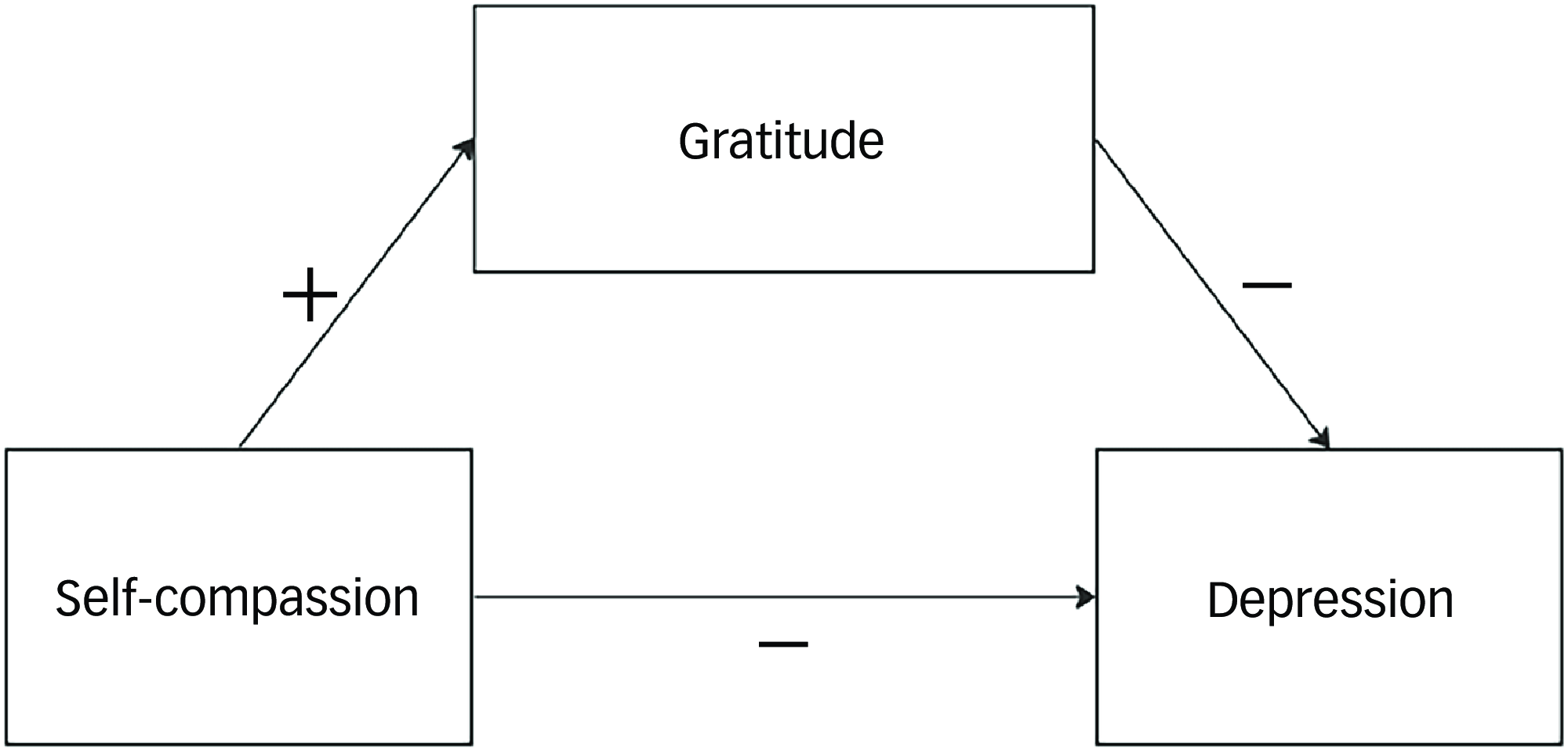
The main aims of this study were: (a) to gain insights into the relationship between self-compassion and depression; and (b) to test the mediating role of gratitude in this relationship. Prior to testing the mediation model, we also examined the correlations among self-compassion, gratitude and depression to better understand their bivariate associations. Based on a literature review, we hypothesised that higher self-compassion would be associated with lower levels of depression and that this relationship would be partially mediated by gratitude (Fig. 1).
The hypothesised model of the relationship between self-compassion and depression, mediated by gratitude.

Method
Procedure and participants
A cross-sectional study design was employed in this online survey, conducted in September 2023. Google Forms was used for data collection, and the survey link was distributed to administrators of university student Facebook groups in Ho Chi Minh City, Vietnam. These groups were accessible only to students from specific universities who had been approved to join. To ensure data quality, several quality control measures were implemented. These included verifying that participants met the inclusion criteria (aged 18–25 and with no prior psychiatric diagnoses), screening for incomplete or inconsistent responses, and excluding duplicate submissions. Additionally, we ensured that only valid, fully completed surveys were included in the final analysis.
The sample size for this study was determined using Monte Carlo power analysis for indirect effects, a method widely recommended for assessing statistical power in mediation models, as proposed by Schoemann et al. Reference Schoemann, Boulton and Short27 The model used in the analysis was informed by indirect effect coefficients reported by Wu et al (2018), Reference Wu, Chi, Lin and Du28 ensuring that the study’s parameters were aligned with existing research and thus providing a robust estimation for power calculations. Based on the analysis, a minimum sample size of 330 was calculated to ensure sufficient statistical power (target power of 80%) for detecting indirect effects in the mediation model. This method guarantees that the study has enough power to reliably detect the effects of self-compassion and gratitude on depression.
Our study recruited 459 Vietnamese young adults aged 18–25 residing, studying or working in Ho Chi Minh City during September 2023. Participants were required to provide informed consent and meet inclusion criteria, which included no prior psychiatric diagnoses. The exclusion criteria removed 103 participants (22.45%), who were outside the eligible age range, provided incomplete responses, gave fixed-pattern or inconsistent answers, or reported prior psychiatric diagnoses. After exclusions, a total of 356 participants (77.55%) completed the study questionnaire.
Ethical standards
The authors assert that all procedures contributing to this work comply with the ethical standards of the relevant national and institutional committees on human experimentation and with the Helsinki Declaration of 1975, as revised in 2013. All procedures involving human subjects/patients were approved by Hoa Sen University (under the Vietnamese Ministry of Education and Training), approval number 2979/QĐ-ĐHHS on 12 December 2023. All participants provided electronic informed consent before participation. The first page of the online survey presented an informed consent form outlining the study’s purpose, procedures, potential risks and benefits, and participants’ ethical rights. Participants were informed that their responses would remain anonymous, with no personally identifying information collected, and that all data would be stored securely on an encrypted computer accessible only to the research team. They were also informed of their right to withdraw from the study at any time without penalty. Only participants who clicked ‘I agree to participate’ were able to proceed to the questionnaire.
Measures
The questionnaires employed in this study encompassed demographic questions, the Self-Compassion Scale – Short Form, Vietnamese Version (VSCS-SF), the Gratitude Questionnaire – Six Item Form (GQ-6) and the Patient Health Questionnaire-9 (PHQ-9).
Demographic information
There were five questions about participants’ demographic information, including age, gender, highest education, marital status and religion.
Self-Compassion Scale – Short Form, Vietnamese Version (VSCS-SF)
The Self-Compassion Scale (SCS), developed by Neff, Reference Neff10 comprises 26 items distributed across 6 subscales. The Self-Compassion Scale – Short Form, Vietnamese Version (VSCS-SF), Reference Truong, Nguyen, Nguyen, Medvedeva and Medvedev29 derived from the English shortened version, features 12 items across 6 subscales, namely: personal benevolence; self-judgement; humanity; isolation; mindfulness; and identification. Reference Raes, Pommier, Neff and Van Gucht30 Scoring involves inverting the scores of two subscales (self-judgement and identification), followed by summing the scores of all questions. A higher total score indicates greater self-compassion, and vice versa. The VSCS-SF demonstrates an excellent Cronbach’s alpha (α = 0.91). In the current study, the Cronbach’s alpha was 0.72.
Gratitude Questionnaire – Six Item Form (GQ-6)
The Gratitude Questionnaire – Six Item Form (GQ-6) Reference McCullough, Emmons and Tsang19 consists of 6 items, utilising a 7-point Likert scale ranging from 1 (strongly disagree) to 7 (strongly agree). Scoring involves reverse-scoring items 3 and 6 and then summing the scores for all questions. Higher scores indicate greater gratitude, whereas lower scores reflect less gratitude. The Cronbach’s alpha for the scale reached a commendable level (α = 0.82). Reference McCullough, Emmons and Tsang19 The GQ-6 has been validated on adolescents Reference Tran, Nguyen Phuoc, Dinh and Nguyen26 and adults Reference Nguyen, Bui, Xiao and Le8 in Vietnam. The present study used the Vietnamese version of the GQ-6, Reference Nguyen, Bui, Xiao and Le8 by Nguyen and colleagues, which originally showed an acceptable Cronbach’s alpha (α = 0.67). In the present study, the Cronbach’s alpha index was 0.74.
Patient Health Questionnaire-9 (PHQ-9)
The Patient Health Questionnaire-9 (PHQ-9) depression assessment scale, Reference Kroenke, Spitzer and Williams31 designed by Spitzer and colleagues, serves to evaluate the severity of depression in primary care settings. It comprises 9 items, utilising a 4-point Likert scale with values from 0 (not at all) to 3 (almost every day) to assess symptom severity over the previous 2 weeks. Reference Kroenke, Spitzer and Williams31 The total score ranges from 0 to 27, with higher scores indicating increased severity. This study used the Vietnamese version of the PHQ-9, Reference Tran, Nguyen Phuoc, Dinh and Nguyen26 which was validated for content and construct validity, ensuring cultural relevance. The scale showed good internal consistency, with a Cronbach’s alpha of 0.81, confirmed by mental health professionals and language experts. Reference Tran, Nguyen Phuoc, Dinh and Nguyen26 In the present study, the Cronbach’s alpha reached a very good level (α = 0.86).
Data analysis
The data collected through the questionnaires were securely stored on an encrypted computer, accessible only to the researchers. After collection, the data were aggregated and verified. Descriptive statistics were employed to provide an overview of participants’ demographic characteristics. In addition, Pearson’s correlation coefficients were calculated to examine the bivariate relationships among variables before conducting regression and mediation analyses. Data analysis was conducted using IBM SPSS Statistics version 25.0 for Windows (IBM Corp., Armonk, NY, USA; https://www.ibm.com/products/spss-statistics), complemented by the PROCESS macro version 4.2 for SPSS (https://www.processmacro.org/) to examine the mediating effect of gratitude in the relationship between self-compassion and depression.
Initially, descriptive statistics were employed to summarise the data, including means and standard deviations for psychological variables (self-compassion, gratitude, depression scores), and frequency along with percentage for demographic characteristics.
Next, a linear regression analysis was used to assess the overall effect of self-compassion on depression, with self-compassion as the independent variable and depression as the dependent variable. Following this, PROCESS Model 4 was employed to test whether gratitude mediated the relationship between self-compassion and depression. To estimate the 95% confidence interval for the indirect effect of gratitude, bootstrapping with 5000 iterations was used, providing a robust assessment of the mediation effect.
To ensure the robustness of the results, multicollinearity was assessed using the variance inflation factor (VIF). Variables with a VIF greater than 10 were considered for further review, ensuring that no excessive multicollinearity affected the model. Additionally, we controlled for potential confounding variables such as gender, age and educational level by including these factors in the regression model to isolate the relationship between self-compassion, gratitude and depression. This helped ensure that the findings were not biased by external factors unrelated to the primary variables of interest.
Results
Demographic characteristics and descriptive statistics of depression, self-compassion and gratitude
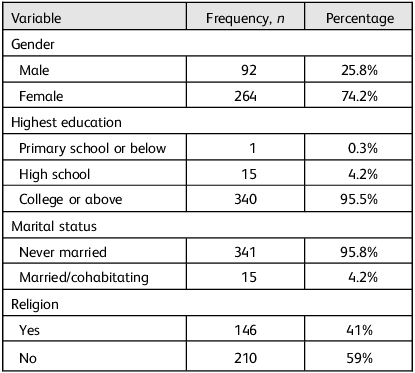
The Monte Carlo power analysis indicated that a minimum of 330 participants was required to achieve 80% power for detecting the hypothesised indirect effects. The final sample of 356 participants exceeded this requirement, confirming that the study was adequately powered to test the mediation model. The sample consisted of 92 males (25.8%) and 264 females (74.2%), with ages ranging from 18 to 25 years (mean 21.23 years, s.d. = 1.6). Details on the other demographic characteristics are provided in Table 1.
Demographic characteristics of participants (n = 356)

Table 1 Long description
A table with demographic characteristics of participants. The table has 4 rows and 3 columns. The columns are labeled Variable, Frequency, n, and Percentage. The rows are labeled Gender, Highest education, Marital status, and Religion. Row 1: Gender, Male, 92, 25.8 percent. Row 1: Gender, Female, 264, 74.2 percent. Row 2: Highest education, Primary school or below, 1, 0.3 percent. Row 2: Highest education, High school, 15, 4.2 percent. Row 2: Highest education, College or above, 340, 95.5 percent. Row 3: Marital status, Never married, 341, 95.8 percent. Row 3: Marital status, Married/cohabitating, 15, 4.2 percent. Row 4: Religion, Yes, 146, 41 percent. Row 4: Religion, No, 210, 59 percent.
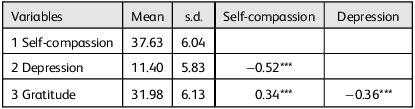
Descriptive statistics for the key variables (self-compassion, depression and gratitude) are shown in Table 2. The mean scores and standard deviations indicate that the sample exhibited a moderate level of self-compassion and gratitude, as well as a moderate level of depression. Table 2 also shows that these variables were significantly correlated.
Means, standard deviations and correlations between variables
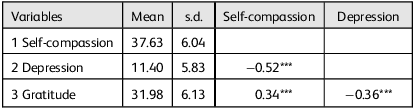
Table 2 Long description
A table with three rows and four columns. The columns are labeled Variables, Mean, s d, Self-compassion, and Depression. The rows present data for self-compassion, depression, and gratitude. Row 1: Variables, Self-compassion; Mean, 37.63; s d, 6.04. Row 2: Variables, Depression; Mean, 11.40; s d, 5.83; Self-compassion, -0.52***. Row 3: Variables, Gratitude; Mean, 31.98; s d, 6.13; Self-compassion, 0.34***; Depression, -0.36***. The table shows the mean scores and standard deviations for self-compassion, depression, and gratitude, along with their correlations.
*** p < 0.001.
Direct impact of self-compassion on depression, and with gratitude as a mediator
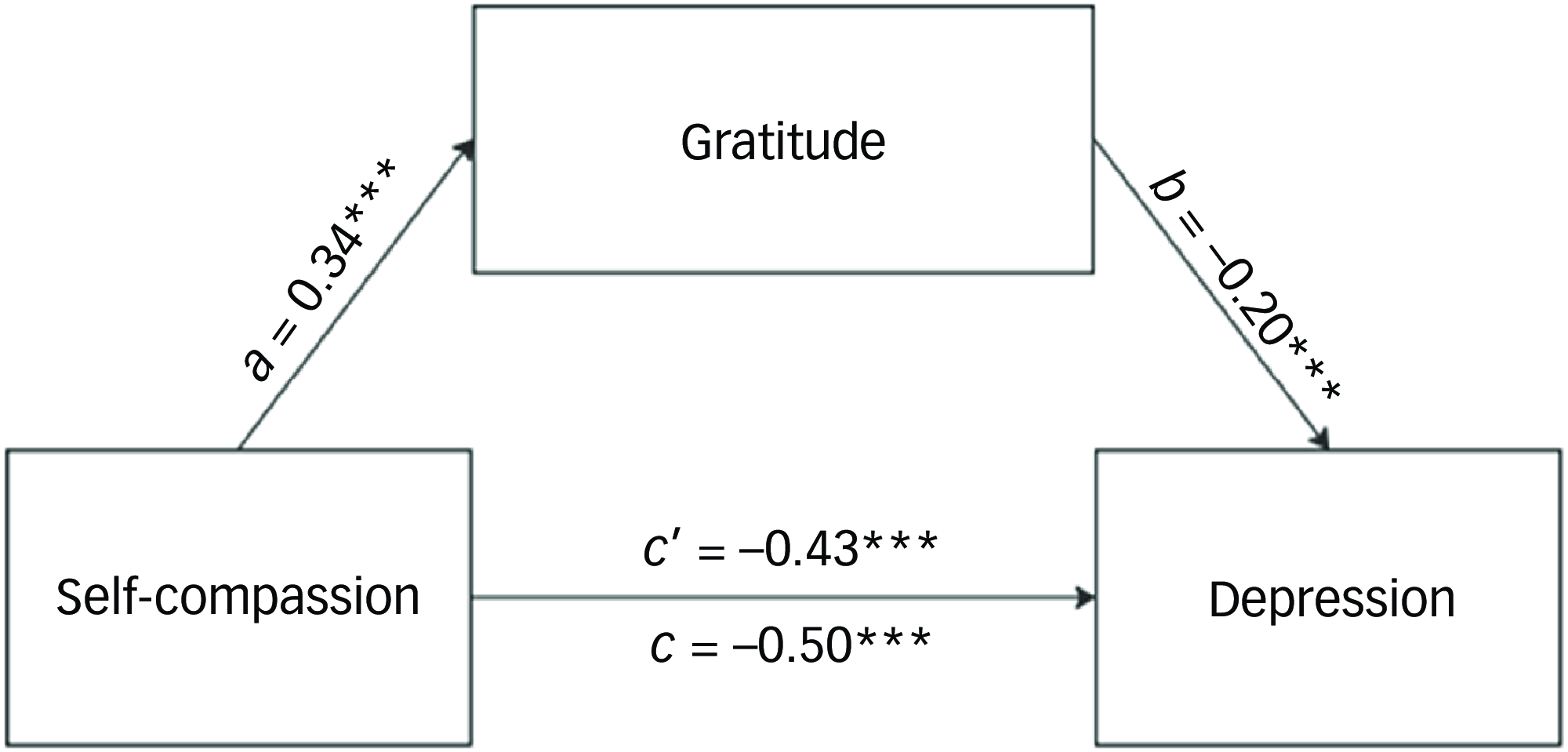
First, the overall impact of self-compassion on depression (path c in Fig. 2) was found to be significant, with R = 0.52, explaining 27% of the variance (adjusted R 2 = 0.27). The model’s reliability is emphasised by an F-test result of F (1, 354) = 130.40 (p < 0.001). Regression analysis revealed that an increase in self-compassion predicts a 0.50 decrease in depression scores (β = −0.50, t = −11.42, p < 0.001), with the effect’s confidence interval ranging from −0.59 to −0.42, thus confirming the hypothesised moderate, negative association between self-compassion and depression. The VIF values for all variables were well below the threshold of 10.
The mediating role of gratitude in the association between self-compassion and depression. ***p < 0.001.

The analysis also controlled for potential confounding variables such as gender (β = −0.05, p = 0.25), highest education (β = −0.07, p = 0.12), marital status (β = 0.03, p = 0.46) and religion (β = −0.09, p = 0.054). None of these control variables reached statistical significance, although religion showed a marginal effect. Including these covariates ensured that the observed effect of self-compassion on depression was not confounded by demographic factors.
Second, the impact of self-compassion on gratitude (path a in Fig. 2) was significant, with β = 0.34, t = 6.80 and p < 0.001. This step established the influence of self-compassion on gratitude, setting the stage for examining the mediation effect.
Third, on introducing gratitude as a mediator within the model, its influence on depression (path b in Fig. 2) was significant (β = −0.20, t = −4.42, p < 0.001). With gratitude included, the direct effect of self-compassion on depression (path c′ in Fig. 2) remained significant (β = −0.43, t = −9.52, p < 0.001). To robustly estimate the mediation effect, we used a bootstrap confidence interval of 95% with 5000 resamples. The indirect effect was small but significant (a × b = −0.07, s.e. = 0.02, 95% CI −0.11 to −0.04), indicating a complementary partial mediation role of gratitude in the link between self-compassion and depression, thus confirming the hypothesis.
Discussion
The direct influence of self-compassion on depression
This research demonstrated an inverse relationship between self-compassion and depression. This implies that as an individual’s self-compassion increases, their level of depression decreases, and conversely. A previous study using the same self-compassion scale corroborated these findings among adults. Reference de Souza, Policarpo and Hutz16 Additionally, a systematic review with a meta-analysis and a qualitative study provided evidence that self-compassion is associated with lower levels of depression symptoms in young people aged 14–24. Reference Pullmer, Chung, Samson, Balanji and Zaitsoff13,Reference Egan, Rees, Delalande, Greene, Fitzallen and Brown17
The negative association between self-compassion and depression can be explained by analysing its three components: self-kindness, common humanity and mindfulness. Reference Neff9 Specifically, individuals with elevated self-compassion exhibit kindness towards themselves by caring for, understanding and accepting their own pain, while avoiding self-judgement, harshness and self-criticism. Reference Neff9 Additionally, those who embrace self-compassion view negative experiences as shared human occurrences, which fosters a sense of connection rather than isolation during times of distress. Reference Gilbert14 This perception helps individuals feel connected instead of isolating themselves when suffering. Last, mindfulness in the context of self-compassion involves awareness and acceptance of the present moment, facilitating emotional balance without resorting to avoidance or rumination. Reference Neff9 Mindfulness-based psychoeducational and self-care therapeutic techniques have also been shown to reduce depression. Reference Pilkington and Wieland32 Consequently, individuals with heightened self-compassion often experience lower levels of depression, as they adopt an objective perspective rather than strongly identifying with negative thoughts and emotions. Reference de Souza, Policarpo and Hutz16,Reference Marsh, Chan and MacBeth33
The mediation model of gratitude
This study supports the hypothesis that gratitude mediates the relationship between self-compassion and depression. Essentially, individuals who tend to be self-compassionate and appreciative are less likely to experience symptoms of depression in adulthood. Reference Wood, Maltby, Gillett, Linley and Joseph21 Additionally, the findings of this study are consistent with previous studies, confirming that self-compassion enhances gratitude, thereby mitigating levels of depression. Reference Neff and Germer15,Reference Kwok, Gu and Kit23
Self-compassion and gratitude are closely linked to regulating emotions and attitudes towards others. Reference Neff9,Reference McCullough, Emmons and Tsang19 First, self-compassion empowers individuals to appreciate each moment of existence, Reference Neff9 which can be considered a prerequisite for gratitude. Second, higher levels of self-compassion contribute to positive connections and comparisons with others, Reference Donaldson, Lee and Donaldson20 likely fostering a sense of appreciation. This can be attributed to the ‘common humanity’ component of self-compassion, which helps individuals recognise that their struggles are not unique but part of a shared human experience. This perspective fosters gratitude for the positive aspects of life and reduces self-isolation during difficult times. Last, individuals who cultivate self-compassion are better equipped to identify and appreciate the positive aspects of their lives, thus increasing their sense of gratitude. Reference Nguyen, Bui, Xiao and Le8,Reference Beni and Latipun25
The role of gratitude in mitigating depression can be understood through its influence on shifting perceptions and regulating emotions. Grateful individuals redirect their focus from negative to positive aspects of life, thereby reducing rumination – a significant precursor to depression. Reference Layous, Kumar, Arendtson and Najera34 Moreover, gratitude fosters feelings of social connectedness and life meaning, which reduces isolation and enhances emotional support. Reference McCanlies, Gu, Andrew and Violanti35
Beyond emotion regulation, gratitude correlates positively with hope, optimism and life satisfaction, as highlighted by McCullough et al. Reference McCullough, Emmons and Tsang19 This positive emotion encourages individuals to perceive life as meaningful and comprehensible while fostering attitudes of appreciation towards self and others. Reference Donaldson, Lee and Donaldson20 These factors collectively reduce depressive symptoms and enhance overall well-being. Furthermore, gratitude mediates the relationship between self-compassion and depression, reinforcing its role in the prevention and reduction of depressive states. Reference Zhang and Wang36
Findings from this study highlight the significance of intervention programmes focusing on self-compassion and gratitude in addressing depression. These programmes have demonstrated efficacy in improving mental health across various modalities, including therapeutic counselling, Reference Cheli, Cavalletti and Petrocchi22 psychoeducational programmes Reference Cook, Miller, Fiat, Renshaw, Frye and Joseph37 and online intervention programmes. Reference Heekerens, Eid, Heinitz and Merkle24 Both cross-sectional and longitudinal studies affirm the effectiveness of these interventions in diverse populations, including youth and students. Reference Egan, Rees, Delalande, Greene, Fitzallen and Brown17,Reference Marsh, Chan and MacBeth33
Limitations
The study has several limitations that merit attention in future research. First, its cross-sectional design precludes establishing causal relationships, even though observed variables exhibit correlations. Subsequent research endeavours could adopt longitudinal or experimental models to elucidate the causal dynamics between these variables. Second, the reliance on self-reported data collected online introduces the potential for common method bias, potentially influencing the outcomes. Moreover, because of the accessible sampling method, the sample is skewed towards females (264 participants, 74.2%) more than males (92 participants, 25.8%). To mitigate this, future studies might employ diverse data collection methods (e.g. interviews) to diminish common method bias and bolster the validity of results. Last, as this study predominantly focuses on a specific group of young Vietnamese individuals, primarily from a few Ho Chi Minh City universities, future studies could diversify participant selection to include other demographic groups for comparative analysis, thereby enriching the study’s external validity.
Implications
This research emphasises the critical role of fostering self-compassion and gratitude in mental health interventions, particularly for young adults in Vietnam. Building on evidence from Nguyen et al (2020), Reference Nguyen, Bui, Xiao and Le8 which highlights the interconnectedness of self-compassion and gratitude, these traits can be integrated into culturally relevant psychoeducational and mindfulness-based programmes. For example, leveraging validated tools like the Vietnamese version of the Gratitude Questionnaire Reference Tran, Nguyen Phuoc, Dinh and Nguyen26 ensures that these interventions are tailored to the Vietnamese context.
Incorporating gratitude-focused practices into school curriculums and community workshops could reinforce traditional Vietnamese values of familial respect and community harmony. Suggested activities include gratitude journalling, family-centred mindfulness sessions and community storytelling, where individuals express appreciation for those who contribute to their lives – activities aligned with cultural traditions such as Lunar New Year celebrations and ancestor worship.
Additionally, evidence suggests that self-compassion and gratitude interventions can improve not only individual well-being but also social connections and resilience. Reference Nguyen, Bui, Xiao and Le8 Integrating these practices into national mental health initiatives – like the Mental Healthcare in School Program – can empower youth to navigate societal pressures while honouring cultural norms. For instance, combining mindfulness and gratitude activities with life-skills training in schools can promote long-term well-being and success. However, self-compassion interventions have their limitations. Some studies suggest that, in certain cases, self-compassion may have the opposite effect, increasing feelings of loneliness and isolation if the procedures are not well-managed, Reference Muris, van den Broek, Otgaar, Oudenhoven and Lennartz38 particularly among young people. In addition, evidence also shows that these practices require appropriate infrastructure and require participants to have certain knowledge and experience. Reference Komariah, Ibrahim, Pahria, Rahayuwati and Somantri39
Finally, future research should focus on expanding culturally adapted interventions, exploring how practices rooted in gratitude and self-compassion can bridge traditional and modern approaches to mental healthcare in Vietnam. These programmes could serve as a model for addressing the mental health needs of adolescents and young adults in other collectivist societies.
Data availability
The data that support the findings of this study are available from the corresponding author on reasonable request.
Acknowledgements
We thank Mr Minh-Thanh Nguyen for his advisory support and the participants for their contributions to this study.
Author contributions
V.H.A.N. developed the idea, designed the research and was responsible for conducting the research. N.-A.D.-N. collected data, processed statistics and drafted the manuscript. T.H.D.L. adjusted the structure and supported the drafting of the entire manuscript. All authors have read and approved the final manuscript.
Funding
This research received no specific grant from any funding agency, commercial or not-for-profit sectors.
Declaration of interest
None.

 Open access


eLetters
No eLetters have been published for this article.