


1 Introduction
Trust refers to the tendency to accept risk to oneself with the expectation that doing so would be reciprocated (Reference Thielmann and HilbigThielmann & Hilbig, 2015). Given that everyday life is fraught with risks, the judgment of whether specific individuals are worthy of trust has important real-world implications. In the present work, we ask whether people (specifically, American Christians) would use an individual’s belief in karma as a cue when judging that individual’s trustworthiness.
Broadly speaking, karma refers to ethical causation where the “cause of good and bad life experiences can be traced to a person’s past good and bad actions” (p. 2, Reference White, Kelly, Sharriff and NorenzayanWhite & Norenzayan, 2019). Karma is a key tenet of many organized religions such as Buddhism, Hinduism, and Jainism (Reference White, Baimel and NorenzayanWhite et al., 2017). However, the concept of karma is not held exclusively by followers of these religions. Many people who are not followers of any organized religion may nonetheless believe in a more widespread conceptualization of karma which is not rooted in any specific religious doctrine. This conceptualization of karma is encapsulated in popular sayings such as “what goes around comes around” and is widespread around the world, including in countries such as United States and Canada (e.g., Reference White, Norenzayan and SchallerWhite et al., 2018). Karma also pervades much of everyday life. As a testimony to that, over 1.8 million users subscribe to r/instantkarma, an internet community on Reddit where member share images and videos that depict ‘instant karma’. Furthermore, people sometimes cite karma as a reason for engaging in various prosocial acts (e.g., charity donation; Reference O’LearyO’Leary, 2015) and attribute misfortunes befalling individuals perceived as immoral to karmic justice (e.g., when former American president Trump got diagnosed with COVID-19; Reference ZimmerZimmer, 2020). In our current paper, we focus on this widespread popular conceptualization of karma that is not necessarily rooted in religions.
The notion of karma has substantial conceptual overlap with several other related concepts in the psychological literature. Of particular relevance is the just world theory, which asserts that people have a general need to believe that the world is a fair place where people get what they deserve (Reference Lerner and MillerLerner & Miller, 1978; Reference FurnhamFurnham, 2003). This belief is thought to help people view the world as orderly and predictable, which could in turn enable the pursuit of long-term goals (Reference HaferHafer, 2000). Delving deeper, two variants of the belief in a just world have been proposed: (i) immanent justice reasoning, and (ii) ultimate justice reasoning (Reference Maes, Lerner and MontadaMaes, 1998).
Immanent justice, first observed in children by Reference PiagetJean Piaget (1932), refers to the causal attribution of events to prior moral (mis)deeds (Reference Callan, Sutton, Harvey and DawtryCallan et al., 2014). For example, when young children were presented with scenarios where an individual who committed an immoral act (e.g., stole apples) subsequently experienced a causally unrelated negative event (e.g., falling through a rotten bridge into a river), children tended to causally attribute the negative event to the prior immoral act (Reference JoseJose, 1990). While first identified in children, adults have also been found to exhibit some degree of immanent justice reasoning (Reference Callan and EllardCallan et al., 2006). Whereas immanent justice reasoning is backwards looking (i.e., looking for cause to events that had occurred), ultimate justice reasoning is forward looking. More specifically, ultimate justice reasoning involves the belief that past or present injustices would eventually be balanced out in the long run (Reference Maes, Lerner and MontadaMaes, 1998; Reference Harvey and CallanHarvey & Callan, 2014). An example of ultimate justice reasoning would suggest that an immoral individual who is not suffering any repercussion at present would be punished in the future.
While karma (and the related concepts outlined above) is often seen as a form of supernatural justice, it is important to note that individuals could nonetheless believe in karma without believing in the supernatural. They may rightly believe that the social world is organized in a manner that rewards moral behaviors and punishes immoral behaviors. For example, people who engage in moral behavior are sometimes recognized for their acts and receive various tangible and non-tangible rewards (e.g., reward money, improved reputation, community awards). Similarly, immoral acts, when discovered, may lead to punishment through the criminal justice system and from informal channels such as social sanctions and social rejections.
The majority of prior research on karmic belief has focused on intra-individual processes (e.g., how karmic belief is associated with other beliefs). Less is known about the interpersonal consequences of believing in karma. How do people perceive and behave towards those who express karmic belief? In the present study, we focus on one such interpersonal consequence: perceived trustworthiness. By investigating the effects of belief in karma on perceived trustworthiness, our work sheds light on how lay theories of spirituality shape interpersonal behavior, and furthers our understanding of how people make trustworthiness judgments.
1.1 Spiritual beliefs and perceived trustworthiness
Previous studies found that people use spiritual beliefs as cues in forming expectations of trustworthiness. More specifically, people who believe in God (and, more generally, follow organized religions) are perceived as more trustworthy than atheists (Reference Gervais, Shariff and NorenzayanGervais et al., 2011; Reference Gervais, Xygalatas, McKay, van Elk, Buchtel and AveyardGervais et al., 2017). Several explanations have been proposed for this phenomenon. First, God may be seen as a supernatural agent who monitors people’s action and enforces justice by punishing immoral deeds and rewarding moral deeds (Reference Gervais, Xygalatas, McKay, van Elk, Buchtel and AveyardGervais, 2013). Such a ‘watchful god’ is expected to deter untrustworthy behavior and promote trustworthy behavior among believers, resulting in its believers being perceived as more trustworthy. Second, religious individuals could be perceived to be more likely to engage in costly behaviors that signal trustworthiness. These may include the tendency to pursue a committed reproductive strategy (e.g., fewer sexual partners, greater parental investment; Reference Moon, Krems and CohenMoon et al., 2018) and follow religious commitments (e.g., dietary restrictions; Reference Hall, Cohen, Meyer, Varley and BrewerHall et al., 2015). These costly behaviors may, in turn, serve as cues that signal cooperativeness and trustworthiness. Third, in geographic areas where there is a major prevailing religion, the tendency to trust religious individuals could stem from an in-group preference to trust fellow believers (Reference Chuah, Gächter, Hoffmann and TanChuah et al., 2016). In line with this in-group bias explanation, a recent study found that American Christians trusted fellow Christians more than they trusted Muslims and non-believers in an incentivized trust game (Reference Thunström, Ritten, Bastian, Minton and ZhappassovaThunström et al., 2021).
Do people also perceive individuals who believe in karma as more trustworthy? While karmic belief shares some conceptual similarities with belief in God, it is not a foregone conclusion that people would also perceive karma believers as more trustworthy. One reason is that belief in karma is “not reducible to” constructs such as belief in God and it is only moderately correlated with belief in God (e.g., r = .31 among an American sample; Reference White, Norenzayan and SchallerWhite et al., 2018). Additionally, of the three aforementioned explanations for the tendency to perceive those who believe in God as more trustworthy, the latter two (i.e., [i] religions’ perceived association with behaviors that signal trustworthiness, and [ii] in-group effects) do not seem to be applicable to the widespread conceptualization of karmic belief that we are investigating. More specifically, this variant of karmic belief, unlike beliefs in God and religion, (i) has no clear association with the costly behavioral tendencies that signal trustworthiness and (ii) does not involve any obvious group boundaries (thereby precluding the in-group preference explanation).Footnote 1 Thus, because these two explanations do not seem to be applicable for people who believe in karma, it is not a foregone conclusion that people would also perceive people who believe in karma as more trustworthy.
Nonetheless, believing in karma may increase one’s perceived trustworthiness via a process similar to the ‘watchful god’ explanation (i.e., the idea that believing in a watchful god encourages moral behavior and deters immoral behavior). People may expect karma to be another supernatural force that enacts justice in a similar manner. Thus, people who believe in karma may be expected to behave in a more trustworthy manner in order to avoid karmic punishment or to reap karmic rewards. The present research tests whether people expect greater trustworthiness from (and are, in turn, more likely to trust) interaction partners who believe in karma.
1.2 Discrepancy between expectation and reality
Beyond looking at expectation from the perceiver’s perspective, we also consider the actual association between people’s karmic beliefs and their trustworthy behavior. Doing so enables us to also investigate the nature and extent of discrepancy (if any) between people’s expectation regarding how karmic belief influences trustworthiness and its actual effects.
1.3 The present research
To summarize, the primary research question of our study is whether people would perceive individuals who do (vs. do not) believe in karma to be more trustworthy. Additionally, we also investigate the potential discrepancy between the expected and actual association between karmic belief and trustworthiness.
2 Method
2.1 Design
Our study examined the effect of targets’ karmic beliefs on perceivers’ trustworthiness judgments with a financially incentivized binary trust game (see Figure 1 for an illustration of the game). Briefly, participants took on the role of either the trustor (i.e., perceiver) or the trustee (i.e., target) Trustors made a binary decision to either trust or not trust (labelled ‘IN’ and ‘OUT’ in Figure 1). If the trustor chose to not trust, the round would end with relatively small financial gains for both the trustor and trustee. If the trustor chose to trust, the final outcome would depend on the trustee’s decision. If the trustee chose to reciprocate (labelled ‘LEFT’), both players will receive moderate financial gains. If the trustee chose to not reciprocate (labelled ‘RIGHT’), the trustee would receive a relatively large financial gain while the trustor will receive the worst financial outcome. As such, trust was operationalized as trustors’ decision to trust and trustworthiness was operationalized as the trustee’s decision to reciprocate.
Depiction of one round of the trust game for (a) trustor and (b) trustee.

Participants in the trustor role were presented with four rounds of the trust game, each with a different partner who either believed in karma or not. In addition, we also varied whether the interaction partners believed in God or not. We did so by operationalizing belief in God as belief in Christianity. We operationalized belief in God in this manner because we planned to conduct this study on MTurk workers in America where Christianity is the most prevalent religion (Pew Research Center, 2019) and the vast majority of Christians believe in God, some higher power, or spiritual force (Reference FahmyFahmy, 2018). As such, the profiles of the four partners were presented in a 2 (Belief in karma: Yes vs. No) x 2 (Belief in Christianity: Yes vs. No) within-subject manner. A separate group of participants in the trustee role played one round of the trust game without any information about the trustor. Study materials, data, analyses scripts, and power analysis is available at https://osf.io/cte9m/
2.2 Participants
We aimed to recruit a total of 700 participants from Amazon’s Mechanical Turk (MTurk), with 350 participants in each of the two roles (i.e., trustor and trustee). The sample size for this study was determined before any data analysis was conducted.
2.2.1 Trustor
We used TurkPrime’s Panel option to recruit Christians for the role of trustor. 353 MTurk workers from the United States participated in our study. Nevertheless, 20 (5.7%) indicated during the survey that they were not Christian. Following our preregistered exclusion rule, we excluded them from all subsequent analyses. This left us with 333 participants (166 males, 166 females, 1 preferred not to disclose gender) in the trustor role with an average age of 40.26 (SD = 13.14). They were paid a base payment of $0.90 to compensate for their time spent on the study and additional bonus payment ranging from $0.10 to $0.30.
2.2.2 Trustee
Participants in the trustee role were 350 MTurk workers from United States (205 males, 142 females, 3 other/preferred not to disclose) with an average age of 39.94 (SD = 12.30). They were paid a base payment of $0.50 to compensate for their time spent on the study and an additional bonus payment ranging from $0.10 to $0.50 depending on the outcome of the trust game. Data collection for participants in the trustee roles was completed before data collection for participants in the trustor role commenced. We used this approach to convince trustors that their outcomes would be based on the decisions of real trustees. Note that participants’ decisions involved real financial consequences.
To determine the bonus payment upon the completion of data collection, each participant in the trustor role was randomly paired with a partner in the trustee role. While each trustor made decisions in four rounds where trustees had different beliefs in karma and Christianity, the round that corresponded to their paired partner’s actual beliefs in Christianity and karma was used to derive their bonus payment.
2.3 Procedures
2.3.1 Trustor role (Player 1)
Participants in the role of the trustor were first provided with a brief explanation of what karma is (“Karma refers to the idea that good actions cause good things to happen and bad actions cause bad things to happen, either at a later time in one’s life or in a future lifetime”) and indicated if they believe in karma (Yes or No). Next, they were provided with an explanation of Christianity (“A Christian is someone who believes in Christianity and God, but may or may not engage in religious practices regularly”) and indicate if they are a Christian. After reporting their beliefs in karma and Christianity, they were then introduced to the trust game. Specifically, they were told that they would be presented with four rounds of a decision-making scenario. In each round, they would be partnered with a different MTurk worker who had made their decisions previously. They were informed that they had been assigned the role of Player 1 and shown a diagram depicting the structure and pay-off for the scenario (see Figure 1a). Participants were informed that their partners had also reported their beliefs in karma and Christianity in the same manner as they did, and that they would be provided with information about these two sets of belief held by each partner. They learnt that the decisions they and their partner make would determine the number of points each player receives. Further, one of the four rounds would be randomly selected for the bonus payment to be implemented and they would receive bonus payment at a rate of $0.01 per point. Next, participants answered three questions to check that they correctly understood the nature of the scenario.
After passing the understanding check, participants proceeded to make decisions on the four rounds. These four rounds represent the fully crossed factorial design where the target’s beliefs in karma and Christianity were varied. For each round, participants indicated their responses on two dependent variables: (i) expectation of reciprocity, and (ii) trusting decision. We assessed expectation of reciprocity by asking participants what they thought Player 2 would do (0 = Definitely will choose LEFT, 10 = Definitely will choose RIGHT). Trusting decision refers to their actual incentivized decision (IN vs. OUT).
After completing all four rounds of the trust game, participants filled out the 16-item belief in karma scale (Cronbach’s alpha = .93; Reference White, Norenzayan and SchallerWhite et al., 2018), which served to validate the single-item binary measure of belief in karma presented at the start of the study to participants in both roles. While the authors of the scale had primarily used the mean response across all 16 items in the scale, we also computed two sub-scales of 8 items each. One sub-scale (“Afterlife”; Cronbach’s alpha = .88) consisted of items which explicitly mentioned the afterlife or reincarnation, while items in the other sub-scale (“This Life”; Cronbach’s alpha = .89) did not explicitly mention the afterlife and reincarnation.
2.3.2 Trustee role (Player 2)
Participants in the role of the trustee first provided binary responses to indicate whether they believed in karma and Christianity (both Yes vs. No). Next, they were introduced to the trust game. The explanation and procedures of the trust game were the same as that of the trustor except for four key differences. First, they were told that they had been assigned the role of Player 2. Second, trustees were presented with only a single round of the trust game (whereas trustors were presented with four rounds). Third, trustees were not provided with information about their partner’s beliefs in karma and Christianity. Fourth, there was only a single dependent variable for trustees, which was their reciprocal response: a binary decision (LEFT vs. RIGHT). After completing the trust game, participants indicated their religious affiliation from a list of 11 options (e.g., Christian, Hindu, Atheist).
2.4 Deviations from preregistration
While our current work was preregisteredFootnote 2, we deviated from our preregistration in several ways. These deviations were due to methodological issues with our preregistered approaches.Footnote 3 For transparency, we describe these deviations here. Two preregistered research questions were omitted from this manuscript. The first involved investigating the interaction between a target’s belief in karma and belief in God in predicting the perceived trustworthiness of the target. The second pertained to the interaction between the target’s and perceiver’s belief in karma in predicting the perceived trustworthiness of the target. These questions were omitted because our study design did not allow us to convincingly answer them. In addition, we also revised our analytic approach for the remaining two research questions. We had initially planned to ask whether people would perceive individuals who believe in karma as more trustworthy by conducting multi-level regressions with random intercept at the level of the participant.Footnote 4 However, we instead took a ‘difference score’ approach where we computed the effect of interest within each perceiver because we are primarily interested in generality across participants. For our second research questions involving the discrepancy between the expected and actual association between karmic belief trustworthiness, we had originally planned to conduct a series of two sample proportion tests. However, this approach does not allow us to directly test if the discrepancy is statistically significant. We therefore opted to instead fit a Poisson regression model.
3 Results
3.1 Descriptive statistics
Descriptive statistics for participants’ beliefs are presented in Table 1. In Table 2, we present the descriptive statistics for trustors’ expectation of reciprocity and trusting decision across their four interaction partners with different beliefs in karma and Christianity. The upper panel of Table 2 shows the expectation of reciprocity for each of the four profiles. Note that this expectation score (ranges from 0 to 10) has been reverse-recoded such that higher scores represents greater expectation that the trustee will reciprocate (i.e., choose LEFT). The lower panel shows the percentage of participants in the trustor role who decided to trust (i.e., choose IN) their interaction partner for each of the four profiles.
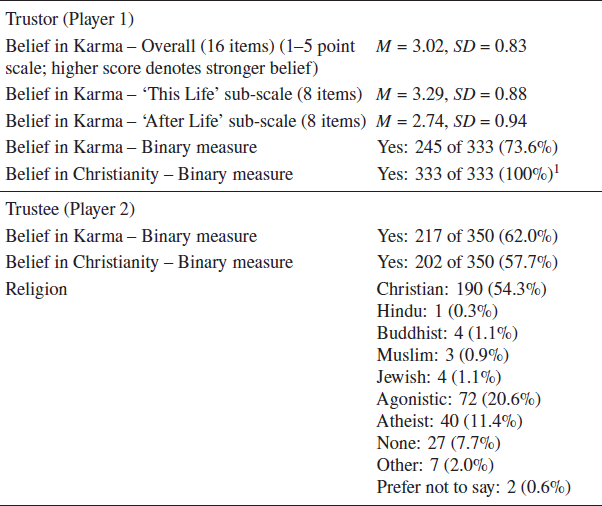
Note:
1 We intentionally sampled only Christians for our trustor sample.

Note. Expectation of reciprocity (upper panel) ranges from 0 to 10 and has been reverse-recoded such that higher scores represents greater expectation that the trustee will reciprocate (i.e., choose LEFT).
3.2 Primary analyses
3.2.1 Do trustors perceive trustees who believe in karma as more trustworthy?
Our primary research question is whether people perceive individuals who believe in karma (vs. do not believe) as more trustworthy. Our results indicate that participants in the trustor role expected trustees who believed in karma to be more likely to reciprocate, and were more likely to trust them.
We first examined the effects of karmic beliefs on expectation of reciprocity within each trustor. Expectation of reciprocity was measured on a 0-to-10 point scale and we derived the effects of karmic belief within each trustor by computing the average difference in expectations of reciprocity between the two partners who did not believe in karma and the two partners who did.Footnote 5 Thus, a positive score indicates that trustors expect those who believed in karma to be more trustworthy. The difference score had a mean of 2.03 (SD = 2.95) and was significantly different from zero (t(332) = 12.55, p < .001).
Turning to the trusting decision, which was measured on a binary (0 vs. 1) scale, we took a similar approach to derive a difference scoreFootnote 6 such that a more positive score indicates that trustors trusted individuals who believed in karma more. The difference score had a mean of 0.24 (SD = 0.38) and was significantly different from zero (t(332) = 11.57, p < .001).
3.2.2 Are there discrepancies between the expected and actual associations between karmic beliefs and trustworthiness?
Our findings thus far indicate that participants tended to perceive individuals who believed in karma as more trustworthy. Next, we examined if trustees who believed in karma actually behaved in a more trustworthy manner. Our results indicate that they did not. The proportion of reciprocation did not differ across trustees who believed in karma (56.68%; 123 out of 217) and those who did not believe in karma (61.65%; 82 out of 133; χ2(1) = 0.65, p = .421). The contingency table is shown in Table 3 (right panel).
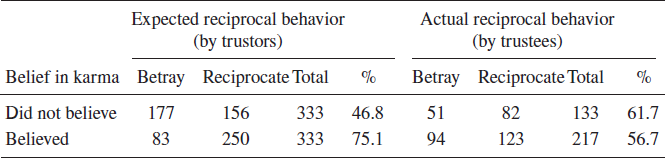
Having established that (i) trustors expected greater trustworthiness from trustees who believed in karma, and (ii) trustees who believed in karma did not behave more trustworthily, we proceeded to examine if this discrepancy was statistically significant. Results indicated that it was. We first recoded trustors’ reciprocal expectations from a 10-point scale into a binary measure (i.e., reciprocate vs. betray). We did so by recoding expectation scores 5 and above as expecting the trustee to reciprocate.Footnote 7 We opted to recode the midpoint (‘5’) as reciprocate because doing so would result in the overall proportion of expectations to reciprocate (61.0%) to be a close approximate of the proportion of trusting decision (66.7%). This resulted in the contingency table for expected reciprocal behavior shown in Table 3 (left panel).
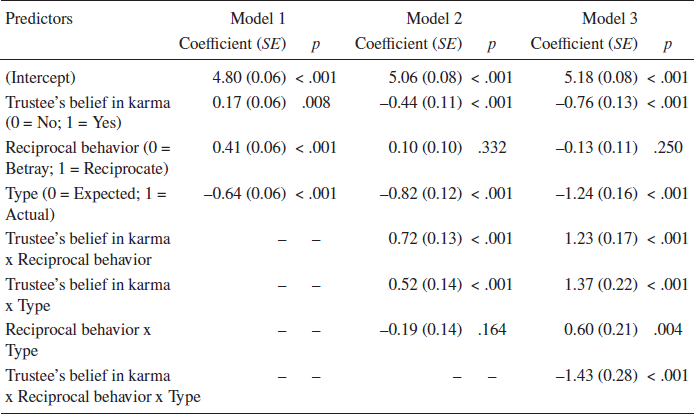
Next, we fitted a Poisson regression model (also known as log linear model) to examine if the contingency tables for actual and predicted reciprocal behavior differed significantly. Results indicated that it did: there was a significant three-way interaction between (i) trustee’s karmic belief, (ii) reciprocal behavior, and (iii) type (expectation vs. actual behavior; b = –1.43, SE = 0.28, p < .001). Results of this regression model are shown in Table 4’s Model 3.
3.3 Perceivers’ belief in karma
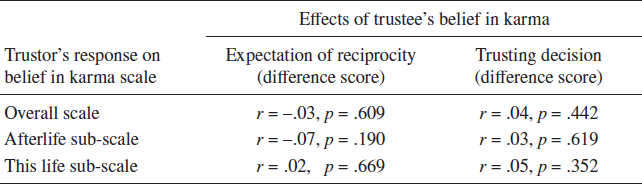
We also asked whether the tendency to perceive individuals who believed in karma as more trustworthy would differ across trustor’s (i.e., perceiver’s) responses on the belief in karma scale. Results indicated that the tendency to perceive individuals who believed in karma as more trustworthy did not differ across trustors’ response on the belief in karma scale. As shown in Table 5, the difference scores for expectation of reciprocity and trusting decision was neither associated with the overall score on the scale, nor the scores of the two sub-scales.
4 Discussion
We asked whether people perceive individuals who believe in karma, compared with those who do not, to be more trustworthy. In an incentivized study of American Christians, we found evidence that this was indeed the case. People expected interaction partners who believed in karma to behave in a more trustworthy manner and trusted these individuals more. Additionally, this tendency did not differ across the perceiver’s belief in karma.
While perceivers expected individuals who believed in karma to be more trustworthy, the individuals’ actual trustworthy behavior did not differ across their belief in karma. This discrepancy indicates that, although participants in our study used karmic belief as a cue when making trustworthiness judgment, it did not track actual trustworthiness. The absence of an association between karmic belief and actual trustworthy behavior among participants in the trustee role may seem to contradict prior research which found that reminders of karma increased generous behavior in dictator games (Reference White, Kelly, Sharriff and NorenzayanWhite et al., 2019; Reference Willard, Baimel, Turpin, Jong and WhitehouseWillard et al., 2020). However, note that our study did not involve any conspicuous reminders of karma – there was only a single question asking if participants believe in karma. Thus, it may be that those who believe in karma would behave in a more trustworthy manner only when the concept is made salient.
Although we had found that karma believers were perceived as more trustworthy, the psychological explanation(s) for this finding remains an open question. One possible explanation is that karma is seen as a source of supernatural justice and that individuals who believe in karma are expected to behave in a more trustworthy manner in order to avoid karmic ]punishment and/or to reap karmic rewards. However, believing in karma might also signal trustworthiness in other ways. For example, believing in karma may serve as a signal of religiosity or adherence to some forms of value system. This could explain why we found both beliefs in karma and Christianity to be individually sufficient in increasing perceived trustworthiness – because both led to inferences about adherence to some forms of value systems or religions.
4.1 Limitations and future directions
Our study had examined trustworthiness judgments in a zero-acquaintance setting where perceivers had no prior knowledge about the target. We opted for this approach because it allowed us to isolate the effects of karmic belief and enabled a clear test of its effects. Nonetheless, future research may consider examining the effects of karmic belief when other information about the targets is concurrently made available. For instance, while we found both beliefs in karma and Christianity to be sufficient in increasing perceived trustworthiness, there may be other unexamined beliefs and behaviors (e.g., beliefs and the practice of sexual abstinence and dietary restrictions) that may exert a similar effect on trustworthiness.
As the participants from our study were from United States and those in the trustor roles were exclusively Christians, the generalizability of our findings is undemonstrated. This is of particular relevance because our present work was centered on the folk understanding of karma and did not present participants with a specific definition of the concept. Given that there is some degree of variability in how participants may interpret the concept (Reference Willard, Baimel, Turpin, Jong and WhitehouseWillard et al., 2020), future work may examine how specific aspects or interpretations of karma relates to trustworthiness in different contexts.
Our findings indicate that there was a discrepancy between expected and actual associations between karmic belief and trustworthiness. However, a potential limitation is that expected and actual trustworthiness were measured on different scales. While actual trustworthiness was measured as a binary decision, expected trustworthiness was measured on a numeric scale and subsequently transformed into a binary variable. Future research could verify our findings when both actual and expected trustworthiness are measured on the same scale.
4.2 Conclusion
Karma is a concept that pervades much of everyday life. Our present research adds to the understanding of karmic belief by providing first evidence that people rely on this belief as a cue when judging the trustworthiness of others. This suggests that the expression of one’s belief in karma may confer interpersonal benefits in the form of being trusted more. In addition, we also show that belief in karma does not translate to actual trustworthiness. This suggests that people would err in relying on such a cue when judging trustworthiness.


 Open access

