


Across the globe, citizens are very concerned about false information in their newsfeeds (Newman et al., Reference Newman, Fletcher, Eddy, Robertson and Nielsen2023) and accusations of disinformation are thriving online (Egelhofer & Lecheler, Reference Egelhofer and Lecheler2019). As perceiving that information is false has real consequences, this research note aims to map mis‐ and disinformation beliefs related to the Russian war in Ukraine in 2022. Because the war is surrounded by high levels of false information, and as propaganda and deception are often used as a strategic weapon amidst armed conflicts (Erlich & Garner, Reference Erlich and Garner2023), the war may also be surrounded by high levels of perceived false information attributed to different (political) actors. In addition, as previous research on media coverage during wars found that domestic media may reflect the political elite's perspective rather than a balanced or neutral stance (e.g., Bell, Reference Bell1998; Hallin, Reference Hallin1985), it is relevant to explore to what extent and how news users across different countries perceive mis‐ and disinformation to be expressed.
Although misinformation beliefs in general may result in the avoidance of established information or support for conspiracy theories (e.g., Van der Linden et al., Reference Van der Linden, Panagopoulos and Roozenbeek2020), disinformation beliefs may further result in cynical views on politics or even anti‐democratic behaviors (e.g., Hameleers et al., Reference Hameleers, Brosius, Marquart, Goldberg, van Elsas and de Vreese2021). Considering that beliefs about the threats of false information are not always directly related to the actual prevalence of mis‐ and disinformation (Knuutila et al., Reference Knuutila, Neudert and Howard2022), we believe it is crucial to map perceptions of both misinformation and disinformation in the context of the war in Ukraine. In this research note, we therefore ask: How salient do people in different regions of the world that differ in geographical and political proximity to the war perceive mis‐ and disinformation on the Russian invasion of Ukraine?
Prior comparative research has indicated that citizens are – on average – quite concerned about the prevalence of misinformation in their (digital) newsfeeds (Newman et al., Reference Newman, Fletcher, Eddy, Robertson and Nielsen2023). However, we know very little about the causes associated with such perceived falsehoods. Do people associate false information mostly with unintended causes, such as a lack of expert knowledge (misinformation), or do they perceive it as driven by intentional deception? (disinformation). By exploring the sources and causes associated with perceived false information, we can better understand the specific reasons for citizens’ distrust in the context of an armed conflict. Arguably, compared to issues such as COVID‐19 where mainstream media may aim to adhere closely to norms of objectivity and neutrality, the context of war may promote a stronger moralistic perspective driven by a country's perspective on the issue (Bell, Reference Bell1998).
Our main findings show that people are most likely to associate falsehoods related to the war with intentional manipulation or deception. In a communication context where disinformation, conspiracy theories, and ‘fake news’ accusations have become omnipresent (e.g., Waisbord, Reference Waisbord2018), citizens may struggle to accept the honesty of information sources. Although this research note focuses on a specific case in which disinformation and propaganda thrive (e.g., Erlich & Garner, Reference Erlich and Garner2023), the finding that conventional national news sources are associated with disinformation is worthwhile for our understanding of people's perceptions of mis‐ and disinformation.
Literature review and research questions
We define misinformation as any form of information that is unintentionally false (Wardle, Reference Wardle2017), or information that is not based on relevant expert knowledge or empirical evidence (Vraga & Bode, Reference Vraga and Bode2020). Likewise, in our study, we map misinformation perceptions as the general perception that information on the war is false or factually inaccurate. Different from conventional measures of trust or media credibility (e.g., Kohring & Matthes, Reference Kohring and Matthes2007), we specifically look at news users’ evaluations of the expertise, accuracy and degree of facticity related to information on the war in Ukraine. We thus regard misinformation perceptions as a specific media evaluation that taps the credibility of information on the dimensions of accuracy, facticity and expertise.
Perceiving that information is false matters for different reasons. First of all, when people believe that most of the information they encounter is false, they may reject conventional knowledge or avoid the news, resulting in a less well‐informed electorate (Hameleers et al., Reference Hameleers, Brosius, Marquart, Goldberg, van Elsas and de Vreese2021). In addition, general perceptions of untruthfulness may motivate the approach of alternative or counter‐factual information that resonates with anti‐establishment or populist perspectives (Müller & Schulz, Reference Müller and Schulz2021). Moreover, Van der Linden et al. (Reference Van der Linden, Panagopoulos and Roozenbeek2020) show that beliefs related to misinformation enhance susceptibility to conspiracy theories. In the context of COVID‐19, Bitar et al. (Reference Bitar, Zawiah, Al‐Ashwal, Kubas, Saeed, Abduljabbar, Jaber, Sulaiman and Khan2021) further find that misinformation beliefs reduce people's willingness to get vaccinated. Perceiving that information is false can thus have real consequences, and considering that the levels of perceived misinformation are not directly related to the actual prevalence of false information across countries (Knuutila et al., Reference Knuutila, Neudert and Howard2022), and likely to be informed by ideological biases (Van der Linden et al., Reference Van der Linden, Panagopoulos and Roozenbeek2020), it is important to map the levels of perceived misinformation among citizens.
Yet, it has to be noted that the context of war relates to a specific setting for mis‐ and disinformation. Different scholars have indicated that media coverage in times of war is not at all times objective, neutral or balanced (e.g., Hallin, Reference Hallin1985; Konstankevych et al., Reference Konstankevych, Kostusiak, Shulska, Stanislav, Yelova and Kauza2022). In their analysis of information warfare, Konstankevych et al. (Reference Konstankevych, Kostusiak, Shulska, Stanislav, Yelova and Kauza2022) show how Russian propaganda techniques were used to sow panic among the Ukrainian population, for example, through attacking the military and delegitimizing politicians. In the context of the Gulf war, Hutchinson (Reference Hutchinson2008) concluded that the Western media covering the war were not objective, distant or neutral, but rather reflected the perspective of the ruling elites. Similar conclusions were drawn by Hallin (Reference Hallin1985), who concluded that the Vietnam war was not covered objectively by the Western media that reflected the (biased) perspective of national elites. The strict adherence to traditional journalistic norms of objectivity and neutrality in a war context is thus questionable (Bell, Reference Bell1998). Considering the presence of biases in domestic coverage of a foreign conflict, people may also be likely to associate the information they receive with mis‐ and disinformation.
It is relevant to additionally explore whether people perceive that information is intentionally false or that misinformation is the consequence of honest mistakes. Disinformation perceptions more specifically tap perceptions of harmful or deceptive intent (Hameleers et al., Reference Hameleers, Brosius, Marquart, Goldberg, van Elsas and de Vreese2021). In line with existing definitions that regard disinformation as intentionally harmful or deceptive information that is based on deliberate acts of doctoring, manipulation or fabrication (e.g., Freelon & Wells, Reference Freelon and Wells2020; Hancock & Bailenson, Reference Hancock and Bailenson2021), disinformation perceptions tap the evaluation that information is intentionally false or deceptive. Especially in times when mainstream media, scientists and political opponents are often associated with the intentional fabrication and manipulation of information with alleged political goals (e.g., Van Duyn & Collier, Reference Van Duyn and Collier2019), we believe that it is important to assess the extent to which news users perceive such intentions, and which sources they associate with false information.
Understanding the perceived causes and sources of falsehoods is important for several reasons. Perceptions related to the unintentional dissemination of falsehoods, for example due to a lack of expert knowledge, may reflect the critical media literacy skills that citizens need to navigate today's complex information setting (e.g., Pinkleton, Reference Pinkleton, Austin, Yushu, Willoughby and Reiser2012). People may still consume and accept information that contains factual inaccuracies, but they may process it using a more critical mindset. However, it matters whether these perceptions are proportionate to the threat. Even though disinformation beliefs associated with Russian propaganda or malign influence campaigns may reflect an accurate assessment of the information war at times (Erlich & Garner, Reference Erlich and Garner2023), Knuutila et al. (Reference Knuutila, Neudert and Howard2022) found that levels of perceived misinformation are not representative of the prevalence of false information. Yet, to date, it is unclear to what extent these findings are transferable to a war context, where propaganda and disinformation are disseminated by various journalistic and political sources (e.g., Konstankevych et al., Reference Konstankevych, Kostusiak, Shulska, Stanislav, Yelova and Kauza2022). At the same time, domestic media covering the war may be biased in their reporting, following their country's political standing on the issue (Hallin, Reference Hallin1985). We therefore aim to comprehensively map the causes and sources people associate with the dissemination of false information.
To map these perceptions of false information, as well as perceived causes and sources, we look at a selection of countries that differ on a number of factors that could relate to levels of perceived misinformation. To include a diverse sample, we collect original data from Austria, Belgium, Brazil, Czech Republic, Switzerland, Germany, Denmark, Spain, Serbia, France, Great Britain, Greece, Hungary, Italy, the Netherlands, Poland, Romania, Sweden and the United States. Here, it needs to be argued, that the sample mostly includes European countries, with the exception of Brazil and the United States. The reason to first of all focus on the European region is geographical proximity and economic and geo‐political interdependencies within this region. Within this region, we aimed to include nations that are geopolitically close (i.e., Poland) and further removed from the conflict (i.e., Spain). Arguably, people in countries close to the conflict may perceive the issue as more relevant, which may affect their evaluation of the veracity of information. Specifically, when personal issue relevance is higher, information is more likely to be subject to systematic processing and scrutiny (e.g., Metzger et al., Reference Metzger, Hartsell and Flanagin2020), which could enhance the overall level of misinformation beliefs in countries close to the conflict. Beyond the European setting, we included Brazil and the United States as they are countries characterized by high levels of polarization and low levels of general media trust – factors that may enhance the likelihood that people perceive misinformation to be prevalent (Humprecht et al., Reference Humprecht, Esser and Van Aelst2020).
Generally, the included countries differ in levels of freedom of speech, press freedom, polarization and overall trust in the media – which are found to correspond to different levels of resilience toward mis‐ or disinformation (Humprecht et al., Reference Humprecht, Esser and Van Aelst2020). More specifically, higher levels of trust in information in countries such as Sweden (50%) or the Netherlands (59%) may make people less inclined to associate information with misinformation (Newman et al., Reference Newman, Fletcher, Eddy, Robertson and Nielsen2023). Yet, lower levels of trust in Greece (32%) or the United States (29%) may correspond to a higher likelihood that information is associated with mis‐ and disinformation (Hameleers et al., Reference Hameleers, Brosius, Marquart, Goldberg, van Elsas and de Vreese2021). Considering that overall trust in the media is generally lowest in Northern and Latin America, and highest in Northern and Western Europe, the variety of included countries covers the diversity of trust in the media across the globe (Newman et al., Reference Newman, Fletcher, Eddy, Robertson and Nielsen2023). The aim of including a wide variety of countries is to explore whether levels of perceived mis‐ and disinformation are similar across settings differing on factors that could play a role in people's assessment of the quality of information. Yet, the sample is by no means representative of the world population or balanced regarding the variables of interest.
In this research note, we specifically raise the following research questions on the levels of false information perceptions across 19 different countries, the sources people regard as most likely to disseminate it and the perceived causes behind its spread. First, we aim to map the level of perceptions of false information in general without specifying perceived causes and intentions (RQ 1). After this, we aim to offer insights into perceptions related to misinformation versus disinformation by mapping the causes people associate with the dissemination of false information (RQ 3).
RQ 1: How pronounced are perceptions of false information related to the Russian war in Ukraine across 19 countries?
RQ 2: What sources do people associate with the dissemination of perceived false information on the war?
RQ 3: What causes do people associate with the dissemination of perceived false information on the war?
RQ 4: To what extent are perceptions of mis‐ and disinformation on the war different across countries?
Methods
We rely on original survey data collected for the purpose of this project in April–May 2022. The project received ethical approval by the review board of the university coordinating the project (The University of Amsterdam). The research questions, data collection protocol, sampling procedures and questionnaire were pre‐registered at the OSF platform. The link can be accessed via https://osf.io/pruda/?view_only=188fca5107ca40639936bfa810bbe5d5. The dataset will be made available on the OSF‐framework after the embargo period of the data collection. In the S1 Supporting Information, the code for data preparation and analyses can be found.
Data collection was conducted by the international research company Kantar, who translated the original English‐language survey into 19 country‐specific versions. All translations were, whenever possible, carefully checked by native speakers co‐authoring this paper. Light quota on gender, education and age were used to ensure a sample composition reflecting the census data in all 19 countries. The final number of completes used in the analyses was 19,037. Fifty‐three percent of the sample was female. The mean age of participants was 48.96 years (SD = 16.31).
To measure false information perceptions, we relied on the conceptualization of mis‐ and disinformation beliefs of Hameleers et al. (Reference Hameleers, Brosius, Marquart, Goldberg, van Elsas and de Vreese2021). The general items were adjusted to the context of the war in Ukraine, which means that we do not ask for perceptions related to false information in general, but specifically related to the Russian invasion of Ukraine. Respondents indicated to what extent they agreed with a total of six statements on a scale from 1 (completely disagree) to 7 (completely agree). The statements are as follows: ‘Information on the war in Ukraine is a) mostly inaccurate, b) not based on relevant expert knowledge, c) not based on objective facts, d) deliberately false, e) based on lies, and f) manipulated to deceive the public.’ We constructed a measure of false information perceptions by averaging across the six items (M = 3.64, SD = 1.56, Cronbach's alpha = 0.94).
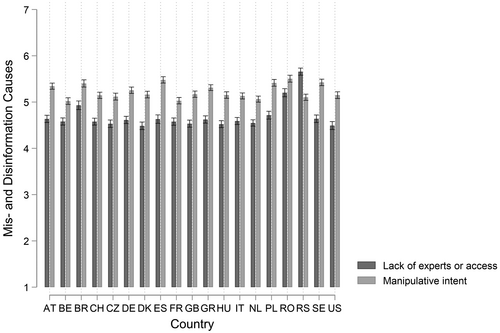
Measures for the perceived causes related to mis‐ and disinformation were based on the conceptual distinction between misinformation as driven by a lack of expert knowledge and/or empirical evidence (Vraga & Bode, Reference Vraga and Bode2020) and disinformation as motivated by goal‐directed deception or manipulation (e.g., Freelon & Wells, Reference Freelon and Wells2020). Based on this conceptualization, the following statements were presented to the participants: ‘False information is spread a) because of a lack of access to conflict areas, b) because of a lack of expert knowledge, c) due to strategic aims of political actors, d) to disrupt the societal order, e) to make financial gains and f) to hide reality from the people.’ Respondents indicated their agreement with these statements on a scale from 1 (completely disagree) to 7 (completely agree). We constructed two scales: ‘Lack of experts or access’ representing misinformation beliefs (M = 4.69, SD = 1.33, Cronbach's alpha = 0.68) and ‘Manipulative intent’ representing disinformation beliefs (M = 5.23, SD = 1.14, Cronbach's alpha = 0.79).
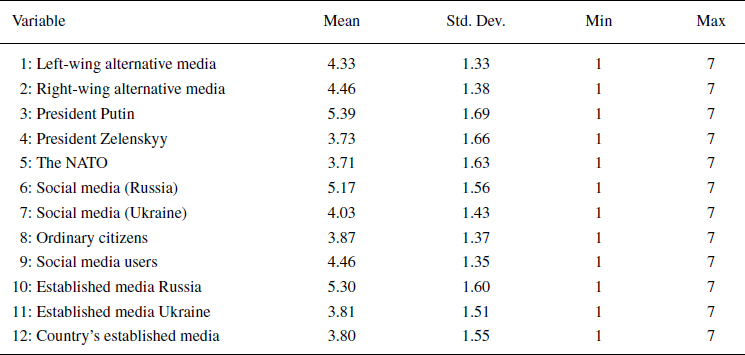
As disinformation can involve many different actors – ranging from ordinary citizens (Starbird, Reference Starbird2019) to elite actors (e.g., Marwick & Lewis, Reference Marwick and Lewis2017) and foreign actors influencing domestic and international politics (e.g., Starbird, Reference Starbird2019), we also asked participants to indicate which sources they associated with the dissemination of perceived false information surrounding the war. Table 1 offers an overview of the descriptive statistics for the included sources associated with perceived false information across all 19 countries. We specifically measured the perceived likelihood that the following actors were involved in the dissemination of false information: a) left‐wing alternative media, b) right‐wing alternative media, c) President Vladimir Putin or the Russian government, d) President Volodymyr Zelenskyy or the Ukrainian government, e) NATO, f) social media accounts in Russia, g) social media accounts in Ukraine, h) ordinary citizens in general, i) social media users, j) established media in Russia, k) established media in Ukraine and l) established media in the respondent's country.
Overview of sources associated with false information

Results
General levels of misinformation beliefs
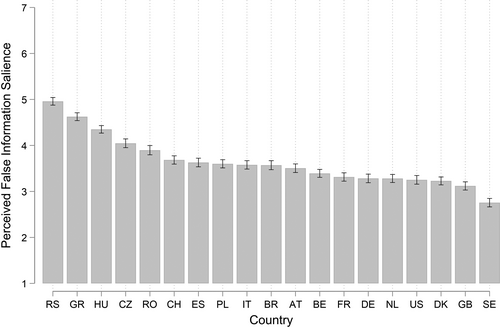
To answer RQ1, we compared mean scores of general misinformation beliefs across all 19 countries. Comparing across countries, we observe that in Serbia false information perceptions are strongest while in Sweden they are least pronounced (see Figure 1). For these analyses, we did not distinguish between the different causes or sources that participants associated with false information. Therefore, these findings offer a general overview of the extent to which people perceive that information about the war is false or erroneous without being necessarily intentionally deceptive.
Perceived salience of false information in 19 countries. Error bars show 95% confidence intervals. Perceptions are measured on a 7‐point scale from 1 (completely disagree) to 7 (completely agree). AT = Austria, BE = Belgium, BR = Brazil, CH = Switzerland, CZ = Czech Republic, DE = Germany, DK = Denmark, ES = Spain, FR = France, GB = Great Britain, GR = Greece, HU = Hungary, IT = Italy, NL = Netherlands, PL = Poland, RO = Romania, RS = Serbia, SE = Sweden, US = United States of America.

Russian sources are seen as the primary spreaders of false information
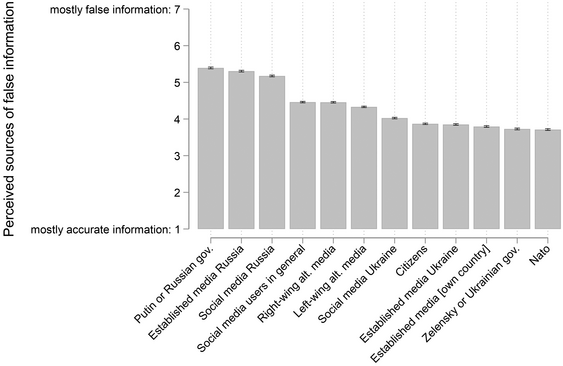
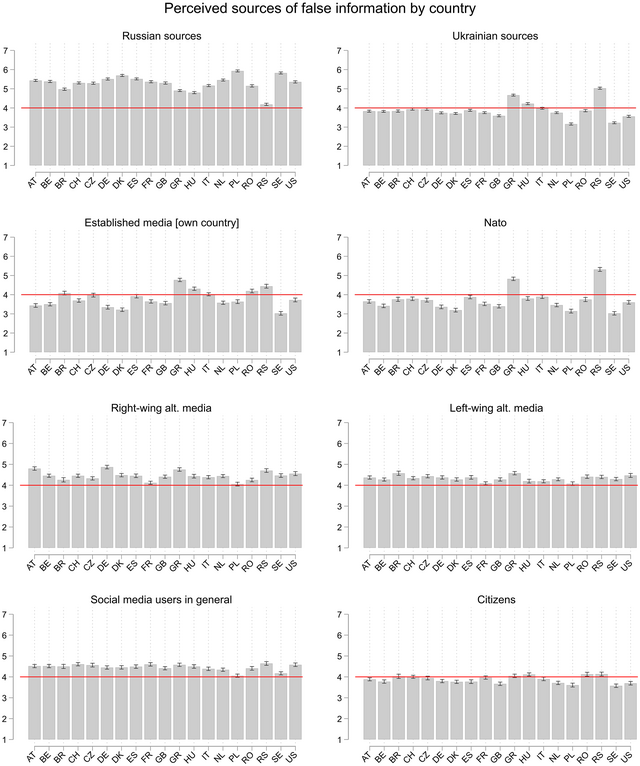
To answer RQ2 about perceived sources of false information across the 19 countries, we compared mean scores of all sources. Figure 2 displays the mean scores of these perceptions pooled across all countries, and Figure 3 offers the image of sources associated with perceived false information in all 19 countries separately. The results clearly indicate a difference in the perceived sources of false information between the two parties involved in the war. Russian actors – including the government, social media and mainstream media – are most likely to be regarded as peddlers of false information (M = 5.29, SD = 1.41). Respondents do not clearly distinguish between these Russian sources. The same sources in Ukraine are substantially and significantly less likely to be associated with the dissemination of false information (M = 3.87, SD = 1.33, t = 90.02, df = 19,036, p < 0.001). Although distrust is most clearly pronounced in relation to the pro‐Russia side, people are also likely to associate domestic established media, citizens and NATO with perceived falsehoods. Participants do not clearly distinguish between NATO and established media in their own country on the one hand and the Ukrainian government or media on the other hand. People's overall support for Ukraine amidst the war goes hand in hand with relatively low levels of perceived falsehoods associated with them versus the Russian aggressor. We do not find any major differences in misinformation beliefs across different demographic profiles. However, people with the lowest education level (i.e., early childhood education) on average rate Russian sources as spreading the lowest level of false information compared to any other education group. At the same time, lower educated participants are most likely to associate NATO with false information dissemination.
Perceived sources of mis‐ and disinformation across 19 countries. Perceptions are measured on a 7‐point scale from 1 (mostly disseminates accurate information) to 7 (mostly disseminates false information).

Perceived sources of mis‐ and disinformation by country. The variable Russian sources is calculated as the average of evaluations of Putin or the Russian government, established media in Russia and social media in Russia. The measure of Ukrainian sources is based on the average rating of social media in Ukraine, established media in Ukraine and Zelenskyy or the Ukrainian government. Perceptions are measured on a 7‐point scale from (mostly disseminates accurate information) to 7 (mostly disseminates false information).

False information is likely to be perceived as caused by deliberate intentions to mislead
To answer RQ3, we explored which factors are perceived as the most likely causes of false information. Based on the pooled analyses, the unintentional dissemination of perceived false information – due to an alleged lack of access to experts and facts – was seen as significantly and substantially less likely (M = 4.49, SD = 1.39) than the deliberate dissemination of falsehoods (M = 5.15, SD = 1.17, t = 14.16, df = 19,036, p < 0.001). Figure 4 displays the results for each of the 19 countries separately. The main pattern of associating perceived false information more with intentional than unintentional causes was confirmed in most countries. Serbia is the exception considering that it is the only country where people believe that false information is mostly due to a lack of access to the area or lacking expert knowledge.
Perceived causes for false information distinguishing between mis‐ and disinformation in 19 countries. Perceptions are measured on a 7‐point scale from 1 (completely disagree) to 7 (completely agree).

Beliefs related to false information differ across countries
Across countries, we find relatively similar patterns of perceived mis‐ and disinformation. Looking at the average level of falsehoods in different countries, beliefs related to false information are less strong in Northern and Western European countries (i.e., Sweden, Denmark, Austria) than Southern and Eastern European countries (i.e., Serbia, Greece, Hungary). This corresponds to general levels of trust in the media across these different countries: Although general media trust is higher in Northern European countries such as Denmark (59%), it is considerably lower in Hungary (30%) or Greece (32%) (Newman et al., Reference Newman, Fletcher, Eddy, Robertson and Nielsen2023).
Discussion
Different from earlier research indicating that people are most likely to associate falsehoods with unsystematic and unmotivated errors (Hameleers & Brosius, Reference Hameleers and Brosius2021), we found that people are most likely to associate falsehoods related to the war with intentional manipulation or deception. The context of the war may thus trigger the suspicion of omnipresent malign information campaigns and goal‐driven manipulation, whereas manipulative intent is less likely to be associated with routine political communication in general. This finding supports extant research on media coverage and objectivity at times of war (e.g., Bell, Reference Bell1998; Hallin, Reference Hallin1985). Considering that even traditional journalistic reporting on a foreign war may be biased by the country's standing on the issue, people may respond with similar beliefs of disinformation.
We also found that information is most likely to be perceived as false when it comes from the enemy or the ‘other’ – revealing social identification dynamics in mis‐ and disinformation perceptions. Who the ‘other’ is may depend on the country's political positioning vis‐a‐vis the warring sides (also see Hovland & Weiss, Reference Hovland and Weiss1951). In this vein, official Russian sources, including the state‐owned media, are most likely to be accused of disseminating false information across most national settings. Ukrainian sources are substantially less likely to be blamed, which reveals a biased interpretation in the mis‐ and disinformation beliefs of citizens across most countries.
We finally explored how pronounced these different beliefs are across different national settings. Our findings show that citizens in countries with lower levels of media trust (i.e., Serbia, Hungary, Poland, Greece) report higher levels of perceived mis‐ and disinformation than democracies with higher levels of trust in information (i.e., Sweden, Denmark, Germany). As an implication of our findings, then, it seems that in countries where trust in conventional information sources is low, mis‐ and disinformation beliefs are more likely to be salient.
The main finding that levels of false information beliefs are high across different settings, and mostly associated with Russian sources and intentional deception, is relevant for journalists, educators, media practitioners and policymakers. Interventions targeting the threats of false information on salient crises, such as the war in Ukraine or COVID‐19, should focus on preventing and countering false statements, but also take into account the legitimacy and trust issues accompanying it. Considering that people do not only associate Russian state media and governments but also domestic media, social media and NATO with falsehoods, it is important to restore trust in accurate information and help people navigate trustworthy sources of information.
Next to restoring trust in reliable and high‐quality information, offering transparency on how information and knowledge is gathered is crucial to help citizens understand when and how false information is caused by deliberate manipulation. Our study indicates that people show high levels of distrust in their own country's media outlets, as they are equally likely to associate them with false information as Ukrainian sources or from NATO. This may be explained as the context of war and an armed conflict may relate differently to mis‐ and disinformation as compared to issues such as COVID‐19. Considering that established media sources and organizations may show a clear bias in their communication on war (e.g., Hallin, Reference Hallin1985), and taking into account that objectivity and neutrality may be less central in war coverage (Bell, Reference Bell1998), people may also associate seemingly objective sources with disinformation in times of war.
To restore trust in the media, and the legitimacy issues surrounding information on the war, it is crucial for media practitioners, platforms and journalists to be transparent about levels of uncertainty, and explain how and why errors are made throughout news coverage as a consequence of ‘honest’ mistakes instead of deliberate deception. Arguably, reflecting more transparently on certain biases and stances in reporting may also help news users to better judge the quality of information. Hence, given the finding that manipulative intent is seen as more prominent than unsystematic errors with less severe democratic implications, practitioners should show readers how information is sourced and verified, whilst also being transparent about the role of objectivity and bias.
Our study is not without limitations. First, our data does not allow us to assess whether people's perceived levels of mis‐ and disinformation are proportionate and representative of the actual levels of mis‐ and disinformation disseminated about the war. Although we used rather crude indicators of extant research indicating a very low level of deceptive information in digital newsfeeds (e.g., Acerbi et al., Reference Acerbi, Altay and Mercier2022) versus the relatively above‐average perceptions of mis‐ and disinformation, we cannot arrive at a clear assessment of whether people are wrong in perceiving that false information abounds.
Second, although we distinguished between sources and causes associated with false information, our data do not allow us to reach conclusions on which sources are accused of misinformation versus disinformation. We suggest future research to investigate which sources are mostly held accountable for ‘honest’ mistakes (i.e., inaccurate coverage due to understandable reasons) versus disinformation and propaganda (i.e., deliberately deceiving the people for political profit).
Third, our data captures perceptions early in the war. As more information became available as the war went on, they are likely to have shifted or solidified. While collecting data at this stage enabled us to capture participants’ assessments based on individual as well as country‐level factors when differences were still more prominent, they are not representative of the whole, still on‐going war. Future research may need to rely on multiwave assessments of perceptions of misinformation. Arguably, when overall media attention for an event is declining whereas knowledge is surrounded by a lower level of uncertainty, perceptions of misinformation may get lower. We should also acknowledge the limitations of our country selection. Although we aimed to capture variety regarding media trust, geographical proximity and other factors potentially related to perceived misinformation, our sample mainly includes European countries that are NATO members. In addition, most countries supported the Ukrainian side, which makes the analysis of misinformation perceptions potentially biased. We therefore suggest future research to look at more different regions, including countries in the Global South.
Despite these limitations, our study offers novel insights into the attitudinal basis of mis‐ and disinformation during a highly salient war. We hope that this assessment can be used in future research to explore the extent to which public concerns about deceptive information and inaccurate coverage are justified or disproportionate.
Funding information
The collection of data in Romania was supported by the Interdisciplinary PhD school of SNSPA.
The research presented in this paper is a part of the project “THREATPIE: The Threats and Potentials of a Changing Political Information Environment” which is financially supported by the NORFACE Joint Research Programme on Democratic Governance in a Turbulent Age and co‐funded by FWO, DFF, ANR, DFG, NCN Poland, NWO, AEI, ESRC and the European Commission through Horizon 2020 under grant agreement No 822166.
The collection of data in the Czech Republic, Hungary and Serbia was supported by the Economic and Social Research Council [ES/S01019X/1].
The collection of data in Italy was supported by the Italian Ministry of Research and University under the PRIN research program (“National Projects of Relevant Interest”, 2017) (grant number: 20175HFEB3).
Online Appendix
Additional supporting information may be found in the Online Appendix section at the end of the article:
Supplement information


 Open access

