





Introduction
In recent years, unmanned aerial vehicles (UAVs; or, more colloquially, ‘drones’) have been a widespread tool worldwide, including in remote areas such as Antarctica. Besides media productions (movies, television, photography) and private users, scientists are also discovering useful applications for UAVs. The scientific fields making use of UAVs range from glacier or sea-ice surveys (McGill et al. Reference McGill, Reisenbichler, Etchemendy, Dawe and Hobson2011, Bhardwaj et al. Reference Bhardwaj, Sam, Akanksha, Martin-Torres and Kumar2016) and flora measurements (Lucieer et al. Reference Lucieer, Robinson, Turner, Harwin and Kelcey2012) to diverse wildlife monitoring applications (Christie et al. Reference Christie, Gilbert, Brown, Hatfield and Hanson2016, Pfeifer et al. Reference Pfeifer, Barbosa, Mustafa, Peter, Rümmler and Brenning2019, Wang et al. Reference Wang, Shao and Yue2019, Román et al. Reference Román, Tovar-Sánchez, Fernández-Marín, Navarro and Barbero2023).
The issue of the impacts of UAVs on wildlife has gained prominence due to the rapid increase in their use, particularly in the extreme and vulnerable Antarctic environment. But even though there have been several studies focusing on this topic (see Mustafa et al. Reference Mustafa, Barbosa, Krause, Peter, Vieira and Rümmler2018, Harris et al. Reference Harris, Herata and Hertel2019), robust data on whether UAV activity influences penguin individuals or populations remain sparse. Regarding Pygoscelis penguins, their reactions to UAVs have been intensively investigated in gentoo (Pygoscelis papua) and Adélie penguins (Pygoscelis adeliae; Rümmler et al. Reference Rümmler, Mustafa, Maercker, Peter and Esefeld2016, Reference Rümmler, Mustafa, Maercker, Peter and Esefeld2018). In chinstrap penguins (Pygoscelis antarcticus), two previous studies reported such observations (Gardner et al. Reference Gardner, LeRoi and Perryman2010, Goebel et al. Reference Goebel, Perryman, Hinke, Krause, Hann, Gardner and LeRoi2015), with both stating that at 30 m flight heights above the animals no reactions were observed. A detailed study on the impacts of different UAV flight heights on adult chinstrap penguins was published by Krause et al. (Reference Krause, Hinke, Goebel and Perryman2021). For flight heights of 30 and 46 m, this study revealed no responses there were distinguishable from the control group. Responses to overflights at 8 and 15 m, on the other hand, were significantly greater than those of the control group.
All of these studies focused mainly on bird behaviour at the individual level. Whether a behavioural reaction is accompanied by any long-term consequences for the individual, such as energy loss and/or reduced survival, cannot be concluded from such data. A first step towards such understanding would be to explore physiological effects such as changes in heart rate, respiration or stress hormones levels. A previous study confirmed the link between behavioural and physiological responses in king penguins (Aptenodytes patagonicus) by measuring heart rates (Weimerskirch et al. Reference Weimerskirch, Prudor and Schull2018). The observations of this study imply that, for chicks, behaviour is linked to heart rate: increased heart rates were observed after UAV flights and (although not always) following stressed behavioural responses. On the other hand, in adults, very minor behavioural reactions were observed, whereas heart rates increased similarly to those of chicks. These results give us reason to assume that physiological reactions are equally or more sensitive than behaviour. Other studies on the physiological consequences of UAV activity have only been conducted in mammals (Ditmer et al. Reference Ditmer, Vincent, Werden, Tanner, Laske and Iaizzo2015, Krause et al. Reference Krause, Hinke, Goebel and Perryman2021, focused on heart rates and respiration rates, respectively).
This study, for the first time to our knowledge, focuses on the response in terms of corticosterone (CORT), the basic adrenal glucocorticoid in birds, to UAV activity. CORT is the principal hormonal mediator of physiological and behavioural responses to stress (Wingfield & Romero Reference Wingfield, Romero and Terjung2011) and has previously been demonstrated to be sensitive to different stressors in penguins, such as human disturbance (Villanueva et al. Reference Villanueva, Walker and Bertellotti2012). To disentangle whether UAV activities influence individuals’ behaviour and disrupt hormonal responses, we applied an experimental approach comparing the effects of two different levels of disturbance by UAV overflights on the behavioural and hormonal responses (i.e. CORT) of chinstrap penguin chicks. As the ‘Soft’ treatment, we chose a flight height of 50 m. In adult chinstrap penguins, Krause et al. (Reference Krause, Hinke, Goebel and Perryman2021) found no significant behavioural impacts of overflights at this height, and this height is recommended as the minimal invasive fleight height above penguins (Mustafa et al. Reference Mustafa, Barbosa, Krause, Peter, Vieira and Rümmler2018). As the ‘Hard’ treatment, we used a flight height of 15 m. This height was chosen to ensure an observable behavioural reaction based on previous knowledge (Rümmler et al. Reference Rümmler, Mustafa, Maercker, Peter and Esefeld2016, Reference Rümmler, Mustafa, Maercker, Peter and Esefeld2018, Krause et al. Reference Krause, Hinke, Goebel and Perryman2021). Even though a flight height of 15 m is not suitable for mapping surveys, other scientific applications pursing different questions and using different sensors might need very low flight heights in the future (e.g. thermoregulation using thermal cameras, recognition of RFID-tagged individuals, penguin chick monitoring during breeding). In addition, television production crews and private UAV pilots are currently flying at these low heights, and so this flight height requires further evaluation. As flying under certain altitudes leads to robust reactions, we hypothesize that low flight heights (15 m) drive stronger behavioural (Rümmler et al. Reference Rümmler, Mustafa, Maercker, Peter and Esefeld2016, Reference Rümmler, Mustafa, Maercker, Peter and Esefeld2018, Krause et al. Reference Krause, Hinke, Goebel and Perryman2021) and physiological (Weimerskirch et al. Reference Weimerskirch, Prudor and Schull2018) responses than higher flight heights, predicting signs of stress through behaviour as well as increased physiological stress (higher CORT levels). Moreover, if physiology is more sensitive than behaviour (Weimerskirch et al. Reference Weimerskirch, Prudor and Schull2018), we can also predict an increment of physiological stress (higher CORT levels) at higher flight heights (50 m) with no behavioural response.
Materials and methods
Study site and studied species
Fieldwork was conducted in the Vapour Col chinstrap penguin colony (62°59′S, 60°43′W) on Deception Island, South Shetland Islands (Antarctica), during the breeding season of 2017/2018. The colony consists of ~18 000 breeding pairs of chinstrap penguins counted on the ground (although it could range down to 13 250; Mustafa et al. Reference Mustafa, Firla, Grämer, Hallabrin, Haucke and Knetsch2020, Belyaev et al. Reference Belyaev, Román, Belliure, Navarro, Barbero and Tovar-Sánchez2024) in aggregations of various sizes from single nests up to sub-colonies of 4000 nests (Barbosa et al. Reference Barbosa, Moreno, Potti and Merino1997). The chinstrap penguin is a medium-sized penguin (~4 kg) that raises a maximum of two chicks per breeding season. Chicks remain on the nest for ~1 month during the so-called guard phase of growth, and they left the nest during the crèche phase, when the transition to thermal independence occurs (Taylor Reference Taylor1986). Chicks remain in the colony until moulting and fledging at ~50–60 days of age (Moreno et al. Reference Moreno, Carrascal, Sanz, Amat and Cuervo1994, Viñuela et al. Reference Viñuela, Moreno, Carrascal, Sanz, Amat and Ferrer1996).
Experimental design
The study was carried out at the beginning of the crèche phase (25 and 27 January 2018). Six sub-colonies were selected, which had not been subjected to any other experiments during that season (Fig. 1). Selected sub-colonies were of similar sizes (14–86 breeding pairs, mean = 45.3 breeding pairs) and were situated in the same area of the colony to minimize the effects of within-colony location and sub-colony size differences on behaviour and hormonal levels. Sub-colonies were spatially separated so as to prevent experiments on one group having any unwanted effects on another group. We used chicks as study subjects for several reasons. Firstly, repeated sampling and observation were not always possible for adults because they leave the sub-colony for foraging trips. However, chicks of this age would stay within their crèche during the whole time of the experiments (3 days). Secondly, chicks are assumed to be more vulnerable and have not yet been investigated regarding their sensitivity to UAV flights. To increase the value of the results of this study for deriving guidelines, we chose to work on this particularly vulnerable stage of penguin biological activity: the early crèche phase.
a. Vapour Col chinstrap penguin colony and b. its location on Deception Island. All sub-colonies are shown, as well as the ones used in the experiment and the unmanned aerial vehicle treatment of each group (C1, C2 = ‘Control’ groups; S1, S2 = ‘Soft’ treatment (50 m flight height); H1, H2 = ‘Hard’ treatment (15 m flight height)). Sub-colony outlines were acquired during the GPS-based census of the colony (Mustafa et al. Reference Mustafa, Firla, Grämer, Hallabrin, Haucke and Knetsch2020).

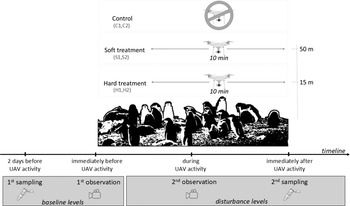
Three different treatments were considered (Control, Soft and Hard), each including two of the selected sub-colonies (see Figs 1 & 2). The Control treatment encompassed no UAV activity and was carried out on sub-colonies C1 and C2. The Soft treatment consisted of overflights above sub-colonies S1 and S2 at a flight height of 50 m. Finally, the Hard treatment consisted of overflights above sub-colonies H1 and H2 at a flight height of 15 m. Both Soft and Hard treatments were applied for 10 min. During flights, the UAV moved back and forth and repeatedly changed its direction. In this way, we made sure that the activity was long enough to be recognized by the penguins. UAV flights were performed using a Quadcopter (size: 29 × 29 cm; weight: 1.28 kg; flight speed: 8–12 m/s; noise level: 70 dB at 5 m; colour: white; Phantom 4 Pro, DJI, Shenzhen, PR China).
Schematic representation of the experimental design. The three treatments, each carried out on two breeding groups, are shown, as well as the timeline explaining the timing of data gathering. For the first sampling, blood was collected 2 days before the experiments, whereas behavioural observations were made directly before treatment. The second sampling was done during unmanned aerial vehicle (UAV) activity for behavioural observations and immediately after UAV flights for blood sampling.

The experiment involved two observation/sampling events of behaviour and hormonal levels to obtain baseline and disturbance measures (see Fig. 2). The first sampling (i.e. baseline levels) for hormonal levels was conducted in all selected sub-colonies 2 days before UAV flights to prevent sampling effects (particularly stress induced by handling) from overlapping with the experiments. The behavioural baseline level (i.e. first observation) was recorded directly before the UAV flights in sub-colonies experiencing UAV activity. We did not observe behaviour within the Control groups twice as no changes occurred between both situations (only occurring a few minutes apart, both without UAV activity), so our presence would have represented an unnecessary additional disturbance within the colony. In the second observation/sampling (i.e. disturbance levels), behaviour was recorded during the UAV flights, and hormonal levels were measured directly after the flights (see Fig. 2).
Behavioural observations and hormonal sampling
The behavioural observations followed the methods described in Rümmler et al. (Reference Rümmler, Mustafa, Maercker, Peter and Esefeld2016). The focal sub-colony was video recorded for 3 min (first observation/baseline levels) or 10 min (second observation/disturbance levels) from ~20 m distance with a camera equipped with a telephoto lens on a tripod. The observer using the camera hid behind natural structures where possible or crouched on the ground if not, avoiding any movement that could add to the disturbance. The recorded material was analysed using CowLog software (version 3.0.2; Pastell Reference Pastell2016). There is no complete record of chinstrap penguin behaviour (Jouventin Reference Jouventin1982), but it is observed to be very similar to the behaviour of Adélie penguins, which are described in detail in many studies (e.g. Ainley Reference Ainley1974, Spurr Reference Spurr and Stonehouse1975b, Schuster Reference Schuster2010). Following Spurr (Reference Spurr1975a), at the age of the crèche stage, chicks are supposed to show all adult behaviours fully or at least in an immature version. We therefore based the behavioural observations on descriptions of Adélie penguins and adapted them according to occurrences in field (see Table I).
Behaviour of chinstrap penguin chicks. Shown is an overview of behaviour observed among chinstrap penguin chicks with descriptions of concrete example behaviours.

Behaviour was analysed in 10 focal individuals within each sub-colony for every second of the recorded video material. To avoid inter-rater differences, all observation were carried out by one observer. Observed individuals were not necessarily the banded individuals used for blood sampling, as the bands were not visible on the videos. However, considering the size of the crèche group, it is very probable that those chicks were part of the behavioural observations. Between the first and second samplings, the observed individuals were mainly the same due to the short time between the samplings and the relatively stationary behaviour of the chicks. The percentage of time spent engaging in any disturbance-indicating behaviour per individual was used for statistical analyses (see Table I).
For hormonal sampling, six chicks were randomly selected in each sub-colony for blood extraction. The selected chicks were captured by hand, one by one, and blood samples were taken from a foot vein using a heparinized capillary tube within 2–5 min after capture. A handling duration of less than 5 min has been demonstrated to have no effect on baseline hormonal stress level (i.e. CORT level) in Adélie penguins (Vleck et al. Reference Vleck, Vertalino, Vleck and Bucher2000). After blood extraction, chicks were banded for later recognition (as the same chicks were used for the first and second samplings) and returned to the breeding group before the next chick was taken out. The chicks were released into the sub-colony immediately after handling, and at the end of all hormonal measurements, the bands were retrieved. Blood samples were kept in Eppendorf tubes inside a cool box in the field and were centrifuged at 1200 rpm for 10 min in the laboratory on the same day to separate plasma and red blood cells. Plasma and red blood cells were frozen at −20°C until laboratory analysis. The plasma level of CORT was quantified with a enzyme-linked immunosorbent assay (ELISA) using a commercial ELISA kit for CORT (DRG Instruments GmbH, Marburg, Germany) according to the manufacturer’s instructions. Absorbance was read at a wavelength of 450 nm with a microplate spectrophotometer at 24°C (Multi-Mode Microplate Reader, Synergy™ HT, BioTek, Winooski, VT, USA). Samples were analysed using microplates on which the treatment was evenly distributed together with duplicates for each sample and standards. Intra-assay coefficients of variation from plates I and II were 6.60% and 2.29%, respectively. The inter-assay coefficient of variation was 15.32%.
Statistical analysis
Statistical analyses included a generalized linear model (GLM) and generalized linear mixed models (GLMMs). All P-values ≤ 0.05 were considered significant. All statistics were performed using R (R Core Team Reference Team2018) in RStudio (RStudio Team 2016).
For statistical analysis of the proportion of disturbance-indicating behaviours, three binomial GLMMs were constructed. In all models, success/failure data (success = seconds an individual spent engaging in disturbed behaviour; failure = seconds not spent engaging in disturbed behaviour) were used as the response variable. First, we tested for differences between sub-colonies before any UAV activity (first observation), using ‘sub-colony’ as a fixed factor and ‘individual’ as a random factor. In the second step, two models were built to compare 1) treatments (Control, Soft and Hard) during the second observation using ‘treatment’ as a fixed factor and ‘individual’ and ‘sub-colony’ as random factors and 2) the differences between the first and second observations within the Soft and Hard treatments using ‘treatment’ and ‘observation’ as well as their interactions as fixed factors and ‘individual’ and ‘sub-colony’ as random factors.
Regarding differences in CORT levels, residuals from the constructed models followed a normal distribution after CORT values were log10 transformed (‘log10 CORT’; Kolmogorov-Smirnov normality test, P > 0.165). A GLM was used to test log10 CORT-level differences between sub-colonies during the first sampling, using ‘log10 CORT’ as the response variable and ‘sub-colony’ as an explanatory factor. After the GLM was constructed, a post hoc analysis (Tukey’s Honestly Significant Difference (HSD) test) was used to discern the within-group differences.
To test for the potential impacts of UAVs on hormonal CORT levels, an initial GLMM was constructed on log10 CORT with ‘treatment’ (Control, Soft and Hard) and ‘sampling event’ (first and second samplings) as fixed factors as well as their interaction, ‘starting time of sampling’ (i.e. time between the end of treatment and the start of each individual’s blood sampling) as a covariate and its interaction with ‘sampling event’, and ‘individual ID’ and ‘sub-colony’ as a random factor. The initial GLMM revealed a dependence of CORT levels on the starting time of sampling in the sub-colony (F(1, 59.196) = 9.491, P = 0.003). Indeed, this association revealed that, during the first sampling, no significant relationship occurred between CORT levels and starting sampling time (r = 0.23, P = 0.185, N = 35; Fig. S1a), whereas during the second sampling, this relationship was significantly positive (r = 0.492, P = 0.003, N = 35; Fig. S1b). To deal with this impact of our manipulation, we excluded all individuals sampled more than 5 min after the start of sampling in the sub-colony from further analyses because, according to Vleck et al. (Reference Vleck, Vertalino, Vleck and Bucher2000), handling duration has no effect on baseline CORT levels if it occurs for less than 5 min in Adélie penguins. After exclusion, there was no effect of starting time of sampling in the initial model (F(1, 26.278) = 2.916, P = 0.1). Thus, only using individuals sampled within the first 5 min after the beginning of the sampling event in the colony, a definitive GLMM was constructed on log10 CORT with ‘treatment’ (Control, Soft and Hard) and ‘sampling event’ (first and second samplings) as fixed factors as well as their interaction and ‘individual ID’ and ‘sub-colony’ as random factors. Similarly, only these individuals (sampled within 5 min) were included to test log10 CORT-level differences between breeding groups during the first sampling.
Results
Behaviour
No significant differences in baseline behavioural level among the different selected sub-colonies before treatment (first observation) were found (F(5,53) = 0.8172, P = 0.5372; see Fig. S2). Within the second observation, proportions of disturbance-indicating behaviours were found to significantly differ between treatments (F(2,55) = 34.149, P < 0.0001, see Fig. 3; for more details, also see Fig. S2). Pairwise comparisons revealed those differences to lie between the Control and Hard treatments (P < 0.0001) as well as between the Hard and Soft treatments (P < 0.0001), whereas the Control and Soft treatments did not differ significantly (P = 0.5881).
Results of behavioural analyses. Boxplot of the comparison of the proportion of disturbance-indicating behaviours during the first and second observations of the three treatments (‘Control’ = no unmanned aerial activity (UAV) activity; ‘Soft’ = UAV flying at 50 m; ‘Hard’ = UAV flying at 15 m).

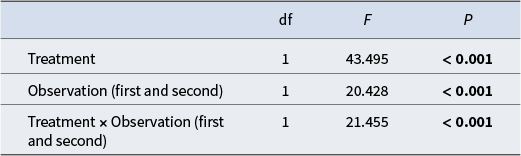
Within the Hard and Soft treatment sub-colonies, ‘treatment’, ‘observation’ and the interaction of both were found to be significantly different (see Table II). Subsequent pairwise comparisons of the interaction revealed the difference in the proportion of disturbance-indicating behaviours between the first and second behavioural observations within the Hard treatment to be significant (P < 0.0001; see Fig. 3), whereas it was not significant during the Soft treatment (P = 0.8724).
Results from the binomial generalized linear mixed model comparing proportions of disturbance-indicating behaviours in the ‘Hard’ and ‘Soft’ treatment groups, examining the effects of treatment, observation (before (first) and during (second) drone flight) and the interaction of both. Significant relations are given in bold.
The main observed behaviours during the Soft and Control treatments were classified as comfort and resting behaviours, with only a minority of the time spent in vigilance (see Fig. S3). Agonistic or escape behaviours were almost never observed. During the Hard treatment, vigilance increased to the dominant behaviour observed, but there was still only a short time spent in agonistic or escape behaviours, with comfort and rest behaviours exceeding these agnostic or escape behaviours (see Fig. S3).
Hormone levels
Initial CORT levels (first sampling) before treatment significantly differed between breeding groups (F(5,10) = 3.929, P = 0.031); the difference was found to lie between breeding groups H1 and C2 and between the two Control groups (Tukey’s HSD test; Fig. S4).
’Treatment’, ‘sampling’ (first and second days of the experiments) and their interaction did not show significant differences regarding CORT levels (see Table III). Nevertheless, CORT levels in all groups except for S2 were higher at the second sampling than at the first sampling, even in the Control groups with no UAV activity on either of the sampling days (Fig. 4; for more details, also see Fig. S4). The CORT levels after treatment did not significantly differ between breeding groups (F(5,15) = 1.306, P = 0.313; Fig. S4).
Results from a analysis of variance of the generalized linear mixed model examining the effects of treatment and sampling event (before (first) and after (second) drone flight) on cortisone levels. Significant relations are given in bold.

Results of physiological analyses. Boxplot of the comparison of cortisone (CORT) levels during the first and second samplings of the three treatments (’Control’ = no unmanned aerial activity (UAV) activity; ‘Soft’ = UAV flying at 50 m; ‘Hard’ = UAV flying at 15 m).

Discussion
Low flight heights (15 m, Hard treatment) were hypothesized to drive stronger behavioural and physiological stress responses than higher flight heights (50 m, Soft treatment), and the behavioural analyses produced very clear and distinct results supporting our hypothesis. While the investigated sub-colonies in general did not differ in their behaviour before treatment, there was a clear difference in behavioural reactions to the different treatments (Figs 3 & S2). The Hard treatment invoked a clear increase in behaviours indicating disturbance, whereas in Soft treatment groups no changes were found in comparison to the Control groups or the first observation. This means that micro-UAV (wingspan < 1 m, maximum weight ~1 kg) activity at high flight heights (50 m) does not cause (measurable) changes in chinstrap penguin chicks’ behaviour compared to their natural, UAV-undisturbed state. This could either mean that, as far as we can conclude from behavioural observations, at this flight height the UAV is not perceived, or that it is simply not regarded as a threat. In contrast, there is a clear reaction to the UAV at a low flight height (15 m).
Previous observations of reactions of chinstrap penguins to UAVs have reported no signs of disturbance at flight heights above 30 m but changes of behaviour at flight heights below this threshold (Gardner et al. Reference Gardner, LeRoi and Perryman2010, Goebel et al. Reference Goebel, Perryman, Hinke, Krause, Hann, Gardner and LeRoi2015, Krause et al. Reference Krause, Hinke, Goebel and Perryman2021). All of these observations have been made on adult penguins, and it is at least questionable to what extent they are transferrable to chicks. In king penguins, crèche chicks reacted more strongly than incubating adults (Weimerskirch et al. Reference Weimerskirch, Prudor and Schull2018) at 25 m flight heights and lower, indicating chicks to be more sensitive than adults, at least during this stage. However, our results show no significant changes in behaviour at 50 m flight heights among chicks. Therefore, we can conclude that the proposed flight altitude of a minimum of 50 m above Pygoscelis penguins (Mustafa et al. Reference Mustafa, Barbosa, Krause, Peter, Vieira and Rümmler2018) is also applicable for chinstrap penguin chicks in the crèche stage. In addition, we demonstrate that UAV flights at very low heights provoke behavioural reactions in chicks in the crèche stage. Even though a clear reaction could be observed, it consisted mainly of an increase in vigilance, and still almost no agonistic or escaping behaviours were seen (see Fig. S3).
Almost all previous studies on UAV bird responses in the Antarctic have focused exclusively on behavioural responses (i.e. Gardner et al. Reference Gardner, LeRoi and Perryman2010, Goebel et al. Reference Goebel, Perryman, Hinke, Krause, Hann, Gardner and LeRoi2015, Rümmler et al. Reference Rümmler, Mustafa, Maercker, Peter and Esefeld2016, Reference Rümmler, Mustafa, Maercker, Peter and Esefeld2018, Krause et al. Reference Krause, Hinke, Goebel and Perryman2021), except for Weimerskirch et al. (Reference Weimerskirch, Prudor and Schull2018), who monitored heart rate to investigate the link between behaviour and physiological responses. Nevertheless, to our knowledge, no further physiological insights have been gained in Antarctic bird species to disentangle whether behavioural reactions are linked to a physiological response and/or drive long-term consequences. In this regard, we implemented CORT measurements to assess the stress levels of chinstrap penguin chicks under the influence of UAVs.
Physiological measurements provide information on how stress affects individuals. Responses to disturbing factors involve the release of glucocorticoids (Sapolsky et al. Reference Sapolsky, Romero and Munck2000), which, at high levels, trigger behavioural responses to move away from the source of disturbance (Wingfield Reference Wingfield2003). Our physiological stress results did not show significant differences in CORT levels before and after UAV flights (first and second samplings), although we found behavioural responses to UAV flights at the 15 m flight height. In our experiment, physiological stress caused by UAVs could not be distinguished with certainty from stress produced by handling during sampling. As we assume that behavioural reactions are linked to physiological changes in seabird chicks (Weimerskirch et al. Reference Weimerskirch, Prudor and Schull2018), we conclude that physiological changes may also have occurred, but at an equal or lower level than those caused by handling. As CORT levels did not differ between Controls and treatment groups, we can also conclude that there is no measurable effect of UAV flights adding to the stress caused by handling (i.e. both stimuli accumulating), thus not supporting our prediction of there being greater physiological than behavioural sensitivity towards UAV flights at high flight heights (50 m). Furthermore, we found increased CORT levels in chicks captured later during sampling, indicating that there is an additive disturbance of chick capture within the sub-colony, with chicks being physiologically stressed not only by handling itself but also by the capturing of neighbouring chicks. This association was found to be significant only in the second sampling, which can be explained by the higher potential disturbance caused during that sampling (UAV activity accumulating with handling in the second sampling vs no UAV activity in the first sampling). The banded chicks also had to be discovered during the second sampling, adding even greater disturbance, while during the first sampling the chicks were randomly selected. In addition, we cannot rule out that the timing of sampling was influencing the results, even though individuals sampled after 5 min were excluded from the analysis, as the information on CORT levels in chinstrap penguin chicks is sparse, as is the information on sampling limitations. It is possible that these hormone levels took more time to increase and thus the sampling perhaps was carried out too early to see such an effect. It is also conceivable that during the 10 min of the UAV flights, individuals would have already habituated to the disturbance, and so the hormone levels would decrease again by the time of testing. It could also be possible that 10 min of UAV activity is insufficient to provoke changes in CORT levels, even though this seems unlikely as the chicks’ behaviour was observably changing.
The results of initial CORT levels (first sampling) showed significant differences between two studied sub-colonies (H2 and C2). These two sub-colonies were most distantly situated from the rest of the sub-colonies (see Fig. 1). Whereas sub-colony H2 was quite isolated, sub-colony C2 was located between two other large sub-colonies that were not included in our experiments. Chronic stress in response to predator pressure locations has been positively related to chronic stress as evaluated by different means, including CORT measurements (Scheuerlein et al. Reference Scheuerlein, Van't Hof and Gwinner2001, Clinchy et al. Reference Clinchy, Zanette, Boonstra, Wingfield and Smith2004, Reference Clinchy, Zanette, Charlier, Newman, Schmidt, Boonstra and Soma2011). Therefore, our results from sub-colony C2 showing lower CORT values might be explained by a lower predation risk due to its location between sub-colonies. In contrast, sub-colony H2 faces a higher predation risk and thus might have a higher stress response due to its isolated location. The rest of the sub-colonies presented an intermediate situation and thus their predation risk can be assumed to be similar to each other.
When interpreting these results, it is important to note the limitations of the experimental setup. The results may be different for other UAV types, such as those with a different shape, size, colour or noise emission. Therefore, it might be expected that UAVs double or triple the dimensions and weight of ours would generate more disturbance among penguins, resulting in greater behavioural and physiological responses. In these cases, higher altitudes than those used here should be taken into consideration. In addition, individual breeding status might be influential (see Krause et al. Reference Krause, Hinke, Goebel and Perryman2021), as chicks in the early crèche state are more independent from their parents than in the weeks before this time and therefore might be more alert. Finally, further studies should investigate the influence that geographical distribution might have on animal responses, as individuals in other colonies might react more or less sensitively to UAV flights.
Conclusions
From our data we can conclude that, regarding behaviour, chinstrap penguin chicks during the crèche stage clearly react to micro-UAVs (wingspan < 1 m, maximum weight ~1 kg) at flight heights of 15 m, but they show no reaction to flight heights of 50 m. However, we could not find any evidence of physiological stress responses (CORT) to UAV activity, probably because UAV stress is not distinguishable from that caused by experimental capture and handling. Our conclusion is that the level of stress caused by UAV flights at high flight heights is negligible and at low flight heights could, at maximum, be the same as that for experimental capture and handling.
More studies should be conducted to further investigate physiological stress responses to UAVs. Future studies should also take the outcomes of this study as evidence of the difficulty of examining physiological stress responses to UAVs and carefully plan their experimental approaches to avoid obtaining such inconclusive results. Furthermore, other species should be investigated, as well as other regions, breeding stages or UAV models, to account for all possible wildlife reactions.
Supplementary material
To view supplementary material for this article, please visit http://doi.org/10.1017/S0954102025100266.
Acknowledgements
We thank the Spanish Antarctic Station ‘Gabriel de Castilla’ for accommodation, the Spanish polar ship Hespérides for transportation and the Maritime Technical Unit of the Spanish Research Council (CSIC) for logistical support during the field season. We thank Lucía Arregui for assistance during laboratory work and Manuel Hallabrin for assisting with the behavioural analysis process. We also thank two anonymous reviewers for their constructive suggestions. Finally, we would like to express our sincere gratitude and respect to Dr Andrés Barbosa, without whom this project would never have been possible. We miss you, as well as your passion for research, penguins and Antarctica. We hope we did you proud.
Financial support
This study was funded by the German Federal Ministry for the Environment, Nature Conservation and Nuclear Safety (UFOPLAN 3716 18 210 0) and the Spanish Research Agency, Ministry of Science and Innovation (CTM2015-64720).
Competing interests
The authors have no conflicts of interest to declare that are relevant to the content of this article.
Ethical approval
Permission to work in the study area and for penguin handling was given by the Spanish Polar Committee and the CSIC Ethic Committee, as well as the German Environment Agency.
Author contributions
All authors designed the research and conducted the experiments. M-CR and OM performed the UAV flights. RC-C, JB, CdlC and AB collected the blood samples. RC-C conducted the laboratory work on the blood samples. MR conducted the behavioural observations. M-CR and RC-C analysed the data, and AB supervised the statistical analysis. M-CR, RC-C and AB wrote the manuscript. M-CR, RC-C, JB, CdlC, OM and AB read, edited and approved the manuscript. OM and AB supervised the project and acquired funding.
Availability of data and material
Raw data will be made accessible in the Spanish National Center of Polar Data at http://hielo.igme.es/index.php/es.



 Open access

