

Introduction
Natural disasters cause sudden health and social impacts upon populations with deaths and injuries, damage to critical infrastructure, damage to health facilities, disruption of transportation networks, and of communication systems.Reference de Ville de Goyet 1 , Reference Henderson, Lillibridge, Salinas, Graves, Roth and Noji 2 Earthquakes, in particular, are disasters that result in the structural collapse of buildings which can entrap the occupants of the buildingReference Cone 3 , Reference Morris 4 under complex, heavy structural debris, and rescue requires complex technical intervention. Earthquakes often result in a massive need for medical care and health assistance; often, hospitals and health facilities are damaged or destroyed by the earthquake and are therefore not able to adequately address health care needs due to the loss of functionality. 5
When disasters exceed the capacity of the affected country to cope within its own resources, assistance from external sources is required and typically requested. 6 The provision of international disaster relief, including search and rescue (SAR) teams and Emergency Medical Teams (EMTs), can be an essential support to the affected country. Activities of the SAR teams involve the location, extrication, and initial medical treatment of victims trapped in structural collapse.Reference Cone 3 The goal of SAR operations is to rescue the greatest number of trapped people in the shortest amount of time, while minimizing the risk to rescuers. 7 The EMTs are groups of health professionals (ie, doctors, nurses, paramedics) coming from governments, militaries, charities (nongovernmental organizations), and international organizations whose goal is to provide treatment to patients affected by an emergency or disaster.
Recently, the cost of international relief and the assumption that these deployments are cost-effective have been questioned by many authors and agencies. De Ville de Goyet and colleaguesReference De Ville De Goyet, Marti and Osorio 8 commented that deploying a relief team to a disaster is an easy decision for donor countries, and it is usually a quick answer that meets an urgent need recognized by the donor public and media. He continues by affirming that the international community is eager to demonstrate its solidarity, exercise its “right of humanitarian intervention,” and undertake its own relief effort on the basis that local health services are unable or unwilling to respond adequately. This usually results in large flows of teams and supplies that do not necessarily match the needs of the affected country and potentially create problems with the coordination of the relief activities. Providing humanitarian assistance is a highly emotional, and therefore a political, undertaking, but many international agencies are starting to re-think the deployment strategy.Reference Bea 9
Cost-benefit analyses of SAR deployments exist, but they are rarely part of the decision process when there is a need to save life. The acceptable costs for disaster response have rarely been scientifically explored sufficiently, even though this is crucial to real-world pre-disaster preparedness and post-disaster response planning.Reference Aoki, Nishimura, Pretto, Sugimoto, Beck and Fukui 10 Despite the economic importance of this subject, there is still little debate or published data. Most of the available information comes from general research and scientific analysis in different fields, each of them with a different focus.Reference Morris 4
This paper presents the results of a comparative review on the cost-effectiveness of SAR and EMT deployment. A comparative, scoping, literature review was performed, selecting and summarizing current knowledge from existing research papers and reports. Results of the search have been used to map concepts and identify gaps in existing literature, with the objective of suggesting how to improve the evaluation of outcomes and inform the decision to deploy a relief team for the future.
Methods
A scoping literature review was carried out to provide an overview of the topic, highlight the criteria used to assess the effectiveness, and identify gaps in research related to relief teams’ deployment, searching, selecting, and synthesizing existing knowledge. As described by Arksey and O’Malley, Reference Arksey and O’Malley 11 this methodology aims to: (1) examine the extent, range, and nature of research activity, especially when it is difficult to visualize the range of material that might be available; (2) summarize and disseminate research findings to policy makers, practitioners, and consumers; and (3) identify gaps in the existing evidence-base, followed by conclusions around the current overall state of the research activity in the area.
The identification of researches from the scientific literature was performed through PubMed (National Center for Biotechnology Information, National Institutes of Health; Bethesda, Maryland USA), Scopus (Elsevier; Amsterdam, Netherlands), and Google Scholar (Google Inc.; Mountain View, California USA) search engines; Google Scholar, in particular, provides full-texts of scientific literature and research across different publishing formats.Reference Mikki 12 , Reference Tober 13 For this paper, peer-reviewed online academic journals and books, conference papers, theses and dissertations, working documents, and technical reports from both national and international organizations were analyzed. The review firstly involved a primary search using keywords, followed by a grey literature search; finally, a hand search was undertaken of the bibliographies of analyzed papers (Table 1).
Search Type Used to Identify Researches to be Included in the Study

Abbreviations: CEA, cost-effective analysis; DFID, UK Department for International Development; EMT, Emergency Medical Team; FFH, foreign field hospital; FMT, foreign medical team; HERR, Humanitarian Emergency Response Review; INSARAG, International SAR Advisory Group; OCHA, UN Office for the Coordination of Humanitarian Affairs; SAR, search and rescue; WHO, World Health Organization.
To enrich the search, a discussion was undertaken with authors and stakeholders to acquire further sources, references, and insights; practitioners involved in the response to the Nepal earthquake in 2015 most recently involved and international responders were contacted.
The review was focused on English language literature, with references not written in English excluded, using each of the following keywords: (1) search and rescue (SAR); (2) cost-effectiveness analysis (CEA); (3) cost; (4) International SAR Advisory Group (INSARAG [Geneva, Switzerland]); 5) disaster; and 6) Emergency Medical Team (EMT). Titles and documents containing those words, or combinations of them, were reviewed to collect information about cost-effectiveness of SAR and EMT deployments. With respect to the review of EMTs, the research was extended to consider the former definitions of medical teams, such as: (1) foreign field hospital (FFH); (2) advanced medical post (AMP); and (3) foreign medical team (FMT). Citations from the hand search had to be complete while inaccurate references were not included. All publication dates were considered, with special attention paid to papers published after the two World Health Organization (WHO; Geneva, Switzerland) official classifications in 1998 for SAR and in 2013 for EMTs. Papers before those dates have been used to assess changes in response and to evaluate improvement (for criteria of inclusion, see Table 2).
Details of the Inclusion Criteria Applied to Search Results
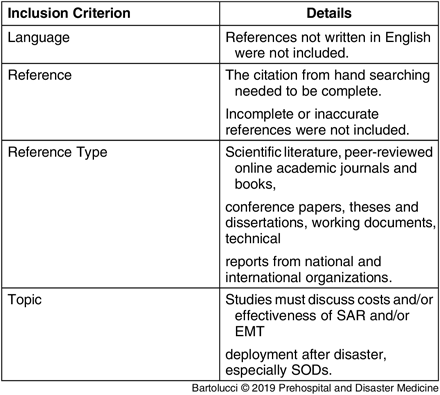
Abbreviations: EMT, Emergency Medical Team; SAR, search and rescue; SOD, sudden-onset disaster.
Selected studies have been analyzed to gather information about costs and/or effectiveness of SAR and/or EMT deployment, with special attention paid to works that provide a comparative discussion on the cost-effectiveness in disaster, particularly sudden-onset disasters (SODs); other deployments, such as conflicts, were not included.
Results
A total of 7,823 studies were found; 7,769 records were excluded after reviewing the title and duplicate removal. Fifty-four records meeting the criteria were identified. Twenty-eight works met all the criteria of the research on cost-effectiveness. Table 3 provides a list of the papers selected after the review.Reference de Ville de Goyet1, Reference Henderson, Lillibridge, Salinas, Graves, Roth and Noji2, Reference Morris4, Reference De Ville De Goyet, Marti and Osorio8–Reference Aoki, Nishimura, Pretto, Sugimoto, Beck and Fukui10, Reference Abolghasemi, Radfar, Khatami, Nia, Amid and Briggs14–35
List of Studies Selected for the Review
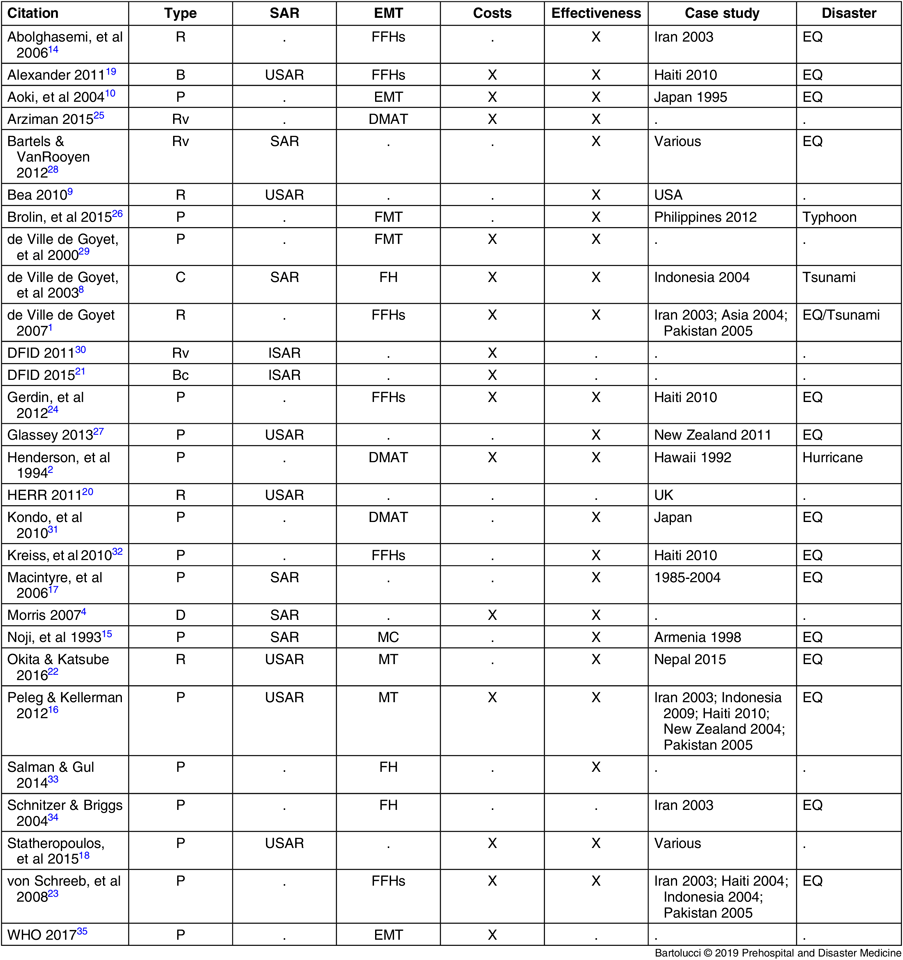
Note: P = peer-reviewed paper; R = report; D = dissertation; Rv = review; B = blog; C = chapter; Bc = business case.
Abbreviations: DMAT, disaster medical assistance team; EMT, Emergency Medical Team; EQ, earth quake; FFH, foreign field hospital; FMT, foreign medical team; ISAR, international SAR; MC, medical care; MT, medical team; SAR, search and rescue; USAR, urban SAR
Cost and Effectiveness
SAR—Despite common beliefs, survivors in the immediate aftermath of a disaster react with solidarity and tend help each other.Reference Auf der Heide36–Reference Quarantelli38 The first rescue efforts are usually performed by survivors and by the local response assets;Reference de Ville de Goyet1, Reference Abolghasemi, Radfar, Khatami, Nia, Amid and Briggs14–Reference Peleg and Kellermann16, Reference Auf der Heide36 the majority of survivors are found and extricated quickly because they are usually “lightly trapped,”Reference Noji, Armenian and Oganessian15, Reference Macintyre, Barbera and Smith17 while a significant number of earthquake victims remain “heavily” trapped under rubble requiring a heavy rescue response.Reference Macintyre, Barbera and Smith17
According to Statheropoulos, et al, Reference Statheropoulos, Agapiou and Pallis18 SAR response is technically demanding and time consuming; SAR success in operations, in fact, involves the advance purchase, operational integration, and deployment of best available technologiesReference Statheropoulos, Agapiou and Pallis18 that make the task-force highly expensive.
Detailed information about urban SAR (USAR) funding is not always available. According to the Congressional Research Service (Washington, DC USA),Reference Bea9 the United States’ USAR task force, as part of the federal emergency network response, was funded with US$28 million in FY 2011 and US$32.5 million in FY 2010. This was due mostly to the perceived successful efforts in Haiti in early 2010, and the growing support for a SAR team for domestic and international crisis. In the United States, a USAR team costs between US$1.8-US$2.2 million per year to maintain.Reference Alexander19 According to the Humanitarian Emergency Response Review (HERR),Reference Ashdown20 the United Kingdom international SAR (ISAR) teams cost £250,000 per life saved in Haiti, and the UK surgical teams about one-hundredth of this (a little over £2,500) per life saved. The HERR suggests that there should be an intelligent deployment decision process. The UK’s main costs lie in maintaining equipment and personnel training at an effective readiness level with a 24/7 deployable capacity. The reported budget does not cover actual deployment costs, which are met from separate government program funds for each specific response.21 Neither does the cost include the salary-related costs of the UK Fire and Rescue Service personnel, which are met by their individual services.
Time is crucial in SAR operations; sophisticated and costly technology is required to minimize the time to intervention, and the sooner a victim is found, the higher the possibility for him/her to survive.Reference Morris4, Reference Macintyre, Barbera and Smith17, Reference Statheropoulos, Agapiou and Pallis18 Most SAR activities are effective when done in the first hours after an event, and the survival rate of trapped victims plunges dramatically over time;Reference Bartels and Vanrooyen28 after several days of searching, SAR teams typically find no additional survivors.Reference Peleg and Kellermann16
As reported by Macintyre, et al, Reference Macintyre, Barbera and Smith17 the majority of rescues (90%) occur within the first 24 hours, with the last survivor rescue usually four days post-impact. A dramatic drop-off occurs during the first 24-48 hours post-earthquake.Reference Barbera and Cadoux39 Rescue activities can last for days; according to Macintyre, et al, Reference Macintyre, Barbera and Smith17 the average maximum time reported in their studies was 6.8 days with the longest time to rescue of 19 days. Comparison between and the analysis of past events, the Armenia earthquake in 1988Reference Noji, Armenian and Oganessian15 and the Nepal earthquake in 2015,Reference Okita and Katsube22 confirm that, despite progressive improvement in coordination and better technologies, the effectiveness of SAR teams has not increased.
Despite the significant cost associated with the deployment of an ISAR team, there is still a lack of detailed information about the issues; for example, most of the existing data refer to a non-itemized total budget, and most of the papers provide the total number of people extracted from the rubble using the criteria “lives saved” rather than a distinction between people saved by ISAR and those saved by locals.
The debate around the effectiveness of SAR introduces a delicate ethical issue; despite the high-cost of their deployment, in most societies, every possible effort is taken to save life, Reference Macintyre, Barbera and Smith17 and teams are requested to operate until the last person has been saved. The risk of abandoning a potential survivor deeply entrapped under rubble usually extends the activities of SAR many days after the last “save.”Reference Macintyre, Barbera and Smith17 More, one of the most valuable services provided by highly-qualified USAR teams is not necessarily finding survivors, but rather using the sophisticated structural assessment, advanced search capabilities, and specialized medical judgment to assist the local leaders in limiting the period that focuses primarily on the possibility of trapped survivors. The extension of this search phase has an impact on response priorities; as long as the possibility of finding survivors exists, the response efforts and the attention of the affected community remain focused on SAR, even though this diverts efforts and resources away from the management of the disaster and other post-disaster issues.Reference Macintyre, Barbera and Smith17 This must be considered as part of the judgement required from some who suggest that international USAR teams are never needed since local personnel, using simple equipment, make the majority of earthquake rescues within 24 hours.Reference de Ville de Goyet40
EMT
In the immediate aftermath of a disaster, authorities need to meet extraordinary treatment and rehabilitation demands with resources that have been drained by the wider emergency response.Reference De Ville De Goyet, Marti and Osorio8 Von Schreeb, et alReference Schreeb, Von, Riddez, Samnegård and Rosling23 reported the estimated cost per bed per day in US dollars during different disasters, such as the 2003 Bam earthquake (US$1,750/bed/day) and the 2005 Kashmir earthquake (US$2,250/bed/day).
As noticed by de Ville de Goyet,Reference De Ville De Goyet, Marti and Osorio8 the cost of mobilizing a field hospital for a few weeks often exceeds US$1 million, and suggests that the funds could be more productively used in the construction and equipping of simple but sturdy temporary facilities. In the case of the Bam earthquake, the cost of rebuilding the entire primary and secondary health facilities and teaching institution was estimated at around US$10.5 million, the same spent on the dispatch of 12 field hospitals from the international community. According to Peleg and Kellerman, Reference Peleg and Kellermann16 the cost of deploying a medium-size USAR mission is roughly equivalent to those of an EMT Type 1. The authors added that a heavy ISAR costs approximately US$900,000 to deploy, while the Israeli Defence Force spent US$1.7 million on its EMT Type 3 in Haiti.
As with SAR, EMT effectiveness is strongly dependent on the time of arrival. Aoki, et alReference Aoki, Nishimura, Pretto, Sugimoto, Beck and Fukui10 analyzed 4,786 cases after the 1995 Kobe earthquake and found that approximately 77% of those who lost their lives died within an hour. Furthermore, they found that 36% of injured victims who died between three and 12 hours after the earthquake might have been saved if the appropriate initial emergency response had been available. Foreign mobile hospitals and medical teams rarely arrive promptly in the immediate aftermath of a disaster, usually not in time for immediate trauma care.Reference de Ville de Goyet1, Reference Henderson, Lillibridge, Salinas, Graves, Roth and Noji2, Reference Gerdin, Wladis and von Schreeb24, Reference Kreiss, Merin and Peleg41 De Ville de Goyet, et alReference De Ville De Goyet, Marti and Osorio8 also noticed that in Banda Aceh, Indonesia, after the 2004 tsunami, victims were eager to return to normality while external medical relief workers were still arriving in large numbers.
The published literature suggests three days to be the average time for an EMT to arrive and become operational into the affected country.Reference Arziman25 The challenge is not just to save the lives of the trauma victims, but to re-establish a level of routine health care for a population living under temporary shelters.Reference de Ville de Goyet1 In the aftermath of a SOD, historically, medical response has been focused on providing emergency trauma care for the first 48 hours following the event, while they tend to be operational much later and treat a different range of problems. The deployment of EMTs should perhaps be oriented toward supporting or substituting for a pre-existing, but damaged, hospital or health facility rather than on providing immediate trauma care.Reference Schreeb, Von, Riddez, Samnegård and Rosling23
As for SAR deployments, there is a lack of detailed published information about cost-effectiveness of EMTs. In particular, the paucity of collection, management, and reporting data results in incomplete and largely qualitative research.Reference Redmond, Mardel and Taithe42 Most reports are narratives of the activities performed by EMTs during recent disasters, Reference Abolghasemi, Radfar, Khatami, Nia, Amid and Briggs14, Reference Kreiss, Merin and Peleg41 and few detail the cost and outcomes.Reference de Ville de Goyet1, Reference Schreeb, Von, Riddez, Samnegård and Rosling23 Many papers report the impossibility to describe the outcome of the EMT activities and the tendency of facilities and agencies not to respond to requests for detail on their activities.Reference Gerdin, Wladis and von Schreeb24, Reference Brolin, Hawajri and von Schreeb26
In addition, the literature usually reports only the total number of interventions,Reference Brolin, Hawajri and von Schreeb26 making it possible to create a timeline and define the phases of the medical response interventions. With such lack of data, it is challenging to estimate and assess the outcome, the quality, and the potential patient benefit for improvements from medical interventions. Gerdin, et alReference Gerdin, Wladis and von Schreeb24 suggest that the huge medical response to a disaster is inadequately documented and, despite the challenging circumstances of their deployment, international agencies should be held accountable for the services they provide.
Disasters are characterized by a highly emotional and sensationalized climate that has prevented the adoption of a cost-effectiveness pragmatic approach to decision making.Reference De Ville De Goyet, Marti and Osorio8 When survival of both people and political institutions are threatened, perceptions and visibility tend to prevail over facts and analysis, resulting in a lack of evidence-based decision based upon cost-benefit considerations.
The political benefit of sending an EMT should not be under-estimated, Reference Gerdin, Wladis and von Schreeb24 and usually there are additional indirect drivers that trigger the deployment. After the Haiti earthquake, at least five (11%) FFH stayed for a very short time, three for just a single week, and the cost-effectiveness and medical value of such a short intervention is debatable.
Discussion
The analysis shows that both SAR and EMT deployments are very expensive and that the effectiveness of both teams is strongly dependent upon the time of arrival. The value of SAR is dependent upon the time of arrival before the maximum time of surviving; unfortunately, most foreign rescue teams arrive late, when they travel over long distances, and their output in terms of people saved remains low.
A similar argument is advanced for the EMTs that rarely arrive within 48 hours, and by which time many patients will have already died from their injuries or been evacuated to other facilities. The team focusing on immediate trauma care will arrive too late and find that they are caring for relatively minor injuries and for health problems not directly related to the disaster. The EMT effectiveness is directly related to the ability to answer the needs of the population.
The literature on cost-effectiveness is based on an analysis of the ratio of lives saved divided by cost of deployment. The concepts described in this paper show that there are consistent differences, such as the different purpose, length of stay, and different activities performed, that make the use of the same criterion to make a comparison between the two deployments too simplistic. In fact, SAR includes people extracted from the rubble, bodies recovered, and structural assessment, but it is difficult to quantify the effect simply on lives saved since this outcome also requires local health system activity or the support of an EMT. On the other hand, the assessment of the effectiveness of an EMT is more complicated; the role of the medical team is not limited in time in the same way. They can stay longer, but one of their primary functions is to support the local health system in providing wider medical care, particularly when the native health system is heavily damaged. The criteria used to define effectiveness, particularly considering their limitations, have been considered and found wanting. The researchers have argued that there is a need to create a different way of considering cost-effectiveness. The concept of comparison by “lives saved” is inappropriate; cost-effectiveness, the balancing of spending on disaster resilience, and the capacity building against post-incident response have rarely been studied and compared, even though this plays a pivotal role in the ultimate outcome from a disaster. Specific data on outcomes from medical activities are rare, often incomplete, and hard to analyze.
There is a need to agree upon a framework and core dataset for the assessment of medical effectiveness, perhaps focusing on the number of people treated and the types of conditions instead of the “lives saved.”
Despite the importance of this topic, international discussion is still limited, and few data are available to objectively describe the outcome of the presence of EMTs. Almost all the authors from the searchReference de Ville de Goyet1, Reference Noji, Armenian and Oganessian15, Reference Peleg and Kellermann16, Reference Alexander19, Reference Schreeb, Von, Riddez, Samnegård and Rosling23, Reference Gerdin, Wladis and von Schreeb24, Reference Brolin, Hawajri and von Schreeb26 agree that this lack of appropriate information results in an ineffective and wasteful relief response, and, in the recent decades, not enough has been done to improve preparedness and response programs based on lessons identified from reviewing responses to previous earthquakes.
As De Ville De Goyet, et alReference De Ville De Goyet, Marti and Osorio8 report, the tendency of the international community to show solidarity and exercise the “right of humanitarian intervention” often leads to mistakes and errors in management. In many cases, this is due to an under-estimation of the local capacity to respond. This error, with the accompanying disregard for the cost-effectiveness of the approach, contributes to making disaster relief one of the least cost-effective health activities. As GlasseyReference Glassey27 suggests, the cost of the deployment could save more lives if allocated pre-event to disaster risk reduction and mitigation programs.
International humanitarian response of every type should be subject to post-assessment critical analysis, including comparison between outcomes and costs, and using standardized and agreed upon criteria. The evaluation should also consider different deployment approaches, including the decision not to send a team for the immediate response, or perhaps the deployment of a late and differently skilled team with a focus on general medical care and rehabilitation rather than on immediate trauma care.
Some of the literature presents proposals on how to improve the general effectiveness of deployment, and so, indirectly, cost. One common theme is to enhance the education and resilience of local resources, with a focus on the first responders. Local and neighboring facilities are the best place to provide immediate health care,Reference de Ville de Goyet1 and each improvement in coordination and organizational capacity can be essential.
Local authorities and available resources, particularly neighboring hospital facilities, are typically not sufficiently considered by international responding agencies, while building the local coping capacity is one of the most cost-effective measures to improve the quality of the national response and the external interventions.Reference de Ville de Goyet 1
Limitations
This study has some limitations; the authors selected the most relevant literature found, but limitations potentially exist due to the scarcity of directly relevant publications. Among the works considered, only a few studies presented detailed costs, budget, organized dataset, and evidence-based analysis.
Some concepts were only briefly explained within the papers, and there is a potential inconsistency in language, complicating comparison. Some documents were narrative, qualitative research, or were based upon interviews of sector experts and after mission reports. Several authors stressed the problem of data gathering with agencies rarely responding to requests to share data.Reference Gerdin, Wladis and von Schreeb 24 , Reference Brolin, Hawajri and von Schreeb 26 , Reference Redmond, Mardel and Taithe 42
Conclusions
The literature and evidence-based research analyses showed that ISAR and EMT deployments are very expensive. Generally, ISAR is characterized by few lives saved, largely due to the response time, the long-distance travel, and the relatively late arrival in the disaster area. Also, EMT evaluation is hampered by a lack of detailed clinical information being gathered and made available. Studies have demonstrated the difficulties in evaluating a response due to the lack of reliable data and the tendency of responding agencies to not share internal reports and records.
Important lessons have been identified from previous disaster responses. The assumption that receiving a great number of relief items always results in a more effective response is false; humanitarian assistance should not be sent a priori, rather it should be the last option, only where the affected country does not have the capacity to absorb and recover itself. Before requesting the deployment of an international team, the host nation and international community should undertake a rapid assessment and assess the specific need. Local resources should be used, and local response plans implemented, supported by the regional and international systems. Increasing local adaptive and absorptive capacity is perhaps the most cost-effective way for the affected government to meet their responsibility.
This review has helped to identify specific research questions that need to be answered. Firstly, the criteria for SAR and EMT cost-effectiveness assessment need to be improved to consider all the outcomes of the two deployments. Secondly, this paper underlines the need to have a mandatory data recording strategy for all the agencies that take part in relief efforts and support the concepts of cost-effectiveness and accountability.
Author ORCIDs
Andrea Bartolucci 0000-0001-9128-1685
Acknowledgements
This study was funded by the Hong Kong Jockey Club (HKJC; Happy Valley, Hong Kong) within the collaborative project “Training and Research Development for Emergency Medical Teams with reference to the WHO Global EMTs initiative, classification, and standards” between the Humanitarian Conflicts and Response Institute (HCRI; Manchester, United Kingdom) and the Hong Kong Jockey Club Disaster Preparedness and Response Institute (HKJCDPRI; Aberdeen, Hong Kong).
Conflicts of interest
none



