


Introduction
In 2015, close to two million new asylum claims were submitted in Europe alone, most of them from Syrian refugees who crossed into Europe via the Mediterranean Sea (United Nations High Commissioner for Refugees (UNHCR) 2017). What is often referred to as the 2015 European refugee crisis was the largest influx of refugees to Europe in the post‐WWII time period.Footnote 1 Despite large differences in how European countries were exposed to the refugee crisis in 2015, considerable political conflict and polarization about refugees and immigration marked societies across the European continent afterwards (Dinas et al. Reference Dinas, Matakos, Xefteris and Hangartner2016; Steinmayr Reference Steinmayr2016; Dustmann et al. Reference Dustmann, Vasiljeva and Piil Damm2018; Hangartner et al. Reference Hangartner, Dinas, Marbach, Matakos and Xefteris2019; Mader & Schoen Reference Mader and Schoen2019). Predictions made by the UNHCR show more refugees will continue to need places to settle as conflicts in both the Middle East and North Africa fail to reach lasting solutions. Recipient countries need to address this challenge. Solid knowledge about citizen reactions to the refugee crisis will be important in doing so. Taking advantage of a multi‐wave panel study carried out before, during and after the refugee crisis in Norway, this article contributes new insights about the scope of public opinion reactions in recipient populations to the 2015 refugee crisis in Europe.
A large literature has examined public opinion toward immigration, immigrants and, albeit to a lesser extent, refugees and asylum seekers (e.g., Bansak et al. Reference Bansak, Hainmueller and Hangartner2016; Citrin et al. Reference Citrin, Green, Muste and Wong1997; Dancygier & Laitin Reference Dancygier and Laitin2014; Finseraas & Listhaug Reference Finseraas and Listhaug2013; Malhotra et al. Reference Malhotra, Margalit and Mo2013; Sides & Citrin Reference Sides and Citrin2007; Weldon Reference Weldon2006). Recently, several studies have emerged that study reactions to the 2015 refugee crisis in Europe specifically (e.g., Dinas et al. Reference Dinas, Matakos, Xefteris and Hangartner2016; Hangartner et al. Reference Hangartner, Dinas, Marbach, Matakos and Xefteris2019; Steinmayr Reference Steinmayr2016; Czymara & Schmidt‐Catran Reference Czymara and Schmidt‐Catran2017; Esaiasson et al. Reference Esaiasson, Martinsson and Sohlberg2016). Most of these studies focus on the size and direction of reactions. They reach, as will be discussed in more detail in the following, mixed conclusions, but point broadly to an exclusionary reaction.
This study makes a novel conceptual contribution to the scientific debate about the effects of the refugee crisis by providing an analytical framework for examining the scope of the exclusionary reaction. We argue for a need to distinguish between three separate scope dimensions. First, it is important to analytically distinguish between whether the public reaction was issue specific, that is limited to opinion about the specific refugee‐question at hand, or if it spilled over to a broader set of related issues. Second, we argue that we need to distinguish between effects that are brief, enduring or permanent. Finally, we point to the need to analytically separate out effects that are politically encompassing, that is extend across the whole electorate, and those that are politicized, that is limited to a particular subset of voters.
A special seven‐wave panel study conducted in one of the European countries that received a high number of asylum applications per capita during the refugee crisis, Norway enables a strong empirical test of these different aspects of the scope of public reactions to the refugee crisis. We had started to collect individual‐level panel data about attitudes to refugees and immigration a year prior to the refugee crisis, beginning in the fall of 2014. In other words, the study includes pre‐crisis baseline measures. We also collected data on the same individuals at the peak of the crisis (in October/November 2015). We then continued to collect data every six months on the same individuals for two more years after the crisis had ended. This set‐up allows us to examine not only the size and direction of the public reaction as has been done in previous studies but also the different aspects of its scope highlighted by the proposed analytical framework.
Applying the framework, we find that the scope of the exclusionary reaction was extensive. It was not limited to questions about refugees, but spilled over also to views about immigration. It was not brief, but endured long after the situation had been brought under control, for as long as two years. Furthermore, it was not found only in the particular segment of voters that were tuned in to negative messages about immigrants but extended to voters of all political stripes. Having noted then the considerable scope of the exclusionary reaction to the refugee crisis along all three analytical dimensions, we are also able to document that the scope was limited in one crucial way. There was no permanent shift in public opinion. After one and a half to two years both attitudes towards refugees and immigrants had reverted back to pre‐crisis baseline levels.
Group threat: The established theoretical framework
Group threat theory is arguably the most prominent approach in the literature on anti‐immigrant opinion. The central claim, broadly, is that the presence of an out‐group, or even the idea of the presence of an out‐group, will tend to generate a sense of threat in members of the in‐group, which in turn is likely to lead to exclusionary reactions (e.g., Albertson & Gadarian Reference Albertson and Gadarian2015; Blumer Reference Blumer1958; Forbes Reference Forbes1997). According to one strand of threat theory – real group threat – group conflict is most intense if the in‐group and the out‐group are in a situation where they compete over limited resources. According to another strand of threat theory – symbolic threat – group conflict can form even in the absence of any competition over resources because the in‐group will nevertheless tend to perceive the presence of the out‐group as a symbolic threat to their community. While these perspectives are sometimes juxtaposed and treated as competing hypotheses, it is increasingly evident that group conflict can result from both of these dynamics and that they can be mutually reinforcing (e.g., Ivarsflaten et al. Reference Ivarsflaten, Blinder, Bjånesøy, Suhay, Grofman and Trechsel2019). For the study at hand, the crucial point is that threat theory would, broadly, predict an exclusionary reaction in the recipient population to a sudden influx of refugees (H1).
Despite this clear prediction from the main theoretical perspective, recent studies of public reactions to the 2015 refugee situation point in different directions. Focusing on public opinion effects, Hellevik and Hellevik (Reference Hellevik and Hellevik2017) and Esaiasson et al. (Reference Esaiasson, Martinsson and Sohlberg2016) conclude that the influx of refugees in 2015 did not lead to any substantial change in attitudes in Norway and Sweden, respectively. Conversely, Czymara and Schmidt‐Catran (Reference Czymara and Schmidt‐Catran2017) find a considerable decrease in public acceptance of immigrants among the German public in response to the same refugee crisis. Also, studies of the electoral effects of refugee migration reach partially contradictory conclusions. Where Steinmayr (Reference Steinmayr2016) finds that the presence of refugees reduced the support for the Austrian anti‐immigrant right party, Dustmann et al. (Reference Dustmann, Vasiljeva and Piil Damm2018), Mader and Schoen (Reference Mader and Schoen2019) and Dinas et al. (Reference Dinas, Matakos, Xefteris and Hangartner2016) find that as the share of refugees in a community increased, the vote for anti‐immigrant parties grew in Denmark, Germany and Greece.
This situation of a clear theoretical expectation and a messier empirical field raises questions about whether the analytical frameworks employed to study effects are sufficiently granular. What are the boundaries within which we could reasonably expect to observe the predicted exclusionary reaction? Conventional theories (e.g., Sniderman et al. Reference Sniderman, Hagendoorn and Prior2004) are less clear on this question, and these unresolved theoretical issues about scope, alongside the problem of less than ideal empirical data, may have contributed to the appearance of contradictory findings. This study aims to clear up these conceptual and empirical issues. We take them each in turn focusing first on the analytical framework we propose for the study of the scope of exclusionary public reactions to a refugee crisis.
The scope of exclusionary reactions in recipient populations
We distinguish three scope dimensions. The first concerns the substantive reach of any exclusionary reaction. What sorts of attitudes are affected? The second concerns duration. For how long does the effect last? The third distinction concerns whether the reaction encompasses all voter segments or is politicized and thus found mainly in certain subsets of voters.
Substantive reach
Most studies recognize that immigration is a large and multi‐faceted political domain, where refugee policies make up only one set of issues. Nevertheless, a line of research on public opinion towards immigration emphasizes the correlation among questions that ask about non‐native out‐groups, (e.g., Ivarsflaten Reference Ivarsflaten2005; Sniderman et al. Reference Sniderman, Peri, Figueiredo and Piazza2002; Blinder Reference Blinder2015). Some would argue that the underlying dimension appears to be what Mudde (Reference Mudde2007) in studies of the populist radical right has called ‘nativism’. That is, a tendency to prefer natives over foreigners, and what is considered to be native over what is considered to be foreign. In political psychological accounts, the common factor with which all such attitudes tend to correlate is believed to be negative outgroup stereotypes, affect or biases (e.g., Aarøe et al. Reference Aarøe, Petersen and Arceneaux2017; Kinder et al. Reference Kinder, Sanders and Sanders1996). One study of public reactions to the refugee crisis found what it called ‘hostile spillover effects’ from one outgroup to another and explicitly call for more research into this question (Hangartner et al. Reference Hangartner, Dinas, Marbach, Matakos and Xefteris2019: 454). These studies lead to the expectation that the substantive scope of the exclusionary reaction to the refugee crisis will not be limited only to attitudes towards refugees specifically, but will also generalize to a broader set of attitudes concerning immigration.
Despite these accounts of generalized public opinion to out‐groups, it is nevertheless formally the case that the political question of receiving refugees is distinct from, for example, that of welcoming immigrant workers. Not least, these questions are considered to be entirely separate as a legal matter under the UN Convention on Refugees. Public opinion studies have therefore naturally examined whether such distinctions matter to recipient publics. Studies have found that they indeed respond to some of the distinctions, but not necessarily in alignment with international law. Some of the best‐known findings hold that recipient populations prefer high‐ over low‐skill labour immigrants (Hainmueller & Hiscox Reference Hainmueller and Hiscox2010; Naumann et al. Reference Naumann, Stoetzer and Pietrantuono2018; Valentino et al. Reference Valentino, Soroka, Iyengar, Aalberg, Duch, Fraile, Hahn, Hansen, Harell, Helbling, Jackman and Kobayashi2017), that humanitarian concerns influence public opinion about refugees (Bansak et al. Reference Bansak, Hainmueller and Hangartner2016; Czymara & Schmidt‐Catran Reference Czymara and Schmidt‐Catran2017), that undocumented migrants are particularly at risk of discrimination (Bloemraad et al. Reference Bloemraad, Silva and Voss2016) and that more culturally dissimilar migrants irrespective of their legal status face greater risks of discrimination (Hainmueller & Hangartner Reference Hainmueller and Hangartner2013; Levine et al. Reference Levine, Carmines and Sniderman1999; Sniderman et al. Reference Sniderman, Hagendoorn and Prior2004).
The question of whether or not the dominant tendency among the recipient public is to differentiate between the specific issue of refugees and the broader issue of immigration is in other words unsettled in the literature. This is a key reason why the analytical framework we propose includes the dimension of substantive reach. Previous research leads to competing hypotheses concerning what could also be thought of as spillover effects. One line of research leads us to expect an exclusionary reaction limited to questions about refugees (H2a). Another line of research predicts a substantively more far‐reaching reaction. It holds that the exclusionary reaction would not be limited to attitudes towards refugees but also spill over to broader questions of immigration (H2b).
Duration
The second scope dimension in our analytical framework is that of duration. How long does the exclusionary reaction to an exogenous shock like a refugee crisis last? Again, previous research provides competing accounts. While some expect a reaction that is limited in duration, others expect permanent shifts.
One line of research leads us to expect limited duration. These studies focus on the role of opinion leadership and how it influences public reactions. Brody and Shapiro's (Reference Brody, Shapiro and Long1989) consensus‐conflict theory is a main contribution in this line of thinking. They note the public's tendency to ‘rally around the flag’ in response to international crises and argue that the initial reaction on the elite level tends to be cross‐party consensus that transcends the usual patterns of political conflict. In their own words:
When events are breaking at an usually rapid pace, when the administration has a virtual monopoly of information about the situation, opposition political leaders tend to refrain from comment or to make cautiously supportive statements.
As a consequence,
(…) press and television accounts of the ‘politics’ surrounding the event will be unusually full of bipartisan support for the president's actions. Political figures from whom we would normally expect negative comment on presidential performance will instead be silent or supportive. (Brody & Shapiro Reference Brody, Shapiro and Long1989: 90, 92)
This apparent political consensus pushes citizens that would normally not approve of the government to do so.
Still, Brody and Shapiro (Reference Brody, Shapiro and Long1989) highlight that this effect is self‐limiting, as the nature of electoral competition provides strong incentives for the parties in opposition to criticize the government. Thus, as politics as usual returns and the extraordinary consensus is replaced by the regular patterns of political conflict, citizens should retract to their baseline position on government approval.
Building on Brody and Shapiro's conflict‐consensus theory, Sniderman et al. (Reference Sniderman, Petersen, Slothuus, Stubager and Petrov2019) extend the model to also include public reactions to exogenous shocks like terror attacks. They introduce concept perturbation effect to describe a mass reaction that is limited in size and duration and where the end state is marked by a return to baseline values of tolerance. Their model is organized around two mechanisms: emotional arousal which incites public reactions, and opinion leadership, which inhibits public reactions. According to the authors:
Peak reactions are limited in duration because the salience of an attack dissipates over time and limited in degree because opinion leadership inhibits – inhibits not eliminates – the effects of emotional arousal. The end of reactions to terror attacks is marked by a return to baseline values because the impact of an attack diminishes as its salience diminishes, leaving the long‐term factors alone in operation. The result: reactions of mass public to terror attacks take the form of perturbations. (Sniderman et al. Reference Sniderman, Petersen, Slothuus, Stubager and Petrov2019: 256)
There exists no empirical evidence to support that the mechanisms of public opinion in meeting with the refugee crisis are the same as for other international crises, not to mention a terrorist attack. Yet it is possible that public reactions to the influx of refugees in 2015 follow a general opinion dynamic as that previously observed for other types of crises. Based on this, we expect the initial exclusionary reactions in the recipient population to be limited in duration (H3a).
Another possibility is that the reaction will endure and that we will observe a more permanent shift of opinion in the exclusionary direction. Certain crises arguably have this transformative potential, and we do not fully know what sorts of factors contribute to permanent political shifts and which to less durable ones (Hutter & Kriesi Reference Hutter and Kriesi2019). That the refugee crisis had major political consequences across Europe is at this point beyond dispute. Brexit and the entry of the populist radical right party Alternative für Deutschland into the German national parliament both happened within less than two years of the 2015 refugee crisis. Some strands of group conflict theory would indeed predict a persistent exclusionary reaction or even deteriorating group relations. As the costs of housing refugees and providing the help they need to start a new life in a new country become apparent, one expectation would be that an initial exclusionary reaction may grow stronger. Our conceptual framework, therefore, highlights duration as a key dimension of the scope of a public opinion reaction that needs to be examined. In the case at hand, a plausible competing hypothesis to the perturbation effect is that of more enduring change; of a permanent shift in public opinion in an exclusionary direction (H3b).
Politicization
The third aspect of scope highlighted by the proposed analytical framework concerns how encompassing the reaction was in the electorate. In ordinary times, we know that public opinion tends to follow predictable political divisions. In the field of immigration politics, far‐right parties across European countries have taken the lead on proposing restrictive immigration policies and pointing out the problems caused by immigration (Ivarsflaten Reference Ivarsflaten2008; de Lange Reference De Lange2007; Van Der Brug et al. Reference Van Der Brug, Fennema and Tillie2000). One expectation is therefore that any exclusionary reaction would be politicized in the sense that it is limited to those already supportive of nativism, that is voters of the far right (H4a).
However, as discussed above, citizens and political elites sometimes set aside partisan differences in times of crisis and this can result in parallel opinion movements across voter segments (Brody & Shapiro Reference Brody, Shapiro and Long1989). Albertson and Gadarian (Reference Albertson and Gadarian2015), for example, argue that when one policy option dominates the elite discussion and there are few dissenting voices, concerned citizens are likely to support protective policies. Brody and Shapiro (Reference Brody, Shapiro and Long1989) argue that crisis events create extraordinary uncertainties that tend to generate cross‐party consensus instead of conflict along party lines. The media, transmitting a picture of cross‐party consensus backing the current leadership, in combination with an absence of public criticism, will tend to make those who are ordinarily disposed to be critical of government to respond more favourably. Thus, public opinion is less likely to be politicized and more likely to move in the same direction as political leadership in this sort of situation.
In the case to be further examined empirically, Norway, the Conservative‐led minority government proposed an asylum agreement which was a direct response to the refugee crisis and included numerous retrenchment policies, such as cuts in social insurance benefits for asylum seekers, stricter rules for family reunification, increased use of provisional residence permits and quicker returns of individuals found not to be in need of refuge (Ministry of Justice & Public Security 2015). The asylum agreement proposal was debated and negotiated in parliament in October and November 2015, and in the end gained support from six out of eight parties (making up 95 per cent of parliamentarians). The broad coalition of parties signing the asylum agreement were the two governing parties, the Progress Party and the Conservative Party; the two parties formally supporting the minority government at the time, the Christian People's Party and the Liberal Party; and two of the parliamentary opposition parties, the Labor Party and the Centre Party. Only two small opposition parties in parliament, the Green Party and the Socialist Left Party, opposed the agreement. The response among politicians in parliament to the refugee crisis was thus exactly as predicted by the Brody and Shapiro framework. Based on both theory and the line of events, we may therefore hypothesize that the public opinion reaction will not be politicized but instead will encompass voters from the whole political spectrum (H4b).
Background and data
Over the course of 2015, the number of people filing for asylum in the European Union (EU) increased dramatically. Comparing asylum claims in Norway with numbers for the EU, we see that the influx of refugees to Norway happened a bit later. Being situated in the Northern hemisphere and off the continent, Norway was one of the destinations farthest away for refugees arriving at Europe's Southern shores. Still, Norway was one of the countries that, after Germany and Sweden, received the most asylum applications per capita during the refugee crisis, with some refugees crossing the Norwegian Northern Schengen border with Russia after Greece's neighbouring countries began to close their borders (Bansak et al. Reference Bansak, Hainmueller and Hangartner2016).
Importantly, Norway was for nearly all refugees crossing its borders a final destination country, that is the country where they submitted their application for asylum. The transit situation experienced further South in Europe was therefore not a part of the refugee crisis experience in Norway. Furthermore, all asylum applicants to Norway have a right to stay in asylum reception centres and the government benefits received are conditional on residence in such centres while the application is processed. As a result, nearly all asylum seekers live in government‐funded reception centres upon arrival in Norway. Furthermore, these centres were spread across the country and refugees were transported to them, thus preventing geographically concentrated refugee hotspots. The experience of the refugee crisis by the recipient population in Norway was therefore quite different from that of those countries that experienced a lot of refugees in transit, such as Greece, Hungary or Austria. The Norwegian situation is likely more representative of experiences in other major destination countries, such as Germany or Sweden.
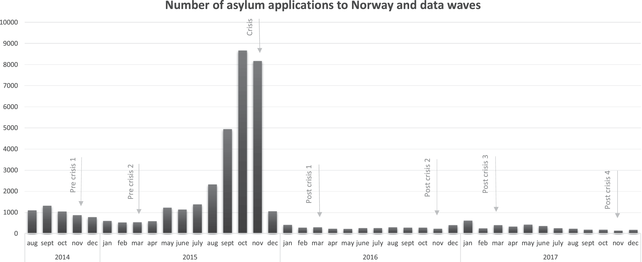
As Figure 1 shows, approximately 30,000 refugees entered Norway during the fall of 2015. This led to an urgent need for housing and subsequently to a dramatic increase in the number of asylum centres. In Norway, 257 new asylum centres were established throughout the country during fall of 2015 and winter of 2016. With the implementation of strict border controls across Europe during fall of 2015, the number of asylum seekers arriving at Norwegian borders dropped dramatically in December 2015. Since January 2016, the number of asylum applications to Norway has been low. According to the Norwegian Directorate of Immigration, a total of 2,654 claims of asylum were registered in Norway in 2018, making it the lowest number of yearly claims since the mid‐1990s (NTB 2019). Thus, the refugee crisis understood as a substantial influx of refugees, happened within a very limited time period in the Norwegian context, making this a useful case for examining reactions to the influx of refugees as a discrete event, where start and end‐points may be clearly identified in time.
Number of monthly asylum applications and survey waves, 2014–2017. Sources: the Norwegian Directorate of Immigration (UDI) and the Norwegian Centre for Research Data (NSD).

To study the effect of the refugee crisis on public opinion, we make use of the Norwegian Citizen Panel (NCP), a university‐owned web survey based at The Digital Social Science Core Facility, the University of Bergen.Footnote 2 The web survey is based on a randomly selected sample of the Norwegian population, drawn from the Norwegian Population Registry and recruited offline through mail. Initial response rates range between 20 and 23 per cent. The survey has been fielded twice annually since November 2013, and we make use of the panel component of the web survey, including waves 3 through to 8, plus wave 10 in our analyses.Footnote 3 Based on the trend in asylum applications to Norway shown in Figure 1, the seven waves are sorted into three temporal periods. We refer to the first two data points (November 2014 and March 2015) as pre‐crisis. The wave conducted in November 2015 is identified as a period of crisis. Based on the monthly number of asylum applications, the refugee crisis from the perspective of Norway ended in January 2016. Consequently, the following four waves of data collection (March 2016, November 2016, March 2017 and November 2017) are considered post‐crisis time points (Skjervheim & Høgestøl Reference Skjervheim and Høgestøl2014; Reference Skjervheim and Høgestøl2015a, Reference Skjervheim and Høgestøl2015b, Reference Skjervheim and Høgestøl2016a, Reference Skjervheim and Høgestøl2016b, Reference Skjervheim and Høgestøl2017; Skjervheim et al. Reference Skjervheim, Høgestøl and Bjørnebekk2017).
For each panel wave, respondents were asked the exact same items about their attitudes towards the social rights of refugees and immigration to Norway. The only exception is the last post‐crisis wave (November 2017), where only the general immigration item was asked. Thus, the analyses of the social rights for refugees‐item is based on six survey waves whereas the immigration‐item is based on seven survey waves. The question wordings and original scales were as follows:
Refugee social rights: ‘To what extent do you agree or disagree with the following statement: “Refugees should have the same rights to social security as Norwegians, even if they are not Norwegian citizens”’ [1 = strongly disagree, 7 = strongly agree].
Immigration: ‘In your opinion, how great an advantage or disadvantage is it for Norway that immigrants come to live here?’ [1 = very great disadvantage, 7 = very great advantage].Footnote 4
Both variables have been rescaled to the unit interval, with 1 identifying the most permissive position on both items.
Panel data, asking the same respondents identical questions repeatedly through time, is valuable in identifying the scope of public opinion reactions to the refugee crisis because it enables modelling of the direction of the causal relationship and controlling for unobserved heterogeneity. In terms of modelling strategy, we run growth models, conceiving of Y as a function of Time itself. The model takes into account the nested structure of waves of observations (level 1) within individuals (level 2). Thus, we model the outcome for each individual as a positive or negative function of time, taking into account the lack of independence in repeated observations (Singer & Willett Reference Singer and Willett2003). This modelling strategy aims to estimate the direct effect of the refugee crisis on attitude change with the following econometric specification:
 \begin{equation*}{Y_{it}} = \gamma Tim{e_t} + \ {X_i}\varphi + \ \left( {{{{\zeta}}_{0i}} + {{{\zeta}}_{1i}} * Tim{e_i} + \ {\varepsilon _{it}}} \right),\end{equation*}
where i indexes each respondent and t each survey wave. Time is a continuous indicator operationalized as the survey waves included here. γ estimates the change in opinion across pre‐crisis, crisis and post‐crisis waves. ${X_i}$ is a row vector of time‐invariant controls (political interest, education, gender, age and size of municipality) recorded at the first data point as well as an intercept. To account for unobserved heterogeneity, random effects components are included in the model, where ${{{\zeta}}_{0i}}$ is the random portion of the individual‐level intercept, ${{{\zeta}}_{1i}}$ is the random portion of the individual‐level slope for Time, and ${\varepsilon _{it}}$ is the idiosyncratic error term for a given individual at a given point in time. Robust standard errors clustered at the respondent level are included to account for potential serial correlation and heteroskedasticity.Footnote 5
This study employs an extraordinary number of panel survey waves. As with all repeated data, the drop‐out rate increases across time due to attrition as well as additional recruitment.Footnote 6 The descriptive analysis of proportions introduced first in the results section uses an unbalanced panel of all observations at pre‐crisis and crisis waves. The subsequent panel analyses use a balanced panel, meaning they include only those respondents who have answered all seven survey waves.Footnote 7 The balanced sample size is 480 for the refugee social rights item and 495 for the general immigration question.Footnote 8 As an additional check on the generalizability of the results to the broader Norwegian population, we compare the sociodemographic composition of the balanced sample with the distributions found for the entire NCP (Table A26 in the Supplementary Information (SI)). This shows that the balanced sample has a moderate overrepresentation of politically interested and highly educated men ranging from 56 to 75. To make sure that the bias does not lead to erroneous results while at the same time not losing too much statistical power, we employ a model‐based approach to correcting for known biases. This means that we include the variables used to construct the proportional weights as controls in the panel analyses: age, gender, geography and education.Footnote 9 Moreover, we control for political interest to account for the observed bias in the sample identified. As a robustness check, we also run our panel analyses with proportional weights. The similarity between the weighted and the model‐based analyses increases confidence that the results presented are generalizable, despite a relatively small sample. Robustness analyses based on the unbalanced panels also confirm the main findings reported here, as do analyses using alternative estimation techniques. The full regression tables including robustness checks are reported in the SI, Sections 2 and 3.
Results
Substantive reach
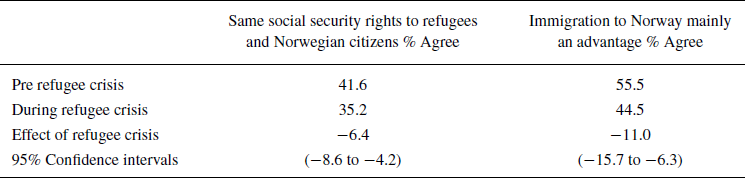
We initially examine the first dimension highlighted in the proposed analytical framework: The substantive reach of the public opinion reaction to the refugee crisis. The competing hypotheses outlined above are tested by comparing the responses of two different survey items fielded before and during the refugee crisis. We report results of a two‐sample test of proportions (PR‐test), and proportional weights are applied to account for sample biases. To make the results as intuitive as possible, we have dichotomized the dependent variable.Footnote 10 Table 1 summarizes the immediate effect of the refugee crisis on support for immigration in general and the social rights of refugees. We compare responses in November 2014 (first pre‐crisis wave) with responses in the November 2015 crisis wave.
The effect of the refugee crisis on support for refugee social rights and immigration

Note: The table gives the percentage of respondents who were positive to immigration in general and refugee social rights in particular before the refugee crisis was introduced and as it was ongoing. Both variables have been recoded from a seven‐point bipolar scale to dichotomies, with 1 signifying agreement with the statement. The difference is the estimated effect of the refugee crisis on these attitudes. Proportional weights are applied. The effects are estimates of respondents who have answered the same questions before and/or during the crisis, based on a two‐sample PR‐test. The refugee social rights question is based on 8,324 respondents in wave 3 and 5,395 respondents in wave 5, and the general immigration question is based on 1,688 respondents in wave 3 and 1,405 respondents in wave 5. Ninety‐five per cent confidence intervals appear in parentheses.
Table 1 shows that there was a reaction in an exclusionary direction that was not limited to questions narrowly focused on refugees. The scope of the exclusionary reaction also spilled over to attitudes to immigration more generally, supporting H2b deriving from a line of studies emphasizing the importance of the underlying psychological common factor, negative outgroup bias. The left column shows that 41.6 per cent of respondents agreed that refugees and Norwegians alike should have equal rights to social security before the refugee crisis and the comparable figure was 35.2 per cent when asked during the crisis. Thus, the refugee crisis reduced support for equal social rights to refugees by 6.4 percentage points, with a 95 per cent confidence interval ranging from −8.6 to −4.2, indicating that this difference is significant in statistical terms. The right column of Table 1 displays the effect of the refugee crisis on attitudes towards the broader immigration question. Support was considerable before the crisis, with 55.5 per cent of respondents seeing immigration mainly as an advantage. Yet, the refugee crisis reduced this positive inclination considerably, with 11 percentage points to 44.5 per cent, with a 95 per cent confidence interval of −15.7 to −6.3, a substantively and statistically significant effect. This means H2b is supported by the evidence, while H2a is not so. In other words, the substantive reach of the reaction was wide, extending to the question of immigration generally, not limited to opinion on refugee policies specifically.
Duration
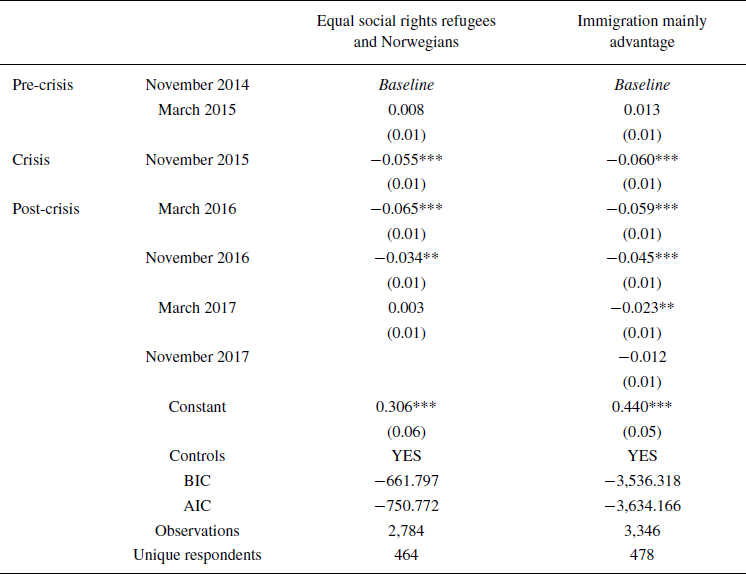
To test the durability hypotheses, we specified growth models as described above. The results, displayed in Table 2, indicate that the exclusionary reaction lasted for a considerable period of time, but that there was no permanent shift.
Attitudes towards refugee rights and immigration before, during and after the refugee crisis

*p < 0.05, **p < 0.01, ***p < 0.001.
Note. Entries are maximum‐likelihood estimates of growth models (coefficients and robust standard errors). The dependent variables are normalized and range from 0 (most restrictive) to 1 (most liberal). Controls are included, see Table A6 in the SI for the full model.
The left column of Table 2 shows the effect of time on citizens’ perceptions of whether refugees should be entitled to the same social security benefits as Norwegians, irrespective of whether they are Norwegian citizens. First, the panel analysis confirms the finding of a movement in the population towards more restrictions on refugee rights in response to the refugee crisis. This is indicated by the negative and significant sign of the coefficient in the crisis wave. Moreover, the negative and significant coefficients in the two following post‐crisis waves indicate that the negative effect endures for a considerable period of time after the influx of refugees had ceased. Yet, the insignificant effects seen in the post‐crisis wave of March 2017 suggests that there was no permanent effect. At this point, attitudes were indistinguishable from the pre‐crisis baseline. In other words, after about one and a half years they reverted to pre‐crisis levels.
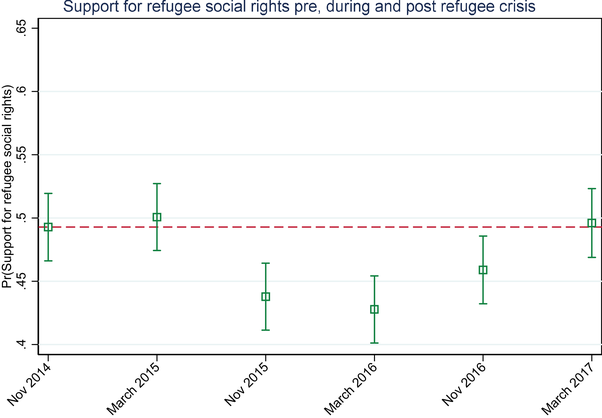
In terms of substantial effects, as displayed in Figure 2, we find a 6.5 percentage point drop in support for granting refugees the same social rights as Norwegians between the last pre‐crisis wave and the crisis wave (from 49.9 to 43.4 per cent). It continues to decline one percentage point further in the first post‐crisis wave. In the second post‐crisis wave (November 2016), we see signs of a diminishing effect on the refugee rights policy and the start of a gradual movement back towards pre‐crisis levels of support. For the third post‐crisis wave conducted in March 2017, the level of public support for refugee rights is at 49.6 per cent and is back to the pre‐crisis baseline level of 49.3 per cent. Thus, the popular loss in support for refugee social rights lasted approximately 16 months after the unusually high number of asylum claims had ended.
Differences in support for refugee rights prior to, during and after the Refugee crisis. Predicted marginal effects (probabilities), based on regression results from the left column of Table 2. The effects plotted at the crisis (November 2015), post crisis 1 (March 2016) and post crisis 2 (November 2016) waves are significantly different (*p < 0.05) from the baseline level (symbolized by the dashed line). [Colour figure can be viewed at wileyonlinelibrary.com]

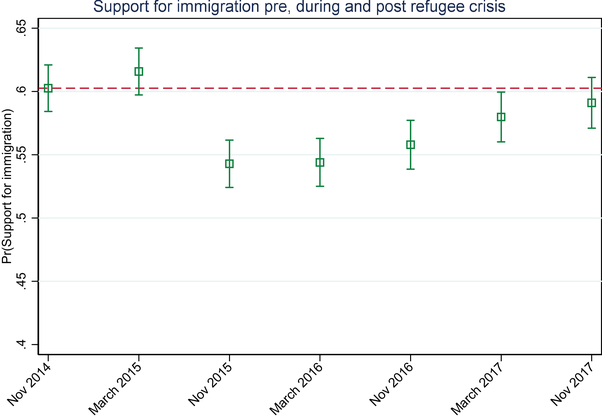
Moving on to examine the broader question of whether immigration is mainly an advantage or a disadvantage to Norway, the right column of Table 2 shows that the duration of the exclusionary reaction is considerable also in this case. The negatively signed coefficients found across the waves succeeding the refugee crisis indicate that the drop in support for immigration to Norway lasted for a considerable period of time. Still, as the table shows, the effect diminished over time, and in the fourth post‐crisis wave, conducted in November 2017, the negative effect is no longer significantly different from the pre‐crisis level of support.
To further substantiate the effects in Table 2 on immigration support, Figure 3 illustrates the results employing marginal effects. Here, we see a 7.7 percentage point drop in support for immigration between the last pre‐crisis and the crisis waves from 61.6 to 53.9 per cent. The first post‐crisis waves show stability at crisis wave levels, whereas the second and third post‐crisis waves of November 2016 and March 2017 indicate a slow movement back towards pre‐crisis levels, although still significantly more restrictive when compared to the pre‐crisis period. Last, the fourth post‐crisis value reverts to the baseline, showing no significantly different effect from pre‐crisis levels. Two years after the refugee crisis peaked, public opinion on immigration returned to pre‐crisis levels.
Differences in immigration attitudes prior to, during and after the Refugee crisis. Predicted marginal effects (proportions), based on regression results from the left column of Table 2. All effects plotted, except the last post‐crisis wave (November 2017), are significantly different (*p < 0.05) from the baseline level (symbolized through the dashed line). [Colour figure can be viewed at wileyonlinelibrary.com]

Taken together, the analysis of duration of effects supports hypothesis H3a that there was no permanent shift. However, labelling the effect of a perturbation would be an understatement. In the case at hand, it took between 16 and 24 months after the refugee crisis was under control before attitudes reverted back to baseline levels. Compared to other studies, this is a considerable duration. Studies of public reaction to terror attacks have, for example, reported returns to baseline positions five months to one year after the attack (Dinesen & Jaeger Reference Dinesen and Jaeger2013; Hopkins Reference Hopkins2010; Jenkins ‐ Smith & Herron Reference Jenkins‐Smith and Herron2005), and studies of demographic change indicate strong, but short‐lived exclusionary reactions moving towards baseline positions after only 10 days of intergroup contact (Enos Reference Enos2014).
The results regarding the duration of the exclusionary reaction to the refugee crisis hence provide two new lessons. First, they show that the reaction lasted for a considerable period of time – up to two years. This is a reaction of considerable scope along the time dimension. Nevertheless, the results also point to a second important lesson, one of the limitations to the exclusionary reaction. There was no permanent shift in opinion towards refugees or immigrants. Just as predicted by Brody and Shapiro's (Reference Brody, Shapiro and Long1989) conflict‐consensus theory, we document that public opinion on both measures eventually did return to the baseline.
Politicization
To assess whether the attitudinal effects on the refugee crisis vary across voter segments, we run growth models interacting time with each respondent's party vote in the 2013 Norwegian General Election. We use a three‐category vote variable to test the hypotheses of differentiated reactions proposed in the theory section. We label the voters of all parties that signed the asylum deal, voters of ‘Asylum deal parties’. We make one exception. Since one of the hypotheses based on previous research suggested that far‐right voters would react most strongly to the refugee crisis, we separate the far‐right Progress Party voters from the voters of the other five parties that signed the asylum agreement (the Conservative Party, the Christian People's Party, the Liberal Party, the Center Party and the Labor Party). The third category includes the voters of the two parties in Parliament opposing the asylum agreement (the Green Party and the Socialist Left Party), and we label these voters of ‘Opposition parties’.
Figure 4 is based on the full growth models run on balanced panels, comparing the first pre‐crisis and the crisis waves. For the interactions of party vote with time, baseline for the party vote covariate is the ‘Asylum deal parties’ category, and the baseline for time is the first pre‐crisis wave conducted in November 2014. Due to missing observations on the party vote variable, the sample is reduced to 425 unique respondents for the refugee social rights item and 417 unique respondents for the immigration item.
Differences in support for refugee social rights and immigration to Norway conditioned on time and party support. Coefficient plots based on regression results from Table A7 in the SI. Effects that are significantly different (*p < 0.05) from the baseline level do not cross the solid, vertical line.

The left panel in Figure 4 considers both the direct and the indirect effect that party vote has on the propensity to support equal social security rights for refugees. The plot confirms that there is a big difference in the level of support for refugee social rights in different voter segments. Compared to voters of the other asylum agreement parties, Progress Party voters are much less likely to support equal social rights for refugees (the estimated difference is around 21 per cent). By contrast, voters of the parties opposing the asylum deal are much more likely to support equal social rights to refugees than voters of the asylum deal parties (the estimated contrast is around 26 per cent).
Turning from examining differences in levels of support according to party vote to considering the effect of the refugee crisis on support, the differentiation is no longer there. The left panel in Figure 4 shows that the refugee crisis affected all voter segments nearly the same. Considering the indirect effect of the party vote on attitudes towards refugee social rights in response to the refugee crisis, the lack of significant differences across the three voter groups indicates that the move in a restrictive direction found in Figure 3 was parallel across voter groups. Thus, the political scope of the exclusionary reaction was not narrow and politicized. It was broad.Footnote 11
Moving on to the right‐hand panel of Figure 4, we see largely similar differences in levels of support for immigration to Norway in the different voter segments. Progress Party voters are much less inclined to consider immigration to Norway to be an advantage compared to voters of the other asylum deal parties (the difference is around 20 per cent). Yet the voters of the parties opposing the asylum deal are not more likely to consider immigration to Norway an advantage at the outset compared to voters of the other asylum deal parties.
The results in the right‐hand panel of Figure 4 confirm the previously observed pattern of no differentiated public reactions in different voter segments. There is no difference in opinion change among Progress Party voters and voters of the other asylum deal parties as the refugee crisis hits Norway, so H4a can be refuted. Also, we fail to find significantly different reactions between voters of the parties that oppose the asylum agreement and voters of the other asylum agreement parties. These findings make clear that the public opinion reaction to the refugee crisis was encompassing in that it affected voters from the entire political spectrum in the same way.
The main take‐away from the analysis of different voter segments is that the exclusionary reaction was large in scope also when we consider different subsets of voters. There is no evidence that any of the reactions we have observed were driven by or isolated among voters of the far right. Voters of all asylum deal parties show as large a change in opinion as the voters of the far right. And even among the voters of the parties opposing the asylum deal, we fail to find a pattern of opinion change differing from that of voters of the asylum deal parties. Thus, H4b postulating non‐politicized effects across voter groups is supported. This serves to suggest that the uniform elite consensus communicated in relation to the asylum agreement affected the entire electorate. Moreover, additional analyses reported in the SI demonstrate an absence of differentiated public reactions in response to the refugee crisis across a range of additional socio‐demographic indicators, supporting the argument that the change in opinion encompassed a wide range of societal groups.Footnote 12
Discussion and conclusion
This study confirms the expected exclusionary reaction to the 2015 refugee crisis using individual‐level panel data, taken up in Norway, and where the attitudinal baseline was measured prior to the crisis. It would be hard to find better evidence demonstrating the expected impact, and so this article does make an empirical contribution in that regard. Nevertheless, the main contribution of this study is not about establishing the direction of the public reaction to the refugee crisis, but rather to propose a conceptual framework for analyzing its scope and use it to carry out an empirical examination.
In laying out a new conceptual framework for the study of the scope of public reactions to the refugee crisis, we brought attention to a series of divergent hypotheses. While the exclusionary nature of the change in public opinion has been fairly well established in previous research, the scope of this change has rarely been analyzed systematically before. One previous study of public reactions to the refugee crisis even explicitly calls for further study of one of the aspects of scope highlighted in this study, spillover effects (Hangartner et al. Reference Hangartner, Dinas, Marbach, Matakos and Xefteris2019). The conceptual framework proposed here answers this call and places spillover effects in a broader conceptual framework as one of three key aspects of the scope of public reaction to crises.
All in all, we conclude based on an application of the proposed analytical framework to the case of Norway that the scope of the exclusionary reaction to the refugee crisis was extensive. It was not limited to questions about refugees but generalized to views about immigration more broadly. It endured long after the situation had been brought under control, for up to two years. Furthermore, it was not found only in the segment of voters that were tuned in to negative messages about immigrants but extended to voters of all political stripes.
While previous research told us there was an exclusionary reaction to the refugee crisis, this article has contributed new knowledge about the scope of this reaction. By doing so, it has provided new theoretical insight into the drivers of public reactions to political crises emanating from a sudden influx of refugees. The first new insight of broad theoretical significance is the importance of the psychological mechanisms known from the study of intergroup attitudes in accounting for the scope of the exclusionary reaction. We found a reaction that was not narrowly focused on refugees, but extended instead to the wider domain of immigration. This underlines the importance of spillover effects.
The second insight of broad theoretical significance is the importance also in the case of the refugee crisis of what appears to be political dynamics commonly observed during other types of crises. We are puzzled by how well the patterns concerning political consensus and duration fit with Brody and Shapiro's conflict and consensus model. Yet there is a key difference between these events and the present case: asylum seekers freely remain in the country over the long term, while the international actors (and terrorist groups) at the centre of most previous studies do not. It would be natural, therefore, to expect more sustained reactions to the refugee crisis than to other types of events given that asylum seekers remain housed within respondents’ municipalities and the same concerns over material competition and ethnic diversity may be at play. Nevertheless, both the reaction of political leadership and the public opinion reaction appears to follow exactly the trajectory identified by Brody and Shapiro for national crises in studies of public opinion in the United States. For a time, the ordinary conflicts were subdued, but when politics as usual eventually returned, public opinion also reverted back to the pre‐crisis pattern. This is a dynamic that, this study suggests, deserves more attention also in other studies of European politics.
For other ongoing comparative or country‐specific scientific inquiries into the impacts of the refugee crisis on public opinion in different European countries, the analysis presented here suggests that exclusionary effects are likely to be detectable regardless of whether the items examined concern refugees specifically or immigration more broadly. Furthermore, it should be possible to observe effects for a considerable point in time after the refugee crisis. Moreover, since the reaction was seen across voter segments, the observability of the effects should not necessitate highly representative panels.
We have no reason to believe these patterns of reaction to be especially likely to be observed in Norway. If anything, the effects – particularly the duration effect – could be expected to be towards the lower end of the spectrum, since the refugee crisis caused no major structural political change in Norway. By contrast, a far‐right party, Alternative für Deutschland, entered the national parliament in Germany for the first time after the refugee crisis. And in the United Kingdom, the referendum decision to leave the EU was made in the wake of the same crisis. Both these consequential structural changes in European politics took place within the two‐year duration of the substantial exclusionary reaction documented in this study. Crises that lead to such substantial structural political change may cause even more long‐lasting public opinion shifts than has been documented here.
The analytical framework proposed here can be of use also in studies of other political crises as a way to identify the scope of the public reactions. By drawing attention to the different scope dimensions and demonstrating how they can be examined empirically, this article also hopes to make a broader conceptual contribution to the study of crises and their political consequences.
Acknowledgments
We would like to thank participants and discussants of the 2017 General Conference of the European Consortium for Political Research and the Nordic Political Science Association Annual Conference of August 2017, the DIGSSCORE Workshop at Vatnahalsen, Norway of June 2018 and the Speaker Series at McGill University in March 2019 for feedback on earlier versions of this manuscript.
Online Appendix
Additional supporting information may be found in the Online Appendix section at the end of the article:
Supplementary information




 Open access

