





Introduction
On 19 September 1991, the spectacular find of a mummified body frozen for thousands of years at an altitude of 3200 m made Austrian and international headlines. A tourist couple had discovered a corpse, still partially frozen in the ice within a glacier area at the border between Austria (Tyrol) and Italy (South Tyrol). A chain of events followed as best described in the book by B. Fowler (Reference Fowler2001).
A summary of scientific efforts undertaken soon after it became clear that the remains are not of an unfortunate contemporary (i.e., 20th century) hiker, provide information about this glacial mummy and the research conducted in the early years (Gaber and Künzel Reference Gaber and Künzel1998).
The first step in the investigation of this Iceman was to find out how old he was. Acceleration mass spectrometry (AMS) was used for age determination because the smallest amount of the sample had to be used for dating. Samples were collected at the University of Innsbruck and submitted to the AMS laboratories in Oxford and Zurich (Kutschera Reference Kutschera1994). In November 1991, a fragment of tissue and bone arrived at the laboratory at ETH Zurich. In addition, a small piece of grass was found in the Iceman’s tissue and was also analyzed. The mean value of all the measurements was 4550 ± 27 BP (Bonani et al. Reference Bonani, Ivy, Hajdas, Niklaus and Suter1994).
The unique preservation and the age of the remains (Barfield Reference Barfield1994) drew the attention of researchers from various disciplines. The body, which has been preserved in a specially built chamber in the dedicated museum in Bolzano, has undergone numerous scientific examinations (Zink Albert & Maixner, Reference Zink Albert and Maixner2019). These and other studies of the remains and associated finds, some of them directly dated using 14C (Rom et al. Reference Rom, Golser, Kutschera, Priller, Steier and Wild1999), resulted in an impressive list of publications (over 4.5 thousand hits in a Google Scholar search), ranging from migration (Müller et al. Reference Müller, Fricke, Halliday, McCulloch and Wartho2003) to diet (Dickson et al. Reference Dickson, Oeggl, Holden, Handley, O’Connell and Preston2000), tattoos (Samadelli et al. Reference Samadelli, Melis, Miccoli, Vigl and Zink2015) and animal sources in the Copper Age (O’Sullivan et al. Reference O’Sullivan, Teasdale, Mattiangeli, Maixner, Pinhasi, Bradley and Zink2016).
Additional radiocarbon dating that has been performed on samples associated with the find was summarized by Kutschera et al. (Kutschera and Muller Reference Kutschera and Muller2003; Kutschera et al. Reference Kutschera, Patzelt, Steier and Wild2017). Here we report radiocarbon ages on soft tissue which were measured on the rest of the material from the 1991 study (Bonani et al. Reference Bonani, Ivy, Hajdas, Niklaus and Suter1994).
The samples from the Ötztal glacial mummy were kept in a glass jar since November 1991. In the first decade of the 21st century, school programs included special days for primary school kids. During the visits, the students were able to look at the tissue using the binocular microscope. Inspired by these visits, new analysis on the remaining material that had been stored frozen for few decades were completed as a part of a high-school project and a student internship, both completed in September 2016.
Methods and results
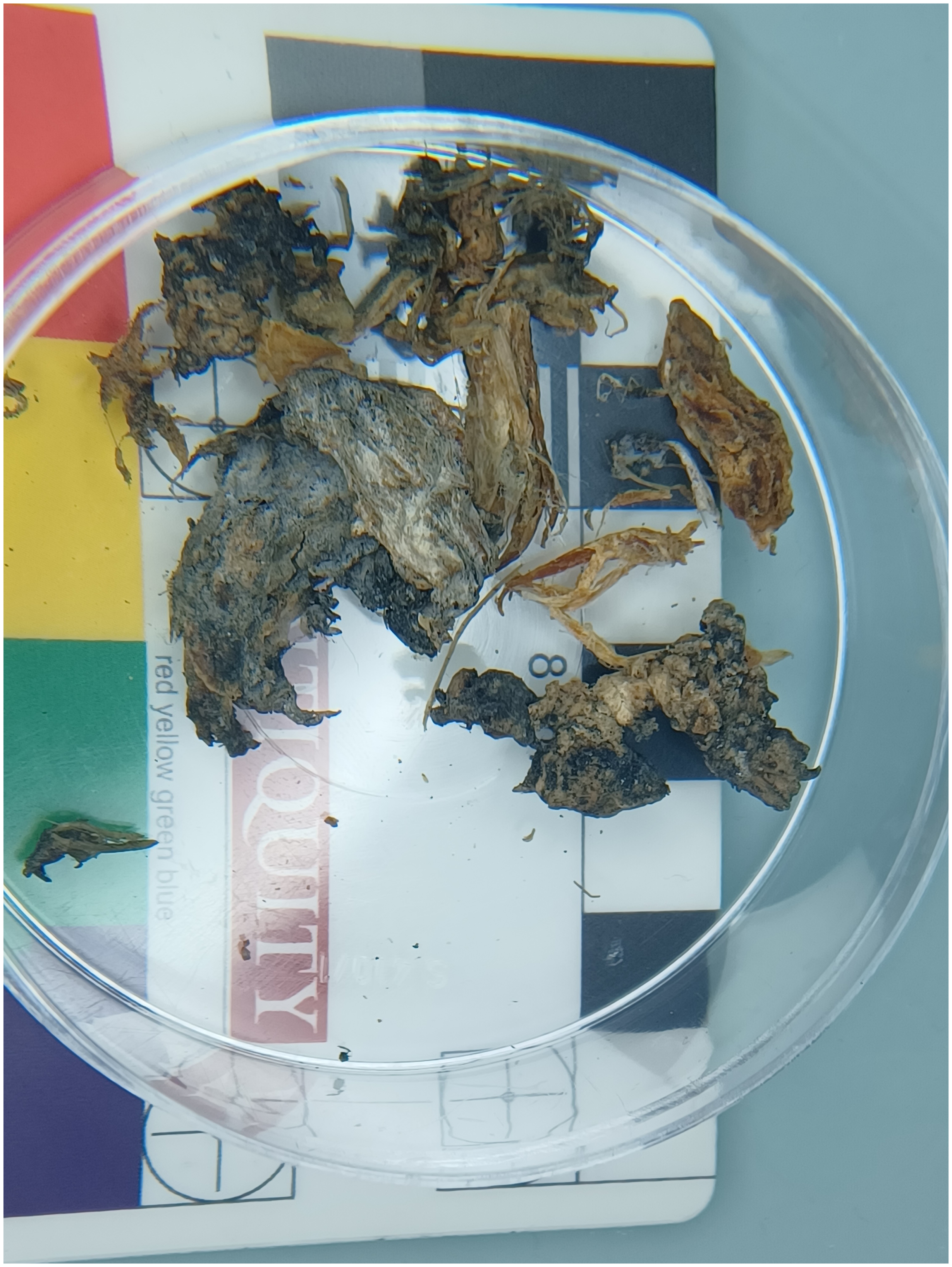
First, the sample was controlled for contaminants by examination under a binocular microscope (Figure 1). In 1991, such observation allowed the determination and separation of pieces of grass mixed into the skin and muscle tissue (Bonani et al. Reference Bonani, Ivy, Hajdas, Niklaus and Suter1994). The standard acid–base–acid (ABA) treatment at the ETH laboratory has not changed over the decades (Hajdas Reference Hajdas2008; Hajdas et al. Reference Hajdas, Bonani, Thut, Leone, Pfenninger and Maden2004, Reference Hajdas, Guidobaldi, Haghipour and Wyss2024). Tissue samples are fragile and can easily dissolve in the base washes. Therefore, the normal ABA treatment, which involves washes in 0.5 M HCl and 0.1M NaOH, at 60 ºC for 1 hr, was monitored, and if needed, the duration of the base step was reduced to avoid loss of the sample (Hajdas et al. Reference Hajdas, Guidobaldi, Haghipour and Wyss2024). The graphitization of these subsamples was performed using the AGE system, which allowed for additional information of C/N ratio in the combusted samples (Hajdas et al. Reference Hajdas, Guidobaldi, Haghipour and Wyss2024; Nemec et al. Reference Nemec, Wacker and Gaggeler2010).
Picture of the remaining frozen tissue of the Iceman stored in a glass jar at the ETH laboratory.

Figure 1 Long description
The image shows a glass jar containing the remaining frozen tissue of the Iceman, stored in a laboratory setting. The tissue appears to be dark and fragmented, with some pieces of grass visible within the jar. The jar is placed on a surface with a colorful background, possibly a calibration chart or a reference guide. The laboratory environment suggests that the tissue is being preserved and analyzed for scientific investigation.
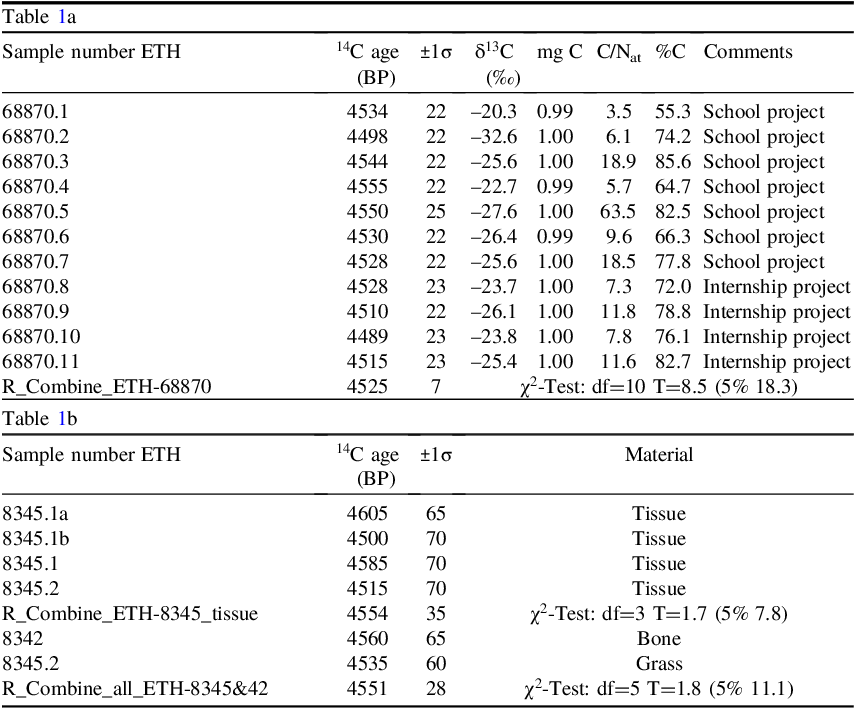
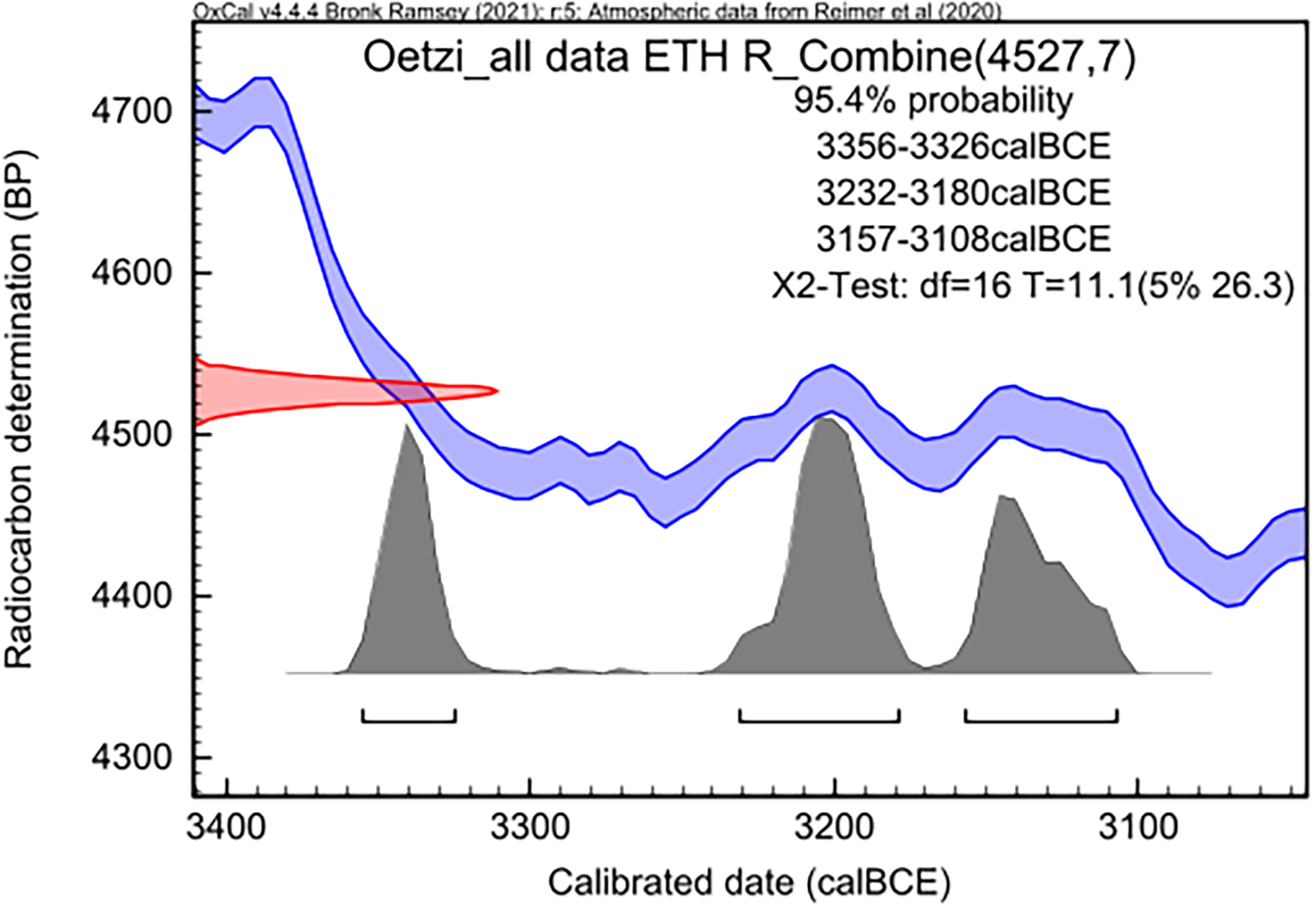
Results of all radiocarbon analysis are summarized in Tables 1a and 1b, together with the combined radiocarbon age of organic matter from the jar. Table 1a shows the results obtained during the student internship and school projects. The excellent agreement with the first analysis shows that frozen organic matter can be dated even after decades. The results acquired in 1991 are listed in Table 1b. Although the new data have been obtained using the MICADAS system (Synal et al. Reference Synal, Stocker and Suter2007) they confirm the analysis performed using the EN tandem (Bonani et al. Reference Bonani, Ivy, Hajdas, Niklaus and Suter1994). All the data shown in Tables 1a and 1b were combined and calibrated using the OxCal 4.4 (Bronk Ramsey Reference Bronk Ramsey2009) and the IntCal20 calibration curve (Reimer et al. Reference Reimer, Austin, Bard, Bayliss, Blackwell, Bronk Ramsey, Butzin, Cheng, Edwards, Friedrich, Grootes, Guilderson, Hajdas, Heaton, Hogg, Hughen, Kromer, Manning, Muscheler, Palmer, Pearson, van der Plicht, Reimer, Richards, Scott, Southon, Turney, Wacker, Adolphi, Büntgen, Capano, Fahrni, Fogtmann-Schulz, Friedrich, Köhler, Kudsk, Miyake, Olsen, Reinig, Sakamoto, Sookdeo and Talamo2020). The weighted mean value of 4525 ± 7 BP was obtained for the new analysis (Table 1a). All the results published by Bonani et al. (Reference Bonani, Ivy, Hajdas, Niklaus and Suter1994) were combined using R_Combine command of the OxCal 4.4 (Bronk Ramsey Reference Bronk Ramsey2009) yielding weighted mean value of 4551 ± 28 BP (Table 1b). The combined age of all the data (tissue, bone and grass), measured in 1991 and in 2016 is 4527 ± 7 BP (χ2-Test; df=16 T=11.1[5% 26.3]). The calibrated age still falls into the extensive radiocarbon age plateau and results in 3 intervals 3356–3326 BCE, 3232–3180 BCE and 3157–3108 BCE (Figure 2). A possible change of 14C calibration curve due to the high altitude of the Iceman discovery site had been investigated in 2004 (Dellinger et al. Reference Dellinger, Kutschera, Nicolussi, Schießling, Steier and Maria Wild2004) through 14C measurements in high-elevation stone-pine tree rings, and was found to be insignificant.
a. Results of radiocarbon analysis on sub-samples selected from the frozen tissue stored at the ETH since 1991. The sample has been given a new ETH number; b. results of dating the Iceman tissue, bone and grass published by Bonani et al. (Reference Bonani, Ivy, Hajdas, Niklaus and Suter1994)

Table 1 Long description
The table presents radiocarbon analysis results of sub-samples from frozen tissue stored at the ETH since 1991. It includes two sections: Table 1a and Table 1b. Table 1a lists sample numbers, radiocarbon ages with standard deviations, delta carbon thirteen values, milligrams of carbon, carbon to nitrogen ratios, percentage of carbon, and comments on the project type. Table 1b lists sample numbers, radiocarbon ages with standard deviations, and the material type. The data show consistent radiocarbon ages across different samples and materials, indicating the reliability of dating frozen organic matter even after decades. The results were obtained using advanced systems like MICADAS and confirm previous analyses performed using the EN tandem. The combined age of all data points to a calibrated age range falling into three intervals: 3356-3326 BCE, 3232-3180 BCE, and 3157-3108 BCE.
Calibrated radiocarbon age of the Iceman tissue, bone and grass combined using the OxCal 4.4 calibration program and the IntCal20 data.

Figure 2 Long description
The line graph titled Oetzi_all data ETH R_Combine(4527,7) displays radiocarbon determination in BP on the y-axis and calibrated date in calBCE on the x-axis. The graph includes a blue line representing the radiocarbon determination data, with a shaded area indicating the 95.4 percentage probability range. The calibrated dates range from 3400 to 3100 calBCE, with notable peaks around 3356-3326 calBCE, 3232-3180 calBCE, and 3157-3108 calBCE. The red line represents the initial radiocarbon determination, and the gray peaks indicate specific data points within the calibrated date range. The x 2-Test value is df equals 16 T equals 11.1 (5 percentage 26.3). All values are approximated.

 Open access

