

Publicly funded and mandated archaeology in the United States has been attacked multiple times during the past several years. Many of these attacks occurred at the state level, where governors and state legislatures tried to defund or outright eliminate state archaeological programs and institutions. At the federal level, we have seen archaeology showcased as a waste of public tax dollars, attempts to defund archaeological research, legislation to move federal projects forward without consideration of impacts on archaeological resources, and proposed changes in the designation of national monuments, many of which protect large numbers of archaeological sites. Here is just a sample of the types of attacks that we have seen over the past two years and more recently:
-
• The Military Land and National Defense Act and amendments to the National Defense Act, which would have allowed military installations to remove properties from the National Register of Historic Places, and veto the designation of properties as eligible for listing in the National Register on these facilities, for reasons of “national security.”
-
• A House Committee on Natural Resources hearing titled “Examining Impacts of Federal Natural Resources Laws Gone Astray, Part II,” which questioned the requirement for federal agencies to identify National Register–eligible properties that may be affected by their actions, pursuant to Section 106 of the National Historic Preservation Act. The committee noted that this requirement “generated uncertainty and drastically broadens the scope of [Section 106] review.” Most archaeological sites are protected under Section 106 because they are determined to be National Register–eligible.
-
• Amendments to the Antiquities Act, radically restricting the president's ability to designate national monuments.
-
• A review of all national monuments designated or expanded since 1996 under the Antiquities Act, where the designation covers more than 100,000 ac, where the designation after expansion covers more than 100,000 ac, or where the Secretary of the Interior determines that the designation or expansion was made without adequate public outreach and coordination with relevant stakeholders.
-
• Reviews of federal agency regulations, policies, and guidelines (e.g., associated with the Department of Energy, Department of the Interior, and Department of Transportation) that “impose unnecessary burdens” and “unjustifiably delay or prevent” the “completion of infrastructure projects.” These include regulations, policies, and guidelines for the protection of archaeological sites and other heritage resources. These reviews are taking place as a result of recent presidential executive orders.
-
• Restructuring National Science Foundation funding, dramatically reducing federal monies for future archaeological research.
-
• Legislation in Florida that would allow individuals to remove artifacts from state-owned submerged lands, as long as they obtained a state permit and report on what they found. They then get to keep the artifacts they find.
-
• Legislation in Georgia that would exempt state-funded transportation projects costing under $100 million from compliance with the state's environmental laws. As a result, no archaeological surveys would be conducted prior to the construction of these projects.
In most cases, a vigilant network of archaeological organizations, including the Society for American Archaeology and the Society for Historical Archaeology, has thwarted past attacks. These efforts were often conducted in partnership with the American Cultural Resources Association and several historic preservation partners (e.g., the Coalition for American Heritage and the National Trust for Historic Preservation). The public, however, largely remains an untapped ally in our efforts to protect and preserve our nation's archaeological heritage. As a discipline, we have not built a strong public support network. Although we know that the public generally likes archaeology, we have not adequately demonstrated the value of archaeology to them, beyond a scattering of educational and informational programs. We are challenged to find the media, messages, and funding to effectively engage the public.
In this article we showcase programs that engage the public as a means of building a strong constituency supporting archaeological research and preservation. These programs demonstrate how we as archaeologists can help protect and preserve the places valued by communities and the general public. Programs range from individual projects to mature programs, and all use resources and approaches that are within reach for many of us. For the most part, these programs have been very effective. Where we have not been successful, the examples can serve as lessons learned.
The discussion that follows identifies creative and innovative ways of addressing the following topics:
-
• Engaging the public, especially the voting public, to build a constituency that will support publicly funded archaeology and the museums holding archaeological collections.
-
• Building a public constituency that will take action and stand with us when archaeology is attacked by members of Congress and state governments.
-
• Informing and educating the public and government decision-makers on the value and contributions of archaeology.
-
• Educating university students on the need to engage the public whenever possible and providing students the tools to develop effective programs that result in building a public constituency.
MICHIGAN STATE UNIVERSITY CAMPUS ARCHAEOLOGY PROGRAM: CREATING COMMUNITIES
The Michigan State University Campus Archaeology Program provides students practical, real-world experiences with public engagement, and stresses the value of this engagement as a way of building a constituency for supporting archaeology. The program began in 2005, when Michigan State University (MSU) celebrated its 150th anniversary and all departments were asked to do something special for the celebration. As department chair of anthropology at the time, Dr. Lynne Goldstein proposed that MSU offer an archaeological field school with current students excavating the remains of the very first dormitory on campus. That project, which was greeted with some skepticism, was spectacularly successful. Although a number of the university's employees were certain that nothing would be found, the project discovered much of the building's basement intact, with lots of debris fill. Articles about the project appeared in local and regional newspapers and on radio and TV. MSU received a Governor's Award for Historic Preservation for that specific project and in 2017 received another Governor's Award for Historic Preservation for continuing work in engaging the public in archaeology, as well as a special tribute from the Michigan legislature.
Subsequent to the sesquicentennial project, the university was open to additional archaeological work. This was significant, since in the more than 30 years previous, no archaeologist was given permission to conduct any archaeological work on campus. When archaeology was required by law, contract firms were only reluctantly allowed access.
Beginning in 2007, Goldstein, with the assistance and support of MSU President Lou Anna K. Simon, created the beginnings of a campus program. Simon had instituted a university-wide initiative called Boldness by Design, and one focus of this initiative was “Stewardship.” The original meaning focused on financial stewardship, but Simon added Goldstein to the group designing the action plan, and historic preservation and archaeology were included in the mission. As a result of this planning process and the press attention for the archaeology conducted, MSU developed a new policy that it will conduct archaeology whenever any ground disturbance is done by the university. This policy extends from new buildings to new sidewalks and even the planting of a new bush or tree. MSU Infrastructure, Planning, and Facilities employees have become enthusiastic supporters of the program and regularly comment that Campus Archaeology has made their jobs much more fun and enjoyable. Campus Archaeology works closely with contractors; university Infrastructure, Planning, and Facilities employees; the MSU administration; the MSU Graduate School; and MSU Archives and Historical Collections, as well as various individual faculty members, students, and alumni.
By 2009, the MSU Campus Archaeology Program (CAP) was well established, and its funding had been regularized. All of the fieldwork, construction discussion, and public outreach of the program is accomplished by students under Goldstein's direction (Figure 1). Each year, approximately six undergraduate and six graduate students serve as interns or fellows. The graduate students each have a project that they select that makes use of archaeological or archival materials. These have included children's programs, archival research on sustainability, social media, geographic information systems, and the development of mobile apps. All undergrad and grad student projects appear in the Campus Archaeology blog, as well as presentations at campus undergraduate and graduate research forums.
Excavations behind the Michigan State University administration building, 2015. (Photograph by Lynne Goldstein.)

Since 2013, CAP has had its own line item in the university budget and also receives significant funding for graduate students from the Graduate School. Each year, Goldstein designates one graduate student as campus archaeologist; this is a half-time position, and that person coordinates much of the fieldwork and research projects.
Perhaps most significantly, the program has changed general attitudes about the importance of archaeology and historic preservation. Archaeology is now something MSU always does when beginning a project. All construction workers on campus now understand that archaeology is required before any ground disturbance, and they regularly call to work out schedules. These construction companies also contact CAP when they inadvertently find something, and local media regularly feature the work.
The program has been developed in the land-grant university tradition—as a way to examine land prior to construction, to train students in archaeology, to conduct archaeological research, and to inform and educate the larger community. This community includes everyone who works and learns on campus, as well as alumni worldwide and the general public. Any time fieldwork is in progress, CAP raises a banner inviting visitors, aggressively uses social media to tweet its progress, and posts on Facebook and Instagram (Figure 2). Students in the program regularly produce blog posts. CAP also regularly has ongoing “quizzes” on social media, with questions such as, “What is this artifact?” Newspapers cover the work, and both undergraduate and graduate archaeology students provide lectures, tours, and events. As examples, CAP created an exhibit on early MSU history in the campus library, regularly conducts a haunted tour for Halloween, and created a set of permanent exhibit panels on MSU's past and archaeology for the newly renovated Graduate School building. Campus Archaeology also has long had a presence at MSU's Science Festival, Grandparents University, and various other public programs.
Advertising and explaining Michigan State Campus Archaeology excavations, 2017. (Photograph by Lynne Goldstein.)

The real significance of CAP has been its overall impact on the campus. A number of physical plant employees have indicated that the program makes their own work more relevant and fun; these workers regularly assist CAP in clearing ground, moving obstacles, and securing sites. Faculty and staff have appreciated knowing more about MSU's past and understanding many of the significant contributions made throughout MSU history. MSU Archives has appreciated the increased visibility that CAP's work has brought it, and students learn more about MSU as finds are made. The program has become better integrated into MSU's infrastructure, and physical plant employees and campus planners automatically include archaeology in all of their planning and construction. Significantly, the administrators who initially thought that there was nothing left to find on campus have now realized that archaeological resources are present and must be incorporated into any future planning. With the large following that CAP has generated, the program can also call people to action on specific bills or actions by the state and federal governments; CAP has created an engaged and educated public focused on the university but concerned about archaeology and historic preservation on a larger scale. This process is of course ongoing—we are never finished.
CROW CANYON ARCHAEOLOGICAL CENTER: ARCHAEOLOGICAL EDUCATION AS ADVOCACY
From its home base in Cortez, Colorado, the Crow Canyon Archaeological Center, under the direction of Deborah Gangloff, conducts cutting-edge archaeological research in the context of public archaeology programs, and in collaboration with Native American tribal partners, it informs and educates the public and government decision-makers about the value and contributions of archaeology. Crow Canyon's Board of Trustee's Governmental Affairs Committee has developed a national public policy agenda, unanimously supported by the board, that says that Crow Canyon stands for the protection of cultural resources and access to those resources for archaeological research and is committed to adding Native American voices to the national public policy debate. That is the intense, but relatively narrow, focus of Crow Canyon's advocacy work. It is accomplished by bringing people onto its campus and archaeological sites, in the Four Corners and beyond.
For more than 30 years, Crow Canyon has invited the public to conduct research with its staff in the field and in the laboratory (Figure 3). Tens of thousands of schoolchildren and thousands of adults have learned about the archaeological process, by doing it. Much of Crow Canyon's research contains data collected by fourth graders. Through their work on Crow Canyon projects, their travel to sites with Crow Canyon staff, and their interaction with Native American scholars, Crow Canyon is changing people's lives, opening them up to different cultures and ways of thinking, and fostering an appreciation of not only societies of the past but those of the present. Archaeology is not just the study of the past; it is an examination of what it is to be human—what we all share. More than that, understanding other cultures creates a more tolerant society. Crow Canyon is not trying to make more archaeologists; instead, the center is trying to make people more culturally and scientifically literate.
Crow Canyon participants identifying and analyzing artifacts. (Photograph by Deborah Gangloff.)

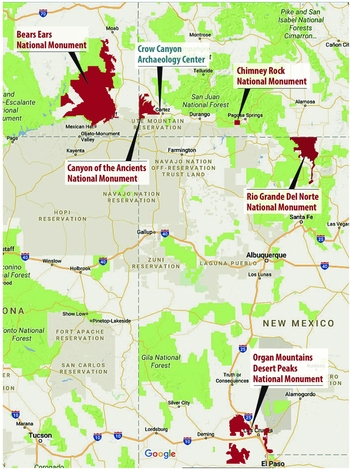
Advocacy (not to be confused with lobbying) is not just a right but a responsibility of nonprofit organizations. Recently, Crow Canyon has advocated locally, regionally, and nationally for the creation of the Chimney Rock National Monument on US Forest Service lands and the Organ Mountains/Desert Peaks National Monument and Rio Grande del Norte National Monument on Bureau of Land Management lands (Figure 4), all of which contain significant cultural resources, both precontact and historic. National monuments can be designated legislatively by Congress or by presidential authority under the 1906 Antiquities Act. While the former is preferred, where legislators push for monument status, Crow Canyon believes that it is the president alone who can act in the national interest. There have been many bills and amendments introduced recently in Congress to limit this presidential authority. Crow Canyon strongly advocates against any lessening or abolishment of that authority. These attacks run the gamut from calling for local and state consent to outright banning new national monuments in certain states or counties. Some attacks have centered on mischaracterizations of the Antiquities Act as it was passed by Congress in 1906: that it only concerns resources under immediate threat of destruction (it does not), that it limits the size of the area of protection (it does not), or that it requires the state governor or legislature to agree with the designation (it does not). President Obama and others before him coordinated a process to gauge local support for new monuments before designation, and Crow Canyon supports that. As a nonprofit organization, Crow Canyon's advocacy work helps supporters feel more a part of the organization and its immediate yet long-lasting impact.
Location of Crow Canyon and the monuments that Crow Canyon and Native American communities are advocating for National Monument status. (Photograph by Deborah Gangloff.)
Working with Native Americans is an essential part of Crow Canyon's advocacy work. The voices of Native Americans are powerful in the public and in the halls of Congress. They make the human connection between the past and the present. For instance, members of the pueblo Ysleta del Sur in Texas showed congressional members images of the sites in Organ Mountains, which they described as their cathedrals, and urged protection of them from vandalism. Similarly, the Pueblos along the Rio Grande, as well as the Hopi, Zuni, Navajo, and Ute, advocated for the creation of the Bears Ears National Monument to protect the significant sites it contains. Looting and vandalism of cultural resources is not just about the past; it is about the present and the future. To be better partners with tribal collaborators and ensure their support, archaeologists need to listen to their concerns and address them, ensuring that their goals for partnership are met.
For Crow Canyon, local economics is another powerful perspective on its work. Crow Canyon is a part of the heritage tourism industry in southwest Colorado. Nationally, this sector employs eight million people; it is an $800 billion-a-year business, with a $2 billion payroll. In an economically challenged area such as southwest Colorado, heritage tourism brings significant economic benefits. Nearby Mesa Verde National Park hosts more than 550,000 visitors a year, who spend $55 million locally and support 814 jobs. These are big numbers in this part of Colorado. Even Crow Canyon, with a less than $5 million budget, provides a direct annual benefit of nearly $7 million locally.
Heritage tourists are a significant portion of all leisure tourists, and they travel longer and spend more on trips. People are interested in history and finding themselves in the past. Crow Canyon's job is to convert that interest into action by engaging them in Crow Canyon's work both on the ground and in decision-makers’ offices. The public benefits by learning about history and becoming a part of something that will endure beyond their lifetime.
THE FLORIDA PUBLIC ARCHAEOLOGY NETWORK: PUBLIC ENGAGEMENT AND THE FUTURE OF FLORIDA ARCHAEOLOGY
The Florida Public Archaeology Network works to engage the public, including youth and the voting public. The goal is that engagement will increase public valuation of Florida archaeology and will lead in turn to support for public programs in archaeology, including museums holding archaeological collections.
Florida has a long history of engaging the public about the value of archaeology and archaeological preservation. The University of West Florida, the University of South Florida, and the city of St. Augustine have established traditions of public archaeology in their communities and have been joined recently by the New College in Sarasota and the Florida Historical Society in Cocoa. The Florida Division of Historical Resources (DHR) has worked with the public throughout the state and in Tallahassee through a major site-based public archaeology program at Mission San Luis. The University of Florida has established another site-based program at the Pineland site near Fort Myers. Numerous towns and counties have preservation ordinances that address archaeology, and some employ preservation archaeologists (Lees, Scott-Ireton, and Miller Reference Lees, Scott-Ireton and Miller2016).
Since 2005 the University of West Florida and its partners (currently Flagler College, Florida Atlantic University, and the University of South Florida) have taken a state-wide approach through the Florida Public Archaeology Network (FPAN). In eight regions, each with a dedicated public archaeology staff, FPAN seeks to increase public valuation of archaeology through public outreach, working with local governments, and assisting the Florida DHR with its educational programming (Lees, Scott-Ireton, and Miller Reference Lees, Scott-Ireton and Miller2016). William Lees serves as FPAN's executive director.
Despite this impressive attention to public engagement in Florida, with its 20 million residents, the state faces significant, recurring preservation challenges. Despite the state's legal claim to its underwater cultural heritage in rivers and along the shores of the Atlantic and the Gulf, state law requires DHR to work with treasure salvors in state waters. A small industry lobby has prevented attempts to end this archaic system that runs counter to what has become best practice in the United States and in many countries around the world (see, for example, United Nations Educational, Scientific and Cultural Organization 2001).
The archaeological community in Florida faces repeated attempts by a small group of “collectors” (some from out of state) to change state law to legalize the removal and private ownership of artifacts from sovereign state waters. Recent attempts have called for “artifact amnesty,” the creation of a “citizen archaeology permit,” or a requirement for DHR to operate an “isolated finds program” (Lees Reference Lees2015, Reference Lees2016; Scott-Ireton Reference Scott-Ireton2013). Amnesty would provide legal title to artifacts previously collected in violation of state law. The others would make removal and private ownership legal with minimal reporting requirements. All would open the floodgates of looting on state lands, which is already a major problem. Looting is fueled by the significant commercial value of Florida artifacts and the remote location of important sites. Recent law enforcement investigations have highlighted the seriousness of the problem but have heightened attempts to change state law.
Despite the long history of public engagement, no groundswell of public objection has risen to scuttle these programs that directly threaten the archaeological record. Instead, and with few exceptions, this work has fallen on the shoulders of those with the least freedom to respond: those working in government and in not-for-profit institutions. Although we have been increasingly successful in building support for archaeology at the local level, it may be unreasonable to expect that this will translate to substantial public action on the state (or national) level.
Our state representatives must therefore become one of our most important publics (Figure 5). While this is an old concept, we have not succeeded in instilling local representatives with the positive values that archaeology offers. This is a challenge for a variety of reasons. Until they become aware of the local value of archaeology to their constituents, they will not be prepared to question proposals that turn state-owned materials over to a selfish few or reduce support for the preservation and study of Florida archaeology.
Florida Public Archaeology Network staff Emily Jane Murray (left) and Sarah Miller (right) with State Representative Cyndi Stevenson (center) at the Florida Capitol during Archaeology Advocacy Day. (Photograph by Florida Public Archaeology.)

Tiring of constantly being reactive to the next challenge, some Florida archaeologists have begun a program of engagement at the local level, by sharing information on local archaeological programs and successes with individual representatives, stressing local values and including, wherever possible, the benefits of archaeology to their constituents and communities. If the first time a representative hears from an archaeologist is when there is a problem, we have already failed.
Cultural resource management (CRM) firms are constrained, on the one hand, by client relationships that make sharing results with the public difficult at best and, on the other, by the lack of funds flowing from governmental agencies that would allow them to go the extra distance for the public (Lees and Scott-Ireton Reference Lees and Scott-Ireton2015). Florida and other states need to step up to this challenge by requiring direct public outcomes as an element of compliance with historic preservation laws and regulations. The CRM profession and every college or university that trains future archaeologists also need to step up to identify a coherent, engaging, visible, and lasting public outcome as a both corporate and individual responsibility of our discipline.
Public archaeology has to evolve to include all archaeology and archaeologists. It can no longer include only those who are public servants or in not-for-profits. Those earning their living as a result of requirements of the National Historic Preservation Act or related state programs must become public archaeologists because they are the ones doing most investigations of archaeological sites. In addition, it is essential that we proactively engage those involved in making our state laws so that they become aware of archaeology in their state and why it is important. Only then will they know what questions to ask, or who to ask for answers, when a proposal about archaeology comes before them. In Florida, where we have a long-standing and robust approach to public engagement, these two items stand out as both our biggest challenges going forward and our best hope for gaining the level of broad support that the state's rich heritage deserves.
ARCHAEOLOGY IN THE CITY: UNEARTHING DETROIT WITH PARTICIPATORY RESEARCH
People want to be a part of history-making in Detroit. This is the seemingly straightforward lesson that Krysta Ryzewski, her students, and her colleagues at Wayne State University have gradually learned over the past five years in their efforts to establish a community-oriented archaeology in the city. Unearthing Detroit tries to educate university students on the need to engage the public whenever possible and to enable students to develop effective programs that result in building a public constituency. The projects engage the public, helping to build a constituency that will support publicly funded archaeology and the museums holding archaeological collections.
The following reflections focus on the connections between archaeology and the public within the context of a fast-changing city that is attempting to recover from a decades-long epidemic of blight and mismanagement. As a professor at Wayne State University, a large public urban research university, Ryzewski has benefited from her institution's proximity and diverse student body in establishing local archaeological research collaborations with the communities whom their work serves and whose tax dollars fund some of their projects.
In 2013, Detroit declared bankruptcy in what was the largest-ever municipal filing in the United States (Isidore Reference Isidore2013). The Detroit of today and tomorrow is concerned with how it will rebound from almost a half century of unprecedented decline plagued by economic struggles, political corruption, redlining, population loss, and racial tension. Home to an estimated 70,000 abandoned properties, more than 40,000 of which will be demolished, Detroit grapples with issues of decay and ruination (Byrnes Reference Byrnes2014). It is the poorest large city in the country and among the most dangerous. These oft-cited statistics cement the city's postindustrial and disaster status in ways that ignore it as a place that is also undergoing some of the most aggressive and unfettered capitalist redevelopment in the country. The political and economic entities undergirding these concurrent circumstances of deterioration and development both fail to recognize the city's rich cultural heritage in the ways that local people do. Indeed, deep-rooted appreciation for the city's past and the ways that it might factor into shaping its future thrives among Detroiters and those who appreciate the city's histories.
Archaeology in Detroit embraces a grassroots spirit present in the city's history of labor organization, civil rights activism, and innovation. One of the university's first efforts to connect archaeological research with Detroit stakeholders was through the Unearthing Detroit project, a collections-based research and community archaeology initiative focused on more than 40 years’ worth of historical archaeological collections recovered from decades of rescue excavations conducted at numerous major landmarks in Detroit by past Wayne State professors. Owing to time and financial constraints, the majority of these collections had not been thoroughly inventoried, cataloged, or studied beyond initial processing. Since receiving funding for the Unearthing Detroit project in 2013, Ryzewski and Wayne State students have worked alongside volunteers from outside of the university to catalog and study the collections from two particular sites, the Renaissance Center and Roosevelt Park (Figure 6). In the process, they have continuously solicited feedback from communities through social media, open days, and involvement with local nonprofit organization activities in developing a blog, a social media platform, and a junior high–level educational module called “Time Jumpers” that showcases the principles of archaeology while integrating stories about the city's early history and residents.
Wayne State University anthropology graduate student Samantha Ellens instructing local middle school students about the values of teamwork and patience when working with artifacts. This exercise involving the reassembly of a broken mug is part of the classroom-based introductory archaeology module developed by Time Jumpers. (Photograph by Krysta Ryzewski.)

The success of the Unearthing Detroit project has led to several additional community-led archaeology projects that exist beyond the confines of a “conventional” long-term archaeological research project. These projects are proposed by Detroiters to Wayne State, a factor that strengthens the role of archaeology in the service of communities and introduces transparency into the process of project design, data collection, and dissemination (Figure 7). They include Wayne State's partnerships with local nonprofit organizations, small business owners, developers, media, community groups, and museums. Some of the projects span several months or years, while others are conducted over the course of a few days. Brief synopses of three projects illustrate the diversity of the university's grassroots archaeological efforts.
Wayne State University archaeologists leading a survey and recovery of remains from the Grande Ballroom, October 2016. Survey team participants also included preservationists, architects, historians, and members of the church that owns the building. (Photograph by Krysta Ryzewski.)

Ethnic Layers of Detroit
The Ethnic Layers of Detroit project is an interdisciplinary digital humanities project funded by the National Endowment for the Humanities. It is developing 25 short digital stories on places in the city associated with its layered ethnic histories. Most of the places featured in the stories are gone, decaying, or transformed, but the videos allow the option of site-specific experiences or distant engagement with memories of them and their histories. The project has an advisory board of more than two dozen local organizations and community groups. They and Wayne State students are both involved in creating the digital stories.
The Speakeasy Project
In 2013, Preservation Detroit and a local businessman, the owner of Tommy's Bar, invited Wayne State to partner with them to conduct a short-term archaeological assessment of an alleged Prohibition-era speakeasy in the bar's basement. Wayne State's collaborative research and excavations in the archives and in the building positively identified the speakeasy and, perhaps unintentionally, connected Ryzewski and Wayne State students with an unexpected community—enthusiastic family descendants of the infamous Jewish-run Purple Gang, who monopolized the bootlegging industry in Detroit during Prohibition. This short project resulted in the bar being integrated into a popular Detroit history bus tour, featured on TV shows, and chronicled in local news outlets and national Jewish newspapers, and it generated momentum for the building's nomination to the National Register of Historic Places.
Detroit Sound
Wayne State archaeologists have partnered with the nonprofit Detroit Sound Conservancy on three mapping projects of mid-twentieth-century recording studios and performance spaces in the city. One in particular, the Blue Bird Inn, intersects with the archaeology and history of African American jazz and blues in the city between the 1930s and 1950s. This work is featured on blogs and social media and is the focus of research presentations and a master's thesis (Brace Reference Brace2016). All of the music-related sites Wayne State has examined are ruined or endangered. During the summer of 2016, the National Parks Service built upon Ryzewski's and Wayne State students’ ongoing work and used the music-making sites as case studies for its Detroit Urban Park Break program, which is working to integrate the physical landscape of music heritage into designs of a future Detroit.
Grassroots archaeology in Detroit is still in its infancy, but it is developing quickly and, fortunately, with local support. For students, participatory research is fast becoming a core tenant of archaeological work and a vehicle for learning about the need to engage the public with archaeology through conventional and creative outlets.
ENGAGING THE LEGISLATURE AND PUBLIC: A CAUTIONARY TALE ABOUT PUBLIC FUNDING FROM THE ILLINOIS STATE MUSEUM
In contrast to the examples above, recent experiences at the Illinois State Museum (ISM) provide a cautionary tale. Having a strong, local public constituency does not always mean that our efforts will be successful. Even in these cases, however, we can learn a lot about the critical importance of public support for archaeology and museums that hold archaeological collections.
The Illinois State Museum System, based at the Illinois State Museum in Springfield (ISM-Springfield), included six facilities across the state and successfully engaged the public in archaeology, as well as art, history, and the natural sciences, but was closed to the public by Governor Rauner at the end of the workday on September 30, 2015. At the time of the closure, Bonnie Styles had been director of the Museum System for 10 years and before that had served as associate director for science and education, director of sciences, and chairperson and curator of anthropology.
The Museum System was largely a pawn in a political fight between the governor and the legislature that had nothing to do with the performance of this nationally accredited Museum System and little to do with state deficits or the absence of a state budget. After all, the absence of a state budget impacted all of state government, and the annual state funding for this six-facility state museum system was relatively low ($6.0–6.5 million). The ISM return on investment was high. Museum staff brought in about $2 million in outside grants and contracts to supplement the state budget, and visitors to ISM facilities spent more than $31 million in Illinois communities each year. However, an underlying reason for targeting the Museum System for elimination was an all-too-common philosophy that museums and the programs they offer (in this case, including archaeological programs) are not essential and should be primarily supported by private, not state or federal, funds. This discussion summarizes the successful ways the ISM and many other museums engage the public and legislators in archaeology and the natural sciences and emphasizes the importance of that engagement, program quality, and continual internal and external advocacy.
The nationally accredited Illinois State Museum System successfully served and engaged the voting public through its on-site exhibitions—including a well-loved anthropology hall (Peoples of the Past) and an interdisciplinary natural history hall focused on the causes of environmental change (Changes), as well as art exhibitions and a children's gallery (Mary Ann MacLean Play Museum), which integrated archaeology and anthropology at the ISM-Springfield, and a whole museum dedicated to archaeological discoveries at Dickson Mounds Museum. The ISM was nationally known for its outstanding scientific and historical research and collections, which provided a sound foundation for its interpretive programs. The museum served more than 386,750 individuals through on-site and popular off-site programs in 2014. It also offered rich online exhibitions on archaeology, including access to collections, on the ISM website, which attracted about 1.5 million virtual visitors each year.
The ISM also engaged people of all ages in programs on archaeology, guided tours of exhibitions, and behind-the-scenes tours for schools and other groups to explore collections and research. The ISM offered numerous hands-on programs and workshops for children and adults. Weekly brown bag lectures and monthly lectures on archaeology and the natural sciences in the Research and Collections Center in Springfield routinely attracted large audiences. The ISM also offered paid internships for college students (funded through outside grants), behind-the-scenes member and public open houses to explore laboratories and collections and meet the researchers, field trips to archaeological sites and other museums, and professional development for teachers in archaeology and the natural sciences. The ISM reached more than 40,000 schoolchildren and 2,300 teachers in 2014. All of these programs helped create an audience of loyal supporters and attracted individuals to join the Museum System's nonprofit friends and fund-raising group, the Illinois State Museum Society.
The ISM offered opportunities for children and adults to participate in field and laboratory research, which strengthens understanding and support. The ISM Museum Tech Academy, developed and supported for three years with funding from the National Science Foundation, engaged low-income teens in a multiyear, after-school and summer program in technology, archaeology, and the natural sciences. Through a partnership with the Center for American Archeology, the Museum Tech Academy included a resident archaeology field school experience in Kampsville. Taste of Archaeology programs for teens and adults at Dickson Mounds Museum also engaged participants in laboratory and fieldwork experiences. The Michigan State University field school at the Morton site provided firsthand field and laboratory research experiences for undergraduate and graduate students. All of the museum's facilities offered volunteers opportunities to work with the collections and ongoing research projects.
Dickson Mounds Museum provided space for and worked closely with the regional avocational archaeology group of the Illinois Association for Advancement of Archaeology and also helped produce its newsletter. ISM-Springfield hosted the meetings of the Lincoln Earth Orbit Society and provided volunteer and enrichment opportunities for its members. The ISM's “A-Team” volunteers had been assisting with inventories of the museum's large archaeological collections for decades. Avocational archaeologists and other citizen scientists often become strong supporters of research and collections and give freely of their time.
ISM staff and board members had strong relationships with local legislators. The ISM-Springfield was situated across the parking lot from the state Capitol and state office buildings and was a popular location for legislative breakfasts held by the ISM, its parent organization (the Department of Natural Resources), and the Illinois Association of Museums (IAM). ISM staff were regular participants in the American Alliance of Museums (AAM) national Museums Advocacy Day in Washington, D.C., and the IAM Museum Day in Springfield. The state event was modeled after the national event and was hosted in the ISM-Springfield. On the state and national advocacy days, ISM staff and board members met with legislators and congressional members in their offices in Springfield and Washington, D.C., asked for their support for museums and state and federal funding for museums, and thanked them for past support. Staff and board members invited state legislators and congressional members to visit sites and exhibitions and to come behind the scenes to explore collections and learn about research and other projects (Figure 8). Each year as a part of AAM and IAM initiatives, ISM provided legislators and congressional members with a one-page educational and economic impact statement for the ISM system to build the case for state and federal support for museums.
Illinois State Museum administrators and archaeologists showing US Senator Dick Durbin the archaeological collections in the museum Research and Collections Center and discussing the importance of the more than 13.5 million objects in the cultural and natural history collections to Illinois and the world. (Photograph by Doug Carr.)

Despite all of the museum's demonstrated successes and educational and economic impacts, the governor of Illinois issued a press release on June 2, 2015, announcing the museum's potential closure to the public if the impasse in dealing with the state's budget shortfall continued. In January 2015, the museum and its supporters had staved off a recommendation from the governor's Office of Management and the Budget to close the Museum System. Based on a strong impact statement developed by the ISM, the museum board and leadership staff had been told in February and March 2015 that the museum would be fully funded. The Department of Natural Resources (DNR) director notified the museum director of the June 2 press release 10 minutes after it had already been issued and indicated that no alternatives to closure would be considered. The media largely opposed closure, and the museum enjoyed strong bipartisan support at the state and national levels. As a requirement of a proposed closure of a state facility with more than 25 staff, a state bipartisan commission (the Commission on Government Forecasting and Accountability) solicited public comments on the closing (June 23–July 22, 2015) and held a hearing on July 13. The commission received and posted 769 pages of public comments and 188 pages of witness records for the hearing (http://cgfa.ilga.gov). All but a few of these comments were in opposition to the closure. Opposition to the closure came from major national and regional professional organizations for museums (including the IAM and AAM) and the disciplines represented at the ISM (including the Society for American Archaeology); universities and museums across the world; state and federal agencies (including the US Department of the Interior and US Army Corps of Engineers); the Peoria Tribe; state legislators; US Senator Dick Durbin; the mayors of Springfield, Lewistown, and Lockport; community leaders; school officials; teachers; and families. The July 13 hearing lasted four hours, and only the director of the Department of Natural Resources (the ISM's parent organization, which is an agency under the governor) testified in support of the closing.
A grassroots organization of loyal supporters of the ISM organized public protests against the closure (Figure 9). It developed the Facebook page “Save the Illinois State Museum” and an electronic petition that garnered more than 12,000 signatures, which was presented to the governor at a July 21, 2015, rally on the steps of the capital building. This peaceful rally drew a diverse audience of about 500 in opposition to the closure.
Save the Illinois State Museum Rally, organized by grassroots supporters, which drew about 500 participants, including numerous families and young children. (Photograph by Doug Carr.)

The commission met again on August 5, 2015, to vote (seven of the nine commissioners present voted in opposition to the closure), and on August 6, it recommended to the governor that the museum not be closed. However, the governor did not take the commissioners’ advice and indicated that he would proceed with closure. With bipartisan support, the Illinois Senate passed a bill in August that required that the state operate a museum system and that it be open to the public. The House passed the bill in October 2015, after the museum had already been closed. The museum was closed to the public effective October 1, 2015, by a decision of Governor Rauner (initially put forward as a threat to get the legislature to support the governor's agenda and linked to the impasse in negotiations to resolve the budget shortfall). After holding the bill that had passed in the House and the Senate, the governor vetoed it in February 2016 (amendatory veto with a rewrite). The legislature did not garner enough votes in the House to override the veto. Thus, a high-performing, accredited museum system with nationally respected exhibitions, programs, and research and strong advocacy and public support was closed to the public. The unfortunate lesson is that one individual, in this case a governor, can choose to ignore strong public and legislative support and close a well-loved, reputable institution. However, the protests to this closure and advocacy for the ISM continued.
This story has a bittersweet ending that suggests that the closure was indeed not related to performance or the lack of a state budget. The governor reopened part of the badly damaged Museum System (ISM-Springfield, the Research and Collections Center in Springfield, and Dickson Mounds Museum in Lewiston) to the public on July 2, 2016, after a nine-month closure and implementation of a meager entrance fee of $5.00 at the ISM-Springfield. During the closure, most of the staff were still working and being paid, and the entrance fee applies only to a minority of visitors, that is, nonmembers and non–military personnel aged 19 to 64. These fees will bring in little money given the start-up and staff costs for ticket sales.
The Museum System was greatly damaged by the closure. Concomitant with the October 1, 2015, closure, the governor and DNR permanently laid off most of the nine-person leadership team (all of whom were nonunion): six were laid off with no health benefits, and two chose to retire on October 1, when they were informed that they would be terminated. The terms for three strong, long-term State Museum Board members, including the long-term chairman of the board, were not renewed. The original plan put forward by DNR was to lay off the staff and hire contract security personnel to oversee the facilities. The museum director urged the DNR director to retain sufficient professional staff to ensure the safety of the collections and permanent exhibitions and perform some critical functions. DNR finally agreed to retain some staff but limited the number to three. Only one member of the original leadership team was retained, ultimately to serve as an interim director, along with one facilities assistant and the manager of the statewide archaeological site file. A pending lawsuit stopped the layoffs of the ISM staff in union bargaining units including curators, museum technicians, guards, and building and grounds laborers when the Museum System was closed to the public. Many highly skilled and experienced curators took positions elsewhere or retired because of the treatment of the staff and the uncertainty about reopening to the public and long-term state support. At the reopening of the museum to the public, the new chairman of the museum board aptly compared the impacts of the closing with those of a major natural disaster.
After more than two years without a budget, the Illinois legislature passed a budget in July 2017 by overriding the governor's vetoes of a budget and tax increase. At the time of this writing, state funding for the Museum System basically covers the salaries of the remaining staff. Staff size and funding have been greatly reduced; and consequently there are fewer programs, and attendance is down. The recently passed state budget will need to support the hiring of critical staff for the museum so that it can continue to serve the public with distinction and fulfill its state-legislated mandates to study, collect, and interpret the natural and cultural heritage of Illinois. Hopefully the state will resolve its continuing budget crisis in ways that do not further damage cultural institutions such as the Illinois State Museum.
The closing of the Museum System could have been permanent had it not been for the ISM's reputation for excellent programs, its considerable success in engaging the public and legislators, and the loud public outcry. Without that support, the Museum System could have remained closed to the public, and this 140-year-old institution, known nationally and internationally for its high-quality research, collection, and interpretive programs and considered a national model of a museum system, would have been gone.
Over a number of years, there have been repeated moves to eliminate or reduce funding for museums, historic preservation, archaeology, humanities, and the arts, such as attempts to reduce funding for the Institute of Museum and Library Services and the recent move to eliminate funding for the National Endowment for the Humanities and National Endowment for the Arts. We clearly need to continue to communicate the importance of public funding for cultural institutions and programs of all types, including archaeology. These educational institutions and programs define us as cultural beings and are important to the education, health, and well-being of our multicultural society. They are essential and worthy of public support and often bring more monies to our communities than they cost.
COMMON PLACE: FOSTERING DIVERSE CONNECTIONS TO THE PAST ON THE GARDEN CREEK PROJECT
One of the most effective ways to build a constituency that supports archaeology is to pursue community-based projects rooted in local curiosity about particular sites or historical moments. The Garden Creek project, in western North Carolina, is an example of a project used to inform and educate the public and government decision-makers on the value and contributions of archaeology by focusing on a specific historic place. Such projects presuppose the existence of some public knowledge about or interest in the past. As a result, they often focus on relatively recent historical events familiar to contemporary communities.
Archaeologists cannot always count on extant knowledge or interest to extend into the precolumbian era. In many parts of the United States, the material and architectural records of Native North America may not be visible to the untrained eye. More insidiously, standard grade school curricula fall short of providing American citizens with a comprehensive understanding of the Native American past before and after contact (Shear et al. Reference Shear, Knowles, Soden and Castro2015). The United States’ dominant historical narrative has relegated Native North America to the sidelines of history, beyond the scope of non-Native experience. As a state senator recently put it to the Archaeological Conservancy, “It may be part of your heritage, but it ain't part of mine” (Michel Reference Michel2003:4).
Public-minded archaeologists must confront this viewpoint and, where appropriate, encourage a more inclusive notion of heritage among constituencies who may lack direct cultural ties to America's deep past. In practice, this involves archaeologists first introducing communities to the indigenous archaeological record and then finding ways to cultivate meaningful relationships between the present and the past. One potential basis for these relationships is place. Regardless of lineal affiliations, contemporary residential communities—“groups whose privately owned homes and lands encompass archaeological sites or other heritage resources” (Wright Reference Wright2015:213)—share some form of place-based identity with the indigenous communities who lived in the same location centuries or millennia ago. Of course, the attachments between past people and particular places are not identical to those that exist today, but some form of place attachment may render intelligible experiences among groups separated by time or by distinct cultural backgrounds. In turn, interest in, appreciation for, and stewardship of the past represented in the archaeological record may emerge from this shared sense of place (see also Sgouros and Stirn Reference Sgouros and Stirn2016).
The Garden Creek Archaeological Project (GCAP), conducted on private land in western North Carolina from 2011 to 2014, underscores some of the challenges and opportunities that can emerge from efforts to muster an archaeologically inclined residential community (Wright Reference Wright2015). Focused on a Middle Woodland period (ca. 100 BC–AD 400) ancestral Cherokee site, GCAP necessarily involved ongoing collaboration with the suburban, largely Euro-American community that lives there today. Many of the residents were aware that Native Americans had lived there in the past, thanks to a historical marker at the neighborhood's entrance, but few knew much about the site or the fact that some of it remained intact below their lawns. Over multiple field seasons, GCAP introduced residents to this archaeological record by sharing the results of geophysical surveys, excavations, and artifact analyses through regular site visits, public archaeology days (Figure 10), and various written media (e.g., blog posts, newspaper articles, semiregular mailers). These initiatives showed residents that the archaeology of the Garden Creek site was not reducible to an isolated point or potsherd find but, rather, encompassed a substantial record of Middle Woodland habitation and community activity. Maps generated from magnetometer and ground-penetrating radar surveys encouraged residents to perceive the site as a full-fledged settlement, not so dissimilar from the settlement where they live today. Detected features revealed where Middle Woodland people lived, ate, gathered, and slept and forged a more viscerally experiential tie between present and past than had previously existed in the neighborhood.
Local residents of Plott Farm neighborhood visiting the Garden Creek site on Public Archaeology Day in August 2011. (Photograph by Alice Wright.)

By fostering relationships between residential communities and local archaeological resources, GCAP and projects like it stand to benefit in the short and long term. First, the support of residential communities increases the likelihood of obtaining the necessary permission to conduct archaeological research on private property. Second, residential communities may strive to protect the archaeological record once they are made aware of its existence and value. This is especially important because many archaeological sites on private property are not protected by federal legislation and may be damaged or destroyed by private development or land management (Neumann, Sanford, and Harry Reference Neumann, Sanford and Gayle Harry2010:31). If a residential community can be alerted to the presence of an irreplaceable archaeological resource, shown the importance of studying the resource in professional detail (i.e., not through looting or lay excavations), and encouraged to empathize with the distant community who generated the archaeological record, then they can become grassroots, on-site archaeological stewards.
While GCAP researchers have not yet needed to mobilize the community for advocacy, postfieldwork engagement with the local community, including the creation of a local museum exhibit, a series of public talks, and informal correspondence with residents, continually underscores the importance of archaeology to members of the voting public at the municipal, county, and state levels. We are all familiar with the axiom “All politics are local.” If, as we argue here, support for archaeological research and the protection of archaeological resources are political, then we are obliged to pursue an explicitly localized archaeology, relevant to particular communities in particular places.
SOME FINAL OBSERVATIONS
These programs and projects provide a menu of activities and actions for effective public engagement. By “public” we mean all individuals living in the United States regardless of social, cultural, and religious affiliation; economic standing; and sexual orientation. We also recognize the importance of descendant communities, especially Native Americans; however, tribes are not “the public” and have a unique role in historic preservation as sovereign nations.
All archaeologists have the responsibility to engage the public, whether they work in academia, CRM, museums, or nonprofit organizations. Government archaeologists are more restricted in what they can do, but there are still things that they can accomplish in the context of their legal and regulatory responsibilities.
The following are some of the key activities and actions we have identified:
-
• Inform and educate the public and government decision-makers on the value and contributions of archaeology. Use every interaction with the public and government decision-makers as a teaching moment.
-
• Offer opportunities for children and adults to participate in archaeological field and laboratory programs and collections research. The Florida Public Archaeology Network is one example of how this can be done across an entire state. There is a large and growing interest among members of the public to participate in archaeological endeavors. Collections, and archaeology in general, can also become an element of science, technology, engineering, and mathematics initiatives within local schools.
-
• Educate university students on the need to engage the public whenever possible and provide them with the tools to develop effective programs that result in building a public constituency. Use participatory research as a core tenant of archaeological work and a vehicle for learning about the need to engage through conventional and creative measures. Those measures include using social media to get the message out, particularly to younger audiences.
-
• Build strong relationships with state and local legislators and members of Congress. Invite your state and local officials and congressional members and staff to your projects, museums, and local events, when they are home during legislative recess. Visit your representatives when you are in a state capital or D.C. and talk about the value of what you do as an archaeologist. These are important opportunities for advocacy and education. While the Illinois State Museum case did not end happily, it may have been much worse without the wide and vocal public support the museum had developed.
-
• Working in partnership with Native Americans is an essential part of advocacy and demonstrates that looting of cultural resources is not only about the past but, in fact, impacts people in the present and future.
-
• Archaeology is part of a complex past, and it is critical that we also work collaboratively with the broader historic preservation community, as well as with environmental groups to protect and preserve the past for the future.
-
• Promote a shared sense of place with members of the public. All of the projects described here have grassroots local origins. They capitalize on people's curiosity about the history of places they know. In turn, interest in and appreciation for the experience of people of the past and with different cultural backgrounds may grow. Stewardship of the past represented in the archaeological record can emerge from this shared sense of place. Campus Archaeology, Unearthing Detroit, and the Garden Creek project demonstrate the value of archaeology and historic preservation to local constituencies who are current and future voters.
-
• Be political. Support for archaeological research and protection are political, so we must pursue archaeology that is relevant to particular communities in particular places. Be an archaeological liaison with your local community.
This article provides examples of creative and inclusive practices that have been used to build successful public programs across the country. The goal is to engage the public and descendant communities in order to build a strong constituency that supports publicly funded and mandated archaeology, as well as museums and institutions holding archaeological collections. It is especially important to engage voters, as these are the individuals that our political decision-makers listen to. We need all of these stakeholders as partners in our efforts to stand up against congressional, Executive Branch, and state and local government attacks on our nation's archaeological heritage. The need for this public constituency has been with us for decades but, unfortunately, has been too often ignored by our discipline. As one of the primary founders of “public archaeology,” Charles McGimsey stated in Reference McGimsey1972:
If there was ever a time when archaeologists could afford to operate as in a vacuum it has long since passed. Without public involvement there has not been and there cannot be effective public support of archaeology, and without public support there cannot be legislative founding and funding of adequate programs to recover and protect a state's or the nation's archaeological heritage [1972:6–7].
Is there a better call to action in today's political environment? We think not.
Data Availability Statement
No original data were used for this article.



