


Introduction: Enumerative Bibliography as the Foundation of Shakespeare Scholarship
“A lifetime would not suffice to draw up a complete bibliography of the studies related to Shakespeare.”
It has been over a century since Clark S. Northup advocated for a systematic, comprehensive bibliography of Shakespeare.Footnote 2 Since then, hundreds of thousands of articles, chapters, and monographs about Shakespeare have come to press, and bibliographers struggle to keep up. Our Element addresses the changing parameters of Shakespearean bibliography by exploring its multifaceted history; by recovering the labor of the bibliographers that underpins our scholarship; and by tracing the changing technologies and institutions that shape the structures and strictures of how we undertake bibliography – and therefore research – today.
It was not long after Shakespeare’s plays were first published that individuals attempted to catalog and list them. Consider, for instance, that Francis Meres’s oft-cited Palladis Tamia (1598) lists titles of Shakespeare’s plays to exemplify his skill as a writer of both tragedy and comedy and to compare him positively to his literary predecessors and contemporaries. In the interest of space and relevance, apart from sixteenth- and seventeenth-century lists of Shakespeare’s works, this Element does not address more recent lists of editions and copies of Shakespeare’s plays, for instance, of the kind created by Henrietta C. Bartlett in the early twentieth century; by Adam G. Hooks and Zachary Lesser in the Shakespeare Census, a digital take on Bartlett’s census; and by Andrew Murphy’s Shakespeare in Print, which aims to list all editions of Shakespeare’s works up to its date of publication.Footnote 3 Instead, it focuses on lists of secondary scholarship on Shakespeare. We do not take it upon ourselves to define what scholarship is – rather, those intrepid bibliographers whose works we discuss set the scope of what counts as scholarship for each of their projects.
Making lists of texts – the foundation of enumerative bibliography and the basis of research from antiquity – is a response to a seeming superabundance of material.Footnote 4 That there is “too much to know” about Shakespeare has been a persistent sentiment for at least two centuries. As Robert Southey observed in 1804 (in response to Issac Reed’s twenty-one volume edition of Shakespeare’s complete works published in 1803): “Comments upon Shakespeare keep pace with the National Debt, and will at last become equally insufferable and out of fashion; yet I should like to see his book, and would buy it if I could.”Footnote 5, Footnote 6 Southey’s ambivalence conveys a sense of the overwhelming number of Shakespeare editions and scholarship by the early nineteenth century and also readers’ insatiable appetites for that seeming glut. Lists allow us to reconcile this sense of bibliographical excess with intellectual desire, as they are a time-efficient way to record and process lots of information.Footnote 7 Indeed, it is striking how much enduring scholarship on early modern drama, especially Shakespeare, is itself in lists, which even in their pared-down versions cannot include all relevant material.
In analog contexts, the compulsion to enumerate led to self-referential and meta-reference works such as Theodore Besterman’s A World Bibliography of Bibliographies (And of Bibliographical Catalogues, Calendars, Abstracts, Digests, Indexes and the Like), which was compiled from 1939 to 1955 with supplements into the late twentieth century.Footnote 8 Shakespearean bibliography thus participates in the genre’s self-referential nature – Shakespeare bibliographies that aim at comprehensiveness must cite other Shakespeare bibliographies – and also its recursiveness, as each bibliography builds on, extends, and perpetuates the genre: it’s bibliographies all the way down.
The importance of lists to literary scholarship should be understood in the context of the discipline of enumerative bibliography: that is, purposeful list-making that was intended to be comprehensive and usable for scholarship by activating particular taxonomies or principles of organization. As the later sections in this Element detail, enumerative bibliographies take many forms: stand-alone codices designed to capture all scholarship to date, but which themselves quickly became outdated; print periodical bibliographies that offer regular updates but were not themselves comprehensive; and later, digital bibliographies, which offer entirely new affordances and can present the illusion of completeness. While the ideals that enumerative bibliographers bring to their work on Shakespeare are often the same, the choices they make and contexts in which they make them (including historical, geographical, and technological) have determined the scope and contents of the bibliographies themselves. In this way, our Element explores how these bibliographies offer scholar-users different means of navigation, searchability, and, especially, usability.
Section 1 explores early practices of Shakespearean list-making in the sixteenth and seventeenth centuries and the cultural impulses that underlay them, as well as the emergence of modern conventions of enumerative bibliography (i.e., comprehensive and sorted lists intended for scholarly use) in the nineteenth century. Section 2 draws on German traditions of Shakespeare bibliography to emphasize the different affordances of periodical publication (in, for instance, the Shakespeare Jahrbuch) and standalone bibliographies. We offer specific examples of how early bibliographers positioned their work and how early scholars around the world used these bibliographies to undertake research. Section 3 sheds light on the annual bibliographies produced by Shakespeare Quarterly (SQ) and its direct predecessor, the Shakespeare Association Bulletin (SAB), a journal created in 1924 by the Shakespeare Association of America. As this bibliography evolved from the Shakespeare Association Bulletin’s annual bibliography, to SQ’s World Shakespeare Bibliography (WSB), to the WSB online, through various institutional and media shifts, the bibliographers responsible for these resources attempted to compile comprehensive lists of Shakespearean scholarship. For over a century, bibliographers lamented the impossibility of the task, but also drew strength from the shared – and global – scholarly enterprise of bibliography. Building on the German and Anglo-American traditions discussed in earlier sections, Section 4 traces regional bibliographies from Japan, Spain, Canada, and South Africa to demonstrate how each emphasizes Shakespeare’s regional importance as well as different national approaches to Shakespeare scholarship. Section 5 turns back to the WSB to show how digital technologies revolutionized enumerative Shakespeare bibliography by altering the material form of the bibliography from static to dynamic (from print to CD-ROM to digital online presence). This shift reshaped search and browse functionality, increased access to bibliographies, and expedited the speed at which bibliographies could be assembled, distributed, updated with new entries, corrected, and searched.
Shakespeare is the most-written-about literary author. His reach is truly international. The challenge of adequately (let alone accurately) cataloging the breadth and depth of Shakespeare scholarship has always been daunting, but it is also transformative: as bibliographers have grappled with exponentially growing quantities of Shakespeare scholarship, their responses have shaped the theories and practices of Shakespeare studies itself. Shakespeare studies, furthermore, is often a bellwether or test case for other areas of literary study. For bibliographical practices, specifically, Shakespeare is exceptional both because of the amount of material written about him and because scholarship about Shakespeare so often sets the stage for literary scholarship in general.
1 Shakespearean List-Making from Francis Meres to William Jaggard
Planning what would become the World Shakespeare Bibliography, Harrison T. Meserole and John B. Smith wrote: “Shakespeare’s unique position in world literature has encouraged an unceasing and burgeoning record of publications and stage presentations and, consequently, an active bibliographical industry to control and make accessible that record.”Footnote 9 The “active bibliographical industry” invoked by WSB editors Meserole and Smith in 1981 flourished during the twentieth century, but its roots can be traced to the late sixteenth century. As noted in the introduction, an early instance of Shakespearean bibliography appears in Palladis Tamia (1598), where Francis Meres listed a dozen Shakespeare plays (Figure 1).Footnote 10 Meres’s list is often cited as evidence for the chronology of Shakespeare’s plays. Unlike later bibliographers, however, Meres did not necessarily aim for comprehensiveness; most scholars agree that The Taming of the Shrew and 1, 2, and 3 Henry VI already existed when he published his list in 1598, even though these titles are not included. Nor was his focus solely upon Shakespeare: even though Meres is mostly read today for insights on Shakespeare’s corpus and reputation in the late sixteenth century, Shakespeare is only one of many authors he names in a laundry list of classical and contemporary literary writers, from Homer and Virgil, to Spenser and Sidney, to many authors barely remembered today.
Francis Meres, Palladis Tamia, 1598, sigs Oo1v and Oo2r, STC 17834.

Figure 1 Long description
Image showing Francis Meres’s list of Shakespeare’s plays on an opening from Wits Treasury (1598), sig. Oo1v-Oo2r. Key passage in modern spelling with capitalization retained: “So Shakespeare among the English the most excellent in both kinds for the stage; for Comedy, witness his gentlemen of Verona, his Errors, his Love labors lost, his love labours wonne, his midsummers night dreame & his Merchant of Venice: for Tragedy his Richard the 2.Richard the 3. Henry 4. King John, Titus Andronicus and Romeo and Juliet.”
While Meres created heterogeneous lists of authors and texts to assert evaluative analogies between well-known and lesser-known writers, the mid seventeenth century saw lists deployed to enumerate a more focused category: English printed drama. In 1656 two catalogs were published claiming to list all English plays in print, both titled “Exact and perfect” catalogs of English playbooks, printed by William Rogers and Richard Ley and included with Thomas Goffe’s play The Careless Shepherdess, and by Edward Archer included in The Old Law by Thomas Middleton, William Rowley, and Thomas Heywood.Footnote 11 Heidi Craig has elsewhere written about these comprehensive catalogs, arguing that these lists were not primarily commercial in nature, but rather had informational purposes.Footnote 12 The effort to list all plays by Shakespeare was part of a broader goal to comprehensively list all English playbooks. As with Meres, Shakespeare was only one of many on a list. While the 1656 comprehensive catalogs are often overlooked in examinations of early bibliography (omitted from William Jaggard’s 1911 account, discussed in a following section, and receiving brief attention in Adam G. Hooks’s Selling Shakespeare),Footnote 13 they inspired the Restoration publisher Francis Kirkman’s better-known “perfect and exact” lists of all English plays, printed in 1661 and 1671, which, like their predecessors from 1656, aimed for comprehensiveness. Rounding out the century are Gerard Langbaine’s bio-bibliographies of English drama, printed in the 1690s. These early bibliographers focused on listing the primary texts of Shakespeare, embedded within comparable lists of titles by Shakespeare’s contemporaries.
As it evolved over the course of the century, the professional editorial tradition of the eighteenth century revealed a growing interest in comprehensive enumerative bibliographies of Shakespeare’s works. Lewis Theobald’s 1733 edition included a “Table of the Several Editions of Shakespeare’s Plays, Collected by the Editor,” while Edward Capell’s 1767 edition of Shakespeare included a “Table of the quartos, folios, ascribed plays, and poems” (1767–8).Footnote 14 Although the rise of professional editing around Shakespeare in the eighteenth century is well studied, the implications of the professional editors’ creation and inclusion of bibliographies (called “catalogues”) within their editions – and enumerative bibliography’s broader function as both preliminary and central to the editor’s work – have received less attention. Although the full implications of Shakespearean bibliography on eighteenth-century editions of Shakespeare are beyond the scope of this Element, suffice it to say that enumerative bibliography was constitutive of Theobald and Capell’s respective editions and was partly how these editors distinguished themselves from their predecessors and professional rivals.Footnote 15 For example, Theobald justified the accuracy and assiduity of his editorial labors by pointing to his bibliographical work: the collection, consultation, collation, and cataloging of early copies. As he discusses in his Preface to The Works of Shakespeare in Seven Volumes (1733), early copies of Shakespeare plays could be difficult to acquire as they were not necessarily for sale. Theobald explains that Martin Folkes “furnish’d me with the first folio Edition of Shakespeare, at a Time when I could not meet with it among the Booksellers; as my obliging Friend Thomas Coxeter, Esq; did with several of the old 4to single Plays, which I then had not in my own Collection.” Theobald continues that “besides a faithful Collation of all the printed Copies, which I have exhibited in my Catalogue of Editions at the End of this Work … I purposely read over Hall and Holingshead’s Chronicles in the Reigns concern’d; all the Novels in Italian … such Parts of Plutarch, from which he had deriv’d any Parts of his Greek or Roman Story: Chaucer and Spenser’s Works; all the Plays of B. Jonson, Beaumont and Fletcher, and above 800 old English Plays, to ascertain the obsolete and uncommon Phrases in him.”Footnote 16 By noting the extent of his bibliographical study (enumerated for the reader in the form of a catalog), Theobald was distinguishing himself from his editorial predecessors, especially Alexander Pope. By Theobald’s measure, Pope’s Works of Shakespear (6 volumes, 1725) edited Shakespeare according to the dictates of polite taste of the eighteenth century, rather than textual evidence. Theobald’s bibliographically informed corrections of Pope sparked a rivalry and feud, with Pope casting “Tibbald” as a petty pedant in his Dunciad.
At the turn of the nineteenth century, the Marquis de Bute’s 1805 manuscript bibliography listed not only all editions of Shakespeare’s primary texts but also secondary works, described as “all commentaries, etc., regarding that author.”Footnote 17 The shift from enumerating editions of Shakespeare’s works to enumerating Shakespeare criticism marks a crucial turning point in Shakespearean enumerative bibliography. Bibliographies by John Britton (1814), John Wilson (1827), William Thomas Lowndes (1831), Thomas Pennant Barton (1834–1836), and James Orchard Halliwell (1841) all attempted, with varying degrees of completeness and accuracy, to create lengthy lists of Shakespeare criticism.Footnote 18 The interest in cataloging Shakespeare scholarship – already a large, unwieldy, and ever-growing corpus in the early nineteenth century – would ensure that a Shakespeare bibliographer would never run out of work; in the twentieth century, this labor would grow exponentially, partly as Shakespeare’s place as a subject of study in the modern university became more secure.
Another landmark of Shakespeare bibliography in English was William Jaggard’s Shakespeare Bibliography: A Dictionary of Every Known Issue of the Writings of Our National Poet and of Recorded Opinion Thereon in the English Language … With Historical Introduction, Facsimiles, Portraits, and Other Illustrations (1911) (Figure 2). In his preface, Jaggard (the descendant of the stationers of the First Folio) explained the value of bibliography as “the indispensable tribute to distinguished merit” not only to aid further explorations of a given work or author, but also to pay homage to “literary genius.” As Jaggard writes, “In modern days, literary genius asserts its right to a fresh prerogative in the shape of bibliography, a claim no one will grudge. That form of hero-worship honourably serves a double purpose: it fulfills the desire to pay homage where due, and as a key to recorded knowledge, becomes a handmaid to fresh literary labour.”Footnote 19 Jaggard underscored his own “labour” as bibliographer, noting “the serious nature of this gigantic task” and the millions who have “read and enjoyed” Shakespeare. He dismissed the “pitiful waste of time, breath and ink” devoted to the Shakespeare authorship question (perennially a separate section in Shakespearean Bibliography), but noted that even “the cranks [i.e. those who doubt the authorship of Shakespeare] have their uses. They encourage zealots, in the process of holding their own, to study the glorious age of Elizabeth to their infinite pleasure.”Footnote 20 For several pages, Jaggard quoted paeans to Shakespeare by John Milton, John Dryden, Matthew Arnold, Robert Browning, Oliver Wendell Holmes, and other famous writers and historical figures as a “microcosm of this bibliography.” After pages of praise, Jaggard concluded: “and so one might continue, almost without finality, to gyrate, as a moth, round the flashing, dazzling arc of light known as William Shakespeare.”Footnote 21 While some might dismiss bibliography as perfunctory, designed only to underpin criticism, Jaggard claimed that bibliography itself is criticism.
Title page of William Jaggard, Shakespeare Bibliography (1911),

Figure 2 Long description
Transcription of title page image: Book Stamp: Ex Libris C. K. Ogden | Shakespeare Bibliography: A Dictionary of Every Known Issue of the Writings of Our National Poet and of Recorded Opinion Thereon in The English Language by William Jaggard with Historical Introduction, Facsimiles, Portraits, and Other Illustrations. (Printer’s ornament of a hand holding a hilt with flowers growing from it, with a metal grate, possibly for paper making, and the word PRU DEN TIA.) ’Take from this my hand . . . your crown, / And He that wears the crown immortally Long guart it yours . . . . . . ’ | Stratford on Avon: At the SHAKESPEARE PRESS, iv. Sheep Street, MCMXI
While Jaggard’s bibliography would be scorned for its lacunae (as we discuss later), his introduction offered an early, albeit potted, history of Shakespeare bibliography from Meres to his own efforts. Jaggard traced a bibliographical throughline across the centuries, whereby the quest for comprehensiveness represents the bibliographer’s “agony and ecstasy.” He noted that John Britton, in 1818, compiled “a bibliography of detached essays and dissertations of Shakespeare” and was astonished by the “number and variety of commentaries on the writings of Shakespeare” which “almost exceed credibility.”Footnote 22 “If that observation fairly represented the student’s library a century ago,” Jaggard continued, “what would Britton say now!” (Over a century later, Jaggard’s observation rings even truer.) In 1827, John Wilson produced a “Catalogue of all the books, pamphlets, etc. relating to Shakespeare.” In 1869, Thomas Pennart Barton compiled a 1,000-page manuscript consisting of “a complete list of all the works relating to Shakespeare.” Jaggard called attention to the “indispensable” “Bibliographer’s manual with its lengthy list of Shakespearana,” as well as bibliographies by John Payne Collier and James Orchard Halliwell, the latter producing “exceedingly interesting” lists that were nevertheless “too haphazard.”Footnote 23 Jaggard’s history continued with Shakespeare bibliographers in the late nineteenth century, concluding with the work of Alfred Pollard in 1909.
After offering this lengthy history of Shakespearean bibliography, Jaggard described the Herculean, nay, Sisyphean, task of the Shakespearean bibliographer:
one might so continue almost indefinitely, but the titles already exhibited show that a score or more of writers in succession strove to subdue this great toil, but in the main it subdued them, as it nearly did the writer. The tyranny of an exacting profession leaves one little leisure for adventure in bibliography.Footnote 24
As we shall see, this is a sentiment reiterated by the various editors of the World Shakespeare Bibliography, lamenting deficits in time, labor, and funds to complete an endless task. Even for the professional Shakespearean, bibliography is often considered subsidiary, despite its foundation to the discipline.Footnote 25 Although, like his predecessors, Jaggard aimed at completeness, he acknowledged the invariable shortcomings of his project: “so vast a field can hardly prove to be perfectly gleaned at the first full attempt.”Footnote 26 He intended to issue “occasional supplements” and asked readers to notify him of any omissions.Footnote 27
Unfortunately for Jaggard, Clark S. Northup did just that the following year, in a very public and lengthy way. In 1912, Northup lamented that “up to the present time no well-trained scholar or group of scholars has undertaken and published an adequate, comprehensive bibliography of the ever-growing literature of Shakespeare.”Footnote 28 This was not because Northup was unfamiliar with Jaggard. Indeed, Northup reviewed Jaggard’s bibliography, along with two others, Bibliographie. In Jahrbuch der Deutschen Shakespeare Gesellschaft (1865–1911), and Albert H. Tolman, Questions on Shakespeare (1910).Footnote 29 Like Jaggard before him, Northup pressed the necessity of a “full analytical bibliography” of Shakespeare, noting that a good bibliography would prevent the present state of affairs, in which Shakespeare critics go on “repeating themselves or others, ignorant of much that their predecessors have said, each writer playing the game in his own little corner of the universe.”Footnote 30 Unfortunately, Jaggard’s was not the “good bibliography” Northup longed for. Even though Jaggard admits that his bibliography is not complete, Northup faulted Jaggard’s apparent claims of completeness and comprehensiveness, noting that Jaggard “might have said, with becoming modesty, that it was his aim to give all these things” rather than, as he does, promise the impossible.Footnote 31 Northup criticized Jaggard for failing to include articles from well-known journals, including Modern Philology and Publications of the Modern Language Association of America.Footnote 32 Over the course of several pages, Northup noted relevant articles from those journals overlooked by Jaggard, as well as other important articles. Emphasizing the incompleteness of any bibliography is important because bibliographies can too often be seen as totalizing and complete works. And yet, quibbling over errors devalues the bibliographer’s effort, always striving yet invariably incomplete, by focusing on what is not there at the expense of what is.
Northup’s review of Jaggard’s bibliography, then, amounts to a bibliography itself: judging from other instances where Shakespeare bibliographies begin by listing other bibliographies, we might note the recursiveness of the genre.Footnote 33 A key move in twentieth-century Shakespearean bibliography was thus to cite other contemporary Shakespeare bibliographies, exposing the burst of Shakespearean bibliography at the beginning of the twentieth century. The bibliographical efforts of Albert C. Baugh, T. S. Graves, and Hardin Craig in the late 1910s and 1920s indicate that Anglo-American bibliographers of Shakespeare and the English Renaissance took Northup’s call to continue Jaggard’s work seriously. Nonetheless, the claim (or aspiration) for comprehensiveness would not return until Sidney Thomas’s bibliographies for Shakespeare Quarterly in the 1950s.
In his critique of Jaggard, Northup noted that “very few book reviews have been entered,” a serious omission in his view, since some of the most prominent Shakespeare scholarship has appeared as reviews of other scholarship.Footnote 34 Northup complained about the organization and taxonomy of Shakespearean bibliography, as well as deficiencies in organization, labels, categories, and anticipation of its users’ needs, especially the difficulty of searching scholarship on individual plays.Footnote 35 While lamenting the flaws of Jaggard’s bibliography, Northup was pessimistic that anything better would replace it, since “publishers are not eager to risk capital in enterprises of this kind.” He continues, “until bibliographical work is more fully appreciated, it is too much to hope that a band of expert bibliographers shall do the thing over and do it properly.”Footnote 36 The refrain – or lament? – of bibliographers is consistent: the expense and labor required by comprehensive bibliography does not align with the lack of respect the genre garners. But without it, scholarship would have no solid foundation.
Ultimately, as early attempts to enumerate scholarship about Shakespeare show, bibliographies matter because they are often the first port of call for a researcher. Jaggard’s bibliography and its critics demonstrate how bibliography changes what and how we can search. Jaggard’s critics show that some early scholars were acutely aware of the need for improved bibliographic practices.
As we trace in the following section, there were two main avenues that bibliographers took to improve bibliographic practices and the currency of the bibliographies thereby produced: with standalone single-volume bibliographies and with periodical bibliographies published repeatedly. The next section begins with German traditions of Shakespearean bibliography in order to illustrate this tension (omnibus bibliographies versus periodical bibliographies), while also pointing to the interrelations between German and Anglo-American bibliography. As we will discuss, this relationship is important for how bibliography was later to develop in England and America. Indeed, Shakespeare Jahrbuch was the first to publish a periodical Shakespeare bibliography. As the next section details, German Shakespeare bibliography was used by scholars and collectors in Europe and North America. The German tradition of Shakespeare bibliography is foundational to Shakespeare bibliography writ large, both in the periodical tradition and in the omnibus, single publication tradition.
2 German Traditions of Shakespeare Bibliography: Format, Categories, Meaning
2.1 Cohn’s Shakespeare Jahrbuch Bibliography
The German tradition of Shakespearean bibliography dates back centuries. It both runs parallel to and is connected to English-language bibliographical traditions. The German Shakespeare Society [Deutsche Shakespeare-Gesellschaft] was founded in 1864, and the society’s annual journal, the Shakespeare Jahrbuch, was first published the following year.Footnote 37 Shakespeare Jahrbuch is, according to Werner Habicht, “the oldest Shakespeare periodical still existing.”Footnote 38 With its initial volume, Shakespeare Jahrbuch began publishing a “Shakespeare-Bibliographie” by Albert Cohn.
Along with Cohn’s “Shakespeare-Bibliographie,” two other enumerative sections regularly appeared in Shakespeare Jahrbuch: a list of German performances of Shakespeare and a list of the new additions to the German Shakespeare Society’s library. The list of performances was compiled by Robert Gericke for its first five years (1876–1880) and continued by Armin Wechsung through the rest of the nineteenth century. Reinhold Köhler, head librarian of the Bibliothek der Deutschen Shakespeare-Gesellschaft, compiled the list of additions to the library from 1868 to 1892, which was later continued by his successors, starting with Paul Friedrich Wilhelm von Bojanowski. Köhler’s list showcased the holdings of the German Shakespeare Society library, and the “[Additions to the Library of the German Shakespeare Society]” was so popular that the library periodically published a complete list of holdings in a short booklet separate from the regular publication in the Jahrbuch to highlight new acquisitions.Footnote 39
Cohn’s “Shakespeare-Bibliographie” was published, usually every other year, from the Jahrbuch’s first volume in 1865 until volume 36 in 1900, when it was continued by other bibliographers.Footnote 40 The bibliography was sorted geographically and then subdivided by topic, a hierarchy of organizing principles that signals the priority of who (in terms of national tradition) was undertaking the scholarship over what the scholarship was about. The first section featured work from “England und Amerika.” Though easily grouped together by Cohn, this combination masked the tension between English and American scholars and bibliographers, as we discuss in the next section. The bulk of the work in the Anglo-American section was published in London and appeared in London-based periodicals such as Notes and Queries; both New York and Stratford-upon-Avon appeared multiple times as imprint locations; and some publications indexed were out of Edinburgh, Dublin, and Massachusetts – that is to say, Cohn’s focus here was Great Britain and the United States. The second section, about Germany, was followed by France, Holland, and then a category of “[Other Countries],” including Bohemia (present-day Austria), Denmark, Italy, Russia, Sweden, Serbia, and Hungary, each appearing alphabetically. Within each geographical section, Cohn began by listing editions of complete works, individual editions of plays, and then “Shakespeariana,” a capacious category that included everything from scholarship about Shakespeare’s works to a poem about Shakespeare published in Notes and Queries. Cohn specified that the “Shakespeariana” section excluded “[reviews, theater reports, pictorial representations, and musical compositions].”Footnote 41 In the German section of the bibliography, but not elsewhere, Cohn included prominent Shakespeare lectures. The German section of the bibliography is 70 percent of the length of the section from “England und Amerika.”Footnote 42 The overall effect of this bibliography is to demonstrate Germany’s excellence in Shakespeare scholarship and to flag the importance of German Shakespeare scholarship on the global stage.
Because Cohn’s bibliographies were reprinted separately from the Jahrbuch, they achieved circulation to many parts of the world.Footnote 43 One such copy of the reprinted bibliography, now at the University of Michigan, includes a letter Cohn sent with a copy of his bibliography, likely to Joseph Crosby (Figure 3).Footnote 44 Crosby, a nineteenth-century Shakespearean, owned “one of the best” private Shakespeare libraries in America.Footnote 45 Writing to Crosby, Cohn recounted how “Mr Hubbard of Boston has sent me part II of his catalogue” – that is, James Mascarene Hubbard sent the second part of his own Catalogue of the Works of William Shakespeare, Original and Translated, Together with the Shakespeariana Embraced in the Barton Collection of the Boston Public Library (1880). Cohn praised Hubbard’s Catalogue as “really admirable for accuracy” with “a wonderfully lucid arrangement,” adding, “I think it is by far the best Shakespearian bibliogr. we possess, though being a catalogue of one particular collection only.” Here, Cohn blurred the line between catalog (holdings of a given library) and bibliography (list of materials available not restricted to a given site or owner), a line that had been clearly demarcated in the Jahrbuch publications: Köhler published the catalog of the German Shakespeare Society Library, and Cohn published the bibliography of as many pieces of scholarship as he could find, regardless of where they were housed. For Cohn, both kinds of enumerative work (cataloging and bibliography) were valuable, and both needed to be disseminated widely because they were foundational to scholarship.
Based in Berlin, Cohn was in active correspondence with Shakespeare scholars and book collectors in America and England. Given the ambitious scope of Cohn’s bibliography, it is not surprising that he repeated the perennial request of bibliographers in his note to Crosby:
Whenever you come across any Shakespearian articles in periodicals or newspapers, I will sincerely thank you to send me a note of them, if you cannot send the papers themselves, for which I would gladly pay. It is by ‘united strength’ only that bibliographical works can be made useful.Footnote 46
Cohn wrote that other prominent English and American Shakespeareans of the day, including Samuel Timmins (a businessman who was one of the founders of the Birmingham Shakespeare Library, United Kingdom) and Horace Howard Furness (one of the foremost editors of Shakespeare, based in Philadelphia) already sent him materials, but acknowledged that despite this existing correspondence, “at present most of the American things are escaping me.”Footnote 47
Opening of Cohn’s letter to Crosby, included with the 1872 reprint of Cohn’s bibliography.
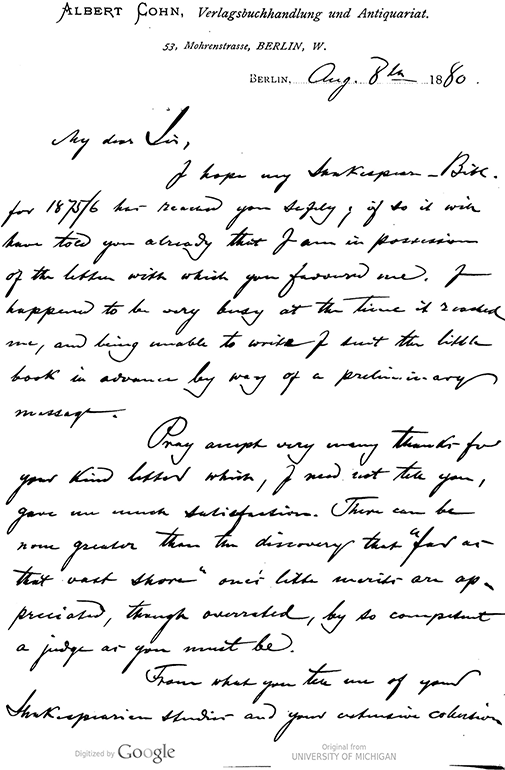
Figure 3 Long description
Full transcript of first page of Cohn’s 1872 letter to Crosby after header: “My dear Sir, I hope my Shakespear Bibl for 1875/6 has reached you safely; if so it will have told you already that I am in possession of the letter with which you favoured me. I happened to be very busy at the time it reached me, and being unable to write I sent the little book in advance by way of a preliminary message. [new paragraph] Pray accept very many thanks for your kind letter which, I need not tell you, gav e me much satisfaction. There can be none greater than the discovery that “far as that vast shore” once little merits are appreciated, though overrated, by so competent a judge as you must be. [new paragraph] From what you tell me of your Shakespearian studies and your extensive collection” [page ends] [digital watermarks: Digitized by Google. Original from University of Michigan]
In his letter, Cohn apologized to Crosby that the material he had enumerated only covered a sliver of Shakespearean bibliography – in this case, from April 1872 to the end of 1873, as the title page announces. As a bibliography published in a periodical, this was to be expected: it updated previous bibliographies from the Jahrbuch and was meant to be used in conjunction with those previous bibliographies. Without access to past issues of the Jahrbuch (or all past copies of the standalone reprints), however, the bibliography would have been woefully inadequate in giving a full picture of the field. Furthermore, the bibliographer building on existing bibliographies would have had to remember or reference what had already been indexed. Cohn lamented his busyness:
otherwise I should have put together long ago the vastness of materials I have collected for a complete Shakespeare-Bibliography which, if the plan could be carried out such as I have conceived it, would not, I believe, be altogether unwelcome to students, in spite of all that has been done already in the same direction. For the present I must content myself by giving a specimen of it in the next ‘Jahrbuch’ independent of the bibliography for 1879/80.
Cohn never realized his best-laid plans for a standalone bibliography as the culmination of his work.
Given that Cohn himself never published an omnibus version of his bibliography, it is unsurprising that readers and librarians gathered his work together in sammelbände, that is, bespoke user-created volumes. The University of California Library, for instance, includes one sammelband that brings together six volumes of Cohn’s reprinted bibliography, functionally creating one volume spanning 1881−1893.Footnote 48 Although sammelbände like these gathered together multiple bibliographies, they still did not offer a unified access point, as Cohn’s imagined omnibus bibliography would. That is to say, a researcher would have to search the same section across multiple volumes instead of looking for a single heading that combined the material from the six previous volumes. (Cohn’s decision to organize his bibliography by geography first would also not have lent itself to finding all relevant material on a given topic because researchers had to search in multiple sections.)
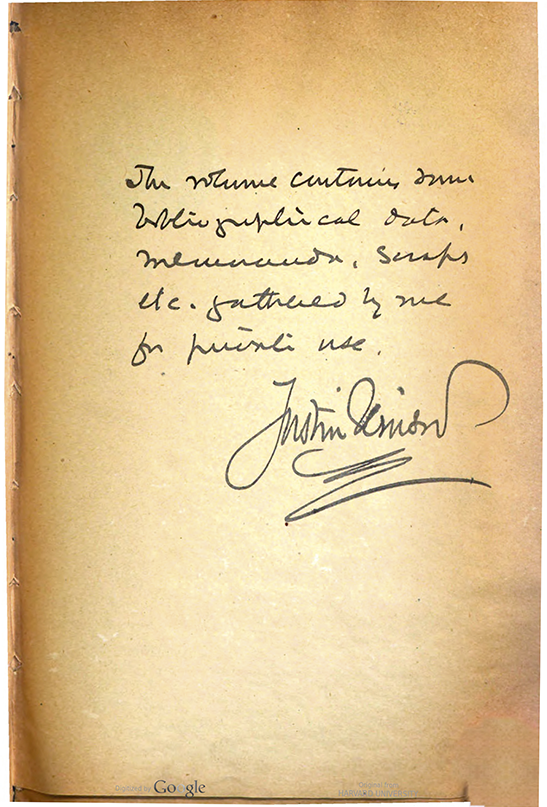
Justin Winsor, librarian of Harvard University from 1877 and first president of the American Library Association, also gathered Cohn’s bibliographies into a bespoke sammelband (Figure 4a). Winsor prefaced the collection with this note: “The volume contains some bibliographical data, memoranda, scraps etc gathered by me for private use” (Figure 4b). Winsor’s “use” of these collected papers (mostly printed, with some handwritten letters) is clear from their organization: his first handwritten section titles are “First Folio Prices” and “First Folio Reprints”; in short, he compiled these pages from sale catalogs, advertisements, and handwritten notes because of his interest in Shakespeare bibliography and book collecting. Winsor published his own Bibliography of the Original Quartos and Folios of Shakespeare, with Particular Reference to Copies in America in 1876 and “Shakespeare’s Poems: A Bibliography of the Earlier Editions” in 1878. Winsor’s sammelband, which included Cohn’s 1877–78 bibliography, was likely gathered as part of his research process, but also continued to grow after Winsor published his Bibliography. In his bespoke volume, Winsor inserts a dedicated title page at the start of the Jahrbuch bibliography, which reads, “Cohn’s Bibliography, 1877–78.” Winsor gathered Cohn’s bibliography with sale catalogs and other bibliographies, including “A List of the Editions of Shakespeare’s Works Published in America” (published by the Shakespeare Memorial Library, 1889). Whether consciously or not, Winsor followed Cohn’s organizational system with his handwritten section title pages: “English and American catalogues” followed by “German catalogues.” Under the title “German catalogues,” Winsor collected prominent book sales in Germany, including the sale of the collection belonging to Robert Gericke, who inaugurated the list of German performances in Shakespeare Jahrbuch and whose books were sold after his death in 1880. For both Cohn and Winsor, the periodical publication of bibliographies was only the start of scholarship: these cumulative reference works had to be gathered by the researcher and put in conversation with other resources.
Justin Winsor’s Handwritten title page: “Shakespearian Bibliography”

Winsor’s prefatory note.
Cohn’s planned (but never realized) omnibus bibliography and the user-created sammelbände in which we find his work highlight some of the challenges of periodical bibliographies for scholars, especially the need to locate multiple issues of the bibliography and then repeat the same topic or keyword search in volume after volume. And yet periodical bibliographies were in high demand because they included recent scholarship. Subscribers to the Jahrbuch clamored for the bibliography, leaving editor Karl Elze to add this note to the bottom of the table of contents in Vol. 9: “[The bibliography, which Mr. A. Cohn was regrettably prevented from editing, will be in the next yearbook].”Footnote 49 Logistically, too, periodical bibliographies create challenges around updating past omissions. After his first published bibliography, in every subsequent bibliography, Cohn noted that his publication included additions that had been missing in previous publications. By the time he published the 1881–1882 bibliography, the title page notice advertised the scale of these backwards insertions: “[With additions to the bibliography from 1864 in volumes I, II, III, V, VI, VIII, X, XII, XIV, and XVI of the Jahrbuch].”Footnote 50 Perhaps with pride, perhaps with weariness, or perhaps with both, Cohn carefully listed these additions, specifying each volume in which the overlooked (but now included) pieces of scholarship were meant to appear.
In 1900, Richard Schröder took over the monumental task of compiling Shakespeare Jahrbuch’s bibliography on an annual basis. In his first preface, Schröder noted that the bibliography would continue regular publication, with some improvements to organization and usability, including the addition of an index and the introduction of a numbering system for entries. Schröder took for granted that scholars both wanted and needed a “[precise and systematically organized Shakespeare bibliography],” saying, “[Opinions about the necessity of this do not differ any more than about the difficulties of such a huge task].”Footnote 51 The Shakespeare Jahrbuch bibliography continued for another eight decades, even appearing during both world wars, until its final appearance, the “Shakespeare-Bibliography für 1979,” edited by Karl-Heinz Magister.Footnote 52 While periodical bibliography was not the ideal system, it did offer some benefits, including timeliness and the ability to offer corrections. Cohn’s ongoing bibliography indeed offered users information about recently published works. When Northup wrote his evaluation “On the Bibliography of Shakespeare” in 1912, he praised Shakespeare Jahrbuch’s bibliography, noting that from 1900 to 1912 there were over six thousand items cataloged in the bibliography by Schröder, Gustav Becker, and Hans Daffis. Northup framed these bibliographies as a nationalist endeavor where Germans outpaced the Anglo-American bibliographers who we discussed in the previous section: “German scholars, excelling in many fields, may also point with pride to this series. As for Shakespearean Bibliography in England and America, after 300 years, we now have – Mr. Jaggard!”Footnote 53 Northup’s derisive exclamation underscores his low opinion of Jaggard’s bibliography.
2.2 Early Standalone German Bibliographies
In 1865, the same year Cohn launched the Shakespeare Jahrbuch bibliography, Franz Thimm published the first edition of his bibliography, Shakespeariana from 1564 to 1864.Footnote 54 Thimm, a German bibliographer living in London, focused his work on English, German, and French publications. Thimm positioned himself as the successor to previous (flawed) bibliographies, beginning his preface with the bald statement: “The first ‘Shakespeariana,’ by Wilson, published in 1827, was too imperfect to be of much use.”Footnote 55 Thimm continued, weighing the pros and cons of various other bibliographies in English, Dutch, and German, including Halliwell’s (1841), one by Jurriaan Moulin (Holland, 1845), and an anonymous 1852 bibliography of German Shakespeare studies. Thimm praises P. H. Sillig’s Die Shakespeare-Literature bis Mitte 1854 (1855) as “the most perfect production of its kind.”Footnote 56 With its extensive content and handsome index, Sillig’s bibliography would indeed have been more usable than others at the time. Thimm’s introduction demonstrates what scholars wanted from a bibliography: comprehensiveness and usability.
In his first edition, Thimm bragged that his own contribution had “over 600 more [entries] than Sillig.”Footnote 57 And yet, unsurprisingly, Thimm’s edition also had numerous gaps; he expanded his publication by 50 percent for the second edition in 1872, which he termed a “supplement.” In his preface to the second edition, Thimm offered specific instructions on how to incorporate the new publication into the old (hoping that folks had not yet bound their bibliographies either separately or with other works): “The Supplement has been printed with the view of incorporating it with the first edition, so that the English part should be bound up after page 48; the German part after page 81; and the French part should be canceled altogether, and the new sheets inserted instead.”Footnote 58 In short, standalone bibliographies could not add new content without encouraging their readers to literally take apart their books.
Other standalone bibliographies, such as Ludwig Unflad’s Die Shakespeare-literatur in Deutschland [Shakespeare Literature in Germany] (1880), were useful but often never updated. Unflad’s preface emphasized his work’s “[practical use]”; and though he offered the traditional call for people to contact him with things he had missed so that he could create “[a supplement or possible new edition],” it seems that no supplement ever appeared.Footnote 59 Unflad’s subtitle and preface underscored that his bibliography was only an attempt and would necessarily be incomplete: “[The greatest care was taken in collecting the material for this little book, although I make no claim to completeness; it is but an attempt.]”Footnote 60 Whether published in periodicals, as a single volume, or now online, Shakespearean bibliography is, as Schröder stated, “[a huge task.]”
The main problem with one-and-done bibliographies is thus readily apparent. Publications about Shakespeare did not stop in 1855 or 1865 or 1880; any bibliography published as a book would be incomplete before it even reached the hands of readers.
2.3 Ebisch and Schücking’s A Shakespeare Bibliography
One of the most impressive and influential German bibliographies was Walther Ebisch and Levin L. Schücking’s A Shakespeare Bibliography, which was published in 1931 and covered the years up until 1929. This was an English-language bibliography by a German librarian-scholar duo. As the title page of the volume announces, Ebisch was “Librarian of the English Seminar” at the University of Leipzig, and Schücking was a professor at the University of Leipzig when this volume appeared. Its publication by Oxford University Press demonstrates that it was intended for a widespread English-speaking audience.
Ebisch and Schücking’s bibliography drew heavily on German Shakespeare studies and therefore emphasized German scholarship. In the section of “Translations of Shakespeare,” Ebisch and Schücking begin with “German Translations,” the only language area to receive subdivisions (“General Works dealing with German Translators” and “The most important German Translations”); this is followed by “Other Germanic Languages,” a short section which lists only three translations: Carl August Hagberg’s “monumental” (to use Ebisch and Schücking’s adjective) Swedish translations; Valdemar Osterberg’s Danish translations and commentary; and Finnur Jónsson’s list of Icelandic translations.Footnote 61 “Romance languages” (subdivided into “French” and “Spanish and Portuguese”) and “Slavonic Translations” share a single page, compared to the four pages devoted to only the most “important” German translations. Similar emphasis on German Shakespeare scholarship is evident in the rest of the section on Shakespeare’s influence. Despite the prevalence of German content in the bibliography, Lawrence Marsden Price laments that even though “the Shakespeare Bibliography had its origins in a German university,” Ebisch and Schücking misconstrue “elementary facts regarding the history of Shakespeare in Germany.”Footnote 62 Price points out key missing German translations, scholars, and apparent confusion of people, adding: “one would expect the part dealing with that subject [the history of Shakespeare in Germany] to be one of the soundest portions of the book, but one is led by the evidence to hope that it is the worst.”Footnote 63 Despite the errors, Price notes that Ebisch and Schücking’s bibliography positions German scholarship as apace with Anglo-American Shakespeare scholarship in terms of volume of entries and organization.
However lopsided their results were, Ebisch and Schücking at least attempted truly global coverage. As they noted in their preface,
The reason why this task [a global Shakespeare bibliography] has nevertheless up till now not been taken in hand consists in the almost inexhaustible riches of Shakespearian literature. It is a subject to which every new year brings new material. To register all of it would be neither desirable nor indeed possible. In other words, the task entails the danger of selection.Footnote 64
Although Ebisch and Schücking’s bibliography acknowledged that comprehensiveness was not possible, they did actively redress some gaps. In 1937, they released a 97-page Supplement for the Years 1930-1935 to A Shakespeare Bibliography. They explained the rationale, organization, and scope of the volume in their preface to the Supplement:
Since the Shakespeare Bibliography was published in 1931, so many contributions to Shakespearian study have appeared in print that the necessity of a supplement to our former work makes itself felt. The subsequent pages follow the method and arrangement of the main work. They contain the new publications from 1930 to April 1936; furthermore, the opportunity has been taken to repair a few important omissions in the original work.Footnote 65
The bibliographers concluded with the same outreach familiar to scholars today, saying they “would be grateful for any suggestions brought forward to fill in the gaps or to improve the work done.”Footnote 66 Both the original Bibliography and its supplement were later reissued in 1968 by Benjamin Blom, a New York publisher. Even decades out of date with current scholarship, this book was valuable enough to merit a reprint. For G. Blakemore Evans, writing in the 1960s, Ebisch and Schücking’s volume was “the old standard.”Footnote 67
No bibliographer works in a vacuum. Ebisch and Schücking lived and worked in Germany through both world wars. Schücking was a pacifist, serving as chair of the Silesian branch of the German Peace Society from 1918 to 1923.Footnote 68 In 1933, he “was threatened with dismissal” from his professorship at Leipzig University because of his pacifist views. That same year, however, he was a signatory on the 1933 “[Vow of Allegiance of the Professors of the German Universities and High-Schools to Adolf Hitler and the National Socialistic State],” wherein German professors proclaimed their support of Hitler and the Nazis. (Ebisch, as a librarian, was likely not even asked to sign.) Schücking continued to be persecuted for his pacifist beliefs, eventually losing his salary in 1942. The English Wikipedia page for Schücking notes that he recanted his pro-Hitler beliefs, but currently offers no citations; he seems to have been consistently pacifist despite signing the “Vow.”Footnote 69
It is hardly a surprise that Ebisch and Schücking did not publish additional supplements to their 1937 bibliography, as political tensions escalated and war was officially declared in 1939. Decades after the war, in 1963, Gordon Ross Smith published A Classified Shakespeare Bibliography, 1936–1958, which he positioned as a successor to Ebisch and Schücking’s Bibliography and Supplement. With permission from Schücking, he continued using their organizational system. Maintaining the organizational system would make it easier for users to use this reference work in concert with the others. Smith’s Classified Bibliography more than doubled Ebisch and Schücking’s content. Although Smith was a professor at The Pennsylvania State University, his contribution bears consideration in this section because it continues the tradition started by Ebisch and Schücking. At Penn State, Smith worked with Harrison T. Meserole, who would (a decade later, in 1976) go on to become editor of the World Shakespeare Bibliography. (We discuss Meserole’s work at more length in Section 5.) Although this section focuses on German bibliography, efforts by Thimm, Ebisch and Schücking, and Smith demonstrate that attempts to classify national contributions to bibliography show how bibliography and scholarship often traverse borders.
As R. W. Dent notes in a footnote to his review of Smith’s Classified Shakespeare Bibliography, Smith emphasizes German reception and production of Shakespeare, like, we add, Ebisch and Schücking. Dent extends the caveat: “the user of Smith should be aware that sections on productions in foreign countries other than Germany, or on translations other than those in German, are thoroughly unreliable guides.”Footnote 70 As the next section details, at this time (1959–1964), Dent was editing the annual bibliography of Shakespeare research that appeared in Shakespeare Quarterly, making him particularly aware of Smith’s omissions and strengths. Dent attributed the uneven coverage to “the correspondents of the bibliographies [Smith] has employed.”Footnote 71 We see this unevenness continue to this day with purportedly global Shakespeare bibliographies that are only as good as their locally situated contributor network. Even as information appears increasingly online, for example, it is often through the contributions of individual correspondents that the World Shakespeare Bibliography, for instance, is able to include the geographic range of coverage it does.
It is not simply what we include in a bibliography that makes it useful: it is how we can navigate and find that information. Dent’s extensive ten-page review of Smith’s Classified Shakespeare Bibliography recognized the labor that went into this bibliography while also noting its omissions and the challenges a “user” (to echo Dent’s phrase) faces when searching for material in a categorized bibliography (i.e., “Classified” into different topical category headings), particularly when it comes to finding materials that could be placed under multiple headings. Smith’s bibliography included limited (but not necessarily intuitive) cross-referencing, as Dent notes with multiple examples included in his review. The challenges of finding materials are further exacerbated when it comes to non-English content. As Dent points out, “Obviously, attempting to place so huge a body of material within so complexly classified a bibliography posed difficulties too great for any one man, probably too great even for a group of experts in the various subject matters.”Footnote 72 S. F. Johnson notes, “Principles of classification are inconsistent where they are not fuzzy.”Footnote 73 Smith himself acknowledged the challenges of categorizing scholarship at this scale: “An unavoidable problem with a classified bibliography of this size is that there are either a great multiplicity of classes or else classes of such size that they cease to be classes.”Footnote 74
Indeed, the challenges for use (especially navigability) are among the largest complaints reviewers of Smith’s volume noted. Herbert Howarth devoted almost a full page in his review to explaining the challenges of finding materials on a given topic for a research paper, asking, “Where must I look amid his 784 pages?”Footnote 75 Johnson projects confusion onto an imagined student user: “Apparently part of the putative audience of this book is the busy graduate student. Our students, however, are not readily going to find what we should like them readily to find in this reference work.”Footnote 76 While usually opening with praise of this volume’s contents, scholars suggest that the contents are much less usable because they are not easily navigable due to the lack of clearly defined and evenly applied classifications and cross-references.
Smith explained that he added new categories to Ebisch and Schücking’s classification system as needed, because, as he noted, “that bibliography contains only about 3,800 items, and this one over 20,000.”Footnote 77 Smith’s thirty-five-page table of contents for the bibliography has multiple broad categories, such as “Shakespeare’s Life,” and “Shakespeare’s Sources, Literary Influences, and Cultural Relations.” Each category is divided into multiple subcategories, and then further subdivided: for instance, “Shakespeare’s Stage and the Production of His Plays” has two subcategories, “The Theatre,” and “The Actors and their Art.” “The Theatre” is broken down into three smaller categories: “History of the Elizabethan Theatre,” “The Court and the Stage,” and “Public and Private Theatres.” “History of Elizabethan Theatre” has three additional subheadings: “Sources,” “General Treatises,” and “Puritan Attack upon the Stage.” While the latter two of these sub(-sub-sub-)headings are not divided, “Sources” is divided with even more nuance into topics such as “The Revels at Court,” “Philip Henslowe,” and “Sources, Other,” the last of which has yet another layer of classification to itemize its contents, including “The Keeling Journal,” “The Manningham Diary,” and simply “Other.” These classifications follow, by and large, Ebisch and Schücking, though Smith eschewed using the Greek alphabet for his sub-subclassifications. Compare, for instance, Ebisch and Schücking’s “XII. SHAKESPEARE’S INFLUENCE THROUGH THE CENTURIES > 2. Shakespeare’s Influence Outside England > c. The Latin Countries > α. France > bb. Influence on Individual Writers” to Smith’s “XIII. SHAKESPEARE’S INFLUENCE THROUGH THE CENTURIES > 3. Shakespeare’s Influence Outside England > c. The Latin Countries > (1) France > (b) Influence on Individual French Writers > iv. Stendhal.” Smith added a subcategory naming individual authors (because they are not to be found in an index); his added categories (such as the “XII. COMPARISONS WITH OTHER WRITERS”) change the numbering system, but the organizational principles are similar. These complicated nested headings (offering a taxonomy in its truest sense) were simultaneously necessary for information retrieval and challenging for users.
While classifications are often what make a bibliography useful, they can also stymy discovery. No two people, be they bibliographers or information seekers, will necessarily classify the same article in the same way, even if given the same taxonomy to work with. Previously, classifications used to be the foundational way to navigate longer bibliographies and scholarly materials. With Smith’s Bibliography, the classification was the only way to navigate, particularly without an index. Today, with various search functions in digital databases and bibliographies, users typically do not turn to the classifications in the same way; yet clearly defined classifications still structure the data (and its findability and navigability), even if those classifications sometimes now operate behind the scenes. Classifying and cross-referencing material adequately takes subject expertise, thought, and planning.
Here is an example of how researchers could be hindered rather than helped by these classifications, as Howarth noted in his review. If a researcher wanted to find information about Arden of Faversham, it would make sense to turn to the eponymous subcategory in the “Apocrypha” section, where they would find entries C290–C307. This would omit, however, three French translations of Arden of Faversham (by André Montaigne, B651a; by André Gide, B683; and by Laurette Brunius and Loleh Bellon, B729), none of which appear in the same subsection of the translation section, because these are sorted by translator and not work. Given that Félix Carrère’s translation of Arden of Faversham appears in the “Apocrypha” section twice (C301, his thesis; and C301a, its publication), a researcher might not realize that there are additional translations in an entirely different section. Carrère’s published translation also appears in “translations” with a different reference number (B671), but his thesis does not. As this example from a less-popular play shows, navigating the classification system was cumbersome and could lead to missing the very material the bibliography was designed to surface. These problems are multiplied with canonical and popular works, which are more likely to be written about as comparators, more likely to be translated, and more likely to appear in multiple categories (such as those relating to performance and recordings).
Though Smith’s bibliography owed much to Ebisch and Schücking, particularly concerning its classifications, it was far more expansive. R. C. Bald extols “Ebisch and Schücking’s” as a “selective bibliography,” noting that “part of its value lay in the skill with which the selection was made.”Footnote 78 Smith’s foreword explains the scope of his volume and pushes back against ideas of objective selectivity with its opening line: “The best argument for so comprehensive a bibliography as this is that no two judgments are alike, that one does not and should not rely on the infallibility of a single source, and therefore that any user of a selective bibliography is likely to be haunted by the fear and perhaps the likelihood that something particularly relevant to his study has been missed.”Footnote 79 For Evans, Ebisch and Schücking’s Shakespeare Bibliography was, on the one hand “misleadingly selective”; on the other hand, he found the sheer amount of material covered in Smith’s bibliography “sobering.”Footnote 80 Ebisch and Schücking’s work had 3,800 entries in the first volume. By Evans’s count, Smith’s bibliography includes “around 20,000 books, articles, notes, etc. on Shakespeare and subjects related to Shakespeare in a little over twenty years, and Professor Smith suggests a possible tripling of this number by the end of the century!”Footnote 81 It is, as Evans describes, a “Babylonian pile” of scholarship to be waded through or added to.Footnote 82
As he himself described it, Smith’s bibliography is not a “comprehensive bibliography.”Footnote 83 It is, rather, an omnibus: it gathers together materials from existing bibliographies. Smith lists all of his bibliographic sources, beginning with the annual Shakespeare Quarterly bibliography, because it provided the most fodder for his bibliography. Other sources Smith gathered into his bibliography include review-articles such as those in Year’s Work in English Studies, the Shakespeare Jahrbuch bibliography, and the Shakespeare Association Bulletin bibliography, as well as Dissertation Abstracts International (the analog precursor to ProQuest’s Digital Dissertations). The workflow of searching existing bibliographies and databases resonates still today – indeed, it is one of the practices still used to update the online World Shakespeare Bibliography.
The desire to create an omnibus bibliography that brings together existing Shakespeare bibliographies is both understandable and laudable. Smith writes: “My purpose has been to provide a bibliography that scholars and students might use with the confidence that they would not also have to consult the bibliographies from which this one has been compiled.”Footnote 84 Howarth emphasizes this in the conclusion of his review: “In fact, what Dr. Smith claims for his bibliography is that scholars and students may now find in one volume the material for which they would hitherto have had to search through forty and more. He has placed the academic world in his debt.”Footnote 85 Yet, despite such lofty goals and praise, Smith points out that his Bibliography is still not the starting and ending point for research. Smith suggests “that the student should not rely on this bibliography alone.”Footnote 86 Smith notes the importance of looking to Ebisch and Schücking for earlier scholarship, gives concrete suggestions on how to supplement their work by turning to other bibliographies compiled before 1936, and points out that for scholarship past 1958 researchers will need to continue to consult multiple sources. While Smith’s impressive bibliography did streamline some of the labor of finding information for researchers, it was not intended to be a one-stop shop.
The bibliographies surveyed in this section, from Cohn’s recurring contribution to the Shakespeare Jahrbuch to Smith’s Bibliography highlight one of the key themes from this Element: the format of bibliographies underpins how they are able to offer information. On the one hand, periodical bibliographies offer up-to-date information, but, before the pre-digital era, required a researcher to access and search multiple volumes. On the other hand, single-volume bibliographies could be a one-time purchase but quickly fall out of date. As this section has traced, early German bibliographies have both direct influences (to readers and users, such as Winsor, and to other bibliographers, such as Smith) as well as general influences because of their categorizations and comprehensiveness. Bibliographies are shaped by the people who work on them and their access to information. While bibliographies seem to impart neutral information, they are shaped by principles of inclusion and exclusion, as well as by how their information is categorized.
3 Shakespeare Association Bulletin and Shakespeare Quarterly: Anglo-American Annual Shakespeare Bibliographies
The first iteration of the World Shakespeare Bibliography appeared in Shakespeare Quarterly in 1950. But the WSB was preceded by an earlier bibliography (in a journal that was a predecessor to SQ), which in turn was preceded by various efforts to enumerate work on and by Shakespeare. This section focuses on twentieth-century enumerative bibliographies of Shakespeare criticism. While the emphasis is on Anglo-American bibliographies, nation- and language-specific bibliographies were in constant dialogue with one another, as the previous section has shown.
3.1 The Shakespeare Association Bulletin Bibliography, 1924–1948
The precursor to SQ was the Shakespeare Association Bulletin (SAB), first published in June 1924 by the newly formed Shakespeare Association of America (SAA). The first issue included “Recent Work in the Shakespearean Field” compiled by Professor Albert C. Baugh and listing titles of new scholarship on Shakespeare. From the beginning, the SAB and this bibliography were self-conscious about the necessity of both a Shakespeare Association and of its bibliographical wing. The first issue of SAB included an article entitled “Why a Shakespeare Association?” by then-President of the SAA Ashley Horace Thorndike, who justified the creation of the SAA and SAB as a way to rectify a perceived lack of Shakespeare recognition in the United States, especially compared with other countries:
In spite of our regard for Shakespeare … there are no funds to encourage Shakespearean scholarship or publication of scholarly works. There is no Shakespeare theatre, no playhouse regularly devoting a part of the time to his plays. There is no Shakespeare journal, no adequate Shakespeare bibliography … . In this and other respects, the United States has lagged far behind England or Germany.Footnote 87
The development of the SAA, then, was a matter of national pride (or, of national anxiety). The desire for an “adequate Shakespeare bibliography” partly spurred the creation of both the SAA, and its “organ,” the SAB, which included a bibliography from its onset. Shakespeare bibliography is therefore central to our field’s professional origins and development. With some irony, the global-facing resource that became the World Shakespeare Bibliography emerged from nationalist drive to keep up with Shakespeare studies on the other side of the Atlantic.
Despite its name and stated intention to represent American interests in the world of Shakespeare, the Shakespeare Association of America had a global cast from the very start. SAA’s “Articles of Incorporation,” printed in the afore-referenced issue 1.1 of the SAB, noted that the SAA’s objective was “To further the appreciation of Shakespeare as the master-mind which may serve to bring into closer union our English-speaking and other countries – a union built upon a lasting foundation, spiritual and intellectual, which is found in the imaginations, in the minds, and in the hearts of all peoples.”Footnote 88 In addition to casting its eye across the globe, the SAA attempted to be inclusive in terms of membership (albeit it in a condescending way that did not truly account for “every class”): 1.1’s “Report of Membership Committee,” noted the paid-up members of the SAA, which “covers every class of Shakespeare lover from the school girl to the scholar.”Footnote 89 Membership required only that one pay one’s dues and have an interest in Shakespeare. The WSB’s global scope and inclusive purview, then, can be traced to SAA’s interest in uniting people, no matter their country or professional affiliation, through a shared interest in Shakespeare. It must be noted that the SAA’s “Articles of Incorporation” are fraught with colonial undertones, suggestive of the way that Shakespeare’s supposed “universality” was problematically mapped onto various cultures that saw Shakespeare as a foreign import, rather than as a mirror of their own lives. While the gesture to inclusivity suggests a certain open-mindedness, white Anglo-American scholarship was clearly controlling the discourse and gatekeeping membership in this purportedly “open” association.
In “Recent Work in the Shakespearean Field” (Figure 5), listing the last year’s work on Shakespeare and printed in the first issue of the SAB, Baugh expresses his aspiration that the bibliography become a regular feature of the journal. The section reprints a portion of Baugh’s “American Bibliography” from PMLA, demonstrating how different bibliographical organizations dovetail and cooperate with one another. Baugh notes, “A summary of this kind shows how much might be done by the Shakespeare Association to bring the larger circle of Shakespeare lovers full and accurate information concerning the large amount of scholarly production that is appearing.”Footnote 90 This early bibliography was not yet the orderly resource that the WSB would later strive to become: there is no clear organizing principle for Baugh’s bibliography, skipping from one topic to the next and back again. It includes non-Shakespearean material, touching on Wyatt, Tottel, Spenser, Sidney, Lyly, Marlowe, and John Heywood, as well as references to broader studies of the Renaissance, such as “Money Lending and Money-Lenders in England during the 16th and 17th centuries,” “The Tradition of Angelic Singing in English Drama,” and “Theatrical Bill Posting in the Age of Elizabeth.” For Baugh, the “Shakespearean Field” includes material adjacent to Shakespeare, unlike the WSB, which excludes material not explicitly linked to Shakespeare. The Shakespearean content of Baugh’s bibliography offers a fascinating snapshot of Shakespeare scholarship in the early twentieth century. It lists Joseph Q. Adams’s Life of William Shakespeare (deemed to be “a book of the first importance”) and two articles about Shakespeare allusions in the seventeenth century (the early twentieth century being the high-water mark of Shakespeare allusion books).Footnote 91 Published in 1924, Baugh’s bibliography also notes several works published marking the 300th anniversary of the publication of the First Folio the previous year, including an entry on Kaufman’s “Celebrating the Tercentenary of a Famous Book.” The bibliography also indexes dissertations and includes a substantial section on articles and books on Hamlet (on the play’s Germanic sources; Hamlet as a “man of action”; the play/character’s influence on Romantic thinking; the first quarto of Hamlet; Hamlet in the Restoration). It does, of course, also list articles and books on other individual Shakespearean plays. After covering Shakespeare, the bibliography returns to non-Shakespearean material, such as scholarship on The Hog Hath Lost his Pearl, and Beaumont and Fletcher plays (including Fletcher’s contributions to Shakespeare plays). The bibliography also gathers references to scholarship on the performance of Shakespeare plays in Germany, attesting to the scope of Shakespearean bibliography outside of the Anglo-American context. The bibliography’s pattern of organization is not obvious or consistent: it does not offer a clear table of contents, index or section headings, and shuttles back and forth between work on Shakespeare and work on non-Shakespearean topics. As we shall see, successive editors of the World Shakespeare Bibliography strove to solve this problem by developing a system of organization that was informative and intuitive.
Albert C. Baugh, “Some Recent Work in the Shakespearean Field,” The Shakespeare Association Bulletin, 1, no. 1 (1924): 17–20.

Figure 5 Long description
First paragraph from Baugh’s “Recent Work in the Shakespearean Field,” (The Shakespeare Association Bulletin, 1, no. 1 (1924): 17-20. : “A part of Professor Albert C. Baugh’s American Bibliography,” which appeared in the March issue of the Publications of the Modern Language Association, is here reprinted with permission and with thanks. A summary of this kind shows how much might be done by the Shakespeare Association to bring to the larger circle of Shakespeare lovers full and accurate information concerning the large amount of scholarly production that is appearing.”
The subsequent few issues of the Shakespeare Association Bulletin show the journal experimenting with different ways of approaching and structuring a Shakespeare bibliography. Following 1.1’s “Recent Work in the Shakespearean Field,” the second issue (1.2, 1925) includes “Our Members in Print,” listing articles and books by SAA membership; entries are organized by member (not in alphabetical order) – a rather solipsistic way to do Shakespearean bibliography! The third issue of Shakespeare Association Bulletin (1.3, 1926) includes the “Classified Index of Shakespeareana in the Periodicals of 1925,” by Samuel A. Tannenbaum, listing articles related to Shakespeare published in different journals. For the first time, the bibliography is clearly organized by topic, including headings such as “Authorship Question,” “Bibliography” (including other bibliographies, such as Graves, “Recent Literature of the English Renaissance,” the German “Shakespeare Bibliographie für 1921–22”), “Biographia and Personalia,” “Handwriting,” and play and poem titles (All’s Well to Venus and Adonis), with the largest subsection devoted to Hamlet. “Staging and Stage History,” “Textual Criticism,” and a catch-all category under “Miscellaneous” were also featured. SAB 1.3 also includes “The Shakespeare Book Shelf,” which lists recent book publications and offers brief summaries of each. Shakespeare Association Bulletin 2.1 (March 1927) also includes “The Book Shelf,” listing titles of recent books along with several paragraphs of explanation for each one, while the Shakespeare Association Bulletin 2.2 (June 1927) includes the “Classified Index of Shakespeareana in the Periodicals of 1926,” with similar topics as the year previous, and the addition of “Commentary and Criticism,” “Knowledge,” “Learning,” and “Music.” Just as the WSB’s tags would later shift over time, introducing new subjects as others receded, the early headings here offer a something of a bird’s eye view of the priorities of Shakespeare Studies in the early days of the SAA’s incorporation.
By 1928, the SAB had found a reliable pattern for its bibliography. The Annual Bibliography for 1927 published in Shakespeare Association Bulletin in 3.1 (1928) was entitled “A Classified Shakespeare Bibliography for 1927,” and compiled by Samuel A. Tannenbaum. Unlike the previous iterations of bibliography in the Shakespeare Association Bulletin (which were divided into books and articles in periodicals), this iteration united books and articles, as well as pamphlets and newspapers. The “Classified Shakespeare Bibliography” first lists the abbreviations for journals; the entries are then organized under the following headings: “Allusions,” “America,” “Art,” “Astrology” (with one entry), “Authorship Problems,” “Bacon-Shakespeare Controversy,” “Bibliography,” “Biographia and Personalia,” “Botany” (with one entry), “Burlesques,” “Commentary and Criticism,” “Criminals and Criminology,” “Environment,” “Forgeries,” “France,” “Handwriting,” “History,” “Humor,” “Identity,” “Language,” “Medical Knowledge,” “Plays and Poems” (with each text as a subheading and Falstaff given his own category), “Politics,” “Portraits,” “Relics,” “Religion,” “Staging and Stage History,” “Stratford-on-Avon,” “Study,” “Textual Criticism,” “Translations,” “Translating,” “Will,” and “Works.” The model established in 1928 for Shakespeare bibliography continued for the next two decades.Footnote 92
In the Shakespeare Bibliography for 1935 (published in 1936), Tannenbaum explained the principles of inclusion:
The following bibliography, based on an examination of the contents of more than 1,300 periodicals and hundreds of books, is a continuation of that published in this Bulletin in January, 1935. Perfunctory notices of books, blurbs, and reviews which contribute nothing new, have not been noted. The names of female writers are distinguished by a colon (instead of a period) after the initial letter of the baptismal name. The titles of books and pamphlets are printed in italics. If no year is mentioned in connection with an item, ‘1935’ is to be understood. Reviews of books are listed (without a preceding number), without title, immediately after the books themselves. The discussion of a book is indicated by printing the title within single quotes.Footnote 93
Book reviews are included alongside the books they cover. Once again, entries are organized by topic. Shakespeare’s contemporaries Beaumont and Fletcher, Chapman, Chettle, and others too many to name, are given their own headings. Of particular note is that women writers are distinguished typographically in the bibliography. Tannenbaum states that, “The names of female writers are distinguished by a colon (instead of a period) after the initial letter of the baptismal name,” with no further explanation given for this distinction.Footnote 94 While the rationale for distinguishing women scholars typographically is at first unclear, Tannenbaum’s emphasis on the “baptismal name” suggests that women were recognized differently because often their names would change over their careers, as when, for instance, they got married.Footnote 95 This typographical distinction not only recognizes women’s scholarly labor but also marks it as exceptional.
Tannenbaum continued to compile “A Classified Bibliography of Shakespeare and his Contemporaries” until 1944, at which point, he started to share the bibliographical work with his spouse Dorothy Rosenzweig Tannenbaum.Footnote 96 She was also responsible for compiling the “Index of Names and Subjects Occurring in the Bibliography of Elizabethan Topics for 1944,” and the same Index for the issue published the following year.Footnote 97 Rosenzweig Tannenbaum was solely responsible for the Classified Bibliography for 1948.Footnote 98 This bibliography includes a note from Tannenbaum: “The Editor expresses his thanks to Mrs. Tannenbaum for compiling the Bibliography for 1948, and is glad to acknowledge aid fully given by Dr. Herman I. Radin, William B. White and Russell N. De Vinney.”Footnote 99 Tannenbaum acknowledging his wife hearkens to the untold stories of women who assisted their male partners in scholarly labors, sometimes invoked as a nameless “my wife” (if their work was noted at all), as demonstrated in Juliana Dresvina’s collection Thanks for Typing: Remembering Forgotten Women in History.Footnote 100 However, Tannenbam does acknowledge his wife by name; as we can see from the shared citation, Rosenzweig Tannenbaum’s active and overt involvement with the bibliography is a notable exception to this otherwise bleak history and can be celebrated as a time when a “helpmate” stepped out of the shadows and into the bibliographical record.
Rosenzweig Tannenbaum’s bibliography was the last to appear before SAB became Shakespeare Quarterly in 1950: fittingly, her bibliography was listed in Shakespeare Quarterly’s first annual bibliography (published in its second issue). In what follows, we discuss the first quarter century of SQ’s annual bibliography, which was indebted to the earlier bibliographies published by the SAB in the 1920s, 1930s, and 1940s, and those in turn were inspired by earlier iterations in the twentieth century and before. As we’ll cover in the final section of this Element, SQ’s annual bibliography would later become the World Shakespeare Bibliography.
3.2 The Shakespeare Quarterly Annual Bibliography, 1950−1976
The first half of the twentieth century was perhaps the high-water mark of comprehensive enumerative bibliography. Much of this enumerative work was devoted to works of Shakespeare and his dramatic contemporaries. Whereas much of nineteenth-century scholarship had been consumed with matters of aesthetics, well-known textual scholars such as Ronald B. McKerrow, A. W. Pollard, and W. W. Greg, as well as understudied bibliographers such as Henrietta C. Bartlett, devoted their attention to bibliography both descriptive and enumerative after the turn of the century.Footnote 101 The New Bibliographers, including McKerrow, Pollard, and Greg, emphasized inferences that could be made from careful study of the physical book, while Bartlett and Greg dutifully compiled lists of those physical books deemed to be worthy of close study. Bartlett and Pollard’s A Census of Shakespeare’s Plays in Quarto 1594−1709 (1916, revised by Bartlett in 1939) lists the locations of known copies of Shakespeare quartos and contains notes on the copies’ binding, condition, and completeness.Footnote 102 Between 1939 and 1959, W. W. Greg published his authoritative Bibliography of the English Printed Drama to the Restoration (1939−1959), a handsomely printed four-volume reference work listing all editions of English drama printed up to 1660, with information about each edition’s paratexts, title pages, and public holdings of individual copies. Both Bartlett/Pollard’s and Greg’s references have been foundational for subsequent scholarship and textual criticism. It is notable that these twentieth-century bibliographies were all compiled in the shadow of the world wars. Scholars have noted how, across time, cultural trauma spurs the compilation of comprehensive bibliographies and other reference works, noting the desire to shore up knowledge in the face of widespread loss.Footnote 103 This trend continued into the twentieth century. It is probably not a coincidence that A World Bibliography of Bibliographies appeared after the apocalyptic losses of the “Great War” and was then republished after World War II.
Shakespeare Quarterly’s first annual bibliography was named “Shakespeare: An Annotated Bibliography for 1949,” appearing in SQ 1.2, printed in Spring 1950 (Figure 6). It was edited by Sidney Thomas (1915−2009), compiled “in cooperation” with academics across Europe (Italy, Austria, West Germany, Poland, the Netherlands, France, Denmark, Norway) as well as from Canada and the United States, the latter with contributing staff members from academic libraries. The specter of global politics stalked the “Annotated Bibliography” from the very start: while the bulk of academics and librarians were operating in Western Europe, Prof. Juliusz Krzyzanowski, of the University of Wroclaw, Poland, was behind the Iron Curtain. The Cold War irreparably shaped Thomas’s life, too. Thomas was a renowned Shakespeare scholar who was ousted from the profession due to his political ideals. His obituary notes that Thomas stood “up to the scourge of McCarthyism in the 1950s [and] he sacrificed his academic job rather than agree to ‘name names.’”Footnote 104 It seems inevitable that global politics would shape a bibliography whose mandate was global inclusivity and which would come to include Shakespeare scholarship from every continent; from every country in North America, South America, and Europe and nearly every country in Asia, Africa, and Australasia; and written in over 120 languages.Footnote 105
Sidney Thomas, “Shakespeare: An Annotated Bibliography for 1949,” Shakespeare Quarterly, 1, no. 2, (1950), p. 97.

Figure 6 Long description
Opening sentence of Thomas’s bibliography: “The following bibliography, which includes only works directly relating to Shakespeare, attempts to list all items of interest to the scholar, the actor and producer, and the general reader.”
From the start, comprehensiveness through collaboration was the annual bibliography’s stated ideal and workflow. The first bibliography of 1950 acknowledges its acquisition of copies of books and off-prints of articles and reviews “in order to ensure as complete a coverage of the field as possible.”Footnote 106 The first bibliography also acknowledged the purpose of collaboration as “broadening [the bibliography’s] scope and increasing its usefulness.”Footnote 107 The scope was to capture all works “directly relating to Shakespeare,” with an “attempt to list all items of interest to the scholar, the actor and producer, and the general reader.”Footnote 108 Features distinctive to the present-day WSB are recognizable in this earliest of iterations, including the comprehensive listing of book reviews for titles related to Shakespeare. In the annual bibliography, reviews of a given book were listed under the titles they discuss (even if the book itself was covered in an earlier iteration of the bibliography). As was later practice, annotations were written to be informative, not critical. “In no sense,” Thomas explained, “are they intended as criticisms of the books or articles which they explain.”Footnote 109 Even as the bibliography duly indexed work on discredited theories (such as Oxfordian theories of Shakespearean publication), it did so without judgment, allowing readers to draw their own conclusions.
Most of the features of the first annual bibliography endured into its second installment, “Shakespeare: An Annotated Bibliography for 1950,” published in 1951.Footnote 110 This issue echoes the rationale of the first in its “attempt to list all items of interest to the scholar, the actor and producer, and the general reader.”Footnote 111 It also articulates the bibliography’s need for a scope that is paradoxically both broad and narrow: the preliminary matter reports its limited inclusion of previously issued editions or studies to substantially revised or expanded ones with exception of “reissues of editions and translations” published in countries or languages different from the original publication. Moreover, the bibliography notes its intention to include works on the same topic, “even though they do not represent original contributions to knowledge or criticism,” while also omitting “journalistic reviews of productions or books, or brief popular articles.”Footnote 112
The second iteration of the bibliography also saw the expansion of international contributors beyond Europe and North America, with contributions from South Africa and Turkey. The third iteration, published in 1952, featured for the first time contributors from Japan and India, and the bibliography from 1953 added a contributor from Yugoslavia.Footnote 113 At the time of writing, the bibliography’s international contributors, past and present, represent fifty-seven nations and regions.
In 1955, for the Annual Bibliography’s sixth iteration, Thomas was replaced as editor by Paul Jorgensen (1916−2000), a Californian who was educated and who worked in California’s UC system. The bibliography for that year acknowledged the “continual support of the University of California Library and the Huntington Library.”Footnote 114 Under Jorgensen’s editorship, the Annual Bibliography retained much of its prefatory matter explaining its rationale, audience, and scope. On the inclusion of performance reviews, Jorgensen explained that, “although no attempt has been made to achieve exhaustive coverage of journalistic reviews of productions or books, there will usually be found a representative body of such selections – particularly those of foreign origin and those dealing with Shakespearian festivals.”Footnote 115 In 1959, we see for the first time the addition of an associate editor, Robert Dent, who became editor in 1960, and was joined in 1965 by Rudolph F. Habenicht of Simon Fraser University (British Columbia, Canada) as associate editor, who in turn became editor in 1966. (Habenicht’s editorship was “Dented” by that previous editor’s return for one year in 1970.)
It was under Habenicht’s editorship that the Annotated Bibliography, already global in scope, announced this in its title. In 1966, “Shakespeare: An Annotated Bibliography” was renamed “Shakespeare: An Annotated World Bibliography.”Footnote 116 When Dent briefly returned as editor in 1970, the bibliography temporarily reverted to “Shakespeare: An Annotated Bibliography.”Footnote 117 In the bibliography published in 1969, the “Annotated World Bibliography” offers special thanks to Professor Harrison T. Meserole for “galley proofs of useful sections of the 1967 and 1968 PLMA International Bibliographies.”Footnote 118 Meserole would later become the Bibliography’s editor, and would usher it into the digital age. This special thanks is the first time Merserole’s contribution was noted in print. Similar thanks were offered in the 1970 iteration, when Bruce Nesbitt became assistant editor. By 1972, Nesbitt was editor, with Rudolph E. Habenicht serving as chairman of the committee for correspondents, the new position suggestive of how much bibliography had expanded globally.Footnote 119
The 1972 “Annotated World Bibliography” announced its and SQ’s association with the Folger Shakespeare Library, declaring the “humanistic importance of enumerative bibliography: as a gentle art, and as a rigorous discipline.”Footnote 120 Noting that the bibliography had started to use computational processes for its compilation, it continues, “Professor Harrison Meserole’s advice has been especially welcome, on both the horrors and the benefits of using modern data-processing systems.”Footnote 121 In this issue, Nesbitt candidly describes the challenges of compiling the bibliography, related to labor and expense:
I am responsible for gathering two-thirds of the entries below and for annotating most items published in areas not covered by the Committee of Correspondents, including the United Kingdom and the United States. After three years with the Bibliography, also voluntarily undertaken, I remain convinced that this work must be shared more equitably … . I am most concerned about problems of indexing, particularly if financing can be obtained for the preparation of a cumulative Shakespeare Quarterly Bibliography.Footnote 122
In the next issue, Nesbitt elaborates further, calling for “the cooperation of scholars” in improving “the scope and accuracy of the Bibliography”: “All Shakespearians interested in contributing information on specific journals or books are encouraged to write me.”Footnote 123 In the subsequent issue, Nesbitt offered a vivid description of the bibliographer’s task:
All enumerative bibliographies are genial dragons, devouring time, haunting dreams, breathing fire on other plans. That the pursuit of the dragon is addictive, on the other hand, can be demonstrated by my founding an annual annotated bibliography of Canadian literature/litterature canadienne, modeled on the style of this Bibliography. And that my other dragon is already nearly the size of this one is surely evidence of the hazards to the peculiar quest of all bibliographers.Footnote 124
Nesbitt also outlined the accomplishment of the past years’ goals “to enhance the accuracy of the Bibliography, and of its indexes; to develop a program which will allow the future mechanization of some aspects of compiling the Bibliography; and to ensure the orderly transfer of the Bibliography from the Shakespeare Association of America to the Folger Shakespeare Library.”Footnote 125 In 1975, Habenicht returned as editor with Thomas F. Grieve.Footnote 126 This iteration was the first to thank the “assistance of an International Committee of Correspondents” and also notes that the “total number of entries, which include some few entered a day after final numbering, represents the largest Shakespeare Quarterly Bibliography since the 1964 Quatercentenary behemoth.”Footnote 127
In 1976, John F. Andrews, editor of Shakespeare Quarterly, in “From the Editor: The ‘New’ World Shakespeare Bibliography,” announced the appointment of Meserole as editor, joined by Priscilla J. Letterman, and acknowledged Penn State University for its support in the compilation of the bibliography.Footnote 128 It also anticipated the bibliography’s latter-day name (World Shakespeare Bibliography), which endures to the present, but which was not officially used until 1979.Footnote 129 This editor’s note describes the Bibliography as a “valuable tool for advanced research” and notes Meserole’s ambition for the next issue: “to employ full computerization, thereby augmenting the efficiency and flexibility with which entries may be recorded and retrieved for scholarly purposes.”Footnote 130 With this in mind, the Bibliography adopted the MLA Style Sheet’s entry format to facilitate future computerization of data; the attending Bibliography notes Meserole’s credentials as “Editor of the massive MLA Bibliography” for over a decade.Footnote 131 The Bibliography for 1975 was reorganized into two divisions: (1) General Shakespeareana (including ten categories related to publication, productions of Shakespeare’s plays, and reviews of productions); and (2) Studies of Particular Works (listed under titles of individual plays and poems, as well as dramatic genres). The Bibliography omits overlapping items, explaining that “each essay or book [is] listed only once, in the category where we believe it will be sought for by the largest group of users of the Bibliography,” but some entries fitting other categories would be cross-referenced, thus modeling another notable feature of the present-day online WSB.Footnote 132
Even with his immense ambition and talent for bibliography, Meserole introduced the Bibliography with typical humility: “It would be comforting to believe, as does Proteus (TGV) that ‘were man but constant, he were perfect.’ Bibliographers, though they strive for perfection, know better. The editor of this Bibliography will be grateful, therefore, to colleagues who discover errors and report corrections.”Footnote 133 In a retrospective issue reflecting on the history of Shakespeare Quarterly and its predecessor, the Shakespeare Association Bulletin, SQ editor Andrews noted that “tradition – a handing down of cultural values from one generation to another – is an appropriate term to apply to the continuity one observes when leafing through back issues of the Bulletin and Quarterly. Much of what characterizes the current journal was present – or at least latent – in the beginning.”Footnote 134 Central to this consistency was SQ’s Bibliography. Andrews’s potted history is thus worth quoting:
The annual bibliography of Shakespeare studies, commenced in 1926 under the direction of Dr. Samuel A. Tannenbaum, has continued for more than five decades [and] has grown enormously … filling entire issues of the periodical as early as 1928 … [The] Bibliography grew by leaps and bounds with a succession of Bibliographers (Robert W. Dent, Rudolph E. Habenicht, Bruce Nesbitt) each widening the net and adding his own refinements to an instrument of scholarship that was increasingly depended upon the world over … [A]n ever-expanding, ever more sophisticated World Shakespeare Bibliography under the direction of Harry Meserole.Footnote 135
While Andrews was looking back, Meserole and his team were looking resolutely forward. With Meserole at the helm and an ambition for full computerization, the WSB was on the cusp of its next significant leap forward. As both this prehistory and history of the WSB suggest, Shakespearean bibliography relied on collaboration and human labor, which sometimes went unacknowledged, as we can see, for instance, from Rosenzweig Tannenbaum’s omission from Andrews’s retrospective. And yet, despite the sometimes thankless and always daunting nature of Shakespeare bibliography, this “genial dragon” was sure to give its keepers ample diversion and occupation.
4 Regional Shakespeare Bibliographies: Case Studies in Scope and Scholarly Attention
Previous sections of this Element have focused on Shakespeare bibliography in British, American, and German contexts and how they aimed to capture all Shakespeare publications. The resulting ambit, then, is always global: we can see how these models led to the World Shakespeare Bibliography, which will be discussed at length in the next section.
At this Element’s center, we turn to regional bibliographies. Such bibliographies emerged to catalog performances and scholarship based outside of the Anglophone world. Even with the World Shakespeare Bibliography (emphasis added), today, these bibliographies are still pivotal to scholarship because their scope can extend to material not covered by the WSB but which captures approaches to Shakespeare in local and regional contexts: for instance, MA theses, newspaper articles, and most university productions. Indeed, some of the WSB’s international correspondents are the same scholars who maintain regional bibliographies.
The regional and thematic Shakespeare bibliographies discussed in this section stand in the middle of our book on purpose: while sometimes these smaller lists are compiled away from the main centers of scholarship, they are central to Shakespearean bibliography because they show that how we choose to make our lists matters for the claims we make – about the value of Shakespeare or the importance of turning to scholarship from a particular region. Likewise, the examples in this section offer a midpoint to our book as they start to move from printed bibliographies to digital. We see how changing technological affordances change users’ expectations, as well as how those compiling bibliographies are able to collaborate.
What follows is not an exhaustive list or consideration of all regional Shakespeare bibliographies, but rather, case studies that emphasize the key themes of this volume: these bibliographies are created by people; creating a bibliography argues for the items listed as worthy of scholarly consideration; and there is no one-size-fits-all technology appropriate for cataloging work in Shakespeare studies. As of 2025, there were over 680 items tagged as “bibliographies and checklists” listed in the WSB, such as Hansjürgen Blinn’s The German Shakespeare, Mahmoud F. Al-Shetawi’s “Shakespeare’s Journey into the Arab World: An Initial Bibliography,” and Krystyna Kujawińska Courtney’s Polska bibliografia szekspirowska [Polish Shakespeare Bibliography] 1980–2000 – not to mention the regional bibliographies that predate the WSB’s 1960 start date, such as Percy J. Marks’s Australasian Shakespeareana (1915).Footnote 136
As the hundreds of bibliographies listed in the World Shakespeare Bibliography attest, the case studies here are not comprehensive. These were selected because they showcase different ways that bibliographies position Shakespeare globally: Japanese Shakespeare bibliography, for instance, highlights Shakespeare’s importance in a non-Western culture, while also underlining how regional translations, adaptations, performances, and scholarship contribute to Shakespeare studies more broadly. Turning to Shakespeare bibliography in South Africa offers an exemplar of thriving Shakespeare studies in the global South, while also acknowledging Shakespeare’s thorny position as a canonical writer in English-colonized countries. The examples of Shakespeare bibliography in Spain and Catalonia point to flourishing European bibliographic traditions beyond the Anglo and German conventions explored at length earlier in this Element and remind us that regional bibliography is not necessarily defined by national borders. This section concludes by pointing to the role of technological change in broadening the scope of Shakespearean bibliography, particularly regional Shakespearean bibliographies.
While many Shakespeare bibliographies that approach Shakespearean scholarship from a regional, cultural, and linguistic perspective are omitted due to space constraints, the ones we cover here demonstrate how regional bibliographies curate a vision of and argue for the importance of geographically situated contributions to Shakespeare studies beyond the traditional strongholds of the field. As Global Shakespeare studies continues to grow as a field of inquiry, so too will the bibliographies, databases, and lists that support it. These case studies invite further scholarship on regional Shakespeare bibliographies, which will need to be attuned to regional and cultural particularities, but might also trace similarities in different traditions and contribute to the growing field of Global Shakespeare studies.
4.1 Japan
Kaori Ashizu points out that, in the 1930s, bibliographies showed the importance of Shakespeare to Japan and Japan to Shakespeare. Ashizu points to Takemi Yamaguchi and Sanki Ichikawa’s Nihon Sheikusupia Shoshi [A Japanese Shakespeare-Bibliography] (published in Eigo Kenkyu [The Study of English], 1931−33) and Yamaguchi’s Nihon Shaou Shomoku Shuran [A Catalog of Books relating to Shakespeare in Japan] (1933) as part of the movement to emphasize Japanese Shakespeare scholarship and productions.”Footnote 137 In 1940, Minoru Toyoda published his monograph, Shakespeare in Japan: An Historical Survey, which included a “Japanese Shakespeare Bibliography” at the end of the volume. This paratext itself concluded by listing three bibliographies, the two mentioned by Ashizu above and “A Shakespeare-Bibliography” (1906) by Bin Ueda, a noted translator and scholar.Footnote 138 This overview does not mention all of the scholarship about Shakespeare in Japan, nor even all the bibliographies; rather, it points to some bibliographies that trace Japanese scholarship about Shakespeare and Shakespeare performance in Japan.
The tradition of creating bibliographies about Shakespeare and Japan continues to this day. The World Shakespeare Bibliography, for instance, relies on Takashi Sasaki’s periodical bibliography published in Shakespeare News From Japan, which began in 1991(covering works published through 1989).Footnote 139 The volume of material about Shakespeare produced in Japan is vast. Sasaki also produced multiple standalone bibliographies, such as Nihon sheikusupia sōran [A Survey of Shakespeare in Japan] (1990, with a second part appearing in 1994), which gathered and expanded the materials he collected in his periodical bibliographies.Footnote 140 His Nihon Sheikusupia kenkyū shoshi (Heisei-hen)[Japanese Shakespeare Research Bibliography (Heisei Edition)] required 500 pages to cover just 20 years: 1989−2009.Footnote 141 To date, the WSB has indexed materials in 22 volumes of Shakespeare News from Japan, covering 1989−2012. Sasaki’s bibliographies are not entirely absorbed by or replaced by the WSB, however, since Sasaki’s bibliographies include materials not covered in the WSB, such as undergraduate theses. The WSB’s coverage of works from Japan is made possible by Sasaki’s painstaking labor. As with so many of the Shakespeareans who have contributed to the WSB, simply listing Sasaki as an international correspondent seems inadequate when measured against the substance of their contributions to making regional scholarship findable to a broader audience.
Shoichiro Kawai, writing about Shakespeare productions in 2014 and 2015, notes that “there are countless Shakespeare productions at Tokyo and it seems they are increasing in number.”Footnote 142 Turning to existing bibliographies and their contents over the years is one way to count those productions that Kawai, quoting Feste, sees “shin[ing] every where.”Footnote 143 Sasaki’s bibliography, for instance, has been used as the basis of quantitative and qualitative analysis, as in Kosai Ishihara and Osamu Hirokawa’s “A Survey of Shakespeare Performance in Japan 2001−2010.”Footnote 144 What is included in bibliographies is what gets counted when we do our research: it is what these reference works make visible that we then make accounts of in our scholarship. Until Smith’s mid twentieth-century Classified Shakespeare Bibliography, Japanese Shakespeare, like most Asian Shakespeare scholarship, was almost altogether overlooked in existing bibliographies, even ones that purported to have global scopes. This is why it is crucial for bibliographers to track scholarship in their own language(s) and regions and why, as we will discuss, the international correspondent model is still in use at the World Shakespeare Bibliography.
Ashizu’s formulation continues to hold true: bibliographies show the importance of Shakespeare in Japan and also of the contributions from Japan that, in turn, support global scholarship. The bibliography of Shakespeare studies in Japan, that is, finding and listing Japanese contributions to global Shakespeare, outlines a history of Shakespeare studies in Japan while also inviting scholars to write additional histories. While Japan’s history of Shakespearean engagement will be, of course, unique and situated, it shows how tracing a Shakespearean scholarship with national and linguistic boundaries is important.
4.2 South Africa
Like Japanese bibliographies to Japan, South African Shakespeare bibliographies showcase the importance of South African contributions to the global study of Shakespeare. For instance, in 1988, the reference staff at the Durban Municipal Library collaborated with their counterparts at other South African libraries to create “A Bibliography of Translations of Shakespeare’s Plays into Southern African Languages.”Footnote 145 This list was organized by translator, but users can easily scan the list to find languages of translation (including Afrikaans, Southern Sotho, and Zulu). This bibliography also clearly lists which libraries held copies of these translations, making it relatively straightforward for users to find a nearby copy. As we saw earlier with Shakespeare Jahrbuch, catalogs and bibliographies coexist and overlap. This detailed list included some short biographies and images of translators. By making this list in English and publishing it in Shakespeare in Southern Africa, a respected academic journal, the bibliography was designed to reach scholars and other librarians. In short, this bibliography celebrated translators while also facilitating access to their works.
Bibliography was an important part of Shakespeare in Southern Africa from the outset. In the first issue (1987), the Department of Librarianship at Rhodes University in South Africa prepared “A Shakespeare Bibliography of Periodical Publications in South Africa in 1985 and 1986.”Footnote 146 Like the bibliography of South African translations, the labor behind this reference work was credited to a collective, emphasizing the collaborative nature of compiling. This three-page list included a short annotation about most publications, a practice rapidly dropped. Although the rationale for which publications were included is not clearly stated anywhere, the list highlighted publications by scholars based at South African universities, as well as publications that have appeared in South African journals such as UNISA English Studies and reviews and articles in major South African newspapers such as the Mail & Guardian (Johannesburg). Over the years, the annual bibliography was primarily compiled by Cecilia Blight (sometimes credited as Celia). The final version of this bibliography appeared in 2009, prepared by Timothy Hacksley.Footnote 147
After its first issue, the South African Shakespeare bibliography self-indexed pieces published in Shakespeare in Southern Africa. This showcased not just a region’s scholars, or scholarship in a particular language, or publications about a specific topic. It also celebrated the publications that were published in a particular region – which, as we all know, appear thanks to the labor and contributions from multiple people at various stages of publication, from editorial management to copyediting and typesetting. In Blight’s 1995 bibliography, for instance, we see listed pieces by both Stephen Greenblatt and Werner Habicht that appeared in Volume 8 of Shakespeare in Southern Africa.Footnote 148 Neither article (“Remnants of the Sacred in Early Modern England” and “Shakespeare in Divided Germany,” respectively) is about South Africa or regional readings; neither scholar was South African or based at a South African university. Blight’s bibliography argued that these works are important because of where they were published: South Africa. The bibliography valued the scholarship its journal published because of where it was published and who did the non-authorial publication work.
The South African Shakespeare bibliography also included materials outside the scope of the World Shakespeare Bibliography. The 2001 bibliography, prepared by Blight, listed a number of Afrikaans works, such as the tantalizingly titled, “Sexy Candice se Geheime Liefde: Sy’s Blond en Pragtig en Sy Gaan Sorg dat Shakespeare Nooit Weer Dieselfde sal Wees Nie [Sexy Candice’s Secret Love: She’s blonde and beautiful and she’s going to make sure Shakespeare will never be the same again.].”Footnote 149 This piece, possibly a production review or teaser, appeared in Huisgenoot, a weekly magazine aimed at the general public, with “the highest circulation figures of any South African magazine.”Footnote 150 Most popular magazine articles are excluded from the WSB. (This is your call, dear reader, to create a bibliography of Shakespeare articles in teen magazines from the 1990s!) Today, in 2026, despite the popularity of Huisgenoot, the digitized back-catalog does not yet go back to 2001, and the only Google search result for this title is Blight’s bibliography. The inaccessibility of this article demonstrates that the use of bibliographies sometimes requires digitization to support scholarship otherwise enabled by these reference works. The inverse is also true: with increasing digitization, we will need ongoing bibliographical work to help us navigate the expanding sea of content.
Shakespearean bibliography is political: for instance, the bibliographies of Shakespeare in South Africa began to appear at the end of Apartheid and continued to be published for decades. Language politics in South Africa is fraught and was particularly challenging during Apartheid; for bibliographers to list translations, criticism, and performances in languages beyond English was to legitimize their contributions and bring them to the attention of a broader audience. Furthermore, Zulu Shakespeare in South Africa is a form of political and cultural resistance, and tracing its history gives voice to that resistance and broadens its impact by making it findable and knowable beyond its original contexts. Online projects that recuperate or digitize regional Shakespeare materials, including scholarship and performance, can likewise contribute to presenting them to global audiences, yet these projects can too often be siloed. As the case of the South African Shakespeare bibliography underscores, each bibliography is created by decisions about scope that affects what gets included or excluded: in this case, it is where a work is published that is valued. The work of bibliography is to make materials discoverable, which is inherently political.
4.3 Spain and Catalonia
Ángel-Luis Pujante and Juan F. Cerdá’s monumental Shakespeare en España: Bibliografia Anotada Bilingue | Shakespeare in Spain: An Annotated Bilingual Bibliography also demonstrates how our bibliographies shape scholarly narratives.Footnote 151 In English and Spanish, presented on facing pages, this bibliography includes 600 chronologically organized and annotated entries, as well as 1,000 unannotated entries listed at the end. The editors thus shaped the volume’s emphasis by choosing which pieces were worth annotating. The editors explained that they annotate scholarly works but not articles about Shakespeare in the popular press; they also chose to emphasize scholarship that takes a literary approach (and not, for instance, a linguistic approach using Shakespeare’s plays to better understand early modern English). These editorial decisions, including what to annotate and how to organize the volume, influence how users perceive the value of the items listed – and provide some insight about regional priorities.
Pujante and Cerdá organized their bibliography chronologically, which spotlights early Spanish scholars writing about Shakespeare, starting with Francisco Mariano Nifo’s [The Spanish nation defended …] in 1764. This start date also emphasizes how this bibliography builds directly on earlier scholarship, such as Pujante and Laura Campillo’s Shakespeare en España: Textos 1764-1916, which opens with a selection of Nifo’s text and, by extension, defines the beginnings of Shakespeare scholarship in the region.Footnote 152 Francesca Rayner points out that by ordering the volume chronologically, Pujante and Cerdá “might seem to construct a narrative of inevitable progress towards the quantitative and qualitative consecration of Spanish studies in Shakespeare in the 1990s, which also coincides with the greater consolidation of Shakespeare studies in Spanish universities.” She notes that editors include more entries from the 1980s and 1990s than from any other periods.Footnote 153 Rayner notes that the editors acknowledge the boom in Shakespeare scholarship at this time. After all, it is only because Pujante and Cerdá listed these publications in the first place that they can draw the quantitative conclusion that “there were as many publications on Shakespeare during the 1990s in Spain as in the first six decades of the twentieth century.”Footnote 154 A comprehensive bibliography thus allows us to make quantitative claims about trends and emphases in scholarship and can show if our use and citation of that scholarship (in, say, anthologies or editions) is truly representative.
Pujante and Cerdá used their bibliography to show which of Shakespeare’s works Spanish scholars (i.e., “written in Spain or by Spaniards”) focused on over time, showing that “Shakespeare begins and ends these three centuries as an author of tragedies.”Footnote 155 They pointed out that Hamlet, Romeo and Juliet, Othello, and Macbeth were mainstays through the nineteenth and early twentieth centuries, while the late twentieth-century boom in scholarship brought a renewed interest in other plays, such as Coriolanus and Richard II.Footnote 156 Pujante and Cerdá suggested the need for additional regional bibliographies, “not so much to measure ourselves against others as to develop a spirit of cooperation which, some day, will enable us to write the history of Shakespeare on the European continent, and, by extension, in the rest of the world.”Footnote 157 Yes, we need more national/regional Shakespeare bibliographies – though bless the soul who will have to disambiguate the entries and who might wonder why, for instance, some of Jan Kott’s work is included in the Shakespeare in Spain bibliography (because, as Jesús Tronch points out, it was published in Valencia), as well as in the Polish bibliography and also in the bibliographies in all the other languages his work might have been translated into.Footnote 158 Regional bibliographies help us better conceptualize and visualize trends in Shakespeare scholarship because of their comprehensiveness and attention to specific contexts.
Just as Pujante and Cerdá articulated their vision for the next steps for their bibliography and outlined how these lists can shape the claims we make, reviewers of the bibliography also proposed improvements to the bibliography: many suggested that this work would be more usable were it online. In his positive review, Juan Antonio Pietro Pablos suggests, “A searchable online bibliography would not only make it more accessible to scholars worldwide and facilitate research; it would also grant the opportunity to correct and, if necessary, enlarge it.”Footnote 159 Pietro Pablos notes that this project already houses an online performance database, ShakRep: Shakespeare Performance in Spain, which takes a bibliographical approach, with textual information about performance. Tronch notes that the unannotated version of this bibliography is available on La Recepción de las Obras de Shakespeare (um.es/web/shakespeare/), a digital project in which both editors are involved and which offers the bibliography in two PDFs, one ordered chronologically and one ordered alphabetically. These downloads lack Pujante and Cerdá’s important introduction and the annotations, as well as the bilingual paratexts (many created, as the copyright page notes, by Keith Gregor) that make this work usable by Spanish and English readers equally. An easy-to-access eBook could be an interim step before turning to a complete database, as it would take a bibliographer time and considerable financial and technical resources to remediate this bibliography.
Rather than calling for a database, Rayner strikes a different tone in her review:
Recently, the University of Lisbon’s performance database was temporarily out of action whilst I was preparing a chapter on Portuguese performances of Shakespeare. My panic made me realize just how dependent I had become on that database but also made me newly appreciative of the good old technology of the book.Footnote 160
As Rayner points out, an online project is only good if it is available – and we know that no digital project is guaranteed longevity.Footnote 161
Before we turn to how digital publication affects regional bibliographies, let us first briefly consider thematic bibliographies. No discussion of Spanish Shakespeare bibliography could be complete without pointing to one particular Spanish bibliographer: José Ramón Díaz Fernández. Díaz Fernández’s work does not usually emphasize Spanish Shakespeare scholarship; rather, his bibliographies are thematic, often focusing on Shakespeare and film.Footnote 162 Díaz Fernández’s publications offer a fantastic example of how thematic bibliographies support scholarship by showing recent developments in a given area of study. For instance, in 2008, he published “Teen Shakespeare Films: An Annotated Survey of Criticism” in Shakespeare Bulletin, focusing on a specific subset of Shakespeare and film.Footnote 163 In “King Lear on Screen: Select Film-Bibliography,” he focused on television, film, and theatrical adaptations of Lear and the scholarship about those adaptations.Footnote 164 And in “Shakespeare on Screen in the Digital Era: An Annotated Bibliography,” which appeared in Cahiers Élisabéthains in 2021, he focused on publications about Shakespeare from 2002 to 2020.Footnote 165 Often included in handbooks on a particular topic, specialized bibliographies like Díaz Fernández’s encourage scholars to join larger conversations and acknowledge existing work. Díaz Fernández, like Sasaki in the Japanese context, extends his scholarly generosity by submitting the bibliographies he creates to the WSB. These smaller bibliographies are valuable contributions on their own, but they also bring coverage that might otherwise be missed in larger bibliographies. Simply put, although Díaz Fernández is a Spanish Shakespeare bibliographer, his bibliographies are thematically based, with clear ambits that do not focus on a particular language or region, but instead, cluster around specific themes that transcend regional boundaries.
Although bibliographies often cluster around geopolitical nations or regions, they can also be based on culture and language. Dídac Pujol, for instance, has published bibliographies about Shakespeare’s translations into Catalan.Footnote 166 Pujol traces a history of Catalan Shakespeare bibliography back to the 1930s to reveal a bibliographical tradition that engages with Catalan Shakespeare from the nineteenth century to the present. Pujol evaluates these bibliographies in terms of currency, accuracy, comprehensiveness, and annotations/commentary.Footnote 167 By focusing on Shakespeare in Catalonia, Pujol posits that Shakespeare studies in Catalonia are distinct from other related traditions, which itself argues for the cultural and linguistic distinctiveness of Catalonia. Regional Shakespeare bibliographies are political by virtue of the scopes they set. Pujol and other Catalan bibliographers highlight the importance of Shakespeare to Catalonia, while also using their engagement with Shakespeare to show the value of Catalan culture and literature to the rest of the world.
Enumerative bibliography is about listing, but also about numerating, that is, counting. Thus, by listing works on a given topic, or from a given region, a bibliographer says: “These count. These matter.” Regional, linguistic, or thematic bibliographies can be individual labors that are shared into larger collaborations, weaving threads of Shakespeare scholarship together.
4.4 Regional Bibliographies and the Digital
As this Element has illustrated so far, early bibliographies emerged from lists. As this subsection will show, these lists and bibliographies are now often moving online. They use database technologies and overlap with databases, but of course, not all databases are bibliographies, nor are all bibliographies databases. A previous rule of thumb to differentiate databases from bibliographies is that databases contain the items they list (and therefore offer incomplete lists) and bibliographies attempt to offer complete lists and do not store the items they include. With evolving technologies and digital crosswalks between platforms, however, that can be hard to disambiguate. (When the WSB first introduced direct links to library holdings with the “Get it for me” button, which might be customized by a subscribing institution, the response was wholeheartedly positive, though one subscriber noted that it would now be impossible to teach students the difference between a bibliography and a database.)
The work of gathering regional translations, scholarship, performance, or other material related to Shakespeare lends itself to digital publication. An online interface can also make sharing information easier. Bi-Qi Beatrice Li’s special issue of Early Modern Digital Review (focusing on Shakespeare in performance) begins with reviews of transnational projects, such as Global Shakespeares and A|S|I|A: The Asian Shakespeare Intercultural Archive before turning to digital projects that focus on different given regions. As Li writes, “Because of their clear focus on a single locale, these projects suggest a chronological narrative and sustenance historicization, contextualization, and intertextual and influence studies. Their documentation of older productions, many without photos or videos, helps to trace Shakespeare’s trajectory, development, and evolution into the present time.”Footnote 168 Some of these projects attempt a bibliographic approach, that is, documenting everything within their scope. While we do not have space here to rehearse every project discussed in Li’s special issue (we encourage you to read the reviews), let alone every digital Shakespeare project that provides bibliographic information, we conclude this section by turning to two different cases that marry bibliographies of performances and bibliographies of secondary sources: Shakespeare in the Philippines and the Canadian Adaptations of Shakespeare Project.
Shech Pacariem’s Shakespeare in the Philippines is a website devoted to documenting information about key Filipino Shakespeare performances from 2008 to 2018 with three non-exhaustive bibliographies of research, translations, and reviews.Footnote 169 Pacariem created it in order to share in-progress research for graduate school, which explains the site’s limited and detailed focus. The project is a strong example of the value of public and open humanities. Shakespeare in the Philippines includes links to reviews, publicity, and social media accounts. Yet, as Michaela Atienza’s review notes,
The digital landscape restructures itself constantly. Practically speaking, this means that links cease to function; posts are deleted; social media accounts disappear or are removed from public view. As Pacariem has pointed out, tracking the production, marketing, documentation, and reception of Shakespeare becomes even more challenging in such conditions, and researching older performances not documented or promoted using social media becomes more difficult.Footnote 170
As the Internet evolves and links change (even from libraries and archival institutions), it is unclear whether the same online record of these productions will persist for another twenty years. Perhaps not much of what exists now will survive, but at least some relevant information will be preserved in Pacariem’s site, if it is still up, of course. And even though major productions should be indexed in the World Shakespeare Bibliography, this aggregating resource is created by people with finite resources, and there are always some gaps, particularly in international and non-English coverage.
On a larger scale, the online publication of the Canadian Adaptations of Shakespeare Project (CASP) announced the importance of Shakespeare in Canada and centered that importance on adaptation. In “Theatrical Adaptations of Shakespeare in Canada: A Working Bibliography,” the first iteration of what would become CASP, Daniel Fischlin explained the significance of Shakespearean adaptation in Canada as a way of offering a rationale for the project: it is “not only a vastly understudied phenomenon but also a useful index of the myriad ways in which theatrical culture comments on issues of national identity formation.”Footnote 171 From this bibliography, printed in Canadian Theatre Review, grew a comprehensive digital project that included new secondary research, access to full-text scripts, and some multimedia content.Footnote 172 Christy Desmet asserts that curation is at the heart of many digital projects about Shakespeare, including CASP, noting that “the database and archive [of CASP] are, in effect, reliant on the ethos of its creators – their assessment of what is missing and what we need more of – revealing the lingering shadow of the collection at the foundation of the project.” Desmet continues, “CASP … is at heart a collection from an impassioned connoisseur.”Footnote 173 That is to say, it is the people who create a list who shape its contents. When the focus of a Shakespearean bibliography or list is narrowed, the choices of its creator are even more apparent.
It might seem like the CASP bibliography and digital site is a natural choice and, should this project not have been created, a similar one would have to come to be; yet, as the other sections in this volume demonstrate, bibliographers have been more concerned with national projects focusing on one country’s scholarly output, an important national Shakespeare library, or production history (consider Cohn’s, Kohler’s and Wechsung’s enumerative contributions to Shakespeare Jahrbuch on scholarship, library holdings, and performance, respectively, as comparators). In her 2021 review of CASP, Kathryn Prince, a respected scholar in the field of Shakespeare studies in Canada, wrote that the site “will remain a crucial source for anyone working on Canadian and global Shakespeares as long as it is available online.”Footnote 174 Prince’s words foreshadowed the site’s demise: CASP is now only partially accessible through the Internet Archive’s Wayback machine, with the note that “We are working on providing access to the rich trove of scholarship from the CASP site.”Footnote 175 Despite collaborations from major scholars, funding from national agencies, and use by the scholarly community, the unfortunate fact remains that this site is, in 2026, not available.
Digital bibliographies and digital projects will not last forever, and none are too big to fail. As with all digital projects, online bibliographies require continued human, institutional, and financial investment to update and maintain. That said, thanks to the collaboration and creativity of scholars and institutions, long-standing Shakespeare bibliographies can continue to exist, even as they evolve into forms unimaginable to their creators. With this in mind, we turn now to the biggest online Shakespeare bibliography, the World Shakespeare Bibliography, to see how it got online, how it stays online, the people and decisions that shape it, and how those choices, in turn, shape what we can search.
5 Collaboration and Technology in the World Shakespeare Bibliography
Digital technologies have revolutionized bibliography, even though those changes may not always be readily apparent to users of digital bibliographies, who primarily treat bibliographies as instruments to find what they need for their research. In fact, when technology is working smoothly, the tremendous amount of labor behind the forward-facing resource scholars consult in order to do their own work is made practically invisible. While bibliography has long been collaborative, computer technologies have expanded the field of bibliography to include computer programmers as collaborators. In the best case scenarios, programmers work closely with bibliographers to ensure that the digital bibliography is usable and accurate. As the technologies are updated, new technical considerations may arise that need to be addressed to make sure that the version of the site that users see and search functions continue to work correctly. Additionally, digital bibliographies complicate the issue of time. For example, in the days of print bibliographies, updating entries was often difficult. If there was more than one edition of the bibliography, then those items that had been missed in the initial printing had to be added, and any typos or other mistakes in the first edition corrected. However, subsequent editions may not be printed, and as soon as a bibliography is sent to the publisher, it may have already been woefully out-of-date. While a digital bibliography can be updated as new books and articles become available, these updates and corrections are still labor-intensive and require a sustained financial commitment to the resource.
The World Shakespeare Bibliography provides us with an interesting case study that illuminates how technology has affected the field of bibliography. One might describe the WSB as a very early example of a digital humanities project. In fact, the WSB’s editorial staff was using computer technology to produce a bibliography long before the existence of the term “digital humanities.”Footnote 176 This section describes the history of the WSB with a focus on how the editorial staff utilized computers and digital technologies to create a cumulative, annotated bibliography of articles, books, musical scores, films, staged performances, musical recordings, radio broadcasts, multimedia performances, and digital projects about Shakespeare. This historical overview highlights the use of computers and digital technologies at the WSB in the following stages: (1) using computers to produce print versions of the WSB (complete with an index); (2) using computers to conduct searches; (3) moving a searchable database to a CD-ROM; (4) moving an updated and searchable database online; and (5) refining search capabilities and developing a digital back-end to the project so that the workflow is fully integrated for WSB staff and contributors. As this section explores, the WSB is a human-created resource that has resulted from generations of collaborative labor and scholarship.
5.1 Computers and Bibliographies: The Early Days, 1976−1985
In 1976, Harrison (Harry) T. Meserole became editor of the WSB. The WSB editorial offices were at Penn State University, where Meserole was a professor specializing in early American literature and bibliography. Priscilla J. Letterman (later Priscilla J. Letterman Meserole after her marriage to Harry in 2002) had been working as Meserole’s assistant since 1965, when Meserole was editor of the MLA International Bibliography (1957−1975).Footnote 177 She was still working with Meserole when the Folger Shakespeare Library contacted him about becoming editor of the WSB. Meserole stepped into the role of WSB editor, and Letterman Meserole turned her attention to assisting him with producing the WSB annually as an issue of Shakespeare Quarterly, as discussed in Section 3.
Though Meserole famously avoided working on computers, he recognized that, if the WSB was to be a vital bibliography for scholars, it would need to migrate to computers, and he wanted to ensure successful computerization of entries (commonly referred to by those in the WSB editorial offices as “records”) in the WSB database.Footnote 178 As Meserole worked to expand the WSB’s coverage, he turned his attention to record structure and preparing records for entry into a computerized system.Footnote 179 In the World Shakespeare Bibliography for 1975, Meserole noted progress in computerizing WSB data:
Entry format is basically that of the MLA Style Sheet. To facilitate future storage of data in the computer, however, certain modifications have been introduced. Every item is dated. Arabic numbers have replaced roman to denote the volume number of a journal. When the issue number of a journal is required for a given entry, it appears in lower-case roman immediately after the arabic volume number. An arabic number preceded by F in square brackets following an entry title refers to an item listed in the “Festschriften and Other Analyzed Collections” sub-section which begins the Bibliography. An asterisk (*) preceding the author’s name of an item listed in this Bibliography indicates that the item has been entered in previous years’ compilations, but is the subject of the current reviews or review-articles for which data are provided at the end of the entry.Footnote 180
Meserole clearly understood the value of a well-structured record and knew that this structure was key to computerizing bibliographic data. Preparing records to be readable, sortable, and searchable by a computer involves people, though the focus on technology often de-emphasizes (or renders invisible) the intensity of human labor required to make the technology work.
The WSB editor had to find a collaborator with the technical knowledge to make the computerization of records a reality. Soon after his appointment as editor of the WSB in 1976, Meserole began working with John B. Smith – an English professor who was also a research consultant in Penn State’s Computation Center – to produce annual print issues of the WSB.Footnote 181 The annual cumulation of bibliographical entries was one piece of a project that was to be called the Cumulative Shakespeare Bibliography: a computerized “bibliographic database of Shakespeare scholarship and dramatic productions.”Footnote 182 Part 1 of the project was to produce a bibliography that contained records from 1958 to 1979, and Part 2 of the project, which was initially funded by the National Endowment for the Humanities, was to extend the database to include entries from as far back as 1900.Footnote 183 The Cumulative Shakespeare Bibliography would be available in three forms: a conventionally published, inclusive reference work; current year cumulations published in Shakespeare Quarterly; and computer printouts of specific search requests offered through a custom retrieval service.Footnote 184 Of all of these, the annual bibliography was the only piece that was actually produced. Nevertheless, the Cumulative Shakespeare Bibliography project did result in the hierarchical taxonomic encoding system that the WSB editorial staff would use in some form until the system was rebuilt in 2016. Additionally, the Cumulative Shakespeare Bibliography also provided Boolean search functionality of the data, which meant that the editorial staff could search the growing database.Footnote 185
When Smith arrived on the scene, the WSB offices were already a hub of activity. Letterman Meserole oversaw the day-to-day administrative functioning of the office on the Penn State campus, which included keeping track of all of the items received in the mail. The scope of the WSB was international, which meant not all books and articles were readily available at the university’s library. The WSB offices received photocopies of books and articles retrieved through Interlibrary Loan, as well as books from publishers and correspondents all over the world. The daily work of creating the bibliography was (and remains), therefore, collaborative. Graduate students were constantly in the office to collect index cards from Meserole that would include bibliographic information about items to be added to the bibliography. They would then retrieve books and articles from the library stacks and bring them to the WSB offices. Annotations were then composed – on index cards – by Meserole and the graduate students.Footnote 186
Editors began using computers in the production of the WSB as the bibliography was transitioning to photo-offset printing. Smith’s computer code was primarily driving the photo-offset process.Footnote 187 Before offset printing, WSB editors would deliver final typewritten manuscripts to the printer, who would set the type on each page, manually laying out the pages for publication. With offset printing, the printer used a photocomposer machine to enter and format text. Offset printing streamlined the creation of the annual bibliography and reduced overall printing costs by using a computerized system to convert an electronic bibliographic file into an electronic file that included photocomposer protocol tags.Footnote 188
Working closely with Meserole, Smith developed a system of programs called BAG/2 – “A Bibliographic and Grouping System for Natural Language Data” – to handle bibliographical citations.Footnote 189 The WSB editorial staff created the bibliography using BAG/2, which included taxonomic codes for both subject and form.Footnote 190 In a nutshell, the first line of each bibliographic record served as a “subject taxonomic marker,” which was used “hierarchically to divide the data base [sic] into separately ordered and extractable sections.”Footnote 191 Additionally, identifiable fields within each bibliographical record were “marked with a form taxonomy marker,” which “would designate: author, title, journal, date of publication, descriptor terms, etc.”Footnote 192 The bespoke coding system looked like this: each line of the record began with a “%,” and the two-digit numeral following the period indicated what kind of data was contained within the field.Footnote 193 For example:
%.10 Author, index form
%.15 Author, substitute print form
%.20 Title, separately published
%.25 Title, contained
%.30 Imprint statement
%.35 Date (suppressed)
%.40 Annotation
%.50 Reviews
%.61 Names for index
%.64 Descriptive terms for index
%.80 Accession number
Each entry, complete with taxonomic codes, was entered into the computer mainframe system at Penn State.Footnote 194
In consultation with a contact in the photocomposer shop, Smith wrote a program to take out the BAG/2 tags and insert photocomposer tags so that the text and formatting would transfer accurately. The print shop received the electronic files on a computer tape, which included the data marked with photocomposer tags. The tagged data file was put into the photocomposer, which generated camera-ready copies of the pages. The printed pages were sent to the editorial staff for proofreading, and the shop person would manually enter changes into the photocomposer. Finally, the print shop used the photocomposer system to adjust final spacing and ensure the best layout and proper page breaks.Footnote 195
This collaboration between bibliographer and computer programmer offers insights into the push-and-pull between Meserole’s desire to ensure adherence to strict bibliographic standards and Smith’s attempts to simplify the process of computerization so that the system could be as efficient and flexible as possible. Meserole and Smith agreed that, ultimately, what they were designing would need to be usable by scholars and students.Footnote 196 If the system was too difficult or cumbersome, then it would not be used. With this in mind, they put together an advisory committee of “eight senior scholars” to help them design a system that would be simple enough for humanities students and scholars to use and to explain to their colleagues, thus “building the support in the scholarly community necessary to ensure the bibliography’s acceptance… [and] utility.”Footnote 197 The advisory group was also particularly helpful in the development of the taxonomic system, as they thought through “what information to embed in the taxonomy and what to include in the data record itself.”Footnote 198
Not surprisingly, Meserole and Smith had to negotiate many details of the records. For example, in the 1960s, 1970s, and 1980s, it was common for Eastern European authors of play reviews to sign their names with lowercase initials (e.g., r. k.). When the index sorted names, these initials would appear as the very first items in the name index (k., r.) before those last names beginning with uppercase A. Instead of “modify[ing] the standard SORT package or develop[ing] a seldom-used separate SORT field,” Meserole and Smith decided to let the lowercase initial names appear at the beginning of the index, even though this was not the standard practice for indexing a print bibliography: “score one for efficiency.”Footnote 199 Another challenge presented itself when it came to indexing the names of multiauthored works. The name index dictated that all names in the index should appear as Last_Name, First_Name Middle_Name. However, bibliographic standards also required that only the name of the first author appear this way in a citation. All other authors’ names appear in Anglo-centric “normal order” (First_Name Middle_Name Last_Name). Even though the WSB was international in scope, the editors made a decision to impose Anglo-centric order on names, despite non-Western names often not following this logic. Meserole and Smith decided to keep the names of subsequent authors in multiauthored works in “normal order” for the bibliographic record and to index the name according to established bibliographic practice, with last name first, even though it required multiple pages of closely written PL/I code: “score one for tradition.”Footnote 200
From 1979 to 1983, Shakespeare Quarterly listed both Meserole and Smith as editors on the first page of each volume: “Edited by HARRISON T. MESEROLE [and] JOHN B. SMITH.”Footnote 201 The biographical footnotes on those same pages describe Smith as “Technical Editor for the World Shakespeare Bibliography.”Footnote 202 Smith was the first Technical Editor at the WSB, indicating the significance of a computer programmer to the bibliographical project.
Though the Cumulative Shakespeare Bibliography never culminated in the initially envisioned publication of a reference book or record-retrieval service that would deliver specific search requests via a computer printout, the project did result in the computerization of records for an annual bibliography published in Shakespeare Quarterly. Shortly after beginning to computerize records, Meserole and the WSB moved from Penn State to the Department of English at Texas A&M University, where WSB editors and staff continued refining the computerization process. Well aware of the amount of work involved in producing the WSB annually – and perhaps also acknowledging the amount of work still needed to computerize the WSB – Meserole insisted that Texas A&M also hire and move Letterman Meserole (along with Harry’s prize-winning orchids and greenhouse) to Texas so that the two could continue collaborating on the WSB. The negotiations were successful, and Meserole, Letterman Meserole, and the WSB moved to Texas A&M in 1985.Footnote 203
5.2 CD-ROM and the World Wide Web, 1986−1999
As Meserole began to think about the future of the WSB beyond his editorship and who might be the best editor to guide the bibliography’s continued computerization, he approached James L. Harner, who was then at Bowling Green State University, about moving to Texas A&M and becoming the next editor of the WSB in early 1988. Later that year, Harner and his family moved to Texas, and Harner began working in the Department of English at Texas A&M University with the understanding that, when Meserole stepped down as editor of the WSB, Harner would become the next editor. Meserole and Harner began working together on the WSB as soon as Harner arrived at Texas A&M and continued to share editorial responsibilities until Meserole stepped down as editor in 1992.Footnote 204
When Harner arrived at Texas A&M, the computerization of WSB records that had started at Penn State was well underway. Through Texas A&M’s IT Department, Meserole connected with Roger Sorrells, a computer programmer interested in Shakespeare and the digitization of the WSB’s bibliographic entries. Harner, Letterman Meserole, and Sorrells refined the text-entry template for word processing, which the WSB editorial staff would work with in some shape or form until the relaunching of the WSB’s website in 2016. Letterman Meserole shifted her focus exclusively to proofreading, while Harner and Sorrells ironed out the computerization details on Texas A&M’s mainframe computer system. The WSB staff – which included a group of graduate research assistants in the Department of English at Texas A&M – entered data into the template that would ultimately facilitate the transformation of information prepared for a print issue of Shakespeare Quarterly into digital format.Footnote 205
In the 1980s and 1990s, CD-ROM databases significantly altered the landscape for researchers accustomed to using printed bibliographies to discover and locate sources. CD-ROM technology was an important early step into a world where scholars would no longer have to shuffle their way through print-only issues of bibliographies (which may or may not be on their university library’s shelves) to track down sources for articles, papers, and lectures. With its adoption of CD-ROM technology, the WSB paralleled The MLA International Bibliography, The Oxford English Dictionary (OED), and The Annual Bibliography of English Language and Literature (ABELL), all of which underwent digitization in the 1980s and 1990s. Together, these histories of digitization demonstrate both how the initial adoption of CD-ROM technology marked a paradigm shift in how bibliographic and reference materials were compiled, edited, and accessed, and how the World Shakespeare Bibliography, despite its small staff and limited resources, was an early adopter of the technologies that undergird digital bibliographic projects to this day.
Both the MLA International Bibliography and the Oxford English Dictionary adopted CD-ROM technology in 1987 to much applause, while the Annual Bibliography of English Language and Literature developed a web presence in 1993 and expanded to CD-ROM in 1998. In her 1986 Report, MLA Executive Director Phyllis Franklin highlighted the transformational impact of the MLA’s upcoming adoption of the compact disc: “the MLA’s entire Bibliography from 1921 through the present – six feet of bookshelf space – can be stored on a single disc.”Footnote 206 The Oxford English Dictionary similarly lauded its new CD-ROM technology as “a great contrast to the hefty twenty-volume work that took up four feet of shelf space and weighed 150 pounds!”Footnote 207 While the promise of freed-up bookshelves likely pleased some users, the MLA and OED’s enthusiastic celebrations of the space-saving capabilities of CDs also convey how the digitization of these resources fundamentally changed the way scholars undertook research. From the comfort of their computer terminals, researchers could access and search hundreds of years of scholarship without ever having to pull a heavy tome or crumbling journal from the shelves. But the adoption of new technologies – as we have seen before – also ushers in the need for new and different types of labor. Foregrounding the expertise and knowledge required to bring ABELL onto the World Wide Web and CD-ROM, ABELL editor Gerard Lowe thanks Cambridge University Library’s “Automation Department” and “IT Services” for “help and advice in this venture” in the prefaces to the Annual Bibliographies of 1993 and 1994.Footnote 208 The introduction of new types of labor into the preparation and presentation of digital bibliographic and reference materials, paired with the nimbleness with which these resources pivoted from “the era of index cards and paper clips” to “new software which revolutionized” bibliographic practices, demonstrates, once more, the push and pull of technological advancements that make bibliographies easier for researchers to use and that can also make more work for bibliographic teams.Footnote 209
Like those who heralded the MLA and OED’s adoption of CD-ROM technology, reviewers noted how The World Shakespeare Bibliography on CD-ROM (hereafter WSB on CD-ROM) saved space and transformed how scholars conducted research. In his 1996 review, Hardy Cook notes that four years of WSB data “fits on one CD-ROM, while the four print volumes that it constitutes take up three inches of space on the shelf.”Footnote 210 This consolidation of data into one, easily searchable source, Cook explains, also radically changed the amount of time required to perform discrete research tasks: “By using the keyword, proximity, and boolean search capabilities of the CD-ROM, one can identify in moments studies that would by contrast require skimming through complete volumes of print bibliographies.”Footnote 211
Other reviews of the WSB on CD-ROM echo these sentiments; scholars recognized the paradigm shift in research that they were experiencing first-hand. In his review, Christopher Smith even goes so far as to compare the adoption of CD-ROM technology to the cultural shift ushered in by the invention of the printing press: “In what one day may well come to be dubbed the incunabula age of electronic information retrieval, the development of the greatly respected bibliography regularly published in the Shakespeare Quarterly into a CD-ROM, the World Shakespeare Bibliography is an event in literary scholarship that merits a report and a review as well as a welcome.”Footnote 212 Christa Jansohn’s review, while not quite ascribing the CD-ROM Gutenbergian status, emphasizes how the digitization of print resources was changing the nature of research. She opens her review with a reflection on how technologies were changing so quickly that soon students and scholars would not even be able to understand that bibliographies had no technical aids and instead depended on flipping through large volumes of printed material (although she did not anticipate the time when the CD-ROM itself would become a forgotten relic).Footnote 213 Stacey Stewart’s review critiques digital bibliography’s learning curve, stating that the WSB “is a fine resource if you are willing to invest the time to learn how to use the technology” but that “it’s probably not worth the investment” until “the disk covers at least half of the twentieth century.”Footnote 214 She does, however, celebrate the convenience of the CD. Comparing the “task of sifting through tome after tome of printed matter” with the research capabilities of the CD, Stewart, perhaps a bit cheekily, declares, “the researcher clicks three times and voila! – instant access to an enormous variety of Shakespearean resources.”Footnote 215 The vast results yielded by a seemingly instantaneous digital search result not only from the labors of the researcher, who “invests” time in mastering bibliographies’ technologies, but also from the programmers and bibliographers who built them in the first place. The speed and ease of the digital technology make it easy to overlook its material construction (particularly when the resources function properly), but it is the product of diligent collaborative work.
The WSB on CD-ROM, first published in 1996 by Cambridge University Press in association with the Folger Shakespeare Library, covered the years 1990−1993 (Figure 7). It included coverage of “more than 12,000 works published or produced during 1990−1993 (as well as several thousand additional reviews of books, productions, films, and audio recordings).”Footnote 216 This initial release package included both the CD-ROM and a fifty-page instruction booklet detailing the scope of the bibliography and explaining how to install the disc, how to perform basic and advanced searches, and how to annotate and print text from entries. Successive versions of the CD-ROM contained the instruction booklet as a DynaText book file preloaded on the CDs. As the promotional pamphlet advertised, “This is not ‘technology for technology’s sake.’ We are not interested in electronic gimmickry or vast amounts of unmarshalled data: our CD-ROMs carry a responsibility to enhance in new ways, to the highest possible standards, the study of the subjects they represent.”Footnote 217
Screenshot of CD-ROM “opening text screen,” World Shakespeare Bibliography on CD-ROM, 1990−1993.
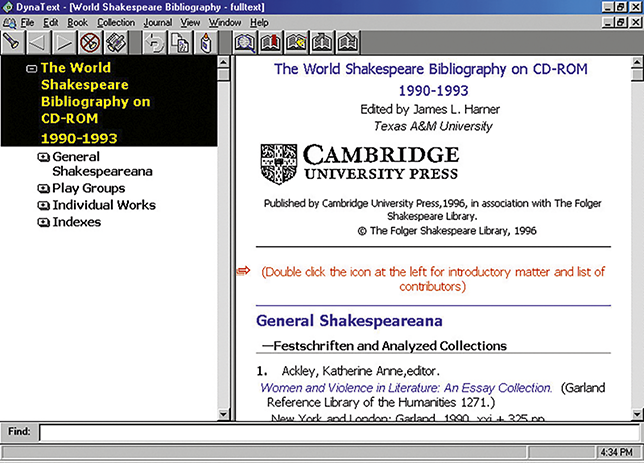
Figure 7 Long description
DOS-style interface for the World Shakespeare Bibliography. Top bar: “DynaText - [World Shakespeare Bibliography - fulltext]”; Top Navigation menu: File, Edit, Book, Collection, Journal, View, Window, Help. Navigation menu with icons: Flashlight, Left Arrow, Right Arrow, No Flashlight, Arrow facing left with reverse C stem, copy, paste, book with magnifying glass, book with bookmark, book with sticky note, book with arrow facing up and right from the page, book with arrow facing down and right onto the page. Left Navigation menu title: “The World Shakespeare Bibliography on CD-ROM 1990-1993” with expandable subcategories: General Shakespeareana; Play Groups; Individual Works; Indexes. Main panel text: “The World Shakespeare Bibliography on CD-ROM 1990-1993, Edited by James L. Harner, Texas A&M University.” [Cambridge University Press logo] “Published by Cambridge University Press, 1996, in association with the Folger Shakespeare Library (c) the Folger Shakespeare Library, 1996.” In red text, below black horizontal rule, with arrow for emphasis: “(Double click the icon at the left for introductory matter and list of contributors).” Below blue horizontal rule, first category listed: “General Shakespeareana - Festschriften and Analyzed Collections.” Below horizontal black rule first entry: 1. Ackley, Katherine Anne, editor. Women and Violence in Literature: An Essay Collection [clickable link]. (Garland Reference Library of the Humanities 1271.) At bottom of page, “Find” bar and clock.
The CD-ROMs for the OED, the MLA International Bibliography, ABELL, and the WSB reveal how the adoption of digital technologies ushered in new rhythms of publication and altered the temporal landscape of many previously annual or periodical publications (as we saw in Section 2 of this Element). As bibliographies and other reference sources began to split between printed and digital editions, and then shifted exclusively to digital, the notion of annual updates (which were often delayed by multiple years) faded into the background as users expected bibliographies and other reference tools to be updated around the clock and to contain the most up-to-date information possible.
Despite the allure of these new digital technologies, their adoption was not easy or straightforward, even for an editorial team that strived to incorporate computers into the creation and digitization of the WSB from as early as the 1970s. While no one who worked directly with the WSB in the 1980s and 1990s has been able to verify these details, Franklin J. Hildy provides an account of the challenges that the WSB encountered on its quest for digitization. Considering that Hildy incorrectly identifies James L. Harner as “James T. Harner” throughout his review of the CD-ROM, one should perhaps take Hildy’s presentation of WSB inside knowledge with a grain of salt:
Over the years the bibliography’s coverage has grown and so has the Shakespeare industry with which it has been attempting to keep up. The exponential growth has made it a prime candidate for conversion to digital technology and under the leadership of its former editor Harrison T. Meserole of Texas A&M University, attempts were made as early as 1988 to begin the daunting process of of converting the “World Shakespeare Bibliography” to CD-Rom format. The current editor, James T. [sic] Harner, has continued this process but it was not until the bibliography’s sponsors, the Folger Shakespeare Library, teamed up with Cambridge University Press in 1996 that the first CD-ROM (covering the years 1990-1993) came to market.Footnote 218
While some of the details of Hildy’s review cannot be verified, he correctly identifies the bibliographers’ almost incessant urge to grow their bibliographies bigger, better, and more advanced at every turn. When the WSB first moved to CD-ROM in 1996, the plan was for the WSB to be updated annually, with each successive CD-ROM moving coverage forward one year and backward three years. The first CD-ROM, released in 1996, covered materials from 1990 to 1993; the second CD-ROM, released in 1997, thus extended coverage backward to 1987 and forward to 1994. Highlighting the way in which CD-ROM technology expedited the electronic publication of past print publications, the CD-ROM box for the WSB on CD-ROM, 1987−1994 reports, “in this second release, coverage is doubled.”Footnote 219 Pamphlets from Cambridge University advertising the WSB on CD-ROM state that the annual updates would continue to extend forward and backward until “the period 1900 to the present day is contained on one disk.”Footnote 220 As is frequently the case, the desires of the bibliographers, strapped for time and resources, could not be fully met.
Having provided an overview of the digital landscape and the WSB on CD-ROM’s impact on this landscape, this section will now turn to the technical specifications of the CD to illustrate how the CD managed to keep some aspects of the print bibliography intact while also introducing fundamentally new ways to use it. The WSB on CD-ROM, 1990−1993 (released in 1996) and subsequent releases in 1997, 1998, and 1999 were presented as DynaText electronic books.Footnote 221 DynaText made it possible to build an electronic bibliography that made use of the same taxonomy that structured the print Bibliography, that presented individual entries in a way that was nearly identical in appearance to entries in print editions of the Bibliography, and that added completely new features such as extensive cross-referencing via hyperlinks and search features that made use of tags (Figure 8). With the adoption of CD-ROM technology that presented the Bibliography as an electronic book, the WSB was able to provide continuity for long-time users who had become accustomed to its structure in Shakespeare Quarterly while also introducing groundbreaking features that, once again, rewrote the rules of bibliographic research.
Screenshot of CD-ROM “browse text screen” World Shakespeare Bibliography on CD-ROM 1990−1993.
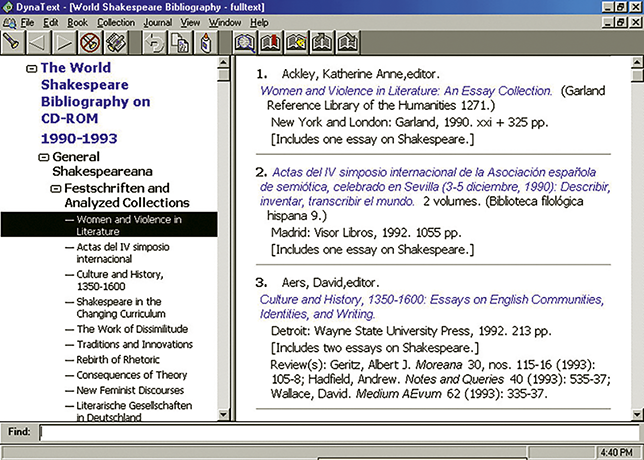
Figure 8 Long description
DOS-style interface for the World Shakespeare Bibliography. Top bar and top navigation menus same as Figure 7. Left Navigation menu title: “The World Shakespeare Bibliography on CD-ROM 1990-1993” with expanded first subcategories: “General Shakespeareana,” expanded subcategory “Festschriften and Analyzed Collections,” and then titles of works listed in that category: “ -Women and Violence in Literature -Actas del IV simposio internacional -Culture and History, 1350-1600, -Shakespeare in the Changing Curriculum, -The Work of Dissimilitude, -Traditions and Innovations, -Rebirth of Rhetoric, -Consequences of Theory, -New Feminist Discourses – Literarische Gesellshaften in Deutschland”. Main panel shows expanded entries for top three books with clickable titles, listing publication details, editors, notes on how many essays deal with Shakespeare, and reviews in scholarly journals.
In a section of the booklet about “Differences between the print and CD-ROM publications,” Harner lays out some of the primary ways in which the CD-ROM’s functionality differed from that of the annual printed bibliographies in Shakespeare Quarterly:
While The World Shakespeare Bibliography on CD-ROM cumulates and significantly expands the annual bibliographies in Shakespeare Quarterly, it omits several entries in the latter (especially works peripherally related to Shakespeare, most obituaries of performers, abstracts of unpublished convention papers, and operas not based on Shakespeare texts), condenses some (especially by omitting non-speaking roles in entries for productions), and conflates others (especially abstracts of published works and book or production reviews originally listed as separate entries).Footnote 222
In this way, the adoption of CD-ROM technology allowed for simultaneous expansion and refinement of the material contained in the bibliography, a form of editing of the bibliography that was not available when it was only distributed in print. In short, the CD-ROM allowed for changes to past entries, unlike periodical print publication.
Of special import was the CD-ROM’s functionality to present cross-references as hypertext links and to expand on the printed volume’s cross-reference functionality through a “See also” icon that “directs readers of an entry to other entries judged relevant by the Bibliography editor.”Footnote 223 In print, cross-references were just as tedious for bibliographers to create as they were tiresome for users to follow. Surprisingly, the “Differences between the print and CD-ROM publication” section of the booklet does not emphasize the search feature available in the electronic book. Today we might take the ability to search electronic resources for granted. In the 1990s, this was revolutionary, but not yet understood well enough to be highlighted as such. One especially useful feature of the simple search is that the number of “hits” for any search term is expressed both in the total occurrence of the search term in the text and in a breakdown of hits for each of the four major divisions that comprise the WSB’s taxonomy. For instance, in the WSB on CD-ROM, 1990−1993, a simple search of the term “Olivier” provided seventy-seven results. Users of the CD-ROM could see in the table of contents window that these results were broken down by section, such that twelve were in “General Shakespeareana,” fifty-two in the “Individual Works,” and thirteen in the “Indexes.” Though CD-ROM publication of the WSB was relatively short-lived, it was a significant step in moving the WSB from print to digital. The CD-ROM version allowed for tagging and cross-references, as the WSB’s editorial team continued to refine presentation of material to users via a content-rich, interactive, digital interface.
5.3 The End of the Printed World Shakespeare Bibliography and the World Shakespeare Bibliography Online, 2001−2013
In 2001, the WSB made its renewed debut on the web as the World Shakespeare Bibliography Online – for which it won the prestigious Besterman/McColvin Medal, awarded by the Library Association (London), now the Council of Library and Information Professionals. The WSB continued to be published as a print issue of Shakespeare Quarterly until 2003, when it moved to being published exclusively online by Johns Hopkins University Press (JHUP) and updated quarterly by the WSB editorial staff. The final print version was published as “World Shakespeare Bibliography 2003,” which appeared as volume 55.5 of Shakespeare Quarterly in 2004.Footnote 224 An editorial note in the previous volume of Shakespeare Quarterly explained that the next-to-last printed edition of the WSB was “more than six hundred entries shorter” than the previous year’s WSB. However, rather than “a reduction in the number of publications about Shakespeare,” the decrease in size was due to the “decision to list entries for productions, audio and video recordings, and films only in the World Shakespeare Bibliography Online” and not on pages of the printed issue.Footnote 225 Furthermore, the final print issue of the WSB in 2004 was to be even shorter, as it would exclude the same taxonomic entries that only appeared online the previous year, as well as “reviews of books that were listed in earlier editions of the WSB.”Footnote 226 Harner’s editorial note in the final print edition explains that “discontinuing the annual print edition will allow the Bibliography staff to improve the coverage and accuracy of the award-winning World Shakespeare Bibliography Online.”Footnote 227 Moving the WSB completely online “offer[s] researchers a resource that fully meets their needs and best reflects Shakespeare Quarterly’s commitment to maintaining a definitive record of Shakespeare scholarship and productions worldwide.”Footnote 228
As the print editions of the WSB were winding down, Priscilla J. Letterman Meserole was planning her retirement from Texas A&M and the WSB. Notably, in the WSB for 1992, Letterman Meserole’s name appeared for the first time on the title page of the print version of the WSB as one of three editors: “James L. Harner, Editor, Harrison T. Meserole, Editor Emeritus,” and “Priscilla J. Letterman, Technical Editor.”Footnote 229 From this point until her retirement, Letterman Meserole was credited as an editor and featured on the title page of the print WSB (and in the booklet for the CD-ROM), with other editors. “World Shakespeare Bibliography 2001” (Shakespeare Quarterly 53.5, published in 2002) was Letterman Meserole’s final issue of the WSB, and in honor of her many years of service to the WSB, Harner dedicated the issue to Letterman Meserole and personalized the issue by selecting a photo of one of her needlepoint creations to grace the cover of her final issue.Footnote 230 By foregrounding the outgoing technical editor’s contributions to the WSB and including an image of her needlepoint on the cover, Harner acknowledged the labor of his long-time colleague in a way that personalizes one of the final print issues of the WSB (Figure 9). Kris L. May was hired a few months before Letterman Meserole retired, so that the outgoing technical editor could train the new technical editor.
Cover of Shakespeare Quarterly, 53, no. 5 (2002). Needlepoint by Priscilla J. Letterman Meserole, published by permission.
One of the labor challenges facing the WSB’s move to digital involved the treatment of older entries. Harner and the WSB staff planned to post current entries, as well as previous years’ entries that had been processed and were ready for digitization. When entries for as far back as 1960 had been processed and moved online, it became apparent that, given the limitations of staff resources, it was in the best interest of the WSB’s users for the editorial staff to focus on keeping the WSB up-to-date with current scholarship and resources and, thus, to discontinue processing entries prior to 1960 for digitization.
As the WSB fully transitioned to an online project, Harner also decided to change the “technical editor” job title to “associate editor.” From a practical standpoint, “associate editor” was a preexisting job title at Texas A&M University that better aligned with the duties of the WSB’s technical editor. Additionally, as the WSB moved from a print publication to an electronic database that was updated quarterly, Harner believed that the associate editor title more accurately represented the duties of the position, which now included not only proofreading text but also composing entries for stage productions, films, radio productions, and television programs and checking and correcting cross-references and online links. Shortly after the final printed edition was published, the WSB’s technical editor became the associate editor.
The look and processes of the WSB developed in 2001, indeed, the coding systems first developed by Smith and Meserole in 1981, remained much the same for fifteen years. Roger Sorrells, the computer programmer who started working closely with Harner when he arrived at Texas A&M, developed some programs to facilitate the processing of the data files for posting online. Significantly, the actual XML coding for the website was not done in the WSB editorial offices. Instead, each quarter, the WSB editorial offices would upload processed files to JHUP’s website. A JHUP programmer developed an error program to detect duplicates and flag other anomalies in the data. WSB editors would review the error files and make necessary corrections. Finally, a programmer at JHUP would run a conversion program that would transform the new data into XML, and the update was posted to the website.
5.4 Rebuilding the World Shakespeare Bibliography, 2013−2016
For many years, the WSB continued this inefficient system of processing bibliographic records, which would finally end up being posted online. WSB editors never touched the website: the editorial staff would send many processed files to a programmer at JHUP, who would then prepare the data to be uploaded to the XML website. The website was only updated four times a year. If something needed to be changed in a particular record, the editor or associate editor would make that change in the local data files. However, the record would not be changed online until the files were processed for the next update. The separation between editors and the website meant that error correction took longer. Additionally, because new records were only added to the website quarterly, it could take up to three months or longer for items to appear online.
In an ideal world, the WSB’s processes and website would have been updated as new and more efficient tools and technologies were developed. However, given the realities of limited (and often shrinking) university department budgets, as well as the economic realities faced by scholarly publication and university presses, the prospect of updating and changing everything to deliver a new WSB Online was daunting. As Harner began to think about retirement, he knew that the next editor of the WSB would have to be digitally savvy enough to take things to the next level.
In 2013, Texas A&M’s Department of English hired Laura Estill, who worked closely with Harner before his retirement during a period that Estill describes as an “apprenticeship” with “a very clear two-year handoff period.” For two years, Harner and Estill were credited as co-editors of the WSB Online. When Harner retired from Texas A&M, he left the WSB entirely in the hands of the new editor. Estill writes, “We could not truly have passed the baton if he had not been willing to let go during the handoff.”Footnote 231 Estill continues:
Another way Jim prepared for the handoff was by not imposing his vision on the project. Jim was clear from the start: he knew the site needed updating, but … he wanted the WSB going forward to reflect my vision and not his, which is why he didn’t undertake the much-needed major overhaul before he retired.Footnote 232
Estill envisioned an integrated workflow system for the WSB. In this new digital environment, WSB graduate assistants, editors, and contributors would submit entries in the system. Editors would edit and publish entries, which would then become visible to WSB users.
Shortly after Estill became editor, the WSB secured a grant through Texas A&M’s Institute for Digital Humanities and Media Culture to hire Quinn Dombrowski to develop an online submission system for WSB editors, graduate assistants, and international contributors.Footnote 233 For decades, graduate assistants and international contributors had submitted Microsoft Word documents containing entries, sometimes with byzantine codes (see section 5.1 for an example) that could be riddled with errors. WSB editors reviewed the entries, edited them, and coded them using the encoding system developed by Smith and Meserole. Though some of the international contributors knew the encoding system and submitted entries they coded themselves, most of them were unfamiliar with the system. Additionally, WSB graduate assistants no longer submitted coded entries. Given that the “WSB’s code was an idiosyncratic, non-standard encoding language that contributors would be unable to apply in other DH projects,” it didn’t make much sense to ask graduate students to spend time learning a nontransferable skill. As Estill recalls, “I found it unethical to ask graduate students to learn WSB encoding. Learning programming or encoding is a valuable skill: however, it has diminishing returns if you cannot apply what you’ve learned.”Footnote 234 The Drupal-based submission site that Dombrowski set up greatly simplified the submission process for graduate assistants and international contributors, who would no longer be required to submit Word files to WSB editors. Though this was a very useful interim submission system, the new “online submission system still had to export in the legacy code,” which was “displayed in the old format.”Footnote 235 Editors were still processing files using the old system and uploading the processed files for the publisher each quarter.
This process changed in 2016 with the release of a new, Drupal-based WSB site that integrated the editorial workflow so that the entire process from entry submission to publication was now streamlined into one system, making the bibliographic “project more welcoming to new international correspondents,” who no longer had to email documents containing entries to WSB editors.Footnote 236 The new site was more intuitive for users and contributors and greatly facilitated the submission process. Additionally, graduate research assistants were now able to submit their entries directly to editors via the website rather than submitting each entry through a separate form that wasn’t part of the website. Each entry waiting to be edited and published was accessible via the back-end of the Drupal-based website, and editors could see the status of each entry in the queue, along with information about who had last saved the entry and timestamps for each entry’s revision. Editors were able to submit entries directly into the system, and they were also able to edit submissions from contributors, publishing them directly to the live system without having to wait for an external publisher to upload a new set of entries. Notably, once the entries were published, editors could edit them at any time rather than having to wait until files were processed and uploaded by a programmer with the publisher. Editors now corrected errors as soon as they were found, deleted duplicate entries, added reviews of publications and performances to existing entries as they became available, edited submitted entries directly in the system, and published entries that would go live immediately.
From an editorial perspective, one of the most exciting features of the new system was the ease with which editors added cross-references. Before the 2016 rebuild, cross-referencing was a time-consuming process, and since editors were typing in record numbers for each cross-reference, the probability of producing errors was always a concern. In the new system, the editor started typing the record entry for the cross-reference, and the system auto-completed the bibliographic record to be cross-referenced. Editors then simply clicked on the record to add the cross-reference to the entry, thus hyperlinking the cross-reference within the entry.
The 2016 rebuild also allowed users to access online journal articles and eBooks if the journal or book “is open access or if an institution subscribes to it.”Footnote 237 Users were now allowed to access their subscribing institution’s holdings by simply clicking on a “Find Text” button. Users were able to “click directly from a book collection to each of its chapters” and “click on journal titles, author names, or tags to browse more organically.”Footnote 238 The WSB was now integrated “with multiple citation management systems such as EndNote or Zotero,” and the site was “mobile-friendly” and “navigable from a phone or tablet.”Footnote 239
The rebuild also included new taxonomic terms for classifying each bibliographic record. As Estill explains:
The WSB is the most comprehensive bibliography of Shakespeare scholarship: we carefully reconsidered our taxonomy of how articles are classified, which involved thinking about the landscape of Shakespeare studies and how it is divided. Of course, any project considering changing their taxonomy needs to ensure that it can update old entries with new labels or accept loss of functionality. We added “musical score” as a document type that is separate from “monograph.” We also renamed “computer software” to “digital project.” These changes are not just about keeping up with current nomenclature: they are about accurately reflecting a field of study.Footnote 240
Notably, Estill’s reflections on rethinking the classification of entries echo Smith and Meserole’s negotiations during the early days of computerizing WSB data: how do we create a digital system that is flexible enough to accommodate strict bibliographic standards and to allow for changes over time?
5.5 Continuing the World Shakespeare Bibliography, 2016−present
In 2019, Heidi Craig joined the WSB as Editor, while Estill shifted to an advisory role. Craig was joined by two new WSB Associate Editors, Katayoun Torabi (2018−2020) and Dorothy Todd (2020−2023). During that same year, Oxford University Press became the publisher of the WSB and Shakespeare Quarterly. While maintaining the practices of finding, annotating and publishing entries in the format established in the 2016 site rebuild, the team also turned its attention to public outreach and publication.Footnote 241 The editorial team created a Resources page, which featured tools the team created to aid researchers, instructors, and students, including an online how-to tutorial and a teaching handout with ideas on how to incorporate the WSB into the university classroom, outlining exercises such as in-class group annotation for the WSB as well as a WSB annotation assignment for individual students.Footnote 242
The timing of the team’s shift to questions of access and outreach was fortuitous, as such matters became especially urgent during the COVID-19 pandemic that engulfed the globe starting in early 2020. The pandemic transformed work life for people across the world and revealed the material resources, processes, and workflows that the WSB’s seamless digital interface often obscured. For instance, the WSB relies on library services in order to obtain the materials to annotate, and the pandemic disrupted library services and operations not only at its home Texas A&M Libraries, but at libraries worldwide. Of course, remote operations were nothing new for the WSB: graduate students and staff were used to working away from the office at various points throughout the semester. The difference, though, was that this time, the entire WSB team – the editor, associate editors, undergraduate interns, and graduate student research assistants – had to shift to working remotely with very little time (if any) spent in the office for almost a year. Nevertheless, its long-standing digital format and flexible workflows that capitalized on digital resources (such as online articles and eBooks) meant the WSB was in a good position to weather the storm and even create new research opportunities.Footnote 243
As a resource that annotates performances from the theater (an industry devastated by the pandemic), the WSB was attuned to the theater industry’s adaptations. For a time, in-person stage productions around the world were halted due to pandemic restrictions, and many theaters moved their productions online. Of course, online productions of Shakespeare’s plays were not new in 2020. However, there were some new things for the WSB staff to consider as they composed entries for these productions and considered particular questions about the performances. Was a production “staged” online with the actors Zoom-ing in from different locations? Did the actors appear on a theater’s physical stage without an audience in the same physical location as the actors? Was a performance recorded and the video recording made available for streaming (via a platform like YouTube) for a certain period of time (either for free or by purchasing tickets)? Should the performance be classified as a “stage production” or as a “film”? The WSB staff considered a variety of new questions involving the nuance of each performance in order to determine the most useful bibliographic data to include for each performance entry.Footnote 244 The team also started to tag performances touched by the pandemic, such as Shakespeare performances that suddenly shifted online or which were expressly designed for a digital format during the COVID-19 era.Footnote 245 The team additionally tagged the many articles about Shakespearean connections to the pandemic, whether about how Shakespearean theater professionals were grappling with and adapting to theater closures, how Shakespeare served as solace, or even inspiration, with his creative activity during early modern plague times potentially providing lessons for people who were currently experiencing lockdown.Footnote 246 As always, the WSB remained focused on providing research resources to Shakespeareans.
In 2023, the World Shakespeare Bibliography’s editorial operations shifted with Heidi Craig to the University of Toronto, Scarborough, thanks to the vision and support of Dr. Patricia Akhimie, Director of the Folger Institute, which funded several new student research fellowships to assist with the WSB’s compilation and publication. By 2024, the WSB’s content management system was due for an upgrade. The Folger’s head of Information Technology, Seán Stickle, spearheaded a migration of the WSB from Drupal to a WordPress site, maintaining the site’s design and functionality but with a decidedly more user-friendly back-end for editors and other contributors. From index cards and early forms of computerization, to CD-ROMs, to Drupal and WordPress sites; from Penn State, to Texas A&M, to the remote workspaces of the pandemic, to the Folger, to the University of Toronto, these various technical shifts and institutional changes demonstrate that even long-standing resources and practices must change and adapt over time to sustain a project this large and complex. And yet, the constant for the WSB has been to provide the fullest records about Shakespeare performance and scholarship to a global audience.
As this Element has shown, the history of the WSB reflects the broader history of Shakespearean bibliography: the way we find our scholarship and reflect on our field of study is through collaboration between human ingenuity and technological transformations. As we look to the past, we also look to the future, with hope and anticipation about how Shakespearean bibliography will continue to evolve.
Coda: Looking Forward
Bibliographies are the work of bibliographers, that is, people. These reference works are shaped by the people who compile them, the access to information and sources those people enjoy, and the institutional, regional, and national contexts in which they are compiled. For decades, W. W. Greg’s quotation, copied and framed by James L. Harner (Figure 10), hung on the World Shakespeare Bibliography office wall, calling bibliographers “useful drudges” and “servi a biblioteca,” that is, servants to the library, and ultimately, the discipline. Today, Shakespeare bibliography is always undertaken collaboratively: whether with co-editors working on a given project, or by turning to existing bibliographies, whether to find information or omissions.
W. W. Greg quotation from the World Shakespeare Bibliography office, copied and framed by James L. Harner: “… it is convenient to students of any subject to regard bibliographers as a race of useful drudges – servi a bibliotheca – who are there to do for them some of the spade-work they are too lazy or too incompetent to do for themselves. W. W. Greg”

As human-created reference works, bibliographies are the result of choices: the scope and organizational structure of a bibliography will foreground some works while pushing others to the margin or eliding them, making them undiscoverable. The ways we categorize and tag items in a bibliography necessarily reflect a given point of view and scholarly moment. These decisions can often look neutral or objective, obscuring more fraught political, cultural, and technological realities. And even within well-defined ambits and with perfectly curated and navigable taxonomies, there will be omissions. Bibliographies have the potential to control what seems important in a given field, and Shakespeare studies is no exception. This Element argues for the importance of bibliographies in both shaping and reflecting scholarly practice; bibliographies, then, are valuable artifacts to produce, interrogate, and evaluate.
In our current age of algorithmic and automatic list-making, it is precisely that automation that has led to an explosion of misinformation and AI-generated junk. With the rise of artificial intelligence, Shakespearean bibliography continues to require human intervention and expertise to tame the “genial dragon” of bibliography.Footnote 247 While algorithms can certainly find pieces of digitized text faster than a human, it still takes a human eye to evaluate and organize the content. Artificial intelligence can even offer summaries of texts that it “reads,” but it does not understand what it reads, and it cannot see the contexts and biases of what it ingests.
Even before the onslaught of artificial intelligence, bibliographers had to use their judgment when it came to including questionable scholarship produced by the rise of paper mills and pay-to-publish predatory journals. Now, as artificial intelligence spews virtual reams of textual slop, bibliographers will be faced with an even more Sisyphean task when it comes to separating the wheat from the chaff. While these virtual reams of AI-generated text are not tangible, we know they are taking a real toll on the environment. Shakespeare has long been a daunting field of study to enter, as students and newcomers face the task of catching up on centuries of humanist inquiry. Bibliographies are a record of scholarship that can offer a glimpse into the scholarly preoccupations of a moment; while no bibliography is complete or unbiased, the best bibliographies can support equity and increase visibility by making multilingual criticism, translations, editions, and performances searchable, as well as bringing new or overlooked voices into the scholarly conversation. Bibliographies are lifelines: some with annotations, some with specialized areas of focus, and some helping us stay abreast of recent publications.
This Element has focused on a particular kind of Shakespeare bibliography: enumerative bibliographies of scholarship about Shakespeare. While we have touched on a number of bibliographies, both periodical and omnibus, the hundreds of bibliographies beyond the scope of this Element invite further study. These Shakespeare bibliographies offer records of our research that in turn shapes how we continue to research. Bibliographies make work findable and help us tell the story of our discipline.
Ultimately, the history of Shakespeare bibliography is important because it helps us better navigate the (increasingly online) scholarly resources available to us in the present. Moreover, Shakespearean bibliographies offer a record of past and present scholarship, which can itself shape future scholarship. We hope this Element prompts scholars to think about enumerative projects not as monolithic reference works, but rather, as purposefully constructed lists that are necessarily incomplete and reflect the contexts and decisions that went into their creation as well as the technologies with which they were created. In Shakespeare studies, as with research more broadly, we cannot effectively search for information unless we know the ambit of the material we search, why it was gathered, and how it was arranged.
Acknowledgments and Collaborations
We would like to thank our research assistants who worked on this project: Minjung Ha (Texas A&M University), Alexandra LaGrand (Texas A&M University), and Alex Lambourne (St. Francis Xavier University). Thanks also to those who spoke to Kris as we pieced together the World Shakespeare Bibliography’s recent history: Darinda Harner, Priscilla J. Letterman Meserole, and John B. Smith. Thanks to Jochen Ruebener for translations from German.
All four authors contributed equally to this Element; any author can be listed as the first author in citations.
We are grateful for funding from the Canada Research Chairs Program, the Social Sciences and Humanities Research Council of Canada Institutional Grant at St. Francis Xavier University, and the College of Arts and Sciences at Texas A&M University to make this volume open access. We would also like to thank the Department of English at Texas A&M University for funding to secure image permissions.
This book is dedicated to the memory of Jim Harner and to the perseverance of all bibliographers, including those who often go unacknowledged and unnamed.
Claire M. L. Bourne
The Pennsylvania State University
Claire M. L. Bourne is Associate Professor of English at The Pennsylvania State University. She is author of Typographies of Performance in Early Modern England (Oxford University Press 2020) and editor of the collection Shakespeare / Text (Bloomsbury 2021). She has published extensively on early modern book design and reading practices in venues such as PBSA, ELR, Shakespeare, and numerous edited collections. She is also co-author (with Jason Scott-Warren) of an article attributing the annotations in the Free Library of Philadelphia’s copy of the Shakespeare First Folio to John Milton. She has edited Fletcher and Massinger’s The Sea Voyage for the Routledge Anthology of Early Modern Drama (2020) and is working on an edition of Henry the Sixth, Part 1 for the Arden Shakespeare, Fourth Series.
Rory Loughnane
University of Kent
Rory Loughnane is Reader in Early Modern Studies and Co-director of the Centre for Medieval and Early Modern Studies at the University of Kent. He is the author or editor of nine books and has published widely on Shakespeare and textual studies. In his role as Associate Editor of the New Oxford Shakespeare, he has edited more than ten of Shakespeare’s plays, and co-authored with Gary Taylor a book-length study about the ‘Canon and Chronology’ of Shakespeare’s works. He is a General Editor of the forthcoming Oxford Marlowe edition, a Series Editor of Studies in Early Modern Authorship (Routledge), a General Editor of the CADRE database (cadredb.net), and a General Editor of The Revels Plays series (Manchester University Press).
Advisory Board
Patricia Akhimie
The Folger Institute
Terri Bourus
Florida State University
Dennis Britton
University of British Columbia
Miles P. Grier
Queen’s College, City University of New York
Chiaki Hanabusa
Keio University
Sujata Iyengar
University of Georgia
Jason Scott-Warren
University of Cambridge
M. J. Kidnie
University of Western Ontario
Zachary Lesser
University of Pennsylvania
Tara L. Lyons
Illinois State University
Joyce MacDonald
University of Kentucky
Laurie Maguire
Magdalen College, University of Oxford
David McInnis
University of Melbourne
Iolanda Plescia
Sapienza – University of Rome
Alan Stewart
Columbia University
About the Series
Cambridge Elements in Shakespeare and Text offers a platform for original scholarship about the creation, circulation, reception, remaking, use, performance, teaching, and translation of the Shakespearean text across time and place. The series seeks to publish research that challenges–and pushes beyond–the conventional parameters of Shakespeare and textual studies.
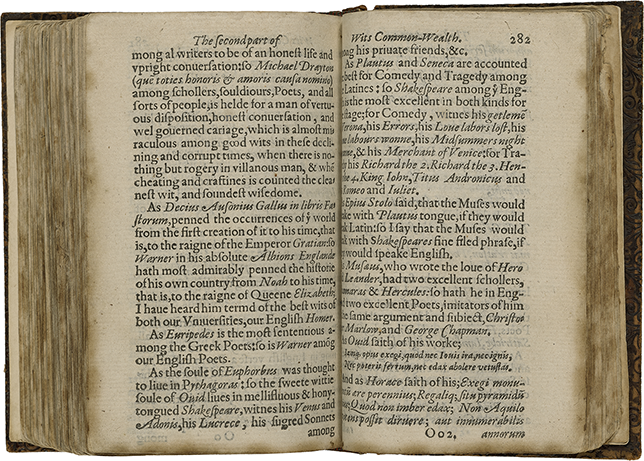
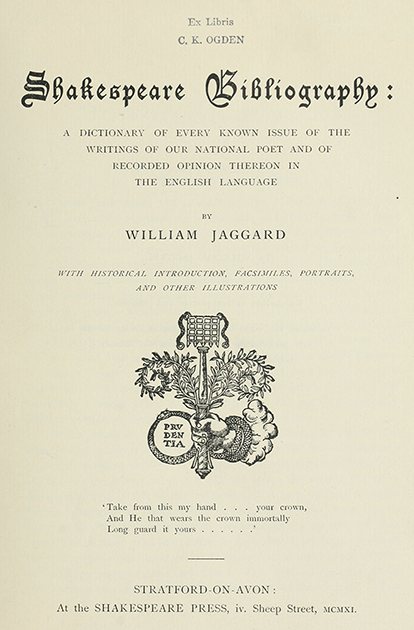
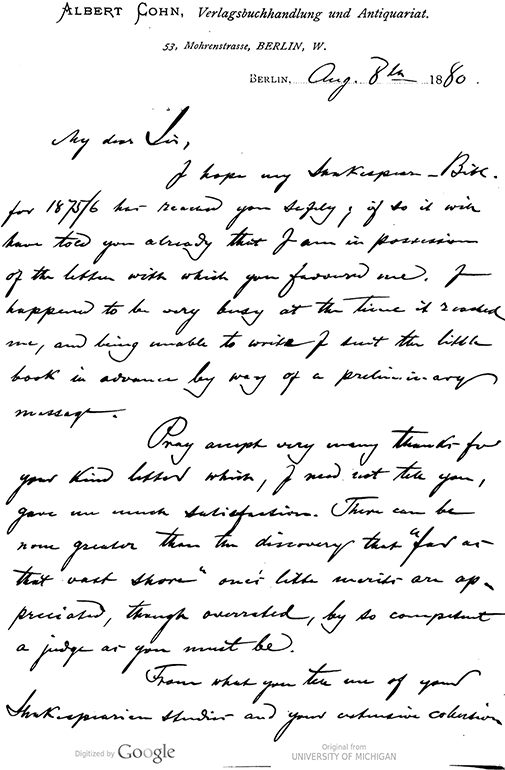
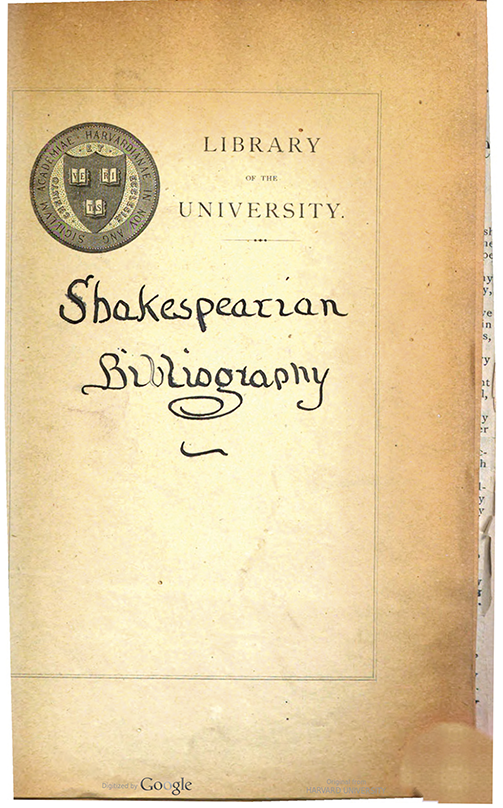
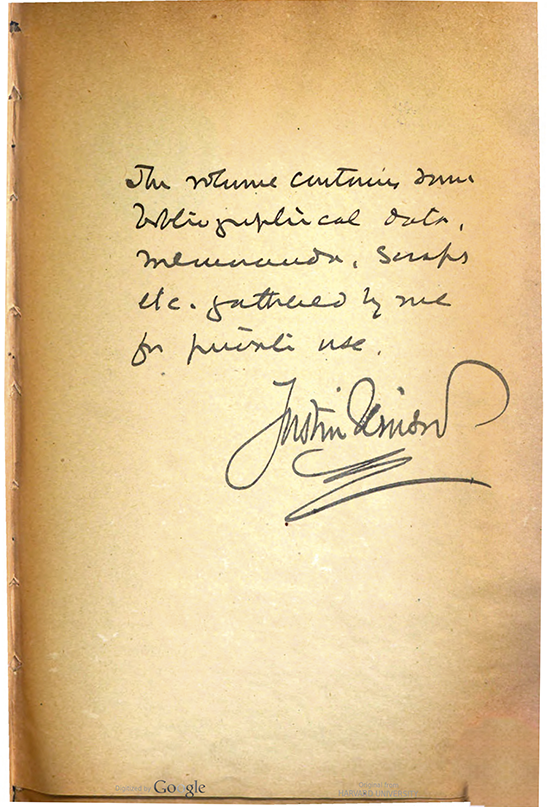
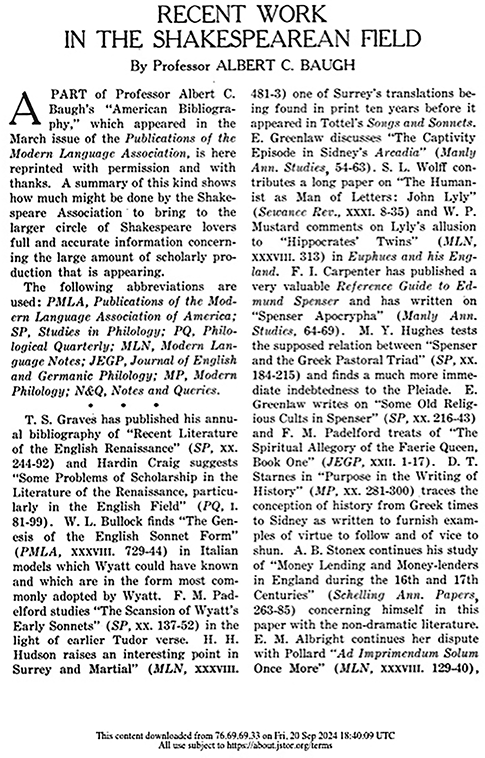
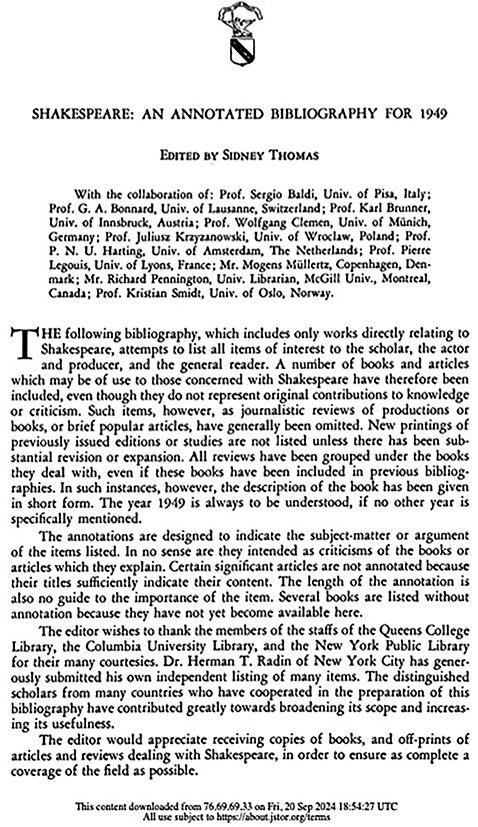
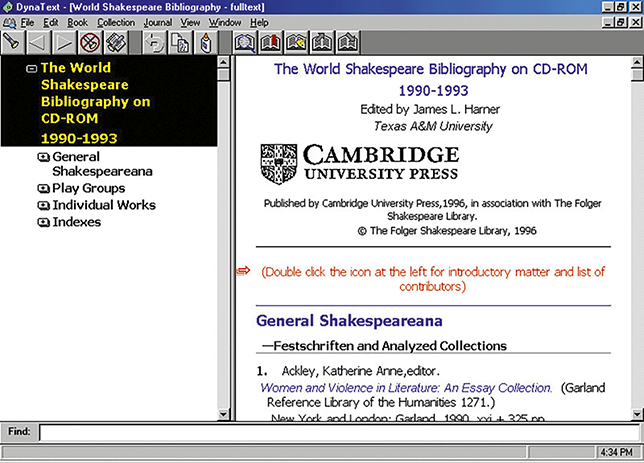
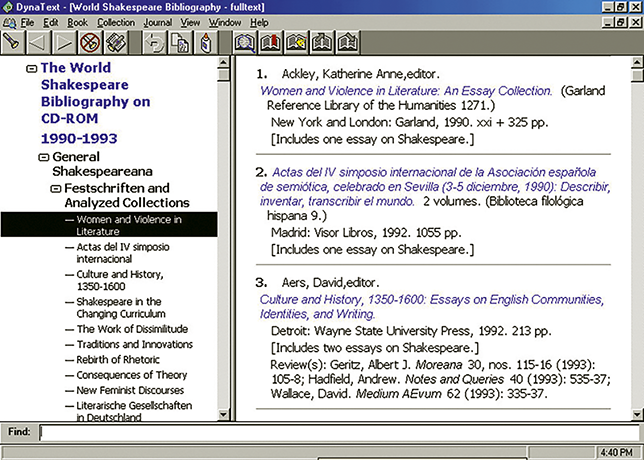
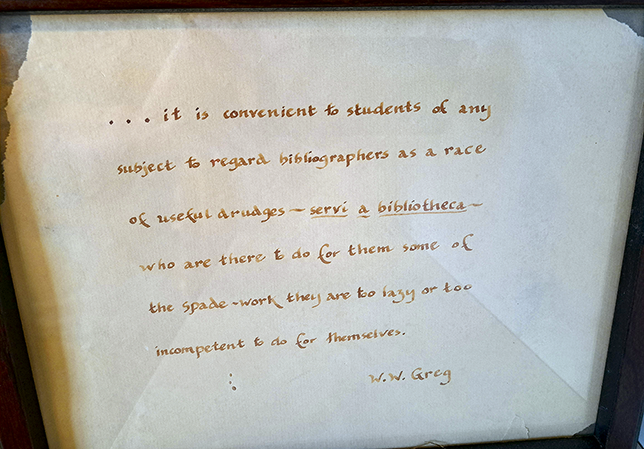

 Open access