


“The South cannot recede … She must fight for her slaves or against them.”
(De Bow’s Review, “Excessive Slave Population: The Remedy”)
The US Civil War turned on an either/or question: should slavery be allowed to expand westward into the hinterland of the American empire or not? The De Bow’s Review, a southern agricultural magazine, typified the Southern Rights position on the issue in 1852. For them, settler colonial expansion was a guarantee against demographic apocalypse. Unable to relocate their human chattel on an even greater expanse of Indigenous territory and northern Mexico, they would be trapped in the Southeast with their bondsmen, who, upon outnumbering the white population, would revolt against their masters. The South’s choice, then, was clear: “fight for her slaves or against them” [emphasis in original] (Johnson Reference Johnson2013: 13).
Though the relationship between settler colonial expansion, slavery, and population was key to precipitating the political crisis over slavery, the scholarship on such crises is ill-equipped to account for it. There are two approaches to crises of hegemony, which I define classically, following Gramsci (Reference Gramsci1971), as the withdrawal of the mass consent to rule.Footnote 1 The first follows a logic of mediation, in which an economic crisis leads the state to facilitate the relationship between capital and labor in ways that introduce new economic contradictions and sow the seeds of subsequent political unrest (O’Connor Reference O’Connor1973; Wright Reference Wright1978). The second follows a logic of repression, in which an economic crisis sparks class conflict and an authoritarian state response thereto (Camp Reference Camp2016; Gilmore Reference Gilmore2007; Gramsci Reference Gramsci1971; Hall et al. Reference Hall, Critcher, Jefferson, Clarke and Roberts2013 [1978]; Poulantzas Reference Poulantzas2014 [1978]; Wood Reference Wood2014).
Such approaches (a) assume a high level of administrative state capacity; and (b) expect a crisis in the economic system to precede political crises in time. These assumptions are problematic for the antebellum American case. As Skowronek (Reference Skowronek1982) observes, the United States government in that period was a “state of courts and parties,” whose capacity for economic and military intervention was tiny compared to the welfare and carceral states envisioned by theories of political crisis. Moreover, antebellum capitalism was hardly an economic system in crisis. Northern industrial capitalism and southern plantation slavery were extraordinarily prosperous in this period. Cotton prices and production were up across the South from 1840 to 1850; 1859 – just two years prior to the Civil War – was the best production year on record. Slavery simultaneously fueled the North’s industrial revolution. Between 1820 and 1860, New England’s textile mills increased their average capital investment by 600 percent, a process that historical economists call “capital deepening” (Barney Reference Barney1974: 3; Baptist Reference Baptist2014: 114, 127, 129, 319–320, 322, 324).
Given these analytic gaps, I pose the following empirical puzzle: if political crises are underpinned by economic relations as mediated or enforced by the state, then why did the political crisis over slavery turn on a racialized dispute over population? My answer is that insurgent political actors pinned their constituencies’ hopes of economic independence on imagined demographic futures that, in turn, disrupted mass white consent for the existing configuration of settler colonialism and slavery.
This hypothesis is based on a synthesis of divergent theories of “articulation.” Together these approaches help to explain how political parties may reorganize the terms of white supremacy and in doing so precipitate social transformation. In its conjunctural sense, articulation entails the “joining up” of the different elements of a social formation (e.g., slavery and industrial capitalism) at a specific historical moment (Althusser and Balibar 1970 [1968]; Hall et al. Reference Hall, Critcher, Jefferson, Clarke and Roberts2013 [1978]; Hall Reference Hall and Morley2019 [1980]; Hall and Schwarz Reference Hall, Schwarz and Hall1988; Marx Reference Marx and Nicolaus1993 [1857]). In its discursive sense, articulation involves the use of political discourse to forge hegemonic blocs out of otherwise socially distant constituent groups (de Leon, Desai, and Tugal Reference de Leon, Desai and Tugal2009, Reference de Leon, Desai and Tugal2015; Laclau Reference Laclau1977). On that account, there is no guarantee that class will be the basis of political struggle; parties may build blocs on the basis of race, religion, or other demographic differences. Accordingly, articulation entails contested questions of population. For example, who are the tiny unaccountable elite, and who the victimized masses? Which group is in danger of extinction, and which the sleeping giant?
If we take the conjunctural and discursive dimensions of articulation to comprise the socioeconomic and political conditions enabling hegemony, then we can deduce the converse conditions enabling crises of hegemony. Thus, to repeat, crises take hold because insurgent political actors pose demographic futures that disrupt mass support for joining up the interlocking elements of the dominant social order under existing terms. In that event, the situation ceases to be a matter of mere arguments or differences of opinion but an existential threat to the social order itself. A crisis of articulation becomes a crisis of hegemony.
In the antebellum American case, Illinois Republicans argued that the extension of slavery into Indigenous territory and northern Mexico would permit the planter class to overrun the land with the enslaved and condemn white workers to a life of endless toil in the factory. Having thus framed slavery as a demographic threat, northern Republicans broke with the nativists of their erstwhile colleagues in the Whig Party by insisting that the territorial claims of landless white settlers, many of them immigrants, must supersede those of planters. Alabama Democrats retained the expansionist politics of their party, but in becoming Southern Rights secessionists held that prohibiting the transport of human chattel to new territories would dam whites up in a land of the enslaved, where the Black population’s superior numbers would ignite a slave revolution. For them, the confinement of slavery to its existing borders hastened the demographic threat both to the white population and plantation slavery itself. These competing demographic futures undercut mass white consent for the Union and in doing so led to the US Civil War.
The contributions of this article are four-fold. First, it problematizes the assumption that economic crisis is a precondition for political crisis. The article instead collapses that analytic separation.Footnote 2 It suggests that the politicization of the interlocking elements of a socioeconomic order – not the socioeconomic by itself – precipitates the withdrawal of the mass consent to rule. Second, though I center the capacity of cultural dynamics, broadly construed, to occasionally throw political systems into crisis as Marshall Sahlins (Reference Sahlins1985) does, I de-emphasize the importance of intercultural contact (i.e., between two putatively independent cultural and political economic systems in the North and South) and assume instead a shared discursive framework and social order based on the interdependence of plantation slavery, industrial capitalism, and settler colonialism. Thirdly, whereas the existing literature privileges the role of the state in crises of hegemony, the article illuminates the role of population politics and partisan struggle in the re-organization of white supremacy and the advent of critical historical conjunctures. Finally, if the transition to liberal democracy in the United States was enabled by mass support for different modes of racial violence as this article suggests, then the very concept of democracy is potentially a misnomer and requires nothing less than mass mobilization on behalf of a political alternative.
Theories of articulation
Any satisfactory account of the political crisis over slavery must accomplish three feats of balance. First, it must take socioeconomic conditions seriously, while not assuming their causal or temporal precedence. Second, it must visualize political institutions as relatively autonomous actors, while not assuming a highly developed state apparatus. Third, we require an account that can specify the linkage between politics, socioeconomic dynamics, and population.
The theory of articulation provides the basis for such an account. It developed in response to purely economistic analyses of capitalism. There are two distinctive approaches. One emphasizes the “joining up” of different elements into complex socioeconomic formations at specific historical conjunctures. Another emphasizes the discourses that political actors use to achieve hegemony, the mass consent to rule.
The first, which I call the conjunctural approach, originates with Marx’s introduction in 1857 to the Grundrisse. In that piece, Marx proposes how we might think about slavery, feudalism, and capitalism as articulated together within bourgeois society. Explicitly rejecting “stage theories” that see these modes of production as mutually exclusive of one another and separable in time, he wrote that an analysis of capitalism must entail, “insights into the structure and the relations of production of all the vanished social formations out of whose ruins and elements it built itself up, whose partly unconquered remnants are carried along within it” (Marx Reference Marx and Nicolaus1993[1857]: 105, 108). Althusser and Balibar would later call bourgeois society an “articulated-hierarchy,” in which some elements or “limbs” were more decisive in shaping the character of the whole than others (Althusser and Balibar Reference Althusser and Balibar1997 [1970]: 98).
It was in conversation with Althusser and Balibar that Stuart Hall made his pre-eminent contribution to the theory of articulation. Hall argued that “race must be given its distinctive and ‘relatively autonomous’ effectivity” in a social formation, “not simply as residues and traces of previous modes but as active structuring principles of the present organization of society” (Hall Reference Hall and Morley2019 [1980]: 210–214). Hall did not urge a general theory of race or racial systems. “One must start,” he argued, “from the concrete historical ‘work’ which racism accomplishes under specific historical conditions—as a set of economic, political, and ideological practices, of a distinctive kind, concretely articulated with other practices in a social formation” (Hall Reference Hall and Morley2019 [1980]: 210–214).
Though the conjunctural approach helps us understand that articulation entails the “joining up” of systems and practices, it suffers from at least two limitations. First, it addresses race as comprehensible only in relation to capitalism and class. This is true even for Hall, who wrote, “Race is thus, also, the modality in which class is ‘lived’, the medium through which class relations are experienced, the form in which it is appropriated and ‘fought through’” (Hall Reference Hall and Morley2019 [1980]: 216). No theory of “racial capitalism” is here contemplated, in which race, instead of or in addition to class, underpins capitalism’s past, present, and future (Robinson Reference Robinson2000 [1983]; Go Reference Go2020). One wonders if the inverse is equally possible, namely that class is the medium through which white people experience or fight through race (Awatramani Reference Awatramani2024: 32). The second limitation of the conjunctural approach is that it is too abstractly mechanistic. It is devoid of actors who accomplish “the work of race” or perform the “joining up” of practices and elements into complex wholes.
For an alternative, we turn to the discursive approach. Here I refer to scholars for whom articulation centers on forging would-be dominant blocs out of socially distant groups, primarily through political discourse. Laclau’s (Reference Laclau1977) intervention in the debate on articulation was a reaction to the failure of class politics in Latin America, where mass mobilization consisted in multiple and contradictory identities that bedeviled socialist parties and movements. From this experience, Laclau derived a theory in which articulations are merely “links between concepts” such that “common sense discourse” is “a system of misleading articulations in which concepts do not appear linked by inherent logical relations, but are bound together simply by connotative or evocative links which custom and opinion have established between them” (Laclau Reference Laclau1977: 7). Laclau’s theory of articulation does not entail the joining up of elements according to “inherent logical relations” as the conjunctural approach would have it, but rather the joining up of concepts in common sense discourse.
Inspired in part by Laclau, political sociologists have since challenged their subfield’s dominant approach to political behavior, which holds that party politics merely reflect social structural cleavages such as class and race. Reversing the causal logic of such “reflection theories,” de Leon, Desai, and Tugal (Reference de Leon, Desai and Tugal2009) hold that parties naturalize social cleavages. Thus, they define “political articulation” as “the process by which parties ‘suture’ together coherent blocs and cleavages from a disparate set of constituencies and individuals, who, even by virtue of sharing circumstances, may not necessarily, share the same political identity” (de Leon, Desai, and Tugal Reference de Leon, Desai and Tugal2015: 2). Practical politics, in other words, entails coalition- and identity-building, not the automatic translation of social formations in political life.
Political articulation departs from the rest of the discursive approach by anchoring discourse in institutions, especially parties, but aligns broadly with the tradition in the sense that partisan struggle gives rise to social divisions, rather than the other way around. The fact that parties naturalize social divisions suggests that articulation is in part about population. Parties frame struggles among putatively competing social groups: immigrants and native-born, working class and elite, the racial majority and the racial minority, and so on.
In doing so, the discursive approach addresses the limitations of its conjunctural counterpart. Instead of an abstractly mechanistic theory of articulation, the discursive approach furnishes institutional actors who accomplish the work of joining up by building blocs. The mobilization of identity and ideological claims on this account requires organization, primarily by political parties and factions. The outcome of these processes is open-ended: class relations do not guarantee the dominance of a given social formation (cf. Ackerman Reference Ackerman2020; Eidlin Reference Eidlin2016, Reference Eidlin2018). Its “no-necessary correspondence” position makes possible that articulation may involve the joining up of other social relations and systems like race.
Articulation also has advantages over the cultural anthropological approach to crisis and conjuncture pioneered by Marshall Sahlins (Reference Sahlins1985). Drawing on the case of Captain James Cook’s assassination in eighteenth century Hawai’i, Sahlins held that the crisis was precipitated by the “structure of the conjuncture,” a confluence of meteorology (a storm), political economy (shoddy shipyard work), and culture that overflowed the capacity of British and Hawai’ian signification systems to incorporate a contingency, the unexpected return of Cook to the islands on February 11, 1779. Sahlins’s students have continued to center intercultural contact, though their emphasis has been on their advisor’s claim that colonization is not a unilateral imposition of the core upon the periphery, but rather the encounter of at least two cultural systems, the result of which is a process of cultural change that involves the agency of the colonized (Fienup-Riordan Reference Fienup-Riordan, Golub, Rosenblatt and Kelly2016; Linnekin Reference Linnekin, Golub, Rosenblatt and Kelly2016; Rosenblatt Reference Rosenblatt2013).
Although I, too, suggest that insurgent articulations overflowed the capacity of political actors to maintain the slaveholding republic, the theory of articulation proposed here is different in two respects. First, antebellum politics did not entail the encounter of two cultural systems, but instead a shared discourse, anchored in the economic independence of white settlers. In this, the present framework aligns with the longstanding literature against southern exceptionalism, which erroneously posits two competing civilizations in the North and South instead of one interconnected society, where industrial capitalism and plantation slavery were nodes in the same political economy.Footnote 3 Second, Sahlins’s account of conjuncture presupposes an eventful temporality in which otherwise unrelated sequences crystalize in a political debacle at a single point in time: both British and Hawai’ian actors were able to culturally navigate their encounter up until February 11, 1779, when Cook’s return abruptly threatened the Hawai’ian king’s sovereignty. By contrast, the proposed theory of articulation understands conjuncture to be the joining up of the elements of a social order and suggests further that this joining up entails the work of actors who mobilize mass consent for competing configurations of these elements. Instead of a purely eventful temporality, articulation thus presupposes a “reactive” temporality (Mahoney Reference Mahoney2000) of partisan reactions and counterreactions.
Articulating the crisis
Unlike Marxist and cultural anthropological theories, I propose an account of the political crisis over American slavery based on a novel synthesis of approaches to articulation. Crises of hegemony are rare because of the two dimensions of articulation: the crystallization of social formations at epochal historical conjunctures and the continuous work of political actors to build and cultivate hegemonic blocs through political discourse.
If these comprise the conditions enabling hegemony, then we should expect the converse conditions to eventuate in crises of hegemony. Crises occur because insurgent political actors suture together a different set of social groups into alternative blocs (articulation’s discursive moment) and disrupt support for the existing way in which the elements of the dominant socioeconomic formation are joined together (articulation’s conjunctural moment). When this happens, political struggle ceases to be a difference of opinion and becomes instead a threat to the social order.
Socioeconomic conditions are important because they make discursive claims plausible, but they do not have an elective affinity for any kind of politics and therefore by themselves cannot explain the collapse of mass consent. The relentless growth of wage dependency in northern cities allowed the Republicans to play on white workers’ fear of being stuck forever in the hell of the factory. Similarly, the political economy of cotton planting animated the Southern Rights message. Planters and petty slaveowners bought ever more land and human chattel to use as collateral for loans and thereby gain access to money. Hence the saying that planters “care for nothing but to buy Negroes to plant cotton & raise cotton to buy Negroes” (Johnson Reference Johnson2013: 12). As Johnson writes, “In order to survive, slaveholders had to expand” (Reference Johnson2013: 14). Thus, political discourse has economic referents, but in the absence of articulation, which links the quotidian fears of social actors to the interlocking elements of the social order, “material conditions” can only provide the grist of crises of hegemony, not the discursive content that mobilizes people to withdraw their consent to be ruled.
Implicit in this theory of crisis is a revised framework for understanding race and articulation. Moving beyond Stuart Hall’s (Reference Hall and Morley2019 [1980]) classic injunction to examine the work that race does for capital at a given historical conjuncture (as if race might drop out in another context), I ask how race as a vital element of capitalism (Robinson Reference Robinson2000 [1983]) not only enables capital accumulation (for example, in justifying certain forms of labor control), but also is fundamental to the mobilization of mass consent for the system as a whole (cf. Clarno and Vally Reference Clarno and Vally2023). Capitalism’s intrinsically racial character, however, by no means determines the content of political discourse, which in this case is anchored in population politics (Curtis Reference Curtis2001; Emigh et al. Reference Emigh, Ahmed and Riley2021; Goldstone Reference Goldstone1991; Loveman Reference Loveman2014; Rodriguez-Muñiz Reference Rodriguez-Muñiz, Janoski, de Leon, Misra and Martin2020: 390–391). This is because the work of articulation is achieved through struggle among competing actors with divergent racial projects, making political discourse about a given racialized group complex and seemingly contradictory. Where these competing actors can agree to fight over issues that do not fundamentally alter the existing terms of racial capitalism, they articulate a coherent social formation; where they cannot agree, they throw the system into crisis.
Thus, for much of the antebellum period, partisan conflict articulated slavery, settler colonialism, and wage dependency into a coherent social formation that became the slaveholding republic. The promise of property made landless whites a poor source of agricultural labor and prompted southern elites to adopt African slavery (Sellers Reference Sellers1991: 125–126). In time, slaveowners and industrialists became interdependent as southern plantations provisioned northern factories with raw materials. But poor whites endured wage dependency so long as economic independence out West remained a real possibility, while southern planters suffered debt dependency so long as they retained access to more land and human chattel. Accordingly, a delicate political compromise balanced the demands of racial capitalism against those of settler colonialism (Byrd Reference Byrd2019; Coulthard Reference Coulthard2014; Kauanui Reference Kauanui2016; McKay et al. Reference McKay, Vinyeta and Norgaard2020; Simpson Reference Simpson2014; Veracini Reference Veracini2010; Wolfe Reference Wolfe2006). The antebellum party system was the keeper of that compromise, but political discourse varied across the differing racial projects of parties and factions vying for state power. For example, nativist Whigs like Millard Fillmore styled themselves the protectors of the economic independence of native-born whites and stoked resentment against German and Irish immigrants, while assimilationist Whigs like Abraham Lincoln sought to cultivate support among immigrants by insisting that nativism was incompatible with opposition to slavery extension (de Leon Reference de Leon2019: 63). Conversely, Free Soil and Southern Rights Democrats had competing analyses of the relationship of white settler colonialism to slavery. For Free Soilers, the expansion of slavery beyond where it already existed threatened the promise of economic independence for landless whites, whereas Southern Rights politicians held that the prohibition of slavery’s expansion would make whites vulnerable to a slave revolution and eventually to the elimination of the white race. When the party system could no longer contain these divergent racial projects within the framework of a slaveholding republic, the political crisis that was the US Civil War began.
Insurgent universality, case selection, and data analysis
In contrast to the linearity of homogeneous empty time, which presupposes progress from the traditional to the modern, Tomba’s (Reference Tomba2015, Reference Tomba2019) concept of “insurgent universality” suggests that there are numerous pathways, temporalities, and projects that exist alongside one another and that pull for alternatives to existing forms of social ordering. Thus, the Declaration of 1793 in France, which advanced the agenda of women, the enslaved, and the poor four years after the more famous Declaration of the Rights of Man “not only interrupted the continuum of a specific historical configuration of power, but it also disclosed and anticipated new political pathways, which indicated alternative trajectories beyond political modernity” (Tomba Reference Tomba2015: 122). The point of insurgent universality, as Joan Scott (Reference Scott2020) puts it, is to “‘deprovincialize’ and ‘decolonize’ the linear temporality of modernity, to insist instead on the coexisting multiplicities of lived time and the tension among them” (Scott Reference Scott2020: 503).
Similarly, this article challenges the linear temporality of existing accounts of the US Civil War, which imply a democratic “transition” from slavery to liberal democracy. It documents the several options available to hegemonic and insurgent party factions, none of whom, in fact, called for the outright abolition of slavery or settler colonialism but argued instead for their reconfiguration. In each time period examined, parties, factions, and white voters confronted divergent political projects. I argue that the US Civil War was a crisis of hegemony organized along “sectional” lines that pitted two mutually antagonistic cross-class coalitions: landless whites, smallholder farmers, and commercial planters in the South against workers, farmers, and industrialists in the North. The plausible historical alternatives that are anticipated both by the empirical facts on the ground and existing theories of political crisis are (1) a crisis organized along class lines (Camp Reference Camp2016; Gaventa Reference Gaventa1980; Gilmore Reference Gilmore2007; Hall et al. Reference Hall, Critcher, Jefferson, Clarke and Roberts2013 [1978]; O’Connor Reference O’Connor1973; Poulantzas Reference Poulantzas2014 [1978]; Wood Reference Wood2014; Wright Reference Wright1978); and (2) the absorption of insurgent articulations, in this case a return to the depoliticization of slavery (Gramsci Reference Gramsci2000: 218–219, Reference Poulantzas2014 [1978]: 206; de Leon Reference de Leon2017, Reference de Leon2019).
In the narrative that follows, political actors confront the choices of class conflict, absorption, and sectionalism in three time periods: 1787 to 1844, 1844 to 1854, and 1854 to 1861. In the first period, the political elite employed class conflict to depoliticize slavery and offer competing solutions to the problem of mounting economic dependency among white settlers. The historical alternative of class conflict was therefore a political strategy for cultivating mass white consent for the existing framework of the Union.Footnote 4 In the middle period, the political elite was confronted with the sectional discourses of the party system’s Free Soil and Southern Rights factions but absorbed the challenge of sectionalism with the candidacy of General Zachary Taylor, the Compromise of 1850, and the project of Unionism. The last period witnessed the resurgence of insurgent articulations, the collapse of mass white consent, and the onset of civil war.
The analysis of these divergent choices, in turn, is complemented by the geographical comparison, for northern and southern actors made similar choices in the same time periods. I chose for my northern case Chicago, Illinois, and for my southern case Tuscaloosa County, Alabama. Antebellum national parties were assemblages of local and state machines. In this, Tuscaloosa, Alabama, and Chicago, Illinois, are strong candidates for comparison. Tuscaloosa preceded Montgomery as the capital of Alabama during the antebellum period, while Chicago was the political and economic epicenter of Illinois. Antebellum Tuscaloosa and Chicago also offer rich socioeconomic diversity. Chicago’s white workers lived inland from their social betters on the Lakeshore, while white subsistence farmers and herdsmen lived in the eastern backcountry of Tuscaloosa County, at some remove from the planters and enslaved in the town of Tuscaloosa. This mix allows us to track the effects of bloc building on disparate social groups over time.
Illinois and Alabama, for their part, were each other’s “balance states,” brought into the Union at the same time to equalize the number of free and slave states represented in the US Senate. Moreover, each state furnished the political leadership of their section. Abraham Lincoln and Stephen A. Douglas were the presidential nominees of the Republican and Democratic parties, respectively, and both were from Illinois. The country’s leading Southern Rights ideologue was from Alabama: William L. Yancey. If Illinois was the Land of Lincoln, then Alabama was the Heart of Dixie.
To reconstruct these actors’ encounter with co-existing political alternatives, I conducted an abductive analysis (Timmermans and Tavory Reference Timmermans and Tavory2012) of the speeches, private correspondence, and diaries of local politicians as well as the entire runs of local party newspapers for the period in question, including but not limited to the Chicago Democrat, Chicago Daily Journal, Chicago Tribune, Tuscaloosa Independent Monitor, Democratic Gazette, and the Alabama Advertiser (for my qualitative coding strategy see the methodological appendix in Supplementary material).
For quantitative evidence that the white mass electorate withdrew their consent to be ruled under the existing framework of the Union, I report ward- and precinct-level electoral returns. Shifts in partisan allegiance were also cross-checked against manuscript census reports and secondary biographical and historical place-name data that illuminated the dynamics of ethnic and socioeconomic residential segregation down to the neighborhood level. These data were critical in ascertaining the voting behavior of disparate social groups. Because individual vote choice data only became available with the advent of modern polling in the 1930s, ward- and precinct-level returns are the most fine-grained voting data available for the antebellum period. All primary data were collected from the Newberry Library, the University of Illinois Library, the Chicago History Museum Research Center, the Hatcher Library at the University of Michigan, the Alabama Department of Archives and History, and the University of Alabama’s W.S. Hoole Special Collections Library.
The early party system, or the class crisis that never was (1787–1844)
Though the interaction between colonialism and slavery would unfold for over a century under British imperialism, it took a distinctive settler colonial turn with the US constitutional convention of 1787.Footnote 5 Unlike an empire, which may promote settlement to secure a foothold in the periphery, a settler colonial regime is an autonomous collectivity that establishes its own political order and carries a special claim of sovereignty that regenerates across time and space (Veracini Reference Veracini2010: 3). It was as the United States that settler colonialism came to be invested in the institution of slavery.
A North-South compromise enabled the passage of the US Constitution. The convention agreed that the North would control shipping, while the South would be allowed to continue the slave trade until 1808. The significance of the constitutional convention was two-fold. To begin, resolving the logistics of the slave trade and slave state representation in Congress removed slavery as a basis of political contention, fracturing southern alliances and enabling cross-sectional class coalitions between North and South. Next, if the political elite took certain issues off the table, then it also left issues on the table, setting “an arena for the sorts of fights they wanted to have, and could have, within the framework of a nation” (Slez and Martin Reference Slez and Martin2007: 63). In these fights each political party claimed the mantel of revolutionary patriots, while branding the opposition the insidious remnants of the British “aristocracy.” Further, the substantive issues at the heart of these fights were issues related to the economic independence of white settlers such as taxes, debt, and western expansion (de Leon Reference de Leon2010). In sum, the US Constitution backgrounded slavery, foregrounded the needs of white settlers, and thereby articulated the two elements together in a social formation that we might call the slaveholding republic (de Leon Reference de Leon2019).
As long as economic issues remained at the center of partisan debate, the early articulation would remain unperturbed, but the Monroe Administration (1816–1824) sought to dissolve the party system after the War of 1812. In the absence of the old parties, Congressional politics devolved into personal factions and sectional conflicts between free and slave states. This led to a conflict over Missouri statehood in 1819, which was resolved through another compromise that restricted slavery north of latitude 36° 30’. That resolution institutionalized the convention of inducting “balance states” into the Union, whereby white settlement on Indigenous lands would proceed two states at a time, one free and one slave. Settler colonial expansion would be permitted, so long as slavery expanded south of the compromise line and at the same pace as northern settlement.
Alarmed by the intensity of the Missouri debacle, a new generation of political elites led by New York’s Martin Van Buren established the modern Democratic Party and prompted the establishment of an opposition party called the Whigs. The express purpose of the newly resuscitated party system was to promote institutionalized class conflict over economic issues that suppressed regional political differences based on slavery (Hofstadter Reference Hofstadter1960; Masur Reference Masur2021: xv). Thus, in a letter dated January 13, 1827, Van Buren urged a newspaper editor in Virginia, “We must always have party distinctions, and the old ones are the best … If the old ones are suppressed, geographical differences founded on local instincts or what is worse, prejudices between free and slave holding states will inevitably take their place” (Aldrich Reference Aldrich1995: 112).
The principal clash between the new parties centered on which domestic policies would threaten or maintain the economic independence of white men under conditions of mounting wage and debt dependency. The Democratic Party mobilized small farmers and landless whites in the North and South behind a populist discourse that promised to check the growing influence of bankers, merchants, and other agents of the market economy. In so doing, they pledged to preserve a pathway by which less affluent whites, many of whom were recent immigrants from Ireland and Germany, could become and remain farmers. Racially, such a promise ensured that whites would maintain status superiority over enslaved Africans, whose material poverty mirrored theirs to such an extent that they feared sliding into “wage slavery” (Roediger Reference Roediger1991). The Whig Party, by contrast, forged a bloc of landed and industrial elites, as well as middle-class proprietors and professionals, again across the North and South. Theirs was a corporatist vision of the future, in which white men of all classes would cooperate in support of pro-business measures that would ensure widespread prosperity and thereby secure the economic independence of each. But if Democratic populism promised to maintain a status distinction between Blacks and ethnic whites, then Whig corporatism cultivated a strong nativist current. In contrast to assimilationist Whigs like Abraham Lincoln and William H. Seward, nativist Whigs insisted that immigrants were incapable of escaping dependency on alcohol, the Catholic Church, and party patronage (de Leon Reference de Leon2019: 62–63). Rather than contest these terms of debate, both parties accepted the goal of economic independence as common sense. Though abolitionism was an available current in public discourse, mainstream political elites marginalized it and kept slavery off the political radar, thus maintaining mass white consent for the slaveholding republic in its Jacksonian phase (Ashworth Reference Ashworth1983; de Leon Reference de Leon2015, Reference de Leon2019; Holt Reference Holt1999; Morrison Reference Morrison1997; Watson Reference Watson1981; Welter Reference Welter1975; Wilson Reference Wilson1974).
But in 1844 two competing articulations of slavery and settler colonialism emerged. A third generation of political elites known as Young America Democrats sought to dislodge Van Buren from the leadership of their party and supplant the latter’s focus on domestic economic policy. Stephen A. Douglas of Illinois, Lewis Cass of Michigan, and James K. Polk of Tennessee, among others, posed a somewhat more aggressive solution for maintaining the economic independence of white settlers, based on a divinely preordained program of rapid territorial expansion known as Manifest Destiny. Continued colonial expansion into Indigenous territory and northern Mexico, they said, would make it possible for all white men to own land for little or no money. As one Young America Democrat wrote, the effect of cheap land “would be to invite a large number of individuals who had settled in eastern cities, who were half-starved and dependent on those who employed them, to go to the West, where with little funds, they could secure a small farm on which to subsist and … get rid of that feeling of dependence which made them slaves” (Morrison Reference Morrison1997: 17).
These new Democrats thus promised a demographic future in which landless whites could escape the stigma and poverty of wage dependency in the East and begin life anew in the western frontier of American empire.
In principle, Manifest Destiny as a political program had the capacity to articulate settler colonialism to slavery under existing terms, but in practice it would undo the bipartisan consensus on the depoliticization of slavery that Van Buren had worked so long to cultivate. The concrete results of Manifest Destiny – the annexation of Texas in 1845 and the conquest of northern Mexico by 1848 – far from preserving the enduring linkage between settler colonialism and slavery, threatened its survival. The bedeviling logistics of expansion ignited a years-long debate over whether planters would be allowed to carry their human chattel into the newly conquered territory.
The rise and temporary absorption of sectionalism (1844–1854)
Texas “annexation,” a euphemism for the theft of that state from Mexico by white settlers, aroused an unprecedented debate on the demographic futures of the South and North. In a speech on the floor of the US House of Representatives in 1845, Congressman William Lowndes Yancey of Alabama framed slavery’s expansion into Texas as a “bond” that would guarantee the persistence of the South’s “favorite institution.” Of his northern colleagues’ effort to scuttle annexation, he asked, “And what would success in all these designs bring? Can it be thought of, without an involuntary shudder passing over the frame of every man who remembers the description of like success elsewhere?” (Yancey Reference Yancey1845: 13). Answering his own questions, Yancey predicted that white southerners would be outnumbered by the enslaved and overcome in a revolution like that of Haiti, which he calls St. Domingo: “Before his vision must have floated the horrors of St. Domingo, where wives were violated upon the bodies of their slaughtered husbands, and the banner of the inhuman fiends was the dead body of an infant, impaled upon a spear, its golden locks dabbled in gore, and its little limbs stiffened by the last agony of suffering nature!” (ibid: 13).
Yancey’s anxiety over the bondsman’s bloodlust mirrored local laws at the time that further restricted Black assembly. For instance, in Mobile, where half of Alabama’s free Black population resided, the Mayor’s Court claimed powers laid out in the state’s 1844 Consolidation Act “[1] to restrain and prohibit the nightly and other meetings of disorderly assemblies of slaves, free negroes and mulattoes; [2] to punish such slaves by whippings, not exceeding twenty stripes; and [3] to punish such free negroes and mulattoes, and other persons for such offences, not exceeding fifty dollars for any one offence” (Farnell Reference Farnell2007: 166).
While southerners anticipated a racial apocalypse, political actors in Illinois grimly predicted the monopoly of Texas soil by southern settlers and their human chattel. “The anti-slavery interest has lost everything,” an Illinois newspaper editor lamented, elaborating, “as that country is principally settled from the Southern States, Southern institutions will go with them, and there is but little doubt that the States formed out of the territory … will be slave States” (Quincy Whig, Feb. 26, 1845).
The dispute over slavery intensified when congressmen began debate on President Polk’s proposal to pay Mexico for their ceded northern lands, known then as the “Mexican cession.” Democratic Congressman David Wilmot of Pennsylvania offered an amendment to the appropriations bill, the so-called “Wilmot Proviso,” that prohibited slavery in the new territory. Wilmot and his fellow “Free Soil Democrats,” consistent with their party’s promise to prevent landless whites from becoming like their Black counterparts, argued that the westward extension of slavery would hamper white workers’ ability to buy cheap land and thereby escape wage dependency in the East.
In Chicago, a coalition of disgruntled workers and local Democratic politicians formed the National Reform Association (NRA) to advocate in favor of the proviso (Bronstein Reference Bronstein1999: 169; Lause Reference Lause2005: 99, 100, 102). On December 8, 1848, the editor of an NRA newspaper, the Gem of the Prairie, registered the organization’s “protest against the further extension of the area of chattel slavery and monopoly of the soil.” He explained:
A denial to the mass of mankind of their equal right to a portion of the earth, must, in the course of events, build up a state of society in which the monopolists of the earth will accumulate all the wealth of the country while the toiling millions, who are the producers of that wealth, must become wage slaves, and sink into hopeless destitution and famine (Gem of the Prairie, Dec. 8, 1848).
Free Soil Democrats thus warned the North’s “toiling millions” of a demographic future in which planters would monopolize the soil and close the door to economic independence. Northern anxiety fixed on a day when free white men would become permanent wage slaves, while Blacks worked land that was meant to be theirs. Indeed, it was in the same year – 1848 – that Democrats submitted to voters a racial-exclusion provision in the Illinois Constitution to bar Black freedmen from immigrating to the state. It was among the most repressive laws of its kind in the United States (Bridges Reference Bridges2015; 296; Heckelman and Dinan Reference Heckelman and Dinan2021: 505).
Southern Rights Democrats, for their part, reiterated the warning that a similar confinement would spark a slave revolution. Animated by a palpable demographobia, they predicted that should slaves be barred from the West and crowded into the Southeast, Blacks would inevitably outnumber whites there and tear down the plantation system. In 1849, the editor of Alabama’s official Democratic organ, the Advertiser, insisted that the Wilmot Proviso would inaugurate a new Haitian revolution: “The negroes will become insupportable when they shall have doubled and trebled the white population South. The sequel may be easily discerned. We have an illustration in point in St. Domingo” (Montgomery Advertiser Nov. 21, 1849; Thornton Reference Thornton1978: 206).
The knock-on effects of Manifest Destiny thus gave rise to competing modes of articulating slavery to settler colonialism. For Free Soil advocates in the North, slavery might be permitted where it then existed but should not expand beyond those borders lest landless white workers be excluded from the promise of westward resettlement. For Southern Rights Democrats, plantation slavery must expand as surely as the would-be farmers of the North or face the odious prospect of a Haitian revolution.
One might reasonably ask at this point why the Civil War did not begin between 1846 and 1850 when the debate over the Wilmot Proviso burned hottest. The answer to that question is that a first secession crisis was in the offing. In fact, a southern convention had been called for the summer of 1850 in Nashville, but the Whig Party arrested its momentum and reabsorbed the insurgents back into the party system.
Promising to resolve the debate over northern and southern claims to the West, Whig politicians began to call themselves “Unionists” and engineered a political comeback between 1848 and 1851 that appeared to contain the intensifying conflict between Free Soil and Southern Rights articulations. Their means of ascent was the nomination of General Zachary Taylor for president in 1848. The Whigs argued that to end the congressional stalemate over slavery, the American people needed someone like their first president, who put country ahead of party. The Independent Monitor, Tuscaloosa’s Whig newspaper, reported on June 29, 1848, that state senator Robert Jemison, Jr. said, “Though like the father of his country he inclines to the leading tenets of one of the great political parties, he is not strictly and fully identified with either. He is above all party … Such a man was Washington, and on such a man the patriots of all parties may unite.”
The plea to preserve the Union worked. The Whigs dominated the South and the nation in the 1848 presidential election. They then fulfilled their promise to end the debate over the Wilmot Proviso by helping to pass the bipartisan Compromise of 1850, which revised the terms for articulating slavery to settler colonialism within the framework of the Union. The compromise declared California a free state and organized Utah and New Mexico on the basis of popular sovereignty, which allowed future residents to vote on whether they should be admitted as free or slave states. It was capped by the Fugitive Slave Law. Accordingly, the compromise set the terms under which both northern landless whites and southern slaveholders could resettle westward, while gifting existing southern states a federal mechanism for recovering escapees and kidnaping freedmen into slavery.
The Compromise held until 1854. The Whigs’ triumph in 1848 and the passage of the Compromise of 1850 cooled internal factionalism over slavery. But as the major political parties began to unify once more, the Democratic Party began to look like its old self again and mounted a comeback in the 1852 presidential elections. That comeback revived the battle between the insurgent Free Soil and Southern Rights factions and at last destroyed mass white consent for the Union.
Crisis and war (1854–1861)
Young America Democrats construed their renewed popularity and the Compromise of 1850 to be a blank check for further westward expansion. Democratic Senator Stephen A. Douglas wrote and passed the 1854 Kansas-Nebraska Act, which brought into the Union the entire unorganized part of the Louisiana Territory. In exchange for their support, southern Democrats demanded that Douglas repeal the prohibition of slavery in the North. That bargain revived the northern charge that southern slaveholders wanted to monopolize the West and destroyed whatever unionist sentiment remained.
Opponents of the new law, known as “Anti-Nebraska” Whigs – men like Abraham Lincoln of Illinois and William H. Seward of New York – left their old party to form the Republican Party. Taking a page out of the Democratic playbook, they pressed their opposition to slavery extension by heightening white anxieties about sharing the same status as Blacks. They argued that a slave power conspiracy to dominate the West would condemn white men to industrial servitude. Connecting the dots from Texas annexation to the Kansas debacle, the Republican Chicago Tribune painted a picture of the North’s demographic future: “It has been the object of all the political maneuvers of the South to fill the Territories with Negroes, to the exclusion of white men” (Chicago Tribune April 30, 1858).
Rank-and-file Democrats also opposed the Kansas-Nebraska Act and defected to the newly formed Republican Party. A meeting of German Democrats in Chicago’s North Side, for example, passed the following resolution:
That in the amendment of the Nebraska bill, reducing the free foreigner to the position now occupied by the slave, who is politically without any rights, and depriving him of all influence against the phalanx of slaveholders, we perceive a spirit particularly inimical to Germans, pioneers of the West as we are and that we have lost our confidence in, and must look with distrust upon, the leaders of the Democratic party, to whom, hitherto, we had confidence enough to think that they paid some regard to our interests. (Chicago Tribune March 20, 1854)
Democratic voters thus reflected the logic of Free Soil population politics. In this passage, they framed the interests of slavery as diametrically opposed to those of settlers, “pioneers of the West.” Moreover, theirs was a prospective argument that hinged on the ominous prophesy that the “phalanx of slaveholders” would shut the door to land ownership in the West and reduce Germans to wage slavery, thus erasing the status distinction between whites and Blacks.
Neither the Republicans nor their new found base among German immigrants referenced an existing economic crisis, as theorists of political crisis might expect. No mention of an uptick in the Black population west of Illinois was made either. Instead, party elites and rank-and-file alike politicized an imagined demographic future, in which free white men would one day wake up to find themselves forever in thrall to the factory and no better than the enslaved.
In contrast to the Republican Party, which understood settler colonialism and slavery as locked in a zero-sum struggle, Southern Rights Democrats bound the fate of one to the other. The 1856 Alabama Democratic Party platform thus claimed for itself “The unqualified right of the people of the slave-holding States to the protection of their property in the States, in the Territories, and in the wilderness, in which territorial governments are as yet unorganized” (Montgomery Advertiser 1856).
The logic of this position was, as ever, population politics. On the eve of the 1860 election, in which Abraham Lincoln would prevail, Southern Rights Democrats reminded their constituents of the stakes in that contest, namely, that slavery’s expansion guarded against slave rebellion. Congressman J.L.M. Curry of Alabama said, “Keeping the slaves, increasing rapidly, within circumscribed limits, while the whites diminish by emigration, is the inexorable effect or purpose of the merciless policy which denies to us expansion. The numerical ascendancy of the blacks … will render emancipation certain, or slavery unprofitable, or the destruction of the white race probable” (Curry Reference Curry1860: 2). For Curry, expansion enabled white southerners to escape the rapidly growing and restive slave population. Confinement meant a demographic future without slavery or “the white race.”
By the election of 1860, the centrifugal forces of Free Soil and Southern Rights had so badly fractured the party system, that the latter could no longer accomplish its delicate purpose, which was to depoliticize slavery while keeping the eyes of landless whites fixed upon the dream of economic independence. The cross-sectional class-based blocs of the Jacksonian era gave way to the cross-class sectional blocs that precipitated the Civil War.
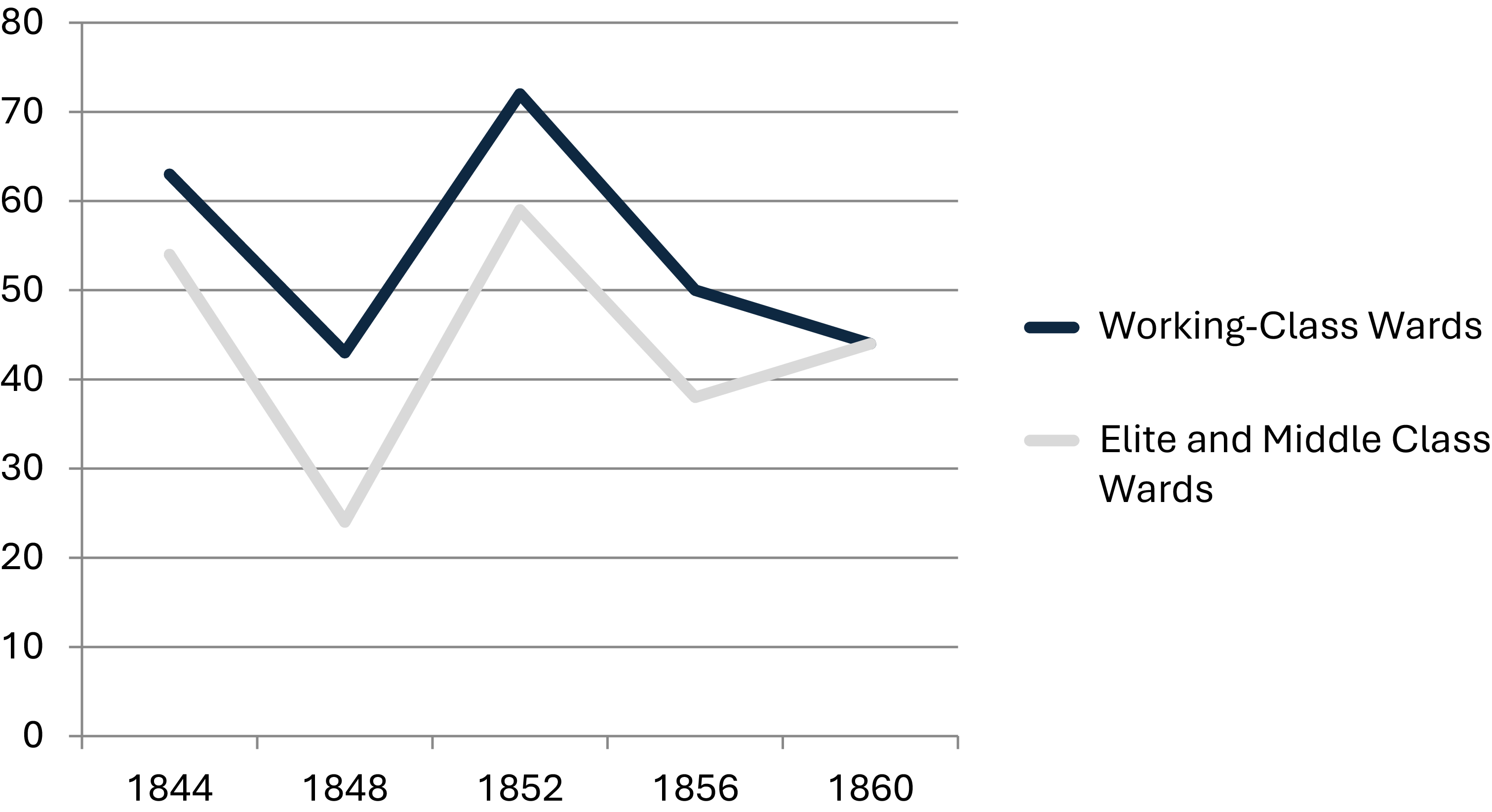
Archival electoral returns by ward and precinct in Illinois and Alabama confirm the weakening of each state’s once dominant unionist blocs on the one hand and the ascendancy of insurgent blocs on the other. Figure 1 reports the Democratic Party’s average white vote share in Chicago wards by class from 1844 to 1860. The Democratic Party in Chicago was ever the champion of the slaveholding republic, but the political crisis precipitated the defection among the city’s white workers to the Republican Party. Though the Yankee elite on the Lakeshore and the middle-class shop owners just west of the present-day Loop were inclined toward Whig unionism (the gray line), working-class wards, located in the interior of the city and along the once putrid Chicago River, favored Democratic unionism (the black line). Their convergence in 1860 suggests that the insurgent Republican Party had forged a victorious cross-class Free Soil coalition. The effect of national politics is evident in the trajectory of the returns: a decrease in Democratic vote share with the success of Whig presidential candidate Zachary Taylor in 1848, a steep increase with the Democratic comeback of 1852, and the collapse of Democratic unionism following the backlash to the 1854 Kansas-Nebraska Act.Footnote 6 The political convergence among elite and landless whites would be repeated throughout Illinois (de Leon Reference de Leon2008: 55).
Average Democratic vote share in Chicago wards by Class, 1844–1860.

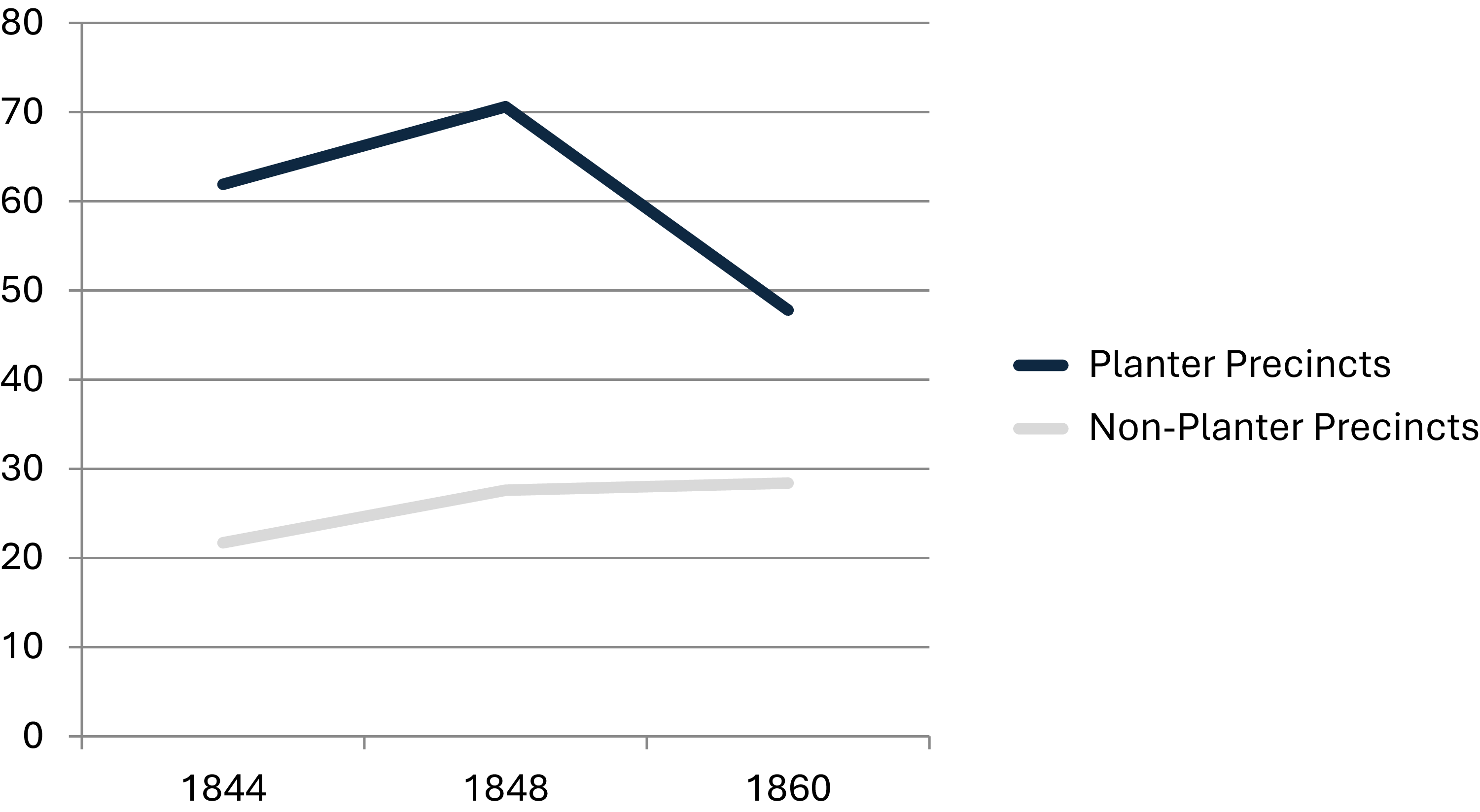
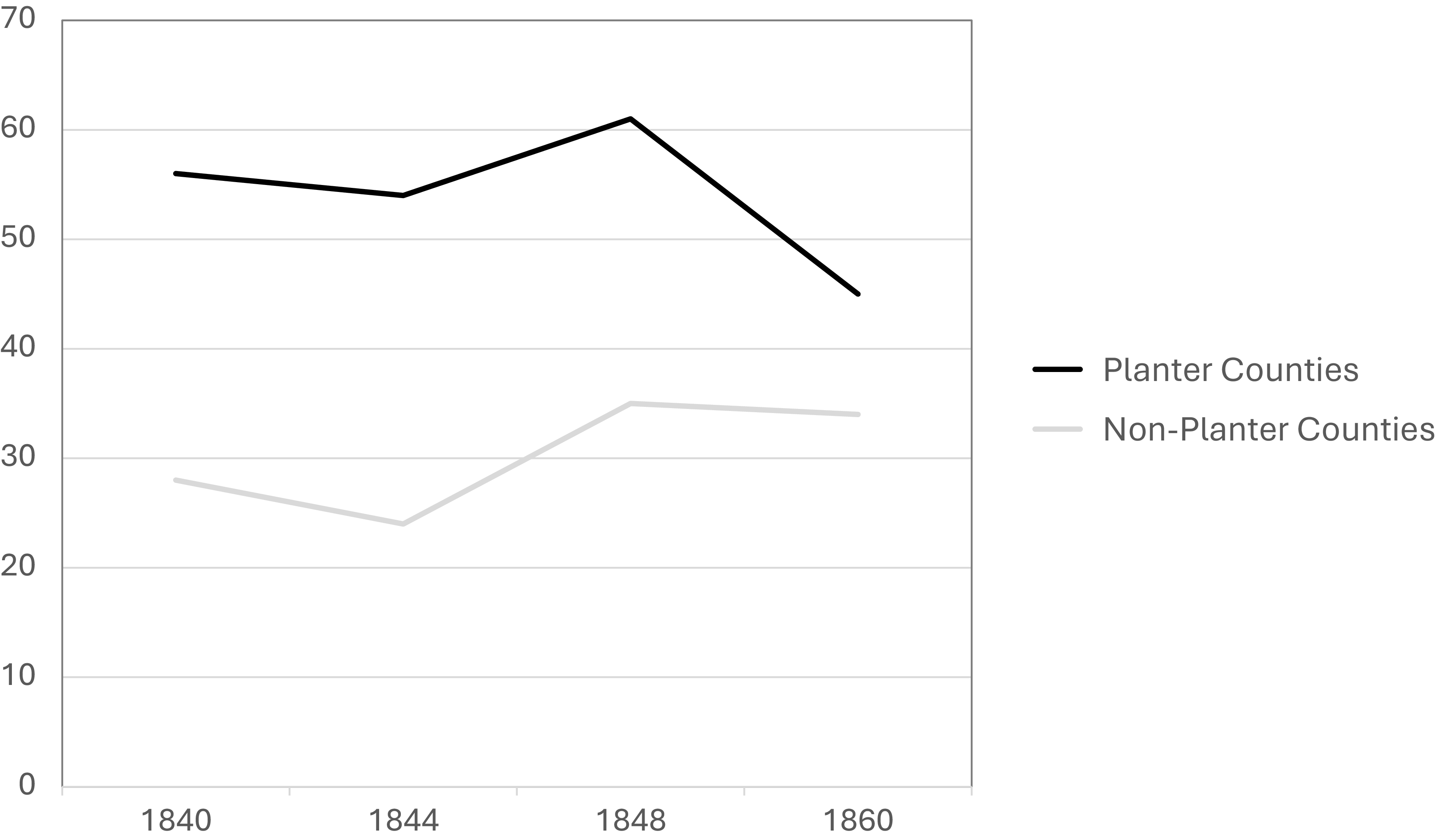
We see an analogous pattern in Tuscaloosa County, Alabama, where Whig unionism had been popular among the white planter elite. Some planter precincts defected to the Democratic Party in 1844, attracted by the prospect of westward resettlement and Manifest Destiny. Figure 2 shows that when the logistics of expansion drew Congress into an intractable debate over slavery extension, planter precincts (figured in black) flew back to the Whig Party in 1848, rallying to the standard of Zachary Taylor and Whig unionism. The precipitous drop in planter support for the Whigs by 1860 offers evidence of the collapse of mass consent for unionism after 1854. Whig planters joined as never before with petty and non-slaveholding whites (figured in gray) in support of secessionist Democrats.Footnote 7 Figure 3 demonstrates a similar convergence across the state of planter counties (in black) and non-planter counties (in gray) away from Whig unionism and toward Southern Rights secessionism.Footnote 8
Average Whig vote share in Tuscaloosa precincts by Class, 1844–1860.

Average Whig vote share in Alabama Counties by Class, 1840–1860.

After their electoral collapse in the 1860 presidential election, unionists were unable to prevent the country’s ensuing breakup. Alabama’s secession convention was held in January 1861. Southern Rights Democrats were so dominant by then that the debate centered not on Abraham Lincoln’s territorial policy, but rather on how and on what timeline they should resist Lincoln’s administration. The delegates to the convention included 53 “immediatists,” primarily Southern Rights men who would not wait for Alabama to secede from the Union, and 47 “cooperationists,” mostly former Whigs who wanted to host a convention of slaveholding states before making a decision (Nichols Reference Nichols1948: 418; Thornton Reference Thornton1978: 426). With the immediatists already in the majority, the final vote for immediate secession was sixty-one ayes to thirty-nine nays. Both delegates from Tuscaloosa voted in the negative (Barney Reference Barney1974; Owen Reference Owen1921: 902; Smith Reference Smith1861: 97–98, 118–119). By 1861 no institutional obstacle remained to stop the momentum of the crisis.
Conclusion
If political crises are underpinned by economic relations as mediated or enforced by the state, then why did the political crisis over slavery turn on a racialized dispute over population? My answer has been that insurgent political actors pinned their constituencies’ hopes of economic independence on imagined demographic futures that disrupted mass white consent for the existing configuration of settler colonialism and slavery. Theoretically, this account is anchored in a synthesis of the conjunctural and discursive approaches to articulation.
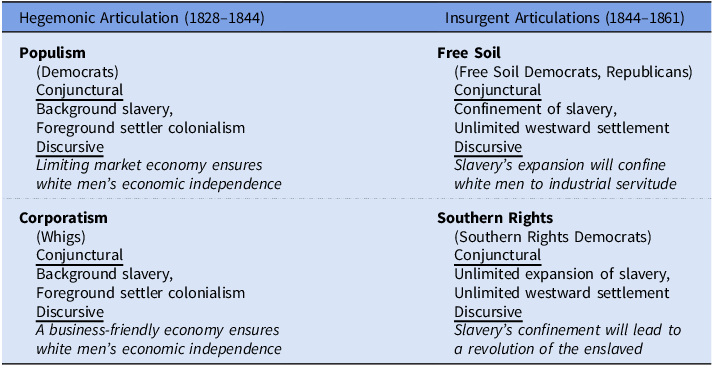
By way of evidence, I have analyzed the time periods or sequences in the years just prior to the US Civil War. As Table 1 shows, the resulting narrative is a story about the ascendancy of insurgent articulations and the defeat of two theoretically plausible alternatives: (1) a crisis organized along class lines and (2) the absorption of sectionalism. From 1787 to 1844, political elites employed a series of compromises to depoliticize slavery while debating policies that would ensure the economic independence of white settlers. Political elites thus managed to articulate slavery to settler colonialism by studiously avoiding the former and fighting about the latter. The blocs of the Jacksonian era (1828–1844) were thus cross-sectional class-based coalitions: the Whig Party, which unified landed and industrial elites with middle-class shop owners and professionals through the discourse of corporatism; and the Democratic Party, which joined small to middling farmers with landless white workers through the discourse of populism. Far from precipitating a crisis of hegemony, class conflict channeled the anxieties of white settlers into institutional politics.
Competing articulations (1828–1861)

Beginning in 1844, however, insurgent factions pressed competing plans for the future relationship of slavery and settler colonialism. Illinois Free Soil Democrats and later Republicans held that slavery’s westward expansion would enable planters to overrun those lands with the enslaved and thereby relegate landless whites to industrial servitude. Alabama Democrats argued that restricting slavery in the West would exponentially increase the Black population and lead to the overthrow of slavery and the white race. Accordingly, unlimited settler colonial expansion without restriction to slavery would defuse that demographic timebomb and preserve slavery for generations to come. These new population politics fractured the bases of the old party system and forged new cross-class sectional white blocs: the Southern Rights Democratic Party, which unified the landed elite with small to middling farmers and landless whites in the South; and the Republican Party, which joined the incipient industrial elite to middle-class shop owners, farmers, and landless white workers in the North.
The unionist establishment did not take the sectional challenge to their power lightly. Between 1848 and 1854, the Whigs mounted a successful bid to absorb the Free Soil and Southern Rights insurgents back into the party system. As the absorption strategy permitted further westward expansion, however, political elites found themselves once again in a congressional stalemate over the status of slavery in the West. The resulting resurgence of sectional articulations eventuated in a crisis of hegemony, in which the mass white electorate of each section withdrew their consent to be ruled under the existing terms of the Union.
This account has several implications. First, the article moves us beyond neo-Marxist theories that assume the temporal and causal precedence of economic relations relative to political crises. It collapses that analytic separation by suggesting that the politicization of the interlocking elements of the dominant social formation – not the socioeconomic by itself – facilitates the withdrawal of mass consent. Second, the article holds that cultural dynamics, in this case political discourse, may overflow the capacity of political systems to avert crisis, while rejecting the outmoded notion that the US Civil War was a clash of civilizations. Third, in contrast to the existing literature on political crisis, which privileges the role of the state, this article illuminates the role of parties and population politics. Finally, the foregoing revises the theory of political articulation, which focuses on the ways in which parties build blocs and suture the social together. In this piece I examine how and why parties tear the social apart. To repeat, a crisis of hegemony is a crisis of articulation.
Beyond the scholarly concerns above, this article offers a lens through which to view the current moment of racial reckoning in the United States and abroad. If the US Civil War was animated by the conflict between two competing visions for articulating slavery to settler colonialism, then the transition to liberal democracy in the United States was enabled by mass support for different modes of racial violence. This suggests that the very concept of democracy which organizes so much of our public discourse is potentially a misnomer and requires nothing less than a shift in paradigm.
In this, a Du Boisian approach to liberal democracy offers a useful alternative (de Leon and Rodriguez-Muñiz Reference de Leon, Rodriguez-Muñiz, Morris, Allen, Brown, Green, Hunter, Johnson-Odim and Schwartz2022). Rather than presuppose that liberal democracy is by definition an antiracist proposition, Du Bois held that democratic expansion often entailed the elevation of one racialized group over others (Du Bois Reference Du Bois2007 [1945]: 276). For example, in their zeal to preserve the economic independence of white men, few antebellum politicians beyond the most ardent abolitionists expressed concern for the possession and dispossession, respectively, of Black and Indigenous people. Though the latter endured a permanent crisis, white elites and mass publics held no sympathy for Native Americans and saw the enslaved as the source of demographic apocalypse instead of a moral stain on the republic. Understanding democratic expansion as always potentially racialized can inform the work of mass movements, as they diagnose and challenge the ways in which supposedly democratic institutions consolidate, rather protect against, elite power.
The centrality of demographic futures in the political crisis over slavery also pulls for a critique of right-wing ethnic nationalism, now in the ascendant from the United States and Hungary in the Global North to Brazil, Turkey and India in the Global South. Contemporary population politics are shaking the foundations of states that were once thought to be stable liberal democratic regimes. Rather than assume that this is an aberration, a Du Boisian sensibility would have us see ethnic nationalism as part and parcel of the liberal democratic project. It is therefore incumbent upon us to envision and struggle for an alternative to liberal democracy, one that takes seriously the enduring legacy of white supremacy, colonialism, and slavery.
Acknowledgments
I am grateful to Yasemin Bavbek, Zophia Edwards, Veda Kim, Heidi Nicholls, Joan Scott, and Don Tomaskovic-Devey for their feedback on previous drafts of this article.
Supplementary material
To view supplementary material for this article, please visit https://doi.org/10.1017/ssh.2025.10114


 Open access

