

The battle for free communications is then necessarily part of a much wider social struggle, but that is no reason from abstaining from struggle, from proposal and counter-proposal on each and every issue that arises. —Raymond Williams. Television.
On October 18, 2019, a group of Chilean high school students decided to organize a coordinated subway fare evasion in Santiago. Students were protesting a thirty-peso hike in the service as a symptom of an economic model that made life increasingly difficult for the vast majority of Chileans.Footnote 1 Disregarding the stark inequalities that define Chilean society, the conservative government of Sebastián Piñera tried to quench the rebellion by sending the special forces of carabineros to repress the students. As the conflict escalated, the president claimed that “Chileans were at war with a powerful enemy,” declared a “state of exception,” and insisted on a repressive solution to a political conflict that, among other things, left more than three hundred protesters with ocular damage caused by carabineros’ rubber bullets and pellets (Piñera Reference Piñera2019).Footnote 2
In turn, the disproportionate and criminal response of the government and the general discontent with the economic model prompted millions of Chileans to take to the streets of Santiago and the main cities of the country. As one of the most famous posters in the marches claimed, the revolt was not about thirty pesos; it was about thirty years of neoliberal governments promoting an economic model that brought poverty and harsh inequalities to most Chileans (Abufón Reference Abufón2019).Footnote 3
In the days following the uprising, Plaza Italia, one of the main squares of Santiago, was renamed Plaza Dignidad (Dignity Plaza), a stray dog—Negro Matapacos—was appointed patron saint of the revolt, the feminist collective Las Tesis performed and made viral their piece “Un violador en tu camino” (a rapist in your path), and social media posts were full of slogans such as “No son 30 pesos son 30 años” (It’s not about thirty pesos, it’s about thirty years”) or “Chile despertó” (Chile Woke Up). It was a veritable revolutionary spring that brought to an abrupt end the politics of consensus tailored by the elites since the end of the Pinochet dictatorship, thus paving the way for the creation of a new constitution.
As people were marching on the streets, a YouTube video titled “El reemplazante despertó” (“El reemplazante Woke Up”) also went viral.Footnote 4 El Reemplazante (The substitute) refers to a successful TV series that ran on TVN (National Television of Chile) from 2012 to 2013. The show tells the story of a group of poor students and their inspiring professor, Carlos Valdivia (Iván Álvarez Araya). Valdivia is a financial operator caught in a scheme of corruption that forces him to take a job as a math substitute. Over the two seasons of the series, Valdivia inspires his students to raise their grades on the PSU (the former exam for college admissions) while he discovers and joins the fight to end segregation in the Chilean educational system.
Betting on the past popularity of the show, the creators of the series inserted the above-mentioned short video in the social media landscape. They were clearly aiming to position the TV show as a precedent for the social uprising of 2019. To that end, they placed two of the most iconic characters of the series, Flavia (Karla Melo) and Maicol (Sebastian Ayala), on a sidewalk discussing, after graduating from high school, whether there could be meaningful changes in Chile. The scene exploits the unresolved romantic tension between the two adolescents over “El baile de los que sobran” (“The dance of those left out”), the rock anthem of the resistance against Augusto Pinochet’s dictatorship in the 1980s by the legendary rock band Los Prisioneros. As the camera pans up to show a military helicopter and then down to show a panoramic shot of an impressive march in Plaza Dignidad—the epicenter of the protest in Santiago de Chile—the music changes to the main title theme of the series, “Mi verdad” (My Reality) by the Chilean rapper Ana Tijoux. The video ends with Flavia and Maicol banging pans in the middle of a protest, holding hands, and kissing at the end.
The success of the short video in social media with more than one hundred thousand views surely speaks to a political necessity to connect past and present uprisings and social struggles from a popular perspective as well as to the power of heteronormative happy endings. At the same time, the immediate popularity of this and other short videos from the creators of El reemplazante points to the survival of a TV series that changed the rules of television in Chile. For most of the audience, El reemplazante was a televisual representation that, for the first time, interpellated the popular sectors of Chilean society. In fact, when the actors and actresses of the show learned about the 2019 social uprising, one reported that they said to themselves, “Dude, we already filmed this. [We] already filmed the discomfort, the fury, and the disenchantment” (Valbuena Reference Valbuena2021).
The main hypothesis of this article is that El reemplazante broke the Chilean televisual consensus by introducing to the small screen the subjectivities of the popular classes, particularly the lower mestizo class—that television, up to that moment, tended to condemn to a series of racist and classist stereotypes (Chico Reference Chico2014). As it is well known, the word consensus possesses heavily loaded connotations in Chile. Tomás Moulián (Reference Moulián1997, 37), the dean of Chilean sociologists, once famously wrote that “consensus is the superior phase of amnesia.” What he meant is that the politics of consensus that defined the transition to democracy in Chile in the 1990s was a covert way of forgetting the violence of the Pinochet dictatorship. Furthermore, the politics of consensus refer to a particular way of deactivating social antagonisms while whitewashing the violent roots of the current democratic and neoliberal economic order in Chile.
In addition, the worshiping of consensus as the only possible public policy silently authorized the transformation of the welfare state of the 1970s into a subsidiary state in the 1980s and 1990s (Gárate Reference Gárate2013). Under this model, the state went from being the main provider of public education, health care, water supply, and virtually every other service to subsidizing private companies that would be allowed to profit from selling those services while transforming them into commodities, thus subjected to the law of supply and demand.
The realm of media and television was of course no exception. In the 1970s, there were only two channels in Chile, Channel 13 and Channel 7. Channel 13 was private and operated by the Pontifical Catholic University, and Channel 7 was public and operated by the University of Chile, the largest and most prestigious public institution in the country. TV licenses were exclusively granted by the state. At the end of the dictatorship, in 1989, the government decided to “liberalize” broadcast TV. According to Sunkel and Geoffroy (Reference Sunkel and Geoffroy2002, 145), this policy created “a market oligopoly of four companies that concentrate a good chunk of the publicity and audience market.”
Although the ownership of these channels—Tele13, Megavisión, Chilevisión, and TVN—has changed over time with the entrance of bigger corporate groups in 2010, such as Warner Media and the Luksic group, the concentration has remained intact. Of these four channels, only TVN is public, but it is a very peculiar public channel. Unlike BBC in the United Kingdom or TVE in Spain, TVN must compete with the other channels and generate the same publicity revenues. This is not just a neutral effect of the market. It was established by design. In 1992 TVN was refunded with the passage of Law 19,132. Article 24 of said law explicitly established that TVN should work like a private corporation and have its balances and accounts audited like any other private media conglomerate. This meant, among other things, that the state could not inject capital into it or lend money to the channel to subsidize high-quality programming of public interest.Footnote 5
To bypass these limitations, the government created CNTV (the National Television Council) to subsidize TV content instead of financing its own public TV. Under this model, different producers compete for grants to create TV series and other programming. This is the exact same logic of the subsidiary state I described earlier. In other words, rather than financing its former public TV channel (TVN), the state subsidizes the supply of the service based on a system of grants and awards that clearly favors private media corporations. As Roberto Bruna (2013) further explains: “The channels see their programming enriched with high quality products just by lending their screen as a shop window. If the product is a success, they capture a good deal of publicity resources and they externalize their production expenses. Sweet deal.”
For our purposes, this means that air TV very rarely reflects the subjectivities of the popular and poor sectors of the country. This is what I call the Chilean televisual consensus, a highly concentrated media system that makes very difficult or almost impossible for critical voices and fiction to appear on TV. As I explain in detail, El reemplazante was for a while the exception to the rule.
Televisual mediations: From the superteacher model to the construction of a popular subjectivity
The premise of El reemplazante follows the highly recognizable and popular model of the “superteacher myth.” This used and abused formula is found in a variety of Hollywood blockbusters, including but not limited to titles such as Dangerous Minds (1995), Stand and Deliver (1988), or Freedom Writers (2016) (Farhi Reference Farhi2014, 157). It is evident that the creators of El reemplazante were fully conversant with this myth. As Javier Mateos-Perez (2019, 213) explains, they even copy the slogan of the film Dangerous Minds as a series subtitle: “She broke the rules … and changed their lives.” The formula, however, presents several ethical and political pitfalls. Ana Helen Petersen (Reference Petersen2009), for example, has criticized it because it frames race and the feminine as abject. She further argues that these films put in place a “white gaze” that constructs “race as a problem to be solved, a color to be blanched, and an evil to be eradicated” (Petersen Reference Petersen2009, 31). These films, she argues, are less about the underprivileged students of color they depict than about the ego of the white teacher and the need to assuage the guilt of a middle-class white audience that has never set foot in such neighborhoods.
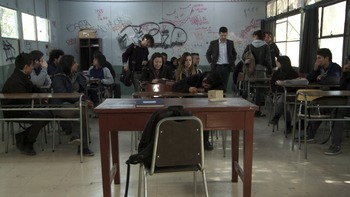
Although racial formations are not exactly equivalent in the United States and Chile, a similar white criollo gaze operates in El reemplazante. Footnote 6 Indeed, the show codes Valdivia—a light-skinned Chilean—as the point of view that structures the plot, the subject the audience is called to identify with. Valdivia is a curious example of the “superteacher myth” because he grew up in San Miguel, a working-class neighborhood adjacent to the school, but he was working in “Sanhattan,” a composite of Manhattan and Santiago that refers to the financial district of the city. In other words, he is from the neighborhood, but he comes back to the school from an upper-class, white space of the city to save the poor mestizo students—with whom he will end up identifying. In the beginning, though, things are not easy. As soon as he sets foot in the classroom, Maicol, one of the students, threatens him with a knife and his cellphone vanishes into thin air. These scenes create a symbolic economy that reifies the white criollo spaces of the city, like Sanhattan, as orderly and rational while representing the mestizo and popular neighborhood of the Príncipe Carlos School as chaotic, violent, and in need of reform and redemption (Figure 1).
Charlie (Ivan Álvarez Araya), the “superteacher” in the classroom of the school Principe Carlos.

By the same token, the series links these racist and classist divisions of the city to the bodies of light-skinned women. The narrative of both seasons is driven by the love affairs of Carlos Valdivia. At the beginning of the first season, Carlos is involved with Rosario (Ignacia Allamand), a well-to-do businesswoman who lives in the financial district. As Carlos becomes more engaged with the students, the romantic tension switches to Ana (Blanca Levin), the art teacher, who is committed to helping the students at the school. But Ana is in a relationship with Pancho (Roberto Farías), the married brother of Valdivia, thus installing a melodramatic Oedipal triangle with Ana at the center of this fratricidal competition for her—the two orphan siblings are seeking in Ana both their lover and their lost mother. Once the relationship with Ana is over, in the second season, the narrative hook oscillates between Carlos’s unresolved tension with Isabel (Valentina Muhr), the new school counselor, and his impossible romance with Lucía (María José Ilanes), the mother of a student. All these women are, without exception, light-skinned lower-class women or elite white criollas, and they are for the most part objectified.
Yet at the same time, El reemplazante is not simply a copy of the Hollywood model of the superteacher myth. For starters, the series quickly deconstructs the criminalization of the students. In the second episode of the first season, the audience learns that Maicol was using a fake knife to assault Carlos and that he has nothing to do with the disappearance of Carlos’s cellphone. One can, indeed, interpret this scene as a hermeneutical warning: beware of appearances, because the protagonist of this show might not be like others you may have seen before on screen.
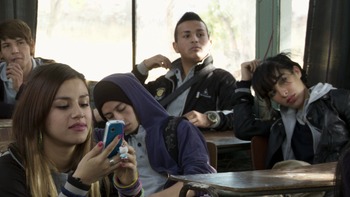
In fact, as the series advances, the focus moves from Carlos Valdivia to the students, from the individualist male hero and his narcissistic romantic exploits to the collectivity of the students and their problematics. These include but are not limited to teen pregnancy, same-sex relationships, homophobia, racism, the high price and low quality of education, drug trafficking in the poblaciónes (shantytowns), lack of opportunities, family problems, lack of access to health care, and of course, romance (Figure 2).
From left to right: Flavia (Karla Melo), Maicol (Sebastián Ayala), and Kathy (Rocío Monasterio).

The show is a veritable portrait of youth in the poor areas of Santiago, but as we will see in the next section, one that always refuses victimization and pornographic exploitation of others’ pain. For the first time in the history of Chilean TV, viewers saw a show that mixed recognizable TV narratives with the oral and visual register of the popular neighborhoods of Santiago de Chile. This palimpsest combines highly recognizable elements of the Hollywood tradition (i.e., the superteacher myth) with a realist portrayal of poor mestizo youth in Santiago.
In this sense, the best way to further theorize the radical visual hybridity of the show is Martín-Barbero’s concept of mediation. Unlike other Latin American intellectuals, Martín-Barbero (Reference Martín-Barbero1997, 13) never regarded television as the “people’s opium,” nor did he consider TV audiences in Latin America as passive receptors of hegemonic values. Instead, he analytically distinguished between mass culture and popular culture, envisioning the unfolding of mass culture in Latin America as an opportunity for the return of “repressed popular subjectivities” (Martín-Barbero Reference Martín-Barbero1987, 28).
Indeed, what he calls mediation is precisely a heterogeneous space in between popular memory and mass culture that alters the hermeneutics of televisual analysis. “For this reason,” writes Martín-Barbero (Reference Martín-Barbero1987, 233), “instead of beginning my research from the analysis of the logics production and reception to search later its relationships of imbrication and confrontation, we propose to begin the analysis from the mediations, that is to say, from the places of origin of the constructions that limit and shape television’s social materiality and social expression.”
However, mediation between popular and mass culture is more complicated in Latin American societies than in other locations because it must come to terms with the vexing heritages of colonialism and slavery. Consequently, the Latin American emergence of mass culture in general, and television, in particular, cannot be conceived without realizing that it has to mediate a vast heterogeneous number of elements from different cultures (e.g., Western, national, regional), social classes, and ethnic groups (e.g., indigenous, black, mestizo, white, criollo) that conforms the thick layers or abigarramiento of Latin American societies.Footnote 7 As Martín-Barbero (Reference Martín-Barbero1997, 17) further explains: “Whether we like it or we hate it, television today constitutes the most sophisticated dispositive of shaping and deforming popular taste, and, at the same time, one of the most expressive mediation of narrative, gestural and performative matrixes of the popular cultural world, understanding by this not the specific traditions of a people, but rather the hybridization of certain forms of enunciation, certain narrative knowledge, and certain literary and theatrical genres from our Western and mestizo cultures of our countries.”
At the same time, both these Latin American strategies of cultural mediation and the emergence of popular subjectivities have a particular and differential history in the case of Chile. To begin with, the term popular and its derivatives población (shantytown) or poblador (shantytown dweller) are commonly used to refer to a lower mestizo class—the popular sector—that has been historically much more inclusive than the industrial working class of European societies (Garcés Reference Garcés2002).
In this regard, this popular mestizo class has nothing to do with the “happy” mestizaje or “mestizofilia” of the Latin American national building projects of the nineteenth century. In the Chilean context, someone of “popular extraction” is not the product of any kind of genetic mixing, but rather someone who is nonwhite, lower class, and of an unclear and dubious origin. In fact, as Sonia Montecino (Reference Montecino Aguirre2010) has explained, the lower mestizo class is historically the product of an often violent union between a Spanish white man and an indigenous woman. The children of this union were born out of wedlock and were popularly referred as huachos and huachas, a word of Quechua origin that refers to adulterous relations.
This created a particular family structure that did not adhere to the heteropatriarchal concept of the European nuclear family. As Montecino (Reference Montecino Aguirre2010, 48) further argues: “Normally, the mother remained with her child, her huacho, abandoned and searching for survival strategies. The Spanish father thus became an absent figure. The mother, present and singular was the one providing a part of the origin: the father was plural, it could be this or that Spaniard, a generic father.” Montecino claims that this family structure has created a sort of universal structure of kinship à la Lévi-Strauss that has been preserved from colonial times to the present in Chile.
Although it is easy to charge Montecino with providing essentialist explanations for phenomena that are surely more complex, the fact is that her foundational narratives still have great explanatory power for the Chilean popular classes. To be sure, history is not an essential continuum that can be grasped with a positivistic hermeneutic. By the same token, structures of kindship or family relations are not as ontologically stable as to provide a transhistorical explanation of paternity and maternity roles in Chile or anywhere else for that matter, as Montecino argues.
Yet without accepting the ontological foundations of this argument, we can retain some of its explanatory power to understand popular mestizo cultural formations as social constructions in El reemplazante. In fact, I further argue that part of the appeal of this TV series has to do with the reprocessing of many of the elements described by Montecino. To begin with, the characters of the series speak a linguistic variant of Spanish clearly identified with the popular sectors of Chilean society. There is no effort here to “translate” the oral register of the characters into an educated register to make it universally appealing. Moreover, the slang of the city’s popular sectors is celebrated, not stigmatized. This has deep implications for an audience accustomed to being chastised for not speaking the upper-class variant of Spanish. As Ángel Rama (Reference Rama2004, 73–74) famously argued, the white criollo elites tended to perceive this popular language as an “enemy language” that needed to be constantly purified so that it did not “contaminate” the European lettered city with this “chaotic and mestizo dialect.” To put it more explicitly, hablar mal was a stigma associated with the lower mestizo class, and with a popular subjectivity that the show here accepts not only as “normal” but also as authentic and even desirable.
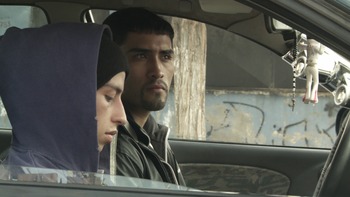
In addition to the use of the popular register of Chilean Spanish, El reemplazante constantly represents marginalization as a defining trait of popular subjectivity in Chile. To provide just an example among many, in episode 3 of the second season, Claudio, the drug dealer of the población, takes Maicol, a student, to a Mexican restaurant in an upper-class neighborhood of the city. There, he tries to convince him that criminal activity is the only option for people like them. In his own words: “The system is fucked up, Maicol, we don’t exist, bro. Look [pointing to one of the waiters] between that huevón [moron] and me, who do you prefer to be? You can study all you want, burn your eyelashes with those books, but at the end of the day the only thing you will become, huevón, is that [pointing again to the same waiter]” (Figure 3).
Claudio (Gastón Salgado), the drug dealer of the población, speaking to Maicol (Sebastián Ayala).

At the same time, marginality is narrowly linked to the experience of huacharaje, the proliferation of huachas and huachos throughout the two seasons of the series. The existence of nuclear families is, in fact, the exception, not the rule in El reemplazante. Huachos and huachas—the lack of a known father—are the norm, not the exception. For instance, the main title song of the series, “Mi verdad,” refers to the story of Maicol, a young huacho who doesn’t know his father and who takes care of her sister Toyita. Furthermore, the multiple aspects of the experience of huacharaje are constantly and obsessively explored in the show. The problematic status of fatherhood, the abandonment of children born out of wedlock, is a constant in both seasons. For instance, Flavia lives alone with her mother, but in the second season her biological father reappears, promising to take her with him to Argentina. In the end, it turns out that he was interested only in the little money she made working at a grocery store. Also, in the second season, Maicol’s mother meets a man from Calama who moves to Santiago and becomes the stepfather of Maicol and Toyita. Maicol, who never trusted him, will end up discovering that he is in fact a child molester trying to prey on his sister. In a somehow exaggerated version of this phenomenon, Gerardo Munizaga, another student at the school, becomes a neo-Nazi, in part because he does not have known father and he cannot tolerate seeing his mother engaging in a romantic relationship with his teacher, Carlos Valdivia.
All these subplots speak to the ambivalent status of paternity in Chilean society and the persistence of the huacharaje as a widespread experience for ample sectors of the bajo pueblo mestizo in Chile. It must be noted, however, that El reemplazante does not stigmatize this reality at all; it does not take the European nuclear family as the norm to produce the urban poor as uncivilized or pathologically deviant. On the contrary, it shows the experience of being huacho or huacha as a wound that finds its cure in the community. In the absence of nuclear families or a sense of traditional paternal functions, the characters of El reemplazante find support in the teachers of the school, in their friendships among peers, and even in Claudio, the drug dealer of the población who, in the absence of a welfare state, provides for some of the needs of the community.
In sum, the historical experience of marginalization of the popular sectors of Santiago—along with the experience of huacharaje and the persistence of structural inequalities—contributes to the construction of a popular subjectivity in El reemplazante. Moreover, the mise-en-scène, the use of nonprofessional actors, the variant of the language they speak, their life challenges, and the configurations of family and community allow the poor mestizo majority of the city to identify with this televisual fiction. These elements are, as I pointed out, mediated by the mass culture code of the superteacher myth and the Hollywood mirror.
Hyperrealism: The real and the repetition of the dictatorial past
One of the potential problems of Martín-Barbero’s concept of mediation lies precisely in the fact that it can contribute to whitewash power relations. Along with other concepts in Latin American theory—such as hybridity, transculturation, and mestizaje—it can be used to harmonize cultural and racial hierarchies or different forms of oppression. It can allow, for instance, celebrating a seamless visual discourse that blends the racist and misogynist narrative of the superteacher formula with more authentic forms of popular subjectivity. This can effectively sublimate social antagonisms by producing a televisual consensus that deactivates any questioning of the neoliberal model that was imposed during the Pinochet dictatorship (1973–1989) and that consolidated during the ensuing transition to democracy that began in 1990.
To avoid these pitfalls, the creators of El reemplazante linked very consciously the historical struggles of the lower mestizo class for a space in the city to the right for public and free education for all. Accordingly, El reemplazante was shot almost entirely in the municipality of Pedro Aguirre Cerda, one of the poorest neighborhoods of Santiago, but also home to some of the city’s most emblematic poblaciones.Footnote 8 Chile has a long and rich history of poor people organizing to gain access to housing. As Mario Garcés explains, in the 1950s, there was a strong influx of migrants from the countryside to the city. Most of them settled in so-called poblaciónes callampa—literally, mushroom shantytowns, because they popped up all over the city like mushrooms—such as Zanjón de la Aguada. Confronted with the lack of responses from the authorities, the inhabitants of these emergency camps organized themselves and occupied empty lots of land at the city’s outskirts to build their own neighborhoods or poblaciones (Mario Garcés Reference Garcés2002, 121).Footnote 9
The creators of El reemplazante were not only fully aware of this dense history of grassroots activism in Pedro Aguirre Cerda; they also wanted to render it into a televisual logic. To do so, they adopted a hyperrealist televisual esthetic, as they called it. The intended effect, as described by series producer Gándara (personal communication, 2016), was that “everything looked too real, you couldn’t distinguish in the mise-en-scène if this was fiction or a documentary.” It goes without saying that there is nothing natural about the effect of hyperreality. It is achieved through myriad televisual means, including, but not limited to, the script, particularly the use of a popular idiolect of Spanish Chilean, costume design, and especially mise-en-scène.
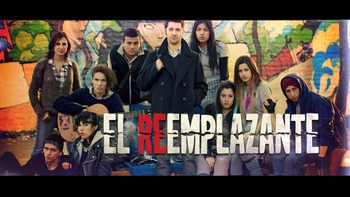
Nicolás Acuña, director of the two seasons, very closely followed the visual strategies and the mise-en-scène of the French film The Class/Entre les murs (2008). To avoid having actors and actresses from the upper parts of the city playing poor students from the shantytowns—a mistake that, in his own words, he had committed before—Acuña demanded that TVN let him use unprofessional actors from Pedro Aguirre Cerda. TVN accepted the request reluctantly. Acuña then proceeded to organize an acting workshop in the community to select the actors and actresses that will play the students in the show. He allowed only two professional actors in the workshop who also came from poor neighborhoods: Karla Melo (Flavia) and Sebastián Ayala (Maicol). However, both actors were instructed not to reveal under any circumstances that they were professional actors. While the workshop lasted, Acuña and the producers of Parox took the members of the workshop and the film crew to paint graffiti in the neighborhood to gain the trust of the community. The show was also filmed while school was in session, and actual students were often asked to participate as extras (Acuña, personal communication, September 7, 2022) (Figure 4).
The cast of El reemplazante in front of graffiti for the promotional poster of the show.

All these decisions contributed to create am immersive experience in the audience, a documentary feel, a sense of authenticity, or a hyperrealist aesthetics, as the creators call it. The hyper in hyperrealism, however, has nothing to do with the homonymous concept of French philosopher Jean Baudrillard—what is at play here is not the disappearance of reality under the spectacular logic of the media, as Baudrillard would put it, but a supplement to that reality, a magnifying lens that highlights its contradictions and structuring social antagonisms. More specifically, the hyper unfolds in connection to urban spaces and the election of shooting locations with deep emotional and historical layers of meaning for most of the audience, especially those who grew up in poor neighborhoods like Pedro Aguirre Cerda.
One of these locations, the abandoned Ochagavía Hospital, stands out as particularly important. This edifice was supposed to be the largest public hospital in Latin America with 1,200 beds to serve the poor people of the surrounding neighborhoods. As such, it was one of the most symbolic urban projects of the Popular Unity government under socialist President Salvador Allende. The construction of the hospital begun in 1971, and it was supposed to last forty-five months. Unfortunately, Augusto Pinochet’s coup d’état interrupted the project in 1973 after the first thirty months of construction. During the dictatorship (1973–1989), the architectural complex remained empty, most likely because it was closely associated with the socialist project of Salvador Allende. The massive building was both literally and in the Benjaminian sense of the term a historical ruin. Surprisingly, with the return of democracy, successive elected governments refused or were unable to conclude construction or find an alternative project for the site.Footnote 10 As time went by, neighbors dubbed the building the “white elephant,” supposedly referring to an Indian myth according to which a white elephant is punishment in the form of a gift.Footnote 11
During the first season of the series, the “white elephant” appears in the background of several key scenes. It appears, for example, in a long shot when Maicol and Toyita escape their home because they discover that their stepfather was a child molester (episode 5, season 2). As the two siblings walk from their home to the school to take refuge, we see their tiny figures contrasting with the magnificent presence of the Ochagavía Hospital in ruins.
The building seems to be there for the entire series as a silent witness of the plot, but it is in the second season when it takes center stage. A good percentage of the second season deals with a new student, Gerardo Munizaga, and the rise of neo-Nazi movements in Chile. Munizaga is also the son of Carlos Valdivia’s new lover, Lucía. As the Oedipal conflict between Munizaga and Carlos intensifies, Víctor, a new Peruvian immigrant, became the displaced object of Gerardo’s hatred. Not coincidentally, Munizaga and his friends meet regularly inside the “white elephant” for their neo-Nazi rituals, with swastikas, Chilean flags, and SS-shaped torches. Finally, in episode 11, Munizaga acts on his threats and attacks Víctor as he returns from prom. When Víctor calls him a “son of a bitch,” Munizaga loses control and beats him with a brass knuckle, leaving him unconscious on the ground. To hide the traces of their heinous crime, Munizaga and his friends run back to the “white elephant” to burn their clothes stained in blood. In time, however, in the last episode, the police find the brass knuckle among the ashes of the fire, after one of Munizaga’s friends, full of remorse, confesses the racist crime. The burden of the proof is therefore in the old Ochagavía hospital.
Although there are some melodramatic and even superficial aspects to this subplot, the brass knuckle can be understood as the return of the Lacanian real of the dictatorship. I understand the Lacanian real here as an excess of death and violence that has remained frozen in time and space, a mnemonic object included by exclusion into the symbolic order. As Davoine and Gaudillere (Reference Davoine, Gaudillere and Fairfield2004, 15) put it, the real always return where “the oppositions that structure our common reality—inside and outside, before and after—no longer function, where the guarantees of legitimacy that underlie the social link are flouted.” The brass knuckle is that leftover of the symbolic order, a reality in excess, that prompts all the unanswered questions: Are we dealing here with Munizaga’s crime or with a much larger crime? The beating of Víctor or the crime of leaving the hospital in ruins? The white elephant or the brass knuckle? Neither or both?
These questions point to repetition, to the real as that “which knows neither name nor image and always return to the same place.” Munizaga’s crime is, in this sense, only the repetition of a previous and more brutal crime. The brass knuckle links together heteropatriarchal violence, toxic masculinity, the social abandonment of the most vulnerable sectors of society, racism, and in the end, the reproduction of fascism and death. In this regard, there is an excess of reality in these scenes, a hyperreality that connects the violence and resistance of the present with the dictatorial past. This return of the repressed violence of the past disrupts the possibility of understanding the show as a form of mediation that brings harmony and closure to the present.
In other words, any interpretation of the show through the lens of Martín-Barbero’s concept of mediation as a form of ideological consensus that suppresses power differentials is simply impossible. The image of the white elephant is stricto sensu the elephant in the room, an open secret: everybody knows that the inequalities of the present, the reproduction of the heteropatriarchy, and the neoliberal disregard for the most vulnerable members of society are the natural consequence of the unfinished building as a metaphor of the truncated socialist past of Chile. This interpretation is also substantiated by the fact that people also refer to the National Stadium of Chile, a former detention and torture center, as the white elephant.
In short, by placing this crucial scene in the Ochagavía Hospital, the writers of El reemplazante are changing the visual regime inherited from the dictatorship, unfreezing a frozen piece of time and space, and therefore unlocking the possibility of giving meaning to the past to explain and resist the intolerable inequalities and violence of the present.
The business of educational segregation
The connection between the hyperrealist esthetic, the representation of the city, and the possibility of arresting the repetition of violence and social exclusion take center stage as El reemplazante addresses the problematic of education, the central issue of the series. Most scenes are, indeed, shot at the Príncipe Carlos School. The school must be understood within the same visual economy as the white elephant. Both buildings are rundown and abandoned, and both were designed to serve the poor, but one represents the past while the other is firmly anchored in the present. In this way, the two locations visually connect the dictatorial past to the neoliberal present while situating the problematic of education within the horizon of the city and its geographies of exclusion and segregation.
Príncipe Carlos is a subsidized private educational establishment. There were three types of schools in Chile when the series were shot: public by neighborhood, private, and privado subvencionado (charter school). According to a report of Fundación Sol, a nonprofit organization based in Santiago, the approval of Law DL 3,472 paved the way for the Chilean state to abdicate its role of educational provider and enter into a partnership with the private sector. Based on this law, the state agreed to subsidize private school owners, and in exchange the private owners of these schools were allowed “to select, profit, and later to charge tuition thru the share financing policy of 1993” (Kremerman Reference Kremerman2011, 5). The immediate effect of this policy was that from 1992 to 2010, there were 2,901 new charter schools like the Príncipe Carlos, and 626 public school closed their doors (Kremerman Reference Kremerman2011, 5).
The plot of El reemplazante is firmly anchored in the consequences of these transformations. When Carlos Valdivia arrives to the school as a substitute, the first thing he notices is that a lot of the students are in the eleventh grade, but they do not know how to add and subtract. He also discovers that the lower grades are deleted from the official records to preserve the state subsidy. The whole system is nothing short of perverse, as the school receives money per student attending the school regardless of learning outcomes. This perversity is more poignantly exemplified in episode 10 of the first season, when the student Lalo (Ricardo Olea) electrocutes himself as he was painting graffiti on the walls of the school; he died because of the lack of maintenance of the school electrical infrastructure. One might think, following the laws of melodrama, that the show is trying to suggest that this is an educational system kills its own students. Yet things get even worse when Carlos Valdivia and his students find out that the school principal has kept Lalo on the school roster after his death to receive the state subsidy. In other words, this subplot shows how the school has transformed Lalo into an object, a commodity from which to extract value and private profits, even after his death.
As Carlos and the students go deeper into the questioning of the school model, they clash with Jorquera (Jaime Azocar), the sostenedor (owner) of the school. Jorquera, like so many other sostenedores in real life, makes money by cooking the school’s books and divesting from its infrastructure. In fact, El reemplazante is framed around an important cycle of protests against this model of education The peak of this social movement, that can be considered the antecedent of the 2019 social uprising, is both the so-called penguin revolution of 2006 and the college student movement of 2011 (Mayol Reference Mayol2012, 188). Accordingly, in the first season, we see the students of Príncipe Carlos attending rallies in downtown Santiago, staging a performance of Michael Jackson’s “Thriller” dressed as zombies, and finally occupying the school facilities with a series of demands mostly centered on much-needed investments to improve their education (e.g., new bathrooms, computer labs, art workshops, teachers). In response to the student’s demands, Jorquera proves willing to do anything to preserve his profits: He brings the carabineros to repress the students, openly lies on TV, appoints Carlos’s brother as new school director of the school, bribes him, and more.
At the end of the first season, Carlos comes up with a clever solution to resolve the conflict. Using the law regulating charter schools, he proposes that parents and professors become investors and stockholders in the school so that they can buy the educational establishment from Jorquera. It is a market solution, as one of the students, Katy (Rocío Monasterio), points out, but it is one that the parents and the students seem to accept eagerly as a lesser evil. Initially, Jorquera, the owner of the school, seems to agree with the proposed solution, but in the first chapter of the second season, the audience discovers that he has sold the school to Los Condores, an educational megacorporation.
The second season, indeed, explores the effect that these huge conglomerates like Los Condores had on the Chilean educational system. These corporations use several opaque financial schemes to generate huge profits. Typically, one of these conglomerates may own several schools, universities, real estate companies, construction businesses, and so-called ATES (Technical Assistance in Education). ATES are private companies that offer schools pedagogical services, train teachers and sell other educational services under the pretense of improving the quality of education. Often the companies are owned by the same family or a small group of investors that sale services and products to each other using different tax ID numbers and forms of legal ownership. For example, one person may be the executive of a construction company that builds overpriced classrooms for a brother that owns a high school and who, in turn, hires an ATES company owned by another relative to provide educational services to the school and so on. These facts are conveniently hidden from parents and students by these educational establishments and by the government via the use of different ID numbers and other tactics. This modus operandi allowed these educational conglomerates to charge both the state and the families exorbitant prices while delivering very low-quality education.
True to the televisual esthetic previously described, the second season is a very realistic representation of the conflicts that these educational corporations create. To begin with, the new school director, Nieves (Trinidad González), renames the school as Prince Charles, brings new private school–like uniforms for the students, and speaks of Los Condores as a “recognizable brand because it promotes excellence.” In addition to this new talk about excellence and the status symbols, the school has a new counselor, Isabel (Valentina Muhr), who represents Educativa, an educational company (or an ATE) that advises the school on delivery of high-quality standards of teaching. As Mateos-Pérez (2018, 210) points out, the script writers based this and other subplots on their research into the issue of education, “that was the case of the name of the School, Prince Charles, which was selected because of its semantic proximity, after reading in the press the case of the Britannia Schools. The sostenedor of the schools escaped with the professors’ salaries of these educational establishments.
Katy and Ariel, the students’ representatives, are the two characters who discover the pitfalls of this new version of the school. They visit the headquarters of Educativa only to find out that Jorquera, the previous owner, is sitting on the board of Los Condores. Later, with the assistance of Carlos Valdivia, the students discover that Gabriela Urzúa, Jorquera’s wife, is the owner of Educativa, and Hormazabal, the owner of Los Condores and the school, is an investor in Jorquera’s real estate business. In other words, the real estate business, Educativa, and the schools are owned by two families that sell services to each other in order to maximize profits at the expense of students and their families. When Carlos Valdivia finally confronts Hormazabal—“You use legal gaps to fill your pockets”—Hormazabal responds: “The state support us, and it also protect us, and let me tell you something else, Mr. Valdivia. If you dislike profit in education, announce your candidacy, enter the congress, and change the laws” (episode 9, season 2).
In short, Hormazabal’s response encapsulates the entire problematic of education in Chile. It exposes in a raw manner the covert solidarity between the commodification of education and the perpetuation of urban segregation and inequalities in Santiago de Chile. Yet the real drama is not that companies can extract profit from poor vulnerable students from the periphery of Santiago, but, as Hormazabal put it, that everything is perfectly legal.
Coda: The endless endings of El reemplazante
El reemplazante documented and effectively exposed the deleterious effects of neoliberalism in Chile and was a direct antecedent of the 2019 social uprising. Indeed, the show can be understood as a televisual meditation on the “open secret”: the continuation of the dictatorship by other means and the deleterious effects that the subsidiary state has on the everyday lives of young poor mestizo students and the general population in Chile.
It was, by all accounts, a unique show that managed to change the conversation not only about the educational model in Chile but also about the structural inequalities brought about by the neoliberal model imposed during the dictatorship. Furthermore, El reemplazante broke the Chilean televisual consensus, by allowing popular subjectivities to emerge on the screen without falling into the violent and melodramatic stereotypes of poor people that had dominated TV series up until that moment (Chico Reference Chico2014).Footnote 12 At the same time, the use of a hyperrealist mode of representation avoided the potential dissolution of social antagonisms and inequalities into the spectacular logic of television. Instead, El reemplazante documented young poor people’s reality, allowing wide sectors of the audience to decode the show as a televisual representation of their own negated lives and subjectivities.Footnote 13
Not surprisingly, the final product was an unparalleled success. The show still counts with a large fan base on social media and has received multiple accolades. In 2013 it won three Altazor Prices (the equivalent of the Oscars in Chile) for best script, best leading actor, and best director. In 2014, the show was acquired by the Colombian public channel Señal Colombia. In 2017 Netflix bought the rights to the series to include in its streaming catalog (Mateos-Pérez 2019, 221). In 2021, the show also received a Golden Copihue as the best show of the last decade, a price granted by the readership of the popular newspaper La Cuarta.
Yet despite this recognition, the show was canceled in 2013 after only two seasons, leaving behind a large audience of fans still eager to watch at least a third season. My first instinct was to suspect a classic case of ideological censorship.Footnote 14 The theory was not farfetched, considering that the show aired on TVN, at the time under the supervision and control of the self-proclaimed neoliberal government of Sebastián Piñera. However, when I asked Sebastián Gándara and Ignacio Arnold, the producers of the show, about the cancellation, they both categorically denied the possibility of political censorship. Instead, they signaled significant audience decline as the main reason for the cancellation—the show’s screen share went from 15.5 percent to 10.6 percent, affecting the channel’s publicity revenue (Arnold, personal communication, October 16, 2016; Gándara, personal communication, November 8, 2016). Hence, if there was censorship, it was not perpetrated by the heavy hand of the state but was rather the “invisible” hand of the market and its categorical imperative to maximize publicity revenues. To put it more pointedly, the market model was a death sentence for a show like El reemplazante because it made it impossible to subsist in a highly concentrated and homogenous media landscape.
To make high-quality TV series like El Reemplazante in Chile, it is necessary either a robust public TV system or a different model of TV production altogether. Neither of the two things exists today in Chile. The show obviously fares much better on Netflix, where it fits a digital cable or “niche TV” model. However, limiting the series to a niche audience on Netflix is highly problematic, because most people in Chile (65 percent) still watch broadcast TV, in contrast to the 35 percent that watch cable and other forms of pay TV. In addition, it presents other problems and contradictions because Netflix “is not an open, social or collaborative platform” like YouTube, Vimeo, or other sites that allow users to upload content (Lobato Reference Lobato2019, 36). In short, limiting these shows to cable TV or niche TV platforms like Netflix deepens the same subsidiary model of production that condemns quality TV to be accessed only by a tiny elite with the means to pay for better contents.
Despite all these barriers, the creators of the show refused to give up. In 2018 they applied and failed to obtain another CNTV grant. In a recent interview, director Nicolás Acuña, declared that he was certain TVN would finance a third season of the series. In addition, Pablo Paredes and Nimrod Amitay, scriptwriter, and creator of the show respectively, have continued recording, small video interventions with the actors the cast of El reemplazante to comment on important events in the country.
The last one of those videos—“Apruebo” (I approve)—shows Flavia and Maicol discussing whether they would vote on the 2021 plebiscite to write a new constitution in Chile. The occasion was extremely important because the demand to write a new constitution emerged out of the 2019 social uprising. In the video, Maicol appears to be unemployed, but echoing the last feminist wave of protest in 2018, he is cleaning and cooking, while Flavia is comfortably sipping a cup of tea. Toyita references in passing that she was one of the students who participated in the coordinated subway fare evasion of 2019. In the end, Flavia and Toyita convince Maicol to go vote in the plebiscite to end the constitution approved during the dictatorship. In this fashion, the video reinserts El reemplazante into the public debate by reflecting the most recent changes in the country.
This stubborn refusal to accept the end of the show, as well as the cyclical return of the characters of El reemplazante to the contemporary Chilean scene, speaks to postponed justice. The characters keep visiting us because the causes that produced their fictional life in the first place remain the same. In fact, paraphrasing the great Gil Scott Heron, we can perhaps affirm that, this time, the revolution or at least its prelude before the social explosion of 2019 were, indeed, televised. As discussed, El reemplazante portrayed and documented the persistence of gruesome inequalities and in general the lack of a dignified life for the popular youth of Santiago.
To conclude, El reemplazante managed to “read” the social malaise of the country before it even exploded in 2019. Of course, the connection between culture and the political demands is not one of perfect causality. Things are, to be sure, more complex, but El reemplazante showed that breaking the televisual consensus was possible, that another television was desirable, one that represents the popular subjectivities of the youth in a dignified fashion. By doing so, El reemplazante became, in its own right, a small but significant part of a long trajectory of political transformations that started with the penguin revolution of 2006 and whose final outcome after the 2019 social uprising and the rejection of the 2022 constitutional draft are still undecided.
Acknowledgments
Special thanks to the students of the master’s program in literature at Universidad Alberto Hurtado (Chile): Darwin Caris, Cristofer Cordoba, Isaac Gajardo, Yanina Guerra, Rosita Herrera, Valentina Pacheco, Carla Pérez, Valeria Tello, and Claudia Zambra. They probably will not remember this, but we discussed El reemplazante on a cold winter night in a school very similar to the one in El reemplazante during an undergraduate student strike. The spirit of those days and their comments are essential to my argument. Many thanks also to Juanjo Adriasola for all the ideas and honest exchanges about social movements and culture over beers at the HBH pub in Nuñoa. And thanks to Nicolás Acuña, Ignacio Arnold, Sebastián Gándara, and Leonora González for responding to all my questions about the experience of creating El reemplazante. I hope these pages do justice to their creative endeavors.

 Open access

