


Introduction
Psaltis proposes a genetic social psychological theory that integrates ontogenetic, microgenetic and sociogenetic analyses in order to capture three types of transformation involved in societal change. I find this proposal particularly enticing for scholars, like me, interested in investigating how to develop in youth a critical understanding of social conflict and violence that contributes to peacebuilding.
Throughout my research trajectory, I have struggled with the limitations of analytic frameworks that focus their attention only on the individual’s mind, or on the influence of social context. Many of these struggles relate to concepts and propositions advanced by Psaltis in Part I of this volume, so engaging with his model allowed me to shed light on the challenges I faced and on the “solutions” I devised to overcome them. I thus decided to take his invitation to write a commentary on his chapters as an opportunity to trace the continuities and transformations in my own work, and to evidence the connections that exist between different parts of it that emerged at different times, in response to different methodological quandaries. My hope is that this self-reflective exercise also serves to illustrate the different components of Psaltis’s model, and the importance of integrating them in a holistic way if we want research and practice to contribute to conflict transformation (Psaltis, Carretero, & Cehanic-Clancy, Reference Psaltis, Carretero and Cehanic-Clancy2017).
This chapter is organized in three sections that describe the evolution of my work over time and the connections I draw with the three processes analyzed by Psaltis. The first discusses my research on critical thinking in the social domain and relates it to an ontogenetic perspective focused on analyzing the cognitive challenges that students face in understanding interpersonal conflicts and social controversies. I illustrate this with the analysis of an ostracism incident among adolescent girls in an American middle school. I then explain the limitations I faced with the cognitive approach I used, which could not account for how other factors, such as the construction of identities or social asymmetries, informed students’ critical thinking. The second section explains how the previous quandary led me to adopt a discursive approach in order to situate students’ performance of critical thinking in their relational and social contexts. I discuss the similarities between this phase of my work and the microgenetic perspective described by Psaltis, and illustrate it with a revised analysis of the ostracism incident and with a second case study of an online discussion about racism and police brutality among American high school students. The third section introduces my current research on the narrative normalization and de-normalization of violence and applies some of its ideas to an ongoing project on the memory and history of violence in the Spanish Basque Country. I draw parallels between this work and the sociogenetic perspective outlined by Psaltis, as it focuses on the societal level in which collective narratives are produced, disseminated, disputed, and transformed. The chapter ends with a brief recapitulation of the interconnections I see between the three analytic perspectives, in my own work and in the similarities with the model proposed by Psaltis.
Addressing Ontogenesis – Cognitive Tools of Critical Inquiry
I began my professional trajectory in Colombia, where I was born and raised. I am sure this shaped my interest in history education as a tool for peacebuilding. In one of my earliest studies, I analyzed how students progressively learn to integrate causality and intentionality in historical explanations, and how this shapes their understanding of agency in processes of social change (Bermudez & Jaramillo, Reference Bermudez, Jaramillo, Dickinson, Gordon and Lee2001). My assumption at the time was that the development of an increasingly sophisticated understanding depended on the individual’s capacity for historical thinking, which in turn was an expression of their intellectual experience reasoning about historical topics (Carretero & Voss, Reference Carretero and Voss1994; Dickinson, Lee, & Rogers, Reference Dickinson, Lee and Rogers1984). A similar view informed my work on moral education (Bermudez & Jaramillo, Reference Bermudez and Jaramillo2000). Research on the development of students’ moral judgment informed the design of pedagogical guidelines proposed to engage teachers and students in exploring moral dilemmas related to issues typical of adolescent life in school and community: stealing, lying, engaging in risky or destructive practices, hurting others to achieve what you want. Drawing on Kohlberg’s tradition (Reference Kohlberg1984), our approach emphasized the limited reach of choices and solutions when dilemmas are addressed with a simplistic mindset – and the improvement that comes about when reasoning takes into account diverse perspectives, beyond the immediacy of time, space, and norms.
Important as this work was, and is still today, looking back, I see that our conceptual frameworks, with a focus on universal reasoning structures and operations, made context irrelevant or insignificant. In a social setting of pervasive corruption, violence, inequality, and abundant discourses to justify them, students’ judgments were most likely influenced by their interactions with such context and discourses. But this did not capture our attention at the time. We had no room in our analytic models for the influence of context.
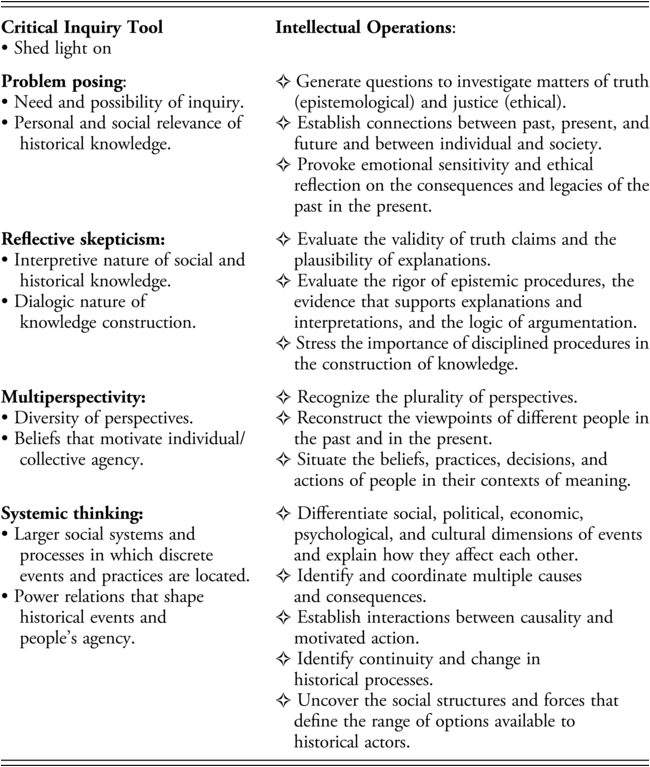
In 2001, I moved to start my doctorate at Harvard Graduate School of Education, and I brought this individual-centered constructivist mindset with me. Building upon educational interventions and datasets developed by Facing History and Ourselves (FHAO),Footnote 1 my dissertation investigated two cases of young people engaged in controversies about current and past violence: the Ostracism Case Study and the Twilight L.A. Case Study. Under the mentorship of Robert Selman and David Perkins, my goal was to analyze student learning to establish if an increasing capacity for critical thinking afforded a more sophisticated understanding of the dynamics of violence and its ethical problems. I developed an analytic model (Table 12.1) that established four tools of critical inquiry in the social domain, drawing upon different conceptualizations of critical thinking in the fields of cognitive and moral psychology, critical pedagogy, and historical thinking. The model reconciled a seeming divergence of approaches in four categories – problem-posing, reflective skepticism, multi-perspectivity, and systemic thinking – that capture the central intellectual operations that these traditions define as critical (Bermudez, Reference Bermudez2015).
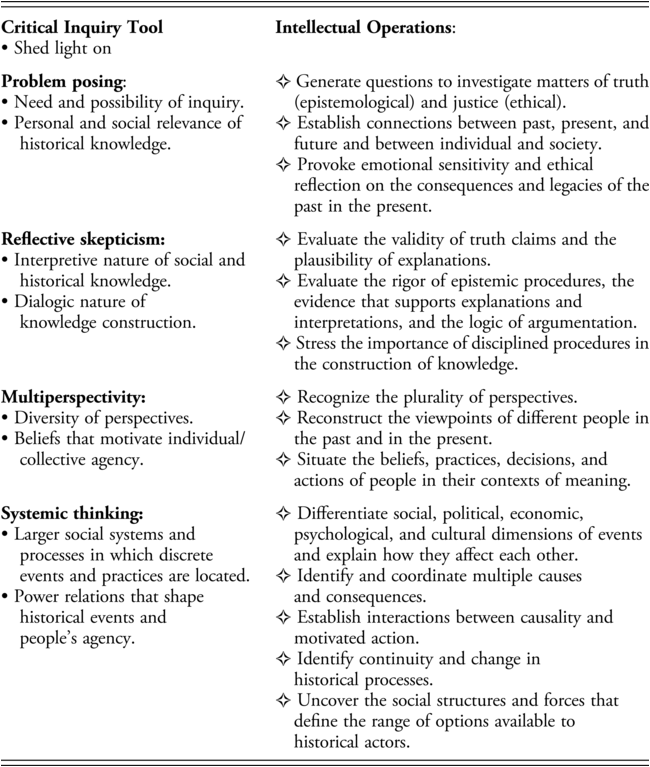
Table 12.1 Long description
The table has two columns. Column 1 titled Critical Inquiry Tool, Shed light on. Column 2 titled Intellectual Operations.
Row 1 column 1 titled Problem posing, lists the following.
1. Need and possibility of inquiry.
2. Personal and social relevance of historical knowledge.
Row 1 column 2 lists the following.
1. Generate questions to investigate matters of truth, epistemological, and justice, ethical.
2. Establish connections between past, present, and future and between individual and society.
3. Provoke emotional sensitivity and ethical reflection on the consequences and legacies of the past in the present.
Row 2 column 1 titled Reflective skepticism, lists the following.
1. Interpretive nature of social and historical knowledge.
2. Dialogic nature of knowledge construction.
Row 2 column 2 lists the following.
1. Evaluate the validity of truth claims and the plausibility of explanations.
2. Evaluate the rigor of epistemic procedures, the evidence that supports explanations and interpretations, and the logic of argumentation.
3. Stress the importance of disciplined procedures in the construction of knowledge.
Row 3 column 1 titled Multiperspectivity, lists the following.
1. Diversity of perspectives.
2. Beliefs that motivate individual or collective agency.
Row 3 column 2 lists the following.
1. Recognize the plurality of perspectives.
2. Reconstruct the viewpoints of different people in the past and in the present.
3. Situate the beliefs, practices, decisions, and actions of people in their contexts of meaning.
Row 4 column 1 titled Systemic thinking, lists the following.
1. Larger social systems and processes in which discrete events and practices are located.
2. Power relations that shape historical events and people’s agency.
Row 4 column 2 lists the following.
1. Differentiate social, political, economic, psychological, and cultural dimensions of events and explain how they affect each other.
2. Identify and coordinate multiple causes and consequences.
3. Establish interactions between causality and motivated action.
4. Identify continuity and change in historical processes.
5. Uncover the social structures and forces that define the range of options available to historical actors.
In this model, critical thinking consists of a set of reflexive cognitive operations with which individuals construct, confront, and transform knowledge. The four tools afford the means to recognize and work through various challenges, particularly vivid in situations of conflict and controversy. Individuals use these tools with different degrees of sophistication that define the quality of their critical thinking and the adequacy of their understanding. This approach to critical thinking is consonant with Psaltis’s description of an ontogenetic analysis that is concerned with “the process of change of the representations of a single individual over time” aiming to map the development of understanding “from simpler to more complex forms, chiefly through a process of reflective transformation” (see Part I in this volume).
The Ostracism Case Study
I first used this model in the Ostracism Case Study (Bermudez, Reference Bermudez2014), focused on a real incident in a group of girls involved in a long grim story of bullying in an urban middle school in the United States.
In December of 1995 Sue and Rhonda considered each other best friends. They belonged to a popular group of girls in the 7th grade. One day, Sue wrote a note to Ronda saying that she thought their friend Jill was “stupid to break up with her boyfriend.” Also in the note, Sue asked Rhonda to keep the note private because she had not yet told Jill that she felt that way. Rhonda decided to tell Jill what Sue had written anyway. Jill confronted Sue and they argued in front of many peers. Their fight snowballed, and many students joined together against Sue. Rhonda, Tina and Patti sided with Jill, and influenced other girls to do the same. For over a year, they excluded Sue from their group, teased her, spread rumors, and wrote hurtful letters to her. Sue went from being a strong student to getting poor grades, not wanting to go to school, and seriously considering suicide.
Researchers from FHAO interviewed seven girls involved in the incident in 1996 and again in 1997 and 2001. Each time, the girls reflected on the ostracism incident, and on other social and historical issues addressed in the curriculum. I was fascinated by the very different explanations that the girls gave of the incident and their own participation in it, and proposed to investigate how the girls’ capacity for critical reflection defined their understanding of the conflict and their sense of responsibility in it.
I first coded the interviews from time 1, identifying excerpts that revealed how each girl used the critical inquiry tools to construct their initial account of the incident. The results for each girl were contrasted through comparisons that exposed the varying levels of complexity of their explanations (cross-sectional analysis). Next, I focused on Rhonda and Patti’s interviews at times 2 and 3, using the analytic model to identify if their explanations gained complexity over time. These results were contrasted through comparisons with the critical complexity demonstrated in time 1 (longitudinal analysis).
Rhonda intrigued me more than any of the girls because, even though she had actively harassed Sue, she felt proud of her behavior. When first interviewed, she placed all the blame on Sue and didn’t doubt the rightfulness of her own actions: Sue had violated their trust, and Jill deserved to know what her “friend” was saying behind her back. Her initial account of the incident showed a simplistic use of the critical inquiry tools. Rhonda never considered Sue’s hurt or perspective (multiperspectivity). While she questioned the teachers’ and Sue’s judgment, she didn’t question her own, nor the incongruence of questioning Sue for exactly the same thing she was doing: telling the story exclusively from her viewpoint (reflective skepticism). Further, Rhonda attributed the escalation of the incident solely to the personal motives of the girls, not recognizing her leadership and obscuring the power dynamics at play (systemic thinking).
One could argue that temporal proximity and Rhonda’s own emotional involvement explained her difficulty in questioning her role. However, other girls, equally involved, did offer a more self-critical account. Rhonda’s simplistic use of the critical inquiry tools offered an important clue to understand her limited sense of responsibility for hurting Sue. Confirming this, subsequent interviews showed a clear improvement in multiperspectivity and systemic thinking, in parallel with a growing acknowledgment of the hurt she inflicted, an expression of regret, and the consideration of alternative solutions (problem posing).
My cognitive interpretation of Rhonda’s simplistic understanding of the incident seemed reasonable, but something did not fit well. Other sections of the interviews, in which she reflected about school and society, showed a more complex use of the critical inquiry tools. Already in early eighth grade, Rhonda was articulate about issues of discrimination and prejudice (problem posing and systemic thinking). She was surprisingly aware of stereotypes, skeptical of social conventions, and challenged what others saw as unquestionable truths or fair social arrangements (multiperspectivity and reflective skepticism). What puzzled me was the contrast between the sophistication of Rhonda’s critical reflection regarding the social world around her and the simplicity with which she reflected on her own involvement in the conflict.
I shared my puzzle with some colleagues working from a critical race theory perspective, who contested my cognitive interpretation of Rhonda’s simplistic and self-indulgent account of the incident. They underlined something that I knew but had no effective tools to address: Rhonda was a tall, thin African American girl with a broad smile, often wearing a red bandana wrapped around her head. She was the youngest of five in a close-knit working-class family. In school, she was one of the few black girls bused daily into an affluent school with a primarily white population. Despite being in the minority, she was popular and a strong leader in her peer group. Teachers described her as very smart and hardworking but sometimes insensitive to other people’s feelings (Barr, Reference Barr1998).
How did all that make a difference? The cognitive approach I had taken could not offer a convincing explanation, and in fact revealed a significant limitation: it had no means to examine how students’ identities and the social asymmetries in which they find themselves play a role in their ways of making sense of social conflict. I had analyzed Rhonda as a “thinking individual,” disregarding her sense of self, her relationships and her sociocultural context. Psaltis (Part I in this volume) describes this limitation as the weakness of an ontogenetic analysis that is conducted from a developmental perspective that fails to capture the situated nature of thinking and understanding. Drawing on the work of Duveen (Reference Duveen2002), he identifies the roots of this weakness in the Piagetian assumption that individuals are able to fix their own inconsistencies through reflective autoregulation, disregarding the influence of the relations of cooperation and co-construction of which they are a part. Resolving this limitation requires, in their view, moving from the study of the epistemic subject toward the study of the social psychological subject.
In light of the interaction with my critical race theory colleagues, Rhonda’s background information, irrelevant in the cognitive analysis, turned significant and raised a new question: How did Rhonda’s experience within the social dynamics of school and society influence her use of critical inquiry tools? Selman, one of my dissertation advisors, recognized my struggle. His early work on the development of role-taking (Selman, Reference Selman1980), rooted, among others, in Kohlberg´s theory, had been subject to similar criticisms, and subsequent transformations of his theory took account of other noncognitive factors that affected children’s relationships and the development of their social awareness (Selman et al., Reference Selman, Watts and Schltz1997; Selman, Reference Selman2003). Selman introduced me to Helen Haste – who had recently started a visiting professorship at Harvard – considering that her Vygotskian and discursive perspectives on morality and civic engagement (Haste, Reference Haste, Noam and Wren1993, Reference Haste2004, Reference Haste and Magioglou2014) could help me unlock the quandary I was in without forgoing my interest in analyzing individuals’ capacity for critical thinking. She read my work and begun to raise questions that turned my thinking upside down and gave way to a long-lasting conversation.
Addressing Microgenesis – Discursive Processes in Controversy
Haste insisted that I needed to consider three domains of meaning-making, and their interactions, in order to get a better grasp of the complexities of people’s engagement in social controversies: (1) the domain of the individual agent that makes meaning of social issues through active cognitive processes that take place “inside the head”; (2) the domain of interpersonal interactions in which the individual engages in dialogue, argumentation, and negotiation with others, drawing upon and shaping his or her individual reasoning and identities; and (3) the domain of the sociocultural production of narratives and discourses that are invoked by individuals and communities to make sense of issues within the frames of collective meaning (Haste, Reference Haste2004). She then led me into the work of social psychologists Rom Harre (2003) and Michael Billig (Reference Billig1996) to understand their discursive perspective on controversy. They regard both thinking and discussion as relational and situated activities that must be analyzed within the interpersonal and sociocultural context in which they perform “function-oriented productions.” Through them, individuals strive to accomplish a variety of social goals, not simply intellectual ones. For instance, they establish relationships of alliance, hostility, or subordination, and within these relationships they talk in ways that make language “do social work” such as establishing bonds, undermining someone’s authority, or reifying an existing account. Three core discursive processes – narrative, rhetoric, and positioning – seemed the most relevant to analyze the ostracism incident taking into account students’ identities, their positions regarding the controversial issues they were dealing with, and the impact of the relationships, power asymmetries, and struggles they were embedded in.
Narratives reflect the cultural systems of representation and construction of meaning that are particular to historical times and cultural contexts. Individuals draw upon the narratives available in their contexts to make sense of social events. They don’t construct meaning through lonesome reflection, but through invoking, negotiating, and transforming these narratives (Haste, Reference Haste2004). Narratives provide the language with which people think and talk about an issue. They define what elements of an issue are connected or disconnected, what aspects are placed in the foreground or background of an argument, and what is taken for granted, what is considered good or appropriate, or, conversely, strange or problematic. Therefore, the meaning of every single position expressed by an individual must be analyzed within the context of these larger social discourses. In controversies, in which multiple narratives collide, participants negotiate with each other the relevance, meaning, and trustworthiness of the different accounts.
Individuals engage with social narratives through the adoption of rhetorical stances. Billig (Reference Billig1996) claims that thinking is, primarily, a process of arguing with others or with yourself. Thus, participants adopt different rhetorical stances, depending on whether they seek to expose ideas that others take for granted, challenge the merits of a claim, resist its meaning and implications, or, alternatively, justify personal beliefs that are disregarded by others or persuade others of their value. Any statement implies another one that is being affirmed or disputed, and we can only understand its meaning if we grasp what it is arguing for or against.
Positioning: Narratives make certain identity categories available that allow participants to position themselves and others as being this or that kind of person. Harré uses the concept of positioning to capture the involvement of the self in the process of argumentation. In controversies, individuals take on and ascribe to others different identities and negotiate the implications that historical accounts have for their sense of self and for the management of interpersonal and social relationships. Therefore, the sense of “self” and “other” that individuals bring to a conversation is constantly redefined through the process of arguing (Harré & Moghaddam, Reference Harré and Moghaddam2003). The analysis of positioning reveals how the participants in a controversy relate to one another through the content of their arguments. Who you are is partly defined by what you argue for or against. Likewise, ideas are signified depending partly on who is claiming or contesting them.
This discursive perspective radically challenged my approach to the analysis of critical inquiry, highlighting the limitations of the cognitive-individualistic framework I had taken so far. If, as Billig (Reference Billig1996) claimed, the form and content of thinking and arguing are significantly defined by “outward dialog” rather than simply by the internal structures of the mind, I had to make room in my analytic model for the relational and sociocultural contexts in which individual reasoning operated and developed. Importantly, this discursive perspective that regards the individual as an active agent (rather than as a passive agent subject to external social forces) provided me with the categories to analyze the discursive activity of the individual, not by displacing my attention from the cognitive operations of critical inquiry, but by situating them in the relational and social dynamics that modulate the performance of critical complexity. This revised approach to critical inquiry resonates with Psaltis’s conceptualization of microgenetic research. The integration of a discursive perspective in the analysis of critical thinking was my way to move from the study of the epistemic subject toward the study of the social psychological subject. Indeed, this move allowed me to capture the interplay between self-regulation and other-regulation that, as claimed by Duveen (Reference Duveen2002), is “rendered intelligible by the embedding of the epistemic subject in group life in a network of symmetric and asymmetric social interactions” (see Psaltis, Part I in this volume).
Discursive Insights on Rhonda
The discursive analysis of Rhonda’s narratives (Bermudez, Reference Bermudez2014) paid special attention to her discussion of the larger social issues. Inequality, discrimination, power, and violence were rather stable in her experience, and therefore had a remarkable continuity across the three interviews. This analysis shed a different light on the source and meaning of her “simplistic and indulgent” interpretation of the ostracism incident.
The Organic Meaning of Critical Inquiry
Discursive analysis suggests that Rhonda’s negotiation of her identity and relationships modulated her engagement in critical inquiry.
Rhonda talked sharply about her personal life, her school and her social milieu, and took active stances regarding them. As she reflected on the tensions she navigated daily, she evoked social narratives about racism, black identity, and white expectations and stereotypes about black people. Three pairs of narrative themes – Fakeness/Authenticity, Bias/Outspokenness, and Exclusion/Independent agency – revealed her perception of interpersonal and social relationships and delineated the sociocultural context of meaning of her arguments. Drawing upon them, Rhonda positioned herself and others in ways that helped her negotiate her black identity and minority status in a white affluent community in which she was placed in the margins and overburden with a social identity that she could not take for granted as the other girls did.
Several anecdotes stress Rhonda’s perception that people were fake. They pretended to care about others more than they really did. In the face of conflict, they hid their views to avoid confrontation. Challenging their attitude and resisting their expectations, Rhonda positioned herself as authentic. At age 13, she stated that Rosa Parks and Harriet Tubman inspired her, or “anybody that sticks up for what they believe in.” However, she knew that what she interpreted as being genuine, others read as being mean. Looking back, in her last interview she explains, “People say I was mean, but I didn’t think I was mean. People say I’m mean now… maybe because I tell people what’s on my mind.”
Rhonda also talked profusely about her experience of bias in relationships. On the basis of skin color, she explained, black people are typified as a source of unease and concern, prone to crime, untamed sexuality, and slang-talk. These stereotypes prevented others from knowing who she truly was, so, in response, Rhonda positioned herself as outspoken. If others won’t listen, she will speak loud and frankly to assure that she gets her point across. Throughout the three interviews she repeated, “I’ll say whatever I want to. I don’t care what other people think about me.”
Adding to the negative stereotypes that pitted her against the normative criteria of what is good and desirable, Rhonda offered several examples of incidents of discrimination. Against the risk of exclusion and disempowerment, she presents herself as assertive and willing to do whatever is necessary to hold her place. Already in eighth grade Rhonda described herself as “an outgoing person who, like, thinks about themself first (sic), … independent, maybe.”
From a cognitive perspective, I was struck by the disparity between Rhonda’s “self-oriented critical thinking” and her “other-oriented critical thinking.” However, discursive analysis revealed a remarkable similarity between Rhonda’s moral claims regarding the conflict with Sue and her perception of relationships in school and society: Sue tried to keep an appearance of being Jill’s best friend when in fact she “went behind,” talking about her behind her back. In questioning Sue’s fakeness and claiming that Jill deserved better, Rhonda asserted her own moral regard for authenticity and outspokenness.
Risk and Vulnerability of Critical Inquiry
Rhonda’s use of the critical inquiry tools was informed by her sense of self and her management of positioning. The experience of living in the margins, together with her sense of authenticity and outspokenness, inclined her to differentiate her perspective from others’ and to dispute stereotypes and biases. However, when she was called into question, sophisticated critical reflection seemed to make her vulnerable and to put her at risk in the negotiation of identities and relationships. Considering the effort Rhonda had put into resisting and challenging negative stereotypes about black youth, the open recognition of contending perspectives regarding the Ostracism Incident could have appeared to Rhonda as accepting the dominant views and values (e.g., black girls are too loud, too blunt, too insensitive) that placed her in the margins. Coordinating her views with other perspectives might have felt as “giving in” to the stereotypes that threatened to erode her sense of self-worth and her standing in peer relationships. In contrast, not caring about what others said about her helped her resist the weight of expectations that she did not share, and the deprecating effect of the identity labels laid on her.
Similarly, considering the disempowering context in which she found herself, overlooking the role she played in the dynamics of fear and peer pressure during the ostracism incident could have seemed necessary to protect one of the few sources of peer recognition available in her minority status. If Rhonda’s strength in this context rested on her commitment to “stay true to herself,” how could she scrutinize the consistency and validity of her own claims and motives in the conflict with Sue without threatening her sense of authenticity and leadership?
A situated view of Rhonda’s use of the critical inquiry tools indicates that her simplistic and self-indulgent reflection about the ostracism incident may have seemed to her the best she could do to stay safe in a precarious environment. While from a cognitive perspective higher critical complexity in thinking and arguing is regarded as better, from a discursive perspective one must consider that the display of critical complexity by specific participants in particular contexts may generate vulnerability in the face of significant social and relational risks. This insight allowed me to understand that, for strategic reasons, Rhonda did not always use the critical thinking capacities she had. Critical inquiry turned out to be too costly for her, undermining her identity, her social relationships, and her management of the conflicts she was immersed in.
In turn, the analysis of Rhonda’s case and the integration of cognitive and discursive perspectives led me to new insights that transformed my understanding of critical inquiry (Bermudez, Reference Bermudez2014). People are not simply individual thinkers, but thinkers-in-relation-to-others, so the relational dynamics need to be considered when explaining how individuals “think critically with others.” Social controversies set in motion an intellectual dynamic in which individuals make use of critical inquiry tools to construct reliable knowledge of the issues at hand. Yet, controversies also set in motion a social dynamic in which individuals engage in discursive processes of affirmation, recognition, and contestation that intertwine with the intellectual processes.
The new interpretation of Rhonda’s understanding and management of the ostracism incident illustrates well the effect of relocating the analysis of critical inquiry in a microgenetic perspective that pays attention to the interaction between individuals, the sociocognitive conflicts that emerge between their different social representations, and the transformations that emerge as they negotiate and (re)construct their representations, identities, and relationships (Psaltis, Part I in this volume). My transformed interest in the dynamics of thinking-critically-with-others echoes the claim that the significant structure to be studied is the functioning of the subject–object–other triad. Applied to Rhonda, the discursive manner of “embedding the epistemic subject in group-life” revealed the “interplay between self-regulation and other-regulation” that shaped her particular way of making sense of interpersonal and social conflicts and of her own and others’ responsibilities in them.
The Twilight L.A. Case Study
With this new understanding of critical inquiry, I embarked in a second case study of an online discussion about racism and police brutality among diverse youth in the United States (Bermudez, Reference Bermudez, Carretero, Asensio and Rodríguez Moneo2012). The “Twilight L.A. Case Study” was based on the extensive documentation of a pedagogical discussion facilitated in 2002 by FHAO teachers on the 10th anniversary of the riots that followed the nonguilty verdict of the white police officers accused of beating African American Rodney King in Los Angeles. Over a hundred African American, Latino, and white students attending different high schools took part in heated controversies that spanned over a month. I used the cognitive and discursive approaches to critical inquiry to analyze the complexity of students’ rendition of the riots and of police brutality, and the role that their identities, positions, and relationships played in their meaning-making and arguing.
One discussion thread involved 20 students arguing about the slavery roots of current racism and the value of historic legacies and memory.Footnote 2 The analysis of rhetorical stances showed that up until the middle of the discussion thread the controversy had divided pretty strongly into two discourses. One sustained that racism was a sore reality that had its roots in a long history of oppression of the African American people and other minorities (Latinos and Native Americans). These participants argued that racism was still alive in the inequalities, stereotypes, and discrimination that marked the life of these minorities in the present. The other discourse sustained that racism is a self-perpetuating fiction, resulting from black people’s resentment against white people. For these participants, racism remained alive in the racial tension created by the attitude of African Americans who blamed their problems on white people. These different narratives operated as the larger context of meaning that framed participants’ contending claims about the role and significance of the past in the present.
RightWinger: In a nutshell, the riots were minority groups protesting white men doing their job and defending their lives against a black felon.
Kit Koi: One thing to remember is that the Rodney King verdict was not the entire reason for people to react the way they did; it was also from oppression they had felt for quite some time then. This incident may just have been the breaking point.
This short interaction already evidences a significant difference in the representation of time. RightWinger’s explanation of the riots as ‘minority groups’ protesting ‘white men doing their job’ confines the issue to discrete actions in the present. In contrast, Kit Koi explains the riots as “the breaking point” in an ongoing social experience of oppression. The controversy continued to build up as other participants chimed in, and what emerged as contrasting narratives about racism as reality or fiction evolved into contrasting narratives about the continuity and discontinuity between past and present.
Jessie: In case you didn’t know, the Rodney King incident was an opportunity. Many people came out of their shells to fight for what they believed in. […] Did you know that the Mexican-Americans had to suffer through stereotyping of being trouble-makers during the zoot-suit riots?
Jfoxx: Zoot suit riots had nothing to do with the King beating.
Jessie: For your information it wasn’t just the blacks that were involved in the riots. It was everyone in L.A., and the zoot suit riots did have something to do with it. The Hispanic community has been through a lot. The zoot suit riots were a root of why they jumped in.
Jfoxx: How long ago was that?!? How many people that lived in the 90s were in it?!?!? Please let me know.
Jessie: So what if the zoot suit riots were a long time ago? The woman’s rights to vote were also a long time ago, and that’s still a motivation for women to come out and do what they have too.
Jessie builds over the image of continuity suggested by Kit Koi. His notion of ‘opportunity’ extends the metaphor of a ‘breaking point’ and provides a concrete image: Hispanics “came out of their shells.” He also explains that the experience of people in the past motivates the action of people in the present. In turn, Jfoxx challenges Jessie’s temporal connection and states an explicit discontinuity between past and present. For him, events that happened long ago cannot motivate people who did not live through them, and with this he supports RightWinger’s claim that the events of the present are to be explained within the present.
These narratives reflect larger social discourses and moral values that provide individuals the language to think, feel, and talk about particular issues, and in this way ‘prescribe’ and ‘proscribe’ their thinking and meaning-making. The discussion between these students reflects a larger controversy at the heart of American culture: The narrative that highlights continuity and fluidity between past and present resembles the Black Heritage discourse. The narrative that highlights discontinuity between past and present, and a present-future orientation, resembles the American Dream discourse. However, as the controversy evidences, the narratives invoked by participants become the object of discursive negotiations in which individuals play an active and creative role disputing established accounts and exposing the two-sidedness of the phenomenon.
Students mobilized the different identity categories made available by the respective narratives to position themselves and each other, and thereby achieve different constructions of self and other identities. The continuous and discontinuous views of past and present implicate different definitions of the boundaries and qualities of “I,” “We,” and “They.”
NubiaQueen: Jfoxx, you have no idea of what AFRICANS AMERICANS go through in our day to day lives. Your ancestors brought us over here to do your dirty work, they raped our women and killed our men. They would burn us inside of our own houses and they would hang our men right in front of our children. […]. African American men are always being followed by police officers or we are always accused for something that we never did. […] The white man took this land away from the NATIVE Americans and from MEXICANS. […] Look into your ancestor background and you’ll probably find out that you ancestors killed mine.
NubiaQueen blends the historic and the contemporary self. In describing the experience of African Americans, she moves fluidly between then and now, stressing the continuity between violence and oppression in the past and between discrimination and stereotyping in the present. A continuous “we” is victimized over time. The past lives with you. She also blends the individual and collective self. The boundaries between I/We are also fluid, so the experience of her ancestors is her own experience. She sees herself as part of a ‘collective actor’ that was ‘brought over here’ and ‘raped.’ Likewise, she positions Jfoxx as one of the “whites” that enslaved and harmed her people in the past. Not surprisingly, Jfoxx responds to Nubia’s provocation with a very different management of identities.
Jfoxx: Slow down there, Queen Latifa. My ancestors had nothing to do with anything. Before you start making assumptions about my heritage, can you guess where my heritage starts?? My grandpa came from England. He was born and raised there until he was about 10 years old. He then moved to Hawaii and then into the States. There he had my dad and my dad had me. So, what was that about me doing stuff to your ancestors?
Wow, I never knew you are in slavery. … I’m sorry you feel that I had blacks do my “dirty work,” and that I “raped” the black women and “killed” the black men. I have no recollection of myself ever doing that. I laugh when I hear people like you talk about what you go through because of slavery. You have never been through it. If you have, then you would be how old?? rrriiiiggghhttt.
Jfoxx resists how NubiaQueen positions him. He responds with facts about his ancestors, to prove that they were not involved in slavery and thus he cannot be blamed for it. Highlighting their individuality, Jfoxx makes a clear distinction between his ancestors and the general category of “white men.” He then turns to challenge NubiaQueen’s definition of herself. With irony he questions her use of the collective voice and her adoption of the experience of slavery and victimization of her ancestors as her own experience. By pointing to the chronological impossibility of her account, he positions NubiaQueen as ignorant or confused. A new participant builds off of Jfoxx to position NubiaQueen and her perspective as childish and immature
Holiday: NubiaQueen: you need to grow up and face the facts. Slavery is over!!! You will amount to nothing in your life if you can’t let the past go. It’s good to know the past, but don’t live in it.
Holiday reinterprets NubiaQueen’s connection with the past as not wanting to “accept reality” and a misleading strategy of blaming everything on others instead of taking charge of her own life and moving forward.
Taken together, these excerpts depict how the discourses of “reality of racism+ past-present continuity” and “fiction of racism + past-present discontinuity” also implicate a sharp contrast between fluid and discrete identities. In the discussion, the students that regarded the past as an indelible heritage that lives in you were confronted for being “too obsessed with the past.” In turn, the students that regarded the past as a burden you must let go of were confronted for being “too stuck in the present.” These discursive interactions help explain why some students were more inclined to situate the L.A Riots within a long-term process of race relations and others more inclined to connect them to the weight of individual’s actions and choices in the present. The difference between them does not necessarily indicate a more developed cognitive capacity for systemic thinking on the part of some students, or the lack of such capacity on the part of other students. Rather, it indicates that the discursive context of controversy informs how students make use of the cognitive tools of critical inquiry, and of whatever capacities they had. Interestingly, these findings seem to echo Duveen & Lloyd’s (Reference Duveen and Lloyd1990) claim that “an adequate account of ontogenesis needs to describe how social representations become psychologically active for individuals” (cited by Psaltis in Part I of this volume). In the conflicting interpretations that RightWinger, KitKoi, Jessie, JFoxx, NubiaQueen, and Holiday make of the Los Angeles Riots of 1992, the particular reconstruction of their respective social identities appears to be what makes a given social representation become active for some of them but not for others.
Important insights gained on critical inquiry, such as the discrepancies that may exist between “self-oriented critical thinking” and “other-oriented critical thinking,” or the social and relational vulnerability of “thinking critically with others,” are clear manifestations of the importance of articulating the ontogenetic and microgenetic perspectives of analysis and, within that, integrate the role that identity, social asymmetries, and sociocultural context have in the development of a critical understanding of social phenomena.
Addressing Sociogenesis – Narrative Mechanisms in the Representation of Political Violence
In the Ostracism and in the Twilight case studies, I used the categories of rhetoric stances, positioning, and narratives to analyze how these three discursive processes played out in shaping interpersonal interactions and meaning-making in the discussion of controversial issues. In respect to narratives, I focused on how participants drew upon or invoked particular social narratives that gave authority and significance to their claims. Yet the Twilight forum highlighted the enormous power that narratives have to frame peoples’ thinking, prescribing and proscribing their understanding of interpersonal and social conflict and their critical reflection about them. This increased my interest in studying the processes of narrative production and circulation, at a societal level, separately from the individual’s discursive gestures of invoking available narratives to ground their claims in a controversy.
In 2011, I moved to the Center for Applied Ethics at Deusto University (Basque Country, Spain) to study the ethical potential of formal and informal history education. In particular, I wanted to deconstruct the narratives about violent pasts that are communicated to young people through artifacts of historical culture, such as school textbooks or museum exhibits, and to examine the implications they could have for conflict transformation and peace building. Historical narratives have powerful and often-unexamined ways of constructing and sustaining social representations that have meaning and practical value in the present. For instance, narratives about violent pasts do not simply describe or explain the occurrence of particular violent events; they also communicate social representations about the nature, functions, and meaning of violence in human relations over time, and these representations inform people’s understanding and action in the face of current conflict and violence.
This last iteration of my research interests relates to what Psaltis characterizes as a sociogenetic analysis (and pedagogical practice) concerned with the “transformation of collective narratives of social groups about specific objects, in historical time” (see Part I in this volume). Indeed, a distinct contribution of history education to the construction of well-rooted cultures of peace rests in the possibility of fostering a critical interrogation of collective representations of conflict and violence. Educational interventions at this level can cultivate in students the capacities and dispositions necessary for a reflective engagement with the social narratives that are available in their communities, exposing the extent to which they open or close the possibilities of a critical understanding of their violent pasts (Bermudez, Sáez de la Fuente, & Bilbao, Reference Bermúdez, de la Fuente and Izaskun y Bilbao2020). This kind of pedagogical work requires research that investigates the processes of production, dissemination, appropriation, and transformation of collective narratives.
In line with these considerations, it called my attention that most of the history taught to young people across the world is a history of violence. Textbooks are full of battles, conquests, and colonizing enterprises, dictatorships, and so forth. However, despite being a dominant motif, violence is rarely discussed or made the object of explicit analysis. Quite the contrary, it is most often treated as a natural trait of human affairs, an inevitable feature of historical processes that is not regarded as problematic and, therefore, requires no explanation. It is not that violence is hidden from the students. Much is said about it, but by avoiding an explicit analysis of its causes, consequences, and alternatives, textbook narratives tend to normalize violence and often hinder critical reflection on it (Bermudez, Reference Bermudez2019). The analysis of textbook accounts on different episodes of the violent pasts of countries like Colombia, Spain, the United States, and Serbia led me to identify 10 narrative mechanisms involved in the normalization of violence (Table 12.2).
1. Conflation of conflict and violence: Conflict and violence tend to be treated as inseparable, implying that where there is conflict, violence follows. Historical narratives rarely explain why an episode turned violent, how violence evolved, or how violence defined the development of historical events.
2. Narrative framing that justifies violence: Historical accounts frame the meaning of specific events by locating them within larger historical process. Most narratives portray violence as an unfortunate but necessary means to valued social ends, such as attaining progress, gaining independence, or building a nation.
3. Biased coordination of different narratives: Historical accounts tend to convey dominant narratives that marginalize alternative viewpoints. Events and perspectives that go against the dominant storyline that justified or sanitized violence are reframed, distorted, or entirely suppressed.
4. Marginalization of the perspective of the victims: Historical narratives tend to understate the extent and depth of violence leveled against certain sectors of the population (particularly if they belonged to an out-group). Thus, the accounts of a violent past come across as stories of violence with no hurt.
5. Marginalization of nonviolent alternatives: Historical narratives rarely represent the historical actors that expressed disagreement, actively opposed the use of violence, or advocated for nonviolent strategies to deal with the conflicts at stake. This silence suggests that there were no alternatives to violence.
6. Obscured depiction of human agency: Most historical narratives portray violence as a spontaneous and inescapable response to conflict, disguising the fact that violence was often socially constructed, that is, that it involved decision-making and operated as a deliberate and instrumental practice. In this way, historical narratives convey stories of hurt with no blame, in which violence is disconnected from authorship and responsibility.
7. Disjointed discussion of the social structures that propel and sustain violence. Violent practices are often described in a vacuum, disconnected from the complex interaction of social structures that generate conflict and trigger or motivate the use of violence as a means to manage tensions and contradictions.
8. Simplistic account of the destructive effects of violence: Beyond the number of human casualties, textbooks did not offer a comprehensive representation of the costs and losses generated by violence at different levels, including, for instance, psychosocial trauma, the destruction of cultural heritage, the loss of economic resources, or environmental devastation.
9. Omission of group-based benefits of violence: Historical narratives provide virtually no discussion of what was gained (by some) with the use of violence, who gained from it, and who paid for it. This silence concealed the “economy of violence,” or the social interests and dynamics that mobilize the recourse to violence.
10. Disconnected Past: Historical narratives rarely make explicit connections between the violence lived in the past and its ripple effects in the present, between societal processes and individual experiences, or between “academic” knowledge of the violent past and collective memory of traumatic events. In this way, historical narratives cast a shadow over the purpose and potential of historical inquiry about the violent past.
Subsequent research conducted in a memorial museum has shown that these mechanisms can be inverted, so to speak, to represent violent pasts in ways that invite critical reflection (Bermudez & Epstein, Reference Bermudez and Epstein2020). Thus, a new analytic model that integrates the two orientations of narrative mechanisms toward the normalization or de-normalization of violence is currently being developed for research and pedagogical purposes: the model may be used to deconstruct the narratives that circulate through formal and informal sites of history education or to design pedagogical mediations that engage students in a critical and ethical examination of violent pasts.
Memory, History Education, and Peace Building in Euskadi
The model of narrative mechanisms involved in the normalization or de-normalization of violence is one of the foundations guiding the “Learning Community on Memory, History Education and Peace Building in Euskadi,” an ongoing project led by the Center for Applied Ethics at the University of Deusto
Ten years after ETA’sFootnote 3 final ceasefire, young people in the Basque Country, the first generation not to have firsthand experience of violence, complained that there were few safe environments where they could ask questions about and discuss the political violence that permeated the last six decades. Many of the university students that participated in the learning community referred repeatedly to the weight of a “legacy of silence” in their families, peer groups, schools, and community (Saéz de la Fuente, Bermudez, & Prieto, Reference Saéz de la Fuente, Bermudez and Prieto2020).
“Whenever I heard something about the Basque conflict, my mother told me not to talk, not to comment on it. […] She said I should better shut up so I wouldn’t get in trouble.” (S.10)
“My parents have not told me anything about what happened, on this subject there has only been silence.” (S.1)
“It’s impossible to talk about the Basque conflict with my friends without arguing. […] I have not experienced the Basque conflict in the first person, but I have felt the tension that continues and that remains today.” (S.2)
“When I hear ‘Basque conflict’ I feel afraid, it has always been a hidden topic that cannot be talked about.” (S.7)
I joined the learning community because I wanted to “learn about the ‘taboo of the Basque conflict’. We, young people, know very little about it, and we feel uncomfortable talking about it.” (E.3)
Aware of the detrimental effect of such forced silence on peacebuilding, the Center for Applied Ethics convened the learning community in 2019 with the goal of fostering a critical dialogue across generations and across political and disciplinary perspectives. During 2019 and 2020 it facilitated an exploratory year-long process of 10 youth from different ideological backgrounds who came together to share and explore their questions and reflections concerning the conflict and violence.
The Basque society is, like any other, plural. However, among the different narratives of the Basque conflict that have coexisted and rivaled for visibility and recognition, the leftist narrative that justified the armed struggle led by ETA has had a long-lasting and relatively dominant hold on public opinion (Sáez de la Fuente, Reference Sáez de la Fuente2011). According to it, the Basque people have been unwillingly subjected to an incessant historical conflict by the Spanish people, who have recurrently strived to invade and conquer their land and destroy their culture. Victimized by foreign oppressors, Basques have been forced at different times in history to resort to violence to defend themselves. ETA’s armed struggle was only the last manifestation of a necessary and inevitable defensive strategy.
Despite their varied social and political backgrounds, many of the students that took part in the learning community recognized traces of this narrative in the fragmented memories they had inherited about the recent past. For instance, one of them recalled how her father tried to explain the conflict,
“‘Say this is a house, with different rooms. And someone comes into my house and settles in my rooms, and decides what he wants to cook and starts cooking […] and decides at what time he has dinner […] That’s how they have entered and started telling us how we have to do things’. And that’s his way, so simple, to explain the subject.” (S.4)
Later on, in a workshop dedicated to analyzing a variety of sources (press articles, journalistic accounts, cartoons, and political statements of various actors), students promptly identified some of the key features and silences of this dominant narrative.
“A central idea that appears in all the texts is that they [ETA] took-up arms because that is part of the history of Basque people. But they do not tell what that violence translated into. Not only do they try to justify what ETA did, but they discredit the complaints or criticisms made by the entire Spanish society and part of Basque society […] We got that impression because … it seems that taking up arms and planting bombs is the normal thing to do, given the history we’ve had. We also noticed that there were immense gaps that can be manipulative […] When they talk about the bombing of Gernika, they don’t mention that Madrid was also bombed during the war because it was full of reds [communists]. So, it is as if suddenly in Madrid everyone went from being red to being Franco supporters. And the Basques were all resistant and we are still all resistant.” (S.2 and S.7)
“Well, we have seen more or less the same, on the one hand, the central idea of building the identity of a people, the Basque people, which comes from antiquity …, as it had always been there. And then also, the attempt to justify ETA taking-up arms. This is always the consequence, it is never an initiative but the consequence of other violent acts on account of which they have suffered oppression by different nations, peoples, ideologies … It is a victimist discourse, we are the victims and we, in legitimate defense, take-up arms and unite to fight against oppression … Another thing we observed is that there is a dichotomous logic of identity construction. There is ‘us’ and there is the ‘others’. ETA understood ‘us’ in a way that didn’t recognize that there were political differences [within the Basque people]. … ETA had the idea that there was a single identity of the Basque people, that there was no room for a plural identity. Basically, it was a ‘us’ or ‘them’, and ‘them’ is identified with evil, the oppressor, the first to attack, and the one who will continue to attack throughout history.” (S.3)
“We have seen an idea of a combat of historical roots, of the Basque people against the invaders. The Basque people, we see our identity as rooted in past generations that have not hesitated to die and kill. Those generations have served so that we today have our language and our identity. It is like justifying [violence] with its utility, it has been useful. And then also, with a sense of legitimate vengeance, we suffered with the flames of Gernika, the hatred we have is because we have suffered, and we want to √ our victims […]. We also realized that in this story there is only one option, an absolute, unquestionable truth, which is ours. And if you do not share it, then you become part of the ‘others’, you are no longer part of ‘us’.” (S.4)
It is easy to recognize the narrative mechanisms at play in the accounts that the students refer to: they frame the recent violent past within a long-term story of victimization and legitimate defense. The perspective and experience of the victims of violence are lost in the heroic rendition of the armed struggle. The intentional agency of the perpetrators of violence is erased, as they were forced by others to take that path. Other possible accounts of the conflict are silenced, ridiculed, or stigmatized as foreign, evil, oppressive, and the like. The wide-ranging and costly consequences of ETA’s violence are dismissed. In these different ways, the still dominant collective narrative of the Basque conflict normalizes and justifies violence.
It is nevertheless worth noting that the ways in which students distanced themselves from the texts they read, reinterpreted their meaning, and discussed them with each other reveal the development of significant fractures in the dominant narrative that open renewed possibilities to interrogate available discourses, express discrepancies, and raise controversies that many would say were improbable a decade ago. What happened in the learning community is, to a certain extent, the result of the active intellectual engagement of the students as they grow older (ontogenesis), and of the holding environment that the group developed to facilitate a collaborative exploration and a safe discussion of a deep-seated social taboo (microgenesis). However, it is also an expression of an ongoing social transformation that is eroding the hold that the dominant narrative had on Basque public opinion and historical culture (sociogenesis). This change is clearly evident in the recent boom of cultural productions that give voice to different perspectives and experiences of the conflict and violence and invite the public to recognize and engage constructively with the pluralism of the Basque society and of its memory of the violent past. A few examples of these productions are Patria (Homeland), the best-selling novel by Fernando Aramburu (2016), turned into a short HBO series that tells the story of two families in a small Basque town pitted against each other by ETA’s ideology and violence, and describes in fine detail the traumatic experience of each of the members of the family that lost the father; Maixabel, a prize-winning movie directed by Iciar Bollain (2021) that tells the real-life story of one of the “restorative encounters” that brought together the wife of an assassinated socialist politician and one of the imprisoned ETA ex-militants that murdered her husband; or Gesto, a crowd-funded documentary directed by Xuban Intxausti (2022) that narrates the 30-year painstaking work of pacifist organization Gesto por la Paz. Also indicative are two new permanent museum exhibits on the topic, one housed at the Centro Memorial de las Víctimas del Terrorismo (Memorial Center of the Victims of Terrorism) that opened to the public in 2021, and Plaza de la Memoria, a 450-m2 itinerary exhibit developed by Gogora – Instituto de la Memoria, la Convivencia y los Derechos Humanos (Remember – Institute for Memory, Coexistence and Human Rights) that since 2016 is placed in public spaces of different Basque towns.
The fractures in the dominant narrative, and the changes they bring about, are also visible in the assessment that students made of their year-long experience in the learning community:
“I would highlight the process of dialogue, the fact that we have been in this community with people who did not always think the same, diverse people. My classmates had questions similar to mine, but some from a different prism, because of the conditions they had in their lives…, people who had lived in a more nationalistic environment, others who had not… It has helped me understand better.” (E.7)
“I take away a lot of experiences from many people, above all, I also take away a new capacity for understanding […] At least in my case it has helped me to understand better and to be able to empathize with all kinds of people and points of view.” (E.5)
“The good thing about the group was that there were people from different backgrounds, ages, and family backgrounds. […]. Being able to talk to all these people in a safe environment, understanding how the conflict marked each family, has served me to have a broader vision, and also to understand that all the victims of violence have suffered a similar pain.” (E.2)
“I have met a lot of people who wanted to talk about the subject, to discuss it, to express their points of view, to convince or to be convinced, simply to contrast opinions and also to contrast facts and do self-criticism, a little of everything […].” (E.6)
“What I have found in the learning community has pleasantly surprised me. There are other young people like me quite interested in what has happened and in looking for solutions thinking about the future. And also to share it with older people, who have lived it, because in the end, we are the children or grandchildren of those who have lived it […].” (E.4)
“I wanted to expose myself to other ideologies and other ways of seeing history and having lived history, and that was totally fulfilled […]. In your close environment the opinions are usually more homogeneous and you are not exposed to opinions that confront yours. And yet in these last sessions studying the history of the conflict, our opinions clashed with each other, and that gave rise to doubts that would not come up if you are only in contact with people from your closest environment.” (E.7)
“If I had to sum up the experience in one sentence, it would say that I had to unlearn what I had learned as a child […] In my environment, the ideas were much more radical. Here I have found a space where I can openly discuss issues which might be uncomfortable outside. It has introduced me to new perspectives, and in the end to seeing different versions of the same conflict. I have come to rethink what I knew so far, what I have absorbed since I was little, I’ve had to question all my ideals.” (E.4)
“To me, the most important contribution is that I can now see the conflict from another perspective. There is a hegemonic discourse that we all have in our heads, and this experience has helped me to demystify that discourse a little, to see what things are true, which are not so true, and to form my own opinion.” (E.3)
The last sessions served us all to open our eyes, because at home, in class, with friends, only one version was told, and what we have seen in the learning community is that that version is distorted.” (E.2)
Aiming to build off this work with young people, the Learning Community inaugurated in 2022 a new phase that convenes a group of historians, political sociologists, ethical philosophers, and pedagogues to develop educational resources that engage young people in a critical exploration of contending collective memories and their contrast with disciplined historical research. We anticipate using these resources to structure critical history–memory dialogues among diverse youth in universities, hoping to foster conflict transformation and peace building in the Euskadi. In turn, this will allow us to investigate not only how the narratives invoked by participants frame their engagement in critical inquiry and controversy about the violent past but also how guided critical inquiry may enrich the discursive negotiation of meaning among them, and thereby contribute to transform the representations of conflict and violence in their communities.
The vision of these memory–history dialogues brings together the three dimensions of change described by Psaltis, as it articulates the active and reflective intellectual engagement of young people, the propitious environment of a learning community that scaffolds productive controversy, and the wider dialog that unfolds from the sociogenetic dynamic of challenging belief-based social representations through their contrast with knowledge-based social representations. Illustrating this distinction proposed by Moscovici (Reference Moscovici and Flick1998), through the learning community we can see how representations grounded on beliefs tend to be “more homogenous, affective, impermeable to experience or contradiction, and leave little scope for individual variations,” while social representations founded on knowledge are “more fluid, pragmatic, amenable to the proof of success or failure, and leave a certain latitude to language, experience, and to the critical faculties of individuals” (cited by Psaltis in Part I of this volume).
Conclusions
In this chapter, I discussed several challenges that I encountered in my research and how I tried to “solve” them by developing analytic frameworks that progressively integrated categories to account for the role of individual, relational, and social dynamics in the construction of a critical understanding of social conflict and violence. I attempted to show how the three frameworks, designed to analyze the use of critical inquiry tools, the discursive dynamics of controversy, and the narrative mechanisms of the normalization or de-normalization of violence, resemble the ontogenetic, microgenetic, and sociogenetic analyses conceptualized by Psaltis.
To be sure, there are also important differences in how we conceptualize particular elements of these processes and the particular methodologies we use to investigate them, but the analysis of such differences is far beyond the scope of this chapter and the depth of my experience with Psaltis’s model. It is nevertheless striking that, coming from somewhat different disciplinary backgrounds and theoretical traditions, we arrived at a similar view of the limitations of research (and educational interventions) that focus only on individual’s thinking, group interactions, or societal dynamics at the expense of capturing the intricate interplay of these dimensions and its impact both on understanding and on the possibilities of conflict transformation. I coincide with Psaltis on that each of the three perspectives of analysis are necessary because they give us important information that the other ones cannot yield. And each perspective also affords important insights on how to intervene, socially and pedagogically, if we aim to foster conflict transformation. Yet, both in research and in educational practice, the three perspectives must be kept in interaction with each other. As illustrated with a variety of examples, individual cognition is embedded in the discursive dynamics deployed in relationships and is framed by the narratives available in particular social contexts. And it is in the interaction between them that we find the possibilities of conflict transformation. Through guided critical inquiry and dialogue, individuals can mobilize their agency to reorient interactions with others and, in this manner, contribute to interrogating and transforming social narratives that sustain conflict and violence.


 Open access