

In bicameral legislatures, members of each chamber often face different electoral and institutional incentives. These differences can shape how cohesively party delegations vote in each chamber, with important consequences for government stability, policy outcomes and executive–legislative relations. This article examines how institutional design affects legislative cohesion across chambers in Chile’s bicameral Congress.
We focus on roll-call vote cohesion among party coalitions in the Chilean Senate and the Chamber of Deputies. The two chambers operate under similar electoral rules, but legislators differ in their time horizons and institutional roles. Deputies are elected every 4 years in elections concurrent with the presidential contest, while senators serve staggered 8-year terms. As a result, presidential coattails, honeymoon dynamics and lame-duck effects should be stronger among deputies than among senators. At the same time, the Senate has a central role in the legislative process and is widely perceived as the more relevant and prestigious chamber. These features create a potential tension: the more ‘important’ chamber may be precisely the one in which it is hardest for presidents and party leaders to maintain cohesive delegations.
We explore how roll-call vote cohesion among party coalitions in both chambers is affected by whether a coalition is in government or in opposition, the electoral calendar and the president’s time in office, the importance of the bill being voted – proxied by its stage in the legislative process and the majority required for passage – and differences in legislators’ time horizons across chambers. Chile is particularly well suited for this analysis. It is a presidential democracy with an institutionalised party system, a bicameral legislature with strong policy-making attributions, and extensive, high-quality roll-call records for both chambers. The electoral rules for the period we study (2006–2018) were very similar across both chambers – open-list proportional representation in two-seat districts – yet senators represented larger constituencies, served longer terms, and were only partially renewed in each electoral cycle.
Classic work on bicameralism highlights variation in the symmetry and congruence of chambers and shows that differences in electoral rules, constituency size and term lengths can affect how each chamber represents interests and processes legislation. At the same time, scholarship on Latin American legislatures emphasises strong presidents and often portrays congresses as reactive bodies. Yet many of these accounts rely on lower-chamber data or treat ‘the legislature’ as a unitary actor, paying little attention to how upper chambers might amplify, moderate or redirect the executive’s agenda.
Empirically, we analyse 11,861 roll-call votes taken in both chambers of the Chilean Congress between 2006 and 2018. We estimate the cohesion of the two main party coalitions in each vote using the Rice and Unity indices, and we test hypotheses about: (1) differences in cohesion between the Senate and the Chamber of Deputies for government and opposition coalitions; (2) the effects of honeymoon and lame-duck periods; and (3) whether advanced-stage and qualified-majority votes induce higher cohesion and whether these effects differ across chambers. The comparison between Rice and Unity also allows us to assess the strategic use of absences, which are particularly relevant in the Senate. The analysis underscores the importance of incorporating upper chambers into empirical studies of legislative behaviour in Latin America.
In what follows, we discuss the theory and postulate our hypotheses. We then discuss the case of Chile, explain our methodology and present the results. After showing the differences in the determinants of legislative cohesion in both chambers, we end by discussing the implications of our findings for comparative studies of legislative behaviour in bicameral systems.
Differences in the behaviour of chambers in bicameral legislatures
Starting with the classification by Arend Lijphart (Reference Lijphart1990) on the levels of congruence and symmetry in bicameral systems – concepts which refer to the rules that govern both their composition and functioning – extensive work has shown that the behaviour of legislators responds to incentives associated with electoral rules and other incentives associated with their time horizon, the size of each chamber, limits on re-election and the law-making rules in each chamber (Fortunato et al. Reference Fortunato, König and Proksch2013; Heller and Branduse Reference Heller and Branduse2014; Llanos and Nolte Reference Llanos and Nolte2003; Tsebelis and Money Reference Tsebelis and Money1997). While most studies on bicameralism focus on the formal powers and compositional differences of each chamber (Heller and Branduse Reference Heller and Branduse2014; Hug Reference Hug2010; Lee and Oppenheimer Reference Lee and Oppenheimer1999), others also include a legitimacy dimension associated with the representativeness of both chambers (Mueller et al. Reference Mueller, Vatter and Dick2023).
Early studies of state legislatures in the United States identified differences in how each chamber functioned in bicameral congresses (Squire Reference Squire1992, Reference Squire2017). The presence of a second chamber does not necessarily have an impact on legislative productivity (Rogers Reference Rogers2003), but it forces the executive to act strategically to advance the government’s agenda (Fisk Reference Fisk2011). The distinctiveness between bicameral state legislatures can be associated with the ratio of seats, bipartisan representation and constituency dissimilarity (Makse Reference Makse2022). Term-limit provisions also vary across states and within bicameral legislatures (Sarbaugh-Thompson Reference Sarbaugh-Thompson2010), as does the power of minority parties (Clark Reference Clark2015). The formal powers of the chambers’ leadership (Mooney Reference Mooney2013) and gate-keeping powers (Anzia and Jackman Reference Anzia and Jackman2013) also vary across states and within state legislatures. The distinctiveness in the composition and functioning of bicameral state chambers has important consequences in the law-making process (Makse Reference Makse2022). In other cases, differences in electoral rules and law-making procedures also account for different outputs between the upper and lower chambers (Patterson and Mughan Reference Patterson and Mughan1999).
In Latin American presidential systems, the executive is often said to have proactive legislative powers and the Congress reactive powers (Cox and Morgenstern Reference Cox and Morgenstern2001; Morgenstern and Nacif Reference Morgenstern and Nacif2002). The executive has tools to influence the behaviour of legislators, particularly those of its own party or the ruling multiparty coalition (Figueiredo and Limongi Reference Figueiredo and Limongi2000). Incentives and rules condition the behaviour of national legislatures. However, in a study of the functioning of the legislatures of seven Latin American countries, Eduardo Alemán and George Tsebelis (Reference Alemán and Tsebelis2016) concluded that the devil is in the details, highlighting how incentives and rules condition the behaviour of national legislatures. Similarly, in a study of roll-call votes in the United States and Latin America, Scott Morgenstern (Reference Morgenstern2004) associates differences with institutional incentives.
To understand the functioning of Congress as a whole – and not just one of its chambers – we must account for how the different institutional designs and law-making rules in both chambers affect the behaviour of legislators. Applying the model of the functioning of Congress as advanced by Thomas Romer and Howard Rosenthal (Reference Romer and Rosenthal1978) therefore needs to incorporate differences in the way each chamber operates (Tsebelis and Money Reference Tsebelis and Money1997). After all, in every vote, the median voter in one chamber may be affiliated to a different party than the median voter in the other (Tsebelis and Money Reference Tsebelis and Money1997).
The determinants of legislative cohesion
The nature of bicameralism is anchored in the idea that the decisive legislator in each chamber is not necessarily from the same party as the other or holds the same ideological position (Cutrone and McCarty Reference Cutrone, McCarty, Weingast and Wittman2006). If the rules governing the election of legislators and the functioning of each chamber are different, the behaviour of their members might also differ (Llanos and Nolte Reference Llanos and Nolte2003; Llanos and Sánchez Reference Llanos and Sánchez2006; Uhr Reference Uhr, Rhodes, Binder and Rockman2006). However, a few comparative studies on the behaviour of legislators in the two chambers have reported more similarities than differences, despite their different composition, electoral rules and time horizons (Desposato Reference Desposato2006).
Since legislators must respond not only to the interests of their principals – normally the voters – but also to their parties of affiliation, divergent interests and loyalties can be understood as reflecting competing principals (Carey Reference Carey2007). The influence of principals depends on the rules governing electoral and legislative processes. If the rules and nature of representation – whether national or at the district level – are different for each chamber, legislators’ behaviour and loyalties will also be different. Similarly, as their time horizons might be different, their relationship with the executive might also respond to different incentives. If lower chamber legislators within the government were elected on the coattails of the presidential candidate in the same election, they might be more loyal to the executive than upper chamber legislators elected in the previous cycle. It would be logical to expect that cohesion in roll-call votes by government and opposition legislators would be different for the upper and lower chambers.
Prior work has shown that legislators from the ruling party will face different incentives than minority legislators or legislators who represent parties that oppose the executive (Saiegh Reference Saiegh2011). Under the model proposed by Romer and Rosenthal (Reference Romer and Rosenthal1978), whoever controls the legislative agenda has more capacity to influence the outcome of the process. Thus, in presidential democracies where the executive controls the agenda, ruling party legislators should have more incentives to line up with the executive’s priorities. In turn, in presidential democracies where Congress has more proactive legislative powers, legislators from the parties that control the majority should have more incentives to be cohesive so as to take advantage of their position (Cox and Morgenstern Reference Cox, Morgenstern, Morgenstern and Nacif2002).
Law-making rules also matter (Cox and McCubbins Reference Cox and McCubbins2005; Krehbiel Reference Krehbiel1992). Majority parties take advantage of these rules to discipline their members (Cox and McCubbins Reference Cox and McCubbins2007). In institutionalised party systems, parties induce legislators to show greater discipline, setting aside their particular interests (Cox and McCubbins Reference Cox and McCubbins2007; Wright and Schaffner Reference Wright and Schaffner2002). Parties punish legislators for undisciplined behaviour by establishing incentives and sanctions that may even include a ban on seeking re-election (Carey Reference Carey2007; Hix Reference Hix2004; Sieberer Reference Sieberer2006). In an analysis of institutional effects on party unity in 19 countries, John Carey showed that ruling parties tend to show less unity in presidential than parliamentary systems (Carey Reference Carey2009). Nonetheless, the executive has some tools to foster greater cohesion among government legislators or, at least, lessen cohesion among opposition legislators (Figueiredo and Limongi Reference Figueiredo and Limongi2000). In Chile, there is also evidence of greater cohesion among government legislators in the Chamber of Deputies (Campos-Parra and Navia Reference Campos-Parra and Navia2017; Figueroa and Navia Reference Figueroa and Navia2021; Toro Maureira Reference Toro Maureira2007) and the Senate (Campos-Parra and Navia Reference Campos-Parra and Navia2022). Ideology also affects how legislators vote (Cox and McCubbins Reference Cox and McCubbins2005; Morgenstern Reference Morgenstern2004). However, since ideology and party membership often coincide, the two concepts are usually treated interchangeably.
The time horizon
Among the rules that govern how legislators are elected and what they can do in office, the length of the term and the moment when the election occurs – concurrently with presidential elections or not – are often mentioned as the most salient factors that impact party discipline (Cheibub Reference Cheibub2007, 170; Shugart and Carey Reference Shugart and Carey1992, 86–87; Shugart Reference Shugart1995, 328, 337) . When legislative terms have the same duration in both chambers and legislative and presidential elections are held concurrently, we would not expect to find differences between the two chambers in the president’s ability to influence government legislators. In turn, when senators have a longer term than deputies and part of the Senate is elected non-concurrently with the president, we expect ruling coalition senators to show less cohesion than ruling coalition deputies, whose term begins and ends with that of the executive. The president has fewer tools to influence government senators who did not get elected on the coattails of a victorious presidential candidate. Therefore, we expect that the executive will be more effective in uniting ruling coalition deputies (elected alongside the president) than ruling coalition senators (half of whom were elected before the president) in the votes that matter most for the executive. This leads to our first hypothesis:
Hypothesis 1 (H1): Government legislators show more cohesion in roll-call votes in the Chamber of Deputies than in the Senate.
In strong presidential systems with concurrent elections, presidential elections predominate over legislative elections. Popular presidential candidates often have a positive impact on the performance of their party’s legislative candidates. In their honeymoon period, presidents enjoy greater popular approval which, in turn, makes government legislators more inclined to approve their bills – and opposition legislators less inclined to block them (Alemán and Calvo Reference Alemán, Calvo, O’Donnell, Tulchin and Varas2008). Indeed, this honeymoon period is ‘the most propitious time for presidential initiatives’ (Fleisher et al. Reference Fleisher, Bond and Wood2008, 10).
In turn, if immediate re-election is not permitted, the executive’s influence will weaken as the end of the presidential term approaches. In this so-called lame-duck period, legislators show increasing loyalty to the more popular presidential candidates rather than the outgoing president (Barrett and Eshbaugh-Soha Reference Barrett and Eshbaugh-Soha2007): when there are term limits for the president but not legislators, at the end of the term, government legislators will show more interest in their own re-election – or other ways of advancing their political careers – than in loyalty to a lame-duck president. In the case of the chamber that is not re-elected in its entirety concurrently with the president, the electoral calendar should have less effect than in the chamber that ends its term together with the president. Therefore, we postulate two hypotheses that suggest a greater effect of the electoral calendar in the Chamber of Deputies than in the Senate:
Hypothesis 2 (H2): As all lower chamber legislators won their most recent election concurrently with the president, the presidential honeymoon effect on roll-call vote cohesion among government legislators will be greater in the lower than in the upper chamber.
Hypothesis 3 (H3): As the president loses influence in the final year of office, government legislators in both chambers will be less cohesive in their roll-call votes.
The content of the bill
The content of the bill being debated also matters. Naturally, parties care more about voting cohesively in issues they deem more important. The importance of a vote depends not only on valence but also on the issue in question and the vote’s importance in the legislative process (Hagopian et al. Reference Hagopian, Gervasoni and Moraes2009). Valence, in turn, depends on the party’s ideology and the political situation (Hagopian et al. Reference Hagopian, Gervasoni and Moraes2009). For example, for a green party, environmental questions will be more of a valence issue than for a conservative Catholic party. However, the objective elements have to do with how advanced a bill is in its passage and its institutional importance. Therefore, while valence depends on values and priorities and will be different for different parties, a bill’s importance will be assessed equally by all parties.
Similarly, at least in the short term, a vote on a more advanced bill will be more important than one on a bill that is still in the early stages. In turn, a bill that implies constitutional reforms or reforms to more important laws – like constitutional organic laws in Chile – should also be more important for all parties. Also, if we assume that the executive has more tools to influence government legislators compared to opposition legislators, we should expect to see greater cohesion among the former in the chamber, which is more susceptible to the executive’s influence when voting on bills that are more advanced and require a qualified majority for their approval. Hence, our fourth hypothesis is:
Hypothesis 4 (H4): In votes on bills that are at a more advanced stage of debate and require a qualified majority for their approval, there will be more cohesion in roll-call votes among government legislators in the lower than in the upper chamber.
Bicameralism in the Chilean legislative proces
In parliamentary democracies, research focuses on the main chamber. In presidential systems with bicameral legislatures, however, upper chambers often have greater powers, yet Latin American research concentrates on lower chambers, leaving the upper houses underexplored. Moreover, there are even fewer comparative studies on the behaviour of both chambers in Latin American presidential democracies.
Presidential democracies with bicameral legislatures present unique challenges when seeking to assess the way in which both chambers behave, because not only do they need to struggle collectively with the executive for influence, but they also fight for influence with each other (Tsebelis and Money Reference Tsebelis and Money1997). In many Latin American presidential democracies, fluid party systems and strong presidents result in weakened legislatures. Hence, unsurprisingly, Latin American legislatures have been referred to as reactive, as opposed to proactive executives (Cox and Morgenstern Reference Cox and Morgenstern2001). However, in democracies with institutionalised party systems, and where the Congress plays an important role in the law-making process, it is important to understand the balance of powers within the legislature.
For this reason, the case of Chile is a useful case to assess differences in the behaviour of legislators in both chambers, as that country has a presidential democracy where the legislature exhibits important attributions and has an increasing influence in the law-making process (Alemán and Navia Reference Alemán, Navia, Alemán and Tsebelis2016; Huneeus and Berríos Reference Huneeus and Berríos2005; Martínez and Dockendorff Reference Martínez, Dockendorff, Llanos and Marsteintredet2023; Mimica and Navia Reference Mimica and Navia2024). Although presidents have strong powers, including the use of presidential urgencies (Huertas-Hernández and Palanza Reference Huertas-Hernández and Palanza2024), the legislature has tools to check the power of the president and exert its oversight prerogatives (Alemán and Micozzi Reference Alemán and Micozzi2022; Alemán et al. Reference Alemán, Micozzi and Ramírez2018; Mimica et al. Reference Mimica, Navia and Cárcamo2024).
The general perception is that, in Latin American bicameral systems, the upper chamber is more important than the lower chamber, given how its members are elected, the length of their term, and the greater requirements for standing as a candidate (Llanos and Nolte Reference Llanos and Nolte2006, 20; Sánchez et al. Reference Sánchez, Nolte and Llanos2005). Following the classification proposed by Lijphart (Reference Lijphart1990), Mariana Llanos and Detlef Nolte (Reference Llanos and Nolte2003) identify the Chilean system as having a high level of inconsistency and a low level of symmetry compared to other Latin American bicameral systems.
In Chile, certain types of bills must start their passage in a particular chamber. Initiatives involving general pardons and amnesty bills must be presented first to the upper chamber (Article 65 of the constitution, second paragraph). Those related to taxes or involving the fiscal budget and recruitment to the lower chamber (Article 65, second paragraph). The legislative process is sequential, requiring that a bill be debated first in one chamber and then reviewed by the other (Soto Velasco Reference Soto Velasco2015). When submitted to a chamber, bills are assigned to a permanent commission for their debate. The passage of bills comprises up to four stages. The First Constitutional Procedure (primer trámite) corresponds to their debate in the chamber to which they were presented, the Chamber of Origin. If it approves the bill, it then goes to the other chamber, the Reviewing Chamber, where it begins its Second Constitutional Procedure. If approved in this stage, it is then sent to the president who can sign it into law or present a veto.
If the Reviewing Chamber rejects a bill, it is submitted to a Conference Committee (Comisión Mixta), formed by an equal number of senators and deputies, to resolve the discrepancies between the two chambers. If the Reviewing Chamber modifies a bill, it is returned to the Chamber of Origin, initiating its Third Constitutional Procedure. If the Chamber of Origin accepts the changes, the bill goes to the president for its signing or veto. If the Chamber of Origin rejects the changes, the bill again goes to a Conference Committee. If the Conference Committee resolves the discrepancies and the bill in its resulting form is approved by both chambers, it is dispatched to the president. Otherwise, unless the executive insists, the bill is filed as rejected.
During the period studied, the electoral rules for both chambers were similar. Senators and deputies were elected under the rules of an open-list proportional representation in two-seat districts. Thus, although there were more districts (60) in the Chamber of Deputies than in the Senate (19), the district magnitude for all districts was the same. The parties formed stable coalitions, and each coalition presented two candidates per district. Senators, who are elected for 8 years, have a longer time horizon than deputies, who have a four-year term. Half the Senate is re-elected in each presidential cycle.
Due to this institutional design, final negotiations also tend to occur in the upper chamber. For example, the annual fiscal budget law – which is introduced by the president and can only be modified by the legislature by making cuts, not additions – must begin its passage in the lower chamber. This gives the Senate an advantage in the negotiations because the lower chamber must make its preferred cuts explicit before the upper chamber does. As the upper chamber has broader attributions and is often where the most important negotiations for a bill’s approval take place, it is particularly important to avoid generalisations based on studies of the lower chamber alone, the Chamber of Deputies.
Before the breakdown of democracy in 1973, the Senate underpinned the stability and survival of the Chilean political system (Agor Reference Agor1971). In the post-1990 presidential era, the Senate has also played an essential role, due both to its composition, which included non-elected members in the early years (Londregan Reference Londregan2000, 82), and because it has more powers than the Chamber of Deputies (Campos-Parra and Navia Reference Campos-Parra and Navia2022). In a study on Senate committees, John Londregan (Reference Londregan2000) found that ideology interacts with the valence that legislators attribute to certain issues. In his research on legislative behaviour in various Latin American countries, Morgenstern (2004: 41) analysed 583 votes in the Chilean Chamber of Deputies between 1997 and 1999 and 94 votes in the Senate between 1992 and 1998, finding more cohesion among senators than deputies. A study of 313 votes and sponsorships of legislation in the Senate between 2004 and 2006 found greater voting cohesion among government legislators but greater cooperation between the coalitions in sponsoring bills (Alemán Reference Alemán2008). However, apart from Eduardo Alemán (Reference Alemán2008), few studies systematically analyse the roll-call voting patterns of Chilean senators (Campos-Parra and Navia Reference Campos-Parra and Navia2022).
By contrast, studies on deputies’ behaviour in the lower chamber abound (Alemán et al. Reference Alemán, Micozzi and Ramírez2018; Campos-Parra and Navia Reference Campos-Parra and Navia2017; Faúndez Caicedo et al. Reference Caicedo, Vicente, Navia and Pérez Aburto2024; Figueroa and Navia Reference Figueroa and Navia2021; Visconti Reference Visconti2011). Its ability to act as a counterweight to the executive is partly explained by the legislative discipline within parties and coalitions (Toro Maureira Reference Toro Maureira2007). The legislative cartel theory applies in Chile only when there is coordination between the executive and the legislators of the majority coalition or when opposition legislators obtain the support of government legislators for their amendments to bills (Toro-Maureira and Hurtado Reference Toro-Maureira and Hurtado2016). Studies of the behaviour of legislators in the lower chamber who introduce and advance various bills (Dockendorff Reference Dockendorff2019, Reference Dockendorff2021; Escobedo Aránguiz and Navia Reference Escobedo Aránguiz and Navia2020) underline the specific incentive structure at work: to serve their constituencies (Dockendorff Reference Dockendorff2020); to represent women’s interests (Dockendorff et al. Reference Dockendorff, Gamboa and Aubry2022); and to form networks (Alemán and Calvo Reference Alemán and Calvo2013; Le Foulon Moran Reference Le Foulon Moran2020).
In general, bills introduced in the upper chamber are more likely to be approved than those introduced in the lower chamber. Indeed, out of the 2,950 bills that, having begun their passage in the lower (76.8%) or the upper (23.2%) chamber, were approved in their first constitutional step between 1990 and 2018, 29.5% of those introduced in the lower chamber were approved by the upper chamber while 37.1% of those introduced in the Senate were approved in the Chamber of Deputies. By contrast, 46.9% of the bills introduced in the lower chamber were modified in the upper chamber compared to 40.0% of bills introduced in the upper chamber that were modified by the lower chamber. In the same period, 2.8% and 3.8% of the bills introduced in the lower and upper chamber, respectively, were rejected by the other chamber and sent to a Conference Committee.
The literature also asserts that legislators elected in smaller districts represent more particular interests, while those elected in larger districts represent more general interests (Heller Reference Heller2007, 259; VanDusky-Allen and Heller Reference VanDusky-Allen and Heller2014, 719). If upper chamber members are elected in a national district, their concerns should be more general than those of lower chamber members elected in local districts. In Chile, before the reform of the electoral system in 2015 (Gamboa and Morales Reference Gamboa and Morales2016), 38 senators were elected under open lists in 19 two-seat districts, while 120 lower chamber members were elected (also under an open list system with proportional representation) in 60 two-seat districts. In other words, lower chamber legislators generally represented significantly smaller electoral units than upper chamber legislators. On average, each upper chamber district comprised 3.2 lower house districts.
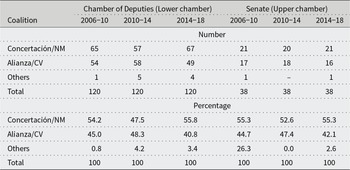
In each 4-year legislative term until 2006, electoral majorities in the upper chamber were distorted by the presence of non-elected senators and, between 1998 and 2006, the life seats awarded to former presidents. The Senate’s importance in the institutional system – particularly during the period when the appointed senators altered electoral majorities – is at odds with the scant information that exists about its performance in the legislative process and senators’ roll-call voting behaviour. From 2006 through to 2018, all 38 members of the Senate were democratically elected. Table 1 shows the composition of the Chilean Congress between 2006 and 2018. The Concertación/Nueva Mayoría (NM) coalition obtained a majority in the three elections that took place in this period. However, the resignation of two upper chamber legislators from the governing parties and their subsequent move to the right-wing benches gave the right-wing opposition a majority in the Senate.
Composition of the Chilean Congress, 2006–2018

Source: Compiled by the authors using data from www.servel.cl.
Previous studies have identified several determinants of roll-call voting behaviour that relate to legislators’ party membership, the rules of the legislative process and the effect of the electoral cycle. Using Nominate scores for the period between 1997 and 2000 (which corresponds to the last year of one legislative term and 3 years of the subsequent term) one study showed more cohesion among right-wing parties than among left-wing parties in the Chamber of Deputies (Alemán and Saiegh Reference Alemán and Saiegh2007). We review the association posited by that study with data from three complete legislative terms.
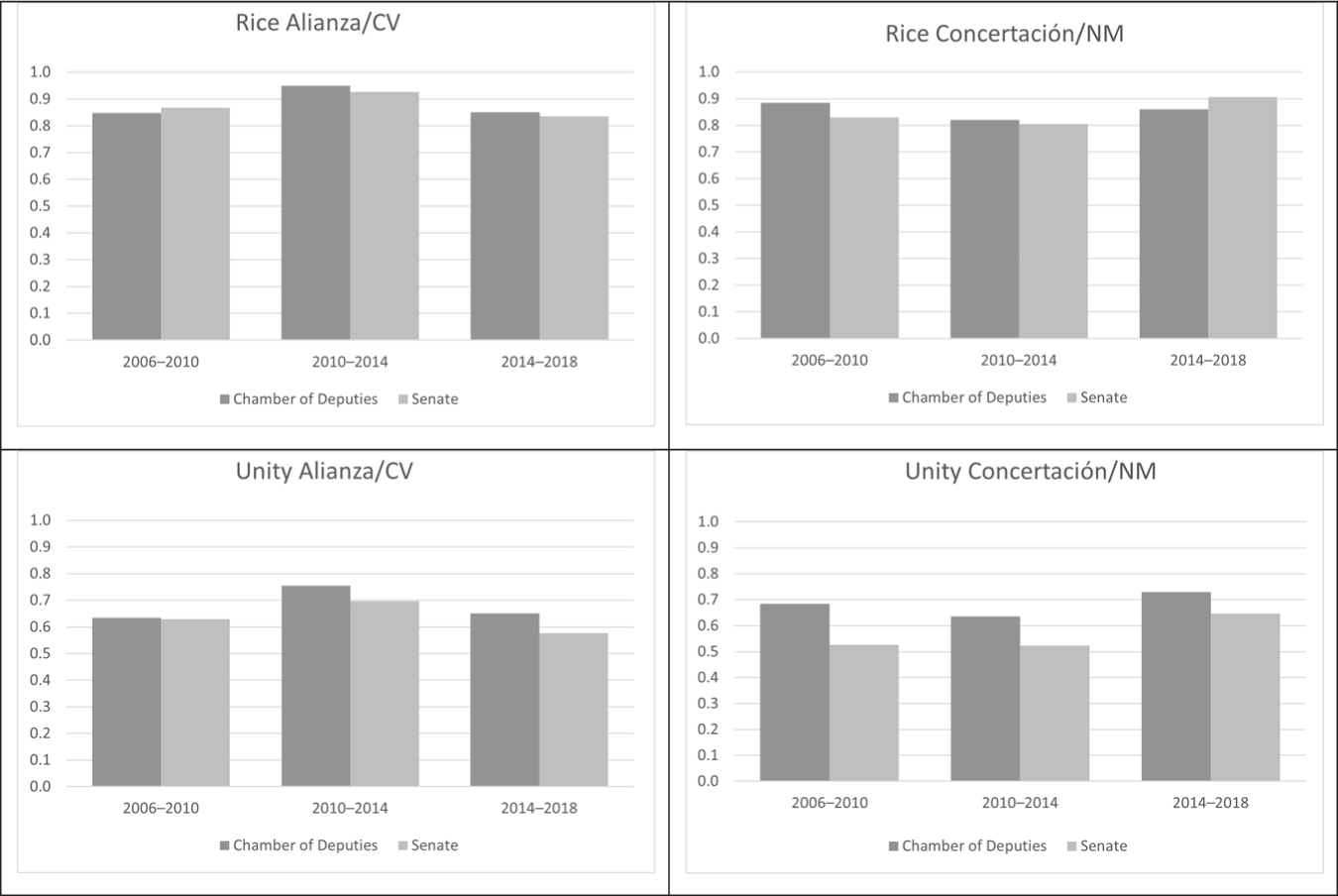
Figure 1 shows the voting cohesion of the Concertación/NM coalition and that of Alianza/Chile Vamos (CV) in both chambers of Congress in the three legislative periods studied, using the Rice and Unity indicators. As expected, the Rice indicators have higher values than the Unity indicators. Both coalitions show more cohesion in the periods when they controlled the executive; namely, 2006–2010 and 2014–2018 in the case of the Concertación/NM coalition; and 2010–2014 in the case of Alianza/CV. The Rice indicator shows no clear pattern of difference concerning coalition cohesion in the two chambers. The reason is probably that when senators do not want to vote with their coalition, they simply skip the vote; an absence that is not picked up by the Rice indicator. The Unity indicator, on the other hand, treats absence as a vote against the majority behaviour of each coalition and shows the coalitions’ voting cohesion as higher in the lower than in the upper chamber. Between 2006 and 2018, party membership influenced voting cohesion in the Chamber of Deputies but appears to have had less effect in the upper chamber. Although greater cohesion is apparent in both coalitions in both chambers when the respective coalition also controls the presidency, the results systematically show that there was less cohesion within the coalitions in the upper than in the lower chamber.
Legislative Cohesion by Political Coalition in Chile, 2006–2018

Methodology
The cohesion of legislators at the party or coalition level is usually measured in terms of roll-call votes. In parliamentary systems where legislators are elected under closed lists or there are rules obliging or inducing them to receive voting orders from their party, voting unity among a party’s legislators is understood as party discipline. However, in systems where party leaders have few tools to enforce discipline among their legislative delegations, voting discipline is understood as cohesion (Morgenstern Reference Morgenstern2004) or party unity (Carroll and Nalepa Reference Carroll and Nalepa2020). Since here we are evaluating a political system without formal party orders or tools for party leaders to force their legislators to vote in a particular way, we use the concept of cohesion to refer to what others name discipline.
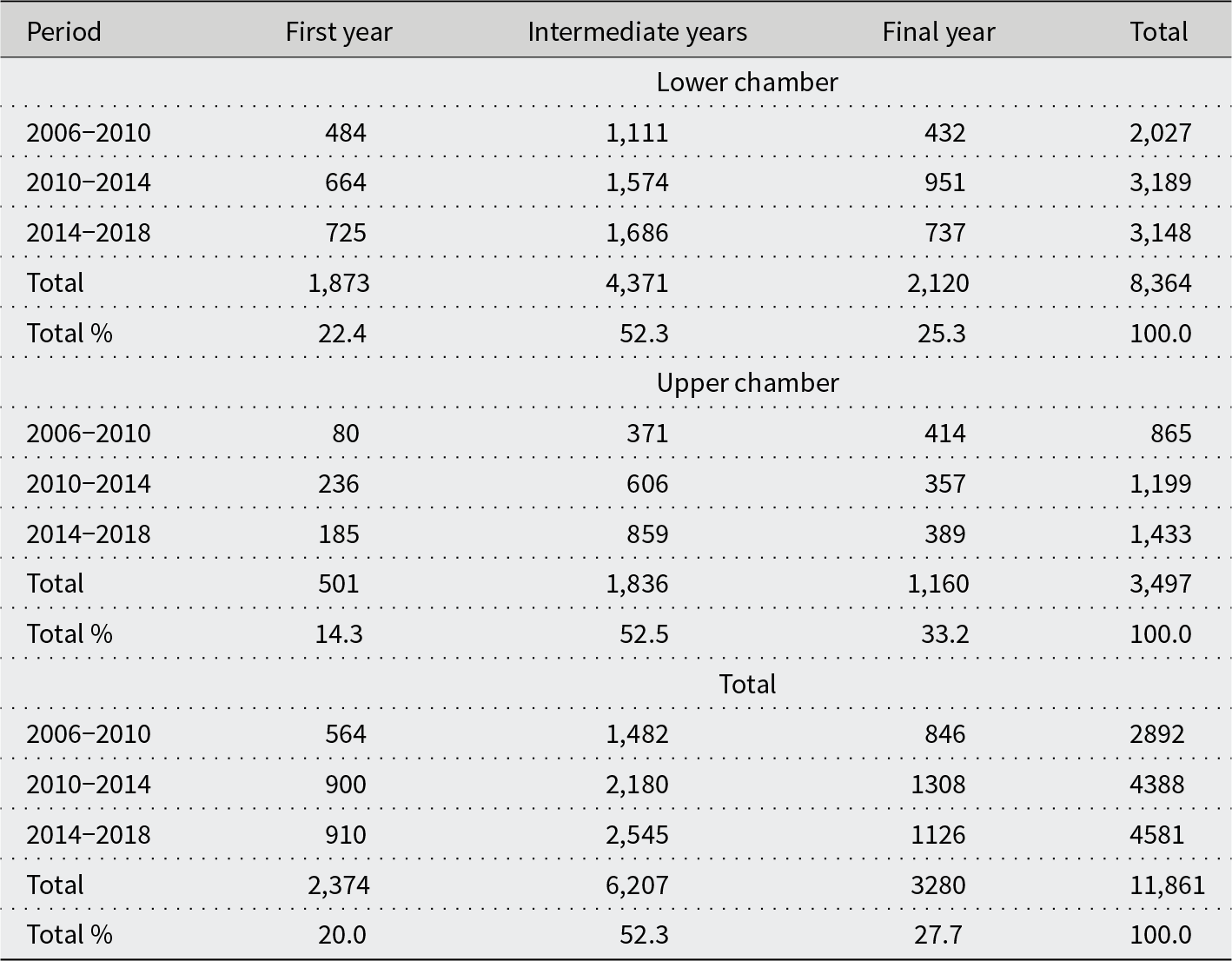
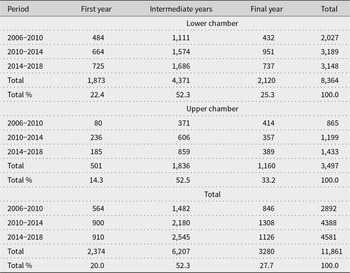
From the websites of the Senate and the Chamber of Deputies – the upper and lower chambers, respectively – we retrieved all publicly available votes on bills in the three legislative periods between 2006 and 2018. As shown in Table 2, more votes took place in the lower (8,364) than in the upper chamber (3,497). Altogether, we have 11,861 roll-call votes. The number of votes increased gradually over these three periods. In addition, the percentage of votes concentrated in the first year of the term is higher in the lower than in the upper chamber. In the latter, there were more votes in the final year than in any of the other three years.
Number of Votes per Legislative Period in the Chilean Legislature, 2006–2018
Note: This includes unanimous votes. Please see the Supplementary Material for the data excluding unanimous votes.
Source: Compiled by the authors using data from www.camara.cl and www.senado.cl.
From the roll-call voting records in both chambers, we also obtained information about the bills on which votes took place. With the date on which each bill was voted, we could establish whether this occurred in the first year of the term, the intermediate years, or the final one. We were also able to identify to which stage of the bill’s passage each vote corresponded (first stage, second stage or later stages); whether the bill was presented by the executive or was a parliamentary motion; whether it began its passage in the lower or upper chamber; and the majority required for approval.
The unit of analysis is the roll-call vote. The dependent variable is the cohesion of multiparty coalitions in the roll-call votes. We measure cohesion with two indicators that are common in studies of this type: Rice and Unity. A detailed description of how both indicators are calculated can be found in Carey (Reference Carey2009: 94–95). The Rice index considers only the votes of legislators present in the chamber, ignoring absences and abstentions, while the Unity indicator considers all legislators, including those absent for the vote. As Carey explains (Reference Carey2009: 95): ‘UNITY is a cousin to RICE, but it is discounted according to the rate of nonvoting in the group’. Thus, while Rice assumes that non-voting members were absent for exogenous reasons, Unity assumes that the decision not to vote might be informed by the legislator’s strategic decisions. By using both indicators in our estimations, we assess how plausible it is that legislators skip some votes to avoid voting differently from the majority in their coalition.
For all the hypotheses, we are interested in the difference between the level of voting cohesion in both chambers. We include a variable that indicates whether the vote took place in the lower (value 0) or upper chamber (value 1).
The independent variable for Hypothesis 1 is the coalition to which the legislator belongs. For this, we identify whether legislators belong to the government coalition or some opposition coalition. In the 2006–2010 and 2014–2018 legislative periods, the governing coalition comprised of centre-left parties was known as Concertación or Nueva Mayoría, while in 2010–2014 it was composed of right-wing parties and known as Alianza or Chile Vamos. The independent variable for Hypothesis 2 is whether the vote took place in the first year of the government, and for Hypothesis 3, whether it took place in the coalition’s last year. In both cases, we constructed dichotomous variables.
For Hypothesis 4, we use two indicators as independent variables. First, whether the vote was on a bill at an advanced stage of its passage. For this, we coded all votes that took place in the first stage of a bill’s debate – that is, in the chamber of origin, meaning the chamber where it was presented – with a value of 0 and votes on more advanced bills (second or third stage) with a value of 1. For the second indicator, we coded all votes requiring a simple majority with a value of 0 and those requiring a qualified majority with a value of 1.
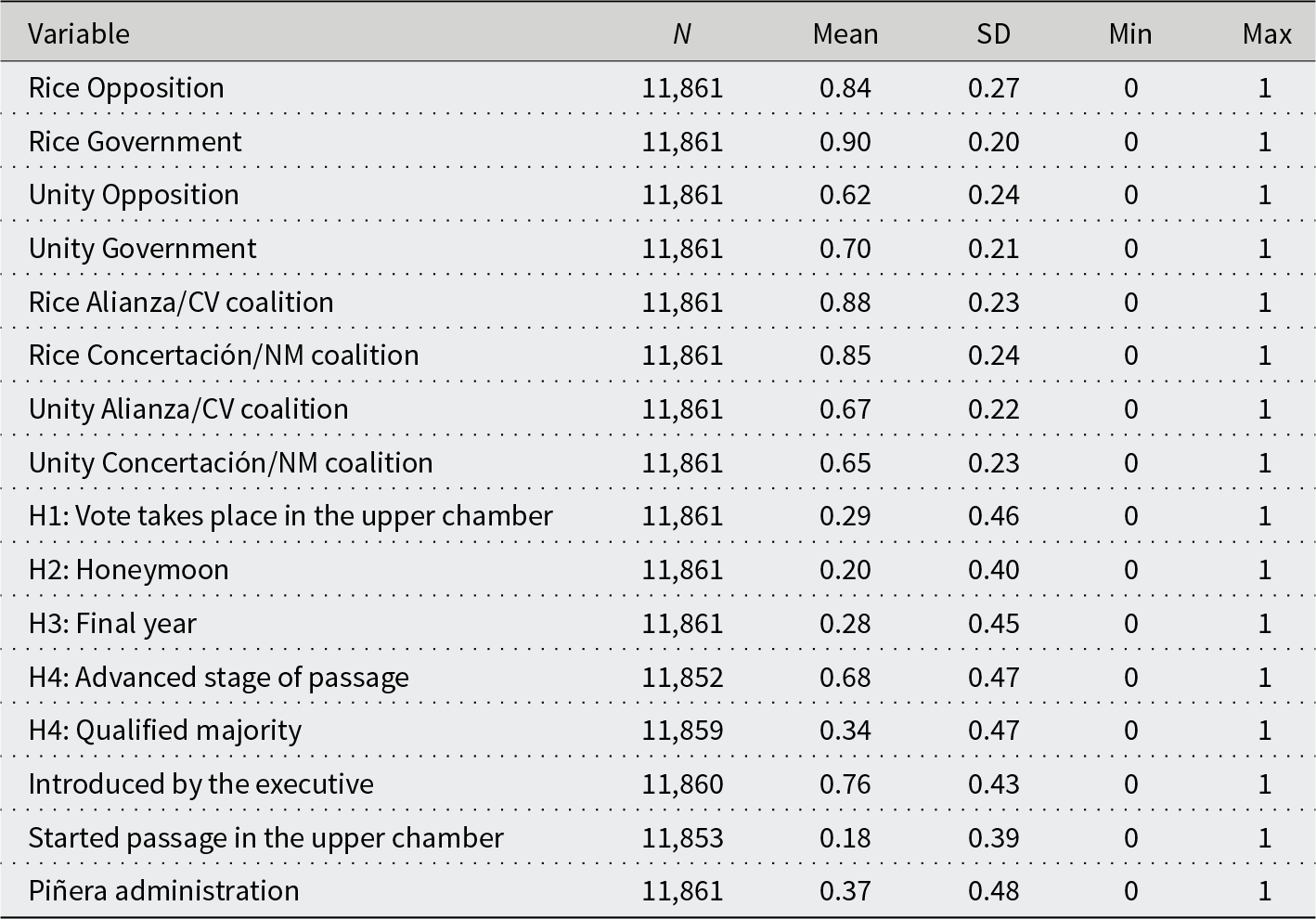
As control variables, we included an indicator for bills introduced by the executive – as distinct from those introduced by legislators – and an indicator for bills that began their passage in the upper chamber rather than in the lower chamber. As a control, we also used the periods when the presidency was in the hands of the right-wing coalition led by Sebastián Piñera (2010–2014). Table 3 shows descriptive data for the dependent and independent variables. For the dependent variable, we estimated the values of Rice and Unity for both coalitions in each vote and also grouped the coalitions according to whether they were in government or opposition in each period. The independent variables are reported as dummies.
Descriptive Statistics for the Dependent and Independent Variables
Source: Compiled by the authors using data from www.camara.cl and www.senado.cl.
There is debate in the literature on legislative cohesion as to how to treat unanimous votes. We include all votes in our analysis. In the Supplementary Material, we present estimations of the models excluding the 5,174 unanimous votes. For the most part, the results of the models are similar.
Results
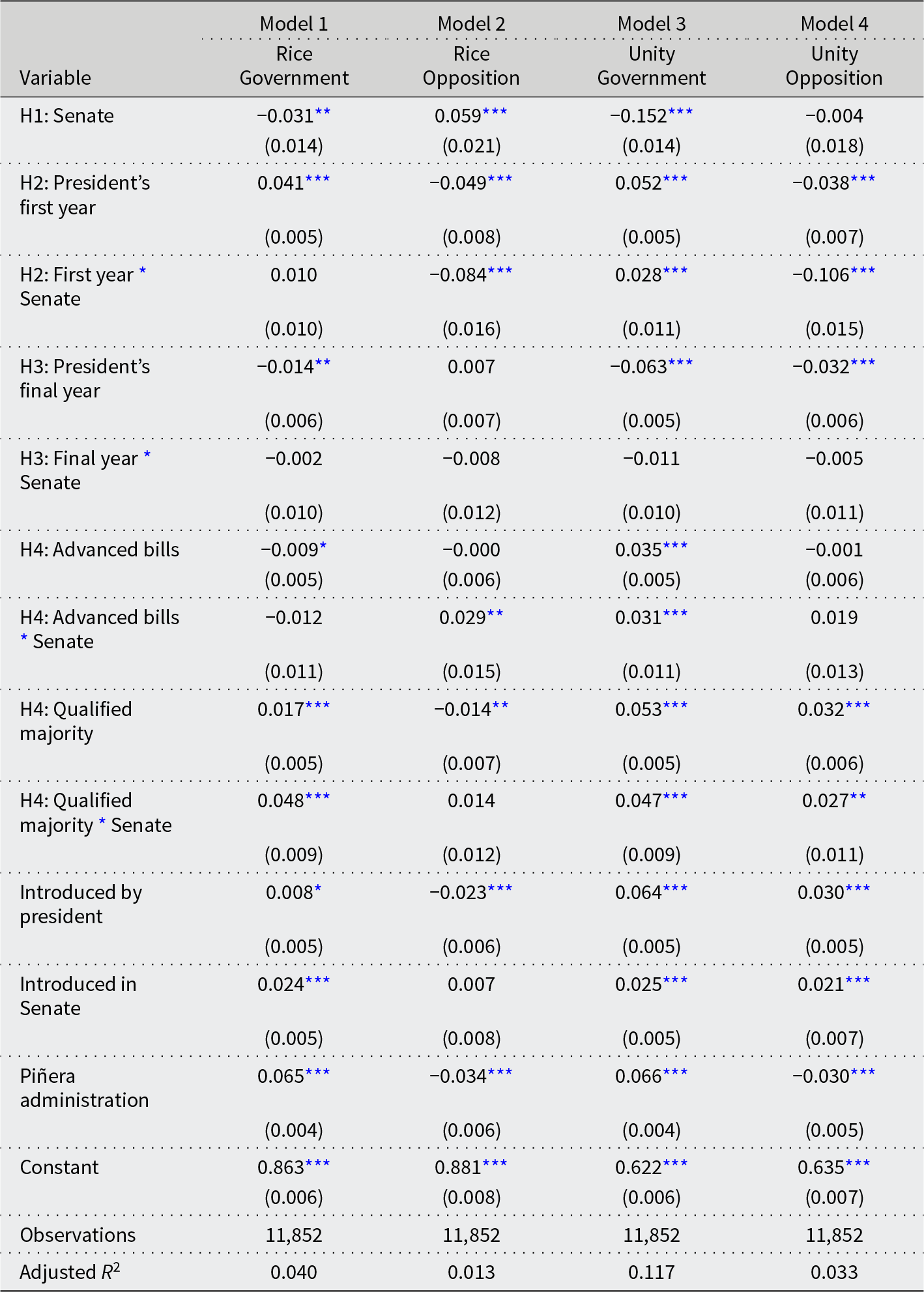
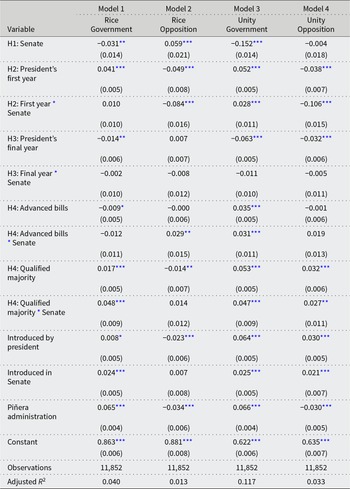
Table 4 shows four ordinary least squares models (OLS) in which the dependent variable is the cohesion of the two main coalitions in each chamber of the Chilean Congress. We use the two classic indicators of cohesion: Rice and Unity.
Determinants of Legislative Cohesion in Both Chambers of the Chilean Congress by Coalition According to Whether in Government or Opposition, 2006–2018
Notes: Significance ***0.001, **0.05 * 0.01. Ordinary least squares models.
Source: Compiled by the authors using data from www.camara.cl and www.senado.cl.
Our first hypothesis asserts that cohesion among government legislators is greater in the lower than in the upper chamber. This is clearly supported: in both the Rice and Unity models, government legislators are significantly less cohesive in the Senate than in the Chamber of Deputies. For opposition legislators, the pattern is mixed: the Rice model suggests slightly greater cohesion in the Senate, while the Unity model shows no significant difference between the chambers.
Hypothesis 2 asserts that, during the honeymoon period, government legislators show more legislative cohesion in the Chamber of Deputies than in the Senate. The results of the models indicate that in Congress in general during this period, government legislators showed more cohesion than opposition legislators, as measured by both the Rice and Unity indicators. When including the interaction variable between the first year and the Senate, there is more cohesion among government legislators, but only with the model using the Unity indicator, and less cohesion among opposition legislators on both indicators. This confirms that the two chambers behave differently in terms of their legislators’ voting cohesion. According to the Unity indicator, government senators are more cohesive than government deputies, but when both indicators are used, opposition senators are less cohesive in the first year than opposition deputies.
Hypothesis 3 suggests that in the government’s final year there is no difference between the chambers concerning the legislative cohesion of government legislators. The models show that, on both indicators, there is less cohesion among government legislators in the final year. This is not surprising, as presidents normally experience a lame-duck effect in their last year in office and find it more difficult to line up legislators behind the government’s initiatives. On the Unity indicator, the opposition is also less cohesive in roll-call votes, as legislators tend to be more concerned with their re-election prospects or are otherwise advancing their political careers. When interacting ‘last year’ with the Senate indicator, the effects are not statistically significant. This implies that while in general cohesion diminishes in the final year, there are no differences between the Chamber and the Senate. This is true not only for government legislators – a finding consistent with Hypothesis 4 – but also for opposition legislators. Hence, the lower cohesion in roll-call votes is most likely also a response to the fact that the legislative term is ending, and not only to the declining influence of the executive on government legislators.
Hypothesis 4 suggests that when a bill is at a more advanced stage of its passage and requires a qualified majority for its approval, there will be greater voting cohesion among government legislators in the lower than in the upper chamber. The data in Table 4 are not consistent with this assertion. There is more cohesion among government legislators in votes on more advanced bills, but only when using the Unity indicator. In fact, according to the Rice indicator, government legislators show slightly less cohesion in voting on bills at an advanced stage. However, the results of the interaction variables between the Senate and a bill’s stage show government legislators as more cohesive when the Unity indicator is used, and the opposition as more cohesive when the Rice indicator is used. This calls into question the argument that government legislators in the Chamber show greater cohesion than their counterparts in the Senate in votes on more advanced bills. Indeed, when legislators who were absent for a vote are excluded, the opposition shows more cohesion in the Senate than in the Chamber. This can be explained by the number of seats in each chamber, since the absence of opposition senators seems to be less relevant than the absence of opposition deputies in the Chamber. Therefore, the results are not systematically consistent with Hypothesis 4, at least as regards votes on more advanced bills. Except for the Unity model for government legislators (Model 3), they show no more cohesion in the Senate than in the Chamber.
In votes on bills that require a qualified majority, the models show that government legislators are more cohesive on both the Rice and Unity indicators while the opposition is also more cohesive on the latter. In turn, the interaction variable shows that government senators are more cohesive on both indicators while the opposition is also more cohesive in the Senate when the Unity indicator is used. In other words, the evidence of the models is not consistent with Hypothesis 4. The data do not allow us to assert that when bills are at a more advanced stage and require a qualified majority, government deputies show more voting cohesion than government senators.
The control variables show some expected effects: for example, that there is greater cohesion on bills that start their passage in the Senate and that government legislators showed more cohesion in the Piñera administration than in the two Bachelet administrations. However, there are also some surprises. For example, according to the Unity indicator, both government and opposition legislators showed more cohesion in votes on bills presented by the president, whereas according to the Rice indicator, there was less cohesion among government legislators on bills of this type.
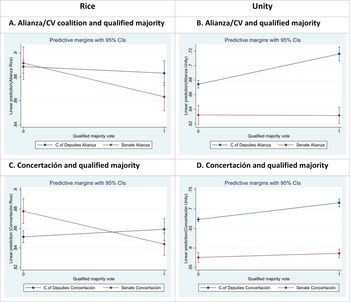
Figure 2 shows predicted probabilities for cohesion in the roll-call vote in each coalition using the Rice and Unity indicators, based on the estimations in Model 4 for whether the legislative delegations in each chamber were part of the government coalition or the opposition and whether the vote required a qualified majority for its passage. Figure 2A shows that while there was more cohesion among ruling coalition senators in the votes with regular thresholds in the Senate than in the Chamber of Deputies, ruling coalition deputies were more disciplined in the votes that required higher thresholds than in regular votes when using the Rice indicator. In turn, Figure 2B shows that senators had similar cohesion in their regular roll-call votes and in the votes that required higher thresholds when using the Unity indicator. Similarly, members of the ruling coalition in the Chamber of Deputies had more cohesion in roll-call votes that required higher thresholds than regular roll-call votes when using the Unity indicator. Thus, while the type of vote had no impact on cohesion among ruling coalition deputies, senators were less cohesive in higher threshold votes than in regular votes when assessed using the Rice indicator. This suggests that ruling coalition senators skipped more votes that required higher thresholds. This might be because they wanted to avoid voting against the declared position of their party in the coalition and, presumably, the government.
Predicted Probabilities for Cohesion among Ruling and Opposition Coalitions in Both Chambers of the Chilean Congress, 2006–2018
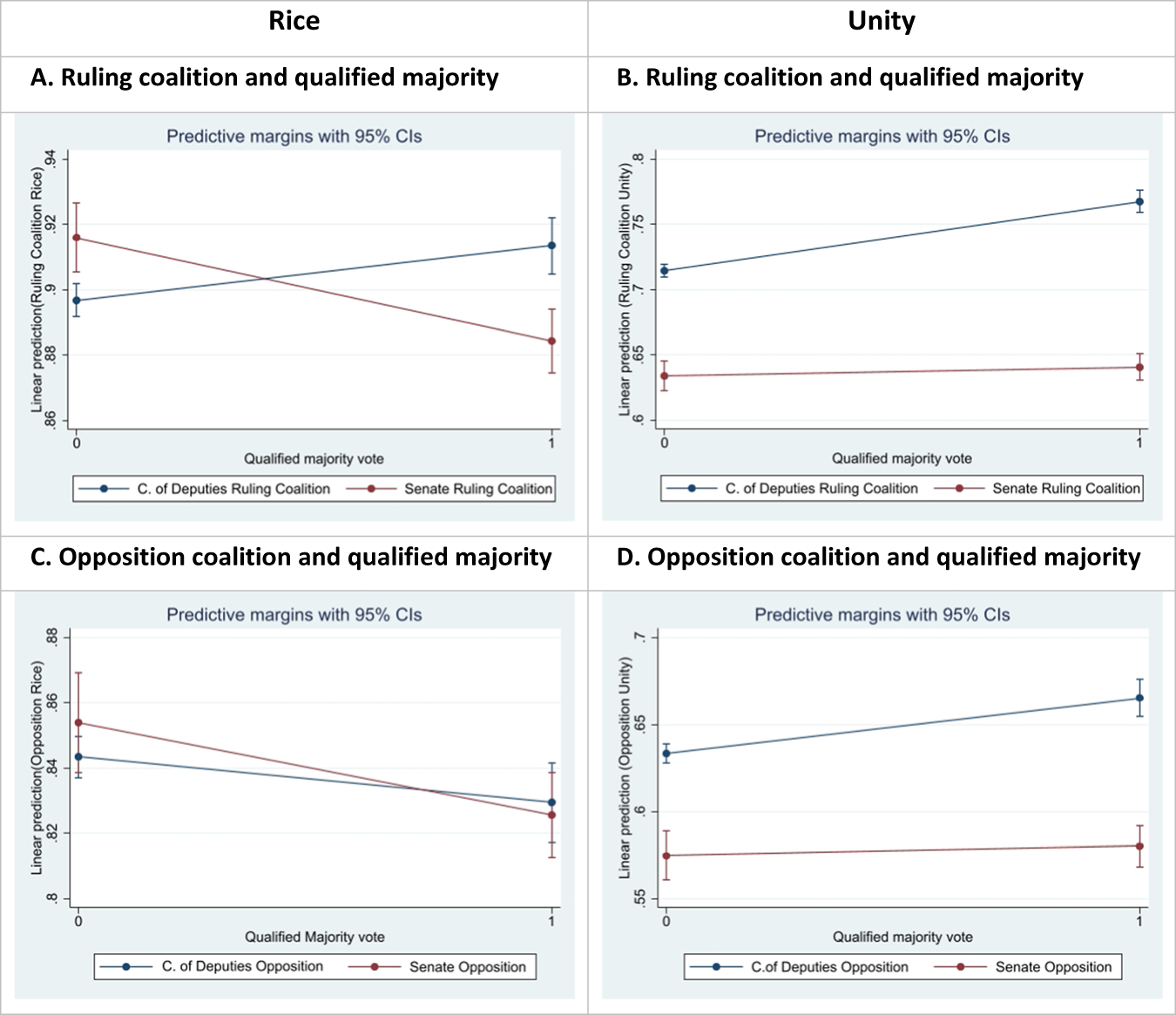
Figure 2C shows no statistically significant difference in the cohesion of opposition coalition legislators in either the Senate or the Chamber of Deputies in both regular votes and votes with higher thresholds using the Rice indicator. As with coalition legislators, using the Unity indicator showed that opposition legislators in the Chamber of Deputies were more cohesive in votes that required higher thresholds than opposition senators. Overall, then, legislators in the Chamber of Deputies, whether in the ruling or opposition coalitions, showed more cohesion in votes that required higher thresholds than legislators in the Senate. The level of cohesion in the roll-call votes among ruling coalition and opposition senators was either similar or, in the case of ruling coalition senators when using the Rice indicator, higher for bills that required a particular threshold for their passage.
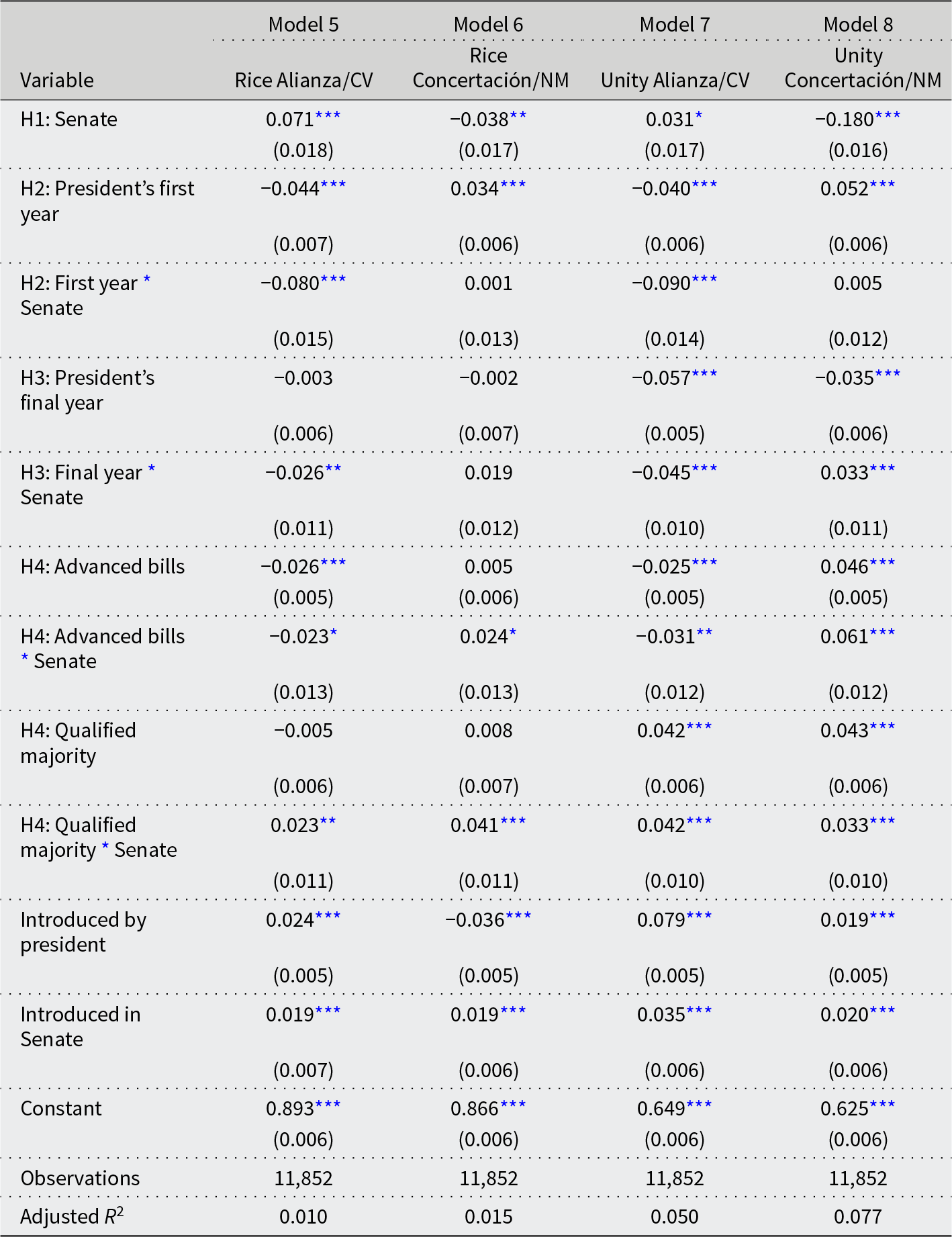
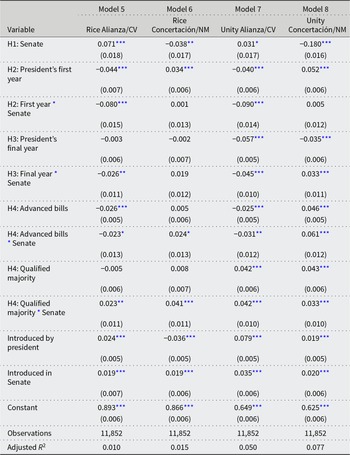
As an additional test, Table 5 shows ordinary least squares estimates separating votes by coalition: the right-wing Alianza/CV coalition and the left-wing Concertación/NM coalition. Although the hypotheses are formulated in terms of government and opposition coalitions, we present these models to verify whether there are differences between the coalitions based on their ideological position, rather than whether they were in government or opposition.
Determinants of Cohesion in Both Chambers of the Chilean Congress by Coalition, 2006–2018
Notes: Significance ***0.001, **0.05 *0.01. Ordinary least squares models.
Source: Compiled by authors using data from www.camara.cl and www.senado.cl.
The models show that, in general, Alianza/CV is more cohesive than Concertación/NM in Senate votes, according to both the Rice and Unity indicators. However, in votes on bills at an advanced stage of their passage, Alianza/CV is less disciplined and Concertación/NM more disciplined, according to the Unity indicator. This is also the case with the interaction variable between advanced bills and the Senate: Concertación/NM is more cohesive in the Senate than in the Chamber relative to Alianza/CV.
Both coalitions show more discipline in votes on bills requiring a qualified majority compared to those requiring only a simple majority. In votes of this type, they both also show more cohesion in the Senate than the Chamber, confirming the Senate’s importance for bills that are considered more important or which have a more difficult passage.
Concertación/NM tends to be more cohesive in votes during the government’s first year, while Alianza/CV is less cohesive in the first year. This is also true when looking at the interaction variable between the year in government and voting in the Senate. Alianza/CV is less cohesive in the Senate in the first year. In the case of the final year in government, both coalitions show less cohesion in both the Chamber and the Senate, and it is even lower in the Senate than in the Chamber.
Alianza/CV is more cohesive in votes on bills presented by the president while Concertación/NM is less cohesive in votes of this type, albeit only according to the Rice indicator. When the Unity indicator is used, Concertación/NM is more cohesive in votes on bills presented by the president. Finally, both coalitions are more cohesive in votes on bills that started their passage in the Senate, regardless of whether they were presented by the executive or as a parliamentary motion.
Figure 3 shows the predicted probabilities for roll-call vote cohesion estimated from the models in Table 5. Figure 3A shows that Alianza/CV senators show slightly less cohesion than deputies in votes that required a qualified majority when using the Rice indicator. When using the Unity indicator, Alianza/CV deputies show more cohesion in qualified majority votes than in regular votes, while Alianza/CV senators show the same lower level of cohesion in regular and qualified majority votes. In turn, Concertación/NM senators show less cohesion in qualified majority votes than in regular votes when using the Rice indicator, while Concertación/NM deputies show the same cohesion in both types of votes when using the Rice indicator. When using the Unity indicator, Concertación/NM deputies show greater cohesion in qualified majority votes than in regular votes. Among Concertación/NM senators, the level of cohesion is the same – and lower than that of deputies – for both regular and qualified majority votes.
Predicted Probabilities for Cohesion among Ruling and Opposition Coalitions in Both Chambers of the Chilean Congress, 2006–2018

Conclusions
This article analysed the degree of legislative cohesion in Chile’s bicameral Congress between 2006 and 2018, drawing on more than 11,800 roll-call votes. By comparing the Chamber of Deputies and the Senate, we examined how institutional design, electoral calendars and the characteristics of bills shape coalition behaviour. Our results show that cohesion is systematically lower among government senators than deputies. The Senate’s staggered 8-year terms weaken the executive’s influence, while deputies elected concurrently with the president display stronger loyalty, especially during the honeymoon period. Cohesion declines in both chambers during the final year of the presidential term, reflecting the waning power of lame-duck presidents and legislators’ re-election concerns.
Bill type also matters. Legislative measures at an advanced stage or requiring a qualified majoritiy generally produce greater cohesion, but the effects differ between the two chambers and according to the indicator used. The Unity measure suggests that voting absences, which are more common in the Senate, serve as a strategic tool to avoid open dissent – an important nuance in assessing legislative discipline.
These findings contribute to comparative debates on bicameralism and presidentialism in Latin America. Much of the scholarship focuses on lower chambers, overlooking the distinct incentives faced by upper chambers. The Chilean case shows that even when electoral rules are similar, different time horizons and institutional roles generate systematic differences in the level of cohesion. Understanding these bicameral dynamics is therefore essential for evaluating legislative behaviour in presidential systems. Ignoring upper chambers risks producing incomplete or distorted conclusions about executive–legislative relations and party unity in Latin America and beyond.
Supplementary material
The supplementary material for this article can be found at https://doi.org/10.1017/gov.2026.10037.
Data availability
The data used for the article are publicly available at https://www.camara.cl/transparencia/datosAbiertos.aspx. We will be happy to share our Stata do and data files with anyone wishing to replicate our findings.
Financial support
The work was supported by FONDECYT, grant number: 1231627 and by the ANID-Millennium Science Initiative Program, grant number: NCS2024_007.
Disclosure statement
The authors report that there are no competing interests to declare.




 Open access

