

INTRODUCTION
For many decades, the primary means of regulating market transactions has been disclosure duties, but mounting evidence suggests that disclosure duties are largely ineffective (Willis Reference Willis2006; Marotta-Wurgler Reference Marotta-Wurgler2009, 341; Radin Reference Radin2013, 219–20; Ben-Shahar and Schneider Reference Ben-Shahr and Schneider2014). More recently, considerable attention has been given to nudges—behaviorally informed means of influencing people’s behavior in a noncoercive way (Thaler and Sunstein Reference Thaler Richard and Sunstein2009; Sunstein Reference Sunstein, Zamir and Teichman2014; Zamir and Teichman Reference Eyal and Teichman2018, 177–85), but the efficacy of nudges in the context of markets is doubtful because suppliers can, and do, counter their impact (Barr, Mullainathan, and Shafir Reference Barr, Mullainathan, Shafir, Moss and Cisternino2009, 25; Willis Reference Willis2013, 1200–10; Bubb and Pildes Reference Bubb and Pildes2014). As a result, in the past decade, there has been growing interest in the mandatory regulation of the content of transactions. Examples of such mandatory regulation include usury laws, minimum wage statutes, statutes that impose liability on construction firms for defects in buildings that they build and sell, and the unenforceability of unconscionable contract terms.
Although the debate over the very need and legitimacy of mandatory regulation of the content of transactions has a long pedigree (for an overview, see Zamir and Ayres Reference Eyal and Ayres2020, 289–302), with very few exceptions (Kimball and Pfennigstorf Reference Kimball and Pfennigstorf1964; Korobkin Reference Russell2003, 1247–90), scholars have only recently begun to address questions associated with the design of such rules (Ben-Shahar Reference Ben-Shahar2011; Furth-Matzkin Reference Furth-Matzkin2017; Ben-Shahar and Porat Reference Ben-Shahar and Porat2019; Johnston Reference Johnston2020; Zamir and Ayres Reference Eyal and Ayres2020). One of the key questions pertains to the optimal substitutes for unenforceable contractual clauses. In this context, it is useful to distinguish between bidirectional and unidirectional mandatory rules (Zamir and Ayres Reference Eyal and Ayres2020, 322–25). When the law lays down a bidirectional mandatory rule, it tolerates no deviation—that is, it applies notwithstanding any divergent contractual clause. For example, the rule that a court will not grant specific performance of a contractual obligation to provide personal services is bidirectionally mandatory (Kronman Reference Kronman1978, 369–76), as is the denial of insurance coverage for willful acts (Fischer Reference Fischer2014). Footnote 1
But, much more often, the law contents itself with setting minimum standards—that is, with unidirectional immutability. In such cases, the law allows the parties to deviate from the rule in favor of one party (for example, the tenant or employee) but not the other (for example, the landlord or employer). Unidirectional immutability characterizes both general standards, such as unconscionability, and more specific rules, such as the invalidation of unreasonably large liquidated damages; Footnote 2 standard, statutory insurance policies that may be deviated from in favor of the insureds, but not to their detriment (for example, the California Standard Form Fire Insurance Policy Footnote 3 or the Standard Fire Insurance Policy of the State of New York); Footnote 4 and the unenforceability of noncompete clauses in employment contracts that are unreasonably broad in terms of time, area, or line of business. Footnote 5 In these cases—which are the focus of this article—the question arises as to what arrangement should substitute for the invalid term.
In a thought-provoking article, Omri Ben-Shahar (Reference Ben-Shahar2011, 869) has drawn attention to this question and suggested that there are three possible answers: “(1) the most reasonable term; (2) a punitive term, strongly unfavorable to the overreaching party; and (3) the minimally tolerable term, which preserves the original term as much as is tolerable.” For example, when unreasonably large liquidated damages are deemed unenforceable, they may be replaced by an award of damages that the injured party is entitled to under the default remedy rules; by denying the injured party’s right to any damages whatsoever; or by awarding her the highest amount of damages that would be considered valid under the liquidated-damages/penalty distinction. We label these three options Moderate, Penalty, and Minimally Tolerable Arrangement (MTA) respectively.
Ben-Shahar demonstrated that MTAs are fairly prevalent (for example, when courts apply the doctrine of partial enforcement of unreasonable terms) and discussed the policy considerations for and against using them, primarily from an economic perspective. He argued that, when the issue is one of incentivizing efficient behavior by the parties, the court should implement the most efficient arrangement, which is ordinarily the most reasonable as well. In contrast, when the issue is purely distributive—as in the case of the price—there are good reasons to adopt the MTA, which is closest to what the parties would have agreed upon, given the unenforceability of the contractual term. However, as Ben-Shahar acknowledged, there is a serious concern that applying the MTA would incentivize suppliers to use excessive and invalid terms, knowing that many customers will yield to them, and, in the worst-case scenario, these would be replaced by the MTA. Hence, when the bounds of permissible contracting are readily known yet still violated by the supplier, the supplier should be deterred by means of administrative and/or contractual sanctions, including a substitute that is more pro-customer than the MTA, possibly even punitive. Other scholars concur (Drygala Reference Drygala, Drygala, Heiderhoff, Staake and Zmij2012, 50–52).
This article revisits this theoretical discussion, questions some of its implicit assumptions, and takes first steps to examining them empirically. It argues that, according to Ben-Shahar’s own criteria, the incidence of the MTA should be rather limited. This is because only a small minority of contractual terms are purely distributive, and, even in those cases, the MTA is usually inappropriate because it creates undesirable incentives for contract drafting. The article then describes the results of five empirical studies of issues that have not been previously addressed: the prevailing judgments regarding the desirability of alternative substitutes; the impact of the substitutes on customers’ inclination to challenge excessive terms once a dispute with the supplier arises; and the substitutes’ impact on the judicial inclination to invalidate excessive terms when such invalidation is discretionary.
The prevailing judgments about the desirability of the possible substitutes are interesting in their own right and are also important because they plausibly influence the legal doctrine. In general, we found that laypersons see the Moderate substitute as significantly more appropriate than either the Penalty or MTA substitutes.
The impact of the substitutes on the inclination of customers to challenge excessive terms (once a dispute with the supplier arises and they learn about the law) is crucial because, without such challenges, mandatory rules may have very little effect on suppliers’ behavior. The results of our experiment show that the substitute arrangement may indeed affect customers’ inclination to stand up for their rights and challenge excessive terms: they are more likely to challenge such terms under the Penalty substitute than under the MTA, even when the disputed sum of money is the same.
Finally, the previous literature has implicitly assumed that the enforceability of contractual terms is exogenous to the choice of the substitute arrangement. However, the annulment of excessive terms is often discretionary, and, in using their discretion, judges may be influenced by the content of the substitutionary arrangement. We offer several alternative hypotheses about the possible impact of the substitute arrangement on the inclination to annul excessive terms and examine these hypotheses through a vignette study conducted first with laypersons and then with legal practitioners (including judges). Our main finding is that the choice of substitute may indeed affect the inclination to invalidate excessive terms but that this effect likely varies among decision makers, depending on their preferred substitute.
Since the first two issues pertain to citizens’ attitudes and customers’ choices, we studied them with representative samples of the general population (three samples of five hundred people each). Since the third issue pertains to judicial decision making, it was studied not only with laypersons (264 people who took part in a survey through the MTurk platform) but also with 325 legal practitioners (including judges). Thus, a total of 2,089 people took part in the five studies.
The upshot of our more nuanced theoretical analysis and new empirical findings is that the case for MTA substitutes is considerably weaker than previously claimed. First, other things being equal, legal norms should preferably be consistent with the prevailing normative judgments, which does not appear to be the case with MTAs. Second, in terms of the incentives created by the substitute arrangement, previous analyses have focused on only one of the three dramatis personae involved in the drama (the supplier), while overlooking the other two (the customer and the judge). Our findings suggest that MTAs not only create undesirable incentives for the drafting of contracts by suppliers (as previously noted) but also are likely to create problematic incentives in terms of customers’ inclination to challenge excessive terms and may affect judicial decision makers’ disposition to invalidate them. As scholars begin to systematically examine the optimal design of mandatory rules (Zamir and Ayres Reference Eyal and Ayres2020), this study should be seen as part of the first steps toward an empirical study of the pertinent considerations (compare Zamir and Katz Reference Zamir and Katz2020; Katz and Zamir Reference Katz and Zamir2021).
Two final comments about the scope of the discussion are in order. First, the article focuses on transactions between commercial sellers of products and providers (or purchasers) of services—including retailers, insurers, lenders, landlords, and employers (collectively labeled “suppliers”), and individual or commercial clients—including consumers, insureds, tenants, borrowers, and employees (collectively labeled “customers”). In these transactions, the supplier typically controls the drafting of the contract. The article does not deal with negotiated contracts between similarly situated parties, but since nowadays the vast majority of consumer and commercial contracts (excluding oral agreements) employ standardized, non-negotiated provisions, our study covers the vast majority of transactions. Second, the article deals with only one key aspect of the design of mandatory rules. It does not discuss the antecedent question of whether, and under what circumstances, mandatory regulation of the content of contracts is desirable. However, the analysis of the design of mandatory rules does have ramifications for the ongoing debate surrounding the desirability and legitimacy of mandatory rules. Once the richness of possible designs of mandatory rules is recognized, blanket opposition to (or support for) mandatory rules is hardly tenable.
REVISITING THE THEORETICAL ANALYSIS
The Tripartite Taxonomy
When the law renders contractual terms, but not the entire contract, unenforceable, the question arises as to which arrangement should substitute the invalid term. Roughly speaking, there are three possible answers to this question: Penalty, Moderate, and MTA (Ben-Shahar Reference Ben-Shahar2011, 876–78). Penalty substitutes the invalid term with an arrangement favoring the party whose interests the law seeks to protect. For example, if a lender charges an interest rate that exceeds a statutory cap, that clause may be replaced by a zero-percent interest. Footnote 6 The primary advantage of this option is that it deters the inclusion of overreaching clauses in contracts (see also Johnston Reference Johnston2020). Such deterrence is particularly warranted when suppliers knowingly use unenforceable terms to mislead customers about their legal entitlements. This typically occurs when the drafter of the contract is a repeat player, such as in typical consumer and commercial (but not private) contracts. Such a drafter is more likely to know the law and should be incentivized to acquire information about it. A penalty substitute may be used instead of, or in conjunction with, administrative or criminal sanctions for including invalid clauses in a contract (Ben-Shahar Reference Ben-Shahar2011, 877, 883–84, 902–3; Hallett Reference Hallett2018, 114–17; Wilkinson-Ryan Reference Wilkinson-Ryan2020, 236–37; Zamir and Ayres Reference Eyal and Ayres2020, 328–30). However, this option is troubling and arguably unfair when neither party knew, or had reason to know, that the contractual term in question was invalid.
While penalty substitutes score high on deterrence, they are the least respectful of the parties’ freedom of contract (inasmuch as this freedom is meaningful in contracts where the relevant mandatory rules apply), and they incentivize the parties to behave inefficiently ex post when performing their contractual obligations. In fact, the deterrence created by penalty substitutes often stems from the inefficient incentives that they generate. For example, substituting an excessive liquidated damages clause with no entitlement to any damages for breach of contract would drastically reduce the customer’s incentive to keep his or her contractual obligations.
Another possibility is to apply the most reasonable term, which is often the default rule or commercial usage that would govern the transaction in the absence of a contractual clause (Ben-Shahar Reference Ben-Shahar2011, 876–77; Lawrence Reference Lawrence2017, section 1–102:294), which we call the moderate arrangement. For example, if a contract unconscionably denies the customer’s entitlement to any remedy whatsoever for breach of contract by the supplier, the customer would be entitled to the remedies ordinarily available to the injured party. Such default rules and commercial usages are typically deemed fair and reasonable. They usually reflect the expectations of most parties in the relevant type of contract and are therefore presumably efficient (Zamir Reference Zamir1997, 1753–55). To be sure, determination of the moderate arrangement is not always easy. There may be discrepancies between the legal default rule and the commercial usage (even in negotiated contracts); defaults may aim to shape people’s judgments of reasonableness and fairness rather than merely mirror them (Zamir Reference Zamir1997, 1758–59) or nudge them in a particular direction (Zamir Reference Zamir2015, 101–9); and they may deviate from the majoritarian arrangement in order to induce the parties to contract around the default, thereby sharing information (see Ayres and Gertner Reference Ayres and Gertner1989; see also Posner Reference Posner2002). While a detailed discussion of these complexities lies beyond the scope of the present discussion, they must be borne in mind (and will be mentioned whenever relevant).
Generally speaking, a moderate substitute deters suppliers less effectively because it assures them that, even if the customer exercises her legal rights (which, in many contexts, is not very likely), the supplier’s position would be no worse off than in the absence of any clause. Also, if the unenforceable clause distributes the contractual surplus between the parties unfairly, but does not affect their behavior in a manner that would affect efficiency (hereinafter referred to as purely distributive terms), the efficiency argument in favor of the moderate arrangement arguably disappears (Ben-Shahar Reference Ben-Shahar2011, 872). Arguably, when it comes to purely distributive terms, there is not even a distributive reason to adopt a penalty or a moderate substitute because the supplier, who controls the wording of the entire contract, can take advantage of its superior bargaining power elsewhere in the contract—possibly, in an inefficient manner (Ben-Shahar Reference Ben-Shahar2011, 897–98; Johnson and Lipsitz Reference Johnson and Lipsitz2022; for a critique of this argument, see Guttentag Reference Guttentag2019, 641–44).
The third possibility is to replace the invalid clause with a minimally tolerable arrangement (MTA)—namely, a term that would favor the drafter to the greatest extent and still be deemed enforceable. For example, assume that, under the default remedy rules, the supplier would be entitled to ten thousand dollars in damages for the customer’s breach; liquidated damages of up to twenty thousand dollars would be considered tolerable; and the contract sets a penalty of thirty thousand dollars for the customer’s breach. According to the present option, the supplier would be entitled to liquidated damages of twenty thousand dollars. The main advantage of MTAs is that they entail the smallest curtailment of the parties’ freedom of contract (Sullivan Reference Sullivan2009, 1129, 1158–59; Ben-Shahar Reference Ben-Shahar2011, 879–80; Williams Reference Williams2019, 2068). It has also been argued that since MTAs best mimic the parties’ agreement given the mandatory rule, they are also the most efficient in the sense that they save the parties the cost of opting out of the default (Ben-Shahar Reference Ben-Shahar2011, 872–73, 879). One may, however, question the latter claim because—contrary to the case of designing default rules—when it comes to the design of substitutes for invalid contractual terms, ex hypothesi the cost of drafting has already been incurred (on setting MTAs as default rules, see Ben-Shahar Reference Ben-Shahar2009). In any event, the greatest drawback of MTAs are the “perverse incentives” that they create for suppliers to include unenforceable terms in their contracts, thereby exploiting customers’ ignorance of the law and their disinclination to engage in confrontation with suppliers (Sullivan Reference Sullivan2009, 1161).
Another drawback is that, inasmuch as mandatory rules aim to preclude unfair and inefficient contract clauses (that result from information problems or other traditional or behavioral market failures), MTAs are less fair and less efficient than moderate substitutes (although, if the parties know best what arrangement would maximize the contractual surplus, while the mandatory rule is inefficient, MTAs are likely to be more efficient than other substitutes). Finally, another limitation of MTAs is that determining their content may be quite challenging, especially when the doctrine in question is a vague, value-based standard, such as unconscionability (Ben-Shahar Reference Ben-Shahar2011, 883–85; Williams Reference Williams2019, 2068–70) (although similar challenges may face the determination of the moderate and penalty substitutes as well). Aware of this difficulty, suppliers may be tempted to influence the determination of the MTA by strategically using extreme terms that will serve as an anchor in the deliberation about the MTA (Feldman, Schurr, and Teichman Reference Feldman, Schurr and Teichman2016, 328–29). Furthermore, if courts continuously adopt the MTA, then those arrangements may become tomorrow’s moderate options due to psychological phenomena akin to hedonic adaptation (people’s tendency to become accustomed to new situations) and the mere exposure effect (the tendency to like familiar things), thus undermining the goals of the mandatory rules.
While useful and illuminating, the tripartite taxonomy should be qualified. First, reality is more complex than implied by this elegant taxonomy. It is sometimes unclear whether a given solution should be considered a moderate arrangement or a penalty (or both). Such is the case when a given trade usage is more favorable to the supplier than the statutory or judge-made default rule. Two pertinent examples are noncompete and arbitration clauses. When a court strikes down an excessive noncompete clause or an unfair arbitration clause, and substitutes them with no restriction on the employee’s freedom of occupation or no compulsory arbitration—are these instances of moderate substitutes (in accordance with the legal default rules) or of penalties (given that reasonable and fair arbitration and noncompete clauses are prevalent in the trade)? (Ben-Shahar Reference Ben-Shahar2011, 876–77; for a comparable example, see Drygala Reference Drygala, Drygala, Heiderhoff, Staake and Zmij2012, 50–52). To take another example, consider a case where a contract first sets the supplier’s liability in broad terms and then lists a series of exclusions to that liability, some of which are deemed unconscionable. Striking down an exclusionary clause while leaving the broad liability intact may be described as a moderate solution but, in reality, may be a penalty (if the remaining liability is broader than the default or prevalent arrangement).
The tripartite taxonomy is also imprecise in the sense that the three possible substitutes are sometimes nothing more than three points on a spectrum. In the interest rate example, suppose that, in a given type of loan, the prevailing annual rate is 20 percent, and there is a statutory cap of 30 percent. When a contract stipulates an annual interest rate of 40 percent, the penalty substitute can be not only anywhere between 0 percent to 20 percent but actually lower than 0 percent—that is, the statute may exempt the borrower from repaying the principal or any part thereof, Footnote 7 and it may impose additional administrative or even criminal sanctions on the lender, including revocation of the lender’s license. Footnote 8 Similarly, in this example, the substitute may be set at any rate between 20 percent and 30 percent—namely, at an intermediate level between the moderate arrangement and the MTA. Nevertheless, for the purpose of our general and relatively abstract discussion, the tripartite taxonomy is very useful, so we will keep using it.
The Questionable Appeal of MTAs
Despite the abovementioned drawbacks of MTAs, Ben-Shahar (Reference Ben-Shahar2011, 901–4) concluded that they are the most appropriate substitute when the invalidated clause is purely distributive, but that this conclusion should be qualified when the invalid clause is incorporated in the contract in bad faith in order to deter such incorporation. With regard to the first part of that conclusion, one may wonder what proportion of unenforceable clauses are merely distributive. The main examples of unenforceable clauses that Ben-Shahar discusses are arbitration clauses, liquidated damages, noncompete clauses, warranty disclaimers, conditions for recovery of insurance benefits, and prices (including interest rates). However, with the exception of prices and interest rates, all these examples refer to clauses that are not purely, or even primarily, distributive. Arbitration clauses affect the extent to which the customer can effectively obtain a legal remedy against the supplier, so they clearly affect the supplier’s behavior throughout the life of the contract (Reuben Reference Reuben2003). Liquidated damages are the poster child of the incentives created by contract remedies—including the promisor’s decision as to whether or not to perform the contract and, consequently, the extent of the promisee’s reliance on the expected performance (Goetz and Scott Reference Goetz and Scott1977; Schwartz Reference Schwartz1990). Noncompete clauses affect the extent to which an employer might be willing to share trade secrets with its employees and the effort that employees put into their work—not to mention their negative externalities in terms of reduced competition (Ben-Shahar Reference Ben-Shahar2011, 896, 901; Prescott, Bishara, and Starr Reference Prescott, Bishara and Starr2016, 379–89). Warranties and warranty disclaimers are primarily about incentives, as they affect the investment in the production and maintenance of goods, the sharing of information about the goods’ qualities and the buyer’s needs, the purchase of insurance, and so forth (Zamir Reference Zamir1991, 70–82). Finally, conditions for the recovery of insurance benefits create incentives for the insured, who must meet them in order to recover (and for the insurer, who can rely on their non-fulfillment to avoid paying the insurance benefits) (Cummins and Tennyson Reference David and Tennyson1996, 30). We are thus left with the price (including interest rates), which is purely distributive. In fact, according to standard economic analysis, when the impact of a rule is purely distributive, there is presumably no justification for interference in the first place, as standard economic analysis focuses on maximizing overall social utility rather than its distribution.
Thus, even before considering the second qualification (bad faith inclusion of unenforceable terms in the contract), the case for MTA appears to have a rather limited application. Not only are the great majority of contractual terms not purely distributive, but the inclination to invalidate purely distributive contractual terms is also often weaker. Unlike most contractual terms, which tend to be “invisible” (Rakoff Reference Rakoff1983), price is often the most salient feature of the contract. Customers are much more likely to know how much they are expected to pay for the goods or services that they buy than the liquidated damages that are to be paid in case of breach or whether or not the contract includes an arbitration clause (and what it means). This is not to say that price terms, which may be complex and obscure (Bar-Gill Reference Bar-Gill2012, 18–21), should not be regulated on the grounds of market failures, fairness, distributive justice, or paternalism—as they sometimes are (Atamer Reference Atamer2017; Zamir and Mendelson Reference Zamir, Mendelson, Yeşim and Pichonnaz2019, 437–45). However, since most contractual terms are not purely distributive, and purely distributive terms are less likely to be regulated in the first place, it does mean that the case for MTAs has a rather narrow application.
Turning to the second qualification, Ben-Shahar rightly points out that MTAs create a strong incentive to insert excessive and unfair terms into the contract. As previously noted, one way to negate this incentive is to impose administrative or criminal sanctions against the inclusion of invalid terms in contracts, but these are not used very often. Another way to achieve the same goal is to avoid using an MTA whenever the supplier includes an unenforceable term in the contract deliberately and in bad faith (Ben-Shahar Reference Ben-Shahar2011, 883, 901–4; Drygala Reference Drygala, Drygala, Heiderhoff, Staake and Zmij2012, 51–52). Ben-Shahar (Reference Ben-Shahar2011, 903–4) points out that identifying such inclusions is easier when the borderline between tolerable and intolerable arrangements is clear, the excessive term is egregious, the supplier is experienced, and the offending term is not prevalent in the relevant trade. Footnote 9 However, as he implicitly recognizes, it is unclear why the appropriate test is one of deliberate or bad-faith behavior (904). If the inclusion of an unenforceable term in the contract is viewed as a sort of accident that should have been prevented ex ante, the issue is not one of deliberate or bad-faith behavior but, rather, of identifying the least-cost avoider. Since this is almost invariably the supplier who drafts the contract, the MTA appears to be inappropriate in most cases, even for purely distributive contract terms (at least as long as administrative or criminal sanctions for including invalid terms are not commonly imposed).
Thus far, we have revisited the question of the arrangements that should substitute invalid contract terms within the limits set by the previous literature. The following parts of the article discuss three elements that are missing from the above analysis: the prevalent judgments about the relative desirability of the various substitutes; the effect of the substitute on customers’ inclination to challenge excessive clauses; and its effect on the judicial inclination to invalidate contract clauses.
DESIRABILITY OF SUBSTITUTE ARRANGEMENTS: PREVALENT JUDGMENTS
General
Thus far, we have described the three possible substitutes for unenforceable contract terms, examined their merits and demerits, and concluded that the MTA substitute is desirable only in relatively few cases. The remainder of the article examines three further aspects of the choice between the three substitutes. First, we examine the prevailing judgments among laypersons about the desirable substitute (which very often differ from the economic analysis, whatever its conclusions are). Of course, the fact that most people view a given substitute as more desirable than others does not mean that it is indeed more desirable, since prevailing judgments may be wrong. However, gaining insight into prevailing judgments is not only interesting in its own right but important for legal policy making as well.
First, inasmuch as legal policy makers share the normative judgments of the public at large, such judgments may explain existing legal doctrine. Second, from a normative perspective, legal policy makers should take the prevailing judgments into account for principled and pragmatic reasons. As a matter of principle, even if deviations from citizens’ preferences are justified when those preferences are misinformed, incoherent, or trumped by more important principles of justice (such as the protection of minority rights), “the presumption of democracy is that there be a close correspondence between the laws of a nation and the preferences of citizens who are ruled by them” (Rehfeld Reference Rehfeld2009, 214). At the pragmatic level, there is evidence to suggest that the perceived fairness of the justice system is key to its effectiveness: to achieve legitimacy and compliance, legal rules should be consistent with prevailing moral intuitions (although this claim is contested; for a recent discussion, see “Symposium: How Law Works” 2017). Finally, it has been argued that if one believes “in some version of the ‘wisdom of the crowds’, widespread approval or disapproval [of governmental policies] might have a degree of epistemic value” (Reisch and Sunstein Reference Reisch and Sunstein2016, 311). The last argument—and, more generally, the argument that democracy is justified because the collective wisdom of the crowd is likely to produce correct answers to policy questions—is controversial (Schwartzberg Reference Schwartzberg2015). But, even if one does not subscribe to this idea, the previous principled and pragmatic arguments are sufficient to motivate our first two studies.
Moreover, even if one doubts that legal policy makers should pay much heed to public attitude (for example, because the public attitude may be unsound, the attitudes on some issues are unlikely to affect compliance, or there are better ways to find “the right answer”), elected policy makers in a liberal democracy do pay heed to their constituencies’ attitudes in a bid to enhance their popularity and prospects of reelection. While the impact of public opinion on policy depends on variables such as the saliency of the issue and the size and stability of changes in public opinion, there is much evidence to suggest that this impact is quite strong (Page and Shapiro Reference Page and Shapiro1983; Burstein Reference Burstein2003; Soroka and Wlezien Reference Soroka and Wlezien2005; Shapiro Reference Shapiro.2011). Gaining insight into people’s attitudes about legal issues is therefore valuable from both a normative and a positive perspective. Footnote 10
In light of this discussion, this section describes two vignette studies of prevailing judgments concerning the desirable substitute arrangements. It then goes on to discuss the implications of the findings.
Study 1A: Three Options
Study 1A elicited peoples’ judgments about the appropriate substitute arrangement for unenforceable contract terms. We hypothesized that most respondents would find the moderate arrangement more desirable than either alternative (Penalty or MTA). This hypothesis was based, in part, on previous studies that have demonstrated that people’s normative judgments tend to rely on notions of fairness, with little attention to incentives (Baron and Ritov Reference Baron and Ritov1993; Zamir and Teichman Reference Eyal and Teichman2018, 436–43). It was also based on previous studies that have shown that laypersons believe that decreasing suppliers’ power to phrase their standard forms as they please actually increases customers’ freedom of contract (Katz and Zamir Reference Katz and Zamir2021). So, if the greatest virtue of Penalty lies in its deterrence effect; the alleged appeal of MTA stems from the fact that it is the least intrusive upon freedom of contract; and the attractiveness of the moderate option is due to its being the fairest—then people will opt for the moderate substitute.
Participants and Procedure
A total of five hundred people—a representative sample of the US adult population in terms of age, gender, and annual income—were recruited through a survey company, Lucid, and completed the survey online. Footnote 11 The group was heterogeneous in terms of the participants’ ideological inclination (on a scale of zero to one hundred, the average ideological worldview was 48.69 (SD = 29.41), where zero was Liberal and one hundred was Conservative).
In the first part of the study, the participants were presented with one of the four decision problems detailed in the Appendix (Brokerage fee, Noncompete, Interest rate, and Contingent fee). In each case, they were informed about the contractual clause, the prevailing contractual arrangement, and the legal rule that invalidates excessive arrangements. For example, in Brokerage fee, the description was:
Most homeowners use a real estate broker when selling a home. In a certain jurisdiction, the standard broker’s fee is 6 percent, which is split between the listing agent and the buyer’s agent. Assume that a broker’s fee that is unconscionably high is considered void and unenforceable. Depending on the circumstances (the value of the property, the characteristics of the homeowner, etc.), fees in excess of 10% are ordinarily considered void and unenforceable.
The other three vignettes dealt with the customary noncompete clause in employment contracts and the unenforceability of unreasonable restrictions of competition; the prevailing interest rate in a given type of loans and the unenforceability of unconscionable rates; and the common contingent fee rate, which courts are authorized to invalidate if it is unreasonably high.
The participants were then asked whether they would enforce a clause that exceeded the minimally tolerable arrangement—in the above example, a brokerage fee of 14 percent—or declare it void. As an attention check, the participants were then asked to indicate which, out of six options, was the subject of the contractual clause that they had previously been presented with, and those who answered the question incorrectly were excluded from the study. After answering these questions, the participants were asked to assume that they have decided to invalidate the clause and to choose among three possible arrangements as a substitute for the invalidated clause: a pro-customer, penalty arrangement; the prevailing, moderate arrangement; or a pro-supplier, minimally tolerable arrangement. For example, in Brokerage fee, the three options were as follows:
[Penalty] Since the contractual fee was found to be void, the homeowner should pay no fee whatsoever.
[Moderate] Since the contractual fee was found to be void, the homeowner should pay the standard fee of 6%.
[Minimally tolerable] Since the contractual fee was found to be void, the homeowner should pay the maximum tolerable fee—namely, 10%.
The participants were randomly assigned to one of two orders of presentation of the three options: Penalty–Moderate–MTA or MTA–Moderate–Penalty. At the end of the survey, the participants were asked to provide demographic details about themselves and to rate themselves on an ideological worldview scale.
Results
Unsurprisingly, a clear majority of participants (78 percent across the four decision problems) thought that the excessive contractual clause should be declared void. Footnote 12 Figure 1 displays the chosen substitute arrangement when suppliers failed to comply with the mandatory rule and the term was declared void. The figure includes the participants who thought that the contractual clause should be enforced as well as those who thought that it should be invalidated. Footnote 13 As Figure 1 shows, across all four decision problems as well as in three out of four of them (Brokerage fee, Interest rate, and Contingent fee), considerably more participants supported the moderate arrangement more than either the penalty option or the MTA. In Noncompete, the MTA similarly gained the smallest suppprt, but Penalty was supported by more participants than Moderate. Footnote 14 No significant association was found between the participants’ demographic attributes (gender, age, income, ideological worldview) and the substitute arrangement that they chose in any of the four decision problems.
Results of Study 1A – The Chosen Substitute (N=500).

Study 1B: Two Options
The results of Study 1 may have been driven by the participants’ substantive preference for the moderate substitute, by the compromise effect, or both. The compromise effect refers to peoples’ tendency to choose intermediate, rather than extreme, options. For example, when consumers were asked to choose between a mid-range and a low-end camera, they were equally divided between the two types. However, when asked to choose between those two cameras and an additional high-end camera, 72 percent chose the mid-range option (Simonson and Tversky Reference Simonson and Tversky1992). Outside the market sphere, the compromise effect may explain decision making in the political sphere (Herne Reference Herne1997) and in adjudication (Kelman, Rottenstreich, and Tversky Reference Kelman, Rottenstreich and Tversky1996). To isolate the participants’ substantive preferences, we presented each participant with only two options in Study 1B.
Participants and Procedure
A total of five hundred people—a representative sample of the US adult population in terms of age, gender, and annual income—were recruited through a survey company, Lucid, and completed the survey online (people who participated in Study 1A could not participate in Study 1B). This group too was heterogeneous in terms of the participants’ ideological inclination (the mean ideological worldview on the zero (Liberal) to one hundred (Conservative) scale was 51.3 (SD = 29.15)).
The participants in Study 1B were presented with one of the four decision problems as in Study 1A: Brokerage fee, Noncompete, Interest rate, and Contingent fee. As in Study 1A, the participants first indicated whether they would enforce the excessive arrangement or declare it void and then answered the same attention question. They were then asked to assume that they have invalidated the contractual arrangement and now had to choose between two substitutionary arrangements, either between Penalty and Moderate (the Penalty/Moderate condition) or between MTA and Moderate (the Moderate/MTA condition). In each condition, the order of substitute arrangements was randomized.
Results
As in Study 1A, a clear majority of participants (73.4 percent) thought that the excessive contractual term should be declared void. Footnote 15 Figure 2 displays the preferred substitutionary arrangement. The figure includes both participants who thought that the original term should be enforced and those who thought that it should be declared void. Across all four decision problems, participants exhibited a clear and highly statistically significant preference for a Moderate over either Penalty or MTA. In seven out of the eight decision tasks, participants statistically significantly preferred Moderate over either Penalty or MTA. However, as in Study 1A, in the Penalty/Moderate condition of the Noncompete decision problem, participants supported Penalty more than Moderate, albeit not statistically significantly. Footnote 16 No significant connection was found between the participants’ demographic attributes (gender, age, income, and ideological worldview) and the substitute arrangement that they chose in any of the four decision problems in both conditions.
Results of Study 1B – The Chosen Substitute (N=500).

Discussion
In both studies, laypersons from the United States judged the moderate substitute to be more desirable than either Penalty or MTA. The only exception was that participants preferred Penalty over Moderate in Noncompete (albeit not statistically significantly so in Study 1B). Footnote 17 Study 1B established that this judgment was not primarily a product of the compromise effect. In retrospect, the finding that in Noncompete—unlike all other comparisons—the subjects preferred Penalty over Moderate stands to reason. In the other three decision problems—Brokerage fee, Interest rate, and Contingent fee—adopting the penalty arrangement meant depriving the broker, the lender, and the lawyer of any remuneration for the benefit they had conferred upon the homeowner, the borrower, and the client, respectively. This result may seem rather drastic and arguably unfair. In contrast, the elimination of a noncompete obligation does not appear to be drastic or unfair to the employer—in fact, the absence of such obligation is usually the legal default rule, and many states impose formal restrictions on deviating from it (Estlund Reference Estlund2006, 391). So, it may have been perceived as akin to the moderate substitute in other contexts.
Notably, the overall preference for Moderate over Penalty suggests that the participants answered the questions from the perspective of a judge, as they had been instructed to do. Presumably, had they considered the issues from the perspective of a customer, they might have preferred Penalty, which protects the customers’ interests to a greater extent.
Our findings do not carry direct normative implications since the prevailing judgments may be unsound. Inasmuch as our findings do represent common judgments, however, they may explain why the moderate substitute is often adopted by the law, and inasmuch as the law should follow the prevailing normative judgments for principled or instrumental reasons, they also provide a normative support for prescribing this substitute. But, of course, it is possible that people’s judgments not only shape the law but are shaped by it as well.
At this point, one might wonder why MTAs, which gained little support in our studies, are nevertheless fairly common (Ben Shahar Reference Ben-Shahar2011, 885–96). Our conjecture is that MTAs have an intuitive appeal in negotiated contracts between similarly situated parties—the archetype of contracts under classical contract theory. When the terms of such contracts are deemed unacceptable for some reason, replacing them with minimally acceptable arrangements—entailing the least curtailment of the parties’ freedom—appears to be sensible. However, this is no longer the case with most modern contracts where substantive mandatory rules apply. Such contracts are usually drafted unilaterally by employers, lenders, or other suppliers who enjoy superior bargaining power. When it comes to such contracts, including the contracts described in Studies 1A and 1B, most people support the moderate substitute.
CUSTOMERS’ INCENTIVES
Background and Motivation
As previously explained, a key incentive effect of the substitute arrangement pertains to the drafting of contracts by suppliers. Suppliers are most likely to use excessive, unconscionable, and invalid clauses in their contracts under MTA and least likely to do so under Penalty. At the same time, the substitute arrangement is considerably less likely to influence customers’ contracting decisions because very often they are unaware of the contract details and do not know what the law is.
Another straightforward—yet hitherto overlooked—effect of substitute arrangements concerns the inclination of customers to challenge potentially (or even definitely) unenforceable terms ex post. While customers hardly ever read standard-form contracts before contracting with suppliers (Ayres and Schwartz Reference Ayres and Schwartz2014; Bakos, Marotta-Wurgler, and Trossen Reference Bakos, Marotta-Wurgler and Trossen2014), they are much more likely to do so once a dispute arises (Becher and Unger-Aviram Reference Becher and Unger-Aviram2010; Furth-Matzkin 2017, 35–40; Reference Furth-Matzkin2019; Becher and Zarsky Reference Becher and Zarsky2019). Inasmuch as customers hold an unshakable belief that unread, unconscionable, and even fraudulently included terms are nevertheless legally binding, they would not try to challenge unenforceable terms (Wilkinson-Ryan Reference Wilkinson-Ryan2017, Reference Wilkinson-Ryan2020; Furth-Matzkin Reference Furth-Matzkin2019; Furth-Matzkin and Sommers Reference Furth-Matzkin and Sommers2020). However, while customers are often ignorant of the legal norms governing their transaction at the contracting stage, once a dispute arises with a supplier, they may seek professional legal advice or at least consult friends or online sources for legal information (Furth-Matzkin Reference Furth-Matzkin2017, 35–40). But this is not enough, because even customers who believe that a contractual term that the supplier relies upon is unenforceable may choose not to assert their legal rights.
Given the typical disparities between many suppliers and customers in terms of resources and sophistication; the desire to avoid a confrontation; the monetary and nonmonetary costs of litigation; and the indeterminacy of many legal norms, many customers yield to the supplier even if the law is (or is likely to be) on their side (Schmitz Reference Schmitz2016; Arbel and Shapira Reference Arbel and Shapira2020). At that point, the substitute arrangement can have a significant effect on the probability that litigation will ensue because the decisions of both parties as to whether or not to take the matter to court is influenced by the expected remedy or sanction. In this article, we focus on the effect of the substitute arrangements on the customer’s decision to challenge the allegedly invalid term, without which, no litigation or even dispute, would arise.
Consider again the loan example discussed above, where the prevailing annual interest rate is 20 percent and there is a statutory cap of 30 percent. Suppose further that a borrower, who has taken out a loan of ten thousand dollars for one year, with an annual interest of 40 percent, faces difficulties repaying it. If she does not challenge the contractual interest rate, she would have to repay fourteen thousand dollars. If she challenges the interest rate and prevails in court, under MTA, she would have to pay only thirteen thousand dollars; under Moderate only twelve thousand dollars; and under Penalty of 0 percent interest rate, only ten thousand dollars. Other things being equal, borrowers are more likely to exercise their rights if by doing so they are expected to gain (or avoid losing) four thousand dollars (under Penalty) than if they are only expected to gain two thousand dollars (under Moderate) and, certainly, if they are expected to gain only one thousand dollars (under MTA). This is all the more true for the borrower’s attorney, who is more likely to take the case if the expected reward is higher because his or her fee often depends on the outcome of handling the case. Inasmuch as there is a problem of under-enforcement of customers’ rights—and, as previously noted, there are good reasons to believe that there is such a problem, especially in the case of underprivileged and unsophisticated tenants, borrowers, employees, and consumers—this analysis provides a potent argument in favor of Penalty (or at least Moderate) and against MTA (of course, if a particular mandatory rule is deemed undesirable or if, for any other reason, one wishes to discourage customers from exercising their rights, the opposite is true). Footnote 18
Obviously, the greater the expected gain from challenging an overreaching term, the stronger the incentive to challenge it. However, we hypothesized that the substitute arrangement may influence customers’ inclination to challenge excessive terms, even when the amount of money or other tangible advantage that is at stake is similar under the three substitutes. Using the above example, let us assume that the prevailing annual interest rate is 20 percent, the statutory cap is 30 percent, and the contractual interest is 40 percent. Now, suppose that one borrower has taken out a loan of five thousand dollars, where the substitute is 0 percent (Penalty); a second borrower has taken out a loan of ten thousand dollars, where the substitute is 20 percent (Moderate); and a third borrower has taken out a loan of twenty thousand dollars, where the substitute is 30 percent (MTA). For all three borrowers, the gain from successfully challenging the excessive interest is two thousand dollars: in the Penalty condition, this represents the entire 40 percent interest on the five-thousand-dollar loan; in Moderate, it is the difference between 40 percent and 20 percent interest on the loan of ten thousand dollars; and in MTA, it is the difference between 40 percent and 30 percent interest on the loan of twenty thousand dollars. Nonetheless, the first borrower may be the most inclined of the three to challenge the contractual interest (and the third borrower least inclined to do so) for two reasons.
First, the substitute may have an expressive effect. According to expressive theories of law, the law influences people’s behavior not only by imposing duties and conveying rights but also by expressing attitudes, shaping public perceptions, and sometimes imposing expressive harms (Sunstein Reference Sunstein1996; Cooter Reference Cooter1998; Anderson and Pildes Reference Anderson and Pildes2000; McAdams Reference McAdams2015). Arguably, by prescribing a penalty substitute, the law is expressing greater condemnation of the suppliers’ inclusion of excessive terms in their contracts. Such condemnation may increase customers’ assessment of their chances to prevail in court or arouse indignation toward suppliers, which would consequently encourage customers to challenge such terms. Conversely, when the law adopts an MTA, it expresses a more lenient attitude toward the inclusion of invalid terms in the contract, which may in turn discourage hesitant customers from challenging them (and Moderate might lie somewhere in between).
Another reason is diminishing sensitivity—namely, the decreasing impact of any given change on people’s perceptions, judgments, and decisions, the further the change is from the reference point (Zamir and Teichman Reference Eyal and Teichman2018, 85–86). A familiar example of this is that consumers may go out of their way to buy a product for twenty dollars instead of twenty-five dollars, but not do so to buy a product for $495 instead of $500 (Thaler Reference Thaler1980, 50–51). In the loan example above, while the absolute amount is the same under the three substitutes (two thousand dollars), in the Penalty condition this sum constitutes 40 percent of the principal, in Moderate 20 percent, and in MTA only 10 percent. Thus, the disputed sum may loom largest in the penalty condition and smallest under MTA. Footnote 19
We initially examined this hypothesis in a between-subject pilot study, which was conducted on MTurk—an Internet platform that facilitates online surveys and randomized experiments and is widely used for behavioral studies. We found that, even when the disputed sum is the same, the customers’ inclination to challenge an excessive interest rate, their estimated chance of prevailing in court, and their assessment of the extent to which the law denounces excessive interest rates, were all highest in the Penalty condition. There were also strong correlations between participants’ answers to the three questions (Choice, Chance, and Denounce). Study 2 aimed to investigate this issue more thoroughly, with a representative sample of the US adult population. Footnote 20
Study 2: Customers’ Inclination to Challenge Contractual Terms
Study 2 examined customers’ inclination to challenge excessive interest rates under the three substitutionary rules in a between-subjects design, where the disputed sum was the same in all three conditions. Of the four decision problems used in Studies 1A and 1B (Brokerage fee, Noncompete, Interest rate, and Contingent fee), Study 2 (as well as Studies 3A and 3B) used interest rate because it is the closest to being purely distributive (whereas the other three much more obviously affect the parties’ behavior) and is therefore the one for which Ben-Shahar’s (Reference Ben-Shahar2011) key insight, as previously discussed, is most relevant.
Participants and Procedure
Five hundred people took part in Study 2, a representative sample of US adult population in terms of age, gender, income, and ethnicity. They were recruited through Toluna, a company specializing in web-based surveys. As in the previous studies, the group of participants was heterogeneous in terms of the participants’ ideological inclinations: the average score on the ideological worldview scale was 53.83 (SD = 29.47).
As shown in the Appendix, in the first part of Study 2, the participants were initially presented with a brief explanation of the concept of principal and interest in loans; informed that the prevailing annual interest rate for a given type of loan in their jurisdiction was 20 percent; and advised that, according to the law, “excessive and unconscionable” interest rates were void. The vignette went on to say that the courts in their jurisdiction have long struggled with the question of when an interest rate should be considered excessive. With regard to this type of nonbank loans, the courts have usually ruled that an annual interest in excess of 30 percent is excessive and void, but, on occasion, they have found that even higher rates were reasonable and valid and, on other occasions, that lower rates were excessive and void.
The vignette then described the outcome of a declaration that a given interest rate is excessive and void, which varied between the three conditions: Penalty (no interest), Moderate (prevailing interest), and MTA (minimally tolerable interest). To ensure that the participants understood the outcome, the initial description was followed by a comprehension question that they had to answer correctly before proceeding with the questionnaire.
Participants were then asked to imagine that they had taken out a loan of the said type in an amount that varied across the three conditions: five thousand dollars in Penalty; ten thousand dollars in Moderate, and twenty thousand dollars in MTA—with an annual interest rate of 40 percent. The amount of interest to be paid after one year, in addition to the principal, was also stated—namely, two thousand dollars, four thousand dollars, and eight thousand dollars for the Penalty, Moderate, and MTA, respectively. The vignette further instructed participants to assume that, after getting advice about the law, they decided to repay only the principal amount (in Penalty), the principal amount plus two thousand dollars (that is, 20 percent of the principal) (in Moderate), or the principal amount plus six thousand dollars (that is, 30 percent) (in MTA)—which they believed they were legally required to pay. In response, the lender insisted that the participant must pay the remaining balance of two thousand dollars. Table 1 summarizes the numerical details of the three conditions.
Details of Conditions in Study 2

The participants were told that they could either pay the difference of two thousand dollars up to the contractual interest rate or go to court and argue that the contractual interest rate is void and therefore pay only what they have already paid. They were first asked to indicate what they would do on a scale of one to seven, where one meant that they would definitely pay the difference and seven that they would definitely go to court (the Choice question). They were then asked to assess the chances that, if they went to court, the court would rule the contractual interest to be excessive and void on a scale of zero to one hundred, where zero meant that there was no chance and one hundred that it was absolutely certain that the court would so rule (the Chance question). Finally, the participants were asked to assess the extent to which the law, as previously described, denounces the charging of excessive interest and treats it as wrong and reprehensible (the Denounce question). The participants marked their answers on a scale of one to seven, where one meant that the law does not denounce excessive interest charges at all and seven that it does so very strongly. After completing the first part of the study, the participants were asked to rank themselves on the ideological worldview scale.
Results
The outcomes of invalidating the contractual interest rate—Penalty, Moderate, or MTA—significantly affected the answers to the choice and chance questions, but not to the denounce question. The participants’ inclination to exercise their rights and their assessments of their chances to win were highest under Penalty and lowest under MTA. Figure 3 presents the mean answers to the Choice (on a one-to-seven scale), Chance (on a zero-to-one-hundred scale), and Denounce (on a one-to-seven scale) questions. The mean reported likelihood to go to court was 5.45 in Penalty, 5.06 in Moderate, and 4.79 in MTA. A one-way between-subjects ANOVA yielded significant associations between the scores in the choice question and the condition (F(2,497) = 5.19; p < 0.01). Post hoc comparisons, using the Tukey HSD test, indicated that the participants rated the likelihood to go to court as significantly higher in the Penalty condition than in the MTA (p < 0.01). The differences between Moderate and MTA and between Penalty and Moderate, however, were not statistically significant.
Results of Study 2 – Choice, Chance, and Denounce in each Condition.

The mean estimated chances of the court invalidating the contractual interest rate were 69.22 in Penalty, 62.61 in Moderate, and 62.23 in MTA. A one-way between-subjects ANOVA yielded significant associations between the scores in the Chance question and the condition (F(2,497) = 4.5; p = 0.01). Post hoc comparisons using the Tukey HSD test indicated that in the Penalty condition participants assessed their chances of winning the case as significantly higher than in the Moderate or MTA (p = 0.03 and p = 0.02, respectively). The difference between Moderate and MTA was not statistically significant. Finally, strong correlations were found between Chance and Denounce (r = 0.56; p < 0.001); between Chance and Choice (r = 0.55; p < 0.001); and between Denounce and Choice (r = 0.36, p < 0.001). No significant associations were found between most of the participants’ demographic characteristics and their answers to the Choice, Chance, and Denounce questions. The answers to the Chance and Denounce questions were statistically significant and positively correlated with the ideological worldview, and the answers to the denounce question were also statistically significant and positively correlated with age.
Discussion
The findings of Study 2 indicate that even when the disputed sum is the same in absolute terms, the customers’ reported inclination to challenge an excessive interest rate in a loan contract is affected by the applicable substitute arrangement: it is strongest under a penalty substitute and weakest under MTA, with the moderate substitute lying in between. At first blush, the correlations between the answers to the Choice, Chance, and Denounce questions suggest that the greatest inclination to challenge excessive interest under Penalty (and the smallest under MTA) was due to the subjects’ higher assessments of their chances to prevail in court, which, in turn, was due to the perception that the legal condemnation of excessive interest rates is strongest under the penalty arrangement. However, the findings of Study 2 do not substantiate this explanation. For one thing, unlike the findings of the abovementioned pilot, in Study 2, we did not find an association between the condition and the assessed denunciation. Moreover, the strong correlations found between participants’ answers to the Choice, Chance, and Denounce questions do not prove the direction of causality between the three. Indeed, it is possible that the greater inclination to challenge the excessive interest rate under Penalty was due to a more optimistic assessment of obtaining a favorable ruling (which, in turn, was due to a higher assessment of the legal condemnation of such rates in this condition) and/or that the stronger perceived legal condemnation aroused indignation that directly prompted participants to challenge the interest rate. However, it is also possible that the answers to the Chance and Denounce questions were an ex post rationalization of the decision that participants had made in the Choice question (and other causal connections between the three variables are also conceivable).
The results of Study 2 are consistent with the diminishing sensitivity hypothesis. The strongest inclination to challenge the excessive interest rate in the Penalty condition (and the weakest inclination to do so under MTA) was possibly due to the fact that in Penalty, the dispute was over an amount equivalent to 40 percent of the principal, whereas in the other two conditions it amounted to only 20 percent (in Moderate) or 10 percent (in MTA) thereof. Importantly, the fact that the proportion between the scope of the dispute and the scope of the transaction is largest under Penalty and smallest under MTA is not an artifact of the study’s design but, rather, an inherent feature of the substitutes.
Study 2 suggests that, even when one compares between cases with apparently similar stakes, the substitute arrangement may influence customers’ inclination to challenge an excessive contractual term—namely, it is likely to be greatest under Penalty and smallest under MTA. Inasmuch as it is desirable to encourage customers to challenge unenforceable contract terms, these findings militate against MTA and in favor of Penalty. Admittedly, however, since the three conditions varied across two dimensions—the size of the loan and the substitute arrangement—the results might have been driven by either or both variables, or some interaction between them. Thus, more work is needed to determine the precise effects of the various substitutes on customers’ behavior and their underlying mechanisms, as well as the generality of our findings and their external validity.
THE ENDOGENEITY OF UNENFORCEABILITY
Background and Motivation
Previous studies have focused on the impact of the substitute arrangement on suppliers’ drafting of contracts (Ben-Shahar Reference Ben-Shahar2011; Drygala Reference Drygala, Drygala, Heiderhoff, Staake and Zmij2012; Wilkinson-Ryan Reference Wilkinson-Ryan2020). The previous section extended this perspective to include the impact of the substitute on customers’ inclination to challenge excessive terms once a dispute arises. This section further expands the scope by examining the effect of the substitute on the inclination to invalidate excessive contractual clauses, when doing so is discretionary, as when the mandatory norm uses standards such as unconscionability or unreasonableness.
Initially, we had no clear hypothesis about the effect of the substitute arrangement on the inclination to invalidate excessive clauses. In fact, we considered several conflicting hypotheses. One was that participants would be most inclined to invalidate an excessive clause under MTA because it arguably involves the smallest intervention in the parties’ agreement and is therefore more respectful of the parties’ freedom of contract than the other two substitutes. In borderline cases, in particular, when decision makers hesitate whether or not to invalidate a contractual term, they might be more willing to do so under MTA, knowing that the outcome of their decision is less consequential than under Moderate or Penalty. This hypothesis is analogous to the idea that people are more inclined to convict a defendant in criminal proceedings if the punishment is less harsh (Greenblatt Reference Greenblatt2008; Tonry Reference Tonry2009; Guttel and Teichman Reference Guttel and Teichman2012).
Another possibility was that, if participants care primarily about the ex post fairness of the contractual terms (as arguably indicated by the results of Studies 1A and 1B), they would be most inclined to invalidate the high interest rate under Moderate. Such an inclination may stem from viewing the other two alternatives as less desirable on the grounds that they are either overly punitive (Penalty) or overly lenient (MTA) toward the supplier. It may also be perceived as a sort of compromise between the two extremes.
Conversely, if participants perceive a penalty substitute as signaling a need to strongly deter excessive contractual terms, or to help customers as much as possible, they might be most inclined to invalidate the questionable term under the penalty substitute. This hypothesis draws on the finding that some people are more inclined to convict a defendant in criminal proceedings when the punishment is more severe (Jones, Jones, and Penrod Reference Jones, Jones and Pernrod2015; Zamir, Harlev, and Ritov Reference Zamir, Harlev and Ritov2017, 138–41).
Finally, if participants believe that they should not be influenced by the substitute arrangement when determining whether a certain term should be invalidated, they would be equally inclined to invalidate the term in all three substitute conditions. Of course, it is also possible that the impact of the substitute varies across decision makers, depending on which of the above arguments appeal to them most (compare Jones, Jones, and Penrod Reference Jones, Jones and Pernrod2015).
Study 3A: Inclination to Invalidate Excessive Terms: Laypersons
To gain insight into this issue, we conducted two studies. For lack of space, a detailed description of Study 3A is provided in the Online Appendix. Briefly, the study was conducted on the MTurk platform with 264 US participants, using a within-subject design. The participants were initially informed that, in many jurisdictions, there are statutes that authorize the courts to declare “excessive and unconscionable” interest rates to be void. It was further explained that, in this context, courts “balance the view that abusive interest rates unfairly enrich lenders and adversely affect borrowers against freedom of contract and the recognition that invalidating high interest rates may prevent some borrowers from getting credit in the first place.” It was added that the outcomes of invalidating excessive interest rates vary from one jurisdiction to another, such that the substitutionary arrangement may be “a penalty arrangement” (borrower pays only the principal), “a moderate arrangement” (borrower pays the principal plus the prevailing interest), or “a minimally tolerable arrangement” (borrower pays the principal plus interest at the highest rate that would still be considered tolerable).
The participants were then asked two key questions: Legislator and Judge. In the Legislator question, they were asked to imagine that they were members of a legislative body that is drafting a new statute authorizing courts to invalidate excessive interest rates. They were asked which of the three outcomes of such invalidation—Penalty, Moderate, or MTA—they would include in the statute. In the Judge question, they were asked to imagine that they were serving as a judge in a jurisdiction where courts were authorized to invalidate excessive interest rates. They were then asked under which of the three arrangements they would be most inclined to invalidate a high interest rate. In addition to Penalty, Moderate, and MTA, they had a fourth option—namely, that their inclination to invalidate the high interest rate would be unaffected by the outcome of such invalidation (Indifferent).
In response to the Legislator question, the participants expressed the greatest support for Moderate (114 out of 264; 43.2 percent), followed by Penalty (94; 35.6 percent), and MTA (56; 21.2 percent). The differences between MTA and Penalty, and between MTA and Moderate were statistically significant, whereas the difference between Moderate and Penalty was not. The greatest support for Moderate in a legislative context replicated the greatest support for this option in Studies 1A and 1B.
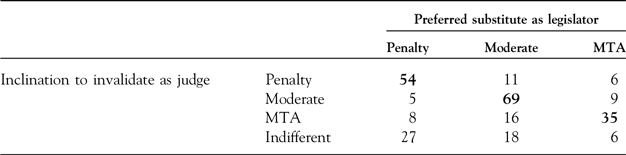
In response to the Judge question, only 51 of the 264 participants (19.3 percent) indicated that their inclination to invalidate a high interest rate would not be affected by the substitutionary arrangement. Among the large majority of 213 participants (out of 264—that is, 80.7 percent) who indicated that they would be affected by the substitute, 83 (39 percent) were most inclined to invalidate a high interest rate under Moderate; 71 (33.3 percent) were most inclined to do so under Penalty; and 59 (27.7 percent) under MTA. The differences between the three substitutionary arrangements were not statistically significant (χ2(2) = 4.06; p = 0.13). These results did not support any of the four hypotheses presented above. The reported inclination to invalidate an excessive interest rate was certainly not unaffected by the substitutionary arrangement, nor was it statistically significantly the strongest under any of the substitutes—Penalty, Moderate, or MTA.
However, there was a strong association between the participants’ inclination to invalidate an excessive interest rate under each of the substitutes (in Judge) and their preferred substitute (in Legislator), as shown in Table 2. Excluding the fifty-one participants who indicated that their inclination to invalidate a high interest rate would not be affected by the substitute arrangement, 158 of the remaining 213 (74.2 percent) were most inclined to invalidate the high interest rate if the substitute arrangement was the one they would support as legislators. This association was highly statistically significant (χ2(4) = 157.42; p < 0.001).
Results of Study 3A: Inclination to Invalidate by Preferred Substitute
These intriguing results did not comport with any of our initial hypotheses. They prompted us to study the issue further—this time with legally trained people. Legal training is important in this context because the decision whether to invalidate a contractual term is ordinarily made by judges. Thus, Study 3B was conducted with legal practitioners, including judges.
Study 3B: Inclination to Invalidate Excessive Terms: Legal Practitioners
Study 3B sought to examine the effect of the substitute arrangement on the subjects’ inclination to invalidate overreaching contractual terms, using a sample of Israeli legal practitioners in a within-subjects design.
Participants
A total of 325 legal practitioners from Israel took part in this study. They were recruited by invitation to take part in a survey, distributed through the mailing list of Nevo, the leading commercial publisher of legal materials in Israel (academics as well as nonlegal subscribers of the list, such as accountants, were excluded). To encourage participation, two participants were selected at random to win a credit of five hundred new Israeli shekels (approximately US $140 at the time of the survey) for the purchase of books from an academic law publisher. A total of 220 participants were male, 103 were female, and 2 did not indicate gender. Their average age was 46.06 years (SD = 12), and their mean professional experience was 15.76 years (SD = 11.73). On average, the participants in the study devoted 48.98 percent of their time to civil litigation (including resolving disputes) (SD = 38.02). Among those involved in civil litigation, 196 represented plaintiffs, 204 represented defendants, 12 served as judges, 54 as arbitrators or mediators, 26 as judicial assistants to judges, and 29 as court clerks (participants could mark more than one answer).
Design and Procedure
The study was conducted in Hebrew (see Appendix for an English translation). As in Study 3A, the participants were first provided with a description of the legal rules that authorize courts in many jurisdictions to invalidate excessive interest rates as well as the conflicting considerations that courts balance in this regard. The text went on to describe the three possible substitutes—once again, as in Study 3A. Two presentation orders of the three substitutes were counterbalanced between subjects: Penalty–Moderate–MTA or MTA–Moderate–Penalty. Following this description, the first question (Comprehension) asked participants to assume that “for a given type of loans in a certain jurisdiction, the prevailing annual interest rate is 10 percent” and that, according to the courts’ ruling, annual interest exceeding 20 percent is excessive and void. Based on these assumptions, they were asked to indicate what the outcome of invalidating an interest rate of 35 percent would be under each of the three substitutes, on a scale of 0 to 35 percent (the correct answers being Penalty: 0 percent; Moderate: 10 percent; MTA: 20 percent). Participants could not proceed with the questionnaire until they had answered all three questions correctly. The order of the three substitutionary arrangements was the same as in the initial description.
The participants then answered the Legislator and Judge questions. In the Legislator question, they were asked to imagine that they were members of parliament enacting a new statute that would authorize courts to invalidate excessive interest rates. They were asked which of the three outcomes of such invalidation—Penalty, Moderate, or MTA—they would include in the statute. Again, each participant was presented with the three options in the same order as in the initial description.
In the Judge question, participants were asked to imagine themselves as judges and to indicate under which substitute arrangement their inclination to invalidate high interest rate would be the strongest. As in Study 3A, in addition to the Penalty, Moderate, and MTA, they had a fourth option—namely, that their inclination to invalidate the high interest rate would be unaffected by the outcome of such invalidation (Indifferent). Four variations of the order of the four answers were used: Penalty–Moderate–MTA–Indifferent; MTA–Moderate–Penalty–Indifferent; Indifferent–Penalty–Moderate–MTA; Indifferent–MTA–Moderate–Penalty (for each participant, the order of the three arrangements was the same as in the initial description). The order of the Legislator and Judge questions was counterbalanced. At the end of the survey, participants were asked to provide demographic details.
Results
The order of the presentation of the questions and the three substitutionary arrangements had little effect on the responses. Footnote 21 In the Legislator question, the participants expressed the greatest support for MTA (154 out of 325; 47.38 percent), followed by Moderate (119; 36.66 percent), and Penalty (16 percent). The differences between MTA and Penalty, between MTA and Moderate, and between Moderate and Penalty were statistically significant (χ2(1) = 50.5; p < 0.001; χ2(1) = 4.49; p = 0.03; and χ2(1) = 26.25; p < 0.001, respectively).
In response to the judge question, only sixty of the 325 (18.46 percent) participants indicated that their inclination to invalidate a high interest rate would not be affected by the substitutionary arrangement. Among the large majority of participants who indicated that they would be affected by the substitute (265 of the 325—that is, 81.54 percent), 158 (59.62 percent) were most inclined to invalidate a high interest rate under MTA; 63 (23.77 percent) were most inclined to do so under Moderate; and 44 (16.66 percent) under Penalty. The differences between MTA and Penalty, and between MTA and Moderate, were statistically significant (χ2(1) = 64.34; p < 0.001; χ2(1) = 40.84; p < 0.001, respectively), and the difference between Penalty and Moderate was marginally statistically significant (χ2(1) = 3.37; p = 0.07). Apparently, these results support the first hypothesis presented above—namely, that the participants would be most inclined to invalidate the excessive interest rate under MTA.
However, this main effect should be interpreted with caution as there was also a highly statistically significant interaction between the participants’ inclination to invalidate an excessive interest rate under each of the substitutes (in Judge) and their preferred substitute (in Legislator), as shown in Table 3 (χ2(4) = 86.46; p < 0.001). Excluding the sixty participants who indicated that their inclination to invalidate a high interest rate would not be affected by the substitute, nearly two-thirds (64.91 percent) were most inclined to invalidate the high interest rate if the substitute arrangement was the one they would support as legislators. To further examine this effect, we ran three additional chi-square tests, such that each test included only two of the possible substitutes (in both the Legislator and Judge questions): Penalty and MTA; Penalty and Moderate; and Moderate and MTA. To determine statistical significance, we used Bonferroni-adjusted alpha levels of 0.017 per test (0.05/3). All these tests demonstrated a similar significant pattern, where participants were most likely to invalidate the excessive interest rate under the substitute they would support as legislators (Penalty–MTA: χ2(1) = 40.59; p < 0.001; Penalty–Moderate: χ2(1) = 16.81; p < 0.001; Moderate–MTA: χ2(1) = 48.89; p < 0.001). This interaction effect replicates the interaction effect found in Study 3A. Footnote 22
Results of Study 3B: Inclination to Invalidate by Preferred Substitute

Discussion
Studies 3A and 3B sought to test the hypothesis that the substitute arrangement may affect judicial inclination to invalidate overreaching contract terms when such invalidation is discretionary. Before discussing their findings, it is interesting to note that the relative support for the various substitutes in the abstract (the legislator question) differed in Study 3B from that found in Studies 1A, 1B, and 3A. In Study 3B, Israeli legal practitioners significantly preferred MTA over both the penalty and moderate arrangements. This preference may have to do with the latter’s familiarity with the relevant Israeli statute. Under section 9(a) of the Israeli Fair Credit Law, 1993, the courts are instructed to invalidate or change any loan contract or a term thereof that does not comply with the statutory requirements, to the extent necessary to adapt them to the statutory requirements. Section 9(b) adds that the court may adjust the interest rate to the statutory cap or set a lower rate, and give any other order as justice requires. While the statute leaves the court with broad discretion, it arguably implies that MTA is the primary option. Previous studies have established that people tend to believe that the existing state of affairs is justified (Eidelman and Crandall Reference Eidelman and Crandall2012; Zamir and Teichman Reference Eyal and Teichman2018, 50). Thus, one explanation for Israeli legal practitioners’ greatest support for MTA in the particular context of excessive interest rate may be the existing law. Another plausible explanation is that legal practitioners identify with lenders more than laypersons.
A possible interpretation of the results is that, when it comes to experienced jurists (who are the pertinent population in this regard), MTAs are likely to increase the judicial inclination to invalidate excessive terms. This is a notable advantage of MTAs if one favors such invalidation. An alternative interpretation—the one we tend to favor, because it explains the results of both Studies 3A and 3B—emphasizes the association between the participants’ reported inclination to invalidate the interest rates (in the Judge question) and their most favored substitute in the abstract (in the Legislator question). This association suggests that participants view the three substitutes as qualitatively different from one another (as opposed to being three points on a spectrum). The participants who preferred MTA (presumably because they were reluctant to intervene in the agreed rate) were naturally less inclined to intervene when the outcome of such invalidation was harsher: Moderate or Penalty. It is less obvious why participants who (as legislators) preferred Penalty or Moderate were not more inclined to invalidate high interest rates under MTA (as judges). After all, even if one prefers Penalty or Moderate in the abstract, in borderline cases, at least, one might feel more comfortable invalidating a contractual interest rate if the outcome of such invalidation is less severe—namely, MTA. With regard to participants who preferred the moderate substitute, one possible answer may be that they prioritized ex post substantive fairness of the contractual terms over considerations of deterrence and freedom of contract, so they were more reluctant to invalidate high interest rates when they deemed the outcome to be less fair (under either Penalty or MTA). As for those who preferred the penalty substitute—possibly because they abhor the charging of excessive interest rates—perhaps they were less inclined to implement a law that they regard as deficient and ineffectual.
In summary, while we would not draw any definitive conclusions about the impact of the substitute arrangement on judicial inclination to invalidate excessive contractual terms based on our findings, they do suggest that the substitute arrangement may indeed have such an effect. Further studies are necessary to advance our understanding of this important issue.
GENERAL DISCUSSION AND CONCLUSION
Mandatory regulation of the content of contracts entails choosing a substitute arrangement in lieu of the invalidated contractual term. Basically, the three possible substitutes are a pro-customer, penalty arrangement; a moderate arrangement; and a pro-supplier, minimally tolerable arrangement. We have critically examined the arguments offered in support of MTAs and found that, at best, they can justify such substitutes only in uncommon cases.
Previous studies have focused on the impact of the choice of the substitute arrangement on the drafting of contracts by suppliers. The five empirical studies reported here advance our understanding of this important choice in several respects. First, they suggest that moderate substitutionary arrangements enjoy relatively broad support. Second, they demonstrate that customers’ reported inclination to challenge excessive terms is the strongest under a penalty substitute, even when the disputed amounts under the three substitutes are the same. Third, they show that the choice of substitute may affect the judicial inclination to invalidate excessive terms when such invalidation is discretionary. Specifically, there is an indication that people are more inclined to invalidate excessive terms when the substitute is the one they prefer in the abstract.
Our empirical findings are preliminary. We examined specific clauses in particular types of transactions. More studies are needed, therefore, to establish the generality of our findings. Specifically, there is much to be learned about the variables that affect customers’ likelihood of challenging exorbitant contract clauses and about possible differences between consumer and commercial contracts. Moreover, there is a concern about the external validity of these results, as there always is with vignette studies. For example, we did not examine many factors that may affect people’s preferred substitute, the customer’s inclination to challenge the contract in court, and judges’ disposition to invalidate excessive terms. Among these are the extent to which the contract term deviates from the reasonable arrangement; the drafting party’s awareness of the existence of the mandatory rule; the fairness of the contract as a whole; and the moral value embedded in the mandatory rule. In addition, there may well be a discrepancy between people’s reported inclination to challenge excessive interest rates in court and their actual behavior. Future research should therefore use other methods, manipulate additional variables, and examine other populations to study the judgments, decision making, and behavior of suppliers, customers, legislators, and judges.
On the whole, our theoretical analysis and empirical findings provide a richer account of the choice of substitutes for invalid contract terms. They considerably weaken the case for MTA substitutes. MTAs strengthen suppliers’ incentives to include invalid terms in contracts; it is unclear whether they increase judicial inclination to invalidate excessive contractual clauses; and they likely diminish customers’ inclination to challenge such clauses. That said, the multiplicity of relevant considerations and the diversity of situations call for careful examination of all available substitutes in a bid to adopt the most appropriate one in any given case. Specifically, one should take into account the goals of any mandatory rule and other aspects of its design. For example, the substitute’s effect on the judicial inclination to invalidate excessive terms is considerably less important if the law allows the judge little or no discretion as to whether or not to invalidate the contractual term. To take another example, the more the law uses other means to deter the incorporation of invalid terms in contracts (such as imposing criminal or administrative sanctions), the less it is imperative to use penalty substitutes to attain that goal.
Finally, the law may leave the choice of the substitute to the judicial decision makers, thus allowing them to make more nuanced decisions by taking into account the specific characteristics of each case (as is already done in some contexts in some legal systems). Footnote 23 Inasmuch as decision makers are more willing to invalidate excessive terms when the substitute is their favorite one (as arguably suggested by the results of Studies 3A and 3B), such a choice may increase the inclination to invalidate excessive terms because it would allow decision makers to replace the invalid term with their favorite substitute. That said, leaving the choice of the substitute to the discretion of the court may well affect the behavior of customers and suppliers. Customers are less likely to challenge excessive terms when the outcome of a successful challenge is less certain and less beneficial to them. Suppliers are more likely to include excessive and invalid terms in their contracts if customers are less likely to challenge them and if, in case they do, the outcome of such challenge is expected to be less costly to the supplier. Designing substitutes for invalid contract terms is a complex task, involving many moving parts. However, there is no escape from this complexity. By drawing attention to hitherto overlooked considerations, our analysis and findings pave the way to a more sophisticated and effective design of mandatory rules.
Supplementary material
To view supplementary material for this article, please visit https://doi.org/10.1017/lsi.2022.24
APPENDIX
Study 1A: Vignettes and Questions
Brokerage fee
Most homeowners use a real estate broker when selling a home. In a certain jurisdiction, the standard broker’s fee is 6%, which is split between the listing agent and the buyer’s agent. Assume that a broker’s fee that is unconscionably high is considered void and unenforceable. Depending on the circumstances (the value of the property, the characteristics of the homeowner, etc.), fees in excess of 10% are ordinarily considered void and unenforceable.
Imagine that you are serving as a judge in a dispute between a homeowner and broker, in a case where the standard-form brokerage contract, drafted by the broker, sets a fee of 14%.
Would you enforce the 14% fee, or rather declare it void and unenforceable?
-
enforce the 14% fee.
-
declare the 14% fee void and unenforceable.
[Attention] What was the subject of the contractual clause described in the previous page? (answers were presented in randomized order)
-
A non-compete clause in employment contracts.
-
A fee paid to a real estate broker.
-
The interest rate for a loan.
-
A lawyer’s fee.
-
Liability for defects in electronic appliances.
-
Waiving a right to sue for a bodily injury.
Assume that, in line with existing precedents, you have decided that the 14% fee was unconscionably high, and therefore void and unenforceable. Now you have to determine whether the homeowner should pay a brokerage fee—and if so, what it should be. Which of the following three options would you choose?
[Penalty] Since the contractual fee was found to be void, the homeowner should pay no fee whatsoever.
[Moderate] Since the contractual fee was found to be void, the homeowner should pay the standard fee of 6%.
[Minimally tolerable] Since the contractual fee was found to be void, the homeowner should pay the maximum tolerable fee—namely, 10%.
Non-compete
A non-compete clause in employment contracts is one that restricts the employee’s freedom to move to another employer in the same trade, or to start a new business that would compete with the employer. Such clauses are considered valid only if deemed reasonable in terms of the geographical area and duration that they apply to. Assume that in a certain jurisdiction, the customary length of this restriction is one year from the end of the employment relationship, and that courts do not ordinarily approve of such clauses with a duration of more than two years.
Imagine that you are serving as a judge in a dispute between an employee and an employer in that jurisdiction, in a case involving an employment contract drafted by the employer that included a non-compete clause of four years’ duration.
Would you enforce the clause, or rather declare it void and unenforceable?
-
enforce the clause.
-
declare the clause void and unenforceable.
[Attention] Same as in Brokerage fee
Assume that, in line with existing precedents, you have decided that the four-year restriction was unreasonably long, and therefore void and unenforceable. Now you have to determine whether the employee should be subject to a non-compete obligation—and if so, for how long. Which of the following three options would you choose?
[Penalty] Since the non-compete clause was found to be void, the employee is not subject to any restriction.
[Moderate] Since the non-compete clause was found to be void, the employee should be subject to the customary restriction of one year.
[Minimally tolerable] Since the non-compete clause was found to be void, the employee should be subject to the minimally tolerable clause—namely, two years.
Interest rate
Assume that for a given type of loans in a certain jurisdiction, the prevailing monthly interest is 3%. The courts in that jurisdiction have long ruled that charging unreasonably high interest rate is unconscionable, and therefore void and unenforceable. A monthly interest rate in excess of 6% is ordinarily considered unconscionable, and is therefore void and unenforceable.
Imagine that you are serving as a judge in a dispute between a lender and a borrower, in a case where the standard-form loan agreement, drafted by the lender, sets a monthly interest of 9%.
Would you enforce the monthly interest of 9%, or rather declare it void and unenforceable?
-
enforce the 9% monthly interest rate.
-
declare the 9% monthly interest rate void and unenforceable.
[Attention] Same as in Brokerage fee.
Assume that, in line with existing precedents, you have decided that the monthly interest rate of 9% was unconscionably high, and therefore void and unenforceable. Now you have to determine whether the borrower should pay an interest on her loan—and if so, at what rate. Which of the following three options would you choose?
[Penalty] Since the contractual interest rate was found to be void, the borrower should pay no interest whatsoever.
[Moderate] Since the contractual interest rate was found to be void, the borrower should pay the prevailing interest rate of 3%.
[Minimally tolerable] Since the contractual interest rate was found to be void, the borrower should pay the maximum tolerable rate—namely, 6%.
Contingent fee
Lawyers who represent people who were injured in an accident usually charge their clients on a contingency basis, with the common contingent fee being one-third (33%) of the recovery. Courts are authorized to invalidate unreasonably high contingent fees, and, depending on the circumstances, usually find contingency fees in excess of 50% unreasonably high, and therefore void and unenforceable.
Imagine that you are serving as a judge in a dispute between a lawyer and her client, in a case where the agreed contingent fee was set at 60%. Would you enforce the contingent fee of 60%, or rather declare it void and unenforceable?
-
enforce the 60% contingent fee.
-
declare the 60% contingent fee void and unenforceable.
[Attention] Same as in Brokerage fee.
Assume that, in line with existing precedents, you have decided that the 60% contingent fee was unconscionably high, and therefore void and unenforceable. Now you have to determine whether the client should pay a fee—and if so, what it should be. Which of the following three options would you choose?
[Penalty] Since the agreed fee was found to be void, the client should pay no contingent fee whatsoever.
[Moderate] Since the agreed fee was found to be void, the client should pay the common fee of 33%.
[Minimally tolerable] Since the agreed fee was found to be void, the client should pay the maximum tolerable fee—namely, 50%.
Study 2: Vignette and Questions
When borrowers take loans from commercial lenders, they usually repay the principal amount plus an agreed interest. Assume that for a given type of non-bank loans in your jurisdiction, the prevailing annual interest rate is 20%. According to the law, “excessive and unconscionable” interest rates are void and unenforceable. The courts in your jurisdiction have long struggled with the question when should an interest rate be considered excessive. As regards the said type of non-bank loans, the courts have usually ruled that an annual interest exceeding 30% is excessive and void, but sometimes they found even higher rates reasonable and valid, and lower rates excessive and void. Under the law, when a court declares a given interest rate excessive and void, the borrower has to pay [Penalty: the principal amount only, without any interest/Moderate: the principal amount plus the prevailing interest rate/Minimally tolerable: the principal amount plus interest at the highest rate that would still be considered tolerable].
Please read the following statements and mark whether each one of them is correct according to the above description:

Imagine that you needed money and took a loan of the type described above in the amount of [Penalty: $5,000/Moderate: $10,000/Minimally tolerable: $20,000], with an annual interest rate of 40%. That is, after one year you had to repay the principal amount plus [Penalty: $2,000/Moderate: $4,000/Minimally tolerable: $8,000]. After getting advice about the law, you decided to repay the principal amount [Penalty: only/Moderate: loan plus $2,000 (20% of the principal amount)/Minimally tolerable: loan plus $6,000 (30% of the principal amount)], which you believe you are legally required to pay. In response, the lender insisted that you must pay the remaining difference of $2,000.
Assume that, at this point, you have two options. One option is to pay the difference of $2,000 up to the contractual interest rate of 40%. The other option is to go to court and argue that the contractual interest rate is void and therefore you only have to pay [Penalty: the principal amount, without any interest/Moderate: an interest rate of 20%, as you did/Minimally tolerable: an interest rate of 30%, as you did].
[Choice] On a scale of 1 to 7 (where 1 means that you will definitely pay the difference and 7 that you will definitely go to court), what will you do?
[Chance] What are, in your opinion, the chances that, if you would avoid paying the difference and go to court, the court would accept your argument that the contractual interest rate is excessive and void? Please mark your assessment on a scale of 0 to 100, where 0 means that there is no chance that your argument would be accepted and 100 means that there is absolute certainty that it would.
[Denounce] To what extent does the law, as described above, denounce the charging of excessive interest and treat it as wrong and reprehensible? Please mark your answer on a 1–7 scale, where 1 means that the law does not denounce the charging of excessive interest at all, and 7 means that it very strongly denounces it.
Study 3B: Vignette and Questions
In many jurisdictions, there are laws that authorize the court to rule that an excessive and unreasonable interest rate is invalid. When courts employ their authority in this matter, they balance between the position that excessive and unreasonable interest enriches the lenders and harms the borrowers unfairly, and freedom of contract and the concern that invalidating high interest rates might deny borrowers the opportunity of getting credit in the first place.
The outcomes of a judicial determination that a given interest is excessive and void vary from one jurisdiction to another. Basically, there are three arrangements, each of which is adopted in some jurisdictions. Specifically, when a court rules that an interest rate is excessive and void, the outcome of such ruling is one of the following:
-
a. A “penalty” arrangement: the borrower pays only the principal and is exempt from paying any interest.
-
b. A “moderate” arrangement: the borrower pays the principal plus the prevailing interest rate in loans of the same type.
-
c. A “minimally tolerable arrangement”: the borrower pays the principal plus interest at the highest rate that would still be considered valid.
[Comprehension] To ensure that the above description is clear, we would be grateful if you could answer the following question. Assume that for a given type of loans in a certain jurisdiction, the prevailing annual interest rate is 10%. According to the ruling of the courts in that country, an annual interest exceeding 20% is excessive and void. Imagine that in a lawsuit filed by a lender against a borrower, the court held that the contract interest of 35% is excessive and void. What interest would the borrower have to pay under each of the arrangements described above, following the court’s decision? Please mark the correct answer:
-
Under the “penalty” arrangement the borrower should pay an interest of: (0% … 35%).
-
Under a “moderate” arrangement the borrower should pay an interest of: (0% … 35%).
-
Under a minimally tolerable arrangement the borrower should pay an interest of: (0% … 35%). Footnote 25
[Legislator] Now, imagine that you are a member of a legislative body that enacts a new statute that would authorize the courts to invalidate excessive interest rates. What outcome of such invalidation would you include in the statute? Please mark one of the following options:
-
a. A “penalty” arrangement: the borrower pays only the principal and is exempt from paying any interest.
-
b. A “moderate” arrangement: the borrower pays the principal plus the prevailing interest rate in loans of the same type.
-
c. A “minimally tolerable arrangement”: the borrower pays the principal plus interest at the highest rate that would still be considered valid.
[Judge] Now, imagine that you are serving as a judge in a jurisdiction where courts are authorized to invalidate excessive interest rates in loans. How would your inclination to invalidate a high interest rate be affected, if at all, by the outcome of such invalidation? Please mark one of the following options:
-
__ My inclination to invalidate high interest rates would be strongest under the “penalty” arrangement.
-
__ My inclination to invalidate high interest rates would be strongest under the “moderate” arrangement.
-
__ My inclination to invalidate high interest rates would be strongest under the minimally tolerable arrangement.
-
__ My inclination to invalidate high interest rates would not be affected by the outcome of such invalidation. Footnote 26


 Open access

