





1. Introduction
Text readability refers to the textual elements that influence the comprehension, reading fluency, and level of interest of the readers (Dale and Chall Reference Dale and Chall1949). These textual components involve several dimensions of text properties, including lexical, syntactic, and conceptual dimensions (Xia et al. Reference Xia, Kochmar and Briscoe2016). In order to predict the readability of a text automatically, text readability assessment task has been proposed and widely used in many fields, such as language teaching (Lennon and Burdick Reference Lennon and Burdick2004; Pearson et al. Reference Pearson, Ngo, Ekpo, Sarraju, Baird, Knowles and Rodriguez2022), commercial advertisement (Chebat et al. Reference Chebat, Gelinas-Chebat, Hombourger and Woodside2003), newspaper readership (Pitler and Nenkova Reference Pitler and Nenkova2008), health information (Bernstam et al. Reference Bernstam, Shelton, Walji and Meric-Bernstam2005; Eltorai et al. Reference Eltorai, Naqvi, Ghanian, Eberson, Weiss, Born and Daniels2015; Partin et al. Reference Partin, Westfall, Sanda, Branham, Muir, Bellcross and Jain2022), web search (Ott and Meurers Reference Ott and Meurers2011), and book publishing (Pera and Ng Reference Pera and Ng2014). In this section, we will first introduce our proposed concept of textual form complexity, then present related work on text readability assessment with handcrafted features, and finally present a novel insight into text readability assessment and our study.
1.1 Concept of textual form complexity
Text complexity refers to the sophisticated level of a text, which manifests in various aspects such as vocabulary level, sentence structure, text organization, and inner semantics (Frantz et al. Reference Frantz, Starr and Bailey2015). Derived from this, a new concept named textual form complexity is proposed in this paper. Among all the aspects of text complexity, textual form complexity covers the outer form facets in contrast to the inner semantic facets. In this section, we will describe this concept of textual form complexity in detail.
Previous studies have not given a consistent and formal definition of text complexity. However, one perspective (Siddharthan Reference Siddharthan2014) suggests defining text complexity as the linguistic intricacy present at different textual levels. To offer a more comprehensive explanation of this definition, we cited the viewpoints of several experts as follows:
-
• Lexical complexity means that a wide variety of both basic and sophisticated words are available and can be accessed quickly, whereas a lack of complexity means that only a narrow range of basic words are available or can be accessed (Wolfe et al. Reference Wolfe, Schreiner, Rehder, Laham, Foltz, Kintsch and Landauer1998).
-
• Syntactical complexity refers to the sophistication of syntactic structure seen in writing or speaking that arises from our ability to group words as phrases and embed clauses in a recursive, hierarchical fashion (Friederici et al. Reference Friederici, Chomsky, Berwick, Moro and Bolhuis2017).
-
• Grammatical complexity means that a wide variety of both basic and sophisticated structures are available and can be accessed quickly, whereas a lack of complexity means that only a narrow range of basic structures are available or can be accessed (Wolfe et al. Reference Wolfe, Schreiner, Rehder, Laham, Foltz, Kintsch and Landauer1998).
-
• Discourse complexity refers to the difficulty associated with the text’s discourse structure or coreference resolution (Cristea et al. Reference Cristea, Ide, Marcu and Tablan2000).
-
• Graphical complexity refers to the challenges in interpreting the visual aspects of text, such as letter combinations, especially for individuals with dyslexia (Gosse and Van Reybroeck Reference Gosse and Van Reybroeck2020).
On the basis of these viewpoints from experts, text complexity is categorized with regard to different aspects, such as lexical, syntactical, grammatical, discourse, and graphical aspects. Different from this way of categorization, we offer a new perspective. In our view, the complexity of a text is affected by the interplay of multiple factors. Among these factors, there are inner semantic-related factors, such as content, vocabulary richness, and implied information or knowledge; and there are outer form-related factors, such as expressions, structural characteristics, and layout. In this paper, we separate out these outer form-related factors and introduce a new concept, namely textual form complexity, to measure the degree of sophistication of the external forms.
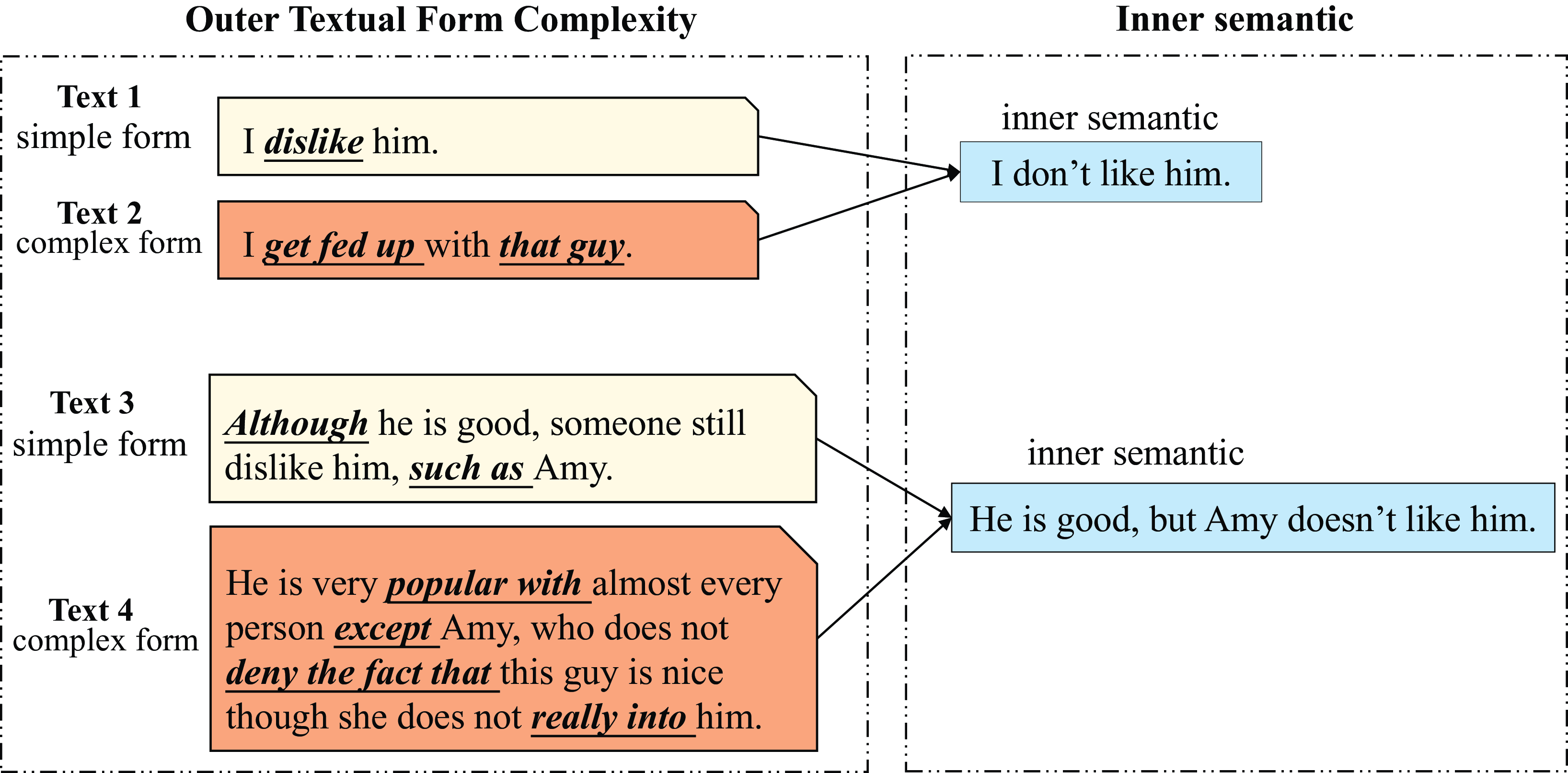
Figure 1 depicts a graph that helps illustrate our proposed concept of textual form complexity. As shown in the picture, four texts are given in terms of their outer form complexity and inner semantics. As can be observed, we have the following discussions: First, there are multiple ways to convey the same semantic, and different ways of expression correspond to different textual outer forms of complexity. For example, given an inner semantic with the meaning “I don’t like him,” text 1 and text 2 are two distinct ways to convey this meaning. Although both of them share the same inner semantic, text 1 expresses it in a simple manner and in a simple textual form, whereas text 2 expresses it in a more complex manner and a more complex textual form. Second, whether the inner semantic is simple or complex, it can be represented by either a simple or a complex textual form. For instance, although the inner semantic of “I don’t like him,” is easy, the complex textual form of text 2 makes it difficult to understand; in contrast, although the inner semantic of “He is good, but Amy doesn’t like him” is a little difficult, the simple textual form of text 3 makes it easy to understand. Based on this observation, we argue that the outer textual form of a text plays a crucial role in determining its reading difficulty, indicating that the proposed concept of textual form complexity is worth further research.
Diagram of the distinctions between the outer textual form complexity and the inner semantic. Four texts are presented in terms of their inner semantic and outer textual form complexity. While text 1 and text 2 convey the same inner semantics, text 2 has a more sophisticated outside textual structure than text 1. Although the inner semantics of text 3 and text 4 are more difficult to comprehend, text 3 expresses them in a simple form, whereas text 4 expresses them in a more complex form.
1.2 Text readability assessment with handcrafted features
Text readability assessment is a significant research field in text information processing. Early work focused on the exploitation of readability formulas (Thorndike Reference Thorndike1921; Lively and Pressey Reference Lively and Pressey1923; Washburne and Vogel Reference Washburne and Vogel1926; Dale and Chall Reference Dale and Chall1948; Mc Laughlin Reference Mc Laughlin1969; Yang Reference Yang1971). Some of the readability formulas approximate syntactic complexity based on simple statistics, such as sentence length (Kincaid et al. Reference Kincaid, Fishburne and Chissom1975). Other readability formulas focus on semantics, which is usually approximated by word frequency with respect to a reference list or corpus (Chall and Dale Reference Chall and Dale1995). While these traditional formulas are easy to compute, they are too simplistic in terms of text difficulty assumptions (Bailin and Grafstein Reference Bailin and Grafstein2001). For example, sentence length is not an accurate measure of syntactic complexity, and syllable count does not necessarily indicate the difficulty of a word (Schwarm and Ostendorf Reference Schwarm and Ostendorf2005; Yan et al. Reference Yan, Song and Li2006).
In recent years, researchers have tackled readability assessment as a supervised classification task and followed different methods to construct their models. The methods can be divided into three categories: language model-based methods (Si and Callan Reference Si and Callan2001; Schwarm and Ostendorf Reference Schwarm and Ostendorf2005; Petersen and Ostendorf Reference Petersen and Ostendorf2009), machine learning-based methods (Heilman et al. Reference Heilman, Collins-Thompson, Callan and Eskenazi2007, Reference Heilman, Collins-Thompson and Eskenazi2008; Xia et al. Reference Xia, Kochmar and Briscoe2016; Vajjala and Lučić, Reference Vajjala and Lučić2018), and neural network-based methods (Azpiazu and Pera Reference Azpiazu and Pera2019; Deutsch et al. Reference Deutsch, Jasbi and Shieber2020; Lee et al. Reference Lee, Jang and Lee2021). Based on the fact that text readability involves many different dimensions of text properties, the performance of classification models highly relies on handcrafted features (Schwarm and Ostendorf Reference Schwarm and Ostendorf2005; Yan et al. Reference Yan, Song and Li2006; Petersen and Ostendorf Reference Petersen and Ostendorf2009; Vajjala and Meurers Reference Vajjala and Meurers2012).
All along, multiple linguistic features have been proposed to improve the performance of text readability assessment, such as lexical features to capture word complexity (Lu Reference Lu2011; Malvern and Richards Reference Malvern and Richards2012; Kuperman et al. Reference Kuperman, Stadthagen-Gonzalez and Brysbaert2012; Collins-Thompson Reference Collins-Thompson2014), syntactical features to mimic the difficulty of the cognitive process (Schwarm and Ostendorf Reference Schwarm and Ostendorf2005; Lu Reference Lu2010; Tonelli et al. Reference Tonelli, Tran and Pianta2012; Lee and Lee Reference Lee and Lee2020), and discourse-based features to characterize text organization (Pitler and Nenkova Reference Pitler and Nenkova2008; Feng et al. Reference Feng, Jansche, Huenerfauth and Elhadad2010).
Although the existing studies have proposed a number of effective handcrafted features for text readability assessment, there are still three points that can be improved. First, the majority of previous studies focused on extracting features based on the content and shallow and deep semantics of the texts; few of them investigated text readability from the perspective of outer textual formal complexity. Second, most of the existing features focus on a single linguistic dimension of texts; namely, one feature tends to correspond to one single linguistic dimension (e.g., the length of a word corresponds to the lexical dimension) (Collins-Thompson Reference Collins-Thompson2014). These single linguistic dimensional features may be limited in their ability to acquire more textual information. If a feature can reflect multiple linguistic dimensions, then it can capture more information about text readability. Third, most of the existing studies focus on a specific language (Chen and Meurers Reference Chen and Meurers2016; Okinina et al. Reference Okinina, Frey and Weiss2020; Wilkens et al. Reference Wilkens, Alfter, Wang, Pintard, Tack, Yancey and François2022), few of them explicitly exploit language-independent features for multilingual readability assessment.
To this end, in this paper, we provide a new perspective on text readability by employing the proposed concept of textual form complexity and introducing a set of textual formal features for the text readability assessment based on the concept.
1.3 A novel insight into text readability assessment
In traditional viewpoints (Feng et al. Reference Feng, Jansche, Huenerfauth and Elhadad2010), text readability evaluates how easy or difficult it is for a reader to understand a given text. In other words, it evaluates the degree of difficulty in comprehending a specific text. In this study, we provide a new perspective on text readability by employing the proposed concept of textual form complexity. As described in Section 1.1, outer textual forms may be carriers of internal core semantics. However, complex outer textual forms may distract the reader and make it more difficult to understand the meaning of the text, reducing the text’s readability. Intuitively, the more exterior textual forms a given text has, the more complex and less readable it is. This perception reflects the implicit association between textual form complexity and text readability, and the purpose of our research is to determine if and to what extent this correlation can contribute to text readability assessment.
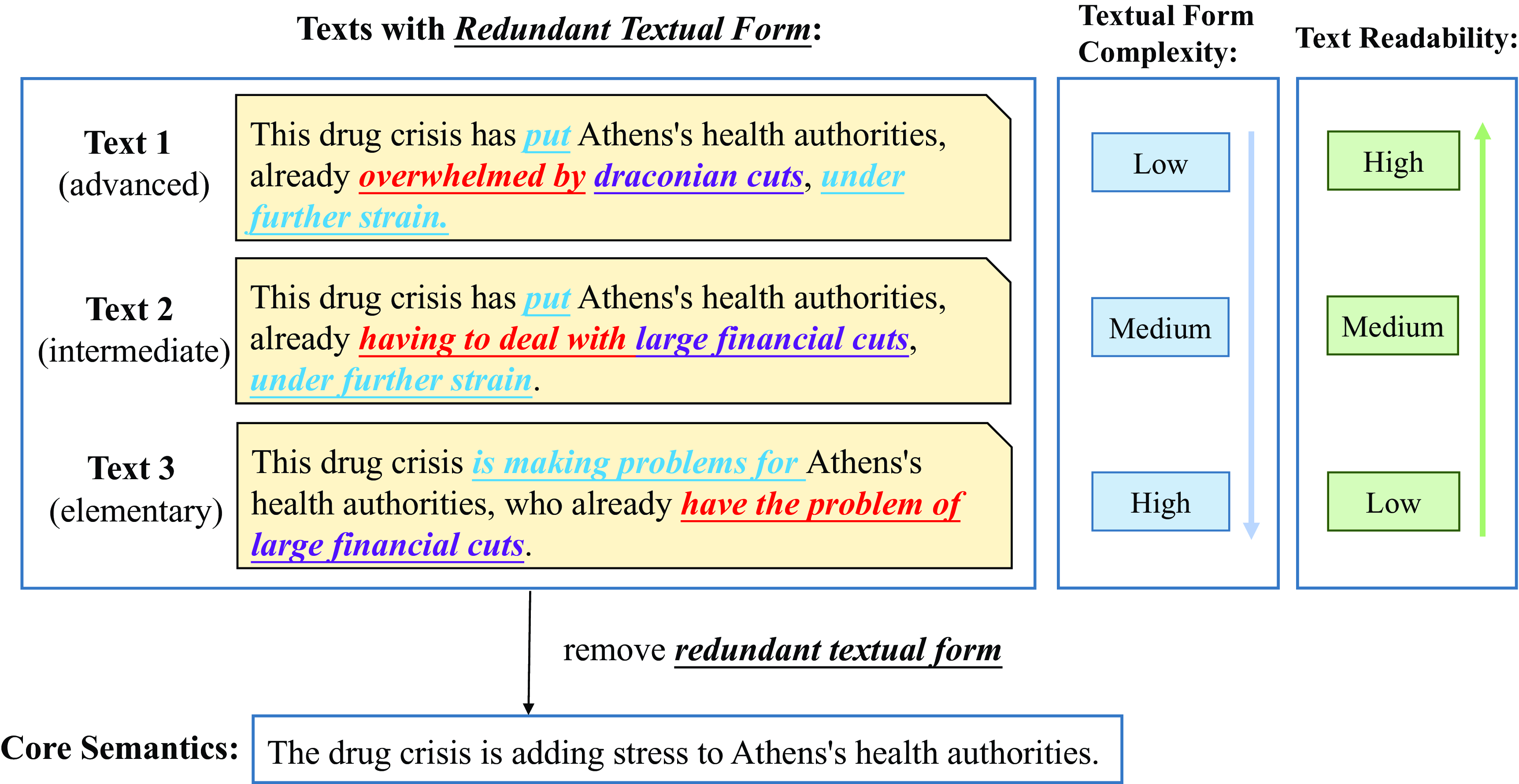
In this work, it is hoped that a novel insight will contribute to a new understanding of text readability assessment. The insight is illustrated in Figure 2. It can be seen that the three provided texts have the same inner core semantics when the exterior textual forms are removed. Due to the different amounts of external textual form, the textual form complexity and readability of the three texts are different. Textual form complexity is positively correlated with the amount of exterior textual form, which results in the ranking of the textual form complexity of the three texts as text 1 $\lt$
text 2
$\lt$
text 2 $\lt$
text 3. Due to the fact that the exterior textual form causes distractions and makes comprehension more difficult, it negatively affects text readability. That is, text readability is negatively connected with the quantity of exterior textual form, which promotes the ranking of the text readability of the three texts as text 3
$\lt$
text 3. Due to the fact that the exterior textual form causes distractions and makes comprehension more difficult, it negatively affects text readability. That is, text readability is negatively connected with the quantity of exterior textual form, which promotes the ranking of the text readability of the three texts as text 3 $\lt$
text 2
$\lt$
text 2 $\lt$
text 1.
$\lt$
text 1.
An instance of the novel insight into text readability. Three parallel texts with the same core semantics from the different readability levels of OneStopEnglish corpus are given. The exterior textual form within the texts is marked with underlines. As can be seen, textual form complexity is positively correlated with the amount of exterior textual form, and the exterior textual form negatively affects text readability.
In summary, using the exterior textual form as a bridge, we can make the following inference: the higher the textual form complexity, the lower the text’s readability. In response to this inference, we propose to construct a set of textual formal features to express the complexity of textual forms and use these features to evaluate the readability of texts. Specifically, we first use a text simplification tool (Martin et al. 2020) to simplify a given text, so as to reduce the complex exterior text forms and obtain the simplified text. Then, we design a set of textual form features based on the similarity, overlap, and length ratio of pre-simplified and post-simplified texts to quantify the differences between them as a measure of the textual exterior form information.
In contrast to existing features based on internal semantics, our proposed textual formal features may benefit from their ability to represent multiple dimensions of the language to obtain more information to assess the readability of the text. This is because textual forms represent a text’s outer qualities and manifest in various linguistic dimensions, such as lexical, syntactical, and grammatical dimensions. In addition, the extraction procedure for the features involves multiple levels, such as word-level deletion, phrase-level substitution, and sentence-level reconstruction, allowing the proposed features to reflect different dimensions of linguistic information. To sum up, two studies are proposed in this work:
-
• Study 1: How to build textual form features to capture text characteristics in terms of textual form complexity?
-
• Study 2: To what extent can the proposed textual form features contribute to readability assessment?
2. Literature review
In this section, we provide a comprehensive review of related works from two perspectives: text complexity and readability assessment. Concerning text complexity, we explore relevant studies focusing on various dimensions individually in Section 2.1. Regarding readability assessment, we conduct a separate review of studies based on different methods in Section 2.2 and provide an in-depth and detailed review of the linguistic features applied for this task in Section 2.3.
2.1 Different dimensions of text complexity
Text complexity refers to the level of difficulty or intricacy present in a given text. It encompasses both linguistic and structural aspects of the text, such as vocabulary richness, sentence length, syntactic complexity, and overall readability. Over time, researchers have devised numerous tools and systems to quantify text complexity in different dimensions. In the following sections, we will separately review the relevant research on text complexity in the lexical, syntactic, and discourse dimensions.
From the lexical dimension, some studies focus on developing tools for analyzing the lexical complexity of a text, while others focus on predicting the difficulty level of individual words. In early studies, Rayner and Duffy (Reference Rayner and Duffy1986) investigate whether lexical complexity increases a word’s processing time. To automatically analyze lexical complexity, there is a widely used tool called Range,Footnote A which focuses on measuring the vocabulary and word diversity. Based on this tool, Anthony (Reference Anthony2014) developed a tool named AntWordProfiler, which is an extension of Range and can be applied to multiple languages. Both tools are based on unnormalized type-token ratio (TTR), and thus, they are all sensitive to the length of the text. Recently, researchers have been engaged in the automatic classification of word difficulty levels (Gala et al. Reference Gala, François and Fairon2013; Tack et al. Reference Tack, François, Ligozat and Fairon2016; Tack et al. Reference Tack, François, Ligozat and Fairon2016). For example, Gala et al. (Reference Gala, François and Fairon2013) investigate 27 intra-lexical and psycholinguistic variables and utilize the nine most predictive features to train a support vector machine (SVM) classifier for word-level prediction. Alfter and Volodina (Reference Alfter and Volodina2018) explore the applicability of previously established word lists to the analysis of single-word lexical complexity. They incorporate topics as additional features and demonstrate that linking words to topics significantly enhances the accuracy of classification.
As another dimension of text complexity, syntactic complexity measures the complexity of sentence structure and organization within the text. In earlier studies, Ortega (Reference Ortega2003) evaluates the evidence concerning the relationship between syntactic complexity measures and the overall proficiency of second-language (L2) writers. They conclude that the association varies systematically across different studies, depending on whether a foreign language learning context is investigated and whether proficiency is defined by program level. Szmrecsanyi (Reference Szmrecsanyi2004) compares three measures of syntactic complexity—node counts, word counts, and a so-called “Index of Syntactic Complexity”—with regard to their accuracy and applicability. They conclude that node counts are resource-intensive to conduct and researchers can confidently use this measure. Recently, Lu and Xu (Reference Lu and Xu2016) develop a system, namely L2SCA, to analyze the syntactic complexity of second-language (L2) writing. The correlation between the output of the L2SCA system and manual calculation is 0.834-1.000. Although L2SCA is designed for L2 texts, studies have shown that it is also suitable for analyzing other textual materials (Gamson et al. Reference Gamson, Lu and Eckert2013; Jin et al. Reference Jin, Lu and Ni2020). Besides, Kyle (Reference Kyle2016) develops another system, TAASSC. The system analyzes syntactic structure at clause and phrase levels and includes both coarse-grained and fine-grained measures.
Despite lexical and syntactic dimensions, discourse is also an integral dimension of text complexity (Graesser et al. Reference Graesser, McNamara and Kulikowich2011). In early work, Biber (Reference Biber1992) employs a theory-based statistical approach to examine the dimensions of discourse complexity in English. They analyze the distribution of 33 surface linguistic markers of complexity across 23 spoken and written registers. The study reveals that discourse complexity is a multidimensional concept, with various types of structural elaboration reflecting different discourse functions. Recently, Graesser et al. (Reference Graesser, McNamara, Cai, Conley, Li and Pennebaker2014) propose a classical discourse-level text analysis system, namely Coh-Metrix, which is designed to analyze text on multiple levels of language and discourse. This system regards cohesion as a textual notion and coherence as a reader-related psychological concept (Graesser et al. Reference Graesser, McNamara, Louwerse and Cai2004). It contains measures such as cohesion features, connective-related features, and LSA-based features (Landauer et al. Reference Landauer, Foltz and Laham1998). Besides, Crossley et al. (2016, Reference Crossley, Kyle and Dascalu2019) also focus on analyzing text cohesion and develop a system named TAACO. In addition to the overall cohesion emphasized in previous systems, this system adds local and global cohesion measures based on LDA (Blei et al. Reference Blei, Ng and Jordan2003) and word2vec (Mikolov et al. Reference Mikolov, Sutskever, Chen, Corrado and Dean2013).
In recent years, educators have been trying to measure the complexity of texts so that they can provide texts that match the level of knowledge and skills of their students. Wolfe et al. (Reference Wolfe, Schreiner, Rehder, Laham, Foltz, Kintsch and Landauer1998) refer to this as the zone of proximal text difficulty. That is, the text should challenge the reader in a way that inspires them to improve their existing knowledge and skills. Besides, the Common Core State Standards (CCSS) set a goal for students to comprehend texts of progressively increasing complexity as they advance through school (Association et al. Reference Association2010). To assist educators in determining the proper degree of complexity, CCSS standards introduce a triangle model to measure text complexity through a combination of qualitative analysis, quantitative measurements, and reader-task considerations (Williamson et al. Reference Williamson, Fitzgerald and Stenner2013). Frantz et al. (Reference Frantz, Starr and Bailey2015) argue that the syntactic complexity, as one aspect of text complexity, should be explicitly included as a quantitative measure in the model. In addition, Sheehan et al. (Reference Sheehan, Kostin, Napolitano and Flor2014) design a text analysis system namely TextEvaluator to help select reading materials that are consistent with the text complexity goals outlined in CCSS. This system expands the text variation dimension in traditional metrics and addresses two potential threats, genre bias and blueprint bias.
2.2 Readability assessment methods
Text readability assessment refers to the process of determining the comprehensibility of a given text. It is a significant research field in text information processing. In the majority of studies, researchers treat readability assessment as a supervised classification task, aiming to assign a readability label to each text. They follow different methods to construct their models, which can be divided into three categories: machine learning-based methods, neural network-based methods, and language model-based methods. The following section will review the relevant studies based on the three methods, respectively.
The machine learning-based method involves utilizing machine learning algorithms and feature engineering to assess the readability of a given text. These approaches typically utilize a set of text features as inputs and train a machine learning model to predict the readability labels. Following this method, Vajjala and Lučić (Reference Vajjala and Lučić2018) introduce a Support Vector Machine (SVM) classifier trained on a combination of 155 traditional, discourse cohesion, lexico-semantic, and syntactic features. Their classification model attains an accuracy of 78.13% when evaluated on the OneStopEnglish corpus. Xia et al. (Reference Xia, Kochmar and Briscoe2016) adopt similar lexical, syntactic, and traditional features as Vajjala and Lučić (Reference Vajjala and Lučić2018) and further incorporate language modeling-based and discourse cohesion-based features to train a SVM classifier. Their approach achieves an accuracy of 80.3% on the Weebit corpus. More recently, Chatzipanagiotidis et al. Reference Chatzipanagiotidis, Giagkou and Meurers2021) collect a diverse set of quantifiable linguistic complexity features, including lexical, morphological, and syntactic aspects, and conduct experiments using various feature subsets. Their findings demonstrate that each linguistic dimension provides distinct information, contributing to the highest performance achieved when using all linguistic feature subsets together. By training a readability classifier based on these features, they achieve a classification accuracy of 88.16% for the Greek corpus. Furthermore, Wilkens et al. (Reference Wilkens, Alfter, Wang, Pintard, Tack, Yancey and François2022) introduce the FABRA readability toolkit and propose that measures of lexical diversity and dependency counts are crucial predictors for native texts, whereas for foreign texts, the most effective predictors include syntactic features that illustrate language development, along with features related to lexical gradation.
With the rise of deep learning, many neural network-based methods have been proposed and applied to readability assessment. For example, Azpiazu and Pera (Reference Azpiazu and Pera2019) introduce a neural model called Vec2Read. The model utilizes a hierarchical RNN with attention mechanisms and is applied in a multilingual setting. They find that no language-specific patterns suggest text readability is more challenging to predict in certain languages compared to others. Mohammadi and Khasteh (Reference Mohammadi and Khasteh2019) employ a deep reinforcement learning model as a classifier to assess readability, showcasing its ability to achieve multi-linguality and efficient utilization of text. Moreover, Deutsch et al. (Reference Deutsch, Jasbi and Shieber2020) evaluate the joint use of linguistic features and deep learning models (i.e., transformers and hierarchical attention networks). They utilize the output of deep learning models as features and combine them with linguistic features, which are then fed into a classifier. However, their findings reveal that incorporating linguistic features into deep learning models does not enhance model performance, suggesting these models may already represent the readability-related linguistic features. This finding connects to the studies of BERTology, which aim to unveil BERT’s capacity for linguistic representation (Buder-Gröndahl, Reference Buder-Gröndahl2023). Research in this area has shown BERT’s ability to grasp phrase structures (Reif et al. Reference Reif, Yuan, Wattenberg, Viegas, Coenen, Pearce and Kim2019), dependency relations (Jawahar et al. Reference Jawahar, Sagot and Seddah2019), semantic roles (Kovaleva et al. Reference Kovaleva, Romanov, Rogers and Rumshisky2019), and lexical semantics (Soler and Apidianaki Reference Soler and Apidianaki2020). In recent studies, hybrid models have also been explored for their applicability in readability assessment. Wilkens et al. (Reference Wilkens, Watrin, Cardon, Pintard, Gribomont and François2024) systematically compare six hybrid approaches alongside standard machine learning and deep learning approaches across four corpora, covering different languages and target audiences. Their research provides new insights into the complementarity between linguistic features and transformers.
The language model-based methods can be divided into early ones based on statistical language models and recent ones based on pre-trained language models. In early work, Si and Callan (Reference Si and Callan2001) are the first to introduce the application of statistical models for estimating the reading difficulty. They employ language models to represent the content of web pages and devise classifiers that integrated language models with surface linguistic features. Later on, many other methods based on statistical models are proposed. For instance, Schwarm and Ostendorf (Reference Schwarm and Ostendorf2005) propose training n-gram language models for different readability levels and use likelihood ratios as features in a classification model. Petersen and Ostendorf (Reference Petersen and Ostendorf2009) train three language models (uni-gram, bi-gram, and tri-gram) on external data resources and compute perplexities for each text to indicate its readability. In recent times, pre-trained language models have gained considerable attention in academia, contributing significantly to advancements in the field of natural language processing. Concurrently, some researchers are also investigating their applicability in readability assessment. For example, Lee et al. (Reference Lee, Jang and Lee2021) investigate appropriate pre-trained language models and traditional machine learning models for the task of readability assessment. They combine these models to form various hybrid models, and their RoBERTA-RF-T1 hybrid achieves an almost perfect classification accuracy of 99%. Lee and Lee (Reference Lee and Lee2023) introduce a novel adaptation of a pre-trained seq2seq model for readability assessment. They prove that a seq2seq model—T5 or BART—can be adapted to discern which text is more difficult from two given texts.
2.3 Linguistic features for readability assessment
This section provides an overview of the linguistic features used in readability assessment. We review these features from five dimensions: shallow features, lexical features, syntactical features, discourse-based features, and reading interaction-based features.
The shallow features refer to the readability formulas exploited in the early research (Thorndike Reference Thorndike1921; Lively and Pressey Reference Lively and Pressey1923; Washburne and Vogel Reference Washburne and Vogel1926; Dale and Chall Reference Dale and Chall1948; Mc Laughlin Reference Mc Laughlin1969; Yang Reference Yang1971). These formulas often assess text readability through simple statistical measures. For example, the Flesch-Kincaid Grade Level Index (Kincaid et al. Reference Kincaid, Fishburne and Chissom1975), a widely used readability formula, calculates its scores based on the average syllable count per word and the average sentence length in a given text. Similarly, the Gunning Fog index (Reference Gunning1952) uses the average sentence length and the proportion of words that are three syllables or longer to determine readability. Beyond syntax, some formulas delve into semantic analysis, typically by comparing word frequency against a standard list or database. As an illustration, the Dale-Chall formula employs a combination of average sentence length and the percentage of words not present in the “simple” word list (Chall and Dale Reference Chall and Dale1995). While these traditional formulas are easy to compute, they exhibit shortcomings in terms of their assumptions about text difficulty (Bailin and Grafstein Reference Bailin and Grafstein2001). For instance, sentence length does not accurately measure syntactic complexity, and syllable count may not necessarily reflect the difficulty of a word (Schwarm and Ostendorf Reference Schwarm and Ostendorf2005; Yan et al. Reference Yan, Song and Li2006). Furthermore, as highlighted by Collins-Thompson (Reference Collins-Thompson2014), the traditional formulas do not adequately capture the actual reading process and neglect crucial aspects such as textual coherence. Collins-Thompson (Reference Collins-Thompson2014) argues that traditional readability formulas solely focus on surface-level textual features and fail to consider deeper content-related characteristics.
The lexical features capture the attributes associated with the difficulty or unfamiliarity of words (Lu Reference Lu2011; Malvern and Richards Reference Malvern and Richards2012; Kuperman et al. Reference Kuperman, Stadthagen-Gonzalez and Brysbaert2012; Collins-Thompson Reference Collins-Thompson2014). Lu (Reference Lu2011) analyzes the distribution of lexical richness across three dimensions: lexical density, sophistication, and variation. Their work employs various metrics from language acquisition studies and reports noun, verb, adjective, and adverb variations, which reflect the proportion of words belonging to each respective grammatical category relative to the total word count. Type-Token Ratio (TTR) is the ratio of number of word types to total number of word tokens in a text. It has been widely used as a measure of lexical diversity or lexical variation (Malvern and Richards Reference Malvern and Richards2012). Vajjala and Meurers (Reference Vajjala and Meurers2012) consider four alternative transformations of TTR and the Measure of Textual Lexical Diversity (MTLD; Malvern and Richards (Reference Malvern and Richards2012)), which is a TTR-based approach that is not affected by text length. Vajjala and Meurers (Reference Vajjala and Meurers2016) explore the word-level psycholinguistic features such as concreteness, meaningfulness, and imageability extracted from the MRC psycholinguistic database (Wilson Reference Wilson1988) and various Age of Acquisition (AoA) measures released by Kuperman et al. (Reference Kuperman, Stadthagen-Gonzalez and Brysbaert2012). Moreover, word concreteness has been shown to be an important aspect of text comprehensibility. Paivio et al. (Reference Paivio, Yuille and Madigan1968) and Richardson (Reference Richardson1975) define concreteness based on the psycholinguistic attributes of perceivability and imageability. Tanaka et al. (Reference Tanaka, Jatowt, Kato and Tanaka2013) incorporate these attributes of word concreteness into their measure of text comprehensibility and readability.
The syntactical features imitate the difficulty of cognitive process for readers (Schwarm and Ostendorf Reference Schwarm and Ostendorf2005; Lu Reference Lu2010; Tonelli et al. Reference Tonelli, Tran and Pianta2012; Lee and Lee Reference Lee and Lee2020). These features capture properties of the parse tree that are associated with more complex sentence structure (Collins-Thompson Reference Collins-Thompson2014). For example, Schwarm and Ostendorf (Reference Schwarm and Ostendorf2005) examine four syntactical features related to parse tree structure: the average height of parse trees, the average numbers of subordinate clauses (SBARs), noun phrases, and verb phrases per sentence. Building on this, Lu (Reference Lu2010) expands the analysis and implements four specific metrics for each of these phrase types, which are respectively the total number of phrases in a document, the average number of phrases per sentence, and the average length of phrases both in terms of words and characters. In addition to average tree height, Lu (Reference Lu2010) introduces metrics based on non-terminal nodes, such as the average number of non-terminal nodes per parse tree and per word. Tonelli et al. (Reference Tonelli, Tran and Pianta2012) assess syntactic complexity and the frequency of particular syntactic constituents in a text. They suggest that texts with higher syntactic complexity are more challenging to comprehend, thus reducing their readability. This is attributed to factors such as syntactic ambiguity, dense structure, and high number of embedded constituents within the text.
The discourse-based features illustrate the organization of a text, emphasizing that a text is not just a series of random sentence but reveals a higher-level structure of dependencies (Pitler and Nenkova Reference Pitler and Nenkova2008; Feng et al. Reference Feng, Jansche, Huenerfauth and Elhadad2010; Lee et al. Reference Lee, Jang and Lee2021). In previous research, Pitler and Nenkova (Reference Pitler and Nenkova2008) investigate how discourse relations impact text readability. They employ the Penn Discourse Treebank annotation tool (Prasad, Webber, and Joshi Reference Prasad, Webber and Joshi2017), focusing on the implicit local relations between adjacent sentences and explicit discourse connectives. Feng et al. (Reference Feng, Elhadad and Huenerfauth2009) propose that discourse processing is based on concepts and propositions, which are fundamentally composed of established entities, such as general nouns and named entities. They design a set of entity-related features for readability assessment, focusing on quantifying the number of entities a reader needs to track both within each sentence and throughout the entire document. To analyze how discourse entities are distributed across a text’s sentences, Barzilay and Lapata (Reference Barzilay and Lapata2008) introduce the entity grid method for modeling local coherence. Based on this approach, Guinaudeau and Strube (Reference Guinaudeau and Strube2013) refine the use of local coherence scores, applying them to distinguish documents that are easy to read from those difficult ones.
Recently, various reading interaction-based features have been proposed and applied in the task of readability assessment (Gooding et al. Reference Gooding, Berzak, Mak and Sharifi2021; Baazeem, Al-Khalifa, and Al-Salman Reference Baazeem, Al-Khalifa and Al-Salman2021). Dale and Chall (Reference Dale and Chall1949) suggest that readability issues stem not only from the characteristics of the text but also from those of the reader. Similarly, Feng et al. (Reference Feng, Elhadad and Huenerfauth2009) argue that readability is not just determined by literacy skills, but also by the readers’ personal characteristics and backgrounds. For example, Gooding et al. (Reference Gooding, Berzak, Mak and Sharifi2021) measure implicit feedback through participant interactions during reading, generating a set of readability features based on readers’ aggregate scrolling behaviors. These features are language agnostic, unobtrusive, and are robust to noisy text. Their work shows that scroll behavior can provide an insight into the subjective readability for an individual. Baazeem et al. (Reference Baazeem, Al-Khalifa and Al-Salman2021) suggest the use of eye-tracking features in automatic readability assessment and achieve enhanced model performance. Their findings reveal that eye-tracking features are superior to linguistic features when combined, implying the ability of these features to reflect the text readability level in a more natural and precise way.
In addition to the linguistic features for readability assessment reviewed above, this paper proposes a set of novel features which characterize text readability from the perspective of outer textual form complexity. In subsequent sections, we will introduce the proposed features and describe our readability assessment method in detail.
3. Method
3.1 Overall framework
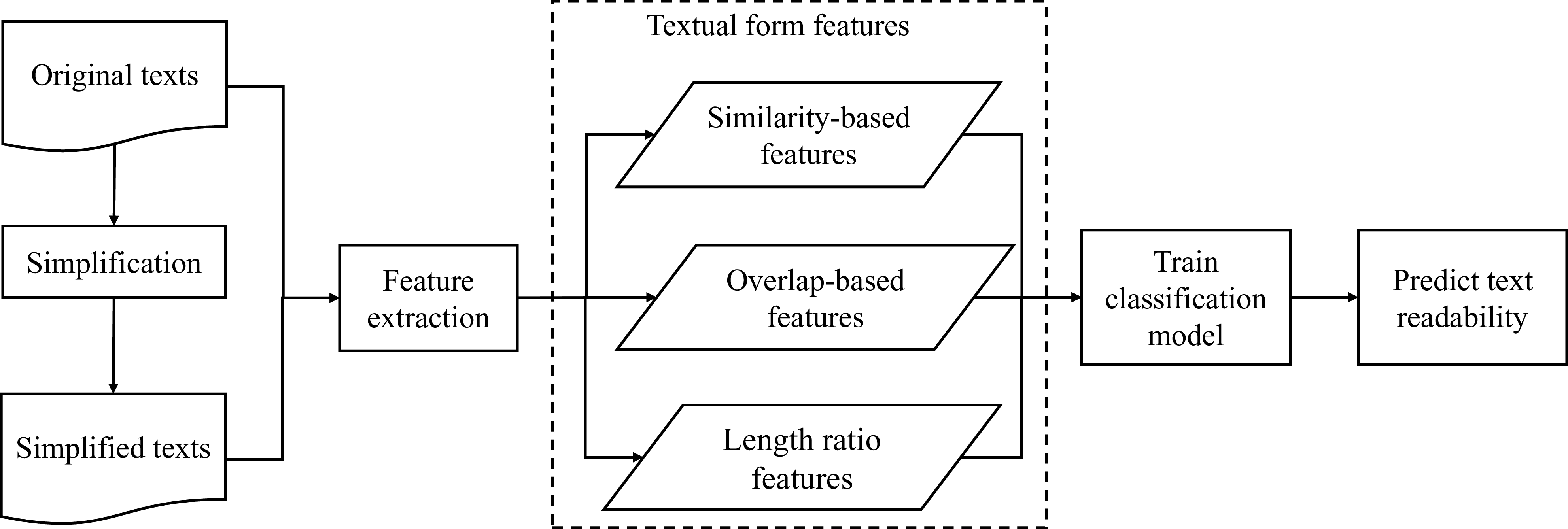
Based on the concept of textual form complexity, we propose to construct a set of textual formal features to help characterize the readability of the text. The overall framework of our method is presented in Figure 3. Our method consists of three components. The first component is the text simplification stage. In this stage, we use the simplification tool to simplify each text to its simplified version. These original and simplified texts are used to extract the textual formal features in the second stage. The process of detailed simplification will be introduced in Section 3.2. The second component is the feature extraction stage. In this stage, we extract the textual form features with the input of the original texts and their simplified versions. The textual form features are extracted by measuring the distinction between the original and the simplified texts from three aspects, which correspond to similarity-based features, overlap-based features, and length ratio-based features. The details of the extraction of the textual form features will be introduced in Section 3.3. The third component is the model training stage. In this stage, we first train a classification model with the extracted features and use the model to predict the readability label of the texts. The details of model prediction will be introduced in Section 3.4.
The flowchart of our method. To obtain the simplified texts, we begin by simplifying the original texts. The original and simplified texts are then passed to feature extraction as inputs to get the three subsets of textual form features. Using these features, we then train a classification model to predict text readability.
3.2 Simplification operations to reduce the exterior textual form
In order to provide a more formal description for the proposed idea of textual form complexity, we study certain criteria for writing simple and clear texts, such as the Plain Language Guidelines (Caldwell et al. Reference Caldwell, Cooper, Reid, Vanderheiden, Chisholm, Slatin and White2008; PLAIN 2011) and the “Am I making myself clear?” guideline (Dean Reference Dean2009). The basic principles shared by these guidelines are: “write short sentences; use the simplest form of a verb (present tense and not conditional or future); use short and simple words; avoid unnecessary information; etc.” Basically, the principle is to simplify the complexity of the textual form by reducing unnecessary exterior textual forms. Consequently, we conclude that the complexity of textual form is a measure of the amount of exterior textual form in a given text.
In the field of automatic text simplification, these guidelines also serve as guidance on the simplification operations (Štajner et al. Reference Štajner, Sheang and Saggion2022), such as splitting sentences, deletion of non-essential parts, and replacement of simple words. Table 1 presents some typical examples. It shows that simplification operations can help reduce the external textual form by reducing the linguistic obstacles within the texts. Furthermore, text simplification, according to Martin et al. (2020), is the process of reducing the complexity of a text without changing its original meaning. Based on the above theoretical foundations, we assume that text simplification can reduce the outer textual form while retaining the inner core semantics. If we can measure what the simplification operations have done, we can quantify the exterior textual form. Motivated by this, we propose to extract the textual form features by measuring the reduced textual forms during the simplification process.
Linguistic obstacles and simplification operations to remove them
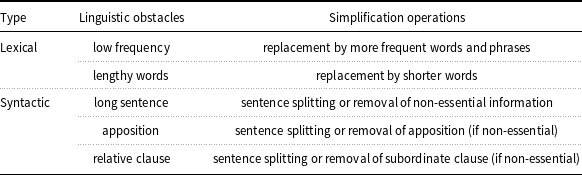
This table is presented by Štajner et al. (Reference Štajner, Sheang and Saggion2022)
We quote this table to show the functions of simplification operations in reducing the exterior textual form.
The technique used in the simplification process is a multilingual unsupervised sentence simplification system called MUSS (Martin et al. 2020). The architecture of this system is based on the sequence-to-sequence pre-trained transformer BART (Lewis et al. Reference Lewis, Liu, Goyal, Ghazvininejad, Mohamed, Levy, Stoyanov and Zettlemoyer2020). For different languages, we utilize the corresponding pre-trained model, that is“ $muss\_en\_mined$
” for English, “
$muss\_en\_mined$
” for English, “ $muss\_fr\_mined$
” for French, and “
$muss\_fr\_mined$
” for French, and “ $muss\_es\_mined$
” for Spanish. Specifically, we first utilize the NLTK tool for sentence segmentation (Loper and Bird Reference Loper and Bird2002). The pre-trained model is then applied to each document, sentence by sentence, to simplify it. Finally, we incorporate the simplified sentences into a single document as the corresponding simplified text.
$muss\_es\_mined$
” for Spanish. Specifically, we first utilize the NLTK tool for sentence segmentation (Loper and Bird Reference Loper and Bird2002). The pre-trained model is then applied to each document, sentence by sentence, to simplify it. Finally, we incorporate the simplified sentences into a single document as the corresponding simplified text.
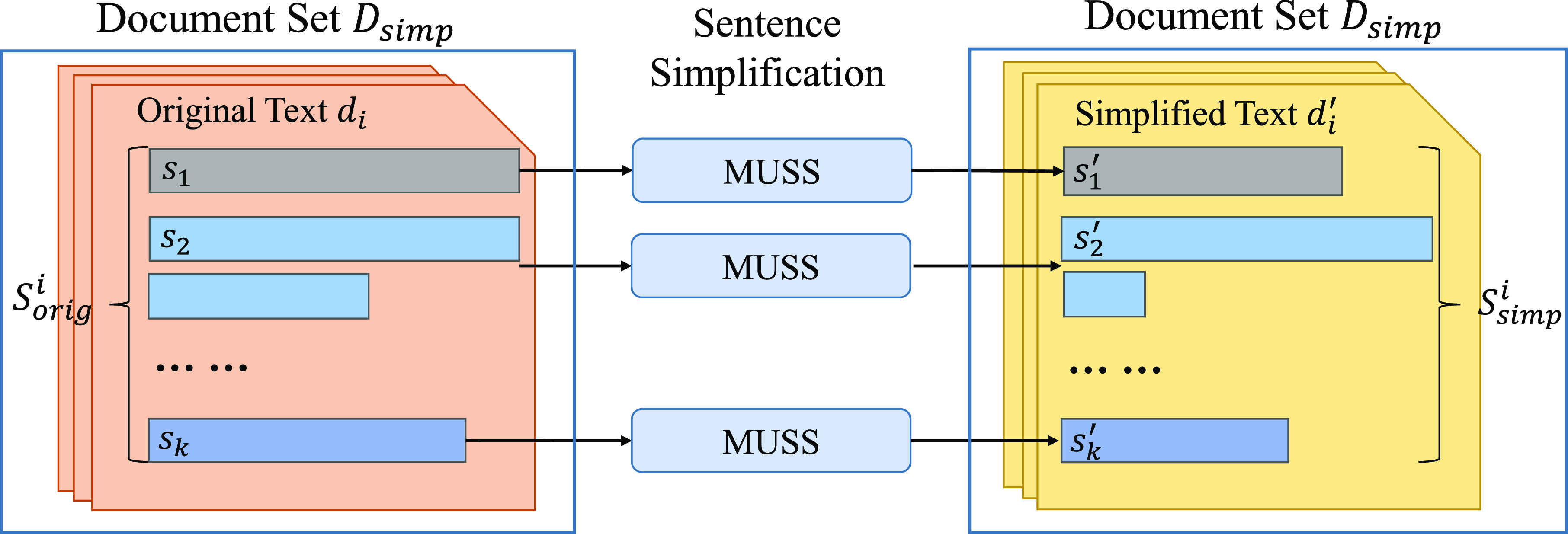
We show the simplification process in Figure 4. Supposing the document set of original texts is $D_{orig}=\{d_1,d_2,\ldots, d_i,\ldots, d_n\}$
. For a given text
$D_{orig}=\{d_1,d_2,\ldots, d_i,\ldots, d_n\}$
. For a given text $d_i$
$d_i$ $(1\le i\le n)$
, the original sentence set of
$(1\le i\le n)$
, the original sentence set of $d_i$
is denoted as
$d_i$
is denoted as $S_{orig}^i=\{s_1,s_2,\ldots s_j,\ldots, s_k\}$
. After the simplification process, the simplified text of
$S_{orig}^i=\{s_1,s_2,\ldots s_j,\ldots, s_k\}$
. After the simplification process, the simplified text of $d_i$
is obtained, which is denoted as
$d_i$
is obtained, which is denoted as $d_i'$
. Due to the sentence-by-sentence manner, we also obtain the parallel simplified sentence
$d_i'$
. Due to the sentence-by-sentence manner, we also obtain the parallel simplified sentence $s_j'$
for each sentence in the text
$s_j'$
for each sentence in the text $d_i$
. If a sentence is split into multiple sub-sentences after simplification, we connect the sub-sentences as the corresponding simplified sentence
$d_i$
. If a sentence is split into multiple sub-sentences after simplification, we connect the sub-sentences as the corresponding simplified sentence $s_j'$
. Then the simplified sentence set of the simplified document
$s_j'$
. Then the simplified sentence set of the simplified document $d_i'$
is obtained, which is denoted as
$d_i'$
is obtained, which is denoted as $S_{simp}^i=\{s_1',s_2',\ldots, s_j',\ldots, s_k'\}$
. We denote the parallel sentence pairs as
$S_{simp}^i=\{s_1',s_2',\ldots, s_j',\ldots, s_k'\}$
. We denote the parallel sentence pairs as $(s_j,s_j')$ $(s_j\in S_{orig}^i, s_j' \in S_{simp}^i, 1 \le i \le n, 1 \le j \le k)$
, where
$(s_j\in S_{orig}^i, s_j' \in S_{simp}^i, 1 \le i \le n, 1 \le j \le k)$
, where $n$
is the total number of the texts in the corpus and
$n$
is the total number of the texts in the corpus and $k$
is the total number of the sentences in each text.
$k$
is the total number of the sentences in each text.
The symbolism of the simplification process. We use the sentence-level simplification model MUSS to simplify each sentence $s_j$
and obtain a simplified sentence
$s_j$
and obtain a simplified sentence $s_j'$
for each text
$s_j'$
for each text $d_i$
in the original document set
$d_i$
in the original document set $D_{orig}$
. Finally, we combine the simplified sentences in each text
$D_{orig}$
. Finally, we combine the simplified sentences in each text $d_i'$
to produce a parallel simplified document set
$d_i'$
to produce a parallel simplified document set $D_{simp}$
.
$D_{simp}$
.
3.3 Textual form features
On the basis of our innovative insight into text readability, we offer a set of textual form features for assessing text readability. The retrieved features are based on the assumption that the differences between the original text and the simplified text can reflect the degree to which the complex exterior textual form is reduced during the simplification process. In other words, the distinctions measure the quantity of the outer textual form and hence serve as an indicator of the complexity of the textual form. To achieve this, we extract features from three dimensions, namely similarity, overlap, and length ratio, to reflect the difference between the original text and the simplified text and to quantify how many exterior forms have been reduced. The proposed textual form features are divided into three subsets:
-
• Similarity-based features. The similarity-based features are based on the classical similarity measurements, including cosine similarity, Jaccard similarity, edit distance, BLEU score, and METEOR score. In particular, we propose an innovative feature $BertSim$
, which determines the distance between BERT-based text representations.
$BertSim$
, which determines the distance between BERT-based text representations. -
• Overlap-based features. The overlap-based features are proposed based on the intuition that word-level overlap can represent word-level change through simplification (e.g., the number of complex word deletion) and capture lexical-dimension textual form complexity (e.g., vocabulary difficulty). We investigate the overlap from the perspective of part-of-speech (i.e., noun, verb, and adjective).
-
• Length ratio-based features. The length ratio-based features are based on the observation that text is usually shortened after being simplified, we propose to use the sentence-level length ratio to characterize the syntactical dimension of textual form complexity.

In the following subsections, we will describe these three types of textual form features in detail.
3.3.1 Similarity-based features
According to the information theory lin1998information, similarity refers to the commonalities shared by two different texts. The greater the commonality, the higher the similarity, and vice versa. Over the past three decades (Wang and Dong Reference Wang and Dong2020), several similarity measurements have been proposed. These similarity measurements vary in how they represent text and compute distance. In this work, we use three classical similarity measurements to capture textual form complexity for readability assessment. In addition, we also propose an innovative feature based on the similarity of BERT embeddings (Imperial Reference Imperial2021). The detailed descriptions of them are as follows:
- $\mathbf{CosSim}$
.
$\mathbf{CosSim}$
.
Cosine Similarity measures the cosine of the angle between two vectors in an inner product space (Deza and Deza Reference Deza and Deza2009). For a given document, the $CosSim$
feature is calculated as the average cosine similarity between the vector representations of sentences in the text. It can be considered a sentence-level similarity between the texts before and after simplification. Specifically, for a given text
$CosSim$
feature is calculated as the average cosine similarity between the vector representations of sentences in the text. It can be considered a sentence-level similarity between the texts before and after simplification. Specifically, for a given text $d_i$
, the
$d_i$
, the $k$
parallel sentence pairs
$k$
parallel sentence pairs $(s_j, s_j')$
are obtained through simplification operations, where
$(s_j, s_j')$
are obtained through simplification operations, where $j$
=1,2…,
$j$
=1,2…, $k$
. We use the one-hot encoding as the vector representations of these sentences, which is a well-known bag-of-words model for text representation (Manning and Schütze Reference Manning and Schütze1999). Then, we calculate the cosine similarity between the one-hot vectors of
$k$
. We use the one-hot encoding as the vector representations of these sentences, which is a well-known bag-of-words model for text representation (Manning and Schütze Reference Manning and Schütze1999). Then, we calculate the cosine similarity between the one-hot vectors of $s_j$
and
$s_j$
and $s_j'$
and average the
$s_j'$
and average the $k$
values in text
$k$
values in text $d_i$
. The feature
$d_i$
. The feature $CosSim$
calculation formula is as follows:
$CosSim$
calculation formula is as follows:
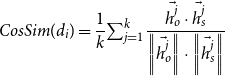 \begin{equation} CosSim(d_i)=\frac{1}{k}{\textstyle \sum _{j=1}^{k}} \frac{\vec{h_o^j}\cdot \vec{h_s^j}}{\left \|\vec{h_o^j}\right \| \cdot \left \|\vec{h_s^j}\right \|} \end{equation}
where $\vec{h_o^j}$
is the one-hot vector of sentence
$\vec{h_o^j}$
is the one-hot vector of sentence $s_j$
in original text
$s_j$
in original text $d_i$
,
$d_i$
, $\vec{h_s^j}$
is the one-hot vector of sentence
$\vec{h_s^j}$
is the one-hot vector of sentence $s_j'$
in simplified text
$s_j'$
in simplified text $d_i'$
,
$d_i'$
, $\left \|\vec{h^j}\right \|$
denotes the modulus of vector
$\left \|\vec{h^j}\right \|$
denotes the modulus of vector $\vec{h^j}$
,
$\vec{h^j}$
, $k$
is the number of sentence pair
$k$
is the number of sentence pair $(s_j, s_j')$
for the given text
$(s_j, s_j')$
for the given text $d_i$
.
$d_i$
.
- $\mathbf{JacSim}$
.
$\mathbf{JacSim}$
.
Jaccard similarity is a similarity metric used to compare two finite sets. It is defined as the intersection of two sets over the union of two sets (Jaccard Reference Jaccard1901). Applied to text similarity measurement, Jaccard similarity is computed as the number of shared terms over the number of all unique terms in both strings (Gomaa and Fahmy Reference Gomaa and Fahmy2013). The feature $JacSim$
measures the average Jaccard similarity of the sentence pairs for the given text. The extraction procedure is the same as for the feature
$JacSim$
measures the average Jaccard similarity of the sentence pairs for the given text. The extraction procedure is the same as for the feature $CosSim$
, and the calculation formula is as follows:
$CosSim$
, and the calculation formula is as follows:
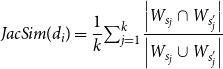 \begin{equation} JacSim(d_i)=\frac{1}{k}{\textstyle \sum _{j=1}^{k}}\frac{\left | W_{s_j} \cap W_{s_j'} \right | }{\left | W_{s_j}\cup W_{s_j'}\right | } \end{equation}
where $W_{s_j}$
denotes the word set of sentence
$W_{s_j}$
denotes the word set of sentence $s_j$
in original text
$s_j$
in original text $d_i$
,
$d_i$
, $W_{s_j'}$
denotes the word set of sentence
$W_{s_j'}$
denotes the word set of sentence $s_j'$
in simplified text
$s_j'$
in simplified text $d_i'$
,
$d_i'$
, $k$
is the number of sentence pairs
$k$
is the number of sentence pairs $(s_j, s_j')$
for the given text
$(s_j, s_j')$
for the given text $d_i$
.
$d_i$
.
- $\mathbf{EditDis}$
.
$\mathbf{EditDis}$
.
Edit distance is a metric used in computational linguistics to measure the dissimilarity between two strings. It is determined by the minimal number of operations required to transform one string into another (Gomaa et al. Reference Gomaa and Fahmy2013). Depending on the definitions, there are different sets of string operations at different edit distances. In our work, we used the Levenshtein distance, which incorporates operations such as the deletion, insertion, or substitution of a character in a string (Levenshtein et al. Reference Levenshtein1966). The feature $EditDis$
calculates the Levenshtein distance between the original text and its simplified version. Because the Levenshtein distance is calculated character by character, the feature
$EditDis$
calculates the Levenshtein distance between the original text and its simplified version. Because the Levenshtein distance is calculated character by character, the feature $EditDis$
can capture the character-level textual form complexity for a given text.
$EditDis$
can capture the character-level textual form complexity for a given text.
- $\mathbf{BertSim}$
.
$\mathbf{BertSim}$
.
The $BertSim$
feature measures the text’s readability based on the similarity between the BERT-based representations of the texts before and after simplification at the document level. BERT is a pre-trained language model that has shown effectiveness in a variety of NLP tasks. It possesses the inherent capability to encode linguistic knowledge, such as hierarchical parse trees (Hewitt and Manning Reference Hewitt and Manning2019), syntactic chunks (Liu et al. Reference Liu, Gardner, Belinkov, Peters and Smith2019), and semantic roles (Ettinger Reference Ettinger2020). We believe such knowledge can be incorporated to capture the text’s multidimensional textual features in order to more comprehensively represent the textual form complexity. During the feature extraction process, we leveraged the pre-trained models “bert-base-casedFootnote
B
” and “bert-base-multilingual-uncasedFootnote
C
” for English and non-English texts. Steps for feature extraction are as follows:
$BertSim$
feature measures the text’s readability based on the similarity between the BERT-based representations of the texts before and after simplification at the document level. BERT is a pre-trained language model that has shown effectiveness in a variety of NLP tasks. It possesses the inherent capability to encode linguistic knowledge, such as hierarchical parse trees (Hewitt and Manning Reference Hewitt and Manning2019), syntactic chunks (Liu et al. Reference Liu, Gardner, Belinkov, Peters and Smith2019), and semantic roles (Ettinger Reference Ettinger2020). We believe such knowledge can be incorporated to capture the text’s multidimensional textual features in order to more comprehensively represent the textual form complexity. During the feature extraction process, we leveraged the pre-trained models “bert-base-casedFootnote
B
” and “bert-base-multilingual-uncasedFootnote
C
” for English and non-English texts. Steps for feature extraction are as follows:
Step 1: BERT-based sentence representation
For each sentence of a given text, we use the BERT tokenizer to split and get the token sequence $[t_1, t_2, \ldots, t_l,\ldots, t_{L}]$
, where
$[t_1, t_2, \ldots, t_l,\ldots, t_{L}]$
, where $t_l$
is the
$t_l$
is the $l^{th}$
token for the sentence and
$l^{th}$
token for the sentence and $L=510$
is the maximum sentence length supported by BERT. If the token length in the sentence is greater than
$L=510$
is the maximum sentence length supported by BERT. If the token length in the sentence is greater than $L$
, the sequence will be truncated; otherwise, it will be padded with the
$L$
, the sequence will be truncated; otherwise, it will be padded with the $[PAD]$
token. The final token sequence of the sentence is concatenated by the
$[PAD]$
token. The final token sequence of the sentence is concatenated by the $[CLS]$
token, original sentence token sequence, and the
$[CLS]$
token, original sentence token sequence, and the $[SEP]$
token, which is denoted as
$[SEP]$
token, which is denoted as $T_j = [[CLS],t_1, t_2, \ldots \ldots t_{L},[SEP]]$
. As described in the work of BERT (Kenton and Toutanova Reference Kenton and Toutanova2019), we use the final token embeddings, segmentation embeddings, and position embeddings as input to the BERT to get the BERT encoding of the sentence. For a given sentence
$T_j = [[CLS],t_1, t_2, \ldots \ldots t_{L},[SEP]]$
. As described in the work of BERT (Kenton and Toutanova Reference Kenton and Toutanova2019), we use the final token embeddings, segmentation embeddings, and position embeddings as input to the BERT to get the BERT encoding of the sentence. For a given sentence $s_j$
, the output hidden states of the sentence are
$s_j$
, the output hidden states of the sentence are $\mathbf{H} \in \mathbb{R}^{L\times d}$
, where
$\mathbf{H} \in \mathbb{R}^{L\times d}$
, where $d=768$
is the dimension of the hidden state. In our work, instead of using the output vector of token [CLS], we use the mean pooling of
$d=768$
is the dimension of the hidden state. In our work, instead of using the output vector of token [CLS], we use the mean pooling of $\mathbf{H} \in \mathbb{R}^{L\times d}$
as the sentence representation, which is denoted as
$\mathbf{H} \in \mathbb{R}^{L\times d}$
as the sentence representation, which is denoted as $\vec{v_{s_j}} \in \mathbb{R}^d$
.
$\vec{v_{s_j}} \in \mathbb{R}^d$
.
Step 2: BERT-based text representation and similarity calculation
After getting the BERT-based representations of the text’s sentences, the BERT-based representation of the text can be obtained by taking the average of the sentence representations. Given the original text $d_i$
and the simplified text
$d_i$
and the simplified text $d_i'$
, we first get the representations of all sentences in them, which are denoted as
$d_i'$
, we first get the representations of all sentences in them, which are denoted as $V_{d_i}=\{\vec{v_{s_1}},\vec{v_{s_2}},\ldots, \vec{v_{s_k}}\}$
for the text
$V_{d_i}=\{\vec{v_{s_1}},\vec{v_{s_2}},\ldots, \vec{v_{s_k}}\}$
for the text $d_i$
and
$d_i$
and $V_{d_i'}=\{\vec{v_{s_1'}},\vec{v_{s_2'}},\ldots, \vec{v_{s_k'}}\}$
for the text
$V_{d_i'}=\{\vec{v_{s_1'}},\vec{v_{s_2'}},\ldots, \vec{v_{s_k'}}\}$
for the text $d_i'$
, where
$d_i'$
, where $k$
is the sentence number,
$k$
is the sentence number, $\vec{v_{s_k}}=[v_1^k,v_2^k,\ldots, v_{768}^k]$
is the vector of the
$\vec{v_{s_k}}=[v_1^k,v_2^k,\ldots, v_{768}^k]$
is the vector of the $k^{th}$
sentence in
$k^{th}$
sentence in $d_i$
and
$d_i$
and $\vec{v_{s_k'}}=[{v_1^k}',{v_2^k}',\ldots, {v_{768}^{k'}}]$
is the vector of the
$\vec{v_{s_k'}}=[{v_1^k}',{v_2^k}',\ldots, {v_{768}^{k'}}]$
is the vector of the $k^{th}$
sentence in
$k^{th}$
sentence in $d_i'$
. The final representation
$d_i'$
. The final representation $\vec{v_{d_i}}=[v_1,v_2,\ldots, v_{768}]$
for text
$\vec{v_{d_i}}=[v_1,v_2,\ldots, v_{768}]$
for text $d_i$
and
$d_i$
and $\vec{ v_{d_i'} }=[ v_{1}',v_{2}',\ldots, v_{768}' ]$
for text
$\vec{ v_{d_i'} }=[ v_{1}',v_{2}',\ldots, v_{768}' ]$
for text $d_i'$
are obtained by averaging the values of each dimension of the
$d_i'$
are obtained by averaging the values of each dimension of the $k$
number of sentences. The inner product of the two text representations is then utilized as the
$k$
number of sentences. The inner product of the two text representations is then utilized as the $BertSim$
feature value. The equations are as follows:
$BertSim$
feature value. The equations are as follows:
 \begin{equation} BertSim(d_i)=\sum _{i=1}^{768} v_i\cdot v_i' \quad (i=1,2,\ldots, 768) \end{equation}
 \begin{equation} v_i = \frac{1}{k}\sum _{j=1}^{k}v_i^j \quad (j=1,2,\ldots, k,\space i=1,2,\ldots, 768) \end{equation}
 \begin{equation} v_i' = \frac{1}{k}\sum _{j=1}^{k}{v_i^j}' \quad (j=1,2,\ldots, k,\space i=1,2,\ldots, 768) \end{equation}
where $k$
is the number of sentences in text,
$k$
is the number of sentences in text, $v_i$
is the average value of
$v_i$
is the average value of $i^{th}$
dimension in the representations of the
$i^{th}$
dimension in the representations of the $k$
sentences of text
$k$
sentences of text $d_i$
, and
$d_i$
, and $v_i'$
is the average value of
$v_i'$
is the average value of $i^{th}$
dimension in the representations of the
$i^{th}$
dimension in the representations of the $k$
sentences of text
$k$
sentences of text $d_i'$
. The detailed procedure for step 2 is presented in Figure 5.
$d_i'$
. The detailed procedure for step 2 is presented in Figure 5.
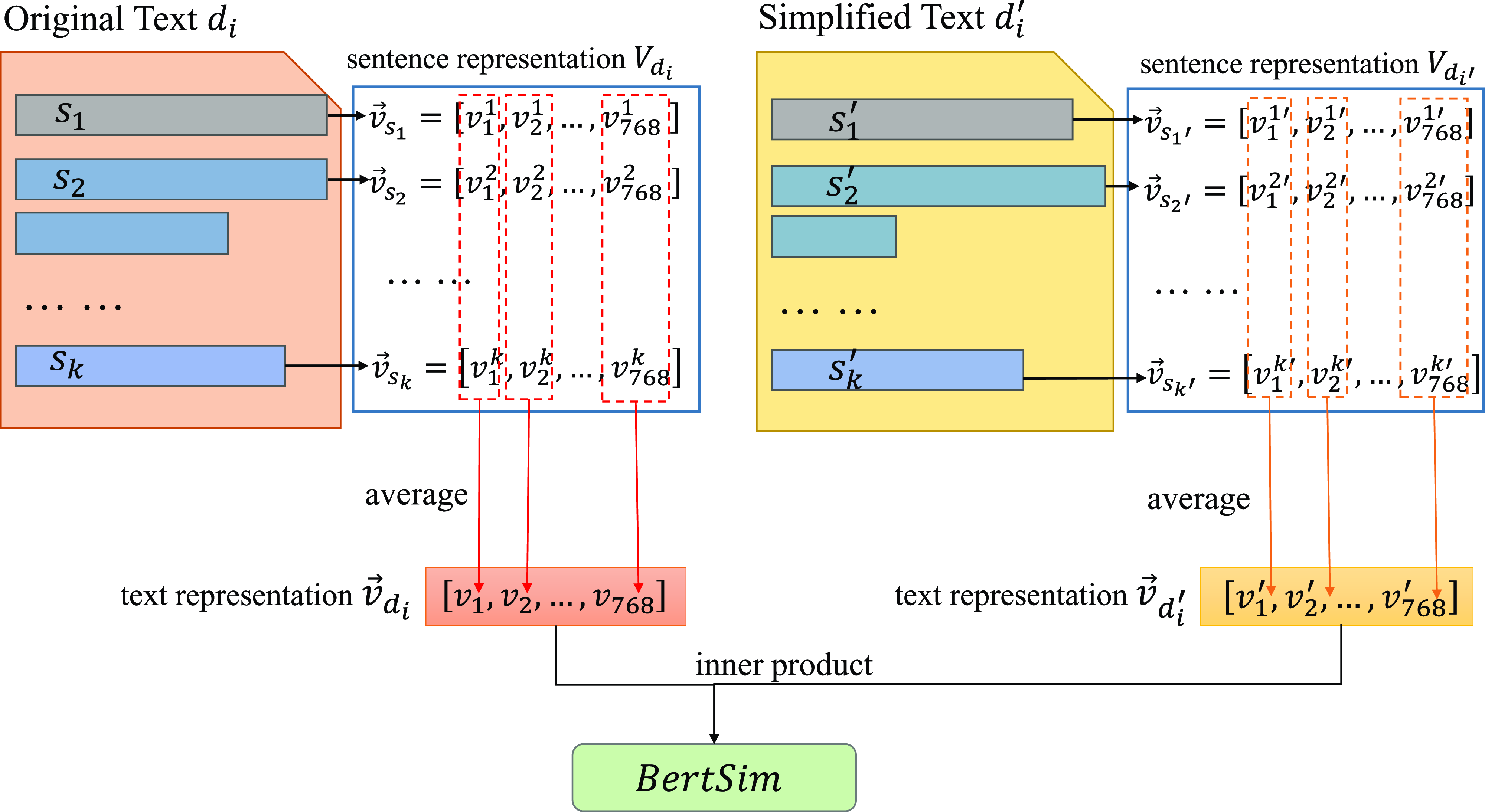
The extraction process of the feature $BertSim$
in step 2. The sentence representations
$BertSim$
in step 2. The sentence representations $\vec{v_{s_k}}$
and
$\vec{v_{s_k}}$
and $\vec{v_s^i}$
are obtained in step 2. For each text
$\vec{v_s^i}$
are obtained in step 2. For each text $d_i$
, we average the value of each dimension in the sentence representations as the text representation. The text representation for the original text is
$d_i$
, we average the value of each dimension in the sentence representations as the text representation. The text representation for the original text is $\vec{v_{d_i}}$
, and the text representation for the simplified text is
$\vec{v_{d_i}}$
, and the text representation for the simplified text is $\vec{v_{d_i'}}$
. At last, the inner product of
$\vec{v_{d_i'}}$
. At last, the inner product of $\vec{v_{d_i}}$
and
$\vec{v_{d_i}}$
and $\vec{v_{d_i'}}$
is calculated as the final value of the feature
$\vec{v_{d_i'}}$
is calculated as the final value of the feature $BertSim$
.
$BertSim$
.
- $\mathbf{BleuSim}$
.
$\mathbf{BleuSim}$
.
The BLEU score is a commonly used evaluation metric for machine translation (Papineni et al. Reference Papineni, Roukos, Ward and Zhu2002). It assesses the frequency of n-gram matches (usually 1-gram to 4-gram) in the machine-generated text compared to reference texts. As the core idea of BLEU is to evaluate the alignment between machine-generated output and human reference, BLEU score can be viewed as a similarity measure between two text segments (Callison-Burch, Osborne, and Koehn Reference Callison-Burch, Osborne and Koehn2006). Based on this similarity measure, we construct the feature $BleuSim$
. Specifically,
$BleuSim$
. Specifically, $BleuSim$
computes the BLEU score for each original-simplified sentence pair for the given text
$BleuSim$
computes the BLEU score for each original-simplified sentence pair for the given text $d_i$
and then averages these scores across all pairs. The calculation formulas are as follows:
$d_i$
and then averages these scores across all pairs. The calculation formulas are as follows:
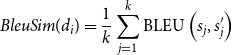 \begin{equation} BleuSim(d_i)=\frac{1}{k} \sum _{j=1}^{k} \operatorname{BLEU}\left (s_{j}, s_{j}^{\prime }\right ) \end{equation}
 \begin{equation} \operatorname{BLEU}\left (s_{j}, s_{j}^{\prime }\right )=\mathrm{BP} \cdot \exp \left (\frac{1}{4} \log P_{1}^{(j)}+\frac{1}{4} \log P_{2}^{(j)}+\frac{1}{4} \log P_{3}^{(j)}+\frac{1}{4} \log P_{4}^{(j)}\right ) \end{equation}
where $\text{BLEU}(s_j, s'_j)$
is the BLEU score for the
$\text{BLEU}(s_j, s'_j)$
is the BLEU score for the $j$
-th sentence pair for text
$j$
-th sentence pair for text $d_i$
,
$d_i$
, $s_j$
is the original sentence,
$s_j$
is the original sentence, $ s'_j$
is the corresponding simplified sentence, and
$ s'_j$
is the corresponding simplified sentence, and $k$
is the total number of sentence pairs.
$k$
is the total number of sentence pairs. $\mathrm{BP}$
is the brevity penalty that penalizes shorter simplified sentences to ensure they are not too brief compared to the original sentences.
$\mathrm{BP}$
is the brevity penalty that penalizes shorter simplified sentences to ensure they are not too brief compared to the original sentences. $P_{n}^{(j)}$
denotes the precision of the
$P_{n}^{(j)}$
denotes the precision of the $n$
-gram for the
$n$
-gram for the $j$
-th sentence pair. Each
$j$
-th sentence pair. Each $n$
-gram length is treated equally with the weight of 1/4.
$n$
-gram length is treated equally with the weight of 1/4.
The precision $P_{n}^{(j)}$
is the proportion of the matched
$P_{n}^{(j)}$
is the proportion of the matched $n$
-grams in
$n$
-grams in $ s'_j$
out of the total number of
$ s'_j$
out of the total number of $n$
-grams in
$n$
-grams in $s_j$
. Its calculation is as follows:
$s_j$
. Its calculation is as follows:
 \begin{equation} P_{n}=\frac{\sum _{n \text{-gram } \in s_{i}^{\prime }} \min \left (\operatorname{Count}_{s_{i}^{\prime }}(n \text{-gram })+1, \operatorname{MaxCount}_{s_{i}}(n \text{-gram })+1\right )}{\sum _{n \text{-gram } \in s_{i}^{\prime }}\left (\operatorname{Count}_{s_{i}^{\prime }}(n \text{-gram })+1\right )} \end{equation}
where $\text{Count}_{s'_i}(n \text{-gram })$
is the count of
$\text{Count}_{s'_i}(n \text{-gram })$
is the count of $n$
-gram in the simplified sentence
$n$
-gram in the simplified sentence $ s'_j$
.
$ s'_j$
. $\text{MaxCount}_{s_i}(n \text{-gram })$
is the maximum count of that
$\text{MaxCount}_{s_i}(n \text{-gram })$
is the maximum count of that $n$
-gram in the original sentence. We use the additive smoothing method to avoid the extreme case where an
$n$
-gram in the original sentence. We use the additive smoothing method to avoid the extreme case where an $n$
-gram is completely absent in
$n$
-gram is completely absent in $ s'_j$
, leading to a zero precision. This smoothing method adds the constant
$ s'_j$
, leading to a zero precision. This smoothing method adds the constant $1$
to the count of all
$1$
to the count of all $n$
-grams.
$n$
-grams.
- $\mathbf{MeteorSim}$
.
$\mathbf{MeteorSim}$
.
The METEOR is an automatic metric for the evaluation of machine translation(Banerjee and Lavie Reference Banerjee and Lavie2005). It functions by aligning words within a pair of sentences. By accounting for both precision and recall, METEOR offers a more balanced similarity measure between two text segments. Based on this similarity measure, we construct the feature $MeteorSim$
. Specifically,
$MeteorSim$
. Specifically, $MeteorSim$
computes the METEOR score for each sentence pair for the given text
$MeteorSim$
computes the METEOR score for each sentence pair for the given text $d_i$
and then averages these scores across all pairs. The calculation formulas are as follows:
$d_i$
and then averages these scores across all pairs. The calculation formulas are as follows:
 \begin{equation} MeteorSim(d_i)=\frac{1}{k} \sum _{j=1}^{k} \operatorname{METEOR}\left (s_{j}, s_{j}^{\prime }\right ) \end{equation}
 \begin{equation} \operatorname{METEOR}\left (s_{j}, s_{j}^{\prime }\right )=(1-\rho ) \times \frac{P_j \times R_j}{\alpha \times P_j+(1-\alpha ) \times R_j} \end{equation}
where $k$
is the total number of sentences in text
$k$
is the total number of sentences in text $d_i$
,
$d_i$
, $s_j$
is the
$s_j$
is the $j$
-th sentence in document
$j$
-th sentence in document $d_i$
,
$d_i$
, $s'_j$
is the corresponding simplified sentence
$s'_j$
is the corresponding simplified sentence $s_j$
.
$s_j$
. $\rho$
is the penalty factor based on the chunkiness of the alignment between
$\rho$
is the penalty factor based on the chunkiness of the alignment between $s_j$
and
$s_j$
and $s'_j$
. It penalizes the score if the word order in the simplified sentence differs significantly from the original sentence.
$s'_j$
. It penalizes the score if the word order in the simplified sentence differs significantly from the original sentence. $\alpha$
is a parameter that balances the contributions of precision
$\alpha$
is a parameter that balances the contributions of precision $P_j$
and recall
$P_j$
and recall $R_j$
.
$R_j$
.
For the $j$
-th sentence pair, precision
$j$
-th sentence pair, precision $P_j$
quantifies the ratio of words in the simplified sentence
$P_j$
quantifies the ratio of words in the simplified sentence $s'_j$
that align to the words in the original sentence
$s'_j$
that align to the words in the original sentence $s_j$
; recall
$s_j$
; recall $R_j$
quantifies the ratio of words in the original sentence
$R_j$
quantifies the ratio of words in the original sentence $s_j$
that find alignments in the simplified sentence
$s_j$
that find alignments in the simplified sentence $s'_j$
. According to Banerjee and Lavie (Reference Banerjee and Lavie2005), the word alignment process is executed by considering not only exact word matches but also the presence of synonyms and stem matches. The calculation formulas are as follows:
$s'_j$
. According to Banerjee and Lavie (Reference Banerjee and Lavie2005), the word alignment process is executed by considering not only exact word matches but also the presence of synonyms and stem matches. The calculation formulas are as follows:
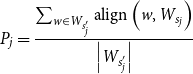 \begin{equation} P_j=\frac{\sum _{w \in W_{s_{j}^{\prime }}} \operatorname{align}\left (w, W_{s_{j}}\right )}{\left |W_{s_{j}^{\prime }}\right |} \end{equation}
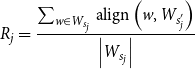 \begin{equation} R_j=\frac{\sum _{w \in W_{s_{j}}} \operatorname{align}\left (w, W_{s_{j}^{\prime }}\right )}{\left |W_{s_{j}}\right |} \end{equation}
where $W_{s'_j}$
is the set of words in the simplified sentence
$W_{s'_j}$
is the set of words in the simplified sentence $s'_j$
,
$s'_j$
, $W_{s_j}$
is the set of words in the original sentence
$W_{s_j}$
is the set of words in the original sentence $s_j$
,
$s_j$
, $\text{align}(w, W)$
is a function that returns 1 if the word
$\text{align}(w, W)$
is a function that returns 1 if the word $w$
aligns with any word in the set
$w$
aligns with any word in the set $W$
, otherwise 0.
$W$
, otherwise 0. $|W_{s_j}|$
and
$|W_{s_j}|$
and $|W_{s'_j}|$
denote the number of words in the sentence
$|W_{s'_j}|$
denote the number of words in the sentence $s_j$
and
$s_j$
and $s'_j$
, respectively.
$s'_j$
, respectively.
The six similarity-based features listed above characterize textual form complexity at various levels and assess text readability across multiple linguistic dimensions. The features $CosSim$
and
$CosSim$
and $JacSim$
measure the word-level text similarity before and after simplification.
$JacSim$
measure the word-level text similarity before and after simplification. $JacSim$
captures vocabulary change through a set operation, whereas
$JacSim$
captures vocabulary change through a set operation, whereas $CosSim$
captures the difference in word distribution through one-hot encoding. For these two features, the lower the value, the greater the textual form complexity and the lower the text’s readability. The feature
$CosSim$
captures the difference in word distribution through one-hot encoding. For these two features, the lower the value, the greater the textual form complexity and the lower the text’s readability. The feature $EditDis$
measures the character-level text distance before and after simplification. Because text distance indicates how much external textual form exists, the higher the value of the feature
$EditDis$
measures the character-level text distance before and after simplification. Because text distance indicates how much external textual form exists, the higher the value of the feature $EditDis$
, the more complex the textual form, and the less readable the text. Regarding the feature
$EditDis$
, the more complex the textual form, and the less readable the text. Regarding the feature $BertSim$
, given that text representations are rich in syntactic and discourse knowledge as noted by Rogers et al. (Reference Rogers, Kovaleva and Rumshisky2020), it is capable of capturing textual form complexity at the text level and assessing readability from the perspective of syntactic. The classical machine translation metrics-based features,
$BertSim$
, given that text representations are rich in syntactic and discourse knowledge as noted by Rogers et al. (Reference Rogers, Kovaleva and Rumshisky2020), it is capable of capturing textual form complexity at the text level and assessing readability from the perspective of syntactic. The classical machine translation metrics-based features, $BleuSim$
and
$BleuSim$
and $MeteorSim$
, differ in their approaches:
$MeteorSim$
, differ in their approaches: $BleuSim$
functions at the n-gram level, evaluating the occurrence of specific phrases up to a length of n, while
$BleuSim$
functions at the n-gram level, evaluating the occurrence of specific phrases up to a length of n, while $MeteorSim$
expands on this by including synonyms and stemming in its evaluation. Similar to
$MeteorSim$
expands on this by including synonyms and stemming in its evaluation. Similar to $CosSim$
and
$CosSim$
and $JacSim$
, lower values of these three features indicate greater textual form complexity and reduced readability.
$JacSim$
, lower values of these three features indicate greater textual form complexity and reduced readability.
3.3.2 Overlap-based features
Text simplification involves some lexical simplification operations, such as word substitution and deletion (Qiang et al. Reference Qiang, Li, Zhu, Yuan and Wu2020). We believe that measuring the simplification change at the word level within the categories of different parts of speech can help in capturing the lexical-textual form complexity of the text in more granular aspects. This is because the greater the change, the more complex the textual form and the less readable the text. Based on this, in this work, we propose using the overlap of the words in the texts before and after simplification in terms of noun, verb, and adjective part-of-speech categories to capture this change. We only focus on these three parts of speech since other parts of speech are less frequent, resulting in a large number of zeros and a limited capacity to capture overlap information. The following describes the extraction process for the three overlap-based features:
- $\textbf{NounOlap}\,,\textbf{AdjOlap}\,,\textbf{VerbOlap}$
.
$\textbf{NounOlap}\,,\textbf{AdjOlap}\,,\textbf{VerbOlap}$
.
The extraction process for the three features contains two steps. Firstly, the NLTK tool is initially employed for word segmentation and pos-tagging. As the NLTK tag categories are fine-grained, the tags are regrouped into three coarse-grained categories: noun, verb, and adjective. The detailed groupings of tags are listed in Appendix A. Secondly, we collect the word sets of each sentence according to the pos-tagging of each word. Assuming that the noun, verb, and adjective word sets are $W_{noun}^{s_j}$
,
$W_{noun}^{s_j}$
, $W_{verb}^{s_j}$
, and
$W_{verb}^{s_j}$
, and $W_{adj}^{s_j}$
for sentence
$W_{adj}^{s_j}$
for sentence $s_j$
and
$s_j$
and $W_{noun}^{s_j'}$
,
$W_{noun}^{s_j'}$
, $W_{verb}^{s_j'}$
, and
$W_{verb}^{s_j'}$
, and $W_{adj}^{s_j'}$
for sentence
$W_{adj}^{s_j'}$
for sentence $s_j'$
, the three overlap-based features are calculated as follows:
$s_j'$
, the three overlap-based features are calculated as follows:
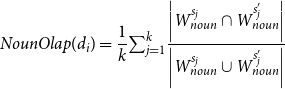 \begin{equation} NounOlap(d_i) = \frac{1}{k}{\textstyle \sum _{j=1}^{k}} \frac{\left | W_{noun}^{s_j} \cap W_{noun}^{s_j'} \right | }{\left | W_{noun}^{s_j} \cup W_{noun}^{s_j'} \right | } \end{equation}
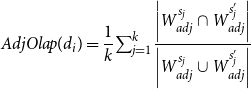 \begin{equation} AdjOlap(d_i) = \frac{1}{k}{\textstyle \sum _{j=1}^{k}} \frac{\left | W_{adj}^{s_j} \cap W_{adj}^{s_j'} \right | }{\left | W_{adj}^{s_j} \cup W_{adj}^{s_j'} \right | } \end{equation}
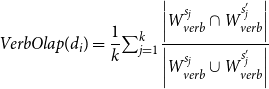 \begin{equation} VerbOlap(d_i) = \frac{1}{k}{\textstyle \sum _{j=1}^{k}} \frac{\left | W_{verb}^{s_j} \cap W_{verb}^{s_j'} \right | }{\left | W_{verb}^{s_j} \cup W_{verb}^{s_j'} \right | } \end{equation}
where $W_{pos} \cap W_{pos}$
and
$W_{pos} \cap W_{pos}$
and $W_{pos} \cup W_{pos}$
are the intersection and union of the two word sets, respectively,
$W_{pos} \cup W_{pos}$
are the intersection and union of the two word sets, respectively, $pos \in \left \{noun, adj, verb\right \}$
is the part-of-speech corresponding to the word sets
$pos \in \left \{noun, adj, verb\right \}$
is the part-of-speech corresponding to the word sets $\left \{W_{noun}, W_{adj}, W_{verb}\right \}$
. The operation
$\left \{W_{noun}, W_{adj}, W_{verb}\right \}$
. The operation $\left | W\right |$
represents the number of the elements in the set
$\left | W\right |$
represents the number of the elements in the set $W$
.
$W$
.
An instance of the overlap at the word level between the sentences is presented in Figure 6. Nouns, adjectives, and verbs in sentences $s_j$
(before simplified) and
$s_j$
(before simplified) and $s_{j}'$
(after simplified) are counted individually. There are common nouns, adjectives, and verbs between the two sentences. The overlap-based features quantify the proportion of common words within the part-of-speech category, indicating the number of words that remain unchanged during the simplification process. Due to the fact that text simplification aims at reducing redundant textual form, the degree of change reveals the complexity of the textual form. Therefore, the lower the feature values, the greater the complexity of the textual form and the lower the readability.
$s_{j}'$
(after simplified) are counted individually. There are common nouns, adjectives, and verbs between the two sentences. The overlap-based features quantify the proportion of common words within the part-of-speech category, indicating the number of words that remain unchanged during the simplification process. Due to the fact that text simplification aims at reducing redundant textual form, the degree of change reveals the complexity of the textual form. Therefore, the lower the feature values, the greater the complexity of the textual form and the lower the readability.
An instance of the overlap at the word level between the sentences $s_j$
(before simplified) and
$s_j$
(before simplified) and $s_j'$
(after simplified). We investigate the overlap from the perspective of part-of-speech. The common nouns, adjectives, and verbs in two sentences are counted separately.
$s_j'$
(after simplified). We investigate the overlap from the perspective of part-of-speech. The common nouns, adjectives, and verbs in two sentences are counted separately.
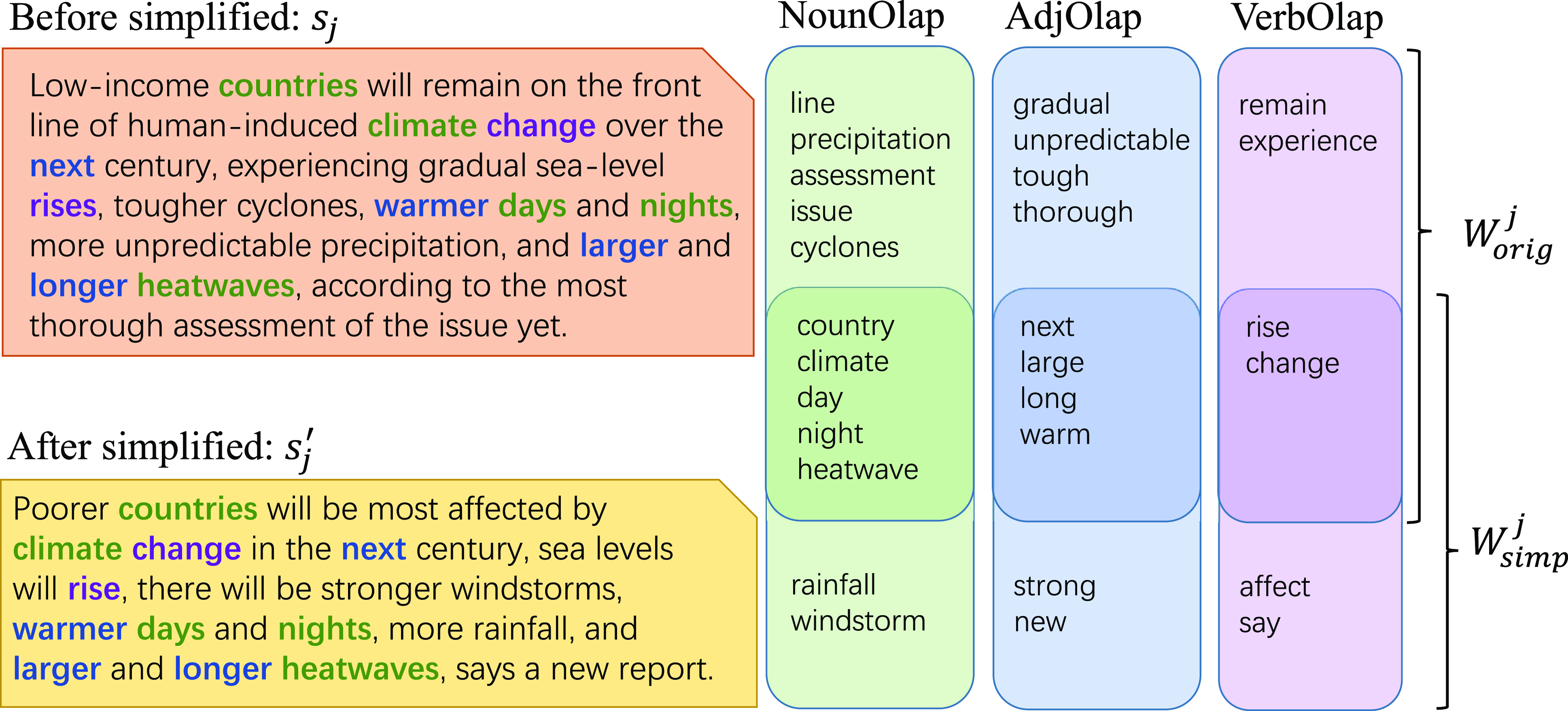
3.3.3 Length ratio-based feature
We introduce a feature named $LenRatio$
that assesses changes in text length due to simplification. On the one hand, simplification may condense the sentence by removing non-essential elements, thereby shortening its length. On the other hand, it can also lead to an increase in length, especially when a complex term with rich meaning is paraphrased using more simple and straightforward words to retain the original connotation. Regardless of whether the simplification results in a longer or shorter text, the change in length mirrors the change of the exterior textual form through simplification and thus characterizes the readability of the original text, as described in Section 3.2. We suggest employing the length ratio to quantify this change. The detailed extraction process is introduced in the following:
$LenRatio$
that assesses changes in text length due to simplification. On the one hand, simplification may condense the sentence by removing non-essential elements, thereby shortening its length. On the other hand, it can also lead to an increase in length, especially when a complex term with rich meaning is paraphrased using more simple and straightforward words to retain the original connotation. Regardless of whether the simplification results in a longer or shorter text, the change in length mirrors the change of the exterior textual form through simplification and thus characterizes the readability of the original text, as described in Section 3.2. We suggest employing the length ratio to quantify this change. The detailed extraction process is introduced in the following:
- $\textbf{LenRatio}$
.
$\textbf{LenRatio}$
.
For a given text $d_i$
, the
$d_i$
, the $LenRatio$
feature of the text is calculated as:
$LenRatio$
feature of the text is calculated as:
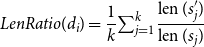 \begin{equation} LenRatio(d_i)= \frac{1}{k}{\textstyle \sum _{j=1}^{k}} \frac{ \operatorname{len}( s_j') }{ \operatorname{len}(s_j) } \end{equation}
where $s_j$
is the
$s_j$
is the $j$
-th sentence in text
$j$
-th sentence in text $d_i$
,
$d_i$
, $s_j'$
is the simplified sentence of
$s_j'$
is the simplified sentence of $s_j$
,
$s_j$
, $k$
is the number of the sentences in text
$k$
is the number of the sentences in text $d_i$
,
$d_i$
, $\operatorname{len}(s_j)$
and
$\operatorname{len}(s_j)$
and $\operatorname{len}(s_j')$
are the length of the original and simplified sentences, which are defined as the total number of words in the sentence.
$\operatorname{len}(s_j')$
are the length of the original and simplified sentences, which are defined as the total number of words in the sentence.
3.4 Model prediction
In our work, we utilize two types of classification models for readability prediction: the tree-based classifier Random Forest (Breiman Reference Breiman2001), and the function-based classifier Support Vector Machine (SVM) (Hearst et al. Reference Hearst, Dumais, Osuna, Platt and Scholkopf1998). For the tree-based model, Random Forest generates multiple decision trees using a randomly selected subset of training samples and employs bagging (Breiman Reference Breiman1996) as the ensemble learning method. The model predicts the class through a majority vote and ensures low correlation among decision trees by creating a random selection of attributes. For the function-based model, SVM works by identifying the optimal hyperplane that most effectively separates different classes in the feature space, aiming to maximize the margin between the closest points of the classes. The model is especially advantageous in high-dimensional spaces and in situations where the number of dimensions surpasses the number of samples. We employ the Sequential Minimal Optimization method (Platt Reference Platt1999) for training the SVM model. Thus, we refer to this model as SMO in the following sections.
We use the WEKA 3.9.6Footnote D (Waikato Environment for Knowledge Analysis) (Witten and Frank Reference Witten and Frank2002) tool to build the models. The models’ hyperparameter settings are shown in Table 2. Following previous work, we use accuracy, F1 score, precision, and recall as metrics to evaluate the model’s performance.
The hyperparameter settings in RandomForest and SMO
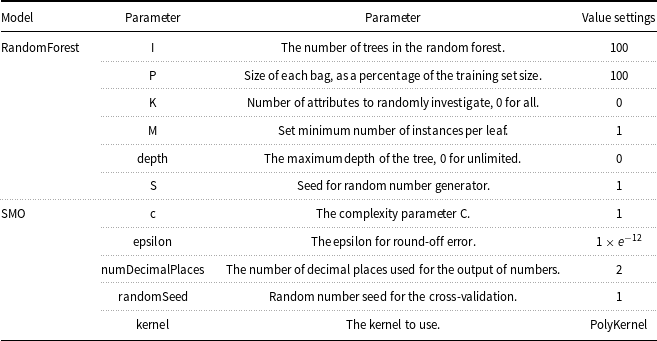
4. Corpora
In order to evaluate to what extent our proposed textual form features can contribute to readability assessment, we first carry out preliminary validation experiments using two parallel corpora, which are widely used in both readability assessment and text simplification tasks. The main experiments in our work are conducted on three traditional readability corpora. Among these corpora, two are in English, and the third is a multilingual corpus in Spanish and French. This section provides an overview of these five corpora.
4.1 Parallel corpora for preliminary validation
Parallel corpora consist of text collections in which every complex sentence from a source text is matched with a more straightforward and comprehensible version of that same sentence. In our work, we employ two such parallel corpora, widely utilized in both readability assessment and text simplification research. Because the sentences in the corpora are manually simplified to their simplified versions, it allows us to extract the proposed features and preliminarily validate their effectiveness, bypassing the need for automated simplification processes.
OneStopEnglish.Footnote E This corpus is created by Vajjala and Lučić (Reference Vajjala and Lučić2018). It contains 189 aligned documents at three reading levels: elementary (ELE), intermediate (INT), and advanced (ADV). The content of the corpus comes from the language learning resource website onestopenglish.com from 2013 to 2016 and was rewritten by English teachers into the three levels for L2 English adult learners. The statistics of the corpus are presented in Table 3. The sentence alignment process, as described by Vajjala and Lučić (Reference Vajjala and Lučić2018), yields 1,674 sentence pairs for the ELE-INT level, 2,166 sentence pairs for the ELE-ADV level, and 3,154 sentence pairs for the INT-ADV level. In our experiment, we regard the elementary-level documents as the simplified versions of the documents at intermediate and advanced levels. Specifically, we utilize the sentence pairs for the ELE-INT level to extract the textual form features of the intermediate-level documents and utilize the sentence pairs for the ELE-ADV level to extract the features of advanced-level documents. The prediction models are trained on the documents from the INT and ADV levels.
Statistics for the OneStopEnglish corpus
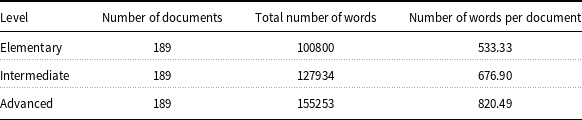
NewsEla. This corpus is created by Xu et al. (Reference Xu, Callison-Burch and Napoles2015) to study how professional editors conduct text simplification. It consists of 1,130 news articles. Each article is rewritten 4 times for children at different grade levels by editors at the Newsela company. The statistics of the corpus are presented in Table 4. Xu et al. (Reference Xu, Callison-Burch and Napoles2015) design a sentence alignment algorithm that pairs each sentence in a simplified text version with the closest matching sentence in a more complex version, utilizing overlapping word lemmas. In our experiments, we employ the aligned sentence pairs and follow a similar procedure to the experiments on the OneStopEnglish corpus. Specifically, we regard the articles at the Simp-4 level as simplified versions of those at the other four levels for feature extraction and build our classification model based on articles from these four levels.
Statistics for the NewsEla corpus
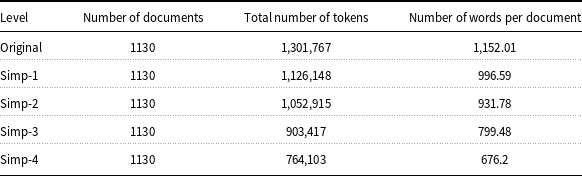
Note: Simp-4 denotes the most simplified level and Simp-1 denotes the least simplified level.
4.2 English and multilingual corpora for readability assessment
Weebit. This corpus combines articles extracted from WeeklyReaderFootnote F and the BBC Bitesize website.Footnote G The articles are classified into five readability levels according to the different targeted age groups. Levels 2, 3, and 4 consist of articles from the educational newspaper Weekly Reader, which covers a wide range of nonfiction topics, from science to current affairs. KS3 and GCSE consist of articles from the BBC Bitesize website, which contain educational material categorized into topics that roughly match school subjects in the UK. Each level of the corpus has 625 documents, for a total of 3,125 documents. The statistics of the corpus are presented in Table 5.
Statistics for the Weebit corpus
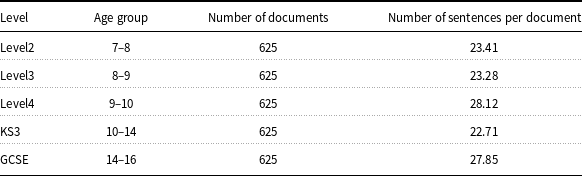
Cambridge. The Cambridge Exam CorpusFootnote H was created by Xia et al. (Reference Xia, Kochmar and Briscoe2016). This corpus categorizes document readability according to Cambridge English Exam levels. The tests are designed for second-language (L2) learners at Common European Framework of Reference levels A2-C2 (CEFR) (Xia et al. Reference Xia, Kochmar and Briscoe2016). The five readability levels KET, PET, FCE, CAE, and CPE correspond to CEFR levels A1 (breakthrough), B1 (threshold), B2 (vantage), C1 (effective operational proficiency), and C2 (mastery), respectively. The statistics of the corpus are presented in Table 6.
Statistics for the Cambridge English exam data
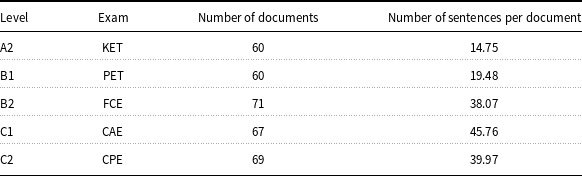
VikiWiki-Es/Fr. The VikiWiki corpus was created by Azpiazu and Pera (Reference Azpiazu and Pera2019). It contains all documents retrieved from Vikidia, together with their corresponding Wikipedia entries. The articles are uniformly distributed between two levels of readability: simple and complex. There are a total of 70,514 documents in six different languages, with 8,390 in Spanish and 23,648 in French. At the simple level, there are on average 16 sentences and 303 words per document, and at the complex level, there are on average 217 sentences and 6,036 words per document. In our work, VikiWiki-Fr (French) and VikiWiki-Es (Spanish) are used for multilingual experiments.
For the three corpora mentioned above, we adopt a 10-fold cross-validation approach in our experiments. Specifically, the documents in the corpora are divided into 10 folds. The classification model is run 10 times on different folds of documents. Each time, the model is trained on nine folds and tested on the 10-th fold. The results of the 10 runs are averaged to generate the performance evaluation.
5. Experimental design
We design four experiments to evaluate the efficacy of our proposed textual form features in assessing readability. Experiment 1 aims to examine the effectiveness of these features in characterizing text readability. Experiment 2 seeks to investigate the contributions of the proposed textual form features in making predictions by examining their importance. Experiment 3 aims to explore the applicability of these features in different languages. Experiment 4 focuses on evaluating the impact that simplification tools on the performance of these features.
5.1 Experiment 1: examining the feature effectiveness in characterizing text readability
In this experiment, we first conduct a preliminary validation of the feature effectiveness on parallel corpora. Then, we evaluate our proposed textual form features by comparing them with other types of features using two traditional readability corpora. Finally, to explore the contributions of the proposed features to the field of readability, we integrate our proposed features into state-of-the-art models and assess whether their inclusion improves the model’s performance.
5.1.1 Preliminary validation of feature effectiveness on parallel corpora.
We conduct experiments on two parallel corpora, OneStopEnglish and NewsEla, to preliminary validate the effectiveness of our proposed textual form features on parallel corpora. As mentioned in Section 4.1, the parallel corpora contain numerous aligned sentence pairs before and after manual simplification. We choose parallel corpora for our validation experiments for two main reasons. Firstly, the texts within these corpora are manually simplified, which guarantees a high quality of simplification and, consequently, ensures the extraction of high-quality features. Second, because these corpora already contain pre- and post-simplification sentence pairs, we may simply extract our proposed features without the need for simplification tools.
Figure 7 illustrates the experimental design we used. As shown in the figure, in a parallel corpus, each document is represented in different versions that correspond to different levels of readability. For example, Level 1 corresponds to the most complex version, while Level 5 corresponds to the most simplified version. We use the most simplified version to facilitate the process of extracting features, while employing documents from other levels for model training and prediction. More specifically, for each document in the training set, we find its corresponding simplified version in Level 5 and utilize the aligned sentence pairs in the two documents to extract our proposed textual form features. In addition, we utilize the Coh-Metrix tool to extract fundamental linguistic features, which will be detailed in the following description of experiments. Next, we implement a step-by-step method to build the feature sets by incorporating our proposed textual form features into the existing baseline features. Finally, we use the feature sets to train classification models and examine whether the inclusion of our proposed features leads to an enhancement in the model’s performance.
Diagram of the experimental design for validation on the parallel corpus. We use documents from the most simplified level in the parallel corpus to facilitate feature extraction, and we use documents from the other levels for training the model and making predictions. We select the most simple version of each document in the training set and use the aligned sentence pairs in the two texts to extract our proposed textual form features.
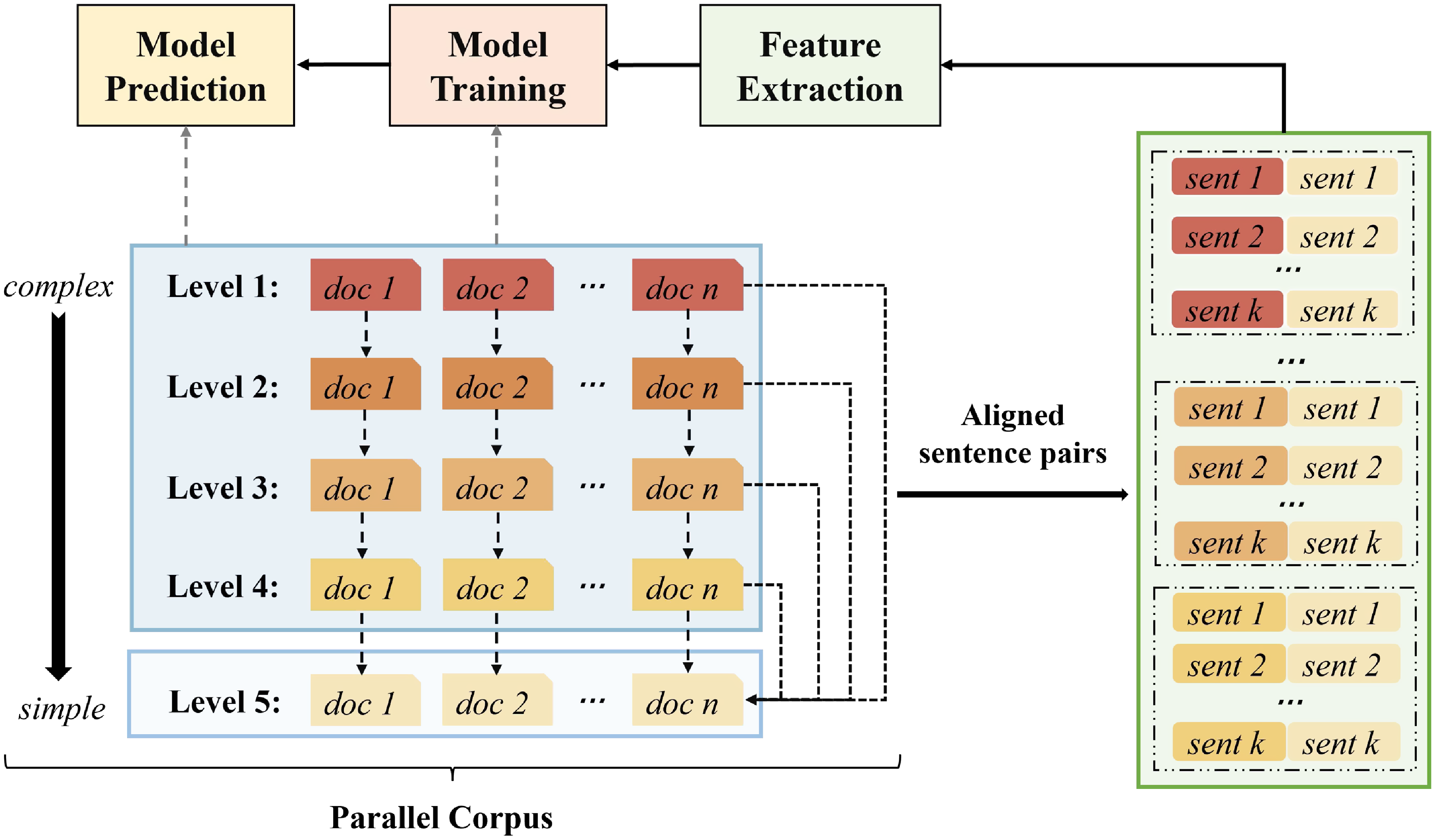
5.1.2 Investigating and comparing feature capabilities in characterizing text readability.
In this experiment, we test different types of features and their combinations in terms of their ability to characterize text readability. In addition to our proposed textual form features, we also select two other types of features for comparison: current representative handcrafted features (inner semantic-based features) and neural features. In the following, we will first introduce the two types of features and then describe our experimental procedure in detail.
Existing handcrafted features mainly focus on the inner semantic-based textual characteristics, while our proposed textual form features concentrate on the external complexity of the texts. To analyze the effects of inner and outer textual aspects on text readability, we utilize the Coh-Metrix tool to extract features as a representative of existing inner semantic-based features. According to Crossley et al. (Reference Crossley, Greenfield and McNamara2008), Coh-Metrix is a synthesis of the advances in conventional readability features. It was designed with the goal of providing a means to match textbooks appropriately to the targeted students (Graesser et al. Reference Graesser, McNamara, Louwerse and Cai2004). It is a computational tool that measures text difficulty from an inner textual perspective, such as discourse cohesion, semantic and conceptual features. The features are categorized into eleven groups based on their linguistic properties. A total of 108 features are extracted. For convenience, we denote the extracted 108 features as Coh-Metrix features in the following sections.
In addition to handcrafted features, neural networks have recently shown powerful capability in capturing high-level textual linguistic information. Among the neural networks, the representative one is the pre-trained language model BERT. Thus, we leverage BERT to extract neural features. The experimental aim is to investigate the strengths and weaknesses of handcrafted and neural features. During the process of extracting neural features, we initially employ the BERT tokenizer to split the text into a sequence of tokens. The length of the input sequences is set to 512. If the length of the token sequence is less than 512, we pad it to 512 with the token $[PAD]$
; If it is longer than 512, the part that exceeds the given length is truncated. Next, we append the token
$[PAD]$
; If it is longer than 512, the part that exceeds the given length is truncated. Next, we append the token $[CLS]$
to the beginning of the sequence and the token
$[CLS]$
to the beginning of the sequence and the token $[SEP]$
at the end of the sequence. By inputting the token sequence, we acquire the associated token embeddings, segmentation embeddings, and position embeddings. Subsequently, we perform element-wise addition (Kenton and Toutanova Reference Kenton and Toutanova2019) on the three embeddings and feed them into the pre-trained BERT model. The output of token
$[SEP]$
at the end of the sequence. By inputting the token sequence, we acquire the associated token embeddings, segmentation embeddings, and position embeddings. Subsequently, we perform element-wise addition (Kenton and Toutanova Reference Kenton and Toutanova2019) on the three embeddings and feed them into the pre-trained BERT model. The output of token $[CLS]$
is used as the extracted neural features, which are 768-dimensional vectors.
$[CLS]$
is used as the extracted neural features, which are 768-dimensional vectors.
The experimental procedure contains two main steps:
Step 1: Extraction of features. The two corpora used in this experiment are Weebit and Cambridge. Both corpora contain five readability levels. On each corpus, we extract three types of features for texts at all five levels. Specifically, we extract our proposed eight textual form features to capture the texts’ outer form characteristics following the methods described in Section 3.3. As described earlier, we utilize the Coh-Metrix tool to extract inner semantic-based features and leverage the pre-trained BERT model to extract neural features.
Step 2: Training the model and making predictions. Using the extracted features, a classification model is trained to predict the readability label for the given text. Our prediction models consist of Random Forest and SMO. The specific details of the model setup can be found in section 3.4. In addition to using individual types of features for model training, we also investigate two feature combinations: 1) The integration of inner semantic-based features and outer textual form features; 2) The combination of handcrafted features and neural features. As for the incorporation of neural features, we concatenate the extracted 768-dimensional vectors with all the extracted handcrafted features, which include 108 inner semantic-based features and ten outer textual form features. The resulting vectors are then considered a combination of handcrafted and neural features, with a dimensionality of 884. Finally, we leverage the trained models to make predictions about the readability of text and evaluate the model’s performance in terms of accuracy, F1 score, precision, and recall.
5.1.3 Examining the feature contributions to enhancing the performance of SOTA models.
Current state-of-the-art (SOTA) methods for readability assessment predominantly employ pre-trained language models based on deep learning approach (Deutsch et al. Reference Deutsch, Jasbi and Shieber2020; Lee et al. Reference Lee, Jang and Lee2021; Liu and Lee Reference Liu and Lee2023). The purpose of this experiment is to validate our proposed features and determine their ability to improve the SOTA performance in the field of readability assessment.
We choose the hybrid models (Lee et al. Reference Lee, Jang and Lee2021; Liu and Lee Reference Liu and Lee2023) from the current state-of-the-art models to ensure a more efficient comparison. These hybrid models combine handcrafted features with fine-tuned pre-trained models, including BERT, RoBERTa, XLNet, and BART. Since the model of Liu and Lee (Reference Liu and Lee2023) is designed for sentence-level readability assessment that differs from our task setup, we choose to make comparisons with the hybrid models for passage-level readability assessment from their previous work (Lee et al. Reference Lee, Jang and Lee2021). This work utilizes corpora that align with ours, specifically Weebit and Cambridge. In this experiment, we integrate our proposed features into their hybrid models and compare the results with those reported in their paper. More precisely, we first reran their code to fine-tune the pre-trained models and obtain the transformer predictions. Next, we concatenate our proposed ten features with their extracted, handcrafted features, namely T1 and P3 feature sets. Finally, we train classification models using the combined handcrafted features and transformer predictions, in accordance with their approach.
5.2 Experiment 2: investigating the feature contributions in model prediction
Beyond gaining good model performance for readability prediction, it is also important to find out which features are indicative of these predictions and the extent to which these features contribute to the model’s performance (Zien et al. Reference Zien, Krämer, Sonnenburg and Rätsch2009). Therefore, we design this experiment to further analyze the impact of our proposed textual form features on the model’s prediction. This experiment is a continuation of Experiment 1 and focuses on all the handcrafted features. To be specific, we train the model using a combination of 108 inner semantic-based features and ten outer textual form features and analyze their contributions to the Weebit and Cambridge corpora.
We employ the mean impurity decrease method to analyze the contributions of features. We use this strategy because Mean Decrease in Impurity (MDI) is a measurement of feature importance in decision tree models, such as Random Forest. More precisely, we first calculate the MDI score for each feature by averaging the total decrease in node impurities over all the trees from splitting on the respective features (Han, Guo, and Yu Reference Han, Guo and Yu2016). Regarding the node impurity, we employ the Gini index, which is calculated using the formula below:
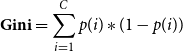 \begin{equation} \mathbf{Gini}=\sum _{i=1}^{C} p(i) *(1-p(i)) \end{equation}
where $C$
is the total number of classes,
$C$
is the total number of classes, $i$
represents the
$i$
represents the $i^{th}$
class, and
$i^{th}$
class, and $p(i)$
is the probability of picking an instance with class
$p(i)$
is the probability of picking an instance with class $i$
. Then, we rank the importance of the total of 118 handcrafted features according to their MDI scores.
$i$
. Then, we rank the importance of the total of 118 handcrafted features according to their MDI scores.
5.3 Experiment 3: exploring the applicability of the proposed features across different languages
The goal of this experiment is to explore the applicability of our proposed features to languages other than English. Previous studies (Scarton et al. Reference Scarton, Aprosio, Tonelli, Wanton and Specia2017; Finnimore et al. Reference Finnimore, Fritzsch, King, Sneyd, Rehman, Alva-Manchego and Vlachos2019; Stodden and Kallmeyer Reference Stodden and Kallmeyer2020) have shown that text simplification exhibits a certain level of consistency across different languages. Therefore, it is reasonable to assume that our proposed text-simplification-based textual form features could be effective across various languages. To test this hypothesis, we apply our proposed features to texts written in Spanish and French and evaluate their efficacy in this multilingual setting. This experiment utilizes the VikiWiki-Es/Fr corpus.
As mentioned in Section 4.2, this corpus contains two sub-corpora: VikiWiki-Es (Spanish) and VikiWiki-Fr (French). Each sub-corpus has two readability levels, namely simple and difficult. Specifically, we first extract our proposed ten textual form features from texts at two levels of each sub-corpus. Then, we train classification models with our proposed features. At last, we evaluate the model’s performance in terms of accuracy and compare our approach with both traditional and state-of-the-art strategies on this corpus. The compared strategies were implemented by Azpiazu and Pera (Reference Azpiazu and Pera2019), and the brief introductions are as follows:
-
• Flesch. In this strategy, the traditional Flesch formula (Kincaid et al. Reference Kincaid, Fishburne and Chissom1975) is used to compute the readability score of each text. Due to the multilingual setting, this strategy considers the language-specific adaptations of the formula (Kandel and Moles Reference Kandel and Moles1958; Fernández Huerta, Reference Fernández Huerta1959). The employed framework categorizes a given text as either simple or complicated by mapping its Flesch score onto a binary value. This mapping is determined by the text’s distance from the average score of texts in each respective category (Azpiazu Reference Azpiazu2017).
-
• LingS3+RandomForest. This is a current state-of-the-art feature engineering strategy. It adopts the classical machine learning method. In this strategy, the Random Forest classification model is trained based on a set of linguistic features introduced by Azpiazu (Reference Azpiazu2017). We denoted this set of features as LingS3 in our paper. Due to the unavailability of the feature set of LingS3, we present their reported results (Azpiazu Reference Azpiazu2017).
-
• Vec2Read. This is a state-of-the-art strategy based on deep learning methods. It employs a multi-attentive recurrent neural network architecture for evaluating the readability of texts in multiple languages (Azpiazu and Pera Reference Azpiazu and Pera2019). In this strategy, a recurrent neural network is leveraged to capture text structure, and a multi-attention mechanism is utilized to incorporate textual information related to syntax and morphology.
5.4 Experiment 4: analyzing the impact of simplification tools on the performance of proposed features
The purpose of this experiment is to assess how different simplification tools affect the capabilities of features to enhance model performance.
In addition to the MUSS simplification tool (Martin et al. 2020) mentioned in Section 3.2, there are several more text simplification tools that can be utilized. Among these tools, we select RewordifyFootnote I for comparison, which is a free and efficient online tool. Morales et al. Morales et al. (Reference Morales, Mora and Alvarez2019) emphasize that this tool enhances reading, learning, and teaching experiences for English texts. It focuses on lexical-level simplification and is capable of contextually modifying lexical expressions within texts.
Table 7 presents a comparison of text simplifications by MUSS and ReWordify using two examples from the Cambridge corpus. According to the table, MUSS frequently condenses and modifies the original sentence phrasing, whereas ReWordify preserves the sentence structure, emphasizing the simplification of individual words and phrases. For example, in the second example, MUSS simplifies and condenses the description by removing phrases like “devotee of” ; ReWordify clarifies and simplifies specific expressions, such as changing “springs eternal” to “springs never-ending.” These examples suggest that MUSS focuses on structural simplification, which can involve condensing information and modifying sentence structure. On the other hand, ReWordify primarily focuses on simplifying the vocabulary by substituting complex words with simpler ones. Both methods aim to make the text more readable and understandable, but they employ different strategies to achieve this goal, each with its own advantages and target use cases.
Simplification examples from the Cambridge corpus using MUSS and ReWordify tools
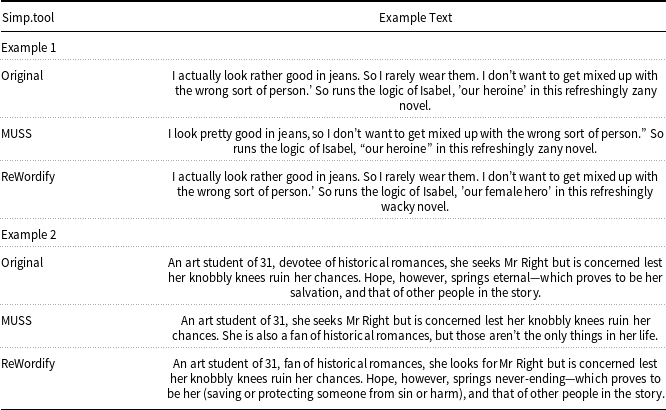
Note: “Simp.tool” denotes the simplification tool.
In this experiment, we use the Rewordify tool for feature extraction. Following the same experimental design as conducted on the Weebit and Cambridge corpora, we train Random Forest and SMO classification models using the extracted features. Finally, we compare the performance of models in three different settings: 1) without using any simplification pipeline, 2) utilizing MUSS for simplification, and 3) employing Rewordify for simplification.
6. Results and discussion
This section presents the findings and discussion of the four experiments mentioned in Section 5. For convenience, we abbreviate the names of the feature sets used in our experiments: TextFormFeat (10) refers to our proposed ten textual form features; Similarity (6) refers to the six similarity-based features, including $CosSim$
,
$CosSim$
, $JacSim$
,
$JacSim$
, $EditDis$
,
$EditDis$
, $BertSim$
,
$BertSim$
, $BleuSim$
and
$BleuSim$
and $MeteorSim$
; Overlap (3) refers to the three overlap-based features, including
$MeteorSim$
; Overlap (3) refers to the three overlap-based features, including $NounOlap$
,
$NounOlap$
, $VerbOlap$
and
$VerbOlap$
and $AdjOlap$
; LenRatio (1) refers to the length-ratio feature
$AdjOlap$
; LenRatio (1) refers to the length-ratio feature $LenRatio$
; Coh-Metrix (108) refers to the 108 Coh-Metrix features; BERTFeat (768) refers to the 768-dimensional neural features extracted from the pre-trained language model BERT. The four evaluation metrics are also represented in their abbreviated forms, where ACC, F1, P, and R denote Accuracy, F1 score, Precision, and Recall, respectively.
$LenRatio$
; Coh-Metrix (108) refers to the 108 Coh-Metrix features; BERTFeat (768) refers to the 768-dimensional neural features extracted from the pre-trained language model BERT. The four evaluation metrics are also represented in their abbreviated forms, where ACC, F1, P, and R denote Accuracy, F1 score, Precision, and Recall, respectively.
Performance comparison of RandomForest and SMO trained with baseline Coh-Metrix features and added textual form features on OneStopEnglish and NewsEla parallel corpora
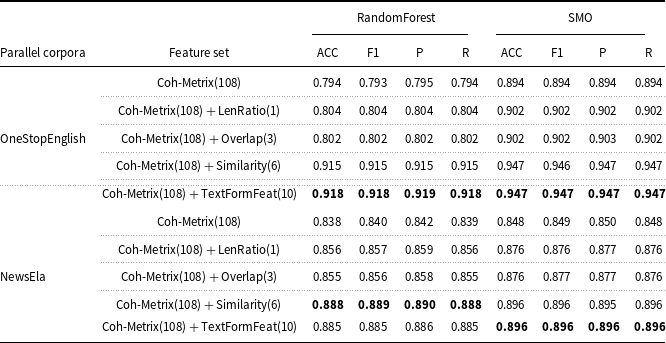
Note: The best performance on the corresponding parallel corpora is highlighted in bold.
6.1 Discussion of feature effectiveness
This section presents the experimental results of Experiment 1. In the following, we first present the preliminary validation results on parallel corpora. Then, we make a discussion of different types of readability features based on the experimental results. Finally, we present the experimental results of integrating our proposed features into the existing SOTA models.
The validation experiments preliminarily confirm the efficacy of our proposed features. From Table 8, it can be seen that adding our proposed textual form feature sets leads to a significant improvement in model performance. Specifically, on the OneStopEnglish corpus, Coh-Metrix (108) + TextFormFeat (10) achieves the best performance in both classification models; RandomForest reaches an accuracy of 0.918 and F1 score of 0.918, while SMO achieves an accuracy of 0.947 and F1 score of 0.947. In comparison to using Coh-Metrix (108) alone, when adding our proposed TextFormFeat (10), the greatest enhancement observed in RandomForest is 12.5% (F1 score), and in SMO is 5.3% (F1 score). On the NewsEla corpus, adding Similarity (6) results in the highest performance for RandomForest, attaining an accuracy of 0.888 and an F1 score of 0.889; and for SMO, adding TextFormFeat (10) yields the best results, with an accuracy of 0.896 and F1 score of 0.896. These results indicate that different models may have varying preferences for the features; however, overall, the inclusion of our proposed features leads to the performance enhancement for both models on two corpora, thus giving a preliminary validation of the efficacy of our proposed features.
We compare the model’s performance based on different types of feature sets on two traditional readability corpora for each classification model mentioned in Section 3.4. The experimental results further demonstrate the effectiveness of our proposed features for readability assessment. Tables 9 and 10 report the model performance of RandomForest and SMO, respectively. It is evident that adding our proposed TextFormFeat (10) to Coh-Metrix (108) enhances the performance of both models on the two corpora. For RandomForest, the model’s performance in terms of accuracy and F1 score improves by 2.4% and 2.3% on the Weebit corpus and by 4.2% and 4.4% on the Cambridge corpus (line 1 and line 6 in Table 9). For SMO, the model’s performance in terms of accuracy and F1 score increases by 2.3% and 2.2% on the Weebit corpus and by 1.2% and 1.5% on the Cambridge corpus (line 1 and line 6 in Table 10). Since only ten features have brought about this considerable improvement, we may safely draw the conclusion that our proposed textual form features are effective. Moreover, it can also be seen that when the three feature subsets Similarity (6), Overlap (3), and LenRatio (1) are added to Coh-Metrix (108) individually, the model performances are all improved. This further demonstrates the effectiveness of each subset of textual form features. Interestingly, for RandomForest, the addition of the feature subset Similarity (6) achieves the best performance on both corpora, demonstrating the effectiveness and superiority of these similarity-based features. Previous research (Martin et al. 2020) points out that overlap-based metrics are not the best for evaluating text simplification tasks. Despite this, we observe that incorporating overlap-based features into our model markedly improves readability assessment predictions. While the specific reasons for this enhancement are not fully clear, we hypothesize that it may be due to the differentiation between the use of Overlap as a predictive feature within the learning algorithm and its use as an evaluative metric.
Performance comparison of RandomForest with different types of feature sets on Weebit and Cambridge
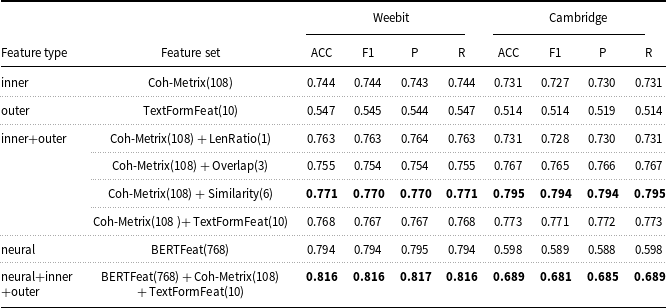
Note: The ‘inner’ and ‘outer’ types belong to handcrafted features, while the ‘neural’ type belongs to neural features. The upper part of the table presents a comparison of solely handcrafted features, with the best performance among these handcrafted-only feature sets highlighted in bold. The lower part of the table includes neural features into comparison, with the best performance highlighted in bold.
Performance comparison of SMO with different types of feature sets on Weebit and Cambridge corpora
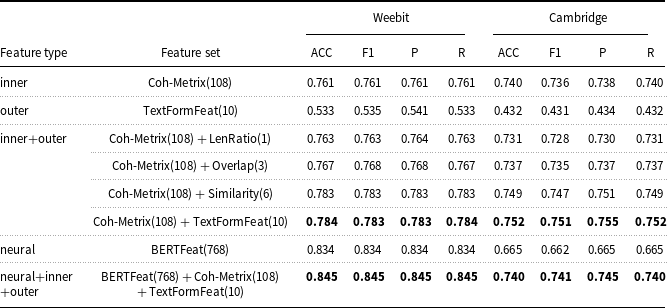
Note: The ‘inner’ and ‘outer’ types belong to handcrafted features, while the ‘neural’ type belongs to neural features. The upper part of the table presents a comparison of solely handcrafted features, with the best performance among these handcrafted-only feature sets highlighted in bold. The lower part of the table includes neural features into comparison, with the best performance highlighted in bold.
It can also be concluded that both inner semantic-based features and outer textual form features are essential in characterizing text readability. With the inner semantic-based features, both models exhibit good performance on the Weebit and Cambridge corpora. As detailed in Tables 9 and 10, using Coh-Metrix(108) as inner features, RandomForest attains an F1 score of 0.744 on Weebit and 0.727 on Cambridge (line 1 in Table 9), SMO attains F1 scores of 0.761 and 0.736 on the respective corpora (line 1 in Table 10). These results indicate that the inner semantic-based features play a crucial role in readability assessment. Regarding the outer textual form features, it’s evident that while the ten features alone may not yield impressive results, they can boost the model when used as a complement to the inner textual features. With RandomForest, combining Coh-Metrix (108) with Similarity (6) results in an F1 score of 0.770 on Weebit and 0.794 on Cambridge. For SMO, the addition of TextFormFeat (10) to Coh-Metrix (108) leads to F1 scores of 0.783 and 0.751 on the respective corpora. Hence, the combination of inner semantic-based and outer textual form features is most likely to improve the model’s performance.
In addition to handcrafted features, we also investigate neural features and observe that neural features sometimes are not necessarily effective. In Tables 9 and 10, we can see that neural features perform pretty well on the Weebit corpus; that is, the combination of handcrafted features and neural features (neural+inner+outer) yields the best performance, with RandomForest reaching an accuracy and F1 score of 0.816 (line 8 in Table 9), and SMO attaining an accuracy and F1 score of 0.845 (line 8 in Table 10). Complementary to our findings, recent research, such as that conducted by Wilkens et al. (Reference Wilkens, Watrin, Cardon, Pintard, Gribomont and François2024), explores the efficacy of combining linguistic features with transformer-based neural features. Their research supports the idea that integrating diverse types of features—traditional linguistic and advanced neural—can significantly improve the performance of readability assessment systems. However, we can also see that neural features are not as effective on the Cambridge corpus. As demonstrated, when trained solely with neural features (BERTFeat (768)), the RandomForest model achieves only an accuracy of 0.598 and F1 score of 0.589 (line 7 in Table 9). Even though concatenating handcrafted features (Coh-Metrix (108)+TextFormFeat (10)), the model’s performance improves to an accuracy of 0.689 and an F1 score of 0.681 (line 8 in Table 9), yet it still does not surpass the performance achieved with the four sets of inner and outer features. Likewise, for SMO, neural features also show subpar performance on the Cambridge corpus. These results suggest the instability of the performance of neural features. In contrast, as can be seen from the two tables, handcrafted features (especially the combination of inner semantic-based features and outer textual form features) have a stable and effective performance on both corpora. For example, using Coh-Metrix(108)+TextFormFeat(10) as inner and outer features, the RandomForest model attains an accuracy of 0.768 on the Weebit corpus and 0.773 on the Cambridge corpus (line 6 in Table 9); meanwhile, the SMO model demonstrates an accuracy of 0.784 on the Weebit corpus and 0.752 on the Cambridge corpus (line 6 in Table 10). Moreover, it is claimed that handcrafted features are better than neural features in terms of their interpretability. Though we cannot give an exact explanation of vectors extracted from neural networks (e.g., the vector of 768 dimensions extracted from BERT), we can gain a good understanding of what information is extracted by handcrafted features (e.g., textual form features capture the outer form characteristics of the text).
The experimental results in Table 11 demonstrate that our proposed features are valid and can enhance the state-of-the-art performance in the field of readability assessment. It is evident that integrating our proposed ten textual form features into the existing four SOTA hybrid models leads to a significant performance improvement. On the Weebit corpus, the model BERT + T1_GB + TextFormFeat (10) achieves the best performance (ACC = 0.974, F1 = 0.974), marking an increase of 7.9% in both ACC and F1 compared to the SOTA model BERT + T1_GB. On the Cambridge corpus, the same model, BERT + T1_GB + TextFormFeat (10), also reaches the highest performance (ACC = 0.791, F1 = 0.788), with an ACC increase of 10.4% and an F1 increase of 10.6% compared to the SOTA model BERT + T1_GB. These results fully demonstrate that our proposed features can enhance the performance of existing SOTA models, contributing significantly to the field of readability.
Performance comparison before and after integrating our proposed features into SOTA models
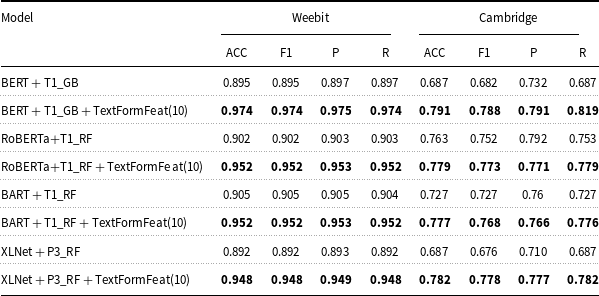
Note: T1 and P3 represent the handcrafted feature sets used in hybrid models (Lee et al. Reference Lee, Jang and Lee2021). RF denotes RandomForest, GB denotes XGBoost. Bold indicates the best performance of the model before and after integrating our proposed TextFormFeat(10).
Additionally, we conduct a performance comparison of models incorporating our features with recent models. We select four existing readability models, which are respectively SVM (Xia et al. Reference Xia, Kochmar and Briscoe2016), BERT + SVM (Deutsch et al. Reference Deutsch, Jasbi and Shieber2020), BERT (Martinc et al. Reference Martinc, Pollak and Robnik-Šikonja2021), and BART + T1_RF hybrid (Lee et al. Reference Lee, Jang and Lee2021). The reason we choose these works is that they all utilize the Weebit corpus. Since not all studies report all four metrics, we report the accuracy metric, which was used across all works. The results, displayed in Table 12, indicate that our models significantly outperform all existing readability assessment models on the Weebit corpus. Specifically, our BART + T1_RF hybrid $+$
TextFormFeat (10) surpasses the previous best model by 4.7%, while our BERT + T1_GB hybrid
$+$
TextFormFeat (10) surpasses the previous best model by 4.7%, while our BERT + T1_GB hybrid $+$
TextFormFeat (10) shows an even more substantial improvement of 6.9% over the same benchmark. The superior performance of our models over established techniques substantiates the effectiveness and applicability of our approach in contemporary readability research.
$+$
TextFormFeat (10) shows an even more substantial improvement of 6.9% over the same benchmark. The superior performance of our models over established techniques substantiates the effectiveness and applicability of our approach in contemporary readability research.
Performance comparison of our models and existing readability assessment models on the WeeBit corpus
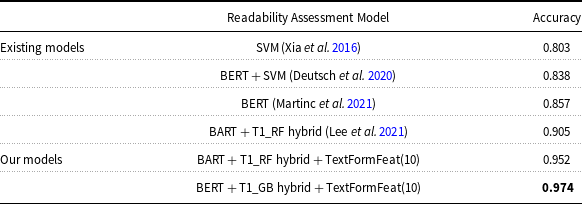
Note: As Accuracy is the common evaluation metric reported in the papers of these existing models, we report Accuracy in this table.
6.2 Analysis of feature contributions
This section presents the experimental results in Experiment 2. We rank the feature importance of the total 118 features (108 Coh-Metrix features and our proposed ten textual form features) according to their MDI scores. Rank lists of the top 15 important features on Weebit corpus and Cambridge corpus are separately presented in Figures 8 and 9. On the $x$
axis, the MDI scores are reported. On the
$x$
axis, the MDI scores are reported. On the $y$
axis, features ranked in the top 15 are reported, where the rank order increases from top to bottom (the rank 1 writes at the top, the rank 15 writes at the bottom). The blue bars represent our proposed textual form features. The gray bars represent the Coh-Metrix features.
$y$
axis, features ranked in the top 15 are reported, where the rank order increases from top to bottom (the rank 1 writes at the top, the rank 15 writes at the bottom). The blue bars represent our proposed textual form features. The gray bars represent the Coh-Metrix features.
Top 15 feature importance ranks on the Weebit corpus. On the $x$
axis, the MDI scores are reported. On the
$x$
axis, the MDI scores are reported. On the $y$
axis, features ranked in the top 15 are reported, where the rank order increases from top to bottom. The blue bars represent our proposed features. The gray bars represent Coh-Metrix features.
$y$
axis, features ranked in the top 15 are reported, where the rank order increases from top to bottom. The blue bars represent our proposed features. The gray bars represent Coh-Metrix features.
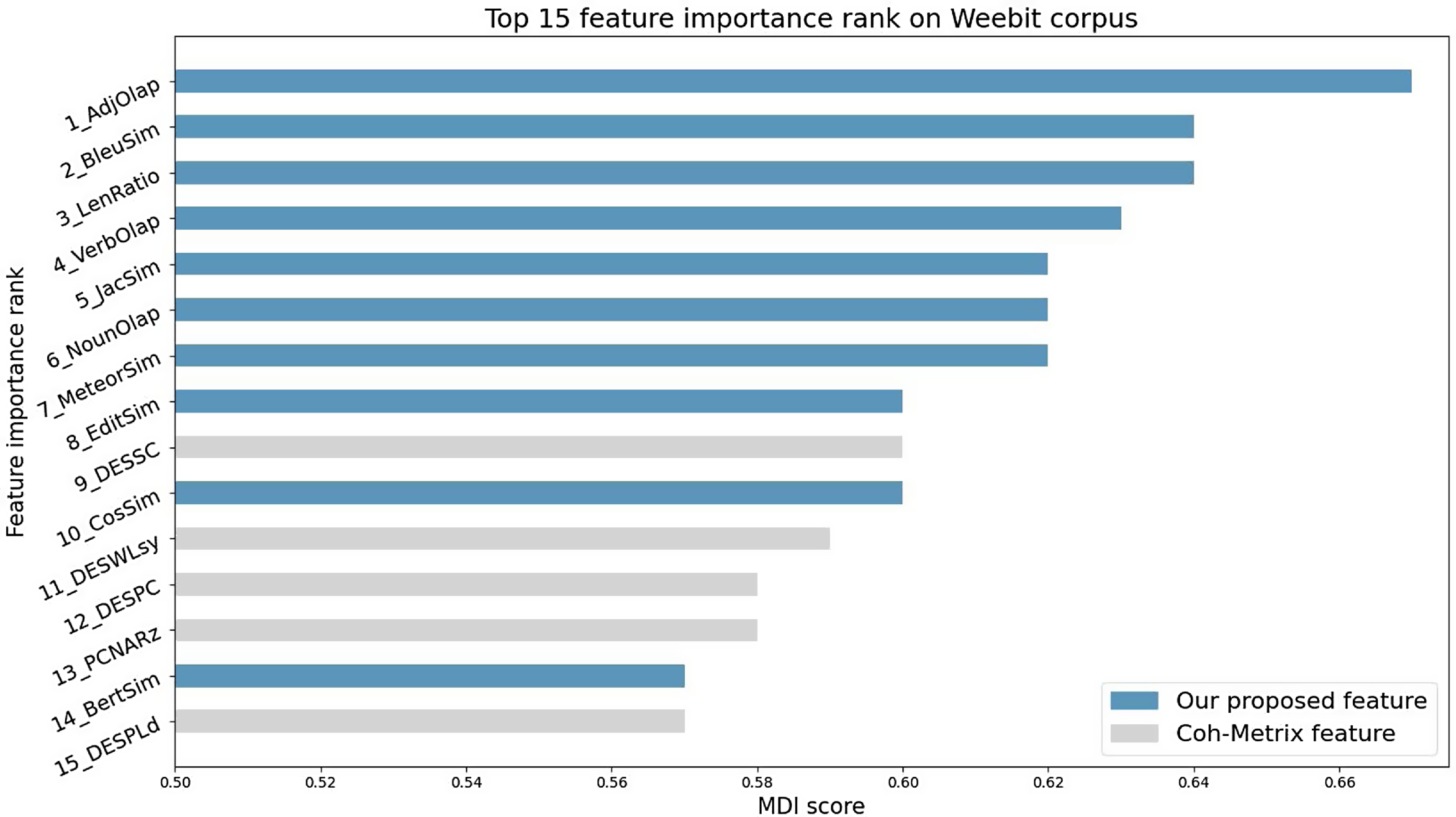
Top 15 feature importance ranks on the Cambridge corpus. On the $x$
axis, the MDI scores are reported. On the
$x$
axis, the MDI scores are reported. On the $y$
axis, features ranked in the top 15 are reported, where the rank order increases from top to bottom. The blue bars represent our proposed features. The gray bars represent Coh-Metrix features.
$y$
axis, features ranked in the top 15 are reported, where the rank order increases from top to bottom. The blue bars represent our proposed features. The gray bars represent Coh-Metrix features.
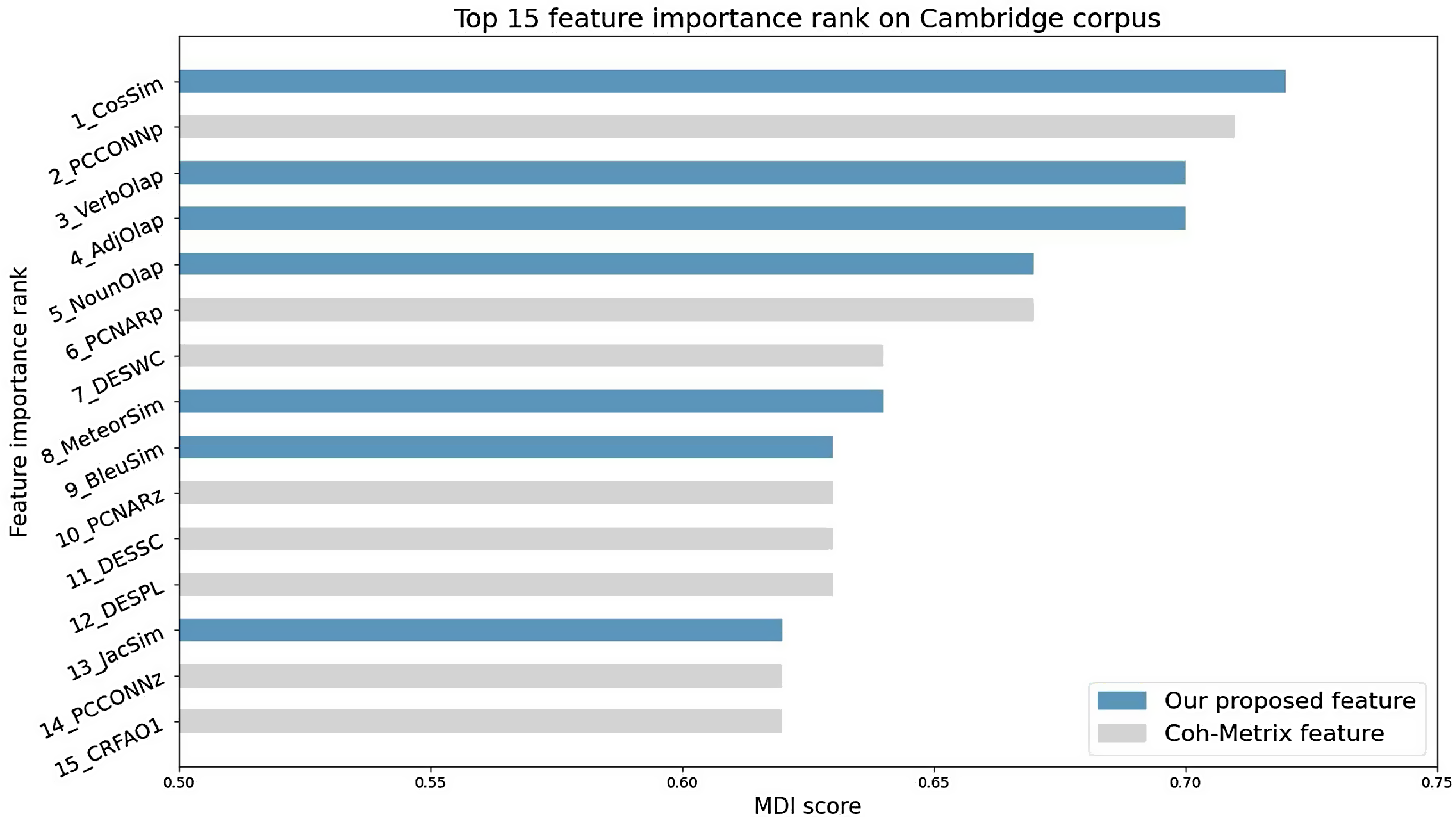
It can be concluded from the two figures that our proposed textual form features play a vital role in the model’s prediction. As can be seen from the figures, the MDI scores of our proposed ten textual form features rank highly among the total 118 features, mostly occupying the top 15 rank lists on the two corpora.
To be specific, it can be seen from Figure 8 that on Weebit corpus, our proposed features occupy the top eight of the importance rank list. And what stands out is that all ten proposed textual form features are in the top 15 ranks on this corpus. Also, in Figure 9, we can see that on Cambridge corpus, seven out of the top 15 features in the rank list are our proposed textual form features, and the top one important feature is our proposed $CosSim$
. It is noteworthy that our proposed features
$CosSim$
. It is noteworthy that our proposed features $CosSim$
,
$CosSim$
, $JacSim$
,
$JacSim$
, $BleuSim$
,
$BleuSim$
, $MeteorSim$
,
$MeteorSim$
, $VerbOlap$
,
$VerbOlap$
, $NounOlap$
, and
$NounOlap$
, and $AdjOlap$
are in the top 15 rank lists on both corpora. Taken together, these results suggest that the proposed ten features have made significant contributions to the model’s prediction.
$AdjOlap$
are in the top 15 rank lists on both corpora. Taken together, these results suggest that the proposed ten features have made significant contributions to the model’s prediction.
From Figure 8 and 9, we can also conclude that some of the Coh-Metrix features are essential in the model prediction as well. As introduced in Section 5.1, the 108 Coh-Metrix features were divided into 11 categories according to their linguistic properties (McNamara et al. Reference McNamara, Graesser, McCarthy and Cai2014). The detailed descriptions of the Coh-Metrix features are presented in Appendix B. From the figures, it can be seen that the highly ranked Coh-Metrix features are mainly distributed in three categories, which are Descriptive, Text Easability Principle Component Scores, and Referential Cohesion. Interestingly, four out of the five Coh-Metrix features that rank among the top 15 on the Weebit corpus are descriptive features. And three descriptive features also appear in the top 15 list on Cambridge corpus as well. As introduced by McNamara et al. (Reference McNamara, Graesser, McCarthy and Cai2014), descriptive features include the basic statistics of a sentence or paragraph in the given text. This result suggests that the descriptive features are more effective among the 108 Coh-Metrix features and have comparable contributions to our proposed textual form features.
6.3 Results in multilingual setting
This section presents the experimental results of Experiment 3. Our strategy is to train the classification model Random Forest based on our proposed textual form features in a multilingual setting (in Spanish and French). We compare our strategy with traditional and state-of-the-art strategies. Table 13 presents the model performance of the strategies on VikiWiki-Es (Spanish) and VikiWiki-Fr (French).
The classification accuracy on the VikiWiki-Es/Fr corpus
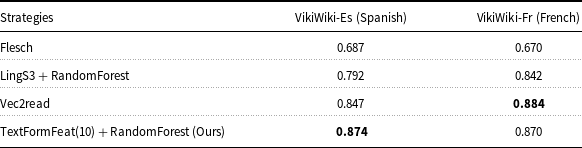
From the results in Table 13, we can conclude that our proposed textual form features can be applied to different languages. As can be seen from the table, based on our proposed features, our strategy achieves the best performance among all the strategies (accuracy of 0.874 on VikiWiki-Es (Spanish); accuracy of 0.870 on VikiWiki-Fr (French)). What is unexpected is that only ten features have yielded such good model performance on Spanish and French corpora and even better performance than on English corpora. To make a fair comparison, we compare our proposed features with the existing multilingual features (LingS3) based on the same prediction model, Random Forest. Results show that our proposed TextFormFeat (10) yields better model performance than LingS3: the accuracy improves from 0.792 to 0.874 on VikiWiki-Es (Spanish), increasing by 8.2%; and improves from 0.842 to 0.870 on VikiWiki-Fr (French), increasing by 2.8%. These improvements further demonstrate the superiority of our proposed features in multilingual readability assessment. Moreover, our strategy even achieves comparable performance with the neural network-based state-of-the-art strategy Vec2Read (see lines 3-4 in Table 13). This suggests that our proposed textual form features are especially powerful in characterizing text readability in this corpus. Overall, our proposed features have been successfully applied to English, Spanish, and French, which confirms the effectiveness of our proposed features for different languages.
6.4 Results with different simplification tools
This section presents the experimental results of Experiment 4. We conduct experiments on the Weebit and Cambridge corpora, comparing model performance when the simplification pipeline in our method is either removed or replaced with different simplification tools. The results for the Weebit and Cambridge corpora are displayed in Table 14 and Table 15, respectively.
Performance comparison of our method with the use of different simplification tools on Weebit corpus
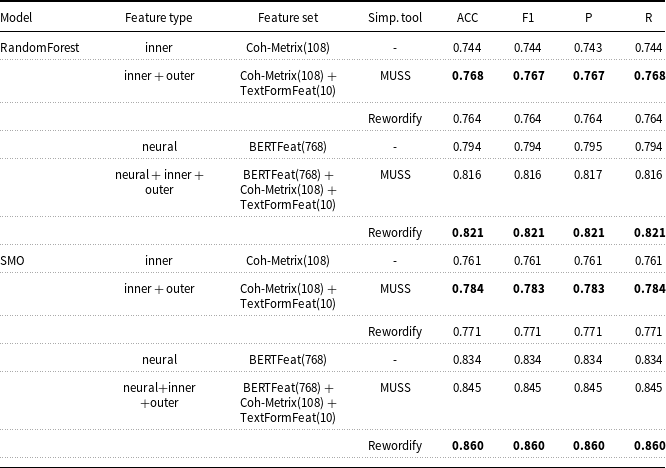
Note: “-” indicates no simplification pipeline used, “Simp. tool” denotes the simplification tool. Bold highlights the highest performance obtained using different simplification tools for each model.
Performance comparison of our method with the use of different simplification tools on Cambridge corpus
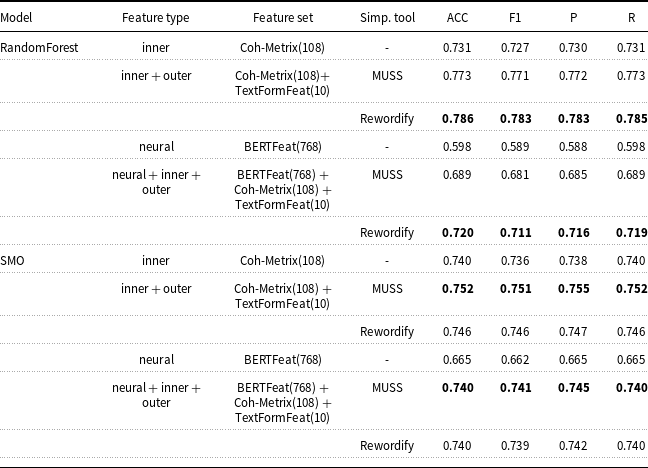
Note: “-” indicates no simplification pipeline used, “Simp. tool” denotes the simplification tool. Bold highlights the highest performance obtained using different simplification tools for each model.
Firstly, it is observed that removing the simplification pipeline results in a decrease in model performance on both corpora, suggesting that incorporating the simplification pipeline into the model contributes to improving the model’s performance. Specifically, for models based solely on handcrafted features, on the Weebit corpus (in Table 14), the absence of the simplification pipeline leads to an average performance decrease of 2.375% and 2.25% for the RandomForest and SMO models, respectively. On the Cambridge corpus (in Table 15), the most significant performance drop is seen in the RandomForest model, with an average decrease of 5.45%. When neural features are also considered, the results remain consistent. Across both corpora for both models, the performance with a simplification pipeline is better than without. This is particularly evident on the Cambridge corpus (in Table 15), where the RandomForest model with a simplification pipeline outperforms the one without an average of 12.325%, and the SMO model with a simplification pipeline exceeds the performance of the one without an average of 7.725%. In summary, the above results demonstrate the contribution of the simplification pipeline towards improving the model performance.
Secondly, it is evident that the performance of models varies with the use of different simplification tools. In Table 14, on the Weebit corpus, for models based solely on handcrafted features, the MUSS simplification tool performs better, with RandomForest achieving an accuracy of 0.768 and SMO reaching 0.784; when neural features are included, the ReWordify simplification tool shows better performance, with RandomForest attaining an accuracy of 0.821 and SMO achieving 0.860. Table 15 shows that on the Cambridge corpus, the ReWordify simplification tool yields better results for the RandomForest model, with the best performance at an accuracy of 0.786; whereas for the SMO model, the MUSS simplification tool is more effective, with the highest performance at an accuracy of 0.740. Overall, although different simplification tools result in varied model performances, likely due to differences in the quality and preferences of the tools, using these tools for feature extraction enhances the model’s performance. This suggests that our method is not limited by the choice of simplification tool and can be effectively applied to other simplification systems, but further investigation is still needed to determine if there is an optimal simplification tool.
7. Conclusion
In this paper, we introduce a new concept, namely textual outer form complexity, to provide a novel insight into text readability. The main idea of this insight is that the readability of a text can be measured by how difficult it is for the reader to overcome the distractions of exterior textual form. Based on this insight, we propose to construct a set of textual form features that reflect the complexity of the text’s outer form, thereby facilitating the evaluation of its readability. We propose two studies in this work to achieve this goal. Study 1 focuses on the method of constructing and extracting features. This study quantifies the differences between pre-simplified and post-simplified texts to construct textual form features. We construct three subsets of textual form features, namely similarity-based, overlap-based, and length ratio-based features, corresponding to the three aspects from which we measure the differences. Study 2 aims to investigate the extent to which our proposed features can contribute to the field of readability assessment. With regard to this, four experiments are designed and conducted.
Experiment 1 demonstrates the effectiveness of our proposed textual form features for readability assessment. We first perform validation experiments on the OneStopEnglish and NewsEla parallel corpora. Results show that incorporating our proposed features demonstrates a notable improvement across both corpora, confirming their potential in readability assessment. We then compare our proposed features with existing inner-semantic-based features in terms of their ability to characterize text readability. Results show that combining our proposed features with existing inner semantic-based features yields the best model performance, both for RandomForest and SMO models across the Weebit and Cambridge corpora. Notably, this combination achieves an accuracy of 0.784 with the SMO model on the Weebit corpus and 0.795 with the RandomForest model on the Cambridge corpus. Therefore, it is concluded that our proposed features are highly complementary to existing inner semantic-based features. In addition to these handcrafted features, neural features are also investigated in this experiment. Results show that handcrafted features are superior to neural features in terms of stability and interpretability. Finally, the incorporation of our proposed features into state-of-the-art models markedly enhances their performance, further confirming the value of our proposed features in readability assessment.
Experiment 2 gives a detailed analysis of the feature contributions to model prediction. Results show that our proposed textual form features rank highly among all the 118 features in terms of the feature importance score (MDI). Notably, all of the ten proposed features have ranked in the top 15 ranking lists on the Weebit corpus. It is concluded that our proposed textual form features significantly contribute to the prediction of readability among the handcrafted features.
Experiment 3 confirms that our proposed textual form features are applicable to different languages. We test the effectiveness of our proposed textual form features in a multilingual setting (in Spanish and French). Our strategy outperforms the feature-engineered state-of-the-art method and achieves comparable performance with the neural network-based state-of-the-art strategy. Experiment 4 analyzes the impact of simplification tools on the performance of features. The results indicate that the model’s performance on both corpora decreases when the simplification pipeline is removed, suggesting that incorporating the simplification pipeline into the model contributes to improving the model’s performance. While the impact on performance differs across various simplification tools, the overall result shows that the inclusion of a simplification tool boosts model performance, suggesting the adaptability of our approach to different simplification systems.
Although our proposed features demonstrate promising results for readability assessment, there are some limitations that need further improvement. One of the limitations is that the quality of the proposed features relies heavily on the performance of the simplification tool. If the simplification tool fails to accurately simplify the given text, the effectiveness of our proposed features could be compromised. Future work will enhance the robustness of proposed features across different simplification tools. Moreover, in the future, we will investigate more fine-grained textual form features and exploit their deeper potential for multilingual readability assessment.
Acknowledgements
This work was supported by the National Natural Science Foundation of China [grant number: 61976062].
A. Part-of-speech tagging in NLTK
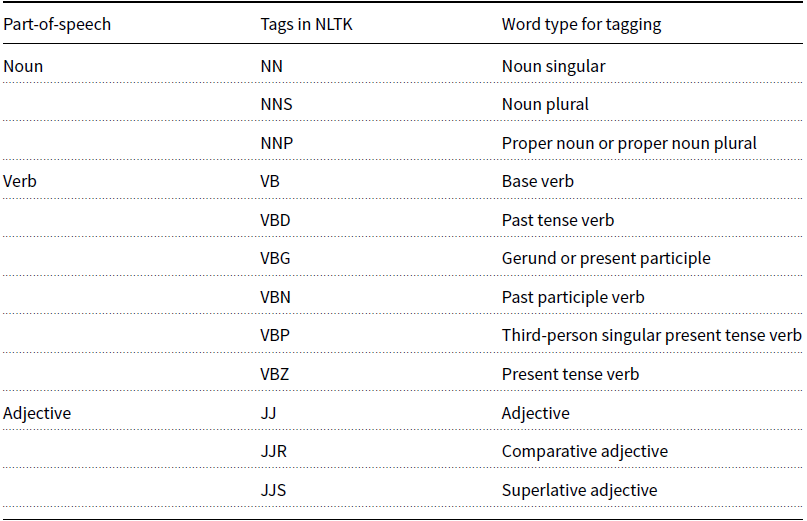
B. Descriptions of the Coh-Metrix features (partial)
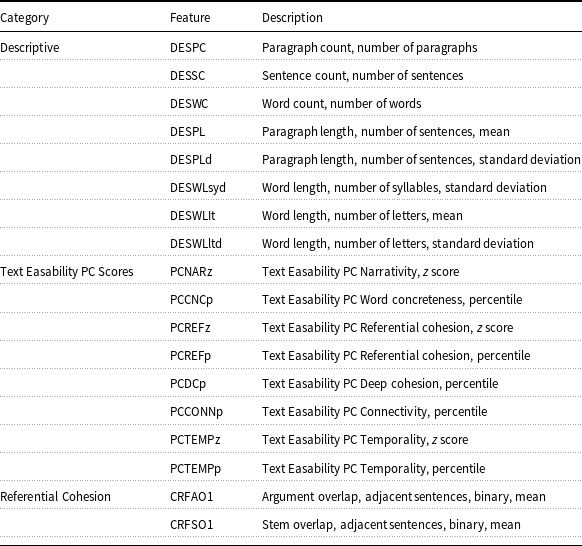
This table is partial quoted from the book written by McNamara et al. (Reference McNamara, Graesser, McCarthy and Cai2014). Due to limited space, only the features mentioned in the paper are presented.


 Open access

