




Unlike other writers, authors of centos work within a limited corpus of pre-existing poetic expressions. The aesthetic value of any patchwork poem is thus inevitably a combined result of the author's skill and the expressive possibilities of the source text. It comes as no surprise, then, that a degree of obscurity has been identified (and criticized) in many of the centos that survive from Late Antiquity. This is also the case with the 24-line cento Progne et Philomela,Footnote 1 one of the seven mythological epyllia—fashioned out of Virgil—that are contained in the Codex Salmasianus of the Latin Anthology (Anth. Lat. 9–15 R). This text of unknown authorship and presumed North African provenance is usually dated (together with other anonymous centos from Virgil) to the fourth or fifth century.Footnote 2 Despite its conciseness, the cento's retelling of the story of King Pandion's daughters offers a rather rich reading. The text employs ingenious allusive strategies, and, as will be argued below, it turns out to be purposefully ambiguous rather than obscure, resembling a mythological riddle to be solved by its readers.Footnote 3
THE PUZZLE OF FAMILY RELATIONSHIPS
What leads me to believe that the cento might have been written as a sort of mythological puzzle is the existence of several versions of the myth and a lack of explicit affiliation to any of them within the text. Of particular significance is that the author of the Progne et Philomela, as noted by Raffaele Perrelli, does not intentionally designate any of the protagonists by their proper names even though these were readily available in Virgil,Footnote 4 who elliptically told the same story in the sixth book of his Eclogues (6.78–81).Footnote 5 The word philomela in line 3 of the cento's four-line aetiological prologue (see below) seems to correlate with the term hirundo in line 1 and should therefore be taken (in line with its original context in G. 4.511) as a common rather than proper noun.Footnote 6 In the rest of the poem, individual characters are referred to predominantly by words expressing their family relationships. While it is obvious that nouns such as tyrannus (lines 8, 16), (Threicius) rex (line 10), amans (line 14) and genitor (lines 21, 23) are all meant to characterize Tereus and that puer (lines 8, 20), progenies (line 9) and natus (line 23) denote his son Itys, it is much more difficult to say which of the two sisters is to be understood as the coniunx (lines 11, 24) / mater (line 7) and which as the uirgo (line 6) / soror (lines 16, 24).
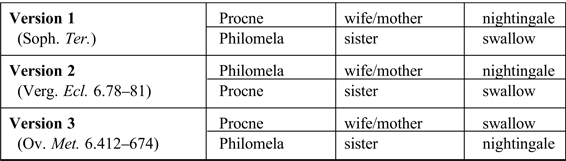
In ancient literary traditions we come across three different versions of the myth. According to the Greek (Sophoclean) version, Procne is the wife of Tereus and the mother of Itys and becomes a nightingale, while Philomela plays the role of the raped sister, who is transformed into a swallow. In Latin renderings, in contrast, Procne turns into a swallow and Philomela into a nightingale, while their roles as the wife/mother and the sister are interchangeable.Footnote 7 To make subsequent references to these variants easier, the following schematic overview of the evolution of the myth may be of use.
The answer to the question of which version of the story is actually followed in the cento is, in my view, implied in its prologue (lines 1–4):
This passage is most probably to be read as a prefiguration of the metamorphosis of both sisters, one into a swallow (line 1) and the other into a nightingale, noted for its sorrowful song (lines 2–4).Footnote 9 This interpretation makes the punctuation adopted in the overwhelming majority of editions somewhat misleading and the capitalization of the generic noun philomela unfounded.Footnote 10 In fact, the proem seems to correspond with the cento's final line, which describes the transformation of both women (line 24): et soror et coniunx petierunt aethera pinnis.Footnote 11 We can therefore reasonably suppose that the swallow (hirundo) first mentioned in the prologue foreshadows the fate of Philomela's sister Procne (soror), while the nightingale (philomela) anticipates the metamorphosis of Tereus’ wife Philomela (coniunx).Footnote 12 In short, it appears that the centonist drew inspiration from his primary source—that is, from Virgil (Ecl. 6.78–81)—and adopted the second version of the myth.Footnote 13
This hypothesis is further confirmed by several allusions to Virgil's handling of the story in the Eclogues to be found in the concluding part of the cento (lines 22–4):
This passage clearly echoes Ecl. 6.78–81:
The imitation of Virgil by means of his own lines is achieved through purely lexical means—the words artus and dapes, forms of the verb petere (petierunt/petiuerit) and the ablative plurals pinnis and alis, both of them placed in final positions in verse.Footnote 15
(INTENTIONAL) AMBIGUITY
From the above, it becomes clear that the cento challenges the readers’ knowledge of the myth and plays with their expectations. Such an effect is certainly produced by the use of the gender-neutral noun coniunx in the charge of guilt in lines 5–6 (causa mali tanti coniunx, thalamique cruenti | uirginis os; notumque furens quid femina possit). While elsewhere in the poem (lines 11 and 24) the word obviously refers to Tereus’ wife, in this case both the husband (Tereus) and his wife (Philomela) come into play as possible referents.Footnote 16 Both of them are, after all, guilty of a crime against morality—Tereus raped his sister-in-law and Philomela killed her own child. Without necessarily having to decide who the major villain is, readers are confronted with a teasing ambiguity, which makes them think about the story in terms of crime and revenge.
Another moment in the cento invested with ambiguous meaning, this time with an added touch of irony, may be found in lines 9–10: progeniem paruam curaeque iraeque coquebant | Threicio regi, … As observed by Scott McGill, this image works both literally and figuratively.Footnote 17 On a literal level, it foreshadows the fate of Itys who is to be cooked and served as a meal to Tereus; metaphorically, it may refer to the passions (namely distress and seething anger) boiling in the heart of Philomela and ultimately leading to an act of violence against her own child. The latter, less obvious meaning of the verb coquere is actually in line with its original context in Aen. 7.345, which describes the emotional turmoil of Queen Amata standing on the threshold of madness.
TALKING-BLOOD IMAGERY
Perhaps the most challenging part of the entire cento, at least for modern scholarship, is the blood imagery in lines 15–20:
The recurring motif of blood can be interpreted as a symbol of (disrupted) family relationships, another of the cento's leitmotifs.Footnote 18 When the image of blood appears for the first time (lines 5–6 causa mali tanti coniunx, thalamique cruenti | uirginis os; …), it is to be taken literally as tangible evidence of the violence committed against the virgin Procne—that is, of her rape by Tereus. The talking-blood imagery employed later in the poem (lines 15–20) has a clearly metaphorical (and presumably aetiological) significance, referring both backward to the crime committed by Tereus and forward to the killing of Itys.
Having previously assigned the roles of wife/mother and sister to Philomela and Procne respectively, we can proceed to examining the question of whose blood is actually talking in the cento, which entails addressing some textual-critical problems. In the first part of the metaphor (lines 15–17), it is clearly the blood of the raped and mutilated sister (Procne) that serves (in place of her severed tongue) as the medium of communication, specifically as the means of crime revelation. The cento shares this motif with two other anonymous poems on the myth preserved in the Codex Salmasianus of the Latin Anthology,Footnote 19 differing in this respect from the classical version, according to which the raped woman wove the story of her suffering into a garment and sent it to her sister. The talking-blood motif probably derives from a detail given in Ovid, where Philomela weaves her story with purple on a white background (Met. 6.577 purpureasque notas filis intexuit albis),Footnote 20 and it might have become a sort of topos in late antique, presumably African, renderings of the myth.Footnote 21
The question is how to interpret the second part of the extended blood metaphor (lines 17–20), where blood pronounces a verdict on Itys. Having no parallel in other treatments of the myth, this particular image is probably the author's innovative elaboration of the role of blood in the story. Rather than belonging to the speechless Procne, whose blood has already borne witness to Tereus’ crime, this voice of blood seems to belong to the other sister, whose status as the wife of Tereus and mother of Itys makes the threatening exclamation in line 20 (heu, miserande puer, nunc te fata impia tangunt!) all the more pathetic.Footnote 22
The belief that in the cento the blood of both sisters has something to say is also supported by the inverted repetition of two keywords in the passage under discussion: pectore and sanguis. Occurring in prominent positions in their respective hexameters, these words create a sort of chiastic parallelism, which may help us to understand the inner logic of the blood imagery. When they occur for the first time, both nouns are found at the beginnings of verses (pectore, 15; sanguis, 17), functioning as a semantic frame for the first part of the metaphor. The focus is clearly on past events, on Tereus’ rape of Procne and his subsequent severing of her tongue, a memento of which is her bloodstained chest. The second occurrence of the same words, only in reverse order and in final (or nearly final) positions in verse (sanguis, 18; pectore, 19), then foreshadows the crime that will be committed in revenge for Tereus’ conduct by his wife Philomela (probably together with her sister Procne)—that is, the killing of Itys, whose blood will stain the breast of his murderer(s) as a memento of the crime.
This lexical parallelism thus strongly corresponds with and emphasizes the theme of crime and punishment in the cento. In addition, it seems to have an aetiological significance similar to that of the prologue. A competent reader may recognize the aforementioned keywords as lexical allusions to an aetiological portrayal of Procne–swallow, as found in Ovid (Ars am. 2.383–4 altera dira parens haec est, quam cernis hirundo: | adspice, signatum sanguine pectus habet!), whose description is clearly inspired by Virgil (G. 4.15 et manibus Procne pectus signata cruentis); cf. aspice in the cento's opening line and pectore together with sanguis in the blood metaphor in lines 15–19. Both Ovid and Virgil mention the bloodstained chest as a distinguishing feature of the swallow. Whereas Virgil's reference to the story of Procne is open to interpretation,Footnote 23 in Ovid, who clearly follows the third version of the myth with Procne–swallow playing the role of mother and wife, the stain of blood is obviously a memento of the killing of her own offspring.
The echo of Ovid's Ars amatoria in the cento, identified by Raffaele Perrelli,Footnote 24 strengthens the aetiological interpretation of lines 18–19 proposed by Paola Paolucci.Footnote 25 According to Paolucci, these lines foreshadow the metamorphosis of the mother of Itys, implied also by the transition from the perfect form accepit to the present fatur. In line 17, Paolucci reads solidae, assuming that this adjective characterizes the severed tongue as a mutilated organ covered with coagulated blood;Footnote 26 in line 19, she proposes to read Virgil's original accepit uocem (Aen. 12.64) instead of the somewhat troublesome emendation accipe ‹ait› uocem, proposed by Pieter Burman (1759) and adopted in the absolute majority of subsequent editions despite the fact that such an expression does not occur in Virgil.Footnote 27 Thus, her reading of the blood metaphor (lines 17–20) is the following: after the mute tongue had been given an opportunity to speak, blood (that of the second sister) took the floor and from a sorrowful heart pronounced a verdict on the pitiable boy.Footnote 28 However plausible this interpretation is, it involves a potential contradiction in the aetiological moment; Philomela, who is most likely identified as the mother of Itys in the cento, is changed into a nightingale, which certainly has no bloodstain on its chest.Footnote 29
A different line of interpretation is taken by the cento's most recent editor Maria Teresa Galli.Footnote 30 While she adopts the emendation accepit uocem in line 19 proposed by Paolucci, she is the first to correct the preserved solite in line 17 to solide, translating it as ‘completamente’.Footnote 31 Galli argues that this adverb refers back to the revelation of Tereus’ crime brought about by the blood of Procne and should therefore be shifted to the end of the first colon stretching across lines 15–17. Unlike Paolucci, she assumes that the blood metaphor concerns in its entirety only the violated sister—that is, Procne, whose change into a swallow with a red sign on its breast is thus prefigured.Footnote 32 In her aetiological reading, Galli repeatedly refers to the above-quoted description of Procne–swallow in Ovid's Ars amatoria (2.383–4) and Virgil's Georgics (4.15) as well as to a passage in Ovid's Metamorphoses (6.667–70) where the story of Pandion's sisters reaches its climax through their transformation:Footnote 33 corpora Cecropidum pennis pendere putares: | pendebant pennis. quarum petit altera siluas, | altera tecta subit; neque adhuc de pectore caedis | excessere notae, signataque sanguine pluma est. On the basis of these literary sources, Galli comes to the conclusion that the stain of blood on the swallow's chest should be taken as a token of Procne's glossotomy rather than as a memento of the killing of Itys.Footnote 34 However, the latter is without a doubt the intended significance in Ovid's Ars amatoria, where it is clearly stated that Procne–swallow plays the role of mother (parens, 2.383), which adds an exemplary quality to her impious deed. Both Ovid in the Metamorphoses and Virgil in the Georgics seem to follow one and the same tradition regarding the myth.Footnote 35 This makes the interpretation put forward by Galli somewhat less convincing. In addition, it is difficult to see a reason why Procne's blood should pronounce a death sentence on Itys when Philomela is able to speak and her reaction to her sister's violation would be only a logical outcome to the revelation scene.
For the reasons provided above, we may need to look for yet another reading of the blood imagery, which involves choosing among some textual options. Even though the ingenious emendation to solide proposed by Galli in line 17 is palaeographically reasonable, the same is true of Virgil's original solidae (Aen. 2.639), which, in my view, makes better sense in the context, providing an anaphoric reference to the unusual means of crime revelation in the first colon and a subject for the verb siccabat in the second.Footnote 36 Moreover, the idea of a severed tongue preserving its original function, as implied in line 17 (solidae postquam data copia fandi),Footnote 37 resonates with the image of Orpheus’ head floating down the river and constantly calling out for Eurydice, evoked in line 13 of the cento (uox ipsa ‹et› frigida lingua, G. 4.525).Footnote 38 In line 19, Paolucci's emendation to accepit uocem seems to be a much more sensible choice than the direct speech accipe ‹ait› uocem addressed to blood, which does not make much sense, whether delivered by the speechless Procne or by Philomela.
Having resolved these textual-critical questions, we can once again try to explain the significance of the talking-blood metaphor, which, in my view, relates to both sisters. In addition to its aetiological implications, the blood imagery perfectly emphasizes, as mentioned earlier, the leitmotif of (disrupted) family relationships in the cento. The passage under discussion thus adds resonance to the blood relationship between Procne and Philomela, two sisters whose fates are closely intertwined by Tereus’ violent crime and by their bloody revenge for it. This family reciprocity is clearly accentuated by the repetition of the keywords pectore and sanguis, which specify the location of the bloodstains revealing Tereus’ crime and thus prefigure the bloody response of Philomela, uttered with a merciless heart (line 19 saeuo sic pectore fatur).Footnote 39 In terms of aetiology, these keywords foreshadow Procne's transformation into a swallow with a bloodstained chest (perhaps as a memento of the killing of Itys), possibly together with Philomela's metamorphosis into a nightingale.Footnote 40 Lines 15–20 of the cento can accordingly be translated as follows: ‘Procne's chest, full of animosity, constantly bears a reminder of a terrible pain, and her blood tells of the tyrant's horrible crime. After the congealed blood had had the opportunity to speak, while (Procne's) wounds around her heart were healing, (Philomela's) blood took the floor and with unrelenting heart said: “Oh poor boy, impious fate will now afflict you!”’
The puzzling image of blood that suddenly begins to speak can be thought of as a play on the polysemy of the word sanguis, which means ‘blood’ as well as ‘bloodshed’ and ‘consanguinity’.Footnote 41 In the context of the story, all of these meanings are obviously relevant, emphasizing the blood relationships between Procne and Philomela, on the one hand, and between mother (Philomela) and son (Itys), on the other. While it is most probably Philomela's blood that is actually threatening Itys, her reaction has been provoked by the bloodstains visible on Procne's chest. This makes blood, a body fluid considered to respond to one's emotions, not only a symbol of a close relationship between the two sisters but also a powerful medium of their communication.
CONCLUSION
As we have seen, the cento Progne et Philomela is far from crystal clear. The number of existing versions of the myth, together with the way in which the poem is written, makes it resemble a compelling mythological puzzle. Indeed, the cento openly plays with the readers’ knowledge of the myth variants, forcing them to reconstruct the complex network of family relationships together with the storyline itself. For this reason, we can plausibly assume that the general ambiguity of the poem is, at least to some extent, a purposefully adopted authorial strategy rather than a side-effect of the method of composition.
Of course, the proposed reading remains a pure conjecture, especially as no other (mythological or other) Virgilian cento from Late Antiquity invites being read in a similar fashion—that is, as an ambiguous riddle rather than as a patchwork text with a more-or-less obscured meaning. Nevertheless, the line of interpretation adopted for the Progne et Philomela may acquire further plausibility if we consider the largest extant collection of ancient Greek riddles in Book 14 of the Palatine Anthology, which contains (apart from arithmetical problems and oracles) more than fifty riddles in the traditional sense (almost all of them of uncertain date and authorship)Footnote 42 concerning everyday objects and mythological figures.Footnote 43 Among the mythological ones, there are two texts with the riddling principle based exclusively on family relationships and the underlying motif of crime and punishment, namely the two-line riddle about Andromache (Anth. Pal. 14.9): ἄνδῤ ἐμὸν ἔκταν̓ ἑκυρός, ἑκυρὸν δ̓ ἔκτανεν ἀνήρ, | καὶ δαὴρ ἑκυρόν, καὶ ἑκυρὸς γενέτην (‘My father-in-law killed my husband and my husband killed my father-in-law; my brother-in-law killed my father-in-law, and my father-in-law my father’); and the riddle concerning Eteocles and Polynices (Anth. Pal. 14.38): κτεῖνα κάσιν, κτάνε δ̓ αὖ με κάσις, θάνομεν δ̓ | ὑπὸ πατρός· | μητέρα δ̓ ἀμϕότεροι τεθναότες κτάνομεν (‘I slew my brother, my brother again slew me; our death is caused by our father, and after our death we both kill our mother’).Footnote 44 These two are really extreme examples; still, many of the other mythological (and other) riddles in the Palatine Anthology also include at least some hint at the parentage or other family ties of the figures concerned.Footnote 45 Family relationships thus seem to be a quite natural (and logical) means of teasing and taxing the readers’ knowledge of particular mythological stories, in which genealogy very frequently plays a crucial role.Footnote 46 And this is exactly what the author of the cento riddle seems to be doing—playing with readers and their expectations.

 Open access

